


Introduction
In new democracies, identifying and measuring mass–elite differences is an explorative task.Footnote 1 At the elite level, the proliferation of political parties, shifting alliances and factional struggles (McAllister and White Reference McAllister and White2007: 201) makes it challenging to identify the political dimensions dividing political parties. At the mass level, voters are highly volatile and rarely identify with political parties, many of them are naturally new to the political scene. In the Arab world, as well as in Eastern Europe for the past three decades, political parties have mostly maintained clientelist and directive linkages to the citizenry (Sikk Reference Sikk2005; Webb and White Reference Webb and White2009; Storm and Cavatorta Reference Storm, Cavatorta, Cavatorta and Storm2018: 4). The fragmentation of party systems in new democracies has theoretical significance because the early rounds of electoral competition shape the emergence and saliency of political dimensions for decades to come (Zielinski Reference Zielinski2002: 201).
To examine mass–elite differences, one has to distinguish between issue position and issue salience.Footnote 2 Position identifies where actors, masses and elites in our case stand in relation to a particular issue, while salience estimates the importance each actor attaches to such an issue (Laver Reference Laver and Laver2003: 66). In addition to new methodological approaches proposed by Bankov and Gherghina (2020) and Bornschier (2020), this article suggests an inductive approach to measuring mass–elite policy congruence by studying issue positions and issue salience of masses before turning to elites. Starting with the masses is grounded in the “delegate model” of political representation according to which political representatives should represent the views and interests of their constituency (Mill 1869; Pitkin Reference Pitkin1967; Pettit Reference Pettit and Shapiro2009). McElwain (2020) adopts a similar approach that differentiates between issue position and issue salience for parliament candidates and voters in Japan.
By examining Tunisia as a case study, this article responds to calls to better integrate the analysis of the post-Arab Spring events into the study of comparative politics (Brownlee et al. Reference Brownlee, Masoud and Reynolds2015: 7). For several decades, academic accounts of the Arab world studied the region through the lens of religious or cultural exceptionalism (Lewis Reference Lewis1996; Stepan and Robertson Reference Stepan and Robertson2004) or from the perspective of authoritarian robustness (Bellin Reference Bellin2004). Tunisia powerfully broke such exceptionalism, for becoming the only country to complete its democratic transition in 2012 after the Arab Spring (Stepan Reference Stepan2012). We cannot underestimate the comparative importance of Tunisia, as a Muslim and Arab democracy. In a world where democratic backsliding is on the rise including in consolidated democracies (Bermeo Reference Bermeo2016), democracy has taken roots in a country within a region that has always been a bastion of authoritarianism. In fact, the successful democratic transition in Tunisia supports the thesis that religion is not per se incompatible with democracy (Stepan Reference Stepan2000). The strength of Tunisia’s religious–Islamist dimension is in line with claims about the resurgence of religion (Hurd Reference Hurd2007; Norris and Inglehart Reference Norris and Inglehart2011) and reflects the enduring religious–secular cleavage in countries as different as Chile on the one hand and Malaysia and Indonesia on the other (Ufen Reference Ufen2012; Raymond and Feltch Reference Raymond and Feltch2014).
In Tunisia, and the wider Arab world, the secular–Islamist is established as the (or one of the) primary political dimensions (Lust Reference Lust2011; Ciftci Reference Ciftci2012; Abduljaber and Arbor Reference Abduljaber and Arbor2018; Wegner and Cavatorta Reference Wegner and Cavatorta2018). However, previous research on Tunisia is characterised by two gaps: first, scholars do not compare the political dimensions dividing both masses and elites, and second, scholars do not differentiate between issue position and issue salience. By examining the case of Tunisia, this article bridges both gaps by documenting evolving mass–elite incongruence of issue positions and congruence of issue salience. The data at hand enable such study: the Arab Barometer survey in Tunisia of 2011, 2013 and 2016 and original coding of the manifestos of the two biggest political parties in Tunisia, namely Ennahda and Nidaa Tounes.
Issue positions in Tunisia: evolving mass–elite incongruence
Mass issue positions
This section first examines the main political dimensions dividing Tunisian masses using survey data from three Arab Barometer waves II, III and IV.Footnote 3 The Tunisian surveys took place in 2011, 2013 and 2016 with an average sample of 1200 representing the 24 governorates. To arrive at the mass issue positions, I first calculate the relative differences for the non-valence (Deegan‐Krause Reference Deegan-Krause, Dalton and Klingemann2007: 539) questions of the three surveys. For instance, the excluded valence questions ask respondents to evaluate government performance or to what degree they have trust in certain political institutions. I use a relative difference threshold of 0.64 (or 64%), which means that the population is divided into at least 66% and 34% groups.Footnote 4 This inductive approach is an alternative to Bornschier’s (2020) approach using linear canonical discriminant analysis. The latter only applies mainly to countries with relatively high degree of party identification, something that is missing in Tunisia.Footnote 5
Out of the 200 questions on average in the survey, 14 questions met the 0.64 threshold. I can group the 14 questions around four categories, namely democracy, religion, gender and foreign relations. One of the most important questions under democracy is “To what extent do you think democracy is appropriate for your country?” Respondents can answer this question on a scale from one (democracy absolutely inappropriate) to ten (democracy completely appropriate). That the Tunisian public is divided on this issue is in line with the observation of Benstead (Reference Benstead2015) about the preference of Arab citizens including Tunisians to democracy as a regime type. Under religion, questions that met the threshold are mostly about the degree to which the laws should be in line with Islamic sharia law. These issues in particular are one of the grey areas for Islamists across the Arab world (Brown et al. Reference Brown, Hamzawy and Ottaway2006). The two questions on gender ask respondents about the qualification of women to become president or prime minister and their political leadership in comparison with men. Respondents answer most of the questions on religion and gender on a four-point scale ranging between “I strongly agree” to “I strongly disagree”. The question on foreign relations is about the degree to which respondents support stronger (economic) relations with Iran, and study subjects answer it on a three-point scale: preference for stronger relations, same relations or weaker relations than previous years.
Second, I use exploratory factor analysis to uncover the issues’ latent dimensions. Factor analysis is a common tool in the cleavage politics literature to clarify political dimensions (Zarycki and Nowak Reference Zarycki and Nowak2000; Westinen Reference Westinen2015). To account for the correlated factors, I adopt maximum-likelihood extraction with direct oblimin rotation in the factor analysis. The factor analysis shows that the different issues group around two political dimensions, namely democratic–authoritarian and secular–Islamist.
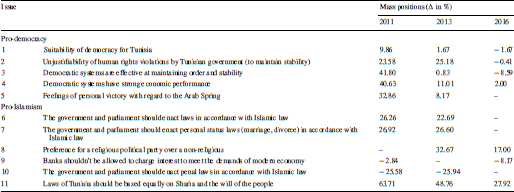
To arrive at the exact position of masses on both political dimensions, that is whether masses are pro-democracy and pro-Islamism, Table 1 presents the difference in percentages. I calculate the difference by subtracting those who are anti-democracy and anti-Islamism from those who are pro-democracy and pro-Islamism, respectively.Footnote 6 The general picture is that the Tunisian mass public has developed more authoritarian and more Islamist positions over time. Under the democratic–authoritarian dimension, the most important issue is the suitability of democracy for Tunisia. In 2016, more Tunisians (38.50%) believed that democracy does not suit Tunisia, compared to only 36.83% believing in its suitability. This is down from 48.91% who believed that democracy is suitable in Tunisia in 2011. Also, over time, Tunisians came to justify human rights violations by the government; they think that democracy is not effective at maintaining order and stability and believe that democracy has weak economic performance.
Issue positions of Tunisian masses on the democratic–authoritarian and secular–Islamist dimensions (2011–2016).

Positive values mean that masses are pro-democracy or pro-Islamism, while negative values mean that masses are against democracy or Islamism
On the secular–Islamist dimension, Tunisians, with a few exceptions, express Islamist attitudes. Tunisians who support the government and parliament to enact Islamic sharia law in general or particularly to personal status matters are nearly double those who are against that. Moreover, Tunisians in general have stronger preference for religious, not secular, political parties, despite a decrease in 2016. However, Tunisians have been against enacting penal laws according to Islamic sharia and are pro allowing banks to charge interests, despite being advocated as anti-Islamic by some religious scholars. This section now moves to examine whether elites are divided along the democratic–authoritarian and secular–Islamist dimensions.
Elite issue positions
I operationalise the positions of Tunisia’s elites as the positions of the two biggest political parties in Tunisia: Nidaa Tounes (secular) and Ennahda (Islamist). Ennahda was founded in 1972 under the name Islamic Group and is currently the biggest and oldest Islamist movement-turned political party in Tunisia. As a secular party, Nidaa Tounes was formed in 2012 by the former Tunisian president Beji Caid Essebsi, to counter the rise of Ennahda. The decision to focus on both parties is justified for two reasons. First, in the 2014 parliamentary elections, both Ennahda and Nidaa Tounes received 65.35% of the vote (37.56% for Nidaa Tounes and 27.79% for Ennahda), which translated to 155 seats or 71.4% of the parliament’s seats (International Foundation for Electoral Systems 2014). The party that received the largest share of the votes after Nidaa Tounes and Ennahda was the Free Patriotic Union, which only received 4.13% of the vote. Second, the fact that Ennahda and Nidaa Tounes were the main political parties that negotiated the 2013 political crisis, under mediation from the Tunisian National Dialogue Quartet led by the Tunisian General Labour Union (UGTT), speaks to their importance on the Tunisian political scene. The dialogue eventually led Ennahda to step down from their coalition-led government (Marks 2015).
To gauge the positions of Ennahda and Nidaa Tounes on both the democratic–authoritarian and secular–Islamist dimensions, I use certain positional sub-categories in the 2014 manifestos of both parties. I code the manifestos using the Manifesto Project’s methodology (Werner et al. 2015).Footnote 7 While party manifestos are usually an expression of saliency (Laver Reference Laver and Laver2003: 73), advocates of saliency theory argue that “emphasis equals direction” that is the position of political actors can be derived from the salience they attach to issues (Budge Reference Budge and Laver2003). This has been subject to heated debate in the literature, and several methods have been developed to measure issue positions of political actors based on their party manifestos (Dinas and Gemenis Reference Dinas and Gemenis2010). Shim and Gherghina (2020) map the different measurement options and data sources for both issue position and issue salience. As an alternative to party manifesto data, Bankov and Gherghina (2020) illustrate how to gauge elite issue positions by analysing speeches of political leaders. However, the fact that many sub-categories in the latest Manifesto Project’s coding instructions include positional coding, either positive or negative, justifies using manifesto data to identify party positions.
This article seeks to gauge the positions of the Tunisian political parties on the democratic–authoritarian and secular–Islamist dimensions. It uses the positional sub-categories that are relevant to both dimensions. Some of the chosen Manifesto Project’s coding sub-categories are included in the right–left (RILE) index (Volkens et al. 2018: 29) such as the sub-categories Freedom and human rights: positive and Constitutionalism: positive on the democratic–authoritarian dimension and the National way of life: positive and Traditional morality: positive on the secular–Islamist dimension. However, the proposed formulas below go beyond the RILE index by including the sub-categories Democracy general: positive and Political corruption: negative given Tunisia’s new democracy and how parties’ positions on that dimension should be taken seriously.
The democratic–authoritarian dimension is measured as follows:Footnote 8
Formula (1): Democratic–Authoritarian

The secular–Islamist dimension is measured as follows:
Formula (2): Secular–Islamist

On the democratic–authoritarian dimension, Ennahda scores 63 compared to 22 by Nidaa Tounes. On the secular–Islamist dimension, Ennahda scores 55 compared to 14 by Nidaa Tounes. This shows that Ennahda is further to the right on both dimensions, that is its manifesto maintains a more Islamist and more democratic position than Nidaa Tounes. Although Nidaa Tounes is the biggest secular party in Tunisia, its position on the secular–Islamist dimension does not concur that, being more towards the centre rather than the secular end.
Mass–elite differences
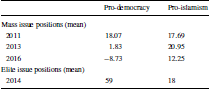
To measure the mass–elite differences on both dimensions, Table 2 compares both the issue positions of Tunisian masses and elites. I calculate mass positions via the mean of the difference in percentages explained earlier in Table 1, while I calculate elite positions using the mean of both the scores of Ennahda and Nidaa Tounes issue positions extracted from their manifestos. Since mass and elite positions are measured using different scales, they only reveal the direction of positions. The findings illustrate evolving mass–elite incongruence particularly on the democratic–authoritarian dimension.
Mass–elite issue positions on the democratic–authoritarian and secular–Islamist dimensions in Tunisia.
Source: Arab Barometer for mass issue positions. Author calculations for elite issue positions

To cross-validate the results, I use a newly acquired data set of the 2014–2016 legislative voting of both Ennahda and Nidaa Tounes.Footnote 9 Between 2014 and 2016, there were a total of 134 law projects voted on by the Tunisian parliament. Almost two-thirds (62.6%) of the laws passed by the parliament’s majority, namely Nidaa Tounes and Ennahda concern economic loans and agreements. Pure economic policies and laws account for the second largest group of adopted laws (14.1%). Next comes freedom of democracy-related laws such as the access to information law, the higher judicial council law or revising other laws to be in line with the constitution (8.2%). It is worth noting that there are no laws that reflect the pro-Islamist positions of elites. In other words, while the manifestos reflected the positions of masses, their electoral voting patterns reveal evolving mass–elite discrepancy on the secular–Islamist dimension. In sum, Ennahda and Nidaa Tounes, as appear from their legislative voting patterns, have maintained their pro-democracy and deepened their anti-Islamism issue positions, leading to further mass–elite incongruence on both the democratic–authoritarian and secular–Islamist dimensions.Footnote 10 The next section examines which issues are salient to both masses and elites before examining mass–elite differences on issue salience.
Issue salience in Tunisia: mass–elite congruence
I first examine issue salience from a mass perspective before turning to elites. Asking people in surveys about the “most important problem” has been one of the conventional methods of gauging mass issue salience (RePass Reference RePass1929; Johns Reference Johns2010). Following this literature, I use the Arab Barometer’s question on “What are the two most important challenges Tunisia is facing today?” to identify mass issue salience in Tunisia.
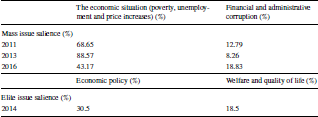
Table 3 summarises mass–elite issue salience. Between 2011 and 2016, Tunisians have considered the economic situation (poverty, unemployment and price increases) as the most important challenge, and thus the most salient issue, followed by financial and administrative corruption. Issue salience diverges greatly from issue position. In fact, the democratic–authoritarian and secular–Islamist dimensions did not turn out to be salient issues. Even at the early days of the Tunisian revolution, fulfilling democratic transition, holding the constituent assembly elections or adopting a new constitution were only salient for no more than 20% of respondents in the three Arab Barometer surveys.
Mass–elite issue salience on the democratic–authoritarian and secular–Islamist dimensions in Tunisia.

I calculate elite issue salience in Tunisia using the importance Ennahda and Nidaa Tounes attached to certain issues in their 2014 party manifestos. In fact, both political parties consider economy as the most salient issue with the economic policy domain consuming 38% of Nidaa Tounes’ manifesto in comparison with 23% of Ennahda’s. While both Ennahda and Nidaa Tounes adopt a more right-leaning to economy, Nidaa Tounes is further to the right by focusing on initiative and providing incentives. Next in importance comes welfare and quality of life (18 and 19%, respectively), freedom and democracy (7 and 3%, respectively) and traditional morality including religion (3 and 0%, respectively).
These results are cross-validated using the parliamentary voting patterns of both parties. During the two years, not a single Islamist law proposal was submitted to the parliament. Also, the coalition with Nidaa Tounes, which Boubekeur (Reference Boubekeur2016: 123) terms a “bargained competition”, led Ennahda to make some concessions on its initial pro-democracy law proposals such as reforming the security sector and the law on political exclusion. Unlike issue positions, masses and elites in Tunisia exhibit congruence on issue salience centred around economic policies.
Conclusion
The article offers a first attempt to identify, measure and compare the main political dimensions dividing masses and elites in Tunisia between 2010 and 2016, as a typical case of new democracies. Following an inductive reasoning, grounded in the “delegate model” of political representation, the article argues for examining issue positions and issue salience of masses before turning to elites. From an issue position perspective, the article uncovers mass–elite incongruence on the democratic–authoritarian and secular–Islamist political dimensions. From an issue salience lens, there is mass–elite congruence on the economic dimension.
The much celebrated accommodation of Tunisia’s elites (Stepan Reference Stepan2012; Bellin Reference Bellin2013) has come at the expense of mass–elite incongruence on issue positions. The problem in Tunisia, Grewal and Hamid (2018) argue, is not polarisation but rather too much partisan accommodation that has left many Tunisians feeling unrepresented. Public support for democracy is a prerequisite for democratic consolidation (Benstead Reference Benstead2015: 1184). In a context where many Tunisians are disillusioned with democracy and the performance of Ennahda and Nidaa Tounes, the Tunisian electorate might be ready to support an Islamic hardline party, which could push Ennahda further back to the right, something that would be good for democratic consolidation (Grewal Reference Grewal2018: 3). The other scenario could be the rise of a strongman rule and the demise of Tunisia’s democratic regime (Grewal Reference Grewal2019: 1). In the 2019 presidential elections, two populist candidates went to the run-off. While none of them was supported by the mainstream secular or Islamist political parties, the more democratically leaning president, Kais Saied, eventually was elected president.
From a comparative perspective, Tunisia’s experience is both different from and similar to that of other new democracies. In Tunisia, the democratic–authoritarian dimension is not between elites, as in the case in many new democracies (Moreno Reference Moreno1999), but rather between masses on the one hand and elites on the other hand. In other words, Tunisia’s elites are more democratic than the electorate, who is becoming increasingly unsatisfied with democracy. The ability of Tunisia’s secularist and Islamist elites to agree on a democratic roadmap after the death of president Beji Caid Essebsi in 2019, just a few months before the parliamentary and presidential elections, speaks to their commitment to the democratic rules of the game. Also, Tunisia is among the few democratic cases where the religious–secular dimension is evident at both mass and elite levels, albeit with differing degrees. Whether the religious–secular dimension remains salient and whether and how mass–elite incongruence persists and affects the quality of Tunisia’s democracy are puzzles for future research.
Funding
Open access funding provided by Projekt DEAL.


 Open access

