


1. Introduction
The manufacturers in automotive industry produce large volumes of vehicles where each vehicle is a rather advanced compilation of technologies and materials. They are used globally with a high impact on services for businesses and people. The automotive industry is furthermore competitive and currently undergoing a rather radical transformation in core technologies, predominately through electrification and hybridization. The business is also exposed to regional and national legislation that evolves and changes constantly. In addition, the industrial ecosystem of companies engaged in realizing automotive products is highly complex. In Europe, the Green Deal and the Circular Economy Action Plan (CEAP) have a clear impact on the future of manufacturers. Legislative initiatives to incentivize resource-efficient and climate-neutral product designs have been introduced in the market (European Commission, 2020a). One of these initiatives is the Digital Product Passport (European Commission, 2020b) that enforce traceability and transparency of material used, is being implemented for the first prioritized areas (e.g. batteries) already, and discussions are ongoing for how to expand. The automotive industry already follows instruments such as the End-of-Life Vehicles (ELV) Regulation, recently proposed updates (European Commission, 2023). The ELV partly addresses similar aspects as the Digital Product Passport, and incentivizes companies to develop more circular economy solutions.
Aside from enforcing clearer traceability and transparency of sustainability information for products, down to the individual products and components and along their life, there are important openings of Circular Economy also for the future generations of automotive solutions. Circular Business Models require, however, more control of the product data and the evolution of the lifecycle of individual vehicles. The ownership of product information and data, that impacts the sustainability performance of the solution, is an asset for manufacturers. The ability to design products to both enable transparency, and traceability while also supporting Circular Economy models is an area that raises significant interest.
In the context of the Circular Economy, detailed information—such as material types, chemical composition, product lifespan, and social conditions in production—is essential for developing more sustainable and circular solutions. Suppliers can also benefit by providing transparent and accessible information to stakeholders downstream in the value chain, as this transparency impacts the entire manufacturing ecosystem. The concept of ecosystems in the context of circular economy, as discussed by Konietzko et al (2024), refers to a collaborative network of diverse actors who work together to achieve circularity. This ecosystem includes companies, governments, the general public, and society at large, all of whom play complementary roles to support the transition from a linear to a circular economy.
In an intensive investigation study together with Volvo Trucks in Sweden and several partners in the value chain and solution providers the aim was to clarify implications (gaps, opportunities) of legislative initiatives, such as DPP, in product development, and to propose a roadmap with an action plan for addressing these implications. Of particular interest was the implications for future product development. In line with this, the research questions to explore were
-
RQ1 What is a desired, future, state where automotive industry can develop more circular products using the increased availability of product data?
-
RQ2 What are the critical areas that needs to be addressed in such vision?
-
RQ3 What actions can be suggested to address gaps in these areas?
These problems may result in manufacturers facing -legislative risks, -missed business and/or - extensive manual labour efforts to meet such requirements. Manually tracing the requested data will quickly add substantial cost for a typical automotive manufacturer.
2. Research approach
In the first phase of the project, knowledge from practice and from literature were investigated resulting in a first identification of gaps and areas of development. In the next step, the project team (Volvo + University researchers) formulated a vision and a list of complementary areas where gaps exist. An extended team, with actors in the value chain and digital solution providers, was mobilised in workshops to analyse and further contribute to a shared vision and further define critical areas of development. The project team concluded by compiling an action plan and roadmap. Outline of activities in Figure 1.
Then main research activities in the study

a. An initial literature review was conducted to identify current state in the field of EU Green Deal Initiatives and sustainable product development in relation to circular design.
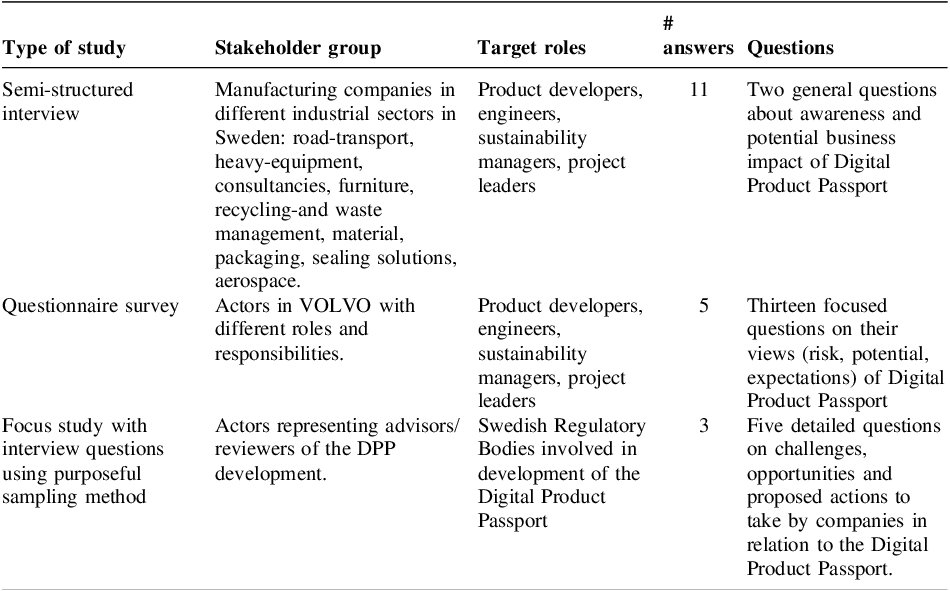
b. A state of practice investigation, where automotive companies and related stakeholders contributed to establish the present status at the market. Data was gathered through semi-structured interviews, a questionnaire survey, and a focus study with interview questions using purposeful sampling method, see Table 1. In the first focus study a semi-structured interview study was conducted, targeted different manufacturing companies in Sweden. The second focus study was based on a questionary survey, targeting stakeholders within the automobile industry in Sweden. The third focus study was based on interview questions and targeted stakeholders representing national advisors/reviewers from Swedish regulatory bodies active in development of Digital Product Passports.
c. Development of a vision and action plan, synthesize, analyse, and categorise findings from a and b to identify actions to address what is needed to advance towards the vision.
d. Workshop: using the findings from a)-c) the draft vision, critical areas, and first actions were presented to an extended team, where additional gaps and feedback was gathered. Project team updated and finalised the Vision, Action Plan and Roadmap based on the feedback.
Summary of the three state of practice focus studies

3. Current state investigation
The literature review was first conducted to summarize the field of Green Deal Initiatives and the relationship between sustainable product development and circular design. In parallel, three focus studies were conducted, targeting automotive manufacturing companies and other stakeholders, to collect insights with the purpose of understanding how different stakeholders in a value chain prepare for and work with regulatory initiatives for sustainability and circular economy, such as Digital Product Passport (DPP). In addition, information from ongoing and recent project initiatives in relation to DPP was summarized. All together this provided a good base of information and contribution to the vision and roadmap, which were formulated based on state-of-the-art and state-of-practice workshops and interviews. The roadmap also comprised a set of proposed activities to provide capabilities for innovation and for more circular and sustainable products.
3.1. Findings from literature review
The EU has implemented new policy instruments to encourage companies to align with sustainable practices (European Commission, 2022). The Green Deal aims to decouple economic growth from resource use and improve circularity. The Circular Economy Action Plan (CEAP) includes launching legislative initiatives to incentivize resource-efficient and climate-neutral product designs (European Commission, 2020c). The EcoDesign Directive is being updated, and DPPs are being investigated to store product information (European Commission, 2020b). Further, the ISO standard for Circular Economy, ISO59000 (see e.g., ISO 59004:2024) series supports wider adoption of Circular Economy principles in industry (International Standard Organization, 2024).
DPPs are intended to trace and store data about a product throughout its entire lifecycle, providing transparency and reliability on green claims. Digital Product Passports are also expected to incentivise industry to develop circular solutions. It is proposed that the DPPs will require data about a product’s durability, reusability, upgradeability, contents of substances of concern, energy and resource efficiency, recycled content, remanufacturing and recycling, carbon and environmental footprints, and waste generation. However, the specific information to be stored in DPPs is yet to be determined. This is an area of interest to explore further and specifically in relation to what sustainability aspects to include and how to represent a sustainability measurement value. The sustainability performance of products and/or systems is difficult to measure, as it requires the systems property of sustainability to be reduced and simplified into sustainability aspects, which can be called “impacts” that are represented by indicators to enable qualitative and quantitative assessment. Product sustainability impacts can be referred to as impacts on the ecological, social, and economic systems, that are triggered by single product or solution lifecycle activities at certain points in time, such as a certain raw material extraction activity or a mode of usage. The lifecycle sustainability performance of a product or system solution is, hence, a product of a long series of activities across its lifecycle. Sustainability performance, if viewed as a single measure, can hence be understood as the aggregated sustainability impacts that are caused by activities associated with e.g., raw material extraction, manufacture, use and maintenance, and end-of-life, i.e., from the “cradle-to-grave” see e.g., (Reference Gagnon, Leduc and SavardGagnon et al., 2012; Reference Zampori and PantZampori & Pant, 2019) Several authors have explored and categorized indicators that can be used, and that are available for use, to estimate or evaluate the sustainability performance of products. Circularity indicators can be used as part of such an indicator set but does not necessarily indicate the sustainability performance of a product or system (Reference Kristensen and MosgaardKristensen & Mosgaard, 2020; Reference Pacurariu, Vatca, Lakatos, Bacali and VladPacurariu et al., 2021; Saidani, Cluzel, et al., 2022).
This review further discusses sustainable product development in relation to circular design. It emphasizes the challenge of defining and communicating sustainability, as well as the variety of indicators used to assess sustainability performance. As previously mentioned, standardized sets of impact assessment indicators and assessment methods are being developed to enable product comparisons and support sustainability evaluation. Different types of indicators are applicable at different design phases, with “ex-ante” indicators suggested for guiding early design decisions (Reference Kravchenko, Pigosso and McAlooneKravchenko et al. 2019). However, reliance on standardized criteria or indicators can lead to sub-optimizations and may not address all sustainability dimensions, or all necessary sustainability impacts.
Apart from defining the appropriate or accurate indicators to include in a DPP, this review also highlighted the challenges and opportunities associated with DPPs. These include the need to make DPPs attractive and user-friendly for stakeholders, the difficulty of collecting and updating data during different lifecycle stages, and the importance of ensuring that consumers can interpret and understand DPPs (Reference Adisorn, Tholen and GötzAdisorn et al. (2021). Access to DPP information raises concerns about protecting intellectual property while facilitating collaboration and improving traceability.
3.2. State of practice
To understand the state of practice and how different stakeholders in a value chain prepare for and work with regulatory initiatives, such as Digital Product Passport, three focus studies were conducted see Table 1.
The introduction of Digital Product Passport (DPP) is being increasingly recognized and attended to by industry stakeholders. The attention towards DPP stems from the uncertainties surrounding its consequences and the clear indication of heightened demands for producer responsibility and traceability of sustainability data throughout the product life cycle.
Although the level of awareness varied among the interviewees, with some having only brief knowledge while others were actively involved in internal investigations, the majority believed that DPP would have a positive impact on their businesses and sustainability efforts. This optimism stemmed from expectations that management would prioritize sustainability-related work to meet legislative requirements, leading to increased resources allocated to sustainability in product development. Furthermore, the legislation would drive companies to enhance their capabilities, skills, and knowledge in sustainability, ultimately fostering the implementation of sustainable design strategies. The ability to compare products based on information stored in the DPP was also seen as advantageous.
However, there were uncertainties regarding the coverage of companies, products, and solutions under the legislation, making it difficult to assess the magnitude of the impact on businesses. Concerns were raised regarding the adaptation of operations to deliver DPPs, particularly in terms of IT and data management systems. Questions were also raised about the storage of DPP data, the existence of a central EU database, and the specific requirements for each company’s product information. Clarity was lacking regarding the timing and extent of the DPP implementation.
A survey targeting stakeholders in the automotive industry, see Table 1, highlighted challenges related to tracking and sharing sustainability information throughout the product life cycle. The respondents expressed difficulty in obtaining data on social aspects and limited knowledge of the extent to which ecological information is available within their supply chains. They emphasized that data easily shared today primarily pertained to internal networks, while sustainability data posed more significant challenges. Identified risks and uncertainties included data reliability from the supply chain, linking information to specific products, the absence of clear standards, data security, excessive administration, suboptimization, and ambiguity surrounding inclusion and information sharing.
Despite these challenges, stakeholders recognized the opportunities presented by DPP. These included communicating commitments to transparency, enhancing transparency and informed decision-making for sustainability improvements, gaining better control over sustainability data along the value chain, facilitating simplified customer communication, promoting circular product solutions and material recycling, and avoiding greenwashing to enhance credibility.
There are numerous initiatives, both in Sweden and other EU countries, focused on the development of Digital Product Passports (DPPs). These initiatives aim to address challenges related to data, transparency, and traceability. Projects like the Global Battery Alliance (GBA) are working towards establishing criteria and benchmarks for sustainable and transparent battery markets (GBA, 2023). The CIRPASS project is developing a roadmap for DPP prototypes in electronic, battery, and textile value chains (CIRPASS, 2023). Other initiatives, such as PROPARE (Axfoundation, 2024) and Trace4Value (Trace4Value, 2024), are building open infrastructures and facilitating data sharing for credible sustainability information. The Onto-DESIDE project (Onto-DESIDE, 2024) aims to improve data sharing and usability in the circular economy. CATENA-X (Reference Mügge, Grosse Erdmann, Riedelsheimer, Manoury, Smolka, Wichmann and LindowMügge et al. (2023) Catena-X, 2024) focuses on creating end-to-end digital traceability in the automotive industry. These initiatives signify ongoing efforts to enhance sustainability and circularity through the implementation of DPPs. Only a few projects, e.g. GBA Battery Passport and CIRPASS, focus on what data should be traced to make an impact towards more circular and sustainable solutions. Only GBA Battery clearly presents the inclusion of the social dimension. This group also plans to develop a sustainability indicator framework. In parallel, in the End of Life Vehicle Directive (European Commission, 2023) it is also proposed to create end-to-end digital traceability in the automotive industry. A digital circularity vehicle passport for light duty trucks is proposed, whereas for heavy trucks it is limited to information enabling the safe removal and replacement of vehicle parts and components.
To mitigate risks and maximize opportunities, measures such as internal control and external follow-up, extended industry dialogue, clearer standardization, simple and adaptive IT solutions, and cross-functional collaboration were recommended. The interviews conducted with key representatives from various industrial sectors underscored the importance of understanding supply chains, technological solutions, and the need for realistic expectations regarding the capabilities of DPP. Maintaining corporate confidentiality and addressing the specific challenges faced by small and medium-sized enterprises were also crucial considerations.
It was emphasized that purposeful implementation of DPP could lead to improved customer communication, and enhanced understanding of circularity while also stating the need for standardization and international collaboration. Companies were advised to familiarize themselves with DPP implications, prioritize the development of digital infrastructure, manage sustainability aspects effectively, and adapt to circular economy laws and regulations.
3.3. Analysis of the present state of knowledge
The expectations of increased transparency and traceability on product data through life, such as underway in Digital Product Passports may have a significant impact on manufacturers and their suppliers. It is important to gain a better understanding and implement design support for sustainable and circular solutions that enable proactive decision-making and innovation for stakeholders across the value chain. The research findings point towards the following gaps with DPP: (i) unclear which sustainability criteria and data are needed, and how these can be represented, (ii) insufficient technology and methods currently in place to transparently trace such data, (iii) limited ability to assess sustainability impact of alternative solutions, and (iv) lack of a design methodology that address factors decisive for circular solutions, such as how to benefit and integrate supplier solutions for circularity. To realise DPP, an integration of digitalisation in the product innovation process, also stated in previous research, has become increasingly important for companies as e.g., the requirements on analysing, handling, and tracing product-related data. To store and trace sustainability and circularity-related product data in digital product passports that are both human and machine readable could facilitate the handling of the data necessary for evaluating the sustainability performance of a product. This requires companies to adapt their data handling and management systems for smooth integration with the DPP which could be challenging before the actual requirements of the DPPs are set.
Even if new regulatory requirements, such as DPP, to enhance sustainable and circular design are not fully developed, companies can benefit to prepare their organization for upcoming regulations. Future research should investigate if DPP can contribute to a faster transition by being able to identify possible sustainability challenges in the value chain and product design early on. In addition, it may be easier to place clear sustainability requirements on suppliers and other actors in the value chain.
4. A desired future state enabling sustainable and circular designs
Based in the understanding of current knowledge in literature and practice (section 3), the project aimed to clarify also the path towards the future. It was early identified that there is a need for a shared vision. Such can be used both to align efforts, but also to capture new insights on additional gaps and actions.
4.1. Building the shared vision
A shared vision of the desired future state was formulated in the project team and validated together with an extended team, outside the project team in a physical workshop. It is based on a common belief in that an increased volume of information that is clearly linked to products through the DPP legislation, will be enabled by the expanded use of sensors and digital traceability technologies. If this scenario becomes real, it will strengthen the interaction between the integrators (OEM’s) and their suppliers. The ability to benefit from this tightened interdependency among the value chain actors open for “smart” innovation in the sustainable and circular dimension. The vision was defined as “Smart use of available product life cycle information that enable sustainable and circular designs in collaborative ecosystems” see figure 2.
A shared vision with critical areas representing an ideal state where sustainable and circular products are developed based on enriched information from the value chain

4.2. Identification of critical capability development areas
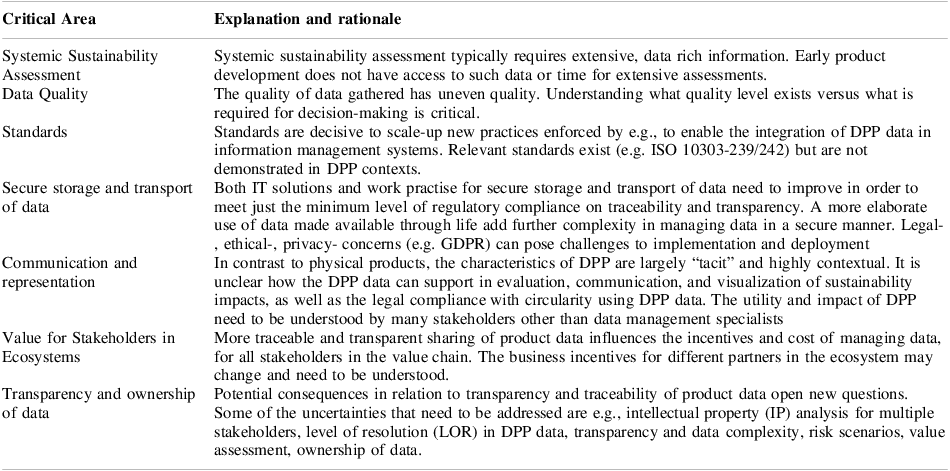
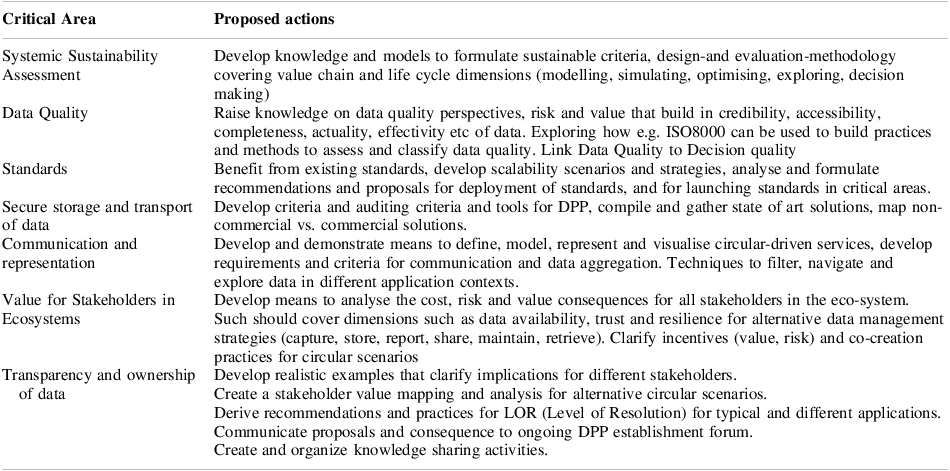
Already in the workshop, participants analysed the critical areas (gaps) that needs to be addressed to reach the vision. The term used was to identify “critical areas” where more knowledge and capabilities need to be developed. The tables below provide explanation and rationale to the seven identified critical areas and lists the proposed actions to close knowledge gaps are listed in the tables below. The critical areas are explained (Table 2) and list of proposed activities (Table 3).
Identified “critical areas” of knowledge and capabilities gaps

Proposed actions to close the knowledge gaps

4.3. Reflections on the proposed actions
The research team analyzed the workshop results and compared them to the existing body of knowledge. The analysis revealed that fully leveraging a digitally transparent and traceable sustainability-related data ecosystem requires simultaneous changes across the entire network of organizations within the value chain. An action plan should therefore address all critical areas with actions that together can achieve a system shift into a scenario of sustainable circular product system practices. In brief, there is a knowledge gap, that drives research to understand and build new design and development knowledge, both inside an organisation and in co-creation networks of organisations. Secondly, the importance of demonstrating the impact and potential of the new logic, calls for demonstration activities. Such demonstrations expect to showcase what is known based on existing (state of the art) knowledge, but also to reveal uncertainties and gaps potentially hindering scale-up of the approaches suggested. Finally, it is expected that standards will play an important tole to implement common practices.
4.4. Capability roadmap
This Roadmap section suggests the logic of organizing the necessary activities that build up design and development capabilities for sustainable and circular economy solutions in manufacturing industry eco-systems. The capabilities are divided into four strands, and their relations are displayed in the “Capability development roadmap” in Figure 3. By capabilities, we refer to complex bundles of skills and accumulated knowledge, exercised through organizational processes that enable firms to coordinate activities and make use of their assets.
The “KNOWLEDGE AND CAPABILITY DEVELOPMENT”, in Figure 3, activities generate new methods, tools, and suggested practices on a lower TRL (Technology Readiness Level). Their criticality and potential impact should be high. Several of the long-term actions identified are recommended to be performed as research projects with academic lead and industry involvement for relevance, contexts, and strategic planning.
The “DEMONSTRATION AND VALIDATION” follows the logic of successively demonstrating more complete and complex capabilities in applied contexts. This means that industry actors need to be active and often lead of the initiatives. Capabilities and knowledge developed in parallel, or preceding, the demonstrators are validated and matured with a higher TRL level. The “UTILISATION AND TRANSFORMATION OF PRACTICE” path focus on introducing and establishing new practices, business and products. This is entirely driven by industrial actors, potentially supported by specialists’ actors, consultants, institutes and/or universities.
The “STANDARDS” strand is always present. The biggest challenge is the pace of change expected, where standards require time to mature, become accepted and foremost becoming adopted and made readily available. Demonstrations are recommended to provide examples and evidence for standardization, both how standards can be used, and to demonstrate areas and topics where standards need to support. Standards can also have direct relation to research studies, where knowledge important to advance standards can be generated and scientifically sound proposals can be included.
The capability development roadmap addresses for parallel proposed actions

5. Concluding discussion
The vision Smart use of available product life cycle information that enable sustainable and circular designs in collaborative ecosystems state an ideal future state, supported by an analysis that identifies and structures the necessary steps into a roadmap. The overarching goal of this vision, along with the proposed roadmap and action plan, is to accelerate industrial transformation by enabling the design of circular and sustainable solutions through enhanced data accessibility. As technologies and methods for capturing, processing, tracing, and retrieving sustainability-related product data continue to evolve—driven largely by legislation and regulatory frameworks—the need for collective change across organisations becomes increasingly evident.
For the design researchers, and industrial leaders of design strategies, the roadmap and action plan bring forward critical areas necessary to address to benefit from the Digital Product Passports (DPPs).
As such, we have addressed RQ1, What is a desired, future, state where the automotive industry can develop more circular products using the increased availability of product data? and RQ2, What are the critical areas that needs to be addressed in such vision?. The literature analysis and focus studies identified seven critical and complementary areas wherein improvements and knowledge need to be generated; i) Systemic Sustainability Assessment, ii) Data Quality, iii) Standards, iv) Secure storage and transport of data, v) Communication and representation, vi) Value for Stakeholders in Ecosystems, and vii) Transparency and ownership of data.
In addressing the RQ 3, What actions can be suggested to address gaps in these areas? - we found that within each of the critical action areas, concrete action items were derived from the gap analysis, from the study of already ongoing initiatives and actions proposed in literature, and in the workshops together with both the OEM view (VOLVO), materials providers, life cycle service providers and digital solution providers. It became evident that there is a need to advance not only new strategies and development practices on the OEM level but also the incentives and conditions for value chain actors need to be understood and included in impactful solutions. It became clear that the actions required to realise the vision are on several levels, i.e., knowledge and capability development, demonstration and validation, utilisation and transformation of practise, and standards.
There is a need to act in parallel to develop knowledge (research), practical knowledge, and awareness in business as well as to standardise work practices in the entire business ecosystem. One critical aspect is the need to co-create solutions in the value chain since conditions change for both suppliers and integrators (OEMs) and also for the end users.
The actions proposed and organised into the critical areas are proposed as a means to guide initiatives in the automotive industry sector. For researchers and educators, it is important to ensure the provision of relevant knowledge. The circumstances emerging with a richer data transparency and traceability environment will require- and open for- new practices where lack of knowledge will raise risks. Demonstrations are necessary to gain a collective understanding, and also a necessity to develop, mature both theory, practice and standards.
It is recommended to advance knowledge, practice and standardisation in a coordinated and iterative manner. The iterative and coordinated way of working expect to meet the need for accelerated development and transformation to a circular and sustainable future.
This study has been a short and intense effort with a limited number of partners in the automotive industry sector. Thereby, there are several arguments and needs that are relevant to study in a follow up stage - also indicated in the roadmap presented. Critical questions can be highlighted for the next steps:
What can manufacturers do to benefit from new means to capture and trace information? What important key areas need to be developed for initiatives, such as DPP, to be efficient and useful in a sustainable and circular economy?, and, How can initiatives, such as DPP, impact the practice of product development to support and create new sustainable and circular solutions?
Such questions drive the search and development of next generation work practices, methods tools and how to benefit from the digital infrastructure that emerge. Since the co-development across organisations in the value chain is central, it is suggested that the co-innovative framework for sustainable and circular solutions is prioritized. Such initiative should emphasise how to use and master an increased data transparency and traceability and help manufactures, such as VOLVO, to accelerate their already ongoing sustainable transformation.
Acknowledgement
The research has been financially supported by Swedish Innovation Agency (VINNOVA) contract 2022-01657. Authors wish to thank all participants also outside the consortia for their participation.




 Open access

