

The Springfield Connection
Thomas H. Suvoong (Shu Hong 舒鴻) arrived with little fanfare at the International YMCA College in Springfield, Massachusetts, on February 17, 1920, in “search of happiness.”Footnote 1 On his hastily filled out application, he jotted down his address as “East of Szechuan Guild, Shanghai, China” – the vagueness of his home address suggesting that he might have been ready to sever ties with the past.Footnote 2 This makes sense considering that his father had recently passed, and he had recently served as a laborer in France during the Great War. So, following in the footsteps of his two older brothers, he had come to the United States to study.
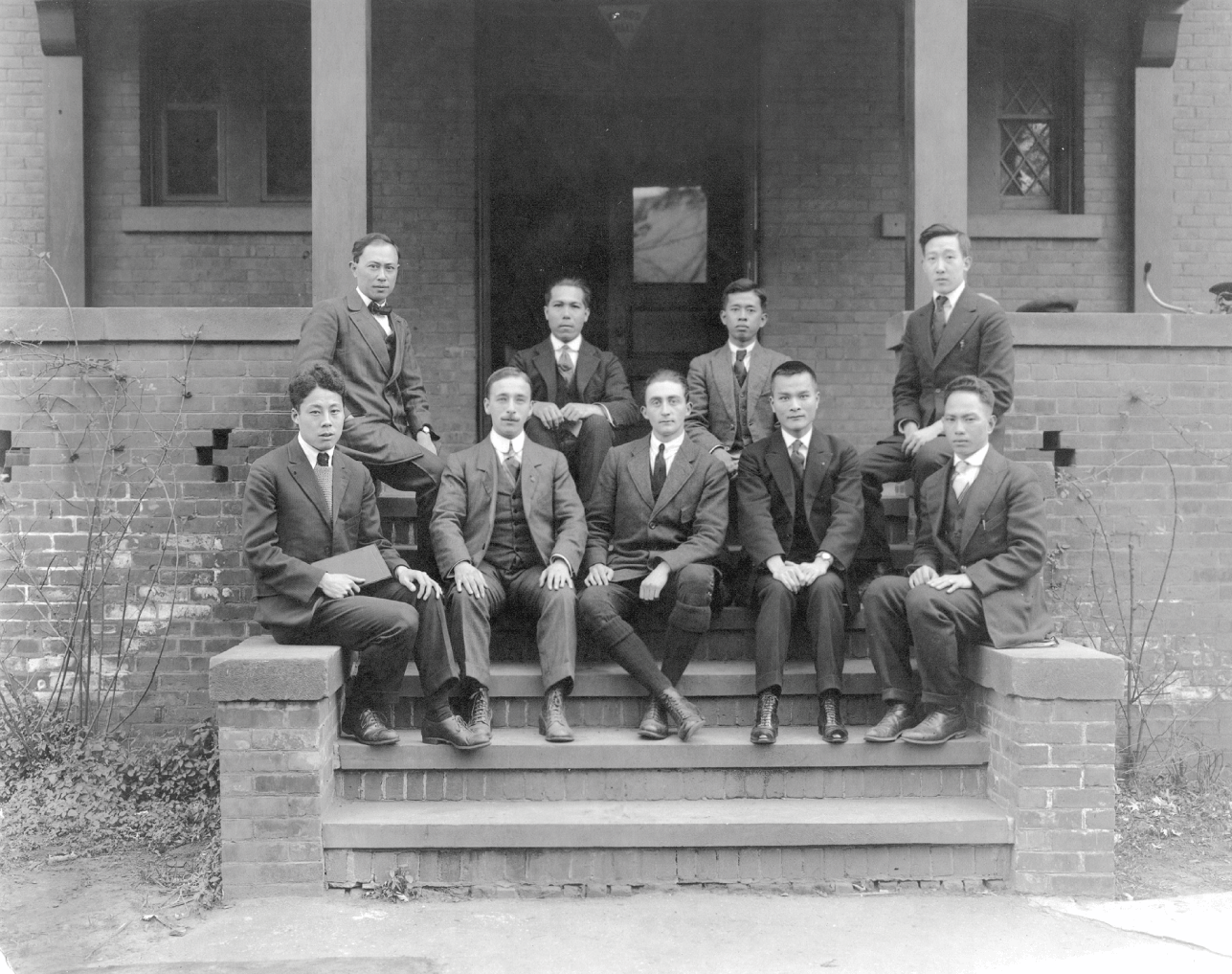
The director of the YMCA in China had sent a letter three days prior, introducing Suvoong to the president of Springfield College.Footnote 3 The director in China suggested to the president, half-heartedly, “you probably will have facilities for his securing such instruction as he may need. If you do not have [them] please feel free to recommend his entering high school.”Footnote 4 This candid introduction is how Suvoong entered the vocation of physical education. This vocation, in turn, led to a rather successful career, with Suvoong serving as the first Chinese referee at the Olympic Games and teaching at Hangzhou Zhijiang University, Nanking National University, and Shanghai Jiaotong University. At Springfield, he joined a contingent of students from China, the Philippines, and other places around the world whose fates would become intertwined (Figure 8.1).Footnote 5
Foreign student group, Springfield College, 1920. Courtesy of the Springfield College Archives and Special Collections.
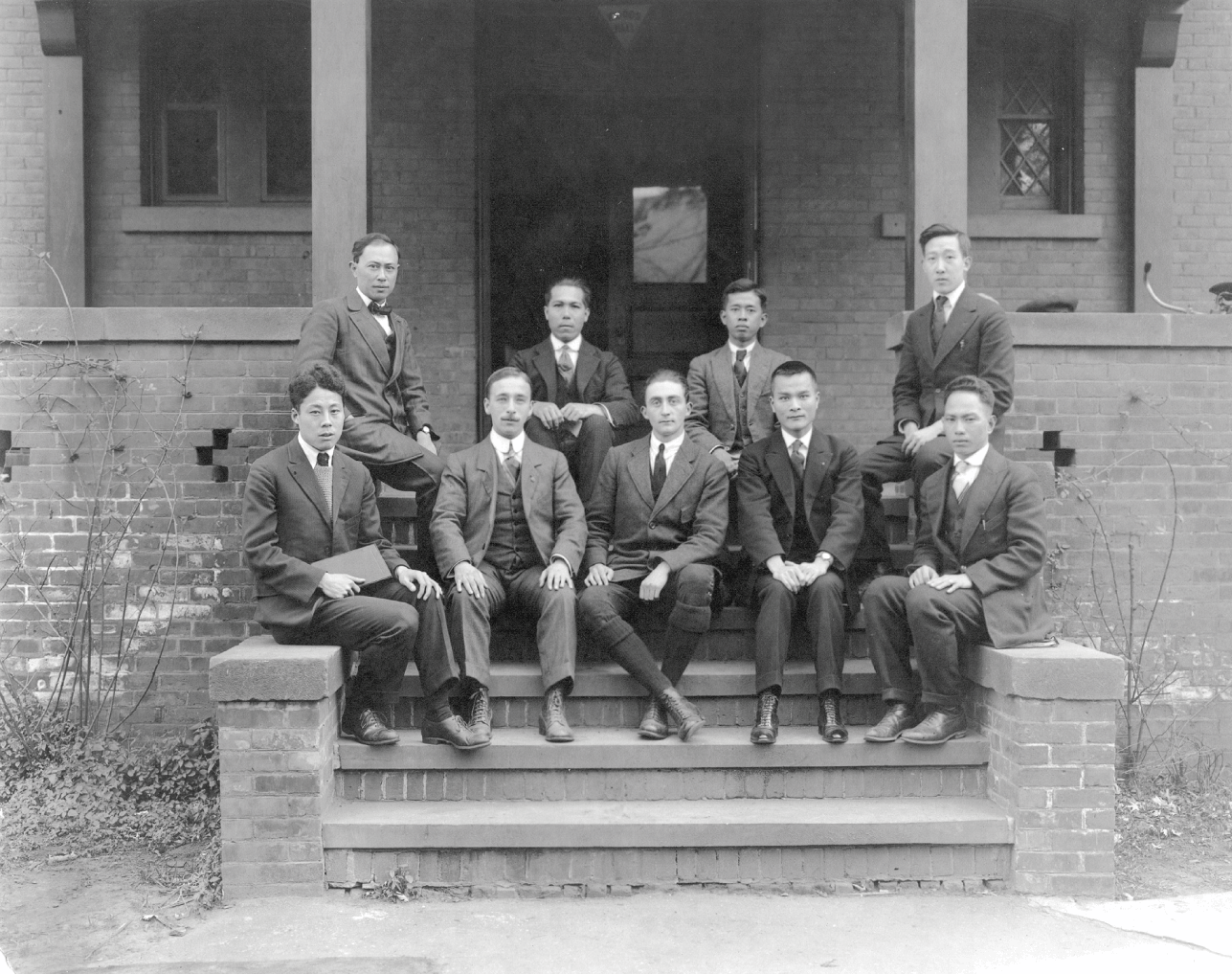
From 1915 to 1932, at least fourteen students from China and five from the Philippines studied in Springfield, and by 1925, seven of them had already taken up leadership positions in physical education programs in their home countries.Footnote 6 Serafin Aquino served as the Director of Physical Education of Public Schools in Manila, Sing-Fu Chang worked as the Director of Physical Education at Southeastern University in Nanjing, John Mo (Ma Yuehan 馬約翰) continued as Director of Physical Education at Tsing Hua College in Beijing, and Regino R. Ylanan served as Director of Physical Education at the University of the Philippines in Manila.Footnote 7
These former Springfield College classmates molded physical education in China and the Philippines respectively, and this chapter traces their intellectual foundations and trajectories through Paul Cohen’s “coalescence-dispersion process.”Footnote 8 In the neutral turf of the United States, these Chinese and Filipino student-scholars, along with their Japanese peers, navigated similar questions about athletics, race, and nation, thereby extending sportive entanglements beyond the boundaries of East and Southeast Asia.Footnote 9 The period between the 1921 and 1934 Far Eastern Championship Games represented an era of possibilities when shared challenges and objectives brought Chinese, Japanese, and Filipinos together, and the mirage of an Asia unified through sports shimmered briefly on the horizon.
Springfield College, or the International YMCA Training School, as it used to be called, became a leading school for sports training, medicine, and research, but its success was far from preordained. Founders chartered the school in 1885 to train physical educators and YMCA secretaries, but from its inception, the school struggled for legitimacy, as it competed directly with George Williams College near Chicago, which also called itself the YMCA Training School.Footnote 10 The Young Men’s Christian Association, or YMCA, a British evangelical organization, had gained many adherents in the United States by the late nineteenth century, and Springfield College positioned itself as one of the first institutions to capture the energy and vigor of sportive evangelicalism through professionalization and academic training.
Under the leadership of the American Luther Gulick, the International YMCA Training School in Springfield transformed from a vocational school designed to produce YMCA secretaries into one of the foremost research centers on sports science and physical therapy in the world. Gulick gave Springfield College “its first philosophy, invented the triangle as its symbol, raised the physical director’s status to that of a profession, and built at Springfield an internationally famous curriculum.”Footnote 11 With this new mission and new international orientation, which set it apart from George Williams College, it attracted the likes of Canadian James Naismith, who invented basketball, and American William G. Morgan, who invented volleyball.Footnote 12 By the 1910s and 1920s, Springfield had already gained international acclaim as a sports college, drawing talent from around the world.
The International YMCA College at Springfield’s location in a progressive and evangelized New England no doubt influenced the Chinese and Filipino students who made their way there to study, but the “international” element of the college also steered students to take a global approach to athletics and sports in their research and later careers. “International” became a mindset of the school. One alum captured this cosmopolitan spirit in an article in the College at Springfield Bulletin, sharing his aim to make “world brotherhood customary,” which would thereby allow “a peaceful international order” to emerge.Footnote 13 While Thomas Suvoong searched for happiness, others searched for world brotherhood, but perhaps, in the end, they were searching for the same thing.
Sporting Nations
In his 1921 Springfield College thesis, Filipino graduate Geronimo Suva, who had played for the Philippine basketball team in the first Far Eastern Championship Games, broadened his research on anthropometry by engaging with the German and Swedish “systems” of gymnastics and corrective exercise.Footnote 14 Extending his international reach, Suva subtly, and perhaps unknowingly, weaved back-and-forth, like a talented point guard, between identifying with Philippine and American audiences in his narrative.Footnote 15 Chinese graduate John Mo similarly located his research on Chinese athletics in the international arena by appealing for foreign assistance to China in his 1920 thesis. He added a lengthy appendix to the end of his work, which answered common questions people had regarding Chinese schools and living and working conditions in his country.Footnote 16 Regino R. Ylanan, a fellow 1920 graduate, likewise noted that his thesis research touched on a topic “which is of paramount significance to physical education not only in this country but also abroad.”Footnote 17
Filipino Regino Ylanan and Chinese John Mo lived parallel lives as physical education trailblazers. From their humble beginnings in Cebu in the central Philippines and Gulangyu in southeastern China respectively, Ylanan and Mo rose to fame as athletes, transformed into scholars in Springfield, and returned to the capital cities of their respective countries to take up the mantles of leadership in athletics. Both had early connections to the Far Eastern Championship Games, Mo having served as a committee member at the 1915 Games and Ylanan having participated in several events at multiple meets from 1913 to 1917.Footnote 18 Both then studied at Springfield College from 1918 to 1920 before returning to their home countries to teach at Tsing Hua University and the University of the Philippines respectively. In other words, Ylanan and Mo not only channeled international influences into their research, but they lived border-crossing lives themselves, setting a precedent for their compatriots.
In the ensuing decades, John Mo and Regino Ylanan became towering figures in physical education. Regino Ylanan helped organize the NCAA of the Philippines, served as the national physical director of the country, edited a sports magazine known as the Filipino Athlete, and published several articles and books on athletics.Footnote 19 John Mo led the Chinese delegation to the Berlin Games in 1936, became the president of Tsing Hua University, served as the chairman of the All China Athletic Federation, and published several book and articles on athletics.Footnote 20 And they both represented their countries at the controversial 1934 Far Eastern Championship Games, which we will return to in the next chapter. They were the Larry Bird and Magic Johnson to the next generation of eager basketballers who followed in their footsteps.
Thomas H. Suvoong, who joined the college the same year that Ylanan and Mo graduated, could be considered one such successor. He didn’t bring many luxuries with him when he came to Springfield, but, like many of his peers from China and the Philippines, he carried a youthful optimism reminiscent of the athletes at the Far Eastern Championship Games. The fact that many of the Chinese and Filipino students in Springfield, like Mo and Ylanan, were themselves alums of the Games probably aided in producing this optimism. Gunsun Hoh, who was known by his Springfield comrades as “H2O,” wrote in a logbook, “Know each other 知人” and “Love each other 愛人.”Footnote 21 Geronimo Suva, meanwhile, wrote that it was his ambition to “do my best in helping my people + give all that I have for a noble cause.”Footnote 22 And Thomas Suvoong wrote that it was his humble goal to be “the light of the earth.”Footnote 23
The students channeled their youthful passion into their research projects, turning Springfield into a laboratory not just to study but to create national histories of sports and sporting culture. Serafin Aquino, who submitted his thesis in June 1922, like John Mo before him, created a compendium of Filipino sports and games purportedly with the dual aim of advising American colonizers and fostering renewed interest in those sports and games among Filipino children.Footnote 24 Gunsun Hoh took a similar approach in 1923 with his Springfield College thesis, “The Past and Future of Physical Education in China.” He started with a long history of physical activity in Chinese history before diving into specific Chinese games and exercises.Footnote 25
These historical theses, as well as the articles and books they inspired, like sports documentaries, tended to follow similar narrative arcs. They started by outlining an early golden age when the victories came easy. Then they described an era of decline under colonialism or a conservative regime. They concluded with a heartfelt comeback story of revival spearheaded by energetic rookies like themselves. For instance, after describing a sportive golden era in the Philippines before colonial occupation, Geronimo Suva proceeded to the period of decline, torching Spanish colonizers for turning Filipinos into “pale looking, humped back, emaciated young with spectacles, ready to die.”Footnote 26 Gunsun Hoh similarly traced the “most contrary age for the development of physical education” to the “Essay system,” which led China to the “lowest point on her down-hill journey.”Footnote 27 Hoh and Suva set the stage for a comeback, and, like good sports writers who squeeze emotions out of underdog stories, they provided them.
These scholars offset the era of decline by researching, recovering, and compiling “traditional” games, and by building a bridge between those games and twentieth-century national revivals.Footnote 28 They pivoted from past to present, stepping over the dark age in between, to draw continuities and craft new narratives for the nation. In other words, Chinese and Filipino scholars incorporated “premodern imperial forms of physical culture into a linear progressive history,” as historian Andrew Morris puts it.Footnote 29 After all, a new sports dynasty doesn’t have the same emotional vigor as a team reviving the glory days of the past, and what was nationalism if not a creative manipulation of emotions that draws from so-called historical traditions to build unity and achieve political objectives?
This formulaic Springfield research had a long-lasting impact in the region and beyond. Gunsun Hoh later converted his Springfield thesis into a highly cited monograph, which we encountered earlier in this chapter. Serafin Aquino channeled some of his thesis for a monograph on Philippine folk dances written by the “Mother of Philippine Dancing,” Francisca Reyes Aquino.Footnote 30 Candido C. Bartolome, another Filipino Springfield alumnus, published several books on physical education through his long career at the University of the Philippines.Footnote 31 And, of course, Regino Ylanan and John Mo also penned well-received sports histories and physical education research.Footnote 32 In other words, these Springfield alumni helped establish long-lasting paradigms in the histories of sports in China and the Philippines.
As leading theorists and advocates of physical education in the Philippines and China, it was only natural for Springfield graduates, upon their return home, to not only take a leading role in research but also to don the mantle of leadership in the premier athletic meet in the region, the Far Eastern Championship Games. As mentioned previously, John Mo and Regino Ylanan both participated in the Games before and after Springfield. George G. Tan (Chen Zhang’e 陈掌谔), another Springfield alumnus, likewise, competed in the decathlon at the fourth Games in Manila in 1919 before studying at the college.Footnote 33 He also served as a Chinese delegate to the 1934 Games and eventually moved permanently to the Philippines.Footnote 34 Two other Filipino alumni, Serafin Aquino and Pedro “Pete” Ablan, served as head and assistant coach of the Philippine track and field team at the 1934 Far Eastern Championship Games.Footnote 35
Chinese and Filipino students at Springfield College also viewed sports, if not as a transnational “placenta of sportsmanship,” then at least as a means to build and enhance cooperation and congeniality in the region. Pedro Ablan, who graduated from Springfield in 1922, for instance, argued in his thesis that the Far Eastern Championship Games and sports more broadly could strengthen relationships within Asia.Footnote 36 Ablan situated the three founding countries of the Games together, writing, “The writer feels sure that another two or three years will see the Philippines, China and Japan competing successfully in the athletic arena with the best athletes of the Western World.”Footnote 37 Instead of portraying the Games as a wedge to separate Filipinos from their Asian peers, he used the Games as a tool to highlight Asian solidarity. Ablan’s juxtaposition reveals the power of sport to also create a common language and experience beyond national boundaries.
A Different Sports Triangle
The Far Eastern Championship Games, enhanced by the Springfield College connection, helped form the Japan–China–Philippines sports triangle.Footnote 38 Cutting across area studies boundaries that typically separate East and Southeast Asia, the Philippines–China–Japan sports triangle challenges us to look beyond those habitual boundaries and appreciate this alternative region as a cohesive and closely connected unit. Historian Roy Bin Wong defines a region as “more than individual countries but far less than the entire globe,” and Anssi Paasi identifies “social institutions such as culture, media and administration” – a list that intersects directly with sports and its connected industries – as key ingredients for forming the “complicated constellation” that is a region.Footnote 39 This definition aligns perfectly with the China–Japan–Philippines sports triangle.
The YMCA uses a red “mind–body–spirit” triangle as its symbol, and Chinese, Japanese, and Filipino Springfield College graduates mapped that triangle onto Asia. In 1927, the young director of the Chinese YMCA in Manila, Lim Chu Cong (Lin Zhuguang 林珠光), whom we encountered in Chapters 3 and 5, led Manila’s Chinese basketball team on a well-publicized “barnstorming tour” of China and Japan.Footnote 40 Springfield alum Regino Ylanan, who by this time had returned to the Philippines to serve as national physical director, noted how tours like this allowed athletes to “serve as ambassadors of friendship and international good-will.”Footnote 41 After all, Ylanan, as a former Far Eastern Championship Games competitor, had served as such an ambassador many times in the past. Channeling good will after his return to Manila at the conclusion of the 1927 tour, a team captain connected all the dots, citing the inspiration of the “famous Y.M.C.A. triangle” of Luther Gulick, which represented “mind–body–spirit,” in yielding a successful trip through the Philippines–China–Japan triangle.Footnote 42
But it was Springfield College itself that served as the training camp for Asian educators, making events like the 1927 tour possible. The classrooms and sports fields in Springfield created ample opportunities for interactions and collaborations among members of the triangle. For instance, the Japanese student Denichi Takeuchi, who would later take Japanese sports teams on tours in the Americas, served as Filipino student Geronimo Suva’s test subject for his thesis, posing for muscle and stature measurements.Footnote 43 Shared classes, playing fields, and research brought these Asian students together, and student clubs and organizations fostered a sense of team spirit and shared mission. The Masonic Club and Cosmopolitan Club in particular brought foreign students together.
The Cosmopolitan Club set out to “unite students of all nationalities in the College for their mutual benefit, socially, intellectually, morally, and spiritually.”Footnote 44 In 1920, Pedro Ablan served as vice-president of the club, Serafin Aquino served as social chairman, and Gunsun Hoh and Geronimo Suva were members.Footnote 45 The next year, Gunsun Hoh became treasurer and Chin F. Song, Tomas Suvoong, Pedro Ablan, and Serafin Aquino were members.Footnote 46 In fact, nearly every student from China and the Philippines at one point participated in the club. If Regino Ylanan and John Mo were the Larry Bird and Magic Johnson of Springfield College, and they were worried about their legacies after retiring from the game, then they could rest assured knowing that Michael Jordan, Charles Barkley, Kobe Bryant, Isaiah Thomas, and others would continue their legacies after they stepped away.
The Cosmopolitan Club, which became the International Student Organization in the 1990s, sponsored school outings to help international students become better acquainted with one another and America. In November of 1922, for instance, members of the club took a trip to the local Indian Motorcycle Plant to learn about American industry.Footnote 47 At a farewell banquet the semester before, over “Philippine steak,” “Shanghai celery,” “Spanish olives,” and other global delicacies, Sing-Fu Chang, Chin F. Song, Serafin Aquino, Gunsun Hoh, and others celebrated the year’s graduates.Footnote 48 Student clubs and the extracurricular events they hosted fostered a sense of camaraderie, setting the stage for future gatherings and reunions at athletic events in Asia.
Because the Far Eastern Championship Games attracted so many Springfield graduates, the cities that hosted the Olympiads acted as sites for reunions. One alum, during a trip to China, noted how he ran into many “Springfield graduates here in Shanghai.”Footnote 49 An image in that same bulletin showed a “Springfield Reunion at Japan During Far Eastern Games” with John Mo and Regino Ylanan appearing smug and confident.Footnote 50 Writing about Chinese and Filipino medical students in a different context, one professor from the University of the Philippines shared that “many a personal friendship has no doubt been made between the two groups in their stay abroad. After their return to their respective countries these friendship[s] could not be forgotten but renewed.”Footnote 51
However, these anecdotes of interaction don’t leave us with much to measure the degree of direct contact between Japanese, Filipino, and Chinese scholar-athletes after graduation outside of a public clash in 1934 that we will explore in the following chapter, which is why this part focuses primarily on parallels. Staff in the alumni office at Springfield College no doubt saw the advantages of reunion publicity, which is why they included the Far Eastern Championship Game image in their bulletin. So, while the image hints at some of the connections that might have existed within the sportive triangle, without personal correspondence, it is impossible to address the depth or persistence of this contact.
Nonetheless, by following the athletes and educators of the China–Japan–Philippines sports triangle to a third space in the United States and to various reunions afterward, this chapter adopts a “trans-area studies” approach that examines Wong’s “geographies of connections that emerge in the spaces beyond national states that are far less than global.”Footnote 52 It is easy for watershed moments, like the 1934 kerfuffle that we will explore in the next chapter, to obscure historical contingencies, like the possibilities at Springfield’s fields. However, by exploring such contingencies, we gain a better appreciation of lost opportunities when things fell apart. We have pivoted from the local to the global, and now it is time to return once more to the local to see how many of the characters introduced in this part came together one last time to struggle over the existence of the Games and the future of Asia.Footnote 53

 Open access