

The work environment is changing rapidly and many employees complain that they are faced with a constant work intensification, which is characterized in particular by high pressure and very short deadlines (Hünefeld, Meyer, Erol & Ahlers, Reference Hünefeld, Meyer, Erol and Ahlers2025). This is not without consequences for employees’ health and behaviors (e.g., ill-being, absenteeism) and may be explained by a decrease in employees’ passion for their work (Trépanier, Fernet, Austin, Forest & Vallerand, Reference Trépanier, Fernet, Austin, Forest and Vallerand2014). In particular, when employees have to cope with many job demands (e.g., work overload and interpersonal conflicts), their work passion can gradually wane as they become tired of always having to make strenuous efforts (Vallerand & Houlfort, Reference Vallerand and Houlfort2019). Although employees’ levels of work passion may vary across industries and job levels, it is important to note that this erosion of work passion following constant and prolonged exposure to high job demands appears to be generalizing to a multitude of work contexts and occupations (Gillet, Morin, Brault, Becker & Verbeke, Reference Gillet, Morin, Brault, Becker and Verbeke2024).
The dualistic model of passion (DMP; Vallerand, Reference Vallerand2010, Reference Vallerand2015) defines passion as a strong inclination toward a specific activity, such as work (Vallerand & Houlfort, Reference Vallerand and Houlfort2019). Passionate workers invest substantial effort and time in their work, consider it central to their identity, love it, and regard it as important (Vallerand & Houlfort, Reference Vallerand and Houlfort2019). However, the major advantage of the DMP, compared to other approaches (Bajaba, Al-Judibi, Basahal & Alsabban, Reference Bajaba, Al-Judibi, Basahal and Alsabban2025; Elemo, Ahmed & Kara, Reference Elemo, Ahmed and Kara2024), is that it is not limited to a one-dimensional approach to passion, but rather considers two forms of passion that do not reflect the same relationship to work. More precisely, the DMP (Vallerand, Reference Vallerand2015) highlights the need to differentiate passion based on its harmonious (HP; a strong psychological investment in an activity [job] that is freely chosen by the individual) or obsessive (OP; strong psychological investment in an activity [job] that is driven by internal or external contingencies associated with the activity) nature. Research has generally reported well-differentiated associations between these two forms of passion and a variety of outcomes (e.g., work–family conflict [WFC] and counterproductive work behaviors [CWB]), in addition to showing that the benefits of passion were accompanied by undesirable consequences when this passion became obsessive (e.g., Gillet et al., Reference Gillet, Vallerand, Schellenberg, Aubouin Bonnaventure, Becker, Brault and Sandrin2023b; Huyghebaert-Zouaghi, Morin, Fernet, Austin & Gillet, Reference Huyghebaert-Zouaghi, Morin, Fernet, Austin and Gillet2022).
However, recent research has demonstrated that the adverse effects of OP may also be reduced when employees display high levels of HP (Morin et al., Reference Morin, Gillet, Chénard-Poirier, Craven, Mooney, Magson and Vallerand2023; Schellenberg et al., Reference Schellenberg, Verner‐Filion, Gaudreau, Bailis, Lafrenière and Vallerand2019). This has important theoretical and practical implications for how to promote a work environment that limits WFC and CWB. The current research builds on prior studies to examine whether HP could moderate the influence of OP on WFC (Samples 1 and 2), while also considering the potential impact of WFC on CWB (Sample 2). These dimensions are important to consider given that they are known to be highly relevant to employees’ professional success and ability to experience satisfactory career trajectories (Huyghebaert-Zouaghi et al., Reference Huyghebaert-Zouaghi, Morin, Fernet, Austin and Gillet2022; Spector, Bauer & Fox, Reference Spector, Bauer and Fox2010). By showing the likely indirect and positive effects of employees’ OP on CWB as mediated by WFC, and by considering whether these relations vary as a function of their levels of HP, the present study seeks to better understand the mechanisms and circumstances involved in the effects of OP. In this way, we aim to offer organizations practical recommendations to reduce employees’ OP. This is all the more important when we know the deleterious effects of OP on both individual and organizational functioning (Vallerand & Houlfort, Reference Vallerand and Houlfort2019). In addition, it is crucial to identify levers for reducing WFC and CWB in light of the numerous studies showing that these dimensions are closely linked to employees’ productivity (Huyghebaert-Zouaghi et al., Reference Huyghebaert-Zouaghi, Morin, Fernet, Austin and Gillet2022; Spector, Bauer & Fox, Reference Spector, Bauer and Fox2010). More generally, in a context of work intensification, such actions could be particularly useful to reduce employees’ exposure to job demands, which represent a threat for their work-family balance and psychological well-being (Trépanier et al., Reference Trépanier, Fernet, Austin, Forest and Vallerand2014).
The effects of work passion
The DMP (Vallerand, Reference Vallerand2015) posits that a passion may be harmonious or obsessive depending on how it is internalized into one’s identity. HP workers freely choose to engage in the work that they love, which has come to be autonomously internalized into their identity. Work occupies an important, but not overpowering, place in their identity. As a result, HP for work represents a strong, but controllable, motivational force that can exist in harmony with other facets of employees’ lives (Vallerand & Houlfort, Reference Vallerand and Houlfort2019). In contrast, although OP employees also love their work, they feel pressured to engage in it as a result of internal or external pressures and contingencies (Vallerand, Reference Vallerand2015). Such contingencies might be a boost of self-esteem, social approval, or the avoidance of negative emotions. As a result of this more externally driven form of internalization, OP entails an uncontrollable urge to work, leading obsessively passionate workers to struggle with establishing adaptive boundaries between work and other life domains (Vallerand & Houlfort, Reference Vallerand and Houlfort2019). Not surprisingly, past research has shown that HP was associated with low levels of WFC, while OP was positively related to WFC (Gillet et al., Reference Gillet, Morin, Austin, Fernet, Huyghebaert-Zouaghi and Vallerand2023a; Huyghebaert-Zouaghi et al., Reference Huyghebaert-Zouaghi, Morin, Fernet, Austin and Gillet2022). However, none of these investigations was conducted with samples of employees with jobs in engineering and administration as it is the case in the present research. Yet, it is important to demonstrate that such results may generalize to employees working in various work settings.
Obsessively passionate employees engage in their work with a rigid persistence, making it harder to establish boundaries between work and other life domains, thereby increasing the likelihood that work will interfere with other life areas (Gillet et al., Reference Gillet, Morin, Austin, Fernet, Huyghebaert-Zouaghi and Vallerand2023a). These employees are thus less likely to accumulate personal resources to support their work. Likewise, because they tend to spend most of their personal resources at work, employees with high levels of OP should be more likely to adopt defensive strategies to protect themselves from further loss of resources in other life domains (Hobfoll, Reference Hobfoll2011). As a result, they are more likely to experience the demands of their personal life as a threat to their work functioning. By prioritizing their work role obsessively, these employees should be less willing to capitalize on resources gained at work to support their psychological functioning, leading them to experience negative outcomes at the work–family interface (e.g., high WFC). Contrastingly, work can typically co-exist harmoniously with other facets of their life among harmoniously passionate employees (Vallerand, Reference Vallerand2010, Reference Vallerand2015). This harmonious co-existence allows them to establish adaptive boundaries between their work and other life areas, thus reducing their risk of experiencing conflicts between their personal and professional lives (Vallerand & Houlfort, Reference Vallerand and Houlfort2019). HP should also help employees to build up, or accumulate, work-related resources as a result of the enjoyment (e.g., well-being) they derive from working (e.g., better health, more positive mood, and greater knowledge and skills; Hobfoll, Reference Hobfoll2011). As these resources accumulate, they become available to support the demands of employees’ personal life, allowing them to experience positive outcomes in their life in general (e.g., low WFC; Vallerand, Reference Vallerand2015; Vallerand & Houlfort, Reference Vallerand and Houlfort2019).
The DMP (Vallerand, Reference Vallerand2015) explicitly positions HP and OP on two separate continua, thus acknowledging the possibility that some workers may simultaneously experience high levels of OP and HP, while others may experience only one, or neither, form of passion. This perspective highlights the need to move beyond the examination of the additive and independent effects of HP and OP to consider their combined role (Schellenberg et al., Reference Schellenberg, Verner‐Filion, Gaudreau, Bailis, Lafrenière and Vallerand2019). More specifically, is it better to display high levels of both OP and HP than high levels of OP coupled with low levels of HP? Little research has attempted to answer this question to date, and the only study conducted in France (Gillet et al., Reference Gillet, Morin, Brault, Becker and Verbeke2024) did not consider employees with jobs in engineering as is the case in our first sample. There is also a need for additional investigations in a Western cultural context – which differs substantially from the cultural contexts (e.g., China) considered in the few previous studies examining the combined of HP and OP (e.g., Li, Zhang, Shao & Chen, Reference Li, Zhang, Shao and Chen2020). Future research is thus needed to document whether and how previous results may apply to different settings and cultures. From an applied standpoint, this is an important contribution, as it enables us to envisage whether or not work passion interventions developed in other contexts and countries could be generalized to French employees with jobs in engineering and administration.
It is quite conceivable that an employee could be characterized by high levels of both HP and OP. This is not necessarily because both types of passion are simultaneously present at the same time in the same individual, but rather because employees may have different levels of passion at work, depending on the period and tasks involved. For instance, the same employee could very well display obsessive behavior during a period of intense pressure to meet deadlines, and much more harmonious behavior at another time, when the pressure to achieve results is less acute. We expect workers displaying high levels of OP and HP to benefit from HP to limit the harmful effects of OP. This can be explained by the fact that HP is theoretically associated with positive emotions (Vallerand, Reference Vallerand2015; Vallerand & Houlfort, Reference Vallerand and Houlfort2019) that help increase workers’ well-being and functioning by attenuating the undesirable effects of negative emotions. In doing so, the presence of HP, in combination with OP, should lead to a more adaptive functioning than the combination of high OP and low HP, which is consistent with the protective role of HP identified in previous research (Gillet et al., Reference Gillet, Morin, Austin, Fernet, Huyghebaert-Zouaghi and Vallerand2023a; Schellenberg et al., Reference Schellenberg, Verner‐Filion, Gaudreau, Bailis, Lafrenière and Vallerand2019).
Based on these considerations and past results, we propose the following hypotheses:
Hypothesis 1. OP will be positively related to WFC.
Hypothesis 2. HP will be negatively related to WFC.
Hypothesis 3. HP will moderate the effect of OP on WFC, such that higher HP will buffer the positive effect of OP on WFC.
The mediating role of WFC
Previous studies have shown that WFC was associated with negative outcomes, including high levels of CWB (Darrat, Amyx & Bennett, Reference Darrat, Amyx and Bennett2010; Ferguson, Carlson, Hunter & Whitten, Reference Ferguson, Carlson, Hunter and Whitten2012). However, none of these studies on the effects of WFC on CWB have been conducted with French employees. Yet, numerous European and developed Western countries, including France, have recently implemented policies seeking to protect employees’ personal life against intrusions from the work domain (e.g., flexible work arrangements, accessible and affordable daycare, the right to disconnect; Drobnič, Beham & Präg, Reference Drobnič, Beham and Präg2010) which are likely to help limit WFC (Huyghebaert-Zouaghi et al., Reference Huyghebaert-Zouaghi, Morin, Fernet, Austin and Gillet2022). In contrast, in many Asian and developing countries, work tends to be characterized by long working hours and inflexible workplace policies that may increase employees’ WFC (Gillet et al., Reference Gillet, Morin, Ndiaye, Colombat, Sandrin and Fouquereau2022). It thus remains important to investigate whether and how similar effects of WFC on CWB will be identified in various occupational groups (e.g., engineering and administration) and cultures (e.g., France).
Employees with high WFC levels may feel that they are unable to manage competing priorities in work and personal contexts (Ellis, Bauer & Crain, Reference Ellis, Bauer and Crain2023). In addition, repeated experiences of WFC are exhausting and associated with negative emotional responses (e.g., French & Allen, Reference French and Allen2020). This may lead employees to experience low levels of work-to-nonwork self-efficacy (Cho, Chen, Cheng & Ho, Reference Cho, Chen, Cheng and Ho2022). Yet, self-efficacy is a critical mechanism of self-regulation that determines employees’ behaviors. More specifically, employees who lack confidence in their ability to cope with their multiple family and work demands may not do their best to do their job, but rather tend to want to harm their organization and its members (e.g., by gossiping or talking badly about their colleagues; Bai, Lin & Wang, Reference Bai, Lin and Wang2016). WFC may also be the source of negative emotions such as anger, which may then turn into CWB (Morgan, Perry & Wang, Reference Morgan, Perry and Wang2018). Indeed, such behaviors may be a way for employees experiencing WFC to take revenge on their organization, and its members, who, in their view, do not respect the rules, norms, or promises (Huyghebaert-Zouaghi et al., Reference Huyghebaert-Zouaghi, Morin, Fernet, Austin and Gillet2022). For instance, when employees are faced with excessive expectations from some of their colleagues and are forced to attend very long meetings that do not allow them to fulfil their family obligations or simply to spend time with their children, they feel that their work interferes with their personal life (i.e., high WFC). This is accompanied by frustration that can turn into CWB, as they are determined to reduce this sense of injustice by targeting the people who are at the root of the problem (Bordia et al., Reference Bordia, Restubog and Tang2008). We thus hypothesized the following:
Hypothesis 4. WFC will be positively related to CWB.
Despite the negative effects of OP on WFC, and more generally on individual functioning (Vallerand & Houlfort, Reference Vallerand and Houlfort2019), and the negative outcomes associated with WFC (Huyghebaert-Zouaghi et al., Reference Huyghebaert-Zouaghi, Morin, Fernet, Austin and Gillet2022), no study to our knowledge has considered WFC as an explanatory mechanism in the relationship between OP and CWB. Although research has considered other dimensions (e.g., need satisfaction, work engagement) in order to explain the harmful effects of OP (Malchelosse, Houlfort, Lavoie & Masson, Reference Malchelosse, Houlfort, Lavoie and Masson2024; Teng, Cheng & Chen, Reference Teng, Cheng and Chen2021), further research is needed to identify alternative mechanisms (e.g., WFC) explaining the effects of OP on employees’ functioning. From this perspective, other studies have largely demonstrated that WFC may be an important variable to consider in explaining the effects of individual and organizational factors on employees’ functioning (Gillet et al., Reference Gillet, Austin, Fernet, Sandrin, Lorho, Brault and Aubouin Bonnaventure2021; Zhang, Ye & Ferreira-Meyers, Reference Zhang, Ye and Ferreira-Meyers2017).
The relations considered in the present research describe a full mediation model according to which: (1) OP is associated with higher levels of WFC (Hypothesis 1) and (2) WFC is associated with higher levels of CWB (Hypothesis 4). In line with prior investigations showing similar indirect effects of OP on employee’s functioning, we propose that the following:
Hypothesis 5. WFC will fully mediate the effect of OP on CWB.
However, we also examine whether the effects of OP on WFC may vary depending on employees’ levels of HP. Thus, we can investigate the conditional indirect effects of OP on CWB via WFC, across different levels of HP. More specifically, we expect that the effects of OP on WFC will be attenuated when employees are harmoniously passionate (Hypothesis 3). The following moderated mediation hypothesis is thus proposed the following:
Hypothesis 6. The indirect relationship between OP and CWB through WFC will be weakened by HP, such that the relationship will be weaker for employees characterized by higher levels of HP.
Method
Participants
In this study, we collected data from two separate samples of French employees. Sample 1 included 497 employees with jobs in engineering (e.g., engineer, technician, and project manager), 64.8% of whom were men. The average age of participants was 38.10 years (SD = 12.26), with an average tenure in the organization of 10.37 years (SD = 9.99), and 61.4% were in a relationship. In terms of degree level, 1.4% had no diploma, 7.4% completed vocational training, 17.1% completed high school, and 74.0% had a university diploma. Participants worked in companies of different sectors and sizes: 6.0% in companies with less than 10 employees, 13.5% in companies with 11–49 employees, 14.7% in companies with 50–249 employees, 11.3% in companies with 250–499 employees, and 54.5% in companies with 500 or more employees. A majority of participants worked in the private sector (88.7%), with permanent (90.7%) and full-time (95.6%) employment.
Sample 2 consisted of 401 employees with administrative jobs (e.g., secretary, administrative manager, and executive assistant), 88.5% of whom were women. The average age of participants was 42.57 years (SD = 10.46), with an average tenure in the organization of 11.45 years (SD = 9.68), and 65.1% were in a relationship. In terms of degree level, 0.5% had no diploma, 13.0% completed vocational training, 35.4% completed high school, and 51.1% had a university diploma. Participants worked in companies of different sectors and sizes: 14.0% in companies with less than 10 employees, 15.7% in companies with 11–49 employees, 19.0% in companies with 50–249 employees, 12.7% in companies with 250–499 employees, and 38.7% in companies with 500 or more employees. A majority of participants worked in the private sector (63.3%), with permanent (91.3%) and full-time (86.3%) employment.
Procedure
Research assistants recruited employees from multiple French organizations through a combination of snowball sampling and networking procedures (i.e., social networks, and personal and professional networks). We only recruited individuals who were employed by an organization (i.e., unemployed, self-employed, and students were excluded). Participants were asked to complete an online self-report questionnaire. Before accessing the survey, they were provided information on the aims of the study. They were also told that they could stop participating in the study at any time, and that participation was confidential and voluntary. They received no remuneration for their participation.
Measures
All questionnaires were previously validated in French and were administered in this language. These French versions were found to display psychometric properties comparable to those of the original versions (Fouquereau, Morin, Lapointe, Mokounkolo & Gillet, Reference Fouquereau, Morin, Lapointe, Mokounkolo and Gillet2019; Huyghebaert et al., Reference Huyghebaert, Fouquereau, Lahiani, Beltou, Gimenes and Gillet2018; Philippe, Vallerand, Bernard-Desrosiers, Guilbault & Rajotte, Reference Philippe, Vallerand, Bernard-Desrosiers, Guilbault and Rajotte2017).
Work passion
Work passion was assessed using Philippe et al.’s (Reference Philippe, Vallerand, Bernard-Desrosiers, Guilbault and Rajotte2017; originally developed in French) questionnaire covering HP (three items; e.g., “Work is in harmony with the other things that are part of me”; α = .80 in Sample 1 and .81 in Sample 2) and OP (three items; e.g., “I have almost an obsessive feeling for work”; α = .66 in Sample 1 and .76 in Sample 2). Items were rated on a 7-point scale (Strongly disagree to Strongly agree). The below .70 Cronbach’s alpha for OP in Sample 1 might be explained by the limited number of items available to measure this dimension. Nevertheless, this value of .66 is still acceptable, especially with three items within this subscale and a sample of less than 500 employees (Lance, Butts & Michels, Reference Lance, Butts and Michels2006).
Work–family conflict
WFC was assessed with three items (e.g., “My work schedule makes it difficult for me to fulfill my family obligations”; α = .89 in Sample 1 and .88 in Sample 2) from Huyghebaert et al. (Reference Huyghebaert, Fouquereau, Lahiani, Beltou, Gimenes and Gillet2018; originally developed in French). Items were rated on a 7-point scale (Strongly disagree to Strongly agree).
Counterproductive work behaviors
CWB were assessed using five items focusing on social interactions (e.g., “Insulted someone about their job performance”; α = .79 in Sample 2) developed by Spector et al. (Reference Spector, Bauer and Fox2010; French version by Fouquereau et al., Reference Fouquereau, Morin, Lapointe, Mokounkolo and Gillet2019), all rated on a seven-point scale (Never to Always).
Analyses
We used the Mplus 8.10 (Muthén & Muthén, Reference Muthén and Muthén2023) software and the robust maximum likelihood estimator. In Sample 1, we first tested a measurement model including work passion, using exploratory structural equation modeling in line with recent studies (Cheyroux, Morin, Colombat & Gillet, Reference Cheyroux, Morin, Colombat and Gillet2023; Gillet et al., Reference Gillet, Morin, Austin, Fernet, Huyghebaert-Zouaghi and Vallerand2023a), and WFC as a latent variable defined by three items. In Sample 2, we also tested a measurement model including work passion, using exploratory structural equation modeling, and WFC and CWB defined by their respective items. Factor scores used in the main analyses were extracted from these measurement models.
These models were then converted into predictive structural equation models (SEM). In Sample 1, HP and OP had direct effects on WFC. In Sample 2, HP and OP had direct effects on WFC, which also had direct effects on CWB. To test the extent to which the effects of HP on WFC could be moderated by OP, we estimated an interaction between HP and OP that was allowed to predict WFC in both samples. Significant interactions were plotted using simple slope analyses to assess the effects of HP at different levels of OP (Marsh, Hau, Wen, Nagengast & Morin, Reference Marsh, Hau, Wen, Nagengast, Morin and Little2013).
To test the adequacy of the measurement models and SEM solutions, we relied on the Tucker-Lewis index (TLI), the comparative fit index (CFI), and the root mean square error of approximation (RMSEA). Values above .90 for TLI and CFI and below .08 for RMSEA indicate that the model tested is well suited to the data collected (Marsh, Hau & Grayson, Reference Marsh, Hau, Grayson, Maydeu-Olivares and McArdle2005). Finally, the indirect effects of HP and OP on CWB through WFC were tested using bias-corrected bootstrap (10,000 bootstrap samples) confidence intervals (CI; Cheung & Lau, Reference Cheung and Lau2008), which show significant indirect effects when the CI do not include 0.
Results
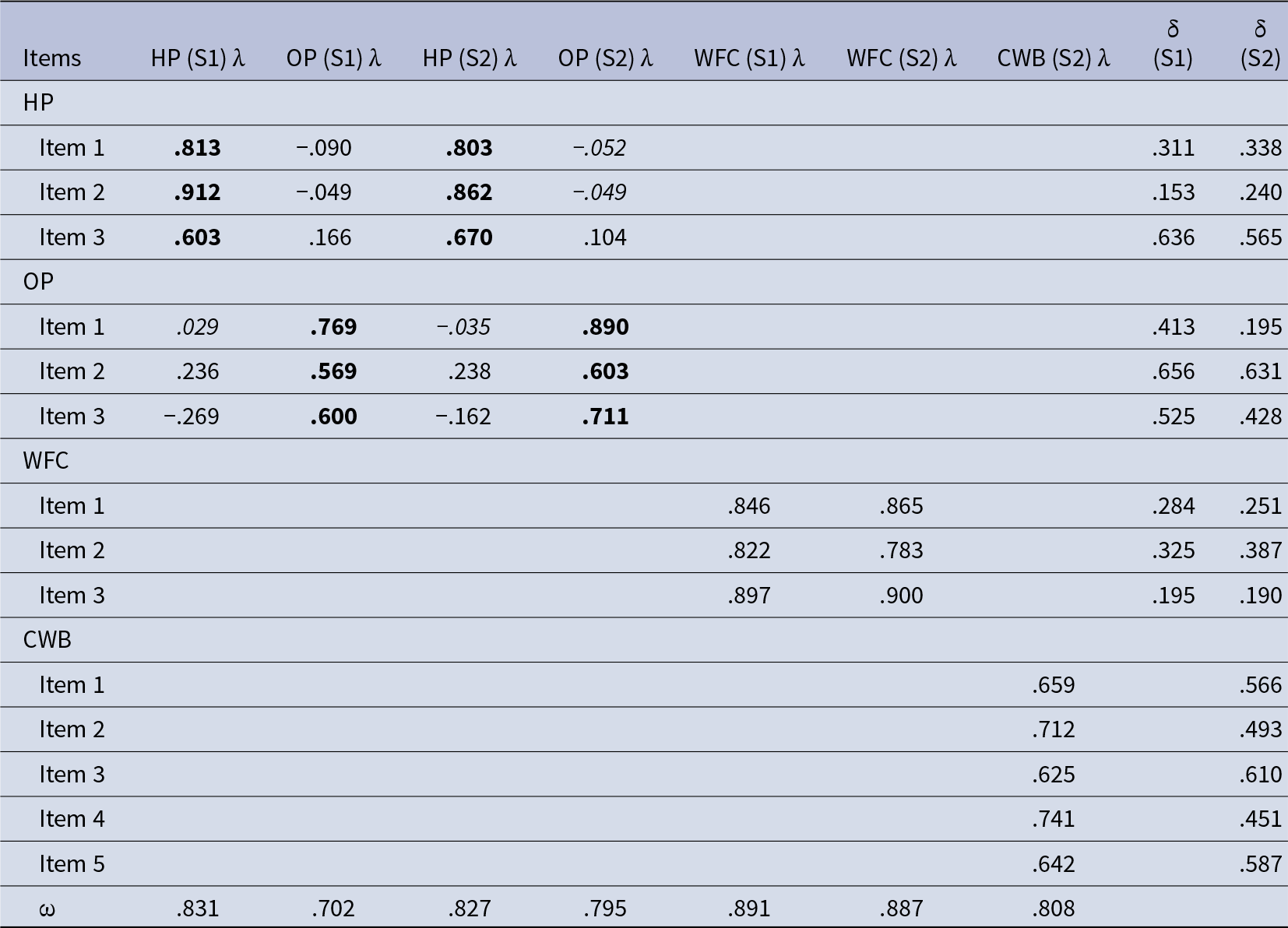
In both samples, the model fit of the measurement models (Sample 1: χ2 = 60.806, df = 20; CFI = 0.973; TLI = 0.952; and RMSEA = 0.064 [0.046; 0.083]; Sample 2: χ2 = 153.416, df = 67; CFI = 0.954; TLI = 0.937; and RMSEA = 0.057 [0.045; 0.069]), and SEM (Sample 2: χ2 = 1.220, df = 3; CFI = 1.000; TLI = 1.000; and RMSEA = 0.000 [0.000; 0.058] [In Sample 1, the SEM solution was saturated, so we cannot report any fit indices.]) solutions was satisfactory. (In Sample 2, we also tested a predictive model in which HP, OP, and the interaction between the two dimensions had, in addition to the effects already specified, a direct effect on counterproductive work behaviors. The results showed no significant direct effect of these variables on counterproductive work behaviors, thus confirming the relevance of the full mediation model proposed and retained.) The final parameter estimates from the measurement model in both samples are reported in Table 1. The results support the adequacy of the HP, OP, WFC, and CWB factors, which appear to be well-defined and reliable.
Standardized factor loadings (λ) and uniquenesses (δ) for the measurement models
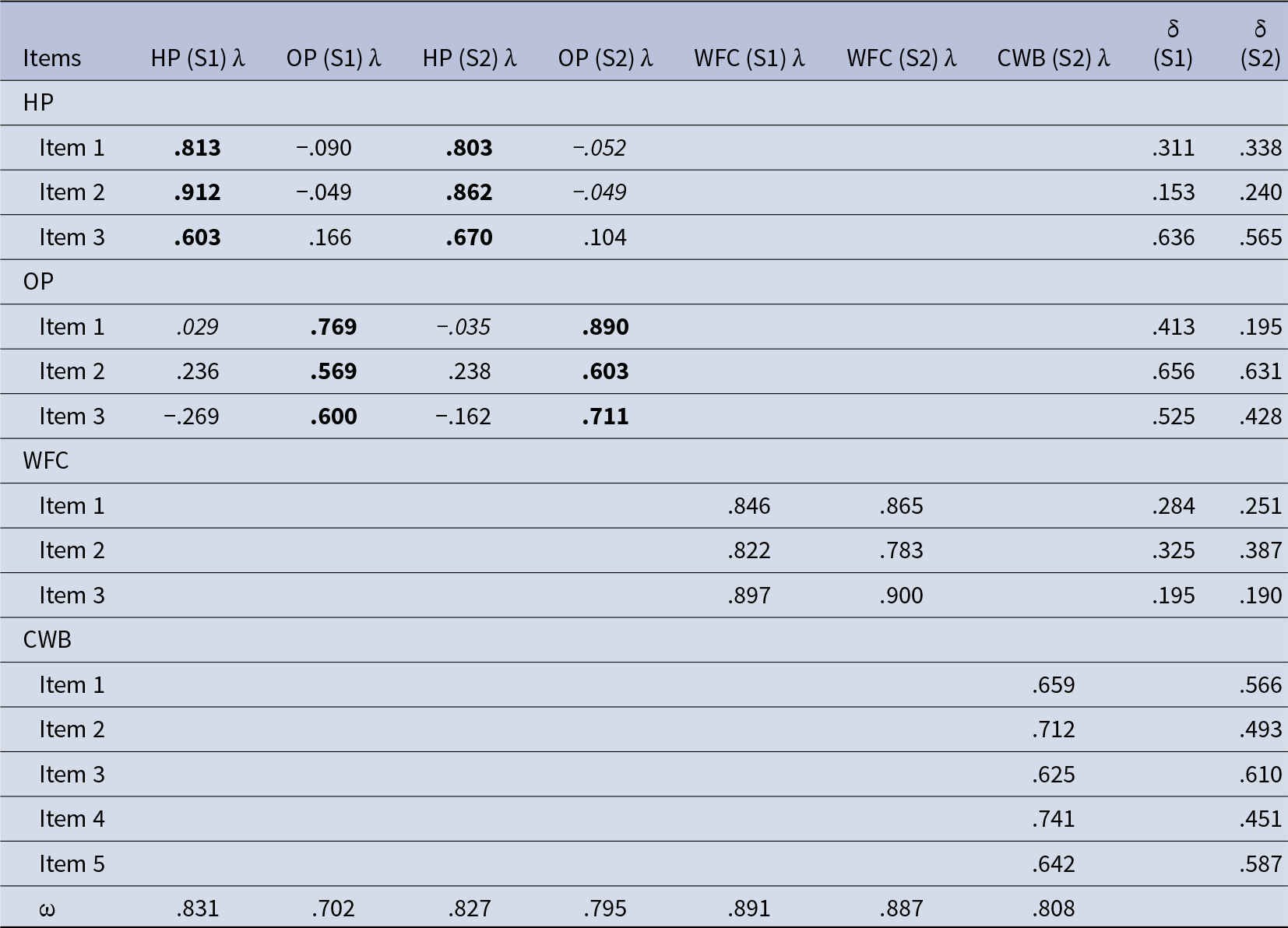
Note: HP: harmonious passion; OP: obsessive passion; WFC: work–family conflict; CWB: counterproductive work behaviors; S1: Sample 1; S2: Sample 2; λ: factor loading; δ: item uniqueness; ω: omega coefficient of model-based composite reliability; target factor loadings are indicated in bold; the non-significant parameters (p > .05) are marked in italics.
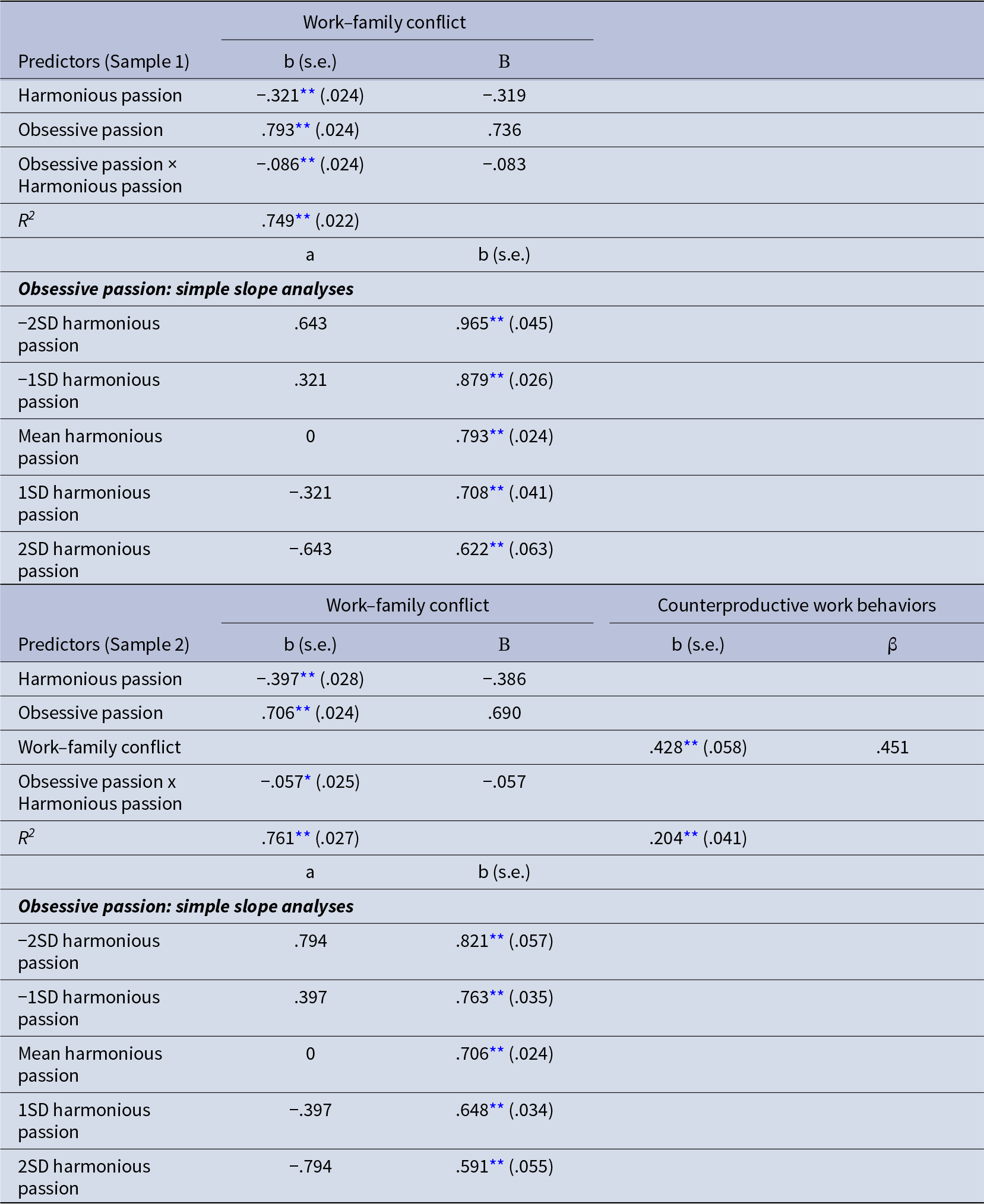
The parameter estimates from the SEM solutions, in addition to the interactions, are reported in Table 2. In both samples, HP was associated with lower levels of WFC, whereas OP was associated with higher levels of WFC. WFC was also associated with higher levels of CWB (Sample 2). Without considering the interaction effects, the indirect effects of HP (IE = −0.170; CI = −0.230 to −0.124) and OP (IE = 0.307; CI = 0.229 to 0.404) on CWB were significantly mediated by WFC.
Predictive results
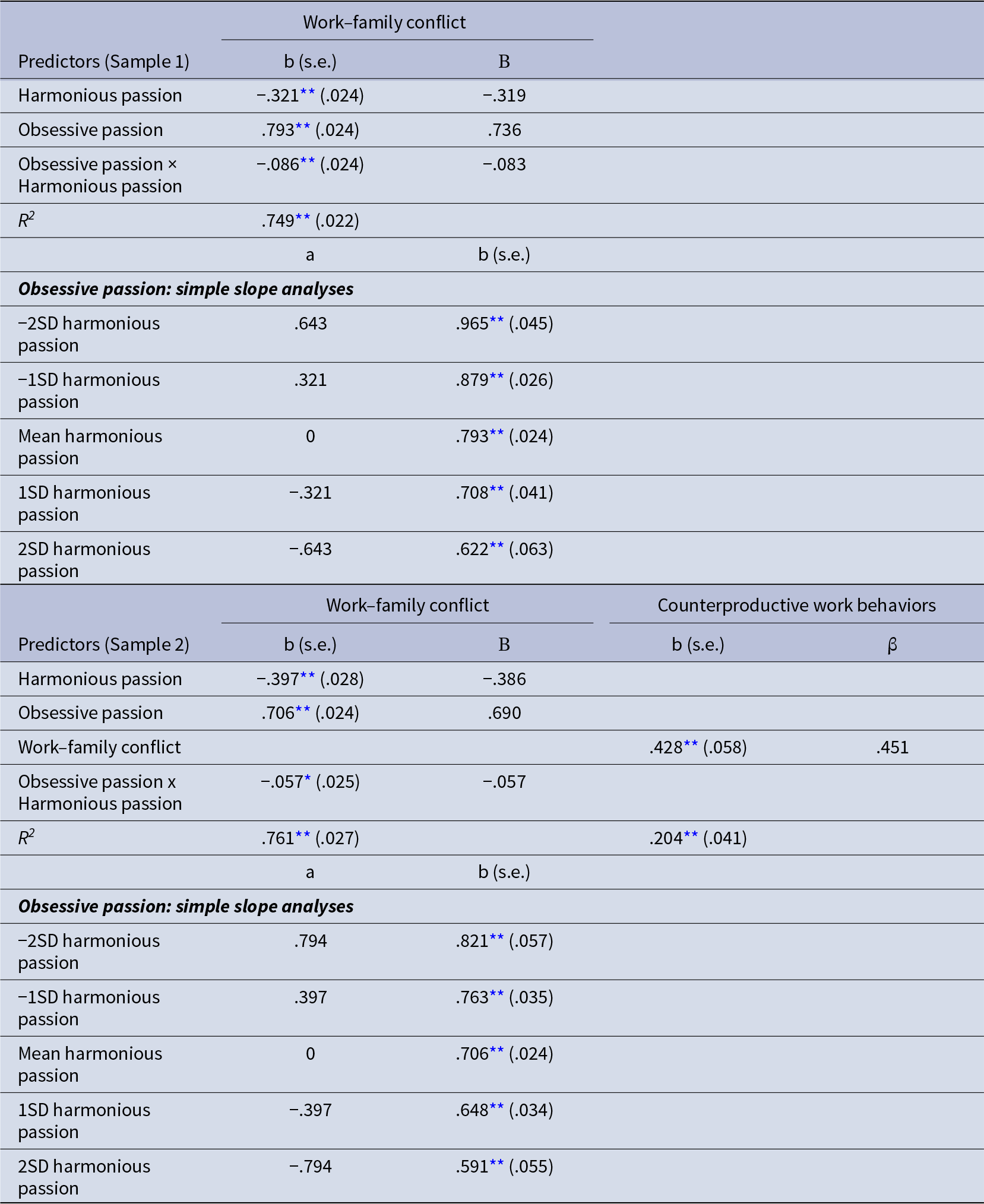
Note: R 2: squared multiple correlation (reflecting the proportion of explained variance); a: regression intercept (used in drawing the simple slope graphs); b: unstandardized coefficient; s.e.: Standard error of the coefficient; β: standardized coefficient.
* p < .05; **p < .01.
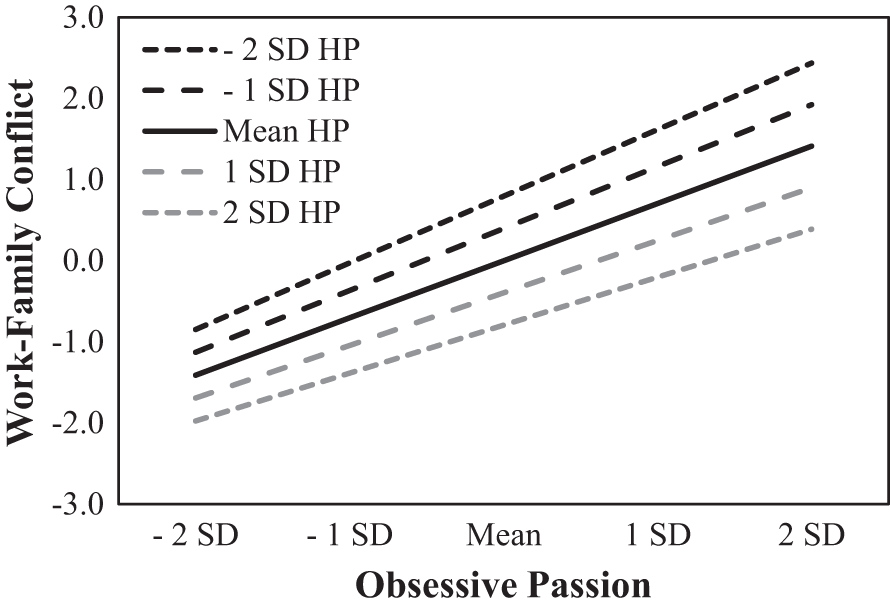
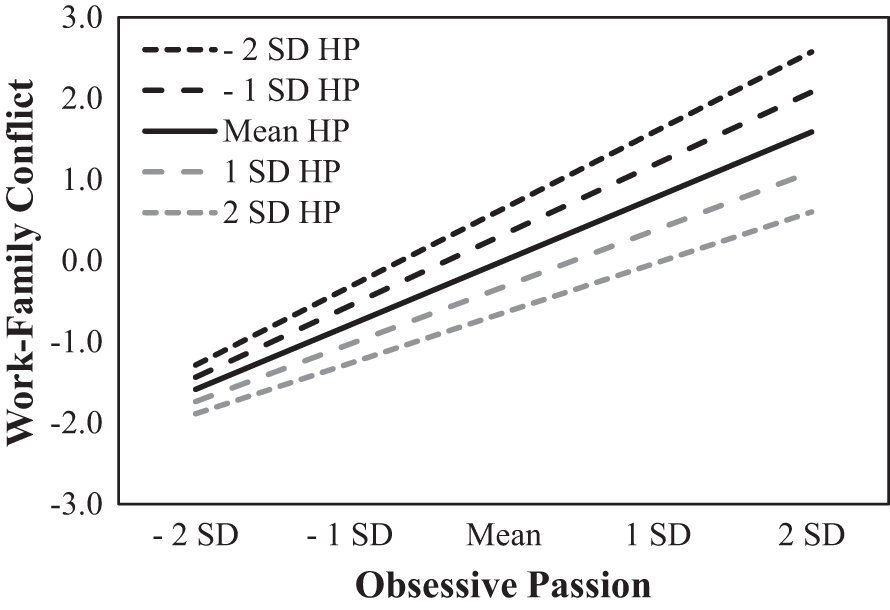
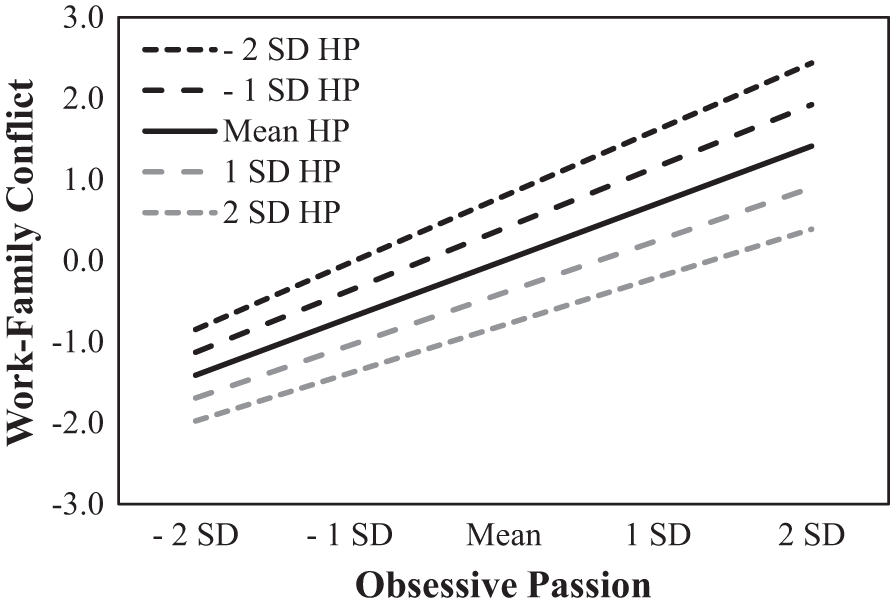
The results also revealed that HP and OP interacted in the prediction of WFC. Simple slope analyses are reported in Table 2 and graphically represented in Figs. 1 (Sample 1) and 2 (Sample 2). As hypothesized, HP buffered the undesirable effects of OP. More specifically, the effects of OP on WFC were lower at high levels of HP. Importantly, simple slope analyses also revealed that the indirect effects of OP on CWB were lower at high levels of HP. More specifically, the indirect effect of OP on CWB was mediated by WFC at −2SD of HP (IE = 0.351; CI = 0.253 to 0.477), −1SD of HP (IE = 0.327; CI = 0.240 to 0.434), mean of HP (IE = 0.302; CI = 0.225 to 0.395), +1SD of HP (IE = 0.277; CI = 0.207 to 0.365), and +2SD of HP (IE = 0.253; CI = 0.183 to 0.344).
Simple slope analysis of the effects of obsessive passion on work–family conflict at different levels of harmonious passion (Sample 1).

Simple slope analysis of the effects of obsessive passion on work–family conflict at different levels of harmonious passion (Sample 2).
Discussion
The current research sought to examine the indirect effects, through WFC, of OP on CWB, while considering how these relations might differ as a function of employees’ levels of HP. Our findings showed that OP was associated with higher levels of WFC, whereas HP was negatively related to WFC. In addition, the effects of OP on WFC were weaker at higher levels of HP. WFC was also associated with higher levels of CWB. Finally, the indirect effects of OP on CWB were mediated by WFC, but these effects were weaker when employees displayed high levels of HP. These results have theoretical and practical implications that are detailed in the following sections.
Theoretical implications
Previous research has emphasized the need for additional studies on the effects of work passion particularly on CWB (Gillet et al., Reference Gillet, Vallerand, Schellenberg, Aubouin Bonnaventure, Becker, Brault and Sandrin2023b). Other studies have also emphasized the importance of identifying mechanisms that could explain these effects of work passion on individual functioning (Vallerand & Houlfort, Reference Vallerand and Houlfort2019). By showing that higher levels of OP were associated with higher levels of WFC, which in turn were associated with higher levels of CWB, our findings support and enrich these previous observations. These positive and indirect relations between OP and CWB can be explained by the fact that employees with high levels of OP are more inclined to invest too much of their personal resources in their work roles despite the detrimental effects on their work-family balance (i.e., high WFC), leaving them with fewer resources available for their personal life (Hobfoll, Reference Hobfoll2011). As a result, they may be tempted to take revenge on their organization and its members in the form of CWB (Bordia et al., Reference Bordia, Restubog and Tang2008; Morgan et al., Reference Morgan, Perry and Wang2018).
In addition to these indirect effects of OP, the present findings also replicated the results from prior research showing that WFC was associated with higher levels of CWB (Darrat, Amyx & Bennett, Reference Darrat, Amyx and Bennett2010; Ferguson et al., Reference Ferguson, Carlson, Hunter and Whitten2012). This is in line with the idea that employees displaying high levels of WFC are not able to cope with all the problems they encounter in their work and personal lives (Huyghebaert-Zouaghi et al., Reference Huyghebaert-Zouaghi, Morin, Fernet, Austin and Gillet2022). Furthermore, our results revealed that HP was associated with lower levels of WFC. This association is consistent with past results demonstrating that HP allows employees to distance themselves from work and not focus too much on it so as not to risk an imbalance between work and personal life (Vallerand, Reference Vallerand2010; Vallerand & Houlfort, Reference Vallerand and Houlfort2019).
When more specifically considering how the effects of OP differed as a function of employees’ levels of HP, we found that the direct effects of OP on WFC were less pronounced among employees displaying high levels of HP. Employees with high levels of OP and high levels of HP may question their excessive investment in their work. They may be more attentive to the prevention messages addressed to them, to the possible signs of deterioration in their health, and to the expectations of their friends and family (Morin et al., Reference Morin, Gillet, Chénard-Poirier, Craven, Mooney, Magson and Vallerand2023). In other words, they are more concerned with establishing a clear and impermeable boundary between professional and personal lives and are not prepared to sacrifice everything for work, thus leading to lower levels of WFC.
When considering the whole explanatory chain of relations, the present results highlight a contingency perspective that helps to clarify and unpack the conditions under which OP may have differential effects on employees’ functioning. More specifically, the present findings revealed that the adverse effects of OP on CWB (through WFC) were attenuated when HP was high. Such findings are aligned with those from past research showing that the effects of some characteristics (e.g., OP) on various outcomes (e.g., CWB) were mediated by WFC (Zhang et al., Reference Zhang, Ye and Ferreira-Meyers2017). They also suggest that HP, because it contributes to reinforce the boundaries between employees’ professional and personal lives (Vallerand & Houlfort, Reference Vallerand and Houlfort2019), can facilitate employees’ functioning. More particularly, high levels of HP seem to offer employees with high levels of OP the control they need to maintain a more balanced life and a reasonable investment in work (Vallerand, Reference Vallerand2015).
Limitations and suggestions for future research
Limitations of the current research must be highlighted. First, we relied solely on self-report questionnaires, which implies that social desirability biases may play a role in our results. To reduce this concern, further research should include informant ratings (e.g., supervisor and colleagues) and objective measures (e.g., official data about turnover and performance). Further studies are also needed to replicate these findings with other questionnaires assessing work passion and having higher levels of internal consistency. Second, since this study only covered workers (with jobs in engineering and administration) who lived and worked in France, additional studies will be needed to test the replicability of the current findings to a variety of work settings, cultures, languages, and countries. Third, we used a cross-sectional research protocol that precludes the establishment of directionality or causality between the constructs considered. Even if investigations provide support for some of the proposed associations (e.g., Gillet et al., Reference Gillet, Morin, Austin, Fernet, Huyghebaert-Zouaghi and Vallerand2023a, Reference Gillet, Vallerand, Schellenberg, Aubouin Bonnaventure, Becker, Brault and Sandrin2023b), reciprocal or inverse associations may also exist. Future studies should examine the nature of these relations using longitudinal methodologies better suited to substantiate the temporal ordering of the observed associations, the dynamic changes in work passion over time, and the long-term effects of work passion on employees’ functioning. Finally, we only considered WFC as an exploratory mechanism and HP as an individual factor that could attenuate the detrimental effects of OP. Additional studies are needed to examine the potential mediating role of other dimensions (e.g., sleep and burnout) and identify other individual and organizational factors (e.g., work-home segmentation preferences, organizational justice, and organizational culture) that may influence OP or moderate the effects of OP (Gillet et al., Reference Gillet, Morin, Brault, Becker and Verbeke2024; Huyghebaert-Zouaghi, Morin, Thomas & Gillet, Reference Huyghebaert-Zouaghi, Morin, Thomas and Gillet2024). Likewise, other negative (e.g., turnover and presenteeism) and positive (e.g., creativity and organizational citizenship behaviors) outcomes could be included to better understand the implications of employees’ work passion (e.g., Fernet, Gillet, Austin, Trépanier & Drouin‐Rousseau, Reference Fernet, Gillet, Austin, Trépanier and Drouin‐Rousseau2021; Sandrin, Morin, Fernet & Gillet, Reference Sandrin, Morin, Fernet and Gillet2020).
Implications for practice
Although we are currently in a society in which organizations and managers tend to value and promote very high work investment (Huyghebaert-Zouaghi et al., Reference Huyghebaert-Zouaghi, Morin, Fernet, Austin and Gillet2022), our results underline the need to limit OP and WFC, while facilitating HP, in order to prevent employees’ CWB. First, it would be important for organizations, supervisors, and the society more generally to consider implementing actions to help employees decrease their levels of OP. Consulting the employees with low levels of OP may make it possible to identify the most useful (or harmful) practices in this regard. Such interventions may subsequently be expanded to help employees displaying higher levels of OP to increase their likelihood of decreasing their levels of OP. Interventions may also be offered to employees with lower levels of OP to help them decrease their likelihood of eventually experiencing a rise in OP. Moreover, counseling or coaching should also help reduce OP at the individual level (Van Gordon et al., Reference Van Gordon, Shonin, Dunn, Garcia-Campayo, Demarzo and Griffiths2017). Modifications to decrease workload sustainably may also help decrease the prevalence of OP over time (Huyghebaert et al., Reference Huyghebaert, Fouquereau, Lahiani, Beltou, Gimenes and Gillet2018).
Likewise, interventions can be proposed to reduce employees’ WFC. As in the case of OP, actions aimed at reducing employees’ workload and, more generally their exposure to job demands, are means of limiting the development of WFC (Gillet et al., Reference Gillet, Austin, Fernet, Sandrin, Lorho, Brault and Aubouin Bonnaventure2021). Furthermore, changes designed to increase employees’ HP could be leveraged to help employees be less exposed to the negative effects of OP, and more generally to support better functioning. For instance, it may be interesting to encourage balanced and healthier lifestyles, to create well-being-oriented workplaces, and to offer enabling versus enclosing work-life policies (Kreiner, Reference Kreiner2006). More generally, actions to facilitate work recovery processes could be considered as a means of protecting employees’ well-being while allowing them to maintain a satisfactory work–family balance. Interestingly, interventional studies have shown that employees can learn and develop efficient work recovery through training (e.g., mindfulness; Hülsheger, Feinholdt & Nübold, Reference Hülsheger, Feinholdt and Nübold2015).
Data availability statement
The data that support the findings of this study are available from the corresponding author upon reasonable request.
Conflict(s) of interest
The authors report no conflicts of interest.

 Open access

