


Introduction
The ruling Liberal Democratic Party (LDP) under Prime Minister Fumio Kishida continued to struggle with low approval ratings throughout 2023, with an expected boost in public perception of the government after hosting the G7 meeting in May failing to materialise to an extent that could justify calling a snap election. The party's situation worsened at the end of the year when a fresh scandal related to the misreporting of ‘slush fund’ kickbacks from fundraising parties to LDP politicians was investigated by police and prosecutors, forcing Kishida to remove all ministers affiliated with the party's largest faction from the Cabinet. By the end of the year, approval ratings for the ruling party and the Cabinet were at some of the lowest levels ever recorded by polling organisations. Despite the unpopularity of the Prime Minister and his Cabinet, no serious challenge to his leadership emerged during 2023, with regular leadership elections in the LDP not scheduled to take place until September 2024.
Election report
No national elections were held in 2023.
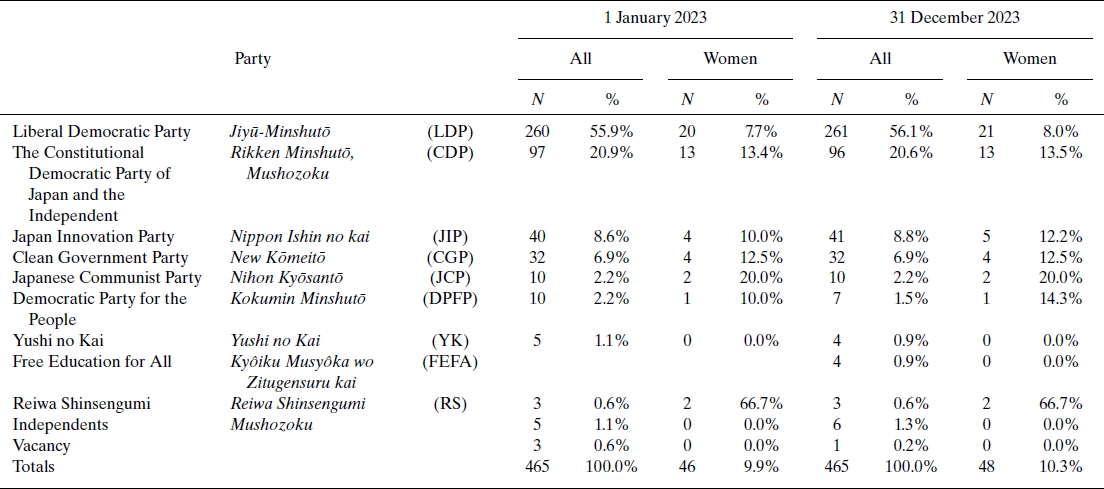
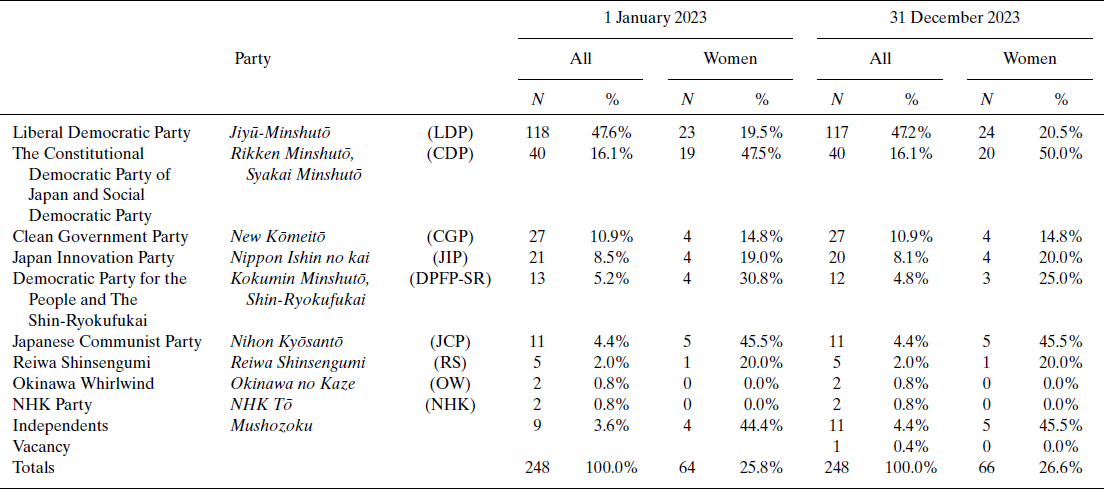
Five by-elections were held alongside the unified local elections on 23 April, including the election to fill the Yamaguchi 4th district seat left empty by the assassination of Shinzō Abe in 2022. Despite the government's low approval ratings, the ruling LDP was able to defend its three House of Representatives seats in the by-elections and even picked up a House of Councillors seat in the Ōita at-large district following the resignation of independent incumbent Kiyoshi Adachi after running (unsuccessfully) in the prefecture's gubernatorial election. The final House of Representatives seat, Wakayama 1st district, was picked up by the Japan Innovation Party from the Democratic Party for the People (DPFP), whose incumbent in the seat, Shuhei Kishimoto, had resigned to run (successfully) for governor of Wakayama.
Two further by-elections were held on 22 October, with the LDP holding the Nagasaki 4th district lower house seat, left empty by the death of Seigo Kitamura in May, but losing the Tokushima-Kōchi at-large district upper house seat vacated by Kōjirō Takano, who resigned after admitting to physically assaulting his secretary, to independent candidate Hajime Hirota.
Cabinet report
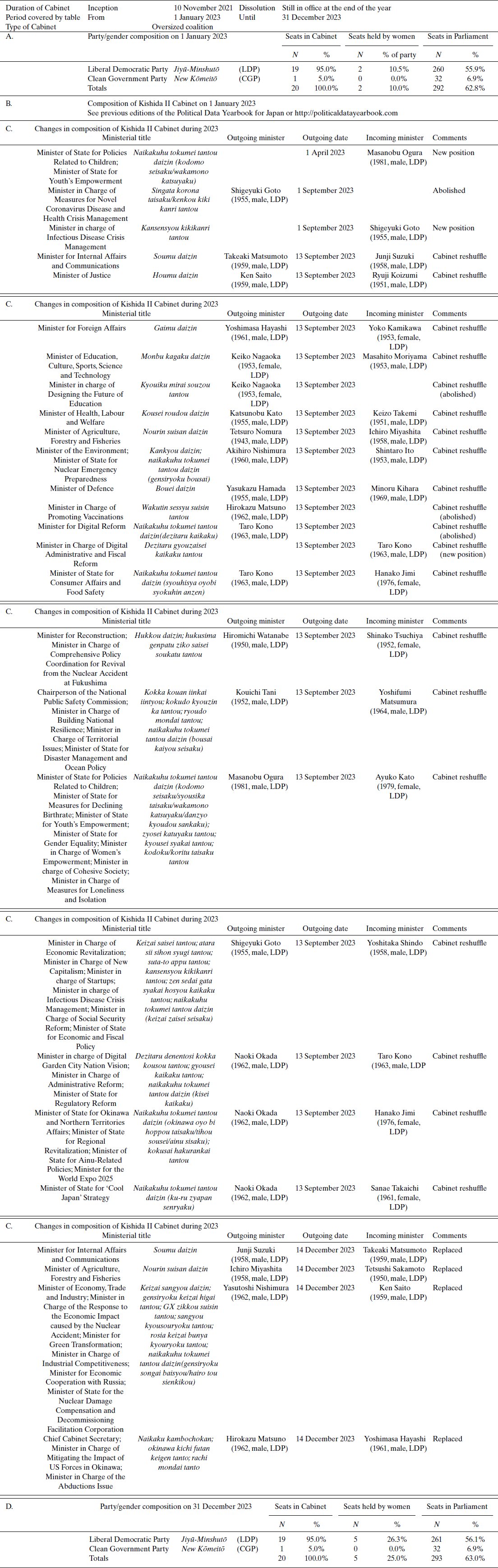
On 1 April, Masanobu Ogura was appointed to a newly created position as Minister of State for Policies Related to Children and Minister of State for Youth Empowerment. This position includes responsibility for the government's policies to tackle the declining birth rate, with the new ministerial role being created to unify oversight of various policy proposals to that end. A further small change to the Cabinet was made on 1 September, when Shigeyuki Goto's role as Minister in Charge for Measures for Novel Coronavirus Disease and Health Crisis Management was changed to Minister in Charge of Infectious Disease Crisis Management, reflecting the winding down of COVID-19 pandemic measures and transitioning towards planning for future health crises.
On 13 September, Prime Minister Kishida extensively reshuffled his Cabinet. This represented a return to the normal timeframe for Cabinet reshuffles, which are commonly carried out in September ahead of the autumn's Extraordinary Diet Session; in the previous year, Kishida had carried out this reshuffle one month earlier in order to remove ministers implicated in the scandal over the LDP's connections to the Unification Church (see Hino et al. Reference Hino, Ogawa, Fahey and Liu2023). In the September 2023 reshuffle, Kishida increased the number of women in the Cabinet from two to five and appointed 11 new ministers to their first Cabinet positions, while leaving a number of veterans in place in key positions. Notably, the two lawmakers who had challenged Kishida at the last party leadership election were retained in their ministerial posts—Taro Kono as Minister for Digital Transformation and Sanae Takaichi as Minister in Charge of Economic Security (whose portfolio was also given charge of the ‘Cool Japan’ economic promotion strategy, which had formerly been a separate Minister of State position).
Among the other veteran ministers retained in their positions were Minister of Finance Shunichi Suzuki; Minister of Economy, Trade and Industry Yasutoshi Nishimura; and Chief Cabinet Secretary Hirokazu Matsuno; as well as Minister of Land, Infrastructure, Travel and Tourism Tetsuo Saito, who is the sole Cabinet representative of the LDP's junior coalition partner, the Clean Government Party (Komeito). Yoko Kamikawa, who had formerly served as Minister of Justice for several terms in the cabinets of Shinzō Abe (2012–2020) and Yoshihide Suga (2020–2021), was appointed as Minister for Foreign Affairs, becoming the third woman to hold this position. New appointees taking Cabinet roles for the first time were Minister for Internal Affairs and Communications Junji Suzuki; Minister of Justice Ryuji Koizumi; Minister of Education, Culture, Sports, Science and Technology Masahito Moriyama; Minister of Health, Labour and Welfare Keizo Takemi; Minister of Agriculture, Forestry and Fisheries Ichiro Miyashita; Minister of the Environment Shintaro Ito; Minister of Defence Minoru Kihara; Minister of Reconstruction Shinako Tsuchiya; Chairman of the National Public Safety Commission Yoshifumi Matsumura; and Minister for Consumer Affairs and Food Safety Hanako Jimi. The final new appointee was Ayuko Kato, who took over the Minister of State for Policies Related to Children position created earlier in the year; the decision to change this appointment so quickly may have come in part due to international criticism of Japan being the only country to send a man, then-incumbent Masanobu Ogura, to the G7's Ministerial Meeting on Gender Equality and Women's Empowerment in June.
While the appointment of such a large number of new faces was intended to allow the Kishida II Cabinet to separate itself from past scandals tainting the administration, the slush fund financial scandal, which broke just two months later in November, forced the Prime Minister to make further changes to his Cabinet line-up. The scandal had particularly focused on the party faction known as the Seiwa Seisaku Kenkyukai, which was formerly led by Shinzō Abe and continued to be known informally as the Abe faction after his assassination in 2022. Kishida removed all four Abe faction members from the Cabinet on 13 December, replacing Junji Suzuki with Takeaki Matsumoto as Minister for Internal Affairs and Communications, Ichiro Miyashita with Tetsushi Sakamoto as Minister of Agriculture, Forestry and Fisheries, Yasutoshi Nishimura with Ken Saito as Minister of Economy, Trade, and Industry, and Hirokazu Matsumoto with Yoshimasa Hayashi as Chief Cabinet Secretary. This left the Cabinet in the very unusual position of having no ministers from the party's largest faction by the end of 2023.
Cabinet changes and composition are shown in Table 1.

Parliament report
In the ordinary session that ran from 23 January to 21 June, 59 of the 61 government-sponsored bills submitted to the Diet passed, including one carried over from the previous session. Two were carried forward to the extraordinary session later in the year. Seventy-two bills were passed in total, including 13 legislator-sponsored bills (Cabinet Legislation Bureau 2023). Among the bills passed were a number related to strengthening Japan's security posture, including the Defence Fiscal Resource Bill, which allows for incremental increases to taxes to fund increased defence spending over the coming years, and bills enhancing Japan's security cooperation with Australia and the United Kingdom. Japan's first law addressing anti-LGBTQ (Lesbian, Gay, Bisexual, Transgender, and Queer) discrimination was also passed during this Diet session, which was cautiously welcomed by activist groups. However, they pointed out that the bill does not create any legal penalties for discrimination, and accused the LDP of watering down its original draft of the bill to appease conservative lawmakers, with particular focus on the change from outlawing ‘discrimination’ in the initial draft to outlawing ‘unfair discrimination’ in the final legislation—implying that some forms of discrimination can be considered ‘fair discrimination’. Two motions of no confidence were submitted by members of the Constitutional Democratic Party—one against Minister of Finance Shunichi Suzuki on 18 May and one against the Kishida Cabinet on 16 June—with both being defeated. The budget for fiscal 2023 was passed on 28 March and marked a record high of 114.4 trillion yen, in line with projections from the previous year. This was further increased by a 13.2 trillion yen supplemental budget passed in November, most of which was earmarked for stimulus measures to combat rising consumer prices.
An extraordinary session of the Diet ran from 20 October to 13 December, in which all 14 government-sponsored bills (including two carried over from the regular session) and three legislator-sponsored bills were passed, a total of 17. No especially notable bills were passed during this session, although one piece of legislation passed that may pave the way to the availability of some forms of medical marijuana in Japan in future, representing a rare break from the government's long-standing strict position on the drug. Two motions of no confidence were submitted during the extraordinary session, both related to the LDP's slush fund scandal—one against Chief Cabinet Secretary Hirokazu Matsuno on 12 December and one against the Kishida Cabinet on 13 December. Both motions were defeated, although Matsuno was subsequently removed as Chief Cabinet Secretary on 14 December.
Tables 2 and 3 show the composition of both houses of Parliament in 2023, including the changes resulting from the seven by-elections held that year (see Election Report).
Party and gender composition of the lower house of the Parliament (House of Representatives/Shūgiin) in Japan in 2023


Political party report
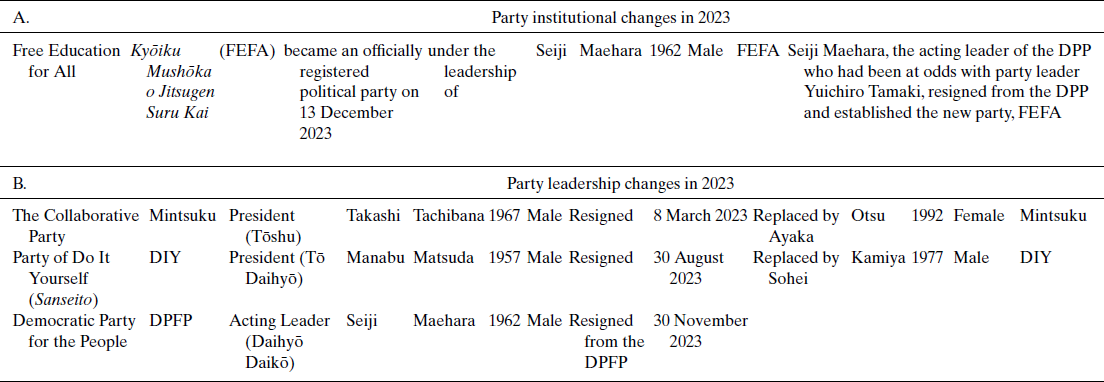
Changes in political parties are shown in Table 4.
Changes in political parties in Japan in 2023

Notes:
1. The Collaborative Party, originally known as the NHK Party, underwent a name change to Seijika Joshi 48 Party on 8 March 2023 and then to The Collaborative Party on 6 November 2023.
2. Seiji Maehara submitted his notice of resignation to the DPP on 30 November 2023 and was formally expelled from the party on 13 December 2023.
Sources: The Asahi Shimbun Online Newspaper Database (2023).
The DPFP underwent a split in November, when Seiji Maehara (see Hino & Ogawa Reference Hino and Ogawa2018: 171) and four other lawmakers left the party over disagreements related to DPFP leader Yuichiro Tamaki's close alignment with the LDP. The DPFP's support for the LDP's supplementary budget and economic stimulus package was the inciting incident for the five lawmakers to resign and form their own party, Free Education for All, under Maehara's leadership.
The only other changes to the party leadership in 2023 were among right-wing fringe parties. The leadership of Sanseito (Party of Do It Yourself) passed to its sole Diet representative, Sohei Kamiya. The leadership of The Collaborative Party (Mintsuku), formerly known as Party to Protect the People from NHK (acronym for Nihon Hōsō Kyōkai, the Japan Broadcasting Corporation), remained in dispute throughout the year, with former leader Takeshi Tachibana resigning in March, but subsequently claiming in April to have expelled new leader Ayaka Otsu from the party—a claim rejected by Otsu, leading the party to effectively have two clashing leaders for the remainder of the year.
Issues in national politics
The Kishida administration continued to face very low levels of public support throughout the year, with opinion polls showing that the low support numbers for both the Cabinet and Prime Minister Kishida himself that had been seen throughout 2022 (see Hino et al. Reference Hino, Ogawa, Fahey and Liu2023), continued to decline in 2023. There was speculation that Kishida could call a snap election in the summer (despite having a remaining mandate of more than two years, see Hino et al. Reference Hino, Ogawa, Fahey and Liu2022) to capitalise on an expected boost in the government's public ratings after hosting the G7 summit in Hiroshima in May, but the improvement in poll numbers reported by the country's major news organisations was both modest and short-lived (Asahi Shimbun Online Newspaper Database 2023; Yomiuri Shimbun Online Newspaper Database 2023), with support for the Kishida Cabinet sliding back below 30 per cent in most polls by July.
Less than a year after the assassination of former Prime Minister Shinzō Abe in July 2022, an attempt was made to assassinate Prime Minister Kishida during a campaign speech for the by-election in Wakayama in April. A home-made pipe-bomb device was thrown at Kishida, who was unharmed after being evacuated by police bodyguards; one bystander and one police officer suffered minor injuries. The man who threw the device, Ryūji Kimura, was detained by locals and police while preparing a second device to throw and was subsequently indicted for attempted murder in September. The incident raised concerns about the security of May's G7 summit, but the international meeting was ultimately held without any major security issues.
In November, the LDP was hit with a new financial scandal related to a so-called ‘slush fund’ of money from political fundraising parties that was returned to politicians in kick-backs for ticket sales, and subsequently underreported to the authorities by both the individual politicians and the party factions involved. The scandal emerged after a criminal complaint led prosecutors to investigate violations of political funding laws. Former Prime Minister Abe's faction, the largest in the party, was particularly strongly implicated in the scandal, leading to the removal and replacement of all four of the faction's Cabinet ministers on 14 December. Later in the month, the headquarters of the Abe faction and the mid-sized Nikai faction were both raided by the National Police Agency, and it was confirmed that five factions were under investigation. This included Kishida's own faction, although he was not personally implicated in the scandal; he subsequently resigned from the faction while remaining party leader. The scandal led to a further decline in the government's approval rating—support for the Cabinet dropped to only 16 per cent in the Mainichi Shimbun's polling in December, with a 79 per cent disapproval rating being the highest ever recorded by the newspaper in the post-war era (Mainichi Shimbun Online Newspaper Database 2023).
Developments in the ongoing war in Ukraine continued to be reported extensively in the Japanese media through 2023. The conflict raised concerns over national security in Japan, not only related to its own territorial dispute with Russia (centred on the Kuril Islands to the north of the country), but also to possible parallels with the tensions between China and Taiwan. These perceived parallels were cited repeatedly by both politicians and media commentators as one of the driving factors behind security legislation passed in the first half of 2023 to allow for further defence spending increases and improve defence cooperation with Australia and the United Kingdom.
Rising consumer prices continued to be a major concern in 2023, with the yen weakening steadily throughout the year and rising above 150 yen to the US dollar in November, matching the 32-year low that had led the Bank of Japan to intervene in the currency markets in the previous year. Inflation reached a 41-year high, with the consumer price index reaching 3.1 per cent for the year, driven by rising food costs and more expensive imports. The government's 13 trillion yen supplemental budget, passed in November, was largely aimed to provide economic stimulus and relief from rising consumer prices.

 Open access

