

Introduction
The principle that all genebank accessions have equal value for conservation because of unknown potential future use has been accepted for many years. Large germplasm collections were assembled to conserve as much diversity as possible before it was lost, either due to rapid replacement of farmer varieties with new improved varieties during the green revolution (Frankel and Bennett, Reference Frankel and Bennett1970) or, more recently, due to the risk of erosion from global threats of population growth, urbanization or climate change (Jarvis et al., Reference Jarvis, Upadhyaya, Gowda, Aggarwal, Fujisaka and Anderson2011). The consequences of mass collection of crop germplasm during the 1970's and 80s has been the creation of large, often poorly characterized and documented, collections of aging seeds that require significant and sustained resources for their conservation, regeneration and safety duplication. This is the challenge facing today's genebank manager.
One approach to better manage large germplasm collections – one that involves challenging the principle of treating all accessions with equal importance – is to stratify their curation as recently accepted as a useful management strategy for use in the genebanks of the Consultative Group on International Agricultural Research (CGIAR) to support efficient use of resources to conserve priority germplasm (CGIAR, 2022). Advantages of the proposed focus on stratified, proactive curation ensures germplasm collections remain relevant and available to support global efforts to sustain future food security. This approach should also ‘free up’ scarce resources for where they are needed to add value to collections, rather than continuing to dedicate resources for conserving accessions which have been de-prioritized.
In this paper, we propose a framework for stratified curation which encourages/empowers incumbent curators to make difficult curation decisions, by providing options for duplicate or non-mandate materials to be archived and for non-unique material to be conserved on a short-term basis. This framework is consistent with the Genebank Standards (FAO, Reference FAO2014), and the International Treaty on Plant Genetic Resources for Food and Agriculture (Plant Treaty) in general, and Article 15 agreements signed by international institutions such as CGIAR Centers to manage their collections under the Plant Treaty framework (ITPGRFA, 2009). This approach is also consistent with, and promotes, rationalization and avoidance of duplication in collections highlighted in the Second Global Plan of Action for Plant Genetic Resources for Food and Agriculture (FAO, 2010). Ideally, in a functioning global system, genebanks should be able to share responsibilities for conservation and be able to rely on each other to conserve specific crops or genepools, so not every genebank needs to conserve the same accession. Further development of the global system with clear responsibilities among participating genebanks would greatly improve the efficiency of conservervation and reduce duplication of effort allowing genebanks to focus on priority germplasm.
Challenges facing crop genebanks
Crop germplasm is conserved ex situ in genebanks, mostly in the form of seeds as a cost effective and long-term conservation method, or in the form of vegetatively propagated collections in field, in vitro and cryopreservation (cryo) genebanks (FAO, Reference FAO2014). Numbers of accessions in ex situ collections grew rapidly between 1970 and 1992 during an era of collecting and growing investment in genebank practices (Halewood et al., Reference Halewood, Jamora, Noriega, Anglin, Wenzl, Payne, Ndjiondjop, Guarino, Kumar, Yazbek, Mchugi, Azevedo, Tchamba, Jones, Venuprasad, Roux, Rojas and Lusty2020). The World Information and Early Warning System on Plant Genetic Resources for Food and Agriculture (WIEWS) (https://www.fao.org/wiews/en/) reported that, by the end of 2021, 5.8 million accessions were conserved ex situ in medium- and long-term storage in 827 genebanks in 115 countries, four regional and 13 international genebanks (FAO, 2022a).
Lack of financial and human resources for genebanks has resulted in significant backlogs in genebank operations with accessions conserved as seeds waiting for viability monitoring, regeneration, safety duplication and health testing, preventing maintenance of seeds in optimal conditions (Bramel et al., Reference Bramel, Giovannini and Dulloo2022). Without continued, reliable funding for operations, many genebanks function today with increasing risk that accessions will lose viability without being tested, regenerated and safety duplicated, posing an alarming question about how much of the unique resources collected in the past are still alive.
Maintenance of germplasm in optimal conditions is the cornerstone of quality genebank management. Different genebanks can and will manage germplasm of different species in different ways consistent with the Genebank Standards and without compromising quality or the goal of long-term conservation and maintenance of genetic integrity. Using limited resources for optimum effectiveness and efficiency is part of active management for sustainable and effective conservation (FAO, Reference FAO2014). Curation involves making accession management decisions based on scientific principles that support the maintenance of maximum diversity in a viable form to make it available to users, using information on phenotypic and genotypic diversity, crop coverage or gaps in collections. With limited funding and the wide range of activities that genebanks pursue, proactive and strategic curation should be based on a transparent decision-making process to determine where to focus resources, and how decisions for prioritization or de-priroitization of accessions are made.
Quality management of ex situ genebanks supported by global genebank standards
Genebank Standards provide international norms and standards for taking a Quality Management Systems (QMS) approach to effective ex situ conservation of PGRFA in seed genebanks, field genebanks, in vitro genebanks and cryopreservation (FAO, Reference FAO2014). These Genebank Standards are underpinned by general principles applicable to all genebanks relating to: (i) identification of accessions; (ii) maintenance of viability; (iii) maintenance of genetic integrity during storage and regeneration; (iv) maintenance of germplasm health; (v) physical security of collections; (vi) availability, distribution and use of germplasm; (vii) availability of information; and (viii) proactive management. The Genebank Standards are intended to be widely applicable to crop genebanks and set the benchmark for current scientific and technical best practices, and reflect the conservation objectives of key international policy instruments for the conservation and use of crop germplasm.
The FAO Practical Guides for the Application of the Genebank Standards for Plant Genetic Resources for Food and Agriculture (Practical Guides) provides guidance for the conservation of orthodox seeds at low temperatures, vegetatively propagated plants in field genebanks and in vitro cultures of meristematic tissues (FAO, 2022b, 2022c, 2022d). Practical guides address some of the unique technical challenges in applying the Genebank Standards to roots, tubers and other vegetatively propagated crops, trees, and crop wild relatives, as well as seed crops. The Genebank Standards and Practical Guides contribute to the development of an efficient and sustainable system of ex situ conservation. Genebanks may use the activities outlined in these guides as a basis to develop Standard Operating Procedures and QMS for conserving germplasm collections, defining in detail how to carry out each activity.
Opportunities for a strategic approach to curation of ex situ crop collections
The Genebank Standards and Practical Guidelines form the overall framework for quality management of ex situ crop collections. Flexibility within that framework supports development of customized approaches to conserving different crops, depending on species, population and genotype biology, collection size and diversity within the crop, within limits of available genebank facilities, staff and financial resources. There is flexibility to use different strategic curation approaches that meet basic objectives of maintaining genetic integrity and viability of individual accessions during long-term conservation while also making diversity available for use. Customized approaches should be informed by important literature concerning routine genebank operations (Engels and Visser, Reference Engels and Visser2003; FAO, Reference FAO2014), seed conservation (Ellis et al., Reference Ellis, Hong and Roberts1985; Rao et al., Reference Rao, Hanson, Dulloo, Ghosh, Nowell and Larinde2006), field and in vitro genebank conservation (Reed et al., Reference Reed, Engelmann, Dulloo and Engels2004), cryopreserved and in vitro genebank conservation (Benson et al., Reference Benson, Harding, Debouck, Dumet, Escobar, Mafla, Panis, Panta, Tay, Van den Houwe and Roux2011a; Reference Benson, Harding, Debouck, Dumet, Escobar, Mafla, Panis, Panta, Tay, Van den Houwe and Roux2011b; Reference Benson, Harding, Debouck, Dumet, Escobar, Mafla, Panis, Panta, Tay, Van den Houwe and Roux2011c) and regeneration (Sackville Hamilton and Chorlton, Reference Sackville Hamilton and Chorlton1997; Dulloo et al., Reference Dulloo, Thormann, Jorge and Hanson2008). These approaches are also consistent with quality management and scientific principles set out in the Genebank Standards.
Stratified curation of a germplasm collection involves strategically tailoring curation activities to specific genebank goals, crops, priorities and resources for each accession based on information about the accession. Strategic and proactive curation supports a more rational and nuanced approach to accession management and is endorsed by the Genebank Standards. Strategic curation enables an improved response to conservation goals and user needs within genebanks and is relevant for all crops maintained in seed, field, in vitro and/or cryo genebanks.
Prioritizing accessions within collections
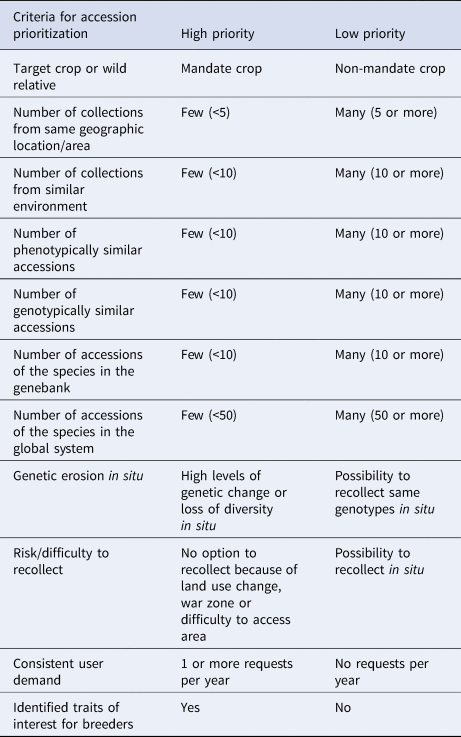
Stratified curation is based on identification of accessions of lower or higher priority for long-term conservation. Criteria for prioritization could include uniqueness of accessions based on area of collection, morphological traits or genetic analysis, amount of diversity and genetic erosion in situ for that part of the genepool and user demand for specific traits inter allia (Table 1). The criteria may be weighted to be crop or accession specific to support the decision-making process. Prioritization will result in some accessions being considered lower priority because of potential duplication or being part of well represented genepools or geographic areas. Information is essential to make the best decision for how best to curate an accession. Careful and accurate prioritization or de-prioritization relies on good passport, characterization and evaluation data for each accession in the genebank. Lack of passport, characterization or evaluation data should not be used to assign accessions to low priority because it can result in potentially useful germplam being discarded. Accessions without passport data should be characterized and evaluated before any decision on their value is made.
Criteria for prioritization of accessions in genebanks
Accession uniqueness is related to geographic collection site and adaptation. Farmer selection over long periods resulted in diverse farmer varieties within an agroecology. Geographic information systems (GIS) modelling passport data have been applied extensively to determine the coverage of the genepool for major crops in genebanks (Castañeda-Álvarez, Reference Castañeda-Álvarez2016) and their wild relatives (Khoury et al., Reference Khoury, Amariles, Soto, Diaz, Sotelo, Sosa, Ramirez-Villegas, Achicanoy, Velásquez-Tibatá, Guarino, Leon, Navarro-Racines, Castañeda-Álvarez, Dempewolf, Wiersema and Jarvis2019) and to make comparisons to diversity in situ as determined by ecogeographic surveys. A conservation gap analysis modelling framework for cultivated crop diversity that takes account of the farmers' role in moving cultivated species outside of their centre of origin has recently been developed by Ramirez-Villegas et al. (Reference Ramirez-Villegas, Khoury, Achicanoy, Mendez, Diaz, Sosa, Debouck, Kehel and Guarino2020). Application of these techniques can inform which accessions are from groups that are already represented by many accessions or from poorly represented groups and therefore potentially of higher priority.
Accession uniqueness is seen in morphological and adaptive traits. Diversity trees, following the concept of core collections, are based on characterization and evaluation data interpreted by experts and farmers to divide diversity within a crop genepool in a hierarchical manner into crop variety groupings. These have been developed for several crop groups (van Treuren et al., Reference Van Treuren, Engels, Hoekstra and van Hintum2009; Global Crop Diversity Trust, 2022) to visualize over and under-representation of genetic diversity within a crop collection. These tools can be applied at genebank level for the prioritization of accessions within a genebank or at a higher level to compare collections between genebanks and to guide acquisition.
Accessions with similar morphology may be genetically similar or genetically distinct. Whole genome sequence or genotyping data combined with phenotyping can be used for discovery of alleles that are unique to accessions as well as identify genetically similar or distinct accessions. Genomic and phenotypic tools have been used to assess representativeness of crop genepools for major crops, including rice (McCouch et al., Reference McCouch, McNally, Wang and Sackville Hamilton2012), wheat (Kabbaj et al., Reference Kabbaj, Sall, Al-Abdallat, Geleta, Amri, Filali-Maltouf, Belkadi, Ortiz and Bassi2017), Aegilops tauschii, a wild progenitor of wheat (Singh et al., Reference Singh, Wu, Raupp, Sehgal, Arora, Tiwari, Vikram, Singh, Chhuneja, Gill and Poland2019), maize (Franco-Duran et al., Reference Franco-Duran, Crossa, Chen and Hearne2019) and banana (Van den Houwe et al., Reference Van den Houwe, Chase, Sardos, Ruas, Kempenaers, Guignon, Massart, Carpentier, Panis, Rouard and Roux2020; Rouard et al., Reference Rouard, Sardos, Sempéré, Breton, Guignon, Van den Houwe, Carpentier and Roux2022). These studies concluded that many genebanks contain genetically similar accessions, due to both recollection of germplasm over time by different collection missions and exchange of germplasm among genebanks (Singh et al., Reference Singh, Wu, Raupp, Sehgal, Arora, Tiwari, Vikram, Singh, Chhuneja, Gill and Poland2019).
User demand, both current and future, can be used to prioritize accessions or groups of accessions within the genebank. While accessions may be prioritized according to use within a defined time period (for example last 10 years), which is important for current food security, it should not be forgotten that diverse germplasm will be needed to meet unknown future demands, which cannot be predicted with any certainty. Therefore, user demand should not overly influence the prioritization process because of its temporal nature. An example of changing demand of two rangeland grass species (Tetrapogon roxburghiana (Schult.) P. M. Peterson and Enteropogon macrostachyus (Hochst. ex A. Rich.)), classed as low or no priority in 2016 (Cook and Schultze-Kraft, Reference Cook and Schultze-Kraft2016) changed to high priority five years later owing to demand for rehabilitation of degraded rangelands in the Arid and Semi-arid Lands of Kenya (KALRO, 2022).
Stratified curation within genebanks
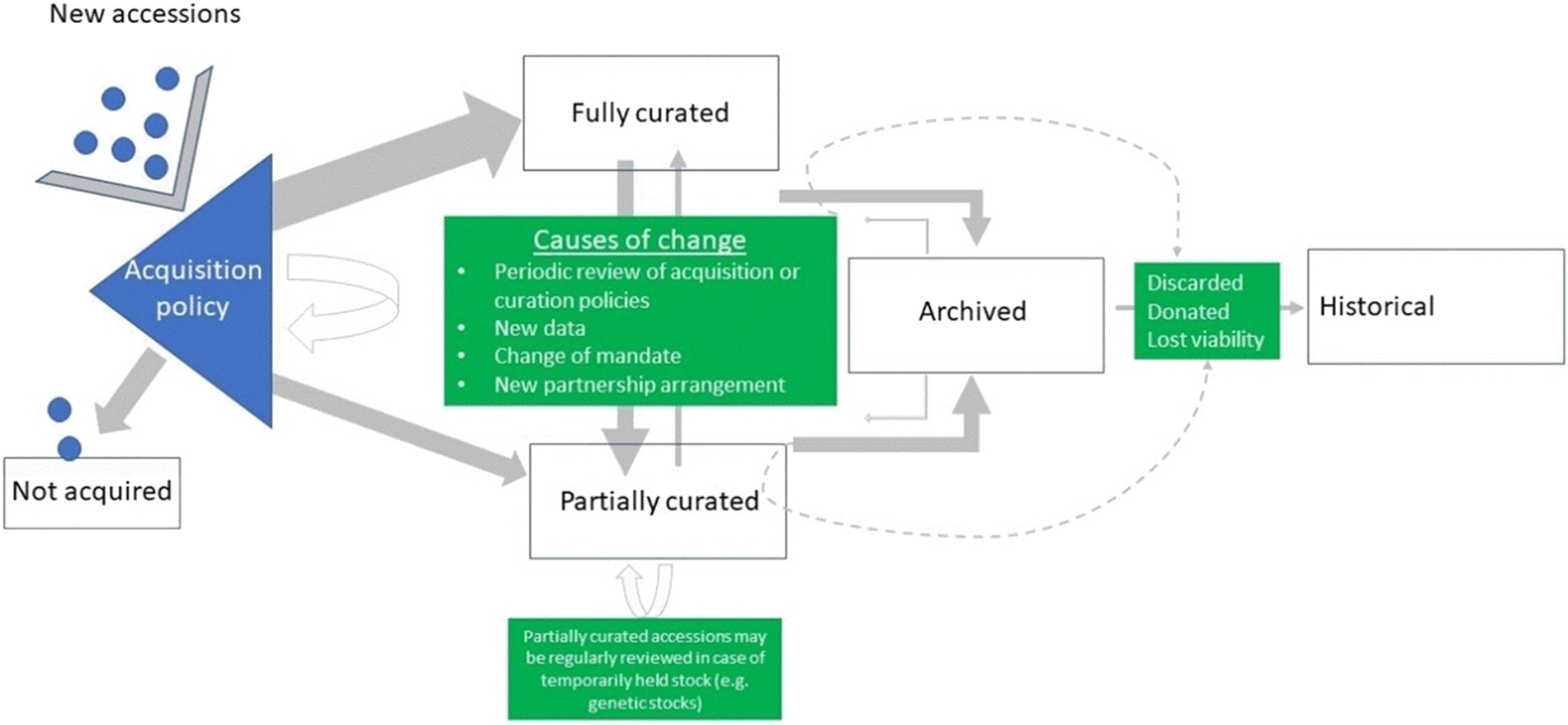
Stratified curation implies using scarce resources for where they are most needed and avoiding expending more resources on accessions which have been de-prioritized. Different curation is needed because numbers of accessions, amount of diversity captured, possibility to collect additional germplasm and threats of genetic erosion in situ vary for accessions, farmer varieties, crop wild relatives, obsolete cultivars and genetic stocks. Stratified curation is an important tool for curation of large germplasm collections and for conservation of wild species and vegetatively propagated germplasm, where conservation costs are generally high. Stratified curation (Fig. 1) recognizes that accessions could be curated in one of three ways.
Relationship between categories of curation.
Full curation
Accessions which have been identified as a priority to represent components or diversity of the crop genepool are managed in full curation in accordance with the Genebank Standards (FAO, Reference FAO2014). This will remain the default curation mode for the majority of accessions conserved as seeds, plants, in vitro cultures or cryopreserved propagules. Accessions are fully curated when they are managed to meet the full set of storage, monitoring, testing and management standards and processes resulting in each accession having sufficient healthy, viable, true-to-type, safety-duplicated germplasm for safe long-term conservation and effective distribution and use. Information on accessions that are fully curated is available directly from the genebank web portal, Genesys (https://www.genesys-pgr.org/) and/or the FAO Global Information System (GLIS) (https://ssl.fao.org/glis/).
Partial curation
Some germplasm, including promising accessions, products of breeding programs, material under development, inbred lines, genetic stocks and/or biparental populations, may be available through the genebank to meet user demand for a limited time period. These accessions are not intended for long-term conservation in the genebank because they do not bring added genetic or other trait value to the crop collection but do require storage and distribution. If stored for a limited time, they may not require viability monitoring, regeneration or safety backup and therefore are subject to only a subset of genebank operations. Information on accessions that are partially curated should be available directly from the genebank or from the genebank's web portal, Genesys and/or GLIS to facilitate use of the accession.
Archived curation
In order to focus scarce resources on the highest priority accessions, a decision can be made to archive de-prioritized accessions (Engels and Visser, Reference Engels and Visser2003) after informing national partners in the country of collection. Archived curation means that the genebank has relinguished responsibility for curation and the accession is no longer available from the genebank. However, rather than immediately discarding them, these accessions are stored under optimal conditions for long-term survival without monitoring or distribution before eventually losing viability or being completely removed from the genebank. Genebanks can also make the decision to donate or safety duplicate seeds of these accessions rather than discard. Archived accessions could be probable duplicates, genetically similar to other fully curated accessions, part of a group of similar accessions from the same collection area, mislabelled accessions or those from non-mandate crops. Information on archived accessions is available directly from the genebank, the genebank's web portal or Genesys, but with an indication that the germplasm is no longer available. The benefit of archiving allows accessions to be retained with minimal management and cost, while keeping the possibility of de-archiving and returning them to fully curated storage within the timeframe determined by the longevity of seeds, plants, in vitro cultures or cryopreserved propagules. Although the exception to the rule, de-archiving accessions could occur if accessions are found to be unique or useful in an unanticipated way, particularly if they are from a large genepool that may not have been fully explored. If there is no further interest in archived accessions, they may be removed from the genebank as space becomes limiting, at which time they would be classified as historical with other accessions which are no longer curated.
Reporting curation decisions
Contracting parties to the Plant Treaty agree to make non-confidential information about accessions in the Multilateral System available through GLIS. GLIS currently includes fields for available/unavailable and historical and physical existence respectively that could be used to show the curation status. Available would cover either fully or partially curated. Unavailable and not historical would cover archived. Temporarily unavailable accessions due to regeneration or disease cleaning are normally classed as available and should not be confused with unavailable, which is a more permanent situation, possibly resulting from access and benefit sharing policies. Historical is only used once the accession is completely removed from that genebank. Currently WIEWS and Genesys do not include information on curation status. However, databases are being adjusted to reflect the reality of stratified curation as it becomes more widely adopted. Genesys is introducing these fields and the CGIAR Centers will also provide, to the Plant Treaty's governing body and the Commission on Genetic Resources for Food and Agriculture, aggregate data on curation status of materials in their ‘Article 15’ collections.
Opportunities for a strategic approach to use of ex situ collections
Another changing dimension to genebanking is the impact of advanced techniques for identifying the genetic basis of traits of interest and developing pre-bred genetic resources to speed up introduction of such traits into breeding pipelines. The challenges of deploying landraces and crop wild relatives as a source of traits in breeding are gradually being overcome through the ability to precisely locate and isolate gene sequences conveying desirable traits for incorporation into improved materials. This has led to a rising demand for pre-bred materials and genotypic and phenotypic information on the diversity of accessions. Demand for genebanks to do more in-depth analysis of accessions and develop specialist collections to support breeders' aims in driving genetic gain is increasing (Diez et al., Reference Díez, De la Rosa, Martín, Guasch, Cartea, Mallor, Casals, Simó, Rivera, Anastasio, Prohens, Soler, Blanca, Valcárcel and Casañas2018; Smale and Jamora, Reference Smale and Jamora2020).
The trends represented by the growth of large collections, lack of adequate resources for their management and the increasing focus on narrower selections of well characterized diversity imposes pressures on the whole system of crop ex situ collections. Long-term conservation of diversity remains a priority but for genebanks to be relevant and useful for contemporary research, collections must be managed more strategically for multiple outcomes. There is a growing well-recognized tension between conservation and use. Traditional ex situ conservation actions are not necessarily compliant with research activities. As a key example, to regenerate good quality seed in sufficient quantities for long-term storage involves managing parameters such as the season, choice of field plot, numbers of plants per accession, planting layout for isolation, treatments for maximum seed production, data gathering and harvest in a defined way that is quite different from how an experimental plot would be laid out and managed for characterization and evaluation for a specific trait. Conservation and research are difficult to combine yet should be complementary. Resources dedicated to conservation activities can take away from evaluation efforts and research and vice versa. A genebank manager has the difficult responsibility of balancing both conservation and use demands with limited resources.
The stratified curation described in this paper represents a sound technical framework by which large collections can be managed more efficiently for both conservation and use outcomes. It is undoubtedly challenging for any genebank manager to consider throwing accessions away. There is ample evidence of useful traits and diversity being discovered in unexpected places (McCouch et al., Reference McCouch, McNally, Wang and Sackville Hamilton2012; Mascher et al., Reference Mascher, Schreiber, Scholz, Graner, Reif and Stein2019). Similarly, apparently genetically identical materials have exhibited phenotypic diversity and vice versa (Castillo et al., Reference Castillo, Gallego-Tévar, Figueroa, Grewell, Vallet, Rousseau, Keller, Lima, Dréano, Salmon and Aïnouche2018). Much remains unknown about the genetic, epigenetic and somaclonal origins of traits, sources of resilience or likely needs for such variation for future demands and uses. Genebanks are typically a bulwark for diversity in all shapes and colours and a safety net to prevent unwise decisions or unpredictable events and trends from causing irreversible losses. It is, therefore, an unnatural action for genebank staff to discard accessions from the collection. However, archiving or de-prioritizing lesser valued materials in a carefully considered way allows genebanks to focus scarce resources on unique and valuable accessions.
Archiving will always be a retrospective and challenging activity since it frequently involves the most resource-hungry and difficult-to-conserve materials that have very little documentation, limited seed viability or seed number. Archiving demands that a minimum amount of information is available on the accession to make an informed decision. Frequently, this requires that the most difficult-to-conserve materials are at least regenerated, characterized and/or genotyped in order to determine whether they are appropriate to archive. Such demanding work can very often detract from the very objective of spending resources strategically and wisely, especially for large collections with little information. Such parts of the collection are like the albatross around the genebank manager's neck, and decisions to archive or discard are frequently delayed due to lack of information.
Looking to the future, there is a strong motivation for all genebanks to have a detailed scope and well-defined acquisition policy and process to prevent the introduction of potentially duplicative, poorly documented germplasm in the first place. These policies should be dynamic and reiterative, so that when new information and acquisitions help fill targeted gaps in collections the acquisition policies are updated. Furthermore, such policies should be shared and coordinated so that different genebanks do not unnecessarily conserve long-term the same subsets, reference materials and duplicates multiple times over. In other cases, duplication between genebanks is intentional as national genebanks are actively involved in repatriation of accessions collected from within their borders that have since been lost and are important sources of crop diversity for farmers and national breeding programmes. Genebanks must also ensure they are fully compliant with applicable national and international access and benefit sharing laws when they acquire, conserve and distribute new materials.
Conclusions
For several decades genebanks have been valiantly conserving crop diversity for use by current and future generations of breeders, researchers and farmers. Collections continue to grow and genebanks could strategically curate collections under their management so that unique materials are better characterized to facilitate their use and conserved for researchers and breeders who need well characterized genetic resources. The framework for stratified curation supports curators to make these difficult decisions to help ensure that germplasm collections remain relevant and used to support global efforts to sustain future food security.
Acknowledgements
The authors wish to thank the CGIAR Genebank Platform for supporting this work. The views expressed in this publication are those of the authors and do not necessarily reflect the views or policies of the Food and Agriculture Organization of the United Nations.


 Open access

