




Introduction
Long-term datasets indicate a global decline in insect abundance and diversity (Hallmann et al. Reference Hallmann, Sorg, Jongejans, Siepel, Hofland and Schwan2017; Laussmann et al. Reference Laussmann, Dahl and Radtke2021). One of the main drivers of insect decline generally is habitat loss due to extensive land modification to accommodate agriculture and urbanisation (Sánchez-Bayo and Wyckhuys Reference Sánchez-Bayo and Wyckhuys2019). Other factors contributing to insect decline are chemical pollutants from pesticides and fertilisers, biotic factors, including pathogens and invasive species, and climate change (Sánchez-Bayo and Wyckhuys Reference Sánchez-Bayo and Wyckhuys2019).
Lepidoptera are among the most affected insect taxa, with examples of severe moth decline observed in the Northern Hemisphere (Wagner et al. Reference Wagner, Fox, Salcido and Dyer2021). The decline in moth abundance and diversity in grassland ecosystems, in particular, demonstrates the sensitivity of this taxon to disturbances (Mangels et al. Reference Mangels, Fiedler, Schneider and Blüthgen2017; Sánchez-Bayo and Wyckhuys Reference Sánchez-Bayo and Wyckhuys2021). At least 75% of the grassland habitat in the Canadian Prairie Provinces has been altered for crop cultivation and livestock production (Shorthouse Reference Shorthouse, Shorthouse and Floate2010). Landscape fragmentation to support intensive monocultures of annual crops and perennial forages is a major driver of the decline in arthropod diversity in agroecosystems (Meehan et al. Reference Meehan, Glassberg and Gratton2013). Agronomic practices, such as crop rotations, soil disturbance through tillage and harvest, and chemical and organic inputs, disturb habitat to a high degree, which impacts insect community structure and population density of pest species (Shennan Reference Shennan2008; Evans and Sanderson Reference Evans and Sanderson2018). Detection of changes in moth diversity and abundance requires systematic monitoring over time.
The order Lepidoptera is one of the most diverse insect taxa in the Prairie Ecozone of Canada, with 2232 species recorded in 61 families (Pohl et al. Reference Pohl, Schmidt, Lafontaine, Landry, Anweiler, Bird, Giberson and Carcamo2014). Moths from the families Geometridae, Erebidae, and Noctuidae represent 78% of the total diversity of macromoth species, and noctuid moths alone, with 693 reported species, make up 28% of the entire lepidopteran fauna in the Canadian Prairies (Pohl et al. Reference Pohl, Schmidt, Lafontaine, Landry, Anweiler, Bird, Giberson and Carcamo2014). Noctuid moths perform important ecological roles in the biotic interactions in prairie habitats. Larvae and adults are food sources for higher trophic levels, including predatory beetles (Frank Reference Frank1971; Cárcamo et al. Reference Cárcamo, Niemalä and Spence1995), spiders (Pearce et al. Reference Pearce, Hebron, Raven, Zalucki and Hassan2004), grassland birds (Maher Reference Maher1979), and insectivorous bats (Vonhof and Hobson Reference Vonhof and Hobson2001). Immature stages of moths serve as hosts to a wide diversity of hymenopteran parasitoids, including wasps in the family Braconidae and Ichneumonidae, and dipteran parasitoids, including flies in the family Tachinidae (Mills Reference Mills1993; Stireman and Singer Reference Stireman and Singer2003). Although often overlooked, noctuid moths also act as generalist nocturnal pollinators in several plant systems and are capable of dispersing pollen over longer distances than other insects typically do (Reynolds et al. Reference Reynolds, Westbrook, Rohde, Cridland, Fenster and Dudash2009; Winfree et al. Reference Winfree, Bartomeus and Cariveau2011). Furthermore, feeding damage by moth larvae can impact plant community structure, which is dependent on the spatial and temporal variation of moth populations (Crawley Reference Crawley1989).
A decrease in moth diversity and abundance can have cascading effects and lead to further losses of plant–animal interactions in grassland ecosystems that could threaten ecosystem services (Wagner et al. Reference Wagner, Fox, Salcido and Dyer2021). The vast majority of lepidopteran species recorded in the Canadian Prairie Provinces (∼98%) have a neutral effect on agricultural production because crop plants either are not larval hosts nor provide valuable ecosystem services to managed systems (Pohl et al. Reference Pohl, Schmidt, Lafontaine, Landry, Anweiler, Bird, Giberson and Carcamo2014; Floate Reference Floate2017). Only a few lepidopteran species (∼25 species) are considered pests of some cereal, pulse, and rapeseed oil crops (Floate Reference Floate2017; Vankosky et al. Reference Vankosky, Cárcamo, Catton, Costamagna and De Clerck-Floate2017). Cutworms and armyworms (Lepidoptera: Noctuidae) are a pest complex in North America that can cause occasional economic damage to several annual crops grown across the Canadian Prairies (Beirne Reference Beirne1971; Floate Reference Floate2017). The larvae and adults are generalist herbivores that feed on a wide range of host species in several plant families. Cutworm damage occurs in early summer when late-instar larvae display characteristic feeding behaviour by cutting the stems of seedlings, which ultimately kills the plant (Beirne Reference Beirne1971). Armyworm injury occurs in mid to late summer. Late-instar larvae feed on foliage and disperse en masse across the landscape in search of host plants when food is depleted (Mason et al. Reference Mason, Arthur, Olfert and Erlandson1998). At low population densities, larval-feeding damage results in crop thinning or bare patches, whereas sporadic outbreaks have caused the complete destruction of entire fields (Beirne Reference Beirne1971). For example, outbreaks of the Bertha armyworm, Mamestra configurata Walter (Lepidoptera: Noctuidae), in canola, Brassica napus Linnaeus) (Brassicaceae), caused yield losses of $Cdn 30 million in 1995 and spraying costs of approximately $Cdn 16.5 million in western Canada in 1994 and 1995 (Mason et al. Reference Mason, Arthur, Olfert and Erlandson1998). The redbacked cutworm, Euxoa ochrogaster (Guenée) (Lepidoptera: Noctuidae), and the pale western cutworm, Agrotis orthogonia (Morrison) (Lepidoptera: Noctuidae), are the most common cutworm species, with localised outbreaks across the Prairie Provinces reported by the Western Committee on Crop Pests (2015, 2016). The diversity and abundance of this pest complex are highly variable and are influenced by regional climate, agricultural practices, moth life history traits, and other factors (Floate and Hervet Reference Floate, Hervet and Reddy2017). Systematic monitoring of cutworm and armyworm populations is necessary to detect and predict population increases and outbreak levels. Moth trap captures can be used as an early warning system to indicate the risk of larval damage and thereby inform producers and scouters of localised areas in which to emphasise larval sampling.
Traps baited with synthetic lures of species-specific female sex pheromones have been used to monitor populations of some lepidopteran pest species (Byers and Struble Reference Byers and Struble1987; Ayre and Lamb Reference Ayre and Lamb1990). However, sex pheromone–baited traps attract only male moths, which may not accurately reflect populations of reproducing females (Byers et al. Reference Byers, Struble and Schaalje1987). Although this approach is useful for monitoring individual species, it is not appropriate for assessing moth diversity. Traps baited with a generalised lure that attracts multiple cutworm and armyworm species, as well as nonpest species, can provide valuable information about the population dynamics of pest species and can document lepidopteran species richness in human-managed ecosystems in the prairie regions across temporal scales.
Light trapping with ultraviolet light sources has often been used to monitor lepidopteran diversity and abundance in agroecosystems (Ayre and Lamb Reference Ayre and Lamb1990; Chey et al. Reference Chey, Holloway and Speight1997; Beck et al. Reference Beck, Schulze, Linsenmair and Fiedler2002). Moth captures in light traps depend on environmental conditions (Yela and Holyoak Reference Yela and Holyoak1997) and the wavelength of the light source (van Langevelde et al. Reference van Langevelde, Ettema, Donners, Wallisdevries and Groenendijk2011; Merckx and Slade Reference Merckx and Slade2014) and require an external power source. Extended day length in summer can reduce moth attraction to light traps in northern latitudes due to natural light reducing moth activity around light traps (Jonason et al. Reference Jonason, Franzén and Ranius2014). Due to these limitations, light trapping assessments generally occur periodically throughout the growing season and may not capture the temporal variation of the moth community assemblage (Lintott et al. Reference Lintott, Bunnefeld, Fuentes-Montemayor, Minderman, Blackmore, Goulson and Park2014).
Food-based semiochemicals attract both male and female moths and have potential as lures to detect and monitor noctuid moth diversity and pest noctuid species (Joyce and Lingren Reference Joyce and Lingren1998). In contrast to the limitations of light trapping, traps baited with food-bait lures remain in place throughout the growing season to survey moth populations and to gather information on seasonal flight patterns. Fermented sugars were some of the first food-bait lures used to monitor lepidopteran diversity. Utrio and Eriksson (Reference Utrio and Eriksson1977) trapped several macrolepidopteran species with individual and mixtures of volatile compounds (simple alcohol, acids, esters, and aldehydes) released from fermented sources of multiple sugars. A mixture of two fermented sugar byproducts, acetic acid and 3-methyl-1-butanol (AAMB), has been used to monitor the diversity and abundance of moths in multiple cropping systems (Landolt et al. Reference Landolt, Pantoja, Hagerty, Crabo and Green2007, Reference Landolt, Adams, Zack and Crabo2011). Several pest species from the cutworm and armyworm complex are attracted to AAMB lures, including the Bertha armyworm (Landolt Reference Landolt2000), true armyworm, Mythimna unipuncta (Haworth) (Landolt and Higbee Reference Landolt and Higbee2002), and the redbacked cutworm (Landolt et al. Reference Landolt, Pantoja, Hagerty, Crabo and Green2007). Food-bait lures comprised of volatile compounds, including phenylacetaldehyde and benzaldehyde, released from flowers visited by noctuid moths have been used to monitor populations of the cabbage looper, Trichoplusia ni (Hübner) (Cantelo and Jacobson Reference Cantelo and Jacobson1979), alfalfa looper, Autographa californica (Speyer) (Guédot et al. Reference Guédot, Landolt and Smithhisler2008), and the soybean looper, Chrysodeixis ubcludens (Walker) (Meagher Reference Meagher2001). Although fermented sugar baits and lures releasing floral volatiles attract a broad group of noctuid moths, responses to food-based semiochemicals by different lepidopteran taxa may differ.
Our previous work (Batallas and Evenden Reference Batallas and Evenden2023) assessed the attractiveness of food-bait lures compared to sex pheromone–baited traps to noctuid pest species in the prairies. In the present study, we report on the diversity (number of species captured in traps) and abundance of all noctuid moths captured in traps baited with food-based semiochemicals derived from fermented sugar byproducts and floral volatiles compared to the diversity and abundance of noctuid moths captured in sex pheromone–baited traps. Specifically, we asked the following questions: (1) Does lepidopteran species composition vary in relation to the annual crop grown in the current season? and (2) Do food-based semiochemicals from fermented sugar baits or floral volatiles influence the attraction and capture of different lepidopteran taxa? We evaluate differences in species composition of moths sampled in two cropping systems – canola, Brassica napus Linnaeus (Brassicaceae), and wheat, Triticum aestivum Linnaeus (Poaceae) – in central Alberta, Canada. We examine differences in lepidopteran taxa – specifically moths within the subfamily Noctuinae – attracted to AAMB lures alone and to traps baited with additional food-based semiochemicals. We hypothesised that (1) noctuid moth species composition would be similar in canola and wheat fields, reflecting a generalised moth community in human-managed ecosystems due to the annual levels of disturbance and the strong dispersal capabilities of moths, and (2) noctuid moths would be attracted to traps baited with volatiles from fermented sugar baits because noctuid moths use microbial volatile organic compounds as semiochemicals to locate food resources.
Despite the important role of noctuid moths in prairie ecosystems, information on the impact of agronomic practices on the status of moth diversity and abundance in agricultural ecosystems is lacking. Moth community composition can be used as a bioindicator to reflect the state of disturbance in agricultural ecosystems and to improve management strategies (Olfert et al. Reference Olfert, Johnson, Brandt and Thomas2002).
Methods
Study area
Experiments were conducted in 2014 and 2015 in wheat and canola fields located in the Aspen Parkland Ecoregion of Alberta, Canada. The landscape is dominated by extensive agricultural plains with discontinuous clusters of trembling aspen, Populus tremuloides Michaux (Salicaceae), and balsam poplar, P. balsamifera Linnaeus (Salicaceae) (Shorthouse Reference Shorthouse, Shorthouse and Floate2010). Seven sites separated by at least 20 km were selected over an area of approximately 7350 km2 in central Alberta (Supplementary material, Fig. S1). Each site comprised a commercial canola field paired with a commercial wheat field, approximately 500 m distant from each other. Each field was an experimental unit, and the size of each field was 0.65 km2. Experiments were conducted at the same sites in both years, but crops grown in the two years were rotated between fields.
Lures
All experiments compared moth diversity in traps baited with food-bait lures or synthetic female sex pheromone lures (Table 1). The sex pheromone lures of the cutworm and armyworm species targeted in the present study (Table 1) are commercially available as red rubber septa loaded by and purchased from Contech Enterprises Inc. (Delta, British Columbia, Canada). Food-bait lures were prepared in 15-mL narrow-mouth Nalgene HDPE bottles (Thermo Scientific, Rochester, New York, United States of America), following the methods of Landolt et al. (Reference Landolt, Pantoja, Hagerty, Crabo and Green2007). The AAMB lure consisted of AAMB in a 50:50 by weight mixture (glacial acetic acid, 99.7% purity; Fisher Scientific, Fair Lawn, New Jersey, United States of America; and 3-methyl-1-butanol, 98.5% purity; Sigma Aldrich, St. Louis, Missouri, United States of America). Ten millilitres of the AAMB lure were loaded into each bottle, followed by two cotton balls to prevent spilling. A 3.0-mm-diameter hole in the centre of the bottle cap allowed for the release of volatile compounds.
Lure composition and deployment schedule for noctuid moth monitoring experiments in canola and wheat fields in central Alberta, Canada, in 2014 and 2015. Experiments evaluated noctuid moth diversity and abundance captured in traps baited with food-bait lures from fermented sugar byproducts and floral volatiles compared to sex pheromone–baited traps

Monitoring and moth identification
All experiments used nonsaturating green universal moth traps (Unitrap, Contech Enterprise Inc. Delta, British Columbia, Canada), baited with either a sex pheromone or a food-bait lure. At each site, unitraps were placed in a linear transect separated by 25 m and positioned 5 m into the field from the edge, at a height of 1.5 m above ground. One replicate of each of the treatments was randomly assigned to traps along the transect in each field at each site. Sex pheromone lures were placed inside baskets attached to the lid of the unitrap and replaced every four weeks. Food-bait lures were attached to the inside of the unitrap bucket with a twist tie and replaced every two weeks. An insecticidal strip of Hercon Vaportape II (10% dichlorvos; Hercon Environmental, Emigsville, Pennsylvania, United States of America) was placed in each trap bucket to kill captured insects and was replaced every four weeks.
Insect trap–catch was collected weekly and frozen at –20 °C until sorting and identification. Moths were separated by sex and pinned. Genitalic dissections were performed on specimens in poor condition (i.e., no scales on wings or missing body parts), following Hardwick’s (Reference Hardwick1950) methods (Batallas and Evenden Reference Batallas and Evenden2023). Moth genitalia were spread and mounted on cardstock (2.0 × 0.5 cm) with an Euparal mounting medium (Bioquip Products Inc., Rancho Dominguez, California, United States of America). Moths were identified to species through wing maculation and morphological characters of genitalia, following taxonomic keys from Lafontaine (Reference Lafontaine1987, Reference Lafontaine1998, Reference Lafontaine2004), Lafontaine and Robert (Reference Lafontaine and Robert1991), and Mikkola et al. (Reference Mikkola, Lafontaine and Gill2009). Identifications were verified using comparisons with reference collections at the E.H. Strickland Entomological Museum (University of Alberta, Edmonton, Alberta, Canada). Pinned moths in the best condition and mounted genitalia dissections from each identified species were selected as voucher specimens and deposited at the E.H. Strickland Entomological Museum.
Experiment 1: moth diversity in synthetic sex pheromone– and AAMB-baited traps
Experiment 1 assessed AAMB lures for monitoring noctuid moth diversity in canola and wheat fields. Sex pheromone–baited traps for cutworm and armyworm pest species were also erected at sites to determine if pest moths were present in the field at the time of the experiment. Unitraps were baited with redbacked cutworm pheromone (canola pest), Bertha armyworm pheromone (canola pest), true armyworm pheromone (cereal pest), army cutworm, E. auxiliaris (Grote), pheromone (canola and wheat pest), or AAMB lure or were left unbaited (Table 1). Six baited traps (one trap per treatment per field; Table 1) were positioned in a 125-m linear transect, as described above, in random order in both canola and wheat fields at each of the seven sites. The experiment was conducted from 10 June to 10 October 2014. Sex pheromone–baited traps were deployed in the field according to the flight period of the target moth species (Table 1), whereas the AAMB-baited and unbaited traps remained in the field throughout the 17-week sampling period to assess moth diversity in general. Moths captured in the differently baited traps were identified to species, and analyses were conducted on the total number of moths captured per lure type in the respective trap. Moth diversity and abundance in the sex pheromone–baited traps were used to evaluate the specificity of each synthetic sex pheromone lure. The diversity and abundance of moths captured in the AAMB-baited traps were compared to those captured in the unbaited control traps.
Experiment 2: moth diversity in traps baited with food-based semiochemicals
Experiment 2 evaluated the diversity and abundance of noctuid moths attracted to AAMB lures with and without the addition of other food-based compounds. Tóth et al. (Reference Tóth, Szarukán, Dorogi, Gulyás, Nagy and Rozgonyi2010) demonstrated that the combination of AAMB lures with 2-methyl-1-propanol or phenylacetaldehyde attracts multiple noctuid species in Europe. We tested these two compounds to enhance the attraction of AAMB lure to monitor cutworm and armyworm pests present in the central Alberta region. Compounds tested in conjunction with AAMB lure included an alcohol fermentation byproduct from sugar baits, 2-methyl-1-propanol (MP, > 99% purity; Acros Organics, Fair Lawn, New Jersey), and a floral volatile, phenylacetaldehyde (PAA, > 98% purity; Acros Organics). Treatments included AAMB alone, AAMB + MP, AAMB + PAA, and AAMB + MP + PAA, as well as an unbaited trap that served as the control. All lures were prepared in the laboratory in a mixture of equal proportions by weight (Table 1). Ten millilitres of the chemical mixtures were loaded in Nalgene HDPE bottles, as previously described (see Lures subsection). In addition to the different food-bait lures, sex pheromone–baited traps targeting redbacked cutworm, Bertha armyworm, pale western cutworm, and true armyworm were deployed to ensure target moths were present in the field at the time of the experiment (Table 1). Nine baited traps (one trap per treatment per field), including those with the pheromone and food-bait lures, and the unbaited trap were positioned in random order in a 200-m linear transect, as described above, in each canola field and each wheat field at each of the seven sites. The experiment was conducted from 22 June to 15 September 2015. Noctuid moth trap catch was identified to species, and analyses were conducted on the total number of moths captured over the sampling season. Results focused on comparing the moth trap catch from the different food-bait lures and unbaited traps.
Statistical analyses
For experiment 1, we determined the specificity of the sex pheromone lures to monitor target moths. Moth trap catch was separated into two groups: target moths and nontarget moths. The percentage of target moths captured in sex pheromone–baited traps was calculated, based on the total moth trap catch ((total number of target moths/total moth trap catch) × 100) for each of the sex pheromone lures tested. Lure specificity was analysed in a binomial count model in which the response variable is a two-vector object comprised of the count of target moths as the first vector (success) and the count of nontarget moths as the second vector (failure). The two-vector response variable was analysed in a generalised linear mixed model with binomial family distribution with the “glmer” command in R package’s lme4, version 1.1-17 (Bates et al. Reference Bates, Maechler and Bolker2015). Crop and sex pheromone lure were specified as explanatory fixed variables, and site was specified as a random block factor.
For both experiments, several analyses compared the total capture of moths in food-bait lures and unbaited traps. A nonmetric multidimensional scaling (“Bray–Curtis” distance) analysis was conducted (1) to determine the diversity of moth species attracted to the food-bait lures compared to the unbaited traps and (2) to evaluate differences in moth species composition sampled in canola fields and in wheat fields. A nonparametric permutation analysis of variance (ADONIS, “Bray” distance) was performed to define the variation in moth species composition explained (R 2) by crop type and food-bait lure treatment. Additionally, two separate analyses of similarities (“Bray” distance) were conducted to determine differences in moth diversity and abundance based on trap treatment and crop type. Similarities analysis compares the mean rank distances between and within the levels of a factor. If the levels of a factor differ significantly, then the dissimilarities between levels are greater than the dissimilarities within levels (analyses of similarities statistic: R-value = 1.0; P < 0.05). Similar analyses were conducted separately, focusing on species from the cutworm and armyworm pest complex to determine the effectiveness of AAMB-baited traps compared to that of unbaited traps (experiment 1) and to determine the diversity of trap capture in response to AAMB lures with additional food-based semiochemical compounds (experiment 2).
For both experiments, moth trap catch was grouped by family and subfamily to compare differences in attraction to food-bait lures by moth taxonomic group. Analyses were conducted on the total number of Noctuinae moths by tribe to compare moth capture in traps baited with the different food-based semiochemicals and that in unbaited traps. Noctuinae moth capture was analysed in a generalised linear mixed model (negative binomial family distribution) with the “glmer.nb” command in the R package, lme4, version 1.1-17 (Bates et al. Reference Bates, Maechler and Bolker2015). Crop, food-bait lure treatment, and Noctuinae tribe were specified as explanatory fixed variables, and site was specified as a random block factor.
For all statistical analyses, models were first fit as full models, in which the fixed factors included the main effect of all relevant explanatory variables and all possible interactions. For all models, model simplification was performed in a step-wise a posteriori procedure by removing nonsignificant interaction terms and comparing nested models through likelihood ratio (LR) χ 2 tests with the “anova” command in the R package, car, version 3.0-0 (Fox and Weisberg Reference Fox and Weisberg2011). The optimal model was selected using Akaike’s information criterion. Test statistic values, degrees of freedom, and P-values were obtained from the “anova” function in the R package, car, version, 3.0-0. The “anova” command produces analysis of variance tables from models created by “glmer” commands. Wald χ 2 tests are calculated for linear mixed models, and LR χ 2 are calculated for generalised linear models. A comparison of means for all experiments was performed using Tukey’s method (α = 0.05) with the package lsmeans, version 2.17 (Lenth and Hervé Reference Lenth and Hervé2015). All statistical tests were conducted using the freely available statistical package R, version 3.1.0 (R Core Team 2014), in RStudio, version 0.98 (http://www.rstudio.com).
Results
Experiment 1: moth diversity in synthetic sex pheromone– and AAMB-baited traps
Specificity of synthetic sex pheromone–baited traps
The redbacked cutworm, E. ochrogaster, was the most abundant captured species of the target pests in sex pheromone–baited traps. Redbacked cutworm sex pheromone–baited traps captured, on average, 1077.5 ± 407.3 (standard error) E. ochrogaster males per trap per site throughout the sampling period. The Bertha armyworm, M. configurata, was the second most abundant target species. Bertha armyworm sex pheromone–baited traps captured, on average, 89.7 ± 33.9 (standard error) M. configurata males per trap per site throughout the sampling period. The true armyworm, Mythimna unipuncta, and the armyworm cutworm, E. auxiliaris, were the least abundant target species. True armyworm sex pheromone–baited traps captured, on average, 1.4 ± 0.5 (standard error) M. unipuncta males per trap per site, whereas army cutworm sex pheromone–baited traps captured, on average, 0.4 ± 0.4 (standard error) E. auxiliaris males per trap per site.
No significant differences were found in the specificity of sex pheromone lure–baited traps between canola fields and wheat fields (Wald χ 2 = 0.29, df = 1, P = 0.591). However, the specificity of the sex pheromone lures differed significantly among cutworm or armyworm species (Wald χ 2 = 242.47, df = 3, P < 0.001; Fig. 1). Redbacked cutworm sex pheromone lures had the highest specificity, with which E. ochrogaster represented 95.2% of the total moth trap catch. Plusia putnami Grote (Lepidoptera: Noctuidae) was the most abundant nontarget species captured in redbacked cutworm sex pheromone–baited traps (3%; Supplementary material, Table S1). Plusia putnami male moths were captured in redbacked cutworm sex pheromone–baited traps in early summer, from 30 June to 5 August 2014, whereas E. ochrogaster male moths were captured later in the season, from 22 July to 10 October 2014. Bertha armyworm sex pheromone lures were less specific, with only 63.3% of the total trap capture being M. configurata. Apamea cogitata (Smith) (Lepidoptera: Noctuidae) was the most abundant nontarget species in Bertha armyworm sex pheromone–baited traps (26%; Table S1). Both M. configurata and A. cogitata were captured in Bertha armyworm sex pheromone–baited traps from 24 June to 29 July.
Sex pheromone lure specificity (experiment 1) expressed as a percentage (%) of target species captured in sex pheromone–baited traps from the total moth trap catch. RBC, redbacked cutworm, Euxoa ochrogaster; BAW, Bertha armyworm, Mamestra configurata; TAW, true armyworm, Mythimna unipuncta; ACW, army cutworm, Euxoa auxiliaris.

The army cutworm sex pheromone lure had low specificity, with E. auxiliaris representing only 28.4% of the total moth trap catch. This low specificity, however, may be a result of the low population density of the target species across all fields. Army cutworm sex pheromone–baited traps captured, on average, 2.1 ± 1.8 (standard error) moths per trap across all sites throughout the season. True armyworm sex pheromone lures had the lowest specificity of the tested lures, with M. unipuncta representing only 0.3% of the total moth trap catch. True armyworm sex pheromone–baited traps captured high numbers of E. ochrogaster (67%), Helatropha reniformis Grote (Lepidoptera: Noctuidae) (12%), A. inficita Walker (10%), and Anarta trifolii (Hugnagel) (Lepidoptera: Noctuidae) (4%; Supplementary material, Table S1). The low capture of M. unipuncta male moths in sex pheromone–baited traps may be a result of the low specificity of the synthetic pheromone lure and the low population density of the target species across all fields.
Diversity of moths captured in AAMB-baited traps
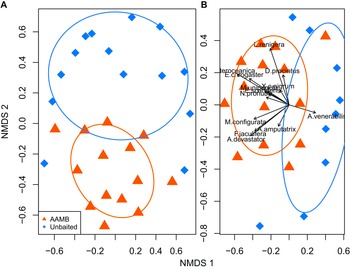
The AAMB-baited traps captured, on average, 70.6 ± 18.1 (standard error) moths per trap per site throughout the sampling period, whereas unbaited traps captured 18.4 ± 10.3 (standard error) moths per trap per site. In total, 54 macro-Lepidoptera species were captured in the AAMB-baited and the unbaited traps (Supplementary material, Table S2). Crop type explained only 5% of the variation in species composition (ADONIS R 2 = 0.03; P = 0.34), whereas lure type explained 15% of the variation in species composition (ADONIS R 2 = 0.15; P = 0.001). No significant difference was observed in the species composition of moths captured in traps deployed in canola fields compared to in wheat fields (analysis of similarities R = 0.01; P = 0.267). Only one species, Mythimna oxygala (Grote) (Lepidoptera: Noctuidae), was more abundant in traps positioned in wheat fields than in canola fields. The AAMB-baited traps captured a higher number of species (canola: 35 spp.; wheat: 42 spp.) than unbaited traps did (canola: 28 spp.; wheat: 21 spp.; analysis of similarities R = 0.365; P = 0.001; Fig. 2A).
Nonmetric multidimensional scaling for the diversity of moths attracted to the acetic acid and 3-mehtyl-1-butanol (AAMB) lure compared to unbaited traps: A, all noctuid moth species (NMDS, stress = 0.265; R 2 = 0.511), and B, cutworm and armyworm species only (NMDS, stress = 0.209; R 2 = 0.656).

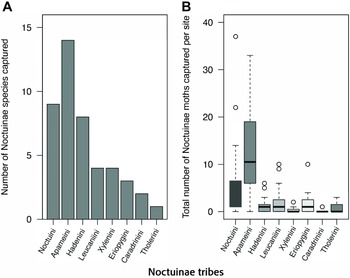
Moths within the Noctuidae family were the most diverse and abundant group attracted to the AAMB-baited traps (47 spp.). Other moth families included Drepanidae (Habrosyne scripta Gosse), Erebidae (Ctenucha virgina Esper), and Sphingidae (Darapsa choerlus Cramer); however, moths from these families were captured in low numbers in AAMB-baited traps (Supplementary material, Table S2). Noctuinae moths were the most diverse and abundant subfamily attracted to the AAMB lure (44 spp.), whereas only a few specimens from Plusiinae (Anagrapha falcifera Kirby) and Acronictinae (Acronicta americana Harris and Acronicata superans Guenée) were captured. Moths from eight Noctuinae tribes were captured in the AAMB-baited traps (Fig. 3A and B). Apameini moths were the most diverse and abundant tribe captured, followed by Noctuini moths. Moths from the tribes Leucaniini, Eriopygini, Tholerini, and Hadenini were trapped in lower numbers, and Xylenini and Caradrinini moths were the least represented tribes. The most abundant species were A. cogitata (15.4%), Enargia decolor (Walker) (14%), Amphipoea interoceanica Smith (12.4%), Feltia jaculifera (Guenée) (7.9%), E. ochrogaster (7.9%), Helatropha reniformis (Grote) (5.3%), and Apamea devastator (Brace) (3.1%).
Diversity and abundance of Noctuinae moth tribes captured in traps baited with acetic acid and 3-methyl-1-butanol (AAMB): A, barplot of the total number of Noctuinae species by tribe, and B, boxplot of the total number of Noctuinae moths by tribe. The midline indicates the median; the top and bottom of the box indicate the first and third quartiles, respectively; the vertical line or whiskers represent the maximum value or 1.5 interquartile range of the data.

An independent analysis compared the total numbers of Noctuinae moths by tribe captured in the AAMB-baited traps and the unbaited traps. The AAMB-baited traps captured more Noctuinae moths in wheat fields (66.4 ± 17.3 (standard error) moths/trap/site) than in canola fields (37.6 ± 7.5 (standard error) moths/trap/site), whereas unbaited traps captured similarly low numbers of Noctuinae moths in both crops (crop × lure type, Wald χ 2 = 8.78, df = 1, P = 0.003). The AAMB-baited traps captured a significantly higher abundance of Noctuinae moths than unbaited traps did, except for moths from the Caradrinini tribe, which were found in similarly low numbers in both trap types (lure type × tribe, Wald χ 2 = 73.23, df = 7, P > 0.001).
The AAMB-baited traps captured a significantly higher diversity and abundance of species of the cutworm and armyworm pest complex than did the unbaited traps (analysis of similarities R = 0.400; P = 0.001; Fig. 2B). These pests represented on average 42.60% of the total moth trap catch in the AAMB-baited traps per site. The most abundant pest species included the strawberry cutworm, A. interoceanica (13.3%), dingy cutworm, F. jaculifera (9.5%), redbacked cutworm (8.9%), glassy cutworm, A. devastator (2.8%), true armyworm (2.9%), and bronzed cutworm, Nephelodes minians Guenée (5.2%). Less abundant species (< 2.0%) captured were the Bertha armyworm, bristly cutworm (Lacinipolia renigera (Stephens)), spotted cutworm (Xestia c-nigrum Linnaeus), the invasive pest winter cutworm (Noctua pronuba Linnaeus), white cutworm (Euxoa scandens (Riley)), yellow-headed cutworm (Apamea amputatrix (Fitch)), and olive-green cutworm (Dargida procinctus Grote). Dusky cutworm, Agrotis venerabilis Walker, was also captured in the AAMB-baited traps in low numbers; however, more dusky cutworm moths were found in unbaited than in AAMB-baited traps.
Experiment 2: moth diversity in traps baited with food-based semiochemicals
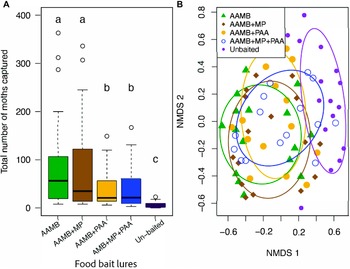
Moth trap catch significantly differed among the food-bait lure traps and unbaited traps (Wald χ 2 = 269.63, df = 4, P < 0.001). Traps baited with AAMB alone and with AAMB + MP lures captured twice the total number of moths than did traps baited with AAMB + PAA lures or with AAMB + MP + PAA lures, and unbaited traps captured the fewest moths (Fig. 4A). Traps baited with AAMB alone and with AAMB + MP lures captured, on average, 173.4 ± 45.34 (standard error) and 163.25 ± 46.41 (standard error) moths per trap per site, respectively, whereas traps baited with AAMB + PAA lures and with AAMB + MP + PAA lures captured 82.5 ± 19.4 (standard error) and 83.1 ± 21.91 (standard error) moths per trap per site, respectively. The unbaited traps captured, on average, 12.4 ± 1.5 (standard error) moths per trap per site throughout the sampling period. In total, 76 macro-Lepidoptera species were captured in all traps across all sites (Supplementary material, Table S3). Crop type explained 2% of the variation in species composition (ADONIS R 2 = 0.02; P = 0.059), and lure type explained 16% of the variation in species composition (ADONIS R 2 = 0.16; P = 0.001). No significant difference was found between the species composition of moths captured in traps in canola fields and traps in wheat fields (analysis of similarities R = 0.00; P = 0.282). Food-bait lure traps captured a significantly higher number of species and abundance of moths compared to what unbaited traps captured (analysis of similarities R = 0.20; P = 0.001); however, species composition of moths did not vary among the traps baited with the different food-bait lures (analysis of similarities R = 0.01; P = 0.287; Fig. 4B).
A, Boxplots of the total number of moths captured in acetic acid and 3-methyl-1-butanol (AAMB) lures with additional food-based semciochemical compounds. The midline indicates the median; the top and bottom of the box indicate the first and third quartiles, respectively; the vertical line or whiskers represent the maximum value or 1.5 interquartile range of the data. Boxplots marked with different letters are statistically different (Tukey method, α = 0.05). B, Nonmetric multidimensional scaling (NMDS, stress = 0.214; R 2 = 0.7182) for the diversity of moths attracted to AAMB lure with and without additional food-based semiochemical compounds. Tested chemicals were an alcohol from fermented byproducts, 2-methyl-1-propanol (MP), and a floral volatile, phenylacetaldehyde (PAA). Treatments included AAMB alone, AAMB + MP, AAMB + PAA, AAMB + MP + PAA, and an unbaited trap that served as control.

Moths within the Noctuidae family were the most diverse and abundant group found to be attracted to food-bait lures (67 spp.). Other families included Erebidae (3 spp.), Sphingidae (2 spp.), Cambridae (1 sp.), Geometridae (1 sp.), and Hesperiidae (1 sp.); however, few individuals from these families were captured in the traps with different food-bait lure combinations (Supplementary material, Table S3). Noctuinae moths were the most diverse subfamily attracted to the food-bait lures (62 spp.), whereas only a few specimens from Plusiinae (4 spp.) and Acronictinae (1 sp.) were captured in the baited traps (Supplementary material, Table S3). Moths from eight Noctuinae tribes were captured in the different food-bait lure traps. Apameini was the most diverse and abundant tribe, followed by Noctuini and Eriopygini. Several species from the tribes Leucaniini, Tholerini, and Hadenini were trapped, and very few species in the Xylenini and Caradrini tribes were captured (Supplementary material, Fig. S2).
An independent analysis compared the total numbers of Noctuinae moths by tribe captured in the different food-bait lure traps and unbaited traps placed in canola and wheat fields. A marginally significant interaction was revealed between crop and lure type (crop × lure type, Wald χ 2 = 9.40, df = 4, P = 0.052) that affected the total Noctuinae moth trap catch. In both canola and wheat fields, Noctuinae captures in traps baited with the various food-bait lures were significantly higher than those in unbaited traps. Interestingly, the different food-bait lures captured similar numbers of Noctuinae moths in canola fields, whereas, in wheat fields, more Noctuinae moths were captured in traps baited with either AAMB or with AAMB + MP than in traps baited with AAMB + PAA or with AAMB + MP + PAA.
A significant interaction was found between the crop and Noctuinae tribe (crop × tribe, Wald χ 2 = 17.48, df = 7, P = 0.016) on moth capture. The number of moths captured from different Noctuinae tribes depended on the type of crop in which the traps were positioned. More Apameini, Eriopygini, and Leucaniini moths were captured in traps located in wheat fields than in traps located in canola fields, whereas moths from the tribes Noctuini, Hadenini, Tholerini, Xylenini, and Caradrini occurred equally in traps positioned in both crops. Lastly, a significant response of Noctuinae moths to food-bait lures was observed depending on the tribe (lure type × tribe, Wald χ 2 = 130.91, df = 28, P < 0.001). The AAMB and the AAMB + MB lures attracted more Apameini, Hadenini, and Tholerini moths than did traps baited with fermented byproducts food-bait lures with floral volatiles (Supplementary material, Fig. S3A, E, and F). Noctuini, Eriopygini, and Leucaniini moths were similarly captured in all traps baited with food-bait lures (Supplementary material, Fig. S3B, C, and D). The number of Caradrini and Xylenini moths did not differ between the food-bait lures and the unbaited traps (Supplementary material, Fig. S3G and F).
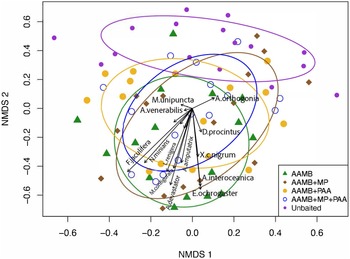
Traps baited with AAMB lures with additional food-based chemicals captured a significantly higher number of species in the cutworm and armyworm pest complex than did unbaited traps (analysis of similarities R = 0.16; P = 0.001). Traps baited with AAMB and with AAMB + MP lures captured significantly higher proportions of pest species (43.1% and 46.1%, respectively) out of the total moth trap catch than did traps baited with AAMB + PAA or with AAMB + MP + PAA lures (41.7% and 37.2%, respectively; Wald χ 2 = 17.36, df = 3, P < 0.001). Several cutworm species, however, were more attracted to AAMB and to AAMB + MP lures than they were to lures containing phenylacetaldehyde, including the dingy cutworm, redbacked cutworm, glassy cutworm, strawberry cutworm, and bronzed cutworm (Fig. 5).
Nonmetric multidimensional scaling (NMDS, stress = 0.193; R 2 = 0.765) for the diversity of cutworm and armyworm species attracted to acetic acid and 3-methyl-1-butanol (AAMB) lure with and without additional chemical compounds. The tested chemicals were an alcohol from fermented byproducts, 2-methyl-1-propanol (MP), and a floral volatile, phenylacetaldehyde (PAA). Treatments included: AAMB alone, AAMB + MP, AAMB + PAA, AAMB + MP + PAA, and an unbaited trap that served as control.

Discussion
At least 2308 lepidopteran species occur in Alberta, representing 17% of the known lepidopteran diversity in North America (Pohl et al. Reference Pohl, Anweiler, Schmidt and Kondla2010). There are 402 macromoths species recorded in the grassland in Alberta (Pohl et al. Reference Pohl, Anweiler, Schmidt and Kondla2010). In the present study, traps baited with food-bait lures based on volatiles from byproducts of fermented sugar baits captured 67 lepidopteran species, which represent 16% of the recorded macromoth species in this ecoregion. In the Prairie Ecozone, parkland and grasslands are particularly rich in noctuid moth species, and many species do not occur elsewhere in Canada (Pohl et al. Reference Pohl, Anweiler, Schmidt and Kondla2010). Only a small portion of the parkland and grassland ecoregions remain in a natural state due to modification of the landscape for agriculture and pastureland. It is therefore important to monitor lepidopteran diversity and abundance in this disturbed landscape.
The specificity of the commercially available synthetic sex pheromone lures varied among the tested pest species. The sex pheromone lures of the redbacked cutworm and Bertha armyworm were the most specific to capturing the targetted pests. As expected, the sex pheromone–baited traps captured larger numbers of target moths than did any of the food-bait lures; however, farmers did not report damage the following crop season. The sex pheromone lures of the army cutworm and true armyworm had the lowest specificity in attracting the target species; however, this may be a result of the low population density across all sampled fields. Although female-produced sex pheromones are known for most pest species in the region (Steck et al. Reference Steck, Underhill and Chisholm1982), pheromone-based monitoring of several cutworm and armyworm pest species has been abandoned. Monitoring programmes with sex pheromone–baited traps were implemented across the Prairie Provinces in the 1980s; however, these programmes were discontinued because moth trap catch does not reflect the local population density or relate to crop damage (Byers and Struble Reference Byers and Struble1987). Moths are attracted to sex pheromone–baited traps from farther distances (Ayre and Lamb Reference Ayre and Lamb1990), and multiple trap–lure systems are required to monitor all pest species. The tested synthetic sex pheromone lures attracted little nontarget moth diversity. A generalised food-bait lure in a single trap that attracts multiple noctuid pest species can also provide important data on the diversity of nonpest moth species in the agroecosystem and on the local population density of pest species.
Moths in the family Noctuidae were the most diverse and abundant lepidopteran taxon captured in AAMB-baited traps in experiment 1. Traps baited with AAMB lures attracted only a few individuals from a few species in the families Erebidae, Geometridae, Sphingidae, Cambridae, and Hesperiidae. The distribution of lepidopteran taxa sampled with AAMB-baited traps, however, is representative of the proportion of species in each family of Lepidoptera present in grassland habits within the Prairie ecozones. Noctuidae represent 80% of the total macro-Lepidoptera diversity in grasslands habitats on the Canadian Prairies, followed by Erebidae with 10% and Geometridae with 9% (Pohl et al. Reference Pohl, Schmidt, Lafontaine, Landry, Anweiler, Bird, Giberson and Carcamo2014). Furthermore, the breadth of lepidopteran taxa captured in AAMB-baited traps in Canadian prairie agroecosystems is similar to that of the lepidopteran taxa captured in AAMB-baited traps in apple orchards in Washington state, United States of America (Landolt and Hammond Reference Landolt and Hammond2001), and in horticultural gardens in Alaska, United States of America (Landolt and Hammond Reference Landolt and Hammond2001). Moths from different families differ in responsiveness to specific cues in the environment and to specific fermented sugar bait byproducts. Traps baited with ethyl alcohol, acetoin, or β-phenyl alcohol attract geometrid moths in a mixed forested area, whereas acetic acid and 3-methyl-1-methanol lures attract noctuid moths in the same ecosystem (Utrio and Eriksson Reference Utrio and Eriksson1977). The response of lepidopteran families to different volatile compounds from fermented sugar baits is due to their olfactory sensitivity and their ability to use microbial volatile organic compounds as semiochemicals to locate food resources (Davis et al. Reference Davis, Crippen, Hofstetter and Tomberlin2013). Our experiments show that AAMB lures in the Prairie ecozone attract mostly noctuid moths.
Noctuinae moths were the most diverse and abundant noctuid subfamily attracted to AAMB lures in the present study, with the majority of species and the highest number of captured moths being from the tribes Apameini and Noctuini. Apamea cogitata was the most commonly captured species in AAMB-baited traps in 2014, and it was also the most frequently captured noctuid species in traps baited with AAMB lures in Alaska (Landolt et al. Reference Landolt, Pantoja, Hagerty, Crabo and Green2007). The AAMB-baited traps captured several cutworm and armyworm pest species in higher numbers than unbaited traps did in 2014 during the present study. Similarly, AAMB-baited traps captured redbacked cutworm, dingy cutworm, glassy cutworm, spotted cutworm, yellow-headed cutworm, and the olive-green cutworm in noctuid moth surveys in Washington state and Alaska (Landolt and Hammond Reference Landolt and Hammond2001; Landolt et al. Reference Landolt, Pantoja, Hagerty, Crabo and Green2007). Those surveys, however, did not include unbaited control traps to determine if AAMB lures actually attract captured moths.
In the present study, AAMB lures, alone or with additional semiochemicals, captured more moths in wheat fields than in canola fields. This difference may be influenced by the host plant volatiles released by the crops in the background where the baited traps were positioned. Acetic acid is a dominant volatile organic compound emitted by canola plants at the flowering stage (Veromann et al. Reference Veromann, Toome, Kännaste, Kaasik, Copolovici and Flink2013), whereas acetic acid is present at low concentrations (Piesik et al. Reference Piesik, Łyszczarz, Tabaka, Lamparski, Bocianowski and Delaney2010, Reference Piesik, Pańka, Delaney, Skoczek, Lamparski and Weaver2011). Traps baited with AAMB lures may be more apparent to moths in wheat fields than in canola fields because the lure stands out from the background volatiles emitted from the crop. No difference was found, however, between the composition of moth species captured in the two crop types. This finding suggests a common noctuid moth community assemblage across agroecosystems in central Alberta and possibly significant dispersal throughout agricultural landscapes. Noctuid moths are strong flyers that disperse over long distances and can migrate into the Prairie Provinces in the summer. Sporadic infestations of the true armyworm and black cutworm, Agrotis ipsilon (Hufnagel) (Lepidoptera: Noctuidae), occur in the Prairie Provinces as a result of early season migration (Beirne Reference Beirne1971; Fields and McNeil Reference Fields and McNeil1984). Mark–recapture experiments illustrate that some noctuid species disperse over great distances. For instance, marked male and female Spodoptera frugiperda (Smith) (Lepidoptera: Noctuidae) were recaptured 806 m and 608 m from the release point in fields of corn, Zea mays Linnaeus (Poaceae), respectively (Vilarinho et al. Reference Vilarinho, Fernandes, Hunt and Caixeta2011). Heliothis virescens (Fabricius) (Lepidoptera: Noctuidae) can disperse up to 30 km from the release point (Schneider Reference Schneider1999).
The results of adding 2-methyl-1-propanol and phenylacetaldehyde to AAMB lures in 2015 showed a pattern similar to the results of the survey conducted in 2014. A similar number of cutworm and armyworm species were found in traps baited with the different food-bait lure types; however, more noctuid pests were attracted to food-bait lures from fermented byproducts than to those with floral volatiles, specifically the dingy cutworm, redbacked cutworm, glassy cutworm, strawberry cutworm, bronzed cutworm, and yellow-headed cutworm. Similar patterns have been reported previously for the glassy cutworm and dingy cutworm (Landolt et al. Reference Landolt, Adams, Zack and Crabo2011). Traps baited with AAMB alone or with the additional alcohol component captured more moths than did traps containing phenylacetaldehyde mainly because A. cogitata was not captured in traps baited with the floral volatile. Likewise, Landolt et al. (Reference Landolt, Adams, Zack and Crabo2011) reported more A. cogitata were captured in AAMB-baited traps than in floral volatile–baited traps in forested riparian sites adjacent to pastures. Although the information on the biology and adult foraging behaviour of A. cogitata is limited, its larvae are known to feed on grasses (Mikkola et al. Reference Mikkola, Lafontaine and Gill2009). Adult A. cogitata may not respond to floral volatiles because this type of semiochemical is not commonly released from their grass host inflorescence. In contrast, alcohol and acids are part of the volatile profile of several hosts in the Poaceae family. For example, winter wheat, Triticum aestivum Linnaeus, emits methanol and acetaldehydes throughout the growing season, whereas volatiles of acetic acid are mainly captured from the environment, and Triticum spp. lack phenylacetaldehyde (Bachy et al. Reference Bachy, Aubinet, Amelynck, Schoon, Bodson and Delaplace2020). Apamea cogitata appears to be more attracted to volatiles acetic acid and alcohols as cues to locate potential grass hosts.
Our results demonstrate a difference in attraction to food-bait lures by subfamilies within Noctuidae. This differential attraction to the different food-based semiochemicals reflects varying foraging strategies used by moths in the different tribes and their interactions with plants for nectar resources or host selection (Landolt et al. Reference Landolt, Pantoja, Hagerty, Crabo and Green2007). In some instances, moths associate floral scents with sexual attraction because some male sex pheromones include floral volatiles such as phenylacetaldehyde (Knudsen and Tollsten Reference Knudsen and Tollsten1993). Food-bait lures based on phenylacetaldehyde are attractive to species from the subfamilies Plusiinae and Heliothinae, whereas food-bait lures based on isoamyl alcohols are more attractive to species in the subfamily Noctuinae and Hadeninae (Szanyi et al. Reference Szanyi, Nagy, Molnár, Katona, Tóth and Varga2017).
Plants with generalised or mixed pollination systems can attract pollinators when they are active with temporal and diurnal variation in floral scent production (Jürgens et al. Reference Jürgens, Glück, Aas and Dötterl2014). Some moth-pollinated plant species release floral scents at dusk or in the early evening to coincide with moth flight (Knudsen and Tollsten Reference Knudsen and Tollsten1993). Alternatively, volatile organic compounds produced by microbes associated with nectar (Davis et al. Reference Davis, Crippen, Hofstetter and Tomberlin2013) can attract generalist pollinators (Schiestl et al. Reference Schiestl, Steinebrunner, Schulz, Von Reuss, Francke, Weymuth and Leuchtmann2006). Yeasts use sugars in flower nectar, and the volatile fermented byproducts of this interaction, which include acetic acid and alcohols, alter the floral volatile profile (Pozo et al. Reference Pozo, Van Kemenade, Van Oystaeyen, Aledón-Catalá, Benavente and Van Den Ende2020). Noctuinae moths may employ microbial volatile organic compounds as a more reliable cue for foraging because floral volatiles may not be present when they are active. Food-bait lures from fermented byproducts therefore may be a more effective lure for monitoring a greater diversity of Noctuinae pests and nonpest species in prairie agroecosystems.
Overall, the present study shows the broad attractiveness of AAMB to a large number of noctuid moths and noctuid pest species. We hypothesised a similar noctuid moth species composition in canola and wheat fields. In both experiments, we observed no difference in the noctuid species composition in the two crop types. These findings reflect a generalised moth community in human-managed ecosystems due to the annual level of disturbance, crop rotation practices, and strong dispersal capabilities of moths. Traps baited with food-bait lures based on fermented byproducts can be used to monitor Noctuinae diversity in agroecosystems (Süssenbach and Fiedler Reference Süssenbach and Fiedler1999), including those in the Canadian Prairies. We hypothesised that noctuid moths would be more attracted to traps baited with volatiles from fermented sugar baits than to traps baited with floral volatiles. The addition of phenylacetaldehyde did not enhance the attraction of noctuid pest species, and some cutworm species were less attracted to food-bait lures with floral volatiles or were potentially repelled by these cues. These findings indicate that noctuid moths use microbial volatile organic compounds as semiochemicals to locate food resources.
Insect biomass and diversity are in decline due to human-driven modification of habitats and climate change (Hallmann et al. Reference Hallmann, Sorg, Jongejans, Siepel, Hofland and Schwan2017; Sánchez-Bayo and Wyckhuys Reference Sánchez-Bayo and Wyckhuys2019; Laussmann et al. Reference Laussmann, Dahl and Radtke2021). Most parkland and grassland ecoregions have been modified to extensive agriculture and pasture, which could lead to homogenisation of the insect fauna. Unless biodiversity is continually surveyed, the impacts of human-caused disturbance cannot be reliably detected. Implementing baited traps with a generalised food-bait lure to monitor the presence, abundance, and flight activity of noctuid species can help to detect changes in lepidopteran diversity and abundance in grasslands and prairie agroecosystems.
Supplementary material
The supplementary material for this article can be found at https://doi.org/10.4039/tce.2025.10014.
Acknowledgements
The authors thank past members of the Evenden Laboratory who provided assistance in conducting the field experiments and in sorting and identifying the moth trap catches (Jessica Kwon, Dylan Sjølie, Chetna Sarann, Sean Andreas, Nicholas Grocock, and Valerie Marshall).
Funding statement
This research was funded by the Canola Agronomic Research Program of the Canola Council of Canada, grant number AAFC CCC 2012.1, and the Agriculture Funding Consortium, grant number 2017F004R.
Competing interests
The authors declare that they have no competing interests.




 Open access

