Hostname: page-component-68c7f8b79f-cf4j5 Total loading time: 0 Render date: 2026-01-15T08:03:35.948Z Has data issue: false hasContentIssue false

Assessing Defence in Late Antique North-eastern Gaul and the Germanic Provinces c. a.d. 250–500: Biases, Distribution and Chronology

Published online by Cambridge University Press:  07 November 2025

James Dodd*
Affiliation:
Radboud University
Rights & Permissions [Opens in a new window]

Abstract

The proliferation of fortification in north-western Europe during Late Antiquity marks an important shift from the first to early third centuries. The fortified cities and military installations were joined by new fortified towns and rural and hilltop defences. While these defences have been extensively studied, there has been little engagement with this transformation at a statistical level. This article provides an overview of defence in the region using data collected across northeastern Gaul and the provinces of Germania Secunda and Germania Prima. It will highlight biases, distributions and key variations in the dataset and demonstrate regional variations in defence on a large scale.

Information

Type
Articles
Creative Commons
Creative Common License - CCCreative Common License - BY
This is an Open Access article, distributed under the terms of the Creative Commons Attribution licence (http://creativecommons.org/licenses/by/4.0), which permits unrestricted re-use, distribution and reproduction, provided the original article is properly cited.
Copyright
© The Author(s), 2025. Published by Cambridge University Press on behalf of The Society for the Promotion of Roman Studies.

Introduction

The defence of north-western Gaul and the Germanic provinces is a key element in the transformation of the Roman West during Late Antiquity. Between the third and fifth centuries, the number of fortifications between the Seine and Rhine rapidly increased. The frontier zones along the Rhine and North Sea coasts entered a period of flux and a new system of fortifications developed in the hinterland of the limes.Footnote 1 Strongpoints, hilltop defences and new fortified towns appeared along the road and river networks, restricting and monitoring access along important transportation corridors.Footnote 2 This went hand-in-hand with a widespread settlement reorganisation of the region. Depopulation, villa transformation and urban change were all a part of this complex new defended landscape in Late Antiquity.Footnote 3

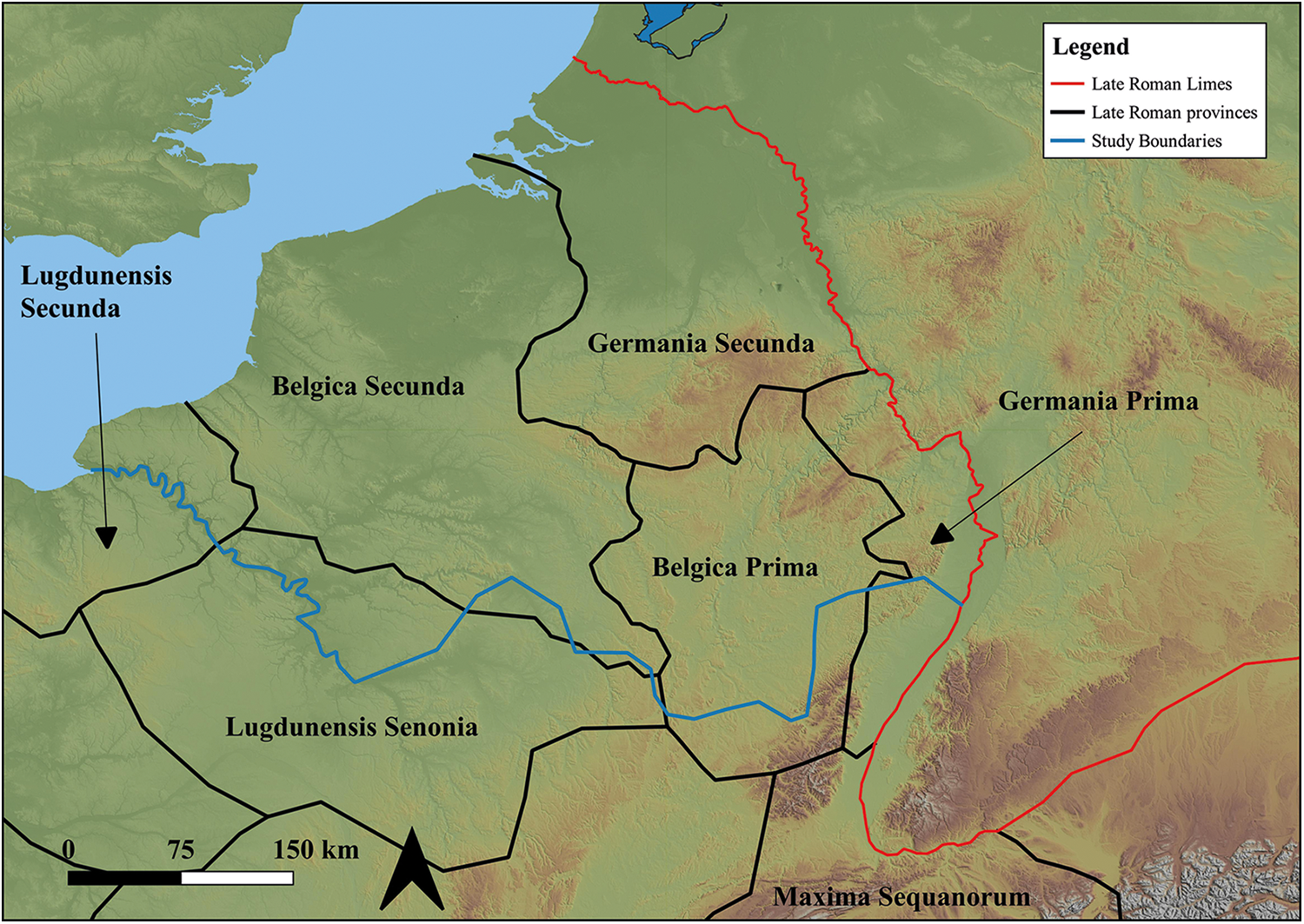
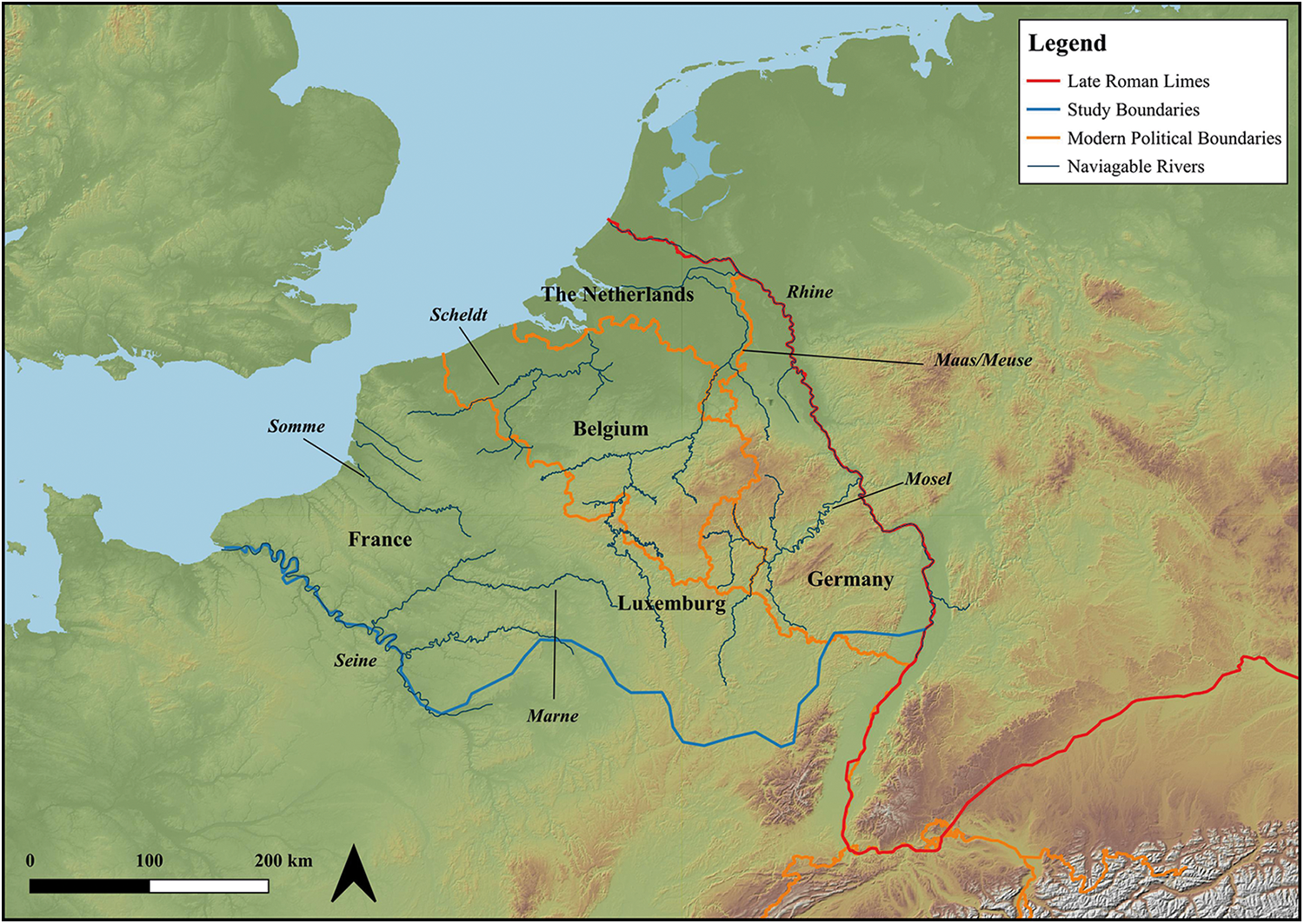
These new fortified installations are a common feature across the landscape and appear in a wide variety of morphological types in both the lowland and highland zones of north-western Europe.Footnote 4 These sites have been the subject of considerable debate since their initial identification in the mid-nineteenth century, with the role and continuity of older military bases on the Rhine limes and the relationship between new defended sites and foederati being particularly problematic.Footnote 5 New data and regional studies have created a fragmented picture of the spatial and temporal distribution of defended sites. In some regions, such as Gaule Septentrionale or the Moselle Valley, we have a good general understanding of the defensive pattern, while other areas, for example, Picardy, are much less well known.Footnote 6 Limited chronological resolutions, incomplete distribution patterns and collection biases have left us at something of an impasse — we lack an overarching examination of the evidence across different countries and regions as it currently stands. This article provides an overview of our current understanding of defended sites in Gallia Belgica, northern Lugdunensis and the Germanic provinces, covering the territory between the Seine and Rhine rivers (Fig. 1). Late antique fortifications were extremely diverse and a range of types have been recorded. This ranges from hilltop Höhensiedlungen and refuges and lowland defended enclosures to urban enceintes and large military installations, either reused or continued from earlier periods, as well as various coastal defences. The paper aims to move beyond historicising preconceptions of a response to third-century invasions or specific imperial building programmes. To achieve this, the paper examines the data on a macro-scale. It adopts a more empirical and data-driven approach, looking at known sites by period and geographical distribution and investigates both the regional and national biases in the record. The occupation trajectories of sites and the morphological nature of the defences are also considered. This builds upon recent work in the field, which has focused on developing typologies for different defensive structures.Footnote 7 This will provide a starting point for future work on fortified landscapes, allowing individual sites to be placed easily into their regional and transnational contexts.Footnote 8

Fig. 1. Map of modern political boundaries and key river corridors. The study area is bound on the south and west by the blue line, and on the eastern side by the red line of the late Roman limes. Underlying map from the EAA Copernicus DEM (author).

The study area and its historical context

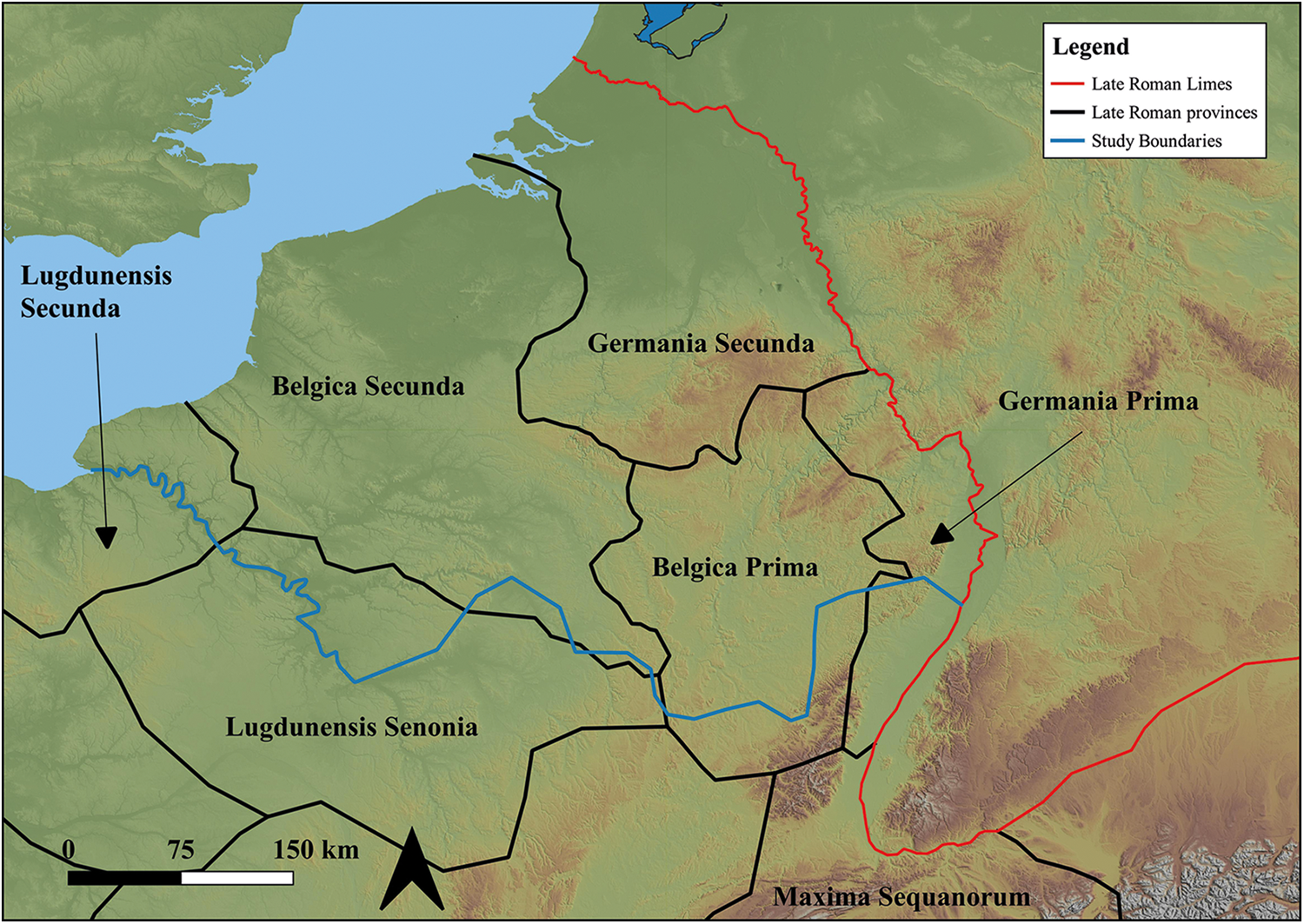
The northern reaches of the late Roman Dioecesis Galliarum encompass a very large zone, covering the geographic area between the Rhine and Seine rivers. This diverse region includes a range of different landscape types from coastal wetland to highland zones, and settlement during the Roman period was accordingly varied. This paper works within the geographical boundaries of north-western Gaul as a historic entity. The study region is defined by the Seine river network on its southern side, the Lorraine plateau in the south and the Rhine and North Sea coast along its eastern and northern side (Fig. 1). This area has been adopted as it has served as the starting point for a variety of regional studiesFootnote 9. It comprises parts of five modern countries. The region was separated into six provinces from the early fourth century onwards (Fig. 2).Footnote 10 This includes the small zones of the provinces of Lugdunensis Senonia and Lugdunensis Secunda north of the Seine.

Fig. 2. North-western continental Europe in the fourth century, showing the Roman administrative boundaries. Underlying map from the EAA Copernicus DEM (author).
Historically, the article covers the period from the second half of the third century to the middle of the fifth century. The beginning of this coincides with the ‘crisis’ in the Roman West.Footnote 11 The most unstable period in north-western Europe came between 250 and 280, under the so-called ‘Soldier-Emperors’ and the Gallic Empire.Footnote 12 Germania Inferior and its late Roman successor, Germania Secunda, were affected by depopulation, especially in the north and east, although the impact of this lessened towards the south and west and a Limesfall may have affected parts of the frontier.Footnote 13 Perhaps in response to this, rural settlement began to undergo a period of transformation, and there is widespread evidence for the demolition of earlier Roman grave monuments for spolia reuse, often in fortifications.Footnote 14

Under the Tetrarchy, a new provincial structure developed, based around a vicarius at Trier.Footnote 15 New defensive networks appeared at urban centres, fortifying reduced cores of settlement, for example, Jülich and Heerlen, while several were abandoned completely, including Voorburg (Forum Hadriani).Footnote 16 A number of mid-fourth-century usurpations and disturbances have been noted in the literature; however, it is difficult to understand their impact.Footnote 17 From the late fourth century onwards, the region slowly drifted out of direct Roman control. Military activity on the Lower Rhine appears to have faded away throughout the fifth century, with security outsourced to foederati groups. The Middle Rhine limes, despite experiencing a limited early fifth-century breakdown, continued in use until at least 450 with long-term continuity at military installations, including Mainz.Footnote 18 Over the course of the fifth century, the region effectively left the Roman orbit. Surviving settlement patterns broke down across the north and new Germanic groups began to repopulate the region.Footnote 19 Further south, settlement survival was more common, and there is plentiful evidence of continuity at a range of hilltop sites, urban centres and some rural sites.Footnote 20

Research history and investigation biases

Before examining the data, it is important to consider our current understanding of the fortified landscape through the lens of excavation, national and research biases. Fortifications have been recovered from every modern country in the study region in varying quantities. This reflects both a reality of Late Antiquity — the obsession with defence — as well as the biases of the current dataset.

Early investigations

Late antique defences were identified early in the development of archaeology in the region. These antiquarian investigations were overwhelmingly rooted in the Roman historical sources and took inspiration from Gibbon’s Decline and Fall of the Roman Empire. Footnote 21 These painted a picture of a ‘crisis’ in the late third century and imperial collapse in the late fourth/early fifth century.Footnote 22 Phases of fortification were quickly assigned to central policy based on the historical references.Footnote 23 These early excavations established our basic model for different types of site and their temporal spread. Despite a clear focus on sites associated with the ‘military’, typologies and patterns taking in civilian structures were also developed: a belt of hilltop sites, the refuges or Höhensiedlungen, burgus-like features, urban defences and large fortresses were identified.Footnote 24 Naturally, these excavations influenced the wider narrative, feeding into a story of decline, unrest and instability across the north-western provinces. National research traditions developed during this formative period; for example, German archaeology focused on military installations. This investigation drove further analysis of fortified settlements, uncovering more defences as the research tradition developed.

Post-war approaches

By the end of the Second World War, this phase had given way to more standardised investigation. New excavations exposed the long-term development of some sites and led to works of synthesis in the 1970s and 1980s.Footnote 25 This momentum continued, with work examining shifting patterns of defence as well as architectural changes and a re-evaluation of key problems in our understanding of the period.Footnote 26 Concurrent with this, new work established an earlier phase of activity associated with the Gallic Empire and the late-third century.Footnote 27 Work on the Höhensiedlungen developed a basis for future work on hilltop sites and excavations at the Belgian refuges have given us an important dataset for the study of these sites.Footnote 28

The publication of the controversial Grand Strategy of the Roman Empire in 1976 influenced the developing narrative.Footnote 29 Although decline and unrest remained a key part of the story, broad concepts of ‘defence-in-depth’ began to be applied to the region.Footnote 30 The emerging pattern appeared to be one of defended highways and elastic defence through a partially depopulated landscape.Footnote 31

Modern analysis

By the end of the twentieth century, the defence of north-western Gaul was increasingly considered ‘solved’, with new data envisaged as filling the gaps in a pattern of defended hilltops and fortified river and road networks. In recent years, however, this model has become increasingly fragile. Examinations have moved beyond an isolated approach to north Gallic defence, viewing the region as part of a wider defended whole rather than a unique example of a heavily militarised zone.Footnote 32 This analytical expansion has impacted on the study of all types of defences. Urban fortifications have undergone a revolution in theory, with important contextual work identifying trends, policies and development, both on the level of individual sites as well as groups of defences.Footnote 33 The re-evaluation of the Höhensiedlungen has driven re-engagement with their function — either for defence or display as well as their form and distribution across the north-western provinces.Footnote 34 Systematic excavation and aerial photography from the 1970s onwards in the German loess belt has seen the number of defended sites increase significantly.Footnote 35 This has been mirrored by developments elsewhere with unexpected new sites appearing in Picardy.Footnote 36

The last 20 years have seen an improved understanding of fortified settlements. Despite the recent flurry of studies, however, there have been few statistical or intra-regional examinations of the area. Work has primarily focused on individual sites or thematically linked groups of installations.Footnote 37 Recently, synthetic investigations have begun to move towards comparable and replicable typologies for defence with further work underway to apply this on a wide scale.Footnote 38 By examining different facets of the study of fortified settlements, we can attempt to establish biases and investigation distributions inherent in the dataset.

Dataset and methodology

The dataset of fortified settlements in the study area comprises 357 sites spread across north-western continental Europe. These installations must be considered as part of a much larger fortified zone, a highly defended landscape across modern western Europe, and cannot be simply viewed as a phenomenon that lies between the Rhine and the Seine. This includes the Saxon Shore forts, Hadrian’s Wall and a range of defended small towns, urban centres and other fortifications in Britannia as well as the important fortified centres along the Lyon–Metz road, irregular fortifications and the riverine defences south of Mainz.Footnote 39

Naturally these sites also come with data of varying quality. This paper examines the data holistically, laying out the underlying biases before examining the geographical and temporal spread of different sites. In collecting the data, no distinction was made between military and civilian sites. Given the problematic nature of defining civil and military groups in late antique Gaul and Germany, a decision was made to assess the data morphologically, without preconceived biases.Footnote 40

Defining fortification

A first step in the process of assessment is establishing definitions of the interrelated terms ‘defence’ and ‘fortification’. In the nineteenth and early twentieth centuries, fortifications were identified as defensive based on thematic morphology, with installations divided into regular (military), irregular (rural) and urban.Footnote 41 By the twenty-first century, further development had identified that this division is problematic, in part due to the blurring of civilian and military in later Roman Gaul and the wide morphological variation of sites.Footnote 42 A vast range of Latin terms have been identified, both in inscriptions and the historical sources, that appear to apply to late Roman defended sites.Footnote 43 These terms, perhaps unsurprisingly, do not provide a firm basis for clear definitions of different types of late Roman defences. This confusion has spilled over into modern languages and there is a vast web of different and often inter-related and contradictory terms and phrases used to describe defended installations in the late antique world.Footnote 44

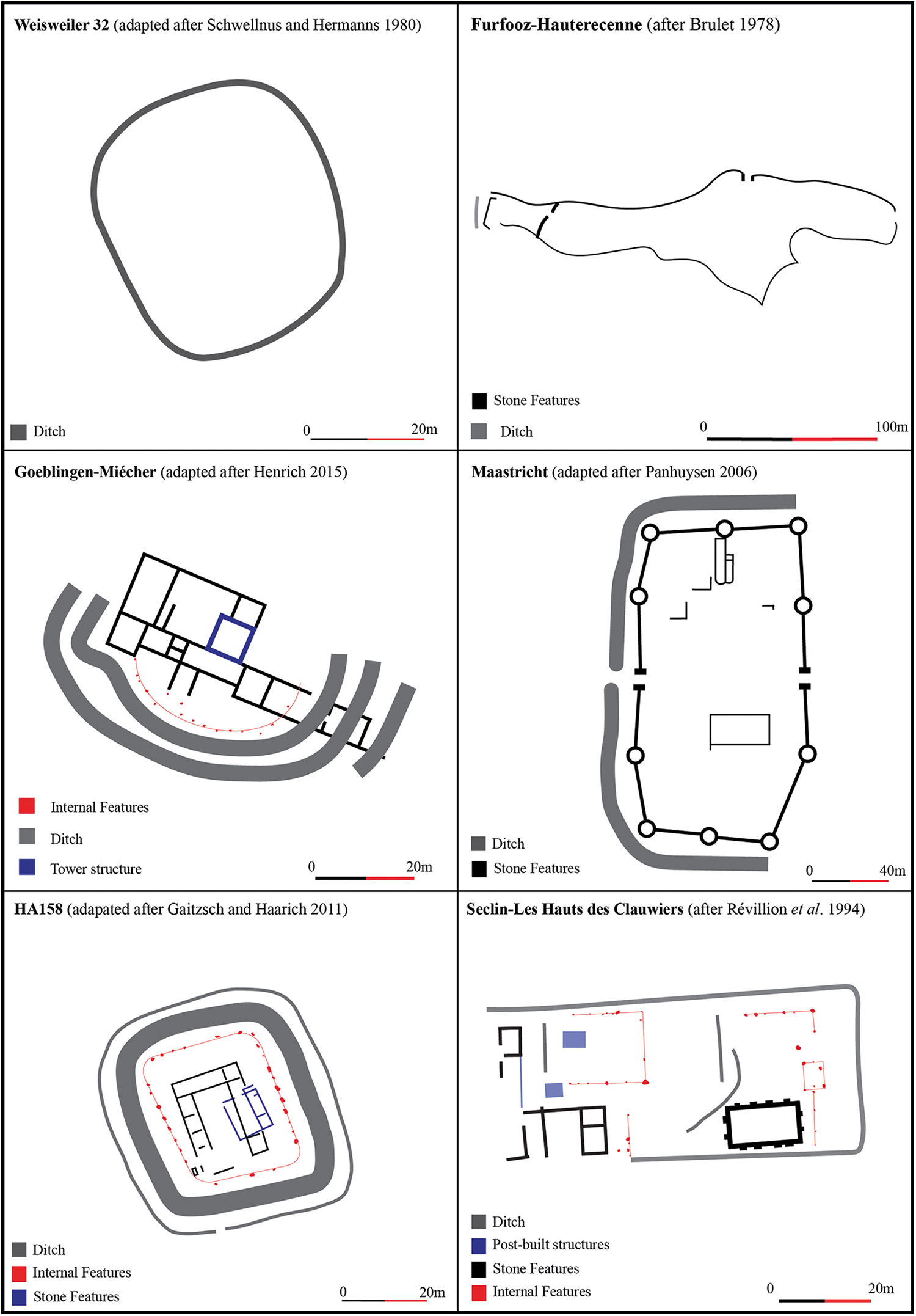
Rather than deferring to the Latin terms and their modern counterparts, this analysis follows recent empirical classification systems based on the morphology of settlements, although these have, until now, been primarily limited to ‘private’ or small-scale installations.Footnote 45 In this article, all fortified settlements are examined, regardless of their presumed function. Sites were defined as fortified if there was a demonstrable presence of architectural elements that could be used for a defensive purpose. Naturally, a vast range of different features and site types, some of which may have been multi-purpose, fall into this category (Fig. 3). This includes everything from the small earthwork defences identified in the Rheinische Lößbörden and the hilltop sites identified across the region to large urban wall circuits and military fortresses on the Rhine.Footnote 46 A significant proportion of these sites could be considered multi-purpose, or include structures that, when combined with other features, appear to be defensive in nature. A good example of this is Seclin-Les Haut des Clauwiers (Fig. 3), a villa located in northern France.Footnote 47 The site underwent an early fourth-century transformation with the villa largely converted to artisan production and grain storage. From the early/mid-fourth century onwards, a new grain storage structure with reinforced buttresses and thick walls, interpreted as a tour-silo, was constructed.Footnote 48 On its own, this would not necessarily be enough to ascribe a defended function; however, the site appeared to be contemporary with a series of palisades and ditches regulating access to the building. This points towards a multi-purpose defensive element at the site. In light of instances such as this and the probable multi-function or unclear function of many of these fortifications, the sites in this paper have been graded at three levels according to their certainty based on the availability of evidence from published reports (Table 1). These methods allowed the establishment of a reasonably coherent model for examining the temporal and spatial density of fortified settlements over the later Roman period and reflects the degree of uncertainty inherent in the dataset.

Fig. 3. A variety of defences: selected fortified installations showing the diversity of types in the region (author).

Table 1. A breakdown of fortifications by data grade (n=357) (author).

Moving beyond the morphological dataset, several different groups of finds are associated with defensive or state activity in late Roman north-western Gaul. Some artefact groups, long associated with the late Roman army or state, have been recorded at potential fortified installations and include crossbow brooches and chip-carved belt sets.Footnote 49 Reinforcing this is the presence of weaponry, or at the very least, multi-functional tools that could have acted as weapons.Footnote 50 Dating these objects has, in the past, been problematic; however, we are now aware of clear typologies from the late third to fifth century for belt sets and crossbow brooches and this allows a level of chronological resolution for material culture findspots.Footnote 51 This has seen the identification of a wider military community in northern Gaul based on the material culture and includes finds from rural settlements, cemeteries and isolated findspots and allows us to infer the presence of defences close by.Footnote 52 In some cases, this is relatively straightforward: there is limited evidence of a defensive morphology beyond terracing at Ben-Ahin-Lovegnée, a hilltop site on the Meuse; however, the presence of an associated cemetery at Sarte-à-Ben, complete with weapons and belt buckles and late Roman ceramics and coins on the hill itself, is suggestive of a fortification on the spur above the river.Footnote 53 Data on these sites were collected in a separate database and has been integrated here to highlight the temporal spread and distribution of activity associated with defence.

Investigation type

Historically, fortifications have been identified through a variety of means. Excavation, both limited and extensive, has been the primary vehicle for study; however other methods have been used to identify and categorise late antique defensive architecture. Aerial photography has a long tradition in parts of the study area, notably northern France and the Rhineland and has proved useful in spotting potential late Roman installations.Footnote 54 Field survey and geophysics have also taken important roles in confirming late antique activity, especially in combination with aerial photos.Footnote 55 Although the chronological and morphological classification of these sites is often less clear, in many cases they can be easily identified as late Roman defences.Footnote 56 This extends to sites identified through finds. The majority of findspots however are less secure and there is significant variation in their location, relationship to a fortification and chronology.

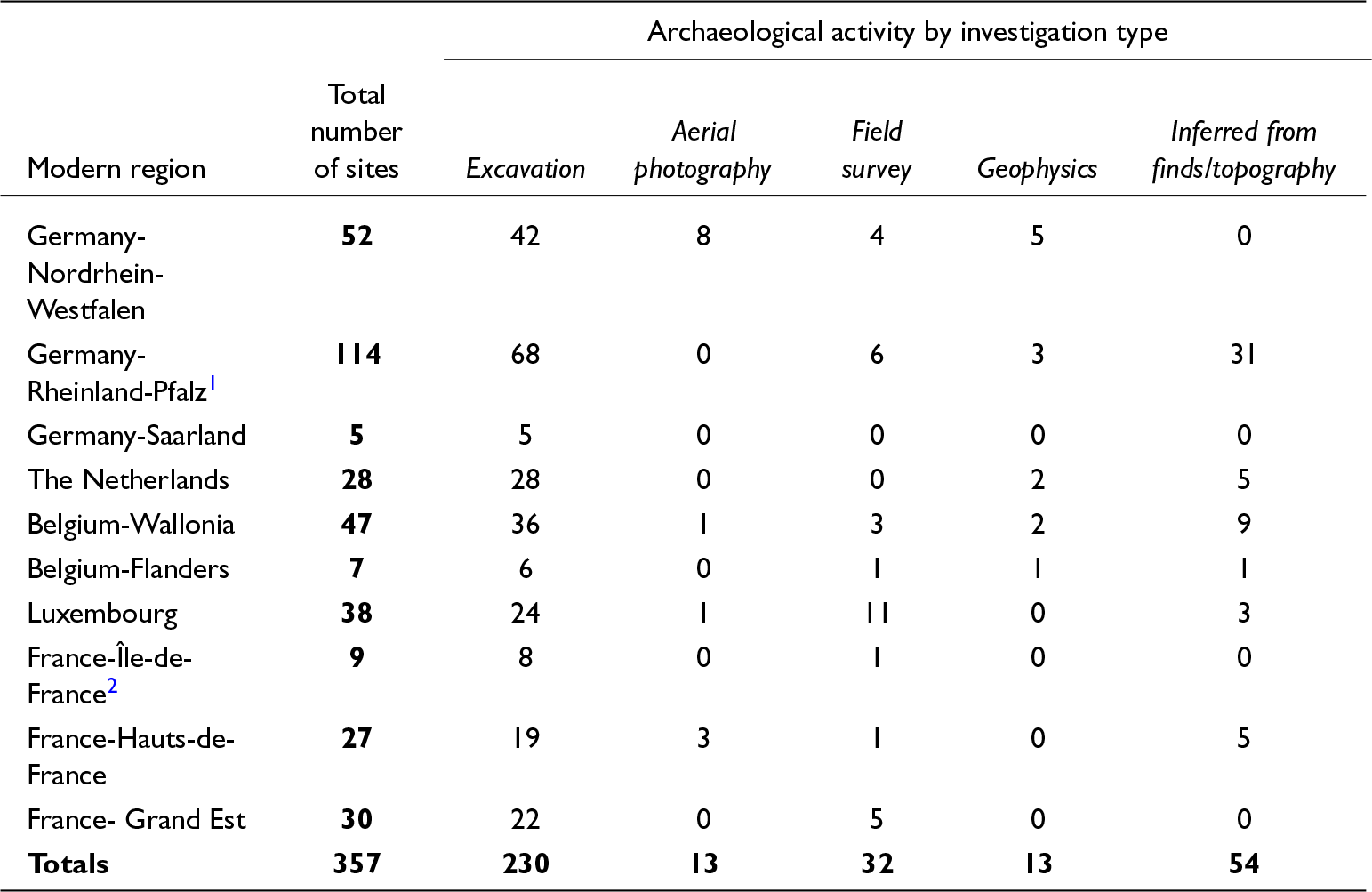
The data presented here are overwhelmingly the result of excavation (Table 2). This reflects both the complex nature of some of these fortifications and in some places, notably the Eifel-Ardennes zone, the difficulties surrounding aerial photographical analysis. There is, however, some regional variation. Aerial photography has been repeatedly used in Nordrhein-Westfalen, and to a lesser extent Hauts-de-France, to identify defended sites, while field survey has commonly been employed as a strategy in Luxembourg and Rheinland-Pfalz. This is the result of the difficult nature of invasive fieldwork at hilltop installations, which are often forested or hard to define. This is also reflected in the large number of Höhensiedlungen in Rheinland-Pfalz that have been identified based on their finds alone.Footnote 57 This group of sites, paralleled in Wallonia, has generally been linked with finds of military equipment on sites with defensive topography.Footnote 58 Linking finds and topography has a long history and accounts for a significant number of sites defined as fortifications in the dataset. The differences in archaeological investigations demonstrate that our analysis of the fortified landscape rests on a very varied base and this is an important element to bear in mind as research into the topic advances.

Table 2. Breakdown of activity types at fortifications in the countries under study, where evidence is currently available (n=357) (author)
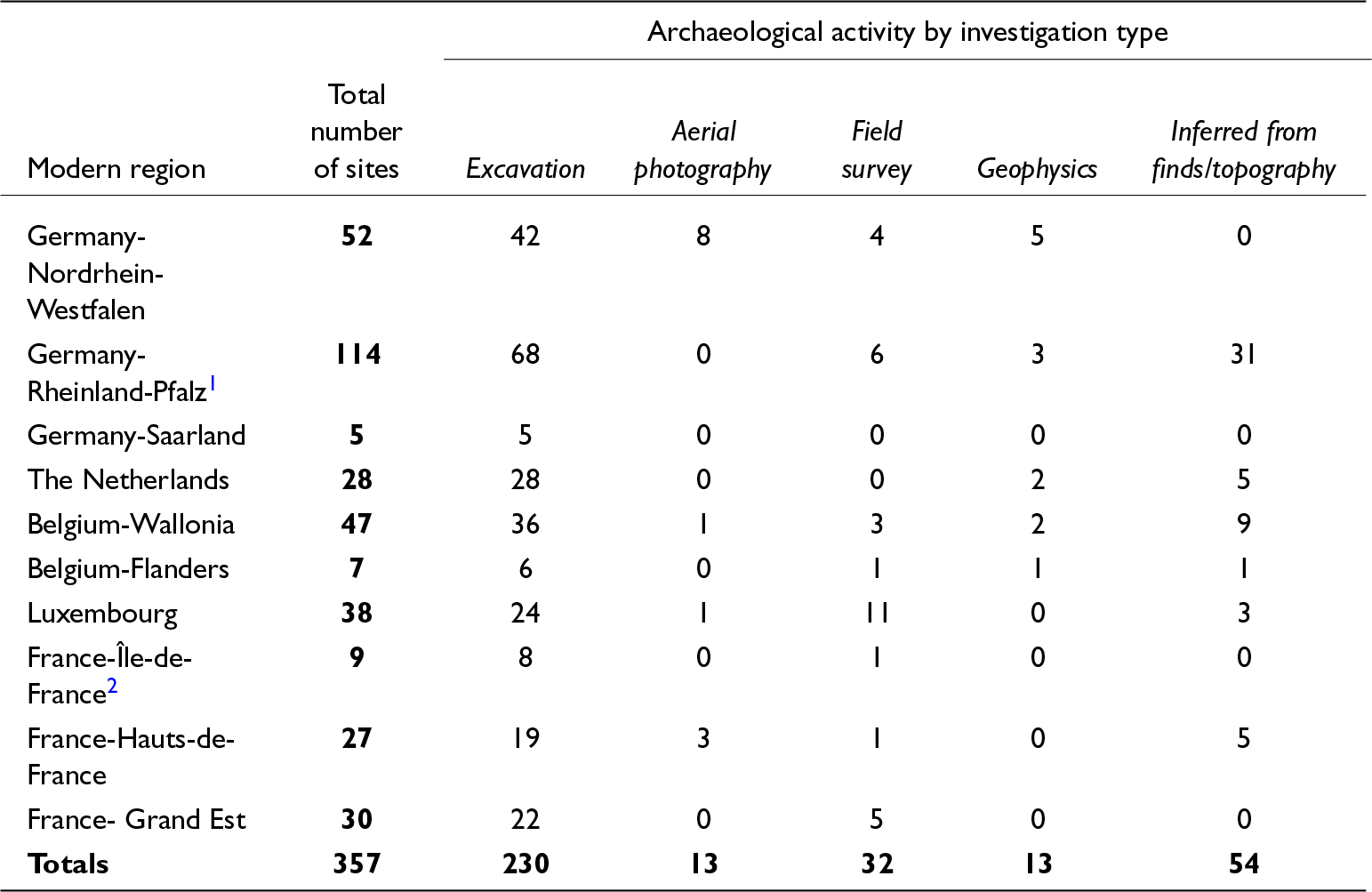
1 This includes the limited number of sites in Hessen (3) and Baden-Württemberg (2).

2 This includes the département of Seine-Maritime.

Investigations by period

Assessments of the data by excavation period highlight the biases and assumptions inherent in the data landscape. This breakdown, including sites that were repeatedly examined in different periods, demonstrates the variability of activity across the previous two centuries. Excavation at these sites has a very long history, with some of the first notable antiquarian studies of the Roman period in north-western Europe focusing on fortifications, especially along the Rhine limes.Footnote 59 The temporal spread of excavation reflects this (Fig. 4) — there is significant nineteenth-century or earlier activity across all countries. These early activities, dominated by France and Germany, both reflect the high numbers of sites within their borders but also hints at the early focus on the military fortresses on the Rhine and the urban wall networks of French towns, sometimes to the detriment of other site types.Footnote 60 In other countries, especially the Netherlands, villas held more attention with relatively limited interest in fortifications.Footnote 61 The situation in Belgium is slightly different. The investigation of defended installations began in the early nineteenth century; however, this antiquarian work generally focused on early medieval cemeteries and the study of the defended hilltop sites associated with them was somewhat secondary.Footnote 62

Fig. 4. The temporal distribution of archaeological investigation at fortified sites, based on the totals set out in Table 2, where evidence is currently available, broken down by country and administrative region (n=548) (author).

Although there are minor variations between each country, driven in part by different national research traditions and priorities, there is a broad increase in archaeological activity at defended sites in the twentieth century. This activity peaks between 1950 and 1980, coinciding with the wider post-war construction and the subsequent economic boom.Footnote 63

Geographical distributions

Our current understanding of the geographical spread of late antique fortifications is highly regionalised. Research has, by and large, examined thematic groups of similar sites, such as the Höhensiedlungen, or focused on specific zones, for example the Rhine frontier and the Via Belgica.Footnote 64 This scholarship focus has been supplemented by excavation biases. The large-scale excavations in Nordrhein-Westfalen prior to lignite mining have exposed large numbers of defended sites in the Rheinische Lößbörden, whilst the expansion of the rail network and Zones d’Activité Économique (ZAE) in France have generated similar data.Footnote 65 Other regions such as Belgium have similar excavation biases. The focus has been on specific sites, such as Braives and Liberchies, and some areas, such as Flanders, are poorly understood.Footnote 66 This is equally true in regions where other site types have been the focus of study. In France-Le Grand Est and Luxembourg, scholarship has been concerned more with rural settlements and the first major surveys of defended installations date to the late 1960s and 1970s.Footnote 67

With these biases in mind, it is clear that while in some areas we have a detailed understanding, our clarity on the distribution of sites in other regions is poor. Overall, the distribution is fragmented, reflecting a series of modern and natural geographical factors. Overwhelmingly, fortifications are located in the east of the study region and broadly, the closer an area is to the Rhine, the greater the density of fortifications (Fig. 5). Dense belts exist along the key transportation arteries; the main roads, notably the Via Belgica, as well at key junctions, some of which, such as Saarbrücken, were located on earlier agglomerations.Footnote 68 Supplementing this is the concentration of hilltop defences in the Eifel-Ardennes-Meuse zone and we would expect further sites in modern day Luxembourg to complete this concentration.Footnote 69 Instead of continuing southwards through the Vosges and Lorraine Plateau, the dense belt peters out, giving way to a range of limited Höhensiedlungen, burgi and other forms of defensive sites, including ex novo military installations such as Saint-Laurent-sur-Othain-Le Châtelet or urban defences like Metz.

Fig. 5. Spatial distribution of fortified sites (250–450) across the study region and beyond. Underlying map from the EAA Copernicus DEM (n=357) (author).

This distribution confirms the lack of fortifications in the depopulated zones of the Dutch and Belgian Kempenland and highlights our limited evidence for late Roman defensive installations along the North Sea coast.Footnote 70 We see a slow increase of sites towards the south along the coast, beginning with the third-century forts at Aardenburg and Oudenburg, eventually forming a complex cluster of morphologically identified installations in the Pas-de-Calais, reinforced by a range of sites with artefacts traditionally associated with militarising communities.Footnote 71 This is complemented by an expected and partially identified drop-off in defended sites further south and west, where the majority of defended settlements are walled towns such as Paris, Melun and Reims and there is a less diverse range of other fortifications.

To some extent these patterns are mirrored across the channel in Britannia. Key defended installations are located on the main arteries, some of which have late antique circuits.Footnote 72 Where this differs, however, is that the majority of major urban centres in Britannia were defended by the mid-third century and received fourth-century augmentation, primarily in the form of towers, for example at London.Footnote 73 Important differences are present between Britannia and the continental provinces: rural fortifications are significantly rarer, with few examples of burgi or hilltop sites.Footnote 74 The military footprint is also more static in comparison to northern Gaul: there are limited examples of new fortifications, with the Saxon Shore and Yorkshire towers being exceptional examples.Footnote 75

The geographical pattern reinforces the fragmented distribution identified in previous thematic studies.Footnote 76 Bringing the data from these sources together allows us to move our geographical understanding forward (Fig. 5). Firstly, we can move towards analysis of location, orientation and interconnectivity and secondly, we can identify lacunae in the wider pattern. These lacunae present interesting problems, especially in the highland zone between the Mosel and Maas rivers and further research may indicate that these zones were simply too far from movement corridors in the landscape to require fortification (see Fig. 1 for locations of rivers).

Temporal distribution

The chronological distribution of fortification presents a more complex picture. Applying a basic classification method to the data allows for the analysis of the temporal intensity of fortified settlements over the period and reflects the degree of uncertainty caused by chronological problems in the data.

To achieve a realistic assessment of certainty of the temporal distribution, three different levels of a graduated scale of occupation certainty were applied to each site (certain, probable, possible). Assessing this employed a variety of different chronological indicators, including ceramic, artefactual and numismatic records and where available, radiocarbon dates or other scientific methods.Footnote 77 It is important to note that the data primarily derive from published sources and given the historicising biases present, this can lead to errors in interpretation. Chronologies based on the ceramics and coin sequences are subject to problems. Ceramic studies have highlighted the problems with fifth-century coarse wares and the longevity of Argonne sigillata in the third centuryFootnote 78. Coin data hold similar problems; the huge number of third-century radiates, the issue of production of the mint at Trier and the longevity of coin use beyond the early to mid-fifth century have made it difficult to accurately pin down abandonment dates for sites.Footnote 79 To offset some of the chronological issues, 50-year blocks were chosen to represent broad resolution changes. Intensity of use was not necessarily identifiable in this broad approach to our current data and further work will be needed to assess this archaeologically.

With these issues in mind, the chronological spread illustrates an unexpected spread of data (Fig. 6). Peaks of activity in the late third to early fourth century and the late fourth to early fifth century were anticipated. These periods have generally been characterised as times of rapid change. The late third century saw the depopulation or étiage of rural settlements and urban centres while broader Roman political control broke down in the fifth century. The instability inherent in these periods has traditionally been seen as a driver for fortification construction and use.Footnote 80 Instead, we see a steady increase in fortified activity over the course of the late third and early fourth century, beginning with limited examples, mostly in the form of military installations, in the first period (200–250).Footnote 81 This peaks in the second half of the fourth century (the period 350–400) and is followed by a sharp drop-off in sites into the fifth century, perhaps associated with the slow withdrawal of Roman control.

Fig. 6. The chronological range of activity at fortified settlements across the region under study, highlighting the certainty of temporal identification (n=248) (author).

The single peak of activity indicates that several other factors are at play and worth exploring — clearly it demonstrates we are not dealing with the cyclical use of instability-linked fortifications, nor are they short-term knee-jerk examples of ‘crisis architecture’ associated with limited periods of occupation. Instead, the evidence suggests many of these installations were developed, expanded and used over the course of half a century or more.Footnote 82 Vireux-Molhain-Le Mont Vireaux for example, was occupied from the late third to mid-fifth centuries and included several phases of reconstruction, expansion and rebuilding.Footnote 83 Although a small number of sites did have the rapid lifespans associated with ‘crisis architecture’, for example the refuge at Nismes-Roche de Sainte-Anne, turnover was relatively low with most sites occupied continuously from the late third/early fourth century onwards.Footnote 84 Given that this peak is visible across both the macro-region and in all sub-regions, it suggests that the same priorities — a desire for defendable sites — was of key importance to groups across the north-west, both on a regional and local level. This priority of construction and use was maintained until at least the mid- to late fourth century, when the number of sites in use begins to decline, although it is worth stating that our chronological resolution for the early fifth century is still unclear and relying on the ceramic and coinage data remains problematic.Footnote 85

This increase in activity, rising from about 40 early third-century military sites focused on the limes and coastlines to nearly 140 active installations in the mid-fourth century, indicates that various interest groups felt a requirement for defence. Equally, it hints that the local population, the state and other agents were motivated and, more importantly, able to marshal the labour and materials needed to construct and defend installationsFootnote 86. This motivation is not limited to one region, but occurs as a single wave of activity across the fourth century.

The temporal overlay of probable and possible sites presents a different story. Both these groups are less chronologically anchored phases and show the expected peaks in the late third and early fifth centuries, broadly coinciding with pre-conceived periods of ‘crisis’ in northern Gaul. This is likely to represent the biases within the dataset inherent from an older, historicising approach. Traditional scholarship, especially on French town walls, has sometimes assumed that fortifications should have been built during the late third-century crisis, as a reaction to barbarian raiding.Footnote 87 Although this may be true, and there is some evidence that some of these defences did have a third-century phase, for example at Amiens, where coins recovered from the wall foundations dated to the reign of Probus, the evidence is ambiguous at many sites.Footnote 88 Future work may indeed identify such phases beyond doubt; however, as it currently stands, the evidence does not point towards significant peaks of third- or fifth-century fortified activity.Footnote 89

The chronological sequence paints a picture of a region with similar defensive priorities, transcending local or regional activity. Although what we see on the ground cannot in any way be called integrated at a supra-provincial level, it is clear that fortified activity is driven by factors at a level above local concern. This suggests that the mid-fourth century was the point at which the state, local populations and other actors were most concerned with defence, and perhaps, by extension, the perception of instability across the entire region was most important.

Future approaches

The ‘state of play’ in the analysis of defence in the continental north-west has been presented and several areas for future investigation highlighted.

The most important recommendation should be to address the problems with our chronological resolution. Increasing the reliability of dating will help to reduce biases in the dataset. The temporal analysis (Fig. 6) has illustrated that sites with less clear dating often revert to older notions of crisis architecture, especially in the late third and fifth centuries. Some progress can be made, notably by using absolute dating where available, and re-evaluations of dating evidence have been proposed for fortifications in the Rheinland-Pfalz.Footnote 90 These activities should be expanded to other key fortifications, including the walls of north Gallic towns, hilltop refuges and burgi: it is imperative that scientific dating methods are conducted wherever possible at defended sites.Footnote 91 Developing a methodology for this is an obvious next step, and it must integrate modern field methods currently in use in other archaeological sectors. Exploring these chronological issues would pay dividends in understanding the genesis of the defended landscape in the third century as well as further developing a model for the processes by which these sites go out of use in the fifth century or beyond. In essence, it can help to assess to what extent these sites can be referred to as a reaction to ‘crisis’ and question whether these sites really can be viewed within the framework of ‘crisis architecture’.Footnote 92

The second recommendation is the increased integration of national research strategies. Comparative databases are required that cover the various countries under study and integrate disparate research approaches on fortifications. Information exchange will speed this process and allow researchers in the field to take required data from a central database. The underpinnings of this are already under way, with the dataset for this article available as open access; however, recent examples have demonstrated just how far this can be taken.Footnote 93

A final recommendation would be to adapt and expand this study to other regions.Footnote 94 The traditional range of continental north-west European studies, between the Seine and the Rhine and Metz and the Channel should be widened significantly. Other Gallic wall networks, road forts and the frontier zones in Austria, southern Germany and Switzerland should be included. This should also incorporate Britain, which seems to buck the trend of widespread fortification as well as areas such as the Agri Decumates, in order to assess the effect regional withdrawal has on fortified trajectories.Footnote 95 There is evidence for Höhensiedlungen-like hilltop sites as far afield as Tarraconensis and Lusitania that appear to be part of a wider phenomenon and examining this on the scale of the Roman West should help to identify larger patterns.Footnote 96

Concluding remarks

This paper has introduced the characteristics of the current dataset of fortified settlements in north-western Gaul. By presenting an initial study of the current data, this work is intended to provide a starting point for future research into defended sites, building on the rich but disparate tradition of scholarship in the field, as well as identifying the biases and issues in the dataset for further work.

Despite the provisional nature of this analysis, the data do highlight important elements of the make-up of the wider defended landscape. The most important of these is the chronological spread of activity. The expectation was that two peaks would appear, corresponding with the late third/early fourth and late fourth/early fifth century, traditionally identified as periods of ‘crisis’. The lack of these peaks was surprising and the expectation of their existence demonstrates just how embedded the historical narrative of late antique Gaul is. Although it is currently impossible to be sure, based on the quality of the dating of the data, it does not seem that further resolution would prove the existence of such peaks of activity. Instead we are faced with a different picture, with a mid-fourth-century peak. Although there is some evidence of occupied sites in the early third century, mostly in the form of military bases along the Rhine or some earlier walled cities, the peak of activity rises quickly from the late third century onwards.

This paper has provided a limited but important examination of the defensive landscape and highlighted the issues and problems inherent in the data. The difficulties in assessing the data have been demonstrated and a series of recommendations proposed to help rectify this. Future work is required to develop this further, both in the field and in the integration of national traditions and data analysis, with this paper providing a ‘jump-off’ point for the re-evaluation of fortified trajectories in north-western Europe during Late Antiquity.

Supplementary material

The supplementary material for this article can be found at https://doi.org/10.1017/S0068113X25100329
Footnotes

*

This publication was prepared under the F.S.R. project ‘A culture on the defensive? The archaeology of fortification in the North-west from Constantine the Great to Aetius’ and was conducted at the CRAN, Université Catholique de Louvain, Belgium.

5 Roosens Reference Roosens1967; Böhme Reference Böhme1974; Bridger and Gilles Reference Bridger and Gilles1998; cf. Esmonde Cleary Reference Esmonde Cleary2013, 45–50 for a good overview.

8 The associated data behind this paper are available as supplementary data to this article.

9 Esmonde Cleary Reference Esmonde Cleary2013, 62, fig. 2.5; Reddé Reference M2017; Reference M2019; Brulet Reference Brulet1990, 5–6; Van Ossel Reference Van Ossel1992, 40-1; Dodd Reference Dodd2021.

10 Jones Reference Jones1954 for the dating of the Verona List.

11 King and Henig Reference King and Henig1981 for earlier views; Millet Reference Millett1990; Witschel Reference Witschel1999; Esmonde Cleary Reference Esmonde Cleary2013, ch. 1 for wider views; Reddé Reference Reddé2021.

13 The Limesfall is the traditional name for the collapse of the frontier zones in the mid–late third century; see Mommsen Reference Mommsen1894, 150–2; van Es Reference Van Es1981, 47–8; Gechter and Kunow Reference Gechter and Kunow1986; Lenz Reference Lenz1999; Heeren Reference Heeren, Roymans, Derks and Hiddink2015; Reference Heeren2017; Dodd Reference Dodd2021; see Heeren Reference Heeren2016 for a more modern critique of this.

15 Pan. Lat. VIII, 5; Wightman Reference Wightman1985, 202–3; Heather Reference Heather2017, 28; Christol Reference Christol, M.2021; Reddé Reference Reddé2021.

18 Claudianus, De Bello Gothico, 419–29; Kulikowski Reference Kulikowski2000, 325–45; Roymans Reference Roymans2017, 66–7; Heising Reference Heising, Quellen and Strukturen2023.

22 Alföldy Reference Alföldy1974; cf. Drinkwater Reference Drinkwater1987, 50–1 for modern summaries; Zosimus, Historia Nova, 1.30–1.71 for the later third century and 5.30 onwards for the fifth century. Scriptores Historiae Augustae, specifically the lives of third-century emperors from Gallieni Duo onwards, although this is notoriously unreliable: Drinkwater Reference Drinkwater1987, 60–2 for some of these problems.

23 Amm. Marc., Res Gestae, 28.2.1–4; Zosimus, Historia Nova, 6.173.

24 For example, Del Marmol Reference Del Marmol1859; Bequet 1887/Reference Bequet1888; Hagen Reference Hagen1931; Breuer Reference Breuer1931; Holwerda Reference Holwerda1933.

28 Mertens and Remy Reference Mertens and Remy1973; Brulet Reference Brulet1978; Gilles Reference Gilles1985 for examples.

32 Kasprzyk and Monteil Reference Kasprzyk and Monteil2017; Chabert and Martinez Reference Chabert and Martinez2017; Smith and Fulford Reference Smith and Fulford2019; Bayard and Fourdrin Reference Bayard and Fourdrin2019; Billoin and Gandel Reference Billoin and Gandel2021.

37 For example, the road forts of the Via Belgica: Brulet et al. Reference Brulet, Leva, Mertens, Plumier and Thollard1995; Bazelmans et al. Reference Bazelmans, Bakels and Kocken2004, or fortified transforming villa complexes: Van Ossel Reference Van Ossel1992; Dodd Reference Dodd2021; Reference Dodd2023b.

40 See Brulet Reference Brulet2019 for the issues of separating soldier and civilian in the late Roman north.

41 Johnson Reference Johnson1983; Brulet Reference Brulet1990, 297–310.

43 Brulet Reference Brulet, Reddé, Brulet, Fellmann, Haalebos and Schurbein2006, 156; Henrich Reference Henrich, Henrich, Miks, Obmann and Wieland2015, 177 for a good overview; examples include RIB 721 from Ravenscar (turrum) and CIL XIII, 8502 at Köln-Deutz (castrum).

44 A small selection of these includes: villa fortifée, tour-silo, éperon barré, camp retranché, Höhensiedlung, Höhenbesfestigungenlager, Tor, defended villa.

48 Révillion et al. Reference Révillion, Bouche and Wozny1994, 130–2.

49 There is a large body of literature on these objects; key summaries include Swift Reference Swift2000; Van Thienen and Lyke Reference Van Thienen and Lyke2017; van der Meulen-van der Veen Reference Van der Meulen-van der Veen2023 for crossbow brooches; Böhme Reference Böhme1974; Reference Böhme2020 for belt sets.

51 Böhme Reference Böhme1974; Reference Böhme2020 for belt sets; Pröttel Reference Pröttel1988; Heeren and van der Feijst Reference Heeren and van de Feijst2018, 178–82 for crossbow brooches.

52 For examples, see Loizel Reference Loizel1977; Delmaire Reference Delmaire1994, 323; Blom et al. Reference Blom, van der Feijst and Veldman2012.

53 For a summary of this, see Brulet Reference Brulet1990, 153–6, 244.

55 Schindler and Koch Reference Schindler and Koch1977; Wessel and Wohlfarth Reference Wessel and Wohlfarth2008.

56 For example, Mechernich-Satvey: Song Reference Song2018, 27, Fig. 4.

57 For a case-by-case summary of these sites, see Gilles Reference Gilles1985.

58 For example, Vieuxville-Château de Logne and Angleur-Bois de l’Ermitage.

59 For example, Katwijk-Brittenburg: Pars Reference Pars1745, 103.

60 Blanchet Reference Blanchet1906 for French town walls and von Veith Reference Von Veith1888 for the example of the legionary fortress at Bonn; cf. Heeren Reference Heeren2016 for the early history of excavation, specifically 185–7 for Reichs-Limeskommission activity further south.

61 Cf. the references in De Maeyer Reference De Maeyer1937 for Belgium and Holwerda and Goossens Reference Holwerda and Goossens1907 for an early Dutch example; summaries in de Groot Reference De Groot2006; Hiddink Reference Hiddink2022.

62 See Del Marmol Reference Del Marmol1859 and Bequet 1887/Reference Bequet1888 for examples.

67 Schindler Reference Schindler1968; Schindler and Koch Reference Schindler and Koch1977; Agache Reference Agache1978, 246–7.

69 For example, further work on the sites in Schindler and Koch Reference Schindler and Koch1977; current work on Altrier, Titelberg and Contern-Pescher.

70 See van der Meulen Reference Van der Meulen2017 for a comprehensive study of sites in the Netherlands and Dhaeze Reference Dhaeze2011 for wider problems of coastal defence; Drinkwater Reference Drinkwater2023; Vanhoutte Reference Vanhoutte2023.

71 Van Thienen Reference Van Thienen2017; Böhme Reference Böhme2020 for the narrative on these artefacts; Vanhoutte Reference Vanhoutte2023 for Oudenburg.

73 Esmonde Cleary Reference Esmonde Cleary and Wilson2003 for an overview; Barker et al. Reference Barker, Hayward and Coombe2021, 280–2.

74 For the very limited examples see Oswald Reference Oswald1937 and Branigan Reference Branigan1977, both of which are problematic, as well as Seaman Reference Seaman, Pergola, Castiglia, Hanna, Martinetto and Segura2022 for hilltop sites in the west of the island.

76 Brulet Reference Brulet2017a, 41, Fig. 2; Esmonde Cleary Reference Esmonde Cleary2013, 47, fig. 2.1.

77 Key reference indicators included Heeren and van de Feijst Reference Heeren and van de Feijst2018 (fibulae); Brulet et al. Reference Brulet, Vilvorder and Delange2016 (ceramics) and Böhme Reference Böhme2020 (belt-sets), as well as the numismatic record.

79 Mairat Reference Mairat2022 for the Gallic Empire’s coinage; Wigg-Wolf Reference Wigg-Wolf, Chameroy and Guihard2016 for the Trier mint and Stroobants Reference Stroobants2013 for a study of fifth-century coin use from Neerharen-Rekem; Esmonde Cleary Reference Esmonde Cleary2017, 186–9 for wider studies of supply.

81 This uses only sites with a temporal grading of certain.

82 Driessen Reference Driessen1995 for the concept of crisis architecture.

83 Lémant et al. Reference Lémant1985; Brulet Reference Brulet1990, 183–6.

84 Doyen Reference Doyen1980 for Nismes-Roche de Sainte-Anne.

87 Butler Reference Butler1959; Johnson Reference Johnson1973 for example; for more recent discussions, see Bayard and Massy Reference Bayard and Massy1983; Bayard and Gemehl Reference Bayard and Gemehl2019; Bayard Reference Bayard2019.

88 Bayard and Massy Reference Bayard and Massy1983, 234; Pichon Reference Pichon2009, 48.

89 Problems with this were identified in the 1970s: Johnson Reference Johnson1983; see a summary of the issues in Esmonde Cleary Reference Esmonde Cleary2013, 74–7.

91 Esmonde Cleary Reference Esmonde Cleary2013, 130–1 for an overview of the chronological issues.

93 For example, the Rural Riches on Merovingian Gaul: https://www.earlymedievaleurope.org/; Rural Settlement of Roman Britain: https://doi.org/10.5284/1030449.

94 See Brulet Reference Brulet1990; Reference Brulet2017a for maps of this zone.

95 Smith and Fulford Reference Smith and Fulford2019; Scherer Reference Scherer2020; Dodd Reference Dodd2021, 82–3.

References

Agache, R. 1978: La Somme pré-romaine et romaine d’après les prospections aériennes à basse altitude, Amiens.Google Scholar
Agache, R. and Bréart, B. 1975: Atlas d’archéologie aérienne de Picardie: Le bassin de la Somme et ses abords à l’époque protohistorique et romaine, Amiens.Google Scholar
Alföldy, G. 1974: ‘The crisis of the third century as seen by contemporaries’, Greek, Roman and Byzantine Studies 15, 89111.Google Scholar
Bachrach, B.S. 2010: ‘The fortification of Gaul; and the economy of the third and fourth centuries’, Journal of Late Antiquity 3.1, 3864.10.1353/jla.0.0056CrossRefGoogle Scholar
Baldini, I. and Bazzechi, E. 2019: ‘About the meaning of fortifications in late antique cities: the case of Athens in context’, in Frederiksen, R., Müth, S., Schneider, P. and Schnelle, M. (eds), Focus on Fortification: New Research on Fortifications in the Ancient Mediterranean and the Near East. Papers of the Conference on the Research of Ancient Fortifications, Athens 6–9 December 2012, Fokus Fortifikation Studies 2, Oxford, 696711.Google Scholar
Barfield, L.H. 1968: ‘Ein Burgus in Froitzheim, Kreis Düren’, in Barfield, L.H. (ed.), Beiträge zur Archäologie des römischen Rheinlands 1, Rheinische Ausgrabungen 3, Düsseldorf, 9120.Google Scholar
Barker, S.J., Coombe, P. and Perna, S. 2018: ‘Re-use of Roman stone in London City walls’, in Coquelet, C., Creemers, G., Dreesen, R. and Goemaere, É. (eds), Roman Ornamental Stones in North-western Europe: Natural Resources, Manufacturing, Supply, Life and After-life, Études et Documents Archéologie 38, Namur, .Google Scholar
Barker, S.J., Hayward, K. and Coombe, P. 2021: ‘Londinium’s landward wall: material acquisition, supply and construction’, Britannia 52, 277326.10.1017/S0068113X21000088CrossRefGoogle Scholar
Bayard, D. 2019: ‘La chronologie des enceintes urbaines de l’Antiquité tardive dans le diocèse des Gaules: état de la question’, in Bayard and Fourdrin 2019, .Google Scholar
Bayard, D. and Fourdrin, J.-P. (eds) 2019: Villes et fortifications de l’Antiquité tardive dans le nord de la Gaule, Revue du Nord, Collection Art et Archéologie 26, Lille.Google Scholar
Bayard, D. and Gemehl, D. 2019: ‘Amiens. Nouvelles données sur le castrum de l’Antiquité tardive’, in Bayard and Fourdrin 2019, .Google Scholar
Bayard, D. and Massy, J.-L. 1983: Amiens romain: Samarobriva Ambianorum, Revue archéologique de Picardie – Numéro spécial 2, Amiens.Google Scholar
Bazelmans, J., Bakels, C. and Kocken, M. 2004: ‘De Romeins wachtpost op de Goudesberg. Een verslag van de opgraving – Valkenburg aan de Geul 2004’, Historische en heemkundige studies in en rond het Geuldal Jaarboek 2004, 6186.Google Scholar
Bequet, A. 1887/1888: ‘Nos fouilles en 1885, Nismes, le refuge de la Roche Trouée’, Annales de la Société archéologique de Namur 5, .Google Scholar
Besson, C., Laneluc, D. and Puaux, O. 2017: ‘L’agglomération de Melun (Seine-et-Marne) durant l’Antiquité tardive: de Metlosedum à Meteglo’, Gallia 74.1, .10.4000/gallia.2386CrossRefGoogle Scholar
Billoin, D. and Cramatte, C. 2017: ‘Le castrum de l’Antiquité tardive et du haut Moyen Âge de Mandeure et l’établissement fortifié de hauteur de Château-Julien (Doubs)’, Gallia 74.1, .10.4000/gallia.2390CrossRefGoogle Scholar
Billoin, D. and Gandel, P. 2021: ‘Les sites de hauteur de l’Antiquité tardive et du haut Moyen Âge dans le département du Jura: lieux de puissance, lieux de pouvoirs’, in Fort, Hostein, Janniard and Kasprzyk 2021, .Google Scholar
Blanchet, A. 1906: Les enceintes romaines de la Gaule, Paris.Google Scholar
Blom, E., van der Feijst, L.M.B. and Veldman, H.A.P. 2012: Plangebied Keizershoeve I: Archeologisch onderzoek op ‘De Grote Aalst’ te Ewijk (gemeente Beuningen), ADC Rapport 2000, Amersfoort.Google Scholar
Böhme, H.-W. 1974: Germanische Grabfunde des 4. bis 5. Jahrhunderts zwischen unterer Elbe und Loire: Studien zur Chronologie und Bevölkerungsgeschichte, Munich.Google Scholar
Böhme, H.-W. 2008: ‘Gallische Höhensiedlungen und germanische Soldner im 4./5. Jahrhundert’, in Steuer and Bierbrauer 2008, 71104.Google Scholar
Böhme, H.-W. 2020: Die spätantiken Gürtel mit kerbschnittverzierten Metallbeschlägen Studien zu Militärgürteln des 4.–5. Jahrhunderts, Mainz.Google Scholar
Branigan, K. 1977: Gatcombe: The Excavation and Study of a Romano-British Villa Estate, 1967–1976, BAR British Series 44, Oxford.10.30861/9780904531961CrossRefGoogle Scholar
Breeze, D., Wilmott, T., Vanhoutte, S. and Bridgland, R. 2022: Frontiers of the Roman Empire: The Saxon Shore and the Maritime Coast/Frontières de l’Empire Romain: Le Litus Saxonicum et la Côte Maritime, Oxford.10.2307/jj.15136000CrossRefGoogle Scholar
Breuer, J. 1931: ‘Le fort romain de Brunhaut-Liberchies’, Bulletin des Musées royaux d’art et d’histoire 3.3, 98103.Google Scholar
Bridger, C. and Gilles, K.-J. (eds) 1998: Spätrömische Befestigungsanlagen in den Rhein- und Donauprovinzen: Beiträge der Arbeitsgemeinschaft ‘Römische Archäologie’ bei der Tagung des West- und Süddeutschen Verbandes der Altertumsforschung in Kempten 08.06.–09.06.1995, BAR International Series S704, Oxford.Google Scholar
Brulet, R. 1974: La Roche à Lomme à Dourbes, Archeologia Belgica 160, Brussels.Google Scholar
Brulet, R. 1978: La Fortification de Hauterecenne à Furfooz, Publications d’histoire de l’art et d’archéologie de l’université Catholique de Louvain 13, Louvain-la-Neuve.Google Scholar
Brulet, R. 1986: ‘Les sites fortifiés ruraux du Bas-Empire et du Haut Moyen Age dans le bassin mosan’, in Otte, M. and Willems, J. (eds), La civilisation mérovingienne dans le bassin mosan: actes du colloque international d’Amay-Liège, du 22 au 24 août 1985, ERAUL 22, Liège, .Google Scholar
Brulet, R. 1990: La Gaule septentrionale au Bas-Empire: occupation du sol et défense du territoire dans l’arrière-pays du Limes aux IVe et Ve siècles, Trierer Zeitschrift Beiheft 11, Trier.Google Scholar
Brulet, R. 2006: ‘L’architecture militaire romaine en Gaule pendant l’Antiquité tardive’, in Reddé, M., Brulet, R., Fellmann, R., Haalebos, J.K. and Schurbein, S. Von (eds), L’architecture de la Gaule romaine — Les fortifications militaires, Documents d’archéologie français 100, Bordeaux, .Google Scholar
Brulet, R. (ed.) 2008: Les Romains en Wallonie, Brussels.Google Scholar
Brulet, R. 2017a: ‘The Roman army and military defence in Northern Gaul and the Germanic provinces during the Late Empire’, in Roymans, Heeren and De Clercq 2017, 3956.Google Scholar
Brulet, R. 2017b: ‘Les agglomérations de Germanie Seconde aux ive et ve s. apr. J.-C.’, Gallia 74.1, .10.4000/gallia.2503CrossRefGoogle Scholar
Brulet, R. 2018: ‘Ad intima Galliarum’, in Matešić, S. and Sommer, C.S. (eds), Limes XXIII. Proceedings of the 23rd International Limes Congress in Ingolstadt 2015, Mainz, .Google Scholar
Brulet, R. 2019: ‘Le Nord de la Gaule et la frontière du Rhin: imbrication des sphères civile et militaire’, in Bayard and Fourdrin 2019, 91108.Google Scholar
Brulet, R., Leva, C., Mertens, J., Plumier, J. and Thollard, P. 1995: Forts romains de la route Bavay-Tongres, Louvain-la-Neuve.Google Scholar
Brulet, R., Vilvorder, F. and Delange, R. 2016: La céramique romaine en Gaule du Nord, Turnhout.Google Scholar
Butler, J.M. 1959: ‘Late Roman town walls in Gaul’, Archaeological Journal 116.1, 2550.10.1080/00665983.1959.10854142CrossRefGoogle Scholar
Chabert, S. and Martinez, D. 2017: ‘Les établissements perchés de l’Auvergne (ive–viie s. apr. J.-C.): de nouvelles formes d’habitat groupé’, Gallia 74.1, 289306.10.4000/gallia.2391CrossRefGoogle Scholar
Chevallier, R. (ed.) 1978: Travaux militaires en Gaule romaine et dans les provinces du Nord-Ouest, Caesarodunum supplément 28, Tours.Google Scholar
Christol, M., 2021: ‘Les transformations des infrastructures de l’État en Gaule entre 250 et 350’, in Fort, Hostein, Janniard and Kasprzyk 2021, 5570.Google Scholar
Clemens, L. 2009: ‘Zum Umgang mit Grabbauten der frühen und mittleren Kaiserzeit während der Spätantike und des Mittelalters nördlich der Alpen’, in Boschung, D. (ed.), Grabbauten des 2. und 3. Jahrhunderts in den gallischen und germanischen Provinzen: Akten des internationalen Kolloquiums Köln 22. bis 23. Februar 2007, Wiesbaden, .Google Scholar
Collins, R. 2012: Hadrian’s Wall and the End of Empire: The Roman Frontier in the 4th and 5th Centuries, London.10.4324/9780203114551CrossRefGoogle Scholar
Collins, R. 2017: ‘Decline, collapse, or transformation? The case for the northern frontier of Britannia’, in Roymans, Heeren and De Clercq 2017, .Google Scholar
De Bruin, J. 2019: Border Communities at the Edge of the Roman Empire: Processes of Change in the Civitas Cananefatium, Amsterdam Archaeological Studies 28, Amsterdam.Google Scholar
De Groot, T. 2006: ‘Roman villae in the loess area of the Dutch province of Limburg: an analysis of their number, distribution and preservation’, Berichten voor de Rijksdienst voor het Oudheidkundig Bodemonderzoek 46, 275301.Google Scholar
De Maeyer, R. 1937: De Romeinsche villa’s in België. Een archeologische studie, Antwerp.Google Scholar
Del Marmol, E. 1859: ‘Fouilles dans un cimetière de l’époque franque à Samson’, Annales de la Société archéologique de Namur 6, .Google Scholar
Delage, R. 2003: ‘Les sigillées du centre de la Gaule peuvent-elles contribuer à la datation des niveaux du IIIe siècle?SFECAG, Actes du congrès de Saint-Romain-en-Gal, 29 mai–1er juin 2003, .Google Scholar
Delmaire, R. 1994: CAG62/2: Pas de Calais, Paris.Google Scholar
Deschieter, J. 2016: ‘Two shield bosses from the Roman vicus at Velzeke: evidence of a countryside in peril… ?’, Journal of Roman Military Equipment Studies 17, .Google Scholar
Dhaeze, W. 2011: De Romeinse kustverdediging langs de Noordzee en het Kanaal van 120 tot 410 na Chr., unpub. PhD thesis, Universiteit Gent.Google Scholar
Diarte-Blasco, P. 2018: ‘Rural and urban contexts in north-eastern Spain: examining and interpreting transformations across the fifth–seventh centuries AD’, in Diarte-Blasco and Christie 2018, .Google Scholar
Diarte-Blasco, P. and Christie, N. (eds) 2018: Interpreting Transformations of People and Landscapes in Late Antiquity and the Early Middle Ages: Archaeological Approaches and Issues, Oxford.Google Scholar
Dierkens, A. and Périn, P. 2003: ‘The 5th century advance of the Franks in Belgica II: history and archaeology’, in Taayke, E., Looijenga, H., Harsema, O.H. and Reinders, H.R. (eds), Essays on the Early Franks, Groningen, .Google Scholar
Dodd, J. 2021: Villa Complexes in the Late Antique West: Case Studies of Regionalisation, Transformation and Migration AD 250–650, unpub. PhD thesis, VU Amsterdam.Google Scholar
Dodd, J. 2023a: ‘A new look at Late Roman defences in the Northwest: initial results of a project at UCLouvain’, Signa 12, 4953.Google Scholar
Dodd, J. 2023b: ‘Burgi in the Loess Plain of the Lower Rhine Region in Late Antiquity’, European Journal of Archaeology 27.1, 4766.10.1017/eaa.2023.38CrossRefGoogle Scholar
Dodd, J. 2024: ‘Establishing a method for visibility and viewshed analysis for late 4th century fortifications in Gallia Belgica and the German Provinces’, Germania 101, 3975.Google Scholar
Doyen, J.-M. 1980: ‘Fouilles à la “Roche Sainte-Anne” campagnes 1976–1979: Rapport Provisoire’, Bulletin du Club Amphora 19, 223.Google Scholar
Doyen, J.-M. 1992: Le Refuge Romain tardif et protomerovingien de la ‘Roche Trouée’ à Nismes, Brussels.Google Scholar
Driessen, J. 1995: ‘Crisis architecture? Some observations on architectural adaptations as immediate responses to changing socio-cultural conditions’, Topoi Orient-Occident 5.1, 6388.Google Scholar
Drinkwater, J.F. 1987: The Gallic Empire: Separatism and Continuity in the North-western Provinces of the Roman Empire, A.D. 260–274, Stuttgart.Google Scholar
Drinkwater, J.F. 2023: ‘The “Saxon Shore” reconsidered’, Britannia 54, 275303.10.1017/S0068113X23000193CrossRefGoogle Scholar
Esmonde Cleary, S. 2003: ‘Civic defences in the west under the high Empire’, in Wilson, P. (ed.), The Archaeology of Roman Towns: Studies in Honour of J.S. Wacher, Oxford, 7285.Google Scholar
Esmonde Cleary, S. 2013: The Roman West, AD 200–500: An Archaeological Study, Cambridge.10.1017/CBO9781139043199CrossRefGoogle Scholar
Esmonde Cleary, S. 2017: ‘Roman state involvement in Britain in the later 4th century: an ebbing tide?’, in Roymans, Heeren and Clercq 2017, 179202.Google Scholar
Esmonde Cleary, S. 2020: ‘Urban defences in late Roman Gaul: civic monuments or state installations?’, in Intagliata, E.E., Couralt, C. and Barker, S.J. (eds), City Walls in Late Antiquity: An Empire Wide Perspective, Oxford, 2750.10.2307/j.ctv138wsz8.9CrossRefGoogle Scholar
Fischer, T. (ed.) 2012: Die Krise des 3. Jahrhunderts n. Chr. Und das Gallische Sonderreich, ZAKMIRA 8, Wiesbaden.10.29091/9783954909971CrossRefGoogle Scholar
Fort, B., tein, A., Janniard, S. and Kasprzyk, M. (eds) 2021: La Présence de l’état dans l’est de la Gaule durant l’antiquité tardive (250–450 ap. J.-C.), Revue Archéologique de l’est Supplément 52, Dijon.Google Scholar
Gailliard, D. and Gustiaux, M. 2006: Hordain, Rue de la Paie (59), SRA du Nord-Pas-de-Calais INRAP, Amiens.Google Scholar
Gaitzsch, W. 2011: ‘Roman villa landscapes of the lignite mining areas in the hinterland of Cologne’, in Roymans, N. and Derks, T. (eds), Villa Landscapes in the Roman North: Economy, Culture and Lifestyles, Amsterdam Archaeological Studies 17, Amsterdam, .Google Scholar
Gaitzsch, W. and Haarich, H. 2012: ‘Römische Kaiserzeit: Zwei spätrömische Befestigungen (burgi) im Tagebau Hambach’, Archäologie im Rheinland 2011, .Google Scholar
Gandel, P. and Billoin, D. 2017: ‘L’établissement fortifié de hauteur alto-médiéval de Château-sur-Salins (Salins-les-Bains, Jura)’, Gallia 74.1, .10.4000/gallia.2341CrossRefGoogle Scholar
Gechter, M. and Kunow, J. 1986: ‘Zur ländlichen Besiedlung des Rheinlandes in römischer Zeit’, Bonner Jahrbuch 186, .Google Scholar
Gerrard, J. 2010: ‘Finding the fifth century: a late fourth- and early fifth-century pottery fabric from south-east Dorset’, Britannia 41, 293312.10.1017/S0068113X10000097CrossRefGoogle Scholar
Gibbon, E. 1776–1789: The History of the Decline and Fall of the Roman Empire, ed. Womersley, D., London (2005).Google Scholar
Gilles, K.-J. 1985: Spätrömische Höhensiedlungen in Eifel und Hunsrück, Trierer Zeitschrift Beiheft 7, Trier.Google Scholar
Gould, J. 1999: ‘The Watling Street “burgi”’, Britannia 30, .10.2307/526679CrossRefGoogle Scholar
Grunwald, L. 2015: ‘Pottery production for the European market – the Roman and Early Medieval potter’s workshops of Mayen’, in Bentz, M. and Heinzelmann, M. (eds), Proceedings of the 19th International Congress of Classical Archaeology, Heidelberg, 2738.Google Scholar
Habermehl, D. 2011: Settling in a Changing World: Villa Development in the North-West Provinces of the Roman Empire, Amsterdam Archaeological Studies 19, Amsterdam.Google Scholar
Hagen, J. 1931: Die Römerstraßen der Rheinprovinz, Bonn.Google Scholar
Halsall, G. 2010: Cemeteries and Society in Merovingian Gaul: Selected Studies in History and Archaeology, 1992–2009, Leiden.10.1163/ej.9789004179998.i-422CrossRefGoogle Scholar
Hanson, W. S. and Keppie, L.J.F. (eds) 1980: Roman Frontier Studies 1979, part iii, BAR International Series S71(iii), Oxford.Google Scholar
Heather, P. 2017: ‘The Late Roman imperial centre and its northwest frontier’, in Roymans, Heeren and De Clercq 2017, 1148.Google Scholar
Heeren, S. 2015: ‘The depopulation of the Lower Rhine region in the 3rd century. An archaeological perspective’, in Roymans, N., Derks, T. and Hiddink, H.A. (eds), The Roman Villa of Hoogeloon and the Archaeology of the Periphery, Amsterdam Archaeological Studies 22, Amsterdam, .Google Scholar
Heeren, S. 2016: ‘The theory of “Limesfall” and the material culture of the late 3rd century’, Germania 94, 185209.Google Scholar
Heeren, S. 2017: ‘From Germania Inferior to Germania Secunda and beyond. A case study of migration, transformation and decline’, in Roymans, Heeren and De Clercq 2017, .Google Scholar
Heeren, S. 2018: ‘Military might for a depopulated region? Interpreting the archaeology of the Lower Rhine area in the Late Roman period’, in Diarte-Blasco and Christie 2018, .Google Scholar
Heeren, S. and van de Feijst, L. 2018: Fibulae uit de Lange Landen, Zwolle.Google Scholar
Heimberg, U. 1977: ‘Ein Burgus bei Zülpich (Kr. Euskirchen)’, Bonner Jahrbuch 177, .Google Scholar
Heimerl, F. 2021: Das Römische Beda/Bitburg, Trierer Zeitschrift Beiheft 39, Trier.10.29091/9783752005233CrossRefGoogle Scholar
Heising, A. 2008: Die römische Stadtmauer von Mogontiacum – Mainz. Archäologische, numismatische und historische Aspekte zum 3. und 4. Jahrhundert, Bonn.Google Scholar
Heising, A. 2023: Der spätantike Mainzer Dukat an Mittel- und Oberrhein. in Quellen, Aufgaben, Strukturen, S. Brather (ed.), Die Dukate des Merowingerreiches: Archäologie und Geschichte in vergleichender Perspektive, Berlin, 65102.10.1515/9783111128818-004CrossRefGoogle Scholar
Henrich, P. 2010: ‘Die in der Spätantike befestigte römische Villa von Bodenbach, Landkreis Vulkaneifel: Vorbericht zu den geophysikalischen Prospektionen und Grabungen 2003–2010’, Funde und Ausgrabungen im Bezirk Trier 42, 3143.Google Scholar
Henrich, P. 2015: ‘Private Befestigungsanlagen der Spätantike in den gallischen und germanischen Provinzen’, in Henrich, P., Miks, C., Obmann, J. and Wieland, M. (eds), Non Solum … Sed etiam. Festschrift für Thomas Fischer zum 65. Geburtstag, Rahden, .Google Scholar
Henrich, P. 2016/2017: ‘Die befestigte Villa von Bodenbach (Landkreis Vulkaneifel) im Kontext der spätantiken Befestigungen Nordgalliens und Niedergermaniens’, Trierer Zeitschrift 79/80, .Google Scholar
Hiddink, H.A. (ed.) 2022: The Roman Villa at Voerendaal-Ten Hove: Excavations of a Late Iron Age Enclosure, a Roman Villa Complex, a Late Roman-Early Medieval Settlement and Burials, Amersfoort.Google Scholar
Hinz, H. 1969: Kreis Bergheim, Düsseldorf.Google Scholar
Holwerda, J.H. 1933: ‘Romeinsch miniatuur castellum in Heumensoord’, Oudheidkundige Mededelingen uit het Rijksmuseum van Oudheden te Leiden 14, 1025.Google Scholar
Holwerda, J.H. and Goossens, W. 1907: ‘De Romeinsche hoeve bij den Heihof bij Valkenburg’, Oudheidkundige mededelingen van het Rijksmuseum van Oudheden te Leiden OR1, 823.Google Scholar
Hunold, A. 2011: Die Befestigung auf dem Katzenberg bei Mayen und die spätrömischen Höhenbefestigungen in Nordgallien, Monographien des RGZM 88, Mainz.Google Scholar
Johnson, D.E. (ed.) 1977: The Saxon Shore, CBA Research Report 18, Portsmouth.Google Scholar
Johnson, S. 1973: ‘A group of Late Roman city walls in Gallia Belgica’, Britannia 4, .10.2307/525868CrossRefGoogle Scholar
Johnson, S. 1983: Late Roman Fortifications, Manchester.Google Scholar
Jonasch, M. 2016: ‘The fortification of secondary settlements in Late Roman Gaul’, in Frederiksen, R., Müth, S., Schneider, P.I. and Schnelle, M. (eds), Focus on Fortifications. New Research on Fortifications in the Ancient Mediterranean and the Near East, Oxford, .Google Scholar
Jones, A.M.H. 1954: ‘The date and value of the Verona List’, Journal of Roman Studies 44.1–2, .10.2307/297552CrossRefGoogle Scholar
Kasprzyk, M. 2017: ‘Les agglomérations/vici/castra du Centre-Est de la Gaule: morphologie et fonctions (iiie–viie s. apr. J.-C.)’, Gallia 74.1, 91117.10.4000/gallia.2385CrossRefGoogle Scholar
Kasprzyk, M. 2019: ‘Les enceintes du Bas-Empire entre Lyon et Metz: état de la question, analyse du réseau et des fonctions’, in Bayard and Fourdrin 2019, 187212.Google Scholar
Kasprzyk, M., and Monteil, M. 2017: ‘Agglomérations, vici et castra du Nord de la Gaule (iiie–vie s. apr. J.-C.): esquisse d’un bilan’, Gallia 74.1, 112.10.4000/gallia.2328CrossRefGoogle Scholar
King, A. and Henig, M. (eds) 1981: The Roman West in the Third Century: Contributions from Archaeology and History, BAR International Series S109, Oxford.Google Scholar
King, A. 1985: The Decline of Samian Ware Manufacture in the North West provinces of the Roman Empire, PhD dissertation, University of London.Google Scholar
King, A. 2013: Coins and Samian Ware. A Study of the Dating of Coin-Loss and the Deposition of Samian Ware (Terra Sigillata), with a Discussion of the Decline of Samian Ware Manufacture in the NW Provinces of the Roman Empire, Late 2nd to Mid 3rd Centuries AD, BAR International Series S2573, Oxford.Google Scholar
Klein, K. 1925: ‘Ein spätrömisches Kastell bei Saarbrücken’, Germania 9.1, 5862.Google Scholar
Krüger, T. and Zantopp, R. 1992: ‘Römische Kleinbefestigungen – aus der Luft entdeckt und unter Denkmalschutz gestellt’, Archäeologie im Rheinland 1991, .Google Scholar
Kulikowski, M. 2000: ‘The Notitia Dignitatum as an historical source’, Historia: Zeitschrift für Alte Geschichte 49, .Google Scholar
Lander, J. 1980: ‘Typology and Late Roman fortifications: the case of the ‘Diocletianic Type’. in Hanson and Keppie 1980, .Google Scholar
Lemaire, F. 2006: Revelles (80) – Le Trélet, SRA de Picardie INRAP, Amiens.Google Scholar
Lémant, J.-P. et al. 1985: Le cimetière et la fortification du Bas-Empire du Vireux-Molhain, Dép. Ardenne, Mainz.Google Scholar
Lenz, K.-H. 1999: Siedlungen der römischen Kaiserzeit auf der Aldenhovener Platte, Rheinische Ausgrabungen 45, Cologne.Google Scholar
Loizel, M. 1977: ‘Le cimetière gallo-romain du Bas-Empire de Merteville (02)’, Revue archéologique de Picardie 4, 151203.10.3406/pica.1977.1247CrossRefGoogle Scholar
Luttwak, E. 1976: The Grand Strategy of the Roman Empire from the First Century AD to the Third, London.Google Scholar
Maloney, B. and Hobley, J. 1983: Roman Urban Defences in the West, CBA Research Report 51, Portsmouth.Google Scholar
Mairat, J. 2022: Roman Imperial Coinage Volume V.4: The Gallic Empire. London.Google Scholar
Mertens, J. 1977: De Laat-Romeins stadmauer van Tongeren, Archaeologia Belgica 196, Brussels, 4954.Google Scholar
Mertens, J. 1980: ‘Recherches récentes sur le limes en Gaule Belgique’, in Hanson and Keppie 1980, .Google Scholar
Mertens, J. and Remy, H. 1973: Un Refuge du Bas Empire à Éprave, Archaeologia Belgica 144, Brussels.Google Scholar
Millett, M. 1990: The Romanisation of Britain: An Essay in Archaeological Interpretation, Cambridge.Google Scholar
Mitthof, F., Martin, G. and Grusková, J. (eds) 2020: Empire in Crisis: Gothic Invasions and Roman Historiography, Vienna.Google Scholar
Mommsen, T. 1894: Römische Geschichte 5: Die Provinzen von Caesar bis Diocletian, Berlin.Google Scholar
Nüsslein, A, Berigaud, N., Boulanger, K., Brkojewitsch, G., Daoulas, G., Murielle, G.-L., Meyer, N. and Ritz, S. 2017: ‘La Lorraine’, in Reddé 2017, 555656.Google Scholar
Oswald, A. 1937: ‘A Roman fortified villa at Norton Disney, Lincs’, Antiquaries Journal 17.2, .10.1017/S0003581500038506CrossRefGoogle Scholar
Pars, A. 1745: Catti Aborigines Batavorum dat is. De Katten, de voorouders der Batavieren oftewel de twee Katwijken aan See en aan den Rijn Etc, Leiden.Google Scholar
Perse, M. 1998: ‘Das spätrömische Kastell in Jülich’, in Bridger and Gilles 1998, 5762.Google Scholar
Pichon, B. 2009: CAG 80/1: Amiens, Paris.Google Scholar
Prien, R. and Hilbich, P. 2012: ‘Zur Rolle von Höhensiedlungen in der spätantiken Siedlungslandschaft der Moselregion’, in Heinrich-Tamáska, O. (ed.), Rauben, Plündern, Morden – Nachweis von Zerstörung und kriegerischer Gewalt im archäologischen Befund, Tagungsbeiträge der Arbeitsgemeinschaft Spätantike und Frühmittelalter 6, Hamburg, 1953.Google Scholar
Pröttel, P.-M. 1988: ‘Zur Chronologie der Zwiebelknopffibeln’, Jahrbuch des Römisch-Germanischen Zentralmuseums Mainz 35, .Google Scholar
M, Reddé.. (ed.) 2017: Gallia Rustica 1, Bordeaux.Google Scholar
M, Reddé.. (ed.) 2019: Gallia Rustica 2, Bordeaux.Google Scholar
Reddé, M. 2021: ‘La crise militaire du troisième siècle dans l’est de la Gaule et la réponse de l’État’, in Fort, Hostein, Janniard and Kasprzyk 2021, 4154.Google Scholar
Reddé, M., Brulet, R., Fellmann, R., Haalebos, J.K. and Von Schurbein, S. (eds) 2006: L’architecture de la Gaule romaine: les fortifications militaires, Bordeaux.10.4000/books.editionsmsh.22093CrossRefGoogle Scholar
Révillion, S., Bouche, K. and Wozny, L. 1994: ‘La partie agricole d’une grande exploitation rurale d’époque romaine: le gisement des “Hauts de Clauwiers”, Seclin (Nord)’, Revue du Nord 76.308, 99146.10.3406/rnord.1994.4973CrossRefGoogle Scholar
Roosens, H. 1967: Laeti, Foederati und andere spätrömische Bevölkerungsniederschläge im belgischen Raum, Die Kunde 18, 89109.Google Scholar
Roymans, N. 2017: ‘Gold, Germanic foederati and the end of imperial power in the Late Roman North’, in Roymans, Heeren and De Clercq 2017, 5780.Google Scholar
Roymans, N. and Heeren, S. 2015: ‘A Late Roman solidus hoard with Hacksilber from Echt (prov. Limburg/NL)’, Archäologische Korrespondenzblatt 45.4, .Google Scholar
Roymans, N., Heeren, S. and De Clercq, W. (eds) 2017: Social Dynamics in the Northwest Frontiers of the Late Roman Empire: Beyond Decline or Transformation, Amsterdam Archaeological Studies 26, Amsterdam.Google Scholar
Scherer, E.S. 2020: Terrae amissae: A Comparative Study of Southwest Germany and Transylvania in the Mid-third Century AD, unpub. PhD thesis, University of Newcastle.Google Scholar
Schindler, R. 1968: Studien zum vorgeschichtlichen Siedlungs und Befestigungswesen des Saarlandes, Trier.Google Scholar
Schindler, R. and Koch, K.-H. 1977: Vor- und frühgeschichtliche Burgwälle des Großherzogtums Luxemburg, Trierer Grabungen und Forschungen, Trier.Google Scholar
Schulzki, H.J. 2001: ‘Der Kastastrophenhorizont der zweiten Hälfte des 3. Jahrhunderts auf dem territorium der CCAA: historisches Phänomen und numismatischer Befund’, Kölner Jahrbuch 34, 788.Google Scholar
Scollar, I. 1963: ‘Einige Ergebnisse der archäologischen Luftbildforschung im Rheinland während des Jahres 1962’, Bonner Jahrbuch 163, .Google Scholar
Seaman, A. 2022: ‘Hillforts in southern Britain: power and place in the late antique landscape’, in Pergola, P., Castiglia, G., Hanna, E.E.K., Martinetto, I. and Segura, J.-A. (eds), Perchement et Réalités Fortifiées en Méditerranée et en Europe, Vème-Xème Siècles, Oxford, .Google Scholar
Smith, A., and Fulford, M. 2019: ‘The defended vici of Roman Britain: recent research and new agendas’, Britannia 50, .10.1017/S0068113X19000151CrossRefGoogle Scholar
Song, B. 2018: ‘Luftbildarchäologie – Methodische Erfahrungen im Jahr 2017’, Archäologie im Rheinland 2017, .Google Scholar
Steuer, H. and Bierbrauer, V. (eds) 2008: Höhensiedlungen zwischen Antike und Mittelalter von den Ardennen bis zur Adria, Ergänzungsbände zum Reallexikon der germanischen Altertumskunde 58, Berlin.Google Scholar
Stroobants, F. 2013: ‘Coins and coin use at the late Roman village of Neerharen-Rekem’, Relicta 10, 71128.10.55465/SMPY7861CrossRefGoogle Scholar
Swift, E. 2000: Regionality in Dress Accessories in the Late Roman West, Montignac.Google Scholar
Tejado Sebastián, J.-M. 2011: ‘La Rioja en la Alta Edad Media a través de la Arqueología’, in Castillo, J.A. Quirós (ed.), Vasconia Alta Edad Media 450–1000: Poderes y communidades rurales en el Norte Peninsular, Bilbao, .Google Scholar
Theuws, F. and Alkemade, M. 2000: ‘A kind of mirror for men: sword depositions in Late Antique northern Gaul’, in Theuws, F. and Nelson, J. (eds), Rituals of Power. From late Antiquity to the Early Middle Ages, Transformation of the Roman World 8, Leiden, .10.1163/9789004477551CrossRefGoogle Scholar
Van der Meulen, B. 2017: The Late Roman limes revisited. The changing function of the Roman army in the Dutch river/coastal area (AD 260–406/7), unpub. rMA thesis, Vrije Universiteit Amsterdam.Google Scholar
Van der Meulen-van der Veen, B. 2023: ‘Chemical compositional data of the corrosion products on late Roman military crossbow brooches. A comparative study’, Journal of Archaeological Science: Reports 48, 103839.Google Scholar
Van Es, W. 1981: De Romeinen in Nederland, Bussum.Google Scholar
Van Ossel, P. 1992: Établissements ruraux de l’Antiquité tardive dans le nord de la Gaule, Gallia supplément 51, Paris.Google Scholar
Van Ossel, P. 1995: ‘Insécurité et militarisation en Gaule du Nord au Bas-Empire. L’exemple des campagnes’, Revue du Nord 77.313, 2736.10.3406/rnord.1995.5067CrossRefGoogle Scholar
Van Ossel, P. and Ouzoulias, P. 2000: ‘Rural settlement economy in Northern Gaul in the Late Empire: an overview and assessment’, Journal of Roman Archaeology 19, .Google Scholar
Van Thienen, V. 2017: ‘A symbol for late Roman authority revisited. A socio-historical understanding of the crossbow brooch’, in Roymans, Heeren and De Clercq 2017, 97126.Google Scholar
Van Thienen, V. and Lyke, S. 2017: ‘From commodity to singularity: the production of crossbow brooches and the rise of the late Roman military elite’, Journal of Archaeological Science 82, 5061.10.1016/j.jas.2017.04.005CrossRefGoogle Scholar
Vanhoutte, S. 2023: Continuity and Change at the Roman Coastal fort at Oudenburg, Relicta Monograph 19, Leiden.Google Scholar
Vilvorder, F. and Verslype, L. 2019: Taviers gallo-romain. L’agglomération et la fortification, Louvain-la-Neuve.Google Scholar
Von Massow, W. 1932: Die Grabmäler von Neumagen, Berlin.Google Scholar
Von Petrikovits, H. 1971: ‘Fortifications in the north-western Roman Empire from the third to the fifth centuries A.D’, Journal of Roman Studies 61, 178218.10.2307/300017CrossRefGoogle Scholar
Von Veith, K.J. 1888: Das Roemische Lager in Bonn: Mit Zwei Plaenen, Bonn.Google Scholar
Wessel, I. and Wohlfarth, C. 2008: Archäologische Forschungen auf der Rheinbacher Lößplatte: ein Projekt zur Prospektion in einem geographischen Kleinraum, Rheinische Ausgrabungen 62, Mainz.Google Scholar
White, A. 2022: ‘Turrum et castrum’: some fresh thoughts on the Roman fortlets of the Yorkshire coast’, Antiquaries Journal 102, 4568.10.1017/S0003581521000366CrossRefGoogle Scholar
Wigg-Wolf, D. 1991: Münzumlauf in Nordgallien um die Mitte des 4. Jahrhunderts n. Chr. Numismatische Zeugnisse für die Usurpation des Magnentius und die damit verbundenen Germaneneinfälle, Studien zu Fundmünzen der Antike 8, Berlin.Google Scholar
Wigg-Wolf, D. 2016: ‘Supplying a dying Empire? The Mint of Trier in the late-4th century AD’, in Chameroy, J. and Guihard, P.-M. (ed.), Produktion und Recyceln von Münzen in der Spätantike, RGZM Tagung 29, Mainz, .Google Scholar
Wightman, E. 1985: Gallia Belgica, Manchester.Google Scholar
Willems, W.J.H. 1984: Romans and Batavians. A Regional Study in the Dutch Eastern River Area II, Amersfoort.Google Scholar
Witschel, C. 1999: Krise – Rezession – Stagnation? Der Westen des römischen Reiches im 3. Jahrhundert n. Chr, Frankfurter Althistorische Beiträge 4, Frankfurt.Google Scholar
Witschel, C. 2004: ‘Re-evaluating the Roman West in the 3rd c. A.D’, Journal of Roman Archaeology 17, .10.1017/S1047759400008242CrossRefGoogle Scholar
Figure 0

Fig. 1. Map of modern political boundaries and key river corridors. The study area is bound on the south and west by the blue line, and on the eastern side by the red line of the late Roman limes. Underlying map from the EAA Copernicus DEM (author).

Figure 1

Fig. 2. North-western continental Europe in the fourth century, showing the Roman administrative boundaries. Underlying map from the EAA Copernicus DEM (author).

Figure 2

Fig. 3. A variety of defences: selected fortified installations showing the diversity of types in the region (author).

Figure 3

Table 1. A breakdown of fortifications by data grade (n=357) (author).

Figure 4

Table 2. Breakdown of activity types at fortifications in the countries under study, where evidence is currently available (n=357) (author)

Figure 5

Fig. 4. The temporal distribution of archaeological investigation at fortified sites, based on the totals set out in Table 2, where evidence is currently available, broken down by country and administrative region (n=548) (author).

Figure 6

Fig. 5. Spatial distribution of fortified sites (250–450) across the study region and beyond. Underlying map from the EAA Copernicus DEM (n=357) (author).

Figure 7

Fig. 6. The chronological range of activity at fortified settlements across the region under study, highlighting the certainty of temporal identification (n=248) (author).

Supplementary material: File

Dodd supplementary material

Dodd supplementary material
Download Dodd supplementary material(File)
File 50.7 KB