





Introduction
Loneliness has been acknowledged as a major public health issue of the recent decades due to its widespread negative implications for mental and physical health outcomes. The prevalence of loneliness in northern European countries has been estimated by 2.7% for middle aged adults and 5.2% for older adults (Surkalim et al., Reference Surkalim, Luo, Eres, Gebel, van Buskirk, Bauman and Ding2022). Loneliness is commonly defined as an unpleasant, subjective experience arising from a discrepancy between individuals' desired and actual social relations, either quantitatively or qualitatively (Luhmann & Hawkley, Reference Luhmann and Hawkley2016; Peplau & Perlman, Reference Peplau, Perlman, Peplau and Perlman1982). Thus, loneliness is also often called perceived social isolation. Accounting for the subjectivity in evaluating one´s social relations, loneliness has to distinguished from the concept of objective social isolation, which refers to objectively measurable parameters of social relations (e.g. household-size, marital status, participation in social groups) (House, Landis, & Umberson, Reference House, Landis and Umberson1988).
A person's vulnerability to loneliness is affected by a multitude of different factors, including one's living environment with objective socio-economic circumstances or subjective feelings of belonging (Barjaková, Garnero, & d'Hombres, Reference Barjaková, Garnero and d'Hombres2023). In particular, marital status, living arrangements, and the characteristics of one's personal social network are quite consistently found to be among the strongest predictors of loneliness (Barjaková et al., Reference Barjaková, Garnero and d'Hombres2023). Age, sex, race, migration, education, employment, and financial situation are related to loneliness most likely rather indirectly (Barjaková et al., Reference Barjaková, Garnero and d'Hombres2023). Physical and mental health problems, psychological factors, such as neuroticism or extroversion are also identified as risk factors for loneliness (Barjaková et al., Reference Barjaková, Garnero and d'Hombres2023; Buecker, Maes, Denissen, & Luhmann, Reference Buecker, Maes, Denissen and Luhmann2020).
Loneliness is related to increased all-cause mortality, cardiovascular diseases, and cancer mortality, partly influenced by chronic diseases (Holt-Lunstad, Smith, Baker, Harris, & Stephenson, Reference Holt-Lunstad, Smith, Baker, Harris and Stephenson2015; Leigh-Hunt et al., Reference Leigh-Hunt, Bagguley, Bash, Turner, Turnbull, Valtorta and Caan2017; Wang et al., Reference Wang, Gao, Han, Yu, Long, Jiang and Zhao2023; Zhou, Yang, & Gao, Reference Zhou, Yang and Gao2023). Feelings of loneliness have the capacity to accelerate the rate of physiological decline with age (Hawkley & Cacioppo, Reference Hawkley and Cacioppo2007), systolic blood pressure (Hawkley, Masi, Berry, & Cacioppo, Reference Hawkley, Masi, Berry and Cacioppo2006; Hawkley, Thisted, Masi, & Cacioppo, Reference Hawkley, Thisted, Masi and Cacioppo2010), and long-term cognitive decline (Ávila-Villanueva, Gómez-Ramírez, Ávila, & Fernández-Blázquez, Reference Ávila-Villanueva, Gómez-Ramírez, Ávila and Fernández-Blázquez2022; Tilvis et al., Reference Tilvis, Kähönen-Väre, Jolkkonen, Valvanne, Pitkala and Strandberg2004; Wilson et al., Reference Wilson, Krueger, Arnold, Schneider, Kelly, Barnes and Bennett2007). Looking more closely at the psychological risk factors for loneliness, beside the large effect size of the traits extroversion (negative correlation) and neuroticism (positive correlation) (Buecker et al., Reference Buecker, Maes, Denissen and Luhmann2020), other psychological characteristics found to be associated with loneliness are for instance low self-esteem or self-efficacy (Barjaková et al., Reference Barjaková, Garnero and d'Hombres2023). Depression is often statistically significantly linked to loneliness with large effect sizes (Beutel et al., Reference Beutel, Klein, Brahler, Reiner, Junger, Michal and Tibubos2017b; Cohen-Mansfield, Hazan, Lerman, & Shalom, Reference Cohen-Mansfield, Hazan, Lerman and Shalom2016; Dahlberg, McKee, Frank, & Naseer, Reference Dahlberg, McKee, Frank and Naseer2022; Mahon, Yarcheski, Yarcheski, Cannella, & Hanks, Reference Mahon, Yarcheski, Yarcheski, Cannella and Hanks2006). Some evidence is longitudinal (Hajek & König, Reference Hajek and König2020; Nyqvist, Näsman, Hemberg, & Nygård, Reference Nyqvist, Näsman, Hemberg and Nygård2021) and some studies found that feelings of loneliness can be both consequences and predictors of depression (Giacco, Reference Giacco2023). Moreover, a positive and direct relationship between suicide and social isolation as well as poorer mental health outcomes and loneliness are shown (Beutel et al., Reference Beutel, Klein, Brahler, Reiner, Junger, Michal and Tibubos2017b; Blázquez-Fernández, Lanza-León, & Cantarero-Prieto, Reference Blázquez-Fernández, Lanza-León and Cantarero-Prieto2023; Leigh-Hunt et al., Reference Leigh-Hunt, Bagguley, Bash, Turner, Turnbull, Valtorta and Caan2017).
To date, little is known about the relation between loneliness and social anxiety. Social anxiety is characterized by an intense fear of being negatively evaluated in social situations (e.g. interactions and performance situations), leading to social withdrawal or to endure social situations with intense fear or anxiety (‘ICD-11 for Mortality and Morbidity Statistics’, 2019). Thus, social anxiety may hamper intimacy and in turn be associated with loneliness. The relation of loneliness and social anxiety can be investigated from a life-span perspective on the re-affiliation motive. According to the evolutionary theory of loneliness, feeling lonely represents the motivation to reconnect with others triggered by perceived social isolation provided by Qualter et al. (Reference Qualter, Vanhalst, Harris, Van Roekel, Lodder, Bangee and Verhagen2015). Sometimes this motivation can fail, leading to prolonged loneliness. Persons, who experienced prolonged loneliness tend to focus their attention on social threats (Cacioppo, Grippo, London, Goossens, & Cacioppo, Reference Cacioppo, Grippo, London, Goossens and Cacioppo2015). As a result, they will often withdraw or encounter their fellow human beings predominantly with distrust and hostility. The social environment may turn away due to these behaviors, whereby the persons become increasingly socially isolated and run the risk of entering a downward spiral from which they can rarely find their way out on their own (Cacioppo, Norris, Decety, Monteleone, & Nusbaum, Reference Cacioppo, Norris, Decety, Monteleone and Nusbaum2009). Supporting these theoretical assumptions, Böger and Huxhold (Reference Böger and Huxhold2018) reported that loneliness influences the size of the social network, and this link is stronger than vice versa. Further, a cross-sectional research panel questionnaire in the U.S. found social anxiety most strongly associated with greater loneliness (Bruce, Wu, Lustig, Russell, & Nemecek, Reference Bruce, Wu, Lustig, Russell and Nemecek2019). Another network analysis showed that emotional loneliness was most strongly explained by social anxiety and depression in contrast to social loneliness which was most strongly explained by social isolation (Wolters et al., Reference Wolters, Mobach, Wuthrich, Vonk, Van der Heijde, Wiers and Klein2023). Beyond, individuals with social anxiety reported significantly more (social) loneliness compared to individuals without social anxiety (Oren-Yagoda, Melamud-Ganani, & Aderka, Reference Oren-Yagoda, Melamud-Ganani and Aderka2022; Teo, Lerrigo, & Rogers, Reference Teo, Lerrigo and Rogers2013), social situations that were experienced as more negative, more positive, and more meaningful all resulted in increased loneliness for them, and both anxiety and loneliness predicted changes in each other and combined to form a deleterious cycle for individuals with social anxiety (Oren-Yagoda et al., Reference Oren-Yagoda, Melamud-Ganani and Aderka2022). Some evidence is longitudinal and found that loneliness can be both consequence and predictor of social anxiety (Lim, Rodebaugh, Zyphur, & Gleeson, Reference Lim, Rodebaugh, Zyphur and Gleeson2016). The link between (intimate) loneliness and social anxiety seems to be stronger for older adults than for younger adults (Hoffman, Grossman, Bergman, & Bodner, Reference Hoffman, Grossman, Bergman and Bodner2021). Nonetheless, results of a study in adolescence clearly indicate that loneliness, social anxiety symptoms, and depressive symptoms are longitudinally distinct from one another (Danneel et al., Reference Danneel, Geukens, Maes, Bastin, Bijttebier, Colpin and Goossens2020) but suggest at the same time that there may be a vicious cycle between social anxiety symptoms and loneliness (Danneel et al., Reference Danneel, Nelemans, Spithoven, Bastin, Bijttebier, Colpin and Goossens2019). Multilevel meta-analyses of cross-sectional and longitudinal associations confirmed that loneliness and social anxiety symptoms are positively associated both within and across time, and across childhood and adolescence (Maes et al., Reference Maes, Nelemans, Danneel, Fernández-Castilla, Van den Noortgate, Goossens and Vanhalst2019). Summed up, it could be hypothesised a complex relation between loneliness and social anxiety and vice versa in adults which has to be proven. Thus, the present study aimed to contribute to the literature by investigating the relation of loneliness and symptoms of social anxiety using a cross-lagged structural equation model. Specific goals are:
(1) To explore levels of loneliness and symptoms of social anxiety in the general population as well as their stability over time
(2) To assess whether and how loneliness affects symptoms of social anxiety and vice versa within a German population-based cohort study over five years, controlling for sociodemographic characteristics, physical illnesses, and further mental health indicators related to loneliness resp. symptoms of social anxiety
Methods
Study design and participants
Data were drawn from the ongoing Gutenberg Health Study (GHS) a population-based, prospective, observational single-center cohort study located in the Rhine-Mine-Region, Germany that started in 2007 (Wild et al., Reference Wild, Zeller, Beutel, Blettner, Dugi, Lackner and Blankenberg2012). The study's primary endpoints are defined by myocardial infarction and cardiovascular death. Additional endpoints are mortality and diseases of the eye, the immune system, cancer, and mental health. The protocol and documents of the study were approved by the local data safety commissioner and by the ethics committee of the Medical Chamber of Rhineland-Palatinate (reference no. 837.020.07; original vote: 22 March 2007, latest update concerning our data analyzed: 20 October 2015). All study investigations were conducted in line with the Declaration of Helsinki and principles outlined in recommendations for Good Clinical Practice and Good Epidemiological Practice. Before inclusion in the study, written informed consent was obtained from all participants.
The GHS sample was drawn randomly from the local registries of the city of Mainz and the district of Mainz-Bingen, stratified 1:1 for sex and residence and in equal strata across age decades. Criterion of inclusion was age 35 to 74 at baseline. Insufficient knowledge of the German language and physical or mental inability to visit the study center for investigation were defined as exclusion criteria. All clinical variables were assessed during an extensive 5-h examination in the study center, following standard operating procedures and performed by certified medical technical assistants, complemented by a computer-assisted personal interview, laboratory examinations from venous blood samples, blood pressure, and anthropometric measurements.
The present study included data from the baseline assessment conducted between 2007 and 2012 and the GHS five-year follow-up conducted between 2012 and 2017. Data of N = 15 010 participants at baseline and N = 12 423 participants of the five-year follow-up was analyzed.
Measures
Sociodemographic characteristics
Sociodemographic characteristics were assessed via self-report and comprised sex, age, education, occupational status, partnership, and living situation. Equivalized income was calculated by dividing a household's total monthly net income by square root of household size.
Physical health
Physical health was operationalized as a binary variable about the absence of all resp. the presence of one or more of the following diagnoses at baseline: hypertension, diabetes, cancer, chronic obstructive pulmonary disease, coronary artery disease, or dyslipidaemia.
Loneliness
A validated single item: ‘I am frequently alone/have few contacts’ was used to measure loneliness. Participants were ask to rate the statement by five response options: 0 (‘no, does not apply’), 1 (‘yes, it applies, but I do not suffer from it’), 2 (‘yes, it applies and I suffer slightly’), 3 (‘yes, it applies and I suffer moderately’), or 4 (‘yes, it applies and I suffer strongly’). Answers were recoded combining 0 and 1 to indicate ‘no loneliness or distress’, 2 = ‘slight loneliness’, 3 = ‘moderate loneliness’, and 4 = ‘severe loneliness’ in line with previous research (Beutel et al., Reference Beutel, Klein, Brahler, Reiner, Junger, Michal and Tibubos2017b; Reinwarth, Ernst, Krakau, Brahler, & Beutel, Reference Reinwarth, Ernst, Krakau, Brahler and Beutel2023). Values ≥ 2 indicate loneliness.
Symptoms of social anxiety
Symptoms of social anxiety were assessed using the three-item short form of the Social Phobia Inventory (mini-SPIN) (Wiltink et al., Reference Wiltink, Kliem, Michal, Subic-Wrana, Reiner, Beutel and Zwerenz2017). The mini-SPIN asks about avoidance of doing things or speaking to people, fear of being in the center of attention, and fear of being embarrassed and looking stupid. On a five-point Likert scale ranging from 0 (‘not at all’) to 4 (‘extremely’) participants indicated how often such symptoms occurred. Answers were summarized to a sum score (0–12). A cut-off of ≥ 6 was used to indicate a probable diagnosis of social anxiety disorder. In a representative community sample, the mini-SPIN showed good internal consistency (α = 0.80).
Depression symptoms
The nine-item depression module of the Patient Health Questionnaire (PHQ-9) was used to capture depression symptoms (Kroenke, Spitzer, & Williams, Reference Kroenke, Spitzer and Williams2001). Participants were asked about cognitive and somatic symptoms of depression (e.g. loss of interest, loss of/increased appetite, self-perception, ability to concentrate and sleep, energy levels, feeling down or depressed, and suicidal ideation) on a four-point scale ranging from 0 (‘not at all’) to 3 (‘nearly every day’) concerning the last two weeks. Responses were summarized to a sum score (0–27). In the present sample, the PHQ-9 showed good internal consistency (ω = 0.84).
Symptoms of generalized anxiety
Symptoms of generalized anxiety were measured using the two-item Generalized Anxiety Disorder Screener (GAD-2) (Kroenke, Spitzer, Williams, & Löwe, Reference Kroenke, Spitzer, Williams and Löwe2010; Löwe et al., Reference Löwe, Wahl, Rose, Spitzer, Glaesmer, Wingenfeld and Brahler2010). Participants rated to what extent they were affected by the feeling of nervousness, anxiety, and the inability to stop or control their worrying over the last two weeks on a four-point scale from 0 (‘not at all’) to 3 (‘nearly every day’). Answers were added to a sum score (0–6).
Social support
Using the six-item Brief Social Support Scale (BS-6) social support were determined (Beutel et al., Reference Beutel, Brahler, Wiltink, Michal, Klein, Junger and Tibubos2017a). Participants were asked how often emotional-informational and tangible social support was available to them. Response options ranged from 1 (‘never’) to 4 (‘always’). Answers were summarized to a sum score (6–24). In the present sample, the BS-6 showed good internal consistency (ω = 0.92).
Statistical analysis
Sample characteristics are reported as absolute numbers and percentages for categorical variables and as means with standard deviations for continuous variables. Based on the mini-SPIN, symptoms of social anxiety were included in the analyses as a latent variable, with higher values indicating higher levels of symptomatology.
The relation of loneliness and symptoms of social anxiety were analyzed in two steps: First, univariate inference tests with χ2 tests and bivariate correlations using Spearman-Rho were conducted. Loneliness and symptoms of social anxiety were operationalized as dichotomous variables in univariate inference tests. Then, multivariate analyses were performed: Potential confounders were identified by multiple regression analyses each with loneliness and symptoms of social anxiety at follow-up including age, sociodemographic, physical illnesses, and mental health indicators as predictors at baseline. Only the effect of covariates at baseline was modelled, hypothesizing that covariates will have most of its effect already on loneliness and symptoms of social anxiety at baseline. Prior to the calculation of the multiple regression analyses, spearman correlation analyses with all relevant variables were performed to test multicollinearity and preclude a strong linear relationship among the included independent variables within one regression model. Correlations above 0.8 are an indicator for multicollinearity (Field, Reference Field2018). Multicollinearity was also tested by variance inflation factor (VIF; Miles, Reference Miles2005), with values above 10 indicating multicollinearity (Myers, Reference Myers1990). For detailed information see online Supplementary Table S1.
Stability and cross-lagged effects of loneliness on symptoms of social anxiety over the course of five years and vice versa were analyzed by autoregressive cross-lagged structural equation models (Little, Reference Little2013) (unadjusted and adjusted for relevant covariates). Within the autoregressive cross-lagged structural equation model the cross-lagged effects of loneliness on symptoms of social anxiety and vice versa were estimated simultaneously, while controlling for loneliness and symptoms of social anxiety at baseline. To establish equivalence of measures over the five year period we tested for metric invariance for symptoms of social anxiety over time (Leitgob et al., Reference Leitgob, Seddig, Asparouhov, Behr, Davidov, De Roover and van de Schoot2023), see online Supplementary Table S2. For symptoms of social anxiety, random and non-random measurement errors could be controlled as multiple indicators have been employed (Little, Reference Little2013). These cross-lagged effects reflect the effect of loneliness at baseline on the change of symptoms of social anxiety over the study period and vice versa. Further, tests of stability of both loneliness indicated by the regression effects from earlier to the same later variable and those from symptoms of social anxiety to the same later variable indicate whether the relative position of the participants has changed considerably or not over the course of five years. Loneliness was included as a continuous directly measured variable and symptoms of social anxiety as a latent variable. Age was scaled so that estimates reflect the change in loneliness and symptoms of social anxiety associated with an increase of age by 5 years.
In the first model, no further covariates besides loneliness and symptoms of social anxiety were included. In the second model, covariates which turned out to be significant predictors in the multiple regression analyses on loneliness and symptoms of social anxiety were additionally included to account for confounding factors.
Standardized regression coefficients were interpreted using the recommendations of (Cohen, Reference Cohen1988). Model fits were evaluated taking into account established cut-off values for structural equation modelling: Comparative fit index (CFI), Root Mean Square Error of Approximation (RMSEA), and Standardized Root Mean Square Residual (SRMR) (West, Taylor, & Wu, Reference West, Taylor and Wu2012).
Robust maximum likelihood estimation was used for all analyses to take into account deviations from multivariate normality.
Statistical analyses were performed using the statistical program R (version 4.2.1, packages: psych; dplyr; lavaan (Rosseel, Reference Rosseel2012); fastDummies.
Results
Participants and baseline characteristics
Data of 15 010 participants at baseline with a mean age of 55.01 (s.d. = 11.10) were analyzed. Of those, 7426 (49.47%) were female. Feelings of loneliness were reported by 1537 participants (10.48%) and 1076 participants (7.41%) showed symptoms of social anxiety.
For detailed information see Table 1.
Baseline characteristics of all participants (N = 15 010)

M, mean; s.d., standard deviation.
Note: Participant characteristics are shown as mean values and standard deviations for continuous variables or as absolute numbers and percentages for categorical variables; occupational status ‘employed’ summarizes full-time, part-time, and irregular employment; occupational status ‘not employed’ summarizes being unemployed, homemaker, in training, maternity leave, partial retirement, other leave of absence, and being retired; physical illness means the present of one or more of the following diagnoses at baseline: hypertension, diabetes, cancer, chronic obstructive pulmonary disease, coronary artery disease, dyslipidemia; loneliness was measured by the single item ‘I am frequently alone/have few contacts’, sum score ranges from 1 to 4, with higher values indicate higher level of loneliness; a cut-off of ≥2 indicated loneliness; symptoms of social anxiety were measured by the mini-SPIN, sum score ranges from 0 to 12, with higher values indicate more symptoms; a cut-off of ≥6 indicated for social anxiety; depression symptoms were measured by the PHQ-9, sum score ranges from 0 to 27, with higher values indicate more symptoms; symptoms of generalized anxiety were measured by the GAD-2, sum score ranges from 0 to 6, with higher scores indicate more symptoms; social support was measured by the BS-6, sum score ranges from 6 to 24, with higher values indicate more social support.
Loneliness and social anxiety
Bivariate correlations of loneliness and symptoms of social anxiety scores across baseline and follow-up indicated a higher stability of symptoms of social anxiety (ρ = 0.57, p < 0.001) compared to loneliness (ρ = 0.38, p < 0.001). Loneliness and symptoms of social anxiety were correlated cross-sectionally at both measurement points (baseline: ρ = 0.18, p < 0.001; follow-up: ρ = 0.23, p < 0.001). The correlation of loneliness at baseline and symptoms of social anxiety at follow-up was ρ = 0.16 (p < 0.001). For symptoms of social anxiety at baseline and loneliness at follow-up a correlation coefficient of ρ = 0.19 (p < 0.001) was observed. For detailed information about proportions of loneliness and symptoms of social anxiety across the observation period, see online Supplementary Table S3.
Testing potential predictors
Significant predictors of loneliness resp. of symptoms of social anxiety were tested by multiple regression analyses. Partnership, living alone, high school degree, social support, depression symptoms, and symptoms of generalized anxiety emerged as significant predictors for loneliness. Significant predictors for symptoms of social anxiety were age, sex, social support, depression symptoms, and symptoms of generalized anxiety. For details see Table 2. Correlations of variables included in the multiple regression analyses were smaller 0.8 and variance inflation factor scores (range: 1.09–2.02) provide no indication for multicollinearity.
Results of the regression analyses on loneliness and symptoms of social anxiety: predictors at baseline of loneliness and symptoms of social anxiety each five years later
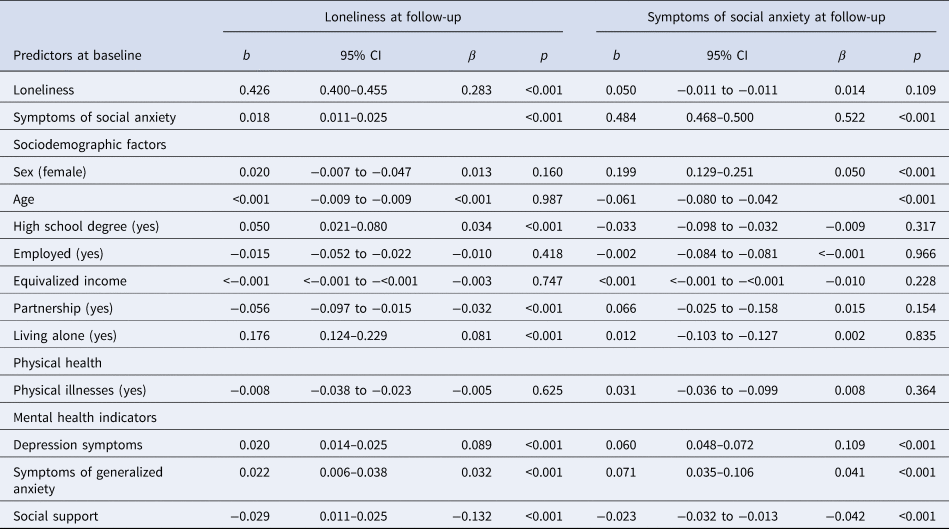
Note: Effects of age are provided in 5-year units; loneliness was measured by the single item ‘I am frequently alone/have few contacts’; symptoms of social anxiety were measured by the mini-SPIN; physical illness means the present of one or more of the following diagnoses at baseline: hypertension, diabetes, cancer, chronic obstructive pulmonary disease, coronary artery disease, dyslipidemia; depression symptoms were measured by the PHQ-9; symptoms of generalized anxiety were measured by the GAD-2; social support was measured by the BS-6; b, regression estimates; CI, confidence interval; β, standardized estimates; R 2loneliness = 0.211; R 2s. of social anxiety = 0.401.
Measurement model
The hierarchical measurement model of symptoms of social anxiety based on mini-SPIN showed a good fit to the empirical data (CFIscaled robust: 0.997; RMSEAsclaed robust [90% CI]: 0.034 [0.028–0.041]; SRMRscaled robust: 0.017). Factor loadings at baseline and follow up were metrically invariant, indicating measurement invariance over time. Factor loadings are shown in Table 3. Figure 1 shows the structure of the measurement model.
Cross-lagged panel model of loneliness and symptoms of social anxiety without confounder adjustment (N = 14 820; model 1)
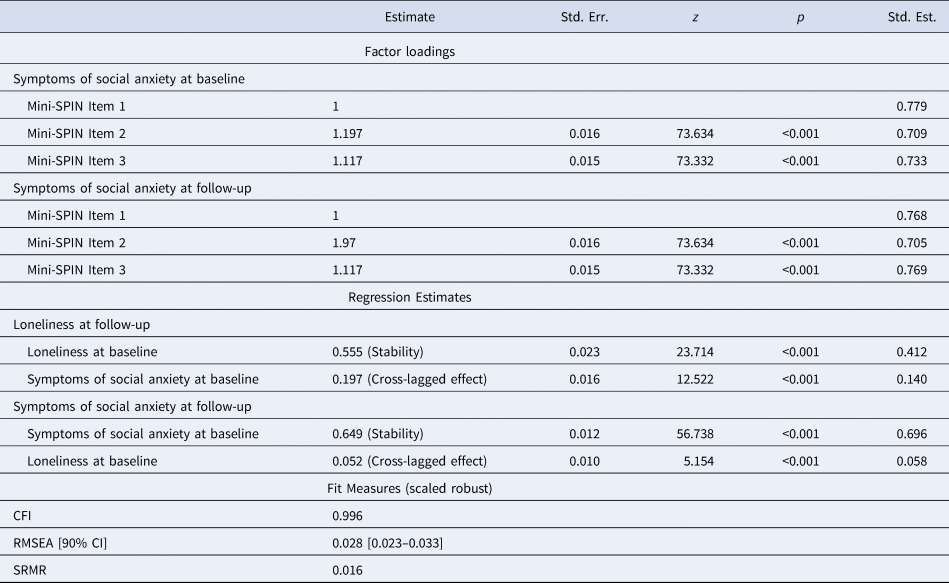
Std. err., standard error; Std. est., standardized estimate; CFI, comparative fit index; RMSEA, root mean square error of approximation; CI, confidence interval; SRMR, standardized root mean square residual.
Upper part with factor loadings of the confirmatory factor analysis with metric invariance shows measurement model of symptoms of social anxiety (N = 14 773).
Note: Loneliness was measured by the single item ‘I am frequently alone/have few contacts’; Symptoms of social anxiety were measured by the mini-SPIN.
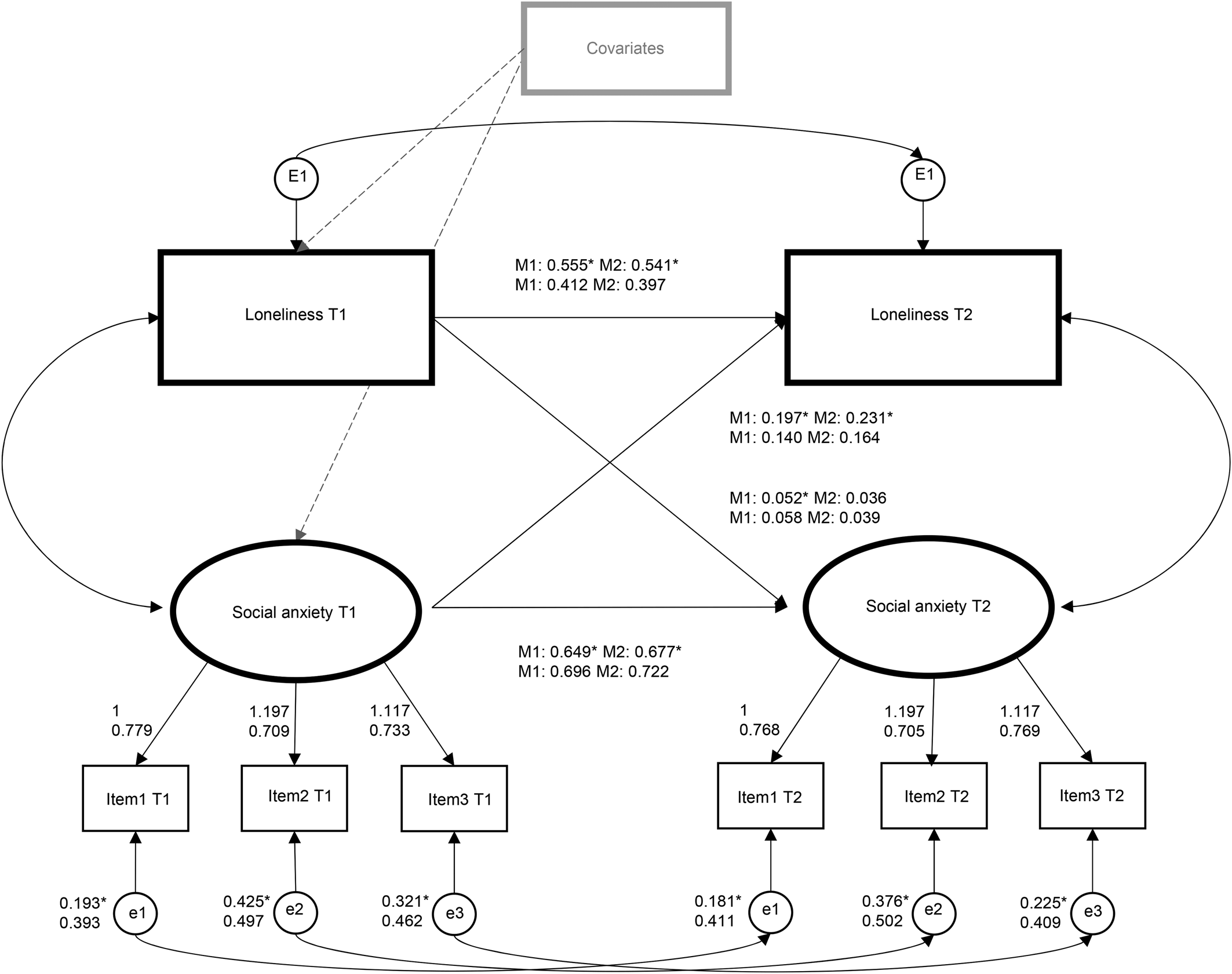
Direct and cross-lagged effects of loneliness on symptoms of social anxiety and symptoms of social anxiety on loneliness over five years with measurement model of social anxiety based on mini-SPIN with factor loadings. Circled are the latent factors, in rectangles are measured item-level variables. Symptoms of social anxiety included as a latent variable allows correction of measurement error in the social anxiety symptoms variable. Factor loadings and regression estimates on top are unstandardized, factor loadings and regression estimates below are standardized. M1: Model 1 (unadjusted), M2: Model 2 (adjusted for potential confounders). * Significant with p < 0.001. e1, e2, e3: error terms.
Cross-lagged panel model
Symptoms of social anxiety had a small statistically significant effect on loneliness five years later in both models. In the unadjusted model (model 1) the effect was estimated at 0.0197 (p < 0.001, standardized estimate of 0.140) and in the adjusted model (model 2) at 0.231 (p < 0.001, standardized estimate of 0.164). Only in the unadjusted model (model 1), loneliness had a small statistically significant effect on symptoms of social anxiety five years later. The unadjusted effect was estimated at 0.052 (p < 0.001, standardized estimate of 0.058). Partnership, living alone, high school degree, social support, depression symptoms, and symptoms of generalized anxiety as significant predictors for loneliness and age, sex, social support, depression symptoms, and symptoms of generalized anxiety as significant predictors for symptoms of social anxiety (compare Table 2) were included as covariates. Almost all covariates show significant effects, except sex and high school degree. The patterns were in line with the results of the multiple regression model for loneliness and symptoms of social anxiety each. For the structural model showing direct and cross-lagged effects of loneliness on symptoms of social anxiety and vice versa over five years with measurement model of social anxiety based on mini-SPIN see Fig. 1. Regression coefficients, as estimated in the structural equation models are shown in Table 3 (model 1) and in Table 4 (model 2). Fit indices of model 1 and model 2 were excellent: CFIscaled robust = 0.996; RMSEAsclaed robust [90% CI] = 0.028 [0.023–0.033]; SRMRscaled robust = 0.016 (compare Table 3) and CFIscaled robust = 0.966; RMSEAsclaed robust [90% CI] = 0.041 [0.039–0.043]; SRMRscaled robust: 0.028 (compare Table 4).
Cross-lagged panel model of loneliness and symptoms of social anxiety adjusted for potential confounders at baseline (N = 12 728; model 2)
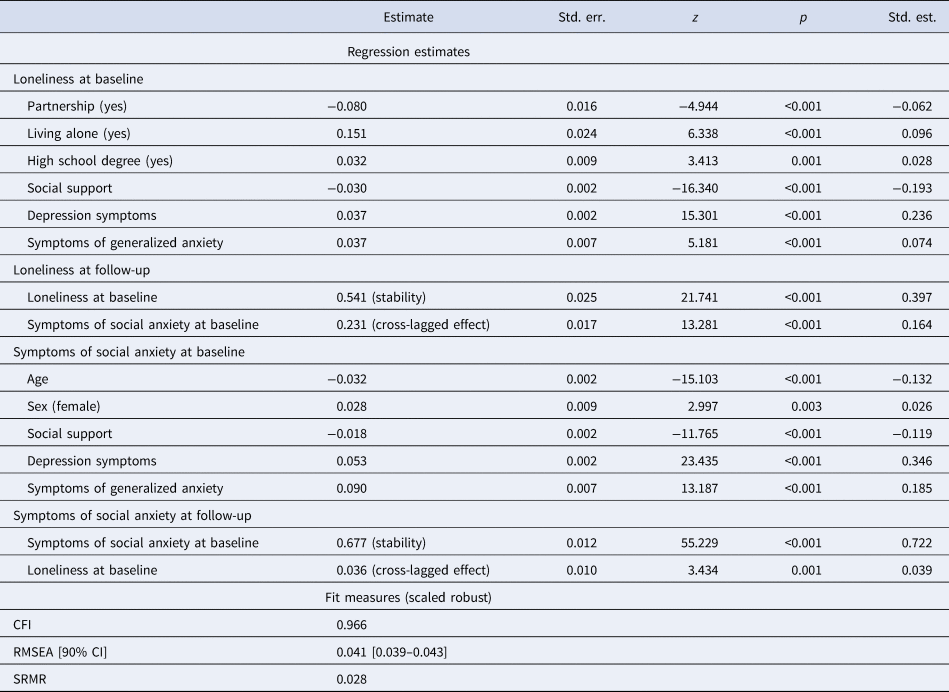
Std. err., standard error; std. est., standardized estimate; CFI, comparative fit index; RMSEA, root mean square error of approximation; CI, confidence interval; SRMR, standardized root mean square residual.
Note: Loneliness was measured by the single item ‘I am frequently alone/have few contacts’; symptoms of social anxiety were measured by the mini-SPIN; depression symptoms were measured by the PHQ-9; symptoms of generalized anxiety were measured by the GAD-2; social support was measured by the BS-6.
Discussion
The present study aimed to analyze the relation between loneliness and symptoms of social anxiety and vice versa within a German population-based cohort study over time. Towards this aim, stability, direct and cross-lagged effects over the course of five years were determined by an autoregressive cross-lagged structural equation model controlling for relevant covariates of symptoms of social anxiety and loneliness each.
Key findings
Overall, the majority of participants reported no loneliness and no symptoms of social anxiety over the observation period of five years. Bivariate correlation analyses indicated a higher stability of symptoms of social anxiety compared to loneliness. Loneliness and symptoms of social anxiety were correlated cross-sectionally at both measurement points. Partnership, living alone, high school degree, social support, depression symptoms, and symptoms of generalized anxiety were identified as significant predictors for loneliness. Age, sex, social support, depression symptoms, and symptoms of generalized anxiety emerged as significant predictors for symptoms of social anxiety. Small, but statistically significant effect of symptoms of social anxiety on loneliness five years later was observed taking into account relevant confounders. Findings could not confirm the reverse impact of loneliness at baseline on later symptoms of social anxiety.
Interpretation
Overall, the presented findings are in accordance with previous studies on the relation between loneliness and symptoms of social anxiety, suggesting positive cross-sectional and longitudinal associations between both mental health burden (Bruce et al., Reference Bruce, Wu, Lustig, Russell and Nemecek2019; Lim et al., Reference Lim, Rodebaugh, Zyphur and Gleeson2016; Maes et al., Reference Maes, Nelemans, Danneel, Fernández-Castilla, Van den Noortgate, Goossens and Vanhalst2019; Oren-Yagoda et al., Reference Oren-Yagoda, Melamud-Ganani and Aderka2022; Teo et al., Reference Teo, Lerrigo and Rogers2013; Wolters et al., Reference Wolters, Mobach, Wuthrich, Vonk, Van der Heijde, Wiers and Klein2023). We showed that symptoms of social anxiety were predictive for loneliness five years later in line with the results of an earlier cross-lagged panel (Lim et al., Reference Lim, Rodebaugh, Zyphur and Gleeson2016). As symptoms of social anxiety are characterized by the fear of being negatively evaluated in social situations, it can be assumed that these fear leads to social withdrawal and in turn hinders the ability to connect with others. However, we observed only a small effect of social anxiety on loneliness, presumably indicating the relevance of other variables (e.g. psychological burden or personal resources).
Contrary to the theoretical implications of the re-affiliation motive within the evolutionary theory of loneliness (Qualter et al., Reference Qualter, Vanhalst, Harris, Van Roekel, Lodder, Bangee and Verhagen2015) and previous observed effects based on a cross-lagged panel (Lim et al., Reference Lim, Rodebaugh, Zyphur and Gleeson2016), the reverse effect of loneliness on symptoms of social anxiety was not observed. Therefore, we cannot support the assumption that persons who have failed the motivation to reconnect with others tend to focus their attention to social threats and in turn run the risk of entering a loneliness-downward spiral (Cacioppo et al., Reference Cacioppo, Norris, Decety, Monteleone and Nusbaum2009, Reference Cacioppo, Grippo, London, Goossens and Cacioppo2015). However, Lim et al. (Reference Lim, Rodebaugh, Zyphur and Gleeson2016) did not include relevant sociodemographic covariates (e.g. age, partnership, education) in their analyses which might explain the different results. Additionally, similarly results suggesting a reciprocally association of loneliness and symptoms of social anxiety over time were found during childhood and adolescence (Maes et al., Reference Maes, Nelemans, Danneel, Fernández-Castilla, Van den Noortgate, Goossens and Vanhalst2019), an age group that were not included in our analyses.
Limitations
Despite the strength referring to the large sample size of the study and its cross-lagged panel design, findings should be interpreted considering study's limitations. Data on loneliness and symptoms of social anxiety relied on participant self-reports. Thus, we cannot exclude response bias, especially as loneliness has a negative stigma character. Additionally, the model only included two measurement points and therefore was not able to control for unobserved heterogeneity. Further, the differentiation of within- and between-person effects were also precluded. The small effects could be an artefact of the large sample size. Including further measurement points, future research should replicate our findings. While we used a screener with three items to assess symptoms of social anxiety, we were not able to validate its diagnostic accuracy by using a clinical diagnosis as external reference. We only modelled the effect of covariates at baseline to reduce complexity of the model. Although we hypothesized and tested that covariates would have most of its effect already at baseline, as some of these are variable over time (e.g. partnership, living situation) we cannot exclude effects on loneliness and symptoms of social anxiety at follow-up.
However, this population-based study allows broad generalizability even if it should be kept in mind, that the GHS as a cohort study of the metropolitan Rhine-Mine region in western Mid-Germany may constitute a wealthier and more homogenous sample with a higher level of education and equivalized income compared to the overall German population.
Implications
Taking the multitude of different factors influencing loneliness into account, prevention and intervention efforts should address the individual embedded within its social broader context. Our results highlighted the subjective component of loneliness as well as the relevance of individual differences such as mental distress or personal resources. Targeting the reduction of symptoms of social anxiety should be one main component of individual-level interventions. Providing skills to manage fear-related avoidance of social situations, results of recent systematic review and meta-analysis (Zagic, Wuthrich, Rapee, & Wolters, Reference Zagic, Wuthrich, Rapee and Wolters2022) concluded that skills to manage fear-related avoidance of social situations was the most effective strategy to improve perceived quality of social connections, supporting our recommendation. However, a robust evidence base for interventions to address loneliness is still lacking (National Academies of Sciences & Medicine, 2020). To date, many interventions have been developed to combat loneliness and social isolation. A recent network meta-analysis to identify and compare the effects of various non-pharmacological interventions on loneliness in community-dwelling older adults consistently pointed to the greatest therapeutic benefits of psychological interventions (Yu et al., Reference Yu, Li, Lin, Kee, Chiu and Wu2023). Groups 4 Health, an intervention that targets the development and maintenance of social group memberships to support health, reduced loneliness and social anxiety at the same time (Haslam et al., Reference Haslam, Cruwys, Chang, Bentley, Haslam, Dingle and Jetten2019) as cognitive-behavioral group therapy and mindfulness-based stress reduction reduce social anxiety and loneliness simultaneously (O'Day et al., Reference O'Day, Butler, Morrison, Goldin, Gross and Heimberg2021). There is no one-size-fits-all approach to address loneliness, social isolation, and social anxiety. Hence, tailored interventions are needed. Therefore, future research on interventions should take into account the shown effect of symptoms of social anxiety on loneliness as well as the effect of further psychological burdens (e.g. symptoms of depression) or personal resources (e.g. social support).
Conclusion
These findings give new insights into the complex relation between loneliness and symptoms of social anxiety. We showed that symptoms of social anxiety were predictive for loneliness five years later, without evidence on the opposite effect. Going from there, prevention and interventions of loneliness would likely be most effective if they took symptoms of social anxiety into account.
Supplementary material
The supplementary material for this article can be found at https://doi.org/10.1017/S0033291724001818.
Funding statement
This work was supported by the government of Rhineland-Palatinate (‘Stiftung Rheinland Pfalz für Innovation’, contract No. AZ 961-386261/733), the research program ‘Wissen schafft Zukunft’ and ‘Schwerpunkt Vaskuläre Prävention’ of the Johannes Gutenberg-University of Mainz, and its contract with Boehringer Ingelheim and Philips Medical Systems including an unrestricted grant for the Gutenberg Health Study as well as through the grants from the Initiative Health Economy Rhineland-Palatinate by the Ministry of Health and the Ministry of Economics, Rhineland-Palatinate, Germany (AZ.623-1) and the Federal Ministry of Education and Research, Germany (BMBF 01EO1003 and BMBF 01EO1503). P. S. W. and T. M. are PIs of the DZHK (German Center for Cardiovascular Research), Partner Site Rhine-Main, Mainz, Germany.
Competing interests
None.
Ethical standards
The authors assert that all procedures contributing to this work comply with the ethical standards of the relevant national and institutional committees (reference no. 837.020.07; original vote: 22 March 2007, latest update concerning our data analyzed: 20 October 2015). Further, all study investigations were conducted in line with the Declaration of Helsinki and principles outlined in recommendations for Good Clinical Practice and Good Epidemiological Practice.


 Open access

