

With representative democracy on the defensive in many parts of the world, interest in direct democracy has grown. Government-initiated referendums, citizen-led initiatives, and other mechanisms of direct democracy (MDDs) are common features of democracies around the world.Footnote 1 With Mexico’s introduction in 2012 of a constitutional provision for referendums, every Latin American democracy has provisions for direct democracy (see Welp Reference Welp2020). Moreover, the region is no exception: across the globe, a majority of democracies holds national-level referendums.
Theorists identify a long list of potential benefits from MDDs. The list includes greater responsiveness to citizens’ preferences, greater legitimacy of public policy, and enhanced citizen involvement in public policy-making (Barber Reference Barber1984; Budge Reference Budge1996). As Qvortrup (Reference Qvortrup2017) observes, referendums can help determine policies on emergent issues, such as climate change and integration into the European Union, at moments when they do not yet align with existing party platforms. Citizens’ groups can use initiatives to place new issues on the political agenda, enhancing the quality of representation, as they have done in Uruguay (Lissidini Reference Lissidini2020). Across Europe, people with weak party attachments view referendums as increasing government responsiveness to their demands (Bessen Reference Bessen2020). But scholars also highlight potential shortcomings. Latin Americanists point to referendums aimed at sidestepping courts and legislatures, as in Ecuador (Ramírez Gallegos Reference Ramírez Gallegos2014), Bolivia (Mayorga Reference Mayorga2020), and Venezuela (Kornblith Reference Kornblith2005, Reference Kornblith2020). Outside of Latin America as well, in countries such as Russia and Turkey, referendums have been part of the process of executive aggrandizement. Partisan actors often instrumentalize direct democracy to further their party’s goals or to minimize the influence of their opponents (Gherghina Reference Gherghina2019; Morel Reference Morel1993; Welp and Milanese Reference Welp and Pablo Milanese2018). Some scholars observe that citizens’ initiatives rarely empower citizens and civil society (Serdült and Welp Reference Serdült and Welp2012). In MDDs more broadly, political parties may influence citizens’ vote choice in ways that limit citizens’ autonomy (Hobolt Reference Hobolt2006). And referendums may fall prey to, rather than overcome, divisions among political elites, as Matanock and García Sánchez (Reference Matanock and García Sánchez2017) argue with regard to the Colombian referendum for peace in 2016.
Another criticism of MDDs is the focus of our study: they often elicit only modest levels of voter participation. Recent Latin American experiences illustrate the variable—and often low—levels of turnout that referendums elicit. For instance, in 2022, Mexico held a referendum on whether to recall the president, Andrés Manuel López Obrador. Turnout was dismal: fewer than one in five Mexican voters went to the polls. This in contrast to the 63 percent who had voted in the 2018 national elections. The Mexican experience, though extreme, exemplifies a pattern: participation in referendums falls far short of participation in candidate elections, both globally and in Latin America.
Low turnout has the potential to erode the legitimacy of MDDs. A basic tension in representative systems is that citizens give up direct self-government in favor of government by their elected representatives. A long history of political theorists, epitomized in the eighteenth century by Jean-Jacques Rousseau, decried this shift of authority as entailing a kind of enslavement of citizens. Mechanisms of direct democracy offer citizens the potential to reclaim direct authority and autonomy, even in systems that are fundamentally representative. But if these direct mechanisms do not work well, if they don’t respond to citizens’ desire to decide their own fate, or if they fail to truly give citizens direct say in policy because they are only masks for the power of officials—any of these flaws undermine a central raison d’être of MDDs.
These difficulties are not abstractions. Research shows that citizens are more likely to accept decisions that they view as important when they are made by referendum than through legislatures (Towfigh et al. Reference Towfigh, Goerg, Glöckner, Leifeld, Llorente-Saguer, Bade and Kurschilgen2016). But the lower the level of voter participation, the lower the perceived legitimacy of the referendum (Arnesen et al. Reference Arnesen, Broderstad, Johannesson and Linde2019; Leininger Reference Leininger2015; Olken Reference Olken2010).
There is a good deal at stake, then, in understanding why turnout lags in referendums. Do citizens not care about the questions put before them? Do they care less about these questions than about choosing their representatives? We have few systematic accounts of turnout in referendums: what does participation look like, and how does this compare to candidate elections? If referendum participation is lower, why? And if the gap is variable—which we show to be the case—what accounts for large gaps of more than forty percentage points in some instances and much smaller gaps, in the single digits, in others? In contrast to prior scholarship that has focused on issue salience among the electorate, we foreground the role of political parties. We argue that anemic citizen participation in mechanisms of direct democracy has as much to do with the incentives of political parties to mobilize for referendums.
With various kinds of evidence, we show that the relatively weak incentives that many political party operatives have to get out the vote in referendums is an important part of the story. In contrast to candidate elections, control over office is not at stake in referendums. That means that office-oriented and clientelistic parties will mount lethargic mobilization efforts. Still, referendum turnout is not always low and not all parties have trouble getting out the referendum vote. Parties that are internally cohesive and disciplined—as well as parties that are more programmatic than clientelistic—do a better job of getting out the vote in referendums.
A key general conclusion of our study is that when referendum participation lags, the responsibility lies as much with parties as with voters. That the power of MDDs depends on how well political parties mobilize voters does not debunk them as instances of direct democracy. Instead, our findings highlight another way in which citizens are better served by programmatic parties than by clientelistic ones. Programmatic parties are better at getting citizens to take advantage of moments in which their views are directly elicited about policy options.
Europe has attracted most of the attention of researchers concerned with voting behavior in MDDs.Footnote 2 Yet MDDs are a worldwide phenomenon. We follow a small but growing cohort of scholars—including Altman (Reference Altman2019, Reference Altman2011), Tuesta and Welp (Reference Tuesta and Welp2020) and the chapter authors in that volume, and Welp (Reference Welp2016)—in studying referendums in Latin America, where MDDs are widespread although, as Welp (Reference Welp2020) explains, they often work poorly.Footnote 3 By shifting attention to Latin American referendums, we are able to broaden the range of political party types involved and include variation that matters for citizen participation. We thus leverage substantial variation on both our explanatory variables (party types and organization) and outcome variables (citizen participation in MDDs), not only across countries but also within them. Because our interest is in the impact of political parties on turnout, we focus on referendums initiated by governments. In other kinds of polls, in particular citizen-initiated ones, parties may or may not want to increase turnout—indeed, they are sometimes hostile to such votes being held.
In the remainder of this article, we draw out the importance of participation in referendums and highlight global trends in turnout. We then offer general propositions about why referendum turnout often lags behind candidate-election turnout, and the kinds of political parties that exacerbate this trend. Next, we discuss our methodology and the kinds of data we use to test our theory about party types. Analysis of cross-national data from Latin America offers initial evidence that uninstitutionalized and clientelistic parties hamper turnout in referendums.
We then turn to case studies of Colombia and Brazil, which draw on qualitative and quantitative data, respectively, to dig deeper and assess the generalizability of our arguments. Our findings indicate not that some kinds of parties simply have difficulty getting out the vote in any election, but that these types of parties perform especially poorly in getting out the vote for referendums. Having demonstrated the relevance of party organization for referendum turnout with cross-national and within-country quantitative data, as well as with cross-party qualitative evidence, we return in the conclusion to broader questions. What do these findings tell us about the prospects, and limitations, of one mechanism of direct democracy for the legitimacy of representative systems?
Turnout in referendums: Basic facts
Political leaders who call referendums worry about turnout. This was true in Poland in 1984 (McManus-Czubinska et al. Reference McManus-Czubinska, Miller, Markowski and Wasilewski2004), in a range of Italian referendums (Uleri Reference Uleri2002), and, we found, in Colombia in 2016. During our fieldwork in Colombia, a politician and former interior minister involved with the national referendum on peace accords told us, “We were very scared that participation would be very low,” a fear that led the pro-Yes majority in congress to reduce the participation quorum from 50 percent of registered voters to 25 percent (Guillermo Rivera, interview, July 19, 2018). Robust participation would have heightened the legitimacy of the peace accords, facilitating their implementation and future-proofing the deal from the opposition (Londoño Reference Londoño2020). When it comes to referendums, voter participation and the legitimacy—or illegitimacy—it can confer are clearly on the minds of their political proponents.
Scholars have observed low referendum turnout in individual countries and in world regions (see, e.g., LeDuc Reference LeDuc2015; Butler and Ranney Reference Butler and Ranney1994; Qvortrup Reference Qvortrup2013; Szczerbiak and Taggart Reference Szczerbiak and Taggart2004; Lutz Reference Lutz2007). As we show in Figure 1, low referendum turnout is a global, not just a regional or national, phenomenon.Footnote 4 The figure draws on our original Global Referendums Dataset. It includes 154 referendums held in forty-nine countries from 1961 to 2020. (We refer to all questions put to voters collectively on a single ballot as one “referendum.”) We plot, along the x-axis, the relative referendum turnout (RRT)—the difference between turnout in a referendum and in the most recent candidate election prior to the referendum. RRT, as a relative quantity, is a more useful measure than raw referendum turnout; analyses of the latter risk confounding drivers of referendum participation with system-wide turnout effects, likely to also be at work in candidate elections in any given country and time period.
Changes in turnout from prior candidate elections to subsequent referendums. Comparison of turnout in each of 154 national referendums worldwide with turnout in the previous national candidate election. Negative values indicate that turnout was lower in the referendum. The referendums in the sample were conducted between 1961 and 2020.
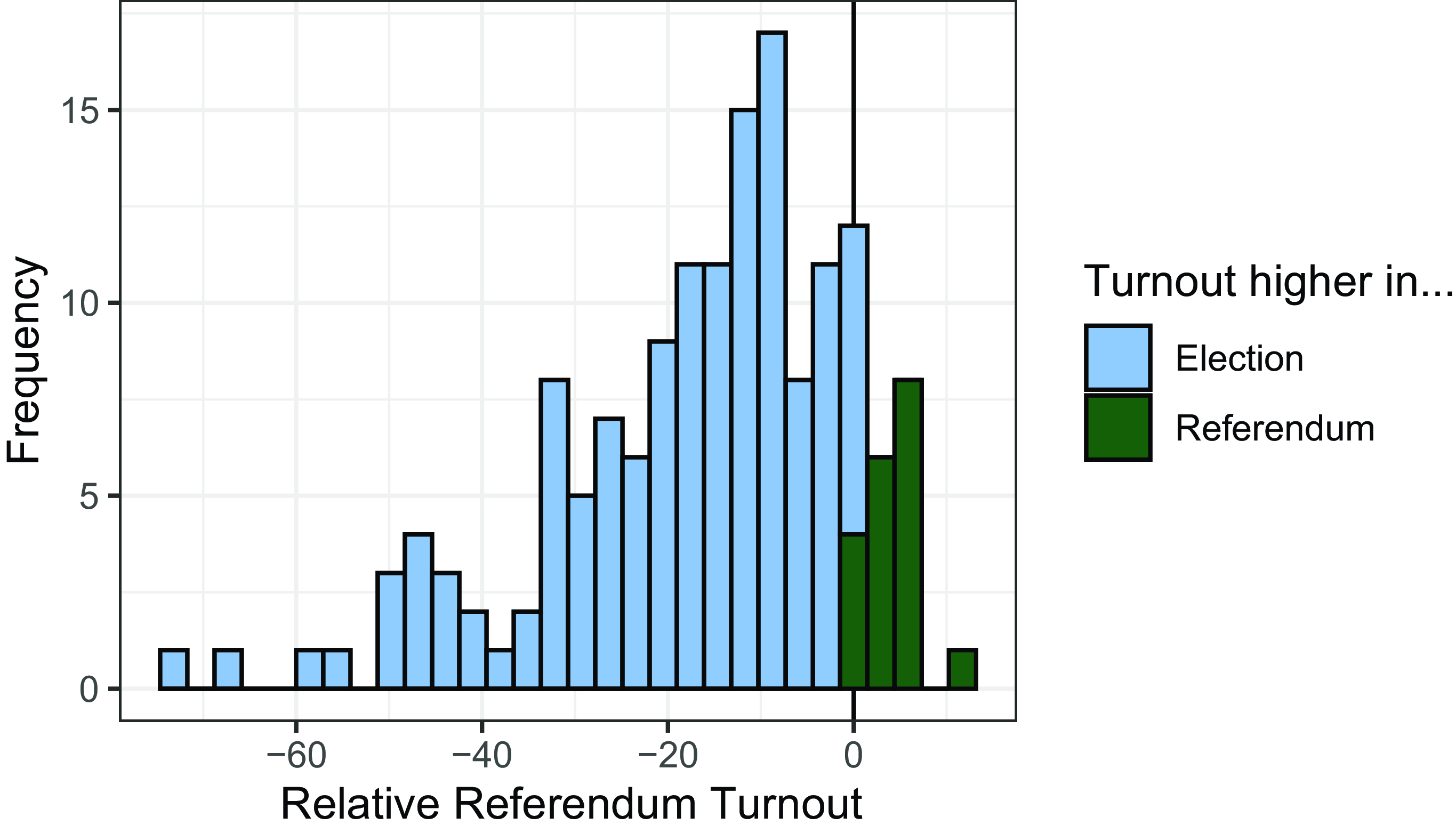
In Figure 1, bars below zero on the x-axis indicate referendums in which turnout was lower than in the most recent national candidate election; 86 percent of cases fall into this category. On average, referendum turnout lags candidate-election turnout by 16.2 percentage points. The turnout gap is thus both geographically widespread and substantively large. In Latin America, referendum turnout lags candidate-election turnout by an average of 15.2 percentage points. And the turnout gap was likely consequential for outcomes: for nearly half of all referendum questions, the turnout shortfall was larger than the margin of victory or defeat of the referendum vote. Higher participation, then, may well have changed the outcome of these referendums.
Scholars of European referendums usually explain low turnout as reflecting the relatively low salience of referendums, compared to candidate elections, and, behind that, voter disinterest (Franklin, Marsh, and Wlezien Reference Franklin, Marsh and Wlezien1994; Beach Reference Beach2018). If voters simply did not care about referendums, we would expect that, when referendums are held simultaneously with candidate elections, many voters would cast ballots in the candidate contests but then leave the polling place without casting a vote in the referendum, a phenomenon known as ballot roll-off. Roll-off is widespread in US candidate elections; scholars have documented a drop of between ten and thirty percentage points between top-of-ballot races (e.g., for president or Congress) and bottom-of-ballot (e.g., state-level) ones (Bullock and Dunn Reference Bullock and Dunn1996; Wattenberg, Mcallister, and Salvanto Reference Wattenberg, Mcallister and Salvanto2000; Marble Reference Marble2017).
In referendums held simultaneously with candidate elections, roll-off is small. Drawing again from our global dataset, Figure 2 reports on thirty-one national referendums that were held simultaneously with a candidate election. It compares the proportion of voters who cast a vote on a referendum question and the proportion who cast a vote for a candidate for the highest office to be voted on that day. In more than three-quarters of cases, the difference was less than five percentage points. The median difference was a mere 0.4 percentage-point decline in the referendum vote. And in 29 percent of simultaneous referendums, a larger number of citizens cast a vote on the referendum question than on the highest-office candidate election.Footnote 5
Valid votes in simultaneous referendums. Referendums held simultaneously with candidate elections. The y-axis indicates the number of valid and nonblank votes on referendum questions, as a proportion of registered voters. The x-axis indicates the number of valid and nonblank votes cast for the highest-level office on the ballot in the same election, also as a proportion of registered voters. (The dashed line marks where x = y.)
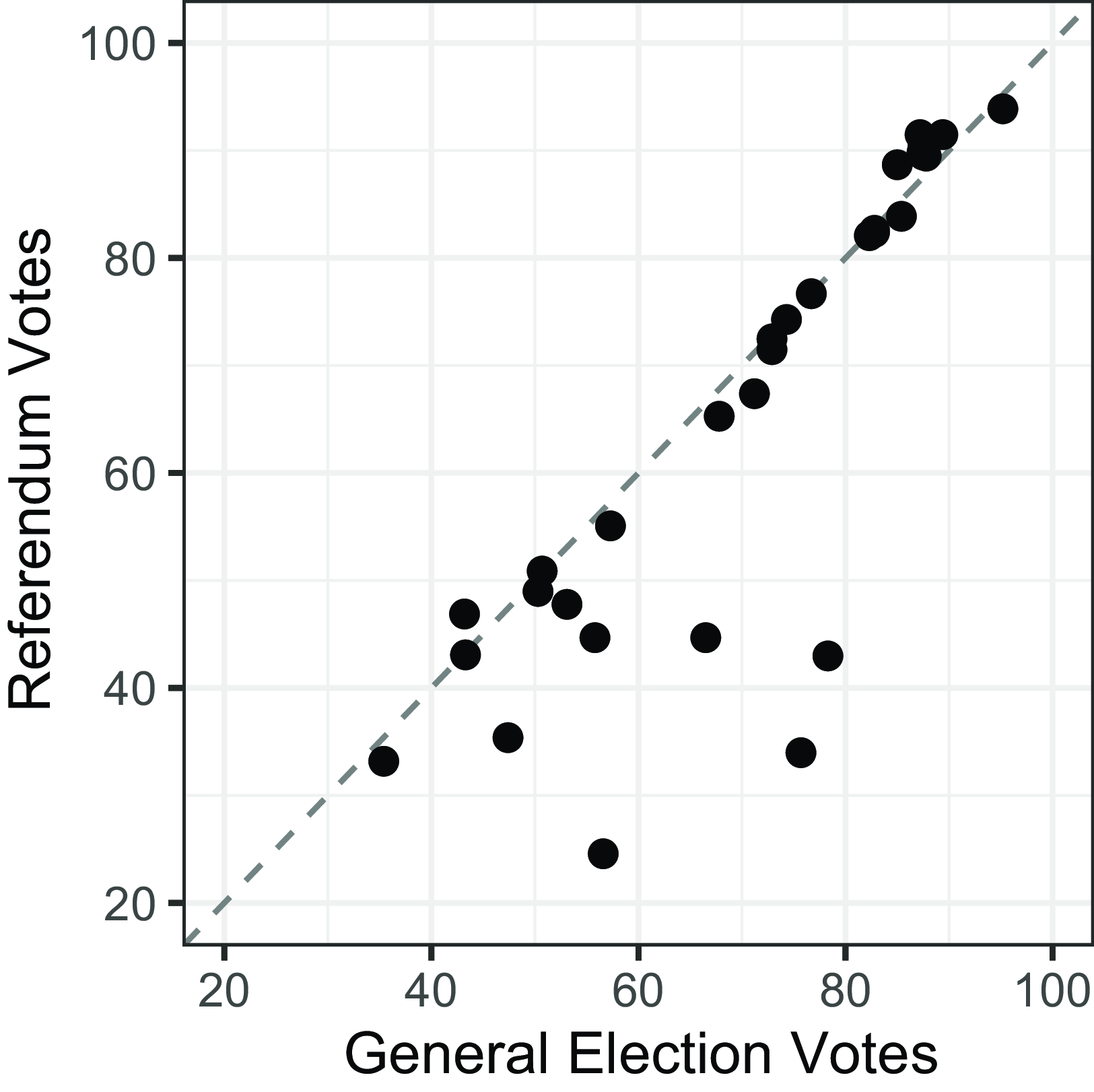
In most simultaneous referendums, once voters get to the polls, they are about as likely to cast a vote on a referendum question as in a high-level candidate election. Yet as shown in Figure 1, when referendums are not held simultaneously with candidate elections, voters are much less likely to get to the polls—on average, sixteen percentage points less likely. The presumed lower salience of referendums, then, leaves much unexplained.
In studies of referendums in Europe, low turnout has also been linked to participation quorums—rules establishing minimum levels of turnout for referendum approval (Aguiar-Conraria and Magalhães Reference Aguiar-Conraria and Magalhães2010). Quorum rules can create incentives for abstention among citizens and political parties that want a ballot measure to fail: if “no” voters are a minority, they do not want to turn out in large enough numbers to boost turnout above the participation quorum and thus help the Yes side to prevail. These dynamics undoubtedly play a role in some settings. Yet our cross-regional empirical analysis, reported later, indicates that the presence of quorum rules is not a significant predictor of turnout (see Table A5 in the appendix).
What other factors might depress referendum turnout? In contrast to behavioral accounts that center on voter disinterest, we take an institutional approach and explore the organization and incentive structures of political parties.Footnote 6 Typically, parties engage in get-out-the-vote drives in candidate elections, and their efforts can have a substantial impact—especially when they engage in door-to-door canvassing and in “ground campaigns” more generally (Gerber and Green Reference Gerber and Green2000). When it comes to referendums, parties campaign energetically on some occasions, but in others their efforts are weak. Hartlinski (Reference Hartlinski2015) points to weak party mobilization efforts to explain the mere 8 percent participation rate in the Polish referendum of 2015. More broadly, Kriesi notes that “participation in direct-democratic votes is expected to be a function of the intensity of the campaign preceding the vote” (Reference Kriesi2007, 121).
In the next section, we identify factors internal to parties that drive referendum turnout. Parties are more or less cohesive and disciplined, and more or less clientelistic or programmatic. These features shape the strength (or weakness) of incentives that party operatives have to invest in turning out the vote.
Party structure and incentives to turn out the vote
Voter turnout in any election has a lot to do with how hard parties try to get out the vote. For several reasons, we expect all parties to put in weaker get-out-the-vote efforts, in general, in referendums than in candidate elections. Candidate elections are life-and-death events for parties. Winning a candidate election means being able to shape policy across a range of issue areas. And it means gaining access to power, resources, and perks. Winning a referendum may certainly matter to parties, but in general less is at stake than in candidate elections. The enticements at the prospect of winning or retaining office are missing.Footnote 7
These differences in parties’ get-out-the-vote efforts are magnified when the types of parties involved vary. As Kitschelt and Wilkinson (Reference Kitschelt and Wilkinson2007) explain, political parties differ in the nature of their linkages to voters. The linkages may be programmatic, in which case they represent to voters distinct ideologies and packages of policy proposals. Or they may be clientelistic, in which case they offer voters individualized perks and largess and do not usually appeal to voters on policy grounds. Ideology is less central to party mobilization efforts when their linkages to voters are clientelistic.
We anticipate lower referendum turnout—other things being equal—when parties are clientelistic. The reason is that interests tend to be misaligned between leaders and local operatives of clientelistic parties, leading to agency problems (see, e.g., Stokes et al. Reference Stokes, Dunning, Nazareno and Brusco2013). The party brokers whose efforts are key to voter turnout may be less keen to invest effort in turning out the vote in referendums. The spoils of victory, so important for stirring party machines to action, are absent in referendum contests. Party operatives’ access to employment and discretionary benefits—either for their own consumption or to hand out to others—will not, in general, grow or shrink, depending on which side prevails in a referendum.
In addition to weaker incentives to mobilize voters in referendums, clientelistic parties are less skilled and less experienced in using policy arguments to turn out the vote (a point that we develop further in our analysis of Colombia’s 2016 referendum). Clientelistic parties are typically staffed by office seekers, not policy-oriented or highly ideological individuals (see Peterlevitz Reference Peterlevitz2020). To the extent that get-out-the-vote efforts for referendums involve discussing the policy question on the ballot, clientelistic brokers would need to pivot from their usual modus operandi.
Of course, to the extent that clientelistic parties are motivated to get out the vote in referendums, they could simply buy turnout, as they often do in candidate elections. Brokers may have some incentives to use the resources at their disposal to turn out the vote in referendums, perhaps because doing so signals to their superiors that they are expending effort for a party goal. It is not the case that party operatives have no incentives to mobilize at all for referendums; but in comparison with candidate elections, the incentives are fewer. Furthermore, the resources they are able to marshal are likely to be more limited in referendum campaigns.Footnote 8 The Colombian experience suggests that the material resources that grease the wheels of party machines might flow more sluggishly or dry up altogether in referendum campaigns. There, a sizable portion of campaign financing in candidate elections comes from private donors who anticipate access and influence. Candidates offer them kickbacks—future contracts in exchange for campaign contributions. Deprived of such resources in referendums, clientelistic parties in countries such as Colombia are less able to buy votes or turnout.
Programmatic parties are better equipped than clientelistic ones to mobilize voter participation in referendums. Their leaders and operatives have greater interest in public policy. They regularly advocate for their favored policies, including in their messages to voters. They develop policy-oriented party manifestos. For programmatic parties, referendum campaigns represent less of a change from their usual practices. Even lower-level canvassers tend to be more experienced at explaining policy proposals than are the brokers and party operatives of clientelistic parties. The voters in each type of parties’ orbit will also be distinctive in their receptiveness to programmatic appeals.
A second feature of political parties that we expect to influence turnout in referendums is party discipline—the degree to which leaders can use incentives to shape the actions of those beneath them. In highly disciplined parties, leaders make use of rewards and punishments, such as in the distribution of organizational advancement or candidacies. Party leaders’ ability to shape the actions of those below them matters for referendum turnout, since leaders often have more at stake in the outcome of referendums than do lower-level operatives. As an example, we interviewed party leaders in Colombia who testified to the uniform agreement of “the leaders here in Bogota” that the peace deal in the 2016 referendum was “important.” But the leadership was anxious about taking the “idea down the vertical scale” of the party and was relying on the party organization to mobilize voters far from the capital. To the extent that the leader can use incentives, such as career advancement and candidacies, to stir those who oversee ground campaigns to action, they can close the referendum turnout gap.
Methodological framework
To test our theory, we use several kinds of data. In a first test, we use quantitative data to study the impact of national-level party institutionalization on relative referendum turnout in Latin America. In countries with more institutionalized parties, the turnout gap between candidate elections and referendums is substantially smaller than in countries where parties are less institutionalized.
Cross-national analysis is suggestive but not well suited to testing all relevant explanations, such as the role of issue type in shaping voter participation. Relatedly, referendum issues plausibly shape party effort. The small number of referendums that have been held does not permit a cross-national statistical test of which issue types might be more or less motivating to voters (or to party mobilization efforts). But we can address the role of issue type by shifting to single-country research designs. These hold the referendum issue constant while still allowing for variation in political parties, our key explanatory variable.
We use two such designs, drawing on cases where we were able to access rich qualitative or quantitative data. One is an interview-based analysis of Colombia’s 2016 referendum on peace accords. The other is a large-N, cross-municipal analysis of the 2005 gun-control referendum in Brazil. In this case we leverage comparisons across thousands of municipalities.
Both cases represent recent, high-profile referendums that had far-reaching substantive impacts in the countries that called them. These are precisely the kinds of referendums that we might, a priori, expect to elicit high turnout and to triumph. Yet both failed, and the Colombian peace referendum failed partly because vast numbers of pro-accords voters stayed home (Dávalos et al. Reference Dávalos, Holmes and Dávalos2018).
Our qualitative analysis in Colombia is, by its nature, a case-specific analysis. But it allows us to disaggregate to the level of individual parties and to look for evidence of the theoretical mechanisms that we have argued drive the aggregate patterns identified in the quantitative analysis; namely, party incentives and structures. In Brazil, we are able to study variation in turnout among municipalities, as a function of the nature of political leaders in a single referendum. This design serves as a relatively fine-grained test for the generalizability of our findings from the Colombian case.
Parties and referendum turnout in Latin America
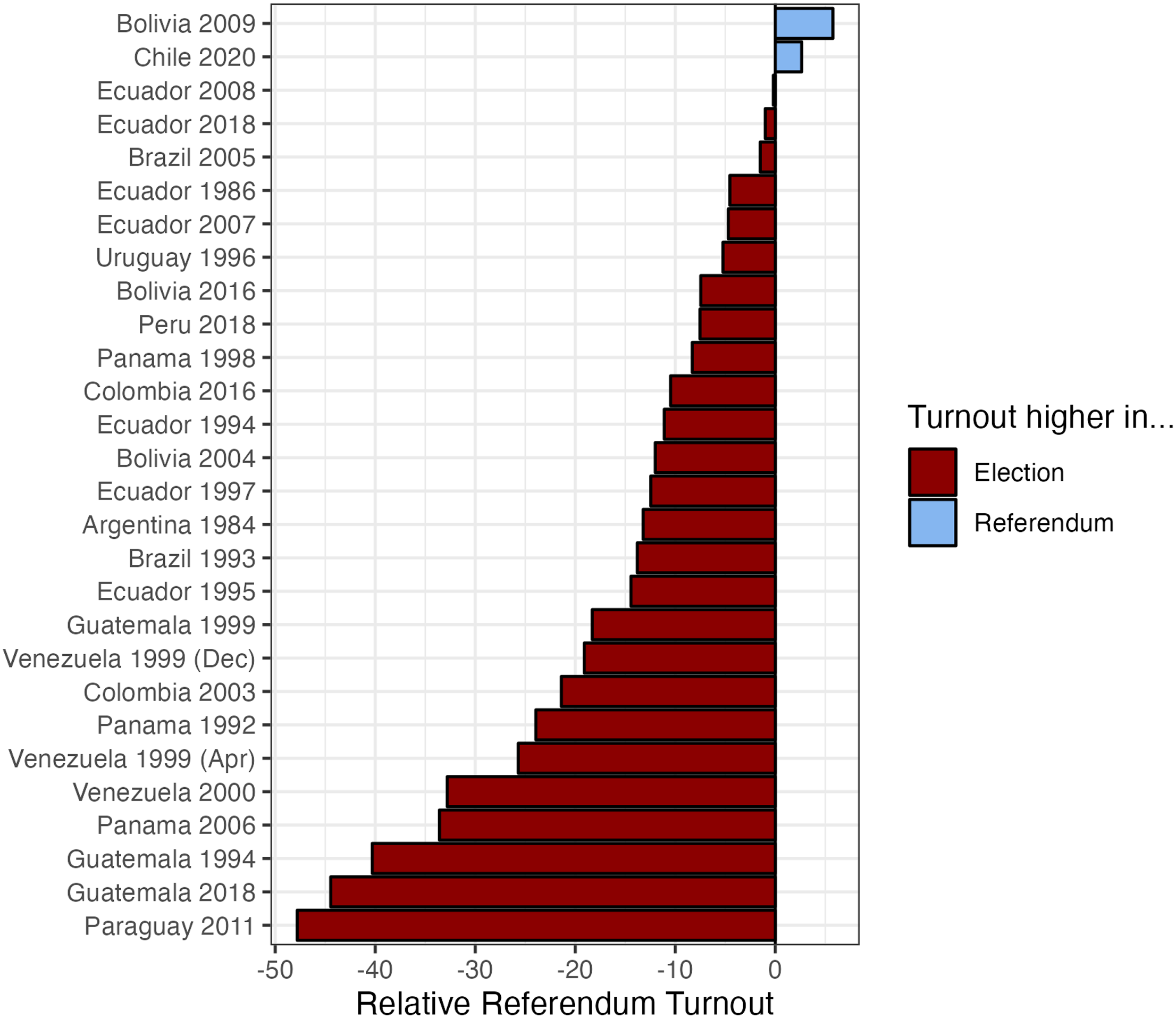
In line with other regions, voter participation in Latin American referendums lags behind that in candidate elections. Figure 3 illustrates the relative referendum turnout in twenty-eight referendums across Latin America. It exceeded prior candidate-election turnout in only two cases, those concerning constitutional reforms in Bolivia (2009) and in Chile (2020). The turnout deficit in referendums exceeded five percentage points in twenty-one of twenty-eight cases; the average referendum-candidate turnout gap, as mentioned, was 15.2 percentage points. Even in countries with compulsory voting laws, fewer voters go to the polls to vote on referendum issues than on how to fill public offices. Compulsory voting reduces the turnout gap but does not close it entirely, probably because enforcement is uneven and because social norms do not always arise to reinforce the importance of voting (Rau Reference Rau2022).Footnote 9
Relative referendum turnout in Latin America. Comparison of turnout in national referendums and in the previous national candidate election. Negative values indicate that turnout was lower in the referendum.
Additional cross-national data, compiled in the Global Referendums Dataset, allows us to dig deeper into the explanation for the turnout gap. This original dataset includes information observed at the national level, at moments of national referendums, and about the referendums themselves. We study the twenty-eight referendums included in Figure 3, spanning the years 1984 to 2020, and exclude referendums held by autocratic regimes.
To estimate the party-system factors discussed earlier, we also draw on the Varieties of Democracy (V-Dem) dataset. The key explanatory variable here is V-Dem’s Party Institutionalization Index (PII). The index includes measures of party strength (e.g., ideological and policy cohesion, party discipline) and party type (programmatic vs. clientelistic).Footnote 10 Parties that score higher on the PII are ones with greater cohesion and discipline and ones that are less clientelistic. Our key outcome variable is relative referendum turnout (RRT), discussed earlier.
To probe for an effect of party structure and organization on referendum turnout, we regress relative turnout, RRT, on party-system institutionalization, PII. And indeed, PII is a significant predictor of RRT. In a bivariate regression (illustrated in the left-hand panel of Figure 4) the effect size is 32 (p < 0.05).Footnote 11 This means that moving from the most institutionalized party system in our sample to the least institutionalized one is associated with a twenty-point decline in relative referendum turnout—a sizable drop and one that could mean the difference between a referendum being approved or rejected. Keep in mind that the implication is not that uninstitutionalized parties are bad at getting voters to the polls at all, but that they are relatively bad at getting them to the polls for referendums compared to in candidate elections.
Party institutionalization and turnout. Points are fitted with linear regression. For full regression details, see Table A2 in the appendix.
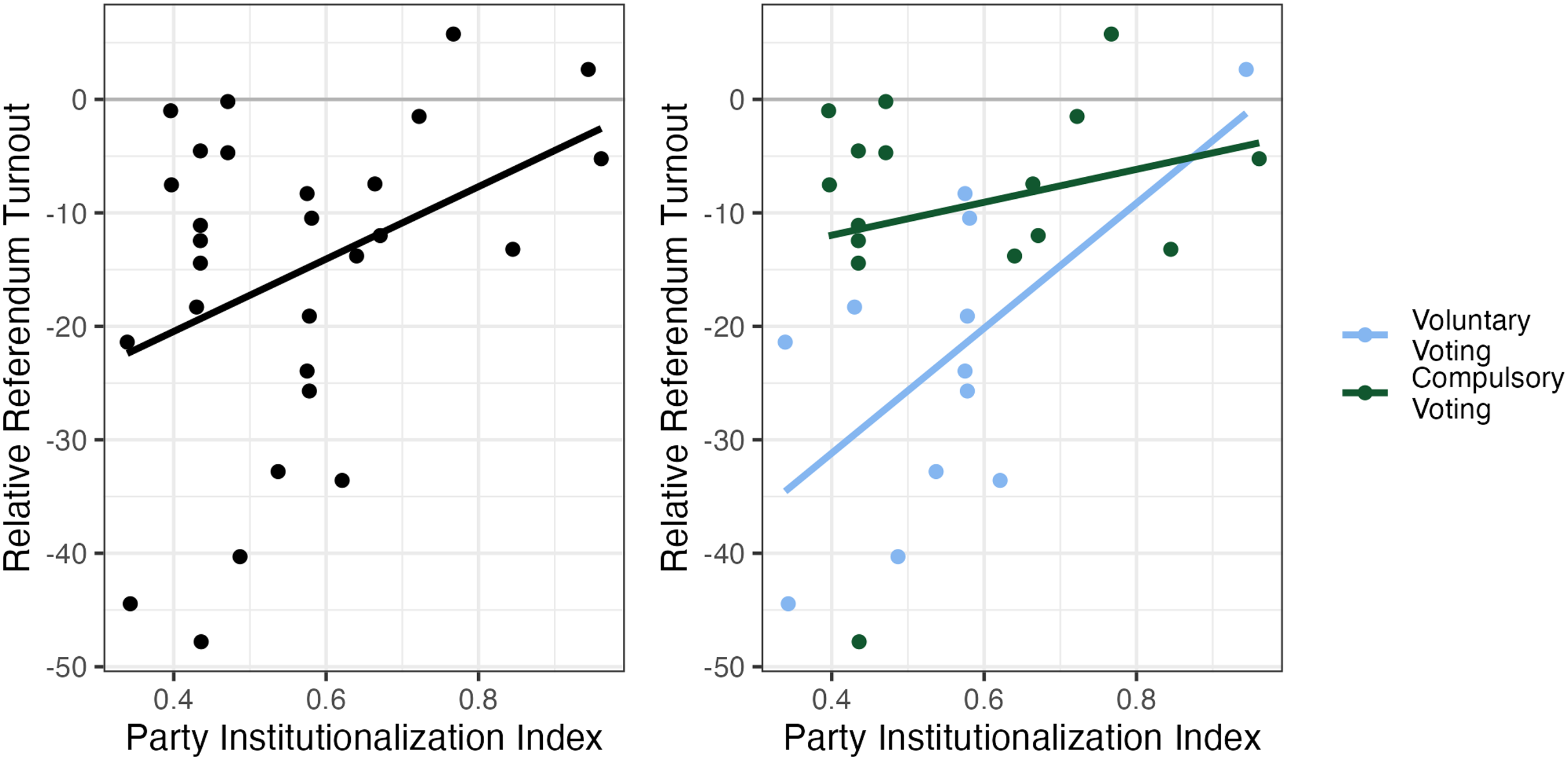
The right-hand graph in Figure 4 distinguishes countries with compulsory voting from those with voluntary voting. Unsurprisingly, the estimated slope is much steeper among countries where voting is voluntary, though the slope is positive in both cases (also see Table A2 in the appendix). Under compulsory voting, the state takes over the function of getting people to the polls, so turnout is less sensitive to the mobilizing efforts of parties.
These findings are robust (see Tables A2–A5 in the appendix). They do not appreciably change when we use alternative measures of the gap between referendum and candidate election turnout or when we include countries from all world regions. Hence the influence of party system institutionalization on the candidate-referendum election turnout gap holds at a global level, as well.
In sum, cross-national data, from the set of Latin American countries and from a worldwide sample, indicate that more disciplined, cohesive, and programmatic parties get people to the polls for referendum votes almost as well as they get them there for candidate elections. Parties that are more undisciplined and clientelistic have reduced capacity and inclination to get voters to the polls for referendums; therefore turnout declines.
Parties and turnout in the 2016 Colombian referendum
Major parties in Colombia vary in their degrees of programmatic and ideological emphasis, clientelism, and discipline. The Colombian case also allows us to set aside other factors expected to influence turnout. Voting in Colombia is voluntary, rather than compulsory, in both candidate elections and referendums. The referendum on which we focus was not held simultaneously with candidate elections. In referendums held simultaneously with candidate elections, it becomes difficult to distinguish mobilization for candidates and mobilization for the referendum.
Our fieldwork in Colombia revolved around the important referendum on peace accords, held in 2016.Footnote 12 We conducted forty-nine semistructured interviews, speaking with national and local-level politicians, campaign managers and staffers from the various referendum campaigns, bureaucrats and peace negotiators active in the peace deal or referendum, and local experts and academics (see the appendix for further details). The fieldwork was carried out in 2018 and 2019, thus beginning eighteen months after the referendum. But the vote was still highly salient and not easily forgotten by key actors.
The people whom we interviewed in Colombia confirmed the picture we have been describing, in which the internal features of parties—their organizational coherence and leadership strength, and the degree to which they rely on programmatic versus clientelistic mobilization—had a powerful influence on their ability and incentives to get out the vote. In candidate elections, these features were much less of an obstacle to voter mobilization.
Voting on the peace accords
The question posed in the 2016 Colombian referendum was whether voters favored ratification of peace accords signed by the government and the Armed Revolutionary Forces of Colombia (Fuerzas Armadas Revolucionarias de Colombia, or FARC). The FARC is an insurgent group that has been active in Colombia since 1964.
Traditional parties led the campaign on the Yes side: the Social Party of National Unity (Partido Social de la Unidad Nacional), known as La U, with President Juan Manuel Santos at its helm, as well as the Liberal Party, the Conservative Party, and the Radical Change party.Footnote 13 In candidate elections, these parties tend to rely on clientelism more than on policy appeals to mobilize their supporters. They feature high rates of party switching among party elites and operatives, and weak internal linkages between local and national levels (Milanese, Abadía, and Manfredi Reference Milanese, Abadía and Manfredi2016; Botero and Alvira Reference Botero and Alvira2012; Gutierrez Sanin Reference Gutierrez Sanin2001). Several leftist parties and figures also favored approval of the peace accords. They worked independently for their passage, with little coordination with the government-linked pro-Yes parties.
On the No side, the major party was the Democratic Center (Centro Democrático, CD), led by Álvaro Uribe. Uribe, a former president, was a towering figure in Colombian politics. Compared to most Yes parties, the CD at the time of the referendum had a clearer ideological profile, emphasizing law and order and promarket economic policies.
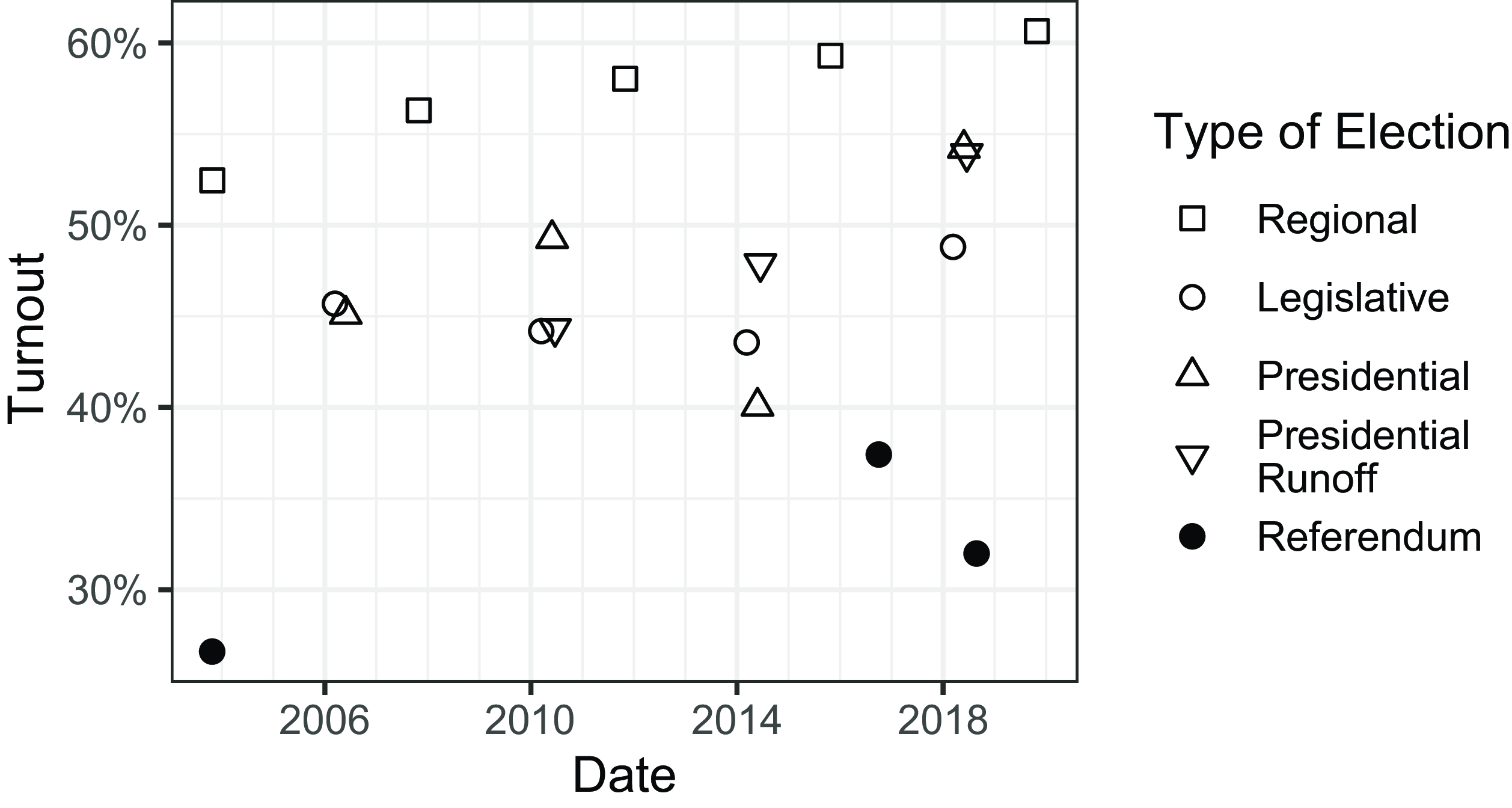
To the surprise of many—the government, international observers, and even those who opposed the peace deal—the referendum failed. The margin of defeat was narrow: the No side won with 50.2 percent of the vote. (For a discussion of vote choice in the referendum, see Kreiman and Masullo Reference Kreiman and Masullo2020.) At 37 percent, turnout was low, even by Colombian standards. Figure 5 plots the turnout rate in every Colombian referendum and candidate election from 2003 to 2019. Turnout was lower in the 2016 referendum than in any candidate election between 2003 and 2019. The only recent elections with lower turnout were two other referendums, held in 2003 and 2018.Footnote 14
Turnout in recent Colombian elections
Survey evidence of differential effectiveness of mobilization
A first piece of evidence that the No side beat the Yes side in the get-out-the-vote effort comes from public opinion data. In the months of the campaign leading up to the referendum, the Latin American Public Opinion Project (LAPOP) asked Colombians whether they planned to vote yes, vote no, or abstain. We estimate time trends in these responses, using the date of interview of each respondent to predict their likelihood of turning out for either Yes or No, as shown in Figure 6.
Turnout intention in 2016 referendum. Estimates are drawn from LAPOP surveys conducted during the campaign period (August–October 2016). Respondents could indicate that they intended to vote yes, vote no, or abstain. We estimated the trends over time via LOESS, using the date of interview for each respondent.
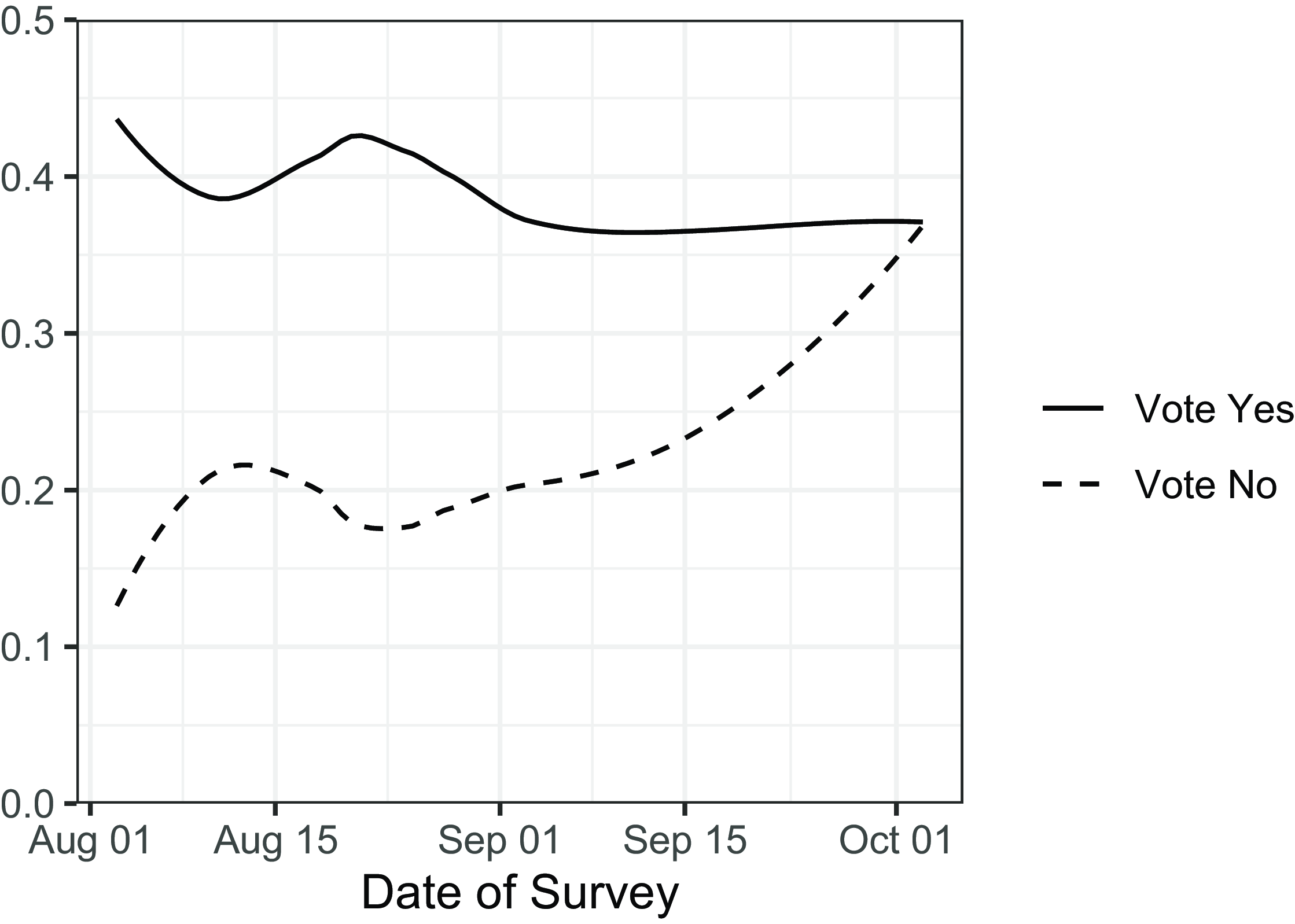
The data reveal that, over the course of the campaign, the No side steadily moved Colombians out of the bucket of abstainers and into the bucket of No voters, whereas the Yes side failed to turn abstainers into supporters.Footnote 15 At the start of the campaigns, the Yes side held a strong advantage—40 percent of respondents supported the Yes versus about 20 percent supporting the No. But by election day, the No campaign had mobilized enough voters to bring the two sides into a dead heat.
On their own, these data are merely suggestive of the party dynamics. And respondents vastly overstate their own likelihood of participating.Footnote 16 Yet even if the aggregate turnout levels implied by these data are inflated by social desirability bias, the trends over time are informative. Together with the evidence from our fieldwork, these trends reinforce a consistent story of disproportionate mobilization on the No side of the referendum.
Party actors’ views of referendum mobilization
In interviews, party leaders and operatives in Colombia explained the challenges of getting voters to the polls in the referendum, especially parties on the Yes side. Among the obstacles was the parties’ lack of institutional and organizational presence. Colombian experts have observed that even relatively large state capitals lack permanent party branches of parties that supported the Yes side (Botero and Alvira Reference Botero and Alvira2012).
The party brokers who are cogs in the machines of pro-Yes parties operate relatively independently of their leaderships, some even lacking any stable relationship with a national political party (Botero and Alvira Reference Botero and Alvira2012; Wills Otero, Batlle, and Barrero Reference Wills Otero, Battle and Barrero2012). This organizational looseness deprives party leaders of tools to stir brokers to action, especially in what the brokers view as nonessential votes, like plebiscites and referendums. In these polls, brokers perceived few concrete benefits for themselves and their local operations.
One party leader, alluded to earlier, complained about the lethargy that the referendum campaign encountered among local operatives: “The leaders [of the party], here in Bogota, we all agreed [that the peace deal] is important. But now I have to take this idea down the vertical scale [of the party], to the leader of the smallest and furthest village, he has to get the idea that the party is supporting the Yes…. These are people who in other circumstances mobilize their families, their friends, express their desires. [In the referendum], at best the [local] leader would vote.” He went on to attest to the weak incentives to campaign when the prize is not political office: “When you carry out a campaign for yourself … you invest time, effort, resources, whatever you need. In a plebiscite, you don’t see your personal benefit, and so there is much more apathy, and it was very difficult to get people to work together” (Germán Córdoba, interview, June 19, 2019).
Clientelistic parties on the Yes side relied on a loose network of brokers who sustained quid pro quo relations with voters and donors. Campaign funds were less available than in the typical candidate election. Campaigns for public office are usually financed by a mix of reimbursement from the state as a function of the vote share they received (Salazar Escalante and Pabon Castro Reference Salazar Escalante and Castro2016); personal bank loans taken out by individual candidates (Sánchez Torres Reference Sánchez Torresn.d.); and corruption, for instance, in the form of promises of future government contracts or other favors in exchange for campaign donations (Graf Lambsdorff and Hady Reference Graf Lambsdorff and Hady2006).
But in the referendum, because control of public office was not at stake, kickbacks and other illicit forms of campaign funds were unavailable (Member of Corpovisionarios, interview, June 18, 2019). Nor were individual politicians willing to run the risk of taking out loans, and there was no official reimbursement for votes won.
For these reasons, according to politicians, academics, and experts, the Yes side lacked material resources needed to buy votes and induce voters to turn out. Without the resources that typically grease the wheels of Colombian machine politics, operatives from the pro-accords parties did not deploy the customary selective incentives for voters in the referendum vote: TLC, a Colombian acronym for steel construction rods (tejas), roast pork (lechona), and cement (cemento) (Tatiana Duque, interview, July 8, 2019).
On the No side, the CD party at the time of the referendum campaign was a more vertically integrated organization. Although Colombian political parties are organizationally weaker than parties elsewhere in Latin America, the CD had stronger internal organization and cohesion than its national rivals.Footnote 17 Whereas other Colombian parties are prone to factionalism (Sánchez López de Mesa Reference Sánchez López de Mesa2018) and to party switching among elites (Botero and Alvira Reference Botero and Alvira2012), the CD was more disciplined and cohesive (Losada and Liendo Reference Losada and Liendo2016). At the time of the referendum, it had active members at the neighborhood and municipal levels, a strong corps of social media volunteers, and legislators who took initiatives that were subsequently supported by the top leadership (Francisco Gutiérrez, interview, June 17, 2019; Felipe Botero, interview, June 13, 2019).
During the referendum campaign, the CD sustained a presence throughout the country, including in remote, rural areas. One CD party worker recalled the campaign he conducted alongside a congressman in the department of Meta: “Almost everything was door-to-door, we walked through the department, door-to-door, voz-a-voz. We went to villages. We went to all the departments of Meta…. We moved around a lot” (Juan Felipe Iregui, interview, July 5, 2019).
Another dimension on which Colombian parties differ is in the degree to which they emphasize ideology and policy in their internal operations and their appeals to voters. The CD was the major party, at the time of the peace accords referendum, with the clearest ideological and policy profile. It boasted a distinctive party brand, revolving around its pro-business and law-and-order stances. Uribe was the dominant force in the CD, endowing the party with elements of personalism and caudillismo. Still, Uribe’s force of personality was not a substitute for programmatic stances.
As a programmatic party, it had advantages in getting out the No vote. Little adjustment was needed to mount an ideological campaign against the peace accords. As a CD senator explained to us, in a referendum campaign, “You are selling ideas, you don’t have to talk about the person.” In the CD, the senator stated, “We are more ideas than people, and that’s very different from other parties in Colombia” (Senator Paloma Valencia, interview, June 20, 2019).Footnote 18
The No campaign offered programmatic arguments against the peace accords. Uribe and the CD consistently criticized the accords as too lenient on the FARC. The CD brought to the No campaign its law-and-order stance and a desire to win in a high-stakes national vote. In interviews, opponents of the peace accords expressed this hunger for a fight. When asked why the CD devoted so much effort to a campaign that they thought they would certainly lose—mistakenly, as it happened—the CD’s campaign director stressed the importance of communicating a message, regardless of the referendum outcome: “What we wanted to leave was a record, that we do not agree [with the peace accords]. We [knew we were] going to lose, but we [were] going to leave [a] record … that many Colombians do not agree [with the accords]” (Carlos Vélez, interview, July 8, 2019).
On the Yes side, there were some ideologically well-defined parties on the left, mirror images of CD on the right. But the largest parties espousing the Yes position—Santos’s U Party and its allies: the Liberals, the Conservatives, and Radical Change—had neither a strong ideological profile nor experience using policy appeals to turn out their supporters. These parties struggled to retool their campaigns for referendum messages.
Several Yes-side party leaders we interviewed noted that their parties were unaccustomed to making policy appeals, and that this inability did not serve them well in the referendum campaign. A senator of the governing U Party noted that “in a campaign, a candidate can ‘sell’ themselves, their qualities”, whereas this is not the case for referendums. He characterized the referendum as an “opinion vote,” where voters on the Yes side did not take cues from parties (Roy Barreras, interview, June 18, 2019).
A Radical Change director echoed this point. In a candidate election, he observed, “It’s easy to personalize the vote. In a referendum, you are selling an idea, and this is very complicated.” Whereas campaigning for a candidate is “tangible,” campaigning for an idea is more challenging because it is “abstract” (Germán Córdoba, interview, June 19, 2019).
The Yes side displayed comparatively low ideological motivation, a hindrance to local efforts to turn out voters. As a campaign director for the government noted, politicians on the Yes side lacked a programmatic platform that united them (Alfonso Prada, interview, July 16, 2019). And as a former interior minister observed, not all politicians formally on the Yes side were equally committed to the peace accords (Guillermo Rivera, interview, June 19, 2019). In candidate elections, many local actors mobilized for the sake of their own career advancement or allegiance to individual politicians. But these incentives were absent in the referendum.
In sum, the CD mounted a No campaign in which it drew from its “high combat morale” (Francisco Gutiérrez, interview, June 17, 2019). The CD, and hence the No side, was more ideologically cohesive and driven by policy critiques. It deployed its party organization to work hard in many parts of the country to get out the vote against the accords.
The Yes side, led by parties that were organizationally and ideologically less cohesive, oversaw relatively lethargic mobilization campaigns. A peace-deal negotiator and high-level Yes campaign leader whom we interviewed confided his skepticism about parties as a vehicle for the campaign: “The peace deal was a wish shared by many Colombians but it was not going to be realized through the parties, that is to say, it was outside the traditional mobilization mechanisms of parties. It probably would not have been possible to mobilize political parties without concrete electoral incentives” (Humberto de la Calle, Interview, July 15, 2019).
Parties and turnout in Brazilian municipalities
Thus far we have used statistical evidence to make comparisons across countries, and qualitative evidence to make comparisons across political parties in one country, in support of our claim that features of party organization explain the referendum turnout gap. In this section we embark on a different kind of comparison: across towns and cities in a single national setting. Because the nature and composition of local party systems vary a good deal from municipality to municipality in Brazil, we are able to home in on the effect of varying parties on turnout while holding constant the kind of referendum being held and the national context. And indeed, we will show, with municipal-level data, that weak and clientelistic parties fare badly at turning out voters for referendums.
Several federal administrations in Brazil had tried to curb the spread of firearms, in a country with one of the highest rates of gun-related fatalities in the world. President Fernando Henrique Cardoso’s administration (1995–2002) passed a gun-control measure in 1997. But by the early 2000s, ownership and fatality rates remained high. The government of President Luiz Inácio Lula da Silva (Lula), of the Workers’ Party (Partido dos Trabalhadores), proposed a referendum that would have outlawed firearms and ammunition sales to most citizens.
In 2005, Brazil held the referendum, with Brazilians voting in towns and cities throughout the country. Although its prospects had appeared encouraging, in the end it fell victim to an aggressive gun-rights campaign, with support from legislators like then federal deputy Jair Bolsonaro and from the US National Rifle Association.Footnote 19
We collected data on political parties and referendum turnout from more than five thousand municipalities. These data allow us to distinguish localities with strong and programmatic local parties from ones with weak and clientelistic ones. Our analysis reveals that towns and cities with weak and clientelistic parties experienced systematically lower turnout than ones with disciplined and programmatic parties. They also saw larger gaps between referendum and candidate-election turnout. One feature to keep in mind is Brazil’s compulsory voting law, which requires all literate citizens between the ages of eighteen and seventy to go to the polls. Voting in the 2005 referendum was also compulsory. Compulsory voting substantially boosts turnout; yet even in many compulsory voting systems, people often abstain, and turnout levels vary from election to election. Brazil is one such country. Countries with strong norms of compliance around compulsory voting laws, such as Uruguay, reliably see turnout rates higher than 90 percent; but in Brazil, turnout frequently falls below 80 percent (Rau Reference Rau2024). Turnout in Brazil also varies from one election to another. For instance, turnout in the 2005 referendum was 7.7 percentage points lower than in the 2004 municipal elections. In short, despite de jure requirements for compulsory voting, de facto abstention is not uncommon and turnout varies.
Data and empirical expectations
We have argued that undisciplined and clientelistic parties find it more difficult to turn out the vote for referendums than do disciplined and programmatic ones. In this section, we systematically assess this proposition with municipal-level data in Brazil.
Our analysis draws on research by Peterlevitz (Reference Peterlevitz2020) that demonstrates a connection between party switching, on one side, and patronage and clientelism, on the other. Politicians switch parties at relatively high rates in Brazil. In the Chamber of Deputies between 1991 and 2003, at least one-third of deputies switched their affiliation to a different legislative party (Desposato Reference Desposato2006).
Local politicians also changed parties with some frequency. In our sample of mayors, approximately 26 percent were party switchers. Peterlevitz (Reference Peterlevitz2020) demonstrates that their motives in doing so are opportunistic. Typically, local politicians switch parties when they fail to secure candidacies in their former party; rarely do they switch to a party whose ideological or programmatic orientation is more in line with their own.
If parties are disciplined in the sense we use that term in this paper, then party leaders are able to harm a local aspirant’s career by denying her the opportunity to run for local office. Party switching by candidates indicates party indiscipline, in this respect. But Peterlevitz’s analyses go beyond this point. Using close-election regression discontinuity designs, he demonstrates that party-switching candidates who barely eke out a win go on, as mayors, to use patronage in public employment to a greater degree than do mayors who barely won and who are not party switchers. The switchers also engage more in vote buying. Peterlevitz concludes that party switchers are “opportunistic politicians,” motivated by their drive to attain office and with a “disregard for policy.” They therefore “rely on mobilization strategies with more immediate payoffs, such as patronage appointments and vote buying” (Peterlevitz Reference Peterlevitz2020, 3). In sum, party switching by mayors is a good proxy for low levels of party discipline, and for clientelism.
We combine data on mayoral party affiliations, party switching, and turnout in 5,471 Brazilian municipalities.Footnote 20 Our main explanatory variable, party switcher, takes a value of 1 if the mayor (elected in 2004) had switched parties in the prior four years. That is, she scored 1 if, between 2000 and 2004, she belonged to a different party from the one she was affiliated with when she ran for mayor in 2004.Footnote 21
Results
Table 1 reports a series of linear regressions. The first model in Table 1 regresses raw referendum turnout on the party-switcher variable. In municipalities with party-switching mayors, turnout was 1.9 percentage points lower than in municipalities with mayors who were not party switchers (p < 0.001). As predicted, in municipalities where the governing party is less disciplined and more clientelistic, referendum turnout falls considerably compared with those municipalities where parties are more disciplined.
2005 Brazilian referendum
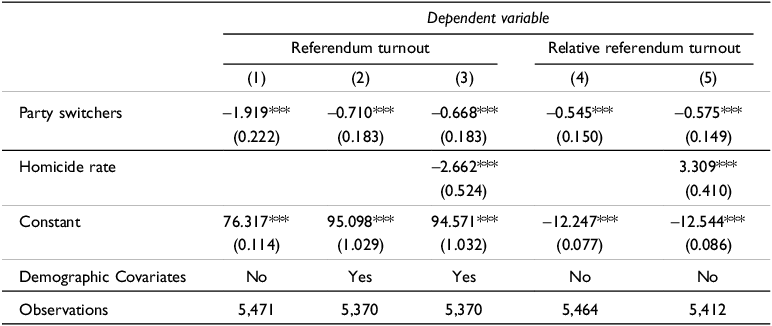
Note: Ordinary least squares models, HC2 robust standard errors. Relative referendum turnout uses turnout in the 2004 municipal elections as the benchmark (Y = 2005 referendum turnout – 2004 municipal election turnout). For full regression details, including all covariates, see Table A7 in the appendix.
*p < 0.05. **p < 0.01. ***p < 0.001.
How confident can we be that it is the nature of municipal parties that is depressing referendum turnout rather than some other factor that produces both parties that are less disciplined, and low turnout? Poverty might be a confounder, as clientelism feeds on voter poverty (Stokes et al. Reference Stokes, Dunning, Nazareno and Brusco2013), and poor people are at higher risk of abstaining (Lijphart Reference Lijphart1997; Schafer et al. Reference Schafer, Cantoni, Bellettini and Berti Ceroni2021); likewise, inequality has historically influenced party structure in Brazil.Footnote 22 As the second model shows, our results are robust to controls for poverty rate, per capita income, infant mortality, population size, and percentage rural population. The estimated effect of party switchers on turnout, though smaller, remains substantively significant at about −0.71 percentage points.
Yet we can’t be sure that we have controlled for every possible confounder. We therefore deploy an alternative dependent variable: relative referendum turnout, a similar measure to the one used in the histogram in Figure 1 to illustrate that the referendum turnout gap is worldwide.Footnote 23 Potential confounders in this case are more difficult to imagine. These would be factors that influence both party discipline or type, and the difference between turnout in candidate elections and referendums, rather than high rates of abstention across the board.
The results from the regression model using party switching to predict relative referendum turnout (model 4 in Table 1) reveal a smaller but still substantively and statistically significant effect. Comparing turnout in the 2005 referendum and the 2004 municipal elections, municipalities with a party-switching mayor saw turnout decline by an additional 0.55 percentage points compared with municipalities governed by a mayor who did not switch parties (p < 0.001). As an additional robustness test, we estimate all five models reported in Table 1 with party fixed effects. The results are substantively unchanged in all models (see Table A8).
We have suggested with anecdotal evidence and with data on roll-offs that the usual explanation of low voter turnout in referendums—low salience or low perceived importance of the contest—is not wrong but is unlikely to offer a complete picture of participation. The Brazilian experience offers an opportunity to further explore salience effects on turnout. The 2005 referendum was aimed at reducing gun violence, a problem that we would expect to be more salient in municipalities with more violence. In model 5, we control for the local-level homicide rate. That rate (measured in homicides per 1,000 population) is positively associated with higher turnout in the referendum, relative to candidate-election turnout—an estimated effect size of 3.3 percentage points (p < 0.001).Footnote 24 But the effect of party-switching candidates remains: the estimated effect is a reduction in relative turnout of 0.58 percentage points (p < 0.001).
In sum, systematic comparisons of parties and referendum turnout across thousands of municipalities in Brazil underscore the importance of political parties—how disciplined and programmatic they are—in opening up (or closing) a gap in citizen participation, between referendums and candidate elections. In addition, municipal comparisons in Brazil support our claim that the salience of referendum issues, though relevant, does not tell the whole story of lackluster citizen participation in referendums.
Concluding remarks: Implications for direct and representative democracy
Our study began with the observation that voter participation in referendums is often quite low when compared to participation in candidate elections. But it would be a mistake to infer that citizens are simply less engaged than in candidate elections. The fault, to put it bluntly, often lies not with apathetic voters but with lethargic political parties. In both candidate elections and referendums, many citizens need to be prodded to get to the polls. The difference is that parties can be relied on to work harder at prodding them when office, rather than a referendum outcome, is at stake.
What are the implications of this study for normative debates about representative and direct democracy? Political scientists have emphasized greater citizen control over the policy agenda as an advantage to direct democracy (Budge Reference Budge1996). Referendums allow ordinary people to make important collective decisions, without the intermediation of political parties. In systems, like Latin America’s, in which party labels are weak and electoral volatility high, voters may get less informative signals about the policies that a party will pursue in office. Slippage between campaign-stated intentions and measures taken by governments has been shown to be common in Latin America (Stokes Reference Stokes2001). And even where such slippage might be less pronounced, if voters are getting a bundle of possible policy actions from political parties, they may be well served by direct democracy, which allows them to cast up or down votes on issues, one by one or a few at a time.
Yet neither parties nor governments are absent from agenda control in moments of direct democracies. As we have seen, they play a crucial role in getting out the vote, or, in the case of clientelistic parties, in failing to do so. What’s more, in referendums, parties and governments are the key players in choosing their content and timing. Parties’ roles are reduced in citizens’ initiatives (iniciativas populares), in which citizens control the procedures for placing questions on the ballot. However, as Welp (Reference Welp2022) notes, citizens’ initiatives have been broadly institutionalized in Latin America but are rarely used.
Citizens’ initiatives probably hold more potential than referendums for improving representation. The recent US experience offers several instances of state legislatures that, because of gerrymandering, tout policies that are out of sync with the preferences of the state electorates. Initiatives have been used effectively in these circumstances, for instance, to protect abortion rights in Kansas or to force states to offer more generous health-care programs in Missouri (Rau, Sarkar, and Stokes Reference Rau, Sarkar and Stokes2022).
Our study counsels against viewing direct democracy—or at least referendums—as a corrective to declines in the legitimacy of democracy, and more so when these declines are due to sagging participation. To understand why, note the reasons turnout may flag in either kind of election. The factors that drive, or suppress, turnout in candidate elections have been studied for decades. The starting point for these discussions is the observation that voters have good reasons not to vote. Their individual votes are unlikely to decide the outcome and voting is costly, requiring time, resources, and planning.
The factors that can push people to vote, despite these disincentives, include higher incomes and education, involvement in personal and social networks, age, and being mobilized by canvassers and other get-out-the-vote techniques. Elections that are viewed as of extraordinary importance, such as the first elections in transitional democracies, can also generate robust turnout. And compulsory voting laws also tend to push turnout up, as much for the norms these laws foster as for the threat of sanctions for abstainers (see Rau Reference Rau2022).
Note, then, that few of these factors suggests a legitimacy crisis when turnout is low. Voters’ apathy may reduce participation, but so may a number of other factors that do not reflect voter disinterest or disengagement. Many voters will need to be nudged—by spouses, friends, or campaigns—if they are to overcome the many justifiable reasons to stay home. The upshot of our study is that they may well be nudged less to turn out for referendums.
In sum, though our study’s implications do not make a strong argument for the advantages of direct democracy as an instigator of voter participation, nor does it adduce evidence of voters’ lacking interest in the topics that make their way onto referendum ballots. Ironically, as our study shows, the perception that voters are unenthusiastic about making their voices heard is somewhat misguided. It is not the case that citizens fail to participate in referendums because they do not care about the matter at hand—or at least, it is not the case that they care less than they do about who will govern them. The gap in turnout between the two kinds of elections will often signal not citizen apathy but party apathy or disarray. Indeed, when party efforts are lethargic, voter interest is also likely to flag. Voter disinterest in this case is an additional explanation for mechanisms linking weak party mobilization to depressed referendum participation.Footnote 25 Stated positively, leaders who hope to restore luster to representative systems by giving their citizens more opportunities to choose for themselves will need to work hard to get those citizens to the polls, at least as hard as they do when leaders’ hold on office is at stake.
Supplementary material
To view supplementary material for this article, please visit https://doi.org/10.1017/lar.2024.74
Acknowledgments
We would like to thank David Altman, Emily Beaulieu Bacchus, Francisco Gutierrez Sanin, Alisha Holland, Adrienne LeBas, Juan Pablo Milanese, Alejandro Sánchez López de Mesa, and Emily Sellars, and participants in seminars at Yale University, the Chicago-Yale Latin American Politics Group, Universidad de San Andrés, Universidad ICESI, Texas A&M University, Boston University, Vanderbilt University, and the American Political Science Association Annual Conferences of 2019 and 2020 for comments. We also thank four anonymous reviewers for their detailed feedback. We are grateful to Yale’s MacMillan Center for International and Area Studies and Council on Latin American and Iberian Studies, and the Tinker Foundation for financial support. The research reported here was deemed exempt by the Yale University Institutional Review Board, protocol #2000023046. Replication files for all quantitative analyses can be found on the Harvard Dataverse, https://doi.org/10.7910/DVN/EXYX5U.


 Open access

