





Clozapine is underused in most countries. Reference Bachmann, Aagaard, Bernardo, Brandt, Cartabia and Clavenna1,Reference Whiskey, Barnard, Oloyede, Dzahini, Taylor and Shergill2 There are many reasons for this underuse, but the burden of blood testing is a frequently cited cause. Reference Gee, Shergill and Taylor3,Reference Oloyede, Blackman, Mantell, Harris, Williams and Taylor4
Blood monitoring is mandatory for people taking clozapine because of the risk of fatality linked to clozapine-induced agranulocytosis. Before monitoring was introduced, fatal agranulocytosis occurred in 1 in 250 people treated Reference Alhava, Olkinuora and Palva5 and agranulocytosis in around 1 in 100. Reference Amsler, Teerenhovi, Barth, Harjula and Vuopio6 Monitoring schemes are aimed at both reducing the incidence of agranulocytosis (by detecting neutrophil count falls before agranulocytosis develops) and at reducing the risk of death should agranulocytosis develop (by allowing prompt withdrawal of clozapine).
In the UK and some other countries, clozapine must be withdrawn in certain situations in which agranulocytosis has not developed but when there are two consecutive counts below 1.5 × 10⁹/L, for example. These are commonly termed red results – two consecutive red results mandate clozapine withdrawal. This precaution may halt the development of agranulocytosis but it may also cause the unnecessary stopping of clozapine in others.
We sought to examine all cases of mandatory clozapine cessation in our hospitals to determine the likely association with clozapine treatment.
Method
Data sources
This was a retrospective study of an anonymised cohort. Data were extracted from the Clinical Record Interactive Search (CRIS), a system providing de-identified information from South London and Maudsley National Health Service Foundation Trust (SLaM) electronic health records. SLaM is the largest tertiary mental healthcare provider in Europe, serving four boroughs in southeast London with a population of over 1.4 million people. In addition, linked data were accessed from the Zaponex Treatment Access System (ZTAS), the provider of mandatory blood monitoring for clozapine treatment SLaM patients. All patients prescribed clozapine at SLaM are registered with ZTAS. ZTAS has a database of all the mandatory blood test results and all the clozapine treatment-related statuses (e.g. on-treatment, discontinued, etc.) assigned to each patient.
SLaM’s Clinical Data Linkage Service (CDLS) provides a secure data environment that allows CRIS to be linked with other external clinical and non-clinical databases, including ZTAS data, using individual matching but then discarding the identifiers, allowing the data to be made available in the same anonymised format as CRIS data. The CRIS data resource, including the linked data used in this manuscript, has received research ethics approval for secondary analyses (Oxford REC C, reference 28/SC/0257). The CRIS Oversight Committee ensures that research conducted using health records is ethical and legal, and patients can opt out of having their CRIS data used for research. Because of this oversight and the certain preservation of patient anonymity, consent was not obtained from all participants, as is usual with CRIS projects covered by our ethical committee approval. Patient details are kept to a minimum to prevent identification of any included patient. The authors assert that all procedures contributing to this work comply with the ethical standards of the relevant national and institutional committees on human experimentation and with the Helsinki Declaration of 1975, as revised in 2013.
Study population
The study cohort consists of SLaM patients present in the linked ZTAS data who meet the following criteria: they have two consecutive red blood test results recorded in ZTAS and have free-text clinical notes available in CRIS. The blood test dates were restricted to the ZTAS data available at the time, spanning from 2 May 2000 to the date of the most recent available record in ZTAS up to 1 October 2019.
Search criteria
For this project, red results were defined as <1.5 × 10⁹L and agranulocytosis as 0.5 × 10⁹L. Benign ethnic neutropenia (BEN) criteria for ‘red’ results (0.5 × 10⁹L) were not applied.
Day 0 was defined as the first red result (RR1) of two consecutive red results. CRIS free-text event data were examined from Day −40 to Day +40 and filtered for ‘medical’ and ‘consultant’ within the professional group category on CRIS (see Supplementary material available at https://doi.org/10.1192/bjp.2025.10423). For treatment courses with over 100 entries within this period, a keyword search was used (see Supplementary material).
Co-prescribed medicines were documented as those prescribed on Day 0 or closest to Day 0. Evidence of cancer chemotherapy was searched from Day −40 to Day 0. For records of pneumonia, Day −40 to Day 0 were searched and for antibiotics Day −40 to Day +40. Confirmed viral illness was documented from Day −40 to Day 0. This was defined as anything specifically ‘viral’, or when aciclovir was prescribed or results were positive for the words Tamiflu, H1N1 or influenza. Mentions of HIV, chest infection, coughs, colds, runny nose and flu-like symptoms were not used as indicators of viral illness. A diagnosis of BEN was assumed when patients were formally registered as having BEN with the clozapine manufacturer.
Fever was defined as 38°C or above. The highest daily temperature recorded was documented each day between Day −7 and Day +30.
Hospital admissions were recorded between Day −40 and Day +40 and categorised into precautionary, infection or other reasons.
Granulocyte-colony stimulating factor (G-CSF) use was documented between Day −40 and Day +40.
Demographic information was collected on ethnicity and BEN status from patient notes.
Review
A panel of five senior clinicians (two experienced psychiatrists (CC, JM), two experienced pharmacists (EW, DT) and an experienced haematologist (SG)) independently gave their views of the cases presented to them (i.e. each was blind to others’ decisions). The review process was as follows. Each reviewer was sent details of all 96 cases and asked to determine, using their professional acumen, which cases were, in their view, definitely caused by clozapine (i.e. beyond reasonable doubt), which were probably caused by clozapine (i.e. more likely than not) and which were not clearly caused by clozapine (i.e. less likely than not). They were also asked to list those cases for whom they felt clozapine should not be represcribed on the basis that the risk of agranulocytosis on rechallenge was too high. When all members of the panel had made their decisions, the extent of agreement was assessed by one member of the panel (DT) and discrepancies identified. Clarifications were then issued to the panel and the assessments redone independently as before.
Factors considered in determining the cause of severe neutropenia were as follows: the pattern of neutrophil count change (speed of decline; the nature of decline (continuous/non-continuous), duration of nadir); the severity of neutropenia; the need for G-CSF; the nature of recovery after cessation of clozapine; and the absence or otherwise of other potential causes of neutropenia.
Factors considered in determining the life-threatening nature of the neutropenia were as follows: the severity of neutropenia; the duration of the neutrophil count nadir; the need for G-CSF; the need for antibiotics; and the presence of fever, hospital admission and pneumonia.
In determining whether clozapine re-exposure should be attempted, panel members were asked to consider the level of certainty that clozapine had been the cause of neutropenia, alongside the duration of clozapine treatment before the neutropenia episode occurred.
Case details and decisions are presented as Supplementary material.
Results
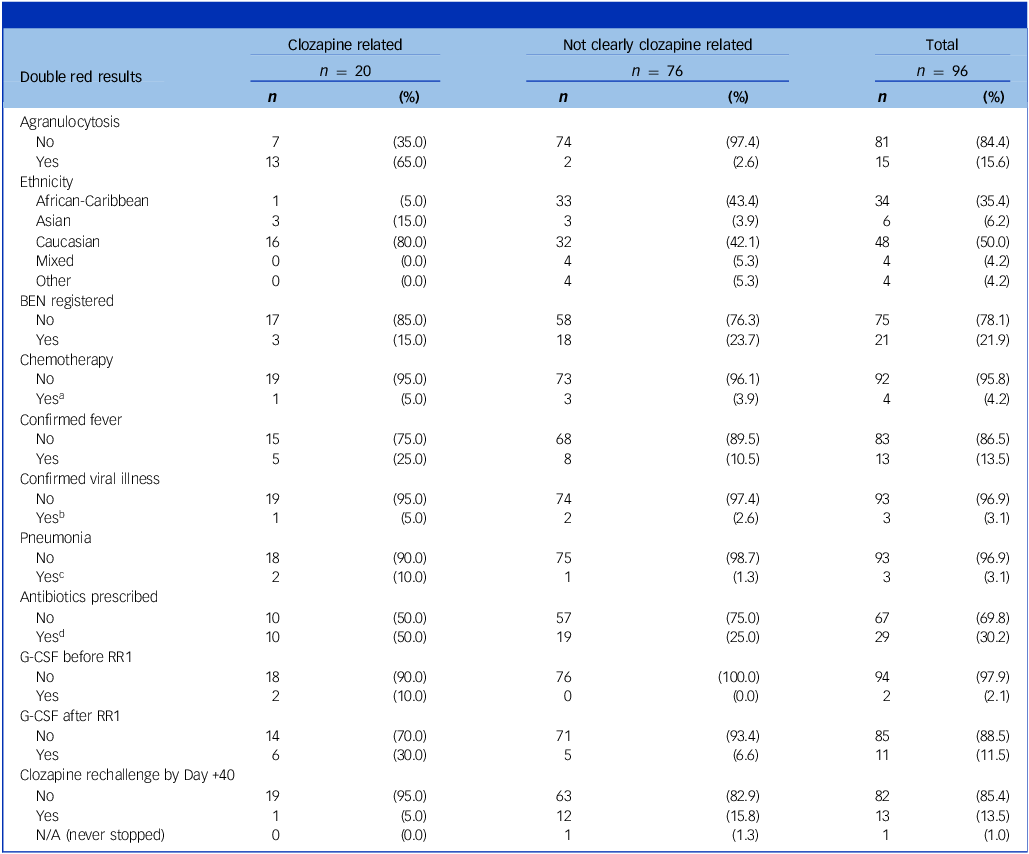
We found 99 cases of mandated treatment cessation (occasioned by two consecutive red results) recorded from 84 patients. The results are presented as treatment courses. Three of the treatment courses had their first red result (RR1) when they were not under the care of SLaM and therefore there were no records on CRIS and accordingly they do not feature in this data-set. All but one of the clozapine treatment courses (for a BEN-registered patient (allowing lower thresholds)) were ceased as mandated. In 13 of 96 cases, rechallenge with clozapine was attempted by Day +40 (Table 1).
Characteristics of clozapine-related and clozapine-unrelated cases

BEN, benign ethnic neutropenia; RR1, first red result; G-CSF, granulocyte-colony stimulating factor.
a. Of the four cases that received chemotherapy, two had unknown start dates, one had chemotherapy 3 days before their RR1 and the other 18 days before.
b. All confirmed viral illnesses were mentioned before RR1 (3, 5, 18 days before RR1).
c. Of the cases with pneumonia, none was confirmed to be viral.
d. Of the 29 cases prescribed antibiotics, 7 were prescribed an intravenous antibiotic.
Evaluation of cases
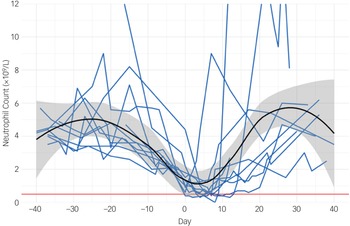
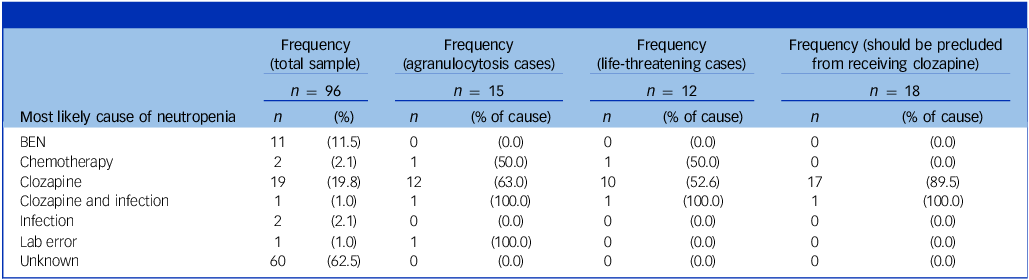
There were 96 cases of severe neutropenia resulting in clozapine cessation for which full details were available (Table 1). Of these, 9 were considered to have definitely been caused by clozapine (Fig. 1) and 11 probably caused by clozapine (Figs. 2 and 3). It was agreed by the panel that 18 of these 20 patients should be precluded from ever receiving clozapine again (the remaining two came from the ‘probable’ group). Of the 76 cases considered unlikely to have been associated with clozapine, 11 cases were considered to be a result of BEN (Fig. 4), and the cause was unknown in 60 cases (Fig. 5). In the remainder, two were most likely caused by concurrent cancer chemotherapy, two by infection and one was probably a result of laboratory error. Details are shown in Table 2.
Pattern of neutrophil count change – clozapine related cases (n = 9). The red line indicates agranulocytosis threshold (0.5 × 10⁹/L). The black line represents a locally estimated scatterplot smoothing trendline with a 95% confidence interval. Neutrophil counts are capped at 12 × 109/L for visualisation purposes (see Supplementary material for the full data range).

Pattern of neutrophil count change – probable clozapine related cases (n = 11). The red line indicates agranulocytosis threshold (0.5 × 10⁹/L). The black line represents a locally estimated scatterplot smoothing trendline with a 95% confidence interval. Neutrophil counts are capped at 12 × 109/L for visualisation purposes (see Supplementary material for the full data range).

Pattern of neutrophil count change – confirmed and probable clozapine related cases (n = 20). The red line indicates agranulocytosis threshold (0.5 × 10⁹/L). The black line represents a locally estimated scatterplot smoothing trendline with a 95% confidence interval. Neutrophil counts are capped at 12 × 109/L for visualisation purposes (see Supplementary material for the full data range).

Pattern of neutrophil count change – benign ethnic neutropenia cases (n = 21). The red line indicates agranulocytosis threshold (0.5 × 10⁹/L). The black line represents a locally estimated scatterplot smoothing trendline with a 95% confidence interval. Neutrophil counts are capped at 12 × 109/L for visualisation purposes (see Supplementary material for the full data range).

Pattern of neutrophil count change – unknown cause (n = 60). The red line indicates agranulocytosis threshold (0.5 × 10⁹/L). The black line represents a locally estimated scatterplot smoothing trendline with a 95% confidence interval. Neutrophil counts are capped at 12 × 109/L for visualisation purposes (see Supplementary material for the full data range).

Frequency by determined cause of neutropenia

BEN, benign ethnic neutropenia.
There were 15 cases of agranulocytosis, of which 12 were life-threatening. Seven of the cases of agranulocytosis were considered to have been caused by clozapine (all life-threatening) and six were possibly caused by clozapine (three life-threatening). One case of agranulocytosis was associated with cancer chemotherapy, and one was considered to be a laboratory error (Table 2).
Interrater agreement
After the first round of assessments, 26 cases were considered to have been probably or definitely caused by clozapine by at least one assessor. The main causes of interrater disagreement were as follows: inclusion of cases of non-continuous neutrophil count falls; an incomplete pattern of neutrophil counts where clozapine was withdrawn early; and the question as to whether a viral infection was sufficient on its own to cause severe neutropenia. It was agreed that the possibility of viral infection-related severe neutropenia should be discounted except where there was definitive and documented diagnosis of a viral infection. It was further agreed that a continuous fall in neutrophil count (i.e. each successive count was lower than the preceding count until a nadir was reached) was necessary (inter alia) for linking to clozapine as a cause. Assessors were also asked not to project or guess what changes in neutrophil count might have occurred in cases where clozapine was withdrawn early. Complete agreement was reached on the second round of assessment.
Incidence of severe neutropenia
Pharmacy records indicate that in the year 2000 the number of patients on clozapine was around 750, and in 2019, that number was around 1250. Assuming a linear rise in people prescribed clozapine, the study period therefore represented very approximately 19 000 patient-years of clozapine treatment. If the 20 cases identified here were indeed clozapine-induced agranulocytosis, that would give an incidence of approximately 0.1%. For definite cases, the incidence was approximately 0.06%. The incidence of two consecutive red results was approximately 0.5%.
Discussion
We examined 96 instances of neutropenia associated with mandated clozapine cessation and judged that only 20 (21%) were definitely or possibly caused by clozapine. Thus, almost four fifths of patients studied might have had clozapine treatment withdrawn unnecessarily. However, this study also shows the value of threshold-based monitoring in identifying cases of clozapine-induced agranulocytosis (13 of 15 cases of agranulocytosis were considered to have been caused by clozapine) and in preventing the development of agranulocytosis (the remaining 7 cases of clozapine-related neutropenia would most likely have developed into agranulocytosis).
In the UK, clozapine patients recording two consecutive neutrophil counts below 1.5 × 10⁹/L must cease treatment and be placed on the non-rechallenge register. The implication here is that clozapine is the cause of the low counts and that further exposure or re-exposure to clozapine would be a risk to life. These two assumptions are connected – if clozapine is the cause of the low counts, then continuing with (or restarting) clozapine will likely result in life-threatening agranulocytosis. Reference Lertxundi, Sanchez, Hernandez and Elizagarate7,Reference Meyer, Gee, Whiskey, Taylor, Mijovic and Gaughran8
Only 20 of 96 neutropenia cases examined here were judged to be caused by clozapine; in the remainder there was no clear association with clozapine. The cause of neutropenia in these remaining cases was largely unknown, although undiagnosed BEN accounted for most of the cases where the cause was known. It is possible that some of these cases were clozapine related, but clozapine was stopped before the distinctive pattern of neutrophil count change could develop, or it may be that clozapine caused a mild neutropenia (as opposed to catastrophic agranulocytosis). In all likelihood, nonetheless, the majority of patients with two consecutive results below 1.5 × 10⁹/L were not at risk of serious harm.
Why is it that so few people in our cohort had confirmed clozapine-associated severe neutropenia? Low neutrophil counts are quite common in population prevalence studies. In one US study (n = 32 102 covering 2011–2018), the point prevalence of neutropenia (defined as neutrophil count below 1.5 × 10⁹/L) was 1.24%. Reference Zhou, Zhou, Liu, Xie, Xu and Dai9 In another (n = 25 222 covering 1999–2004), the prevalence was 1.2%. Reference Hsieh, Everhart, Byrd-Holt, Tisdale and Rodgers10 In these general populations, clozapine is an unlikely cause of neutropenia, being prescribed in, at most, 1 in 5000 people. Reference Bachmann, Aagaard, Bernardo, Brandt, Cartabia and Clavenna1 In all probability, these cases of neutropenia are made up of non-pathological statistical outliers (e.g. cases of BEN), laboratory errors and those with neutropenia owing to other causes. The repeated monitoring of full blood counts (FBCs) in people on clozapine leads to a surveillance bias in which these rare cases are more likely to be picked up simply because of repeated testing. These random or clozapine-unrelated events are then falsely linked to clozapine.
In the UK, clozapine patients registering two consecutive counts below 1.5 × 10⁹/L are placed on the centrally held clozapine non-rechallenge database (CNRD). Two studies have examined the success rate of restarting clozapine in people on the CNRD – the proportion of people for whom re-exposure does not precipitate severe neutropenia or agranulocytosis. In the first, Reference Oloyede, Casetta, Dzahini, Segev, Gaughran and Shergill11 59 of 62 (95%) re-exposures were successful. In the second, Reference Oloyede, Whiskey, Casetta, Dzahini, Dunnett and Gandhi12 419 of 519 (81%) re-exposures did not result in further neutropenia. Thus, more than four fifths of people placed on the CNRD appear not to have had a clozapine-related neutropenia in the first place, otherwise this would have recurred on re-exposure. This proportion of non-clozapine related neutropenia is very similar to that found in this study.
Undiagnosed BEN was a particular cause of unnecessary clozapine cessation in this study. Clinical diagnosis of BEN is often only prompted by low neutrophil counts, and many clozapine patients wait years for BEN to be conclusively diagnosed. Reference Oloyede, Dzahini, Barnes, Mijovic, Gandhi and Stuart-Smith13 The familial tendency to low neutrophil counts is predicted by the presence of the c–c genotype of the SNP rs2814778 of the atypical chemokine receptor 1 (ACKR1) gene. Pre-clozapine testing for this homozygote would go a long way to preventing unnecessary clozapine cessation in people with BEN. Reference Aziri, Vallianatou, Balgobin and Taylor14
This study has some potential limitations. The assessors could be wrong in at least some cases of their assessment of the possible cause of the observed cases of neutropenia. These were somewhat subjective assessments made by clinical judgement, albeit using, wherever possible, agreed parameters. In addition, there may have been insufficient detail in each case to make an accurate diagnosis. Furthermore, early withdrawal of clozapine may have disguised clozapine’s role as the causative agent – in 23 (24%) of cases, clozapine was stopped before RR1 (Day 0). Strengths include the use of a large, real-world clinical data-set and the unanimous agreement obtained from multidisciplinary review by a panel with diverse expertise.
Our results demonstrate clearly that registering two successive neutrophil counts below 1.5 × 10⁹/L is clearly not a definitive indicator of impending clozapine-related agranulocytosis and should not lead to the mandatory stopping of clozapine. The neutrophil count decline in clozapine-related agranulocytosis has a distinctive pattern: neutrophils fall suddenly and continuously to zero or near zero and remain at that point for several days Reference Taylor, Vallianatou, Whiskey, Dzahini and MacCabe15,Reference Silva, Legge, Casetta, Whiskey, Oloyede and Gee16 – exactly the pattern identified here and shown in Figs. 1, 2 and 3; and in some contrast to the patterns in Figs. 4 and 5. The majority of these cases do not record a count in the neutropenia range before reaching zero. Reference Oloyede, Bachmann, Dzahini, Lopez Alcaraz, Singh and Vallianatu17 Only when clozapine is stopped before or at the time of the precipitant fall in neutrophils does the distinctive pattern not develop. Reference Taylor, Vallianatou, Gandhi, Casetta, Howes and MacCabe18 Pattern-based diagnosis of clozapine-associated agranulocytosis may offer better specificity without compromising sensitivity.
In conclusion, the current threshold-based system for identifying potential cases of clozapine-related agranulocytosis lacks specificity and causes large numbers of people to cease clozapine treatment unnecessarily. Clozapine-related agranulocytosis has a distinct pattern, and a pattern-based monitoring system can improve specificity without sacrificing sensitivity. Early identification of BEN using genetic testing would also help prevent the unnecessary stopping of clozapine.
Supplementary material
The supplementary material is available online at https://doi.org/10.1192/bjp.2025.10423
Data availability
The data that support the findings of this study are available from the corresponding author, upon reasonable request. All patient identifiers will be removed.
Acknowledgements
We thank the CRIS Oversight Committee.
Author contributions
P.W. contributed to the design of the study, data search, collection and analysis and drafted the manuscript. R.G. contributed to the design of the study. C.C. reviewed and voted on each case. E.W. reviewed and voted on each case. S.G. reviewed and voted on each case. A.J. contributed to the design of the study. J.M. conceived of and designed the study and reviewed and voted on each case. D.T. conceived of and designed the study, reviewed and voted on each case and finalised the manuscript.
Funding
This research received no specific grant from any funding agency, or commercial or not-for-profit sectors.
Declaration of interest
J.M. has received investigator-initiated research funding from H Lundbeck. He has received research funding for clinical trials from H Lundbeck and Bristol Myers Squibb. He has participated in advisory boards for H Lundbeck, LB Pharma, Newron Pharmaceuticals and Teva UK Ltd. D.T. has received investigator-initiated research grants from Janssen, received speaker fees from Lundbeck, Otsuka, Viatris and Recordati and has shares in Myogenes, Saladax and 428-Pharma. All other authors declare no competing interests.





 Open access


eLetters
No eLetters have been published for this article.