

Introduction
In the Netherlands, most of the Miocene and earliest Pliocene marine succession is assigned to the Breda Formation (Zagwijn & Van Staalduinen, Reference Zagwijn and Van Staalduinen1975; Van Adrichem Boogaert & Kouwe, Reference Van Adrichem Boogaert and Kouwe1993–1997; Westerhoff et al., Reference Westerhoff2003; Munsterman & Brinkhuis, Reference Munsterman and Brinkhuis2004; individual descriptions of lithostratigraphic units, like the Breda Formation, are the official building blocks of the Stratigraphic Nomenclature that the Dutch Geological Survey publishes on Dinoloket.nl (www.dinoloket.nl/nomenclator)). Numerous studies of its stratigraphy, lithology, biostratigraphy and palaeogeographic setting have been carried out since the 1960s (e.g. Keizer & Letsch, Reference Keizer and Letsch1963; Doppert et al., Reference Doppert, Ruegg, Van Staalduinen, Zagwijn, Zandstra, Zagwijn and Van Staalduinen1975; Van den Bosch et al., Reference Van den Bosch, Cadee and Janssen1975; Van Staalduinen et al., Reference Van Staalduinen1979; Doppert, Reference Doppert1980; NAM & RGD, 1980; Letsch and Sissingh, Reference Letsch and Sissingh1983; Zagwijn, Reference Zagwijn1989; Geluk, Reference Geluk1990; Van Adrichem Boogaert and Kouwe, Reference Van Adrichem Boogaert and Kouwe1993–1997; Geluk et al., Reference Geluk, Duin, Dusar, Rijkers, Van den Berg and Van Rooijen1994; Van den Berg, Reference Van den Berg1994, Reference Van den Berg1996; Verbeek et al., Reference Verbeek, de Leeuw, Parker and Wong2002; Duin et al., Reference Duin, Doornenbal, Rijkers, Verbeek and Wong2006; Wong, Reference Wong, Wong, Batjes and De Jager2007; Thöle et al., Reference Thöle, Gaedicke, Kuhlmann and Reinhardt2014; Harding & Huuse, Reference Harding and Huuse2015). Sediments of the Breda Formation were deposited in a predominantly restricted- to open marine environment. A large part of the formation’s stratal organisation is characterised by fore-set and bottom-set beds representing large-scale prograding shelf–delta systems. The bulk of the sediments represents alternations of shallow marine grey-green to black-green silty clays, silts or very fine- to moderately fine-grained sands (105–210 μm), which can be glauconitic and/or calcareous. Along the eastern and southeastern fringes of the distribution area, (near-)coastal deposits occur which generally contain a low glauconitic content. In the Province of Limburg in the southern part of the Netherlands, the coastal deposits consist of pure quartz sands (locally known as ‘silver sands’; Kuyl, Reference Kuyl1980). At the southeastern edges of the distribution area, continental wedges with thin lignite layers are present, which represent deposition in a vegetated coastal plain. The unit either overlies the Veldhoven Formation of presumed Chattian to earliest Miocene age, or older deposits. Overlying strata have been assigned to either the marine Oosterhout Formation or the fluvio-deltaic Kieseloolite Formation (NAM & RGD, 1980; Van Adrichem Boogaert & Kouwe, Reference Van Adrichem Boogaert and Kouwe1993–1997).
Following multiple local and regional stratigraphic and mapping surveys (e.g. Tesch, Reference Tesch1942; Pannekoek, Reference Pannekoek1956; Zagwijn & Van Staalduinen, Reference Zagwijn and Van Staalduinen1975), an overview of existing lithostratigraphic classifications of the Miocene and earliest Pliocene marine succession was established in 1980 as part of the ‘Stratigraphic Nomenclature of the Netherlands’ (NAM & RGD, 1980). Van Adrichem Boogaert & Kouwe (Reference Van Adrichem Boogaert and Kouwe1993–1997) revised the standard for the Dutch community. Seven years later a Working Group on the Cenozoic proposed an emendation of the nomenclature for that interval (Weerts et al., Reference Weerts, Cleveringa, Ebbing, de Lang and Westerhoff2000, Reference Weerts, Westerhoff, Cleveringa, Bierkens, Veldkamp and Rijsdijk2005; Rijsdijk et al., Reference Rijsdijk, Passchier, Weerts, Laban, van Leeuwen and Ebbing2005). The same working group defined a lectostratotype for the Breda Formation on the southern Venlo Block (borehole Groote Heide; Table 1) where the formation is more complete compared to the original type section at Rijsbergen (Figure 1).
Well metadata information

Location map of the Netherlands, with position of wells, lithostratigraphic correlation and two seismic panels.

Recently, renewed interest in the hydrogeological value of Cenozoic sedimentary successions in the Netherlands resulted in the launch of so-called H3O projects (Deckers et al., Reference Deckers, Vernes, Dabekaussen, Den Dulk, Doornenbal, Dusar, Matthijs, Menkovic, Reindersma, Walstra, Westerhoff and Witmans2014; Vernes et al., Reference Vernes, Deckers, Bakker, Bogemans, De Ceukelaire, Doornenbal, den Dulk, Dusar, Van Haren, Heyvaert, Kiden, Kruisselbrink, Lanckacker, Menkovic, Meyvis, Munsterman, Reindersma, ten Veen, van de Ven, Walstra and Witmans2018). These projects are executed by TNO – Geological Survey of the Netherlands in cooperation with institutions of neighbouring countries, e.g. Flemish Institute for Technical Research (VITO), the Royal Institute of Natural Sciences (Belgium) and the Federal Institute for Geosciences and Natural Resources (BGR, Germany). The main aim of these projects is to establish cross-border harmonisation of hydrological/geological units, through mapping and the construction of hydrogeological models. The results of these studies have led to significant improvement in the development and correlation of Cenozoic successions. Building on the legacy of the Cenozoic Working Group, this work proposes an update and revision of the Miocene–early Pliocene lithostratigraphy.
At this moment, stratigraphic studies of the Breda Formation and of Neogene and Palaeogene successions in general, are complicated by a number of issues:
Detailed studies of the Breda Formation and other Neogene and Palaeogene successions in the Dutch subsurface are limited in number (Munsterman & Brinkhuis, Reference Munsterman and Brinkhuis2004), despite the long history of study. Apart from a few shallow gas fields in the northern Dutch offshore, these successions have not been explored extensively by the exploration and production (E&P) industry (Kuhlmann et al., Reference Kuhlmann, Langereis, Munsterman, Van Leeuwen, Verreussel, Meulenkamp and Wong2006a,b). With the exception of some wells in peripheral areas along the southern and eastern borders of the country (Wong, Reference Wong, Wong, Batjes and De Jager2007), most non-E&P wells (e.g. on groundwater, geotechnical investigations) do not reach the deeply buried strata belonging to this interval.
Lithostratigraphic classification work executed in the past 20 years relied too much on the presumption that classical lithological characterisation provides unique solutions. However, investigated boreholes commonly occur as ‘floating points’, lacking a documented borehole transect and/or (seismo)stratigraphic framework, making the lateral correlation and embedding of units extremely difficult. This often resulted in similar lithologies being assigned to the same lithostratigraphic units.
At some locations, including the lectostratotype, the depth of the base of the Breda Formation was misinterpreted, leading to geologically unrealistic correlations between boreholes.
The distinction between the Breda and the overlying Oosterhout Formation is mainly based on quantitative differences in glauconite and molluscs content. Due to laterally and vertically varying concentrations of glauconite in both formations and the lack of high-resolution age-dating, their transition is the subject of ongoing discussion.
These stratigraphic issues require an improved definition of the Breda Formation and its relationship with under- and overlying successions. Integrated stratigraphic analysis proves of great importance for the recognition of depositional sequences (e.g. Catuneanu, Reference Catuneanu2006), i.e. sequences that are bounded by unconformities or their marine correlative conformities and have been shown to ameliorate the reconstruction of geological history (Munsterman et al., Reference Munsterman, Verreussel, Mijnlieff, Witmans, Kerstholt-Boegehold and Abbink2012; Verreussel et al., Reference Verreussel, Bouroullec, Munsterman, Dybkjaer, Geel, Houben and Kerstholt-Boegehold2018). This study will seek to identify regionally extensive unconformity-bound sequences and/or successions, resulting from an integrated interpretation of biostratigraphy, well-log correlation, lithological description and seismic data. So far basin-wide hiatuses are poorly constrained and the subject of ongoing discussion (e.g. Rasmussen and Dybkjær, Reference Rasmussen and Dybkjær2014). The definition of unconformities will be arrived at in the current proposed revision by linking lithostratigraphic unit boundaries to the transition of associated seismic sequences or successions. We focus on two areas located in the Venlo Block and in the Roer Valley Graben (hereafter RVG), respectively (see Figure 1) to ensure regional correlation and thus reliability of the improved stratigraphy. As a result, new lithostratigraphic relationships and names will be introduced in this paper. To conclude, we propose a new stratigraphic scheme of the Miocene and earliest Pliocene successions that will sublimate our understanding of the Cenozoic history of the North Sea Basin. The revision and update of the stratigraphic framework is here focused on the RVG and adjacent blocks, because this area accommodates the traditional holostratotype wells. Further application of the newly proposed lithostratigraphic framework to other areas will be considered by the Geological Survey of the Netherlands under the auspices of the Dutch Stratigraphical Commission.
Study area and methods
Study area
The study was carried out in two areas (see Figure 1). The first area (Area 1) is situated in the RVG including the fringe of the Eastern Campine Block (ECB). The RVG rift system forms the main structural–physiographic unit of the so-called Lower Rhine Embayment, bordered by the Rhenish Massif in the east and by the Brabant Massif in the southwest (Zagwijn, Reference Zagwijn1989; Geluk, Reference Geluk1990; Ziegler, Reference Ziegler1990; Van den Berg, Reference Van den Berg1994). The RVG is differentiated into several tectonic units. To the northwest the graben broadens into the West Netherlands Basin. Blocks of intermediate subsidence flank the RVG on both sides. In the southwest, these areas are the Eastern and Western Campine Blocks, while the Venlo, Peel and Köln Blocks are recognised to the northeast of the graben (Geluk et al., Reference Geluk, Duin, Dusar, Rijkers, Van den Berg and Van Rooijen1994). The second area (Area 2) is located on the southeastern part of the Venlo Block. The deepest part of the Venlo–Peel Block is often referred to as the Venlo Graben (Van den Berg, Reference Van den Berg1994). The Peel Block is a horst that has been uplifted up to 1000 m along the NW–SE-oriented Peel Boundary Fault. The Tegelen Fault divides the Peel Block and the Venlo Block (Van Adrichem Boogaert & Kouwe, Reference Van Adrichem Boogaert and Kouwe1993–1997). The Viersen Fault is the principal displacement zone that separates the Venlo Block and the northeastern Krefeld Block (Munsterman & Brinkhuis, Reference Munsterman and Brinkhuis2004).
Transect, borehole and gamma log data
In order to consistently map stratigraphic transitions in Area 1, a SSW–NNE-oriented well-correlation panel was constructed consisting of one air-lift well (well Goirle-01; Table 1) and three rotary drilled exploration wells. In order to include the marine transition of the former Breda and Oosterhout formations, the transect of the well panel is positioned westward of the distribution area of the continental Kieseloolite Formation as represented in the DGM2.2 model (Gunnink et al., Reference Gunnink, Maljers, Van Gessel, Menkovic and Hummelman2013). The transects starts at the edge of the ECB close to the Belgian–Dutch border (well Goirle-01), crosses the Veldhoven Fault into the RVG (well HVB-01), continues toward the centre (wells SMG-01 and HSW-01) and terminates at the northern margin of the RVG near the Peel Boundary Fault zone. A seismic reflection profile was selected along the same transect which is used to support the well-log correlation. In Area 2, two air-lift, cored wells were studied (wells Groote Heide and Broekhuizenvorst). Well Groote Heide was designated as the Breda Formation lectostratotype by Weerts et al. (Reference Weerts, Cleveringa, Ebbing, de Lang and Westerhoff2000).
For all wells, standardised lithological descriptions (SBB5.1, Bosch, Reference Bosch2000) and gamma-ray logs are available in the NLOG (www.nlog.nl/welkom-bij-nlog) and DINO loket (www.dinoloket.nl/) portals.
Palynological analysis
From the studied wells, over 400 samples were selected for palynological analysis. In air-lift drilling operations, samples are taken every 1–3 m. Consequently, a maximum sample resolution of 1 sample per metre (well Goirle) or 1 sample per 3 m (wells Groote Heide and Broekhuizenvorst) can be achieved. The exploration wells only yielded cuttings samples with a typical resolution of 1 sample per 10–20 m in the expanded late Miocene Roer Valley successions.
In order to support the correlation of lithology- and gamma-ray logs, organic-walled dinoflagellate cysts (dinocysts) analysis was utilised. This type of analysis has led to significant improvements in age-dating of Neogene successions in NW Europe and beyond and in understanding their palaeoenvironmental setting (e.g. Powell, Reference Powell1986, Reference Powell and Powell1992; Head et al., Reference Head, Norris and Mudie1989; Brinkhuis, Reference Brinkhuis1992, Reference Brinkhuis1994; Zevenboom, Reference Zevenboom1995; De Verteuil and Norris, Reference De Verteuil and Norris1996; Head Reference Head, Van Kolfschoten and Gibbard1998; Dybkjaer and Rasmussen, Reference Dybkjær and Rasmussen2000; Louwye, Reference Louwye2002; Louwye et al., Reference Louwye, Head and De Schepper2004; Köthe, Reference Köthe2007; Köthe et al., Reference Köthe, Gaedicke and Lutz2008; De Schepper and Head, Reference De Schepper and Head2009; Dybkjaer and Piasecki, Reference Dybkjær and Piasecki2010; Anthonissen, Reference Anthonissen2012; Quaijtaal et al., Reference Quaijtaal, Donders, Persicoc and Louwye2014; De Schepper et al., Reference De Schepper, Schreck, Beck, Matthiessen, Fahl and Mangerud2015, Reference De Schepper, Beck and Mangerud2017; Dybkjaer et al., Reference Dybkjaer, Rasmussen, Śliwińska, Esbensen and Matthiessen2018). The potential of dinoflagellate cyst analyses in (bio)stratigraphic differentiation for Neogene intervals in the Netherlands has been proven as well (e.g. Munsterman & Brinkhuis, Reference Munsterman and Brinkhuis2004).
Standard palynological techniques, including HCL and HF digestion, no oxidation and 15 µm sieving, were applied. The slides were mounted in glycerine jelly. Dinocyst taxonomy is according to that cited in Williams et al. (Reference Williams, Fensome and Macrae2017). One microscope slide per sample was counted until a minimum of 200 palynomorphs (spores, pollen and dinoflagellate cysts) had been identified. The remainder of the slides were scanned for rare taxa. Miscellaneous fossils (e.g. Pediastrum, Botryococcus) were also counted, but kept outside the total sum of 200 specimens.
The Miocene dinoflagellate cyst (dinocyst) zonation is based on Munsterman & Brinkhuis (Reference Munsterman and Brinkhuis2004), recalibrated to the Geological Time Scale of Ogg et al. (Reference Ogg, Ogg and Gradstein2016) (see Figure 2). This zonation is based on consistent dinocyst events (mainly on last occurrence datum) from available peer-reviewed palynological contributions in NW Europe and also includes use of a global compilation calibrated to palaeomagnetic, calcareous plankton and/or foraminifera/bolboforma (Zevenboom, Reference Zevenboom1995; De Verteuil and Norris, Reference De Verteuil and Norris1996; Van Leeuwen, Reference Van Leeuwen2000; and references therein). The age assessments have been cross-validated by correlation to recognised sea-level fluctuations (Hardenbol et al., Reference Hardenbol, Thierry, Farley, Jacquin, De Graciansky, Vail, Graciansky, Hardenbol, Jacquin and Vail1998; Munsterman & Brinkhuis, Reference Munsterman and Brinkhuis2004). The zonation of Dybkjaer & Piasecki (Reference Dybkjær and Piasecki2010) is more detailed for the early Miocene, but that of Munsterman & Brinkhuis (Reference Munsterman and Brinkhuis2004) is more differentiated for the middle to late Miocene, the interval we are dealing with here. Therefore we selected the recalibrated Dutch dinoflagellate cyst zonation of Munsterman and Brinkhuis. To enable a correlation of our results with those of our southern neighbours, we also depicted the zonation of De Verteuil & Norris (Reference De Verteuil and Norris1996), because all (including the most recent) Belgian papers use this Atlantic zonation (see Figure 2).
Overview of the Miocene zonation scheme sensu Munsterman & Brinkhuis (Reference Munsterman and Brinkhuis2004) and De Verteuil & Norris (Reference De Verteuil and Norris1996), recalibrated to the Geological Time Scale of Ogg et al. (Reference Ogg, Ogg and Gradstein2016). In red: correlation lines between both zonation schemes.

Seismic analysis
Data
A large number of 2D seismic lines are available in the RVG. The locations of the seismic lines are indicated on the NLOG data portal. Most of the lines were collected for hydrocarbon exploration between 30 and 60 years ago. Based on the 2D seismic data available, two regional composite sections were constructed (Figure 1). One section is oriented SW–NE which is perpendicular to the basin trend. This section connects the wells Goirle, HVB-01, SMG-01, HSW-01 and BKZ-01. The other composite line is situated parallel to the NW–SE basin strike and runs from well SMG-01 to the NW which is about longitudinal to the deepest part of the basin.
In order to display the vertical position of different stratigraphies identified in the wells, the availability of time–depth information is required. For the RVG, this information either comes from time–depth (T/Z) pairs that are derived from counted ticks in paper sonic logs, or from digital sonic logs. Both can be used to instantly switch between the time and depth domain. Considering the limited amount of wells with T/Z information in the vicinity of the composite lines, other wells were used as well.
Seismic horizon interpretation
Seismic horizons were interpreted in Petrel© v2016 using the stratigraphic zonations (‘well tops’) at well location as reference. In doing so, specific attention was paid to the identification of seismic reflection terminations and the character of genetic reflection packages (acoustic facies) that define seismostratigraphic units. The reflection terminations as described by Catuneanu (Reference Catuneanu2006 and references therein) include toplap (indicative of angular or erosional unconformities), downlap (indicative of prograding clinoform on sub-horizontal substratum) or base- and onlap (indicative of infill of inclined and/or faulted substratum). Depositional sequences (Mitchum & Vail, Reference Mitchum, Vail and Payton1977) are those units that are demarcated by erosional boundaries at their base (onlap) and top (toplap truncation).
The dataset shows a large variation in quality. For instance the vertical resolution of the seismic data (separability) varies between <10 m and ~30 m. In low-resolution data, limited bed thicknesses in topset to fore-set transitions can be erroneously interpreted as toplap truncations. Similarly, concordant inclined clinoform toeset beds may appear as pseudo downlap. Due to the large variation in seismic quality, the identification and correlation of acoustic facies is also troublesome. In general, however, transparent intervals seem to correspond to relatively homogeneous lithological sequences, whereas stronger reflectivity patterns represent more heterogeneous sequences.
Description and interpretation of sedimentary units
Area 1: Roer Valley Graben and Eastern Campine Block fringe
In Area 1, the sediments of the formerly defined Breda Formation comprise four stratigraphic units (here referred to as Units 1–4). The depth of the base of the formation ranges from about 272 m on the Campine Block to 1175 m in the RVG. Its thickness ranges from 162 m on the Campine Block to over 700 m in the centre of the RVG (Figure 3). In this area, the sediments of the Breda Formation overlie sediments of the Veldhoven Formation. The transition between both formations is defined by the Early Miocene Unconformity (EMU). Along the fringes of the RVG the upper part of the Veldhoven Formation is defined by the Someren Member. Sediments of the upper part of the Veldhoven Formation are consistently of a middle Burdigalian age (Zone M3, c.17.5 Ma). A major hiatus, referred to as the Mid-Miocene Unconformity (MMU), occurs intercalated within the Breda Formation. It sets the succession apart into Units 1 and 2. The sediments of the formerly defined Breda Formation are overlain by sediments of the Oosterhout Formation. The transition between both formations is represented by the newly defined Late Miocene Unconformity (LMU), here dividing Units 2 and 3.
Lithostratigraphical interpretation (based on palynology, wire-line and lithology studies) of a NE–SW transect in the Roer Valley Graben, including wells Heeswijk-01 (HSW-01), St-Michielsgestel-01 (SMG-01), Hilvarenbeek-01 (HVB-01) and Goirle (50H0373).
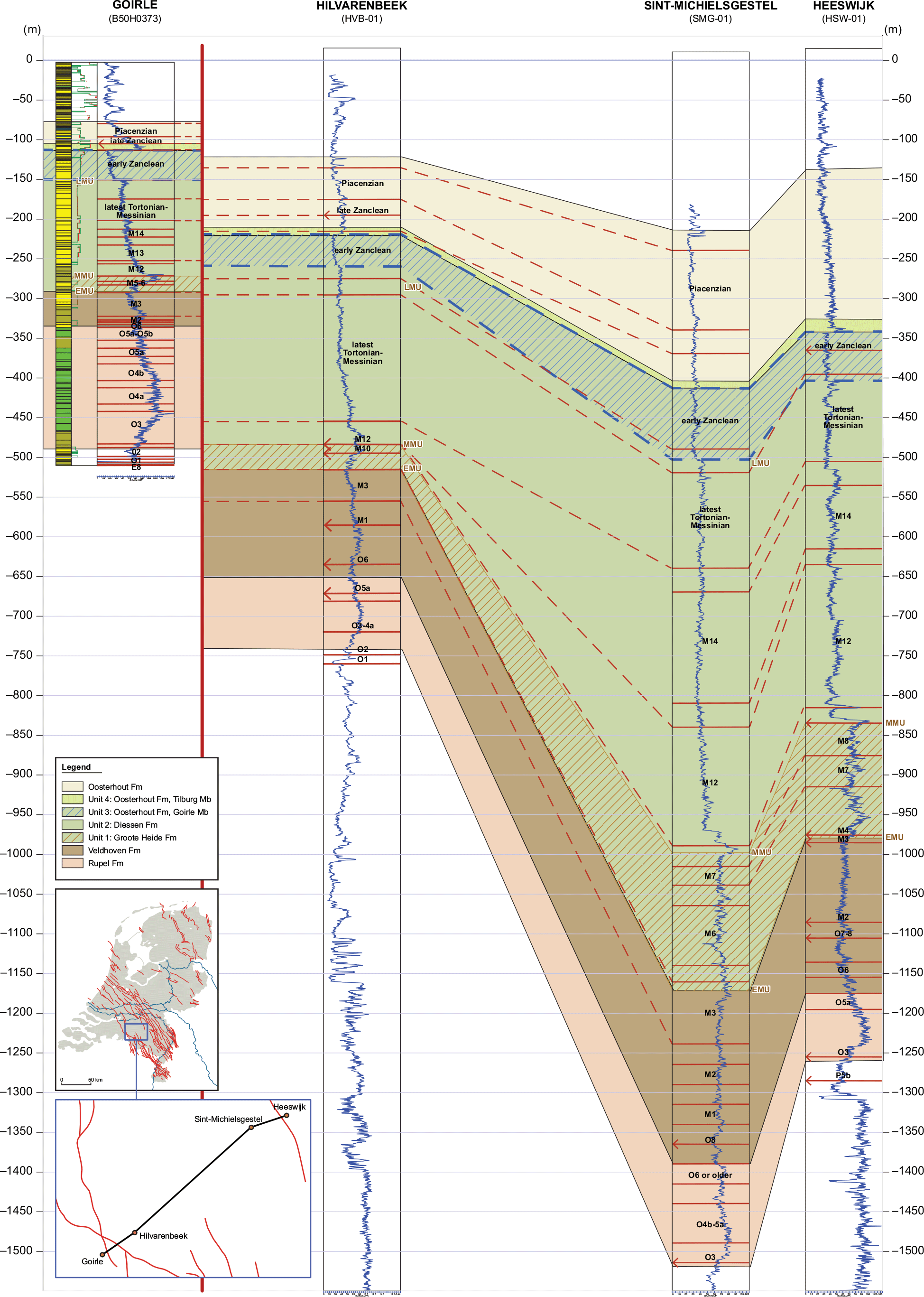
Detailed lithological and mineralogical information was only available from well Goirle. From the other (deeper) wells, only general descriptions are available based on cuttings samples. Correlations between well Goirle and the wells in the RVG are based on biostratigraphical results and well logs (Figure 3).
Unit 1
Lithology and facies
Data from well Goirle (Figure 4) shows that Unit 1 predominantly consists of dark green-grey loam which can be very sandy and includes traces of mica and very common levels of high concentrations of glauconite. In the deepest part of the RVG, Unit 1 consists of dark grey-greenish clays that are rich in glauconite and locally contain pyrite (well St-Michielsgestel). Upwards, above ~1120 m in well St-Michielsgestel, the clays get more grey-brownish in colour. Locally, sponge needles, sea urchin remnants and fragments of molluscs occur.
Overview of the palynological interpretation of well Goirle showing the Early Miocene, Mid-Miocene and Late Miocene unconformities (EMU, MMU and LMU, respectively). The O zones are based on Van Simaeys et al. (Reference Van Simaeys, Munsterman and Brinkhuis2005).
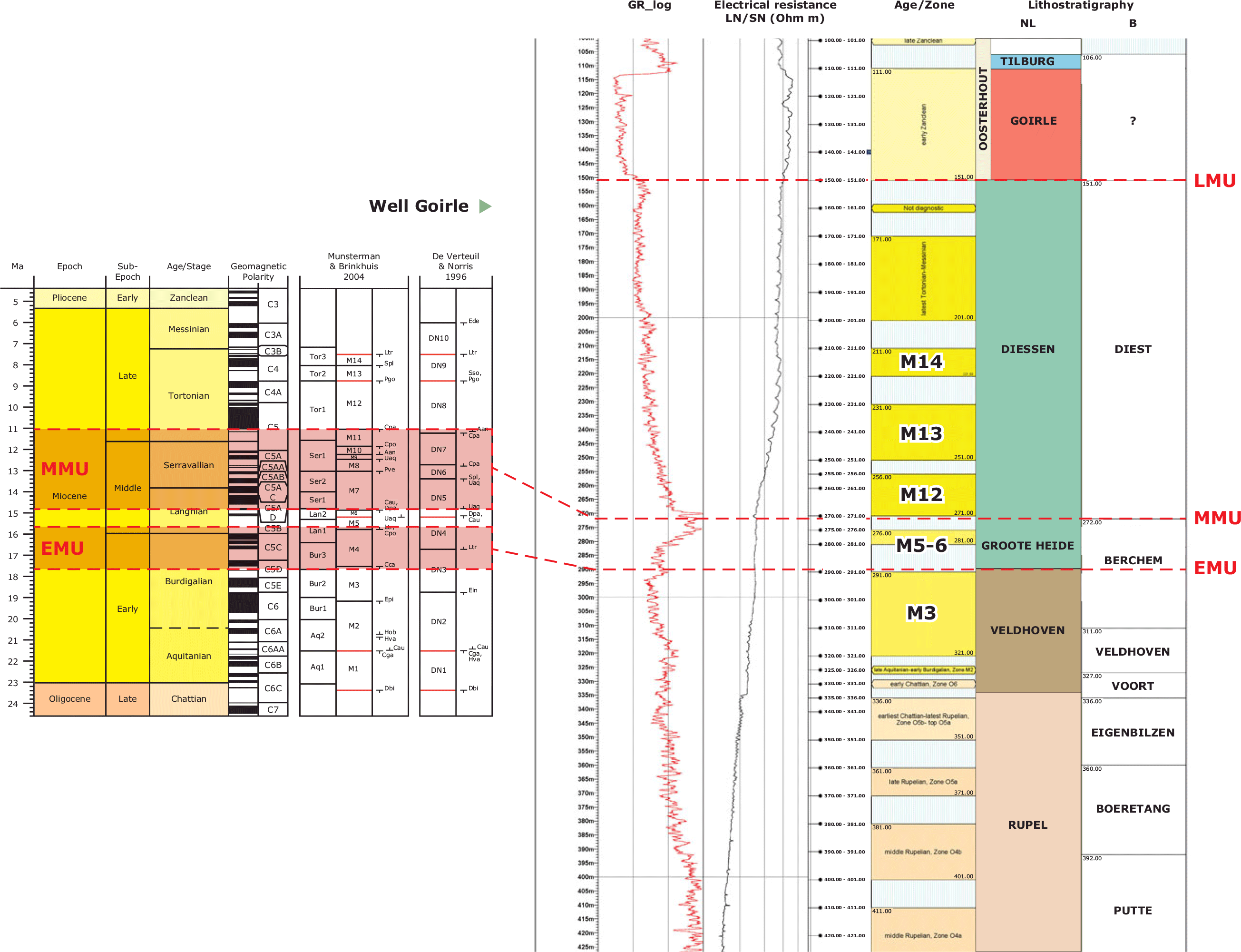
On the Campine Block and along the western flank of the RVG the gamma-ray log at the base of Unit 1 shows a sharp increase, which we associate with the EMU. This shift is followed by a rapid decrease towards the top of the unit (e.g. wells Goirle and Hilvarenbeek). In the deeper parts of the RVG the sharp positive shift is also observed, but the log pattern remains more stable above (wells St-Michielsgestel and Heeswijk).
In well Goirle, the heavy mineral content of unit 1 is dominated by garnet, amphibole and epidote. There is a slight gradual increase in tourmaline and the metamorphic minerals staurolite, kyanite and andalusite relative to epidote and amphibole from bottom to top (Figure 5).
Log (Epidote + Amphibole)/(Tourmaline + metamorphic minerals (Al2SiO5) + Staurolite)) is the main provenance proxy (explained in Verhaegen et al., Reference Verhaegen, Weltje and Munsterman2018). The current proxy is shown opposite the dinoflagellate cyst (M) zones (Munsterman & Brinkhuis, Reference Munsterman and Brinkhuis2004) for wells Goirle and SMG-01. The depth and the modal grain size are also given for each data point. Abbreviations: Ep (Epidote), Amph (Amphibole), Tur (Tourmaline), Meta (metamorphic minerals).

Doppert et al. (Reference Doppert, Ruegg, Van Staalduinen, Zagwijn, Zandstra, Zagwijn and Van Staalduinen1975) interpreted the depositional environment in the central RVG (well SMG-01) based on the analysis of foraminifera as open marine, infraneritic conditions (water depth c.40–100 m). In the Campine Block (borehole Goirle), dinoflagellate cyst assemblages indicate coastal marine conditions. The dinoflagellate cyst taxon Apteodinium spiridoides has a very common occurrence.
Biostratigraphy and age
In the centre of the RVG, the base of Unit 1 is older than closer to the fringe of the RVG. In wells Heeswijk and St-Michielsgestel, the base of Unit 1 was dated as latest Burdigalian/earliest Langhian (Zone M4), respectively mid-Langhian (Zone M6), while in well Hilvarenbeek a mid-Serravallian (Zone M10) was identified. The age of the top of the unit falls in Zone M10.
Seismic and lithostratigraphic position
The seismic data shows a distinct surface at the base of Unit 1. This surface reflects the EMU (Figures 6 and 7) and shows evidence for onlap. On the seismic profile it is evident that the sands of the Someren Member are locally missing in the centre of the basin. The similarity in age of the Veldhoven Formation just below the EMU suggests that the Someren Member pinches out instead of being cut by the unconformity (Figures 6 and 7). These lines of evidence are important for interpreting the EMU as onlap surface formed by the progressive infill by the succession of Unit 1 from centre to edge of the RVG. This interpretation is confirmed by the seismic profile that shows the EMU as a regional onlap/baselap surface (Figures 6 and 7).
Seismic interpretation of a NE–SW (c. perpendicular) transect in the RVG, including wells Heeswijk-01 (HSW-01), St-Michielsgestel-01 (SMG-01), Hilvarenbeek-01 (HVB-01) and Goirle (50H0373).

Geological interpretation of the lithostratigraphical units in the RVG by integrated multidisciplinary results.

Unit 1 is regarded as the basal unit of the formerly defined Breda Formation and corresponds to the Antwerpen Sand Member of the Berchem Formation as defined in the Neogene Nomenclature of Belgium (Laga et al., Reference Laga, Louwye and Geets2001; Deckers & Louwye, Reference Deckers and Louwye2019; see Figure 8). The unit is the lateral equivalent of, and partly interfingers with, the German Ville Formation (Figure 8).
Schematic cross-section of the Oligocene–Early Pliocene lithostratigraphy and chronostratigraphy from the Antwerp area (Belgium)–northwestern part of the RVG (the Netherlands)–southeastern part of the RVG (Germany). The lithostratigraphy is modified after Deckers & Louwye (Reference Deckers and Louwye2019) and Van Adrichem Boogaert & Kouwe (Reference Van Adrichem Boogaert and Kouwe1993–1997).

Unit 2
Lithology and facies
Data from well core Goirle shows that the lithology of Unit 2 changes from loam at its base to sand with some silty intervals and moderate-to-high glauconite content higher up in the sequence. The colour shifts from green-grey to grey as the concentration of mica increases upward. Traces of molluscs and sea urchin spines are present. In the deepest part of the RVG, Unit 2 consists of grey-greenish clays with glauconite, although glauconite especially dominates the upper ~50 m (well St-Michielsgestel). Here, the siltiest and sandiest part of the unit occurs below ~750 m depth.
In most wells, the high glauconite content at the base of Unit 2 is responsible for a very high and distinctive gamma-ray peak which we associate with the MMU. The peak is followed by a sharp negative shift in gamma-ray values and succeeded by a consistent and gradual decrease. The latter pattern reflects an overall coarsening-upward trend. In the same interval, the resistivity log shows a kick at the base followed by gradual increase consistent with the coarsening-upward trend (Figure 4). The upper part of Unit 2 shows more constant gamma-ray and resistivity.
Coincident with the shift to lower grain size at the base of Unit 2 in well Goirle there is a sharp increase in epidote and amphibole relative to tourmaline and metamorphic minerals (Figure 5). Upwards, the heavy mineral composition again becomes increasingly rich in tourmaline and metamorphic minerals, exceeding the values at the top of Unit 1. The sediments of Unit 2 were deposited as pro-deltaic sediments in a fluvio-deltaic system (see below). In borehole Goirle, marine dinoflagellate cysts become very rare to absent at the top of this unit, indicating marginal marine and possibly even subaerial conditions. Infra- to epineritic conditions (water depths between less than 100 m at the base and c. 10–30 m at the top of the unit) were interpreted on the basis of the foraminiferal analysis in well SMG-01 (Doppert et al., Reference Doppert, Ruegg, Van Staalduinen, Zagwijn, Zandstra, Zagwijn and Van Staalduinen1975).
Biostratigraphy and age
The distinct gamma-ray peak at the base of Unit 2 is consistently positioned below the early Tortonian Zone M12. The base of Unit 2 coincides with the LOD (Last Occurrence Datum) of Cannosphaeropsis passio in all wells. The top of this zone is defined by the LOD of the dinoflagellate cyst Palaeocystodinium golzowense. DinoZone M11 (latest Serravallian–earliest Tortonian) is missing in all wells, suggesting that the MMU represents a hiatus after which sedimentation resumes in the early Tortonian, DinoZone M12. Higher in succession the late Tortonian (zones NSM13–NSM14) and the latest Tortonian–Messinian are recorded. Marker taxa are Systematophora placacantha for Zone NSM13 and Hystrichosphaeropsis obscura and Labyrinthodinium truncatum for Zone NSM14. The last occurrence of Impagidinium densiverrucosum is used to mark the top of the Miocene. Lund (Reference Lund1998) recorded this taxon for the Miocene/Pliocene boundary in the Ems Area (NW Germany).
Seismic and lithostratigraphic position
The seismic data shows a widespread downlap surface of the overlying clinoforms (see Figure 6) that characterise the internal architecture of Unit 2. In the gamma-ray log, this downlap surface is represented as a peak that coincides with the MMU (Figures 6 and 7). However, in seismic data, the biostratigraphically constrained hiatus associated with the MMU cannot be linked to truncation.
Multiple, stacked and westward-prograding sets of clinoforms can be distinguished. The clinoform fore-set beds have depositional slopes up to ~2° and are laterally extensive over tens of kilometres. The clinoform arrangement indicates multiple phases of progradation and/or avulsion of a large fluvio-deltaic system. Usually, avulsion plays a major role in the spatial distribution of delivered fluviatile sediment and thus the lateral and vertical stacking of delta lobes (as entity in which clinoforms develop and here synonymous to clinoform sets). Consequently, the possibility to correlate the delta lobes is not expected to be large. However, the high lateral (E–W) continuity of the Unit 2 clinoform sets may be indicative of external control on accommodating the fluvio-delta system, such as tectonics and/or climate. Topset truncation and downstepping of clinoform inflection points (the shelf edge) indicate that higher-order sea-level fluctuations are superposed on the overall westward progradation trend.
Unit 2 was regarded as being part of the former Breda Formation and is seen as the lateral equivalent of the shallow marine Diest Formation in Belgium and the fluvial Inden and Kieseloolite formations in Germany (Figure 8). The base of the Diest Formation is interpreted by a kick on the electrical resistivity log (see Figure 4). In the Campine area (and even more in the Hageland area), deeply erosive channels were recorded at the base of the Diest Formation (Gulinck, Reference Gulinck, de Heinzelin and Tavernier1962; Vandenberghe et al. Reference Vandenberghe, Laga, Steurbaut, Hardenbol, Vail, de Graciansky, Hardenbol, Jacquin and Vail1998, Reference Vandenberghe, Harris, Wampler, Houthuys, Louwye, Adriaens, Vos, Lanckackers, Matthijs, Deckers, Verhaegen, Laga, Westerhoff and Munsterman2014). These are related to the subsidence of the RVG and uplift of the Brabant Massif (Gullentops, Reference Gullentops1957; Houbolt, Reference Houbolt, Scrutton and Talwani1982; Vandenberghe et al., Reference Vandenberghe, Harris, Wampler, Houthuys, Louwye, Adriaens, Vos, Lanckackers, Matthijs, Deckers, Verhaegen, Laga, Westerhoff and Munsterman2014). These erosive channels were not observed in the study area.
Unit 3
Lithology and facies
Data from well Goirle shows that Unit 3 consists of light-grey to white-coloured, fine to medium-grained and slightly silty sands. The sands show minor traces of mica and fluctuating concentrations of glauconite. In the deeper part of the RVG, no specific lithological data was available since the unit was described in one lumped setting with overlying Unit 4.
The sands are characterised by very low gamma-ray values and a typical ‘blocky’ log appearance (see Figures 3 and 4). The associated strong gamma-ray shift towards lower values and the blocky gamma-ray pattern observed in well Goirle can be easily correlated with the other wells in the panel (Figure 3).
The heavy mineral association is again characterised by a gradual increase in tourmaline and metamorphic minerals relative to epidote and amphibole, coincident with a coarsening-upwards grain-size trend. The highest values for staurolite are reached at the top of Unit 3 (Figure 5).
Foraminifera analysis in the central RVG (well SMG-1) indicates littoral to shallow epineric conditions (with bathymetrical values between 0 and c.30 m). In borehole Goirle the results of the dinoflagellate cyst analysis confirm littoral conditions at the base of the unit and a development to shallow marine circumstances higher in succession. Many heterotrophic genera, like Barssidinium, Selenopemphix and Trinovantedinium, are present, pointing to nutrient-rich waters.
Biostratigraphy and age
The sands of Unit 3 are palynologically dated as early Zanclean. The age is estimated to be older than 4.4/4.5 Ma based on the presence of the marine dinoflagellate cyst Reticulatosphaera actinocoronata (see review of Louwye et al., Reference Louwye, Head and De Schepper2004 in De Schepper et al., Reference De Schepper, Beck and Mangerud2017). Unit 3 also contains the marine dinoflagellate cysts Oligosphaeridium tegillatum and Selenopemphix armageddonensis. Although the FOD (First Occurrence Datum) of Selenopemphix armageddonensis occurs at 7.6 Ma (Dybkjaer & Piasecki, Reference Dybkjær and Piasecki2010), all last occurrences of Miocene marker species are missing here. The transition from Unit 2 to Unit 3 in well Goirle is sampled at 160 m depth and seems to coincide with an indistinct palynological association, which chronostratigraphically approximates the Miocene–Pliocene boundary. Due to a very poor palynological recovery this interval is age non-diagnostic. Such low palynological yielding is usually explained by oxidation processes instigated by subaerial exposure and might thus be representative of a hiatus or sorting.
Seismic and lithostratigraphic position
The seismic profile shows that all topset beds of the Unit 2 clinoforms are missing and are directly overlain by the parallel strata of Unit 3 (see Figures 6 and 7). We interpret this angular unconformity as the LMU and infer the presence of a hiatus due to considerable erosion. Despite the fact that a hiatus cannot be identified on the basis of palynological criteria, all Miocene dinoflagellate cyst marker taxa disappear from the assemblages across the unconformity.
From the NW–SE seismic section paralleling the basin trend (Figure 9), it is evident that inclined and concave-downward strata of Unit 3 downlap on the LMU. Despite the low quality of the seismic data, the stratal geometry seems to resemble low-angle sigmoidal clinoforms. Considering the evident break in lithology, log patterns, age dating and seismic characters, Unit 3 is attributed to the base of the Oosterhout Formation and defined as the new Goirle member (see the Appendix for a more extensive description).
Seismic interpretation paralleling the RVG basin (longitudinal trend). Abbreviations: BRAK = Brakel; KWK = Kerkwijk; WWK = Waalwijk; SMG = St-Michielsgestel; NLLF: Landen Formation; NLFF = Dongen Formation; NMRF = Rupel Formation; NMVFV = Voort Member; NMVFO = Veldhoven Clay Member. Units 1–4 with the newly proposed stratigraphic names as described in the text.

The glauconite-poor sands correlate with the upper part of the Belgian Diest Formation (Laga & Notebaert, Reference Laga and Notebaert1981; Louwye & De Schepper, Reference Louwye and De Schepper2010; see Figure 8).
Unit 4
Lithology and facies
Data from well Goirle shows that Unit 4 consists of dark green-grey, partly cemented, sands and clays with abundant glauconite and mollusc traces. The unit is only c.6 m thick and sandwiched between the light-grey to clean white sands of Unit 3 and overlying grey to green moderately fine-grained sands. Mollusc fragments occur in variable (occasionally very high) concentrations. In the overlying c.15 m above this unit, the glauconite concentration is still high, but decreases and becomes very low in the remainder of the succession. The overlying sequence is also relatively rich in molluscs, including several shelly ‘Crag facies’ layers. A positive gamma-ray excursion at the base of Unit 4 and overall higher gamma-ray values can be identified in all wells (Figure 3).
Doppert (Reference Doppert1980) interpreted the interval corresponding to Unit 4 as being deposited in littoral to shallow epineric environments based on foraminifera in well SMG-01. This interpretation is not different than that of the underlying Unit 3. The dinoflagellate cyst assemblage in borehole Goirle is slightly more variegated, including a slight increase in open marine species, and remaining high numbers of heterotrophic species. This small change in facies indicates a development to a slightly more distal position, but presumably also within shallow epineritic conditions (10–c.30 m water depth). It likely represents a flooding event.
Biostratigraphy and age
Unit 4 fits within the early Zanclean. The dinoflagellate cyst Reticulatosphaeridium actinocoronata has its latest (youngest) occurrence in this unit. An increase in non-photosynthetic genera (Protoperidinium) is recorded.
Seismic and lithostratigraphic position
Although the unit is below the seismic resolution because of its limited thickness, it appears as a very distinct and bright reflector that separates the low-angle sigmoidal clinoforms of Unit 3 from the higher-angle tangential clinoforms within the Oosterhout Formation (Figure 9). Visualisation of this geometrical arrangement supports the usually challenging task to distinguish the Breda and Oosterhout Formations in areas where Unit 3 is absent.
Due to its unique and distinctive nature, we define Unit 4 as another lithostratigraphic unit within the Oosterhout Formation, here named the Tilburg member. A more comprehensive description of the Tilburg member is provided in the Appendix. The relatively clayey and glauconite-rich interval defined as Unit 4 plausibly correlates with the Belgian Kattendijk Formation (Vandenberghe et al., Reference Vandenberghe, Laga, Steurbaut, Hardenbol, Vail, de Graciansky, Hardenbol, Jacquin and Vail1998; Louwye & Laga, Reference Louwye and Laga2008; see Figure 8).
Area 2: Venlo Block
For Area 2 we discuss data from two wells. The first well (Groote Heide) is the lectostratotype of the Breda Formation as defined by Weerts et al. (Reference Weerts, Cleveringa, Ebbing, de Lang and Westerhoff2000). The second well contains an additional reference section of the Veldhoven Formation (Van Adrichem Boogaert & Kouwe, Reference Van Adrichem Boogaert and Kouwe1993–1997). Gamma-ray well-log correlation (this study) shows that the new lecto-stratotype section for the Breda Formation in well Groote Heide overlaps in part with the additional reference section of the older Veldhoven Formation in the nearby well Broekhuizenvorst (see correlation of both wells in Figure 10), an issue that will be discussed further in this paper.
Correlation of the lectostratotype well Groote Heide for the Breda Formation (here split into newly proposed Groote Heide and Diessen formations) and additional reference section of the Veldhoven Formation in well Broekhuizenvorst: showing the revised base of the lectostratotype Breda Formation (including the Veldhoven–Breda formation transition).

In the two wells, we again identified two stratigraphic units in the formerly so-defined Breda Formation (here referred to as Units 1 and 2). The depth of the (partly newly defined) base of the formation in these two wells occurs at 223 m (Broekhuizenvorst) and 320.8 m (Groote Heide) and its thickness is 130 m and 164 m respectively, making the record less thick than in the RVG. As in Area 1, the sediments of the Breda Formation overlie sediments of the Veldhoven Formation that are consistently of middle Burdigalian age (Zone M3, c.17.5 Ma). The sediments of the Breda Formation are overlain by sediments of the Kieseloolite Formation. Part of the Breda Formation in Area 2 contains organic intercalations.
Unit 1
Lithology and facies
The basal interval of Unit 1 is characterised by an alternation of relatively thin layers (few metres) of dark brown clays and green-grey very fine sands. The latter are moderately glauconitic, often humus and contain mollusc fragments. Upwards in the succession an alternation of very fine sands and silty clays occurs. In well Groote Heide this interval contains three lignite-containing beds. The gamma-ray log of Unit 1 is nearly identical in both wells and shows an abrupt change from relatively high-amplitude gamma-ray readings (below ~320 m in well Groote Heide, and below ~223 m in well Broekhuizenvorst at the top of the Veldhoven Formation) to lower- and higher-amplitude readings with a lower-order sinusoidal log pattern.
The base of Unit 1 shows a marked change in the palynomorph assemblage with the (continuous) occurrence of the freshwater algae Pediastrum (well Groote Heide, Figure 10). The content of freshwater algae remains relatively low, seesawing around 12% of the total sum of spores, pollen and predominately shallow marine dinocysts. The alternations are related to fluctuations in salinity. Deposition occurred in an estuarine environment with occasional marine incursions. At the Burdigalian/Langhian transition at 302.3 m, Paralecaniella dominates the association. This acritarch or schizosporous algal genus indicates near-coastal, restricted marine conditions (Louwye et al., Reference Louwye, Marquet, Bosselaers and Lambert2010). Gamma-ray log values increase from c.237 to 198 m. Foraminiferal analysis from this interval shows higher bathymetrical values due to increased numbers of Asterigerina and Uvigerina and a decrease of Cibicides and Ammonia (Van Leeuwen, Reference Van Leeuwen2000). The highest peak in the gamma-ray values roughly corresponds to the maximum occurrence of open marine dinoflagellate cyst species. Successively a shallowing occurred from c. 198 m to 159.8 m depth, with clays recurrently grading into sands. In this interval the gamma-ray decreases once more and Paralecaniella dominates the spectra at the top, indicating restricted marine conditions again.
Biostratigraphy and age
The transition toward the (base of the) Breda Formation in well Broekhuizenvorst at ~223 m falls in the transition of Zone NSM3/NSM4 which is defined by the LOD of Cordosphaeridium cantharellum (see Figure 10). This gives the base of Unit 1 a late Early Miocene (c. late Burdigalian) age. Zones M4–M10 are all present in well Groote Heide (see Figure 2), suggesting a relatively continuous late Burdigalian–Serravallian succession. In well Broekhuizenvorst, however, zones M9–M10 are absent.
Lithostratigraphic position
We correlate the complex alternation of very fine humus sands, brown coal and silty humus clays between ~281.1 and 308.8 m in well Groote Heide (Figure 10) to the Morken Seam (Schäfer & Utescher, Reference Schäfer and Utescher2014; Prinz et al., Reference Prinz, Schäfer, McCann, Utescher, Lokay and Asmus2017). The two additional lignite-containing beds higher up in the succession (intervals 266.8–268.8 m and 248–251.9 m) are interpreted as the Frimmersdorf 1 and 2 Seams (Schäfer & Utescher, Reference Schäfer and Utescher2014; Prinz et al., Reference Prinz, Schäfer, McCann, Utescher, Lokay and Asmus2017; Figure 10). The coal seams also define the upper and lower limit of the Heksenberg Member. In the same core, the sediments of the Breda Formation below the coal seams belong to the Kakert Member. Although no brown coal was described in well Broekhuizenvorst, the gamma-ray pattern is similar to that of well Groote Heide, but misses the high peaks related to the coal seams. The Heksenberg Member can clearly be identified on the basis of low gamma-ray values while the characteristic gradual decrease in gamma-ray patterns below shows the presence of the Kakert Member. The sediments of Unit 1 that are positioned above the Heksenberg Member are part of the Vrijherenberg Member.
Unit 2
Lithology and facies
The base of Unit 2 (Groote Heide: c.156.8 m; Broekhuizenvorst c.99 m) is characterised by fine-grained glauconitic sands that occasionally show minor cementation; upward they become more silty and include dark clayey beds. After the long shallowing trend to restricted marine conditions at the top of Unit 1, a transgressive phase is interpreted at depth 156.8 m, when the relative numbers of Paralecaniella drop from 60 to less than 5%. The marine dinoflagellate cyst associations show increased numbers of shallow (and open) marine species, which indicate a deepening of the depositional environment. The abrupt facies transition also points to a sedimentary hiatus verified by the foraminifera data which demonstrate the absence of the FC2B2 subzone (Van Leeuwen, Reference Van Leeuwen2000). This hiatus is associated with the MMU. Above, the gamma ray shifts to higher values again. In well Groote Heide, a fining-upwards trend is shown in the interval 156.8–133 m (Figure 10). The gamma-ray log continues mirroring a more condensed sinusoidal pattern. In its highest coarsening-upward part, the top of Unit 2 is defined at 99.75 m, corresponding to an evident transition from shallow marine fine-grained weakly glauconitic sands to the overlying fluvial-deltaic Kieseloolite Formation. It is characterised by light to dark and even brownish-grey, moderately to very coarse-grained (M63: 200–750 µm) sands at the base, with grey to dark-brown sandy clay intervals, coal layers and gravel beds higher up in the sequence. The Kieseloolite Formation is rich in plant and wood remains.
Biostratigraphy and age
The MMU associated with the absence of the FC2B2 subzone (Van Leeuwen, Reference Van Leeuwen2000) comprises the latest Serravallian. The base of Unit 2 corresponds to the top of Zone M11 (earliest Tortonian). Unit 2 continues up and beyond Zone M14. The top of Zone M14 (late Tortonian) is based on the LOD of Labyrinthodinium truncatum. This event is recorded in well Groote Heide at depth 102.15 m. This implies that Unit 2 in the Venlo Block does not reach up to the LMU, as in the RVG, because the top of this unit corresponds to the latest (unzoned) Tortonian (see Figure 10). In well Groote Heide, the base of the Kieseloolite Formation is dated as latest (unzoned) Tortonian and thus precedes the age of the LMU. This can be interpreted by progradation of the pre-LMU part of the Kieseloolite Formation into the Venlo Block. As such it represents the fluvio-deltaic depositional domain associated with Unit 2 as depicted in Figure 8. The LODs of Impagidinium densiverrucosum and Hystrichosphaerina obscura are important dinoflagellate cyst events that support the dating at the top of the current unit. The latter taxon has a LOD in the Tortonian (De Verteuil & Norris, Reference De Verteuil and Norris1996; Dybkjaer & Piasecki, Reference Dybkjær and Piasecki2010).
Lithostratigraphic position
The shallow marine fine-grained glauconitic sands of Unit 2, which are interpreted as part of the former Breda Formation, are dated as Tortonian and cover zones M11 (p.p.), M12–M14, and an additional unzoned latest Tortonian. The shallow marine sands overlie the MMU. Unit 2 is the lateral equivalent of the marine Diest Formation (p.p.) in Belgium and the fluvial/deltaic Inden Formation in Germany and the southeast of the Netherlands (Figure 8). In the Venlo Block, Unit 2 is obviously overlain by the coarse-grained Kieseloolite Formation.
Discussion
Correlations between Area 1 (Roer Valley Graben and Eastern Campine Block fringe) and Area 2 (Venlo Block)
Formerly, long-distance correlation of Neogene sediments between the RVG and adjacent blocks of intermediate subsidence, like the Peel–Venlo Block, has always been difficult and included large uncertainties. This is due to large differences in thickness of the sediments, different lithologies and changing depositional environments. Furthermore, detailed biostratigraphic analysis of the Neogene interval was very limited or missing, in particular in the RVG. The present integration of scarce new and existing palynological study results with lithological and seismic data offers a framework for placing depositional patterns and lithofacies trends into depositional sequences. Here we discuss the correlation of Units 1 and 2 of the two studied areas. The marine Units 3 and 4 are not described as they are not present in the Venlo Block where the time-equivalent fluvial-deltaic Kieseloolite Formation occurs.
Unit 1
In all studied wells, the top of the Veldhoven Formation, below the EMU, has a middle Burdigalian age (Zone M3, c.17.5 Ma). Along the southern edge, the hiatus associated with the EMU between the Veldhoven Formation and Unit 1 spans c.3 Myr more as compared to the unconformity in the centre of the RVG. This suggests diachronism at the base of the Breda Formation. At the Venlo Block, no such hiatus is recorded, although there is an evident shift towards lower gamma-ray values. In addition, the unit thickness of c.175 m in well SMG-01 (RVG centre) is considerably greater than the 25 m in well HVB-01 and the 18 m at the fringe of the ECB. As shown by the seismic onlap structures, it can be concluded that the progressive infill of sediments occurred from the centre to the edge of the RVG. The succession in well Groote Heide shows a relatively complete zonal development with a thickness of 145 m. Well Broekhuizenvorst in the Venlo Block, however, misses the younger zones M9 and M10 and is 20 m thinner than the lectostratotype well. Hence, for Unit 1 the maximum developed thickness in the Venlo Block seems relatively congruent with that of the centre of the RVG. The successions in the younger southern edge of the RVG and that of the adjacent Eastern Campine Basin show a thinner development. The depositional environments of the studied areas vary substantially: from open marine, infra-neritic conditions in the centre to coastal marine at the edge of the RVG and estuarine to restricted-shallow marine conditions in the Venlo Block.
Unit 2
Unit 2 occurs in all wells above the MMU. The base is associated with an increase in gamma-ray values in all wells and coincides with the base of Zone M12 in the RVG and the ECB and falls within the top of Zone M11 in the Venlo Block. The MMU in the RVG and ECB comprises at least Zone M11. In the Venlo Block the MMU is indicated by an abrupt shift in facies from restricted to shallow marine conditions and the hiatus is demonstrated by the absence of the foraminiferal FC2B2 subzone (Van Leeuwen, Reference Van Leeuwen2000). Compared to Unit 1 there are remarkable differences in the thickness trends between the RVG, ECB and Venlo Block. In the centre of the RVG a relatively complete succession is recorded and the thickness reaches c.500 m in well SMG-01 and 430 m in well HSW-01. The more proximal wells HVB-01 and Goirle, positioned in the RVG and ECB, respectively, show minor thicknesses (25 m and 18 m, respectively) in Unit 1. Both wells show a remarkably thicker Unit 2, with a total of 220 m in HVB-01 and 125 m in Goirle. Deckers & Louwye (Reference Deckers and Louwye2019) inferred an abrupt change or increase in sediment accommodation rates from Unit 1 to Unit 2 in the Campine area. They related this increase to a change in depositional regime from sediment starvation in Unit 1 to sedimentary infill in Unit 2 and/or an increase in subsidence of the southern North Sea Basin during Unit 2. The dinocyst analyses by this study, the foraminiferal analyses by Doppert et al. (Reference Doppert, Ruegg, Van Staalduinen, Zagwijn, Zandstra, Zagwijn and Van Staalduinen1975) and the observed increase in grain size are also in favour of a shallowing of the depositional environment from Unit 1 into Unit 2.
In Unit 1 the rate of deposition in the Venlo Block almost kept pace with that of the centre of the RVG; for Unit 2, on the contrary, a minor development is recorded. Well Groote Heide (Venlo Block) shows all biozones M12–M14, but they are relatively condensed (55 m thickness). The palaeoenvironment is shallow marine. Well Broekhuizenvorst (Venlo Block) is less complete (15 m thickness). While the marine Unit 2 in the RVG and ECB continues up to the latest (unzoned) Tortonian–Messinian, in the Venlo Block it is concurrently overlain by the fluvio-deltaic (coarser-grained) Kieseloolite Formation. The top of the Unit 2 in the RVG and the ECB is associated with the LMU. The LMU is clearly shown on the gamma-ray log by a sharp decrease in values. During the LMU, epineritic conditions prevailed in the RVG, while marginal to non-marine deposition occurred in the ECB.
Age and hiatuses
The EMU and MMU correlate remarkably well with the equally named hiatuses in well G11-1 in the German North Sea Sector (Figure 11). Here, the EMU represents a hiatus that covers the mid-Burdigalian–earliest Langhian, DN3 and DN4 zones sensu De Verteuil & Norris (Reference De Verteuil and Norris1996), which approximates to zones M3–M5 of Munsterman & Brinkhuis (Reference Munsterman and Brinkhuis2004; see Figure 2). The MMU is characterised by the absence of the mid-Serravallian–earliest Tortonian, DN6 and DN7 zones sensu De Verteuil & Norris (Reference De Verteuil and Norris1996), which approximates to zones M8–M11 of Munsterman & Brinkhuis (Reference Munsterman and Brinkhuis2004; see Figure 11) that are adjusted to Köthe et al. (Reference Köthe, Gaedicke and Lutz2008). Offshore Denmark, the MMU is also described by Rasmussen & Dybkjær (Reference Rasmussen and Dybkjær2014) below the glauconite-rich layer which corresponds to a transgressive sequence-stratigraphic surface. The base of the MMU hiatus was dated as mid-Miocene (c.15 Ma) for Norway (Dybkjær & Piasecki, Reference Dybkjær and Piasecki2010). In general the MMU seems to span most of the Serravallian, with the exception of the Danish sector of the North Sea. Here, a 3 m thick condensed section composed of deeper marine hemipelagic clays spans several million years and coincides with the MMU hiatus elsewhere (Rasmussen & Dybkjær, Reference Rasmussen and Dybkjær2014). At that time, this area was the main depocentre for sediments sourced from southwestern Scandinavia. This thin and condensed section represents a period of sediment starvation caused by subsidence-induced flooding of the eastern North Sea area which was coincident with climatic cooling, initiated in the Serravallian (Rasmussen & Dybkjær, Reference Rasmussen and Dybkjær2014). Very thin condensed sections dated as Zone DN 6 and Zone DN 7 were also incidentally interpreted for the Campine area in wells Kalmhout and Retie (Louwye, Reference Louwye2005), which seems to indicate that sediment starvation also occurred in this area (Deckers & Louwye, Reference Deckers and Louwye2019). Erosion and associated channel incision occurred since the late Serravallian (Vandenberghe et al., Reference Vandenberghe, Harris, Wampler, Houthuys, Louwye, Adriaens, Vos, Lanckackers, Matthijs, Deckers, Verhaegen, Laga, Westerhoff and Munsterman2014). For most of the Campine area a period of non-deposition and/or erosion during the Serravallian was recorded (Demyttenaere, Reference Demyttenaere1989; Wouters & Vandenberghe, Reference Wouters and Vandenberghe1994; Louwye & Laga, Reference Louwye and Laga2008). This event was related to a phase of uplift in northern France and southwest Belgium (Van Vliet-Lanoë et al., Reference Van Vliet-Lanoë, Vandenberghe, Bergerat, Henriet, Mansy, Mielliez, Lacquement, Sintubin, Vandycke and Degryse2002). Erosional channels with basal gravels with rounded flints are documented in the Campine area and attest to this uplift phase. Afterwards, during the Tortonian, deposition of the Diest Formation commenced. These variable regional observations indicate that the MMU is not a regional hiatus, but is merely the local expression of coinciding tectonic or climatic events, or both.
(Early Miocene--Mid-Miocene--Late Miocene) Unconformities deduced from well G11-1, German North Sea Sector (adjusted after Köthe et al., Reference Köthe, Gaedicke and Lutz2008).

Distribution map of the Goirle member.

The palynological analysis of the Late Miocene succession in the RVG does not reveal an undisputable hiatus associated with the LMU. This is in contrast to Dutch and German offshore North Sea settings, such as in well G11-1 (Köthe et al., Reference Köthe, Gaedicke and Lutz2008; Benvenuti et al., Reference Benvenuti, Kombrink, Ten Veen, Munsterman, Bardi and Benvenuti2012). In the German North Sea area the LMU shows a hiatus comprising the late Tortonian to early Zanclean, zones DN9–DN10 and even a younger unzoned interval (Figure 11) sensu De Verteuil and Norris, Reference De Verteuil and Norris1996 (zones M13–M14 and a younger unzoned interval sensu Munsterman & Brinkhuis, Reference Munsterman and Brinkhuis2004; see Figure 2). This interval runs from the LOD of dinocyst Palaeocystodinium golzowense to the LOD of dinocyst Reticulatosphaeridium actinocoronata and spans 4 Myr (c.8.8–4.4 Ma). However, for the RVG a sudden change in depositional style is suggested by lithological and gamma-ray shifts. The low palynological yielding could be explained by oxidation processes, i.e. subaerial exposure, and hence be representative of a hiatus. On the seismic profile all topsets are missing, indicating at least a ‘small’ hiatus. The LMU in the current area may be associated with an important accommodation effect, whereby massive sediment supply, and erosion due to sea-level lowering, led to sediment bypass.
Update and revision proposal for the Miocene and earliest Pliocene lithostratigraphy in the RVG and adjacent blocks
By using a multidisciplinary approach, this study pursued new criteria to improve the definition of the lower and upper boundaries of the former Breda Formation and to achieve an improved understanding of its internal sequences. The internal sequences of the former Breda Formation are defined by dis- or unconformities, which demands the establishment of four new lithostratigraphic units: two formations and two additional members. The lithological, mappable and unique seismic characteristics of Unit 1 and Unit 2, separated by the MMU (see description above) necessitates abandoning the former Breda Formation and proposing the definition of two (new) formations: the Groote Heide and Diessen formations for Unit 1 and Unit 2, respectively (Figure 8). The Groote Heide formation is constraint to Unit 1, bounded by the EMU and MMU. Both formations are bounded by unconformities that are in line with the lithostratigraphic organisation of mid–late Miocene successions of the neighbouring countries around the North Sea Basin. Furthermore, both Units 3 and 4 require the introduction of new members at the base of the Oosterhout Formation. In particular, seismic reflection data shows that Unit 2, here newly defined as the Diessen formation, is unconformably overlain by Unit 3. The transition concurs with the LMU, i.e. the Miocene–Pliocene boundary. Based on lithological characteristics and (gamma-ray) logs, Units 3 and 4 can easily be traced throughout the RVG, both laterally and vertically (see Figures 3, 6 and 7). Therefore the grey to white sandy Goirle member (Unit 3) and the glauconitic rich clayey sand Tilburg member (Unit 4) are mappable units that are here newly proposed and defined (Figure 8).
The similarity in gamma-ray log patterns and age interpretation of the wells Groote Heide and Broekhuizenvorst indicates that the base of the former Breda Formation (= now proposed as Groote Heide formation) in the lectostratotype (Weerts et al., Reference Weerts, Cleveringa, Ebbing, de Lang and Westerhoff2000) needs to be amended by excluding the basal interval between 320.8 and 496.7 m. This very fine-grained glauconitic silty to sandy sequence can be interpreted instead as the Someren Member in the upper part of the Veldhoven Formation (cf. additional reference well Broekhuizenvorst in Van Adrichem Boogaert & Kouwe, Reference Van Adrichem Boogaert and Kouwe1993–1997). The higher gamma-ray values in the Someren Member can be linked to an increased concentration of glauconite. The Veldhoven/Breda (= now proposed as Groote Heide) Formation transition is formed by an unconformity (Van Adrichem Boogaert & Kouwe, Reference Van Adrichem Boogaert and Kouwe1993–1997). The present results in the RVG and ECB confirm the occurrence of the EMU. However, in the Venlo Block, the transition from the Veldhoven Formation to the Breda Formation (= now proposed as Groote Heide formation) is relatively continuous. Palynological data does not show a hiatus. An evident break on the gamma-ray log is nevertheless present at all wells, indicating an obvious lithological transition described earlier. The newly defined late Burdigalian age (Zone M4) for the base of the former Breda Formation (= now proposed as Groote Heide formation) will replace both the early Burdigalian age previously defined by Van Adrichem Boogaert and Kouwe (Reference Van Adrichem Boogaert and Kouwe1993–1997) and the late Chattian age by Weerts et al. (Reference Weerts, Cleveringa, Ebbing, de Lang and Westerhoff2000).
In both reference wells Groote Heide and Broekhuizenvorst the marine Diessen formation is overlain by the SE–NW-prograding fluvio-deltaic Kieseloolite Formation, which predominantly consists of coarse-grained clastic sediments. The units can be easily distinguished. The geographical distribution of the Kieseloolite Formation is limited to the SE part of the country; elsewhere the Diessen formation is overlain by the sandy Oosterhout Formation (Van Adrichem Boogaert and Kouwe, Reference Van Adrichem Boogaert and Kouwe1993–1997), which forms the shallow marine equivalent of the Kieseloolite Formation (Figure 8). The main lithological difference was that the Oosterhout Formation comprises less glauconitic sands and clays and often shows a higher number of marine molluscs (Van Adrichem Boogaert & Kouwe, Reference Van Adrichem Boogaert and Kouwe1993–1997). As these indicators are present in fluctuating percentages in both lithostratigraphical units, they were not the best discriminators. The occurrences of glauconite and molluscs are strongly facies-controlled and are therefore less suitable criteria for lithostratigraphic definition. Glauconite is an authigenic mineral formed during relatively less dynamic, oxygen-depleted, marine conditions and is often used as indicator for slow accumulation rates on a nearshore marine shelf (McRae, Reference McRae1972; Odin & Matter, Reference Odin and Matter1981; Amorosi, Reference Amorosi1997).
The system of codification of lithostratigraphic units used by NAM & RGD in the 1980 Nomenclature and by RGD & NOGEPA in the 1993 Nomenclature has been continued. This system shows a three-stage hierarchy with levels of groups, subgroups, formations and members (see Appendix).
The lithostratigraphic revision of the Breda Formation here proposed is limited to the RVG and adjacent blocks. Future research will need to show if and to what extent these new insights may be applied to northerly-located Miocene-to-early-Pliocene successions. Pending further studies, the former Breda Formation is proposed be temporally transferred and raised in rank to the newly established Hilvarenbeek subgroup, which comprises both the Groote Heide and Diessen formations.
Conclusions
Using a combined litho-, bio-, seismo- and sequence-stratigraphic approach, methodically following the revision and update of the Late Jurassic–Early Cretaceous lithostratigraphy of the Dutch northern Offshore, an improved regional framework and more comprehensive lithostratigraphic subdivision of the Miocene–early Pliocene successions originated. The presented multidisciplinary approach led to a revision and update of the former Breda Formation’s base (including the lecto-stratotype section) and top and the differentiation in four units distinguished by three regional recognisable unconformities, i.e. the Early Miocene Unconformity (EMU), the Mid-Miocene Unconformity (MMU) and the Late Miocene Unconformity (LMU). These unconformities correspond to three similarly named unconformities that are recognised in the Dutch northern offshore and adjacent areas in Germany and Denmark. In particular the assignment of the intraformational MMU led to the new insight to propose to split the formerly defined Breda Formation at the current event and establish two new formations: the Groote Heide formation for sequence Unit 1 in between the EMU and MMU, and the Diessen formation for sequence Unit 2 in between the MMU and LMU. Hence it is here proposed that the name Breda Formation be abandoned. Pending further research that will focus on the regional applicability of the proposed definition, the former Breda Formation is proposed to be temporally raised in rank and changed into to the newly established Hilvarenbeek subgroup, which comprises both the Groote Heide and Diessen formations. The successions overlying the LMU comprise the two other newly proposed lithostratigraphic units 3 and 4, named the Goirle and the Tilburg members, which are positioned at the base of the Oosterhout Formation.
Acknowledgements
Special thanks goes to Nico Janssen (TNO) and Malcolm Jones (PLS – UK) for palynological sample preparation. Nik Trabucho (TNO) is gratefully acknowledged for improving the figures. The authors want to express their gratitude to Erik Rasmussen (GEUS, Denmark), Frank Wesselingh (Naturalis, Netherlands), Michiel van der Meulen (TNO, Netherlands) and Geert-Jan Vis (TNO, Netherlands) for their reviews improving the manuscript and the incentive (E.R.) to differentiate the Breda Formation immediately in this paper.
Appendix. Overview of proposed update lithostratigraphy
See Table A.1.
Overview of proposed update lithostratigraphy

Hilvarenbeek subgroup (NUHI): new proposed subgroup
The assignment of the intraformational MMU led to the new insight to split the formerly defined Breda Formation at the current event and establish two new formations: the Groote Heide formation for the succession in between the EMU and MMU, and the Diessen formation for the interval in between the MMU and LMU. Pending further research that will focus on the regional applicability of the presented lithostratigraphical revision, the former Breda Formation will be temporally raised in rank and changed into to the newly established Hilvarenbeek subgroup, which comprises both the Groote Heide and Diessen formations. The Breda Formation is abandoned.
Derivatio nominis
Named after the capital of the municipality of the same name (Hilvarenbeek) in the Dutch province of Noord-Brabant.
Type section
Borehole Goirle, code B50H0373 (X-coordinate: 131471; Y-coordinate: 387296); interval 151–290 m; thickness: 139 m along hole.
Additional reference section
Well Hilvarenbeek, code HVB-01 (X-coordinate: 646999; Y-coordinate: 5708275); interval 236–514 m; thickness: 278 m along hole.
Groote Heide formation (NUGR): new proposed formation
The new formation is classified in the Upper North Sea Group (Van Adrichem Boogaert & Kouwe, 1993). The unit is mainly extracted from the early part of the former Breda Formation, although with a readjusted base. The Breda Formation is here abandoned. The new unit is bounded by two recognizable unconformities: the Early Miocene Unconformity (EMU) and the Mid-Miocene Unconformity (MMU), or associated concordant. The upper part of the former Breda Formation, above the MMU and below the LMU (Late Miocene Unconformity), is here defined as the new Diessen formation (see below).
Derivatio nominis
Groote Heide is a nature reserve of 247 ha, located on the territory of the Dutch municipality of Venlo. It is in possession of the provincial ‘Limburg Landscape’. The site is located east of the city of Venlo on the border with Germany.
Type section
Borehole Groote Heide, code B58F0064 (X-coordinate: 213300; Y-coordinate: 374800); interval 156.8–320.8 m; thickness: 164 m along hole.
Lithological description
Sand, very fine to moderately fine-grained (105–210 μm), silty, grey green to black green, glauconitic and calcareous. Clay, strongly sandy to moderately silty. The presence of glauconite is, with the exception of the deposits developed in the coastal area, very characteristic of the formation. In the province of Zeeland and in the western part of Noord-Brabant, moderately fine to moderately coarse-grained (150–300 μm) glauconite-rich sands occur. On the Peel Horst, the deposits are generally fine-grained and include mica flakes. In the RVG organic deposits occur. In the eastern part of the Netherlands, alternations of sand and clay layers occur, with varying glauconite content and with goethite and phosphorite concretions.
Depositional setting
The Groote Heide formation was predominantly deposited in a shallow-marine environment. The formation largely consists of fore-set and bottom-set beds deposited in a delta-front setting. Along the edges of the distribution area, (near-)coastal settings occur. The glauconitic content of these deposits is clearly lower than the average of the formation. In Limburg, pure quartz sands (locally known as ‘silver sands’) occur in a coastal setting. Also, locally, at the edges of the distribution area, continental wedges including thin lignite layers are present.
Lower boundary
An unconformity (EMU) is usually present at the base of the unit. The unit rests unconformably on the Veldhoven Formation in places where there is only a small or limited hiatus in the succession, i.e. in the central and southeastern Netherlands. The gamma-ray log shows lower values at the base of the formation, due to the decreased concentration of glauconites. Elsewhere, i.e. on the uplifted margins of the RVG and in the Campine area, the formation rests with a clear hiatus on the Rupel Formation (mainly Boom Member) or, locally, on older deposits. In the Peel region and in part of the RVG the lower boundary of the formation is difficult to establish, because the transition from the slightly glauconitic beds of the Veldhoven Formation to the greensands of the Breda Formation is gradual.
Upper boundary
The onlap reflector geometry of the Breda Formation shown on the seismic confirms that after the EMU the RVG was filled up successively from the centre to the edge of the basin. Compared to the distal centre of the RVG, the extent of the Groote Heide formation is more limited along the fringe of the basin. A decrease in thickness is shown from c.175 m in well SMG-01 to c.25 m in well HVB-01. The MMU on top of the Groote Heide formation is characterised in all wells by a very distinctive gamma-ray log kick. This mirrors a dramatic increase in the gamma-ray log values, immediately followed by a sharp decrease. This outstanding phase occurs consistently before the early Tortonian, Zone M12. DinoZone M11 (latest Serravallian–earliest Tortonian) is missing in all wells. This suggests that the MMU represents a hiatus after which sedimentation resumes in the early Tortonian, DinoZone M12, which coincides with the base of the Diessen formation. In the centre of the RVG the upper boundary of the Groote Heide formation is associated with a shift in colour of the glauconitic clays from dark green to greenish-grey. In more proximal settings an associated lithological change is registered, e.g. from strong sandy loam to mild silty fine-grained sands.
Distribution
The formation is present in most of the Dutch subsurface. It is absent in small areas in the extreme east, southeast and southwest part of the country, and on the Kijkduin High and a northwestern extension into the offshore area.
Age
Late Early Miocene (late Burdigalian)–Middle Miocene.
Diessen formation (NUDI), new proposed formation
The formation is here newly established in the Upper North Sea Group. The assignment of the intraformational Mid-Miocene Unconformity led to the insight to split the former Breda Formation at this hiatus and invoke a younger Diessen formation for strata in between the MMU and LMU. The lower part of the former Breda Formation is newly defined as the Groote Heide formation and limited to the interval in between the EMU and MMU (see above). Hence the former Breda Formation is divided into two formations: the Groote Heide and Diessen formations lining up well with, and facilitating correlation to, the (classification of) lithostratigraphical units in the Dutch neighbouring countries. The Breda Formation is here abandoned.
Derivatio nominis
Named after the village of Diessen in the Dutch municipality of Hilvarenbeek, province of Noord-Brabant. The former municipality of Diessen was merged with that of Hilvarenbeek on 1 January 1997 during the municipal reorganisation.
Type section
Well Goirle, code B50H0373 (X-coordinate: 131471; Y-coordinate: 387296); interval 151–272 m; thickness: 121 m along hole.
Lithological description
Data from well Goirle shows that the lithology changes from high concentrations of sandy loam at its base to mild silty fine-grained sand, including a moderate-to-high glauconite content. The colour shifts from green-grey to grey as the concentration of mica increases upward. Traces of molluscs and sea urchin spines are present. Coincident with the development to lower grain size in well Goirle there is a sharp increase in epidote and amphibole relative to tourmaline and metamorphic minerals. Upwards, the heavy mineral composition again becomes increasingly rich in tourmaline and metamorphic minerals. The succession in the deepest part of the RVG (well SMG-01) consists of grey-greenish clays with glauconite.
Depositional setting
The sediments were deposited as prodeltaic in a fluvio-deltaic system. The clinoform arrangement on seismic indicates multiple phases of progradation and/or avulsion of a large E–W fluvio-deltaic system. In borehole Goirle, marine dinoflagellate cysts become very rare to absent at the top of the succession, indicating marginal marine and possibly even subaerial conditions. Infra- to epineritic conditions (water depths between less than 100 m at the base and c. 10–30 m at the top of this unit) were interpreted on the basis of the foraminiferal analysis in well SMG-01 (Doppert, 1975).
Lower boundary
In most wells, the base of the Diessen Formation is characterised by a very high and distinctive gamma-ray peak which we associate with the MMU. The peak is followed by a sharp negative shift in gamma-ray values and succeeded by a consistent and gradual decrease. The latter pattern reflects an overall coarsening-upward trend. In the same interval, the resistivity log shows a kick at the base followed by gradual increase consistent with the coarsening-upward trend. The upper part of the Diessen formation shows more constant gamma-ray and resistivity.
The seismic data shows a widespread downlap surface of the overlying clinoforms that characterise the internal architecture. In the gamma-ray log, this downlap surface is represented as a peak that coincides with the MMU, confirming that the MMU can be interpreted as unconformity. Multiple, stacked and westward-prograding sets of clinoforms can be distinguished. The clinoform fore-set beds have depositional slopes up to ~2° and are laterally extensive over tens of kilometres.
Upper boundary
The upper boundary of the Diessen formation is predominantly taken at the top of a series of green-grey clayey sands including glauconite, and is overlain by light-grey to white, grey-brown sands of the Oosterhout Formation, including higher numbers of molluscs. The transition is associated with the LMU. On the seismic profile of the RVG, an angular unconformity can be observed between the clinoforms of the Diessen formation and the parallel strata of the base of the Oosterhout Formation, Goirle member. The LMU comprises at least all topset beds of the Diessen formation clinoforms that are missing. In the succession directly overlying the Goirle member, glauconite concentrations reach high values; however, the gamma-ray log shows (over tens of metres) gradually decreasing values, reflecting a trend to lower concentrations of glauconite upward in the Oosterhout Formation. In the southeastern part of the Netherlands the formation interdigitates with the mainly continental deposits of the Inden and Kieseloolite formations. These transitions are marked by erosional scours and shift to more coarse-grained deposits. In the northeastern part of the country the Diessen formation is in lateral contact with the nearshore to continental beds of the Peize Formation.
Distribution
The formation is present in most of the Dutch subsurface. It is absent in small areas in the extreme east, southeast and southwest part of the country, and on the Kijkduin High and a northwestern extension into the offshore area.
Age
Late Miocene, Tortonian–Messinian.
Goirle member (NUOOGO), new proposed member
The Goirle member is included in the Oosterhout Formation, Upper North Sea Group. The member is newly established here. Seismic interpretation evidently shows an angular unconformity at the base of the Goirle member. The lower boundary coincides with the LMU. The visual differences in lithology (colour) of the lithostratigraphical unit are very distinctive. The characteristics of the Goirle member are summed up in the lithostratigraphic description below.
Derivatio nominis
Named after the municipality in the province of Noord-Brabant, directly south of Tilburg.
Type section
Well Goirle, code B50H0373 (X-coordinate: 131471; Y-coordinate: 387296); interval 112–151 m; thickness: 39 m along hole.
Lithological description
Section of predominately light-grey to clean white, moderately fine to slightly silty sands. The sands show minor traces of mica and generally low, but slightly fluctuating, concentrations of glauconite. Molluscs and sea urchin spines are (very) rare to absent. The gamma-ray log reflects (very) low values.
Depositional setting
The Goirle member is deposited in a (near-)coastal restricted to shallow marine setting.
Lower boundary
The sands are unconformably underlain by a relatively enriched glauconitic Diessen formation sequence. The lower boundary is marked by a sharp decrease in gamma-ray readings. The lower values are due to waning concentrations of glauconite. The colour of the sands changes evidently from green into light grey and/or white. The transition is clearly indicated by an angular unconformity on seismic data. This cutting unconformity, where topsets are missing, is associated with the LMU (see Figure 6). The Goirle sands occur on seismic as parallel-layered.
Upper boundary
The upper boundary of the Goirle member is predominantly taken below the base of a series of dark green-grey clayey sands with abundant glauconite (Tilburg member). The shift on the gamma-ray log towards high values stands out very prominently. The sands change from light grey-white, moderately fine-grained into dark green-grey (including cemented parts of) silty moderately fine- to coarse-grained sands and clays with abundant glauconite.
Distribution
Central to southern part of the province of Brabant and adjacent northernmost part in Belgium (see Figure 12).
Age
The succession is palynologically dated as early Zanclean. The age (older than 4.4/4.5 Ma) is based on the presence of marine dinoflagellate cysts Oligosphaeridium tegillatum, Reticulatosphaera actinocoronata and Selenopemphix armageddonensis (review of Louwye, Head and De Schepper, 2004 in De Schepper et al., Reference De Schepper, Beck and Mangerud2017). Miocene marker taxa are missing.
Tilburg member (NUOOTI), new proposed member
The Tilburg member is included in the Oosterhout Formation, Upper North Sea Group. The member is newly established here.
Derivatio nominis
Named after the so-called town in the southern part of the province of Noord-Brabant. Tilburg occurs in the ‘Liber Aureus’ of 1191.
Type section
Well Goirle, code B50H0373 (X-coordinate: 131471; Y-coordinate: 387296); interval 106–112 m; thickness: 6 m along hole.
Lithological description
The lithology shows dark green-grey, highly glauconitic, slightly silty sands including clay. The sands develop upward from moderately fine-grained to coarse-grained with an increase in clumping and spreading of grains. The sediment may contain a trace of shell grit.
Depositional setting
The base of the Tilburg member is interpreted as a marine flooding surface. Conditions are shallow marine.
Lower boundary
The dark green to grey, highly glauconitic, slightly silty sands and clays are underlain by light-grey to clean white, moderately fine to slightly silty sands with fewer glauconites. A positive gamma-ray excursion at the base of the Tilburg member and overall higher gamma-ray values can easily be identified. On seismic data this transgressive surface reflector separates the low-angle sigmoidal clinoforms of the Goirle member (low-stand systems tract) from the higher-angle tangential clinoforms (high-stand systems tract) of the overlying Oosterhout Formation.
Upper boundary
The upper boundary of the Tilburg member is predominantly taken at the top of a series of dark green-grey clayey sands with abundant glauconite, and are overlain by green-grey to grey-brown sands of yet undifferentiated Oosterhout Formation, including higher numbers of molluscs. The overlying sequence is still rich in glauconite. The gamma-ray log, however, shows (over tens of metres) gradually decreasing values, reflecting a trend to lower concentrations of glauconite upward in the Oosterhout Formation. See lower boundary for developments on seismic.
Distribution
The scope for the Tilburg member is more comprehensive than the overlying Goirle member and comprises the provinces of Brabant and Limburg.
Age
Early Zanclean.


 Open access

