

In 2011, UNESCO included the “pilgrimage to the sanctuary of the Lord of Qoyllurit’i” on its List of Intangible Heritage of Humanity. UNESCO website hosts a video of the Peruvian Ministry of Culture about the pilgrimage that states:
For the Inkas the high mountains were sacred. They were the home of supreme spirits. To this day the people of the Andes continue this religious tradition…. In 1615 the chronicler Guaman Poma described the Inka himself performed ceremonies on [Ausangate’s] slopes…. In the eighteenth century, the Catholic faith was introduced for the worship of Christ on the cross. In 1780 an image was painted on the rock, one sacred to the Inkas…. The pawlucha, the oldest dance group, climbs the mountain under the moonlight performing on its glaciers ancient ceremonies, the secrets of which have been guarded for centuries.
This text and the nomination documents hosted on the same website highlight the Inka origins of the pilgrimage, the importance of the Ausangate glacier in it, and 1780 as the year when it was Christianized, a date deeply associated with the Tupac Amaru rebellion.
Quyllurit’i is one of the largest Andean pilgrimages.Footnote 1 The shrine is at 4,650 meters of altitude and eighty kilometers southeast of Cuzco city, in the Sinaqara wetlands at the bottom of the Qulqipunku glacier. The shrine is nineteen kilometers from the town of Ocongate, the district capital, at 3,540 meters. The shrine’s core is a rock that has a crucified Christ painted on it, the Señor de Quyllurit’i (Lord Shining Snow) or Taytacha Quyllurit’i (Dear Father Shining Snow). Currently, the rock is behind the main altarpiece of the long, concrete church, built in the 1970s. Thousands of pilgrims inundate Sinaqara during the main days of the pilgrimage, immediately before the Catholic celebration of Corpus Christi, around May and June. Pilgrims arrive at Mahuayani (altitude, 4,097 meters) by bus or truck through the Interoceanic Road that passes through Cuzco toward Puerto Maldonado. From there, they start to walk to the shrine (Figure 1).Footnote 2
The Quyllurit’i shrine, glaciers, main places mentioned, and the borders of the former hacienda Lauramarca. Elaborated by the author based on maps of the Superintendencia Nacional de los Registros Públicos and the Instituto Geográfico Nacional.

While many pilgrims go with friends or family, the customary way is to attend with a dance troupe that always includes pablito/ukuku dancers. Organized by their eight naciones (nations, grossly corresponding to their provinces), the pablito/ukuku dancers climb the Qulqipunku glacier on the Monday night before Corpus Christi. They stay there until early Tuesday, descending with their naciones’ crosses to the shrine for the final Mass of Blessing. Catholic practices coexist along with indigenous ones without major concern for their practitioners.
This article discusses common historical claims regarding this pilgrimage, many of them endorsed by several scholars. First, it examines claims about its Inka origins and then how it is related to the Tupac Amaru rebellion. The text then pays attention to the social tensions present in the area in the late nineteenth and first half of the twentieth centuries, to discuss the 1932 production of the first written account of the pilgrimage’s origins—where the historical inscription of 1780 and 1783 initiates—and how the Ocongate neighbors were intervening in the pilgrimage. The article ends by showing how, when the pilgrimage grew beyond the locality and scholars started to study it, these historical anchorages were associated with hypotheses about its possible relations with the Great Rebellion.Footnote 3
Quyllurit’i and the Inkas
As far as it is possible to know, the contemporary practices that take place in Quyllurit’i are not related to any Inka imperial practice. Contrary to previous claims about the presence of Inka terraces in the shrine (Gow and Condori Reference Gow and Condori1976, 83; Randall Reference Randall1982, 40), the archaeological prospecting carried out in 2015 by the Ministry of Culture as a result of a request to expand the shrine’s protected area found no significant archaeological remains of precolonial times in the area.Footnote 4 This is consistent with a report of archaeological sites in the Ocongate area published in 1937. It describes small Inka sites in the contemporary district of Carhuayo, west of Ocongate, and the Apacheta Walla Walla, a high pass marking the boundary between Ocongate and Marcapata districts. The report does not mention any similar site in the vicinity of Sinaqara or Mahuayani, that is, in the area of the shrine (Franco Inojosa Reference Franco Inojosa1937).
A particular set of relevant Inka imperial rituals was the capacocha processions that reproduced the hierarchies between the Inka and the subjugated polities, involving sacrifices of the latter’s noble infants and adolescents (MacCormack Reference MacCormack2000). Inka sites containing human remains of infants and adolescents sacrificed in capacocha contexts have been found in high glaciers in Arequipa (Peru); Jujuy, Salta, and Mendoza (Argentina); and near Iquique and Santiago (Chile) (Reinhard and Ceruti Reference Reinhard and Constanza Ceruti2010).
The peculiarities of Quyllurit’i, which involve ritual climbing to the glacier, are propitious for claiming cultural continuity from the processions and sacrifices of the Inka capacocha as, for example, Ceruti (Reference Ceruti2007, 30) claims: “It can even be noticed the survival of certain widespread beliefs in Inka times, about the propitiatory and expiatory efficacy of the offerings presented in the heights.”Footnote 5 Then, based on the sayings of a young dancer who had attended the pilgrimage three times, she claims that “deaths in the Sinacara glaciers are frequent during the pilgrimage” (Ceruti Reference Ceruti2007, 30). Citing two interviews published by Flores Lizana (Reference Flores Lizana1997), Ceruti (Reference Ceruti2007, 31) claims that “physical death is conceived as claimed by the mountain spirits, capable of guaranteeing abundant rainfall and the fertility of the crops.” This type of claim is also present in the nonacademic literature about the pilgrimage. Consider the dedication of a photographer’s book about it: “I dedicate this book to the devotees who died during the pilgrimage to the Lord of Qoyllur Rit’i celebration, who gladly offered their lives to the Apu Ausangate with joy, and the confidence that their sacrifice would not be in vain” (Álvarez Reference Álvarez2006, 5).
Stories of the accidental deaths of dancers framed as sacrifices to the glacier are certainly present in the testimonies of participants and observers of the pilgrimage (Ramírez Reference Ramírez1969; Poole Reference Poole1988, 116–117). However, they are typically given by Spanish speakers talking about Quechua speakers and, as the fragments cited from the interviews of Flores Lizana (Reference Flores Lizana1997, 272, 306) show, they have a clear patterning: The speaker refers to events that someone else saw or that took place in another year or long ago. This allows the speaker to refuse responsibility for the factuality of the events. And they have good reasons to do so. Since I started participating in the pilgrimage in 1996, I have never met someone who has witnessed one of these accidents. I have seen other accidents that even involved urgent evacuations, and I can say that it is easy to know when this happens because this type of news spreads very quickly in the shrine. The Jesuit priest José María García (Reference García1983, 61) provides the only testimony that I know of a firsthand incident when one pablito/ukuku dancer almost died on the glacier. It shows a community utterly worried and then very angry at this dancer’s irresponsibility for endangering his life. This description is quite far from a community expecting rain and a good harvest in exchange for human life. Surely, over the years, some dancers might have fallen into crevasses in the glacier, but these tragic events do not happen two or three times each year, as Ceruti (Reference Ceruti2007, 30) claims. These types of claims about cultural continuity since Inka times, as some discourses about Andean ritual violence (Remy Reference Remy and Urbano1991), not only lack factuality but also reproduce problematic stereotypes about indigenous peoples, reinforcing racial-ethnic hierarchies.
Another source used to link the contemporary pilgrimage with Inka times rests in the association between the pilgrimage and the Ausangate glacier. Certainly, many people assume that the shrine is at the bottom of the Ausangate glacier. However, it is located at the bottom of the Qulqipunku glacier, which is located thirty kilometers north of the Ausangate. This widespread idea tends to be constantly reinforced because, first, Ausangate is the most powerful sentient glacier that owns the region, including the city of Cuzco; and second, when it is time to go to Quyllurit’i, during the dry season, Ausangate becomes directly visible from the city (see Figure 1).
Taking this association for granted, Guaman Poma’s chronicle—written more than eighty years after the European invasion—is quoted as a transparent source of Inka practices. Guaman Poma just mentions Ausangate in enumerations of powerful places worshipped by the Inka in the Collasuyo, one of the four regions of the empire: “The Inka made a lot of sacrifices to major idols and wak’as…. Those of Collasuyu [were] Ausangate, Vilcanota, Ayaviri, Pomacanchi…. These were the most esteemed and given in sacrifice much gold and silver” (Guaman Poma Reference Guaman Poma1615, 275 [277]). Ausangate is mentioned once more in the same chapter: “The sorcerers were like canon priests for the major wak’as like Sawasiray, Pitusiray, Ausangate, Coropuna, Suriwillka, Qichikalla, all the volcanoes of this realm. These Inkas’ sorcerers served salaried and paid” (Guaman Poma Reference Guaman Poma1615: 280 [282]). From these two mentions of Ausangate in a late-colonial chronicle one cannot associate the contemporary pilgrimage and the Inkas as, for example, Flores Ochoa (Reference Flores Ochoa1990b, 74) implies.
Certainly, Ausangate is mentioned by earlier chroniclers, such as Cieza ([1553] 1984, 268). However, he did not associate it with Inka rituals but with a shrine of Urcos’s local people who regarded “Auçancata” as their place of origin. Similarly, Betanzos ([1555] 2015, 127) mentions a shrine for Viracocha, a creator god, located near Urcos built because he sat at the summit of “a high mountain” and ordered the emergence of the local people. If we assume that Betanzos is referring to Ausangate, as MacCormack (Reference MacCormack1991, 96) does, notice that these two early sources, written by authors who were part of the invading forces and still saw Inka rituals, associate this glacier with the local people of Urcos rather than with the Inkas.
For the colonial times, Flores Ochoa (Reference Flores Ochoa1990a) interprets a pair of queros of the Museo Inka of the Universidad Nacional de San Antonio Abad del Cuzco as referring to the pilgrimage in the late sixteenth or the first half of the seventeenth centuries. The queros are wooden vases for drinking corn beer that were used in pairs in Inka and other indigenous ceremonial contexts (Cummins Reference Cummins2002).
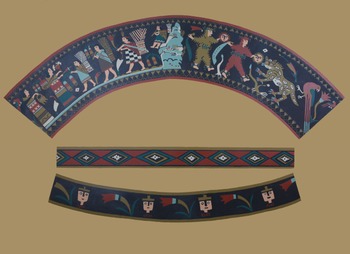
The vases depict a glacier on which is a seated individual dressed in Inka attire. He plays a flute, faces toward the right side of the picture, and carries a load of ichu—a type of straw that grows in the puna—on his back. Water descends from the glacier, flows toward the right, either underground or as a stream at the bottom of the image. On the right side of the glacier, above the water stream, three males, also dressed in similar Inka attire, walk toward the right. They also carry ichu. The closest one to the glacier carries a flower, the middle one plays a flute, and the third one carries a branch of another type of flower. They encounter two females dressed in Inka attire who are standing and facing them. One of the females carries a pot, while the other has a vessel for carrying corn beer on her back. The latter female holds a spinning tool with her left hand and a type of cup in her right hand, from which two birds are drinking.
To the left of the glacier, there is no water stream. Two dancers, dressed in animal skins and with rattles on their ankles, waists, and heads, march toward the left in the picture plane. Each one holds a mask in their left hand and appears to be holding a wide ribbon in their right hand. Facing the dancers, and gazing toward the right, is an otorongo (jaguar). Adjacent to it is a large parrot, followed by a smaller parrot perched on the bundle carried on the back of the second woman, establishing a connection between the two scenes.
Flores Ochoa (Reference Flores Ochoa1990a) frames these vases as containing the theme “Shining Snow,” thus linking them with the pilgrimage. He suggests that the glacier in the vases is Ausangate. He calls the two dancers covered in skins, paulucha, the pablito/ukuku dancers that climb the Qulqipunku glacier in the pilgrimage. While it might be plausible that these dancers represent spectacle bears in the vases, and thus could be framed as bear dancers, they hardly resemble contemporary pablito/ukuku dancers. He claims that the males carrying ichu are ch’unchu dancers, important contemporary dancers in the pilgrimage who represent indigenous people of the Amazonian lowlands. However, they neither resemble the usual representation of Amazonian people in other queros—wearing “face paint, tunics with jaguar markings, and elaborated feather headdresses” (Cummins Reference Cummins2002, 195)—nor the contemporary wayri ch’unchu dancers of the pilgrimage (Salas Carreño Reference Salas Carreño2010; Mendoza Reference Mendoza2017). They rather correspond to low-ranking Inkas (Figure 2).
Drawing of one of the queros characterized as “Shining Snow” by Jorge Flores Ochoa (1990a). Code MOMA-254, drawing by E. Araujo (1966). Photo by the Museo Inka de la Universidad Nacional de San Antonio Abad del Cusco, 2024.

Hence, we cannot establish a plausible connection between this pair of queros and the Quyllurit’i pilgrimage. Certainly, the pilgrimage is associated with the opposition between the highlands and the Amazonian lowlands. While this pair of queros is clearly inscribed in that opposition, with the glacier marking the boundaries between them, there are no elements to ensure that it is particularly referring to the Quyllurit’i pilgrimage or other practice. Instead, these vases align with a common theme of opposition and hierarchy between the highlands and lowlands, a motif present in other queros like the Inka-Anti Battle Motif (Cummins Reference Cummins2002, 254).
Other scholars also claim that the contemporary pilgrimage is related to Inka rituals; however, these claims do not rest on evidence but on hypothetical scenarios or just cite previous assertions of other scholars (e.g., Brachetti Reference Brachetti2002; Kania Reference Kania2019; Randall Reference Randall1982).
How the Great Rebellion is related to the Quyllurit’i pilgrimage
This issue is directly related to the first written account of the pilgrimage and the archive of the Ccatca parish. In 1932, the priest Adrián Mujica and Ccatca notable Ezequiel Arce coauthored the earliest existing account of the miracle that originated the pilgrimage—from now on the First Account—providing a specific date for the occurrence: June 23, 1783 (manuscript transcribed in Flores Lizana Reference Flores Lizana1997, 30–36). The manuscript was preserved in the archive of the Ccatca parish, and it is the origin of the widely held belief among devotees that the miracle took place around 1780, just at the time of the Great Rebellion.
Because of the First Account, many scholars assume that something important happened around 1780 concerning the pilgrimage. David Gow (Reference Gow1976, 245) asked: “Is it mere coincidence that the year 1780, the date of the miracle of Qoyllur Rit’i, was also the date of Tupac Amaru’s uprising, especially when one remembers that both Ocongate and Paucartambo were rebel strongholds?” For him the miracle was “a successful attempt by the peasants to legitimize one of their sacred places in the eyes of the Catholic Church” (Gow Reference Gow1976, 245). In contrast, Randall (Reference Randall1982, 41) thought that the Church fabricated the miracle in 1780 to co-opt indigenous rituals faced with the Tupac Amaru rebellion, which involved a revival of interest in the Inka. Similar assertions were made by Brachetti (Reference Brachetti2002, 110).
Sallnow (Reference Sallnow1987, 207–208) acknowledges that there is uncertainty regarding the sources for the First Account, yet he assumes its historical plausibility. He proposes that the miracle might have involved some “conscious strategy” by the priest and Ocongate notables at the end of the rebellion when they announced that “the suffering Christ has appeared before them, on the mountain all Indians consider the most sacred” (Sallnow Reference Sallnow1987, 214).Footnote 6
Having researched the pilgrimage for over twenty-five years, I can affirm that there is no known source that explicitly indicates an event taking place in Sinaqara around 1780. Furthermore, it is highly strange that the first existing source mentioning the miracle is dated 150 years after the reported miracle.
The earliest source that mentions the Señor de Tayankani—a sculpture of a crucified Christ located in the Ocongate church that participates marginally in the pilgrimage—is a book of inventories of the Ocongate church from 1783 to 1841.Footnote 7 It is located in the archive of the Ccatca parish, as Ocongate was its vice-parish. The first inventory made in 1783 mentions the “Señor de Tayankani” without giving further details.Footnote 8 A second source that mentions the Señor de Tayankani is a 1785 painting in the Ocongate church.Footnote 9 The third one describes an event of 1815, when this image was crucial for the de-escalation of a brief indigenous siege of Ocongate, as registered in a document of a judicial process (Cahill and O’Phelan Godoy Reference Cahill and O’Phelan Godoy1992, 143).Footnote 10
With this evidence, we can ascertain that in 1783, there existed an image of a crucified Christ called Señor de Tayankani in the Ocongate church. However, this does not prove that something happened in Sinaqara at that time, nor does it suggest that this image was associated with such an event. Notice that the place named Tayankani is 2.6 kilometers away from Ocongate, while it is 16.2 kilometers from Sinaqara.
The archive of the Ccatca parish played a crucial role in the creation of the First Account in 1932, as well as in preserving it, which eventually became a canonical text. This archive was crucial for having 1780 and 1783 as the years when the miracle supposedly occurred. As with any other archive, this one was shaped by the conditions of possibility that defined which types of written documents could be kept within it, what information could be recorded, and what was deliberately excluded from its contents (Stoler Reference Stoler2002, 91). While the Catholic Church played a crucial role in colonial Andean state affairs, the Ccatca church archive in the 1930s greatly differed from the archives that Stoler (Reference Stoler2010) engages with to discuss its mediation of the nineteenth-century colonial governance or those presented by Mbembe (Reference Mbembe, Hamilton, Harris, Taylor, Pickover, Reid and Saleh2002) as pillars of the modern state. Though serving as a civil register for baptisms, marriages, and deaths, the Ccatca parish archive lacked documents for securing properties, establishing heirs, or disputing inheritances as those of colonial public notaries of Cuzco studied by Burns (Reference Burns2010). Beyond these strong differences, this archive was notably shaped by politics.
The relationship between the Great Rebellion and the official year of the miracle was established by how the former shaped the Ocongate church documents that ended up in the Ccatca parish archive. The Great Rebellion greatly impacted Ocongate and the surrounding areas. There, Diego Cristóbal Tupac Amaru recruited forces on his route to seize Pisac and the Sacred Valley in 1780 (Walker Reference Walker2014, 103). Following defeats there, Diego Cristóbal’s troops retreated to Ocongate and Lauramarca, in the highlands near Ausangate. In June 1781, Commander José del Valle, in a letter detailing the intensification of attacks against priests, reported the rebels’ execution of the Ocongate priest (Walker Reference Walker2014, 137, 200).
Despite the January 1782 ceasefire signed by Diego Cristóbal in Sicuani, violence persisted in Ocongate and Lauramarca entangled with disputes between their kurakas. Ocongate’s kuraka and his followers defeated and killed the kuraka of Lauramarca, burning down his house (Gow Reference Gow1976, 144; Walker Reference Walker2014, 224). Ocongate people did “not lay down their arms for months, pledging to fight the Spanish” and “remained mobilized throughout 1782” (Walker Reference Walker2014, 224, 238).
During these violent events, the Ocongate church suffered damage, resulting in the loss of adornments, equipment, and documents. This is stated in the inventory book, which starts in 1783. The parish priest of Ccatca mentioned that he had to initiate a new inventory book of the Ocongate church because the previous one was “taken by the rebels in the recently concluded uprising.”Footnote 11 Thus, the documents of the Ocongate vice-parish were destroyed or lost during the rebellion, and those produced afterward were later moved to the Ccatca parish archive.
In 1932, the priest Adrián Mujica and Ccatca notable Ezequiel Arce examined the Ccatca parish archive to historically anchor the origins of the pilgrimage. The earliest mention of the Señor de Tayankani that they were able to find was in the 1783 Ocongate church’s inventory. They likely were aware of the 1785 painting of the Ocongate church; however, the 1783 mention gave them an earlier date. Using these mentions of the Señor de Tayankani, without any other information regarding any practice at Sinaqara, they incorporated 1780 and 1783 into the First Account. I claim that the association between these years and the pilgrimage would not have been possible without the 1783 book of inventories, which was initiated because of the destruction of the Ocongate church’s documents caused by the Great Rebellion. It was therefore the structure of the archive, shaped by the Great Rebellion, that made possible the inscription of 1780 and 1783 in the First Account.
This manuscript took oral narratives that typically do not refer to dates or years (Mannheim and Van Vleet Reference Mannheim and Van Vleet1998) and anchored them within historical time. They did so by incorporating dates and names, such as that of the then bishop of Cuzco, Juan Manuel Moscoso, extracted from the archive but that had no relationship with anything happening in Sinaqara. Therefore, Mujica and Arce introduced a fictional historical narrative in it.Footnote 12 While they claimed that their account was “carefully extracted” from “the existing annotations in the books of the Ocongate vice-parish” (manuscript transcribed in Flores Lizana Reference Flores Lizana1997, 30), they rather constructed the relationship between 1780 and 1783 and the narrative of the miracle out of thin air. The inclusion of these years in the First Account was crucial for the later association of the origins of the pilgrimage with the Great Rebellion.
Why the First Account was written in 1932
This issue is related to the disputes between the neighbors of Ocongate and the hacienda Lauramarca, which included Mahuayani and Sinaqara (see Figure 1; Reátegui Reference Reátegui1977, 3). At some point in the nineteenth century, Ocongate was no longer considered a Cabildo de Indios but a town of literate merchants, whereas Lauramarca was a hacienda known to be the largest in the region.Footnote 13
Andean hacienda systems are said to rest on a triad: the priests, the state representatives, and the landlords, usually complemented with local nonindigenous merchants in their common exploitation of indigenous peasants (Bretón Solo de Zaldívar Reference Bretón Solo de Zaldívar2020, 293; Manrique Reference Manrique1988). This case highlights how these different actors were not necessarily aligned with each other but rather competing in their aim to appropriate indigenous production.
The tensions between the notables of Ocongate and the Saldivar family, the Lauramarca landlords, reached a violent confrontation in 1899 (Quintín Reference Quintín1991). Due to maintenance work, the landlord’s nephew worked with some hacienda laborers to dismantle a bridge. As the day drew to a close, the Ocongate governor and companions, after overseeing the land distribution in the Coñamuro community, attempted to return to Ocongate but were unable to cross the bridge. A violent altercation broke out, resulting in the capture and retention of the governor at the hacienda (Quintín Reference Quintín1991). According to another source, “Saldivar had the local governor arrested, dragged by horse to Lauramarca, and lashed to a tree in the patio. The governor had dared to sell liquor to peasants on Lauramarca lands” (Gow Reference Gow1976, 145). The following day, armed residents of Ocongate launched an attack on the hacienda. Two hacienda laborers died during the assault, and four others sustained injuries. The hacienda owner, priest Antonio Saldivar, was also wounded and passed away a few days later (Quintín Reference Quintín1991; Ramírez Reference Ramírez1996, 41–43). Notice how the district state representative and the landlord-priest led opposing sides.
The expansion of haciendas in southern Peru during the second half of the nineteenth century was closely linked to the British demand for wool that reached the most remote corners of the highlands through small-scale merchants (Burga and Flores Galindo Reference Burga and Flores Galindo1979; Manrique Reference Manrique1988; Miller Reference Miller2011). Foreign wool demand became the engine of southern Peru’s economy between 1850 and 1920. Alpaca wool became a highly valuable commodity with better prices than sheep wool (Jacobsen Reference Jacobsen2013, 534; Jacobsen Reference Jacobsen and Monsalve2019, 153).
Quintín (Reference Quintín1991) shows how this mercantile expansion fueled the dispute between the hacienda Lauramarca and the Ocongate merchants over the commercialization of colono alpaca wool. The colono families worked without pay in the best hacienda pastures and lands. In return, they cultivated some hacienda plots for their subsistence and had their own animals in the hacienda pastures. The hacienda not only directly extracted the colono labor but also sought to intermediate the commercialization of these families’ production. This was crucial because the colonos owned the majority of sheep and alpaca herds within hacienda lands and cultivated two-thirds of the agricultural land in Lauramarca (Quintín Reference Quintín, Dancourt, Mayer and Monge1994, 181). This pattern was widespread; throughout the southern Andes, haciendas sought to control the alpaca wool of their colonos (Jacobsen Reference Jacobsen2013, 539). Particularly in Lauramarca, each Sunday, all colonos were required to attend mass at the manorial house, bringing with them whatever produce or livestock they had to sell. Saldivar was the sole buyer at this weekly market. He then resold the goods to the local mestizo merchants in Ocongate, who objected strongly to his monopoly” (Gow Reference Gow1976, 145). However, the haciendas’ actual control was always limited by the complexity of the environment and the colonos’ strategies (Jacobsen Reference Jacobsen and Monsalve2019, 154)
The 1897–1902 electoral registry shows that of the forty-three Ocongate electors, thirty-five were merchants. This high proportion indicates their involvement not only in the commercialization of the Ocongate’s four free indigenous parcialidades’ production but also in that of the colono families living in areas that easily escaped hacienda control (Quintín Reference Quintín, Dancourt, Mayer and Monge1994, 182). The Ocongate merchants, as other local merchants, sought to commercialize the colono alpaca wool, which had become a highly valuable commodity since the 1880s (Jacobsen Reference Jacobsen and Monsalve2019). It is not surprising, then, that the nephew of the slain landlord accused the Ocongate state functionaries and merchants of harboring “usurping instincts to appropriate what belongs to others” and “filling their pockets with the fruits of the poor Indians’ labor” (Quintín Reference Quintín1991, 6).
The year 1920 was a turning point in these disputes. That year, the merchants were able to move the weekly fair held at the hacienda Lauramarca to the main square of Ocongate, becoming the district’s primary fairground (Quintín Reference Quintín, Dancourt, Mayer and Monge1994, 181; Ramírez Reference Ramírez1996, 43–45). More importantly, the demand for alpaca wool plummeted in 1921, and its price fell to less than 30 percent of what it was in 1918 (Jacobsen Reference Jacobsen2013, 550). The decline of the wool export cycle in the region, already visible after World War I, was only confirmed by the Great Depression of 1929–1932 (Jacobsen Reference Jacobsen and Monsalve2019, 170). The crisis of the wool economy in the 1920s began the long stagnation of the regional economy that lasted until the 1969 Agrarian Reform (Jacobsen Reference Jacobsen2013, 540).
Faced with the drop in alpaca wool prices in the 1920s, the hacienda Lauramarca drastically reduced the already meager prices it paid the colono families for their wool. The colonos reacted immediately. In April 1922, they refused to work for the hacienda, took control of it, and began a judicial process denouncing the exploitation and abuse by the Saldivar landlords (Reátegui Reference Reátegui1977, 90–91). A long period of judicial processes, mobilizations, unfulfilled agreements and violent state repression lasted until Lauramarca ceased to be a hacienda in 1970 during the Agrarian Reform (Reátegui Reference Reátegui1977; De la Cadena Reference De la Cadena2015). According to several Ricketts Corporation’s agents responsible for purchasing alpaca wool directly from the hacienda, in the 1920s, the hacienda could not control the production of the colonos who sold their wool directly in Checacupe and Sicuani (Burga and Flores Galindo Reference Burga and Flores Galindo1979, 125).
This situation presented an important opportunity for the Ocongate merchants who sought to purchase the colono alpaca wool in competition with the markets of Checacupe and Sicuani. Like other wool merchants, they cultivated compadrazgo (coparenting) relationships as part of their strategies to build lasting relationships with the colono families of Lauramarca (Quintín Reference Quintín, Dancourt, Mayer and Monge1994, 183; Reátegui Reference Reátegui1977, 71A). Compadrazgo involves creating kinship relations with non-biologically-related people (Weismantel Reference Weismantel1995). As illustrated by the relationships between Ocongate merchants and colono households, compadrazgo typically relates couples of different social and economic statuses. These asymmetrical connections provide access to critical resources, such as protection from government officials, credit at stores, or exclusive access to alpaca wool, which are difficult to obtain through alternative means (Leinaweaver Reference Leinaweaver, Linda and Kathleen2018, 240).
As in other Andean contexts, compadrazgo went hand in hand with sponsorship of indigenous celebrations such as those associated with carnival, cattle branding, or patron saints (Langer Reference Langer2004, 21; Rabey et al. Reference Rabey, Merlino and González1986, 147). Thus, while they were already becoming involved in the indigenous practices of Sinaqara, this had only intensified since the 1920s. That is how, in the context of weak or nonexistent hacienda control, the Ocongate neighbors, seeking to strengthen their ties with the alpaca herders living within Lauramarca—which included Sinaqara and Mahuayani (see Figure 1; Reátegui Reference Reátegui1977, 3)—became deeply involved in the Quyllurit’i pilgrimage. That is why the First Account was created in 1932. It was a consequence of the involvement of local merchants in this small local indigenous pilgrimage that was provoked by their attempts to commercialize colono alpaca wool.
The first part of the First Account is the inscription of oral narratives of the miracle into historical time. The second and third parts recount the involvement of people beyond Ocongate in the practices at Sinaqara, already indicating some initial growth of the pilgrimage. The second part explains the origin of the painting on the rock at Sinaqara. An Acomayo miner was working in the Amazonian Quincemil gold panning areas—located to the east of Ocongate—but without success and in considerable debt. He asked the “Señor de Ccoyllor-Ritte” for help and immediately found gold. Grateful, he gave a large sum of money to the priest Mujica, who used it to paint a crucified Christ on the rock. The third part tells how Ezequiel Arce donated the first sudario (shroud) that clothed the Christ painted on the rock (manuscript transcribed in Flores Lizana Reference Flores Lizana1997, 33–36). Thus, the First Account was both part of and a consequence of the participation of nonindigenous town neighbors in the pilgrimage. The First Account also makes clear that they were not only participating in the pilgrimage to strengthen their ties with the alpaca herders of the area; in the process, they became devotees and attempted to control the pilgrimage as it started to grow. Notice, however, that the First Account did not attempt to relate the pilgrimage to the Great Rebellion.
From Tayankani to “Qoyllur Rit’i”
In this section, I show how the Ocongate neighbors’ attempts to control the pilgrimage are clearly expressed in the First Account and in the structure of the pilgrimage’s processions, as well as why the focus changed from Tayankani to “Qoyllur Rit’i.” The first part of the First Account (manuscript transcribed in Flores Lizana Reference Flores Lizana1997, 30–33) tells the story of Mariano, an indigenous boy, whose family lived in Mahuayani around 1780. He took care of the family’s alpaca herd in Sinaqara, next to the glacier. There, he met a white boy who became his playmate as the alpaca herd miraculously thrived. The white boy’s name was Manuel, and he was from Tayankani. On June 23, 1783, the Ocongate priest and notables went to Sinaqara. There, they saw Mariano next to the other boy who emanated a dazzling light. Approaching the light near a large rock, the priest attempted to grab Manuel, but instead touched a tayanka tree.Footnote 14 Suddenly, they saw Christ crucified in agony. Overwhelmed by the sight of his friend in such a state, Mariano suddenly died. When the light faded, there was a cross-shaped tayanka tree. They buried Mariano’s body next to the rock.
According to it, the miraculous child who came from Tayankani turned into the tayanka cross; therefore, he was the Señor de Tayankani. This framing is part of the broader effort of the Ocongate neighbors to impose the Señor de Tayankani—the sculpture of Christ of the Ocongate church—over the practices in Sinaqara. This is already in its title: “Traditional origin of the apparition of the Señor de Sinakara and Tayankani according to the existing annotations in the books of Ocongate vice-parish.” In contrast, in the entire first part, the Señor de Quyllurit’i is mentioned only twice: The first in a subtitle and the second in the last sentence: “Some know [the Christ] by the name Señor de Ccoyllor-Ritte due to the effulgence emitted by the Lord’s body.” Hence, in the First Account, the shrine’s rock, Taytacha Quyllurit’i, only marks Mariano’s tomb. Thus, the 1932 account does not explain the overwhelming centrality of the rock in the pilgrimage.
These points are more evident in a later version of the miracle written by the priest Juan Andrés Ramírez (Reference Ramírez1969):
The King of Spain heard about the miraculous events at Sinaqara and asked for the Tayanka Cross. When it was not returned, the Indians became restless. To appease them, the priest had a replica made, known as the Señor de Tayankani, now kept in Ocongate. However, it was Mariano’s tomb in Sinaqara that ignited the Indians’ devotion. To prevent superstition, the religious authorities had an image of Christ painted on the rock.
Quechua versions of the miracle have only been recorded since the 1970s, and notably, they do not mention the tayanka tree or the Señor de Tayankani. Instead, they emphasize how the dazzling light penetrated the rock (Sallnow 1987; Reference Sallnow, Ross Crumrine, Morinis and Press1991; Gow Reference Gow1974; Gow and Condori Reference Gow and Condori1976). Thus, the Quechua narratives clearly explain why the rock is the center of the pilgrimage: the miraculous child is the rock, Taytacha Quyllurit’i. Moreover, they follow a clear indigenous logic that connects the extraordinary child, the rock, and the glacier (Allen Reference Allen and Howard-Malverde1997). These are contrasting ways of defining the center of the pilgrimage and constructing its legitimacy. One gives centrality to the Tayankani sculpture, which is kept in the nonindigenous town of Ocongate, and the other to Quyllurit’i, the rock, that is clearly associated with the glacier through indigenous logics (Sallnow Reference Sallnow1987, 211; Gow Reference Gow1976, 217–218).
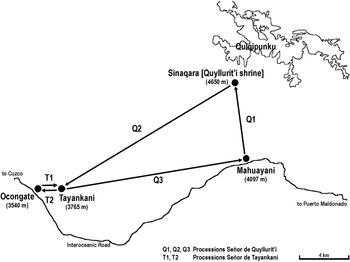
The effort to associate the sculpture of the Ocongate church with the practices of Sinaqara is also present in the structure of the processions. There are two movable Christ sculptures that are central to them. One is also called Señor de Quyllurit’i and stays in the Mahuayani chapel most of the year. The second one, the Señor de Tayankani, stays in Ocongate. The contemporary structure of the processions has remained remarkably stable at least since the first available description (Ramírez Reference Ramírez1969). The pilgrimage cycle begins with the procession of these two Christs on the same day. The first, accompanied by a Virgen Dolorosa, goes from Mahuayani (at 4,097 meters) to the Sinaqara shrine (at 4,650 meters; Q1, Figure 3). The second, also accompanied by another Virgen Dolorosa, goes from Ocongate (altitude, 3540 meters) to the Tayankani chapel (3,765 meters; T1, see Figure 3).
Processions on the Quyllurit’i pilgrimage. Elaborated by the author with information from Flores Lizana (Reference Flores Lizana1997), Sallnow (Reference Sallnow1987), Ramírez (Reference Ramírez1969), fieldwork, and based on Instituto Geográfico Nacional’s maps.

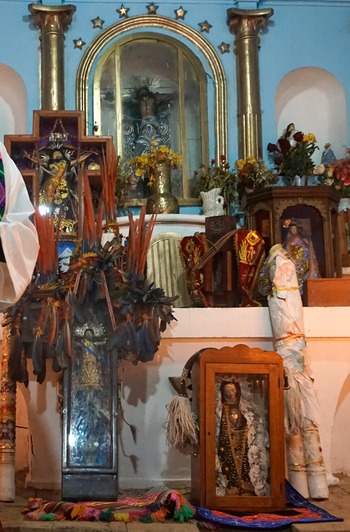
During the main pilgrimage days, the mobile Señor de Quyllurit’i remains next to the Señor de Quyllurit’i, the rock. On the Tuesday before Corpus Christi, after the descent of the pablito/ukuku dancers from the Qulqipunku glacier and the blessing mass, the Señor de Quyllurit’i and the Virgen Dolorosa begin a long procession to Tayankani. Known as the twenty-four-hour procession, it involves walking through the night (Q2, see Figure 3). The Señor de Quyllurit’i and the Señor de Tayankani, accompanied by their respective Virgen Dolorosa, meet at the Tayankani chapel on the day before Corpus Christi (Figure 4). They bestow blessings together, and the Señor de Tayankani returns to Ocongate (T2, see Figure 3), while the Señor de Quyllurit’i returns to Mahuayani (Q3, see Figure 3). Thanks to the pictures of Martín Chambi (Reference Chambi1990), who attended the pilgrimage invited by Ezequiel Arce, we know that these processions were already in place in 1931.Footnote 15
At bottom, Señor de Quyllurit’i, adorned with three wayri ch’unchu headdresses, with a Virgen Dolorosa at his left, when they just arrived from the twenty-four procession to the Tayankani chapel. In the center is Ocongate’s Señor de Tayankani with a Virgen Dolorosa to his left. Above and inside the altar is another crucified Christ, also called the Señor de Tayankani, but affectionately referred to as “El Vaguito” because he never moves from the Tayankani chapel. Photo by Francesco D’Angelo, May 2024.

The procession between Tayankani and Ocongate covers a short distance of 2.6 kilometers, going up and down a hill. In contrast, the overnight procession from Sinaqara to Tayankani involves ascending and descending steep slopes at higher altitudes, making it an extremely strenuous undertaking, covering 16.2 kilometers in a straight line (see Figure 3). Note that this meeting of the Señor de Quyllurit’i with the Señor de Tayankani is the only link between the latter and the miraculous power of the rock of Sinaqara. Thanks to these processions, the Señor de Tayankani, clearly under the control of the Ocongate neighbors, was able to participate in the miraculous power of Quyllurit’i. The structure of these processions shows that their origin is rooted in the interest of placing the Señor de Tayankani at the center of the pilgrimage.
Efforts to impose the name Tayankani over Quyllurit’i persisted long after the 1930s. The construction of the Cuzco-Ocongate road in 1938 increased the popularity of the shrine. By the 1940s, it had grown beyond Ocongate and Ccatca. In 1948, the parish priest of the provincial capital, Urcos, founded the Asociación del Señor de Tayankani (Sallnow Reference Sallnow1987, 215) “with the aim to put in order the Indians who go up there to dance and, drunk, commit excesses” (quoted by Flores Lizana Reference Flores Lizana1997, 26). Its members included devotees from Ocongate and other towns farther from the shrine who were pushing the former out of control of the pilgrimage. The second available written account of the miracle, produced in 1946 in Urcos, insisted on associating the rock with the Señor de Tayankani:
Mayta’s body was buried at the vision site, and as a remembrance, they decided to paint an image of Our Lord Jesus Christ in the mystery of his crucifixion and construct the existing chapel, where this is celebrated every June 26, with the name señor de tayancani. (Flores Lizana Reference Flores Lizana1997, 39)
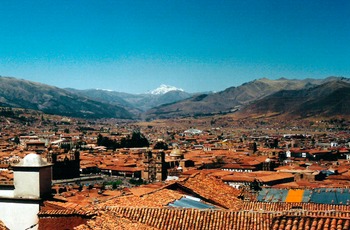
In 1960, however, the association was renamed Hermandad del Señor de Qoyllur Rit’i. This change was related to the growth of the pilgrimage beyond Ocongate. Quyllurit’i (Shining Snow) was a name that easily participated in the emergence of the pilgrimage’s association with the Ausangate glacier. Additionally, when it is time to go to Quyllurit’i, in the dry season, Ausagante becomes visible from the city of Cuzco and many other places in the region (Figure 5). The vast sphere of influence of Apu Ausangate, the most important sentient glacier in the region, easily encompassed the rural and increasingly urban places where those who were becoming Quyllurit’i’s pilgrim-dancers were building their lives. Thus, the Quyllurit’i shrine allowed the growing mobile population of the region to honor this high glacier through a Catholic frame (Salas Carreño Reference Salas Carreño2010, 72; Salas Carreño Reference Salas Carreño2021, 330).
Ausangate glacier, as seen from the city of Cuzco during the dry season. Photo by the author, June 2007.

Thus, at least since the 1960s on, Taytacha Quyllurut’i, the rock of Sinaqara, has been the undisputed center of the pilgrimage. The twenty-four-hour procession, crucial to Ocongate’s neighbors’ control of Sinaqara, was not strictly followed by pilgrims from other districts, who preferred to return directly to Mahuayani. While the Señor de Tayankani remained central to the Ocongate’s neighbors, it was increasingly overshadowed by the rock as the pilgrimage grew. At the same time, the brotherhood began to include members from more distant towns and, eventually, from the city itself (Flores Lizana Reference Flores Lizana1987, 144–145).
It was the brotherhood since the 1960s that promoted the writing “Qoyllur Rit’i.” It originated in the First Account as “Ccoyllor-Ritte” and was crucial to the widespread use of the translation “snow star.” As the late Jorge Flores Ochoa explained, both the writing and the translation force a Quechua name into Spanish grammar.Footnote 16 It is the juxtaposition of two words: quyllur (star) and rit’i (snow). However, people do not pronounce Quyllur Rit’i but Quyllurit’i. Here, quyllu refers to a particular type of wool color, shining white, in the Quechua register of the region’s highland alpaca herders (Flores Ochoa Reference Flores Ochoa1990b). “Ccoyllor-Ritte” was written in the First Account likely because the word quyllu was absent from the authors’ Quechua register, and they were unfamiliar with that of alpaca herders.Footnote 17 This was reproduced by many later actors for the same reasons. Thus, the widespread use of the writing “Qoyllur Rit’i” and its translation as “snow star” is part of the history of the alpaca herders’ loss of control over the pilgrimage. The writing and translation changed only in 2008, when Jorge Flores Ochoa presented his arguments to the organizations of pilgrims and the Ministry of Culture. As a result of his intervention, the Ministry of Culture and the Brotherhood adopted the writing “Qoyllurit’i” and the translation “shining white snow.”
Conclusions (or why the Great Rebellion is related to the Quyllurit’i pilgrimage)
This article discusses how and why the origins of the pilgrimage were inscribed in historical time. However, it makes no claims about its origin. Rather, it affirms that there is no evidence that it was either initiated or Christianized around 1780. Given the available evidence, if I had to propose a hypothetical origin, I would say that it began to resemble the earliest available photographs and descriptions during the nineteenth century. In any case, there is no proof of this, and we do not know if other practices were performed there before. However, I must emphasize that the pilgrimage involves a complex and evolving set of indigenous practices regardless of when they originated. It is an overwhelming expression of contemporary indigenous vitality.
The 1780s were associated with the pilgrimage in the First Account of 1932. The earliest available document in the Ccatca parish archive that mentions the Señor de Tayankani was written in 1783 because of the destruction caused in the Ocongate church by the violent events of 1782. The authors of the First Account used this earliest mention of the Señor de Tayankani in the archives and established 1783 as the year in which the miracle took place. Thus, the Great Rebellion and the First Account are related because of the way the former shaped a local archive.
The First Account was created in the context of the strong interest on the part of Ocongate merchants to establish long-lasting relationships with the colono alpaca herders of the hacienda Lauramarca. While this interest had been present since alpaca wool became a valuable commodity, it was intensified when the hacienda entered a period of sustained conflicts with the colono families in the 1920s. The First Account was part of the involvement of these nonindigenous actors in the pilgrimage and their attempts to control it. The inclusion of 1780 and 1783 in the First Account was not an attempt to link the pilgrimage with the Great Rebellion. That happened much later. The efforts of the Ocongate neighbors to control the pilgrimage included trying to impose the Señor de Tayankani over the practices in Sinaqara.
Meanwhile, the legal processes and mobilizations of the colono families, as well as the landlord and state violence, continued until Lauramarca ceased to be a hacienda in 1970 (Reátegui Reference Reátegui1977, 147; De la Cadena Reference De la Cadena2015, 68). Also in the 1970s, during the Velasco regime, Tupac Amaru became a popular national hero, and the first anthropological studies of the “Qoyllur Rit’i” pilgrimage, as it was already known beyond Ocongate, were carried out (Gow Reference Gow1974, Reference Gow1976; Marzal Reference Marzal1971; Sallnow Reference Sallnow1974).
This is the context that explains why scholars in the 1970s and 1980s began to hypothesize connections between the pilgrimage and the Great Rebellion, based on the First Account of 1932. Additionally, the First Account was published as a booklet by a Catholic Pastoral Group from Urcos to commemorate the “Bicentenary 1780-1980” of the pilgrimage (Grupo Pastoral 1980). From these initial associations emerged the widespread assumptions about an actual relationship between the Great Rebellion and the Quyllurit’i pilgrimage, deeply linked to issues of indigenous cultural authenticity, continuity, and resistance prevalent in the 1980s (Ortner Reference Ortner1995).
As early as 1988, Deborah Poole criticized these tropes associated with the pilgrimage: “In the search for the pre-Columbian roots of Qoyllur Rit’i … we confuse the origins of Andean culture with its present rationality, the utopian past that we seek with the actual motivations of people living and barely surviving the present” (Poole Reference Poole1988, 119). By arguing for the pilgrimage’s origins and continuity with Inka rituals, or assuming links with the Great Rebellion, these discourses participated in the negation of pilgrims’ coevalness (Fabian Reference Fabian1983). As Poole (Reference Poole1988, 118) put it, these perspectives assumed that “what is Andean ‘culture’ should not belong to the present … it should not contaminate its alterity and its utopias with commodity forms that we recognize as part of our identities, as products of our history and fetishes of our fears.”
These points feel familiar after the postmodern critique within anthropology (e.g., Clifford and Marcus Reference Clifford and Marcus1986), critiques within North American Andean anthropology (Poole Reference Poole1988; Starn Reference Starn1991), and within Peruvian anthropology (Ansion Reference Ansion, Dancourt, Mayer and Monge1994; Degregori Reference Degregori and Cotler1995; Fuenzalida Reference Fuenzalida1992; Mayer Reference Mayer1991). However, these tropes have been appropriated and reproduced by multiple actors in Cuzco and Peru, both within and outside academia. As the opening quote shows, state institutions such as the Ministry of Culture and multilateral organizations like UNESCO contribute to their reproduction. They are reinforced by the New Age environmental indigenism that flourishes in the region. Thus, they permeate popular perceptions of the pilgrimage in mass media and social networks. These historical claims about the pilgrimage contribute to perpetuating the denial of coevalness of those who are seen as the most rural indigenous participants in the pilgrimage and the naturalization of everyday forms of racial-ethnic discrimination.
Acknowledgments
This article would not have been possible without the help of many people over the years. I cannot mention them all. However, I would particularly like to thank the late padre José María García, SJ, who, despite his reluctance toward researchers, generously shared his experience of the pilgrimage and gave me access to the Ccatca parish archive in 2004. I would also like to thank Alejandro Diez and Carlos Contreras for their helpful reading suggestions, Francesco D’Angelo for the photograph of the three taytachas (Figure 4), and the anonymous reviewers who helped to improve this article.


 Open access

