

INTRODUCTION
Scholars of prehistory often cite finely crafted pottery as illustration of the technical achievements of a particular civilization in terms of craftsmanship and artistic skill and as emblems of social transactions and affluence within a society (LeCount Reference LeCount1996; Reents-Budet and Bishop Reference Reents-Budet and Bishop1998). One of the traditional hallmarks of the “classic” period of a civilization is a conspicuous increase in specialized activities, consumables, and durable goods related to foodways. Elaborate vessels for such conspicuous foodways are commonly designed to be distinct from common or domestic utilitarian forms in quality, quantity, form, or decoration. For the Late Classic period, Maya elite vessels provide similar evidence of an evolving sophistication in foodways and beliefs. Among the various defined classes of pottery vessels from the later part of the Classic period (a.d. late 600–800) are small flask containers. These flasks are frequently referred to as poison bottles, pilgrim's flasks, veneneras, pigment bottles, medicine bottles, or snuff bottles (Carlson Reference Carlson2007a, Reference Carlson and Dunkelman2007b; Eppich Reference Eppich2011; Groark Reference Groark2010; Houston et al. Reference Houston, Stuart and Taube2006). Some of these descriptors imply specific vessel contents, while others suggest an analogy to particular native North American traditions. This paper will present, in part, details of a recent study revealing that tobacco was among the contents of some such flasks. We will also present data on vessel construction and contents that address the broader function and use of these flasks.
This class of vessels is well-known to archaeologists (Smith Reference Smith1955), although it is rarely the focus of discussions and research. Although the sizes are variable, the flasks are generally small enough to fit in one's hand. The shapes are highly diverse, and include a large number of effigy flasks created to resemble human and mythological beings, animals, house and temples, or gourds. In the Maya creation myth the Popol Vuh, a “gourd of tobacco” (Tedlock Reference Tedlock1985:204) is named among the items given as a symbol of lordship. Groark (Reference Groark2010) has indicated that the modern Maya practice of storing dried tobacco products in actual gourd containers is a likely continuation of ancient methods (see also Wilbert Reference Wilbert1987:58). The practice of creating clay vessels to resemble gourd vessels is well known for Maya peoples, and is considered by archaeologists to be the origin of certain specific clay vessel types (see for example Tedlock Reference Tedlock2002). Some flasks resemble small thatched-roof houses or structures (Carlson Reference Carlson2007a). Other examples are not house-shaped, but instead bear the text y-otoot “home” indicating that the vessel is considered a home or house regardless of its shape (Houston et al. Reference Houston, Stuart and Taube1989). The research presented here discusses one such hieroglyphically labeled vessel. Mass spectrometry of samples extracted from this Late Classic-period flask provide the first positive evidence for the presence of nicotine in a Maya vessel, showing conclusively that it once contained a tobacco product.
Late Classic Maya traditions of vessel forms and styles include numerous designs intended to fulfill specific functions. A vessel created with the capabilities of performing a simple containment task may not actually have been used for that task or for that task alone. This pragmatic ambiguity leads us to consider the intended uses and contents, both ideal and actual, of many of the Classic ritual or elite vessels more thoroughly (Loughmiller-Newman Reference Loughmiller-Newman2012). Interpretation of the actual Maya use or uses of such vessels is further complicated by the frequent presence of intricate decoration, complex iconography, and at times opaque textual statements that occasionally allude to specific vessel contents and use.
Classic Maya artwork often contains hints of vessel use and function. Through depictions of rites, rituals, and mythological scenes the most ceremonial of all vessels are frequently shown in use. The depiction of the small flasks in such contexts, however, is more limited. The Kerr Maya Vase databaseFootnote 1 contains hundreds of “rolled-out” photographs of the elaborately decorated Classic Maya cylinder vessels where depictions of vessels in use are commonly found. To date, flasks have been identified in only a few scenes in which a figure is clearly depicted holding a small vessel in one hand (see, for instance, Kerr archives: K1377, K3460). Eppich (Reference Eppich2011) suggests that perhaps in other images, where small round hand-held objects are depicted in feasting scenes, these may be flasks as well. We agree with Eppich's suggestion, and offer support for this interpretation as well as additional evidence that may be useful for identifying flasks within the art and iconography.
The research presented here is based on the ceremonial and/or ritual vessels held in the Kislak Collection, which is part of the Ancient Americas Collection housed at the Library of Congress. This collection contains over 100 Maya flasks. Seventy-five of these flasks are broadly discussed here, with additional information provided on the small codex flask containing nicotine. Only the flasks in the Kislak Collection were included in this study, but the description applies to most known flasks of the Late Classic period.
Body Construction
The known flask types follow two general forms, which we will call the paneled flask (Figure 1, n = 46) and the sculpted flask (Figure 2, n = 29). The paneled flasks are constructed with four distinct sides. The front and back of these vessels are comprised of two flat panels of equal size, which are the largest of the four sides. They are relatively flat, and are usually cut geometrically to circular or quadrilateral shapes. The front and back panels are, in many instances, decorated with images and occasionally text. The side panels are cut to adhere to the front and back panels, and are less commonly decorated. The sculpted flasks, on the other hand, are constructed from a single ball of clay. Sculpted flasks are far more variable in overall shape than the four-panel flasks, with most being formed into representations of gourds, animals, or anthropomorphic heads.
Example of a paneled flask. Photo taken by Loughmiller-Cardinal courtesy of the Library of Congress, Kislak Collection.

Example of a sculpted flask. Photo taken by Loughmiller-Cardinal courtesy of the Library of Congress, Kislak Collection.
The sides of the paneled flasks connect the front to the back on the right and left sides of the vessel. They are applied to match the line of the body of the vessel up through the neck. A small, rectangular bottom panel is joined to the side panels. This bottom panel often has applied pedestal feet or rounded appliqué that used to stabilize a seated vessel. The neck of the vessel is also applied to the body. When adorned, the sides of the vessel are embellished with either roller stamped hieroglyphic text or applied decorative elements such as twisted strands. Opposing pairs of panels share the same image or text in nearly all cases. The majority of panel vessels in the Kislak Collection were pressed with stamps. Several vessels in the collection display the exact same scene with variation only expressed in the depth of the impression. Upon closer examination, it was determined that six nearly identical stamps were being employed on twenty different flasks (Loughmiller Reference Loughmiller-Newman2011).
The average height of the 46 panel flasks examined is 76 mm measured from the bottom of the vessel to the lip. None of the flasks are taller than 100 mm. The average width is less than 61 mm (μ = 60.67 mm). The necks of the vessels have a consistent size, extending between 20 and 24 mm above the shoulder. The diameter of the opening is between 29 to 32 mm. The lip is flattened, suggesting that a specific cork or stopper was used. The clay is burnished on the exterior, with some examples showing heavy burnishing. The interior treatment is inconsistent, and presents a variety of surface characteristics. Some are highly burnished, while others are left rough and porous.
In 1989, Houston, Stuart, and Taube isolated several folk classifications related to certain vessel forms found on Late Classic pottery. The inscriptions on a number of flasks seem to indicate that at least some of them were called 'otoot “home” of some product (Boot Reference Boot2005:8). Numerous rectangular paneled flasks have been recovered that were designed to look like thatched-roof houses, further suggesting a “home/house” association (Figure 1) (Boot Reference Boot2005; Carlson Reference Carlson2007a, Reference Carlson and Dunkelman2007b). The majority of vessels bearing the 'otoot label, however, are not house shaped flasks but instead are rounded or sculpted vessels including the tobacco vessel discussed below.
The 29 sculpted flasks are formed from single balls of clay. The majority are representations of animals or anthropomorphic heads (Figure 2), perhaps depicting 'ajaaw “lords.” They range in size from 50 to 65 mm in height, and from 40 to 68 mm width. The mean cannot adequately characterize the variation so the range is provided here. Overall, the sculpted flasks are smaller than the paneled flasks. Some of the sculpted flasks do not have necks (n = 4), but those that do (n = 25) have applied necks 8 to 12 mm in height with a 22 to 30 mm diameter opening. Several of these vessels are complete with a ceramic stopper, but the seals are not airtight. The lip on each of the sculpted flasks is rounded, regardless of whether it has a neck or not. The vessels that do not have a neck tend to have a larger opening up to 35 mm diameter. The overall body construction and base seem designed to be placed on a flat surface. In some cases, applied decoration such as a long beard or chin is used to provide additional stability to the seated vessel.
Of the 75 vessels, 60 (80 percent) of the flasks examined appear to have been formed to allow the vessel to be strung. These vessels either have applied clay loops on the shoulders or a worn grooved depression around the neck, indicating that something had been tied around it (Adams Reference Adams1971; Smith Reference Smith1955). Where present, many of the loops show signs of wear as if they were indeed strung. The stringing methods would have resulted in the flask being hung neck-up (Figure 3). Of the remaining 15 flasks, six sculpted flasks show no obvious indications or places that they might have been strung.
Example of flask with holes for stringing. Photo taken by Loughmiller-Cardinal courtesy of the Library of Congress, Kislak Collection.
The stability of the panel flasks when seated on a flat surface would have been rather precarious, especially the rounded front/back paneled vessels. The paneled flasks are typically taller than they are wide, and therefore more prone to toppling. The six sculpted vessels without indication of elements for stringing are designed to be stable when placed on a flat surface by the application of tripod supports, protrusions, or basal rings. Five of these vessels also have slightly larger openings directly into the body of the vessel, only one having a neck. Given this design, it is possible that these six vessels (and perhaps the others) had their contents drawn out by a spoon-like utensil or sucked out with a straw similar to modern day practices noted by Groark (Reference Groark2010).
Depiction of Flasks
Kerr rollout images K1377 (Figure 4a) and K3460 (Figure 4b) are among the few commonly cited images depicting flask vessels in use. Although both of these examples depict small olla-shaped containers, they are shown as held rather than worn. Flasks are more commonly depicted than has been previously recognized however, and are present within several noteworthy contexts. The Mayas depicted strung items hanging from around the neck or waist as well as inserted into headdresses and backracks. Strung, paneled, rounded flasks are depicted worn by the gods and way figures (spirit beings) on the codex-style vessels. These scenes are set within the underworld (xibalba), and have a common theme of death (see for example K521, K927; Figures 5a, 5b). These flasks are generally depicted upside down, with two small intertwining serpents coiling downwards from the neck. These “death flasks” are most frequently worn by Chaak’, skeletal god A, and god A′. Most of the flasks worn by the gods are marked with either 'ak'ab’ “darkness” or cimi “death.” In both cases, they are typically strung on cords featuring the “death eye’” (Figures 5a, 5b). There are no known artifacts that correspond to these depicted flasks labeled with 'ak'ab’ or cimi in the Kislak Collection or that are otherwise known to the authors, suggesting that these images may be denoting some aspect of function rather than actual vessel decoration.
(a, b) Examples of flasks in artwork. Photograph by Justin Kerr, Kerr archives K1377 and K3470.
(a, b) Examples of upside down flasks. Photograph by Justin Kerr, Kerr archives K521 and K927.
Groark (Reference Groark2010:11) points out that modern Tzeltal Mayas use similar small gourd vessels to hold powdered substances, particularly a slackened lime and powdered tobacco mixture. Small round gourds and bottle gourds are extremely common in the Maya area, and are known to have ancient presence in the Americas (Ford Reference Ford1981; Fritz Reference Fritz1990; Hart et al. Reference Hart, Daniels and Sheviak2004:142; Newsome et al. Reference Newsome, Webb and Dunbar1993). Gourds are easily grown and extremely durable once dried. In the Classic Maya artwork, gourd vessels are denoted by a classifier element indicating te’ “wood or wood-like substance” (Figure 6). There are numerous images of figures wearing small round or oblong vessels in the Kerr database, some of which are clearly marked with the te’ element (see Figure 7, as well as K1606 and K1669). This suggests that both gourd flasks and clay flasks were used contemporaneously, and possibly were being used for similar purposes.
Example of te' “wood.” Drawing by Loughmiller-Cardinal.
(a, b) Examples of flasks with te'. Photograph by Justin Kerr, Kerr archives K1606 and K1669.
The creation of clay replicas of gourd vessels suggests a formalization of these vessels' use in rituals or rites. It may also indicate an isolation of a subsequently specific ritual form from a previous utilitarian vessel form. If this is so, it may indicate that such a clay vessel took on a specific significance that made it desirable, perhaps for its more durable and long-lasting. As with other Maya vessels such as sumptuary plates and drinking vessels, these flasks may have been items of intrinsic or symbolic importance that we would expect to have encouraged curation for a prolonged life. Flasks are commonly found alongside the elaborate food vessels in burials or the Late Classic elites. Unlike the personalized vessels that were occasionally passed from parent to child (such as examples from Calakmul), however, there is no evidence that flasks were passed from one generation to another. It appears that flasks were laid to rest with their owners.
Visual inspection of these flasks for indications of wear patterns does suggest that some were strung, and were probably worn like pectorals. The symbol on or shape of the flask possibly denoted a title, office, or status of a particular individual. It would likely have been a symbol that they traditionally would have worn made from other materials. Several of the flasks in the Kislak Collection share decorative elements and motifs that are also common to pectoral charms depicted in Maya art such as the Tlaloc “badge” associated with Teotihuacan (Groff Reference Groff2003:7) (Figures 8a–d; K1463). The jawless Tlaloc face is also commonly depicted on the flasks. Additionally, there are a number of flasks in the form of an 'ajaaw face or bearing images of ballplayers or scribes.
(a, b) Example of flask with Tlaloc symbol. Photo taken by Loughmiller-Cardinal courtesy of the Library of Congress, Kislak Collection. (c, d) Example of ‘ajaaw flask. Photograph by Justin Kerr, Kerr archives K1463 and K1524.
In some images, objects that appear to be pectorals worn by nobles might instead be depicting sculpted flasks with their lip side up. It is difficult to determine whether these are in fact flasks, since they can be approximately the same size as known pendants. Chest pectorals, charms, and large decorative beads are common and have been identified in burial contexts. Some central charms depicted in the images, however, are far more robust than the typical strung figurine artifacts that have been recovered archaeologically (e.g., K1524, shown in Figure 8d).
It is widely accepted among Mayanists that the Classic Mayas represented idealized events and personas in their artwork, exclusively depicting the lives of the elite and their pantheon of deities. Aspects of actual behavior and real material goods are presented in the images, but it must be recognized that the events and behaviors shown are not typical or mundane activities. We never see depictions of commoners and their behavior. The artisan selected and idealized what was to be depicted. Therefore, the portrayal of people and things should be expected either to represent their idealized purpose or to reflect the most formal and proper acts and accoutrements demanded by the scenario being depicted. This means that accoutrements shown in such a scene, including vessels, are representative of some essential requirement or aspect of the event. In these contexts, we can identify the presence of such a vessel as significant and symbolic, even though its specific meaning as a symbol may still be unknown to us.
Although these vessels are depicted in contexts that suggest certain functions, as researchers we cannot simply assume that they always (or even often) performed those actual functions in real life. In other words, we cannot directly apply literal interpretations derived from scenes in the artwork to make broad assumptions about actual behavior. We can assume, however, that such vessels existed in some form because they are being represented. Furthermore, we can presume that actual behavior attempted (at least on some occasions) to achieve the represented ideal function. We can further surmise that the images present legitimate and culturally recognizable aspects of flask function and use, despite our lack of a specific understanding of its symbolic connotation. It is also necessary to consider that originally there would have been various social actors who would observe a depiction of a flask and its socially relevant information and be able to interpret its function from their own viewpoint (Latour Reference Latour1996, Reference Latour2005; Law and Singleton Reference Law and Singleton2000; Martin Reference Martin2005).
The physical vessel can be assumed to have retained its symbolic associations regardless of its actual use (Tedlock Reference Tedlock2002). It is in distinguishing the symbolic associations from the actual use that presents the greatest difficulty in archaeological interpretation. For elite Maya ritual vessels, this problem of interpretation is further exacerbated by the additional layers of interrelated information presented by the application of text to both depicted and actual vessels (Loughmiller-Newman Reference Loughmiller-Newman2012).
It is clear that there are multiple frames of reference to be considered in the interpretation of a depicted item. Interpretation of these vessels' uses necessitates a multifaceted approach that describes them as meaningful on multiple levels. The images provide one means of description, but this must be considered only in conjunction with archaeological and ethnological approaches. Such a triangulation of approaches provides scholars with the best means of moving from assumptions gathered from images and ethnographic analogy to archaeological means of verification through evaluating the material culture.
A recurrent hurdle in the interpretation of these flasks, as with a number of other types of Maya vessels, has been the disparity between two types of functional explanation. On the one hand, classifications of Maya vessels have been derived from their symbolic representation in iconography, analogous ethnohistorical forms, or text labels on the vessels themselves. This has led to the use of such terms as “medicine” or “poison” flasks, which imply a specific content and function for the vessels that are either archaeologically unsubstantiated or ambiguous at best. On the other hand, utilitarian functional classifications that are based solely on physical vessel characteristics inappropriately discriminate between various flask forms. It obscures their interrelationship as multiple forms within a single culturally recognized category of objects. That is, objects with highly variable formal characteristics that would have been thought to be functionally equivalent by their users. In both cases, whether by formal function or social function, the flasks have been improperly categorized and/or categorically underspecified. It is insufficient simply to identify the morphological features of the vessels and say “flask,” just as it is insufficient to look at depictions of the vessels and say “symbol.”
In the first instance, the presupposition of functional use by way of ascribed symbolic connotation stands in place of a functional explanation. Through drawing analogies to depicted or ethnographic examples and thereby assigning object use by that analogy, the actual and contextual Maya use of the objects is subsumed as though the flask exists primarily to fulfill its role in the analogy. As Kincaid (Reference Kincaid1990:343) succinctly illustrates, “Functional explanations should not be invertible .… We have chairs in order to sit down but we do not sit in order to have chairs.” This is precisely, however, the situation created by presuming use and function of a class of ceramic vessels (or for any artifact type) based exclusively on analogy or association with a pictorially represented context. In the case of the flasks, while there is ample iconographic evidence to suggest their use in some symbolic context, the visible referents are insufficiently explicit to allow us to presume the specific nature of that context, its breadth, or its exclusivity.
In the second instance, the mere form of a flask-like vessel alone provides insufficient information for us either to ascertain specific use or to presuppose its analogical identity to a depiction in representational iconography or to an ethnographic parallel. While morphological detail and physical capabilities of an object constrain its possible uses, they do not solely determine an object's actual use or its potential symbolism. The functional role of an object, as well as its symbolic mediation of that functional role within a social context, is determined by the appropriate use or uses for which it is employed by social actors. To paraphrase Kincaid, the simple presence of a chair does not require us to sit or in fact to use that object as a chair at all. Nor, for that matter, does the existence of chairs necessitate that sitting cannot occur without a chair, or that different forms or types of chairs require a different manner of sitting. With respect to Maya flasks, not all forms of flask-like vessels appear in iconography or have a direct ethnographic analogy. Nevertheless, it is apparent archaeologically that the different vessel constructions discussed here were used and have been found in equivalent or similar contexts.
Archeological Evidence
“Five small ceramic receptacles called veneneras were directly associated with five early burials recovered in 1999 …. All are oval-shaped, with annular supports, straight walled-necks, direct rims, and smoothly finished surfaces and are decorated with red resist-painted circles, small applique knobs along their sides, and perforations at the base for suspension by a small cord or string, likely from around the neck. Traditionally identified as receptacles for antivenin for snakebites or as bottles for fragrances, these identifications are highly unlikely.” (Smyth and Rogart Reference Smyth and Rogart2004:31).
Ritual vessels, or those found in ritual contexts such as burials, cannot necessarily be assumed also to fulfill utilitarian roles. Ritual contexts, being outside of the mundane activities of normal life, do not provide direct correlations with non-ritual use. In other words, if the archaeological context included a hearth (near a dwelling) and a fire-blackened pot, this provides reasonably direct evidence for mundane use of that vessel. If a similar pot was discovered in a burial context, however, then such direct evidence is unavailable. While it might have been a vessel designed and possibly used as a cooking vessel at one time, there would be no direct evidence for that use from that context.
Flasks are most commonly found in the ritual context of burials (Eppich Reference Eppich2011; Eppich et al. Reference Eppich, Navarro-Farr, Perez Robles and Rich2013; Smyth and Rogart Reference Smyth and Rogart2004:31). Most of the panel vessels and many of the sculpted vessels in the Kislak Collection were covered or filled with red pigment identified (see also Varela and Braswell Reference Varela, Braswell and Braswell2003:266) as either cinnabar (mercury sulfide, HgS) or, more often, hematite (iron oxide, Fe2O3). This final content has led to speculation that the sole function of the flasks may have been as pigment vessels. Approximately 70 percent (n = 53) of the 75 flasks that we examined have red pigment in or on them. Approximately 20 percent of those vessels (n = 11), however, also had some evidence of remains below the pigment. This indicates that at least some flasks had held something prior to the red pigment. The addition of this pigment may be part of a funerary termination ritual where the tombs are covered with red pigment, similar to those identified in the burial of the Red Queen of Palenque and in Chamber 2 of the Margarita Tomb at Copan, Honduras. McNeil (Reference McNeil, Staller and Carrasco2010:306) further speculates that this application of red pigment could be associated with blood, specifically that “its bright red color undoubtedly recalls the importance of blood as an offering to ensure agricultural and community success.”
The color red was of great significance to the Mayas, and red body painting is known from images found on the polychrome vessels (for examples, see K764 and K1439). In addition, there are a number of images in the Kerr images showing underworld scenes with deep red backgrounds (e.g., K6020 and K0501). Images from the polychrome vases also often depict deities wearing a vessel that is the relative size and style of a flask inverted around the neck (Figures 5a, 5b). This is particularly true of the gods associated with death or sacrifice, especially Chaak. This may indicate an association of these vessels with death, and may be a play on the word chak meaning “red” as well. It should be noted that cinnabar and hematite are the pigment-base for the red paint used in the codices (Coe and Kerr Reference Coe and Kerr1997:151–2).
Despite the presence of an overlying layer of red pigment in or on these flasks, there are often unidentified traces of earlier contents below the pigment deposits. This suggests that their use as pigment vessels was not necessarily the initial purpose of the flask, but rather a secondary or later usage prior to interment. These earlier layers of residual deposits were sampled as part of our overall project of analyzing this collection of vessels. Unfortunately, these samples have provided inconclusive results at this time as to what those earlier contents may have been.
Speculation over the contents of these vessels stems, in part, from the small size of the container. They appear to be designed to hold something that one would not want or need in large quantities. Contents such as medicines, ritual drugs, spices, or perfumes have therefore been suggested. Among the considered contents, Borhegyi (Reference Borhegyi2012:1) suggests that the smallest of the flasks were “too small to hold tobacco, [and they] most likely contained a narcotic mushroom-based powder used in smoking cigars.” Houston et al. (Reference Houston, Stuart and Taube2006:114) suggest that the term “poison bottle” may have originated with flask contents of venom. A sherd found at Calakmul bears the inscription y-otoot y-ich “home of his chili pepper” (David Stuart, personal communication 2011). “What we know for sure, however, is that they [the flasks] are burial offerings and may have been portable incense burners since burned residue appears on the bottom of two burial bottles” (Smyth and Rogart Reference Smyth and Rogart2004:31). Archaeological examples have been discovered holding copal such as a flask found at Uaxactun (Smith Reference Smith1955:103). The burning of copal in such a small container would necessitate a specific design that would not smother the embers. Further research is necessary to clarify this practice. Based on their imagery and texts, Carlson (Reference Carlson2007a, Reference Carlson and Dunkelman2007b:11–13) has proposed that small Maya flasks served as snuff containers (see also Houston et al. Reference Houston, Stuart and Taube2006). This indeed appears to be the case for at least one of the Maya flasks discussed below.
Certain contents can be ruled out by considering the construction and physical properties of the vessels. The generally porous nature of the sculpted flasks cannot support water-based liquid contents for extended duration. Our analysis shows that such contents seep through the vessel body within minutes, and extended concentration would eventually destroy the vessel. Even the highly burnished panel flasks showed evidence of significant absorption during the sampling process, with an average absorption rate of 25 percent at 20 seconds. Given the limited interior space, 25 percent loss would be a significant portion of the contents. This would be an unreasonable loss if it contained a precious or rare substance. Oils can be ruled out by the lack of interior discoloration created by lipid content.
Experimentation has also proven that these vessels cannot be used to pour liquids efficiently. The lip of the vessels does not allow liquid to be precise pouring. If the contents of the vessel were a highly valued liquid, an efficient and precise mechanism for pouring would be essential. It is therefore highly unlikely that any liquid was stored in these flasks. Finally, the flasks that have been recovered with their original cork show no sign of it ever being airtight or even tightly fitting, although it may have been tied into place with fabric or cord. It is more likely that the contents of the flasks would have been fresh, dry, or pulped. Four flasks in the sample have two or more tiny holes drilled into the top of the vessel. Such a feature would also make liquid content highly unlikely, but would have allowed a powdered substance contained in them to breathe.
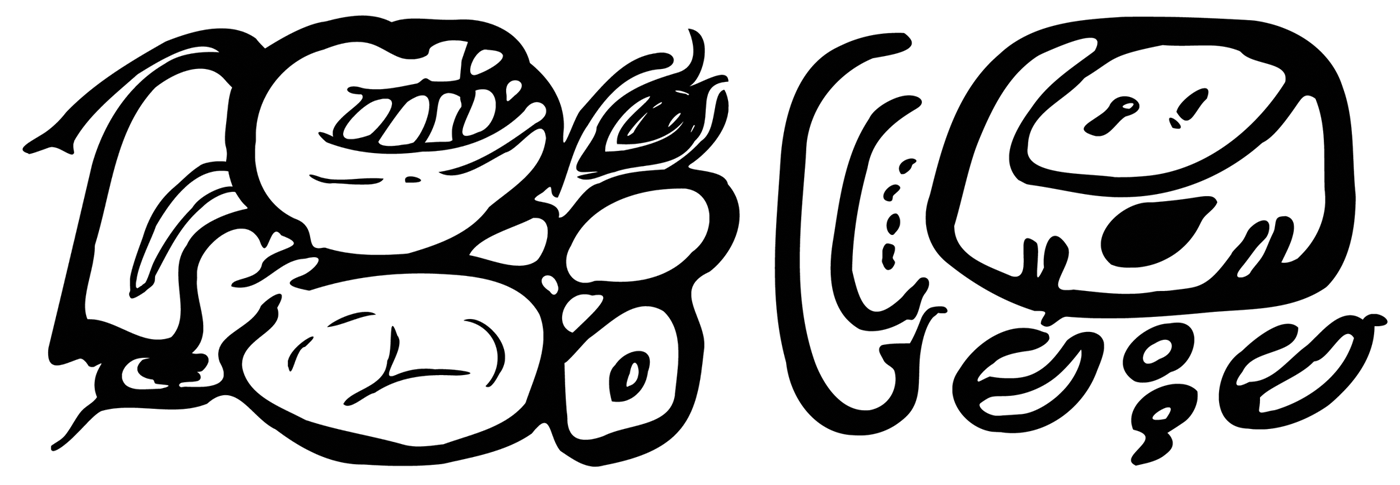
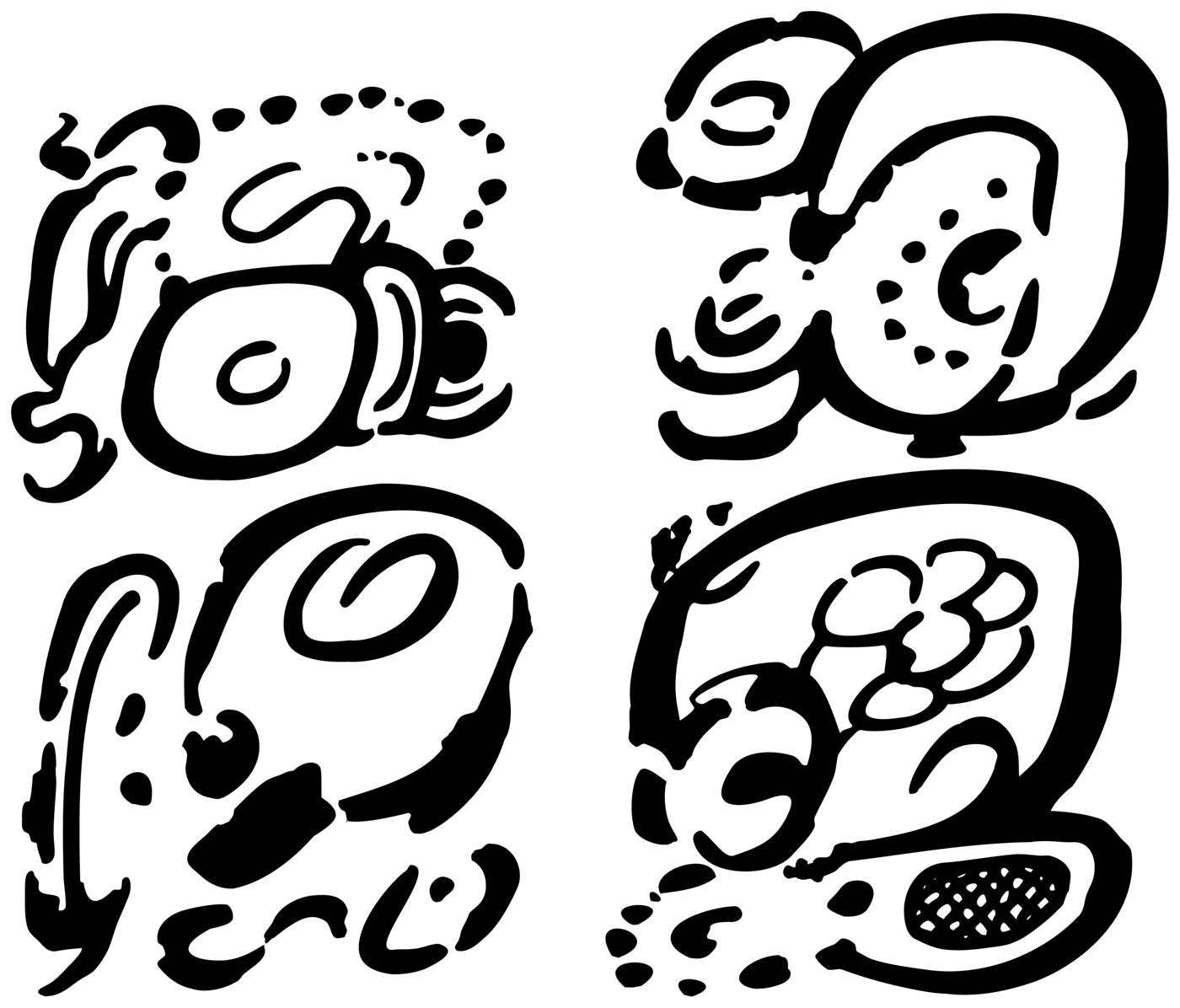
Among the vessels we analyzed in the Kislak Collection in 2010, there was a flask bearing text on the front and back panels (Figure 9). One side (Figure 10) has three signs: yo-OTOT-ti — a common hieroglyphic expression spelling y-otoot “home of” (see Boot Reference Boot2009; Houston Reference Houston and Houston1998). The opposite side bears the spelling 'u-MAY-ya for 'u-mahy or 'u-maay, meaning something like “his tobacco (powder?)” (Kaufman with Justeson Reference Kaufman and Justeson2003:1144). The ma sign in this text is slightly eroded, but other flasks such as one in the Berlin museum bear parallel statements securing this reading of the text (for example, yo-to-ti 'u-ma-ya 'a-ku MO’-'o “the home of Turtle Macaw's tobacco”; see Figure 11, cf. Coe Reference Coe1973).
May flask. Photo taken by Loughmiller-Cardinal courtesy of the Library of Congress, Kislak Collection.
Glyphic readings yo-'OTOT-ti 'u-MAY-ya. Drawing by Loughmiller-Cardinal.
Turtle Macaw's tobacco yo-to-ti 'u-ma-ya 'a-ku MO’-'o. Drawing by Loughmiller-Cardinal (after Coe Reference Coe1973).
The use of the word mahy/maay, rather than the other Maya words for tobacco, could indicate that this term may refer to tobacco consumed in some form other than a rolled cigar. Other known words, like siik’ “cigar” or k'uhtz “tobacco.” seem to be specifically associated with smoking and/or tobacco leaves. An example of the k'uhtz spelling is given in the Dresden Codex: 15A2-3. It shows tzi-k'u (although reflecting a reverse spelling order) and k'u-tzi-li collocations that refer to the plants in which the protagonists are entwined, presumably tobacco.
The calligraphic style of the text that is painted on the particular vessel discussed here is similar to the “codex” style known from the Mirador Basin around Nakbe’ and El Mirador (Forsyth Reference Forsyth, Laporte, Arroyo, Escobedo and Mejía2003). Known dates for these codex-style vessels fall between 9.12.0.0.0. and 9.16.0.0.0, or a.d. 710 ± 40 years (Reents-Budet et al. Reference Reents-Budet, Le Landais, Bishop and Blackman2010). The codex-style vessels are named for their painting style, which reflects broad similarities with the three extant codices belonging to the contact period Mayas. The rim of the vessel from the Kislak Collection is painted red, the exterior is not significantly burnished, and it remains quite porous despite its slip-paint decoration it. The interior was highly porous, rough, unslipped, and was not kiln fired (there is presently little evidence to indicate the Mayas used kilns in the Classic period).
The dry residue samples were extracted from the interior of this flask in the controlled environment of the dry labs at the Conservation Department of the Library of Congress. The extraction method included scraping off and discarding the immediate surface of the targeted sample area. The interior of the vessel had not been modified since deposition. The extracted residue sample was found embedded in a crevice that had been protected by a small, rough protrusion of clay from the interior body of the vessel.
The collected residue samples were ground, and the organic components extracted using a methanol-methylene chloride mixture and then water. The combined organic and aqueous solutions were separated from the residue, filtered, and concentrated before being analyzed by gas-chromatography mass spectrometry (GCMS) and liquid-chromatography mass spectrometry (LCMS) methods. Both methods produced signals corresponding to nicotine. This identification was confirmed by mass measurements, unique mass spectral dissociation, and comparison of the chromatographic and mass spectral characteristics with a nicotine standard. The nightshade family is the only known significant source of nicotine. Nicotine is found in high concentrations in the leaves of the tobacco plant. There is no ethnographic or archaeological evidence that other vegetable members of the nightshade family were selected for their nicotine content. LCMS analysis also revealed the presence of two common oxidation products of nicotine—nicotine-N-oxide and nicotine-N’-oxide. Since no products or compounds that result from thermal treatment were found, we consider the contents to have been a fresh or dried tobacco product (Zagorevski and Loughmiller-Newman Reference Zargorevski and Loughmiller-Newman2012).
Mass spectrometry has become an important and highly useful way of evaluating archaeological materials. The application of GCMS and LCMS analytical methods to identify alkaloids such as theobromine, theophylline, caffeine (biomarkers of chocolate; Anderson Reference Anderson1986; Hurst et al. Reference Hurst, Martin, Tarka and Hall1989, Reference Hurst, Tarka, Powis, Valdez and Hester2002; Popl et al. Reference Popl, Fähnrich and Tatar1990; Torres et al. Reference Torres, Schultes, Llagostera and McKenna1991; Trivedi Reference Trivedi2002), and nicotine (Rafferty Reference Rafferty2001, Reference Rafferty2002) has been well established in fields of chemical and biochemical research and more recently in archaeology. Although preservation remains our largest hurdle, the long-term viability of certain alkaloids is now confirmed by recent studies (Powis et al. Reference Powis, Hurst, Rodríguez, Ortíz C., Blake, Cheetham, Coe and Hodgson2008).
CONCLUSION AND SYNTHESIS
The Maya flasks are a unique class of vessel used as storage containers for dried, semi-desiccated, or powdered contents. These flasks variously contained food ingredients, intoxicants, pigments, incense, or other substances intended either for practical consumption or for ritual use in small, likely measured amounts. Their widespread gourd counterparts (Groark Reference Groark2010; Thompson Reference Thompson1970) suggest that flasks were perhaps among the first pottery containers regularly employed in Mesoamerica.
Although Classic Maya artwork indicates that flasks were worn by elites during ritual occasions, it does not indicate that they were among the exclusive “feasting” or ceremonial vessels used by them. Furthermore, since flasks are often discovered in burial contexts, we are extremely limited on what interpretations of their use-life we can make. We can point out that termination of a flask with the interment of the owner is common. This fact speaks to individual ownership of flasks as well as to its importance as a burial good. As a votive offering, it is removed from living use by the interment.
As a burial good, it is included with its owner as an accoutrement for the afterlife. An argument can be made that the flasks served a dual purpose—a purpose for its use in life, and a transformed purpose for its use in death. The flasks are most commonly found packed with red pigment, and occasionally they are found in burial contexts that are covered with red pigment similar to the pigments found within the interred flask. This, together with the fact that bodies decorated with red pigment are depicted in Classic Maya artwork, suggests that the flasks had a burial function different from their living function. It further suggests that its function was distinct from that of other goods. Prior to interment, it appears that the flasks held a substance consumable by humans. As burial goods, however, they held substances not ingestible or consumable by humans but perhaps consumable by beings of spirit (i.e., by the dead or by the gods). McNeil points out that in the Margarita tomb of Copan, foodstuffs were discovered mixed with red pigment rendering them inedible by humans (Reference McNeil, Staller and Carrasco2010:304).
The actual use of any flask, however, cannot be understood solely by interpretation of either decoration or label or by physical analysis and empirical data. Significant interpretation for these vessels must incorporate, and reconcile, both. We have provided a broad discussion of flask vessels and their potential uses. Additionally, we have presented findings from a tobacco flask in the Kislak Collection that provide clear and direct empirical evidence of tobacco storage in a labeled Late Classic period codex-style flask. Although we make no general claims concerning the uses of all Maya flasks, these results contribute to our understanding of at least one of the functions of this class of elite Maya vessels.
This study also illustrates the application of a robust type of laboratory procedure that can be used to identify specific vessel contents empirically, and which can offer a better understanding of the range of uses for these flasks and other vessels. The identification of nicotine by this procedure will help to reconstruct the history of tobacco consumed by ancient Americans. The methods presented in this article also add to the growing list of successful applications of analytical chemistry to archaeology. The correspondence between the hieroglyphic label and the chemical results suggests that further studies should be pursued on similarly labeled vessels for residue remains in order to inform and confirm their correct interpretations empirically.
The findings of this study provide unequivocal evidence for agreement between a vessel's actual content and a specific iconographic or hieroglyphic representation of that content on the same vessel. Hall et al. (Reference Hall, Tarka, Hurst, Stuart and Adams1990) established the only prior example of such a correspondence two decades ago for cacao, and since then cacao residues have been found in a large number of vessels. Despite these examples, subsequent studies have not found vessels with cacao residues bearing corresponding hieroglyphic texts referring to cacao, nor have such residues been found in vessels of the same form class as that initial find.
The Kislak Collection's tobacco flask discussed here involves a different type of text. This flask specifically refers to the vessel as a container “home of” rather than “home for” tobacco powder. It involves a different vessel type than those analyzed for previous cacao-focused studies, and this particular vessel form appears to be in some way functionally related to its different content (i.e., tobacco). Most of the suspected contents proposed for the flasks, including tobacco and pigments, could be dried and/or processed into powder. There is now evidence that such powders may well have been stored in flasks. Powdered pigments and incense, though inedible, have also been found stored in such vessels. Therefore, it is possible that the designation y-otoot and the vessel form replicating a house designate containers that were made specifically to hold dried or powered substances.
A more comprehensive program of residue analysis of Maya vessels, with and without texts relating to possible contents, has to be undertaken if we are to understand the cultural meanings of the uses of the vessels and of the texts that some of them carry. Until that time, we have suggested methods applicable to unraveling the rather complex use and function of any class of Maya vessel. We encourage a broader evaluation of the art and iconography for the presence of these vessels, and greater attention to the archaeological contexts where they are recovered. The potential importance of flasks and their contents to Maya ritual behavior has only begun to be understood (Carlson Reference Carlson2007a, Reference Carlson and Dunkelman2007b; Borhegyi Reference Borhegyi2012; Eppich Reference Eppich2011; Houston et al. Reference Houston, Stuart and Taube2006).
RESUMEN
Entre las vasijas mayas clásicas especializadas del periodo clásico (550–900 d.c.) se encuentran contenedores con forma de botella conocidos como frascos. Las interpretaciones actuales de sus usos, como botellas para veneno o medicina, son especulativas. En algunos casos, las interpretaciones son basadas en comparaciones analógicas y similitudes formales con otros contenedores nativos americanos. Este documento presenta investigación sobre los métodos básicos de construcción de los frascos, un juego de correlaciones entre el arte y artefactos del periodo clásico, sus usos de mediación social (correlaciones de materiales) y un reporte de sus contenidos específicos. También proveemos evidencias del primer descubrimiento de nicotina en una vasija maya antigua, la cual es la primera prueba científica de la presencia de tabaco contenido en una vasija de uso y tradición cultural. Los frascos estilo códice con esta evidencia parecen contener textos donde se lee yo-‘OTOT-ti ‘u-MAY-ya, escrito y-otoot ‘u-mahy, “la casa del tabaco de él o ella”. Este es apenas en segundo caso en el cual el análisis de residuos muestra que una vasija maya guardaba el mismo contenido que es señalado por el texto jeroglífico en el exterior del frasco.
ACKNOWLEDGMENTS
The senior author expresses her appreciation to J. Scott Cardinal, John Justeson, Martin Pickands, Ignacio Cases, Eric Boot, David Stuart, Sean Rafferty, Jose Rivera, Keith Eppich, Jim Cardinal, Jean Loughmiller, and Nadia Marin Guadarrama for comments on this paper and to John Carlson, for discussion of the research during Loughmiller-Cardinal's (Newman) tenure as a Kislak Fellow. She also conveys her gratitude to the many people of the Library of Congress, Kislak Foundation, Kluge Center, the Conservation Department of the Library of Congress, and especially to Rensselaer Polytechnic Institute (RPI) who made this research possible.