





Impact statement
Argentina’s drylands cover 50.7% of the national territory and are inhabited by nearly 20% of the country’s population. This study provides clear evidence that these regions have experienced increasing aridity over the last six decades, associated with decreasing precipitation and rising atmospheric evaporative demand. The identification of climatically homogeneous regions revealed distinct linear and nonlinear hydroclimatic behaviors, indicating that aridification does not progress uniformly across space, with semiarid Patagonia standing out for particularly persistent and pronounced changes. These results are relevant for climate monitoring, land management and risk assessment in drylands. They also help anticipate pressures on water resources, soils and ecosystems near critical thresholds by improving understanding of regional changes in temperature, precipitation and aridity. Beyond the case of Argentina, the study contributes to the global understanding of how drylands respond to climate variability and change, offering insights applicable to other drylands worldwide. Overall, by highlighting the importance of both linear and nonlinear climate trends, this work supports more realistic assessments of future risks associated with aridification and desertification under ongoing climate change.
Introduction
Drylands are fragile environments, characterized by sparse vegetation cover, low soil fertility and insufficient precipitation to meet the atmospheric evaporative demand (Nicholson, Reference Nicholson2011; Yao et al., Reference Yao, Liu, Huang, Gao, Wang, Li, Yu and Chen2020). These conditions make them particularly vulnerable to climate change, so that even small changes in temperature or precipitation significantly affect the limited water availability (Berdugo et al., Reference Berdugo, Delgado-Baquerizo, Soliveres, Hernandez-Clemente, Zhao, Gaitan, Gross, Saiz, Maire, Lehmann, Rillig, Solé and Maestre2020; Zhang et al., Reference Zhang, Yang, Yang and Wu2021), forcing both natural and human systems to adapt to seasonal or permanent water deficits (He et al., Reference Wang, Guo and Wu2019).
Drylands contribute to the regulation of the global climate through carbon sequestration and storage, and provide essential ecosystem services to diverse populations (Daramola and Xu, Reference Daramola and Xu2022; Lu et al., Reference Lu, Yu, Zhang, Lu, Fu, Fu and Stafford-Smith2024; Wang et al., Reference Wang, Wang and Cui2024). However, these ecosystems are highly sensitive to hydroclimatic variability. One of the main challenges is aridification, defined as the progressive increase in aridity over time (Overpeck and Udall, Reference Overpeck and Udall2020). Although water scarcity is characteristic of drylands, intensified aridity can reduce water availability and accessibility (Bass et al., Reference Bass, Goldenson, Rahimi and Hall2023; Ketchum et al., Reference Ketchum, Hoylman, Huntington, Brinkerhoff and Jencso2023; Li et al., Reference Li, Yang, Ma, Wu, Duan, Li and Zheng2024). This, in turn, promotes other adverse phenomena such as desertification, in which drylands are partially or completely degraded in a systematic manner due to climatic variability and human activities (United Nations Convention to Combat Desertification [UNCCD], 1996), limiting the adaptive capacity of strategic sectors such as agriculture (Moral et al., Reference Moral, Rebollo, Paniagua, García-Martín and Honorio2016; Li et al., Reference Li, Yang, Wu, Feng, Ljungqvist, Che, Zhang, Yang, Guan, Huang, Xiao and Miao2025). Therefore, it is essential to conduct research that identifies hydroclimatic trends in drylands to assess aridification processes and support strategies aimed at combating desertification and promoting sustainable management of these lands.
In recent decades, several studies based on atmospheric aridification have shown that drylands worldwide have undergone continuous and accelerated expansion (Cherlet et al., Reference Cherlet, Hutchinson, Reynolds, Hill, Sommer and Von Maltitz2018), particularly in regions such as the southwestern United States, the Mediterranean basin, the African Sahel, southeastern Australia, large areas of China and Mongolia, northeastern Brazil and the Argentine Patagonia (Prăvălie et al., Reference Prăvălie, Bandoc, Patriche and Sternberg2019; Chai et al., Reference Chai, Mao, Chen, Wang, Shi, Jin, Zhao, Hoffman, Ricciuto and Wullschleger2021; Ullah et al., Reference Ullah, You, Sachindra, Nowosad, Ullah, Bhatti, Jin and Ali2022; Luo et al., Reference Luo, Hu, Dai, Hou, Di, Liang, Cao and Zeng2023). According to these studies, the increase in aridity has been driven by higher evapotranspiration, consistent with global warming and by changes in precipitation patterns (Park et al., Reference Park, Jeong, Joshi, Osborn, Ho, Piao, Chen, Liu, Yang, Park, Kim and Feng2018; Greve et al., Reference Greve, Roderick, Ukkola and Wada2019; Overpeck and Udall, Reference Overpeck and Udall2020; Chen et al., Reference Chen, Li, Li, Huang, Liu and Feng2022; Yang et al., Reference Yang, Zhao, Li and Yang2024). However, from an ecohydrological perspective, it has been proposed that global drylands may be decreasing because of global greening, mainly linked to increased precipitation and the expansion of croplands in certain regions (He et al., Reference Wang, Guo and Wu2019; Berg and McColl, Reference Berg and McColl2021; Chen et al., Reference Chen, Wang, Cescatti and Forzieri2023; Tripathi et al., Reference Tripathi, Mahto, Kushwaha, Kumar, Tiwari, Sahu, Jain and Mohapatra2024). These differences create inconsistencies in the estimation of global and regional trends in dryland areas, representing a topic that remains debated. In this study, an approach focused on atmospheric aridification as a driver of dryland expansion was adopted, without disregarding the importance of the ecohydrological perspective.
Several studies have analyzed trends in key climatic variables for the water balance, such as temperature and precipitation, and have reported concerning results for drylands. For instance, Kimura and Moriyama (Reference Kimura and Moriyama2024) noted that global drylands became drier between 2000 and 2020, affecting more than 50% of grasslands, shrublands and savannas. Li et al. (Reference Li, Chen and Li2019) showed that although rapid warming since the 1980s has been an important factor in the recent trend toward global drought, aridity changes in the drylands of America and Africa are mainly due to the natural variability of precipitation. Daramola and Xu (Reference Daramola and Xu2022) found that temperature increased significantly in most drylands, while precipitation exhibited spatial variations over the last decades. However, even where precipitation has increased, the continuous warming of drylands could sustain soil moisture loss, as rising temperatures exacerbate moisture depletion, which in turn could trigger changes in the climate of these regions through feedback processes.
In Argentina, although drylands cover more than half of the territory and concentrate nearly 22% of the national population (Torres et al., Reference Torres, Abraham, Rubio, Barbero‐Sierra and Ruiz-Pérez2015), their hydroclimatic conditions have been little explored. Regional studies have shown that these lands have expanded due to significant aridification (Blanco and Doyle, Reference Blanco and Doyle2024). For example, in northern Patagonia, drier trends have been recorded over the past decades, with a decrease in precipitation of nearly 20% and an abrupt shift between 2006 and 2008, affecting the dynamics of river streamflows in the region (Hurtado et al., Reference Hurtado, Calianno, Adduca and Easdale2023). Furthermore, in Patagonian dryland basins, hydroclimatic trends have shown complex and nonlinear behavior, linked to teleconnection patterns such as El Niño-Southern Oscillation and the Southern Annular Mode (Ricetti et al., Reference Ricetti, Hurtado and Agosta2025). In this context, Blanco and Doyle (Reference Blanco and Doyle2025a, Reference Blanco and Doyle2025b) demonstrated that the positive phase of the South Atlantic Ocean Dipole and the negative phase of the Pacific Decadal Oscillation favor greater aridity, lower precipitation and higher PET, driving the expansion of drylands eastward in central Argentina. Despite these advances, no studies have yet analyzed the long-term changes of hydroclimatic variables in Argentine drylands, such as precipitation or potential evapotranspiration. Therefore, the aim of this study is to analyze the trends in hydroclimatic conditions of Argentina’s drylands over the period 1961–2020.
Data and methods
Data and study region
Monthly near-surface air temperature (TEMP) and total precipitation (PRE) data for the 1961–2020 period were obtained from version 4.06 of the Climatic Research Unit (CRU) dataset (Harris et al., Reference Harris, Osborn, Jones and Lister2020). This product is derived from the interpolation of observations from a global network that covers all continental regions except Antarctica and provides a complete monthly time series. Although CRU data are provided on a relatively high-resolution grid (0.5° × 0.5°), a simple bilinear interpolation was applied to resample the dataset to a finer resolution (0.16° × 0.16°) to improve the spatial representation of the analyzed climatic variables, particularly in coastal areas and along the boundaries of the study region. When sub-setting the original CRU grid to the Argentine domain, some marginal and coastal cells were not optimally represented. Resampling allowed for a more accurate delineation of spatial patterns without modifying the original data values. This interpolation method has been widely used in downscaling studies and in the evaluation of global climate models, showing better performance than other interpolation methods and enabling a more detailed spatial analysis of regional climate variability (Zazulie et al., Reference Zazulie, Rusticucci and Raga2017; Peng et al., Reference Peng, Ding, Liu and Li2019; Rivera and Arnould, Reference Rivera and Arnould2020). In addition, TEMP was used to estimate potential evapotranspiration (PET) using the Thornthwaite method (Thornthwaite, Reference Thornthwaite1948), a practical and widely used procedure that represents the thermal energy available to sustain evaporation and transpiration (Proutsos et al., Reference Proutsos, Tsiros, Nastos and Tsaousidis2021).
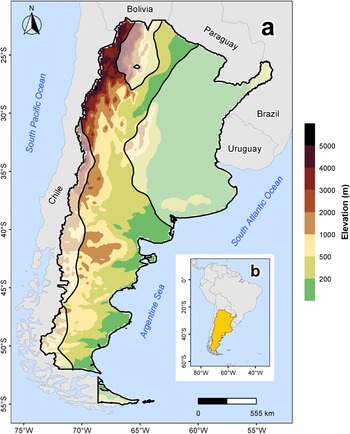
The study area corresponds to continental Argentina (Figure 1a), located at the southern end of South America (Figure 1b), where climate is shaped by three major topographic units (Pereyra, Reference Pereyra, Rubio, Lavado and Pereyra2019): the Andes Mountain Range, an extensive system with pronounced altitudinal contrasts in the western sector; the Chaco-Pampean Plains, a broad low-elevation surface with gently undulating relief in the eastern sector; and the Patagonian Plateau, a series of plateaus and basins with elevations between 200 and 1,500 meters south of 40°S.
(a) Topography of continental Argentina. Unshaded areas indicate drylands, while areas shaded in white represent humid lands. (b) Location of continental Argentina within South America.

Aridity Index and delineation of drylands
Annual values of total precipitation (PRE, mm) and potential evapotranspiration (PET, mm) were derived from their monthly data, and the annual Aridity Index (AI) proposed by the United Nations Environment Programme (UNEP, Reference Middleton and Thomas1997) was then calculated following Equation 1. This dimensionless index expresses the relationship between the water supplied to the land surface and the maximum potential water loss to the atmosphere. Thus, it is widely used to characterize water-deficit conditions and to delineate the average extent of drylands at the global scale (Huang et al., Reference Huang, Ji, Xie, Wang, He and Ran2016; Ullah et al., Reference Ullah, You, Sachindra, Nowosad, Ullah, Bhatti, Jin and Ali2022; Luo et al., Reference Luo, Hu, Dai, Hou, Di, Liang, Cao and Zeng2023).
 $$ AI=\frac{PRE}{PET} $$
Based on AI values, six climate types are identified. Hyperarid climates (0–0.05) and arid climates (0.05–0.2) exhibit very low PRE that does not satisfy atmospheric demand. In semiarid (0.2–0.5) and dry subhumid climates (0.5–0.65), water deficits persist but with lower intensity. Wet subhumid climates (0.65–1) and humid climates (>1) have water available during most or all of the year. According to the UNCCD (2022), drylands are delineated using AI isolines of 0.05 and 0.65, and encompass arid, semiarid and dry subhumid climates, excluding hyperarid and polar regions.
According to Blanco and Doyle (Reference Blanco and Doyle2025a), using the same CRU dataset employed in the present study, drylands in Argentina cover 50.7% of the national territory. These drylands extend from the northwestern Andes to the southernmost part of Patagonia and the Atlantic coast, as well as along a narrow band located between 23°–27°S and 60°–65°W (Figure 1a). Within this framework, semiarid conditions dominate (29.7% of the territory), whereas arid and dry subhumid climates are found in marginal areas adjacent to the semiarid region and represent smaller proportions (8.9% and 12.1%, respectively).
Regionalization
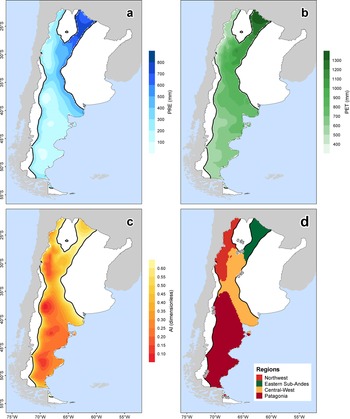
Climatically homogeneous regions within the drylands of Argentina were identified using the unsupervised k-means classification method (Hartigan and Wong, Reference Hartigan and Wong1979). This method was applied to the long-term annual mean fields (1961–2020) of PRE, PET and AI (Figure 2a–c) rather than using annual time series, incorporating topography as a complementary variable to refine regional boundaries.
Annual mean fields of (a) precipitation (PRE), (b) potential evapotranspiration (PET) and (c) Aridity Index (AI) for the drylands of Argentina over 1961–2020. Panel (d) shows the regionalization of Argentina’s drylands based on these annual mean climatic fields. In addition, it indicates the upper boundary of the drylands (AI isoline of 0.65).

The variables analyzed exhibit well-defined spatial gradients, with relatively higher values in the eastern sector and lower values toward Patagonia and the northwestern part of the study area. PRE (Figure 2a) decreases progressively toward Patagonia and the northwest, whereas PET (Figure 2b) shows maxima in the eastern Sub-Andean ranges and minima in the southernmost areas. The combination of these fields defines the spatial structure of AI (Figure 2c), with relatively higher values along the eastern boundary and lower values in central-western sectors and Patagonia, where localized or concentric patterns are identified. In these regions, such spatial features may be associated with the low density of meteorological stations, which can influence the structure of interpolated mean fields (Bettolli et al., Reference Bettolli, Rivera and Penalba2010; Oruezabal et al., Reference Oruezabal, Martin and Castañeda2023). However, interpolated data from the CRU monthly dataset for TEMP and PRE show good agreement with available observations in these areas, with smaller biases compared to other datasets, both in the northwestern drylands and in Patagonia (Bianchi et al., Reference Bianchi, Villalba, Viale, Couvreux and Marticorena2016; Almonacid et al., Reference Almonacid, Pessacg, Diaz, Bonfili and Peri2021, Reference Almonacid, Pessacg, Diaz, Bonfili and Peri2022).
Hydroclimatic variables were standardized and integrated into a single set of spatial observations, where each grid point was treated as an independent observation defined by a vector of climatic attributes. In this context, the k-means algorithm partitioned the observations into a representative number (k) of nonhierarchical clusters, minimizing within-cluster variability and maximizing differences between groups (Bettolli et al., Reference Bettolli, Rivera and Penalba2010; Almonacid et al., Reference Almonacid, Pessacg, Díaz and Peri2023). Each spatial point was assigned to the nearest centroid in the multidimensional space defined by the considered variables (Abbas, Reference Abbas2008; Pike and Lintner, Reference Pike and Lintner2020). The optimal number of clusters was determined using the elbow method, evaluating the within-cluster sum of squares for k-values between 2 and 10, with stabilization at k = 4 (Cui, Reference Cui2020; D’Silva and Sharma, Reference D’Silva and Sharma2020; Deka and Saha, Reference Deka and Saha2023; Permadi et al., Reference Permadi, Tahalea and Agusdin2023). The algorithm was executed with random initialization, a maximum of 1,000 iterations and a fixed seed, ensuring reproducibility of the results (Carvalho et al., Reference Carvalho, Melo-Gonçalves, Teixeira and Rocha2016). The centroids showed consistent convergence, and all grid points were assigned to their corresponding clusters.
According to hydroclimatic conditions, four regions can be distinguished within Argentina’s drylands (Figure 2d). First, the Eastern Sub-Andean region (22–30°S and 60–65°W) is distinguished by its low average elevation (206 m) and its dry subhumid climate (AI = 0.57), exhibiting the highest values of PRE (693 mm) and PET (1217 mm). Second, the Central-West region shows the second lowest average elevation (484 m) and a semiarid climate (AI = 0.46), with moderate values of PRE (396 mm) and PET (867 mm), all lower than those of the Eastern Sub-Andean region. Third, the Patagonia region (35–54°S and 64–72°W), with an average elevation of 544 m, ranks third PET (653 mm), but has the lowest PRE among the four regions (175 mm), reflected in a semiarid climate (AI = 0.27). Finally, the Northwest region (22–34°S and 66–70°W) has the highest average elevation (3021 m) and is characterized by the lowest values of PET (609 mm), as well as relatively low PRE (221 mm), resulting in a semiarid climate (AI = 0.39). Although Central-West, Patagonia and Northwest are classified as semiarid according to AI, they exhibit distinct climatic and geographic characteristics. Central-West presents higher mean PET and PRE than Patagonia and Northwest, while Northwest is located at lower latitude and higher elevation compared to the other regions.
Statistical analysis of trends
To analyze trends in hydroclimatic variables (PRE, PET and AI) across Argentina’s drylands, different statistical methods were applied both at the grid-point scale within the dryland areas and to the spatially averaged time series for each region identified within these lands. First, linear trends were estimated using simple linear regression, which provided the regression slope (β), whose magnitude represents the annual rate of change – or the decadal rate when multiplied by 10. A positive (negative) β indicates an increase (decrease) in the variable. To enable comparison among variables with different units, the relative rate of change of β with respect to the climatic mean (B) was calculated as defined in Equation 2:
 $$ B=\frac{\beta }{\overline{X}}\times 100 $$
where β is the slope of the linear regression line and X̄ is the climatic mean of the variable for the 1961–2020 period. The statistical significance of β was assessed using the Student’s t-test at the 90% confidence level.
Second, nonlinear trends were estimated using third-order polynomial regression. This polynomial, unlike a second-order one, can adequately represent the curvature and phase changes associated with low-frequency variability within the analyzed period, providing sufficient flexibility to capture multidecadal fluctuations while limiting overfitting. The selection of a third-order polynomial should not be interpreted as universally optimal for a specific time span (e.g., 60 years), but rather as a context-dependent statistical approximation whose behavior may vary if the study period is extended or shortened. It is important to note that this approach provides a statistical representation of low-frequency variability and does not imply the existence of deterministic oscillatory mechanisms. The performance of the polynomial model was evaluated through the adjusted coefficient of determination (adj-R 2), which indicates the proportion of variability explained by the model while penalizing the inclusion of unnecessary parameters. Values near 1 denote a satisfactory fit, whereas near 0 or negative values show that the nonlinear model does not adequately represent the variability of the series. The overall significance of the polynomial model was evaluated using Fisher’s F test at the 90% confidence level.
Finally, maps of B and adj-R 2 were generated for the study area and for each hydroclimatic variable. Statistical significance was also included for each case. It is worth noting that changing the confidence level from 90% to 95% does not lead to substantial changes in the maps of the analyzed variables. In addition, spatially averaged time series were constructed for the dryland regions of Argentina, and their linear (simple regression) and nonlinear (third-order polynomial regression) trends were estimated.
Results
Spatial distribution of hydroclimatic trends in drylands of Argentina
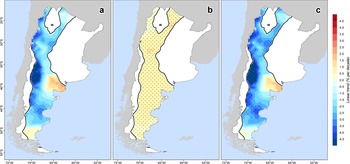
The linear trends of PRE and PET in the drylands of Argentina during the period 1961–2020 exhibit well-defined contrasts in both the sign and magnitude of their trends (Figure 3a,b). While PET shows a low to moderately significant and spatially widespread increase, PRE displays a more heterogeneous and higher-intensity pattern, with extensive areas dominated by negative trends and localized sectors with positive trends, such as in the southwestern Pampas Plains (around 40°S and 65°W) and the southern tip of Patagonia. In turn, AI reproduces the main spatial patterns of the linear trend observed in PRE (Figure 3c). In some regions, such as the central-western sector of the drylands, the decrease in PRE is more pronounced than the increase in PET, and the spatial pattern of AI reflects a generalized negative trend.
Annual linear trends of (a) precipitation (PRE), (b) potential evapotranspiration (PET) and (c) Aridity Index (AI) for the drylands of Argentina over 1961–2020. Values are expressed as the percentage of the slope relative to the average of the study period. Dotted areas indicate statistically significant linear trends at the 90% confidence level, assessed using Student’s t-test.

PRE (Figure 3a) predominantly decreases across much of the drylands, especially in the west-central areas between 34° and 40°S around 69°W, where significant decreases reach around −4% per decade, while some areas, such as in the southwestern Pampas Plains (around 40°S and 65°W) and in the central Patagonia around 45°S, show nonsignificant increases of 0–2.5% per decade. PET (Figure 3b) shows significant increases across the drylands of Argentina (ranging from 0 to 1.5% per decade), and with the largest increases concentrated in the eastern Sub-Andean Ranges in the central-northern sector of the country. Finally, annual AI (Figure 3c) closely follows the spatial pattern of PRE, although areas with positive trends decrease in extent and exhibit lower magnitudes.
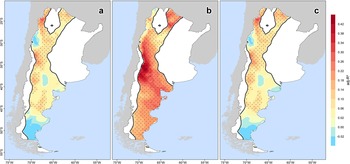
The spatial distribution of the adjusted coefficient of determination (adj-R 2) of the third-order polynomial model for PRE and PET exhibits contrasting patterns in the drylands of Argentina (Figure 4a,b). PRE shows a more heterogeneous spatial pattern, with regions displaying moderate and significant positive values in the central-western and northwestern drylands, and areas with values close to zero or even negative in the northwest and southern Patagonia. For PET, a pattern of predominantly positive adj-R 2 values is observed, more intense and statistically significant in the central-west of the study region (around 35°S and 70°W). Regarding the spatial distribution of adj-R 2 for AI (Figure 4c), it is observed to be like that of PRE.
Adjusted coefficient of determination (adj-R 2) of the third-order polynomial trend model of (a) precipitation (PRE), (b) potential evapotranspiration (PET) and (c) Aridity Index (AI) for the drylands of Argentina over 1961–2020. Dotted areas indicate statistically significant third-order polynomial trends at the 90% confidence level, assessed using the Fisher test.

PRE (Figure 4a) presents a heterogeneous spatial pattern of adj-R 2, with some regions showing moderate values (0.10–0.26) and others close to zero or even negative. For instance, from the northwesternmost region to around 40°S and some areas of central Patagonia display significant adj-R 2, indicating that the polynomial model satisfactorily captures the variability of the series, whereas in some areas, such as the Andes around 30°S and 70°W, the central region around 40°S and the southern tip of Patagonia, negative values indicate that the polynomial model fails to adequately represent long-term variability. PET (Figure 4b) shows an adj-R 2 above 0.18 across most of the drylands, reaching over 0.38 in the central-western regions, indicating that the nonlinear model explains more than 38% of the series variability in these areas; in contrast, in the northwest over the Andes, values decrease and are not significant. Finally, the annual AI (Figure 4c) exhibits adj-R 2 patterns similar to those of PRE. In regions with relatively high and significant values (the northwesternmost region to around 40°S and some areas of central Patagonia), the polynomial model reliably captures long-term variability of the index, indicating that water availability follows significant nonlinear changes that do not necessarily correspond to a linear trend. Conversely, in areas with adj-R 2 close to zero or negative (the Andes around 30°S and 70°W, the central region around 40°S and the southern tip of Patagonia), the model fails to adequately represent the temporal dynamics of the AI, so the long-term nonlinear changes in aridity are more variable, which complicates the estimation of consistent trends in water availability.
Hydroclimatic variability and trends for the different dryland regions
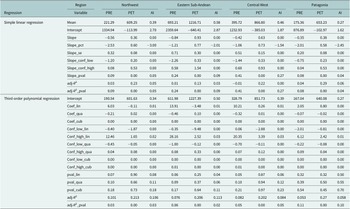
The hydroclimatic variability and trends during the 1961–2020 period were analyzed for the dryland regions of Argentina (Figure 5 and Table 1). When comparing across regions, all cases display an increase in PET, together with a decrease in PRE and AI during the period analyzed. Regarding nonlinear behavior, some notable differences are observed. On the one hand, in the Northwest, Eastern Sub-Andean and Central-West, PRE and AI increase rapidly until the late 1970s, followed by a progressive decrease until the mid-2010s and, subsequently, a rebound toward the end of the study period. On the other hand, in Patagonia, a different pattern is observed, with a slight increase until the late 1970s and a sustained decrease thereafter, with no signs of recovery. PET in the Northwest, Central-West and Patagonia show nonlinear dynamics that closely follow the linear trend, with few oscillations. In the Eastern Sub-Andean region, the variations are more pronounced, with a rapid decline until the early 1980s followed by a sustained increase through the present.
Annual time series of precipitation (PRE), potential evapotranspiration (PET) and Aridity Index (AI) for the different dryland regions of Argentina during the 1961–2020 period. The columns display the regional time series for each climatic variable, and the rows show the time series for each region. Linear trends estimated using simple regression and nonlinear trends derived from third-order polynomial regression are included.

Summary of linear and third-order polynomial regression models for precipitation (PRE), potential evapotranspiration (PET) and the Aridity Index (AI) across Argentine dryland regions (1961–2020)

Note: For the simple linear regression, the following are shown: Mean (average of the variable over the entire analyzed period), Intercept (y-intercept), Slope (slope of the line), Slope_pct (slope expressed as a percentage relative to the regional mean per decade), Slope_se (standard error of the slope), Slope_conf_low/Slope_conf_high (lower and upper limits of the 90% confidence interval for the slope), Slope_pval (p-value associated with the slope), adj-R2 (adjusted coefficient of determination of the linear model) and adj-R2_pval (p-value associated with the full linear model). For the third-order polynomial regression, the following are shown: Intercept (intercept), coef_lin (coefficient of the linear term), coef_qua (coefficient of the quadratic term), coef_cub (coefficient of the cubic term), conf_low_lin/conf_high_lin (confidence interval for the linear coefficient), conf_low_qua/conf_high_qua (confidence interval for the quadratic coefficient), conf_low_cub/conf_high_cub (confidence interval for the cubic coefficient), pval_lin/pval_qua/pval_cub (p-values for the linear, quadratic and cubic coefficients, respectively), adj-R2 (adjusted R2 of the polynomial model) and adj-R2_pval (p-value associated with the full polynomial model).
In the Northwest, PET presents a significant increase (0.6% per decade), while PRE and AI records a significant decrease (−2.53% and 3% per decade, respectively). All variables display nonlinear behavior adequately represented by third-order polynomial models: the highest and most significant adj-R 2 values correspond to PET (0.213) followed by AI (0.106) and PRE (0.101), which also show significant fits.
In the Eastern Sub-Andean region, a significant increase is observed in PET (0.77% per decade). PRE shows a nonsignificant decreasing trend (−1.21% per decade), whereas AI exhibits a statistically significant decline (−2.01% per decade). Although all variables exhibited a significant polynomial fit, the highest adj-R 2 value was observed for PET (0.206), and the lowest for AI (0.113) and PRE (0.076).
In the Central-West, significant increases are found in PET (0.73% per decade), while PRE and AI exhibit nonsignificant decreases (−1.06% and −1.54% per decade, respectively). Nonlinear patterns are more pronounced in PET, whose polynomial model reaches a significant adj-R 2 value of 0.202. In contrast, AI and PRE record lower but significant adj-R 2 values (0.084 and 0.082, respectively).
In Patagonia, positive trends are observed in PET (0.58% per decade) and negative trends in PRE and AI (−2.01% and −2.45% per decade, respectively), all statistically significant at the 90% confidence level. PET and AI exhibit robust polynomial models, with adj-R 2 values of 0.27 and 0.058, respectively. In contrast, PRE shows a nonsignificant value (0.053), suggesting that the long-term variability of this variable does not respond well to nonlinear dynamics, at least as represented by the third-order polynomial regression curve.
Discussion and conclusions
This study reveals that drylands in Argentina underwent atmospheric aridification over the period 1961–2020, characterized by a decrease in the AI driven by a widespread reduction in PRE, together with significant increases in PET. These results are consistent with previously reported aridification trends in South America during the historical period, which identify the region as one of the most vulnerable worldwide to hydroclimatic degradation and the expansion of drylands (Tomasella et al., Reference Tomasella, Vieira, Barbosa, Rodriguez, de Oliveira Santana and Sestini2018; Prăvălie et al., Reference Prăvălie, Bandoc, Patriche and Sternberg2019; Ullah et al., Reference Ullah, You, Sachindra, Nowosad, Ullah, Bhatti, Jin and Ali2022; Hurtado et al., Reference Hurtado, Calianno, Adduca and Easdale2023; Casañas et al., Reference Casañas, Cometto, Vera, Bruzzone, Easdale and Maerker2024; Tomasella et al., Reference Tomasella, Amaral Cunha, Zeri and Costa2025; Blanco and Doyle, Reference Blanco and Doyle2025a, Reference Blanco and Doyle2025b).
Hydroclimatic conditions in the Argentine drylands during the 1961–2020 period were characterized by nonlinear dynamics, with long-term oscillations superimposed on the underlying linear trend. PRE and AI show less robust polynomial fits than PET. This situation is likely related to the fact that, compared to PET, the uncertainties associated with PRE and AI are higher (ranging from 0 to 40%) when using the CRU dataset against meteorological observations (Blanco and Doyle, Reference Blanco and Doyle2025c). Taken together, our results indicate that the hydroclimatic evolution of the drylands of Argentina responds to the interaction between gradual changes and multidecadal variability. This complexity is consistent with previous studies that have documented long-term hydroclimatic variations, such as the shift from a positive to a negative trend in annual PRE in northern and central Argentina toward the mid-1980s (Minetti et al., Reference Minetti, Vargas, Poblete, Acuña and Casagrande2003; Rivera et al., Reference Rivera, Penalba and Betolli2013; Maenza et al., Reference Maenza, Agosta and Bettolli2017; Piquer-Rodríguez et al., Reference Piquer-Rodríguez, Butsic, Gärtner, Macchi, Baumann, Pizarro and Kuemmerle2018), as well as the marked decrease in PRE in Patagonia from the early twentieth century to the present (Minetti et al., Reference Minetti, Vargas, Poblete, Acuña and Casagrande2003; Brendel et al., Reference Brendel, del Barrio, Campoy, Irigoyen, Cogliati, Paez, Reyes and Serio2022; Martin et al., Reference Martin, Oruezabal, Castañeda, Mandal, Maiti, Nones and Beckedahl2022). In this regard, the results obtained highlight the need to integrate linear and nonlinear approaches for a more comprehensive characterization of the hydroclimatic evolution of drylands, given that trends may change in magnitude and sign over time.
In contrast, PET calculated using the Thornthwaite method shows polynomial fits that follow a pattern like the linear trends. Although the Thornthwaite method has recognized limitations, particularly in arid or high-elevation regions and under dry advective conditions, it provides a temperature-based climatic-scale approximation of PET that is suitable for large-scale hydroclimatic assessments (Pereira and De Camargo, Reference Pereira and De Camargo1989). In fact, the uncertainties associated with PET calculated using this method are relatively low (ranging from 0 to −20%) when comparing the CRU dataset with meteorological observations (Blanco and Doyle, Reference Blanco and Doyle2025c). However, it is noteworthy that the nonlinear dynamics of the drylands are also linked to complex processes, such as vegetation responses and their interaction with hydroclimatic changes. Vegetation does not act simply as a passive receptor; it regulates transpiration according to water availability, and its growth strongly depends on soil properties and water content (Zhang et al., Reference Zhang, Zhang, Lian, Zheng, Zhao, Zhang, Xu, Huang, Chen, Li and Piao2023; Zhu et al., Reference Zhu, Wang, Shi, Wu, Liang and Liu2025). Therefore, analyzing how vegetation-associated processes affect the sustained increase in PET could constitute a topic of interest for future research.
Four climatically homogeneous regions were identified within the drylands of Argentina. This approach made it possible to synthesize the information and to deepen the analysis of temporal patterns in hydroclimatic variables by capturing the spatial heterogeneity associated with the wide extent of these regions across the country. In all regions, a common signal of increasing PET was detected, together with a decrease in PRE and AI. However, the main regional differences were found in the nonlinear trends, with contrasts in the magnitude and persistence of the oscillations. In this regard, Patagonia stands out for its distinctive dynamics, characterized by more pronounced oscillations and a sustained decline with no clear signs of recovery, which highlights a differential hydroclimatic response within the drylands of Argentina. Overall, these results underscore the importance of analyzing both linear and nonlinear trends in hydroclimatic variables at the regional scale, as they may be associated with the influence of different teleconnection modes. For example, our results for Patagonia can be linked to previous studies showing that a positive phase of the South Atlantic Ocean Dipole or a negative phase of the Pacific Decadal Oscillation promotes the expansion of drylands in this region (Blanco and Doyle, Reference Blanco and Doyle2025a, Reference Blanco and Doyle2025b), while a cold phase of the El Niño-Southern Oscillation and a positive trend in the Southern Annular Mode are associated with drier conditions and reduced river flows in the Patagonian drylands (Hurtado et al., Reference Hurtado, Calianno, Adduca and Easdale2023; Ricetti et al., Reference Ricetti, Hurtado and Agosta2025). This is key not only for monitoring the climate of drylands but also for understanding larger-scale processes and their potential impacts, providing relevant information for the design of adaptation and mitigation strategies in the face of changes that may alter the hydrological balance and promote desertification processes.
The results of this study indicate that trends in AI across the Argentine drylands respond directly to PRE and PET changes. The generalized decline in PRE, together with the increase in PET associated with significant warming, explains the predominance of negative AI trends. Nevertheless, the magnitude of the PRE decrease exceeds the PET increase, identifying PRE as the primary control on both the evolution and spatial patterns of AI change, while PET acts as a modulating factor that can either intensify or attenuate atmospheric aridification depending on the region. This relationship is also reflected in the spatial distribution of the adj-R 2, where AI reproduces patterns that are nearly identical to those of PRE and concentrates the nonlinear oscillations captured by the polynomial model, in contrast to PET, which exhibits a more linear and monotonic temporal structure with weak oscillatory behavior. These findings are consistent with previous studies indicating that PRE is the dominant driver of aridity changes at both global and regional scales, while PET generally plays a secondary or amplifying role (Feng and Fu, Reference Feng and Fu2013; Pan et al., Reference Pan, Wang, Liu, Li, Xue, Wei, Yu and Fu2021; Wang et al., Reference Wang, Li, Chen, Ning, Yuan and Lü2022). Taking together, our results reinforce the view that AI changes should be interpreted as the outcome of interactions between water availability and atmospheric evaporative demand, rather than as a response to a single climatic forcing.
Finally, the results have significant environmental and economic implications. The evidence indicates a sustained intensification of hydroclimatic and atmospheric stress in the drylands of Argentina, a key aspect for understanding recent changes and projecting future scenarios. Drylands play a fundamental role in climate regulation and the provision of ecosystem services, although they are highly vulnerable to climate change (Berdugo et al., Reference Berdugo, Delgado-Baquerizo, Soliveres, Hernandez-Clemente, Zhao, Gaitan, Gross, Saiz, Maire, Lehmann, Rillig, Solé and Maestre2020; Daramola and Xu, Reference Daramola and Xu2022; Wang et al., Reference Wang, Wang and Cui2024). Within this framework, the findings contribute to a better understanding of the recent evolution of drylands and open the possibility for future research to assess the impacts of these trends on sectors highly dependent on water availability, such as agriculture, industry and water and food security (Stringer et al., Reference Stringer, Mirzabaev, Benjaminsen, Harris, Jafari, Lissner, Stevens and Der Pahlen2021). Aridification associated with decreasing PRE and increasing PET may lead to reduced water availability in river basins, changes in soils and additional pressures on ecosystems that, although adapted to dry conditions, may not respond as rapidly to a sustained increase in aridity. It is crucial for future research to also consider the role of vegetation as an active component in processes that may accelerate or slow aridification and, consequently, drive changes in the extent of drylands. In this sense, the results of this study allow the identification of critical regions particularly vulnerable to climate variability and climate change, such as Patagonia, where the most intense linear and nonlinear changes may affect and be associated with other components of the system, such as soils and vegetation.
Open peer review
For open peer review materials, please visit http://doi.org/10.1017/dry.2026.10029.
Data availability statement
The gridded dataset used in this study is publicly accessible and can be obtained from the following link and corresponding source: CRU TS 4.06 – https://crudata.uea.ac.uk/cru/data/hrg/cru_ts_4.06/ (Harris et al., Reference Harris, Osborn, Jones and Lister2020). Artificial Intelligence tools were used solely for language editing; the authors take full responsibility for the content of the manuscript.
Acknowledgments
The authors express their gratitude for the comments provided by the editors and reviewers, which have been valuable in improving the quality of the research.
Author contribution
Pedro Samuel Blanco carried out the research, produced the figures and wrote the manuscript. Moira Evelina Doyle performed a critical review to ensure the intellectual rigor of the content.
Financial support
This work was supported by the National Scientific and Technical Research Council of Argentina (PIP KE2 11220210100752CO).
Competing interests
The authors declare none.


 Open access

