





1. Introduction
This paper studies the mean field limit (MFL) of the following general co-evolutionary Kuramoto network:
 \begin{align} \dot{\phi }_i =&\ \omega _i(t)+\frac{1}{N}\sum _{j=1}^NW_{ij}(t)g(\phi _j-\phi _i), \\[-32pt] \nonumber \end{align}
 \begin{align} \dot{W}_{ij} =& -\varepsilon (W_{ij}+h(\phi _j-\phi _i)), \end{align}
where $\phi _i$
is the phase of the
$\phi _i$
is the phase of the $i$
-th oscillator,
$i$
-th oscillator, $\omega _i(t)$
is the time-dependent natural frequency of the
$\omega _i(t)$
is the time-dependent natural frequency of the $i$
-th oscillator,
$i$
-th oscillator, $W_{ij}$
is the signed coupling weight of the edge between node
$W_{ij}$
is the signed coupling weight of the edge between node $i$
and node
$i$
and node $j$
,
$j$
, $g$
is the coupling function, and
$g$
is the coupling function, and $h$
the adaptation rule. We also include a parameter
$h$
the adaptation rule. We also include a parameter $\varepsilon \gt 0$
, which is often assumed to be small in applications so that the particle dynamics is much faster than the timescale of the network/graph adaptation. In addition, the feedback of the phase on the underlying graph is assumed to be local. The weight function of a given edge depends only on the edge itself as well as the phases of the two nodes associated with the edge. In particular, when
$\varepsilon \gt 0$
, which is often assumed to be small in applications so that the particle dynamics is much faster than the timescale of the network/graph adaptation. In addition, the feedback of the phase on the underlying graph is assumed to be local. The weight function of a given edge depends only on the edge itself as well as the phases of the two nodes associated with the edge. In particular, when $g$
is a trigonometric function (see Section 6), the above model was proposed to describe the dynamics of a co-evolutionary network of FitzHugh–Nagumo neurons coupled through chemical excitatory synapses equipped with plasticity [Reference Berner, Vock, Schöll and Yanchuk15, Reference Ha, Noh and Park27, Reference Newman42, Reference Strogatz45] (see also the references therein).
$g$
is a trigonometric function (see Section 6), the above model was proposed to describe the dynamics of a co-evolutionary network of FitzHugh–Nagumo neurons coupled through chemical excitatory synapses equipped with plasticity [Reference Berner, Vock, Schöll and Yanchuk15, Reference Ha, Noh and Park27, Reference Newman42, Reference Strogatz45] (see also the references therein).
1.1. Macroscopic limit of interacting particle systems
Before presenting the main result of this paper, let us first review briefly the literature on macroscopic limits of Kuramoto-type networks. One type of macroscopic limit is the so-called MFL, that is, a (weak) limit of the empirical distributions composed of Dirac measures of equal probability mass at the solutions of each node of the network, as the number of nodes of the network tends to infinity. Heuristically, the MFL captures the statistical dynamics of large networks. The pioneering works date back to as early as the 1970s, by Braun and Hepp [Reference Braun and Hepp17], by Dobrushin [Reference Dobrushin22], and by Neunzert [Reference Neunzert and Cercignani41], where the underlying coupling graph is complete, the interaction kernel is Lipschitz, and the underlying metric induces the weak topology. The techniques have led to a quite complete derivation of the MFL for the Kuramoto model for all-to-all coupling by Lancellotti [Reference Lancellotti37]. Later, MFL of Kuramoto oscillators on a sequence of dense heterogeneous (deterministic or random) graphs with and without Lipschitz continuity were studied, for example, in [Reference Chiba and Medvedev20, Reference Chiba and Medvedev21, Reference Gkogkas and Kuehn24, Reference Kaliuzhnyi-Verbovetskyi and Medvedev30–Reference Kuehn and Xu32]. Recently, results were extended to sparse graphs using different approaches [Reference Gkogkas and Kuehn24, Reference Jabin, Poyato and Soler28, Reference Kuehn31, Reference Kuehn and Xu32, Reference Lacker, Ramanan and Wu35, Reference Oliveira, Reis and Stolerman43]. So far, all the above network models are given on a static network. It is worth mentioning that the approaches in [Reference Jabin, Poyato and Soler28, Reference Lacker, Ramanan and Wu35, Reference Oliveira, Reis and Stolerman43] dealing with sparsity are more graph-theoretic, the ones in [Reference Kaliuzhnyi-Verbovetskyi and Medvedev30] are based on analysis of $\mathcal{L}^p$
-functions while restricted to graphon type graph limits, the one in [Reference Gkogkas and Kuehn24] is more operator-theoretic combined with harmonic analysis techniques, and [Reference Kuehn and Xu32] more measure-theoretic. It is noteworthy that results for graph limits of a sequence of intermediate/low density are also covered by the approaches in [Reference Gkogkas and Kuehn24, Reference Kuehn and Xu32]. The fast development of mean field theory of interacting particle system (IPS) coupled on heterogeneous networks owes much to the development of graph limits [Reference Backhausz and Szegedy8, Reference Benjamini and Schramm13, Reference Kunszenti-Kovács, Szegedy and Lovász34, Reference Lovász38]. The MFL of large networks coupled on static graphs, when they are viewed as a probability measure, is generally absolutely continuous with respect to a certain reference measure (provided the initial distribution is so) [Reference Kaliuzhnyi-Verbovetskyi and Medvedev30, Reference Neunzert and Cercignani41]. The density of the MFL is captured by the solution of a transport type PDE, the so-called Vlasov equation, cf. [Reference Gkogkas and Kuehn24, Reference Kaliuzhnyi-Verbovetskyi and Medvedev30–Reference Kuehn and Xu32, Reference Neunzert and Cercignani41].
$\mathcal{L}^p$
-functions while restricted to graphon type graph limits, the one in [Reference Gkogkas and Kuehn24] is more operator-theoretic combined with harmonic analysis techniques, and [Reference Kuehn and Xu32] more measure-theoretic. It is noteworthy that results for graph limits of a sequence of intermediate/low density are also covered by the approaches in [Reference Gkogkas and Kuehn24, Reference Kuehn and Xu32]. The fast development of mean field theory of interacting particle system (IPS) coupled on heterogeneous networks owes much to the development of graph limits [Reference Backhausz and Szegedy8, Reference Benjamini and Schramm13, Reference Kunszenti-Kovács, Szegedy and Lovász34, Reference Lovász38]. The MFL of large networks coupled on static graphs, when they are viewed as a probability measure, is generally absolutely continuous with respect to a certain reference measure (provided the initial distribution is so) [Reference Kaliuzhnyi-Verbovetskyi and Medvedev30, Reference Neunzert and Cercignani41]. The density of the MFL is captured by the solution of a transport type PDE, the so-called Vlasov equation, cf. [Reference Gkogkas and Kuehn24, Reference Kaliuzhnyi-Verbovetskyi and Medvedev30–Reference Kuehn and Xu32, Reference Neunzert and Cercignani41].
In contrast to the many aforementioned works on MFLs of IPS on statics networks, few works consider particle systems on a dynamic network/graph. In [Reference Ayi and Pouradier Duteil7], the MFL of a network model characterising the collective dynamics of moving particles with time-dependent couplings among nodes is investigated. However, these time-dependent graphs satisfy that each node has the same edge weight to all the other nodes. Hence, the graph is $N$
-dimensional rather than
$N$
-dimensional rather than $O(N^2)$
-dimensional, and hence this makes it possible to treat the time-dependent weight function as a second component of an lifted particle system parametrised by the node variable. Hence, it reduces to the MFL of an IPS on a static graph, where a classical approach suffices (cf. [Reference Kaliuzhnyi-Verbovetskyi and Medvedev30]). However, when the weights are not ‘uniform’, rigorous works are lacking. MFLs of IPS were discussed also in [Reference Burger18], where kinetic equations for large finite population size were obtained, but the MFL was not rigorously characterised. Letting the number
$O(N^2)$
-dimensional, and hence this makes it possible to treat the time-dependent weight function as a second component of an lifted particle system parametrised by the node variable. Hence, it reduces to the MFL of an IPS on a static graph, where a classical approach suffices (cf. [Reference Kaliuzhnyi-Verbovetskyi and Medvedev30]). However, when the weights are not ‘uniform’, rigorous works are lacking. MFLs of IPS were discussed also in [Reference Burger18], where kinetic equations for large finite population size were obtained, but the MFL was not rigorously characterised. Letting the number $N$
of population size tend to infinity and the small timescale
$N$
of population size tend to infinity and the small timescale $\varepsilon$
tend to zero simultaneously for sparse co-evolutionary networks using fast-slow arguments, a non-MFL result was investigated in [Reference Barré, Dobson, Ottobre and Zatorska10], where the underlying graph is assumed to be independent of the dynamics of the particle system and hence the dynamics of the particle system plus the weights of the underlying graph is decoupled. Moreover, evolution of graphon-valued stochastic processes motivated from genetics was lately investigated in [Reference Athreya, den Hollander and Röllin6]. To our best knowledge, there seems to have been rather rare rigorous work on the MFL of co-evolutionary networks, where the dynamics of the network depends on the dynamics on the network and vice versa. This paper is a first step to investigate rigorously the MFL of such networks by studying the co-evolutionary model (1.1)–(1.2).
$\varepsilon$
tend to zero simultaneously for sparse co-evolutionary networks using fast-slow arguments, a non-MFL result was investigated in [Reference Barré, Dobson, Ottobre and Zatorska10], where the underlying graph is assumed to be independent of the dynamics of the particle system and hence the dynamics of the particle system plus the weights of the underlying graph is decoupled. Moreover, evolution of graphon-valued stochastic processes motivated from genetics was lately investigated in [Reference Athreya, den Hollander and Röllin6]. To our best knowledge, there seems to have been rather rare rigorous work on the MFL of co-evolutionary networks, where the dynamics of the network depends on the dynamics on the network and vice versa. This paper is a first step to investigate rigorously the MFL of such networks by studying the co-evolutionary model (1.1)–(1.2).
Another type of macroscopic limit frequently encountered in the literature is the so-called continuum limit, defined as a ‘pointwise limit’ of the network model. Essentially, when taking each vertex of the underlying graph of the network as a location in a metric space, as the number of vertices increases to infinity, the ODE modelling the network tends to a (possibly non-local due to some potentially long-range interactions) parabolic PDE, a model with a continuum spatial structure. One uses the $\ell _{\infty }$
-norm to quantify the distance between the solution of the ODE and that of the PDE so that the error is measured pointwise by taking an essential supremum over errors of trajectories at all different locations. In contrast, the MFL is a limit in a statistical sense (from the perspective of sampling), which reflects the distribution of solutions of each node (e.g., phases of the oscillators) on the graph/network of a sufficiently large size. For a more precise and clearer description of the continuum limit, we refer the reader to, for example, a companion work [Reference Gkogkas, Kuehn and Xu25]. Continuum limits of the Kuramoto model were investigated in [Reference Medvedev40] on random sparse static networks and more recently investigated in [Reference Gkogkas, Kuehn and Xu25] on deterministic co-evolutionary networks. We mention that continuum limits of collective dynamics models with ‘uniform’ time-varying weights (e.g., the Cucker–Smale model) were also recently studied in [Reference Ayi and Pouradier Duteil7], which is restricted to the case where the approach for particle systems coupled on static networks remains valid. In contrast, such a restriction was removed in [Reference Gkogkas, Kuehn and Xu25]. We refer the reader to [Reference Ayi and Duteil1] for a more comprehensive review on the topic of MFL of non-exchangable systems.
$\ell _{\infty }$
-norm to quantify the distance between the solution of the ODE and that of the PDE so that the error is measured pointwise by taking an essential supremum over errors of trajectories at all different locations. In contrast, the MFL is a limit in a statistical sense (from the perspective of sampling), which reflects the distribution of solutions of each node (e.g., phases of the oscillators) on the graph/network of a sufficiently large size. For a more precise and clearer description of the continuum limit, we refer the reader to, for example, a companion work [Reference Gkogkas, Kuehn and Xu25]. Continuum limits of the Kuramoto model were investigated in [Reference Medvedev40] on random sparse static networks and more recently investigated in [Reference Gkogkas, Kuehn and Xu25] on deterministic co-evolutionary networks. We mention that continuum limits of collective dynamics models with ‘uniform’ time-varying weights (e.g., the Cucker–Smale model) were also recently studied in [Reference Ayi and Pouradier Duteil7], which is restricted to the case where the approach for particle systems coupled on static networks remains valid. In contrast, such a restriction was removed in [Reference Gkogkas, Kuehn and Xu25]. We refer the reader to [Reference Ayi and Duteil1] for a more comprehensive review on the topic of MFL of non-exchangable systems.
1.2. Highlights of this paper
Our approach of analytically obtaining the MFL of the Kuramoto-type model (1.1) rests on the idea that the co-evolutionary system can be decoupled (the weights of the time-dependent graph can be represented in terms of those of the initial graph as well as the added weights from the feedback of the phase state of the IPS). Therefore, we equivalently represent the Kuramoto model as an integral equation coupled on a static initial signed graph that allows both positive and negative coupling manners. Then one may be able to utilise similar techniques in establishing the MFL of an IPS on a graph limit (e.g., [Reference Gkogkas and Kuehn24, Reference Kaliuzhnyi-Verbovetskyi and Medvedev30, Reference Kuehn and Xu32]), except that the graph limit here is allowed to be a graph with signed weights. Some special care needs to be taken regarding the approximation of the signed graph measures. We prove the well-posedness and approximation of the MFL as solutions to a so-called generalised Vlasov equation.
Nevertheless, it is not obvious if the absolute continuity of the solution of the MFL still follows from that of the initial distribution, as in the classical case where the underlying graph is positive and static. Indeed, it seems challenging to obtain the absolute continuity of the MFL. A high-level heuristic conjecture is that the underlying mean field process becomes no longer Markovian due to the co-evolving nature. For this reason, even if the MFL is absolutely continuous (with respect to a reference measure, e.g., the Lebesgue measure of a Euclidean space), the corresponding PDE accounting for the density of the MFL may not be a transport-type PDE on a finite-dimensional state space, but rather on an infinite-dimensional state space of functions. Technically, the standard technique by Gronwall inequalities fails owing to the added effects coming from the co-evolutionary terms. In this context, as there are second-order non-local terms in the equation of characteristics ((3.10)), a reverse second-order Gronwall inequality would be desirable to tackle this issue, which unfortunately fails in general, as shown by a simple example (see Appendix A). A special case where the underlying graph evolves but not coevolves with the oscillators (i.e., the adaptation function $h$
is constant) was studied in an earlier version of the manuscript [Reference Gkogkas, Kuehn and Xu4], and it is shown that the absolute continuity of the MFL is preserved provided the initial distribution was absolutely continuous. We leave this general question on absolute continuity of the MFL as well as the PDE accounting for the density for our future study.
$h$
is constant) was studied in an earlier version of the manuscript [Reference Gkogkas, Kuehn and Xu4], and it is shown that the absolute continuity of the MFL is preserved provided the initial distribution was absolutely continuous. We leave this general question on absolute continuity of the MFL as well as the PDE accounting for the density for our future study.
Schematic diagram of the approach of deriving MFL.

1.3. Main results and sketch of the proof
Now, we present an informal statement of the main result of this paper.
Theorem A.
Under certain conditions, there exists a unique mean field limit of the Kuramoto-type model (1.1)–(1.2), provided the signed graph sequence $\{W_{i,j}(0)\}_{N\in \mathbb{N}}$
as well as the sequence of initial empirical measures
$\{W_{i,j}(0)\}_{N\in \mathbb{N}}$
as well as the sequence of initial empirical measures $\{\frac{1}{N}\sum _{i=1}^N\delta _{\phi _i(0)}\}_{N\in \mathbb{N}}$
converge in a suitable weak sense. More precisely, the mean field limit is a weak limit of the sequence of time-dependent empirical measures
$\{\frac{1}{N}\sum _{i=1}^N\delta _{\phi _i(0)}\}_{N\in \mathbb{N}}$
converge in a suitable weak sense. More precisely, the mean field limit is a weak limit of the sequence of time-dependent empirical measures $\{\frac{1}{N}\sum _{i=1}^N\delta _{\phi _i(t)}\}_{N\in \mathbb{N}}$
for
$\{\frac{1}{N}\sum _{i=1}^N\delta _{\phi _i(t)}\}_{N\in \mathbb{N}}$
for $t$
over a finite time interval.
$t$
over a finite time interval.
For a detailed and precise statement, see Theorem4.2 (well-posedness) and Theorem5.6 (approximation).
We are going to apply the result to investigate the MFL of an example of a binary tree Kuramoto-type networks, where the sequence of initial underlying graphs are sparse (see Section 6).
There are basically five steps to achieve the well-posedness as well as the approximation of the MFL of the co-evolutionary Kuramoto model (see Figure 1 for a flow chart on how these steps and the relevant results are linked).
Step I. Formulation of a generalised co-evolutionary Kuramoto network ((3.1)–(3.3)). We treat signed graph limits as measure-valued functions (so-called signed digraph measures, see Definition 2.4), and hence (1.1)–(1.2) can be regarded as special cases of a hybrid system ((3.1)–(3.3)) of ODEs and measure differential equations (MDEs). To do this, we introduce the derivative of a family of parameterised (by ‘time’) measures in the Banach space of all finite signed measures equipped with the total variation norm. Well-posedness of the hybrid system is then obtained (Theorem3.4), by applying the Banach contraction principle to a suitable complete metric space, in the spirit of the standard Picard–Lindelöf iteration for ODEs.
Step II. We establish an analogue of the variation of parameters formula for the MDE, in analogy to the Duhamel’s principle for PDEs in finite-dimensional state spaces [Reference John29] (Proposition 3.8). Thanks to this formula, we can decouple the dynamics of the oscillators from the dynamic graph measures and successfully reduce the hybrid system ((3.1)–(3.3)) to a one-dimensional integral equation (IE) ((3.10)) indexed by the vertex variable coupled on the prescribed initial graph measures as well as prescribed time-dependent measure-valued functions (i.e., the MFL to be determined). Such IE can be viewed as the equation of characteristics [Reference Kuehn and Xu32].
Step III. We establish continuous dependence of the solutions to the IE (Proposition 3.10) and show the existence and the Lipschitz regularity of the semiflow forward in time generated by the IE (Proposition 3.12), using a Gronwall type inequality.
Step IV. We construct a generalised Vlasov equation (VE) ((4.1)) – a fixed point equation induced by the pushforward of the semiflow generated by the IE, in the sense of Neunzert [Reference Neunzert and Cercignani41]. Then we are able to apply the Banach contraction principle again to show the unique existence of solutions to the generalised VE (Theorem4.2).
Step V. We establish the approximation by the MFL (solution to the generalised VE) of the empirical distributions generated by a sequence of ODEs like (1.1)–(1.2) (Theorem5.6). To do this, we rely on the continuous dependence of the semiflow (Propositions 4.1 and 4.4). Such an approximation result is also based on the discretisation of a given initial signed digraph measure as well as the initial distribution (i.e., the initial condition of the generalised VE), which further is a consequence with calibration (due to that the digraph measure may not be positive) of the recent results of probability measures by finitely supported discrete measures with equal mass on each point of the support (so-called uniform approximation [Reference Xu and Berger48], or deterministic empirical approximation [Reference Bencheikh and Jourdain12, Reference Chevallier19]) [Reference Bencheikh and Jourdain12, Reference Chevallier19, Reference Xu and Berger48].
1.4. Organisation of this paper
We first provide necessary preliminaries on measure theory to introduce MDEs in Section 2. Next, we propose a generalised co-evolutionary Kuramoto model and investigate its well-posedness in Section 3. We construct a generalised Vlasov equation and study the well-posedness of this equation in Section 4 and address the approximation of its solutions in Section 5. To demonstrate the applicability of the main results, we provide a simple example in Section 6. Proofs of the main results are given in Section 7. Further in-depth discussions on limitations and extensions of the results and the approach of this paper together with some outlooks including other types of evolutionary network models are provided in Section 8.
2. Preliminaries
A table of notation is provided in Appendix G for the reader to check back and forth whenever necessary through reading this paper. Let $(Y,d_Y)$
be a complete metric space. For
$(Y,d_Y)$
be a complete metric space. For $\upsilon \in \mathcal{M}(Y)$
, define the total variation norm
Footnote
1
$\upsilon \in \mathcal{M}(Y)$
, define the total variation norm
Footnote
1
 \begin{align*}\|\upsilon \|_{\textsf {TV}}\,:\!=\,\sup _{f\in \mathcal {B}_1(Y)}\int f\textrm {d}\upsilon =\upsilon ^+(Y)+\upsilon ^-(Y), \end{align*}
where $\upsilon ^+$
and
$\upsilon ^+$
and $\upsilon ^-$
are the positive and negative part of
$\upsilon ^-$
are the positive and negative part of $\upsilon$
, respectively, owing to the Hahn decomposition [Reference Bogachev16]. Recall from [Reference Bogachev16, Chapter 8] that
$\upsilon$
, respectively, owing to the Hahn decomposition [Reference Bogachev16]. Recall from [Reference Bogachev16, Chapter 8] that $\mathcal{M}(Y)$
with the total variation norm
$\mathcal{M}(Y)$
with the total variation norm $\|{\cdot} \|_{\textsf{TV}}$
is a Banach space. Let
$\|{\cdot} \|_{\textsf{TV}}$
is a Banach space. Let $d_{\textsf{TV}}$
be the metric induced by
$d_{\textsf{TV}}$
be the metric induced by $\|{\cdot} \|_{\textsf{TV}}$
. For
$\|{\cdot} \|_{\textsf{TV}}$
. For $\upsilon _1,\upsilon _2\in \mathcal{M}(Y)$
,
$\upsilon _1,\upsilon _2\in \mathcal{M}(Y)$
,
 \begin{align*}d_{\textsf {TV}}(\upsilon _1,\upsilon _2)=\|\upsilon _1-\upsilon _2\|_{\textsf {TV}}=\sup _{f\in \mathcal {B}_1(Y)}\int fd(\nu _1-\nu _2)\end{align*}
For every $\upsilon \in \mathcal{M}(Y)$
, let
$\upsilon \in \mathcal{M}(Y)$
, let
 \begin{align*}\|\upsilon \|_{{\textsf {BL}}}\,:\!=\, \sup _{f\in \mathcal {BL}_1(Y)}\int _Y f\textrm {d}\upsilon, \end{align*}
the bounded Lipschitz norm of $\upsilon$
. Let
$\upsilon$
. Let $d_{{\textsf{BL}}}$
be the bounded Lipschitz metric induced by
$d_{{\textsf{BL}}}$
be the bounded Lipschitz metric induced by $\|{\cdot} \|_{{\textsf{BL}}}$
, which admits the following supremum representation: For
$\|{\cdot} \|_{{\textsf{BL}}}$
, which admits the following supremum representation: For $\upsilon _1,\upsilon _2\in \mathcal{M}(Y)$
,
$\upsilon _1,\upsilon _2\in \mathcal{M}(Y)$
,
 \begin{align*}d_{{\textsf {BL}}}(\upsilon _1,\upsilon _2)=\sup _{f\in \mathcal {BL}_1(Y)}\int fd(\upsilon _1-\upsilon _2)\end{align*}
Note that both $\mathcal{M}_+(Y)$
and
$\mathcal{M}_+(Y)$
and $\mathcal{P}(Y)$
with the bounded Lipschitz metric are complete metric spaces [Reference Bogachev16]. Moreover, if the cardinality of
$\mathcal{P}(Y)$
with the bounded Lipschitz metric are complete metric spaces [Reference Bogachev16]. Moreover, if the cardinality of $Y$
is infinite, then the topology induced by the bounded Lipschitz norm is strictly weaker than that induced by the total variation norm, and hence by Banach’s theorem,
$Y$
is infinite, then the topology induced by the bounded Lipschitz norm is strictly weaker than that induced by the total variation norm, and hence by Banach’s theorem, $\mathcal{M}$
equipped with the bounded Lipschitz norm is not complete since the two norms are not equivalent [Reference Bogachev16]. In addition, if the complete metric space
$\mathcal{M}$
equipped with the bounded Lipschitz norm is not complete since the two norms are not equivalent [Reference Bogachev16]. In addition, if the complete metric space $Y$
is compact, then the bounded Lipschitz metric metrizes the weak topology, and convergence in
$Y$
is compact, then the bounded Lipschitz metric metrizes the weak topology, and convergence in $d_{{\textsf{BL}}}$
also ensures the convergence in all finite moments.
$d_{{\textsf{BL}}}$
also ensures the convergence in all finite moments.
The following properties of measure-valued functions from [Reference Gkogkas, Kuehn and Xu25, Reference Kuehn and Xu32] will be used to define the evolution of weights of a generalised co-evolutionary Kuramoto network in the next section (see (3.1)).
Definition 2.1.
Let $(\eta _t)_{t\in{\mathbb{R}}}\subseteq \mathcal{M}(Y)$
. Equip
$(\eta _t)_{t\in{\mathbb{R}}}\subseteq \mathcal{M}(Y)$
. Equip $\mathcal{M}(Y)$
with the strong topology induced by the total variation norm. If
$\mathcal{M}(Y)$
with the strong topology induced by the total variation norm. If
 \begin{align*}\lim _{\varepsilon \to 0}\frac {\eta _{t+\varepsilon }-\eta _{t}}{\varepsilon }\in \mathcal {M}(Y)\end{align*}
exists, then
 \begin{align*}\frac {\textrm {d}\eta _t}{\textrm {d} t}=\lim _{\varepsilon \to 0}\frac {\eta _{t+\varepsilon }-\eta _{t}}{\varepsilon }\end{align*}
is called the derivative of $\eta _t$
at
$\eta _t$
at $t$
.
$t$
.
Remark 2.2. If $f\in \mathcal{C}^1({\mathbb{R}},(0,\infty ))$
and
$f\in \mathcal{C}^1({\mathbb{R}},(0,\infty ))$
and $\xi \in \mathcal{M}(Y)$
, then
$\xi \in \mathcal{M}(Y)$
, then $\eta _t=f(t)\xi \in \mathcal{M}(Y)$
satisfies
$\eta _t=f(t)\xi \in \mathcal{M}(Y)$
satisfies
 \begin{align*} \frac{\textrm{d}\eta _t}{\textrm{d} t}=&\ \frac{f'(t)}{f(t)}\eta _t, \end{align*}
c.f. [Reference Gkogkas, Kuehn and Xu25]. Moreover, not all families of parameterised measures are differentiable (e.g., $\{\delta _t\}_{t\in{\mathbb{R}}}$
[Reference Gkogkas, Kuehn and Xu25]).
$\{\delta _t\}_{t\in{\mathbb{R}}}$
[Reference Gkogkas, Kuehn and Xu25]).
Recall the following fundamental theorem of calculus for measure-valued functions [Reference Gkogkas, Kuehn and Xu25].
Proposition 2.3.
Let $\mathcal{N}$
be a compact interval of
$\mathcal{N}$
be a compact interval of $\mathbb{R}$
containing a point
$\mathbb{R}$
containing a point $t_0\in{\mathbb{R}}$
. Assume
$t_0\in{\mathbb{R}}$
. Assume $\eta _{{\cdot} }\in \mathcal{C}(\mathcal{N},\mathcal{M}(Y))$
. Then
$\eta _{{\cdot} }\in \mathcal{C}(\mathcal{N},\mathcal{M}(Y))$
. Then $\xi _t=\int _{t_0}^t\eta _{\tau }\textrm{d}\tau \in \mathcal{M}(Y)$
, understood in the weak sense,
$\xi _t=\int _{t_0}^t\eta _{\tau }\textrm{d}\tau \in \mathcal{M}(Y)$
, understood in the weak sense,
 \begin{align*}\int _Yg\textrm {d}\xi _t=\int _{t_0}^t\left (\int _Yg\textrm {d}\eta _{\tau }\right )\textrm {d}\tau, \quad \forall g\in \mathcal {C}_{\textsf {b}}(Y),\end{align*}
is differentiable at $t$
for all
$t$
for all $t\in \mathcal{N}$
, where the derivative is understood as one-sided at the two endpoints of
$t\in \mathcal{N}$
, where the derivative is understood as one-sided at the two endpoints of $\mathcal{N}$
.
$\mathcal{N}$
.
Let $X$
be a compact set of a Euclidean space
$X$
be a compact set of a Euclidean space ${\mathbb{R}}^r$
for some
${\mathbb{R}}^r$
for some $r\in \mathbb{N}$
. Equipped with the metric induced by the
$r\in \mathbb{N}$
. Equipped with the metric induced by the $\ell _1$
of
$\ell _1$
of ${\mathbb{R}}^r$
,
${\mathbb{R}}^r$
, $X$
becomes a complete metric space. Throughout this paper,
$X$
becomes a complete metric space. Throughout this paper, $Y=X$
or
$Y=X$
or $Y={\mathbb{T}}$
.
$Y={\mathbb{T}}$
.
Definition 2.4.
A signed measure-valued function $\eta \in \mathcal{B}(X,\mathcal{M}(X))$
is called a signed digraph measure (SDGM).
$\eta \in \mathcal{B}(X,\mathcal{M}(X))$
is called a signed digraph measure (SDGM).
We remark that this definition extends the one (where the SDGM is positive and called DGM) introduced in [Reference Kuehn and Xu32].
Next, we introduce duality of sets and measures from [Reference Kuehn and Xu32], which will be used to state properties on the symmetry of digraph measures Footnote 2 (see Proposition 3.6 below).
Definition 2.5.
Given a set $A\subseteq X^2$
, the set
$A\subseteq X^2$
, the set $A^*=\{(x,y)\in X^2\,\colon (y,x)\in A\}$
is called the dual of
$A^*=\{(x,y)\in X^2\,\colon (y,x)\in A\}$
is called the dual of $A$
.
$A$
.
Definition 2.6.
Given a measure $\eta \in \mathcal{M}(X^2)$
, the measure
$\eta \in \mathcal{M}(X^2)$
, the measure $\eta ^*$
defined by
$\eta ^*$
defined by
 \begin{align*}\eta ^*(A)=\eta (A^*),\quad \forall A\in \mathfrak {B}(X^2),\end{align*}
is called the dual of $\eta$
.
$\eta$
.
Definition 2.7.
A measure $\eta \in \mathcal{M}(X^2)$
is symmetric if
$\eta \in \mathcal{M}(X^2)$
is symmetric if $\eta ^*=\eta$
.
$\eta ^*=\eta$
.
Definition 2.8.
An SDGM is symmetric if, viewed as a signed measure
Footnote
3
on $\mathcal{M}(X^2)$
, it is a symmetric measure.
$\mathcal{M}(X^2)$
, it is a symmetric measure.
We remark that SDGM is a natural way to embed a graph into a dynamical network [Reference Bayraktar, Chakraborty and Wu11, Reference Kuehn and Xu32, Reference Kuehn and Xu33, Reference Lacker and Soret36]. This is because the dynamical network is indexed by the node variable. Since the graph is directed, the weights of adjacent outward edges from a node $i$
is associated with a vector with entries being weights
$i$
is associated with a vector with entries being weights $(a_{ij})_{1\le j\le N}$
, and such vectors can be naturally treated as a fibre measure [Reference Backhausz and Szegedy8]. For this reason, we introduce SDGM (see also [Reference Kuehn and Xu32]). Here,
$(a_{ij})_{1\le j\le N}$
, and such vectors can be naturally treated as a fibre measure [Reference Backhausz and Szegedy8]. For this reason, we introduce SDGM (see also [Reference Kuehn and Xu32]). Here, $X$
stands for the space of vertices, and we choose
$X$
stands for the space of vertices, and we choose $X$
to be abstract rather than the commonly used unit interval
$X$
to be abstract rather than the commonly used unit interval $[0,1]$
since in some cases due to the geometric feature of the underlying signed graphs, the space of vertices should be chosen different from
$[0,1]$
since in some cases due to the geometric feature of the underlying signed graphs, the space of vertices should be chosen different from $[0,1]$
. For instance, if the signed graphs are rings, then the space
$[0,1]$
. For instance, if the signed graphs are rings, then the space $X$
is naturally chosen to be
$X$
is naturally chosen to be $\mathbb{T}$
to encode the cyclic nature. For more diverse interesting graph limits with different density captured by different
$\mathbb{T}$
to encode the cyclic nature. For more diverse interesting graph limits with different density captured by different $X$
, the reader is referred to [Reference Kuehn and Xu32, Section 2 and Section 4].
$X$
, the reader is referred to [Reference Kuehn and Xu32, Section 2 and Section 4].
For any $\eta, \xi \in \mathcal{B}(X,\mathcal{M}(Y))$
, let
$\eta, \xi \in \mathcal{B}(X,\mathcal{M}(Y))$
, let
 \begin{align*}\|\eta \|=\sup _{x\in X}\|\eta ^x\|_{\textsf {TV}}, \\[-32pt] \end{align*}
 \begin{align*}d_{\infty, \textsf {TV}}(\eta, \xi )\,:\!=\,\sup _{x\in X}d_{\textsf {TV}}(\eta ^x,\xi ^x)\end{align*}
The other metric $d_{\infty, {\textsf{BL}}}$
for space
$d_{\infty, {\textsf{BL}}}$
for space $\mathcal{B}(X,\mathcal{M}(Y))$
is defined analogously.
$\mathcal{B}(X,\mathcal{M}(Y))$
is defined analogously.
Let $\mathcal{N}\subseteq{\mathbb{R}}$
be a non-empty subinterval. For any
$\mathcal{N}\subseteq{\mathbb{R}}$
be a non-empty subinterval. For any $\eta _{{\cdot} },\xi _{{\cdot} }\in \mathcal{B}(\mathcal{N},{\mathcal{B}}(X,\mathcal{M}(Y)))$
, let
$\eta _{{\cdot} },\xi _{{\cdot} }\in \mathcal{B}(\mathcal{N},{\mathcal{B}}(X,\mathcal{M}(Y)))$
, let
 \begin{align*}\|\eta _{{\cdot} }\|_{\mathcal {N}}=\sup _{t\in \mathcal {N}}\|\eta _t\|\end{align*}
be the uniform total variation norm of $\eta _{{\cdot} }$
and let
$\eta _{{\cdot} }$
and let
 \begin{align*}d^{\mathcal {N}}_{\infty, \textsf {TV}}(\eta, \xi ) =\sup _{t\in \mathcal {N}} d_{\textsf {TV},\infty }(\eta _t,\xi _t),\quad d^{\mathcal {N}}_{\infty, {\textsf {BL}}}(\eta, \xi ) =\sup _{t\in \mathcal {N}} d_{{\textsf {BL}},\infty }(\eta _t,\xi _t)\end{align*}
the uniform total variation metric and uniform bounded Lipschitz metric, respectively.
We will use the convergence in uniform total variation distance to prove the existence of solutions to the generalised co-evolutionary Kuramoto network (3.1)–(3.3). In comparison, we will use the uniform bounded Lipschitz distance inducing the uniform weak topology for the approximation result in Section 5.
Next, we introduce the notion of uniform weak continuity, which will be used to define solutions of the VE.
Definition 2.9.
Let $Y=X$
or
$Y=X$
or $Y={\mathbb{T}}$
. Given
$Y={\mathbb{T}}$
. Given
 \begin{align*}\mathcal {B}(X,\mathcal {M}_+(Y))\ni \eta \,\colon \begin {cases} X\to \mathcal {M}_+(Y),\\ x\mapsto \eta ^x, \end {cases}\end{align*}
we say that $\eta$
is weakly continuous in
$\eta$
is weakly continuous in $x$
if for every
$x$
if for every $f\in \mathcal{C}(Y)$
, we have
$f\in \mathcal{C}(Y)$
, we have
 \begin{align*}\mathcal {C}(X)\ni \eta (f)\,\colon \begin {cases} X\to {\mathbb {R}},\\ x\mapsto \eta ^x(f)\,:\!=\,\int _{Y}f\textrm {d}\eta ^x. \end {cases}\end{align*}
Definition 2.10.
Let ${\mathcal{I}}\subseteq{\mathbb{R}}$
be a non-empty compact interval, and
${\mathcal{I}}\subseteq{\mathbb{R}}$
be a non-empty compact interval, and $Y=X$
or
$Y=X$
or $Y={\mathbb{T}}$
. Given
$Y={\mathbb{T}}$
. Given
 \begin{align*}\eta _{{\cdot} }\,\colon \begin {cases} \mathcal {I}\to \mathcal {B}(X,\mathcal {M}_+(Y)),\\ t\mapsto \eta _t, \end {cases}\end{align*}
we say that $\eta _{{\cdot} }$
is uniformly weakly continuous in
$\eta _{{\cdot} }$
is uniformly weakly continuous in $t$
if for every
$t$
if for every $f\in \mathcal{C}(Y)$
,
$f\in \mathcal{C}(Y)$
, $t\mapsto \eta _t^x(f)$
is continuous in
$t\mapsto \eta _t^x(f)$
is continuous in $t$
uniformly in
$t$
uniformly in $x\in X$
.
$x\in X$
.
Proposition 2.11.
Let $\mathcal{N}\subseteq{\mathbb{R}}$
be a non-empty compact interval.
$\mathcal{N}\subseteq{\mathbb{R}}$
be a non-empty compact interval.
-
(i) Let $\eta _{{\cdot} }\,\colon \mathcal{N}\to{\mathcal{B}(X,\mathcal{M}_+(Y))}$
. Then
$\eta _{{\cdot} }$
is uniformly weakly continuous in
$t$
if and only if
$\eta _{{\cdot} }\in \mathcal{C}(\mathcal{N},{\mathcal{B}(X,\mathcal{M}_+(Y))})$
.
$\eta _{{\cdot} }\,\colon \mathcal{N}\to{\mathcal{B}(X,\mathcal{M}_+(Y))}$
. Then
$\eta _{{\cdot} }$
is uniformly weakly continuous in
$t$
if and only if
$\eta _{{\cdot} }\in \mathcal{C}(\mathcal{N},{\mathcal{B}(X,\mathcal{M}_+(Y))})$
. -
(ii) Assume
$\eta _{{\cdot} },\ \xi _{{\cdot} }\in \mathcal{C}(\mathcal{N},{\mathcal{B}(X,\mathcal{M}_+(Y))})$
, then
$\|\eta _{{\cdot} }\|\lt \infty$
and
$t\mapsto d_{\infty, {\textsf{BL}}}(\eta _t,\xi _t)$
is continuous.
-
(iii) Assume
$\eta \in{\mathcal{C}(X,\mathcal{M}(Y))}$
. Then
$\eta$
is weakly continuous in
$x$
.










Proof. The proofs of (i)–(ii) are analogous to that of [Reference Kuehn and Xu32, Proposition 2.9] (see also [Reference Kuehn and Xu33, Proposition2.3]) and hence are omitted. For (iii), similarly, one can first show that if $\eta \in{\mathcal{C}(X,\mathcal{M}_+(Y))}$
, then
$\eta \in{\mathcal{C}(X,\mathcal{M}_+(Y))}$
, then $\eta$
is weakly continuous in
$\eta$
is weakly continuous in $x$
. Note that
$x$
. Note that $\eta \in{\mathcal{C}(X,\mathcal{M}(Y))}$
implies
$\eta \in{\mathcal{C}(X,\mathcal{M}(Y))}$
implies $\eta ^+,\ \eta ^-\in{\mathcal{C}(X,\mathcal{M}_+(Y))}$
, where
$\eta ^+,\ \eta ^-\in{\mathcal{C}(X,\mathcal{M}_+(Y))}$
, where $\eta ^x=(\eta ^+)^x-(\eta ^-)^x$
is the Hahn decomposition of
$\eta ^x=(\eta ^+)^x-(\eta ^-)^x$
is the Hahn decomposition of $\eta ^x$
for each
$\eta ^x$
for each $x\in X$
. Hence,
$x\in X$
. Hence, $\eta$
is weakly continuous in
$\eta$
is weakly continuous in $x$
since so are both
$x$
since so are both $\eta ^+$
and
$\eta ^+$
and $\eta ^-$
. It is completely analogous as for the case of real-valued functions to show that
$\eta ^-$
. It is completely analogous as for the case of real-valued functions to show that $\eta ^+$
and
$\eta ^+$
and $\eta ^-$
are continuous and we leave it to the interested reader (indeed the positive part and the negative part as maps between two metric spaces are Lipschitz-1 and hence as a composition,
$\eta ^-$
are continuous and we leave it to the interested reader (indeed the positive part and the negative part as maps between two metric spaces are Lipschitz-1 and hence as a composition, $\eta ^+,\ \eta ^-$
are also continuous).
$\eta ^+,\ \eta ^-$
are also continuous).
3. Generalised co-evolutionary Kuramoto network
We first reformulate several assumptions of this paper, which we are going to use in the paper. Let
 \begin{align*}{\mathcal {B}}_{\infty }\,:\!=\, \left\{\xi \in \mathcal {B}(X,\mathcal {M}_+({\mathbb {T}}))\,\colon \int _{{\mathbb {T}}}\xi ^x({\mathbb {T}})\textrm {d} x=1 \right\}\end{align*}
and
 \begin{align*}{\mathcal {C}}_{\infty }\,:\!=\, \left\{\xi \in \mathcal {C}(X,\mathcal {M}_+({\mathbb {T}}))\,\colon \int _{{\mathbb {T}}}\xi ^x({\mathbb {T}})\textrm {d} x=1 \right\}\end{align*}
As we will set, the solutions of the generalised Vlasov equations (see Section 4) in will take values in these two sets, both of which are closed subsets of $\mathcal{B}(X,\mathcal{M}_+({\mathbb{T}}))$
, and hence are complete under the uniform metric
$\mathcal{B}(X,\mathcal{M}_+({\mathbb{T}}))$
, and hence are complete under the uniform metric $d_{\infty, {\textsf{BL}}}$
.
$d_{\infty, {\textsf{BL}}}$
.
-
(A1)
$X\subseteq{\mathbb{R}}^r$
is a compact subset of unit Lebesgue measure for some
$r\in \mathbb{N}$
. -
(A2)
$g\,\colon \mathbb{T}\to{\mathbb{R}}$
is Lipschitz continuous:Footnote
4
For
$\phi, \varphi \in \mathbb{T}$
,
\begin{align*} |g(\phi ) - g(\varphi )| \le \textsf {Lip}(g)d_{\mathbb {T}}(\phi, \varphi ). \end{align*}
-
(A3)
$h\,\colon \mathbb{T}\to{\mathbb{R}}$
is Lipschitz continuous: For
$\phi, \varphi \in \mathbb{T}$
,
\begin{align*} |h(\phi ) - h(\varphi )| \le \textsf {Lip}(h)d_{\mathbb {T}}(\phi, \varphi ). \end{align*}
-
(A4)
$\omega \,\colon{\mathbb{R}}\times X\to{\mathbb{R}}$
is continuous in the first variable
$t$
and for every compact interval
$\mathcal{N}\subseteq{\mathbb{R}}$
,
\begin{align*}\|\omega \|_{\mathcal {N},\infty }\,:\!=\,\sup \limits _{s\in \mathcal {N}}\|\omega (s,{\cdot} )\|_{\infty }\,:\!=\,\sup \limits _{s\in \mathcal {N}}\sup _{x\in X}|\omega (s,x)|\lt \infty .\end{align*}
-
(A5)
$\eta _0\in \mathcal{C}(X,\mathcal{M}(X))$
. -
(A6)
$\nu _{{\cdot} }\in \mathcal{C}_{\textsf{b}}({\mathbb{R}},{\mathcal{B}}_{\infty })$
. -
(A4)
$\omega \,\colon{\mathbb{R}}\times X\to{\mathbb{R}}$
is continuous in the second variable
$x$
. -
(A6)
$\nu _{{\cdot} }\in \mathcal{C}_{\textsf{b}}({\mathbb{R}},{\mathcal{C}}_{\infty })$
.










We make some comments on the above assumptions. $\textbf{(A1)}$
ensures the vertex space is compact. Such compactness is important in establishing estimates in general for the main results [Reference Kuehn and Xu32]. For the ease of exposition, here we choose the Lebesgue measure
$\textbf{(A1)}$
ensures the vertex space is compact. Such compactness is important in establishing estimates in general for the main results [Reference Kuehn and Xu32]. For the ease of exposition, here we choose the Lebesgue measure $\lambda$
of
$\lambda$
of ${\mathbb{R}}^r$
as the reference probability measure. One can simply relax the assumption
${\mathbb{R}}^r$
as the reference probability measure. One can simply relax the assumption $\textbf{(A1)}$
so that
$\textbf{(A1)}$
so that $(X,\mathfrak{B}(X),\lambda )$
is a compact probability space equipped with an arbitrary reference Borel probability measure
$(X,\mathfrak{B}(X),\lambda )$
is a compact probability space equipped with an arbitrary reference Borel probability measure $\mu _X$
on
$\mu _X$
on $X$
. For instance, one can choose
$X$
. For instance, one can choose $(X,\mu _X)$
to be the unit sphere
$(X,\mu _X)$
to be the unit sphere $\mathbb{S}^{r-1}$
with the normalised Haar measure on
$\mathbb{S}^{r-1}$
with the normalised Haar measure on $\mathbb{S}^{r-1}$
. Assumptions
$\mathbb{S}^{r-1}$
. Assumptions $\textbf{(A2)}$
-
$\textbf{(A2)}$
- $\textbf{(A6)}$
as well as
$\textbf{(A6)}$
as well as $\textbf{(A4)'}$
and
$\textbf{(A4)'}$
and $\textbf{(A6)'}$
are the regularity conditions of the model. Among them
$\textbf{(A6)'}$
are the regularity conditions of the model. Among them $\textbf{(A5)}$
is used for the approximation result, which can be relaxed to
$\textbf{(A5)}$
is used for the approximation result, which can be relaxed to $\eta _0\in{\mathcal{B}}(X,\mathcal{M}(X))$
particularly for the results on the well-posedness [Reference Kuehn and Xu32]. Nevertheless, for the ease of exposition, we will prefer not to distinguish the subtle difference.
$\eta _0\in{\mathcal{B}}(X,\mathcal{M}(X))$
particularly for the results on the well-posedness [Reference Kuehn and Xu32]. Nevertheless, for the ease of exposition, we will prefer not to distinguish the subtle difference.
The following well-posedness of the co-evolutionary Kuramoto network (1.1)–(1.2) is an easy consequence of the Picard–Lindelöf iteration.
Proposition 3.1.
Assume $\textbf{(A2)}$
-
$\textbf{(A2)}$
- $\textbf{(A4)}$
. Then there exists a global solution to the initial value problem of (1.1)–(1.2).
$\textbf{(A4)}$
. Then there exists a global solution to the initial value problem of (1.1)–(1.2).
The reader may refer to Appendix B for a proof of Proposition 3.1.
Next, we investigate the properties of a generalised co-evolutionary Kuramoto model, which naturally extends (1.1)–(1.2). For the ease of exposition, we choose the initial time to be $0$
and let
$0$
and let $(\phi _0,\eta _0)\in \mathcal{B}(X,\mathbb{T}\times \mathcal{M}(X))$
. Consider the following generalised co-evolutionary Kuramoto network:
$(\phi _0,\eta _0)\in \mathcal{B}(X,\mathbb{T}\times \mathcal{M}(X))$
. Consider the following generalised co-evolutionary Kuramoto network:
 \begin{align} \frac{\partial \phi (t,x)}{\partial t} = &\ \omega (t,x)+\int _X\int _{\mathbb{T}}g(\psi -\phi (t,x)) \textrm{d}\nu _{t}^y(\psi )\textrm{d}\eta _{t}^x(y),\quad t\in{\mathcal{I}},\ x\in X, \\[-28pt] \nonumber \end{align}
 \begin{align} \frac{\partial \eta _t^x}{\partial t}(\bullet )=& -\varepsilon \eta _{t}^x(\bullet ) -\Bigl (\varepsilon \int _{\mathbb{T}}h(\psi -\phi (t,x))\textrm{d}\nu _{t}^{\bullet }(\psi )\Bigr )\lambda (\bullet ),\quad t\in{\mathcal{I}},\ x\in X, \\[-28pt] \nonumber \end{align}
 \begin{align} \phi (0,x)=&\ \phi _0(x),\quad{\eta _{t}^x|_{t=0}}=\ \eta _0^x, \end{align}
which is interpretated in a (weaker) sense as an integral equation. For $t\in \mathcal{I}$
,
$t\in \mathcal{I}$
, $x\in X$
,
$x\in X$
,
 \begin{align} \phi (t,x) = &\ \phi _0(x)+\int _{0}^t\left [\omega (\tau, x)+\int _X\int _{\mathbb{T}}g(\psi -\phi (\tau, x)) \textrm{d}\nu _{\tau }^y(\psi )\textrm{d}\eta _{\tau }^x(y) \right ]\textrm{d}\tau \mod 1, \end{align}
 \begin{align} \eta _t^x(\bullet ) = &\ \eta _0^x(\bullet )-\left (\varepsilon \int _{0}^t\eta _{\tau }^x\textrm{d}\tau \right )(\bullet ) -\Bigl (\varepsilon \int _{0}^t\left (\int _{\mathbb{T}} h(\psi -\phi (\tau, x))\textrm{d}\nu _{\tau }^{\bullet }(\psi )\right )\textrm{d}\tau \Bigr )\lambda (\bullet ), \end{align}
where by Proposition 2.3, the equation (3.5) is understood in the weak sense
 \begin{align} \int _Xf(y)\textrm{d}\eta _t^x(y)&=\int _Xf(y)\textrm{d}\eta _0^x(y)-\varepsilon \int _{0}^t \left (\int _Xf(y)\textrm{d}\eta _{\tau }^x(y)\right )\textrm{d}\tau \\ &\quad -\varepsilon \int _{0}^t\left (\int _Xf(y)\int _{\mathbb{T}}h(\psi -\phi (\tau, x))\textrm{d}\nu _{\tau }^y(\psi )\right ) \textrm{d} y\textrm{d}\tau, \quad \forall f\in \mathcal{C}(X).\nonumber \end{align}
The above equation (3.6) for measures $\eta _t^{x}$
is well defined. Indeed, since
$\eta _t^{x}$
is well defined. Indeed, since $h$
is continuous and
$h$
is continuous and $\phi (t,x)$
is continuous in
$\phi (t,x)$
is continuous in $t$
(to be shown in Theorem3.4 below), by Proposition 2.11(i) and
$t$
(to be shown in Theorem3.4 below), by Proposition 2.11(i) and $\textbf{(A6)'}$
, we have
$\textbf{(A6)'}$
, we have $h({\cdot} -\phi (t,x))$
is integrable w.r.t.
$h({\cdot} -\phi (t,x))$
is integrable w.r.t. $\nu _{t}^y$
,
$\nu _{t}^y$
, $\varepsilon \int _{\mathbb{T}}h(\psi -\phi (t,x))\textrm{d}\nu _{t}^y(\psi )$
is continuous
$\varepsilon \int _{\mathbb{T}}h(\psi -\phi (t,x))\textrm{d}\nu _{t}^y(\psi )$
is continuous $t$
and is integrable w.r.t.
$t$
and is integrable w.r.t. $\lambda$
so that
$\lambda$
so that $\Bigl (\varepsilon \int _{\mathbb{T}}h(\psi -\phi (t,x))\textrm{d}\nu _{t}^{\bullet }(\psi )\Bigr )\lambda (\bullet )$
defines a measure in
$\Bigl (\varepsilon \int _{\mathbb{T}}h(\psi -\phi (t,x))\textrm{d}\nu _{t}^{\bullet }(\psi )\Bigr )\lambda (\bullet )$
defines a measure in $\mathcal{M}(X)$
absolutely continuous w.r.t.
$\mathcal{M}(X)$
absolutely continuous w.r.t. $\lambda$
.
$\lambda$
.
It is easy to verify that one can recover the co-evolutionary network (1.1)–(1.2) by substituting specific $X$
,
$X$
, $\lambda$
,
$\lambda$
, $\phi$
,
$\phi$
, $\eta _{{\cdot} }$
, and
$\eta _{{\cdot} }$
, and $\nu _{{\cdot} }$
into the characteristic equation (3.1)–(3.3) (see Appendix B for details). Indeed, (3.1)–(3.3) is an analogue of the McKean stochastic differential equation (SDE) when noise is added, where
$\nu _{{\cdot} }$
into the characteristic equation (3.1)–(3.3) (see Appendix B for details). Indeed, (3.1)–(3.3) is an analogue of the McKean stochastic differential equation (SDE) when noise is added, where $\nu _t$
(i.e., the collection of fibre measures
$\nu _t$
(i.e., the collection of fibre measures $\{\nu _t^x\}_{x\in X}$
) that induces the charateristic equation corresponds to the distribution of the system. In the SDE case, it precisely corresponds to the distribution of the McKean SDE; in the ODE case in our paper, it would correspond to the empirical distribution (see (6.4) in Section (6)).
$\{\nu _t^x\}_{x\in X}$
) that induces the charateristic equation corresponds to the distribution of the system. In the SDE case, it precisely corresponds to the distribution of the McKean SDE; in the ODE case in our paper, it would correspond to the empirical distribution (see (6.4) in Section (6)).
The rationale of using (3.2) to describe the evolution of weights naturally is motivated by [Reference Backhausz and Szegedy8], where fibre measures are generalisations of vectors of weights of a vertex of a graph. Such a family of MDEs are parameterised by vertices naturally appear in the context of dynamical networks [Reference Bayraktar, Chakraborty and Wu11, Reference Kuehn and Xu32, Reference Lacker and Soret36].
Definition 3.2.
A pair $(\phi, \eta _{{\cdot} })\in \mathcal{C}({\mathbb{R}},\mathcal{B}(X,\mathbb{T}\times \mathcal{M}(X)))$
is called a global solution to the initial value problem (IVP) of (3.1)–(3.3) if it satisfies (3.4)–(3.5) for all
$(\phi, \eta _{{\cdot} })\in \mathcal{C}({\mathbb{R}},\mathcal{B}(X,\mathbb{T}\times \mathcal{M}(X)))$
is called a global solution to the initial value problem (IVP) of (3.1)–(3.3) if it satisfies (3.4)–(3.5) for all $x\in X$
and
$x\in X$
and $t\in{\mathbb{R}}$
.
$t\in{\mathbb{R}}$
.
Definition 3.3.
Let $T\gt 0$
and
$T\gt 0$
and ${\mathcal{I}}=[0,T]$
. A pair
${\mathcal{I}}=[0,T]$
. A pair $(\phi, \eta )\in \mathcal{C}({\mathcal{I}},\mathcal{B}(X,\mathbb{T}\times \mathcal{M}(X)))$
is called a local solution to the IVP of (3.1)–(3.3) if it satisfies (3.4)–(3.5) for all
$(\phi, \eta )\in \mathcal{C}({\mathcal{I}},\mathcal{B}(X,\mathbb{T}\times \mathcal{M}(X)))$
is called a local solution to the IVP of (3.1)–(3.3) if it satisfies (3.4)–(3.5) for all $x\in X$
and
$x\in X$
and $t\in{\mathcal{I}}$
.
$t\in{\mathcal{I}}$
.
The following result provides well-posedness of the generalised co-evolutionary Kuramoto network (3.1)–(3.3).
Theorem 3.4.
Assume $(\textbf{A1})$
-
$(\textbf{A1})$
- $(\textbf{A6})$
. Let
$(\textbf{A6})$
. Let $(\phi _0,\eta _0)\in \mathcal{B}(X,\mathbb{T}\times \mathcal{M}(X))$
. Then there exists a unique global solution
$(\phi _0,\eta _0)\in \mathcal{B}(X,\mathbb{T}\times \mathcal{M}(X))$
. Then there exists a unique global solution $\mathcal{T}_{t}(\phi _0,\eta _0)=(\mathcal{T}^1_{t}(\phi _0,\eta _0),\mathcal{T}^2_{t}(\phi _0,\eta _0))$
in
$\mathcal{T}_{t}(\phi _0,\eta _0)=(\mathcal{T}^1_{t}(\phi _0,\eta _0),\mathcal{T}^2_{t}(\phi _0,\eta _0))$
in $\mathcal{B}(X,\mathbb{T}\times \mathcal{M}(X))$
to (3.1)–(3.3). In particular, if
$\mathcal{B}(X,\mathbb{T}\times \mathcal{M}(X))$
to (3.1)–(3.3). In particular, if $(\textbf{A4})'$
holds and
$(\textbf{A4})'$
holds and $(\phi _0,\eta _0)\in \mathcal{C}(X,\mathbb{T}\times \mathcal{M}(X))$
, then
$(\phi _0,\eta _0)\in \mathcal{C}(X,\mathbb{T}\times \mathcal{M}(X))$
, then $\mathcal{T}_{t}(\phi _0,\eta _0)\in \mathcal{C}(X,\mathbb{T}\times \mathcal{M}(X))$
for all
$\mathcal{T}_{t}(\phi _0,\eta _0)\in \mathcal{C}(X,\mathbb{T}\times \mathcal{M}(X))$
for all $t\in{\mathbb{R}}$
.
$t\in{\mathbb{R}}$
.
The proof is provided in Subsection 7.1.
Remark 3.5. Note that the digraph measures may not be regular enough so that the convolution of the test function with the fibre measure may not be smooth but rather just measurable. Hence, the bounded Lipschitz metric will not be a good choice while the total variation norm seems to be a natural choice as measurability of test functions suffices. Nevertheless, such norm is only well suited for the existence of solutions to the characteristic equation. As will be seen below, in contrast, bounded Lipschitz metric is used to establish the well-posedness and approximation of solutions to the generalised Vlasov equation (see Section 4).
The following property demonstrates that the symmetry of the evolving graph measure is preserved over time under certain symmetry condition on $h$
and
$h$
and $\nu _{{\cdot} }$
.
$\nu _{{\cdot} }$
.
Proposition 3.6.
Assume $(\textbf{A1})$
-
$(\textbf{A1})$
- $(\textbf{A6})$
. Additionally assume
$(\textbf{A6})$
. Additionally assume $h$
and
$h$
and $\nu _{{\cdot} }$
satisfy the following symmetry condition:
$\nu _{{\cdot} }$
satisfy the following symmetry condition:
 \begin{align} \int _{{\mathbb{T}}} h(\psi -\phi (t,x))\textrm{d}\nu ^y_t(\psi ) = \int _{{\mathbb{T}}} h(\psi -\phi (t,y)\textrm{d}\nu ^x_t(\psi ),\quad \forall t\in{\mathcal{I}},\ \lambda \otimes \lambda \text{-a.e.}\ (x,y)\in X^2, \end{align}
where $\lambda \otimes \lambda$
is the Lebesgue measure on
$\lambda \otimes \lambda$
is the Lebesgue measure on ${\mathbb{R}}^{2r}$
. Let
${\mathbb{R}}^{2r}$
. Let $(\phi, \eta _{{\cdot} })$
be the solution to the IVP (3.1)–(3.3) on
$(\phi, \eta _{{\cdot} })$
be the solution to the IVP (3.1)–(3.3) on $t\in{\mathcal{I}}$
. Then,
$t\in{\mathcal{I}}$
. Then, $\eta _t$
is symmetric for all
$\eta _t$
is symmetric for all $t\in{\mathcal{I}}$
provided
$t\in{\mathcal{I}}$
provided $\eta _0$
is symmetric.
$\eta _0$
is symmetric.
Proof. Since $\eta _0$
is symmetric, in the light of (3.9) below and Fubini Theorem, it suffices to show for each
$\eta _0$
is symmetric, in the light of (3.9) below and Fubini Theorem, it suffices to show for each $A\in \mathfrak{B}(X^2)$
,
$A\in \mathfrak{B}(X^2)$
,
 \begin{align*}\int _A\int _{{\mathbb {T}}} h (\psi -\phi (\tau, x)) \textrm {d}\nu ^y_{\tau }(\psi )\textrm {d} x\textrm {d} y=\int _A\int _{{\mathbb {T}}} h (\psi -\phi (\tau, y)) \textrm {d}\nu ^x_{\tau }(\psi )\textrm {d} x\textrm {d} y,\end{align*}
which holds provided (3.7) holds.
Example 3.7.
Let $X=[0,1]$
and
$X=[0,1]$
and $h$
with its natural extension (still denoted
$h$
with its natural extension (still denoted $h$
) being an even 1-periodic function on
$h$
) being an even 1-periodic function on $\mathbb{R}$
, and
$\mathbb{R}$
, and $\nu _t^x=\delta _{\phi (t,x)}$
for
$\nu _t^x=\delta _{\phi (t,x)}$
for $t\in{\mathcal{I}}$
and
$t\in{\mathcal{I}}$
and $\lambda$
-a.e.
$\lambda$
-a.e. $x\in [0,1]$
. Then
$x\in [0,1]$
. Then $h(u)=h(-u)$
for all
$h(u)=h(-u)$
for all $u\in{\mathbb{R}}$
and hence for all
$u\in{\mathbb{R}}$
and hence for all $t\in{\mathcal{I}}$
and
$t\in{\mathcal{I}}$
and $x,y\in [0,1]$
,
$x,y\in [0,1]$
,
 \begin{multline*} \int _{{\mathbb{T}}}h(\psi -\phi (t,x))\textrm{d}\nu ^y_t(\psi )=\int _{{\mathbb{T}}}h(\psi )\textrm{d}\nu _t^y(\phi (t,x)+\psi ) = h(\phi (t,y)-\phi (t,x))\\ =h(\phi (t,x)-\phi (t,y))=\int _{{\mathbb{T}}} h(\psi )\textrm{d}\nu _t^y(\phi (t,x)+{\cdot} )=\int _{{\mathbb{T}}}h(\psi -\phi (t,y))\textrm{d}\nu ^x_t(\psi ), \end{multline*}
that is, (3.7) holds. Let $N\in \mathbb{N}$
and
$N\in \mathbb{N}$
and $W=(W_{i,j})_{1\le i,j\le N}$
be a symmetric signed matrix (
$W=(W_{i,j})_{1\le i,j\le N}$
be a symmetric signed matrix ( $W_{ij}=W_{ji}\in{\mathbb{R}}$
) and
$W_{ij}=W_{ji}\in{\mathbb{R}}$
) and $I_i=[\tfrac{i-1}{N},\tfrac{i}{N}[$
for
$I_i=[\tfrac{i-1}{N},\tfrac{i}{N}[$
for $i=1,\ldots, N$
. Let
$i=1,\ldots, N$
. Let $\phi (t,x)=\phi _i(t)$
for
$\phi (t,x)=\phi _i(t)$
for $x\in$
,
$x\in$
, $i=1,\ldots, N$
. Define
$i=1,\ldots, N$
. Define
 \begin{align*}\eta _0\,\colon x\mapsto \sum _{i=1}^N\unicode {x1D7D9}_{I_i}(x)\sum _{j=1}^NW_{ij}\lambda |_{I_j},\end{align*}
where $\lambda |_{I_j}$
is the Lebesgue measure restricted to
$\lambda |_{I_j}$
is the Lebesgue measure restricted to $I_j$
. Then for any
$I_j$
. Then for any $A\in \mathfrak{B}(X^2)$
,
$A\in \mathfrak{B}(X^2)$
,
 \begin{align*} \eta _0(A)=& \sum _{i=1}^N\sum _{j=1}^N\int _{A\cap I_i\times I_j}\textrm{d}\eta _0^x(y)\textrm{d} x=\sum _{i=1}^N\sum _{j=1}^NW_{ij}(\lambda \otimes \lambda )(A\cap I_i\times I_j)\\ =& \sum _{i=1}^N\sum _{j=1}^NW_{ji}(\lambda \otimes \lambda )(A\cap I_j\times I_i)=\sum _{i=1}^N\sum _{j=1}^NW_{ij}(\lambda \otimes \lambda )(A\cap I_j\times I_i)\\ =& \sum _{i=1}^N\sum _{j=1}^NW_{ij}(\lambda \otimes \lambda )(A^*\cap I_j\times I_i)=\eta _0(A^*), \end{align*}
where the fourth equality uses the symmetry of $(W_{ij})_{1\le i,j\le N}$
. By Definition 2.8
,
$(W_{ij})_{1\le i,j\le N}$
. By Definition 2.8
, $\eta _0$
is a symmetric SDGM.
$\eta _0$
is a symmetric SDGM.
We have an equivalent characterisation of the solutions to the characteristic equation (3.1)–(3.3) by an integral equation.
Proposition 3.8 (Variation of constants formula). Assume $(\textbf{A1})$
-
$(\textbf{A1})$
- $(\textbf{A6})$
. Then
$(\textbf{A6})$
. Then $(\phi, \eta )$
is a local (global, respectively) solution to (3.1)–(3.3) if and only if
$(\phi, \eta )$
is a local (global, respectively) solution to (3.1)–(3.3) if and only if $(\phi, \eta )$
is a local (global, respectively) solution to
$(\phi, \eta )$
is a local (global, respectively) solution to
 \begin{align*} \phi (t,x)=&\ \Bigl (\phi _0(x)+\int _{0}^t\left (\omega (s,x)+\text{e}^{-\varepsilon s}\int _X\int _{{\mathbb{T}}}g(\psi -\phi (s,x))\textrm{d}\nu _s^y(\psi )\textrm{d}\eta _0^x(y)\right .\\ &\left .-\varepsilon \int _{0}^s\text{e}^{-\varepsilon (t-\tau )}\int _X\left (\int _{{\mathbb{T}}}g(\psi -\phi (s,x)) \textrm{d}\nu _s^y(\psi )\right .\right . \end{align*}
 \begin{align} &\left .\left .{\cdot} \int _{{\mathbb{T}}}h(\psi -\phi (\tau, x))\textrm{d}\nu _{\tau }^y(\psi )\right )\textrm{d} y\textrm{d}\tau \right )\textrm{d} s\Bigr ) \mod 1,\quad x\in X,\quad t\in{\mathbb{R}}, \end{align}
 \begin{align} \eta _t^x(\bullet )=&\ \text{e}^{-\varepsilon t}\eta _0^x(\bullet )-\Bigl (\varepsilon \int _{0}^t\text{e}^{-\varepsilon (t-s)}\int _{{\mathbb{T}}}h(\psi -\phi (s,x)) \textrm{d}\nu _{s}^{\bullet }(\psi )\textrm{d} s\Bigr )\lambda (\bullet ),\quad x\in X,\quad t\in{\mathbb{R}}. \end{align}
The proof is given in Appendix C.
From (3.9), the graph measure is composed of two parts, the dilated initial measure with time-dependent dilation $e^{-\varepsilon t}$
, and an absolutely continuous measure with time-dependent density
$e^{-\varepsilon t}$
, and an absolutely continuous measure with time-dependent density $-\varepsilon \int _{0}^te^{-\varepsilon (t-\tau )}\int _{{\mathbb{T}}}h(\psi -\phi (\tau, x))\textrm{d}\nu _{\tau }^y(\psi )\textrm{d}\tau$
,
$-\varepsilon \int _{0}^te^{-\varepsilon (t-\tau )}\int _{{\mathbb{T}}}h(\psi -\phi (\tau, x))\textrm{d}\nu _{\tau }^y(\psi )\textrm{d}\tau$
, $y\in X$
.
$y\in X$
.
By Theorem3.4, let $\mathcal{T}_{t}[\nu _{{\cdot} },\omega ] =(\mathcal{T}^1_{t}[\nu _{{\cdot} },\omega ],\mathcal{T}^2_{t}[\nu _{{\cdot} },\omega ])$
denote the solution map of the integral equations (3.8) and (3.9), emphasising the dependence on
$\mathcal{T}_{t}[\nu _{{\cdot} },\omega ] =(\mathcal{T}^1_{t}[\nu _{{\cdot} },\omega ],\mathcal{T}^2_{t}[\nu _{{\cdot} },\omega ])$
denote the solution map of the integral equations (3.8) and (3.9), emphasising the dependence on $\nu _{{\cdot} }$
and
$\nu _{{\cdot} }$
and $\omega$
. From Proposition 3.8, we immediately get the properties of
$\omega$
. From Proposition 3.8, we immediately get the properties of $\mathcal{T}$
.
$\mathcal{T}$
.
Corollary 3.9.
Assume $(\textbf{A1})$
-
$(\textbf{A1})$
- $(\textbf{A6})$
. Then the solution map of (3.1)–(3.3) is given, for
$(\textbf{A6})$
. Then the solution map of (3.1)–(3.3) is given, for $x\in X$
and
$x\in X$
and $t\in{\mathbb{R}}$
, by
$t\in{\mathbb{R}}$
, by
 \begin{align*} \mathcal{T}_{t}^{1,x}[\nu _{{\cdot} },\omega ](\phi _0,\eta _0)=&\ \Bigl (\phi _0(x)+\int _{0}^t\omega (s,x) \textrm{d} s\\ &\left .+\int _{0}^t\text{e}^{-\varepsilon s}\int _X\int _{\mathbb{T}}g(\psi -\mathcal{T}_{s}^{1,x}[\nu _{{\cdot} },\omega ](\phi _0,\eta _0)) \textrm{d}\nu _s^y(\psi )\textrm{d}\eta _0^x(y) \textrm{d} s\right .\\ &-\varepsilon \int _{0}^t\int _{0}^s\text{e}^{-\varepsilon (t-\tau )}\int _X\Bigl (\int _{\mathbb{T}}g(\psi - \mathcal{T}_{s}^{1,x}[\nu _{{\cdot} },\omega ](\phi _0,\eta _0))\textrm{d}\nu _s^y(\psi )\\ &{{\cdot} }\int _{\mathbb{T}}h\bigl (\psi -\mathcal{T}_{\tau }^{1,x} [\nu _{{\cdot} },\omega ](\phi _0,\eta _0)\bigr )\textrm{d}\nu _{\tau }^y(\psi )\Bigr )\textrm{d} y\textrm{d}\tau \textrm{d} s\Bigr ) \mod 1,\\ \mathcal{T}_{t}^{2,x}[\nu _{{\cdot} },\omega ](\phi _0,\eta _0)(\bullet ) =&\ \text{e}^{-\varepsilon t}\eta _0^x(\bullet )\\ &-\Bigl (\varepsilon \int _{0}^t\text{e}^{-\varepsilon (t-\tau )}\int _{\mathbb{T}} h(\psi -\mathcal{T}_{\tau }^{1,x}[\nu _{{\cdot} },\omega ] (\phi _0,\eta _0))\textrm{d}\nu _{\tau }^{\bullet }(\psi )\textrm{d}\tau \Bigr )\lambda (\bullet ). \end{align*}
To investigate the mean field behaviour of the co-evolutionary Kuramoto model on heterogeneous networks, one typically needs to construct a Vlasov-type equation via some fixed point equation [Reference Neunzert and Cercignani41]. A simple look into the generalised co-evolutionary Kuramoto network reveals that such MFLs may have support on an infinite-dimensional space (some measure space, for the sake of the second component – the graph measure). In order to get around this difficulty/complexity, in the following we decouple the characteristic equation using Corollary 3.9 so that we embed the dynamic nature of the underlying graph measure into the dynamics of the oscillators. In this way, we come up with a one-dimensional integral equation on the circle and can turn to study the MFL for this integral model coupled on static initial graph measures.
Furthermore, for every fixed initial SDGM $\eta _0\in \mathcal{C}(X,\mathcal{M}(X))$
, for any given
$\eta _0\in \mathcal{C}(X,\mathcal{M}(X))$
, for any given $T\gt 0$
and
$T\gt 0$
and ${\mathcal{I}}=[0,T]$
, we define a family of parameterised operators. For every
${\mathcal{I}}=[0,T]$
, we define a family of parameterised operators. For every $t\in{\mathcal{I}}$
,
$t\in{\mathcal{I}}$
,
 \begin{align*}{\begin {cases} \mathcal {S}_t[\eta _0,\nu _{{\cdot} },\omega ]\,\colon \mathcal {B}(X,\mathbb {T})\to \mathcal {B}(X,\mathbb {T})\\ \mathcal {S}^x_{t}[\eta _0,\nu _{{\cdot} },\omega ](\phi _0) =\mathcal {T}_{t}^{1,x}[\nu _{{\cdot} },\omega ](\phi _0,\eta _0),\quad x\in X, \end {cases}} \end{align*}
that is, the solution map of the following integral equation:
 \begin{align} \begin{split} \phi (t,x)=&\ \Bigl (\phi _0(x)+\int _{0}^t\Bigl (\omega (s,x)+\text{e}^{-\varepsilon s}\int _X\int _{\mathbb{T}}g(\psi -\phi (s,x)) \textrm{d}\nu _s^y(\psi )\textrm{d}\eta _0^x(y)\\ &-\varepsilon \int _{0}^s\text{e}^{-\varepsilon (t-\tau )}\int _X\int _{\mathbb{T}}g(\psi - \phi (s,x))\textrm{d}\nu _s^y(\psi )\\ &{\cdot} \int _{\mathbb{T}}h(\psi -\phi (\tau, x))\textrm{d}\nu _{\tau }^y(\psi )) \textrm{d} y\textrm{d}\tau \Bigr )\textrm{d} s\Bigr )\!\!\!\mod 1 \end{split} \end{align}
We remark that (3.10) is one-dimensional, which makes it possible to generate a fixed point equation induced by the semiflow of (3.10), and we can use this to study the mean field dynamics of the original coupled hybrid characteristic equation (3.1)–(3.3). Note that (3.10) is generally referred to as equation of mean field characteristics [Reference Golse26], and in case it generates a flow, such flow is named as ‘mean field characteristic flow’ [Reference Golse26]. Nevertheless, the semiflow of (3.10) may not necessarily be a flow, unless in special cases, for example, when $h$
is a constant, that is, when coevolution disappears despite evolution of the underlying graph. Indeed, it is possible that multiple different initial graph measures
$h$
is a constant, that is, when coevolution disappears despite evolution of the underlying graph. Indeed, it is possible that multiple different initial graph measures $\eta _0$
contribute to the same phase at future time.
$\eta _0$
contribute to the same phase at future time.
In order to fully investigate the well-posedness of solutions to a fixed point equation, we need to rely on some continuity properties of the operator $\mathcal{S}$
.
$\mathcal{S}$
.
Proposition 3.10.
Assume $(\textbf{A1})$
-
$(\textbf{A1})$
- $(\textbf{A6})$
. Let
$(\textbf{A6})$
. Let $T\gt 0$
and
$T\gt 0$
and ${\mathcal{I}}=[0,T]$
.
${\mathcal{I}}=[0,T]$
.
-
(i)
$\mathcal{S}_{t}^x[\eta _0,\nu _{{\cdot} },\omega ]$
is continuous in
$x$
. For
$\phi _0\in{{\mathcal{C}}(X,{\mathbb{T}})}$
,provided
\begin{align*}\lim _{{|x-y|}\to 0}|\mathcal {S}_{t}^x[\eta _0,\nu _{{\cdot} },\omega ]{(\phi _0)} -\mathcal {S}_{t}^y[\eta _0,\nu _{{\cdot} },\omega ]{(\phi _0)}|=0,\end{align*}
$(\textbf{A4})'$
holds.
-
(ii)
$\mathcal{S}_{t}^x[\eta _0,\nu _{{\cdot} },\omega ]$
is Lipschitz continuous in
$t$
. For
$\phi _0\in{{\mathcal{B}}(X,{\mathbb{T}})}$
, for
$t_1,\ t_2\in{\mathcal{I}}$
,where
\begin{align*}|\mathcal {S}_{t_1}^{x}[\eta _0,\nu _{{\cdot} },\omega ](\phi _0) -\mathcal {S}_{t_2}^{x}[\eta _0,\nu _{{\cdot} },\omega ](\phi _0)|\le L_1(\nu _{{\cdot} })|t_1-t_2|,\end{align*}
$L_1(\nu _{{\cdot} })=\|\omega \|_{\infty }+\|g\|_{\infty }{\|\nu _{{\cdot} }\|_{{\mathcal{I}}}}\|\eta _0\| +(\tfrac{1}{2}T^2+1)\varepsilon \|g\|_{\infty }\|h\|_{\infty }({\|\nu _{{\cdot} }\|_{{\mathcal{I}}}})^2$
.
-
(iii)
$\mathcal{S}_{t}^x[\eta _0,\nu _{{\cdot} },\omega ](\phi _0)$
is Lipschitz continuous in
$\phi$
. For
$\phi _0,\ \varphi _0\in \mathcal{C}(X,\mathbb{T})$
,where
\begin{align*}\sup _{x\in X}|\mathcal {S}_{t}^{x}[\eta _0,\nu _{{\cdot} },\omega ](\phi _0) -\mathcal {S}_{t}^{x}[\eta _0,\nu _{{\cdot} },\omega ](\varphi _0)|\le \text {e}^{L_2(\nu _{{\cdot} })t}\|\phi _0-\varphi _0\|_{\infty },\end{align*}
$L_2(\nu _{{\cdot} })=C_1(\nu _{{\cdot} })+ \frac{\varepsilon \|g\|_{\infty }\textsf{Lip}(h)({\|\nu _{{\cdot} }\|_{{\mathcal{I}}}})^2}{C_1(\nu _{{\cdot} })}$
and
$C_1(\nu _{{\cdot} })=\textsf{Lip}(g){\|\nu _{{\cdot} }\|_{{\mathcal{I}}}}\left (\|\eta _0\|+\|h\|_{\infty }{\|\nu _{{\cdot} }\|_{{\mathcal{I}}}}\right )$
.
-
(iv)
$\mathcal{S}_{t}^x[\eta _0,\nu _{{\cdot} },\omega ]$
is Lipschitz continuous in
$\omega$
. Assume
$\widetilde{\omega }$
also satisfies
$(\textbf{A4})$
with
$\omega$
replaced by
$\widetilde{\omega }$
, then
\begin{align*}|\mathcal {S}_{t}^{x}[\eta _0,\nu _{{\cdot} },\omega ](\phi _0)-\mathcal {S}_{t}^{x} [\eta _0,\nu _{{\cdot} },\widetilde {\omega }](\phi _0)|\le T\text {e}^{L_2t}\|\omega -\widetilde {\omega }\|_{\infty, {\mathcal {I}}}.\end{align*}
-
(v)
$\mathcal{S}_{t}^x[\eta _0,\nu _{{\cdot} },\omega ]$
is continuous in
$\eta _0$
. Let
$(\eta _k)_{k\in \mathbb{N}_0}\subseteq \mathcal{C}(X,{\mathcal{M}(X)})$
Footnote
5
be such that
Assume additionally
\begin{align*}\lim _{k\to \infty }d_{\infty, {\textsf {BL}}}(\eta _0,\eta _k)=0.\end{align*}
$(\textbf{A6})'$
. Then
\begin{align*}\lim _{k\to \infty }\sup _{t\in {\mathcal {I}}}\sup _{x\in X}|\mathcal {S}_{t}^{x}[\eta _0,\nu _{{\cdot} },\omega ](\phi _0)-\mathcal {S}_{t}^{x} [\eta _k,\nu _{{\cdot} },\omega ](\phi _0)|=0.\end{align*}
-
(vi)
$\mathcal{S}_{t}^x[\eta _0,\nu _{{\cdot} },\omega ]$
is Lipschitz continuous in
$\nu$
. For
$\nu _{{\cdot} },\ \upsilon _{{\cdot} }\in{\mathcal{C}}({\mathcal{I}},{\mathcal{B}}_{\infty })$
,where
\begin{align*}|\mathcal {S}_{t}^{x}[\eta _0,\nu _{{\cdot} },\omega ](\phi _0) -\mathcal {S}_{t}^{x}[\eta _0,\upsilon _{{\cdot} },\omega ](\phi _0)|\le L_3\text {e}^{L_4t}\int _0^t {d}_{\infty, {\textsf {BL}}}(\nu _s,\upsilon _s)\textrm {d} s,\end{align*}
$L_3=L_3(\nu _{{\cdot} },\upsilon _{{\cdot} })={\textsf{BL}}(g)({\|\upsilon _{{\cdot} }\|_{{\mathcal{I}}}}\|h\|_{\infty }+\|\eta _0\|) +\|g\|_{\infty }{\textsf{BL}}(h){\|\nu _{{\cdot} }\|_{{\mathcal{I}}}}\varepsilon T$
and
$L_4=L_4(\nu _{{\cdot} },\upsilon _{{\cdot} })={\|\nu _{{\cdot} }\|_{{\mathcal{I}}}}\Bigl (\textsf{Lip}(g)(\|\eta _0\|+\|h\|_{\infty }{\|\upsilon _{{\cdot} }\|_{{\mathcal{I}}}}) +\|g\|_{\infty }\textsf{Lip}(h){\|\nu _{{\cdot} }\|_{{\mathcal{I}}}}\varepsilon T\Bigr )$
.


















The proof of Proposition 3.10 is provided in Appendix D.
Remark 3.11. From $d_{{\mathbb{T}}}(x,y)\le |x-y|$
for any
$d_{{\mathbb{T}}}(x,y)\le |x-y|$
for any $x,y\in \mathbb{T}$
it follows that the results in Proposition 3.10 still hold when
$x,y\in \mathbb{T}$
it follows that the results in Proposition 3.10 still hold when $|{\cdot} -{\cdot} |$
is replaced by the distance
$|{\cdot} -{\cdot} |$
is replaced by the distance $d_{{\mathbb{T}}}$
on the circle. However, the (stronger) upper estimates will be used in the proof of further results in Section 4.
$d_{{\mathbb{T}}}$
on the circle. However, the (stronger) upper estimates will be used in the proof of further results in Section 4.
The following result on existence and Lipschitz continuity of the semiflow is a direct consequence of Proposition 3.10.
Proposition 3.12.
Assume $(\textbf{A1})$
-
$(\textbf{A1})$
- $(\textbf{A6})$
and
$(\textbf{A6})$
and $(\textbf{A4})'$
. Let
$(\textbf{A4})'$
. Let $T\gt 0$
and
$T\gt 0$
and ${\mathcal{I}}=[0,T]$
. Then for every
${\mathcal{I}}=[0,T]$
. Then for every $t\in{\mathcal{I}}$
,
$t\in{\mathcal{I}}$
, $\mathcal{S}^{{{\cdot} }}_{t}[\eta _0,\nu _{{\cdot} },\omega ]$
is a Lipschitz operator from
$\mathcal{S}^{{{\cdot} }}_{t}[\eta _0,\nu _{{\cdot} },\omega ]$
is a Lipschitz operator from $\mathcal{C}(X,\mathbb{T})$
to
$\mathcal{C}(X,\mathbb{T})$
to $\mathcal{C}(X,\mathbb{T})$
.
$\mathcal{C}(X,\mathbb{T})$
.
4. Generalised Vlasov Equation
To study convergence of (1.1)–(1.2) to some limit in a distributional sense, based on the standard approach of deriving MFL [Reference Golse26], it is tempting to construct a fixed point equation based on the equation of characteristics (3.1)–(3.3). Nevertheless, (3.1)–(3.3) is not a (fibre) finite-dimensional ODE, so one may expect one has to study a Vlasov-type PDE in an infinite-dimensional spatial domain. It seems the usual approximation schemes used in the literature, for example, [Reference Kaliuzhnyi-Verbovetskyi and Medvedev30, Reference Kuehn and Xu32], all collapse.
To get around this barrier caused by infinite dimensionality, our plan is to use (3.10) in place of (3.1)–(3.3), as the equation of characteristics, for the former is a finite-dimensional (integral) equation. Then we instead use the solution map of (3.10) to construct the fixed point equation and study the convergence of (1.1)–(1.2). To do this, we investigate the Lipschitz continuity of the solution $\nu$
to the generalised Vlasov equation (VE) in the sense of Neunzert [Reference Neunzert and Cercignani41]:
$\nu$
to the generalised Vlasov equation (VE) in the sense of Neunzert [Reference Neunzert and Cercignani41]:
 \begin{align} \nu _t^x=\nu _0^x\circ (\mathcal{S}^x_{t})^{-1}[\eta _0,\nu _{{\cdot} },\omega ],\quad x\in X, \end{align}
with respect to $\eta _0$
and
$\eta _0$
and $\nu _0$
, where
$\nu _0$
, where $(\mathcal{S}^x_{t})^{-1}[\eta _0,\nu _{{\cdot} },\omega ](\phi (t,x))$
is the pre-imageFootnote
6
of
$(\mathcal{S}^x_{t})^{-1}[\eta _0,\nu _{{\cdot} },\omega ](\phi (t,x))$
is the pre-imageFootnote
6
of $\phi (t,x)$
under the operator
$\phi (t,x)$
under the operator $\mathcal{S}^x_{t}$
, for
$\mathcal{S}^x_{t}$
, for $t\in{\mathcal{I}}=[0,T]$
with
$t\in{\mathcal{I}}=[0,T]$
with $T$
fixed while to be determined below. We remark that a variant of the generalised VE seemed to be first introduced in [Reference Kaliuzhnyi-Verbovetskyi and Medvedev30] to investigate MFLs of IPS coupled on heterogeneous static networks.
$T$
fixed while to be determined below. We remark that a variant of the generalised VE seemed to be first introduced in [Reference Kaliuzhnyi-Verbovetskyi and Medvedev30] to investigate MFLs of IPS coupled on heterogeneous static networks.
To obtain the existence of solutions to the generalised Vlasov equation, it is standard to apply Banach fixed point theorem to a given complete metric space, for example, ${\mathcal{B}}({\mathcal{I}},{\mathcal{B}}_{\infty })$
or
${\mathcal{B}}({\mathcal{I}},{\mathcal{B}}_{\infty })$
or ${\mathcal{C}}({\mathcal{I}},{\mathcal{B}}_{\infty })$
.
${\mathcal{C}}({\mathcal{I}},{\mathcal{B}}_{\infty })$
.
To prepare for the existence result of the generalised Vlasov equation as outlined above, we will first establish some continuity properties of the map on the right-hand side of (4.1). Define $\mathcal{F}[\eta _0,\omega ]$
by
$\mathcal{F}[\eta _0,\omega ]$
by
 \begin{align*}(\mathcal {F}[\eta _0,\omega ]\nu _{{\cdot} })_t^x=\nu _0^x\circ \left (\mathcal {S}^x_{t}[\eta _0,\nu _{{\cdot} },\omega ]\right )^{-1},\quad t\in {\mathcal {I}},\ x\in X.\end{align*}
The result on existence as well as approximation of solutions to the generalised Vlasov equation rests on the properties of $\mathcal{F}$
, which we will establish below, is as follows.
$\mathcal{F}$
, which we will establish below, is as follows.
Proposition 4.1.
Assume $\textbf{(A1)}$
-
$\textbf{(A1)}$
- $\textbf{(A5)}$
. Let
$\textbf{(A5)}$
. Let $T\gt 0$
and
$T\gt 0$
and ${\mathcal{I}}=[0,T]$
. Assume
${\mathcal{I}}=[0,T]$
. Assume $\nu _{{\cdot} }\in \mathcal{C}({\mathcal{I}},\mathcal{B}_{\infty })$
. Then
$\nu _{{\cdot} }\in \mathcal{C}({\mathcal{I}},\mathcal{B}_{\infty })$
. Then $\mathcal{F}[\eta _0,\omega ]\nu _t$
is
Footnote
7
$\mathcal{F}[\eta _0,\omega ]\nu _t$
is
Footnote
7
-
(i) continuous in
$t$
:
$t\mapsto \mathcal{F}[\eta _0,\omega ]\nu _{t}\in \mathcal{C}({\mathcal{I}},\mathcal{B}_{\infty })$
. Moreover, the mass conservation law holds:
In particular, if
\begin{align*}(\mathcal {F}[\eta _0,\omega ]\nu _t)^x(\mathbb {T})=\nu _0^x(\mathbb {T}),\quad \forall t\in {\mathcal {I}},\quad x\in X.\end{align*}
$\textbf{(A4)'}$
holds and
$\nu _0\in \mathcal{C}_{\infty }$
, then
$\mathcal{F}[\eta _0,\omega ]\nu _{{\cdot} }\in \mathcal{C}({\mathcal{I}},\mathcal{C}_{\infty })$
.
-
(ii) Lipschitz continuous in
$\omega$
: Assume
$\widetilde{\omega }$
satisfies
$\textbf{(A4)}$
with
$\omega$
replaced by
$\widetilde{\omega }$
. For all
$t\in{\mathcal{I}}$
,where
\begin{align*} d_{\infty, {\textsf {BL}}}(\mathcal {F}[\eta _0,\omega ]\nu _{t}, \mathcal {F}[\eta _0,\widetilde {\omega }]\nu _{t})\le T\|\nu _{{\cdot} }\|_{{\mathcal {I}}} \text {e}^{L_2(\nu _{{\cdot} })t}\|\omega -\widetilde {\omega }\|_{\infty, {\mathcal {I}}}, \end{align*}
$L_2(\nu _{{\cdot} })$
is defined as in Proposition 3.10(iii).
-
(iii) continuous in
$\eta _0$
: Assume
$\textbf{(A6)'}$
. For all
$t\in{\mathcal{I}}$
, and
$\eta _k\in \mathcal{B}(X,\mathcal{M}(X))$
for
$k\in \mathbb{N}_0$
such that
$\lim _{k\to \infty }{d_{\infty, {\textsf{BL}}}}(\eta _0,\eta _k)=0$
,
\begin{align*} \begin{split} & \lim _{k\to \infty }d_{\infty, {\textsf{BL}}}(\mathcal{F}[\eta _0,\omega ]\nu _t, \mathcal{F}[\eta _k,\omega ]\nu _t)=0. \end{split} \end{align*}
-
(iv) Lipschitz continuous in
$\nu _{{\cdot} }$
: For all
$t\in{\mathcal{I}}$
, and
$\nu _{{\cdot} },\upsilon _{{\cdot} }\in \mathcal{C}({\mathcal{I}},{\mathcal{B}}_{\infty })$
,where
\begin{align*} & d_{\infty, {\textsf{BL}}}(\mathcal{F}[\eta _0,\omega ]\nu _t,\mathcal{F}[\eta _0,\omega ]\upsilon _t)\le \text{e}^{{L_2(\upsilon _{{\cdot} })}t}d_{\infty, {\textsf{BL}}}(\nu _0,\upsilon _0)\\ & \quad +{L_3(\nu _{{\cdot} },\upsilon _{{\cdot} }){\|\nu _{{\cdot} }\|_{{\mathcal{I}}}}\text{e}^{L_4(\nu _{{\cdot} },\upsilon _{{\cdot} }) t}}\int _0^t d_{\infty, {\textsf{BL}}}(\nu _s,\upsilon _s) \textrm{d} s, \end{align*}
$L_2(\upsilon _{{\cdot} })$
,
$L_3(\nu _{{\cdot} },\upsilon _{{\cdot} })$
and
$L_4(\nu _{{\cdot} },\upsilon _{{\cdot} })$
are as defined in Proposition 3.10
.















The proof of Proposition 4.1 is provided in Appendix E.
Next, we will provide well-posedness of the generalised Vlasov equation.
Theorem 4.2.
Assume $\textbf{(A1)}$
-
$\textbf{(A1)}$
- $\textbf{(A5)}$
. Let
$\textbf{(A5)}$
. Let $T\gt 0$
and
$T\gt 0$
and ${\mathcal{I}}=[0,T]$
. Assume
${\mathcal{I}}=[0,T]$
. Assume $\nu _0\in \mathcal{B}_{\infty }$
. Then there exists a unique solution to (4.1). In particular, if
$\nu _0\in \mathcal{B}_{\infty }$
. Then there exists a unique solution to (4.1). In particular, if $\nu _0\in{\mathcal{C}}_{\infty }$
, then
$\nu _0\in{\mathcal{C}}_{\infty }$
, then $\nu _{{\cdot} }\in \mathcal{C}({\mathcal{I}},\mathcal{C}_{\infty })$
.
$\nu _{{\cdot} }\in \mathcal{C}({\mathcal{I}},\mathcal{C}_{\infty })$
.
The proof of Theorem4.2 is provided in Section 7.2.
Remark 4.3. Although we successfully decouple the dynamics of the edges from the dynamics of the nodes and thus achieve an analogue of equation of characteristics in the classical sense, the classical technique via equation of characteristics by interchanging derivative in time with derivative in state fails, since the vector field not only depends on the current state but also on the entire trajectory (as well as the mean field limit) from initial time to present. This makes it impossible to obtain a characterisation of the MFL, when it is absolutely continuous, via a Vlasov PDE on the finite-dimensional phase space $\mathbb{T}$
. We believe such MFL may share similar properties as that for a delay IPS [10].
$\mathbb{T}$
. We believe such MFL may share similar properties as that for a delay IPS [10].
The next proposition provides continuous dependence of the solutions to the generalised VE, which is useful to obtain the approximation result later.
Proposition 4.4.
Assume $\textbf{(A1)}$
-
$\textbf{(A1)}$
- $\textbf{(A5)}$
. Let
$\textbf{(A5)}$
. Let $T\gt 0$
,
$T\gt 0$
, ${\mathcal{I}}=[0,T]$
. Then solutions to (4.1) have continuous dependence on
${\mathcal{I}}=[0,T]$
. Then solutions to (4.1) have continuous dependence on
-
(i) the initial conditions:
where
\begin{align*}d_{\infty, {\textsf {BL}}}(\nu _t^1,\nu _t^2)\le \text {e}^{L_5t}d_{\infty, {\textsf {BL}}}(\nu _0^1,\nu _0^2),\quad t\in {\mathcal {I}},\end{align*}
$\nu ^i_{{\cdot} }$
is the solution to (4.1) with initial condition
$\nu ^i_0\in{{\mathcal{B}}_{\infty }}$
for
$i=1,2$
, and
$L_5(\nu _{{\cdot} }^1,\nu _{{\cdot} }^2) = \Bigl (L_3(\nu ^{1}_{{\cdot} },\nu ^{2}_{{\cdot} })\|\nu ^{1}_{{\cdot} }\|+\max \{L_2(\nu ^{1}_{{\cdot} }),L_4(\nu ^{1}_{{\cdot} },\nu ^{2}_{{\cdot} })\}\Bigr )$
-
(ii)
$\omega$
: Let
$\nu ^i_{{\cdot} }$
be the solution to (4.1) with functions
$\omega _i$
for
$i=1,2$
and the same initial condition
$\nu _0^1=\nu _0^2{\in{\mathcal{B}}_{\infty }}$
. Then
where
\begin{align*}d_{\infty, {\textsf {BL}}}(\nu ^1_t,\nu ^2_t)\le {T\|\nu ^1_{{\cdot} }\|_{{\mathcal {I}}}}\text {e}^{L_5(\nu ^1_{{\cdot} },\nu ^2_{{\cdot} })t}\|\omega _1-\omega _2\|_{\infty, {\mathcal {I}}},\end{align*}
$L_5(\nu ^1_{{\cdot} },\nu ^2_{{\cdot} })$
is given in (i).
-
(iii)
$\eta _0$
: Let
$\{\eta _k\}_{k\in \mathbb{N}}\subseteq \mathcal{B}(X,\mathcal{M}(X))$
. If
$\lim _{k\to \infty }d_{\infty, {\textsf{BL}}}(\eta _0,\eta _k)=0$
, then
where
\begin{align*}\lim _{k\to \infty }d^{{\mathcal {I}}}_{\infty, {\textsf {BL}}}(\nu _{{\cdot} },\nu ^k_{{\cdot} })=0,\end{align*}
$\nu ^k_{{\cdot} }$
is the solution to (4.1) with initial SDGM
$\eta _k$
for
$k\in \mathbb{N}$
and the same initial condition
$\nu _0\in{\mathcal{C}}_{\infty }$
.









Remark 4.5. One can simply observe by symmetry that one can replace $L_5$
in Proposition 4.4(i) by
$L_5$
in Proposition 4.4(i) by
 \begin{align*}L_5(\nu _{{\cdot} }^1,\nu _{{\cdot} }^2) = \min _{i=1,2} \Bigl (L_3(\nu ^{i}_{{\cdot} },\nu ^{3-i}_{{\cdot} })\|\nu ^{i}_{{\cdot} }\|+\max \{L_2(\nu ^{i}_{{\cdot} }),L_4(\nu ^{i}_{{\cdot} },\nu ^{3-i}_{{\cdot} })\}\Bigr )\end{align*}
Nevertheless, we here do not aim to make an effort to optimise the constant.
5. Approximation of the mean field limit
Based on Proposition 4.4, one can simply obtain the convergence of empirical distributions to the MFL using triangle inequalities, provided the respective SDGMs, frequency functions, as well as initial empirical distributions converge.
In this section, we consider an inverse problem. Given the solution to the generalised Vlasov equation, how to construct a sequence of co-evolutionary ODEs in forms of (1.1)–(1.2) so that the solution is the MFL of the the constructed ODEs? In this way, we not only address the existence of the approximations of particularly, the SDGM and the initial distributions of the generalised Vlasov equation, but do so by construction. Hence, such construction can be viewed as a numerical scheme of the generalised Vlasov equation.
To make a long story short, the Vlasov equation can be approximated by a sequence of ODEs (5.8) indexed by $m,n$
(Theorem5.6), which are well posed (Proposition 5.5). The following lemmas provide the involved functions that appear in the constructed ODEs, as approximations of the frequency function
$m,n$
(Theorem5.6), which are well posed (Proposition 5.5). The following lemmas provide the involved functions that appear in the constructed ODEs, as approximations of the frequency function $\omega$
, the initial distribution
$\omega$
, the initial distribution $\nu _0$
, as well as the initial SDGM
$\nu _0$
, as well as the initial SDGM $\eta _0$
.
$\eta _0$
.
Before proceeding to the technical lemmas, we first provide an idea on how to construct these functions ( $\omega$
,
$\omega$
, $\nu _0$
,
$\nu _0$
, $\eta _0$
) of
$\eta _0$
) of $x$
.
$x$
.
We first mesh the underlying space $X$
using a partition
$X$
using a partition $\{A_i^m\}_{1\le i\le m}$
into grids of size
$\{A_i^m\}_{1\le i\le m}$
into grids of size $m$
. Then by virtue of the continuity of the above three functions, within each small set
$m$
. Then by virtue of the continuity of the above three functions, within each small set $A_i^m$
of the partition, we will use a constant function on
$A_i^m$
of the partition, we will use a constant function on $A_i^m$
to approximate each of them confined to the subdomain
$A_i^m$
to approximate each of them confined to the subdomain $A_i^m$
, respectively; for
$A_i^m$
, respectively; for $\omega$
this is rather standard, while for the other two measure-valued functions, such ‘constant’ may be of a measure value (with or without an absolutely continuous part w.r.t.
$\omega$
this is rather standard, while for the other two measure-valued functions, such ‘constant’ may be of a measure value (with or without an absolutely continuous part w.r.t. $\lambda$
) of a support containing potentially infinitely many (or finite while unbounded number in
$\lambda$
) of a support containing potentially infinitely many (or finite while unbounded number in $m$
as
$m$
as $m$
tends to infinity). To generate a measure in terms of a finite-dimensional ODE (in most cases, e.g., [Reference Kuehn and Xu32]) or equivalently while more conveniently in form of an integral equation (see (5.8) below) in our case, it is arguably intuitive to consider a finitely supported measure (in [Reference Kuehn and Xu32] as well as in this paper) or a piecewise uniform measure (in [Reference Kaliuzhnyi-Verbovetskyi and Medvedev30] as well as most relevant papers on graphon systems since graphon can be viewed as the kernel of a measure-valued function) to do this task. In the former case as what we plan to do here, we apply results on approximation of probability measures by atomic measures (e.g., [Reference Chevallier19, Reference Xu and Berger48]) to the positive and negative part of a signed measure (for
$m$
tends to infinity). To generate a measure in terms of a finite-dimensional ODE (in most cases, e.g., [Reference Kuehn and Xu32]) or equivalently while more conveniently in form of an integral equation (see (5.8) below) in our case, it is arguably intuitive to consider a finitely supported measure (in [Reference Kuehn and Xu32] as well as in this paper) or a piecewise uniform measure (in [Reference Kaliuzhnyi-Verbovetskyi and Medvedev30] as well as most relevant papers on graphon systems since graphon can be viewed as the kernel of a measure-valued function) to do this task. In the former case as what we plan to do here, we apply results on approximation of probability measures by atomic measures (e.g., [Reference Chevallier19, Reference Xu and Berger48]) to the positive and negative part of a signed measure (for $\eta _0$
) with normalisation (to make a positive finite measure a probability measure). To make these discretisations of measures feasible, we reasonably need more points (of size
$\eta _0$
) with normalisation (to make a positive finite measure a probability measure). To make these discretisations of measures feasible, we reasonably need more points (of size $n$
, which generically is far larger than
$n$
, which generically is far larger than $m$
) in the support of the approximations for each fixed
$m$
) in the support of the approximations for each fixed $m$
. With these discretisations of functions, we substitute into the general model (3.10) to obtain the integral equation discretisation ((5.8)) of the equation of characteristics in the light of continuous dependence of the solution map
$m$
. With these discretisations of functions, we substitute into the general model (3.10) to obtain the integral equation discretisation ((5.8)) of the equation of characteristics in the light of continuous dependence of the solution map $\mathcal{S}^x_t$
(Proposition 3.10). One needs to pay particular attention that replacing each
$\mathcal{S}^x_t$
(Proposition 3.10). One needs to pay particular attention that replacing each $\phi (t,x)$
one needs
$\phi (t,x)$
one needs $n$
‘copies’ (
$n$
‘copies’ ( $\phi _{(i-1)n+j}(t)$
for
$\phi _{(i-1)n+j}(t)$
for $1\le j\le n$
) instead of just one for each
$1\le j\le n$
) instead of just one for each $x\in A^m_i$
, which is consistent with that we need
$x\in A^m_i$
, which is consistent with that we need $n$
atoms in the approximation of
$n$
atoms in the approximation of $\eta ^x_t$
as well as that there are
$\eta ^x_t$
as well as that there are $mn$
nodes in the underlying graph. The approximation in terms of the empirical distributions of the integral equation of the solution to the generalised Vlasov equation comes from the Dobrushin estimate we established earlier (Proposition 4.4). The discretisation of the evolving SDGM
$mn$
nodes in the underlying graph. The approximation in terms of the empirical distributions of the integral equation of the solution to the generalised Vlasov equation comes from the Dobrushin estimate we established earlier (Proposition 4.4). The discretisation of the evolving SDGM $\eta _t$
is constructed based on (3.9) by further discretising the Lebesgue measure on
$\eta _t$
is constructed based on (3.9) by further discretising the Lebesgue measure on $X$
by atomic measures supported on the mesh points
$X$
by atomic measures supported on the mesh points $x^m_i\in A^m_i$
given in Lemma 5.1.
$x^m_i\in A^m_i$
given in Lemma 5.1.
Lemma 5.1.
Assume $(\textbf{A1})$
and
$(\textbf{A1})$
and $\nu _0\in{\mathcal{C}}_{\infty }$
. Then there exists a partition
$\nu _0\in{\mathcal{C}}_{\infty }$
. Then there exists a partition $\{A^m_i\}_{1\le i\le m}$
of
$\{A^m_i\}_{1\le i\le m}$
of $X$
for
$X$
for $m\in \mathbb{N}$
satisfying
$m\in \mathbb{N}$
satisfying
 \begin{align*}\lim _{m\to \infty }\max _{1\le i\le m}\textrm {Diam} \, A^m_i=0.\end{align*}
Let $x_i^m\in A_i^m$
, for
$x_i^m\in A_i^m$
, for $i=1,\ldots, m$
,
$i=1,\ldots, m$
, $m\in \mathbb{N}$
. Moreover, there exists a sequence
$m\in \mathbb{N}$
. Moreover, there exists a sequence $\{\varphi ^{m,n}_{(i-1)n+j}\,\colon i=1,\ldots, m,j=1,\ldots, n\}_{n,m\in \mathbb{N}}\subseteq \mathbb{T}$
such that
$\{\varphi ^{m,n}_{(i-1)n+j}\,\colon i=1,\ldots, m,j=1,\ldots, n\}_{n,m\in \mathbb{N}}\subseteq \mathbb{T}$
such that
 \begin{align*}\lim _{m\to \infty }\lim _{n\to \infty }{d_{\infty, {\textsf {BL}}}}({\nu ^{m,n}_0},\nu _0)=0,\end{align*}
where ${\nu ^{m,n}_0}\in \mathcal{B}_{\infty }$
with
${\nu ^{m,n}_0}\in \mathcal{B}_{\infty }$
with
 \begin{align} {(\nu ^{m,n}_0)^x}\,:\!=\,\sum _{i=1}^m\unicode{x1D7D9}_{A^m_i}(x)\frac{a_{m,i}}{n}\sum _{j=1}^n \delta _{\varphi ^{m,n}_{(i-1)n+j}},\quad x\in X, \\[-28pt] \nonumber \end{align}
 \begin{align*}a_{m,i}=\begin {cases} \frac {\int _{A_i^m}\nu _0^x(\mathbb {T})\textrm {d} x}{\lambda (A_i^m)},& \text {if}\quad \lambda (A_i^m)\gt 0,\\ \nu _0^{x^m_i}(\mathbb {T}),& \text {if}\quad \lambda (A_i^m)=0. \end {cases}\end{align*}
Proof. Note that the existence of such a partition of $X$
is ensured by [Reference Kuehn and Xu32, Lemma 4.4]. Let
$X$
is ensured by [Reference Kuehn and Xu32, Lemma 4.4]. Let $Y=[0,1]$
. Note that
$Y=[0,1]$
. Note that
 \begin{align*}d_{\mathbb {T}}(x,y)=\min \{|x-y|,1-|x-y|\}\le |x-y|,\quad x,y\in \mathbb {T}\equiv [0,1[\end{align*}
and $\mathcal{BL}_1({\mathbb{T}})\subsetneq \mathcal{BL}_1(Y)$
as the former only consists of the proper subset of
$\mathcal{BL}_1({\mathbb{T}})\subsetneq \mathcal{BL}_1(Y)$
as the former only consists of the proper subset of $1$
-periodic functions (so that the function value coincide at
$1$
-periodic functions (so that the function value coincide at $x=0$
and
$x=0$
and $x=1$
) defiend on
$x=1$
) defiend on $Y$
. It follows from the supremum representation of the bounded Lipschitz metric [Reference Cabrelli and Molter2] (see also e.g., [Reference Rabin, Delon and Gousseau5, Reference Xu47, Reference Xu49]) that
$Y$
. It follows from the supremum representation of the bounded Lipschitz metric [Reference Cabrelli and Molter2] (see also e.g., [Reference Rabin, Delon and Gousseau5, Reference Xu47, Reference Xu49]) that
 \begin{align} d_{{\textsf{BL}}}(\mu, \nu )\le \widetilde{d}_{{\textsf{BL}}}(\mu, \nu ),\quad \mu, \nu \in \mathcal{M}(\mathbb{T}), \end{align}
where $\widetilde{d}_{{\textsf{BL}}}$
stands for the bounded Lipschitz metric on
$\widetilde{d}_{{\textsf{BL}}}$
stands for the bounded Lipschitz metric on $\mathcal{M}(Y)$
, and any
$\mathcal{M}(Y)$
, and any $\mu \in \mathcal{M}(\mathbb{T})$
can be regarded as a measure in
$\mu \in \mathcal{M}(\mathbb{T})$
can be regarded as a measure in $\mathcal{P}(Y)$
supported in a subset of
$\mathcal{P}(Y)$
supported in a subset of $[0,1[$
. Since
$[0,1[$
. Since $\nu _0\in{\mathcal{C}}_{\infty }$
, applying [Reference Kuehn and Xu32, Lemma 4.5], there exists
$\nu _0\in{\mathcal{C}}_{\infty }$
, applying [Reference Kuehn and Xu32, Lemma 4.5], there exists ${\widetilde{\nu }^{m,n}_0}\in{\mathcal{B}}(X,\mathcal{M}_+(Y))$
such that
${\widetilde{\nu }^{m,n}_0}\in{\mathcal{B}}(X,\mathcal{M}_+(Y))$
such that
 \begin{align*}\lim _{m\to \infty }\lim _{n\to \infty }\sup _{x\in X}\widetilde {d}_{{\textsf {BL}}}({(\widetilde {\nu }^{m,n}_0)^x},\nu _0^x)=0,\end{align*}
where
 \begin{align*}{(\widetilde {\nu }^{m,n}_0)^x}\,:\!=\,\sum _{i=1}^m\unicode {x1D7D9}_{A^m_i}(x)\frac {a_{m,i}}{n}\sum _{j=1}^n \delta _{\widetilde {\varphi }^{m,n}_{(i-1)n+j}},\quad x\in X, \\[-28pt] \nonumber \end{align*}
 \begin{align*}a_{m,i}=\begin {cases} \frac {\int _{A_i^m}\nu _0^x(\mathbb {T})\textrm {d} x}{\lambda (A_i^m)},& \text {if}\quad \lambda (A_i^m)\gt 0,\\ \nu _0^{x^m_i}(\mathbb {T}),& \text {if}\quad \lambda (A_i^m)=0, \end {cases}\end{align*}
and $\{\widetilde{\varphi }^{m,n}_{(i-1)n+j}\}_{1\le i\le m,1\le j\le n}\subseteq Y$
. For every
$\{\widetilde{\varphi }^{m,n}_{(i-1)n+j}\}_{1\le i\le m,1\le j\le n}\subseteq Y$
. For every $x\in X$
, let
$x\in X$
, let $(\nu ^{m,n}_0)^x$
be the discrete measure by transporting the mass of the discrete measure
$(\nu ^{m,n}_0)^x$
be the discrete measure by transporting the mass of the discrete measure $(\widetilde{\nu }^{m,n}_0)^x$
at
$(\widetilde{\nu }^{m,n}_0)^x$
at $1$
to that at
$1$
to that at $0$
:
$0$
:
 \begin{align*}{(\nu ^{m,n}_0)^x}(z)=\begin {cases} {(\widetilde {\nu }^{m,n}_0)^x}(z),& \text {if}\quad z\neq 0,\\[3pt] {(\widetilde {\nu }^{m,n}_0)^x}(0)+{(\widetilde {\nu }^{m,n}_0)^x}(1),& \text {if}\quad z=0. \end {cases}\end{align*}
Then $\nu ^{m,n}_0$
can be represented by (5.1), and it follows from (5.2) that
$\nu ^{m,n}_0$
can be represented by (5.1), and it follows from (5.2) that
 \begin{align*}d_{\infty, {\textsf {BL}}}({\nu ^{m,n}_0},\nu _0)=\sup _{x\in X}d_{{\textsf {BL}}}({(\nu ^{m,n}_0)^x},\nu _0^x)\le \sup _{x\in X}\widetilde {d}_{{\textsf {BL}}}({(\widetilde {\nu }^{m,n}_0)^x},\widetilde {\nu }_0^x),\end{align*}
which immediately yields the conclusion.
Lemma 5.2.
Assume $(\textbf{A1})$
and
$(\textbf{A1})$
and $(\textbf{A4})'$
. For every
$(\textbf{A4})'$
. For every $m\in \mathbb{N}$
, let
$m\in \mathbb{N}$
, let $A^m_i$
and
$A^m_i$
and $x_i^m$
be defined in Lemma 5.1 for
$x_i^m$
be defined in Lemma 5.1 for $i=1,\ldots, m$
,
$i=1,\ldots, m$
, $m\in \mathbb{N}$
. Then there exist two sequences
$m\in \mathbb{N}$
. Then there exist two sequences $\{y^{k,m,n}_{(i-1)n+j}\,\colon i=1,\ldots, m,j=1,\ldots, n\}_{m,n\in \mathbb{N}}\subseteq X$
for
$\{y^{k,m,n}_{(i-1)n+j}\,\colon i=1,\ldots, m,j=1,\ldots, n\}_{m,n\in \mathbb{N}}\subseteq X$
for $k=1,2$
such that
$k=1,2$
such that
 \begin{align*}\lim _{m\to \infty }\lim _{n\to \infty }d_{\infty, {\textsf {BL}}}(\eta _0^{m,n},\eta _0)=0,\end{align*}
where $\eta _0^{m,n}\in \mathcal{B}(X,\mathcal{M}(X))$
are given by
$\eta _0^{m,n}\in \mathcal{B}(X,\mathcal{M}(X))$
are given by
 \begin{align} (\eta _0^{m,n})^x\,:\!=\,\sum _{i=1}^m\unicode{x1D7D9}_{A^m_i}(x) \sum _{j=1}^n\Bigl (\frac{b_{1,m,i}}{n}\delta _{y^{1,m,n}_{(i-1)n+j}}-\frac{b_{2,m,i}}{n}\delta _{y^{2,m,n}_{(i-1)n+j}}\Bigr ); \end{align}
for $k=1,2$
,
$k=1,2$
,
 \begin{align} b_{k,m,i}=\begin{cases} \frac{\int _{A_i^m}\eta _{0,k}^x(X)\textrm{d} x}{\lambda (A_i^m)},& \text{if}\quad \lambda (A_i^m)\gt 0,\\ \eta _{0,k}^{x_i^m}(X),& \text{if}\quad \lambda (A_i^m)=0, \end{cases} \end{align}
and $\eta _{0,1}$
and
$\eta _{0,1}$
and $\eta _{0,2}$
are the positive and negative part of
$\eta _{0,2}$
are the positive and negative part of $\eta _0$
, respectively.
$\eta _0$
, respectively.
Proof. Let $\eta _0=\eta _{0,1}-\eta _{0,2}$
be the Hahn decomposition of
$\eta _0=\eta _{0,1}-\eta _{0,2}$
be the Hahn decomposition of $\eta _0$
, where
$\eta _0$
, where $\eta _{0,1}$
and
$\eta _{0,1}$
and $\eta _{0,2}$
are the positive and negative part of
$\eta _{0,2}$
are the positive and negative part of $\eta _0$
, respectively. Applying [Reference Kuehn and Xu32, Lemma 4.6] (with
$\eta _0$
, respectively. Applying [Reference Kuehn and Xu32, Lemma 4.6] (with $r=1$
therein) to
$r=1$
therein) to $\eta _{0,1}$
and
$\eta _{0,1}$
and $\eta _{0,2}$
, respectively, we obtain two sequences of points
$\eta _{0,2}$
, respectively, we obtain two sequences of points $\{y^{k,m,n}_{(i-1)n+j}\,\colon i=1,\ldots, m,j=1,\ldots, n\}_{m,n\in \mathbb{N}}\subseteq X$
for
$\{y^{k,m,n}_{(i-1)n+j}\,\colon i=1,\ldots, m,j=1,\ldots, n\}_{m,n\in \mathbb{N}}\subseteq X$
for $k=1,2$
such that for
$k=1,2$
such that for $k=1,2$
,
$k=1,2$
,
 \begin{align*}\lim _{m\to \infty }\lim _{n\to \infty }d_{\infty, {\textsf {BL}}}(\eta _{0,k}^{m,n},\eta _{0,k})=0,\end{align*}
where $\eta _{0,k}^{m,n}\in \mathcal{B}(X,\mathcal{M}_+(X))$
with
$\eta _{0,k}^{m,n}\in \mathcal{B}(X,\mathcal{M}_+(X))$
with
 \begin{align*}(\eta _{0,k}^{m,n})^x\,:\!=\,\sum _{i=1}^m\unicode {x1D7D9}_{A^m_i}(x)\frac {b_{k,m,i}}{n} \sum _{j=1}^n\delta _{y^{k,m,n}_{(i-1)n+j}},\quad x\in X, \end{align*}
and $b_{k,m,i}$
are given in (5.4). By triangle inequality, we obtain
$b_{k,m,i}$
are given in (5.4). By triangle inequality, we obtain
 \begin{align*}\lim _{m\to \infty }\lim _{n\to \infty }d_{\infty, {\textsf {BL}}}(\eta _{0}^{m,n},\eta _{0})=0,\end{align*}
where $\eta _{0}^{m,n}=\eta _{0,1}^{m,n}-\eta _{0,2}^{m,n}$
is given in (5.3).
$\eta _{0}^{m,n}=\eta _{0,1}^{m,n}-\eta _{0,2}^{m,n}$
is given in (5.3).
Remark 5.3.
-
(i) We remark that
$\lambda (A^m_i)=0$
is possible, even in the light of
$\lambda (X)\gt 0$
. Indeed, this is because it is possible that
$X=X_1\cup X_2$
, where the two subsets
$X_1$
and
$X_2$
have a positive Hausdorff distance and one of them, say
$X_2$
, is of Lebesgue measure zero, for example,
$X=[0,1]\cup \{2\}$
. In this case, to ensure the diameter of
$A_i^m$
tends to zero as
$m\to \infty$
,
$A^m_i$
may only contain points in one of the two sets
$X_1$
and
$X_2$
, and hence
$\lambda (A^m_i)=0$
for those
$A_i^m$
that partition
$X_2$
. -
(ii) One generally cannot obtain the discrete approximation directly applied to a sign measure in
$\mathcal{M}(X)$
as it with the metric
$d_{{\textsf{BL}}}$
is not complete.





To associate the points in $\{y^{k,m,n}_{n(i-1)+j}\}_{1\le i\le m; 1\le j\le n}$
with the sets
$\{y^{k,m,n}_{n(i-1)+j}\}_{1\le i\le m; 1\le j\le n}$
with the sets $A^m_i$
of the partition, let
$A^m_i$
of the partition, let $q^{k,m,n}_{i,j}$
be the indices such that
$q^{k,m,n}_{i,j}$
be the indices such that $y^{k,m,n}_{n(i-1)+j}\in A^m_{q^{k,m,n}_{i,j}}$
, for
$y^{k,m,n}_{n(i-1)+j}\in A^m_{q^{k,m,n}_{i,j}}$
, for $k=1,2$
,
$k=1,2$
, $i=1,\ldots, m$
,
$i=1,\ldots, m$
, $j=1,\ldots, n$
.
$j=1,\ldots, n$
.
For more examples of discretisations of $\nu _0$
and
$\nu _0$
and $\eta _0$
(where the SDGM is a DGM, while one can construct discretisations of an SDGM by applying the discretisations of DGMs to the positive and negative parts of the SDGM), the reader is referred to [Reference Kuehn and Xu32, Section 4]. Next, we provide discretisations of the frequency function
$\eta _0$
(where the SDGM is a DGM, while one can construct discretisations of an SDGM by applying the discretisations of DGMs to the positive and negative parts of the SDGM), the reader is referred to [Reference Kuehn and Xu32, Section 4]. Next, we provide discretisations of the frequency function $\omega$
.
$\omega$
.
Lemma 5.4.
Assume $(\textbf{A1})$
,
$(\textbf{A1})$
, $(\textbf{A4})$
and
$(\textbf{A4})$
and $(\textbf{A4})'$
. Let
$(\textbf{A4})'$
. Let $T\gt 0$
and
$T\gt 0$
and ${\mathcal{I}}=[0,T]$
. For every
${\mathcal{I}}=[0,T]$
. For every $m\in \mathbb{N}$
, let
$m\in \mathbb{N}$
, let $A^m_i$
and
$A^m_i$
and $x_i^m$
be defined in Lemma 5.1 for
$x_i^m$
be defined in Lemma 5.1 for $i=1,\ldots, m$
,
$i=1,\ldots, m$
, $m\in \mathbb{N}$
. For every
$m\in \mathbb{N}$
. For every $m\in \mathbb{N}$
, let
$m\in \mathbb{N}$
, let
 \begin{align*}\omega ^m(t,z)=\sum _{i=1}^m\unicode {x1D7D9}_{A^m_i}(z)\omega (t,x_i^m),\quad t\in {\mathcal {I}},\ z\in X.\end{align*}
Then
 \begin{align*}\lim _{m\to \infty }\int _0^T\sup _{x\in X}\left |\omega ^m(t,x)-\omega (t,x)\right |\textrm {d} t=0.\end{align*}
The proof of Lemma 5.4 is analogous to [Reference Kuehn and Xu32, Lemma 4.9] and hence omitted.
Now we are ready to provide a discretisation of the integral equation of characteristics (3.10) on an initial SDGM $\eta _0$
by a sequence of ODEs characterising the dynamics of the oscillators coupled on the underlying coevolving graphs. To make it convincing that we so far obtain all necessary discretisations to construct the desired ODEs, we summarise the information below. There exist
$\eta _0$
by a sequence of ODEs characterising the dynamics of the oscillators coupled on the underlying coevolving graphs. To make it convincing that we so far obtain all necessary discretisations to construct the desired ODEs, we summarise the information below. There exist
-
• a partition
$\{A^m_i\}_{1\le i\le m}$
of
$X$
and points
$x^m_i\in A^m_i$
for
$i=1,\ldots, m$
, for every
$m\in \mathbb{N}$
; -
• three sequence of non-negative numbers
$\{a_{m,i}\}_{1\le i\le m},\ \{b_{k,m,i}\}_{1\le i\le m} \subseteq{\mathbb{R}}_+$
for
$k=1,2$
,
$m\in \mathbb{N}$
; -
• a sequence of double-indexed points on the circle
$\{\varphi ^{m,n}_{(i-1)n+j}\}_{1\le i\le m;1\le j\le n}\subseteq{\mathbb{T}}$
for
$n,m\in \mathbb{N}$
; -
• two sequences of double-indexed points on
$X$
$\{y^{k,m,n}_{(i-1)n+j}\}_{1\le i\le m;1\le j\le n}\subseteq X$
, for
$k=1,2$
and
$n,m\in \mathbb{N}$
; -
• a sequence of frequency functions
$\{\omega _i\}_{1\le i\le m}\subseteq{\mathcal{C}}({\mathcal{I}})$
for
$m\in \mathbb{N}$
; -
• a sequence of SDGMs
$\eta _0^{m,n}\in \mathcal{B}(X,\mathcal{M}(X))$
for
$n,m\in \mathbb{N}$
, and -
• a sequence of finite discrete measures
$\nu _0^{m,n}\in \mathcal{M}_+(X)$
for
$n,m\in \mathbb{N}$













such that
 \begin{align*}\lim _{m\to \infty }\lim _{n\to \infty }d_{\infty, {\textsf {BL}}}({\nu ^{m,n}_0},\nu _0)=0,\\[-29pt] \end{align*}
 \begin{align*}\lim _{m\to \infty }\lim _{n\to \infty }d_{\infty, {\textsf {BL}}}(\eta _0^{m,n},\eta _0)=0,\\[-29pt] \end{align*}
 \begin{align*}\lim _{m\to \infty }\int _0^T\max _{1\le i\le m}\sup _{x\in A_i^m}\left |\omega ^m_i(t)-\omega (t,x)\right |\textrm {d} t=0, \end{align*}
where
 \begin{align} \omega ^m_i(t)=&\ \omega (t,x_i^m),\quad t\in \mathbb{T},\ i=1,\ldots, m,\\[-25pt] \nonumber \end{align}
 \begin{align} {(\eta ^{m,n}_0)^x}= & \sum _{i=1}^m\unicode{x1D7D9}_{A^m_i}(x)\sum _{j=1}^n \bigl (\tfrac{b_{1,m,i}}{n}\delta _{y^{1,m,n}_{(i-1)n+j}}-\tfrac{b_{2,m,i}}{n}\delta _{y^{2,m,n}_{(i-1)n+j}}\bigr ),\quad x\in X \\[-28pt] \nonumber \end{align}
 \begin{align} {(\nu ^{m,n}_0)^x}= & \sum _{i=1}^m\unicode{x1D7D9}_{A^m_i}(x)\sum _{j=1}^n \frac{a_{m,i}}{n}\delta _{\varphi ^{m,n}_{(i-1)n+j}},\quad x\in X. \end{align}
Consider the following coupled system of integral equations
 \begin{align*} \phi _{(i-1)n+j}(t) = & \varphi _{(i-1)n+j}^{m,n}+\int _0^t w^m_i(s)ds + \int _0^t\text{e}^{-\varepsilon s}\nonumber\\ &{\cdot} \Bigl (\frac{b_{1,m,i}}{n}\sum _{\ell =1}^n \frac{a_{m,q^{1,m,n}_{i,\ell }}}{n}\sum _{\ell '=1}^ng(\phi _{(q^{1,m,n}_{i,\ell }-1)n+\ell '}(s)-\phi _{(i-1)n+j}(s))\end{align*}
 \begin{align} &-\frac{b_{2,m,i}}{n}\sum _{\ell =1}^n \frac{a_{m,q^{2,m,n}_{i,\ell }}}{n}\sum _{\ell '=1}^ng(\phi _{(q^{2,m,n}_{i,\ell }-1)n+\ell '}(s)-\phi _{(i-1)n+j}(s))\Bigr )\textrm{d} s \nonumber\\ &-\Bigl (\varepsilon \int _{0}^t\int _0^s\text{e}^{-\varepsilon (t-\tau )}\sum _{p=1}^m\lambda (A^m_p)\frac{a_{m,p}^2}{n^2}\sum _{\ell =1}^n\sum _{\ell '=1}^ng(\phi ^{m,n}_{(p-1)n+\ell }(s)-\phi ^{m,n}_{(i-1)n+j}(s))\nonumber \\ & {\cdot} h(\phi ^{m,n}_{(p-1)n+\ell '}(\tau )-\phi ^{m,n}_{(i-1)n+j}(\tau ))\textrm{d}\tau \textrm{d} s\Bigr ) \mod 1,\quad t\in{\mathbb{R}}, \end{align}
The above integral equation is well posed, as a consequence of the standard Picard–Lindelöf iteration.
Proposition 5.5.
Assume $(\textbf{A1})$
-
$(\textbf{A1})$
- $(\textbf{A4})$
and
$(\textbf{A4})$
and $(\textbf{A4})'$
. Let
$(\textbf{A4})'$
. Let $T\gt 0$
. Then there exists a unique solution
$T\gt 0$
. Then there exists a unique solution $(\Phi ^{m,n}(t)=(\phi ^{m,n}_{(i-1)n+j}(t))_{1\le i\le m,\ 1\le j\le n}$
to (5.8).
$(\Phi ^{m,n}(t)=(\phi ^{m,n}_{(i-1)n+j}(t))_{1\le i\le m,\ 1\le j\le n}$
to (5.8).
For $t\in{\mathcal{I}}$
, let
$t\in{\mathcal{I}}$
, let $\Phi ^{m,n}(t)=(\phi ^{m,n}_{(i-1)n+j}(t))_{1\le i\le m;1\le j\le n}$
be the solution to (5.8), and define a sequence of fibre empirical distributions
$\Phi ^{m,n}(t)=(\phi ^{m,n}_{(i-1)n+j}(t))_{1\le i\le m;1\le j\le n}$
be the solution to (5.8), and define a sequence of fibre empirical distributions $({(\nu ^{m,n}_{{\cdot} })})_{m,n\in \mathbb{N}}\subseteq{\mathcal{C}}({\mathcal{I}},{\mathcal{B}}_{\infty })$
:
$({(\nu ^{m,n}_{{\cdot} })})_{m,n\in \mathbb{N}}\subseteq{\mathcal{C}}({\mathcal{I}},{\mathcal{B}}_{\infty })$
:
 \begin{align} {(\nu ^{m,n}_t)^x}\,:\!=\,\sum _{i=1}^m\unicode{x1D7D9}_{A^m_i}(x)\frac{a_{m,i}}{n} \sum _{j=1}^{n}\delta _{\phi ^{m,n}_{(i-1)n+j}(t)},\quad x\in X,\quad t\in{\mathcal{I}}. \end{align}
Theorem 5.6.
Assume ( $\textbf{A1}$
)–(
$\textbf{A1}$
)–( $\textbf{A5}$
) and (
$\textbf{A5}$
) and ( $\textbf{A4}$
)’. Let
$\textbf{A4}$
)’. Let $T\gt 0$
and
$T\gt 0$
and ${\mathcal{I}}=[0,T]$
. Assume
${\mathcal{I}}=[0,T]$
. Assume $\nu _0\in \mathcal{C}_{\infty }$
. Let
$\nu _0\in \mathcal{C}_{\infty }$
. Let ${\eta ^{m,n}_0}\in \mathcal{B}(X,\mathcal{M}(X))$
,
${\eta ^{m,n}_0}\in \mathcal{B}(X,\mathcal{M}(X))$
, ${\nu ^{m,n}_0}\in \mathcal{B}_{\infty }$
, and
${\nu ^{m,n}_0}\in \mathcal{B}_{\infty }$
, and $\omega ^m_i\in \mathcal{C}({\mathcal{I}})$
and
$\omega ^m_i\in \mathcal{C}({\mathcal{I}})$
and $(\nu ^{m,n}_{{\cdot} })$
be defined in (5.7)–(5.5) and (5.9), respectively. Let
$(\nu ^{m,n}_{{\cdot} })$
be defined in (5.7)–(5.5) and (5.9), respectively. Let $\nu _{{\cdot} }$
the solution to the generalised VE (4.1) with initial condition
$\nu _{{\cdot} }$
the solution to the generalised VE (4.1) with initial condition $\nu _0$
. Then
$\nu _0$
. Then
 \begin{align*}\lim _{n\to \infty }{d^{{\mathcal {I}}}_{\infty, {\textsf {BL}}}(\nu ^{m,n}_{{\cdot} },\nu _{{\cdot} })}=0\end{align*}
6. An example – A model on binary tree networks
In this section, to demonstrate the applicability of our main results obtained in Sections 4 and 5, we provide one example where the sequence of initial graphs is not dense. It is noteworthy that despite it is assumed in this paper that $X$
is a compact set of a positive Lebesgue measure, almost the same arguments yield some other interesting cases where
$X$
is a compact set of a positive Lebesgue measure, almost the same arguments yield some other interesting cases where $X$
is a circle (and hence as a subset of
$X$
is a circle (and hence as a subset of ${\mathbb{R}}^2$
, it is a Lebesgue measure zero set) and the reference probability measure on
${\mathbb{R}}^2$
, it is a Lebesgue measure zero set) and the reference probability measure on $X$
is chosen to be the Haar measure on the circle. We refer the interested reader to other examples including the Kuramoto model on a ring network in an earlier version of this paper [Reference Gkogkas, Kuehn and Xu4, Section 6.1].
$X$
is chosen to be the Haar measure on the circle. We refer the interested reader to other examples including the Kuramoto model on a ring network in an earlier version of this paper [Reference Gkogkas, Kuehn and Xu4, Section 6.1].
Consider the binary Kuramoto network
 \begin{align} \begin{split} \dot{\phi }^N_i=&\ \omega _i^N(t)+\frac{1}{N}\sum _{j=1}^NW^N_{ij}g(\phi ^N_j-\phi ^N_i),\quad 0\lt t\le T^*,\\ \dot{W}^N_{ij}=&-\varepsilon (W^N_{ij}+h(\phi _j^N-\phi ^N_i)),\quad 0\lt t\le T^*\\ \phi ^N_i(0)=&\ \varphi ^N_{i},\quad W^N_{ij}(0)=W^N_{i,j,0},\quad i,j=1,\ldots, N, \end{split} \end{align}
where $T^*\gt 0$
,
$T^*\gt 0$
, $\omega _i^N(t)$
is the natural time-dependent frequency of the
$\omega _i^N(t)$
is the natural time-dependent frequency of the $i$
-th oscillator,
$i$
-th oscillator, $h(u)=-\sin ^22\pi u$
and
$h(u)=-\sin ^22\pi u$
and $g(u)=\sin 2\pi u$
, and the network is a sequence of binary trees of
$g(u)=\sin 2\pi u$
, and the network is a sequence of binary trees of $N$
nodes (see Figure 2(b)) with
$N$
nodes (see Figure 2(b)) with
 \begin{align*}W^N_{i,j,0}=N\unicode {x1D7D9}_{\{2i,2i+1,\lfloor i/2\rfloor \}}(j),\quad i,j=1,\ldots, N,\end{align*}
for all $N=2^{m+1}-1$
where
$N=2^{m+1}-1$
where $m$
is the number of levels of the binary tree. Let
$m$
is the number of levels of the binary tree. Let $X=[0,1]$
,
$X=[0,1]$
, $I_i^N=\bigl [\frac{i-1}{N},\frac{i}{N}\bigr [$
,
$I_i^N=\bigl [\frac{i-1}{N},\frac{i}{N}\bigr [$
, $i=1,\ldots, N-1$
and
$i=1,\ldots, N-1$
and $I^N_N=\bigl [\frac{N-1}{N},1\bigr ]$
be a uniform partition of
$I^N_N=\bigl [\frac{N-1}{N},1\bigr ]$
be a uniform partition of $X$
. For every
$X$
. For every $x\in I^N_i$
,
$x\in I^N_i$
, $t\in [0,T^*]$
, let
$t\in [0,T^*]$
, let
 \begin{align} \phi ^{N}(t,x)=\phi ^N_i(t),\quad \varphi ^N(x)=\varphi ^N_i,\quad \omega ^N(t,x)=\omega _i^N(t), \\[-28pt] \nonumber \end{align}
 \begin{align} \eta ^{x}_{N,0}=\frac{1}{N}\sum _{j=1}^NW_{i,j,0}^N\delta _{\frac{2j-1}{2N}},\quad \nu _{N,t}^{x}=\delta _{\phi _i^N(t)}. \end{align}
Define the empirical distribution of the network (6.1)
 \begin{align} \int _0^1\nu ^{x}_{N,t}\textrm{d} x\,:\!=\,\frac{1}{N}\sum _{i=1}^N\delta _{\phi ^N_i(t)} \end{align}
Let
 \begin{align*}\eta ^x_0=\begin {cases} 2\delta _0,&\text {if}\ x=0,\\ 2\delta _{2x}+\delta _{x/2},& \text {if}\ 0\lt x\le 1/2,\\ \delta _{x/2},& \text {if}\ 1/2\lt x\le 1. \end {cases}\end{align*}
Note that $x\mapsto \eta ^x_0$
is continuous at all
$x\mapsto \eta ^x_0$
is continuous at all $x\in ]0,1/2[\cup ]1/2,1]$
.
$x\in ]0,1/2[\cup ]1/2,1]$
.
Oscillators coupled on binary trees.

By Theorem3.4 and Corollary 3.9, there exists a solution map $\mathcal{S}^x_{t}$
generated by
$\mathcal{S}^x_{t}$
generated by
 \begin{align} \begin{split} \phi (t,x)=&\ \Bigl (\phi _0(x)+\int _{0}^t\Bigl (\omega (s,x)+\text{e}^{-\varepsilon s}\int _0^1\int _{\mathbb{T}}\sin \bigl (2\pi (\psi -\phi (s,x))\bigr ) \textrm{d}\nu _s^y(\psi )\textrm{d}\eta _0^x(y)\\ &+\varepsilon \int _{0}^s\text{e}^{-\varepsilon (t-\tau )}\int _0^1\int _{\mathbb{T}}\sin \bigl (2\pi (\psi - \phi (s,x))\bigr )\textrm{d}\nu _s^y(\psi )\\ &{\cdot} \int _{\mathbb{T}}\sin ^2\bigl (2\pi (\psi -\phi (\tau, x))\bigr )\textrm{d}\nu _{\tau }^y(\psi )) \textrm{d} y\textrm{d}\tau \Bigr )\textrm{d} s\Bigr )\mod 1 \end{split} \end{align}
Define the following generalised VE
 \begin{align} \nu _t^x=\nu _0^x\circ (\mathcal{S}^x_{t})^{-1}[\eta _0,\nu _{{\cdot} },\omega ],\quad x\in [0,1]. \end{align}
Theorem 6.1.
Assume $\textbf{(A4)}$
and
$\textbf{(A4)}$
and $\textbf{(A4)'}$
. Let
$\textbf{(A4)'}$
. Let $\nu _0\in{\mathcal{B}}_{\infty }$
. Then there exists a unique solution
$\nu _0\in{\mathcal{B}}_{\infty }$
. Then there exists a unique solution $\nu _t$
to (6.6). Moreover, if
$\nu _t$
to (6.6). Moreover, if $\nu _0\in{\mathcal{C}}_{\infty }$
and
$\nu _0\in{\mathcal{C}}_{\infty }$
and $\lim _{N=2^{m+1}-1\to \infty }d_{\infty, {\textsf{BL}}}(\nu _{N,0},\nu _0)=0$
, then
$\lim _{N=2^{m+1}-1\to \infty }d_{\infty, {\textsf{BL}}}(\nu _{N,0},\nu _0)=0$
, then
 \begin{align*} \lim _{N=2^{m+1}-1\to \infty }d_{\infty, {\textsf {BL}}}(\nu _{N,t},\nu _t)=0,\quad \forall t\in [0,T^*]. \end{align*}
In particular,
 \begin{align*} \lim _{N=2^{m+1}-1\to \infty }d_{{\textsf {BL}}}\Bigl (\frac {1}{N}\sum _{i=1}^N\delta _{\phi ^N_i(t)}, \int _0^1\nu _t^x(\bullet )\textrm {d} x\Bigr )=0.\end{align*}
Proof. It suffices to show that
 \begin{align*}\lim _{N=2^{m+1}-1\to \infty }d_{\infty, {\textsf {BL}}}(\eta _{N,0},\eta _0)=0.\end{align*}
For any $x\in [0,1[$
, let
$x\in [0,1[$
, let $i=i(x)=\lfloor xN\rfloor +1$
. Then
$i=i(x)=\lfloor xN\rfloor +1$
. Then $x\in \Bigl [\frac{i-1}{N},\frac{i}{N}\Bigr [$
. For
$x\in \Bigl [\frac{i-1}{N},\frac{i}{N}\Bigr [$
. For $x=0$
,
$x=0$
, $i=1$
, and
$i=1$
, and $W_{i,j,0}^N=N\unicode{x1D7D9}_{\{2,3\}}(j)$
. For
$W_{i,j,0}^N=N\unicode{x1D7D9}_{\{2,3\}}(j)$
. For $x\in \bigl ]0,\frac{1}{2}\bigr [$
,
$x\in \bigl ]0,\frac{1}{2}\bigr [$
, $W_{i,j,0}^N=N\unicode{x1D7D9}_{\{2i,2i+1,\lfloor i/2\rfloor \}}(j)$
. For
$W_{i,j,0}^N=N\unicode{x1D7D9}_{\{2i,2i+1,\lfloor i/2\rfloor \}}(j)$
. For $x\in \bigl [\frac{1}{2},1\bigr [$
,
$x\in \bigl [\frac{1}{2},1\bigr [$
, $W_{i,j,0}^N=N\unicode{x1D7D9}_{\{\lfloor i/2\rfloor \}}(j)$
. Hence for
$W_{i,j,0}^N=N\unicode{x1D7D9}_{\{\lfloor i/2\rfloor \}}(j)$
. Hence for $x=0$
,
$x=0$
,
 \begin{align*} d_{{\textsf{BL}}}(\eta ^{x}_{N,0},\eta ^x_0)=&\sup _{f\in \mathcal{BL}_1([0,1])}\int _0^1f\textrm{d}\bigl (\delta _{\frac{3}{2N}} +\delta _{\frac{5}{2N}}-2\delta _{0}\bigr )\\ \le &\ \Bigl |\frac{3}{2N}\Bigr |+\Bigl |\frac{5}{2N}\Bigr |=\frac{4}{N}; \end{align*}
for $x\in ]0,1/2[$
,
$x\in ]0,1/2[$
,
 \begin{align*} d_{{\textsf{BL}}}(\eta ^{x}_{N,0},\eta ^x_0)=&\sup _{f\in \mathcal{BL}_1([0,1])}\int _0^1f\textrm{d}\bigl (\delta _{\frac{4i-1}{2N}} +\delta _{\frac{4i+1}{2N}}+\delta _{\frac{2\lfloor i/2\rfloor -1}{2N}}-2\delta _{2x}-\delta _{x/2}\bigr )\\ \le &\ \Bigl |\frac{4i-1}{2N}-2x\Bigr |+\Bigl |\frac{4i+1}{2N}-2x\Bigr |+\Bigl |\frac{2\lfloor i/2\rfloor -1}{2N}-\frac{x}{2}\Bigr |\\ \le &\ \frac{3}{2N}+\frac{5}{2N}+\frac{2}{2N}=\frac{5}{N}; \end{align*}
for $x\in \Bigl ]\frac{1}{2},1\Bigr [$
,
$x\in \Bigl ]\frac{1}{2},1\Bigr [$
,
 \begin{align*} d_{{\textsf{BL}}}(\eta ^{x}_{N,0},\eta ^x_0)=&\sup _{f\in \mathcal{BL}_1([0,1])}\int _0^1f\textrm{d}\bigl (\delta _{\frac{2\lfloor i/2\rfloor -1}{2N}}-\delta _{x/2}\bigr )\\ \le &\ \Bigl |\frac{2\lfloor i/2\rfloor -1}{2N}-\frac{x}{2}\Bigr |\le \frac{1}{N}; \end{align*}
for $x=1$
,
$x=1$
,
 \begin{align*} d_{{\textsf{BL}}}(\eta ^{x}_{N,0},\eta ^x_0)=&\sup _{f\in \mathcal{BL}_1([0,1])}\int _0^1f\textrm{d}\bigl (\delta _{\frac{2\lfloor N/2\rfloor -1}{2N}}-\delta _{1/2}\bigr )\\ \le &\ \Bigl |\frac{(N-1)-1}{2N}-\frac{1}{2}\Bigr |=\frac{1}{N}. \end{align*}
This implies that
 \begin{align*}d_{\infty, {\textsf {BL}}}(\eta _{N,0},\eta _0)\le \frac {5}{N}\to 0,\quad \text {as}\quad N\to \infty .\end{align*}
We comment that the limit of such sequence of graphs are not dense and hence cannot be represented as a ‘graphon’ [Reference Lovász and Szegedy39]; instead, it can be viewed as a symmetric digraph measure [Reference Kuehn and Xu32] (see also [Reference Kunszenti-Kovács, Szegedy and Lovász34]).
7. Proofs of main results
7.1 Proof of Theorem3.4
Proof. The proof is in similar spirit to that of [Reference Gkogkas, Kuehn and Xu25, Theorem A]. For the reader’s convenience, we provide a complete proof here.
Since $\nu _{{\cdot} }\in \mathcal{C}_{\textsf{b}}({\mathbb{R}},{\mathcal{B}_{\infty }})$
, we have
$\nu _{{\cdot} }\in \mathcal{C}_{\textsf{b}}({\mathbb{R}},{\mathcal{B}_{\infty }})$
, we have
 \begin{align*}\|\nu _{{\cdot} }\|_{{\mathbb {R}}}=\sup _{t\in {\mathbb {R}}}\|\nu _t\|\lt \infty .\end{align*}
For simplicity, let $\mathcal{N}=[0-t_*,0+t_*]$
for any fixed
$\mathcal{N}=[0-t_*,0+t_*]$
for any fixed $0\lt t_*\lt \varepsilon ^{-1}$
, where we recall that
$0\lt t_*\lt \varepsilon ^{-1}$
, where we recall that $\varepsilon$
is slow timescale of the underlying SDGM in (3.2). In the following, we prove the conclusions in several steps. First, we show the solution exists locally in a subset of
$\varepsilon$
is slow timescale of the underlying SDGM in (3.2). In the following, we prove the conclusions in several steps. First, we show the solution exists locally in a subset of $\mathcal{C}(\mathcal{N},\mathcal{C}(X,{\mathbb{T}}\times \mathcal{M}(X)))$
(Step 1 and Step 2), and then we prove the uniqueness of solutions in
$\mathcal{C}(\mathcal{N},\mathcal{C}(X,{\mathbb{T}}\times \mathcal{M}(X)))$
(Step 1 and Step 2), and then we prove the uniqueness of solutions in $\mathcal{C}(\mathcal{N},\mathcal{C}(X,{\mathbb{T}}\times \mathcal{M}(X)))$
using Gronwall inequality (Step 3). Then we extend the solution to an open maximal existence interval and use a priori estimates to show global existence (Step 4).
$\mathcal{C}(\mathcal{N},\mathcal{C}(X,{\mathbb{T}}\times \mathcal{M}(X)))$
using Gronwall inequality (Step 3). Then we extend the solution to an open maximal existence interval and use a priori estimates to show global existence (Step 4).
To show that the solution uniquely exists in the bigger space $\mathcal{C}(\mathcal{N},\mathcal{B}(X,{\mathbb{T}}\times \mathcal{M}(X)))$
, all the arguments still remain, by simply replacing
$\mathcal{C}(\mathcal{N},\mathcal{B}(X,{\mathbb{T}}\times \mathcal{M}(X)))$
, all the arguments still remain, by simply replacing $\mathcal{C}(\mathcal{N},\mathcal{C}(X,{\mathbb{T}}\times \mathcal{M}(X)))$
by
$\mathcal{C}(\mathcal{N},\mathcal{C}(X,{\mathbb{T}}\times \mathcal{M}(X)))$
by $\mathcal{C}(\mathcal{N},\mathcal{B}(X,{\mathbb{T}}\times \mathcal{M}(X)))$
. Note that Step 1-(c) is not needed in this case.
$\mathcal{C}(\mathcal{N},\mathcal{B}(X,{\mathbb{T}}\times \mathcal{M}(X)))$
. Note that Step 1-(c) is not needed in this case.
For $(\phi, \eta _{{\cdot} }),(\varphi, \xi _{{\cdot} })\in \mathcal{C}(\mathcal{N},\mathcal{B}(X,\mathbb{T}\times \mathcal{M}(X)))$
,
$(\phi, \eta _{{\cdot} }),(\varphi, \xi _{{\cdot} })\in \mathcal{C}(\mathcal{N},\mathcal{B}(X,\mathbb{T}\times \mathcal{M}(X)))$
, $t\in \mathcal{N}$
,
$t\in \mathcal{N}$
, $x\in X$
, define
$x\in X$
, define
 \begin{align*}d_{{\mathbb {T}},\textsf {TV}}\left ((\phi (t,x),\eta _t^x),(\varphi (t,x),\xi _t^x)\right )\,:\!=\, d_{\mathbb {T}}(\phi (t,x),\varphi (t,x))+d_{\textsf {TV}}(\eta _t^x,\xi _t^x),\\[-32pt] \end{align*}
 \begin{align*}{d}_{\infty, {\mathbb {T}},\textsf {TV}}((\phi (t),\eta _t),(\varphi (t),\xi _t))\,:\!=\,\sup _{x\in X}d_{{\mathbb {T}},\textsf {TV}}((\phi (t,x),\eta _t^x),(\varphi (t,x),\xi _t^x)),\\[-32pt] \end{align*}
 \begin{align*}d^{\mathcal {N}}_{\infty, {\mathbb {T}},\textsf {TV}}((\phi, \eta _{{\cdot} }),(\varphi, \xi _{{\cdot} }))\,:\!=\,\sup _{t\in \mathcal {N}}d_{\infty, {\mathbb {T}},\textsf {TV}}((\phi (t),\eta _t),(\varphi (t),\xi _t))\end{align*}
Note that $\mathcal{C}(\mathcal{N},\mathcal{B}(X,{\mathbb{T}}\times \mathcal{M}(X)))$
and
$\mathcal{C}(\mathcal{N},\mathcal{B}(X,{\mathbb{T}}\times \mathcal{M}(X)))$
and $\mathcal{C}(\mathcal{N},\mathcal{C}(X,{\mathbb{T}}\times \mathcal{M}(X)))$
are both complete metric spaces under the uniform metric
$\mathcal{C}(\mathcal{N},\mathcal{C}(X,{\mathbb{T}}\times \mathcal{M}(X)))$
are both complete metric spaces under the uniform metric $d^{\mathcal{N}}_{\infty, {\mathbb{T}},\textsf{TV}}$
, which can be readily proved as [Reference Kuehn and Xu32, Proposition 2.6]. To show the local existence of solutions, we will construct a subspace
$d^{\mathcal{N}}_{\infty, {\mathbb{T}},\textsf{TV}}$
, which can be readily proved as [Reference Kuehn and Xu32, Proposition 2.6]. To show the local existence of solutions, we will construct a subspace $\Omega$
of
$\Omega$
of $\mathcal{C}(\mathcal{N},\mathcal{C}(X,{\mathbb{T}}\times \mathcal{M}(X)))$
and apply the Banach fixed point theorem on the space
$\mathcal{C}(\mathcal{N},\mathcal{C}(X,{\mathbb{T}}\times \mathcal{M}(X)))$
and apply the Banach fixed point theorem on the space $\Omega$
.
$\Omega$
.
Let $\sigma \ge \frac{(\|\eta _0\|+\|\nu _{{\cdot} }\|_{\mathcal{N}}\|h\|_{\infty })}{(\varepsilon t_*)^{-1}-1}$
and
$\sigma \ge \frac{(\|\eta _0\|+\|\nu _{{\cdot} }\|_{\mathcal{N}}\|h\|_{\infty })}{(\varepsilon t_*)^{-1}-1}$
and
 \begin{align*}\Omega = \left\{(\phi, \eta )\in \mathcal {C}(\mathcal {N},\mathcal {C}(X,{\mathbb {T}}\times \mathcal {M}(X)))\,\colon \phi (0,x)=\phi _0(x),\ \eta _{t}^x|_{t=0}=\eta _0^x,\ \forall x\in X;\ \|\eta _{{\cdot} }-(\eta _0)_{{\cdot} }\|_{\mathcal {N}}\le \sigma \right\}\end{align*}
Here, we abuse $\eta _0\in \mathcal{C}(\mathcal{N},{\mathcal{C}}(X,\mathcal{M}(X))$
for the constant function
$\eta _0\in \mathcal{C}(\mathcal{N},{\mathcal{C}}(X,\mathcal{M}(X))$
for the constant function
 \begin{align*}(\eta _0)_t^x\equiv \eta _0^x\ \text {for}\ t\in \mathcal {N}\ \text {and}\ x\in X.\end{align*}
By the assumption $\textbf{(A5)}$
,
$\textbf{(A5)}$
, $\eta _0\in \mathcal{C}(X,{\mathbb{T}}\times \mathcal{M}(X))$
. The space
$\eta _0\in \mathcal{C}(X,{\mathbb{T}}\times \mathcal{M}(X))$
. The space $\Omega$
is complete since it is a closed subset of the complete metric space
$\Omega$
is complete since it is a closed subset of the complete metric space $\mathcal{C}(\mathcal{N},\mathcal{C}(X,{\mathbb{T}}\times \mathcal{M}(X)))$
. Define the operator
$\mathcal{C}(\mathcal{N},\mathcal{C}(X,{\mathbb{T}}\times \mathcal{M}(X)))$
. Define the operator $\mathcal{A}=(\mathcal{A}^{1},\mathcal{A}^{2})=\{\mathcal{A}^{x}\}_{x\in X}=\{(\mathcal{A}^{1,x},\mathcal{A}^{2,x})\}_{x\in X}$
from
$\mathcal{A}=(\mathcal{A}^{1},\mathcal{A}^{2})=\{\mathcal{A}^{x}\}_{x\in X}=\{(\mathcal{A}^{1,x},\mathcal{A}^{2,x})\}_{x\in X}$
from $\Omega$
to
$\Omega$
to $\Omega$
. For every
$\Omega$
. For every $x\in X$
and
$x\in X$
and $(\phi, \eta )\in \Omega$
,
$(\phi, \eta )\in \Omega$
,
 \begin{align} \mathcal{A}^{1,x}(\phi, \eta )(t)=&\ \Bigl (\phi _0(x)+\int _{0}^t\Bigl (\omega (\tau, x) +\int _X\int _{\mathbb{T}}g(\psi -\phi (\tau, x)) \textrm{d}\nu _{\tau }^y(\psi )\textrm{d}\eta _{\tau }^x(y) \Bigr )\textrm{d}\tau \Bigr )\mod 1 \\[-27pt] \nonumber \end{align}
 \begin{align} (\mathcal{A}^{2,x}(\phi, \eta )(t))(\bullet )=&\ \eta _0^x(\bullet ) -\varepsilon \int _{0}^t\eta _{\tau }^x(\bullet )\textrm{d}\tau -\varepsilon \left (\int _{0}^t\int _{\mathbb{T}}h(\psi -\phi (\tau, x))\textrm{d}\nu _{\tau }^{\bullet }(\psi )\textrm{d}\tau \right ) \lambda (\bullet ),\quad y\in X. \end{align}
In Steps 1 and 2, we will show that the $n$
-th iteration
$n$
-th iteration $\mathcal{A}^n$
for some large
$\mathcal{A}^n$
for some large $n\in \mathbb{N}$
is a contraction from
$n\in \mathbb{N}$
is a contraction from $\Omega$
to
$\Omega$
to $\Omega$
.
$\Omega$
.
-
Step 1.
$\mathcal{A}$
is a mapping from
$\Omega$
to
$\Omega$
.-
Step 1(a). It is obvious that
$\mathcal{A}^{1,x}(\phi, \eta )(t)\in \mathbb{T}$
, since (7.1) is regarded as an equation modulo 1. That
$\mathcal{A}^{2,x}(\phi, \eta )(t)\in \mathcal{M}(X)$
for
$t\in \mathcal{N}$
follows fromas well as
\begin{align*}\sup _{\tau \in \mathcal {N}}\sup _{y\in X}\left |\int _{\mathbb {T}}h(\psi -\phi (\tau, x))\textrm {d}\nu _{\tau }^y(\psi )\right |\le \|h\|_{\infty }\|\nu _{{\cdot} }\|_{\mathcal {N}}\end{align*}
\begin{align*}\sup _{t\in \mathcal {N}}|\eta _t^x|(X)\le \|\eta _0\|+\sigma \lt \infty .\end{align*}
-
Step 1(b).
$t\mapsto \mathcal{A}(\phi, \eta )(t)$
is continuous. Let
$t,\ t'\in \mathcal{N}$
with
$t\lt t'$
. First,
\begin{align*} &d_{{\mathbb{T}}}(\mathcal{A}^{1,x}(\phi, \eta )(t),\mathcal{A}^{1,x}(\phi, \eta )(t'))\\ \le &\ \left|\mathcal{A}^{1,x}(\phi, \eta )(t)-\mathcal{A}^{1,x}(\phi, \eta )(t')\right| \end{align*}
Moreover,
\begin{align*} \le &\int _t^{t'}\left |\omega (\tau, x)+\int _X\int _{\mathbb{T}}g(\psi -\phi (\tau, x)) \textrm{d}\nu _{\tau }^y(\psi )\textrm{d}\eta _{\tau }^x(y) \right |\textrm{d}\tau \\ \le &\left (\sup _{\tau \in [t,t']}|\omega (\tau, x)|+\|g\|_{\infty }\|\nu _{{\cdot} }\|_{\mathcal{N}}\sup _{t\in \mathcal{N}} |\eta _t^x|(X)\right )|t-t'|\\ \le &\left (\sup _{\tau \in [t,t']}|\omega (\tau, x)|+\|g\|_{\infty }\|\nu _{{\cdot} }\|_{\mathcal{N}}(\|\eta _0\| +\sigma )\right )|t-t'| \end{align*}
Together it yields
\begin{align*} &d_{\textsf{TV}}(\mathcal{A}^{2,x}(\phi, \eta )(t),\mathcal{A}^{2,x}(\phi, \eta )(t'))\\ =&\sup _{f\in \mathcal{B}_1(X)}\int _Xf\textrm{d}\left (\mathcal{A}^{2,x}(\phi, \eta )(t) -\mathcal{A}^{2,x}(\phi, \eta )(t')\right )\\ \le &\ \varepsilon \int _t^{t'}\sup _{f\in \mathcal{B}_1(X)}\int _Xf(y)\textrm{d}\left (-\eta _{\tau }^x(y) -\int _{{\mathbb{T}}}h(\psi -\phi (\tau, x)) \textrm{d}\nu _{\tau }^y(\psi )\textrm{d} y\right )\textrm{d}\tau \\ \le &\ \varepsilon |t'-t|\left (\sup _{\tau \in \mathcal{N}}\|\eta _0^x-\eta _{\tau }^x\|_{\mathcal{N}} +\sup _{\tau \in \mathcal{N}}\bigl \|\eta _0^x(\bullet )+\int _{{\mathbb{T}}} h(\psi -\phi (\tau, x))\textrm{d}\nu _{\tau }^{\bullet }(\psi )\lambda (\bullet )\bigr \|_{\mathcal{N}}\right )\\ \le &\ \varepsilon |t'-t|(\sigma +\|\eta _0\|+\|\nu _{{\cdot} }\|_{\mathcal{N}}\|h\|_{\infty }) \end{align*}
\begin{align*} &d_{\infty, {\mathbb{T}},\textsf{TV}}(\mathcal{A}(\phi, \eta )(t),\mathcal{A}(\phi, \eta )(t'))\\ \le & |t'-t|\Bigl (\varepsilon (\sigma +\|\eta _0\|+\|\nu _{{\cdot} }\|_{\mathcal{N}}\|h\|_{\infty }) + \sup _{\tau \in [t,t']}|\omega (\tau, x)|+\|g\|_{\infty }\|\nu _{{\cdot} }\|_{\mathcal{N}}(\|\eta _0\| +\sigma )\Bigr )\\ \to &0,\quad \text{as}\quad |t-t'|\to 0. \end{align*}
-
Step 1(c). We show for each fixed
$t\in \mathcal{N}$
,
$x\mapsto \mathcal{A}^{x}(\phi, \eta )(t)$
is continuous provided
$x\mapsto \eta _0^x$
is so by
$(\textbf{A5})$
. The continuity of
$\mathcal{A}^{1,x}(\phi, \eta )(t)$
in
$x$
follows from
$(\textbf{A2})$
,
$(\textbf{A4})'$
, the continuity of
$x\mapsto \phi (t,x)$
, as well as the fact that continuity of
$x\mapsto \eta _{\tau }^{x}$
in total variation distance implies that in bounded Lipschitz distance, which further implies their weak continuity, by applying Proposition 2.11(iii). Next, we verify the continuity of
$x\mapsto \mathcal{A}^{2,x}(\phi, \eta )(t)$
. For
$x,x'\in X$
,by the Dominated Convergence Theorem, since for every
\begin{align*} &d_{\textsf{TV}}(\mathcal{A}^{2,x}(\phi, \eta )(t),\mathcal{A}^{2,x'}(\phi, \eta )(t))\\ =&\sup _{f\in \mathcal{B}_1(X)}\int _Xf\textrm{d}\left (\mathcal{A}^{2,x}(\phi, \eta )(t) -\mathcal{A}^{2,x'}(\phi, \eta )(t)\right )\\ \le &\ d_{\textsf{TV}}(\eta _0^x,\eta _0^{x'})+\varepsilon \left |\int _{0}^{t}d_{\textsf{TV}}(\eta _{\tau }^x,\eta _{\tau }^{x'}) \textrm{d}\tau \right |\\ &+\varepsilon \left |\int _{0}^{t}\int _X\int _{{\mathbb{T}}}|h(\psi -\phi (\tau, x))-h(\psi -\phi (\tau, x'))| \textrm{d}\nu _{\tau }^y(\psi )\textrm{d} y\textrm{d}\tau \right |\\ \le &\ d_{\textsf{TV}}(\eta _0^x,\eta _0^{x'})+\varepsilon \left |\int _{0}^{t}d_{\textsf{TV}}(\eta _{\tau }^x,\eta _{\tau }^{x'}) \textrm{d}\tau \right |\\ &+\varepsilon \textsf{Lip}(h)\|\nu _{{\cdot} }\|_{\mathcal{N}}\left |\int _{0}^{t}|\phi (\tau, x)-\phi (\tau, x')|\textrm{d}\tau \right |\to 0,\quad \text{as}\quad{|x-x'|}\to 0, \end{align*}
$\tau \in \mathcal{N}$
,due to
\begin{align*}d_{\textsf {TV}}(\eta _{\tau }^x,\eta _{\tau }^{x'}),\ |\phi (\tau, x)-\phi (\tau, x')|\to 0,\quad \text {as}\,{|x-x'|}\to 0,\end{align*}
$\eta _{\tau }\in \mathcal{C}(X,\mathcal{M}(X))$
and
$\phi (\tau, {\cdot} )\in \mathcal{C}(X,{\mathbb{T}})$
.
-
Step 1(d). We show
Indeed, since
\begin{align*}\|\mathcal {A}^{2}(\phi, \eta )-\eta _0\|_{\mathcal {N}}\le \sigma .\end{align*}
$\mathcal{A}^{2}(\phi, \eta )(0)=\eta _0$
, by Step 1(b),
\begin{align*} \|\mathcal{A}^{2}(\phi, \eta )-\eta _0\|_{\mathcal{N}}=&\sup _{t\in \mathcal{N}}\|\mathcal{A}^{2}(\phi, \eta )(t)-\eta _0\|\\ \le &\ \sup _{t\in \mathcal{N}} \varepsilon |t|(\sigma +\|\eta _0\|+\|\nu _{{\cdot} }\|_{\mathcal{N}}\|h\|_{\infty })\\ \le &\ \varepsilon t_*(\sigma +\|\eta _0\|+\|\nu _{{\cdot} }\|_{\mathcal{N}}\|h\|_{\infty })\le \sigma \end{align*}
-
-
Step 2. The aim is to prove that
$\mathcal{A}^n$
is a contraction for some
$n\in \mathbb{N}$
. Let
$(\phi, \eta ),\ (\varphi, \zeta )\in \Omega$
. Thenwhere
\begin{align*} &d_{{\mathbb{T}}}(\mathcal{A}^{1,x}(\phi, \eta )(t),\mathcal{A}^{1,x}(\varphi, \zeta )(t))\\ \le &\left |\mathcal{A}^{1,x}(\phi, \eta )(t)-\mathcal{A}^{1,x}(\varphi, \zeta )(t)\right |\\ \le &\left |\int _{0}^t\int _X\int _{{\mathbb{T}}}(g(\psi -\phi (\tau, x))-g(\psi -\varphi (\tau, x))) \textrm{d}\nu _{\tau }^y(\psi )\textrm{d}\eta _0^x(y)\textrm{d}\tau \right |\\ &+\left |\int _{0}^t\int _X\int _{{\mathbb{T}}}(g(\psi -\phi (\tau, x))-g(\psi -\varphi (\tau, x))) \textrm{d}\nu _{\tau }^y(\psi )\textrm{d}(\eta _{\tau }^x(y)-\eta _0^x(y))\textrm{d}\tau \right |\\&+\left |\int _{0}^t\int _X \int _{{\mathbb{T}}}g(\psi -\varphi (\tau, x))\textrm{d}\nu _{\tau }^y(\psi ) \textrm{d}\left (\eta _{\tau }^x(y)-\zeta _{\tau }^x(y)\right )\textrm{d}\tau \right |\\ \le &\ \textsf{Lip}(g)\|\nu _{{\cdot} }\|_{\mathcal{N}}\|\eta _0\|\left |\int _{0}^t|\phi (\tau, x)-\varphi (\tau, x)|\textrm{d}\tau \right |\\ &+\textsf{Lip}(g)\|\nu _{{\cdot} }\|_{\mathcal{N}}\sup _{\tau \in \mathcal{N}}d_{\textsf{TV}}(\eta _{\tau }^x,\eta _0^x)\left |\int _{0}^t |\phi (\tau, x)-\varphi (\tau, x)|\textrm{d}\tau \right |\\ &+\|g\|_{\infty }\|\nu _{{\cdot} }\|_{\mathcal{N}}\left |\int _{0}^td_{\textsf{TV}}(\eta _{\tau }^x,\zeta _{\tau }^x)\textrm{d}\tau \right |\\ \le &\ |t|\left (\textsf{Lip}(g)\|\nu _{{\cdot} }\|_{\mathcal{N}}\Bigl (\|\eta _0\|+\sup _{\tau \in \mathcal{N}}d_{\textsf{TV}}(\eta _{\tau }^x, \eta _0^x)\Bigr )\sup _{\tau \in \mathcal{N}} |\phi (\tau, x)-\varphi (\tau, x)|\right .\\ &\left .+\|g\|_{\infty }\|\nu _{{\cdot} }\|_{\mathcal{N}}\sup _{\tau \in \mathcal{N}}d_{\textsf{TV}}(\eta _{\tau }^x,\zeta _{\tau }^x))\right )\\ \le &\ |t|\left (\textsf{Lip}(g)\|\nu _{{\cdot} }\|_{\mathcal{N}}(\|\eta _0\|+\sigma )\sup _{\tau \in \mathcal{N}} |\phi (\tau, x)-\varphi (\tau, x)|\right .\\&\left .+\|\nu _{{\cdot} }\|_{\mathcal{N}}\|g\|_{\infty }\sup _{\tau \in \mathcal{N}} d_{\textsf{TV}}(\eta _{\tau }^x,\zeta _{\tau }^x)\right )\\ \le &\ |t|M_{1}\sup _{\tau \in \mathcal{N}}d_{\infty, {\mathbb{T}},\textsf{TV}}((\phi (\tau, x),\eta _{\tau }^x),(\varphi (\tau, x),\zeta _{\tau }^x)), \end{align*}
$M_{1}=\|\nu _{{\cdot} }\|_{\mathcal{N}}(\textsf{Lip}(g)(\|\eta _0\|+\sigma )+\|g\|_{\infty })$
. Similarly,where
\begin{align*} &d_{\textsf{TV}}(\mathcal{A}^{2,x}(\phi, \eta )(t),\mathcal{A}^{2,x}(\varphi, \zeta )(t))\\ =&\sup _{f\in \mathcal{B}_1(X)}\int _Xf\textrm{d}\left (\mathcal{A}^{2,x}(\phi, \eta )(t)- \mathcal{A}^{2,x}(\varphi, \zeta )(t)\right )\\ \le &\ \varepsilon \left (\left |\int _{0}^td_{\textsf{TV}}(\eta _{\tau }^x,\zeta _{\tau }^x)\textrm{d}\tau \right |\right .\\&\left . +\left |\int _{0}^t\int _X\int _{{\mathbb{T}}}|h(\psi -\phi (\tau, x)) -h(\psi -\varphi (\tau, x))|\textrm{d}\nu _{\tau }^y(\psi )\textrm{d} y\textrm{d}\tau \right |\right )\\ \le &\ \varepsilon \left (\left |\int _{0}^td_{\textsf{TV}}(\eta _{\tau }^x,\zeta _{\tau }^x)\textrm{d}\tau \right |+ \textsf{Lip}(h)\|\nu _{{\cdot} }\|_{\mathcal{N}}\left |\int _{0}^t|\phi (\tau, x)-\varphi (\tau, x)|\textrm{d}\tau \right |\right )\\ \le &\ \varepsilon |t|\Bigl (\sup _{\tau \in \mathcal{N}}d_{\textsf{TV}}(\eta _{\tau }^x,\zeta _{\tau }^x) +\textsf{Lip}(h)\|\nu _{{\cdot} }\|_{\mathcal{N}}\sup _{\tau \in \mathcal{N}}|\phi (\tau, x)-\varphi (\tau, x)|\Bigr )\\ \le &\ |t|M_{2}\sup _{\tau \in \mathcal{N}}d_{{\mathbb{T}},\textsf{TV}}((\phi (\tau, x),\eta _{\tau }^x),(\varphi (\tau, x),\zeta _{\tau }^x)), \end{align*}
$M_{2}=\varepsilon (1+\textsf{Lip}(h)\|\nu _{{\cdot} }\|_{\mathcal{N}})$
. Hence,where
\begin{align*} d_{{\mathbb{T}},\textsf{TV}}(\mathcal{A}^x(\phi, \eta )(t),\mathcal{A}^x(\varphi, \zeta )(t)) \le &\ |t|M_3\sup _{\tau \in \mathcal{N}}d_{{\mathbb{T}},\textsf{TV}}((\phi (\tau, x),\eta _{\tau }^x),(\varphi (\tau, x),\zeta _{\tau }^x)), \end{align*}
$M_3=\max \{M_{1},M_{2}\}$
. This implies that
\begin{align*} d_{\infty, {\mathbb{T}},\textsf{TV}}(\mathcal{A}(\phi, \eta )(t),\mathcal{A}(\varphi, \zeta )(t)) \le &\ |t|M_3\sup _{\tau \in \mathcal{N}}d_{\infty, {\mathbb{T}},\textsf{TV}}((\phi (\tau, {\cdot} ),\eta _{\tau }),(\varphi (\tau, {\cdot} ),\zeta _{\tau })). \end{align*}
Moreover, from the above estimates we can further prove that
(7.3)Repeatedly applying (7.3) yields. For
\begin{alignat}{2} d_{{\mathbb{T}},\textsf{TV}}\left (\mathcal{A}^{x}(\phi, \eta )(t),\mathcal{A}^{x}(\varphi, \zeta )(t)\right )\le M_3\left |\int _{0}^td_{{\mathbb{T}},\textsf{TV}}((\phi (\tau, x),\eta _{\tau }^x),(\varphi (\tau, x),\zeta _{\tau }^x))\textrm{d}\tau \right |. \end{alignat}
$n\in \mathbb{N}$
,(7.4)which further implies that
\begin{alignat}{2} d_{{\mathbb{T}},\textsf{TV}}\left ((\mathcal{A}^{x}(\phi, \eta ))^n(t),(\mathcal{A}^{x}(\varphi, \zeta ))^n(t)\right )\le \frac{(M_3|t|)^n}{n!}\sup _{\tau \in \mathcal{N}}d_{{\mathbb{T}},\textsf{TV}}((\phi (\tau, x),\eta _{\tau }^x),(\varphi (\tau, x),\zeta _{\tau }^x)), \end{alignat}
Hence, there exists some large
\begin{align*}d^{\mathcal {N}}_{\infty, {\mathbb {T}},\textsf {TV}}\left ((\mathcal {A}(\phi, \eta ))^n,(\mathcal {A}(\varphi, \zeta ))^n\right )\le \frac {(M_3t_*)^n}{n!}d^{\mathcal {N}}_{\infty, {\mathbb {T}},\textsf {TV}}((\phi, \eta ), (\varphi, \zeta )).\end{align*}
$n\in \mathbb{N}$
such that
$\frac{(M_3t_*)^n}{n!}\lt 1$
and hence
$\mathcal{A}^m$
is a contraction for all
$m\ge n$
. By the Banach contraction principle, there exists a unique solution
$\mathcal{T}_{t}(\phi _0,\eta _0)$
for
$t\in \mathcal{N}$
in
$\Omega \subseteq \mathcal{C}(\mathcal{N},\mathcal{C}(X,{\mathbb{T}}\times \mathcal{M}(X)))$
to the equation (3.1)–(3.2) of characteristics.
-
Step 3. In Steps 1 and 2, we only obtained the uniqueness within
$\Omega$
. Next, we show that the solution is unique in
$\mathcal{C}(\mathcal{N},\mathcal{C}(X,\mathbb{T}\times \mathcal{M}(X)))$
. Let
$(\phi, \eta ),\ (\varphi, \zeta )\in{\mathcal{C}(\mathcal{N},\mathcal{C}(X,\mathbb{T}\times \mathcal{M}(X)))}$
be two solutions to the IVP of (3.1)–(3.2) with
$(\phi, \eta )\in \Omega$
. Similar as in (7.3), one can show. For
$t\ge 0$
,which implies by Gronwall’s inequality that
\begin{align*} d_{\infty, {\mathbb{T}},\textsf{TV}}((\phi (t,{\cdot} ),\eta _t),(\varphi (t,{\cdot} ),\zeta _t))\le M_3\int _{0}^t d_{\infty, {\mathbb{T}},\textsf{TV}}((\phi (\tau, {\cdot} ),\eta _{\tau }),(\varphi (\tau, {\cdot} ),\zeta _{\tau }))\textrm{d}\tau \end{align*}
(7.5)Similarly, one can show that (7.5) holds for
\begin{align} d_{\infty, {\mathbb{T}},\textsf{TV}}((\phi (t,{\cdot} ),\eta _t),(\varphi (t,{\cdot} ),\zeta _t))=0. \end{align}
$t\le 0$
. Hence,
$(\phi (t,{\cdot} ),\eta _t)=(\varphi (t,{\cdot} ),\zeta _t)$
for all
$t\in \mathcal{N}$
. This shows that the solution to the IVP of (3.1)–(3.3) is unique in the entire set
$\mathcal{C}(\mathcal{N},\mathcal{C}(X,\mathbb{T}\times \mathcal{M}(X)))$
.
-
Step 4. By Zorn’s lemma, one can always extend the solution by repeating Steps 1–3 indefinitely up to a maximal existence time
$T^+_{0}$
with the dichotomy:-
(i)
$\lim _{t\uparrow T^+_{0}}|\mathcal{T}^1_{t}(\phi _0,\eta _0)|+\|\mathcal{T}^2_{t}(\phi _0,\eta _0)\|=\infty$
; -
(ii)
$T^+_{0}=+\infty$
.
Note that
$|\mathcal{T}^1_{t}(\phi _0,\eta _0)|\le 1$
since
$\mathcal{T}^1_{t}(\phi _0,\eta _0)\in \mathbb{T}$
. Moreover, by (3.9) in Proposition 3.8,which implies that case (i) will never occur. Hence,
\begin{align*} \|\mathcal{T}^2_{t}(\phi _0,\eta _0)\|\le &\ \|\eta _0\|+\|\nu _{{\cdot} }\|_{\mathcal{N}}\|h\|_{\infty }\varepsilon \int _{0}^t\text{e}^{-\varepsilon (t-\tau )}\textrm{d}\tau \le \|\eta _0\|+\|\nu _{{\cdot} }\|_{\mathcal{N}}\|h\|_{\infty },\quad t\ge 0, \end{align*}
$T^+_{0}=+\infty$
. Analogously, one can show the minimal existence time
$T^-_{0}=-\infty$
. This shows that the solution globally exists on
$\mathbb{R}$
.
-



































We have completed the proof.
7.2 Proof of Theorem4.2
Proof. Note that ${\mathcal{B}}_{\infty }$
is a closed subset of
${\mathcal{B}}_{\infty }$
is a closed subset of $\mathcal{B}(X,\mathcal{M}_+({\mathbb{T}}))$
. The unique existence of solutions to the generalised VE is a result of the Banach contraction principle applied in the complete metric space
$\mathcal{B}(X,\mathcal{M}_+({\mathbb{T}}))$
. The unique existence of solutions to the generalised VE is a result of the Banach contraction principle applied in the complete metric space $\mathcal{C}({\mathcal{I}},{\mathcal{B}}_{\infty })$
[Reference Kuehn and Xu32, Proposition2.11] under a dilated metric
$\mathcal{C}({\mathcal{I}},{\mathcal{B}}_{\infty })$
[Reference Kuehn and Xu32, Proposition2.11] under a dilated metric $d_{\infty, {\textsf{BL}}}^{{\mathcal{I}},\alpha }\,:\!=\, \sup _{t\in{\mathcal{I}}}\text{e}^{-\alpha t}d_{\infty, {\textsf{BL}}}(\eta _t,\xi _t)$
, with an appropriately chosen
$d_{\infty, {\textsf{BL}}}^{{\mathcal{I}},\alpha }\,:\!=\, \sup _{t\in{\mathcal{I}}}\text{e}^{-\alpha t}d_{\infty, {\textsf{BL}}}(\eta _t,\xi _t)$
, with an appropriately chosen $\alpha \gt 0$
, due to the mass conservation law in Proposition 4.1(i). The arguments are analogous to those in the proof of [Reference Kuehn and Xu32, Proposition 3.5], based on Proposition 4.1.
$\alpha \gt 0$
, due to the mass conservation law in Proposition 4.1(i). The arguments are analogous to those in the proof of [Reference Kuehn and Xu32, Proposition 3.5], based on Proposition 4.1.
Note that $\nu _{{\cdot} }\in \mathcal{C}({\mathcal{I}},\mathcal{C}_{\infty })$
follows from Proposition 4.1(i).
$\nu _{{\cdot} }\in \mathcal{C}({\mathcal{I}},\mathcal{C}_{\infty })$
follows from Proposition 4.1(i).
7.3 Proof of Theorem5.6
Proof. The idea of the proof is analogous to that of [Reference Kuehn and Xu32, Theorem 4.11]. We will prove the approximation of the solution to the generalised Vlasov equation in four steps.
Based on the continuous dependence of the solutions on the frequency function, the SDGM, as well as the initial distribution (Proposition 4.4), we aim to construct three auxilliary generalised VEs, each replacing one of the three variables by their approximation, and show convergence using the triangle inequalities.
Step I. Show that $(\nu ^{m,n}_{{\cdot} })$
defined in (5.9) is the solution to the generalised VE associated with
$(\nu ^{m,n}_{{\cdot} })$
defined in (5.9) is the solution to the generalised VE associated with $\eta ^{m,n}_0$
and
$\eta ^{m,n}_0$
and $\omega ^m$
:
$\omega ^m$
:
 \begin{align} {(\nu ^{m,n}_{{\cdot} })} =\mathcal{F}[{\eta ^{m,n}_0},{(\nu ^{m,n}_{{\cdot} })},\omega ^m]{(\nu ^{m,n}_{{\cdot} })}. \end{align}
To prove this, we calculate $\mathcal{F}[{\eta ^{m,n}_0},{(\nu ^{m,n}_{{\cdot} })},\omega ^m]{(\nu ^{m,n}_{{\cdot} })}$
explicitly and show that
$\mathcal{F}[{\eta ^{m,n}_0},{(\nu ^{m,n}_{{\cdot} })},\omega ^m]{(\nu ^{m,n}_{{\cdot} })}$
explicitly and show that $(\nu ^{m,n}_{{\cdot} })$
satisfies (7.6). Then by the uniqueness of solutions from Theorem4.2, we prove that
$(\nu ^{m,n}_{{\cdot} })$
satisfies (7.6). Then by the uniqueness of solutions from Theorem4.2, we prove that $(\nu ^{m,n}_{{\cdot} })$
is the unique solution to (7.6). We first need to examine the equation of characteristics (3.10) associated with
$(\nu ^{m,n}_{{\cdot} })$
is the unique solution to (7.6). We first need to examine the equation of characteristics (3.10) associated with $\eta ^{m,n}_0$
and
$\eta ^{m,n}_0$
and $\omega ^m$
.
$\omega ^m$
.
We first prove the equivalence of (5.8) and (3.10) associated with $\eta ^{m,n}_0$
and
$\eta ^{m,n}_0$
and $\omega ^m$
.
$\omega ^m$
.
Let $W_{k,i,0}^{m,n}=b_{k,m,i}$
and
$W_{k,i,0}^{m,n}=b_{k,m,i}$
and $W^{m,n}_{0}=(W^{m,n}_{1,0},W^{m,n}_{2,0})$
with
$W^{m,n}_{0}=(W^{m,n}_{1,0},W^{m,n}_{2,0})$
with $W^{m,n}_{k,0}=(W^{m,n}_{k,i,0})_{1\le i\le m}$
for
$W^{m,n}_{k,0}=(W^{m,n}_{k,i,0})_{1\le i\le m}$
for $k=1,2$
. By Proposition 5.5, let
$k=1,2$
. By Proposition 5.5, let $\mathcal{Q}_{t}[W^{m,n}_0,\omega ^m]$
be the solution map generated by (5.8) such that
$\mathcal{Q}_{t}[W^{m,n}_0,\omega ^m]$
be the solution map generated by (5.8) such that
 \begin{align*}\Phi ^{m,n}(t)=\mathcal {Q}_{t}[W^{m,n}_0,\omega ^m]\Phi ^{m,n}_0,\quad \text {with}\quad \Phi ^{m,n}_0=(\varphi ^{m,n}_{(i-1)n+j})_{1\le i\le m,1\le j\le n}.\end{align*}
In the following, we verify that this solution map coincides with $\mathcal{S}^x_{t}[\eta ^{m,n}_0,\nu ^{m,n}_{{\cdot} },\omega ^m]$
. More precisely, by the uniqueness of solutions of (5.8) as well as those of (3.10), it suffices to show that solutions to the following equation solve (5.8). For
$\mathcal{S}^x_{t}[\eta ^{m,n}_0,\nu ^{m,n}_{{\cdot} },\omega ^m]$
. More precisely, by the uniqueness of solutions of (5.8) as well as those of (3.10), it suffices to show that solutions to the following equation solve (5.8). For $i=1,\ldots, m$
, for
$i=1,\ldots, m$
, for $x\in A^m_i$
,
$x\in A^m_i$
, $j=1,\ldots, n$
,
$j=1,\ldots, n$
,
 \begin{align} \phi _{(i-1)n+j}(t) ={\mathcal{S}}^x_{t}[\eta ^{m,n}_{0},\nu ^{m,n}_{{\cdot} },\omega ^m]\varphi ^{m,n}_{(i-1)n+j}, \end{align}
where $\eta ^{m,n}_{0}=\eta ^{m,n}_{0,1}-\eta ^{m,n}_{0,2}$
is given by. For
$\eta ^{m,n}_{0}=\eta ^{m,n}_{0,1}-\eta ^{m,n}_{0,2}$
is given by. For $k=1,2$
,
$k=1,2$
, $i=1,\ldots, m$
,
$i=1,\ldots, m$
, $x\in A_i^m$
,
$x\in A_i^m$
,
 \begin{align*}(\eta ^{m,n}_{0,k})^{x}=\frac {W^{m,n}_{k,i,0}}{n}\sum _{j=1}^n\delta _{y^{k,m,n}_{(i-1)n+j}},\end{align*}
and
 \begin{align*}(\nu ^{m,n}_{t})^x\,:\!=\,\frac {a_{m,i}}{n}\sum _{j=1}^n \delta _{\phi ^{m,n}_{(i-1)n+j}(t)},\end{align*}
 \begin{align} \omega ^m(t,x)=\omega ^m_i(t). \end{align}
Next, we explicitly calculate each term in (3.10) associated with $\eta ^{m,n}_{0,k}$
,
$\eta ^{m,n}_{0,k}$
, $\nu ^{m,n}_{t}$
and
$\nu ^{m,n}_{t}$
and $\omega ^m$
. Note that for
$\omega ^m$
. Note that for $x\in A_i^m$
,
$x\in A_i^m$
,
 \begin{align} &\int _X\int _{{\mathbb{T}}}g(\psi -\phi (s,x))\textrm{d}(\nu ^{m,n}_s)^y(\psi )\int _{{\mathbb{T}}} h(\psi -\phi (\tau, x))) \textrm{d}(\nu ^{m,n}_{\tau })^y(\psi )\textrm{d} y \nonumber \\ = &\ \sum _{p=1}^m\lambda (A^m_p)\frac{a_{m,p}}{n}\sum _{\ell =1}^n g(\phi ^{m,n}_{(p-1)n+\ell }(s)-\phi (s,x)){\cdot} \frac{a_{m,p}}{n}\sum _{\ell '=1}^nh(\phi ^{m,n}_{(p-1)n+\ell '}(\tau )-\phi ^{m,n}_{(i-1)n+j}(\tau )) \nonumber \\ = &\ \sum _{p=1}^m\lambda (A^m_p)\frac{a_{m,p}^2}{n^2}\sum _{\ell =1}^n\sum _{\ell '=1}^n g(\phi ^{m,n}_{(p-1)n+\ell }(s)-\phi (s,x))h(\phi ^{m,n}_{(p-1)n+\ell '}(\tau )-\phi (\tau, x)), \end{align}
 \begin{align} \nonumber &\int _X\int _{{\mathbb{T}}}g(\psi -\phi (s,x))\textrm{d}(\nu ^{m,n}_{s})^y(\psi )\textrm{d}(\eta ^{m,n}_{0,k})^{x}(y)\\ \nonumber = &\ \frac{W^{m,n}_{k,i,0}}{n}\sum _{\ell =1}^n\int _{{\mathbb{T}}}g(\psi -\phi (s,x)) \textrm{d}(\nu ^{m,n}_{s})^{y^{k,m,n}_{(i-1)n+\ell }}(\psi )\\ \nonumber = &\ \frac{W^{m,n}_{k,i,0}}{n}\sum _{\ell =1}^n\sum _{p=1}^n \unicode{x1D7D9}_{A_p^m}(y^{k,m,n}_{(i-1)n+\ell }) \frac{a_{m,p}}{n}\sum _{\ell '=1}^ng(\phi ^{m,n}_{(p-1)n+\ell '}(s)-\phi (s,x))\\ = &\ \frac{W^{m,n}_{k,i,0}}{n}\sum _{\ell =1}^n \frac{a_{m,q^{k,m,n}_{i,\ell }}}{n}\sum _{\ell '=1}^ng(\phi ^{m,n}_{(q^{k,m,n}_{i,\ell }-1)n+\ell '}(s) -\phi (s,x)), \end{align}
where we recall $1\le q^{m,n}_{i,\ell }\le m$
such that
$1\le q^{m,n}_{i,\ell }\le m$
such that $y^{m,n}_{(i-1)n+\ell }\in A^m_{q^{m,n}_{i,\ell }}$
.
$y^{m,n}_{(i-1)n+\ell }\in A^m_{q^{m,n}_{i,\ell }}$
.
Plugging the above four expressions (7.8), (7.9) and (7.10) into (3.10) yields that solutions to (7.7) are $\Phi ^{m,n}=(\phi ^{m,n}_{(i-1)n+j})_{1\le i\le m; 1\le j\le n}$
that solves (5.8).
$\Phi ^{m,n}=(\phi ^{m,n}_{(i-1)n+j})_{1\le i\le m; 1\le j\le n}$
that solves (5.8).
Hence, we can conclude that
 \begin{align} (\nu ^{m,n}_{t})^x={(\nu ^{m,n}_0)^x}\circ \Bigl ({\mathcal{S}}^x_{t}[\eta _0^{m,n},\nu ^{m,n}_{{\cdot} },\omega ^m]\Bigr )^{-1},\quad x\in X, \end{align}
that is, (7.6) holds. To see this, pick an arbitrary Borel measurable set $B\in \mathcal{B}(\mathbb{T})$
, let
$B\in \mathcal{B}(\mathbb{T})$
, let $f=\unicode{x1D7D9}_B$
. Then for
$f=\unicode{x1D7D9}_B$
. Then for $x\in A^m_i$
,
$x\in A^m_i$
,
 \begin{align*} &\int _{\mathbb{T}} f\textrm{d}\nu _{m,n,0}^x\circ \Bigl ({\mathcal{S}}^x_{t}[{\eta ^{m,n}_0},{(\nu ^{m,n}_{{\cdot} })},\omega ^m]\Bigr )^{-1}\\ = &\ \int _{\mathbb{T}} f\circ{\mathcal{S}}^x_{t}[{\eta ^{m,n}_0},{(\nu ^{m,n}_{{\cdot} })},\omega ^m]\textrm{d}{(\nu ^{m,n}_0)}^x\\ = &\ \frac{a_{m,i}}{n} \sum _{j=1}^nf\left ({\mathcal{S}}^x_{t}[{\eta ^{m,n}_0},{(\nu ^{m,n}_{{\cdot} })},\omega ^m]\varphi ^{m,n}_{(i-1)n+j}\right )\\ = &\ \frac{a_{m,i}}{n} \sum _{j=1}^nf\left (\phi ^{m,n}_{(i-1)n+j}(t)\right )=\int _{{\mathbb{T}}}f\textrm{d}{(\nu ^{m,n}_t)^x}, \end{align*}
which shows that (7.11) holds, since $B$
was arbitrary and
$B$
was arbitrary and $X=\cup _{i=1}^mA^m_i$
.
$X=\cup _{i=1}^mA^m_i$
.
Step II. Construct an auxiliary approximation based on continuous dependence on the graph measures. Since $\nu _0\in \mathcal{C}_{{{\infty }}}$
, by Theorem4.2, let
$\nu _0\in \mathcal{C}_{{{\infty }}}$
, by Theorem4.2, let $\widehat{\nu }^{m,n}_{{\cdot} }$
be the solution to the generalised VE in
$\widehat{\nu }^{m,n}_{{\cdot} }$
be the solution to the generalised VE in $\mathcal{C}({\mathcal{I}},{\mathcal{C}}_{{{\infty }}})$
 \begin{align*}{\widehat {\nu }^{m,n}_{{\cdot} }}=\mathcal {F}[{\eta ^{m,n}_0},{\widehat {\nu }^{m,n}_{{\cdot} }},\omega ]{\widehat {\nu }^{m,n}_{{\cdot} }}\end{align*}
with ${\widehat{\nu }^{m,n}_0}=\nu _0$
. By Proposition 4.4(iii), we have
${\widehat{\nu }^{m,n}_0}=\nu _0$
. By Proposition 4.4(iii), we have
 \begin{align} \lim _{m\to \infty }\lim _{n\to \infty }d_{\infty, {\textsf{BL}}}(\nu _t,{\widehat{\nu }^{m,n}_{t}})=0, \end{align}
since
 \begin{align*}\lim _{m\to \infty }\lim _{n\to \infty }d_{\infty, {\textsf {BL}}}(\eta _0,{\eta ^{m,n}_0})=0.\end{align*}
Step III. Construct another auxiliary approximation based on continuous dependence on $\omega$
. Let
$\omega$
. Let $\bar{\nu }^{m,n}_{{\cdot} }$
be the solution to the fixed point equation
$\bar{\nu }^{m,n}_{{\cdot} }$
be the solution to the fixed point equation
 \begin{align*}{\bar {\nu }^{m,n}_{{\cdot} }}=\mathcal {F}[{\eta ^{m,n}_0},{\bar {\nu }^{m,n}_{{\cdot} }},\omega ^m]{\bar {\nu }^{m,n}_{{\cdot} }}\end{align*}
with $\bar{\nu }_{m,n,0}=\nu _0$
. By Lemma 5.2 and Lemma 5.4,
$\bar{\nu }_{m,n,0}=\nu _0$
. By Lemma 5.2 and Lemma 5.4,
 \begin{align} \sup _{m,n\in \mathbb{N}}\|{\eta ^{m,n}_0}\|+\sup _{m\in \mathbb{N}}|\omega ^m|\lt \infty \end{align}
are uniformly bounded, which implies that
 \begin{align*}C=\sup _{m,n\in \mathbb {N}}T{\|\eta ^{m,n}_0\|}\text {e}^{{L_5}({\eta ^{m,n}_0})T}\lt \infty .\end{align*}
By Proposition 4.4(ii),
 \begin{alignat*}{2} &d_{\infty, {\textsf{BL}}}({\bar{\nu }^{m,n}_{t}},{\widehat{\nu }^{m,n}_{t}}) \le C\|\omega -\omega ^m\|_{\infty, {\mathcal{I}}}, \end{alignat*}
which implies that
 \begin{align} \lim _{m\to \infty }\lim _{n\to \infty }d_{\infty, {\textsf{BL}}}({\bar{\nu }^{m,n}_{t}},{\widehat{\nu }^{m,n}_{t}})=0. \end{align}
Step IV. Since $(\nu ^{m,n}_{{\cdot} })$
is the solution to the generalised VE
$(\nu ^{m,n}_{{\cdot} })$
is the solution to the generalised VE
 \begin{align*}{(\nu ^{m,n}_{{\cdot} })}=\mathcal {F}[{\eta ^{m,n}_0},{(\nu ^{m,n}_{{\cdot} })},\omega ^m]{(\nu ^{m,n}_{{\cdot} })}\end{align*}
with initial condition $\nu ^{m,n}_0$
, by Lemma 5.1 and Proposition 4.4(i),
$\nu ^{m,n}_0$
, by Lemma 5.1 and Proposition 4.4(i),
 \begin{align*} d_{\infty, {\textsf {BL}}}({\nu ^{m,n}_t},{\bar {\nu }^{m,n}_{t}}) \le \text {e}^{{L_5}({\eta ^{m,n}_0})t} d_{\infty, {\textsf {BL}}}({\nu ^{m,n}_0},\nu _0). \end{align*}
Similarly, $\sup _{m,n\in \mathbb{N}}{L_5}({\eta ^{m,n}_0})\lt \infty$
by (7.13), and thus
$\sup _{m,n\in \mathbb{N}}{L_5}({\eta ^{m,n}_0})\lt \infty$
by (7.13), and thus
 \begin{align} \lim _{m\to \infty }\lim _{n\to \infty }d^{{\mathcal{I}}}_{\infty, {\textsf{BL}}}({\nu ^{m,n}_{{\cdot} }},{\bar{\nu }^{m,n}_{{\cdot} }})=0. \end{align}
In sum, from (7.12), (7.14) and (7.15), by triangle inequality it yields that
 \begin{align*}\lim _{m\to \infty }\lim _{n\to \infty }d^{{\mathcal {I}}}_{\infty, {\textsf {BL}}}(\nu _{{\cdot} },{\nu ^{m,n}_{{\cdot} }})=0.\end{align*}
8. Discussions and outlook
8.1 Sign of the underlying graphs
For instance, when $h$
is a signed function like many harmonic functions, or even the initial graph is the empty graph where all edge weights are zero, it hardly is possible to separate the positive part and negative part of the evolving graph in a generic way directly.
$h$
is a signed function like many harmonic functions, or even the initial graph is the empty graph where all edge weights are zero, it hardly is possible to separate the positive part and negative part of the evolving graph in a generic way directly.
The sign change in a physical or biological sense implies the feedback the underlying graph receives from the dynamics on the graph can be alternatively inhibitory and excitatory, which is actually a scenario observed in many neural networks. Hence, it could arguably reflects the nature of many such real-world models.
In what follows, we propose a new framework where the positive part and the negative part of the evolving SDGM is trackable, by separating the positive adaptation rule from the negative one
 \begin{align} \dot{\phi }_i =&\ \omega _i+\frac{1}{N}\sum _{j=1}^NW^1_{ij}(t)g_1(\phi _j-\phi _i)-\frac{1}{N}\sum _{j=1}^NW^2_{ij}g_2(\phi _j-\phi _i), \end{align}
 \begin{align} \dot{W}^1_{ij} =& -\varepsilon _1(W_{ij}-h_1(\phi _j-\phi _i)), \end{align}
 \begin{align} \dot{W}^2_{ij} =& -\varepsilon _2(W_{ij}-h_2(\phi _j-\phi _i)), \end{align}
where $h_1$
and
$h_1$
and $h_2$
are positive functions, and
$h_2$
are positive functions, and $\varepsilon _1$
and
$\varepsilon _1$
and $\varepsilon _2$
are two small positive numbers accounting for different timescales of the evolution of the graphs relative to the evolution of the oscillators. Here, one may take
$\varepsilon _2$
are two small positive numbers accounting for different timescales of the evolution of the graphs relative to the evolution of the oscillators. Here, one may take $h_1$
and
$h_1$
and $h_2$
as the positive and negative part of
$h_2$
as the positive and negative part of $h$
in (1.2), respectively. It is easily observed in terms of the variation of parameters formula that
$h$
in (1.2), respectively. It is easily observed in terms of the variation of parameters formula that $W^1$
and
$W^1$
and $W^2$
will remain positive for all times. While in contrast to (1.1)–(1.2), such a model might be less realistic as the underlying graphs may have no chance to alter the sign of their edge weights, it does become mathematically more tractable. So it would not be surprising if the approach used in this paper may extend to the model (8.1)–(8.3).
$W^2$
will remain positive for all times. While in contrast to (1.1)–(1.2), such a model might be less realistic as the underlying graphs may have no chance to alter the sign of their edge weights, it does become mathematically more tractable. So it would not be surprising if the approach used in this paper may extend to the model (8.1)–(8.3).
8.2 A model with non-local adaptivity
In this paper, the edge weights of the underlying digraph depend locally on the dynamics of the oscillators, that is, the adaptation of an edge is made only based on its two vertices. It will be interesting to study where long-range non-local adaptations are incorporated, for example, consider the following system
 \begin{align*} \dot{\phi }_i=& \ \omega _i(t)+\frac{1}{N}\sum _{j=1}^NW_{ij}(t)g(\phi _j-\phi _i),\\ \dot{W}_{ij}=&-\varepsilon \Bigl (W_{ij}+\sum _{k=1}^Na_{jk}h_1(\phi _j-\phi _k)+\sum _{k=1}^Nb_{ik}h_2(\phi _j-\phi _k)\Bigr ), \end{align*}
where $a_{jk}$
and
$a_{jk}$
and $b_{ik}$
stand for the connectivity between oscillators
$b_{ik}$
stand for the connectivity between oscillators $j$
,
$j$
, $k$
and that between oscillators
$k$
and that between oscillators $i$
,
$i$
, $k$
. Similarly, the evolution of edge weights may depend on the edge weights also non-locally: the evolution of
$k$
. Similarly, the evolution of edge weights may depend on the edge weights also non-locally: the evolution of $W_{ij}$
may depend on
$W_{ij}$
may depend on $W_{ik}$
and
$W_{ik}$
and $W_{jk}$
for all
$W_{jk}$
for all $k=1,\ldots, N$
. Such more general models seem desirable for the sake of their potential applications [Reference Berner, Gross, Kuehn, Kurths and Yanchuk14]. Nevertheless, new appropriate perspectives and methods are called for to study the MFL.
$k=1,\ldots, N$
. Such more general models seem desirable for the sake of their potential applications [Reference Berner, Gross, Kuehn, Kurths and Yanchuk14]. Nevertheless, new appropriate perspectives and methods are called for to study the MFL.
8.3 Other co-evolutionary models
To get around the difficulty due to the infinite dimensionality caused by the generic mechanism that the dynamics on the network cannot be decoupled from that of the network, we propose the following co-evolutionary network:
 \begin{align} \begin{split} \dot{\phi }_i(t) =&\ \omega _i(t)+\frac{1}{N}\sum _{j=1}^NW_{ij}u_i(t)v_j(t)g(\phi _j-\phi _i),\\ \dot{u}_{i}(t) =& -\varepsilon _1 (u_i(t)-\frac{1}{N}\sum _{j=1}^Na_{ij}h_1(\phi _j(t)-\phi _i(t))),\\ \dot{v}_{i}(t) =& -\varepsilon _2 (v_i(t)-\frac{1}{N}\sum _{j=1}^Nb_{ij}h_2(\phi _j(t)-\phi _i(t))), \end{split} \end{align}
where $\phi _i$
is the phase of the
$\phi _i$
is the phase of the $i$
-th oscillator,
$i$
-th oscillator, $h_1$
and
$h_1$
and $h_2$
are the adaptivity functions, and
$h_2$
are the adaptivity functions, and $W=(W_{ij})_{1\le i,j\le N}$
is a static matrix as a module to generate the time-dependent underlying coupling graph with the adjacency matrix
$W=(W_{ij})_{1\le i,j\le N}$
is a static matrix as a module to generate the time-dependent underlying coupling graph with the adjacency matrix $W_{ij}(t)=\bar{W}_{ij}u_i(t)v_j(t)$
that coevolves with the dynamics of the oscillators. For this network, one can treat the adaptive network for
$W_{ij}(t)=\bar{W}_{ij}u_i(t)v_j(t)$
that coevolves with the dynamics of the oscillators. For this network, one can treat the adaptive network for $\phi$
as a coupled network for the triple
$\phi$
as a coupled network for the triple $(\phi, u,v)$
, and hence the problem reduces to a finite-dimensional problem so that the classical approach in [Reference Kuehn and Xu32] for studying MFL of static networks applies.
$(\phi, u,v)$
, and hence the problem reduces to a finite-dimensional problem so that the classical approach in [Reference Kuehn and Xu32] for studying MFL of static networks applies.
To incorporate certain non-linear self-adaptation ( $G'$
), we propose the following two models:
$G'$
), we propose the following two models:
 \begin{align} \begin{split} \dot{\phi }_i=&\ \omega _i(t)+\frac{1}{N}\sum _{j=1}^NW^{(1)}_{ij}(t)g(t,\phi _j,\phi _i),\\ \dot{W}^{(1)}_{ij}=&\ -\varepsilon (G'(W^{(1)}_{ij}))^{-1}h(t,\phi _j,\phi _i); \end{split} \end{align}
 \begin{align} \begin{split} \dot{\phi }_i=&\ \omega _i(t)+\frac{1}{N}\sum _{j=1}^NW^{(2)}_{ij}(t)g(t,\phi _j,\phi _i)\\ \dot{W}^{(2)}_{ij}=&\ -\varepsilon \bigl ((G'(W^{(2)}_{ij}))^{-1}G(W_{ij}^{(2)})+h(t,\phi _i,\phi _j)\bigr ), \end{split} \end{align}
where $G$
in either case is assumed to be continuously differentiable with an invertible derivative so that we can represent the edge weights by applying the chain rule and product rule to the second equations of (8.5) and (8.6), respectively:
$G$
in either case is assumed to be continuously differentiable with an invertible derivative so that we can represent the edge weights by applying the chain rule and product rule to the second equations of (8.5) and (8.6), respectively:
 \begin{align*}W^{(1)}_{ij}(t) = G^{-1}\bigl (-\varepsilon G(W_{ij}^{(1)}(0))\int _0^t h(s,\phi _i(s),\phi _j(s))\textrm {d} s\bigr )\end{align*}
 \begin{align*}W^{(2)}_{ij}(t) =G^{-1}\bigl (\text {e}^{-\varepsilon s}G(W^{(2)}_{ij}(0))-\varepsilon \int _0^t\text {e}^{-\varepsilon (t-s)}h(s,\phi _i(s),\phi _j(s))\textrm {d} s\bigr )\end{align*}
Note that in both cases, the way that the connection (in term of $W_{ij}(0)$
rather than the coupling in terms of
$W_{ij}(0)$
rather than the coupling in terms of $g$
) among nodes on the graph become non-linear. We would like to clarify that these two models are proposed more out of the mathematical curiosity, considering the potential new technical challenges that might occur owing to this non-linearity. For the influence of the non-linearity of the graph limit on the MFL of the network, we refer the interested reader to [Reference Coppini, De Crescenzo and Pham3].
$g$
) among nodes on the graph become non-linear. We would like to clarify that these two models are proposed more out of the mathematical curiosity, considering the potential new technical challenges that might occur owing to this non-linearity. For the influence of the non-linearity of the graph limit on the MFL of the network, we refer the interested reader to [Reference Coppini, De Crescenzo and Pham3].
8.4 Technical extensions
The key approach of this paper may still be valid with other necessary technical ingredients added, under the following relaxed assumptions:
-
• the initial time
$0$
changed to be an arbitrary finite time
$t_0$
. -
•
$g(\psi -\phi )$
and
$h(\psi -\phi )$
replaced by
$g(t,\psi, \phi )$
and
$h(t,\psi, \phi )$
. -
•
$\lambda$
changed to be an arbitrary probability measure on
$X$
. -
• the linear vector field of the edge weights replaced by certain non-linear one (e.g., (8.5) and (8.6)) so that the dynamics of the oscillators can still be decoupled from that of the edge weights.
-
• the underlying graph changed to be random.
-
• one type of interaction (in terms of the underlying graph or coupling function) extended to finitely many interactions (so long as the variation of parameters trick still applies).
-
• the pairwise interaction changed to higher-order interactions (with the techniques from [Reference Kuehn and Xu32] adapted to those from [Reference Kuehn and Xu33]).
-
• the deterministic node dynamics (in terms of ODEs) changed to stochastic dynamics (e.g., in terms of SDEs).


8.5. Challenge regarding absolute continuity
Generically, even if one is able to obtain absolute continuity of the solution to the generalised Vlasov equation, the PDE for its density is reasonably expected to be one on an infinite-dimensional state space (i.e., a functional PDE). Classical conditions for absolute continuity of the MFL based on Rademacher’s change of variables formula [Reference Evans and Gariepy23] assume the equation of characteristics to generate a Lipschitz flow. It would be interesting to construct simple networks that might serve as examples or counter-examples in order to gain a better understanding of what is the essential mechanism responsible for absolute continuity of the MFL or Lipschitz flow of the equation of characteristics and further to explore the physical or biological explanation behind these phenomena.
Acknowledgments
The authors appreciate the high-value comments from both referees which help improve the presentation of this manuscript in an indispensable way.
Financial support
MAG and CK gratefully thank the TUM International Graduate School of Science and Engineering (IGSSE) for support via the project ’Synchronization in Co-Evolutionary Network Dynamics (SEND)’. CK also acknowledges partial support by a Lichtenberg Professorship funded by the VolkswagenStiftung. CX acknowledges support by TUM Foundation Fellowship funded by TUM University Foundation, the Alexander von Humboldt Fellowship funded by the Alexander-von-Humboldt Foundation, the Simons Travel Grant by Simons Foundation and an internal start-up funding from the University of Hawai’i at Mānoa.
Competing interests
The authors have no competing interests.
Appendix A. Gronwall inequalities
The following is a second-order Gronwall–Bellman inequality.
Proposition A.1.
[45] Let $T\gt 0$
and
$T\gt 0$
and $u,\ f,\ g\in{\mathcal{C}}({\mathcal{I}},{\mathbb{R}}^+)$
Footnote
8
. If
$u,\ f,\ g\in{\mathcal{C}}({\mathcal{I}},{\mathbb{R}}^+)$
Footnote
8
. If
 \begin{align*}u(t)\le u_0+\int _0^tf(s)u(s)\textrm {d} s+\int _0^tf(s)\int _0^sg(\tau )u(\tau )\textrm {d}\tau {\textrm {d} s},\quad t\in {\mathcal {I}},\end{align*}
then
 \begin{align*}u(t)\le u_0\left (1+\int _0^tf(s)\exp \left (\int _0^s(f(\tau )+g(\tau ))\textrm {d}\tau \right )\textrm {d} s\right ),\quad t\in {\mathcal {I}}.\end{align*}
Appendix B. Proof of Proposition 3.1
Proof. The uniqueness and existence of a global solution follows from Picard–Lindelöf theorem [Reference Teschl46]. Indeed, it is a corollary of Theorem3.4 below. Let $X=[0,1]$
and
$X=[0,1]$
and $\{A_i^N\}_{1\le i\le N}$
be the uniform partition of
$\{A_i^N\}_{1\le i\le N}$
be the uniform partition of $X$
:
$X$
:
 \begin{align*}A_i^N=\Bigl [\frac {i-1}{N},\frac {i}{N}\Bigr [,\quad \text {for}\ i=1,\ldots, N-1,\ \text {and}\ A_N^N=\Bigl [1-\frac {1}{N},1\Bigr ].\end{align*}
Let
 \begin{align*}\omega (t,x)=\omega _i,\quad \phi (t,x)=\phi _i(t),\quad \nu _t^x=\delta _{\phi _i(t)},\quad x\in A_i^N,\quad i=1,\ldots, N,\ t\ge 0,\end{align*}
and
 \begin{align*}\textrm {d}\eta _t^x(y)=W_{ij}(t)\textrm {d} y,\quad \textrm {d}\eta _0^x(y)=W_{ij}(0)\textrm {d} y,\quad (x,y)\in A_i^N\times A_j^N,\quad i,j=1,\ldots, N.\end{align*}
Plugging the specific expressions above into the generalised co-evolutionary Kuramoto model (3.1)–(3.3), we have
 \begin{align*} \dot{\phi }_i(t)=&\ \omega _i+\frac{1}{N}\sum _{j=1}^NW_{ij}(t)g(\phi _j(t)-\phi _i(t)),\\ \dot{W}_{ij}(t)=&-\varepsilon (W_{ij}+h(\phi _j-\phi _i)), \end{align*}
Appendix C. Proof of Proposition 3.8
Proof. We show the conclusion in three steps.
-
Every solution to (3.1)–(3.3) is a solution to (3.8)–(3.9). By Theorem3.4, let
$(\phi, \eta )$
be the unique solution to (3.1)–(3.3). LetBy Proposition 2.3,
\begin{align*}\xi _t=-\varepsilon \int _{0}^t\text {e}^{\varepsilon s}\int _{{\mathbb {T}}}h(\psi -\phi (s,x))\textrm {d}\nu _{s}^y(\psi )\textrm {d} y\textrm {d} s\in \mathcal {C}(X;\mathcal {M}(X)),\quad \forall t\in {\mathcal {I}}.\end{align*}
$\xi$
is differentiable andby the chain rule (using the definition of derivative). On the other hand, since
\begin{align*} \frac{\textrm{d}\xi _t}{\textrm{d} t}=&-\text{e}^{\varepsilon t}\varepsilon \int _{{\mathbb{T}}}h(\psi -\phi (t,x))\textrm{d}\nu _t^y(\psi )\textrm{d} y, \end{align*}
$(\phi, \eta )$
is the solution to (3.1)–(3.3), we have
$\frac{\textrm{d}\xi _t}{\textrm{d} t}=\text{e}^{\varepsilon t}\frac{\textrm{d}\eta _t}{\textrm{d} t}+\varepsilon \text{e}^{\varepsilon t}\eta _t=\frac{\textrm{d}}{\textrm{d} t}(\text{e}^{\varepsilon t}\eta _t)$
. This showsintegrating on both sides in
\begin{align*}\frac {\textrm {d}}{\textrm {d} t}(\text {e}^{\varepsilon t}\eta _t)=-\text {e}^{\varepsilon t}\varepsilon \int _{{\mathbb {T}}}h(\psi -\phi (t,x))\textrm {d}\nu _{t}^y(\psi )\textrm {d} y;\end{align*}
$t$
yields (3.9). Then substituting (3.9) into (3.1) yields (3.8).
-
We use Gronwall inequality to show solutions of (3.8)–(3.9) are unique. Let
$(\varphi, \zeta )$
be another solution to (3.8)–(3.9). It suffices to show
$\varphi =\phi$
, and then
$\zeta =\eta$
follows from (3.9). Write (3.8) in its integral form. For
$0\le t$
,
\begin{align*} &|\phi (t,x)-\varphi (t,x)|\\ \le & \int _{0}^t\text{e}^{-\varepsilon s}\int _X\int _{{\mathbb{T}}}|g(\psi -\phi (s,x))-g(\psi -\varphi (s,x))|\textrm{d}\nu _s^y(\psi )\textrm{d}\eta _0^x(y)\textrm{d} s\\ &+\varepsilon \int _{0}^t\int _{0}^s\text{e}^{-\varepsilon (t-\tau )}\int _X\left |\int _{{\mathbb{T}}}g(\psi -\phi (s,x)) \textrm{d}\nu _s^y(\psi ) \int _{{\mathbb{T}}}h(\psi -\phi (\tau, x))\textrm{d}\nu _{\tau }^y(\psi )\right .\\ &\left .-\int _{{\mathbb{T}}}g(\psi -\varphi (s,x))\textrm{d}\nu _s^y(\psi ) \int _{{\mathbb{T}}}h(\psi -\varphi (\tau, x))\textrm{d}\nu _{\tau }^y(\psi )\right |\textrm{d} y\textrm{d}\tau \textrm{d} s\\ \le &\ \textsf{Lip}(g){\|\nu _{{\cdot} }\|_{{\mathcal{I}}}}\|\eta _0\|\int _{0}^t\text{e}^{-\varepsilon s}|\phi (s,x)-\varphi (s,x)|\textrm{d} s\\ &+\varepsilon \int _{0}^t\int _{0}^s\text{e}^{-\varepsilon (t-\tau )}\int _X \left (\left |\int _{{\mathbb{T}}}g(\psi -\phi (s,x))\textrm{d}\nu _s^y(\psi ) \int _{{\mathbb{T}}}h(\psi -\phi (\tau, x))\textrm{d}\nu _{\tau }^y(\psi )\right .\right .\\ &\left .\left .-\int _{{\mathbb{T}}}g(\psi -\varphi (s,x))\textrm{d}\nu _s^y(\psi ) \int _{{\mathbb{T}}}h(\psi -\phi (\tau, x))\textrm{d}\nu _{\tau }^y(\psi )\right |\right .\\ &\left .+\left |\int _{{\mathbb{T}}}g(\psi -\varphi (s,x))\textrm{d}\nu _s^y(\psi ) \int _{{\mathbb{T}}}h(\psi -\phi (\tau, x))\textrm{d}\nu _{\tau }^y(\psi )\right .\right .\\ &\left .\left .-\int _{{\mathbb{T}}}g(\psi -\varphi (s,x))\textrm{d}\nu _s^y(\psi ) \int _{{\mathbb{T}}}h(\psi -\varphi (\tau, x))\textrm{d}\nu _{\tau }^y(\psi )\right |\right )\textrm{d} y\textrm{d}\tau \textrm{d} s\\ \le &\ \textsf{Lip}(g){\|\nu _{{\cdot} }\|_{{\mathcal{I}}}}\|\eta _0\|\int _{0}^t\text{e}^{-\varepsilon s}|\phi (s,x)-\varphi (s,x)|\textrm{d} s \end{align*}
By Proposition A.1,
\begin{align*} &+\varepsilon \int _{0}^t\int _{0}^s\text{e}^{-\varepsilon (t-\tau )} \int _X\left (\int _{{\mathbb{T}}}\left |g(\psi -\phi (s,x))-g(\psi -\varphi (s,x))\right |\textrm{d}\nu _s^y(\psi )\right .\\ &\left .{\cdot} \int _{{\mathbb{T}}}|h(\psi -\phi (\tau, x))|\textrm{d}\nu _{\tau }^y(\psi )+\int _{{\mathbb{T}}} |g(\psi -\varphi (s,x))|\textrm{d}\nu _s^y(\psi )\right .\\ &\left . {\cdot} \int _{{\mathbb{T}}}\left |h(\psi -\phi (\tau, x)) -h(\psi -\varphi (\tau, x))\right |\textrm{d}\nu _{\tau }^y(\psi )\right )\textrm{d} y\textrm{d}\tau \textrm{d} s\\ \le &\ \textsf{Lip}(g){\|\nu _{{\cdot} }\|_{{\mathcal{I}}}}\|\eta _0\|\int _{0}^t\text{e}^{-\varepsilon s}|\phi (s,x)-\varphi (s,x)|\textrm{d} s\\ &+\varepsilon ({\|\nu _{{\cdot} }\|_{{\mathcal{I}}}})^2\int _{0}^t\int _{0}^s\text{e}^{-\varepsilon (t-\tau )}(\textsf{Lip}(g) \|h\|_{\infty }|\phi (s,x)-\varphi (s,x)|\\ &+\|g\|_{\infty }\textsf{Lip}(h)|\phi (\tau, x) -\varphi (\tau, x)|)\textrm{d}\tau \textrm{d} s\\ \le &\ \textsf{Lip}(g){\|\nu _{{\cdot} }\|_{{\mathcal{I}}}}\left (\|\eta _0\|+\|h\|_{\infty }{\|\nu _{{\cdot} }\|_{{\mathcal{I}}}}\right ) \int _{0}^t|\phi (s,x)-\varphi (s,x)|\textrm{d} s\\ &+\varepsilon \|g\|_{\infty }\textsf{Lip}(h)({\|\nu _{{\cdot} }\|_{{\mathcal{I}}}})^2\int _{0}^t\int _{0}^s|\phi (\tau, x) -\varphi (\tau, x)|\textrm{d}\tau \textrm{d} s. \end{align*}
where
\begin{align*}|\phi (t,x)-\varphi (t,x)|\le 0{\cdot} \frac {C_1\text {e}^{(C_1+C_2)t}+C_2}{C_1+C_2},\end{align*}
(C.1)This shows the uniqueness of solutions of (3.8)–(3.9).
\begin{align} C_1=\textsf{Lip}(g){\|\nu _{{\cdot} }\|_{{\mathcal{I}}}}\left (\|h\|_{\infty }{\|\nu _{{\cdot} }\|_{{\mathcal{I}}}}+\|\eta _0\|\right )\quad \text{and}\ C_2=\frac{\varepsilon \|g\|_{\infty }\textsf{Lip}(h)({\|\nu _{{\cdot} }\|_{{\mathcal{I}}}})^2}{C_1}. \end{align}
-
By Steps 1 and 2, and in the light of the uniqueness of solutions to (3.1)–(3.3), we show the solution to (3.1)–(3.3) and that to (3.8)–(3.9) coincide.





Appendix D. Proof of Proposition 3.10
Proof. (i) is obvious since solutions to (3.1)–(3.3) are in ${\mathcal{C}}({\mathcal{I}},{\mathcal{C}}(X,\mathbb{T}\times \mathcal{M}(X)))$
, by Theorem3.4.
${\mathcal{C}}({\mathcal{I}},{\mathcal{C}}(X,\mathbb{T}\times \mathcal{M}(X)))$
, by Theorem3.4.
From Corollary 3.9,
 \begin{align*} \begin{split} \mathcal{S}_{t}^{x}[\eta _0,\nu _{{\cdot} },\omega ](\phi _0)=&\ \Bigl (\phi _0(x)+\int _0^t\left (\omega (s,x)+\text{e}^{-\varepsilon s}\int _X\int _{{\mathbb{T}}}g(\psi -\mathcal{S}_{s}^{x}[\eta _0,\nu _{{\cdot} },\omega ](\phi _0))\textrm{d}\nu _s^y(\psi ) \textrm{d}\eta _0^x(y)\right .\\ &-\varepsilon \int _{0}^s\text{e}^{-\varepsilon (t-\tau )}\int _X\left (\int _{{\mathbb{T}}}g(\psi - \mathcal{S}_{s}^{x}[\eta _0,\nu _{{\cdot} },\omega ](\phi _0))\textrm{d}\nu _s^y(\psi )\right .\\ &\left .\left .\int _{{\mathbb{T}}}h(\psi -\mathcal{S}_{\tau }^{x}[\eta _0,\nu _{{\cdot} },\omega ](\phi _0)) \textrm{d}\nu _{\tau }^y(\psi )\right )\textrm{d} y\textrm{d}\tau \right )\textrm{d} s\Bigr )\mod 1 \end{split} \end{align*}
-
(ii) Lipschitz continuity in
$t$
. Let
$t_1\lt t_2$
.
\begin{align*} &|\mathcal{S}_{t_1}^{x}[\eta _0,\nu _{{\cdot} },\omega ](\phi _0) -\mathcal{S}_{t_2}^{x}[\eta _0,\nu _{{\cdot} },\omega ](\phi _0)|\\ \le &\left |\int _{t_1}^{t_2}\left (\omega (s,x)+\text{e}^{-\varepsilon s}\int _X\int _{{\mathbb{T}}}g(\psi -\mathcal{S}_{s}^{x}[\eta _0,\nu _{{\cdot} },\omega ](\phi _0)) \textrm{d}\nu _s^y(\psi )\textrm{d}\eta _0^x(y)\right )\textrm{d} s\right |\\ &+\varepsilon \int _{0}^{t_2}\int _0^s\left |\text{e}^{-\varepsilon (t_2-\tau )} -\text{e}^{-\varepsilon (t_1-\tau )}\right |\int _X\left (\int _{{\mathbb{T}}}g(\psi - \mathcal{S}_{s}^{x}[\eta _0,\nu _{{\cdot} },\omega ](\phi _0))\textrm{d}\nu _s^y(\psi )\right .\\ &\ \left .\left .\int _{{\mathbb{T}}}h(\psi -\mathcal{S}_{\tau }^{x}[\eta _0,\nu _{{\cdot} },\omega ](\phi _0)) \textrm{d}\nu _{\tau }^y(\psi )\right )\textrm{d} y\textrm{d}\tau \right )\textrm{d} s \end{align*}
where we rest on the fact that
\begin{align*} &+\varepsilon \int _{t_1}^{t_2}\int _0^s\text{e}^{-\varepsilon (t_1-\tau )}\int _X\left (\int _{{\mathbb{T}}}|g(\psi - \mathcal{S}_{s}^{x}[\eta _0,\nu _{{\cdot} },\omega ](\phi _0))|\textrm{d}\nu _s^y(\psi )\right .\\ &\ \left .\left .\int _{{\mathbb{T}}}|h(\psi -\mathcal{S}_{\tau }^{x}[\eta _0,\nu _{{\cdot} },\omega ](\phi _0))| \textrm{d}\nu _{\tau }^y(\psi )\right )\textrm{d} y\textrm{d}\tau \right )\textrm{d} s\\ \le &\ |t_2-t_1|\left (\max _{t_1\le s\le t_2}{|\omega (s,x)|}+\|g\|_{\infty }{\|\nu _{{\cdot} }\|_{{\mathcal{I}}}}\|\eta _0\|\text{e}^{-\varepsilon t_1}\right )\\ &+\varepsilon \|g\|_{\infty }\|h\|_{\infty }({\|\nu _{{\cdot} }\|_{{\mathcal{I}}}})^2\left (\int _0^{t_2}\int _0^s|\text{e}^{-\varepsilon (t_1-\tau )} -\text{e}^{-\varepsilon (t_2-\tau )}|\textrm{d}\tau \textrm{d} s +\int _{t_1}^{t_2}\int _0^s\text{e}^{-\varepsilon (t_1-\tau )}\textrm{d}\tau \textrm{d} s\right )\\ \le &\ |t_2-t_1|\left (\max _{t_1\le s\le t_2}{|\omega (s,x)|}+\|g\|_{\infty }{\|\nu _{{\cdot} }\|_{{\mathcal{I}}}}\|\eta _0\|\text{e}^{-\varepsilon t_1}+(\tfrac{1}{2}t_2^2\varepsilon ^2+1)\|g\|_{\infty }\|h\|_{\infty }({\|\nu _{{\cdot} }\|_{{\mathcal{I}}}})^2\right )\\ \le &\ L_1|t_2-t_1|, \end{align*}
$\text{e}^{-x}+x$
is increasing in
$x\in{\mathbb{R}}^+$
and
\begin{align*}L_1=L_1(\nu _{{\cdot} },\eta _0,\omega )=\max \limits _{s\in {\mathcal {I}}}\|\omega (s,{\cdot} )\|_{\infty }+\|g\|_{\infty }{\|\nu _{{\cdot} }\|_{{\mathcal {I}}}}\|\eta _0\| +{(\tfrac {1}{2}T^2+\varepsilon ^2)}\|g\|_{\infty }\|h\|_{\infty }({\|\nu _{{\cdot} }\|_{{\mathcal {I}}}})^2\end{align*}
-
(iii) Lipschitz continuous dependence on the initial conditions:
where in the last inequality we applied Proposition A.1, the Gronwall–Bellman inequality, with
\begin{align*} &|\mathcal{S}_{t}^{x}[\eta _0,\nu _{{\cdot} },\omega ](\phi _0) -\mathcal{S}_{t}^{x}[\eta _0,\nu _{{\cdot} },\omega ](\varphi _0)|\le |\phi _0(x)-\varphi _0(x)| \\ &+\int _0^t\text{e}^{-\varepsilon s}\int _X\int _{{\mathbb{T}}}|g(\psi -\mathcal{S}_{s}^{x}[\eta _0,\nu _{{\cdot} },\omega ](\phi _0)) -g(\psi -\mathcal{S}_{s}^{x}[\eta _0,\nu _{{\cdot} },\omega ](\varphi _0))| \textrm{d}\nu _s^y(\psi )\textrm{d}\eta _0^x(y)\textrm{d} s\\ &+\varepsilon \int _0^t\int _{0}^s\text{e}^{-\varepsilon (t-\tau )}\left .\int _X\left |\int _{{\mathbb{T}}}g(\psi - \mathcal{S}_{s}^{x}[\eta _0,\nu _{{\cdot} },\omega ](\phi _0))\textrm{d}\nu _s^y(\psi ) \int _{{\mathbb{T}}}h(\psi -\mathcal{S}_{\tau }^{x}[\eta _0,\nu _{{\cdot} },\omega ](\phi _0)) \textrm{d}\nu _{\tau }^y(\psi )\right .\right .\\ &\left .-\int _{{\mathbb{T}}}g(\psi - \mathcal{S}_{s}^{x}[\eta _0,\nu _{{\cdot} },\omega ](\varphi _0))\textrm{d}\nu _s^y(\psi ) \int _{{\mathbb{T}}}h(\psi -\mathcal{S}_{\tau }^{x}[\eta _0,\nu _{{\cdot} },\omega ](\varphi _0)) \textrm{d}\nu _{\tau }^y(\psi )\right |\textrm{d} y\textrm{d}\tau \textrm{d} s\\ \le &|\phi _0(x)-\varphi _0(x)|+\textsf{Lip}(g){\|\nu _{{\cdot} }\|_{{\mathcal{I}}}}\|\eta _0\|\int _0^t\text{e}^{-\varepsilon s}|\mathcal{S}_{s}^{x}[\eta _0,\nu _{{\cdot} },\omega ](\phi _0)-\mathcal{S}_{s}^{x} [\eta _0,\nu _{{\cdot} },\omega ](\varphi _0))|\textrm{d} s\\ &+\varepsilon \int _0^t\int _{0}^s\text{e}^{-\varepsilon (t-\tau )}\int _X\left (\int _{{\mathbb{T}}}|g(\psi - \mathcal{S}_{s}^{x}[\eta _0,\nu _{{\cdot} },\omega ](\phi _0))-g(\psi - \mathcal{S}_{s}^{x}[\eta _0,\nu _{{\cdot} },\omega ](\varphi _0))|\textrm{d}\nu _s^y(\psi )\right .\\ &{\cdot} \int _{{\mathbb{T}}}|h(\psi -\mathcal{S}_{\tau }^{x}[\eta _0,\nu _{{\cdot} },\omega ](\varphi _0))| \textrm{d}\nu _{\tau }^y(\psi )+\int _{{\mathbb{T}}}|g(\psi - \mathcal{S}_{s}^{x}[\eta _0,\nu _{{\cdot} },\omega ](\phi _0))|\textrm{d}\nu _s^y(\psi )\\ &\left .{\cdot} \int _{{\mathbb{T}}}|h(\psi -\mathcal{S}_{\tau }^{x}[\eta _0,\nu _{{\cdot} },\omega ](\phi _0)) -h(\psi -\mathcal{S}_{\tau }^{x}[\eta _0,\nu _{{\cdot} },\omega ](\varphi _0))|\textrm{d}\nu _{\tau }^y(\psi ) \right )\textrm{d} y\textrm{d}\tau \textrm{d} s\\ \le &\ |\phi _0(x)-\varphi _0(x)|+\textsf{Lip}(g){\|\nu _{{\cdot} }\|_{{\mathcal{I}}}}\|\eta _0\|\int _0^t\text{e}^{-\varepsilon s}|\mathcal{S}_{s}^{x}[\eta _0,\nu _{{\cdot} },\omega ](\phi _0) -\mathcal{S}_{s}^{x}[\eta _0,\nu _{{\cdot} },\omega ](\varphi _0))|\textrm{d} s\\ &+\textsf{Lip}(g)\|h\|_{\infty }({\|\nu _{{\cdot} }\|_{{\mathcal{I}}}})^2\varepsilon \int _0^t\int _{0}^s\text{e}^{-\varepsilon (t-\tau )} |\mathcal{S}_{s}^{x}[\eta _0,\nu _{{\cdot} },\omega ](\phi _0) -\mathcal{S}_{s}^{x}[\eta _0,\nu _{{\cdot} },\omega ](\varphi _0)|\textrm{d}\tau \textrm{d} s\\ &+\|g\|_{\infty }\textsf{Lip}(h)({\|\nu _{{\cdot} }\|_{{\mathcal{I}}}})^2\varepsilon \int _0^t\int _{0}^s\text{e}^{-\varepsilon (t-\tau )} |\mathcal{S}_{\tau }^{x}[\eta _0,\nu _{{\cdot} },\omega ](\phi _0)-\mathcal{S}_{\tau }^{x} [\eta _0,\nu _{{\cdot} },\omega ](\varphi _0)|\textrm{d}\tau \textrm{d} s\\ \le &\ |\phi _0(x)-\varphi _0(x)|+\|g\|_{\infty }\textsf{Lip}(h)({\|\nu _{{\cdot} }\|_{{\mathcal{I}}}})^2\varepsilon \int _0^t\int _{0}^s |\mathcal{S}_{\tau }^{x}[\eta _0,\nu _{{\cdot} },\omega ](\phi _0) -\mathcal{S}_{\tau }^{x}[\eta _0,\nu _{{\cdot} },\omega ](\varphi _0)|\textrm{d}\tau \textrm{d} s\\ &+\textsf{Lip}(g){\|\nu _{{\cdot} }\|_{{\mathcal{I}}}}(\|h\|_{\infty }\|\nu _{{\cdot} }\|+\|\eta _0\|) \int _0^t|\mathcal{S}_{s}^{x}[\eta _0,\nu _{{\cdot} },\omega ](\phi _0) -\mathcal{S}_{s}^{x}[\eta _0,\nu _{{\cdot} },\omega ](\varphi _0))|\textrm{d} s\\ \le &\ |\phi _0(x)-\varphi _0(x)|{\cdot} \frac{C_1\text{e}^{(C_1+C_2)t}+C_2}{C_1+C_2}\le \text{e}^{L_2t}\|\phi _0-\varphi _0\|_{\infty }, \end{align*}
$C_1$
and
$C_2$
given in (C.1) and
$L_2=C_1+C_2$
.
-
(iv) Lipschitz continuous dependence in
$\omega$
. The proof is similar to that of (iii). For the reader’s convenience, we provide a complete proof with detailed estimates:where again in the inequality before last we applied Proposition A.1.
\begin{align*} &|\mathcal{S}_{t}^{x}[\eta _0,\nu _{{\cdot} },\omega ](\phi _0)-\mathcal{S}_{t}^{x} [\eta _0,\nu _{{\cdot} },\widetilde{\omega }](\phi _0)|\\ \le &\int _0^t|\omega (s,x)-\widetilde{\omega }(s,x)|\textrm{d} s\\ &+\int _0^t\text{e}^{-\varepsilon s}\int _X\int _{{\mathbb{T}}} |g(\psi -\mathcal{S}_{s}^{x}[\eta _0,\nu _{{\cdot} },\omega ](\phi _0)) -g(\psi -\mathcal{S}_{s}^{x}[\eta _0,\nu _{{\cdot} },\widetilde{\omega }](\phi _0))| \textrm{d}\nu _s^y(\psi )\textrm{d}\eta _0^x(y)\textrm{d} s\\ &\left .+\varepsilon \int _0^t\int _0^s\text{e}^{-\varepsilon (t-\tau )}\int _X\left |\int _{{\mathbb{T}}}g(\psi - \mathcal{S}_{s}^{x}[\eta _0,\nu _{{\cdot} },\omega ](\phi _0))\textrm{d}\nu _s^y(\psi ) \int _{{\mathbb{T}}}h(\psi -\mathcal{S}_{\tau }^{x}[\eta _0,\nu _{{\cdot} },\omega ](\phi _0)) \textrm{d}\nu _{\tau }^y(\psi )\right .\right .\\ &\left .-\int _{{\mathbb{T}}}g(\psi - \mathcal{S}_{s}^{x}[\eta _0,\nu _{{\cdot} },\widetilde{\omega }](\phi _0))\textrm{d}\nu _s^y(\psi ) \int _{{\mathbb{T}}}h(\psi -\mathcal{S}_{\tau }^{x}[\eta _0,\nu _{{\cdot} },\widetilde{\omega }](\phi _0)) \textrm{d}\nu _{\tau }^y(\psi )\right |\textrm{d} y\textrm{d}\tau \textrm{d} s\\ \le &\ t\max \limits _{0\le s\le t}|\omega (s,x)-\widetilde{\omega }(s,x)|+\textsf{Lip}(g){\|\nu _{{\cdot} }\|_{{\mathcal{I}}}}\|\eta _0\|\int _0^t\text{e}^{-\varepsilon s}|\mathcal{S}_{s}^{x}[\eta _0,\nu _{{\cdot} },\omega ](\phi _0)-\mathcal{S}_{s}^{x} [\eta _0,\nu _{{\cdot} },\widetilde{\omega }](\phi _0))|\textrm{d} s\\ &+\varepsilon \int _0^t\int _{0}^s\text{e}^{-\varepsilon (t-\tau )}\int _X\left (\int _{{\mathbb{T}}}|g(\psi - \mathcal{S}_{s}^{x}[\eta _0,\nu _{{\cdot} },\omega ](\phi _0))-g(\psi - \mathcal{S}_{s}^{x}[\eta _0,\nu _{{\cdot} },\widetilde{\omega }](\phi _0))|\textrm{d}\nu _s^y(\psi )\right .\\ &{\cdot} \int _{{\mathbb{T}}}|h(\psi -\mathcal{S}_{\tau }^{x}[\eta _0,\nu _{{\cdot} },\widetilde{\omega }](\phi _0))| \textrm{d}\nu _{\tau }^y(\psi )|+\int _{{\mathbb{T}}}|g(\psi - \mathcal{S}_{s}^{x}[\eta _0,\nu _{{\cdot} },\omega ](\phi _0))|\textrm{d}\nu _s^y(\psi )\\ &\left .{\cdot} \int _{{\mathbb{T}}}|h(\psi -\mathcal{S}_{\tau }^{x}[\eta _0,\nu _{{\cdot} },\omega ](\phi _0)) -h(\psi -\mathcal{S}_{\tau }^{x}[\eta _0,\nu _{{\cdot} },\widetilde{\omega }](\phi _0))|\textrm{d}\nu _{\tau }^y(\psi )\right )\textrm{d} y\textrm{d}\tau \textrm{d} s\\ \le &\ t\max \limits _{0\le s\le t}|\omega (s,x)-\widetilde{\omega }(s,x)|+\textsf{Lip}(g){\|\nu _{{\cdot} }\|_{{\mathcal{I}}}}\|\eta _0\|\int _0^t\text{e}^{-\varepsilon s}|\mathcal{S}_{s}^{x}[\eta _0,\nu _{{\cdot} },\omega ](\phi _0) -\mathcal{S}_{s}^{x}[\eta _0,\nu _{{\cdot} },\widetilde{\omega }](\phi _0))|\textrm{d} s\\ &+\textsf{Lip}(g)\|h\|_{\infty }({\|\nu _{{\cdot} }\|_{{\mathcal{I}}}})^2\varepsilon \int _0^t\int _{0}^s\text{e}^{-\varepsilon (t-\tau )} |\mathcal{S}_{s}^{x}[\eta _0,\nu _{{\cdot} },\omega ](\phi _0) -\mathcal{S}_{s}^{x}[\eta _0,\nu _{{\cdot} },\widetilde{\omega }](\phi _0)|\textrm{d}\tau \textrm{d} s\\ &+\|g\|_{\infty }\textsf{Lip}(h)({\|\nu _{{\cdot} }\|_{{\mathcal{I}}}})^2\varepsilon \int _0^t\int _{0}^s\text{e}^{-\varepsilon (t-\tau )} |\mathcal{S}_{\tau }^{x}[\eta _0,\nu _{{\cdot} },\omega ](\phi _0)-\mathcal{S}_{\tau }^{x} [\eta _0,\nu _{{\cdot} },\widetilde{\omega }](\phi _0)|\textrm{d}\tau \textrm{d} s\\ \le &\ t\max \limits _{0\le s\le t}|\omega (s,x)-\widetilde{\omega }(s,x)|\\ &+\|g\|_{\infty }\textsf{Lip}(h)({\|\nu _{{\cdot} }\|_{{\mathcal{I}}}})^2\varepsilon \int _0^t\int _{0}^s |\mathcal{S}_{\tau }^{x}[\eta _0,\nu _{{\cdot} },\omega ](\phi _0) -\mathcal{S}_{\tau }^{x}[\eta _0,\nu _{{\cdot} },\widetilde{\omega }](\phi _0)|\textrm{d}\tau \textrm{d} s\\ &+\textsf{Lip}(g){\|\nu _{{\cdot} }\|_{{\mathcal{I}}}}(\|h\|_{\infty }{\|\nu _{{\cdot} }\|_{{\mathcal{I}}}}+\|\eta _0\|) \int _0^t|\mathcal{S}_{s}^{x}[\eta _0,\nu _{{\cdot} },\omega ](\phi _0) -\mathcal{S}_{s}^{x}[\eta _0,\nu _{{\cdot} },\widetilde{\omega }](\phi _0))|\textrm{d} s\\ \le &\max \limits _{0\le s\le t}|\omega (s,x)-\widetilde{\omega }(s,x)|t\frac{C_1\text{e}^{(C_1+C_2)t}+C_2}{C_1+C_2}\le T\text{e}^{L_2t}\max \limits _{s\in{\mathcal{I}}}\|\omega -\widetilde{\omega }\|_{\infty }, \end{align*}
-
(v) Continuous dependence on the initial SDGM
$\eta _0$
. LetThen
\begin{align*}g_k(t,x,y)=\int _{\mathbb {T}} g(\psi -\mathcal {S}_{t}^{x}[\eta _k,\nu _{{\cdot} },\omega ](\phi _0)) \textrm {d}\nu _t^y(\psi ),\quad t\in {\mathcal {I}},\ x,y\in X.\end{align*}
\begin{align*} &|\mathcal{S}_{t}^{x}[\eta _0,\nu _{{\cdot} },\omega ](\phi _0) -\mathcal{S}_{t}^{x}[\eta _k,\nu _{{\cdot} },\omega ](\phi _0)|\\ \le &\int _0^t\text{e}^{-\varepsilon s}\left |\int _X\int _{{\mathbb{T}}} g(\psi -\mathcal{S}_{s}^{x}[\eta _k,\nu _{{\cdot} },\omega ](\phi _0)) \textrm{d}\nu _s^y(\psi )\textrm{d}(\eta _0^x(y)-\eta _k^x(y))\right |\textrm{d} s\\ &+\int _0^t\text{e}^{-\varepsilon s}\int _X\int _{{\mathbb{T}}} |g(\psi -\mathcal{S}_{s}^{x}[\eta _0,\nu _{{\cdot} },\omega ](\phi _0)) -g(\psi -\mathcal{S}_{s}^{x}[\eta _k,\nu _{{\cdot} },\omega ](\phi _0))| \textrm{d}\nu _s^y(\psi )\textrm{d}\eta _0^x(y)\textrm{d} s \end{align*}
where the second last inequality follows from Proposition A.1 again. Since
\begin{align*} &\left .+\varepsilon \int _0^t\int _{0}^s\text{e}^{-\varepsilon (t-\tau )}\int _X\left |\int _{{\mathbb{T}}}g(\psi - \mathcal{S}_{s}^{x}[\eta _0,\nu _{{\cdot} },\omega ](\phi _0))\textrm{d}\nu _s^y(\psi ) \int _{{\mathbb{T}}}h(\psi -\mathcal{S}_{\tau }^{x}[\eta _0,\nu _{{\cdot} },\omega ](\phi _0)) \textrm{d}\nu _{\tau }^y(\psi )\right .\right .\\ &\left .-\int _{{\mathbb{T}}}g(\psi - \mathcal{S}_{s}^{x}[\eta _k,\nu _{{\cdot} },\omega ](\phi _0))\textrm{d}\nu _s^y(\psi ) \int _{{\mathbb{T}}}h(\psi -\mathcal{S}_{\tau }^{x}[\eta _k,\nu _{{\cdot} },\omega ](\phi _0)) \textrm{d}\nu _{\tau }^y(\psi )\right |\textrm{d} y\textrm{d}\tau \textrm{d} s\\ \le &\int _0^t\text{e}^{-\varepsilon s}\left |\int _Xg_k(s,x,y)\textrm{d}(\eta _0^x(y)-\eta _k^x(y))\right |\textrm{d} s\\ &+\textsf{Lip}(g){\|\nu _{{\cdot} }\|_{{\mathcal{I}}}}\|\eta _0\|\int _0^t\text{e}^{-\varepsilon s}|\mathcal{S}_{s}^{x}[\eta _0,\nu _{{\cdot} },\omega ](\phi _0) -\mathcal{S}_{s}^{x}[\eta _k,\nu _{{\cdot} },\omega ](\phi _0))|\textrm{d} s\\ &+\varepsilon \int _0^t\int _{0}^s\text{e}^{-\varepsilon (t-\tau )} \int _X\left (\int _{{\mathbb{T}}}|g(\psi - \mathcal{S}_{s}^{x}[\eta _0,\nu _{{\cdot} },\omega ](\phi _0))-g(\psi - \mathcal{S}_{s}^{x}[\eta _k,\nu _{{\cdot} },\omega ](\phi _0))|\textrm{d}\nu _s^y(\psi )\right .\\ &\left .{\cdot} \int _{{\mathbb{T}}}|h(\psi -\mathcal{S}_{\tau }^{x}[\eta _k,\nu _{{\cdot} },\omega ](\phi _0))| \textrm{d}\nu _{\tau }^y(\psi )|+\int _{{\mathbb{T}}}|g(\psi -\mathcal{S}_{s}^{x}[\eta _0,\nu _{{\cdot} },\omega ](\phi _0))| \textrm{d}\nu _s^y(\psi )\right .\\ &\left .{\cdot} \int _{{\mathbb{T}}}|h(\psi -\mathcal{S}_{\tau }^{x}[\eta _0,\nu _{{\cdot} },\omega ](\phi _0)) -h(\psi -\mathcal{S}_{\tau }^{x}[\eta _k,\nu _{{\cdot} },\omega ](\phi _0))|\textrm{d}\nu _{\tau }^y(\psi )\right )\textrm{d} y\textrm{d}\tau \textrm{d} s\\ \le &\int _0^t\text{e}^{-\varepsilon s}\left |\int _X{g_k(s,x,y)}\textrm{d}(\eta _0^x(y)-\eta _k^x(y))\right |\textrm{d} s\\ &+\textsf{Lip}(g){\|\nu _{{\cdot} }\|_{{\mathcal{I}}}}\|\eta _0\|\int _0^t\text{e}^{-\varepsilon s}|\mathcal{S}_{s}^{x}[\eta _0,\nu _{{\cdot} },\omega ](\phi _0) -\mathcal{S}_{s}^{x}[\eta _k,\nu _{{\cdot} },\omega ](\phi _0))|\textrm{d} s\\ &+\textsf{Lip}(g)\|h\|_{\infty }(\|\nu \|^*)^2\varepsilon \int _0^t\int _{0}^s\text{e}^{-\varepsilon (t-\tau )} |\mathcal{S}_{s}^{x}[\eta _0,\nu _{{\cdot} },\omega ](\phi _0) -\mathcal{S}_{s}^{x}[\eta _k,\nu _{{\cdot} },\omega ](\phi _0)|\textrm{d}\tau \textrm{d} s\\ &+\|g\|_{\infty }\textsf{Lip}(h)({\|\nu _{{\cdot} }\|_{{\mathcal{I}}}})^2\varepsilon \int _0^t\int _{0}^s\text{e}^{-\varepsilon (t-\tau )} |\mathcal{S}_{\tau }^{x}[\eta _0,\nu _{{\cdot} },\omega ](\phi _0) -\mathcal{S}_{\tau }^{x}[\eta _k,\nu _{{\cdot} },\omega ](\phi _0)|\textrm{d}\tau \textrm{d} s\\ \le &\int _0^T\text{e}^{-\varepsilon s}\left |\int _Xg_k(s,x,y)\textrm{d}(\eta _0^x(y)-\eta _k^x(y))\right |\textrm{d} s\\ &+\textsf{Lip}(g){\|\nu _{{\cdot} }\|_{{\mathcal{I}}}}(\|h\|_{\infty }{\|\nu _{{\cdot} }\|_{{\mathcal{I}}}}+\|\eta _0\|) \int _0^t|\mathcal{S}_{s}^{x}[\eta _0,\nu _{{\cdot} },\omega ](\phi _0) -\mathcal{S}_{s}^{x}[\eta _k,\nu _{{\cdot} },\omega ](\phi _0))|\textrm{d} s\\ &+\|g\|_{\infty }\textsf{Lip}(h)({\|\nu _{{\cdot} }\|_{{\mathcal{I}}}})^2\varepsilon \int _0^t\int _{0}^s |\mathcal{S}_{\tau }^{x}[\eta _0,\nu _{{\cdot} },\omega ](\phi _0)-\mathcal{S}_{\tau }^{x} [\eta _k,\nu _{{\cdot} },\omega ](\phi _0)|\textrm{d}\tau \textrm{d} s\\ \le &\frac{C_1\text{e}^{(C_1+C_2)t}+C_2}{C_1+C_2}\int _0^T\text{e}^{-\varepsilon s}\left |\int _Xg_k(s,x,y)\textrm{d}(\eta _0^x(y)-\eta _k^x(y))\right |\textrm{d} s\\ \le &\ \text{e}^{L_2t}\int _0^T\text{e}^{-\varepsilon s}\left |\int _Xg_k(s,x,y)\textrm{d}(\eta _0^x(y)-\eta _k^x(y))\right |\textrm{d} s, \end{align*}
$\nu _{{\cdot} }\in \mathcal{C}({\mathcal{I}},{\mathcal{C}}_{\infty })$
by
$\textbf{(A6)'}$
, by Proposition 2.11,
$\textbf{(A2)}$
, and (ii), we have
$g_k({\cdot}, x,{\cdot} )\in \mathcal{C}_{\textsf{b}}({\mathcal{I}}\times X)$
for every
$x\in X$
. Hence,
$\lim _{k\to \infty }{d_{\infty, {\textsf{BL}}}}(\eta _0,\eta _k)=0$
impliesby Proposition 2.11(i). Moreover,
\begin{align*}\lim _{k\to \infty }\sup _{x\in X}\left |\int _X{g_k(s,x,y)}\textrm {d}(\eta _0^x(y)-\eta _k^x(y))\right |=0,\quad \text {for all}\ s\in {\mathcal {I}},\end{align*}
by Dominated Convergence Theorem,
\begin{align*}\sup _{s\in {\mathcal {I}}}\sup _{x\in X}\left |\int _X{g_k(s,x,y)}\textrm {d}(\eta _0^x(y)-\eta _k^x(y))\right |\le \|g\|_{\infty }{\|\nu _{{\cdot} }\|_{{\mathcal {I}}}} (\|\eta _0\|+\|\eta _k\|),\end{align*}
and the conclusion follows from Fatou’s lemma.
\begin{align*} \lim _{k\to \infty }\int _0^T\text {e}^{-\varepsilon s}\sup _{x\in X}\left |\int _X{g_k(s,x,y)}\textrm {d}(\eta _0^x(y)-\eta _k^x(y))\right |\textrm {d} s=0, \end{align*}
-
(vi) Lipschitz continuous dependence on
$\nu _{{\cdot} }$
. Then
\begin{align*} &|\mathcal{S}_{t}^{x}[\eta _0,\nu _{{\cdot} },\omega ](\phi _0) -\mathcal{S}_{t}^{x}[\eta _0,\upsilon _{{\cdot} },\omega ](\phi _0)|\\ \le &\int _0^t\text{e}^{-\varepsilon s}\left |\int _X\int _{{\mathbb{T}}} g(\psi -\mathcal{S}_{s}^{x}[\eta _0,\upsilon _{{\cdot} },\omega ](\phi _0)) \textrm{d}(\nu _s^y(\psi )-\upsilon _s^y(\psi ))\textrm{d}\eta _0^x(y)\right |\textrm{d} s\\ &+\int _0^t\text{e}^{-\varepsilon s}\int _X\int _{{\mathbb{T}}} |g(\psi -\mathcal{S}_{s}^{x}[\eta _0,\nu _{{\cdot} },\omega ](\phi _0)) -g(\psi -\mathcal{S}_{s}^{x}[\eta _0,\upsilon _{{\cdot} },\omega ](\phi _0))| \textrm{d}\nu _s^y(\psi )\textrm{d}\eta _0^x(y)\textrm{d} s\\ &\left .+\varepsilon \int _0^t\int _{0}^s\text{e}^{-\varepsilon (t-\tau )}\int _X\left |\int _{{\mathbb{T}}}g(\psi - \mathcal{S}_{s}^{x}[\eta _0,\nu _{{\cdot} },\omega ](\phi _0))\textrm{d}\nu _s^y(\psi ) \int _{{\mathbb{T}}}h(\psi -\mathcal{S}_{\tau }^{x}[\eta _0,\nu _{{\cdot} },\omega ](\phi _0)) \textrm{d}\nu _{\tau }^y(\psi )\right .\right .\\ &\left .-\int _{{\mathbb{T}}}g(\psi - \mathcal{S}_{s}^{x}[\eta _0,\upsilon _{{\cdot} },\omega ](\phi _0))\textrm{d}\upsilon _s^y(\psi ) \int _{{\mathbb{T}}}h(\psi -\mathcal{S}_{\tau }^{x}[\eta _0,\upsilon _{{\cdot} },\omega ](\phi _0)) \textrm{d}\upsilon _{\tau }^y(\psi )\right |\textrm{d} y\textrm{d}\tau \textrm{d} s\\ \le &\ \|\eta _0\|{\textsf{BL}}(g)\int _0^t\text{e}^{-\varepsilon s}d_{\infty, {\textsf{BL}}}(\nu _s,\upsilon _s)\textrm{d} s\\ &+\textsf{Lip}(g){\|\nu _{{\cdot} }\|_{{\mathcal{I}}}}\|\eta _0\|\int _0^t\text{e}^{-\varepsilon s}|\mathcal{S}_{s}^{x}[\eta _0,\nu _{{\cdot} },\omega ](\phi _0) -\mathcal{S}_{s}^{x}[\eta _0,\upsilon _{{\cdot} },\omega ](\phi _0))|\textrm{d} s\\ &+\varepsilon \int _0^t\int _{0}^s\text{e}^{-\varepsilon (t-\tau )} \int _X\left [\int _{{\mathbb{T}}}|g(\psi -\mathcal{S}_{s}^{x}[\eta _0,\nu _{{\cdot} },\omega ](\phi _0))| \textrm{d}\nu _s^y(\psi )\right .\\ &{\cdot} \left (\int _{{\mathbb{T}}}|h(\psi -\mathcal{S}_{\tau }^{x}[\eta _0,\nu _{{\cdot} },\omega ](\phi _0)) -h(\psi -\mathcal{S}_{\tau }^{x}[\eta _0,\upsilon _{{\cdot} },\omega ](\phi _0))|\textrm{d}\nu _{\tau }^y(\psi )\right .\\ &\left .+\left |\int _{{\mathbb{T}}}h(\psi -\mathcal{S}_{\tau }^{x}[\eta _0,\upsilon _{{\cdot} },\omega ](\phi _0)) \textrm{d}(\nu _{\tau }^y(\psi )-\upsilon _{\tau }^y(\psi ))\right |\right )\\ &+\left (\int _{{\mathbb{T}}}|g(\psi - \mathcal{S}_{s}^{x}[\eta _0,\nu _{{\cdot} },\omega ](\phi _0))\textrm{d}\nu _s^y(\psi )-g(\psi - \mathcal{S}_{s}^{x}[\eta _0,\upsilon _{{\cdot} },\omega ](\phi _0))|\textrm{d}\nu _s^y(\psi )\right .\\ &\left .+\left |\int _{{\mathbb{T}}}g(\psi -\mathcal{S}_{\tau }^{x}[\eta _0,\upsilon _{{\cdot} },\omega ](\phi _0)) \textrm{d}(\nu _{s}^y(\psi )-\upsilon _{s}^y(\psi ))\right | \right )\\ &\left .{\cdot} \int _{{\mathbb{T}}}|h(\psi -\mathcal{S}_{\tau }^{x}[\eta _0,\upsilon _{{\cdot} },\omega ](\phi _0))| \textrm{d}\upsilon _{\tau }^y(\psi )|\right ]\textrm{d} y\textrm{d}\tau \textrm{d} s\\ \le &\ \|\eta _0\|{\textsf{BL}}(g)\int _0^t\text{e}^{-\varepsilon s}d_{\infty, {\textsf{BL}}}(\nu _{s}, \upsilon _{s})\textrm{d} s\\ &+\textsf{Lip}(g){\|\nu _{{\cdot} }\|_{{\mathcal{I}}}}\|\eta _0\|\int _0^t\text{e}^{-\varepsilon s} |\mathcal{S}_{s}^{x}[\eta _0,\nu _{{\cdot} },\omega ](\phi _0) -\mathcal{S}_{s}^{x}[\eta _0,\upsilon _{{\cdot} },\omega ](\phi _0))|\textrm{d} s\\ &+\|g\|_{\infty }\textsf{Lip}(h)({\|\nu _{{\cdot} }\|_{{\mathcal{I}}}})^2\varepsilon \int _0^t\int _{0}^s\text{e}^{-\varepsilon (t-\tau )} |\mathcal{S}_{\tau }^{x}[\eta _0,\nu _{{\cdot} },\omega ](\phi _0) -\mathcal{S}_{\tau }^{x}[\eta _0,\upsilon _{{\cdot} },\omega ](\phi _0)|\textrm{d}\tau \textrm{d} s\\ &+\|g\|_{\infty }{\textsf{BL}}(h){\|\nu _{{\cdot} }\|_{{\mathcal{I}}}}\varepsilon \int _0^t\int _{0}^s \text{e}^{-\varepsilon (t-\tau )}d_{\infty, {\textsf{BL}}}(\nu _{\tau }, \upsilon _{\tau })\textrm{d}\tau \textrm{d} s\\ &+\textsf{Lip}(g)\|h\|_{\infty }{\|\nu _{{\cdot} }\|_{{\mathcal{I}}}}\|\upsilon _{{\cdot} }\|_{{\mathcal{I}}}\varepsilon \int _0^t\int _{0}^s \text{e}^{-\varepsilon (t-\tau )}|\mathcal{S}_{s}^{x}[\eta _0,\nu _{{\cdot} },\omega ](\phi _0) -\mathcal{S}_{s}^{x}[\eta _0,\upsilon _{{\cdot} },\omega ](\phi _0)|\textrm{d}\tau \textrm{d} s\\ &+{\textsf{BL}}(g)\|h\|_{\infty }\|\upsilon _{{\cdot} }\|_{{\mathcal{I}}}\varepsilon \int _0^t\int _{0}^s\text{e}^{-\varepsilon (t-\tau )} d_{\infty, {\textsf{BL}}}(\nu _{s}, \upsilon _{s})\textrm{d}\tau \textrm{d} s\\ \le &\,{\textsf{BL}}(g)(\|h\|_{\infty }\|\upsilon _{{\cdot} }\|_{{\mathcal{I}}}+\|\eta _0\|)\int _0^t d_{\infty, {\textsf{BL}}}(\nu _{s}, \upsilon _{s})\textrm{d} s\\ &+\|g\|_{\infty }{\textsf{BL}}(h){\|\nu _{{\cdot} }\|_{{\mathcal{I}}}}\varepsilon \int _0^t\int _{0}^s d_{\infty, {\textsf{BL}}}(\nu _{\tau }, \upsilon _{\tau })\textrm{d}\tau \textrm{d} s \end{align*}
where again the last inequality is a consequence of the Gronwall inequality with
\begin{align*} &+\textsf{Lip}(g){\|\nu _{{\cdot} }\|_{{\mathcal{I}}}}(\|h\|_{\infty }\|\upsilon _{{\cdot} }\|_{{\mathcal{I}}}+\|\eta _0\|)\int _0^t |\mathcal{S}_{s}^{x}[\eta _0,\nu _{{\cdot} },\omega ](\phi _0) -\mathcal{S}_{s}^{x}[\eta _0,\upsilon _{{\cdot} },\omega ](\phi _0))|\textrm{d} s \\ &+\|g\|_{\infty }\textsf{Lip}(h)({\|\nu _{{\cdot} }\|_{{\mathcal{I}}}})^2\varepsilon \int _0^t\int _{0}^s |\mathcal{S}_{\tau }^{x}[\eta _0,\nu _{{\cdot} },\omega ](\phi _0) -\mathcal{S}_{\tau }^{x}[\eta _0,\upsilon _{{\cdot} },\omega ](\phi _0)|\textrm{d}\tau \textrm{d} s\\ \le &\ \Bigl ({\textsf{BL}}(g)(\|h\|_{\infty }\|\upsilon _{{\cdot} }\|_{{\mathcal{I}}}+\|\eta _0\|)+\|g\|_{\infty }{\textsf{BL}}(h){\|\nu _{{\cdot} }\|_{{\mathcal{I}}}}\varepsilon T\Bigr )\int _0^t d_{\infty, {\textsf{BL}}}(\nu _s,\upsilon _s)\textrm{d} s\\ &+{\|\nu _{{\cdot} }\|_{{\mathcal{I}}}}\Bigl (\textsf{Lip}(g)(\|h\|_{\infty }\|\upsilon _{{\cdot} }\|_{{\mathcal{I}}}+\|\eta _0\|) +\|g\|_{\infty }\textsf{Lip}(h){\|\nu _{{\cdot} }\|_{{\mathcal{I}}}}\varepsilon T\Bigr )\\ &{\cdot} \int _0^t |\mathcal{S}_{s}^{x}[\eta _0,\nu _{{\cdot} },\omega ](\phi _0) -\mathcal{S}_{s}^{x}[\eta _0,\upsilon _{{\cdot} },\omega ](\phi _0))|\textrm{d} s\\ \le &\ L_3\text{e}^{L_4t}\int _0^t d_{\infty, {\textsf{BL}}}(\nu _{s},\upsilon _{s})\textrm{d} s, \end{align*}
$L_3=L_3(\nu _{{\cdot} },\upsilon _{{\cdot} })={\textsf{BL}}(g)(\|h\|_{\infty }\|\upsilon _{{\cdot} }\|_{{\mathcal{I}}}+\|\eta _0\|) +\|g\|_{\infty }{\textsf{BL}}(h){\|\nu _{{\cdot} }\|_{{\mathcal{I}}}}\varepsilon T$
and
$L_4=L_4(\nu _{{\cdot} },\upsilon _{{\cdot} })={\|\nu _{{\cdot} }\|_{{\mathcal{I}}}}\Bigl (\textsf{Lip}(g)(\|h\|_{\infty }\|\upsilon _{{\cdot} }\|_{{\mathcal{I}}} +\|\eta _0\|)+\|g\|_{\infty }\textsf{Lip}(h){\|\nu _{{\cdot} }\|_{{\mathcal{I}}}}\varepsilon T\Bigr )$
.









Appendix E. Proof of Proposition 4.1
Proof. We will suppress some of the variables of ${\mathcal{S}}_{t}[\eta _0,\nu _{{\cdot} },\omega ]$
in the bracket whenever it is clear and deemphasised from the context. Recall the integro-differential equation for
${\mathcal{S}}_{t}[\eta _0,\nu _{{\cdot} },\omega ]$
in the bracket whenever it is clear and deemphasised from the context. Recall the integro-differential equation for $\mathcal{S}_{t}^{x}[\eta _0,\nu _{{\cdot} },\omega ](\phi )$
:
$\mathcal{S}_{t}^{x}[\eta _0,\nu _{{\cdot} },\omega ](\phi )$
:
 \begin{align*} \begin{split} \mathcal{S}_{t}^{x}[\eta _0,\nu _{{\cdot} },\omega ](\phi _0) =&\ \Bigl (\phi (x)+\int _0^t\left (\omega (x)+\text{e}^{-\varepsilon s}\int _X\int _Yg(\psi -\mathcal{S}_{s}^{x}[\eta _0,\nu _{{\cdot} },\omega ](\phi _0)) \textrm{d}\nu _s^y(\psi )\textrm{d}\eta _0^x(y)\right .\\ &-\varepsilon \int _{0}^s\text{e}^{-\varepsilon (t-\tau )}\int _X\left (\int _Yg(\psi - \mathcal{S}_{s}^{x}[\eta _0,\nu _{{\cdot} },\omega ](\phi _0))\textrm{d}\nu _s^y(\psi )\right .\\ &\left .\left .\int _Yh(\psi -\mathcal{S}_{\tau }^{x}[\eta _0,\nu _{{\cdot} },\omega ](\phi _0)) \textrm{d}\nu _{\tau }^y(\psi )\right )\textrm{d} y\textrm{d}\tau \right )\textrm{d} s\Bigr )\mod 1 \end{split} \end{align*}
-
(i) Note that for every
$\nu _{{\cdot} }\in{\mathcal{C}}({\mathcal{I}},{\mathcal{B}}_{\infty })$
, we have
$\|\nu _0\|\lt \infty$
, and
$\mathbb{T}\subseteq (\mathcal{S}^x_{t}[\eta _0,\nu _{{\cdot} },\omega ])^{-1}\mathbb{T}$
, which implies the mass conservation law:This further implies that
\begin{align*} (\mathcal {F}[\eta _0,h]\nu _{t})^x(\mathbb {T})=\nu _0^x((\mathcal {S}^x_{t}[\eta _0,\nu _{{\cdot} },\omega ])^{-1}\mathbb {T})=\nu _0^x(\mathbb {T}),\quad t\in {\mathcal {I}},\quad x\in X. \end{align*}
$\mathcal{F}[\eta _0,\omega ]\nu _t\in{\mathcal{B}}_{\infty }$
. Assume
$\nu _{{\cdot} }\in{\mathcal{C}}({\mathcal{I}},{\mathcal{B}}_{\infty })$
. Next, we will show the Lipschitz continuity of
$\mathcal{F}[\eta _0,\nu _{{\cdot} },\omega ]\nu _{t}$
in
$t$
. Indeed, from Proposition 3.10(ii),
\begin{align*} &d_{\infty, {\textsf{BL}}}(\mathcal{F}[\eta _0,\nu _{{\cdot} },\omega ]\nu _{t},\mathcal{F}[\eta _0,\nu _{{\cdot} },\omega ]\nu _{t'})\\ =&\sup _{x\in X}d_{\textsf{BL}}(\nu _0^x\circ ({\mathcal{S}}^x_{t}[\eta _0,\nu _{{\cdot} },\omega ])^{-1},\nu _0^x\circ ({\mathcal{S}}^x_{t'}[\eta _0,\nu _{{\cdot} },\omega ])^{-1})\\ =&\sup _{x\in X}\sup _{f\in \mathcal{BL}_1(\mathbb{T})}\Bigl |\int _{\mathbb{T}}f(\phi )\textrm{d}(\nu _0^x\circ ({\mathcal{S}}^x_{t}[\eta _0,\nu _{{\cdot} },\omega ])^{-1}(\phi )-\nu _0^x\circ ({\mathcal{S}}^x_{t'}[\eta _0,\nu _{{\cdot} },\omega ])^{-1}(\phi ))\Bigr |\\ =&\sup _{x\in X}\sup _{f\in \mathcal{BL}_1(\mathbb{T})}\Bigl |\int _{\psi \in \cup _{\phi \in \mathbb{T}}{\mathcal{S}}^x_{t}[\eta _0,\nu _{{\cdot} },\omega ]^{-1}(\phi )}f\circ ({\mathcal{S}}^x_{t}[\eta _0,\nu _{{\cdot} },\omega ])\psi \textrm{d}\nu _0^x(\psi )\\ &\hspace{2cm} -\int _{\psi \in \cup _{\phi \in \mathbb{T}}{\mathcal{S}}^x_{t'}[\eta _0,\nu _{{\cdot} },\omega ]^{-1}(\phi )} f\circ ({\mathcal{S}}^x_{t'}[\eta _0,\nu _{{\cdot} },\omega ])\psi \textrm{d}\nu _0^x(\psi )\Bigr | \end{align*}
as
\begin{align*} =&\sup _{x\in X}\sup _{f\in \mathcal{BL}_1(\mathbb{T})}\left |\int _{\mathbb{T}}\left (f\circ ({\mathcal{S}}^x_{t}[\eta _0,\nu _{{\cdot} },\omega ])\psi -f\circ ({\mathcal{S}}^x_{t'}[\eta _0,\nu _{{\cdot} },\omega ])\psi \right )\textrm{d}\nu _0^x(\psi )\right |\\ \le &\sup _{x\in X}\int _{\mathbb{T}}\left |{\mathcal{S}}^x_{t}[\eta _0,\nu _{{\cdot} },\omega ]\psi -\mathcal{S}^x_{t'}[\eta _0,\nu _{{\cdot} },\omega ]\psi \right | \textrm{d}\nu _0^x(\psi )\\ \le &\ L_1(\nu _{{\cdot} }){\|\nu _0\|}|t-t'|\to 0, \end{align*}
$|t-t'|\to 0$
. This shows that
$t\mapsto \mathcal{F}[\eta _0,\omega ]\nu _{t}\in \mathcal{C}({\mathcal{I}},{\mathcal{B}_{\infty }})$
is Lipschitz continuous. Now additionally assume
$\nu _0\in{\mathcal{C}}_{\infty }$
, which immediately implies(E.1)We will show
\begin{align} \lim _{{|x-y|}\to 0}d_{{\textsf{BL}}}(\nu _0^x,\nu _0^y)=0. \end{align}
$\mathcal{F}[\eta _0,\omega ]\nu _{t}\in{\mathcal{C}}_{\infty }$
for all
$t$
, which immediately yields
$\mathcal{F}[\eta _0,\omega ]\nu _{{\cdot} }\in{\mathcal{C}}({\mathcal{I}},{\mathcal{C}}_{{\infty }})$
. Recall from Proposition 3.10(iii) thatwhere the finite constant
\begin{align*}|{\mathcal {S}}_{t}^x[\eta _0,\nu _{{\cdot} },\omega ]\phi _1(x) -{\mathcal {S}}_{t}^x[\eta _0,\nu _{{\cdot} },\omega ]\phi _2(x)|\le \text {e}^{L_2(\nu _{{\cdot} })t}\|\phi _1-\phi _2\|_{\infty },\end{align*}
$L_2(\nu _{{\cdot} })$
is given in Proposition 3.10(iii). Hence, for every
$f\in \mathcal{BL}_1(\mathbb{T})$
,This shows
\begin{align*}\textsf {Lip}(f\circ {\mathcal {S}}^x_{t}[\eta _0,\nu _{{\cdot} },\omega ])\le \textsf {Lip}(f)\textsf {Lip}({\mathcal {S}}^x_{t}[\eta _0,\nu _{{\cdot} },\omega ]) \le \textsf {Lip}(f)\text {e}^{L_2(\nu _{{\cdot} })t},\ \|f\circ {\mathcal {S}}^x_{t}[\eta _0,\nu _{{\cdot} },\omega ]\|_{\infty }\le \|f\|_{\infty }.\end{align*}
${\textsf{BL}}(f\circ{\mathcal{S}}^x_{t}[\eta _0,\nu _{{\cdot} },\omega ])\le \text{e}^{L_2(\nu _{{\cdot} })t}$
. Similarly,Hence, it follows from (E.1),
\begin{align*} &d_{{\textsf{BL}}}((\mathcal{F}[\eta _0,\omega ]\nu _{t})^x,(\mathcal{F}[\eta _0,\omega ]\nu _{t})^y)\\ =&\ d_{\textsf{BL}}(\nu _0^x\circ ({\mathcal{S}}^x_{t}[\eta _0,\nu _{{\cdot} },\omega ])^{-1},\nu _0^y\circ ({\mathcal{S}}^y_{t}[\eta _0,\nu _{{\cdot} },\omega ])^{-1})\\ \le &\ d_{\textsf{BL}}(\nu _0^x\circ ({\mathcal{S}}^x_{t}[\eta _0,\nu _{{\cdot} },\omega ])^{-1},\nu _0^y\circ ({\mathcal{S}}^x_{t}[\eta _0,\nu _{{\cdot} },\omega ])^{-1})\\ &+d_{\textsf{BL}}(\nu _0^y\circ ({\mathcal{S}}^x_{t}[\eta _0,\nu _{{\cdot} },\omega ])^{-1},\nu _0^y\circ ({\mathcal{S}}^y_{t}[\eta _0,\nu _{{\cdot} },\omega ])^{-1})\\ \le &\sup _{f\in \mathcal{BL}_1(\mathbb{T})}\int _{\mathbb{T}} f\circ ({\mathcal{S}}^x_{t}[\eta _0,\nu _{{\cdot} },\omega ])\psi \textrm{d}(\nu _0^x(\psi )-\nu _0^y(\psi ))\\ &+\sup _{f\in \mathcal{BL}_1(\mathbb{T})}\left |\int _{\mathbb{T}}\left (f\circ ({\mathcal{S}}^x_{t}[\eta _0,\nu _{{\cdot} },\omega ])\psi -f\circ ({\mathcal{S}}^y_{t}[\eta _0,\nu _{{\cdot} },\omega ])\psi \right )\textrm{d}\nu _0^y(\psi )\right |\\ \le &\ \text{e}^{L_2(\nu _{{\cdot} }) t}d_{{\textsf{BL}}}(\nu _0^x,\nu _0^y)+\|\nu _0\|\sup _{\psi \in \mathbb{T}} |{\mathcal{S}}^x_{t}[\eta _0,\nu _{{\cdot} },\omega ](\psi )-{\mathcal{S}}^y_{t}[\eta _0,\nu _{{\cdot} },\omega ](\psi )|. \end{align*}
$\nu _0\in{\mathcal{C}}_{\infty }$
, and Proposition 3.10(i) thatThis shows
\begin{align*}\lim _{{|x-y|}\to 0}d_{\infty, {\textsf {BL}}}((\mathcal {F}[\eta _0,\omega ]\nu _{t})^x,(\mathcal {F}[\eta _0,\omega ]\nu _{t})^y)=0.\end{align*}
$\mathcal{F}[\eta _0,\omega ]\nu _{t}\in{\mathcal{C}}_{\infty }$
.
-
(ii) Lipschitz continuity in
$\omega$
. First recall from Proposition 3.10(iv) thatNow we show
\begin{align*}|{\mathcal {S}}_{t}^x[\omega ]\phi (x)-{\mathcal {S}}_{t}^x[\widetilde {\omega }]\phi (x)|\le T\text {e}^{L_2t}\|\omega -\widetilde {\omega }\|_{\infty, {\mathcal {I}}}.\end{align*}
${\mathcal{S}}^x_{t}[\omega ]$
is Lipschitz continuous in
$\omega$
. Note that(E.2)where the last inequality follows from Proposition 3.10(iv) with
\begin{align} \nonumber &d_{\textsf{BL}}(\nu _0^x\circ ({\mathcal{S}}^x_{t}[\omega ])^{-1},\nu _0^x\circ ({\mathcal{S}}^x_{t}[\widetilde{\omega }])^{-1})\\ \nonumber =&\sup _{f\in \mathcal{BL}_1(\mathbb{T})}\int _{\mathbb{T}} f(\phi )\textrm{d}((\nu _0^x\circ ({\mathcal{S}}^x_{t}[\omega ])^{-1})(\psi )-(\nu _0^x\circ ({\mathcal{S}}^x_{t}[\widetilde{\omega }])^{-1})(\psi ))\\ \nonumber =&\sup _{f\in \mathcal{BL}_1(\mathbb{T})}\int _{\mathbb{T}} ((f\circ{\mathcal{S}}^x_{t}[\omega ])(\psi )-(f\circ{\mathcal{S}}^x_{t}[\widetilde{\omega }])(\psi ))\textrm{d}\nu _0^x(\psi )\\ \nonumber \le &\int _{\mathbb{T}}\left |{\mathcal{S}}^x_{t}[\omega ](\psi )-{\mathcal{S}}^x_{t}[\widetilde{\omega }](\psi )\right |\textrm{d}\nu _0^x(\psi )\\ \le &\ T\text{e}^{L_2(\nu _{{\cdot} })t}{\|\nu _{{\cdot} }\|_{{\mathcal{I}}}}\max \limits _{s\in{\mathcal{I}}}\|\omega -\widetilde{\omega }\|_{\infty, {\mathcal{I}}} \end{align}
$L_2(\nu _{{\cdot} })$
given in Proposition 3.10(iii). This implies
\begin{align*} d_{\infty, {\textsf {BL}}}(\mathcal {F}[\eta _0,\omega ]\nu _{t}, \mathcal {F}[\eta _0,\widetilde {\omega }]\nu _{t})\le {T\|\nu _{{\cdot} }\|_{{\mathcal {I}}}\text {e}^{L_2(\nu _{{\cdot} })t}}\|\omega -\widetilde {\omega }\|_{\infty, {\mathcal {I}}}. \end{align*}
-
(iii) Lipschitz continuity in
$\eta _0$
. Note thatDefine
\begin{align*} &d_{\textsf{BL}}(\nu _0^x\circ ({\mathcal{S}}^x_{t}[\eta _0])^{-1},\nu _0^x\circ ({\mathcal{S}}^x_{t}[\eta _k])^{-1})\\ =&\sup _{f\in \mathcal{BL}_1(\mathbb{T})}\int _{\mathbb{T}} f(\psi )\textrm{d}((\nu _0^x\circ ({\mathcal{S}}^x_{t}[\eta _0])^{-1})(\psi )-(\nu _0^x\circ ({\mathcal{S}}^x_{t}[\eta _k])^{-1})(\psi ))\\ =&\sup _{f\in \mathcal{BL}_1(\mathbb{T})}\int _{\mathbb{T}} ((f\circ{\mathcal{S}}^x_{t}[\eta _0])(\psi )-(f\circ{\mathcal{S}}^x_{t}[\eta _k])(\psi ))\textrm{d}\nu _0^x(\psi )\\ \le &\int _{\mathbb{T}}\left |{\mathcal{S}}^x_{t}[\eta _0](\psi )-{\mathcal{S}}^x_{t}[\eta _k](\psi )\right |\textrm{d}\nu _0^x(\psi ). \end{align*}
$\widehat{\nu }_0\in \mathcal{M}_+(\mathbb{T})$
:Obviously,
\begin{align*}\widehat {\nu }_0(B)\,:\!=\,\sup _{x\in X}\nu _0^x(B),\quad \forall B\in \mathfrak {B}(\mathbb {T}).\end{align*}
$\|\widehat{\nu }_0\|_{\textsf{TV}}\le \|\nu _0\|$
. ThenNote that
\begin{align*} d_{\infty, {\textsf{BL}}}(\mathcal{F}[\eta _0,\omega ]\nu _t,\mathcal{F}[\eta _k,\omega ]\nu _t) \le &\sup _{x\in X}\int _{\mathbb{T}}\left |{\mathcal{S}}^x_{t}[\eta _0](\psi )-{\mathcal{S}}^x_{t}[\eta _k](\psi )\right |\textrm{d}\nu _0^x(\psi )\\ \le &\int _{\mathbb{T}}\sup _{x\in X}\left |{\mathcal{S}}^x_{t}[\eta _0](\psi )-{\mathcal{S}}^x_{t}[\eta _k](\psi )\right |\textrm{d}\widehat{\nu }_0(\psi ). \end{align*}
By Dominated Convergence Theorem, it follows from
\begin{align*}\left |{\mathcal {S}}^x_{t}[\eta _0](\psi )- {\mathcal {S}}^x_{t}[\eta _k](\psi )\right |\le 1,\quad \forall x\in X,\quad \psi \in \mathbb {T}.\end{align*}
$\textbf{(A6)'}$
and Proposition 3.10(v) that
\begin{align*} &d_{\infty, {\textsf{BL}}}(\mathcal{F}[\eta _0,\omega ]\nu _t,\mathcal{F}[\eta _k,\omega ]\nu _t)\to 0,\quad \text{as}\quad k\to \infty . \end{align*}
-
(iv) Lipschitz continuity in
$\nu _{{\cdot} }$
. Next, we show
${\mathcal{S}}^x_{t}[\nu _{{\cdot} }]$
is Lipschitz continuous in
$\nu _{{\cdot} }$
. Observe that(E.3)We estimate the two terms separately. Note that
\begin{align} \nonumber &d_{\textsf{BL}}(\nu _0^x\circ ({\mathcal{S}}_{t}^x[\nu _{{\cdot} }])^{-1},\upsilon _0^{x}\circ ({\mathcal{S}}^x_{t}[\upsilon _{{\cdot} }])^{-1})\\ \le &\ d_{\textsf{BL}}(\nu _0^{x}\circ ({\mathcal{S}}_{t}^x[\nu _{{\cdot} }])^{-1},\nu _0^{x}\circ ({\mathcal{S}}^x_{t}[\upsilon _{{\cdot} }])^{-1})+d_{\textsf{BL}}(\nu _0^{x}\circ ({\mathcal{S}}^x_{t}[\upsilon _{{\cdot} }])^{-1},\upsilon _0^{x}\circ ({\mathcal{S}}^x_{t}[\upsilon _{{\cdot} }])^{-1}). \end{align}
(E.4)where the last inequality follows from Proposition 3.10(vi) with
\begin{align} \nonumber &d_{\textsf{BL}}(\nu _0^{x}\circ ({\mathcal{S}}^x_{t}[\nu _{{\cdot} }])^{-1},\nu _0^{x}\circ ({\mathcal{S}}^x_{t}[\upsilon _{{\cdot} }])^{-1})\\ \nonumber =&\sup _{f\in \mathcal{BL}_1(\mathbb{T})}\int _{\mathbb{T}} f(\phi )\textrm{d}((\nu _0^{x}\circ ({\mathcal{S}}^x_{t}[\nu _{{\cdot} }])^{-1})(\phi )-(\nu _0^{x}\circ ({\mathcal{S}}^x_{t}[\upsilon _{{\cdot} }])^{-1})(\phi ))\\ \nonumber =&\sup _{f\in \mathcal{BL}_1(\mathbb{T})}\int _{\mathbb{T}} ((f\circ{\mathcal{S}}^x_{t}[\nu _{{\cdot} }])(\phi )-(f\circ{\mathcal{S}}^x_{t}[\upsilon _{{\cdot} }])(\phi ))\textrm{d}\nu _0^{x}(\phi )\\ \nonumber \le &\int _{\mathbb{T}}\left |{\mathcal{S}}^x_{t}[\nu _{{\cdot} }](\phi )-{\mathcal{S}}^x_{t}[\upsilon _{{\cdot} }](\phi )\right |\textrm{d}\nu _0^{x}(\phi )\\ \le &\ L_3(\nu _{{\cdot} },\upsilon _{{\cdot} }){\|\nu _{{\cdot} }\|_{{\mathcal{I}}}}\text{e}^{{L_4(\nu _{{\cdot} },\upsilon _{{\cdot} })} t}\int _0^t{d_{\infty, {\textsf{BL}}}}(\nu _s,\upsilon _s)\textrm{d} s, \end{align}
$L_3,\ L_4$
given in Proposition 3.10(vi). From the proof of (i), for every
$f\in \mathcal{BL}_1(\mathbb{T})$
, we have
${\textsf{BL}}(f\circ{\mathcal{S}}^x_{t}[\upsilon _{{\cdot} }])\le \text{e}^{L_2(\upsilon _{{\cdot} })t}$
. For every
$x\in X$
,(E.5)Combining (E.4) and (E.5), it follows from (E.3) that
\begin{align} \nonumber &d_{\textsf{BL}}(\nu _0^{x}\circ ({\mathcal{S}}^x_{t}[\upsilon _{{\cdot} }])^{-1},\upsilon _0^{x}\circ ({\mathcal{S}}^x_{t}[\upsilon _{{\cdot} }])^{-1})\\ \nonumber =&\sup _{f\in \mathcal{BL}_1(\mathbb{T})}\int _{\mathbb{T}}(f\circ{\mathcal{S}}^x_{t}[\upsilon _{{\cdot} }])(\phi )\textrm{d}(\nu _0^{x}(\phi )-\upsilon _0^{x}(\phi ))\\ \le &\ e^{{L_2(\upsilon _{{\cdot} })}t}d_{\textsf{BL}}(\nu _0^{x},\upsilon _0^{x})\le \text{e}^{{L_2(\upsilon _{{\cdot} })}t}d_{\infty, {\textsf{BL}}}(\nu _0,\upsilon _0). \end{align}
\begin{align*} &d_{\infty, {\textsf{BL}}}(\mathcal{F}[\eta _0,\omega ]\nu _{t},\mathcal{F}[\eta _0,\omega ]\upsilon _{t})\\ =& \sup _{x\in X}d_{\textsf{BL}}(\nu _0^{x}\circ{({\mathcal{S}}^x_{t}[\nu _{{\cdot} }])^{-1}},\upsilon _0^{x}\circ{({\mathcal{S}}^x_{t}[\upsilon _{{\cdot} }])^{-1}})\\ \le &\ \text{e}^{{L_2(\upsilon _{{\cdot} })}t}d_{\infty, {\textsf{BL}}}(\nu _0,\upsilon _0)+{L_3(\nu _{{\cdot} },\upsilon _{{\cdot} }){\|\nu _{{\cdot} }\|_{{\mathcal{I}}}}\text{e}^{L_4(\nu _{{\cdot} },\upsilon _{{\cdot} }) t}}\int _0^t d_{\infty, {\textsf{BL}}}(\nu _s,\upsilon _s) \textrm{d} s. \end{align*}
















Appendix F. Proof of Proposition 4.4
Proof.
-
(i) The proof is analogous to that of [Reference Kuehn and Xu32, Proposition 3.5], by applying Gronwall inequality to the inequality in Proposition 4.1(iv).
-
(ii) Continuous dependence of solutions of (4.1) on
$\omega$
. Let
$\nu ^i_{{\cdot} }\in \mathcal{C}(\mathcal{I},{\mathcal{B}}_{\infty })$
for
$i=1,2$
be the solutions to the generalised VE (4.1) with
$\omega$
replaced by
$\omega _i$
, with the same initial condition
$\nu ^1_0=\nu ^2_0$
. We denote
$\nu _0^{i,x}$
for
$(\nu ^i_0)^x$
:It follows from Proposition 4.1(ii) that
\begin{align*} &d_{\textsf{BL}}(\nu _0^{1,x}\circ{({\mathcal{S}}^x_{t}[\nu ^1_{{\cdot} },\omega _1])^{-1}}, \nu _0^{1,x}\circ{({\mathcal{S}}^x_{t}[\nu ^2_{{\cdot} },\omega _2])^{-1}})\\ \le &\ d_{\textsf{BL}}({\nu _0^{1,x}\circ ({\mathcal{S}}^x_{t}[\nu ^1_{{\cdot} },\omega _1])^{-1}},{\nu _0^{1,x}\circ ({\mathcal{S}}^x_{t}[\nu ^1_{{\cdot} },\omega _2])^{-1}})\\ &+d_{\textsf{BL}}({\nu _0^{1,x}\circ ({\mathcal{S}}^x_{t}[\nu ^1_{{\cdot} },\omega _2])^{-1}},{\nu _0^{1,x}\circ ({\mathcal{S}}^x_{t}[\nu ^2_{{\cdot} },\omega _2])^{-1}}). \end{align*}
It suffices to estimate
\begin{align*} &d_{\textsf{BL}}(\nu _0^{1,x}\circ{({\mathcal{S}}^x_{t}[\nu ^1_{{\cdot} },\omega _1])^{-1}},\nu _0^{1,x}\circ{({\mathcal{S}}^x_{t}[\nu ^1_{{\cdot} },\omega _2])^{-1}})\le{T\|\nu ^1_{{\cdot} }\|_{{\mathcal{I}}}\text{e}^{L_2(\nu _{{\cdot} }^1)t}\|\omega _1-\omega _2\|_{{\mathcal{I}},\infty }}. \end{align*}
$d_{\textsf{BL}}({\nu _0^{1,x}\circ ({\mathcal{S}}^x_{t}[\nu ^1_{{\cdot} },\omega _2])^{-1}},{\nu _0^{1,x}\circ ({\mathcal{S}}^x_{t}[\nu ^2_{{\cdot} },\omega _2])^{-1}})$
, which follows from (E.2) that:Hence,
\begin{align*} {d_{\textsf {BL}}(\nu _0^{1,x}\circ {({\mathcal {S}}^x_{t}[\nu ^1_{{\cdot} },\omega _2])^{-1}},\nu _0^{1,x}\circ {({\mathcal {S}}^x_{t}[\nu ^2_{{\cdot} },\omega _2])^{-1}})\le L_3(\nu ^1_{{\cdot} },\nu ^2_{{\cdot} })\|\nu ^{1}\|_{{\mathcal {I}}}\text {e}^{L_4(\nu ^1_{{\cdot} },\nu ^2_{{\cdot} })t} \int _0^t d_{\infty, {\textsf {BL}}} (\nu ^1_{\tau },\nu ^2_{\tau })\textrm {d}\tau .}\end{align*}
By Gronwall’s inequality,
\begin{align*} d_{\infty, {\textsf{BL}}}(\nu ^1_{t},\nu ^2_{t})=&\sup _{x\in X}d_{\textsf{BL}}({\nu ^{1,x}_t,\nu ^{2,x}_t})\\ \le &\,{T\|\nu ^1_{{\cdot} }\|_{{\mathcal{I}}}\text{e}^{L_2(\nu _{{\cdot} }^1)t}\|\omega _1-\omega _2\|_{{\mathcal{I}},\infty } +L_3(\nu ^1_{{\cdot} },\nu ^2_{{\cdot} })\|\nu ^{1}\|_{{\mathcal{I}}}\text{e}^{L_4(\nu ^1_{{\cdot} },\nu ^2_{{\cdot} })t} \int _0^t d_{\infty, {\textsf{BL}}} (\nu ^1_{\tau },\nu ^2_{\tau })\textrm{d}\tau .} \end{align*}
\begin{align*}d_{\infty, {\textsf {BL}}}(\nu ^1_t,\nu ^2_t)\le {T\|\nu ^1_{{\cdot} }\|_{{\mathcal {I}}}\text {e}^{L_5t}\|\omega _1-\omega _2\|_{\infty, {\mathcal {I}}}.}\end{align*}
-
(iii) Continuous dependence on
$\eta _0$
. Assume
$\{\eta _k\}_{k\in \mathbb{N}_0}\subseteq{\mathcal{B}}(X,\mathcal{M}(X))$
satisfySince
\begin{align*}\lim _{k\to \infty }d_{\infty, {\textsf {BL}}}(\eta _0,\eta _k)=0.\end{align*}
$\lim _{k\to \infty }d_{\infty }(\eta _0,\eta _k)=0$
, it follows from the triangle inequality that
$a=\sup \limits _{k\in \mathbb{N}_0}\|\eta _k\|\lt \infty$
. Let
$\nu _{{\cdot} }$
be the solution to the generalised VE (4.1) with initial condition
$\nu _0\in{\mathcal{C}}_{\infty }$
. Let
${\nu ^k_{{\cdot} }}\in \mathcal{C}(\mathcal{I},{\mathcal{B}_{\infty }})$
be the solutions to the generalised VE (4.1) with
$\eta _0$
replaced by
$\eta _k$
with the same initial conditions
$\nu _0=\nu _{k,0}$
. Note that
$\|\nu _{{\cdot} }\|_{{\mathcal{I}}},\|{\nu ^k_{{\cdot} }}\|_{{\mathcal{I}}}\le \|\nu _0\|$
by Proposition 4.1(i), the mass conservation law. It then suffices to showBy triangle inequality,
\begin{align*}\lim _{k\to \infty }d_{\infty, {\textsf {BL}}}(\mathcal {F}[\eta _0]\nu _t,\mathcal {F}[\eta _0]{\nu ^k_{t}})=0,\quad t\in {\mathcal {I}}.\end{align*}
(F.1)From (E.4), it follows that
\begin{align} \nonumber d_{\textsf{BL}}(\nu _t^x,\nu _{k,t}^x)=&\ d_{\textsf{BL}}(\nu _0^x\circ{({\mathcal{S}}^x_{t}[\eta _0,\nu _{{\cdot} }])^{-1}},\nu _0^x\circ{({\mathcal{S}}^x_{t}[\eta _k,{\nu ^k_{{\cdot} }}])^{-1}})\\ \le &\ d_{\textsf{BL}}(\nu _0^x\circ{({\mathcal{S}}^x_{t}[\eta _k,\nu _{{\cdot} }])^{-1}},\nu _0^x\circ{({\mathcal{S}}^x_{t}[\eta _k,{\nu ^k_{{\cdot} }}])^{-1}})\\ \nonumber &+d_{\textsf{BL}}(\nu _0^x\circ{({\mathcal{S}}_{t}^x[\eta _0,\nu _{{\cdot} }])^{-1}},\nu _0^x\circ{({\mathcal{S}}^x_{t}[\eta _k,\nu _{{\cdot} }])^{-1}}),\quad x\in X. \end{align}
(F.2)where
\begin{align} \nonumber &d_{\textsf{BL}}(\nu _0^x\circ{({\mathcal{S}}^x_{t}[\eta _k,\nu _{{\cdot} }])^{-1}},\nu _0^x\circ{({\mathcal{S}}^x_{t}[\eta _k,{\nu ^k_{{\cdot} }}])^{-1}})\\ \nonumber \le &\int _{\mathbb{T}}|{\mathcal{S}}_{t}^x[\eta _k,\nu _{{\cdot} }]\psi -{\mathcal{S}}^x_{t}[\eta _k,{\nu ^k_{{\cdot} }}]\psi |\textrm{d}{\nu _0^x}(\psi )=:{\beta _k(t,x)},\\ \le &\,{L_{3,k}(\nu _{{\cdot} },\nu ^{k}_{{\cdot} })\|\nu _{{\cdot} }\|_{{\mathcal{I}}}}\text{e}^{{L_{4,k}(\nu _{{\cdot} },{\nu ^k_{{\cdot} }})} t} \int _0^td_{\infty, {\textsf{BL}}}(\nu _{\tau },{\nu ^k_{\tau }})\textrm{d}\tau, \end{align}
$L_{3,k}$
and
$L_{4,k}$
defined in Proposition 3.10 that depend on
$\|\eta _k\|$
linearly. For
$i=3,4$
, let
$\bar{L}_{i}$
be
$L_{i}$
defined in Proposition 3.10 replacing
$\|\eta _0\|$
by
$a$
, and
$\|\nu _{{\cdot} }\|_{{\mathcal{I}}}$
and
$\|\upsilon _{{\cdot} }\|_{{\mathcal{I}}}$
both by
$\|\nu _0\|$
. From (F.2) it follows that(F.3)We now estimate the second term in (F.1).
\begin{align} d_{\textsf{BL}}(\nu _0^x\circ{({\mathcal{S}}^x_{t}[\eta _k,\nu _{{\cdot} }])^{-1}},\nu _0^x\circ{({\mathcal{S}}^x_{t}[\eta _k,{\nu ^k_{{\cdot} }}])^{-1}})\le{\beta _k(t,x)}\le{\bar{L}_3\text{e}^{\bar{L}_4t}} \int _0^td_{\infty, {\textsf{BL}}}(\nu _{\tau },{\nu ^k_{\tau }})\textrm{d}\tau . \end{align}
(F.4)Let
\begin{align} \nonumber &d_{\textsf{BL}}(\nu _0^x\circ ({\mathcal{S}}^x_{t}[\eta _0,\nu _{{\cdot} }])^{-1},\nu _0^x\circ ({\mathcal{S}}^x_{t}[\eta _k,\nu _{{\cdot} }])^{-1})\\ \nonumber =&\sup _{f\in \mathcal{BL}_1(\mathbb{T})}\int _{\mathbb{T}}\left ((f\circ{\mathcal{S}}^x_{t}[\eta _0,\nu _{{\cdot} }])(\psi )-(f\circ{\mathcal{S}}^x_{t}[\eta _k,\nu _{{\cdot} }])(\psi )\right )\textrm{d}\nu _0^x(\psi )\\ \le &\int _{\mathbb{T}}|{\mathcal{S}}^x_{t}[\eta _0,\nu _{{\cdot} }]\psi -{\mathcal{S}}^x_{t}[\eta _k,\nu _{{\cdot} }]\psi )|\textrm{d}\nu _0^x(\psi ) =:{\gamma _k(t,x)} \end{align}
$C_k={\|\gamma _k\|_{{\mathcal{I}},\infty }}$
. It follows from (F.2), (F.3) and (F.4) that, for
$t\in{\mathcal{I}}$
,which further implies by Gronwall inequality that
\begin{align*} d_{\textsf {BL}}(\nu _t^x,{(\nu ^k)^x_t})\le C_k+ {\bar {L}_3} \text {e}^{{\bar {L}_4} T} \int _0^td_{\infty, {\textsf {BL}}}(\nu _{\tau },{\nu ^k_{\tau }})\textrm {d}\tau, \end{align*}
Note that
\begin{align*}d_{\infty, {\textsf {BL}}}(\nu _{t},{\nu ^k_{t}})\le C_k\text {e}^{{\bar {L}_3} e^{{\bar {L}_4} T}T},\quad t\in {\mathcal {I}}.\end{align*}
$\lim _{k\to \infty }C_k=0$
by Proposition 3.10(v) and the Dominated Convergence Theorem. This shows that
\begin{align*}\lim _{k\to \infty }{d_{,{\mathcal {I}},\infty, {\textsf {BL}}}(\nu _{{\cdot} },{\nu ^k_{{\cdot} }})}=0.\end{align*}





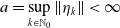





Appendix G. Notation
Notation





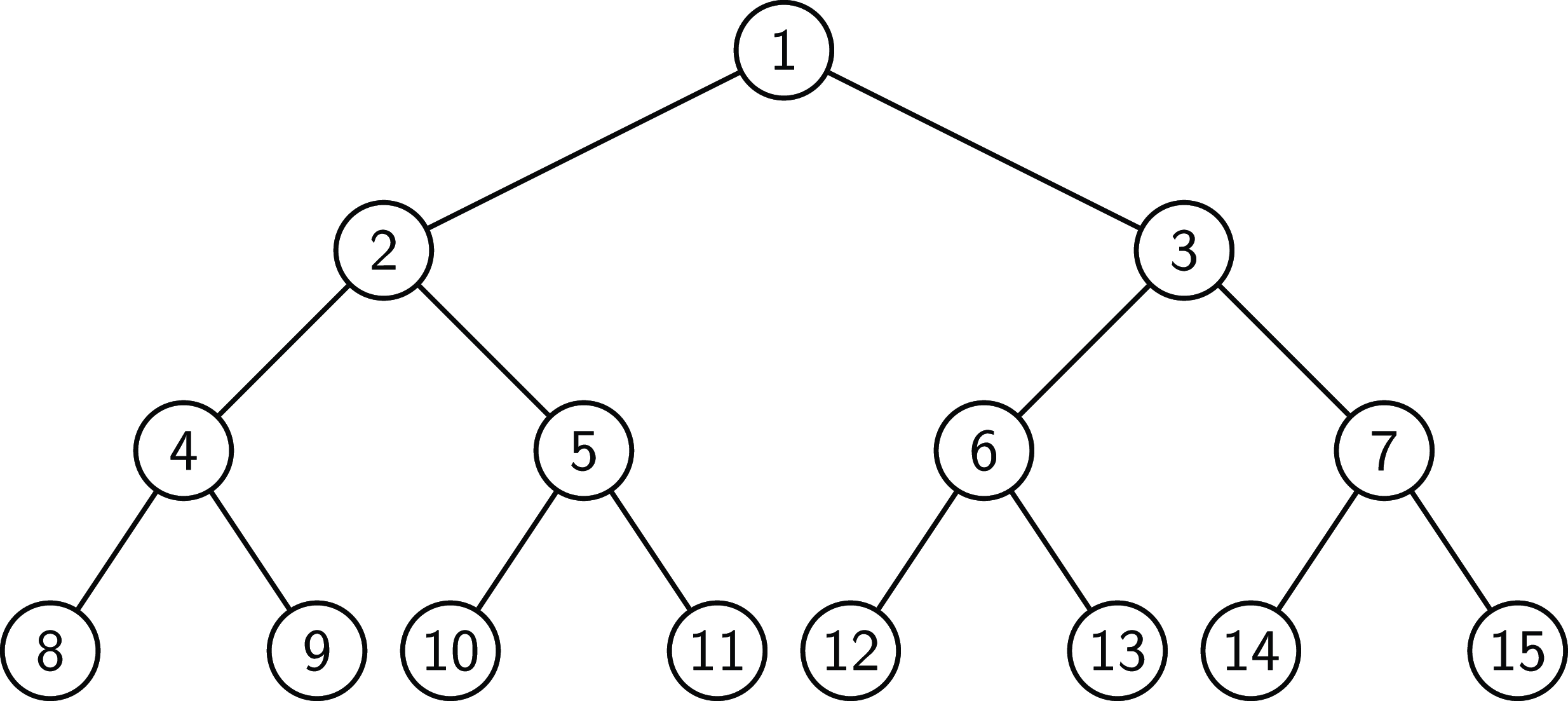
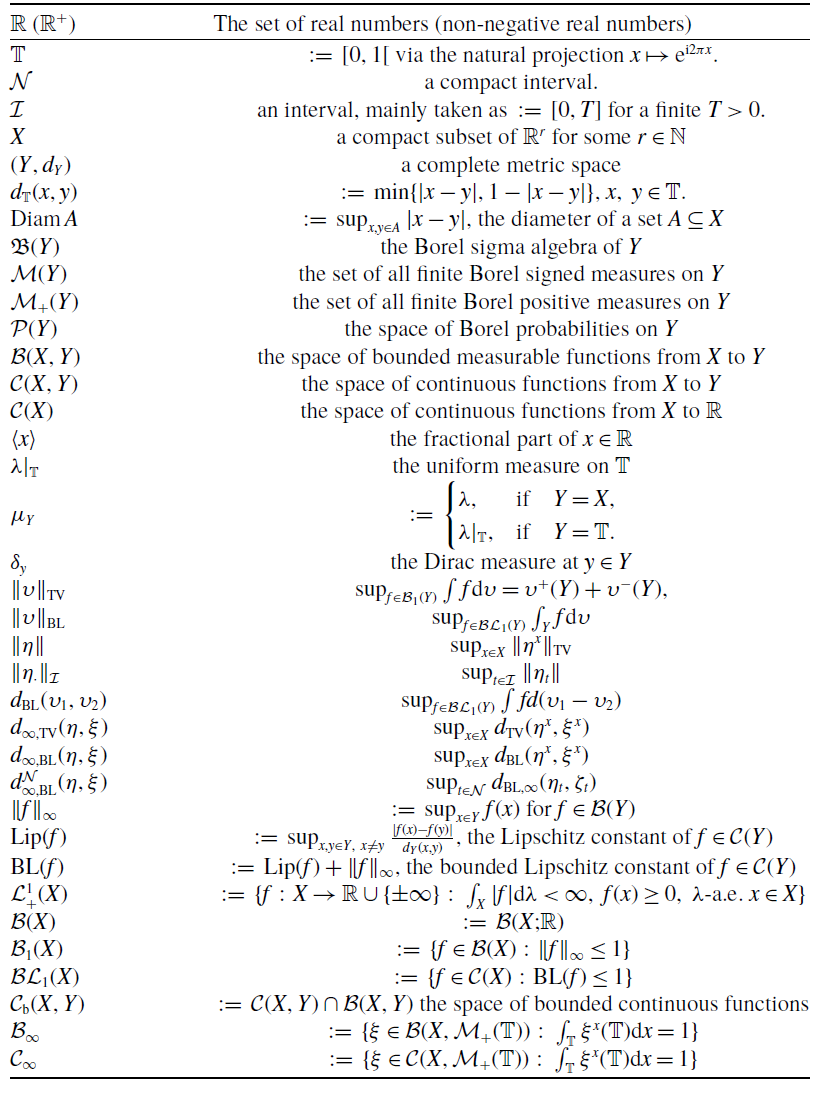

 Open access

