


Specialist community forensic mental health teams are coming under scrutiny from funders to demonstrate their model of intervention, and their relationship to other types of community mental health team working such as assertive outreach and intensive case management. Snowden et al (Reference Snowden, Mckenna and Jasper1999) described a variety of ways in which these forensic teams position themselves in relation to the generic services, often described as resembling either a more ‘ parallel’ or a more ‘integrated’ arrangement. The author is not aware of any UK studies describing the profile of patients these teams serve, the model of intervention or relevant outcome measures.
Alongside this debate about models, there has been a parallel consideration of the nature of risk assessment and management, which is clearly an integral function of any specialist forensic team. The publication of the MacArthur Study in the USA (Reference Monahan, Steadman and SilverMonahan et al, 2001) illustrates how far the debate about clinical v. actuarial prediction has come, and the methodology of improving predictive accuracy is becoming ever more sophisticated.
The aim of my study was to provide a profile of the patients managed by an inner-city specialist community forensic team. Like many such teams, this grew originally out of a medium secure unit (MSU) after-care service, following up patients discharged from hospital. The team developed a stronger identity in 1997 following the fusion of two cultures: staff with experience of working in a forensic MSU were joined by a group who had previously worked in a generic community team. As a result, in addition to the majority of the team's patients who had a previous MSU admission, a small number of ‘difficult to manage’ general psychiatry patients were referred to the team. This mixture of cases may not be unusual for community forensic teams. It could be argued that lack of clarity about access criteria and therapeutic models adds to confusion about the role of these teams, and to tensions arising from the interface between forensic and generic services.
This study collected comprehensive clinical and offending data on patients of the community forensic team. Information on risk was collected using the HCR-20 Violence Risk Assessment Scheme (Reference Webster, Douglas and EavesWebster et al, 1997). This instrument contains 20 items organised around three scales: historical (10 items), clinical (5 items) and risk (5 items). The 10 historical items are mainly static in nature and therefore unlikely to fluctuate over time. The 5 clinical items refer to current mental, emotional and psychiatric status and include risk markers that are likely to change over time. The 5 risk items are concerned with forecasting the patient's future social, living and treatment circumstances, as well as anticipating the patient's reactions to those conditions. In my view, the tool has good face validity and is helpful to staff in identifying risk and drawing up risk management plans.
The HCR-20 is increasingly used in the UK to assess risk, and there is a rapidly growing collection of studies attesting to its reliability and validity in a range of settings; see Douglas (Reference Douglas1999) for a review. However, most of these studies have been conducted in either North America or Sweden (Reference BelfrageBelfrage, 1998; Reference DouglasDouglas, 1999). There has therefore been a need to see how UK samples are rated with this instrument, and perhaps to establish some preliminary norms that might help put the assessment of new patients in context.
Method
Data on 47 community patients were collected through case file review and an interview with each patient's keyworker (usually a community psychiatric nurse) in summer 1998. No direct contact with the patient was involved in the collection of the information. This was a complete sample of patients managed by Lambeth community forensic team and subject to enhanced care programme approach. Data collected were used to complete the HCR-20 (version 2) on all patients (Reference Webster, Douglas and EavesWebster et al, 1997). The psychopathic disorder (measured with the PCL-R; Reference HareHare, 1991) and personality disorder variables were rated by the author in two-thirds of the cases. Personality disorder diagnoses can be made on a variety of bases, including self-report questionnaires and structured clinical interviews. As these assessments were not routinely available, the rater therefore had to make a judgement based on information from a variety of sources. Significant risk behaviours were also classified according to the criteria of the Admission to Secure Services Schedule, developed by Eastman & Bellamy (personal communication). Data were recorded on a specially developed forensic case register form and analysed using the Statistical Package for the Social Sciences, version 10. Recidivism data (after risk assessment) were collected from file review and community review meetings. The HCR-20 data were rated over a 3-month period, with an approximately 2.5-year follow-up period for all patients.
Results
Demographic, clinical and forensic history information
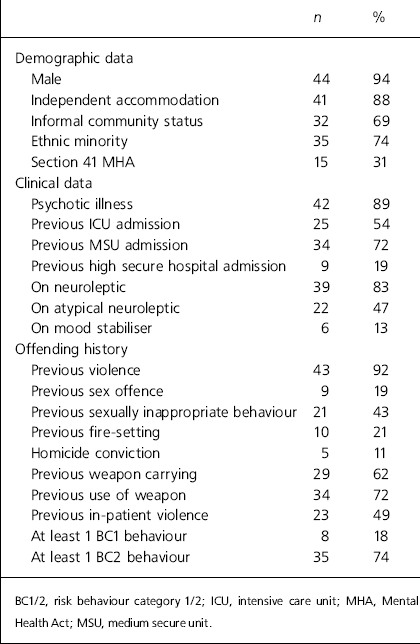
The majority of the sample of 47 patients were African-Caribbean men, and about a third of the sample were subject to Home Office restriction orders. Most patients had a diagnosis of a psychotic illness and were taking neuroleptic medication, with about half of these prescriptions being for atypical antipsychotics (Table 1). Nearly all the patients had a history of violence. The frequencies of sexual offending and fire-setting were similar, being recorded in about a fifth of the sample, and about two-fifths had a history of sexually inappropriate behaviour not leading to conviction. About one in ten had committed a homicide. Weapon carrying and use were both more likely than not to be a feature of the history. The severity of previous offending was illustrated by the high numbers registering at least one instance of risk behaviour category 2 (BC2) behaviour in the Eastman & Bellamy system.
Demographic, clinical and criminal history data of the patient sample (n=47, mean age 37.7 years)
| n | % | |
|---|---|---|
| Demographic data | ||
| Male | 44 | 94 |
| Independent accommodation | 41 | 88 |
| Informal community status | 32 | 69 |
| Ethnic minority | 35 | 74 |
| Section 41 MHA | 15 | 31 |
| Clinical data | ||
| Psychotic illness | 42 | 89 |
| Previous ICU admission | 25 | 54 |
| Previous MSU admission | 34 | 72 |
| Previous high secure hospital admission | 9 | 19 |
| On neuroleptic | 39 | 83 |
| On atypical neuroleptic | 22 | 47 |
| On mood stabiliser | 6 | 13 |
| Offending history | ||
| Previous violence | 43 | 92 |
| Previous sex offence | 9 | 19 |
| Previous sexually inappropriate behaviour | 21 | 43 |
| Previous fire-setting | 10 | 21 |
| Homicide conviction | 5 | 11 |
| Previous weapon carrying | 29 | 62 |
| Previous use of weapon | 34 | 72 |
| Previous in-patient violence | 23 | 49 |
| At least 1 BC1 behaviour | 8 | 18 |
| At least 1 BC2 behaviour | 35 | 74 |
Results of HCR-20 assessment
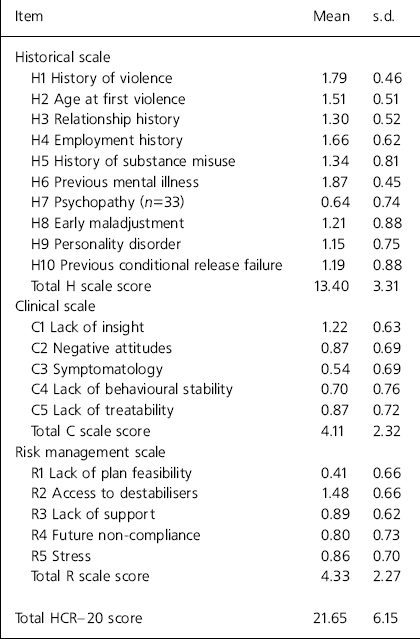
The HCR-20 data (Table 2) illustrate that all historical (H) risk factors for this patient sample are above average in the HCR-20 scoring framework, with the exception of PCL-R measured psychopathy. In the clinical (C) risk factors section, it is interesting that lack of insight (mean C1 score 1.22) is particularly problematic; negative attitudes also score highly, albeit to a lesser extent (mean C2 score 0.87); but the presence of positive symptoms is less of a problem (mean C3 score 0.54). The striking thing about the risk (R) scores is the high level of access to destabilisers (mean R2 score 1.48).
Mean HCR—20 scores (n=47)
| Item | Mean | s.d. |
|---|---|---|
| Historical scale | ||
| H1 History of violence | 1.79 | 0.46 |
| H2 Age at first violence | 1.51 | 0.51 |
| H3 Relationship history | 1.30 | 0.52 |
| H4 Employment history | 1.66 | 0.62 |
| H5 History of substance misuse | 1.34 | 0.81 |
| H6 Previous mental illness | 1.87 | 0.45 |
| H7 Psychopathy (n=33) | 0.64 | 0.74 |
| H8 Early maladjustment | 1.21 | 0.88 |
| H9 Personality disorder | 1.15 | 0.75 |
| H10 Previous conditional release failure | 1.19 | 0.88 |
| Total H scale score | 13.40 | 3.31 |
| Clinical scale | ||
| C1 Lack of insight | 1.22 | 0.63 |
| C2 Negative attitudes | 0.87 | 0.69 |
| C3 Symptomatology | 0.54 | 0.69 |
| C4 Lack of behavioural stability | 0.70 | 0.76 |
| C5 Lack of treatability | 0.87 | 0.72 |
| Total C scale score | 4.11 | 2.32 |
| Risk management scale | ||
| R1 Lack of plan feasibility | 0.41 | 0.66 |
| R2 Access to destabilisers | 1.48 | 0.66 |
| R3 Lack of support | 0.89 | 0.62 |
| R4 Future non-compliance | 0.80 | 0.73 |
| R5 Stress | 0.86 | 0.70 |
| Total R scale score | 4.33 | 2.27 |
| Total HCR—20 score | 21.65 | 6.15 |
Recidivism data
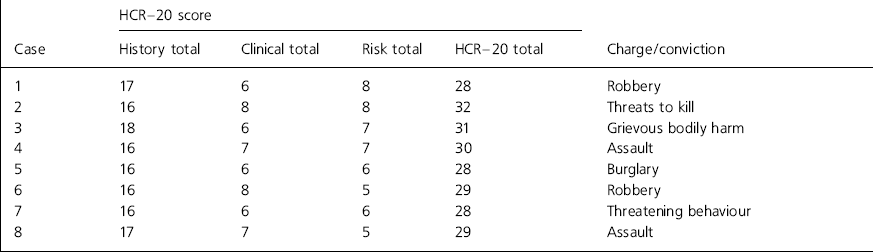
Over the follow-up period, eight patients were charged or convicted of a new offence (Table 3). These were all violent offences. Comparison of the HCR-20 mean score of these eight patients (mean score 29.4) with the remaining 39 patients in the sample (mean score 21.2) shows a significant result (P<.05, independent t-test).
Offences and HCR-20 scores in the eight recidivist patients
| HCR-20 score | |||||
|---|---|---|---|---|---|
| Case | History total | Clinical total | Risk total | HCR-20 total | Charge/conviction |
| 1 | 17 | 6 | 8 | 28 | Robbery |
| 2 | 16 | 8 | 8 | 32 | Threats to kill |
| 3 | 18 | 6 | 7 | 31 | Grievous bodily harm |
| 4 | 16 | 7 | 7 | 30 | Assault |
| 5 | 16 | 6 | 6 | 28 | Burglary |
| 6 | 16 | 8 | 5 | 29 | Robbery |
| 7 | 16 | 6 | 6 | 28 | Threatening behaviour |
| 8 | 17 | 7 | 5 | 29 | Assault |
Discussion
The majority of the community forensic team patients were men, among whom African-Caribbean men were overrepresented. Of the three women, two had committed a homicide, and the third was a woman with severe borderline and sadistic personality traits. Few of the patients were living in supported housing or hostel accommodation of any kind. Nearly three-quarters had had a previous MSU admission, so it appears that relatively few patients were referred to the team directly from generic services in the community.
Not surprisingly, many of the patients had used and carried weapons, and a majority displayed evidence of antisocial behaviour prior to the onset of their illness. About half had a record of violence as an in-patient. Although just under a fifth had committed a sex offence, it is notable that over two-fifths had shown at some time evidence of sexually inappropriate behaviour. It is clear from these findings that these community forensic patients had high levels of serious offending, and that many had both severe mental illness and personality disorder.
The HCR-20 is easy to administer and collect relevant data, even from files and contact with a keyworker. The clinical and risk management scales suggest that insight (CI) is often limited in this group of patients and that access to destabilisers, such as alcohol, drugs, weapons and potential victims (R2), is a problem. Deciding whether a risk management plan is feasible (R1) is not always straightforward and depends on the extent of the remit of mental health services to limit criminogenic contacts.
The study provides means for the scale scores for the HCR-20. The HCR-20 total scale mean obtained in this study (21.65) is within the lower range of values provided in the forensic samples. Comparison with some of the other published HCR-20 studies (Reference BelfrageBelfrage, 1998) indicates that the mean H scale total of 13.4 is comparable with that of many of the forensic samples reported there. The total C and R scale scores appear to be a little lower than in many of the other forensic studies, but some of the latter involved ratings in hospital, where one might expect the level of clinical risk factors to be higher.
There are several methodological limitations to this study. First, all the cases were rated by the author. Second, the author had worked clinically with some of the patients in the study, which might have introduced bias, although this should be in favour of comprehensive data collection. Third, the recidivism data are limited to file records and information collected from clinical staff. Although it is extremely unlikely that serious offending would not have come to the attention of the clinical team, the study did not have the self-report or systematic collateral report resources that were used in the MacArthur Study (Reference Monahan, Steadman and SilverMonahan et al, 2001).
Analysis of the distribution of HCR-20 totals indicates an approximately normal distribution, with about seven cases scoring 1 standard deviation above or below the sample mean. Monahan et al (Reference Monahan, Steadman and Silver2001) suggest that a preliminary risk analysis of a sample should identify an upper and lower cut-off point, identifying clear high-risk and low-risk groups within the sample. This will leave a residual group of patients scoring around the mean, for whom it may be very difficult to make predictions about their risk. Monahan et al (Reference Monahan, Steadman and Silver2001) describe one way of resolving this by using a number of iterated predictions. The HCR-20, however, is a simple additive measure of risk that does not seek to order variables or weight them in a formula derived from a main effects regression equation. As the authors of the HCR-20 note in their manual (Reference Webster, Eaves and DouglasWebster et al, 1995), this may lead to reduced accuracy but is more user-friendly and less resource-intensive.
In the eight cases of recidivism collected in the 30 months following data collection nearly all the patients were charged with or convicted of violent offences. In two cases offending appeared to be closely linked to a deteriorated mental state. In the other six cases the patients appeared to have maintained their mental stability, and the offence related to patterns of instrumental violence, substance misuse and antisocial personality characteristics.
The patients who reoffended all had HCR-20 scores significantly higher than the mean for this sample. In particular, they had high H scores (16+) and high total scores (28+), which matches the clinical observation that they had histories of instrumental violence, substance misuse and antisocial personality traits. A minority of these offences arose out of a deteriorating mental state. This illustrates the dilemma for many forensic services of deciding whether to attempt to reduce a propensity for substance misuse and instrumental violence that is unrelated to mental state. The author is not aware of any studies indicating that any specific psychological intervention can have an impact in this population, although there are now clear theoretical models of the relevance of general criminogenic issues in mentally disordered offenders (Reference HollinHollin, 1999). The MacArthur Study (Reference Monahan, Steadman and SilverMonahan, 2001) also suggests that a significant proportion of violent incidents committed by patients following discharge are unrelated to mental state, and instead occur in the context of alcohol misuse and poor anger management skill.
In terms of the relationship between forensic and generic services, it might be helpful for a forensic community team to orient itself towards a particular type of patient. During this research it became clear that there are patients who have remained stable for some years, without relapse, whose care could perhaps be handed back to the generic service were it not for the fact that they had committed a very serious offence in the past and are on a restriction order; typically these patients had a total HCR-20 score below 15. Other patients relapse and require admission regularly, but are essentially manageable on ordinary acute wards when ill (typical HCR-20 scores 15-28); these patients may acutally be disadvantaged in gaining rapid admission through not being looked after by a local generic service. A third group, whose mental illness is only a small part of the presenting problem, might benefit from supervised placement and specific psychological approaches targeting their criminality, substance misuse and poor anger management; these patients have HCR-20 scores of 28 or more. It is important for forensic services to demonstrate expertise in managing this latter group.


 Open access


eLetters
No eLetters have been published for this article.