

This chapter is structured as follows. After providing basic information about the overall geography of Benin, Section I goes into the country’s history in order to examine whether some important legacies can be traced back to particular events or circumstances. Section II then looks at the issue of ethnicity and discusses its possible role in Benin’s recent performance. Section III proceeds by supplying a summary view of the political history of the country in the post-World War II era. Taking the discussion up from there, Section IV attempts to characterise the political system of Benin by describing the main mechanisms governing its operation. Section V concludes the chapter.
I Geography and History
A Geography
Benin, shown in Map 1.1 and formerly known as Dahomey (1890–1975), is a West African country located between Togo and Nigeria, with which it shares 600 and 700 km of border, respectively. Currently, the country includes twelve administrative departments: Alibori, Atacora, Atlantique, Borgou, Collines, Couffo, Donga, Littoral, Mono, Ouémé, Plateau, and Zou.
Map of Benin

In 2016, Benin had a population of 10,822,298 living in an area of 112,760 km². Its gross domestic product (GDP) was estimated at US$8,583 billion. Benin is therefore a relatively small country in comparison to its giant neighbour to the east, Nigeria, which is currently Africa’s largest economy in terms of GDP (US$404,653 billion) and population size (185,989,640 inhabitants). In addition, Benin possesses few natural resources except for agricultural land, and its biggest geographical asset is its direct access to the sea.
B Deep Historical Legacies
Benin is an extraordinarily varied mosaic of people and ethnic groups, as well as a place with a long legacy of all sorts of political entities, running from old kingdoms or empires (the Yoruba kingdoms, which centred on the Ife and Oyo, the Bight of Benin, the Allada kingdom, and its successor states the Dahomey kingdom and the Borgou kingdom) to principalities and microstates (possibly born of the breaking up of kingdoms or empires), which also coexisted with stateless areas dominated by non-hierarchised families and clans (particularly among the peoples bordering Benin). Because over the last ten centuries the country has been the locus of numerous waves of migration from neighbouring countries, it is a multinational state with strong links to its neighbours, and has porous and flexible borders considered from the standpoint of human settlement. Relatedly, with its direct access to the sea in its southern part, Benin has long been a nexus of trade networks and routes actively engaged in regional and even external commerce. It is therefore not surprising that although the kings of Benin seem to have been reluctant to supply either the quantity or the quality of slaves that the Portuguese wanted during the sixteenth century, Benin became an important basis for the transatlantic slave trade by the end of the seventeenth century when the demand for slaves intensified under the pressure of growing needs in the Americas (Fage, Reference Fage2002, pp. 235, 266–67; Iliffe, Reference Iliffe2007, pp. 78–80).
The kingdom of Dahomey was thus created in response to the Atlantic trade. It was first an offshoot of Allada, the then chief polity among the Adja-Ewe people together with the Bight of Benin (late fifteenth century). When Allada tried to control the intensive trade in slaves and firearms that began at that time, the Dahomey king conquered it (in 1724) and became the dominant local power, although it remained tributary to Oyo state (in present-day Nigeria). It was a more efficient authoritarian state than its predecessors and was politically stable (until its dismantling by the French colonial power). This was partly due to three factors: the royal succession was largely determined by primogeniture, the kingdom was closely administered through commoner chiefs and royal courts, and it was stridently militaristic and treated its enemies cruelly (Iliffe, Reference Iliffe2007, pp. 148–49).
That account suggests that in addition to the absence of mineral resources, present-day Benin might suffer from two important problems: (1) a lack of cooperation due to strong ethnic diversity (along the line proposed by Alesina and La Ferrara, Reference Alesina and La Ferrara2005); and (2) a lack of interpersonal trust due to the traumatic experience of slavery (as argued in Nunn, Reference Nunn2007, Reference Nunn2008). The situation nevertheless appears in a more positive light if two favourable elements of Benin’s legacy are emphasised: (3) a tradition of centralised state organisations with the associated political and administrative skills; and (4) long periods of active engagement in supra-local trade and commercial entrepreneurship.
It is impossible to determine whether the net outcome of these forces is positive or negative. In fact, it is not even clear how strong the effect of each of them is on the long-term development prospects of the country. We now elaborate upon the reasons behind our agnosticism, and this is done under several points corresponding to the earlier categorisation (plus a point concerning the availability of natural resources).
The absence of natural resources, mineral and non-mineral, is not necessarily a disadvantage for economically poor countries where democracy is immature in the sense that institutions are weak and democratic habits not well ingrained. A widespread view argues, on the contrary, that abundant resources are liable to slow down development in these countries owing to the so-called resource curse: by creating easily appropriable rents, resources that are highly valuable and physically concentrated tend to establish a narrow link between political power and economic gains, thereby encouraging political leaders to sacrifice the collective good for their own personal interests (see, e.g. Mehlum et al., Reference Mehlum, Moene and Torvik2006a, Reference Mehlum, Moene and Torvik2006b; Robinson et al., Reference Robinson, Torvik and Verdier2006).
Turning to (1), two main points must be made. First, if ethnic fragmentation may ignite tensions between different ethnic groups in a competitive environment, it may yield favourable effects when the groups possess complementary skills. Second, even in the presence of competition, the existence of a large number of groups, as is the case in Benin (and Tanzania), is much less damaging than situations of ethnic polarisation, such as those found in Rwanda, Burundi, or Kenya (see Esteban and Ray, Reference Esteban and Ray1994, Reference Esteban and Ray2008; Duclos et al., Reference Duclos, Esteban and Ray2004). This matters especially in the sphere of politics, where the possibility of different inter-group coalitions and counter-coalitions may give rise to a spirit of cooperation more conducive to development than the ‘winner-takes-all’ approach that a polarised society typically fosters. More will be said about this when we turn to the political system.
The idea that slavery has left deep scars in the societies where it prevailed, undermining trust among people, has gained ground following the pioneering work of Nunn; see (2). Unfortunately, there is no firm evidence of this long-term impact in the case of Benin, which requires that confounding effects (such as ethnic diversity) are duly controlled for. As a first approximation, we would expect measures of trust to be of lower value for Benin than for African countries that did not suffer from the slave trade, at least on a scale corresponding to modern transatlantic commerce. Just to get a rough and preliminary idea, we compare Benin to three African countries that did not experience slave trading: Lesotho, Malawi, and Kenya. Kenya is probably the best comparator because, like Benin, it suffers from strong ethno-regional antagonisms. Employing data from the Afrobarometer (2011–2013 Round), we use several subjective indicators of trust and corruption, carefully distinguishing between interpersonal trust (Table 1.1) and trust in institutions (Table 1.2).

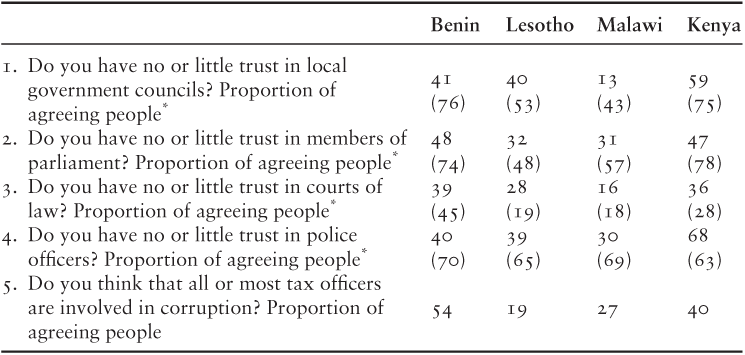
* Between brackets are indicated the proportions of people who believe that all or most corresponding officers are corrupt.
What are the messages emerging from these two tables? First, in terms of interpersonal trust, Benin does not fare unambiguously worse, or better, than the three other African countries considered. Moreover, when we compare Benin with the rest of Africa in a regression framework, the ambiguity persists. More precisely, based on individual data, we compute regressions in which the dependent variable corresponds to each indicator, and the key explanatory variable is a dummy equal to one when the country is Benin and to zero when it is any other country belonging to the African continent. We also control for the gender, education, income, and residence (rural or urban) of the respondent. We then find that Benin exhibits relatively more interpersonal trust than other African countries when the first two questions mentioned in Table 1.1 are used as indicators, but relatively less trust when the last two questions are used.Footnote 1 This indicates that when the question of interpersonal trust is raised in rather abstract or general terms, the population of Benin is more confident than other African populations. But when the question is related to ‘concrete others’ (neighbours, relatives, etc.), the opposite is true. There are two possible interpretations here. First, the regression results can be taken as evidence that the population of Benin has more generalised trust, but less particularised trust, than other populations in Africa. Whether this is a superior outcome than the opposite situation is open to debate: if generalised trust is better for the operation of anonymous markets, particularised trust is critical for the smooth functioning of social networks that underlie many informal institutions in Africa. Second, and less advantageously, it could be said that Beninese profess more interpersonal trust when the question is raised in general terms, alludes to distant people, and refers to situations that have not been personally experienced, whereas they appear more suspicious as soon as the question makes concrete reference to known people and known situations.
Second, as far as trust in institutions is concerned, Benin appears worst only regarding courts of law (the difference with the second worst-ranked country is only one percentage point regarding members of parliament). Third, Benin fares worst, and neatly so, when asked whether judges or magistrates are corrupt (see the figures between brackets in question 3 of Table 1.2), or whether tax officials are corrupt (see question 5). Overall, Benin does not display a bright picture, but the situation is especially worrying with respect to the justice and tax collection systems.Footnote 2 Comparing Benin with the rest of Africa in a regression framework leads to the same conclusion in the sense that Benin’s people exhibit less trust in court magistrates and tax officials (questions 3 and 5 of Table 1.2). Yet, Benin performs relatively better if we look at trust in police officers (question 4). It also performs better if trust in institutions is measured by trust in local governments and members of parliament (questions 1 and 2).
The overall picture is therefore mixed. It appears bleaker, however, when the Afrobarometer data on trust are complemented by data from Transparency International’s Corruption Perception Index, which ranks countries according to the degree of perceived corruption in government and politics (corruption is defined as the abuse of public office for personal gain). Out of 176 countries evaluated in 2016, Benin ranked 95th, behind Senegal. Examination of the dynamics in the ranking over the period 2012–2016 points to slow progress: Benin’s score was 36 in both years, while Senegal moved from 36 to 64. The picture is again confirmed by firm surveys: as many as 84 per cent of companies consider corruption to be a major problem, with informal payments seemingly required for day-to-day operations such as requesting a telephone line and obtaining import documents or a trade licence (Benin, Reference Benin2006, Reference Benin2016; World Bank, 2016; MCA, 2012).
Let us now turn to dimension (3). Here, we would want to weigh the positive effect of a legacy of pre-colonial centralised state organisations against the negative effect of (French) colonisation. Under the former, Africans acquired some degree of administrative experience and skills in statehood, and it is a remarkable feat that the kingdom of Benin kept its polity intact until the very end of the nineteenth century. By then, the state-formation process was already well advanced in Benin (Fage, Reference Fage2002, pp. 99, 270). Since the existence of more layers of hierarchy prior to contact with Europeans has been shown to be robustly associated with greater development today (Gennaioli and Rainer, Reference Gennaioli and Rainer2007; Michalopoulos and Papaioannou, Reference Michalopoulos and Papaioannou2013, Reference Michalopoulos and Papaioannou2014), political history seems to favour development in the case of Benin. Under the latter, by contrast, Africans were submitted to a centralised and authoritarian system of government in which they became simple auxiliaries or, in the best cases, executive subordinates of French officers receiving their orders from a well-defined chain of command (Fage, Reference Fage2002, pp. 410–12).Footnote 3 It is only through assimilation, a formal process involving education in French schools, performing military service, formal forswearing of traditional and Muslim law and custom, and a minimum of French civilian employment, that locals could be elevated in the French colonial order. Only a tiny minority proved to be eligible. There are therefore grounds to believe that French colonisation undermined positive legacies of pre-colonial states in Benin, the kingdom of Dahomey in particular. Note that this line of argument goes against the idea that, compared to British rule, the legacy of French colonial rule is a positive asset for long-term development because the French colonial power encouraged state centralisation and strong bureaucracies, in addition to using French as a common official language and downplaying ethnic cleavages (Ali et al., Reference Ali, Fjeldstad, Jiang and Shifa2019).
Factor (4) is probably the most indisputable long-term legacy that Benin can benefit from today. For many centuries, the country has enjoyed a well-organised trading system that is easily accessible from the sea, and fruitful trading relationships were established with the interior and with earlier European traders on the coast (Fage, Reference Fage2002, pp. 106, 270). At times, like during the Benin kingdom (fifteenth and sixteenth centuries), the rulers felt so self-confident that they could choose to virtually cut the country off from contacts with Europe: ‘European trade was something it chose to do without’ (p. 236). A major impetus to trade came with successive waves of migrants from Yorubaland (in present-day Nigeria), particularly under the Ife and the Oyo empires during the sixteenth to eighteenth centuries. According to Fage, the Yoruba developed a remarkably strong sense of identity and cultural specificity, aided in this, somewhat paradoxically, by the fact that they were open to Christian missions, and hence to Western education, as early as the 1840s (p. 99). They became specialised in trade in the first part of the nineteenth century and quickly understood that an open society that fosters free competition and establishes links with the outside world can offer considerable opportunities for men of skill and initiative (p. 346). Moreover, the Yoruba have always provided an organic link to Nigeria, from which they originated, maintaining special relationships with the states of Kwara, Oyo, Ogun, and Lagos. (Other ethnic groups nurture persisting links with Niger, Burkina Faso, and Togo: the Maori with Niger, the Gourmantche of northern Benin with the eastern part of Burkina Faso, and the Adja with Togo.) What bears emphasizing is that Benin enjoys the presence of groups other than the Yorubas, which have well-established experience in trade and long-distance trade. Thus, the Waranga are caravan merchants from the Bariba northern group who have a long tradition in linking present-day Ghana and Burkina Faso to northern Benin.
To end this overview of the historical legacies of Benin, it is important to note that a tight interrelationship between slavery, commerce, and strong political organisation has always existed in West Africa (and in other parts of the continent), so it is meaningless to assess the impact of these three factors separately. The logic, which evokes the argument developed by Domar (Reference Domar1970) and Mathur (Reference Mathur1991), has been succinctly put as follows by Fage (Reference Fage2002, pp. 268–70). People were scarce relative to land and other natural resources. Confronted with this situation, traditional village societies based on ties of kinship and subsistence agriculture were unable to take advantage of all the opportunities arising from growing external demands for scarce and valuable commodities such as gold, copper, and ivory. There were too few people to act as traders and carriers, as workers in the mines, to provide the political organisation and military force required for the safe transportation of goods, and to supply food and other support for those withdrawn from the subsistence sector to engage in these new activities. The solution lay in the creation of kings powerful enough to recruit labour and to extract tribute, and forced recruitment meant that ordinary men and women were converted into slaves, clients, or tributaries. In West Africa, some slaves were employed simply as agricultural labourers on the estates of kings and other Big Men. More generally, however,
they were regarded as additions to the social group headed by their master and, although they could never wholly escape the stigma of their slave origin, in course of time they and their descendants – especially if these came by marriage with a free member of the group – became integral parts of it, acquiring or inheriting property much like other members. At the lowest levels, then, they became members of the family unit. At the highest levels they could become trusted traders or soldiers or court officials.
The latter, rather paradoxical situation occurred when old slaves were considered reliable agents by their masters: their slave origin indeed meant that their authority was solely a reflection of their master’s authority, which they could not therefore usurp for themselves.
The main function of slaves thus consisted of relaxing the labour constraint that prevented kinship groups or large families from seizing upon valuable economic opportunities. With the forced mobilisation of labour came the growth of political authority, and both processes largely pre-dated the expansion of transatlantic slave trading, the main effect of which was to intensify them.Footnote 4 If slaves could be exchanged for the desirable goods brought by long-distance travellers and even exported to distant lands in the Americas, the general pattern was different. They were less valued as traded goods than as a resource needed to produce goods for export, and to support the economic and political superstructures that trade required to flourish (Fage, Reference Fage2002, p. 269).
II Ethnicity
As underlined in the previous subsection, ethnic diversity is a key feature of Benin’s socio-historical landscape. Here, we elaborate on this feature by supplying population statistics that allow us to have an idea of the relative importance of the main ethnic groups forming Beninese society. Afterwards, we examine whether there is a match between these population shares and political representation. We will then be ready to look in more detail into the recent political history of the country.
The Beninese population is made up of nearly 100 ethnic groups, the majority of which are found in the south and in the Atacora Mountains in the north-western parts of the country. During the 1961 demographic census, 47 ethnic subgroups were identified that were regrouped into 12 broad ethnic families. However, subsequent national censuses (in 1979, 1992, 2002, and 2013), although they counted around 56 ethnic subgroups, opted for a reorganisation into nine broad families only: Adja, Fon, Yoruba, Bariba, Dendi, Otamari, Yao, Fulani, and a residual category of other minority groups. Table 1.3 shows the evolution of population shares of Benin’s main ethnic groups between 1992 and 2013. The Fon (and related ethnic groups) clearly form the dominant group, followed by the Adja and the Yoruba, the two main migrant groups. In terms of dynamics, we see that the population share of the Fon has slightly decreased over the period considered, whereas that of the Fulani has significantly increased. We must nevertheless worry about the reliability of statistical records, since the Fulani are nomadic herders and it is quite possible that their movements into and out of the country may be very imperfectly measured, and that measuring problems have been (partly) corrected during recent years.
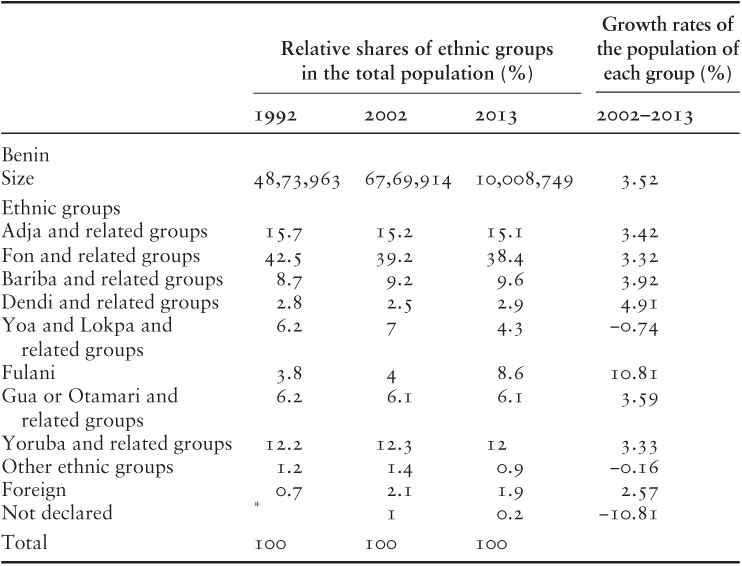
*Percentage less than 0.1.
It is worth noting that among all the ethnic groups, three are widely distributed spatially: the Fon, the Yoruba, and the Adja are present in at least nine out of the twelve administrative departments into which the national territory has been divided. This means that major migrant groups are not heavily concentrated in some limited parts of the country. It is noteworthy, still, that in terms of population numbers the Yoruba are mostly present in the southern part of Benin; that is, close to the coast. This is consistent with their aforementioned specialisation in trading. On the other hand, the Otamari, who are agriculturists, are an important group inhabiting the north. The fact that they represent much less than 10 per cent of the total population reflects the low population density observed in that part of the country, as compared to the centre and the south.
Benin is characterised not only by ethnic but also by religious diversity. Catholicism and Islam are the two dominant religions and while Catholicism was the most important religion in the early 1990s, it was overtaken by Islam in 2013, probably as a result of higher fertility rates among Muslim populations. In 2013, about 53 per cent of the Beninese population declared their adherence to one of these two big monotheistic religions. Another interesting dynamic observation is the rapid rise of evangelical and charismatic churches, mostly from Protestant affiliations, and the displacement of traditional religions (mostly Voodoo) that they are causing. Finally, and not surprisingly, ethnicity and location, on the one hand, and religion, on the other hand, stand correlated. Most strikingly, people living in the north (the Otamari and the Fulani, in particular) tend to be Muslim, whereas those living in the south tend to be Christians of the traditional Catholic or evangelical Protestant type.
We have already mentioned, in general terms, the delicate issue of how ethnic diversity bears upon cooperation practices among the people of Benin, emphasising politics. We would therefore like to know how, in the specific case of Benin, politics is affected by ethnic diversity. Figures 1.1a–1.1d show how key political functions, heads of executive and ministerial jobs, have been apportioned to different ethnic groups over a forty-six-year period subdivided into two subperiods, 1960–1989 and 1990–2006. The overall picture is of a rather fair representation of the main ethnic groups and the main regions at the highest levels of power. The dominant group, the Fon, is under-represented at the level of the presidency but is well represented at the level of ministerial jobs. The Otamari, a group that is comparatively small nationwide but important in the north, has a disproportionate share of the allocations of the highest executive position. Finally, the Adja and the Yoruba, the two groups that are numerically dominant behind the Fon, are well represented among government members.
Political representation of main ethnic groups: Ethnicity of the executive, 1960–1989 (per cent)

Political representation of main ethnic groups: Ethnicity of the executive, 1990–2006 (per cent)

Political representation of main ethnic groups: Ministries, 1960–1989 (per cent)

Political representation of main ethnic groups: Ministries, 1990–2006 (per cent)

The question now is whether this situation reflects a political arrangement devised to ensure ‘ethnic peace’ and political stability in the country. The fact that Benin is widely regarded as a pioneer democracy in Africa (see, e.g. Fage, Reference Fage2002, p. 536) could be related to a sense of compromise and respect for diversity, as epitomised in the distribution of power among dominant ethnic groups. An alternative interpretation of the facts is nevertheless possible: the distribution of power does not result from constitutional rule or an informal, non-official mechanism of power rotation, but is the outcome of a fierce struggle for power among contenders whose levels of strength are not too different and are variable over time. A careful look into the recent political history of Benin suggests that, unfortunately, the second interpretation is probably closer to the truth. The need for alternance has typically been brought to bear by political showdowns and secret dealings rather than through a transparent and well-accepted mechanism.
Before going into the details of the political history of Benin, an important remark deserves to be made. Despite the appearance of significant ethnic diversity, the socio-political life of Benin is structured around essentially four groups: the Adja-Fon, the Bariba, the Yoruba, and the people from the Atacora. However, and contrary to what this categorisation might suggest, it is not the tensions between those four groups that cause the most serious problems for harmonious social fabric in the country. What creates instability are the strong and deep-rooted divisions inside a single ethno-linguistic family, namely the Adja-Fon. More specifically, there is persistent hostility between the Fon of Abomey, the Goun of Porto-Novo, and the Mina-Adja coming from Mono.Footnote 5 Sometimes the hostility dates back to the colonial period. This can be seen in the antagonism between the first two subgroups: the people of Abomey have never forgotten the treason of their ‘brothers’ from Porto-Novo who joined with the French colonial forces to conquer Abomey in the late nineteenth century.Footnote 6 The internal divisions of the Adja-Fon group are reflected at the political level. Thus, the political configuration prevailing in southern Benin is determined by the fierce struggles between three groups – PRD–Porto-Novo, Renaissance du Benin–Abomey, and PSD–Mono – which are themselves the scions of old parties – the PRD of Apithy in Porto-Novo, the UDD of Ahonmandégbé in Abomey, and the Mono movement directed by Adrien Dégbéh. How the tensions between these three branches of the same family have been settled politically since the time of independence, whether in an authoritarian or a democratic setting, depends on the key refereeing role played by the other three ethnic groups.
III Landmarks In The Post-1944 Political History
To have a good grasp of the interactions between political institutions and economic development in Benin, three key periods in the country’s political and economic history need to be distinguished. Chronic political instability was the hallmark of the years 1944–1972, a Marxist–Leninist revolutionary regime ruled during the period 1972–1989, and the period from 1990 to the present has been characterised by a democratic renewal that soon became perverted by narrow links between state power and business interests.
A Political Instability before and after Independence: 1944–1972
Dahomeans began to take an active role in the modern political life of the country around 1944, at the time of the Brazzaville conference when France ruled out colonial self-government and instead decided that each colony would be given electoral representation in the French Assembly in Paris (Iliffe, Reference Iliffe2007, p. 242). The first Beninese intellectuals, educated in French schools and universities (in Dakar and France), were assuming leadership in a national movement that was tainted by ethno-regionalism from the very start. The multiparty political system in place was highly unstable owing to intense personal rivalries between strong figureheads representing three main regions and their associated political legacies: the north (around Parakou) led by Hubert Maga, the centre (around Abomey) led by Justin Ahomadégbé, and the southeast (around Porto-Novo) led by Sourou Apithy. It is in this context dominated by personal confrontations and fragmented identities that the Republic of Dahomey was proclaimed in December 1958, the elections to the first National Assembly took place in April 1959 (where no party won a majority), the first presidential election was organised in July 1960, and the country’s independence was declared on 1 August of the same year after some seventy years of French colonisation. The newly elected president was Hubert Maga from the northern region, who obtained the support of the party standing for the central region.
As was the case in other newly independent French-speaking countries, the early rules governing elections ensured that nationalism took a predominantly constitutional form, and the transfer of power from France to its ex-colonies took place peacefully. This contrasts with East Africa, where violence played a crucial role, and with Congo, where the Belgians did not build representative institutions or governmental training before granting independence (Iliffe, Reference Iliffe2007, pp. 255–56). In West Africa in general, and in Benin in particular, the new political elite thus chose to introduce a system of liberal democracy in line with the model used in France. The new constitution, adopted in 1959, was largely inspired by the French Constitution of 1958. It provided for a parliamentary system with a president at the head of the country, but also with a prime minister responsible to the parliament. Moreover, it set out fundamental rights for citizens, such as freedom of expression, association, and the press.
Unfortunately, the country’s first twelve years of independence were turbulent, marked as they were by the frequent alternation of military and civilian regimes. In fact, during the period between 1960 and 1972, Benin was at a stage of intense ethnic and regional tensions, social movements of varying levels of intensity, abuses of power of all kinds, political intrigues, and incessant disputes between the country’s three regional leaders. Unlike several newly independent countries in Africa, the Republic of Benin did not witness the emergence of a charismatic leader able to dominate the national political scene. Genuine Beninese citizenship hardly existed, as voting behaviour was primarily driven by powerful patron–client networks that were largely based on ethno-regional identity. Fragmented loyalties, adroitly manipulated by the political leaders, had the effect of fuelling instability and, in some cases, fostering violence.
Worker and student unions could perhaps have improved the situation by helping to transcend traditional identity feelings in the name of cross-cutting social interests. In practice, however, many union leaders were easily seduced or co-opted by the political Big Men, and unions gradually became convenient platforms from which ambitious people could opportunistically rise to positions of political responsibility inside the ethnically defined party machines. Any other tactic was met with harsh repression meted out by public authorities fearful of demonstrations that lay outside of their control. In the end, the co-option tactic prevailed, and trade unions largely ceased to be independent bodies in the country’s political landscape.
These were not ideal conditions in which to design and implement public policies to promote national development. The instability of political rule made long-term planning impossible, while the existence of various centres of state power and the quasi-absolute control exercised by the three regional leaders over entire areas of the country complicated cooperation, coordination, and control. Consequently, political decisions related to development strategic choices and investments were often deferred, and the state apparatus was often unable to function. Discouraged by this malfunction of the political system, civilians were sometimes prompted to call on men in uniform to restore order.
For much of the period, the doctrine of socialism/collectivism was the official political ideology, thus laying the ground for the subsequent regime. An important element of socialist politics was the introduction of ‘collective fields’ in the early 1960s. Like in Nyerere’s ujamaa communities in Tanzania, a collective field was defined as the field of a village community managed under the responsibility of the village council and under the supervision of the rural departmental committee. This implied that the proceeds from crop sales accrued to the village budget. We know little about how effectively this doctrine was translated into fact, and whether it was equally endorsed by the three regional bigwigs. However, we can surmise that the simple fear or anticipation of its implementation would have discouraged private investment in agriculture.
B A Marxist–Leninist Revolution: 1972–1990
On 26 October 1972, Lieutenant-Colonel Mathieu Kérékou, from the northern region, undertook the sixth military state coup in Benin. Two years later, he became the new president of the republic, and officially opted for scientific socialism based on Marxism–Leninism as the political doctrine to guide the country’s development. This involved the nationalisation of production units and the development of collectivism, the creation of a single political party (the Parti de la Révolution Populaire au Benin, or PRPB), the creation of a single workers’ organisation, a single women’s and a single youth organisation, and a change of national flag. This period also saw the introduction of Marxist tenets into public discourse and official documents, with special emphasis on the leading role of the party, democratic centralism, and state economic interventionism, particularly in the agricultural sector, where massive investments were to be made in order to create food self-sufficiency. Fundamental freedoms were restricted, and a new constitution establishing the People’s Republic of Benin was drafted and adopted.
It is only when compared to the first twelve years of independence that the revolutionary period (between 1972 and 1989) can be said to have promoted relative political stability. There were, indeed, numerous attempts to overthrow the government, sometimes coming from military quarters themselves (January 1977). The turmoil was not surprising given the poor economic performance of the new regime, coupled with its propensity to nurture corruption and rent-seeking. Thus, a series of investigations into parastatal organisations revealed the same problem of top-down corruption and widespread inefficiency. According to Chris Allen (as cited in Meredith, Reference Meredith2005, p. 278): ‘The institutions were found to be hierarchical, authoritarian, and highly bureaucratic, leading to failure to perform essential tasks, to waste and inefficiency. The personnel, apart from being in many cases unqualified or ill-qualified, tended to be idle, undisciplined, arrogant and above all corrupt’. Fraud was especially pervasive in the banking sector, with dramatic consequences for the whole economy. As pointed out by Meredith (Reference Meredith2005, p. 387), Kérékou and his cronies ‘had looted the state-owned banking system so thoroughly that nothing was left to pay the salaries of teachers and civil servants’. It is as a result of large unsecured loans awarded to members of his inner circle and the bogus companies they had set up that three state-owned banks went bankrupt in 1988. And, in an almost surrealist manner, his closest adviser, a Malian marabout known as Mohammed Cissé, took ‘the habit of sitting in the manager’s office at the Commercial Bank, transferring millions of dollars by telex to his bank accounts in Europe and the United States’. It is therefore not surprising that the draining of all liquid funds of the entire state banking and credit system eventually caused the disruption of all current business activities, whether in the production or trading sectors (Meredith, Reference Meredith2005, pp. 387–88).
Groups of citizens, civil society organisations, trade unions, and underground political parties started to express their growing frustrations about the suppression of freedoms, corruption, months of salary arrears, and deteriorating living conditions in the country. In January 1989, a student protest over unpaid grants triggered a general mobilisation against Kérékou’s regime that involved teachers, civil servants, workers, and church groups. The army did not keep quiet and was bubbling with plots. Unpaid soldiers did not hesitate to hijack shipments of banknotes sent in from abroad to alleviate the general economic crisis. Only Kérékou’s elite Presidential Guard, drawn exclusively from his northern ethnic group, remained loyal to the regime (Meredith, Reference Meredith2005, p. 388).
The regime was thus compelled to open up, especially because to the internal demonstrations were added external pressures from international financial institutions and donors in a context of relaxed geo-political relations at the world level (around the end of the Cold War). When Kérékou asked for Western aid to pay salary arrears, he was turned down. Under these mounting pressures, he abandoned Marxism–Leninism as an official ideology and, still expecting to manipulate events, proposed a national ‘Conférence des Forces Vives de la Nation’ to find a solution to the deadlock. That solution was to take the form of constitutional reform. Lasting nine days from 19 February 1990, the National Conference brought together 488 participants from all walks of life (business, professional, religious, labour, and political groups), including the so-called enemies of the revolution who were living in exile at the time.
Counter to Kérékou’s expectations, the conference proceedings, broadcast live on radio and television, consisted of a severe indictment of the venality and corruption of his regime. In a dramatic turn of events, ‘the delegates, presided over by Archbishop Isodore de Souza, declared themselves to hold sovereign power, suspended the constitution, dissolved the National Assembly, appointed a former World Bank official, Nicéphore Soglo, as prime minister of an interim government and laid down a schedule for elections’ (Meredith, Reference Meredith2005, p. 389). The National Conference adopted a new constitution on 11 December 1990, which re-established liberal democracy and the market economy in Benin. In 1991, in a presidential election considered free and fair by international observers, Kérékou – who had stayed on as interim president – was decisively defeated by Soglo. Unlike what his military background might have led us to expect, Kérékou accepted the voting verdict and ceded power to his political rival. As a result, Benin ‘became the first African state in which the army was forced from power by civilians and the first in which an incumbent president was defeated at the polls’ (p. 389).
C Democratic Renewal: 1990–2016
As soon as the Renouveau Démocratique (Democratic Renewal) was initiated, a series of intense and protracted struggles for power broke out between Africa’s Big Men and opposition groups determined to oust them. The rules of the old game were quickly restored, and key figures of the opposition, former ministers, and members of the elite were motivated less by democratic ideals than by their determination ‘to get their own turn at the trough of public power and money’ (Meredith, Reference Meredith2005, p. 389). Many Big Men were able to outmanoeuvre the opposition and remain in power, resulting in the disillusionment of many ordinary people with the Democratic Renewal and the oft-heard complaint that it had not changed political life in the country. Although there was certainly less repression and more possibilities existed to express dissent, the same elites (the ‘crooks’) were still in control (p. 390).
In this old game, all sides continued to rely heavily on erstwhile loyalties for support, as attested by the fact that in the 1991 election, northerners voted massively for Kérékou, while a very large majority of southerners voted for Soglo. Thus, neither ideology nor policy nor class mattered at election time. In the words of Meredith again: ‘After seventeen years of “northern” rule [under Kérékou], what many southerners had in mind was not so much the notion of Renouveau Démocratique as the need for alternance – a political changeover: their turn was due’. As for people in the north, Democratic Renewal meant that ‘hated southerners were in charge’ (pp. 389–90). It is both puzzling and revealing that Kérékou’s discomfiture in the 1991 election proved temporary. Five years later, in the 1996 presidential election, the people expressed their discontent with the austerity measures Soglo had adopted, and they voted the former dictator back into office (Fage, Reference Fage2002, p. 536).
Looking over three decades of Democratic Renewal (1990–2017) and comparing that period with the years 1960–1972, there is no doubt that Benin has succeeded in creating a good measure of political stability in the sense that, until recently, state power has changed hands in a relatively smooth and peaceful manner (with a power shift occurring in half of the presidential elections). Regular elections (six presidential elections, seven legislative elections, and three local and municipal elections) have been held according to the constitution, even though their organisation sometimes suffers delays. Also, fundamental freedoms are well protected, and democratic institutions laid out in the constitution have been gradually put in place.
Behind the democratic institutions, however, an unhealthy game is being played in which Big Men or political patrons exploit identity politics and use their network-based leverage to promote their own economic and political interests. Because the patron–client networks do not strictly coincide with ethno-regional boundaries, and probably less so than before, the north–south divide is not the only fighting line around which the sharing of political spoils is decided. The fact of the matter is that powerful informal actors on the political scene are the leaders of subgroups of their own regional and ethnic entity, which often means clans or subclans. In vying for political influence, they seek alliances with other Big Men with whom they can define common interests, at least in the short or medium term. Political competition of a factional nature thereby ensures that coalitions made of different ethno-regional identities come to form the ruling government or the opposition.
D From 2016 Onwards: Towards a Regime Change?
The year 2016 appears to be a landmark in the recent political history of Benin. As a matter of fact, the presidential election that occurred in that year saw the victory of one of the most important businessmen in the country, Patrice Talon. His business career started in the provision of inputs for the cotton sector, where he quickly acquired a dominant position. His takeover of the cotton industry then proceeded with the creation of ginning factories at the time the cotton sector was liberalised in 1990 and later, and with the acquisition of the factories initially operated by the national company Société Nationale pour la Promotion Agricole (SONAPRA), which was dismantled in 2008. The former operation owed much to the support he offered to the election of President Soglo in 1991, and the latter to his support of President Yayi in 2006. Thereafter, thanks to his support for the re-election of Yayi in 2011, he was also able to secure the control of the Programme of Verification of Imports (PVI), an agency that assesses the value of imported goods. He thus gained considerable control over the Beninese economy and the corresponding rents.
As a result of a serious conflict with President Yayi shortly after his re-election, the PVI licence and a portion of the ginning factories were taken away from Talon’s control. The second measure was vindicated as being part of a move to re-nationalise the ginning and commercialisation of cotton. There are good grounds to believe that the conflict with President Yayi prompted Talon to stand as a candidate in the 2016 election, which he won with the support of a rival Beninese tycoon, S. Ajavon. In this instance, the business elite defeated the political elite in the political arena, most likely because the former was no longer able to control the latter through standard levers.
Soon after Talon took power, his business empire regained the PVI licence and the ginning factories, while the cotton sector was re-privatised. Talon’s grip on the cotton sector, the backbone of Benin’s economy, is almost monopolistic. As for his control over imports, it is equally strategic given the importance of Benin’s re-export activity towards Nigeria. On the political front, the rise of Talon to supreme power also constituted a breakthrough. First, as we explain in the next section, he decided to reorganise or rationalise the political landscape by drastically reducing the number of political parties. But he did it in a way that throws suspicion on his real intents, since the consolidation of political parties blatantly benefited him. Second, Talon has obviously adopted the style of ‘iron fist’ rule, which reflects his admiration for enlightened despotism. Whether this political system will cause a surge in Benin’s economic development is a crucial question that we address shortly, at the end of the next section.
In the following section, we elaborate on the characteristics of the post-Marxist political system of Benin, stressing the tight links between business and politics that lie at its heart.
IV Characterising The Political System Of Benin: Patrimonialism With Multiple Oligarchs
A General Considerations
Patrimonialism means that state power and private business interests are tightly interpenetrated, implying that a large portion of state resources are privately appropriated and rent capture is the main objective of political contenders. Accumulation of wealth is largely conditional upon access to political power. In the purest form of patrimonialism, the ruler does not make any distinction between the state budget and his private purse, which are merged for all practical purposes. In more common forms, he uses any possible stratagem to embezzle public money, distort public contracting, extort money and assets from private agents, and appropriate national resources or the rents flowing from them.
Patrimonial power may be conferred according to some pre-determined rule (such as dynastic rule) or through fierce competitive struggles. In the case of sub-Saharan Africa, as many political scientists have pointed out, these struggles oppose Big Men who are heads of factions mobilised around ‘natural groups’ (clan, tribe, ethnicity, common birthplace, etc.) or networks formed in the course of schooling, professional, or other significant life experiences. To accede to supreme power, a Big Man needs to buy or co-opt leaders of at least some other factions or cliques, especially in contexts of strong ethnic fragmentation. This requires him to be wealthy enough to finance the related expenses, which come on top of the demands of the people at various levels of his own patronage network. Unless he satisfies these demands, he risks losing clients or supporters to rival factions or networks (see, in particular, Sklar, Reference Sklar1979; Bates, Reference Bates1983; Bayart, Reference Bayart and Chabal1986, Reference Bayart1989; Booth, Reference Booth1987; Kennedy, Reference Kennedy1988; Boone, Reference Boone1992, Reference Boone, Migdal, Kohli and Shue1994; Platteau, Reference Platteau2009; De Waal, Reference De Waal2015).
What must now be added to this conventional analysis of the African state is the role of business. In the unregulated set-ups of weak states, in which there are no established (and well-enforced) rules constraining the behaviour of Big Men, businesspeople are eager to control key power holders up to the highest level (i.e. the presidency). The former want to be able to exert pressure on the latter, so they enact decisions aligned with their particular private interests. Because they are typically reluctant to occupy the front stage of politics, which carries all the risks associated with visibility and publicness, they favour more discreet positions. Their preferred tactic consists of financing the costs of the political career of a Big Man (or two) considered to be reliable, and in return they expect to be granted exclusionary privileges and other advantages that can be used to promote the expansion of their business ventures. Only if this tactic appears too risky, as a result of great political instability or high unpredictability of political outcomes, do they opt for a more direct pre-emption of state power that may lead them to apply for the highest political responsibility themselves.
Two additional points deserve to be made. First, in a context of weak governance, the control of the state apparatus requires the placement of many loyal men (and, possibly, women) at key positions. A system based on vertical but highly personalised relationships follows from this requirement. Young (Reference Young, Berg and Whitaker1986) thus noted that abstract bureaucratic jurisprudence was no longer sufficient after independence, since ‘hostile cliques and conspiracies had to be pre-empted by ensuring placement of personnel at critical points in the state apparatus’. Their fidelity to the ruler ‘was not simply formal, but immediate and personal’. What rulers did was to construct ‘an inner layer of control – key political operatives, top elements in the security forces, top technocrats in the financial institutions – whose fidelity was guaranteed by personal fealty as well as by hierarchical subordination’. Affinity of community or kinship was the surest basis for such fidelity, although it was to be coupled with personal interest, ‘the most reliable collateral for loyalty’. The key principle followed by rulers was thus to ‘reward generously and impose severe sanctions for any weakening of zeal’. The consequence was that public resources became a pool of benefits and prebends, while dismissal from office, confiscation of goods, and prosecution were the punishments awaiting those guilty of ‘slackness in their personal fidelity’. In this way, holders of high office became clients of the ruler individually, whereas collectively they formed a service class (Young, Reference Young, Berg and Whitaker1986, p. 38).
Second, in most instances there are several Big Men or oligarchs interested in capturing state power. As already suggested, coalitions between two or more oligarchs are possible, since the payment of compensatory transfers is common practice in the kind of political system considered. Nonetheless, as shown by Shapley and Shubik (Reference Shapley and Shubik1969) in a celebrated paper, as soon as there are more than two players the feasibility of such (Coasian) transfers does not guarantee the existence of a stable cooperative equilibrium. In fact, a coalition may well be succeeded by a counter-coalition, itself followed by a counter-counter-coalition so that an infinite sequence of unstable agreements unfolds. This is true even when several (quite restrictive) conditions that the Coasian approach requires are fulfilled: zero transaction costs, credibility of promises, symmetrical information about the gains and costs of feasible coalitions, and so on. We therefore have solid ground on which to argue that political instability is an expected outcome when access to state power is managed in a purely decentralised manner; that is, with no superior rule of the game applying to the contenders. If the number of contenders is two, instability is still likely, but will then certainly result from the violation of at least some of the aforementioned restrictive conditions.
B The Case of Benin
The case of Benin fits remarkably well with this characterisation. We now explain why in more detail.
There are several successful businessmen competing for the control of state power in order to advance their particularised interests. They strike alliances that nevertheless appear to be continuously shifting, as a result of which politics is highly unstable and accusations of treason and corruption are commonplace.
Thus, on the occasion of the 2006 presidential election, Patrice Talon, until then quite a discreet businessman, chose to support Thomas Boni Yayi, who had been governor of the West African Bank for Development, at the expense of Nicéphore Soglo, previously a World Bank official. This choice was made despite Talon’s tight links with the Soglo family. His calculation was presumably that Yayi’s chances of winning the election were higher, therefore providing a more secure way to expand his control over the cotton sector (he became known as the ‘king of cotton’ among the people). The plan worked very well, since several of Talon’s competitors (foremost among whom was Sefou Fagbohoun) were eliminated at the behest of the newly elected president.
In the meantime, Sébastien Ajavon, another outsized businessman who accumulated wealth in the cross-border trade with Nigeria, threw his weight behind Adrien Houngbédji, the natural leader of the rich Ouémé region, who was defeated by Yayi. Ajavon nonetheless succeeded in becoming president of the powerful employers’ association (Association du Patronat), which made him Talon’s most prominent rival.
The next presidential campaign, in 2011, set the stage for an apparent about-turn on the part of Talon. The stakes seem to have been the management and control of the juicy rent opportunities opened by the new Programme de Vérification des Importations, or PVI. Talon made an approach to Ajavon and Houngbédji, thus betraying his alliance with Yayi, at least upon a first reading of the event. His tactic was more subtle, though, as it consisted of playing off Yayi against Houngbédji to extract from the former the concession that he was seeking. Once more, his political stratagem paid off, as he was awarded the contracts for Bénin Control (the new name of the PVI) as well as other highly profitable business deals. The big loser was Ajavon, who was indicted by Yayi for alleged tax evasion.
Surprisingly, only one year after the election, disagreements about the way of sharing the spoils of state power led Talon into a poisonous conflict with President Yayi (Yayi actually accused Talon of having attempted to poison him), following which he was forced into exile in France. In essence, Yayi found Talon too greedy. In this way, even though it was Talon who bankrolled two successful campaigns for Yayi, the two men became involved in what has been called ‘one of the more bizarre falling-outs in West African politics in recent years’ (Corey-Boulet, Reference Corey-Boulet2019).
Talon did not give up, however. He clinched a deal with Dossou, a businessman with interests in the railways, and with his old enemy Ajavon. Determined to return to his country and to retrieve his business privileges, he discreetly prepared his campaign for the presidential election of 2016. This move did not please Ajavon and Dossou, who considered it a violation of their tacit agreement, according to which supreme state power should remain in the hands of politicians. In reaction, Ajavon decided to apply as a candidate for the presidency himself. As a result, Benin’s two highest net worth individuals started to confront each other openly on the political terrain. The saga did not end there because, upon reflection, the two men understood that the priority lay in breaking Yayi’s system. Talon took the lead over Ajavon, but made heavy concessions that included reimbursement of all the state debts of Ajavon’s commercial companies. Talon became president, but quickly came to the conclusion that the demands of his partner-rival were impossible to meet. Ajavon responded angrily and in due course became the number one enemy of the regime.Footnote 7
The end result of this succession of political moves and counter-moves is a triangular struggle between three Big Men or oligarchs: Yayi, Talon, and Ajavon. This struggle, which has come into the open through political contests, is devastating for the long-term development of the country, not least because it reinforces the idea that, behind the façade of parliamentary democracy, the key operators think only of lining their pockets rather than promoting national progress. Not surprisingly, any attempt to combat corruption is viewed as a partisan move by its initiator to crush political enemies and business rivals.
For instance, critics blamed President Talon for being selective and overzealous in his anti-corruption campaign. This applies to his initiative of creating the Court for the Punishment of Economic and Terrorism Infractions (CRIET in its French acronym), which has been used to prosecute figures like Ajavon (sentenced to twenty years in prison on drug-trafficking charges). It is therefore not surprising that the Court stands accused by the opposition of using trumped-up charges driven by political motives (Corey-Boulet, Reference Corey-Boulet2019). More generally, it is striking that when scandals are exposed and when the government demands audits that ultimately point to the responsibility of ministers and high-level public servants, those persons are barely punished and the money embezzled or unduly appropriated is not repaid.Footnote 8 Such visible impunity provides an important reason for the lack of trust of the people of Benin in their judicial system.
According to expectations, Benin has been characterised by ‘anarchic multipartism’, as reflected in a proliferation of political parties. The number of political parties reached 200 in 2015, while it was only 36 about twenty-five years earlier. Combined with the rule of proportional representation, this situation has led to an unprecedented atomisation of the country’s political landscape. The question then arises as to how such ethno-political fragmentation squares with the aforementioned system of patrimonialism with multiple oligarchs. Two main points need to be made here.
First, the growing practice of ‘cross-party transhumance’ indicates that ethnic affiliation was not a rigidly defined, overwhelming criterion conditioning access to a particular political party. Joining a party or a political faction is obviously motivated by considerations from which self-interest is not absent and in which the personal qualities and winning chances of the leader play a non-negligible role.
Second, political parties tend to be regrouped into large federations for the purpose of supporting a particular candidate. Thus, the FCBE (Forces Cauris pour un Benin Emergent) is a collection of about forty small parties determined to back President Yayi. The political party Union fait la Nation, created in 2008, has attracted his opponents and gave its support to Adrien Houngbédji during the 2011 presidential election. Alliance Soleil (Sun Alliance) regroups parties from the north, with the exception of those allied with Yayi. The party of Ajavon (Union Sociale Libérale) is anchored in the Ouémé region, which forms his electoral basis. As for Talon, he eventually consolidated all his support bases into two major blocs. These blocs were the only ones sanctioned by the electoral commission in the 2019 parliamentary election, a decision that Talon justified by the need to avoid political fragmentation.
The important point is that political alliances struck in the form of confederations of parties continuously evolve according to the interests of the Big Men at their helm. If regional and ethnic affiliations play an undoubted role in the prevailing political alignments, then it is important to note that they are not the only factor at play.
That said, the rise of Talon to supreme power in 2016 could well prove to be a game changer in Benin. As pointed out in the previous section, this rise marked the defeat of the old political elite at the hands of the business elite, which was no more satisfied by the constraints placed on its expansion and ambitions. Since Talon has taken various measures to consolidate his power, the question arises as to how a more authoritarian rule will affect the country’s destiny. A priori, the profile of a president-cum-oligarch raises serious doubts about his ability to design enlightened policies that give priority to common good considerations. But it could be retorted that precisely because he exerts significant control over the economy and is very wealthy, the president-cum-oligarch can now pursue other ends that will promote his fame and reputation as a leader who rescued his country from stagnation and even pervasive corruption.
It is of course too early to form a judgement on such a thorny issue. Two facts tend to indicate that the combination of politics and business in a single figurehead ought perhaps to be given its chance in the specific context of Benin. For one thing, there is no denying that the new president has so far shown a determined willingness to launch important reforms and to establish clear priorities. Overall, these priorities go in the right direction, as they are addressing key constraints that hamper the country’s economic development. Especially worth singling out are the reforms of the education system (with an emphasis on the creation of technical schools and training institutions), plans for infrastructure expansion, and measures intended to diversify the economy in the sense of adding value to agricultural and raw material (e.g. cotton) products. Furthermore, a war against corruption has been declared and in just a few years the petty corruption that was so extensively observed under all the previous regimes (harassment and bribe taking by the police in particular) seems to have been significantly reduced as a result of drastic sanctions introduced by Talon. Such results can earn him popular support among ordinary people. Taking this into account, it remains to be seen how a president-cum-oligarch can surmount the numerous conflicts of interests that are bound to beset his rule. For example, how can a man who privately controls the customs end corruption in that vital part of the revenue collection system? And how can his monopoly position in key sectors of the economy (including oil distribution) be made to work for the general good?
V Conclusion
There are four main lessons to draw from this overview.
First, Benin has a historical legacy marked by the existence of a succession of pre-colonial kingdoms and mini-states. Often, several political units coexisted inside the country’s present-day territory, and they were typically stretched over neighbouring countries, Nigeria in particular. According to some recent research, this legacy of centralised polities should have a positive impact on Benin’s long-term development.
Second, Benin is characterised by the presence of multiple ethnic groups, some of which also live beyond the country’s borders. Ethnic fragmentation is not necessarily an impediment to development, especially if it helps escape situations of persisting opposition between two antagonistic groups, such as has been found in Rwanda and Burundi. If in the past politics has been largely defined by the north–south divide, today it appears to be the locus of competition between multiple factions that enter into shifting alliances. Consequently, political power does not belong to one group at the definite expense of the other groups. However, the fact that the contending factions tend to take a ‘winner-takes-all’ approach to power has the effect of raising the stakes of elections and promoting particularised privileges instead of policies aimed at the country’s long-term economic development.
Third, Benin has a long history of regional trade facilitated by direct access to the sea. Some ethnic groups, the Yoruba in particular, have over time developed skills and experience in all sorts of trading businesses, and their approach to life gives primacy to education and openness to the outside world. In a free market environment where ethnic antagonisms are not fuelled by cynical political leaders, the presence of entrepreneurial and outward-looking groups of people would act as a powerful driver of development.
Fourth, there definitely seems to be a critical problem with the justice and tax collection systems in Benin. People’s level of trust in the courts as well as the judges and magistrates is very low, and they tend to believe that the latter are often corrupt. People also tend to believe that tax officials are corrupt. These worrying findings should mitigate the optimism of those who praise Benin’s democratic system since the Democratic Renewal took place. In fact, a careful analysis of the way this system works in practice reveals that it operates as a patrimonial system with multiple Big Men or oligarchs, most of whom have accumulated big fortunes and see state power as an instrument to advance their economic interests. Impunity for embezzlement or undue appropriation of public assets or money, as well as the partisan character of accusations, nurtures popular discontent and anger against power holders. Moreover, the coalitions and counter-coalitions they form in pursuit of the control of state positions, whether vicariously or not, create a great political instability that further undermines long-term national development.


 Open access