







1 Introduction
The notion of being pseudo-finite for semigroups arises from a variety of sources and may be expressed in several different ways, as explained in [Reference Dandan, Gould, Quinn-Gregson and Zenab5]. The simplest way of approaching this condition is via the universal relation, regarded as a one-sided congruence. Informally, a semigroup S is right (resp. left) pseudo-finite if the universal right (resp. left) congruence on S is finitely generated and there is a bound on the length of sequences required to relate any two elements. A more precise definition will be given in Section 3.
The property of being (left) pseudo-finite was introduced by White in [Reference White16] in the language of ancestry. This work was motivated by a conjecture of Dales and żelazko, which states that a unital Banach algebra in which every maximal left ideal is finitely generated is necessarily finite-dimensional. One of the main results of [Reference White16] states that a monoid M is left pseudo-finite if and only if the augmentation ideal $l_1^0(M)$
is finitely generated [Reference White16, Theorem 1.7].
$l_1^0(M)$
is finitely generated [Reference White16, Theorem 1.7].
In [Reference Dandan, Gould, Quinn-Gregson and Zenab5], Dandan et al. systematically studied the condition of being left pseudo-finite, within the broader context of semigroups having finitely generated universal left congruence. These two conditions are certainly finiteness conditions (that is, every finite semigroup satisfies them). The latter condition was shown to be equivalent to several other concepts, which have previously been studied in different areas, e.g., the homological finiteness property of being type left- $FP_1$
[Reference Dandan, Gould, Quinn-Gregson and Zenab5, Theorem 3.10]. For a group
$FP_1$
[Reference Dandan, Gould, Quinn-Gregson and Zenab5, Theorem 3.10]. For a group $G,$
the universal left (or right) congruence on G is finitely generated if and only if G is a finitely generated group, and G is left (or right) pseudo-finite if and only if it is finite [Reference Dandan, Gould, Quinn-Gregson and Zenab5, Proposition 2.7]. In fact, it was noted in [Reference White16] that for weakly right cancellative monoids, which include groups, being left pseudo-finite coincides with being finite. This is far from true for arbitrary semigroups and monoids, as will become apparent. For example, any monoid with zero is left (and right) pseudo-finite. Of course, a zero is precisely a trivial minimal ideal.
$G,$
the universal left (or right) congruence on G is finitely generated if and only if G is a finitely generated group, and G is left (or right) pseudo-finite if and only if it is finite [Reference Dandan, Gould, Quinn-Gregson and Zenab5, Proposition 2.7]. In fact, it was noted in [Reference White16] that for weakly right cancellative monoids, which include groups, being left pseudo-finite coincides with being finite. This is far from true for arbitrary semigroups and monoids, as will become apparent. For example, any monoid with zero is left (and right) pseudo-finite. Of course, a zero is precisely a trivial minimal ideal.
If a semigroup contains no proper ideals, then it is said to be simple. A minimal (left/right/two-sided) ideal of a semigroup is a (left/right/two-sided) ideal containing no proper (left/right/two-sided) ideals. If a semigroup S has a minimal two-sided ideal, it is unique and is a simple subsemigroup. If a simple semigroup contains minimal left and right ideals, it is said to be completely simple. One strand of [Reference Dandan, Gould, Quinn-Gregson and Zenab5] concerns the existence and nature of a minimal ideal in a (left) pseudo-finite semigroup. This was partly motivated by a question posed to Gould by Dales and White, asking whether every pseudo-finite semigroup is isomorphic to a direct product of a semigroup with zero by a finite semigroup. This question was answered negatively in [Reference Dandan, Gould, Quinn-Gregson and Zenab5, Example 7.7]. On the other hand, it was shown in [Reference Dandan, Gould, Quinn-Gregson and Zenab5] that every pseudo-finite semigroup that is inverse or a union of groups necessarily contains a completely simple minimal ideal. It was noted in [Reference Dandan, Gould, Quinn-Gregson and Zenab5, Remark 8.9] that [Reference Dandan, Gould, Quinn-Gregson and Zenab5, Theorem 8.1] (which concerned the universal left congruence being finitely generated) could potentially be adapted to provide necessary and sufficient conditions for a semigroup with a completely simple minimal ideal to be pseudo-finite. It was then observed in [Reference Dandan, Gould, Quinn-Gregson and Zenab5, Open Question 8.10] that every pseudo-finite semigroup hitherto considered possesses a completely simple minimal ideal, and the authors raised the question as to whether all pseudo-finite semigroups have this property. (A positive answer would then yield a complete description of all pseudo-finite semigroups.) This problem was later solved in the negative: in an article investigating the related condition that every right congruence of finite index is finitely generated, a counterexample was provided by way of a pseudo-finite simple (but not completely simple) semigroup [Reference Miller12, Remark 7.3].
The above progress still leaves open the possibility that every pseudo-finite semigroup possesses a minimal ideal. The aim of the present paper is to systematically explore the existence and nature of a minimal ideal in a (right) pseudo-finite semigroup. After some generalities concerning semigroups and their actions in Section 2, the notion of pseudo-finiteness is introduced in Section 3. The main theme of the paper, i.e., the relationship between pseudo-finiteness and minimal ideals, is properly started in Section 4. The next four sections contain the main results of the article. In Sections 5 and 6, we exhibit a number of natural classes of semigroups within which pseudo-finiteness implies the existence of a minimal ideal, and, often, a completely simple minimal ideal. It turns out, however, that in general pseudo-finiteness need not imply the existence of a minimal ideal. We present a specific transformation semigroup that is pseudo-finite, but has no minimal ideal at the beginning of Section 8. To enable us to provide further such examples, in Section 7, we introduce a general construction based on an ideal extension of a Rees matrix semigroup. This construction is then deployed in the remainder of Section 8 to exhibit pseudo-finite monoids without a minimal ideal that possess some additional desirable properties. The article concludes with some open questions and directions for future research in Section 9.
2 Preliminaries: semigroups, ideals, and actions
In this section, we establish some basic definitions and facts about semigroups and actions. We refer the reader to [Reference Howie9] for a more comprehensive introduction to semigroup theory, and to [Reference Kilp, Knauer and Mikhalev10] for further details on actions.
Unless stated otherwise, S will always denote a semigroup and $S^1$
the monoid obtained from S by adjoining an identity (if S is already a monoid, then
$S^1$
the monoid obtained from S by adjoining an identity (if S is already a monoid, then $S^1$
has a new identity). We denote the set of idempotents of S by
$S^1$
has a new identity). We denote the set of idempotents of S by $E(S).$
If
$E(S).$
If $S=E(S),$
it is called a band. A semilattice is a commutative band.
$S=E(S),$
it is called a band. A semilattice is a commutative band.
An element $a\in S$
is said to be regular if there exists
$a\in S$
is said to be regular if there exists $b\in S$
such that
$b\in S$
such that $a=aba.$
The semigroup S is said to be regular if every element of S is regular. It turns that for every regular element
$a=aba.$
The semigroup S is said to be regular if every element of S is regular. It turns that for every regular element $a\in S$
there exists
$a\in S$
there exists $b\in S$
such that
$b\in S$
such that $a=aba$
and
$a=aba$
and $b=bab$
; in this case, the element b is said to be an inverse of
$b=bab$
; in this case, the element b is said to be an inverse of $a,$
and vice versa. If S is regular and each of its elements has a unique inverse, then S is called inverse. If S is inverse, then its set of idempotents
$a,$
and vice versa. If S is regular and each of its elements has a unique inverse, then S is called inverse. If S is inverse, then its set of idempotents $E(S)$
forms a semilattice.
$E(S)$
forms a semilattice.
A nonempty subset $I\subseteq S$
is said to be a right ideal of S if
$I\subseteq S$
is said to be a right ideal of S if $IS\subseteq I.$
Left ideals are defined dually, and an ideal of S is a subset that it is both a right ideal and a left ideal. A right ideal I of S is said to be generated by
$IS\subseteq I.$
Left ideals are defined dually, and an ideal of S is a subset that it is both a right ideal and a left ideal. A right ideal I of S is said to be generated by $X\subseteq I$
if
$X\subseteq I$
if $I=XS^1.$
A right ideal I is said to finitely generated if it can be generated by a finite set, and I is said to be principal if it can be generated by a one-element set.
$I=XS^1.$
A right ideal I is said to finitely generated if it can be generated by a finite set, and I is said to be principal if it can be generated by a one-element set.
A right congruence on S is an equivalence relation $\rho $
on S such that
$\rho $
on S such that $(a, b)\in \rho $
implies
$(a, b)\in \rho $
implies $(ac, bc)\in \rho $
for all
$(ac, bc)\in \rho $
for all $a, b, c\in S$
; left congruences are defined analogously. The importance of one-sided congruences for monoids is that they determine monogenic (single-generated) actions; one-sided ideals are not sufficient for this.
$a, b, c\in S$
; left congruences are defined analogously. The importance of one-sided congruences for monoids is that they determine monogenic (single-generated) actions; one-sided ideals are not sufficient for this.
Green’s relations ${\mathcal {L}}$
,
${\mathcal {L}}$
, ${\mathcal {R}}$
,
${\mathcal {R}}$
, ${\mathcal {H}}$
,
${\mathcal {H}}$
, ${\mathcal {D}}$
, and
${\mathcal {D}}$
, and ${\mathcal {J}}$
are standard tools for describing the ideal structure of a semigroup. Green’s preorder
${\mathcal {J}}$
are standard tools for describing the ideal structure of a semigroup. Green’s preorder ${\leq _{\mathcal {L}}}$
on S is given by
${\leq _{\mathcal {L}}}$
on S is given by
 $$ \begin{align*} a\,{\leq_{\mathcal{L}}}\,b\Leftrightarrow S^1a\subseteq S^1b, \end{align*} $$
and this leads to the ${\mathcal {L}}$
-relation:
${\mathcal {L}}$
-relation: $a\,{\mathcal {L}}\,b$
if and only if
$a\,{\mathcal {L}}\,b$
if and only if $a\,{\leq _{\mathcal {L}}}\,b\text { and }b\,{\leq _{\mathcal {L}}}\,a.$
In other words,
$a\,{\leq _{\mathcal {L}}}\,b\text { and }b\,{\leq _{\mathcal {L}}}\,a.$
In other words, $a, b\in S$
are
$a, b\in S$
are ${\mathcal {L}}$
-related if and only if they generate the same principal left ideal. The preorders
${\mathcal {L}}$
-related if and only if they generate the same principal left ideal. The preorders $\leq _{{\mathcal {R}}}$
and
$\leq _{{\mathcal {R}}}$
and $\leq _{{\mathcal {J}}}$
are defined analogously and yield the equivalences
$\leq _{{\mathcal {J}}}$
are defined analogously and yield the equivalences ${\mathcal {R}}$
and
${\mathcal {R}}$
and ${\mathcal {J}},$
respectively. Next, we have
${\mathcal {J}},$
respectively. Next, we have ${\mathcal {H}}={\mathcal {R}}\cap {\mathcal {L}},$
and finally
${\mathcal {H}}={\mathcal {R}}\cap {\mathcal {L}},$
and finally ${\mathcal {D}}={\mathcal {R}}\circ {\mathcal {L}}(={\mathcal {L}}\circ {\mathcal {R}}={\mathcal {L}}\vee {\mathcal {R}})$
. It is clear from the definitions that Green’s relations are equivalences on
${\mathcal {D}}={\mathcal {R}}\circ {\mathcal {L}}(={\mathcal {L}}\circ {\mathcal {R}}={\mathcal {L}}\vee {\mathcal {R}})$
. It is clear from the definitions that Green’s relations are equivalences on $S.$
Moreover, the preorder
$S.$
Moreover, the preorder ${\leq _{\mathcal {L}}}$
is right compatible and hence
${\leq _{\mathcal {L}}}$
is right compatible and hence ${\mathcal {L}}$
is a right congruence, and similarly
${\mathcal {L}}$
is a right congruence, and similarly ${\mathcal {R}}$
is a left congruence on
${\mathcal {R}}$
is a left congruence on $S.$
It is easy to see that the following inclusions between Green’s relations hold:
$S.$
It is easy to see that the following inclusions between Green’s relations hold:
 $$ \begin{align*} \mathcal{H}\subseteq\mathcal{L},\, \mathcal{H}\subseteq\mathcal{R},\, \mathcal{L}\subseteq\mathcal{D},\, \mathcal{R}\subseteq\mathcal{D},\, \mathcal{D}\subseteq\mathcal{J}. \end{align*} $$
Following the standard convention, we will denote the $\mathcal {L}$
/
$\mathcal {L}$
/ $\mathcal {R}$
/
$\mathcal {R}$
/ $\mathcal {H}$
/
$\mathcal {H}$
/ $\mathcal {D}$
/
$\mathcal {D}$
/ $\mathcal {J}$
-class of
$\mathcal {J}$
-class of $a\in S$
by
$a\in S$
by $L_a$
/
$L_a$
/ $R_a$
/
$R_a$
/ $H_a$
/
$H_a$
/ $D_a$
/
$D_a$
/ $J_a.$
It can be easily shown that every right/left/two-sided ideal is a union of ${\mathcal {R}}/{\mathcal {L}}/{\mathcal {J}}$
-classes. A semigroup with no proper right/left ideals is called right/left simple. A semigroup is called simple if it has no proper ideals. Clearly, if S is right or left simple, then it is simple.
${\mathcal {R}}/{\mathcal {L}}/{\mathcal {J}}$
-classes. A semigroup with no proper right/left ideals is called right/left simple. A semigroup is called simple if it has no proper ideals. Clearly, if S is right or left simple, then it is simple.
A right/left/two-sided ideal I of S is said to be minimal if there is no right/left/two-sided ideal of S properly contained in I. It turns out that, considered as semigroups, minimal right/left ideals are right/left simple [Reference Clifford3, Theorem 2.4], and minimal ideals are simple [Reference Clifford3, Theorem 1.1]. The semigroup S contains at most one minimal ideal, but S may possess multiple minimal right/left ideals. If S has a minimal right/left ideal, then the minimal ideal exists and is equal to the union of all the minimal right/left ideals [Reference Clifford3, Theorem 2.1].
A completely simple semigroup is a simple semigroup that possesses both minimal right ideals and minimal left ideals. A semigroup has both minimal right ideals and minimal left ideals if and only if it has a completely simple minimal ideal [Reference Clifford3, Theorem 3.2]. In particular, every finite semigroup has a completely simple minimal ideal.
Suppose that S is a semigroup with a completely simple minimal ideal $K.$
Then the minimal right ideals of K are also the minimal right ideals of S; let us denote them by
$K.$
Then the minimal right ideals of K are also the minimal right ideals of S; let us denote them by $R_i$
(
$R_i$
( $i\in I$
). Similarly, let
$i\in I$
). Similarly, let $L_j$
(
$L_j$
( $j\in J$
) be the minimal left ideals of K (and hence of S). The intersections
$j\in J$
) be the minimal left ideals of K (and hence of S). The intersections $H_{ij}=R_i\cap L_j$
are
$H_{ij}=R_i\cap L_j$
are ${\mathcal {H}}$
-classes of S and are isomorphic groups. For
${\mathcal {H}}$
-classes of S and are isomorphic groups. For $h\in H_{ij}$
and
$h\in H_{ij}$
and $s\in S,$
we have
$s\in S,$
we have $hs\in R_i$
and
$hs\in R_i$
and $sh\in L_j,$
due to the minimality of
$sh\in L_j,$
due to the minimality of $R_i$
and
$R_i$
and $L_j$
. In other words, S acts on the right on each
$L_j$
. In other words, S acts on the right on each $R_i$
and on the left on each
$R_i$
and on the left on each $L_j$
. In fact,
$L_j$
. In fact, $H_{ij}s=H_{il}$
for some
$H_{ij}s=H_{il}$
for some $l\in J$
; i.e., S acts on the set of
$l\in J$
; i.e., S acts on the set of ${\mathcal {H}}$
-classes inside an
${\mathcal {H}}$
-classes inside an ${\mathcal {R}}$
-class. When
${\mathcal {R}}$
-class. When $S=K,$
the above facts may be easily seen from the classic structure theorem outlined below.
$S=K,$
the above facts may be easily seen from the classic structure theorem outlined below.
Let T be a semigroup, let I and J be two index sets, and let $P=(p_{j,i})$
be a
$P=(p_{j,i})$
be a $J\times I$
matrix with entries from
$J\times I$
matrix with entries from $T.$
The Rees matrix semigroup
$T.$
The Rees matrix semigroup $S=\mathcal {M}[T;I,J;P]$
is the set
$S=\mathcal {M}[T;I,J;P]$
is the set $I\times T\times J$
with multiplication
$I\times T\times J$
with multiplication
 $$\begin{align*}(i,u,j)(k,v,m)=(i,up_{j,k}v,m). \end{align*}$$
The Rees–Suschkewitsch theorem [Reference Howie9, Theorem 3.3.1] states that a semigroup S is completely simple if and only if it is isomorphic to some $\mathcal {M}[G;I,J;P]$
where G is a group. Furthermore, in this situation, P can be chosen to be in normal form, i.e., to satisfy
$\mathcal {M}[G;I,J;P]$
where G is a group. Furthermore, in this situation, P can be chosen to be in normal form, i.e., to satisfy $p_{1,i}=p_{j,1}=1_G$
for all
$p_{1,i}=p_{j,1}=1_G$
for all $i\in I$
and
$i\in I$
and $j\in J$
; here,
$j\in J$
; here, $1\in I\cap J$
should be viewed as an arbitrary fixed element of both I and
$1\in I\cap J$
should be viewed as an arbitrary fixed element of both I and $J.$
$J.$
Semigroup actions are representations of semigroups by transformations of sets. More precisely, a right action of a semigroup S on a set A is a map $A\times S\rightarrow A$
,
$A\times S\rightarrow A$
, $(a, s)\mapsto as,$
such that
$(a, s)\mapsto as,$
such that $(as)t=a(st)$
for all
$(as)t=a(st)$
for all $a\in A$
and
$a\in A$
and $s, t\in S$
. If S is a monoid and
$s, t\in S$
. If S is a monoid and $a1=a$
for all
$a1=a$
for all $a\in A,$
then we have a monoid action. In either case, we say that A is a right S-act. If A is a right S-act, there is a natural associated monoid action of
$a\in A,$
then we have a monoid action. In either case, we say that A is a right S-act. If A is a right S-act, there is a natural associated monoid action of $S^1$
on A; we will make use of this association without further comment throughout.
$S^1$
on A; we will make use of this association without further comment throughout.
Let A be a right S-act. A subset B of A is called a subact of A if $bs\in B$
for all
$bs\in B$
for all $b\in B$
and
$b\in B$
and $s\in S$
; that is,
$s\in S$
; that is, $B=BS^1.$
A subset U of an A is a generating set for A if
$B=BS^1.$
A subset U of an A is a generating set for A if $A=US^1; A$
is said to be finitely generated if it has a finite generating set and monogenic if it has a one-element generating set. An equivalence relation
$A=US^1; A$
is said to be finitely generated if it has a finite generating set and monogenic if it has a one-element generating set. An equivalence relation $\rho $
on A is a congruence if
$\rho $
on A is a congruence if $(a, b)\in \rho $
implies
$(a, b)\in \rho $
implies $(as, bs)\in \rho $
for all
$(as, bs)\in \rho $
for all $s\in S$
. For
$s\in S$
. For $X\subseteq A\times A,$
the congruence generated by X is the smallest congruence on A containing X; we denote this congruence by
$X\subseteq A\times A,$
the congruence generated by X is the smallest congruence on A containing X; we denote this congruence by $\langle X\rangle .$
Lemma 2.1 [Reference Kilp, Knauer and Mikhalev10, Lemma I.4.37]
Let S be a semigroup, let A be a right S-act, and let X be a subset of $A\times A.$
For any
$A\times A.$
For any $a, b\in A,$
we have
$a, b\in A,$
we have $(a, b)\in {\langle } X{\rangle }$
if and only if either
$(a, b)\in {\langle } X{\rangle }$
if and only if either $a=b$
or there exists a sequence
$a=b$
or there exists a sequence
 $$ \begin{align*} a=x_1s_1,\ y_1s_1=x_2s_2,\ \dots, \ y_ns_n=b, \end{align*} $$
where $(x_i, y_i)\in X$
or
$(x_i, y_i)\in X$
or $(y_i, x_i)\in X,$
and
$(y_i, x_i)\in X,$
and $s_i\in S^1,$
for all
$s_i\in S^1,$
for all $i\in \{1, \dots , n\}.$
A sequence of the form given in Lemma 2.1 is referred to as an X-sequence of length n from a to b; if $a=b$
, we say that there is an X-sequence of length
$a=b$
, we say that there is an X-sequence of length $0$
from a to b.
$0$
from a to b.
Every semigroup S is a right S-act via right multiplication. The subacts of this right S-act are precisely the right ideals of $S,$
and its congruences are the right congruences on
$S,$
and its congruences are the right congruences on $S.$
Left/right dualizing the preceding discussion, we arrive at the notion of left semigroup acts and their basic properties.
$S.$
Left/right dualizing the preceding discussion, we arrive at the notion of left semigroup acts and their basic properties.
3 Pseudo-finiteness: introduction
Previously, the notion of pseudo-finiteness has only been considered for semigroups. However, we will see that it is both natural and useful to define this notion for S-acts as well.
3.1 Fundamental definitions
Let S be a semigroup, and let A be a right S-act. Consider a set $X\subseteq A\times A$
such that
$X\subseteq A\times A$
such that $\omega _A={\langle } X{\rangle }$
, where
$\omega _A={\langle } X{\rangle }$
, where $\omega _A$
denotes the universal relation on
$\omega _A$
denotes the universal relation on $A.$
For any
$A.$
For any $a, b\in A$
, let
$a, b\in A$
, let $d_X(a, b)$
denote the smallest
$d_X(a, b)$
denote the smallest $n\in \mathbb {N}^0$
such that there is an X-sequence of length n from a to
$n\in \mathbb {N}^0$
such that there is an X-sequence of length n from a to $b.$
It is easy to see that
$b.$
It is easy to see that $d_X : A\times A\rightarrow \mathbb {N}^0$
is a metric.
$d_X : A\times A\rightarrow \mathbb {N}^0$
is a metric.
Definition 3.1 Let S be a semigroup, and let A be a right S-act.
-
• If $\omega _A={\langle } X{\rangle },$
we call the diameter of the metric space
$(A, d_X)$
the X-diameter of A and denote it by
$D(X, A)$
; in other words,
$$\begin{align*}D(X, A)=\sup\{d_X(a, b)\::\: a, b\in A\}. \end{align*}$$
$\omega _A={\langle } X{\rangle },$
we call the diameter of the metric space
$(A, d_X)$
the X-diameter of A and denote it by
$D(X, A)$
; in other words,
$$\begin{align*}D(X, A)=\sup\{d_X(a, b)\::\: a, b\in A\}. \end{align*}$$
-
• If
$\omega _A$
is finitely generated, we define the diameter of A to be
$$ \begin{align*} D(A)=\min\{D(X, A) : \omega_A=\langle X\rangle, \ |X|<\infty\}. \end{align*} $$
-
• We say that A is pseudo-finite if it has finite diameter.


Note that if X and Y are two finite generating sets for $\omega _A,$
then
$\omega _A,$
then $D(X, A)$
is finite if and only if
$D(X, A)$
is finite if and only if $D(Y, A)$
is finite; the proof of this fact is essentially the same as that of [Reference Dandan, Gould, Quinn-Gregson and Zenab5, Lemma 2.5].
$D(Y, A)$
is finite; the proof of this fact is essentially the same as that of [Reference Dandan, Gould, Quinn-Gregson and Zenab5, Lemma 2.5].
Definition 3.2 Let S be a semigroup.
-
• If
$\omega _S={\langle } X{\rangle },$
the right X-diameter of
$S,$
denoted by
$D_r(X, S),$
is the X-diameter of S considered as a right S-act. -
• If
$\omega _S$
is finitely generated, the right diameter of
$S,$
denoted by
$D_r(S),$
is the diameter of S considered as a right S-act. -
• We say that S is right pseudo-finite if it has finite right diameter (or, equivalently, S is pseudo-finite as a right S-act).


We dually define the notions of left X-diameter of S and left diameter of $S,$
denoted by
$S,$
denoted by $D_l(X, S)$
and
$D_l(X, S)$
and $D_l(S),$
respectively, and the notion of S being left pseudo-finite. In a subsequent paper, we will explore the notion of diameter in more detail, but it is convenient to have this terminology to draw upon here.
$D_l(S),$
respectively, and the notion of S being left pseudo-finite. In a subsequent paper, we will explore the notion of diameter in more detail, but it is convenient to have this terminology to draw upon here.
3.2 Finiteness conditions
It is clear that being right pseudo-finite is a semigroup finiteness condition, in the sense that every finite semigroup is right pseudo-finite. In fact, for some classes of semigroups, right pseudo-finiteness is equivalent to being finite. Most notably, this is the case for groups, as noted in [Reference Dandan, Gould, Quinn-Gregson and Zenab5], referring back to [Reference White16]. In fact, a more general result is stated at the end of Section 4 of [Reference White16], which we prove here for completeness.
A semigroup S is said to be weakly left cancellative if for any $a, b\in S$
the set
$a, b\in S$
the set $\{s\in S^1 : a=bs\}$
is finite. Weakly right cancellative semigroups are defined dually. The class of weakly left cancellative semigroups includes all left cancellative semigroups (a semigroup S is left cancellative if
$\{s\in S^1 : a=bs\}$
is finite. Weakly right cancellative semigroups are defined dually. The class of weakly left cancellative semigroups includes all left cancellative semigroups (a semigroup S is left cancellative if $ab=ac$
implies
$ab=ac$
implies $b=c$
for all
$b=c$
for all $a, b, c\in S$
) and hence all groups.
$a, b, c\in S$
) and hence all groups.
Proposition 3.3 [Reference White16, Section 4]
A weakly left cancellative semigroup S is right pseudo-finite if and only if it is finite.
Proof We have already remarked that being right pseudo-finite is a finiteness condition, so we only need to prove the direct implication. Let $\emptyset \neq X\subseteq S$
be a finite generating set for
$\emptyset \neq X\subseteq S$
be a finite generating set for $\omega _S$
, and let
$\omega _S$
, and let $D_r(X, S)=n.$
For
$D_r(X, S)=n.$
For $c, d\in S,$
denote the set
$c, d\in S,$
denote the set $\{s\in S^1 : c=ds\}$
by
$\{s\in S^1 : c=ds\}$
by $[c : d].$
Each
$[c : d].$
Each $[c : d]$
is finite by assumption. Fix
$[c : d]$
is finite by assumption. Fix $b\in S.$
We define sets
$b\in S.$
We define sets $U_i\subseteq S^1$
recursively as follows:
$U_i\subseteq S^1$
recursively as follows:
 $$ \begin{align*} U_1=\bigcup_{x\in X}[b : x],\; U_i=\bigcup_{x, y\in X}\bigcup_{u\in U_{i-1}}[yu : x]\;\, (i\geq 2). \end{align*} $$
Since X is finite, by an easy induction argument, we have that each $U_i$
is finite. Let
$U_i$
is finite. Let $U=\bigcup _{i=1}^nU_i,$
and let V denote the finite set
$U=\bigcup _{i=1}^nU_i,$
and let V denote the finite set $XU.$
We claim that
$XU.$
We claim that $S=V.$
Indeed, let
$S=V.$
Indeed, let $a\in S.$
Then there exists an X-sequence
$a\in S.$
Then there exists an X-sequence
 $$ \begin{align*} b=x_1s_1, \ y_1s_1=x_2s_2,\ \dots,\ y_ks_k=a, \end{align*} $$
where $k\leq n.$
We have that
$k\leq n.$
We have that $s_1\in [b : x_1]\subseteq U_1,$
and hence
$s_1\in [b : x_1]\subseteq U_1,$
and hence $s_2\in [y_1s_1 : x_2]\subseteq U_2.$
Continuing in this way, we deduce that
$s_2\in [y_1s_1 : x_2]\subseteq U_2.$
Continuing in this way, we deduce that $s_k\in U_k\subseteq U,$
and hence
$s_k\in U_k\subseteq U,$
and hence $a=y_ks_k\in V,$
as required.
$a=y_ks_k\in V,$
as required.
The next result, following similar lines, is framed in terms of the so-called Green’s $\ast $
-equivalences. The equivalence relation
$\ast $
-equivalences. The equivalence relation ${\mathcal {L}}^{\ast }$
on a semigroup
${\mathcal {L}}^{\ast }$
on a semigroup $S,$
introduced in [Reference McAlister11], is defined by the rule that
$S,$
introduced in [Reference McAlister11], is defined by the rule that $(a, b)\in {\mathcal {L}}^{\ast }$
if and only if
$(a, b)\in {\mathcal {L}}^{\ast }$
if and only if $a, b$
are
$a, b$
are ${\mathcal {L}}$
-related in some oversemigroup
${\mathcal {L}}$
-related in some oversemigroup $T.$
We say that S is
$T.$
We say that S is ${\mathcal {L}}^{\ast }$
-simple if it has a single
${\mathcal {L}}^{\ast }$
-simple if it has a single ${\mathcal {L}}^{\ast }$
-class;
${\mathcal {L}}^{\ast }$
-class; ${\mathcal {R}}^{\ast }$
-simple semigroups are defined analogously.
${\mathcal {R}}^{\ast }$
-simple semigroups are defined analogously.
Proposition 3.4 An ${\mathcal {L}}^{\ast }$
-simple semigroup S is right pseudo-finite if and only if it is finite.
${\mathcal {L}}^{\ast }$
-simple semigroup S is right pseudo-finite if and only if it is finite.
Proof Again, we just prove the direct implication. Since S is ${\mathcal {L}}^{\ast }$
-simple, by [Reference Pastijn13, Theorem 1], there exists an oversemigroup T such that S is contained in a single
${\mathcal {L}}^{\ast }$
-simple, by [Reference Pastijn13, Theorem 1], there exists an oversemigroup T such that S is contained in a single ${\mathcal {L}}$
-class of
${\mathcal {L}}$
-class of $T.$
(One can take T to be the dual of the full transformation monoid on
$T.$
(One can take T to be the dual of the full transformation monoid on $S^1,$
in which maps are composed from right to left.)
$S^1,$
in which maps are composed from right to left.)
Now, let $n=D_r(S),$
and let
$n=D_r(S),$
and let $X\subseteq S$
be a finite generating set for
$X\subseteq S$
be a finite generating set for $\omega _S$
such that
$\omega _S$
such that $D_r(X, S)=n.$
For each pair
$D_r(X, S)=n.$
For each pair $x, y\in X,$
since x and y are
$x, y\in X,$
since x and y are ${\mathcal {L}}$
-related in T, we can choose
${\mathcal {L}}$
-related in T, we can choose $\alpha (x,y)\in T$
such that
$\alpha (x,y)\in T$
such that $x=\alpha (x,y)y.$
Fix
$x=\alpha (x,y)y.$
Fix $b\in S.$
The set
$b\in S.$
The set
 $$ \begin{align*} U=\{\alpha(x_1,y_1)\dots\alpha(x_k,y_k)b : x_i, y_i\in X, k\leq n\}\subseteq T \end{align*} $$
is finite since it consists of products of a finite number of elements of length at most $n+1.$
We claim that
$n+1.$
We claim that $S\subseteq U.$
Indeed, for any
$S\subseteq U.$
Indeed, for any $a\in S$
, there exists an X-sequence
$a\in S$
, there exists an X-sequence
 $$ \begin{align*} a=x_1s_1,\ y_1s_1=x_2s_2,\ \dots,\ y_ks_k=b, \end{align*} $$
where $k\leq n.$
Letting
$k\leq n.$
Letting $\alpha _i=\alpha (x_i, y_i),$
we have that
$\alpha _i=\alpha (x_i, y_i),$
we have that
 $$ \begin{align*} a=x_1s_1=\alpha_1y_1s_1=\alpha_1x_2s_2=\alpha_1\alpha_2y_2s_2=\cdots =\alpha_1\dots\alpha_ky_ks_k=\alpha_1\dots\alpha_kb\in U, \end{align*} $$
as required.
Remark 3.5 There is an intriguing connection between Propositions 3.1 and 3.2. On the one hand, there are considerable similarities in the structure of the proofs, even though they deal with fairly different sets of assumptions. On the other hand, if the single ${\mathcal {L}}$
-class of T in the proof of Proposition 3.4 happens to be the
${\mathcal {L}}$
-class of T in the proof of Proposition 3.4 happens to be the ${\mathcal {L}}$
-class of the identity, then this implies that S is left cancellative, thus recovering a special case of Proposition 3.3.
${\mathcal {L}}$
-class of the identity, then this implies that S is left cancellative, thus recovering a special case of Proposition 3.3.
3.3 Diagonal acts
Given a semigroup $S,$
one can define a right action of S on the set
$S,$
one can define a right action of S on the set $S\times S$
by
$S\times S$
by $(a, b)c=(ac, bc)$
for all
$(a, b)c=(ac, bc)$
for all $a, b, c\in S.$
With this action,
$a, b, c\in S.$
With this action, $S\times S$
is called the diagonal right S-act. The diagonal left S-act is defined dually. Diagonal acts first appear, implicitly, in the work of Bulman-Fleming and McDowell [Reference Bulman-Fleming and McDowell1]. They were formally defined and studied by Robertson et al. in [Reference Robertson, Ruškuc and Thomson14], and the same authors then made use of this notion in relation to wreath products [Reference Robertson, Ruškuc and Thomson15]. The importance of diagonal acts for the theory of right pseudo-finite semigroups is encapsulated in the following result.
$S\times S$
is called the diagonal right S-act. The diagonal left S-act is defined dually. Diagonal acts first appear, implicitly, in the work of Bulman-Fleming and McDowell [Reference Bulman-Fleming and McDowell1]. They were formally defined and studied by Robertson et al. in [Reference Robertson, Ruškuc and Thomson14], and the same authors then made use of this notion in relation to wreath products [Reference Robertson, Ruškuc and Thomson15]. The importance of diagonal acts for the theory of right pseudo-finite semigroups is encapsulated in the following result.
Proposition 3.6 For a nontrivial semigroup $S,$
the diagonal right S-act is finitely generated if and only if S has right diameter 1. In particular, if the diagonal right S-act is finitely generated, then S is right pseudo-finite.
$S,$
the diagonal right S-act is finitely generated if and only if S has right diameter 1. In particular, if the diagonal right S-act is finitely generated, then S is right pseudo-finite.
Proof Suppose first that the diagonal right S-act is generated by a finite set $U.$
This means that, for any
$U.$
This means that, for any $a, b\in S$
, there exist
$a, b\in S$
, there exist $(u, v)\in U$
and
$(u, v)\in U$
and $s\in S^1$
such that
$s\in S^1$
such that $(a, b)=(u, v)s$
. But then,
$(a, b)=(u, v)s$
. But then, $a=us, vs=b$
is a U-sequence of length
$a=us, vs=b$
is a U-sequence of length $1$
, and hence
$1$
, and hence $D_r(S)=1.$
Conversely, if
$D_r(S)=1.$
Conversely, if $D_r(S)=1,$
let X be a generating set for
$D_r(S)=1,$
let X be a generating set for $\omega _S$
such that
$\omega _S$
such that $D_r(X,S)=1.$
Setting
$D_r(X,S)=1.$
Setting
 $$ \begin{align*} U=\{(x, y)\::\: (x, y)\in X \text{ or } (y, x)\in X\}, \end{align*} $$
it follows readily that $S\times S=US^1$
.
$S\times S=US^1$
.
Gallagher [Reference Gallagher6, Reference Gallagher and Ruškuc7] systematically studied finitely generated diagonal acts, a class that turns out to be quite rich and rather curious. As a source of examples, we summarize his findings regarding certain monoids of transformations and binary relations.
Theorem 3.7 [Reference Gallagher and Ruškuc7, Table 1]
Let X be an infinite set.
-
(1) The monoid
$\mathcal {B}_X,$
consisting of all binary relations on
$X,$
has cyclic diagonal right act and cyclic diagonal left act. -
(2) The full transformation monoid
$\mathcal {T}_X$
has cyclic diagonal right act and cyclic diagonal left act. -
(3) The partial transformation monoid
$\mathcal {P}_X$
has cyclic diagonal right act and cyclic diagonal left act. -
(4) The monoid
$\mathcal {F}_X,$
consisting of all transformations on X whose kernel classes are finite, has cyclic diagonal right act, but its diagonal left act is not finitely generated.


3.4 Basic properties
We begin this subsection by remarking that, given an S-act $A,$
any finite generating set for
$A,$
any finite generating set for $\omega _A$
is contained in one of the forms
$\omega _A$
is contained in one of the forms $X\times X$
for some finite set
$X\times X$
for some finite set $X\subseteq A.$
We shall often abuse terminology by saying that
$X\subseteq A.$
We shall often abuse terminology by saying that $\omega _A$
is generated by X, by which we mean that
$\omega _A$
is generated by X, by which we mean that $\omega _A$
is generated by
$\omega _A$
is generated by $X\times X$
. Similarly, we shall speak of the X-diameter of
$X\times X$
. Similarly, we shall speak of the X-diameter of $A,$
meaning the (
$A,$
meaning the ( $X\times X$
)-diameter.
$X\times X$
)-diameter.
We now establish some basic results concerning pseudo-finiteness of acts and semigroups.
Lemma 3.8 Let S be a semigroup. Every pseudo-finite right S-act is finitely generated. In particular, if S is right pseudo-finite, then it is finitely generated as a right ideal.
Proof Let A be a pseudo-finite right S-act. If A is trivial, then it is certainly finitely generated, so suppose that A has at least two elements. There exists $X\subseteq A$
such that A has finite X-diameter. Let
$X\subseteq A$
such that A has finite X-diameter. Let $a\in A$
, and pick any
$a\in A$
, and pick any $b\in A$
,
$b\in A$
, $b\neq a$
. Then there exists an X-sequence of positive length connecting a to
$b\neq a$
. Then there exists an X-sequence of positive length connecting a to $b,$
so that
$b,$
so that $a=xs$
for some
$a=xs$
for some $x\in X$
and
$x\in X$
and $s\in S^1.$
Thus, A is generated by
$s\in S^1.$
Thus, A is generated by $X.$
$X.$
Lemma 3.9 Let S be a semigroup. Let A be a finitely generated right S-act, and let B be a subact of $A.$
If B is pseudo-finite, then so is
$A.$
If B is pseudo-finite, then so is $A.$
$A.$
Proof We have that $A=US^1$
for some finite set
$A=US^1$
for some finite set $U\subseteq A.$
Suppose that
$U\subseteq A.$
Suppose that $\omega _B=\langle X\rangle $
for some finite set
$\omega _B=\langle X\rangle $
for some finite set $X\subseteq B.$
Since B is pseudo-finite, the X-diameter
$X\subseteq B.$
Since B is pseudo-finite, the X-diameter $D(X, B)$
is finite. For any
$D(X, B)$
is finite. For any $a\in A,$
there exist some
$a\in A,$
there exist some $u\in U$
and
$u\in U$
and $s\in S^1$
such that
$s\in S^1$
such that $a=us.$
Then
$a=us.$
Then $xs\in B$
for any
$xs\in B$
for any $x\in X.$
It follows that
$x\in X.$
It follows that $\omega _A={\langle } Y{\rangle },$
where
$\omega _A={\langle } Y{\rangle },$
where $Y=X\cup U,$
and that
$Y=X\cup U,$
and that $D(Y, A)\leq D(X, B)+2.$
Thus,
$D(Y, A)\leq D(X, B)+2.$
Thus, $D(A)\leq D(Y, A)$
is finite, and hence A is pseudo-finite.
$D(A)\leq D(Y, A)$
is finite, and hence A is pseudo-finite.
Lemma 3.10 Let S be a semigroup. Let A be an S-act, and let B be a homomorphic image of $A.$
If A is pseudo-finite, then so is
$A.$
If A is pseudo-finite, then so is $B.$
$B.$
Proof Let $\omega _A=\langle X\rangle $
for some finite set
$\omega _A=\langle X\rangle $
for some finite set $X\subseteq A.$
Since A is pseudo-finite, the X-diameter
$X\subseteq A.$
Since A is pseudo-finite, the X-diameter $D(X, A)$
is finite. Let
$D(X, A)$
is finite. Let $\theta : A\to B$
be a surjective homomorphism, and let
$\theta : A\to B$
be a surjective homomorphism, and let $Y=X\theta .$
Applying
$Y=X\theta .$
Applying $\theta $
to any X-sequence yields a Y-sequence of the same length. It follows that
$\theta $
to any X-sequence yields a Y-sequence of the same length. It follows that $\omega _B=\langle Y\rangle $
and that
$\omega _B=\langle Y\rangle $
and that $D(Y, B)\leq D(X, A).$
Thus,
$D(Y, B)\leq D(X, A).$
Thus, $D(B)\leq D(Y, B)$
is finite, and hence B is pseudo-finite.
$D(B)\leq D(Y, B)$
is finite, and hence B is pseudo-finite.
Lemma 3.11 Suppose that S is a subsemigroup of T, and let A be a T-act. If A is pseudo-finite as an S-act, then it is also pseudo-finite as a T-act.
Proof For any $X\subseteq A\times A$
, every X-sequence where A is regarded as an S-act is also an X-sequence with A regarded as a T-act.
$X\subseteq A\times A$
, every X-sequence where A is regarded as an S-act is also an X-sequence with A regarded as a T-act.
Turning to right pseudo-finiteness of semigroups, a similar argument to that of Lemma 3.10 proves the following lemma.
Lemma 3.12 [Reference Dandan, Gould, Quinn-Gregson and Zenab5, Proposition 4.1]
Let S be a semigroup, and let T be a homomorphic image of $S.$
If S is right pseudo-finite, then so is
$S.$
If S is right pseudo-finite, then so is $T.$
$T.$
Lemma 3.13 If S is right pseudo-finite semigroup, then so is $S^1.$
Proof The $S^1$
-act
$S^1$
-act $S^1$
contains S as a subact. This subact is pseudo-finite by Lemma 3.11, and hence
$S^1$
contains S as a subact. This subact is pseudo-finite by Lemma 3.11, and hence $S^1$
is right pseudo-finite by Lemma 3.9.
$S^1$
is right pseudo-finite by Lemma 3.9.
The converse of the previous lemma is not true. For instance, let S be any semigroup with zero that is not finitely generated as a right ideal (such as the infinite semilattice S with zero in which $st=0$
for any
$st=0$
for any $s\neq t$
). Then S is not right pseudo-finite by Lemma 3.8. However,
$s\neq t$
). Then S is not right pseudo-finite by Lemma 3.8. However, $S^1$
is right pseudo-finite by [Reference Dandan, Gould, Quinn-Gregson and Zenab5, Corollary 2.15], since it is a monoid with zero.
$S^1$
is right pseudo-finite by [Reference Dandan, Gould, Quinn-Gregson and Zenab5, Corollary 2.15], since it is a monoid with zero.
4 Pseudo-finiteness and ideals
We saw in Section 3.2 that for certain classes of semigroups, notably groups, right pseudo-finiteness is equivalent to finiteness. On the other hand, as noted before, any monoid S with a zero is right pseudo-finite. We have already remarked that having a zero is the same as having a trivial minimal ideal. It is relatively easy to see that the assumption that S be a monoid can be weakened to S being finitely generated as a right ideal, and the assumption of the existence of a zero can be replaced with a finite minimal ideal (see also [Reference Dandan, Gould, Quinn-Gregson and Zenab5, Corollary 8.2 and Remark 8.9]).
The foregoing discussions point to the following natural question: under what conditions, and in what ways, the presence of a minimal ideal implies right pseudo-finiteness of the semigroup. This will be one of the guiding questions throughout this paper. The following easy general result, which relates right pseudo-finiteness of a monoid with pseudo-finiteness of its right ideals and acts, will prove invaluable in these considerations.
Proposition 4.1 The following are equivalent for a monoid S:
-
(1) S is right pseudo-finite.
-
(2) S has a right ideal that is pseudo-finite as a right S-act.
-
(3) Every principal right ideal of S is pseudo-finite as a right S-act.
-
(4) Every finitely generated right ideal of S is pseudo-finite as a right S-act.
-
(5) Every monogenic right S-act is pseudo-finite.
-
(6) Every finitely generated right S-act is pseudo-finite.
Proof The implications (6) $\Rightarrow $
(4)
$\Rightarrow $
(4) $\Rightarrow $
(2) and (6)
$\Rightarrow $
(2) and (6) $\Rightarrow $
(5)
$\Rightarrow $
(5) $\Rightarrow $
(3)
$\Rightarrow $
(3) $\Rightarrow $
(2) are straightforward, and an application of Lemma 3.9 yields (2)
$\Rightarrow $
(2) are straightforward, and an application of Lemma 3.9 yields (2) $\Rightarrow $
(1).
$\Rightarrow $
(1).
(1) $\Rightarrow $
(6). Let A be a finitely generated S-act. We claim that the diameter
$\Rightarrow $
(6). Let A be a finitely generated S-act. We claim that the diameter $D(A)$
of A is at most
$D(A)$
of A is at most $2D_r(S)+1,$
which is finite since S is right pseudo-finite. Let
$2D_r(S)+1,$
which is finite since S is right pseudo-finite. Let $X\subseteq S$
be a finite generating set for
$X\subseteq S$
be a finite generating set for $\omega _S$
such that
$\omega _S$
such that $D_r(X, S)=D_r(S).$
Now, let U be a finite generating set for A and put
$D_r(X, S)=D_r(S).$
Now, let U be a finite generating set for A and put $V=UX^1.$
Let
$V=UX^1.$
Let $a, b\in A.$
Then
$a, b\in A.$
Then $a=us$
and
$a=us$
and $b=vt$
for some
$b=vt$
for some $u, v\in U$
and
$u, v\in U$
and $s, t\in S.$
By assumption, we have an X-sequence
$s, t\in S.$
By assumption, we have an X-sequence
 $$ \begin{align*}s=x_1s_1,\ y_1s_1=x_2s_2,\ \dots,\ y_ks_k=1,\end{align*} $$
where $k\leq D_r(S).$
Hence, we have a V-sequence
$k\leq D_r(S).$
Hence, we have a V-sequence
 $$ \begin{align*}a=(ux_1)s_1,\ (uy_1)s_1=(ux_2)s_2,\ \dots, \ (uy_k)s_k=u\end{align*} $$
from a to $u.$
Similarly, there exists a V-sequence from b to v of length at most
$u.$
Similarly, there exists a V-sequence from b to v of length at most $D_r(S).$
Since
$D_r(S).$
Since $u, v\in V,$
we conclude that a and b can be connected by a V-sequence of length at most
$u, v\in V,$
we conclude that a and b can be connected by a V-sequence of length at most $2D_r(S)+1,$
as required.
$2D_r(S)+1,$
as required.
Combining Lemma 3.11 and Proposition 4.1, we have the following corollary.
Corollary 4.2 Let S be a monoid, and let I be a right ideal of $S.$
If I is right pseudo-finite (as a semigroup), then S is right pseudo-finite.
$S.$
If I is right pseudo-finite (as a semigroup), then S is right pseudo-finite.
Consider a right ideal I of a monoid $S.$
If I has an identity, then it is a retract of
$S.$
If I has an identity, then it is a retract of $S.$
Indeed, letting
$S.$
Indeed, letting $1_I$
denote the identity of
$1_I$
denote the identity of $I,$
define a map
$I,$
define a map $\theta : S\to I$
by
$\theta : S\to I$
by $s\theta =1_Is.$
For any
$s\theta =1_Is.$
For any $s, t\in S,$
we have
$s, t\in S,$
we have
 $$ \begin{align*} (st)\theta=1_I(st)=(1_Is)t=\bigl((1_Is)1_I\bigr)t=(1_Is)(1_It)=(s\theta)(t\theta), \end{align*} $$
so $\theta $
is a homomorphism. Clearly,
$\theta $
is a homomorphism. Clearly, $\theta |_I$
is the identity map on
$\theta |_I$
is the identity map on $I,$
so
$I,$
so $\theta $
is a retraction, as required. (In fact, the converse also holds: if I is a retract of S via a retraction
$\theta $
is a retraction, as required. (In fact, the converse also holds: if I is a retract of S via a retraction $\theta : S\to I,$
then I has identity
$\theta : S\to I,$
then I has identity $1_S\theta .$
) From this observation and Lemma 3.12, along with Corollary 4.2, we deduce the following corollary.
$1_S\theta .$
) From this observation and Lemma 3.12, along with Corollary 4.2, we deduce the following corollary.
Corollary 4.3 Let S be a monoid, and let I be a right ideal of S that has an identity. Then S is right pseudo-finite if and only if I is right pseudo-finite.
Going in the converse direction, we may wonder in what situations right pseudo-finiteness of a semigroup implies the existence of minimal ideals, or even minimal ideals of a certain kind. This is certainly the case in all instances where right pseudo-finiteness implies finiteness, as discussed in Section 3.2, since we noted earlier that a finite semigroup must possess a completely simple minimal ideal. Furthermore, if S is right pseudo-finite with exactly one minimal left ideal L and exactly one minimal right ideal R, then by [Reference Clifford3, Theorem 4.2] we have that $L=R$
is the minimal ideal of S and is also a group. It follows from Corollary 4.3 and Proposition 3.3 that this group must be finite.
$L=R$
is the minimal ideal of S and is also a group. It follows from Corollary 4.3 and Proposition 3.3 that this group must be finite.
Returning to various natural semigroups with cyclic diagonal acts encountered in Theorem 3.7, we remark that the monoids $\mathcal {B}_X$
,
$\mathcal {B}_X$
, $\mathcal {P}_X$
, and
$\mathcal {P}_X$
, and $\mathcal {T}_X$
each have a completely simple minimal ideal. Indeed, the former two both contain a zero element, and the minimal ideal of
$\mathcal {T}_X$
each have a completely simple minimal ideal. Indeed, the former two both contain a zero element, and the minimal ideal of $\mathcal {T}_X$
is a right zero semigroup, consisting of all the constant maps on X (this minimal ideal is infinite since X is infinite). The monoid
$\mathcal {T}_X$
is a right zero semigroup, consisting of all the constant maps on X (this minimal ideal is infinite since X is infinite). The monoid $\mathcal {F}_X$
turns out to be bisimple, meaning that it has a single
$\mathcal {F}_X$
turns out to be bisimple, meaning that it has a single $\mathcal {D}$
-class, and hence regular (since any bisimple monoid is regular). (The proof that
$\mathcal {D}$
-class, and hence regular (since any bisimple monoid is regular). (The proof that $\mathcal {F}_X$
is bisimple is essentially the same as the proof that the similarly defined monoid
$\mathcal {F}_X$
is bisimple is essentially the same as the proof that the similarly defined monoid $\mathcal {M}(X)$
is bisimple [see [Reference Clifford and Preston4, Section 8.6]]. We note that
$\mathcal {M}(X)$
is bisimple [see [Reference Clifford and Preston4, Section 8.6]]. We note that $\mathcal {M}(X)=\mathcal {F}_X$
when X is countable.) The monoid
$\mathcal {M}(X)=\mathcal {F}_X$
when X is countable.) The monoid $\mathcal {F}_X$
is not completely simple; indeed, it can be easily deduced from the Rees–Suschkewitsch representation, given in Section 2, that a monoid is completely simple if and only if it is a group, and
$\mathcal {F}_X$
is not completely simple; indeed, it can be easily deduced from the Rees–Suschkewitsch representation, given in Section 2, that a monoid is completely simple if and only if it is a group, and $\mathcal {F}_X$
is certainly not a group. Thus, there exist right pseudo-finite (regular) monoids with minimal ideals that are not completely simple.
$\mathcal {F}_X$
is certainly not a group. Thus, there exist right pseudo-finite (regular) monoids with minimal ideals that are not completely simple.
Given any infinite set $X,$
the Baer–Levi semigroup
$X,$
the Baer–Levi semigroup
 $$ \begin{align*} \mathcal{BL}_X=\{\alpha\in\mathcal{T}_X : \alpha\text{ is injective}, |X\!\setminus\!X\alpha|=|X|\}\end{align*} $$
is a right simple, right cancellative semigroup without idempotents (so certainly not completely simple) [Reference Clifford and Preston4, Theorem 8.2], and is right pseudo-finite [Reference Miller12, Remark 7.3]. It can be easily shown that $\mathcal {BL}_X$
is the minimal ideal of the monoid
$\mathcal {BL}_X$
is the minimal ideal of the monoid $\operatorname {\mathrm {\mathcal {I}\mathit {nj}_X}}$
of all injective mappings on
$\operatorname {\mathrm {\mathcal {I}\mathit {nj}_X}}$
of all injective mappings on $X.$
Thus, by Corollary 4.2, we have the following proposition.
$X.$
Thus, by Corollary 4.2, we have the following proposition.
Proposition 4.4 For any infinite set $X,$
the monoid
$X,$
the monoid $\operatorname {\mathrm {\mathcal {I}\mathit {nj}_X}}$
is right pseudo-finite.
$\operatorname {\mathrm {\mathcal {I}\mathit {nj}_X}}$
is right pseudo-finite.
Remark 4.5 Let X be an infinite set. The monoid $\operatorname {\mathrm {\mathcal {I}\mathit {nj}_X}}$
is
$\operatorname {\mathrm {\mathcal {I}\mathit {nj}_X}}$
is ${\mathcal {R}}^{\ast }$
-simple since it coincides with the
${\mathcal {R}}^{\ast }$
-simple since it coincides with the ${\mathcal {R}}$
-class of the identity of
${\mathcal {R}}$
-class of the identity of $\mathcal {T}_X.$
It follows from the dual of Proposition 3.4 that no infinite subsemigroup of
$\mathcal {T}_X.$
It follows from the dual of Proposition 3.4 that no infinite subsemigroup of $\operatorname {\mathrm {\mathcal {I}\mathit {nj}_X}}$
is left pseudo-finite.
$\operatorname {\mathrm {\mathcal {I}\mathit {nj}_X}}$
is left pseudo-finite.
From the preceding discussion, a potentially intricate landscape begins to emerge, relating the property of pseudo-finiteness with the existence and/or nature of minimal ideals. The aim of this paper is to provide an in-depth exploration of this landscape.
5 Completely simple minimal ideals
For the remainder of the paper, we focus on monoids, since if S is right pseudo-finite/has a minimal ideal, then the same properties are true of $S^1$
. In this section, we discuss the relationship between the property of being right pseudo-finite and the existence of a completely simple minimal ideal. We first establish a result that characterizes right pseudo-finiteness in the presence of a completely simple minimal ideal. We then discover various classes of semigroup for which being right pseudo-finite implies the existence of such an ideal.
$S^1$
. In this section, we discuss the relationship between the property of being right pseudo-finite and the existence of a completely simple minimal ideal. We first establish a result that characterizes right pseudo-finiteness in the presence of a completely simple minimal ideal. We then discover various classes of semigroup for which being right pseudo-finite implies the existence of such an ideal.
The following result provides two necessary and sufficient conditions for a monoid with a completely simple minimal ideal to be right pseudo-finite. The first is new, whereas the second was indicated in [Reference Dandan, Gould, Quinn-Gregson and Zenab5, Remark 8.9] where it was noted that the results of that section, which concerned the universal left congruence being finitely generated, could be modified to the (left) pseudo-finite case. In fact, the modifications in this instance are significant, and we give a direct argument below.
The statement features the action of a semigroup on the ${\mathcal {H}}$
-classes in a minimal right ideal; this was introduced in Section 2.
${\mathcal {H}}$
-classes in a minimal right ideal; this was introduced in Section 2.
Theorem 5.1 Let S be a monoid with a completely simple minimal ideal $K.$
Then the following three statements are equivalent.
$K.$
Then the following three statements are equivalent.
-
(1) S is right pseudo-finite.
-
(2) S satisfies the following two conditions:
-
(a) There exists a (completely simple) left ideal
$K_0$
of K such that
$K_0$
is the union of finitely many
${\mathcal {L}}$
-classes and
$K_0^1$
is right pseudo-finite. -
(b) For any
${\mathcal {R}}$
-class R of
$K,$
the right S-act
$R/{\mathcal {H}}$
is pseudo-finite.
-
-
(3) S satisfies the following two conditions:
-
(a) There exists a left ideal
$K_0$
of K such that
$K_0$
is the union of finitely many
${\mathcal {L}}$
-classes and any maximal subgroup
$G=H_e$
of
$K_0$
has finite (
$F\cup V$
)-diameter, where
$F\subseteq G$
is finite and
$$ \begin{align*} V=\{fg : f, g \in E(K_0), f\,{\mathcal{R}}\,e\,{\mathcal{L}}\,g\}\subseteq G. \end{align*} $$
-
(b) For any
${\mathcal {R}}$
-class R of
$K,$
the right S-act
$R/{\mathcal {H}}$
is pseudo-finite.
-


Proof (1) $\Rightarrow $
(2). We first prove that (2a) holds. Let
$\Rightarrow $
(2). We first prove that (2a) holds. Let $X\subseteq S$
be a finite generating set for
$X\subseteq S$
be a finite generating set for $\omega _S,$
and let
$\omega _S,$
and let $n=D(X, S).$
Fix an idempotent
$n=D(X, S).$
Fix an idempotent $e\in K.$
We may assume that
$e\in K.$
We may assume that $e\in X.$
Let
$e\in X.$
Let $V=\{ex : x\in X\}\subseteq R_e,$
and let
$V=\{ex : x\in X\}\subseteq R_e,$
and let
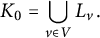 $$ \begin{align*} K_0=\bigcup_{v\in V}L_v. \end{align*} $$
Let
 $$ \begin{align*} Y=\{1, ex : x\in X\}\cup\bigl(E(K_0)\cap R_e\bigr)\subseteq(K_0\cap R_e)^1. \end{align*} $$
Clearly, Y is finite. We claim that the Y-diameter of $K_0^1$
is no more than
$K_0^1$
is no more than $2n+3.$
Indeed, let
$2n+3.$
Indeed, let $a, b\in K_0.$
Let f be the idempotent in the
$a, b\in K_0.$
Let f be the idempotent in the ${\mathcal {H}}$
-class of
${\mathcal {H}}$
-class of $ea,$
and let g be the idempotent in the
$ea,$
and let g be the idempotent in the ${\mathcal {H}}$
-class of
${\mathcal {H}}$
-class of $eb.$
Then
$eb.$
Then $f, g\in E(K_0)\cap R_e\subseteq Y.$
Now, there exists an X-sequence
$f, g\in E(K_0)\cap R_e\subseteq Y.$
Now, there exists an X-sequence
 $$ \begin{align*} a=x_1s_1,\ y_1s_1=x_2s_2,\ \dots,\ y_ks_k=f \end{align*} $$
in $S,$
where
$S,$
where $k\leq n.$
Therefore, we have a Y-sequence
$k\leq n.$
Therefore, we have a Y-sequence
 $$ \begin{align*} a=1a,\ ea=eaf=(ex_1)(s_1f),\ (ey_1)(s_1f)=(ex_2)(s_2f), \dots,\ (ey_k)(s_k)f=ef^2=f \end{align*} $$
in $K_0$
that has length
$K_0$
that has length $k+1.$
Similarly, there exists a Y-sequence of length at most
$k+1.$
Similarly, there exists a Y-sequence of length at most $n+1$
from b to
$n+1$
from b to $g.$
Since
$g.$
Since $f, g\in Y,$
we conclude that there exists a Y-sequence of length at most
$f, g\in Y,$
we conclude that there exists a Y-sequence of length at most $2n+3$
from a to
$2n+3$
from a to $b,$
as required.
$b,$
as required.
For (2b), let R be any ${\mathcal {R}}$
-class of
${\mathcal {R}}$
-class of $K.$
Then R is a pseudo-finite as a right S-act by Proposition 4.1, and hence the quotient
$K.$
Then R is a pseudo-finite as a right S-act by Proposition 4.1, and hence the quotient $R/\mathcal {H}$
is pseudo-finite by Lemma 3.10.
$R/\mathcal {H}$
is pseudo-finite by Lemma 3.10.
(2) $\Rightarrow $
(3). Condition (3b) is identical to (2b), so we just need to prove that (3a) holds. Let
$\Rightarrow $
(3). Condition (3b) is identical to (2b), so we just need to prove that (3a) holds. Let $K_0$
be as given in (2a). In particular,
$K_0$
be as given in (2a). In particular, $K_0$
is the union of finitely many
$K_0$
is the union of finitely many ${\mathcal {L}}$
-classes. Consider a maximal subgroup
${\mathcal {L}}$
-classes. Consider a maximal subgroup $G=H_e$
of
$G=H_e$
of $K_0.$
Let
$K_0.$
Let $T=K_0^1.$
Since T is right pseudo-finite, there exists a finite set
$T=K_0^1.$
Since T is right pseudo-finite, there exists a finite set $Y\subseteq T$
such that
$Y\subseteq T$
such that $\omega _T=\langle Y\rangle $
and the Y-diameter of T is finite, say
$\omega _T=\langle Y\rangle $
and the Y-diameter of T is finite, say $n.$
Let
$n.$
Let $F=\{e,\, eye: y\in Y\},$
and let
$F=\{e,\, eye: y\in Y\},$
and let $X=V\cup F$
where V is as given in the statement. Clearly, F is finite, but V may be infinite. We claim that
$X=V\cup F$
where V is as given in the statement. Clearly, F is finite, but V may be infinite. We claim that $\omega _G=\langle X\rangle $
and that X-diameter of G is no greater than
$\omega _G=\langle X\rangle $
and that X-diameter of G is no greater than $3n.$
Indeed, let
$3n.$
Indeed, let $u, v\in G.$
Then there exists a Y-sequence
$u, v\in G.$
Then there exists a Y-sequence
 $$ \begin{align} u=x_1t_1,\, y_1t_1=x_2t_2,\cdots, y_kt_k=v \end{align} $$
in $T,$
where
$T,$
where $k\leq n$
. Let
$k\leq n$
. Let $x_i'=ex_ie, y_i'=ey_ie, t_i'=et_ie,$
let
$x_i'=ex_ie, y_i'=ey_ie, t_i'=et_ie,$
let $e_i, f_i, g_i$
be the idempotents in the
$e_i, f_i, g_i$
be the idempotents in the ${\mathcal {H}}$
-classes of
${\mathcal {H}}$
-classes of $ex_i, ey_i, t_ie,$
respectively, and let
$ex_i, ey_i, t_ie,$
respectively, and let $a_i=e_ig_i$
and
$a_i=e_ig_i$
and $b_i=f_ig_i.$
The elements are arranged in the following egg-box pattern.
$b_i=f_ig_i.$
The elements are arranged in the following egg-box pattern.
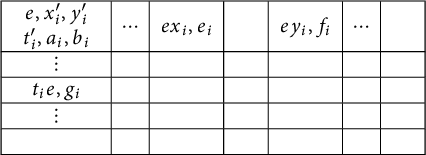 $$\begin{align*}\begin{array}{|c|c|c|c|c|c|c|} \hline \begin{array}{c} e, x_i', y_i'\\ t_i^{\prime}, a_i, b_i\end{array}&\cdots &ex_i, e_i &\phantom{xx} &ey_i, f_i &\cdots &\phantom{xx}\\ \hline \vdots &&&&&& \\ \hline t_ie, g_i&&&&&&\\ \hline \vdots&&&&&&\\ \hline &&&&&&\\ \hline \end{array} \end{align*}$$
Note that $x_i^{\prime }, y_i^{\prime }\in F$
and
$x_i^{\prime }, y_i^{\prime }\in F$
and $a_i, b_i\in V.$
We claim that we have a sequence
$a_i, b_i\in V.$
We claim that we have a sequence
 $$ \begin{align} u=x_1'a_1t_1',\, y_1'b_1t_1'=x_2'a_2t_2',\cdots, y_k'b_kt_k'=v. \end{align} $$
To see this, observe that
 $$\begin{align*}x_i'a_it_i'=(ex_ie)(e_ig_i)(et_ie)=(ex_i)(ee_i)(g_ie)(t_ie)=(ex_i)e_ig_i(t_ie)=(ex_i)(t_ie).\end{align*}$$
Similarly, we have $y_i'a_it_i'=(ey_i)(t_ie).$
Thus, multiplying the sequence (5.1) both on the left and right by e yields the sequence (5.2). Now, for each
$y_i'a_it_i'=(ey_i)(t_ie).$
Thus, multiplying the sequence (5.1) both on the left and right by e yields the sequence (5.2). Now, for each $i\in \{1, \dots , k\},$
there exists an X-sequence
$i\in \{1, \dots , k\},$
there exists an X-sequence
 $$ \begin{align*} x_i'a_it_i'=x_i'(a_it_i'),\, e(a_it_i')=a_it_i',\, b_it_i'=e(b_it_i'),\, y_i'(b_it_i')=y_i'b_it_i', \end{align*} $$
which has length 3. We conclude that there exists an X-sequence of length no greater than $3n$
from u to
$3n$
from u to $v,$
as required.
$v,$
as required.
(3) $\Rightarrow $
(1). Fix
$\Rightarrow $
(1). Fix $e\in K_0$
, and let
$e\in K_0$
, and let $R=R_e.$
By Proposition 4.1, it suffices to prove that R is pseudo-finite as a right S-act. Let
$R=R_e.$
By Proposition 4.1, it suffices to prove that R is pseudo-finite as a right S-act. Let $G=H_e.$
By (3a), G has finite
$G=H_e.$
By (3a), G has finite $(F\cup V)$
-diameter, say
$(F\cup V)$
-diameter, say $n,$
where F and V are as given in the statement. By (3b), the quotient
$n,$
where F and V are as given in the statement. By (3b), the quotient $A=R/{\mathcal {H}}=\{ [a]_{\mathcal {H}}\, :\, a\in R\}$
is pseudo-finite. Let
$A=R/{\mathcal {H}}=\{ [a]_{\mathcal {H}}\, :\, a\in R\}$
is pseudo-finite. Let $\omega _A=\langle Y\rangle $
for some finite set
$\omega _A=\langle Y\rangle $
for some finite set $Y\subseteq A,$
and let m be the Y-diameter of
$Y\subseteq A,$
and let m be the Y-diameter of $A.$
For each
$A.$
For each $y\in Y$
, choose
$y\in Y$
, choose $x_y\in R$
such that
$x_y\in R$
such that $y=[x_y]_{\mathcal {H}},$
and let
$y=[x_y]_{\mathcal {H}},$
and let $X=\{x_y : y\in Y\}.$
We claim that
$X=\{x_y : y\in Y\}.$
We claim that $\omega _R$
is generated by the finite set
$\omega _R$
is generated by the finite set
 $$ \begin{align*} Z=F\cup\bigl(E(K_0)\cap R\bigr)\cup X, \end{align*} $$
and that the Z-diameter of R is no greater than $2n(m+1)+m.$
We first claim that for any $u, v\in R$
such that
$u, v\in R$
such that $u\,{\mathcal {H}}\,v,$
there exists a Z-sequence of length no greater than
$u\,{\mathcal {H}}\,v,$
there exists a Z-sequence of length no greater than $2n$
from u to
$2n$
from u to $v.$
Indeed, let u and v be as given above. If
$v.$
Indeed, let u and v be as given above. If $u=v$
, then we are done, so assume that
$u=v$
, then we are done, so assume that $u\neq v.$
Let h be the idempotent in
$u\neq v.$
Let h be the idempotent in $H_u=H_v.$
We have that
$H_u=H_v.$
We have that $ue, ve\in G,$
so there exists an
$ue, ve\in G,$
so there exists an $(F\cup V)$
-sequence
$(F\cup V)$
-sequence
 $$ \begin{align*} ue=u_1s_1, v_1s_1=u_2s_2, \dots, v_ks_k=ve, \end{align*} $$
where $k\leq n.$
Since
$k\leq n.$
Since $eh=h$
and
$eh=h$
and $uh=u, vh=v,$
multiplying the above sequence on the right by
$uh=u, vh=v,$
multiplying the above sequence on the right by $h,$
we obtain an
$h,$
we obtain an $(F\cup V)$
-sequence
$(F\cup V)$
-sequence
 $$ \begin{align*} u=u_1s_1h, v_1s_1h=u_2s_2h, \dots, v_ks_kh=v. \end{align*} $$
If $u_i, v_i\in F$
for all
$u_i, v_i\in F$
for all $i\in \{1, \dots , k\},$
then we have an F-sequence from u to
$i\in \{1, \dots , k\},$
then we have an F-sequence from u to $v,$
and we are done. So suppose otherwise, and consider
$v,$
and we are done. So suppose otherwise, and consider $(w, z)\in \{(u_i, v_i), (v_i, u_i)\}$
such that
$(w, z)\in \{(u_i, v_i), (v_i, u_i)\}$
such that $w\in V.$
Then
$w\in V.$
Then $w=fg$
where
$w=fg$
where $f, g \in E(K_0)$
and
$f, g \in E(K_0)$
and $f\,{\mathcal {R}}\,e\,{\mathcal {L}}\,g.$
Since
$f\,{\mathcal {R}}\,e\,{\mathcal {L}}\,g.$
Since $e, f\in E(K_0)\cap R,$
we have a Z-sequence
$e, f\in E(K_0)\cap R,$
we have a Z-sequence
 $$ \begin{align*} ws_ih=f(gs_ih),\, e(gs_ih)=es_ih. \end{align*} $$
If $z\in V$
, then, by the same argument, there exists a Z-sequence of length 1 from
$z\in V$
, then, by the same argument, there exists a Z-sequence of length 1 from $zs_ih$
to
$zs_ih$
to $es_ih.$
Otherwise, if
$es_ih.$
Otherwise, if $z\in F,$
then clearly we have a Z-sequence of length 1 from
$z\in F,$
then clearly we have a Z-sequence of length 1 from $zs_ih$
to
$zs_ih$
to $es_ih.$
It follows that there is a Z-sequence of length 2 from
$es_ih.$
It follows that there is a Z-sequence of length 2 from $ws_ih$
to
$ws_ih$
to $zs_ih.$
We conclude that there is a Z-sequence of length no greater than
$zs_ih.$
We conclude that there is a Z-sequence of length no greater than $2n$
from u to
$2n$
from u to $v,$
establishing the claim.
$v,$
establishing the claim.
Now let $a, b\in R.$
Then
$a, b\in R.$
Then $[a]_{\mathcal {H}}, [b]_{\mathcal {H}}\in A,$
so there exists a Y-sequence
$[a]_{\mathcal {H}}, [b]_{\mathcal {H}}\in A,$
so there exists a Y-sequence
 $$ \begin{align*} [a]_{\mathcal{H}}=y_1t_1, z_1t_1=y_2t_2, \dots, z_lt_l=[b]_{\mathcal{H}}, \end{align*} $$
where $y_i, z_i\in Y, t_i\in S^1$
and
$y_i, z_i\in Y, t_i\in S^1$
and $l\leq m.$
Letting
$l\leq m.$
Letting $x_i=x_{y_i}$
and
$x_i=x_{y_i}$
and $x_i^{\prime }=x_{z_i},$
we deduce that
$x_i^{\prime }=x_{z_i},$
we deduce that
 $$ \begin{align*} a\,{\mathcal{H}}\,x_1t_1,\, x_1^{\prime}t_1\,{\mathcal{H}}\,x_2t_2,\, \dots, x_l^{\prime}t_l\,{\mathcal{H}}\,b. \end{align*} $$
Note that $x_i, x_i^{\prime }\in X.$
By the above claim, for each pair
$x_i, x_i^{\prime }\in X.$
By the above claim, for each pair $(u, v)$
in
$(u, v)$
in
 $$ \begin{align*} \{(a, x_1t_1), (x_i^{\prime}t_i, x_{i+1}t_{i+1}), (x_l^{\prime}t_l, b) : 1\leq i\leq l-1\}, \end{align*} $$
there exists a Z-sequence of length no greater than $2n$
from u to
$2n$
from u to $v.$
By interleaving these sequences with single steps from
$v.$
By interleaving these sequences with single steps from $x_it_i$
to
$x_it_i$
to $x_it_i^{\prime },$
we obtain a Z-sequence of length no greater than
$x_it_i^{\prime },$
we obtain a Z-sequence of length no greater than $2n(m+1)+m$
from a to
$2n(m+1)+m$
from a to $b.$
This completes the proof.
$b.$
This completes the proof.
Corollary 5.2 Let S be a right pseudo-finite monoid with a completely simple minimal ideal $K.$
If K has finitely many
$K.$
If K has finitely many ${\mathcal {R}}$
-classes, then its maximal subgroups are finite.
${\mathcal {R}}$
-classes, then its maximal subgroups are finite.
Proof By Theorem 5.1, there exists a left ideal $K_0$
of K such that
$K_0$
of K such that $K_0$
is the union of finitely many
$K_0$
is the union of finitely many ${\mathcal {L}}$
-classes and any maximal subgroup
${\mathcal {L}}$
-classes and any maximal subgroup $G=H_e$
of
$G=H_e$
of $K_0$
has finite (
$K_0$
has finite ( $F\cup V$
)-diameter, where
$F\cup V$
)-diameter, where $F\subseteq G$
is finite and
$F\subseteq G$
is finite and
 $$ \begin{align*}V=\{fg : f, g \in E(K_0), f\,{\mathcal{R}}\,e\,{\mathcal{L}}\,g\}.\end{align*} $$
Since every maximal subgroup of K is isomorphic to $G,$
it suffices to prove that G is finite. Since
$G,$
it suffices to prove that G is finite. Since $K_0$
is completely simple (and hence regular), Green’s relation
$K_0$
is completely simple (and hence regular), Green’s relation ${\mathcal {R}}$
on
${\mathcal {R}}$
on $K_0$
is the restriction of Green’s relation
$K_0$
is the restriction of Green’s relation ${\mathcal {R}}$
on K [Reference Howie9, Proposition 2.4.2]. Therefore, since K has finitely many
${\mathcal {R}}$
on K [Reference Howie9, Proposition 2.4.2]. Therefore, since K has finitely many ${\mathcal {R}}$
-classes, so does
${\mathcal {R}}$
-classes, so does $K_0.$
Since
$K_0.$
Since $K_0$
has finitely many
$K_0$
has finitely many ${\mathcal {L}}$
-classes, we conclude that
${\mathcal {L}}$
-classes, we conclude that $K_0$
is the union of finitely many maximal subgroups. Thus,
$K_0$
is the union of finitely many maximal subgroups. Thus, $E(K_0)$
is finite. It follows that V is finite. Since F is finite, we have that
$E(K_0)$
is finite. It follows that V is finite. Since F is finite, we have that $F\cup V$
is finite, and hence G is right pseudo-finite. Then G is finite by Proposition 3.3.
$F\cup V$
is finite, and hence G is right pseudo-finite. Then G is finite by Proposition 3.3.
Remark 5.3 If a monoid S has a completely simple minimal ideal K whose maximal subgroups are finite, then S clearly satisfies condition (3a) of Theorem 5.1 (where $K_0$
can be taken to be any
$K_0$
can be taken to be any ${\mathcal {L}}$
-class of K), so S is right pseudo-finite if and only if for any
${\mathcal {L}}$
-class of K), so S is right pseudo-finite if and only if for any ${\mathcal {R}}$
-class R of K the right S-act
${\mathcal {R}}$
-class R of K the right S-act $R/{\mathcal {H}}$
is pseudo-finite.
$R/{\mathcal {H}}$
is pseudo-finite.
Remark 5.4 It is possible for a right pseudo-finite monoid to have a completely simple minimal ideal that has finitely many ${\mathcal {R}}$
-classes and infinitely many
${\mathcal {R}}$
-classes and infinitely many ${\mathcal {L}}$
-classes. Indeed, as discussed in Section 3, the full transformation monoid
${\mathcal {L}}$
-classes. Indeed, as discussed in Section 3, the full transformation monoid $\mathcal {T}_X$
on an infinite set X is right pseudo-finite and has a minimal ideal that is an infinite right zero semigroup, which has a single
$\mathcal {T}_X$
on an infinite set X is right pseudo-finite and has a minimal ideal that is an infinite right zero semigroup, which has a single ${\mathcal {R}}$
-class and infinitely many
${\mathcal {R}}$
-class and infinitely many ${\mathcal {L}}$
-classes.
${\mathcal {L}}$
-classes.
Specializing Theorem 5.1 to completely simple semigroups with $1$
adjoined, we obtain the following corollary.
$1$
adjoined, we obtain the following corollary.
Corollary 5.5 Let K be a completely simple semigroup, and let $S=K^1.$
Then S is right pseudo-finite if and only if:
$S=K^1.$
Then S is right pseudo-finite if and only if:
-
(1) K has finitely many
${\mathcal {L}}$
-classes; and -
(2) any maximal subgroup
$G=H_e$
of K has finite (
$F\cup V$
)-diameter, where
$F\subseteq G$
is finite and
$V=\{fg : f, g \in E(K), f\,{\mathcal {R}}\, e\,{\mathcal {L}}\, g\}.$


Proof Notice that the action of a completely simple semigroup K on $R/{\mathcal {H}}$
, where R is an
$R/{\mathcal {H}}$
, where R is an ${\mathcal {R}}$
-class, satisfies the following property: if
${\mathcal {R}}$
-class, satisfies the following property: if $[x]_{\mathcal {H}}, [y]_{\mathcal {H}}\in R/{\mathcal {H}}$
, then for any
$[x]_{\mathcal {H}}, [y]_{\mathcal {H}}\in R/{\mathcal {H}}$
, then for any $s\in K$
we have
$s\in K$
we have $[x]_{\mathcal {H}}s=[y]_{\mathcal {H}}s$
. It follows that every equivalence relation on the S-act
$[x]_{\mathcal {H}}s=[y]_{\mathcal {H}}s$
. It follows that every equivalence relation on the S-act $R/{\mathcal {H}}$
is a congruence, or, in other words, the congruence generated by a set is the smallest equivalence relation containing that set. Hence, the full congruence is finitely generated only if
$R/{\mathcal {H}}$
is a congruence, or, in other words, the congruence generated by a set is the smallest equivalence relation containing that set. Hence, the full congruence is finitely generated only if $R/{\mathcal {H}}$
is finite. The rest of the proof is a direct application of Theorem 5.1.
$R/{\mathcal {H}}$
is finite. The rest of the proof is a direct application of Theorem 5.1.
Remark 5.6 As discussed in Section 2, every completely simple semigroup can be represented as a Rees matrix semigroup $K=\mathcal {M}[G;I, J;P]$
, where G is a group and P is normal, meaning that
$K=\mathcal {M}[G;I, J;P]$
, where G is a group and P is normal, meaning that $p_{1,i}=p_{j,1}=1_G$
for all
$p_{1,i}=p_{j,1}=1_G$
for all $i\in I$
,
$i\in I$
, $j\in J,$
where
$j\in J,$
where $1\in I\cap J.$
In this representation, assuming without loss of generality that
$1\in I\cap J.$
In this representation, assuming without loss of generality that $e=(1, 1_G, 1),$
the set
$e=(1, 1_G, 1),$
the set $\{fg : f, g \in E(K), f\,{\mathcal {R}}\, e\,{\mathcal {L}}\, g\}$
corresponds to the set of entries
$\{fg : f, g \in E(K), f\,{\mathcal {R}}\, e\,{\mathcal {L}}\, g\}$
corresponds to the set of entries $\{p_{j,i}\:: \: i\in I,\ j\in J\}$
(see the proof of [Reference Howie9, Theorem 3.2.3]). If this set of entries comprises the whole of
$\{p_{j,i}\:: \: i\in I,\ j\in J\}$
(see the proof of [Reference Howie9, Theorem 3.2.3]). If this set of entries comprises the whole of $G,$
and if J is finite, Corollary 5.5 implies that
$G,$
and if J is finite, Corollary 5.5 implies that $S=K^1$
is right pseudo-finite. Specializing further, if we take an infinite group G, take I such that
$S=K^1$
is right pseudo-finite. Specializing further, if we take an infinite group G, take I such that $|I|=|G|,$
set
$|I|=|G|,$
set $J=\{1,2\}$
, and populate the second row of P with all the elements of
$J=\{1,2\}$
, and populate the second row of P with all the elements of $G,$
we obtain a right pseudo-finite semigroup with a completely simple ideal that has infinite maximal subgroups.
$G,$
we obtain a right pseudo-finite semigroup with a completely simple ideal that has infinite maximal subgroups.
In what follows, we consider some conditions on right pseudo-finite monoids that imply the existence of a completely simple minimal ideal.
Proposition 5.3 of [Reference Dandan, Gould, Quinn-Gregson and Zenab5] provides necessary and sufficient conditions for an inverse monoid to be right pseudo-finite. An immediate consequence is the following.
Proposition 5.7 An inverse monoid is right pseudo-finite if and only if it has a minimal ideal that is a finite group.
A semigroup is said to be completely regular if it is a union of groups. The class of completely regular semigroups includes completely simple semigroups, Clifford semigroups, and bands. By [Reference Dandan, Gould, Quinn-Gregson and Zenab5, Corollary 8.3], we have the following proposition.
Proposition 5.8 Every right pseudo-finite completely regular monoid has a completely simple minimal ideal.
A regular semigroup is said to be orthodox if its idempotents form a subsemigroup. We note that all inverse semigroups are orthodox, but the converse is not true; moreover, orthodox semigroups need not be completely regular, and vice versa.
The proof of Theorem 5.10 makes use of some techniques from classical semigroup theory. We explain them as we come across them, with the exception of the following construction of a semilattice of subsemigroups, which we will also need in Section 6.
Definition 5.9 A semigroup S is a semilattice Y of subsemigroups $S_{\alpha },\alpha \in Y$
, if (i)
$S_{\alpha },\alpha \in Y$
, if (i) $S_{\alpha }\cap S_{\beta }=\emptyset $
for all
$S_{\alpha }\cap S_{\beta }=\emptyset $
for all $\alpha \neq \beta \in Y$
; (ii)
$\alpha \neq \beta \in Y$
; (ii) $S=\bigcup _{\alpha \in Y}S_{\alpha }$
; and (iii)
$S=\bigcup _{\alpha \in Y}S_{\alpha }$
; and (iii) $S_{\alpha }S_{\beta }\subseteq S_{\alpha \beta }$
for all
$S_{\alpha }S_{\beta }\subseteq S_{\alpha \beta }$
for all $\alpha ,\beta \in Y$
.
$\alpha ,\beta \in Y$
.
Notice that if S is a semilattice Y of subsemigroups, then Y is a homomorphic image of $S.$
Thus, if S is right pseudo-finite, then by Lemma 3.12 so is
$S.$
Thus, if S is right pseudo-finite, then by Lemma 3.12 so is $Y,$
and hence Y is forced to have a zero by [Reference Dandan, Gould, Quinn-Gregson and Zenab5, Proposition 5.3]. It is worth remarking that a completely regular semigroup is a semilattice of completely simple semigroups, which together with the foregoing remark yields Proposition 5.8. For orthodox semigroups, we must work a little harder.
$Y,$
and hence Y is forced to have a zero by [Reference Dandan, Gould, Quinn-Gregson and Zenab5, Proposition 5.3]. It is worth remarking that a completely regular semigroup is a semilattice of completely simple semigroups, which together with the foregoing remark yields Proposition 5.8. For orthodox semigroups, we must work a little harder.
Theorem 5.10 Let S be an orthodox monoid. Then the following are equivalent:
-
(1) S is right pseudo-finite.
-
(2) S has a completely simple minimal ideal K whose (maximal) subgroups are finite, and the right S-act
$R/{\mathcal {H}}$
is pseudo-finite for any
$\mathcal {R}$
-class R of
$K.$


Proof (1) $\Rightarrow $
(2). Denoting by B the band of idempotents
$\Rightarrow $
(2). Denoting by B the band of idempotents $E(S)$
of S, we have that B is a semilattice Y of rectangular bands
$E(S)$
of S, we have that B is a semilattice Y of rectangular bands $B_{\alpha }, \alpha \in Y$
[Reference Howie9, Theorem 4.4.1]. Moreover,
$B_{\alpha }, \alpha \in Y$
[Reference Howie9, Theorem 4.4.1]. Moreover, $S/\gamma $
is an inverse monoid, where
$S/\gamma $
is an inverse monoid, where $\gamma $
is the least inverse congruence on
$\gamma $
is the least inverse congruence on $S.$
It follows from [Reference Howie9, equation (6.2.5)] that
$S.$
It follows from [Reference Howie9, equation (6.2.5)] that $E(S/\gamma )\cong Y.$
Now,
$E(S/\gamma )\cong Y.$
Now, $S/\gamma $
is right pseudo-finite by Lemma 3.12, and hence, by [Reference Dandan, Gould, Quinn-Gregson and Zenab5, Proposition 5.3], the semilattice Y has a least element
$S/\gamma $
is right pseudo-finite by Lemma 3.12, and hence, by [Reference Dandan, Gould, Quinn-Gregson and Zenab5, Proposition 5.3], the semilattice Y has a least element $0.$
It follows that the rectangular band
$0.$
It follows that the rectangular band $B_0$
is the minimal ideal of B. Fix an idempotent e in
$B_0$
is the minimal ideal of B. Fix an idempotent e in $B_0.$
We claim that the
$B_0.$
We claim that the ${\mathcal {L}}$
-class
${\mathcal {L}}$
-class $L_e$
of S is a minimal left ideal. Clearly, it suffices to prove that
$L_e$
of S is a minimal left ideal. Clearly, it suffices to prove that $L_e$
is a left ideal. So, let
$L_e$
is a left ideal. So, let $a\in L_e$
and
$a\in L_e$
and $s\in S.$
Then
$s\in S.$
Then $a=ae$
and hence
$a=ae$
and hence $sa=sae.$
Let f be an idempotent such that
$sa=sae.$
Let f be an idempotent such that $sa\,{\mathcal {L}}\,f.$
Then it follows that
$sa\,{\mathcal {L}}\,f.$
Then it follows that $f=fe.$
Consequently, by the minimality of
$f=fe.$
Consequently, by the minimality of $B_0,$
we have
$B_0,$
we have $f\in B_0.$
From
$f\in B_0.$
From $f=fe$
and the fact that
$f=fe$
and the fact that $B_0$
is a rectangular band, we obtain
$B_0$
is a rectangular band, we obtain $f\,{\mathcal {L}}\,e.$
It follows by transitivity that
$f\,{\mathcal {L}}\,e.$
It follows by transitivity that $sa\in L_e,$
as required. A dual argument proves that the
$sa\in L_e,$
as required. A dual argument proves that the ${\mathcal {R}}$
-class
${\mathcal {R}}$
-class $R_e$
is a minimal right ideal of
$R_e$
is a minimal right ideal of $S.$
Since S has both a minimal left ideal and a minimal right ideal, it has a completely simple minimal ideal, say
$S.$
Since S has both a minimal left ideal and a minimal right ideal, it has a completely simple minimal ideal, say $K.$
$K.$
To prove that the maximal subgroups of K are finite, we consider the map
 $$ \begin{align*} \varphi_e : S\rightarrow S, a\mapsto eae. \end{align*} $$
Since K is completely simple and the minimal ideal of $S,$
it is clear that the image of
$S,$
it is clear that the image of $\varphi _e$
is
$\varphi _e$
is $H_e.$
Let
$H_e.$
Let $a, b\in S.$
Since S is regular, there exist idempotents
$a, b\in S.$
Since S is regular, there exist idempotents $g, h\in E(S)$
such that
$g, h\in E(S)$
such that $ea\,{\mathcal {L}}\,g$
and
$ea\,{\mathcal {L}}\,g$
and $h\,{\mathcal {R}}\,be.$
But then,
$h\,{\mathcal {R}}\,be.$
But then, $g, h\in B_0.$
Since
$g, h\in B_0.$
Since $B_0$
is a rectangular band, we have
$B_0$
is a rectangular band, we have $geh=gh.$
Consequently, we have
$geh=gh.$
Consequently, we have
 $$ \begin{align*} (ab)\varphi_e&=e(ab)e= (ea)(be)=(eag)(hbe)=(ea)(gh)(be)\\ &=(ea)(geh)(be)=(eag)e(hbe)=(ea)e(be)=(eae)(ebe)\\ &=(a\varphi_e)(b\varphi_e), \end{align*} $$
so that $\varphi _e$
is a homomorphism. Thus,
$\varphi _e$
is a homomorphism. Thus, $H_e$
is right pseudo-finite by Lemma 3.12, and hence
$H_e$
is right pseudo-finite by Lemma 3.12, and hence $H_e$
is finite by Proposition 3.3.
$H_e$
is finite by Proposition 3.3.
By Theorem 5.1, the right S-act $R/{\mathcal {H}}$
is pseudo-finite for any
$R/{\mathcal {H}}$
is pseudo-finite for any $\mathcal {R}$
-class R of
$\mathcal {R}$
-class R of $K.$
$K.$
(2) $\Rightarrow $
(1). This follows from Remark 5.3.
$\Rightarrow $
(1). This follows from Remark 5.3.
Example 5.11 In the case of orthodox monoids, we cannot make inferences about finiteness of the minimal ideal, or of its constituent ${\mathcal {R}}$
- or
${\mathcal {R}}$
- or ${\mathcal {L}}$
-classes. Indeed, let S be any infinite right pseudo-finite orthodox monoid, e.g., an infinite group with a zero adjoined. Let T be the extension by constants of S (see [Reference Grillet8, p. 155]). Then
${\mathcal {L}}$
-classes. Indeed, let S be any infinite right pseudo-finite orthodox monoid, e.g., an infinite group with a zero adjoined. Let T be the extension by constants of S (see [Reference Grillet8, p. 155]). Then $T=S\cup I$
, where
$T=S\cup I$
, where $I=\{c_u\::\: u\in S\}$
is a right zero semigroup (i.e.
$I=\{c_u\::\: u\in S\}$
is a right zero semigroup (i.e. $c_uc_v=c_v$
), and
$c_uc_v=c_v$
), and $sc_u=c_u$
,
$sc_u=c_u$
, $c_us=c_{us}$
. The semigroup T can be viewed concretely as follows: for
$c_us=c_{us}$
. The semigroup T can be viewed concretely as follows: for $s\in S$
, let
$s\in S$
, let $\rho _s\::\: S^0\rightarrow S^0$
be the right translation by s, and let
$\rho _s\::\: S^0\rightarrow S^0$
be the right translation by s, and let $\gamma _s:S^0\rightarrow S$
be the constant mapping with value s. Then T is isomorphic to the subsemigroup
$\gamma _s:S^0\rightarrow S$
be the constant mapping with value s. Then T is isomorphic to the subsemigroup $\{\rho _s,\gamma _s\::\: s\in S\}$
of
$\{\rho _s,\gamma _s\::\: s\in S\}$
of $T_{S^0}$
. It is clear that T is orthodox and that I is a (completely simple) minimal ideal with infinitely many (trivial)
$T_{S^0}$
. It is clear that T is orthodox and that I is a (completely simple) minimal ideal with infinitely many (trivial) ${\mathcal {L}}$
-classes. Since the action of S on I is pseudo-finite, it follows from Proposition 4.1 that T is right pseudo-finite. Of course, we can extend S by left constants, by embedding it into the subsemigroup
${\mathcal {L}}$
-classes. Since the action of S on I is pseudo-finite, it follows from Proposition 4.1 that T is right pseudo-finite. Of course, we can extend S by left constants, by embedding it into the subsemigroup $\{\lambda _s,\gamma _s\::\: s\in S\}$
of the dual transformation monoid
$\{\lambda _s,\gamma _s\::\: s\in S\}$
of the dual transformation monoid $T_{S^0}^{\ast }$
, where
$T_{S^0}^{\ast }$
, where $\lambda _s$
is the left translation by S. Finally, we may extend S by the rectangular band of left and right constants, by embedding into the subsemigroup
$\lambda _s$
is the left translation by S. Finally, we may extend S by the rectangular band of left and right constants, by embedding into the subsemigroup $\{(\lambda _s,\rho _s),(\gamma _s,\gamma _t)\::\: s,t\in S\}$
of the direct product
$\{(\lambda _s,\rho _s),(\gamma _s,\gamma _t)\::\: s,t\in S\}$
of the direct product $T_{S^0}^{\ast }\times T_{S^0}$
; this last monoid is orthodox with infinitely many
$T_{S^0}^{\ast }\times T_{S^0}$
; this last monoid is orthodox with infinitely many ${\mathcal {R}}$
- and
${\mathcal {R}}$
- and ${\mathcal {L}}$
-classes in the minimal ideal, and is both left and right pseudo-finite.
${\mathcal {L}}$
-classes in the minimal ideal, and is both left and right pseudo-finite.
We now turn our attention to the class of ${\mathcal {J}}$
-trivial monoids. In what follows, a local zero of an element a in a semigroup S is any idempotent
${\mathcal {J}}$
-trivial monoids. In what follows, a local zero of an element a in a semigroup S is any idempotent $e\in E(S)$
such that
$e\in E(S)$
such that $ae=ea=e.$
Lemma 5.12 Let S be a ${\mathcal {J}}$
-trivial monoid, and let
${\mathcal {J}}$
-trivial monoid, and let $a\in S.$
An idempotent
$a\in S.$
An idempotent $e\in E(S)$
is a local zero of a if and only if
$e\in E(S)$
is a local zero of a if and only if $e\,{\leq _{\mathcal {J}}}\,a.$
Proof The forward implication is clear. For the converse, we have that $e=sat$
for some
$e=sat$
for some $s, t\in S.$
Then
$s, t\in S.$
Then $e=e^2=esat.$
Thus,
$e=e^2=esat.$
Thus, $e\,{\mathcal {R}}\,es,$
so
$e\,{\mathcal {R}}\,es,$
so $e=es$
since
$e=es$
since ${\mathcal {R}}\subseteq {\mathcal {J}}$
and S is
${\mathcal {R}}\subseteq {\mathcal {J}}$
and S is ${\mathcal {J}}$
-trivial. Then
${\mathcal {J}}$
-trivial. Then $e=eat,$
so
$e=eat,$
so $e\,{\mathcal {R}}\,ea$
and hence
$e\,{\mathcal {R}}\,ea$
and hence $e=ea.$
A dual argument proves that
$e=ea.$
A dual argument proves that $e=ae.$
Theorem 5.13 Let S be a ${\mathcal {J}}$
-trivial monoid in which every element has a local zero. Then S is right pseudo-finite if and only if it has a zero.
${\mathcal {J}}$
-trivial monoid in which every element has a local zero. Then S is right pseudo-finite if and only if it has a zero.
Proof The reverse implication follows immediately from Corollary 4.2. For the direct implication, let $D_r(S)=n,$
and let
$D_r(S)=n,$
and let $X\subseteq S$
be a finite generating set for
$X\subseteq S$
be a finite generating set for $\omega _S$
such that
$\omega _S$
such that $D_r(X, S)=n.$
For each
$D_r(X, S)=n.$
For each $u\in S,$
choose a local zero
$u\in S,$
choose a local zero $u^{\ast }$
of
$u^{\ast }$
of $u.$
Consider
$u.$
Consider $a\in S.$
There exists an X-sequence
$a\in S.$
There exists an X-sequence
 $$ \begin{align*}1=x_1s_1,\ y_1s_1=x_2s_2,\ \ldots,\ y_ks_k=a,\end{align*} $$
where $k\leq n.$
Then
$k\leq n.$
Then $x_1, s_1\in J_1,$
so
$x_1, s_1\in J_1,$
so $x_1=s_1=1$
since S is
$x_1=s_1=1$
since S is ${\mathcal {J}}$
-trivial. Let
${\mathcal {J}}$
-trivial. Let $e_1=y_1^{\ast }.$
Then
$e_1=y_1^{\ast }.$
Then $e_1\,{\leq _{\mathcal {J}}}\,y_1=y_1s_1.$
Thus, if
$e_1\,{\leq _{\mathcal {J}}}\,y_1=y_1s_1.$
Thus, if $k=1$
, then
$k=1$
, then $e_1\,{\leq _{\mathcal {J}}}\,a.$
Suppose that
$e_1\,{\leq _{\mathcal {J}}}\,a.$
Suppose that $k>1.$
For each
$k>1.$
For each $i\in \{1, \dots , k-1\},$
let
$i\in \{1, \dots , k-1\},$
let $e_{i+1}=(y_{i+1}^{\ast }e_i)^{\ast }.$
Let
$e_{i+1}=(y_{i+1}^{\ast }e_i)^{\ast }.$
Let $i\in \{1, \dots , k-1\}$
and assume that
$i\in \{1, \dots , k-1\}$
and assume that $e_i\,{\leq _{\mathcal {J}}}\,y_is_i.$
Then
$e_i\,{\leq _{\mathcal {J}}}\,y_is_i.$
Then
 $$ \begin{align*}s_{i+1}\,{\geq_{\mathcal{J}}}\,x_{i+1}s_{i+1}=y_is_i\,{\geq_{\mathcal{J}}}\,e_i,\end{align*} $$
so $s_{i+1}e_i=e_i.$
Then
$s_{i+1}e_i=e_i.$
Then
 $$ \begin{align*}y_{i+1}s_{i+1}\,{\geq_{\mathcal{J}}}\,y_{i+1}^{\ast}y_{i+1}s_{i+1}e_i=y_{i+1}^{\ast}e_i\,{\geq_{\mathcal{J}}}\,(y_{i+1}^{\ast}e_i)^{\ast}=e_{i+1}.\end{align*} $$
Hence, by finite induction, we have that $e_k\,{\leq _{\mathcal {J}}}\,a.$
Now, the element
$e_k\,{\leq _{\mathcal {J}}}\,a.$
Now, the element $e_k$
depends only on the elements
$e_k$
depends only on the elements $y_1, \dots , y_k\in X.$
Since X is finite and
$y_1, \dots , y_k\in X.$
Since X is finite and $k\leq n,$
it follows that there exists a finite set
$k\leq n,$
it follows that there exists a finite set $V=\{v_1, \dots , v_m\}\subseteq E(S)$
with the following property: for any
$V=\{v_1, \dots , v_m\}\subseteq E(S)$
with the following property: for any $a\in S$
, there exists
$a\in S$
, there exists $i\in \{1, \dots , m\}$
such that
$i\in \{1, \dots , m\}$
such that $v_i\,{\leq _{\mathcal {J}}}\,a.$
Setting
$v_i\,{\leq _{\mathcal {J}}}\,a.$
Setting $z=v_1\dots v_m,$
we have that
$z=v_1\dots v_m,$
we have that $z\,{\leq _{\mathcal {J}}}\,v_i$
for each
$z\,{\leq _{\mathcal {J}}}\,v_i$
for each $i\in \{1, \dots , m\},$
and hence
$i\in \{1, \dots , m\},$
and hence $z\,{\leq _{\mathcal {J}}}\,a$
for all
$z\,{\leq _{\mathcal {J}}}\,a$
for all $a\in S.$
Thus, z is a zero of
$a\in S.$
Thus, z is a zero of $S.$
$S.$
A semigroup S is said to be periodic if every monogenic subsemigroup of S is finite (equivalently, for every $a\in S$
, there exist
$a\in S$
, there exist $q, r\in \mathbb {N}$
such that
$q, r\in \mathbb {N}$
such that $a^{q+r}=a^q$
).
$a^{q+r}=a^q$
).
Corollary 5.14 A periodic ${\mathcal {J}}$
-trivial monoid S is right pseudo-finite if and only if it has a zero.
${\mathcal {J}}$
-trivial monoid S is right pseudo-finite if and only if it has a zero.
Proof Let $a\in S$
be arbitrary. Since S is periodic, there exist
$a\in S$
be arbitrary. Since S is periodic, there exist $q, r\in \mathbb {N}$
such that
$q, r\in \mathbb {N}$
such that $a^{q+r}=a^q.$
Then
$a^{q+r}=a^q.$
Then $a^q\,{\mathcal {J}}\,a^{q+1},$
so
$a^q\,{\mathcal {J}}\,a^{q+1},$
so $a^q=a^{q+1}$
as S is
$a^q=a^{q+1}$
as S is ${\mathcal {J}}$
-trivial. It follows that
${\mathcal {J}}$
-trivial. It follows that $a^q$
is a local zero of
$a^q$
is a local zero of $a.$
The result now follows from Theorem 5.13.
$a.$
The result now follows from Theorem 5.13.
In the remainder of this section, we consider a wide class of monoids that includes all commutative monoids, namely right reversible monoids.
Definition 5.15 A monoid S is right reversible if for any $a, b\in S$
there exist
$a, b\in S$
there exist $u, v\in S$
such that
$u, v\in S$
such that $ua=vb$
.
$ua=vb$
.
In addition to commutative monoids, the class of right reversible monoids contains all inverse monoids, monoids in which the $\mathcal {L}$
-classes form a chain, monoids with a left zero, and left orders in groups.
$\mathcal {L}$
-classes form a chain, monoids with a left zero, and left orders in groups.
Before we proceed, we provide the following curious result, giving a sufficient condition for right reversibility in terms of a generating set for the full right congruence.
Proposition 5.16 Let T be a right reversible submonoid of a monoid $S.$
If
$S.$
If $\omega _S$
has a generating set
$\omega _S$
has a generating set $X\subseteq T,$
then S is right reversible.
$X\subseteq T,$
then S is right reversible.
Proof Let $a, b\in S.$
Then there exists an X-sequence
$a, b\in S.$
Then there exists an X-sequence
 $$ \begin{align*}a=x_1s_1,\ y_1s_1=x_2s_2,\ \ldots,\ y_ks_k=b,\end{align*} $$
where $k\in \mathbb {N}.$
We prove by induction on k that there exist
$k\in \mathbb {N}.$
We prove by induction on k that there exist $u, v\in T$
such that
$u, v\in T$
such that $ua=vb.$
Suppose first that
$ua=vb.$
Suppose first that $k=1.$
Since
$k=1.$
Since $x_1, y_1\in T$
and T is right reversible, there exist
$x_1, y_1\in T$
and T is right reversible, there exist $u, v\in T$
such that
$u, v\in T$
such that $ux_1=vy_1.$
Then
$ux_1=vy_1.$
Then $ua=vb.$
Now, let
$ua=vb.$
Now, let $k>1$
and assume that there exist
$k>1$
and assume that there exist $w, z\in T$
such that
$w, z\in T$
such that $wa=z(x_ks_k).$
Since
$wa=z(x_ks_k).$
Since $zx_k, y_k\in T$
and T is right reversible, there exist
$zx_k, y_k\in T$
and T is right reversible, there exist $u, v\in T$
such that
$u, v\in T$
such that $uzx_k=vy_k$
and hence
$uzx_k=vy_k$
and hence $(uw)a=vb.$
If $\omega _S$
is generated by a single pair of the form
$\omega _S$
is generated by a single pair of the form $(1, s),$
the assumptions of Proposition 5.16 are satisfied with T the submonoid generated by s, and hence S is right reversible.
$(1, s),$
the assumptions of Proposition 5.16 are satisfied with T the submonoid generated by s, and hence S is right reversible.
We now make a couple of technical definitions.
Definition 5.17 Let S be a monoid. We say that a subset $V\subseteq S$
is an absorbing set for S if for any
$V\subseteq S$
is an absorbing set for S if for any $a\in S$
there exist
$a\in S$
there exist $u, v\in V$
such that
$u, v\in V$
such that $ua=v.$
We say that S is finitely absorbed if it has a finite absorbing set.
$ua=v.$
We say that S is finitely absorbed if it has a finite absorbing set.
Definition 5.18 We say that a monoid S has special right radius 2 if there exists a finite set $X\subseteq S$
such that for any
$X\subseteq S$
such that for any $a\in S$
we have an X-sequence
$a\in S$
we have an X-sequence
 $$\begin{align*}a=x_1s_1,\, y_1s_1=x_2s_2,\, y_2s_2=1,\end{align*}$$
where $x_1$
is right invertible.
$x_1$
is right invertible.
It is clear that any monoid with special right radius 2 is right pseudo-finite. We remark that monoids with right diameter 1 and monoids with zero have special right radius 2.
We will later see how pseudo-finiteness interacts with right reversibility and the property of being finitely absorbed. First, we show that the latter condition itself implies that the monoid is right pseudo-finite (indeed, it satisfies the stronger property of having special right radius 2).
Definition 5.19 A monoid S is weakly right reversible if for any infinite sequence
 $$ \begin{align*} Sa_{1},\ Sa_{2},\dots \end{align*} $$
of principal left ideals of $S,$
there exist
$S,$
there exist $i, j\in \mathbb {N}$
with
$i, j\in \mathbb {N}$
with $i<j$
such that
$i<j$
such that ${Sa_{i}}\cap {Sa_{\hspace{-1pt}j}}\neq \emptyset $
.
${Sa_{i}}\cap {Sa_{\hspace{-1pt}j}}\neq \emptyset $
.
Proposition 5.20 The following are equivalent for a monoid S:
-
(1) S is finitely absorbed.
-
(2) S has a completely simple minimal ideal with finite
$\mathcal {R}$
-classes. -
(3) S is weakly right reversible and has special right radius 2.

Proof (1) $\Rightarrow $
(2). Let V be a finite absorbing set of
$\Rightarrow $
(2). Let V be a finite absorbing set of $S.$
Observe that, for
$S.$
Observe that, for $u, v\in V,$
if
$u, v\in V,$
if $ua=v$
, then
$ua=v$
, then $v\leq _{\mathcal {L}}a.$
Since the set V is finite, we deduce that S has minimal left ideals; the union of these minimal left ideals is the minimal ideal of
$v\leq _{\mathcal {L}}a.$
Since the set V is finite, we deduce that S has minimal left ideals; the union of these minimal left ideals is the minimal ideal of $S,$
say
$S,$
say $K.$
Choose
$K.$
Choose $w\in S$
such that
$w\in S$
such that $L_w$
is a minimal left ideal of
$L_w$
is a minimal left ideal of $S.$
Now, we have that
$S.$
Now, we have that $w\,{\mathcal {L}}\,w^i$
for all
$w\,{\mathcal {L}}\,w^i$
for all $i\in \mathbb {N}.$
Since V is absorbing, for each
$i\in \mathbb {N}.$
Since V is absorbing, for each $i\in \mathbb {N}$
, there exists
$i\in \mathbb {N}$
, there exists $(u_i, v_i)\in V$
such that
$(u_i, v_i)\in V$
such that $u_iw^i=v_i.$
But since V is finite, we must have
$u_iw^i=v_i.$
But since V is finite, we must have $(u_i, v_i)=(u_{i+j}, v_{i+j})$
for some
$(u_i, v_i)=(u_{i+j}, v_{i+j})$
for some $i, j\geq 1$
. Letting
$i, j\geq 1$
. Letting $u=u_i=u_{i+j}$
and
$u=u_i=u_{i+j}$
and $v=v_i=v_{i+j},$
we have that
$v=v_i=v_{i+j},$
we have that
 $$\begin{align*}vw^j=uw^iw^j=uw^{i+j}=v.\end{align*}$$
Since $v\leq _{\mathcal {L}}w,$
by the choice of w, we have that
$v\leq _{\mathcal {L}}w,$
by the choice of w, we have that $w\,{\mathcal {L}}\,v,$
so that
$w\,{\mathcal {L}}\,v,$
so that $w=tv$
for some
$w=tv$
for some $t\in S$
. It follows that
$t\in S$
. It follows that $w=tvw^j=w^{j+1},$
so w is periodic and hence K contains an idempotent. Thus, K is completely simple. For any
$w=tvw^j=w^{j+1},$
so w is periodic and hence K contains an idempotent. Thus, K is completely simple. For any $a\in K,$
there exist
$a\in K,$
there exist $u, v\in V$
such that
$u, v\in V$
such that $ua=v,$
so
$ua=v,$
so $(wu)a=wv.$
It follows that every element of K is
$(wu)a=wv.$
It follows that every element of K is ${\mathcal {L}}$
-related to some
${\mathcal {L}}$
-related to some $wv,$
where
$wv,$
where $(u, v)\in V$
for some
$(u, v)\in V$
for some $u\in S.$
Hence, K has finitely many
$u\in S.$
Hence, K has finitely many ${\mathcal {L}}$
-classes. Now, consider a maximal subgroup
${\mathcal {L}}$
-classes. Now, consider a maximal subgroup $G=H_e$
of
$G=H_e$
of $K.$
For any
$K.$
For any $g\in G,$
there exist
$g\in G,$
there exist $u, v\in V$
such that
$u, v\in V$
such that $ug=v.$
Now,
$ug=v.$
Now, $eue,eve\in G$
and so
$eue,eve\in G$
and so $g=(eue)^{-1}eve.$
Thus,
$g=(eue)^{-1}eve.$
Thus, $G=\{(eue)^{-1}eve : u, v\in V\}.$
Since V is finite, we conclude that G is finite. It follows that the
$G=\{(eue)^{-1}eve : u, v\in V\}.$
Since V is finite, we conclude that G is finite. It follows that the ${\mathcal {R}}$
-classes of K are finite.
${\mathcal {R}}$
-classes of K are finite.
(2) $\Rightarrow $
(3). Certainly, S is weakly right reversible. Let
$\Rightarrow $
(3). Certainly, S is weakly right reversible. Let $R_e$
be an
$R_e$
be an ${\mathcal {R}}$
-class in the completely simple minimal ideal, and let X denote the finite set
${\mathcal {R}}$
-class in the completely simple minimal ideal, and let X denote the finite set $\{1\}\cup R_e$
. For any
$\{1\}\cup R_e$
. For any $a, b\in S,$
we have an X-sequence
$a, b\in S,$
we have an X-sequence
 $$ \begin{align*}a=1a,\, ea=(ea)1,\, (1)1=1.\end{align*} $$
Thus, S has special right radius 2.
(3) $\Rightarrow $
(1). By assumption, S has special right radius
$\Rightarrow $
(1). By assumption, S has special right radius $2$
, so let
$2$
, so let $X\subseteq S$
be a finite set witnessing this property. Consider an arbitrary
$X\subseteq S$
be a finite set witnessing this property. Consider an arbitrary $a\in S$
. Then there is an X-sequence
$a\in S$
. Then there is an X-sequence
 $$ \begin{align} a=x_1s_1,\, y_1s_1=x_2s_2,\, y_2s_2=1, \end{align} $$
where $x_1$
is right invertible, say with
$x_1$
is right invertible, say with $x_1t=1$
. Furthermore, clearly,
$x_1t=1$
. Furthermore, clearly, $y_2$
is right invertible, with right inverse
$y_2$
is right invertible, with right inverse $s_2$
. Considering the sequence of principal right ideals
$s_2$
. Considering the sequence of principal right ideals $Sx_2y_2,Sx_2y_2^2,\dots $
and using the fact that S is weakly right reversible, there exist
$Sx_2y_2,Sx_2y_2^2,\dots $
and using the fact that S is weakly right reversible, there exist $u, v\in S$
and
$u, v\in S$
and $m, n\in \mathbb {N}$
such that
$m, n\in \mathbb {N}$
such that
 $$ \begin{align*} ux_2y_2^{m+n}=vx_2y_2^m. \end{align*} $$
Similarly, having chosen v, there exist $p, q\in S$
and
$p, q\in S$
and $i, j\in \mathbb {N}$
such that
$i, j\in \mathbb {N}$
such that
 $$ \begin{align*} pvy_1x_1^{i+j}=qvy_1x_1^i. \end{align*} $$
Then
 $$ \begin{align*} (pvy_1x_1^{j-1})a&=pvy_1x_1^js_1=pvy_1x_1^{i+j}t^is_1=qvy_1x_1^it^is_1=qvy_1s_1=qvx_2s_2\\ &=qvx_2y_2^ms_2^{m+1}=qux_2y_2^{m+n}s_2^{m+1}=qux_2y_2^{n-1}. \end{align*} $$
Hence, the set of all elements $pvy_1x_1^{j-1}$
,
$pvy_1x_1^{j-1}$
, $qux_2y_2^{n-1}$
, as a runs through S, is an absorbing set for S. In fact, this set can be chosen to be finite, by noticing that the choices of individual factors u, v, p, and q and exponents j and n, featuring in the above elements, which we have made along the way, depend only on the sequence
$qux_2y_2^{n-1}$
, as a runs through S, is an absorbing set for S. In fact, this set can be chosen to be finite, by noticing that the choices of individual factors u, v, p, and q and exponents j and n, featuring in the above elements, which we have made along the way, depend only on the sequence $(x_1,y_1,x_2,y_2)$
appearing in (5.3). There are only finitely many such sequences because X is finite. Therefore, S is finitely absorbed, as required.
$(x_1,y_1,x_2,y_2)$
appearing in (5.3). There are only finitely many such sequences because X is finite. Therefore, S is finitely absorbed, as required.
The following result provides several equivalent characterizations for a monoid to be both right pseudo-finite and right reversible.
Theorem 5.21 The following are equivalent for a monoid S:
-
(1) S is right pseudo-finite and right reversible.
-
(2) S is finitely absorbed and right reversible.
-
(3) S has a minimal ideal of the form
$L\times G$
where L is a left zero semigroup and G is a finite group. -
(4) S is right pseudo-finite and has a single minimal left ideal.

Proof (1) $\Rightarrow $
(2). Suppose that
$\Rightarrow $
(2). Suppose that $\omega _S$
is generated by a finite set
$\omega _S$
is generated by a finite set $X\subseteq S,$
and let
$X\subseteq S,$
and let $n=D(X, S).$
Let
$n=D(X, S).$
Let $\mathcal {S}$
be the set of sequences of elements of X of even length no greater than
$\mathcal {S}$
be the set of sequences of elements of X of even length no greater than $2n.$
Consider a sequence
$2n.$
Consider a sequence
 $$\begin{align*}(x_1, y_1, x_2, y_2, \cdots, x_k, y_k)\end{align*}$$
in $\mathcal {S}.$
Since S is right reversible, there exist
$\mathcal {S}.$
Since S is right reversible, there exist $u_1, v_1,\cdots , u_k, v_k\in S$
such that
$u_1, v_1,\cdots , u_k, v_k\in S$
such that
 $$\begin{align*}u_1x_1=v_1y_1,\, u_2v_1x_2=v_2y_2,\cdots, \, u_kv_{k-1}x_k=v_ky_k. \end{align*}$$
Let
 $$\begin{align*}V=\{u_k\cdots u_2u_1, v_k: (x_1, y_1, \cdots, x_k, y_k)\in \mathcal{S}\}; \end{align*}$$
notice that V is finite. We claim that V is an absorbing set of S. Indeed, let $a\in S.$
Then there exists an X-sequence
$a\in S.$
Then there exists an X-sequence
 $$\begin{align*}a=x_1s_1, \, y_1s_1=x_2s_2,\cdots, y_ks_k=1,\end{align*}$$
where $k\leq n.$
Let the elements
$k\leq n.$
Let the elements $u_1, v_1, \cdots , u_k, v_k$
be chosen as above. Then
$u_1, v_1, \cdots , u_k, v_k$
be chosen as above. Then
 $$\begin{align*}u_1a=u_1x_1s_1=v_1y_1s_1.\end{align*}$$
Suppose for induction that
 $$\begin{align*}u_i\cdots u_2u_1a=v_iy_is_i.\end{align*}$$
Then
 $$\begin{align*}u_{i+1}u_i\cdots u_2u_1a=u_{i+1}v_iy_is_i=u_{i+1}v_ix_{i+1}s_{i+1}=v_{i+1}y_{i+1}s_{i+1},\end{align*}$$
so that in a finite number of steps
 $$\begin{align*}u_k\cdots u_2u_1a=v_ky_ks_k=v_k,\end{align*}$$
as required.
(2) $\Rightarrow $
(3). By Proposition 5.20, S has a completely simple minimal ideal K with finite
$\Rightarrow $
(3). By Proposition 5.20, S has a completely simple minimal ideal K with finite $\mathcal {R}$
-classes. Let
$\mathcal {R}$
-classes. Let $w\in K$
be arbitrary. By right reversibility, for any
$w\in K$
be arbitrary. By right reversibility, for any $p\in K$
, there exist
$p\in K$
, there exist $x, y\in S$
such that
$x, y\in S$
such that $xp=yw.$
But then,
$xp=yw.$
But then, $p\,{\mathcal {L}}\,xp=yw\,{\mathcal {L}}\,w.$
Thus,
$p\,{\mathcal {L}}\,xp=yw\,{\mathcal {L}}\,w.$
Thus, $K=L_w.$
We conclude that
$K=L_w.$
We conclude that $K\cong L\times G$
where L is a left zero semigroup and G is a finite group.
$K\cong L\times G$
where L is a left zero semigroup and G is a finite group.
(3) $\Rightarrow $
(4). For any
$\Rightarrow $
(4). For any $e\in L,$
the set
$e\in L,$
the set $\{e\}\times G\cong G$
is a finite right ideal of
$\{e\}\times G\cong G$
is a finite right ideal of $S.$
Therefore, by Proposition 4.1, S is right pseudo-finite. It is obvious that
$S.$
Therefore, by Proposition 4.1, S is right pseudo-finite. It is obvious that $L\times G$
is a minimal left ideal.
$L\times G$
is a minimal left ideal.
(4) $\Rightarrow $
(1). Let L be the minimal left ideal of
$\Rightarrow $
(1). Let L be the minimal left ideal of $S.$
Then L is the minimal ideal of
$S.$
Then L is the minimal ideal of $S.$
Let
$S.$
Let $a, b\in S.$
Picking any
$a, b\in S.$
Picking any $u\in L,$
we have that
$u\in L,$
we have that $ua, ub\in L.$
Since
$ua, ub\in L.$
Since $ua\,{\mathcal {L}}\,ub,$
there exists
$ua\,{\mathcal {L}}\,ub,$
there exists $v\in L$
such that
$v\in L$
such that $vua=ub.$
Thus, S is right reversible.
$vua=ub.$
Thus, S is right reversible.
Corollary 5.22 Let M be a commutative monoid. Then M is right pseudo-finite if and only if it has a minimal ideal that is a finite group.
Proposition 5.7 is also an immediate corollary of Theorem 5.21.
6 Minimal ideals
In this section, we show that if either of the partial orders ${\leq _{\mathcal {L}}}$
or
${\leq _{\mathcal {L}}}$
or ${\leq _{\mathcal {J}}}$
is left compatible with multiplication in a right pseudo-finite monoid S, then S must have a minimal ideal. Each of these two results is derived as a corollary of more technical necessary and sufficient conditions for a right pseudo-finite monoid to have a minimal left ideal or a minimal two-sided ideal. For clarity, in what follows, the relation
${\leq _{\mathcal {J}}}$
is left compatible with multiplication in a right pseudo-finite monoid S, then S must have a minimal ideal. Each of these two results is derived as a corollary of more technical necessary and sufficient conditions for a right pseudo-finite monoid to have a minimal left ideal or a minimal two-sided ideal. For clarity, in what follows, the relation ${\leq _{\mathcal {L}}}$
or
${\leq _{\mathcal {L}}}$
or ${\leq _{\mathcal {J}}}$
always denotes the relation
${\leq _{\mathcal {J}}}$
always denotes the relation ${\leq _{\mathcal {L}}}$
or
${\leq _{\mathcal {L}}}$
or $\leq _{\mathcal {J}}$
in the parent semigroup. The relation
$\leq _{\mathcal {J}}$
in the parent semigroup. The relation ${\leq _{\mathcal {L}}}$
is always right compatible with multiplication, but need not be left compatible; the relation
${\leq _{\mathcal {L}}}$
is always right compatible with multiplication, but need not be left compatible; the relation ${\leq _{\mathcal {J}}}$
need not be either.
${\leq _{\mathcal {J}}}$
need not be either.
Theorem 6.1 Let S be a right pseudo-finite monoid. The following are equivalent:
-
(1) S has a minimal left ideal.
-
(2) S has a left ideal I such that
${\leq _{\mathcal {L}}}\cap (I\times I)$
is left compatible with multiplication in S. -
(3) For each
$a\in S$
, there exists
$k=k_a\in S$
such that for any
$u, v\in S,$
$$\begin{align*}u\,{\leq_{\mathcal{L}}}\,v \mbox{ implies that }auk\,{\leq_{\mathcal{L}}}\,avk.\end{align*}$$
-
(4)
$\omega _S$
has a finite generating set
$X\subseteq S,$
and for each
$x\in X$
, there exists
$k=k_x\in S$
such that for any
$u, v\in S,$
$$\begin{align*}u\,{\leq_{\mathcal{L}}}\,v \mbox{ implies that }xuk\,{\leq_{\mathcal{L}}}\,xvk.\end{align*}$$


Proof (1) $\Rightarrow $
(2) Choosing a minimal left ideal
$\Rightarrow $
(2) Choosing a minimal left ideal $Sk$
of S, it is immediate from the minimality of
$Sk$
of S, it is immediate from the minimality of $Sk$
that for any
$Sk$
that for any $a\in S$
and
$a\in S$
and $u,v\in S$
, we have
$u,v\in S$
, we have $auk\,{\mathcal {L}}\, uk\,{\mathcal {L}}\, k\, {\mathcal {L}}\, vk\,{\mathcal {L}}\ avk$
, whence (2) trivially holds.
$auk\,{\mathcal {L}}\, uk\,{\mathcal {L}}\, k\, {\mathcal {L}}\, vk\,{\mathcal {L}}\ avk$
, whence (2) trivially holds.
(2) $\Rightarrow $
(3) Let I be a left ideal satisfying the conditions of (2). Let
$\Rightarrow $
(3) Let I be a left ideal satisfying the conditions of (2). Let $k\in I$
and
$k\in I$
and $a\in S$
. For any
$a\in S$
. For any $u,v\in S$
with
$u,v\in S$
with $u\,{\leq _{\mathcal {L}}}\, v$
, we have that
$u\,{\leq _{\mathcal {L}}}\, v$
, we have that $uk\,{\leq _{\mathcal {L}}}\, vk$
, since
$uk\,{\leq _{\mathcal {L}}}\, vk$
, since ${\leq _{\mathcal {L}}}$
is right compatible, and clearly
${\leq _{\mathcal {L}}}$
is right compatible, and clearly $uk,vk\in I$
. By assumption,
$uk,vk\in I$
. By assumption, $auk\,{\leq _{\mathcal {L}}}\, avk$
. Thus, (3) holds with
$auk\,{\leq _{\mathcal {L}}}\, avk$
. Thus, (3) holds with $k_a=k$
for all
$k_a=k$
for all $a\in S.$
(3) $\Rightarrow $
(4) This is immediate.
$\Rightarrow $
(4) This is immediate.
(4) $\Rightarrow $
(1) Suppose that (4) holds. Let
$\Rightarrow $
(1) Suppose that (4) holds. Let $N=D(X, S).$
It is convenient to assume that
$N=D(X, S).$
It is convenient to assume that $1\in X$
(we can take
$1\in X$
(we can take $k_1=1$
). Let
$k_1=1$
). Let $a\in S.$
There exists an X-sequence
$a\in S.$
There exists an X-sequence
 $$\begin{align*}a=x_1t_1,\, y_1t_1=x_2t_2, \dots,\, y_{n-1}t_{n-1}=x_nt_n,\, y_nt_n=1,\end{align*}$$
where $n\leq N.$
Let
$n\leq N.$
Let $s\in S.$
Then we have
$s\in S.$
Then we have
 $$\begin{align*}as=x_1s_1,\, y_1s_1=x_2s_2, \dots,\, y_{n-1}s_{n-1}=x_ns_n,\, y_ns_n=s,\end{align*}$$
where $s_i=t_is$
for
$s_i=t_is$
for $1\leq i\leq n.$
Certainly,
$1\leq i\leq n.$
Certainly, $s\,{\leq _{\mathcal {L}}}\,s_n,$
so that
$s\,{\leq _{\mathcal {L}}}\,s_n,$
so that $x_nsk_{x_n}\,{\leq _{\mathcal {L}}}\,x_ns_nk_{x_n}.$
Suppose for finite induction that, for some
$x_nsk_{x_n}\,{\leq _{\mathcal {L}}}\,x_ns_nk_{x_n}.$
Suppose for finite induction that, for some $1<j\leq n$
, we have
$1<j\leq n$
, we have
 $$\begin{align*}x_jx_{j+1}\dots x_nsk_{x_n}\dots k_{x_{j+1}}k_{x_j}\,{\leq_{\mathcal{L}}}\,x_js_jk_{x_n}\dots k_{x_{j+1}}k_{x_j}.\end{align*}$$
Then, since $x_js_j=y_{j-1}s_{j-1},$
we have
$x_js_j=y_{j-1}s_{j-1},$
we have
 $$\begin{align*}x_jx_{j+1}\dots x_nsk_{x_n}\dots k_{x_{j+1}}k_{x_j}\,{\leq_{\mathcal{L}}}\,s_{j-1}k_{x_n}\dots k_{x_{j+1}}k_{x_j}.\end{align*}$$
It follows that
 $$\begin{align*}x_{j-1}x_jx_{j+1}\dots x_nsk_{x_n}\dots k_{x_{j+1}}k_{x_j}k_{x_{j-1}}\,{\leq_{\mathcal{L}}}\,x_{j-1}s_{j-1}k_{x_n}\dots k_{x_{j+1}}k_{x_j}k_{x_{j-1}}.\end{align*}$$
By finite induction, we have
 $$ \begin{align} x_1x_2\dots x_nsk_{x_n}\dots k_{x_{2}}k_{x_1}\,{\leq_{\mathcal{L}}}\,x_1s_1k_{x_n}\dots k_{x_2}k_{x_1}=ask_{x_n}\dots k_{x_2}k_{x_1}. \end{align} $$
Hence, there is a finite set $V\subseteq S\times S$
with the following property: for any
$V\subseteq S\times S$
with the following property: for any $a\in S$
, there exists
$a\in S$
, there exists $(u, v)\in V$
such that
$(u, v)\in V$
such that
 $$\begin{align*}usv\,{\leq_{\mathcal{L}}}\,asv\end{align*}$$
for all $s\in S.$
Enumerate the elements of V as
$s\in S.$
Enumerate the elements of V as $(p_1, q_1), \dots , (p_m, q_m),$
and let
$(p_1, q_1), \dots , (p_m, q_m),$
and let $q=q_1\dots q_m.$
Let
$q=q_1\dots q_m.$
Let $k\in \{1, \dots , m\}$
be such that
$k\in \{1, \dots , m\}$
be such that $p_kq$
is minimal under
$p_kq$
is minimal under ${\leq _{\mathcal {L}}}$
among
${\leq _{\mathcal {L}}}$
among $\{p_jq : 1\leq j\leq m\}.$
We claim that
$\{p_jq : 1\leq j\leq m\}.$
We claim that $L=Sp_kq$
is a minimal left ideal of
$L=Sp_kq$
is a minimal left ideal of $S.$
Clearly, L is a left ideal, so it suffices to prove that L is the
$S.$
Clearly, L is a left ideal, so it suffices to prove that L is the ${\mathcal {L}}$
-class of
${\mathcal {L}}$
-class of $p_kq.$
So, let t be any element of S and consider
$p_kq.$
So, let t be any element of S and consider $tp_kq.$
There exists
$tp_kq.$
There exists $(p_i, q_i)\in V$
such that for any
$(p_i, q_i)\in V$
such that for any $s\in S$
we have
$s\in S$
we have
 $$\begin{align*}p_isq_i\,{\leq_{\mathcal{L}}}\,(tp_k)sq_i.\end{align*}$$
Taking $s=q_1\dots q_{i-1},$
we have
$s=q_1\dots q_{i-1},$
we have
 $$\begin{align*}p_iq_1\dots q_{i-1}q_i\,{\leq_{\mathcal{L}}}\,(tp_k)q_1\dots q_{i-1}q_i.\end{align*}$$
Then, since ${\leq _{\mathcal {L}}}$
is right compatible, multiplying on the right by
${\leq _{\mathcal {L}}}$
is right compatible, multiplying on the right by $q_{i+1}\dots q_m$
, we obtain
$q_{i+1}\dots q_m$
, we obtain
 $$\begin{align*}p_iq\,{\leq_{\mathcal{L}}}\,tp_kq.\end{align*}$$
Then $p_iq\,{\leq _{\mathcal {L}}}\,p_kq.$
Since
$p_iq\,{\leq _{\mathcal {L}}}\,p_kq.$
Since $p_kq$
is minimal under
$p_kq$
is minimal under ${\leq _{\mathcal {L}}}$
among
${\leq _{\mathcal {L}}}$
among $\{p_jq : 1\leq j\leq m\},$
we have that
$\{p_jq : 1\leq j\leq m\},$
we have that $p_iq\,{\mathcal {L}}\,p_kq.$
It follows that
$p_iq\,{\mathcal {L}}\,p_kq.$
It follows that $tp_kq\,{\mathcal {L}}\,p_kq.$
This completes the proof.
$tp_kq\,{\mathcal {L}}\,p_kq.$
This completes the proof.
Theorem 6.1 applies to any monoids such that $uS\subseteq Su$
for any
$uS\subseteq Su$
for any $u\in S$
.
$u\in S$
.
Corollary 6.2 Let S be a right pseudo-finite monoid. If ${\leq _{\mathcal {L}}}$
is left compatible with multiplication, then S has a minimal ideal that is the union of finitely many minimal left ideals.
${\leq _{\mathcal {L}}}$
is left compatible with multiplication, then S has a minimal ideal that is the union of finitely many minimal left ideals.
Proof Let X be as given in the statement of Theorem 6.1. Since $\leq _{\mathcal {L}}$
is left compatible by assumption, in (4) of the statement of Theorem 6.1, we can set
$\leq _{\mathcal {L}}$
is left compatible by assumption, in (4) of the statement of Theorem 6.1, we can set $k_x=1$
for all
$k_x=1$
for all $x\in S.$
Let
$x\in S.$
Let
 $$ \begin{align*}Q=\{x_1\dots x_n : x_i\in X, n\leq N\}.\end{align*} $$
Clearly, Q is finite. From equation (6.1) in the proof of Theorem 6.1 with $s=1,$
we see that, for any
$s=1,$
we see that, for any $a\in S$
, there exists some
$a\in S$
, there exists some $x=x_1\dots x_n\in Q$
such that
$x=x_1\dots x_n\in Q$
such that $x\leq _{\mathcal {L}}a.$
It follows that S has finitely many minimal left ideals (the union of which is the minimal ideal of S).
$x\leq _{\mathcal {L}}a.$
It follows that S has finitely many minimal left ideals (the union of which is the minimal ideal of S).
Corollary 6.2 yields another proof that a commutative pseudo-finite monoid must have a minimal (left) ideal.
We now consider the existence of a minimal ideal in a right pseudo-finite monoid.
Theorem 6.3 Let S be a right pseudo-finite monoid. The following are equivalent:
-
(1) S has a minimal ideal.
-
(2) S has an ideal I such that
${\leq _{\mathcal {J}}}\cap (I\times I)$
is left compatible with multiplication in I. -
(3) For each
$a\in S$
, there exists
$k=k_a\in S$
such that for any
$u, v\in S,$
$$\begin{align*}u\,{\leq_{\mathcal{J}}}\,v \mbox{ implies that }auk\,{\leq_{\mathcal{J}}}\,avk.\end{align*}$$
-
(4)
$\omega _S$
has a finite generating set
$X\subseteq S,$
and for each
$x\in X$
, there exists
$k=k_x\in S$
such that, for any
$u, v\in S,$
$$\begin{align*}u\,{\leq_{\mathcal{J}}}\,v \mbox{ implies that }xuk\,{\leq_{\mathcal{J}}}\,xvk.\end{align*}$$


Proof Suppose that (1) holds. The argument that (2) holds is as in Theorem 6.1. Furthermore, letting k be any element of the minimal ideal of $S,$
it is clear that (3) holds with
$S,$
it is clear that (3) holds with $k_a=k$
for all
$k_a=k$
for all $a\in S.$
Clearly, (3) implies (4).
$a\in S.$
Clearly, (3) implies (4).
To see that (2) implies (4), let I be the ideal witnessing (2). Let X be a finite generating set of $\omega _S$
. Replacing X with
$\omega _S$
. Replacing X with $\{ 1,w \}\cup wX$
if necessary, where
$\{ 1,w \}\cup wX$
if necessary, where $w\in I$
, we can assume that
$w\in I$
, we can assume that $X=\{ 1\} \cup Y$
, where
$X=\{ 1\} \cup Y$
, where $Y\subseteq I$
. It is clear that we can put
$Y\subseteq I$
. It is clear that we can put $k_1=1$
. Now, let
$k_1=1$
. Now, let $y\in Y$
and fix
$y\in Y$
and fix $k\in I$
. Let
$k\in I$
. Let $u,v\in S$
with
$u,v\in S$
with $u\,{\leq _{\mathcal {J}}}\, v$
, so that
$u\,{\leq _{\mathcal {J}}}\, v$
, so that $u=pvq$
for some
$u=pvq$
for some $p,q\in S$
. Certainly,
$p,q\in S$
. Certainly, $uk=pvqk$
and
$uk=pvqk$
and $uk, vqk\in I$
with
$uk, vqk\in I$
with $uk\,{\leq _{\mathcal {J}}}\, vqk$
. By assumption,
$uk\,{\leq _{\mathcal {J}}}\, vqk$
. By assumption, $yuk\,{\leq _{\mathcal {J}}}\, yvqk$
. Furthermore,
$yuk\,{\leq _{\mathcal {J}}}\, yvqk$
. Furthermore, $qk\,{\leq _{\mathcal {J}}}\, k$
and
$qk\,{\leq _{\mathcal {J}}}\, k$
and $qk,k\in I$
, so that again by the compatibility assumption,
$qk,k\in I$
, so that again by the compatibility assumption, $yvqk\,{\leq _{\mathcal {J}}}\, yvk$
. By transitivity of
$yvqk\,{\leq _{\mathcal {J}}}\, yvk$
. By transitivity of ${\leq _{\mathcal {J}}}$
, we have
${\leq _{\mathcal {J}}}$
, we have $yuk\,{\leq _{\mathcal {J}}}\, yvk$
and so (4) holds.
$yuk\,{\leq _{\mathcal {J}}}\, yvk$
and so (4) holds.
Suppose now that (4) holds. By essentially the same argument as the one in the proof of (4) $\Rightarrow $
(1) of Theorem 6.1, with
$\Rightarrow $
(1) of Theorem 6.1, with $s=1$
and
$s=1$
and ${\leq _{\mathcal {J}}}$
instead of
${\leq _{\mathcal {J}}}$
instead of ${\leq _{\mathcal {L}}}$
, we obtain a finite set
${\leq _{\mathcal {L}}}$
, we obtain a finite set $V\subseteq S$
with the following property: for any
$V\subseteq S$
with the following property: for any $a\in S$
, there exists
$a\in S$
, there exists $v\in V$
such that
$v\in V$
such that $v\,{\leq _{\mathcal {J}}}\,a.$
Enumerating the elements of V as
$v\,{\leq _{\mathcal {J}}}\,a.$
Enumerating the elements of V as $q_1, \dots , q_m$
and letting
$q_1, \dots , q_m$
and letting $q=q_1\dots q_m,$
it follows that
$q=q_1\dots q_m,$
it follows that $q\,{\leq _{\mathcal {J}}}\,a$
for all
$q\,{\leq _{\mathcal {J}}}\,a$
for all $a\in S.$
Thus,
$a\in S.$
Thus, $J_q$
is the minimal ideal of
$J_q$
is the minimal ideal of $S.$
$S.$
Corollary 6.4 Let S be a right pseudo-finite monoid. If ${\leq _{\mathcal {J}}}$
is left compatible with multiplication, then S has a minimal ideal.
${\leq _{\mathcal {J}}}$
is left compatible with multiplication, then S has a minimal ideal.
To see how Corollary 6.4 may be applied, let S be a semilattice Y of semigroups $S_{\alpha }$
where the
$S_{\alpha }$
where the $S_{\alpha }$
are simple. It is easy to see that the
$S_{\alpha }$
are simple. It is easy to see that the $S_{\alpha }$
are the
$S_{\alpha }$
are the ${\mathcal {J}}$
-classes of S, and that
${\mathcal {J}}$
-classes of S, and that $a\,{\leq _{\mathcal {J}}}\, b$
if and only if
$a\,{\leq _{\mathcal {J}}}\, b$
if and only if $a\in S_{\alpha },b\in S_{\beta }$
, and
$a\in S_{\alpha },b\in S_{\beta }$
, and $\alpha \leq \beta $
. (Here, we are using the natural order in a semilattice given by
$\alpha \leq \beta $
. (Here, we are using the natural order in a semilattice given by $x\leq y$
if and only if
$x\leq y$
if and only if $x=xy=yx$
.) Since the order in the semilattice is compatible, it is immediate that
$x=xy=yx$
.) Since the order in the semilattice is compatible, it is immediate that ${\leq _{\mathcal {J}}}$
is compatible in S. This yields another proof that right pseudo-finite completely regular semigroups (including bands) must have minimal ideals.
${\leq _{\mathcal {J}}}$
is compatible in S. This yields another proof that right pseudo-finite completely regular semigroups (including bands) must have minimal ideals.
7 A Rees matrix semigroup extension
In this section, we introduce a construction, in the form of a specific ideal extension of a Rees matrix semigroup, which is then used to exhibit a series of examples illustrating our findings from the previous sections, and to explore their limitations. We first introduce the construction in its most general form, and then give a special instance of it that will be particularly useful in constructing various examples without minimal ideals in the next section.
Construction 7.1 Let S and T be semigroups. Let I be a left S-act, and let J be a right S-act. Let $P=(p_{j,i})$
be a
$P=(p_{j,i})$
be a $J\times I$
matrix with entries from T such that
$J\times I$
matrix with entries from T such that $p_{js,i}=p_{j,si}$
for all
$p_{js,i}=p_{j,si}$
for all $i\in I, j\in J$
, and
$i\in I, j\in J$
, and $s\in S.$
Let
$s\in S.$
Let $M=S^1\cup \mathcal {M}[T; I, J; P].$
Define a multiplication on
$M=S^1\cup \mathcal {M}[T; I, J; P].$
Define a multiplication on $M,$
extending those on
$M,$
extending those on $S^1$
and
$S^1$
and $\mathcal {M}[T; I, J; P],$
as follows:
$\mathcal {M}[T; I, J; P],$
as follows:
 $$ \begin{align*}s(i, t, j)=(si, t, j)\text{ and }(i, t, j)s=(i, t, js)\end{align*} $$
for all $i\in I, j\in J, s\in S^1$
, and
$i\in I, j\in J, s\in S^1$
, and $t\in T.$
One can check by an exhaustive case analysis that this multiplication is associative, and hence M is a monoid with identity 1. Here is a sample case, in which the assumption
$t\in T.$
One can check by an exhaustive case analysis that this multiplication is associative, and hence M is a monoid with identity 1. Here is a sample case, in which the assumption $p_{js,i}=p_{j,si}$
is used:
$p_{js,i}=p_{j,si}$
is used:
 $$ \begin{align*} \bigl((i, t, j)s\bigr)(k, u, l)&=(i, t, js)(k, u, l)=(i, tp_{js,k}u, l)=(i, tp_{j,sk}u, l) =(i, t, j)(sk, u, l)\\ &=(i, t, j)\bigl(s(k, u, l)\bigr). \end{align*} $$
We denote the monoid M by $\mathcal {E}(S, T; I, J; P).$
We permit S to be empty in this construction, in which case
$\mathcal {E}(S, T; I, J; P).$
We permit S to be empty in this construction, in which case $\mathcal {E}(S, T; I, J; P)$
is simply
$\mathcal {E}(S, T; I, J; P)$
is simply $\mathcal {M}[T; I, J; P]^1$
.
$\mathcal {M}[T; I, J; P]^1$
.
Remark 7.2 The above construction is closely related to another matrix construction, introduced by Byleen [Reference Byleen2]. Specifically, the monoid $\mathcal {E}(S, T; I, J; P)$
can be found as a subsemigroup inside some Byleen’s monoid
$\mathcal {E}(S, T; I, J; P)$
can be found as a subsemigroup inside some Byleen’s monoid $\mathscr {C}(U;\beta ,\alpha ;P)^1,$
where U,
$\mathscr {C}(U;\beta ,\alpha ;P)^1,$
where U, $\alpha $
,
$\alpha $
, $\beta $
are as outlined below. First, let
$\beta $
are as outlined below. First, let $U=S\cup T$
and define a multiplication on U, extending those on S and T, by
$U=S\cup T$
and define a multiplication on U, extending those on S and T, by $st=ts=s$
, for all
$st=ts=s$
, for all $s\in S$
,
$s\in S$
, $t\in T$
. Then U is a semigroup with subsemigroup T and ideal S. The left (resp. right) action of S on I (resp. J) can be extended to a left (resp. right) action
$t\in T$
. Then U is a semigroup with subsemigroup T and ideal S. The left (resp. right) action of S on I (resp. J) can be extended to a left (resp. right) action $\beta $
(resp.
$\beta $
(resp. $\alpha $
) of U on I (resp. J) by setting
$\alpha $
) of U on I (resp. J) by setting $ti=i$
,
$ti=i$
, $jt=j$
for all
$jt=j$
for all $i\in I$
,
$i\in I$
, $j\in J$
, and
$j\in J$
, and $t\in T$
. It is then straightforward to check that all the conditions are satisfied for forming the Byleen semigroup
$t\in T$
. It is then straightforward to check that all the conditions are satisfied for forming the Byleen semigroup $\mathscr {C}(U;\beta ,\alpha ;P),$
as specified in [Reference Byleen2]. Its elements are
$\mathscr {C}(U;\beta ,\alpha ;P),$
as specified in [Reference Byleen2]. Its elements are $I^+J^{\ast }\cup I^{\ast } U J^{\ast } \cup I^{\ast } J^+$
[Reference Byleen2, Lemma 1.1]. The monoid
$I^+J^{\ast }\cup I^{\ast } U J^{\ast } \cup I^{\ast } J^+$
[Reference Byleen2, Lemma 1.1]. The monoid $\mathcal {E}(S, T; I, J; P)$
embeds into
$\mathcal {E}(S, T; I, J; P)$
embeds into $\mathscr {C}(U;\beta ,\alpha ;P)^1$
via
$\mathscr {C}(U;\beta ,\alpha ;P)^1$
via $1\mapsto 1$
,
$1\mapsto 1$
, $s\mapsto s$
(
$s\mapsto s$
( $s\in S$
),
$s\in S$
), $(i,t,j)\mapsto itj$
(
$(i,t,j)\mapsto itj$
( $i\in I$
,
$i\in I$
, $j\in J$
,
$j\in J$
, $t\in T$
). This observation can be used to avoid checking associativity above.
$t\in T$
). This observation can be used to avoid checking associativity above.
It turns out that the construction yields a plethora of pseudo-finite monoids. The following result gives a sufficient condition for this to be the case. It is interesting to compare it with Theorem 5.1, Corollary 5.5, and [Reference Dandan, Gould, Quinn-Gregson and Zenab5, Theorem 6.5], which all deal with extensions of Rees matrix semigroups.
Theorem 7.3 Let $M=\mathcal {E}(S, T; I, J; P).$
Suppose that the following conditions hold:
$M=\mathcal {E}(S, T; I, J; P).$
Suppose that the following conditions hold:
-
(1)
$T=T^1X$
for some finite set
$X\subseteq T$
. -
(2) There exists a finite subset
$J_0\subseteq J$
such that
$T=\{p_{j,i} : j\in J_0, i\in I\}$
. -
(3) There exists
$j_0\in J_0$
such that
$p_{j_0,i}\in X$
for all
$i\in I$
. -
(4) J is pseudo-finite as a right S-act.


Then M is right pseudo-finite.
Proof Without loss of generality, we may assume that $\omega _J$
is generated by
$\omega _J$
is generated by $J_0$
(otherwise, given a finite generating set
$J_0$
(otherwise, given a finite generating set $J_1\subseteq J$
of
$J_1\subseteq J$
of $\omega _J$
, let
$\omega _J$
, let $J_0^{\prime }=J_0\cup J_1$
; then
$J_0^{\prime }=J_0\cup J_1$
; then $J_0^{\prime }$
can replace
$J_0^{\prime }$
can replace $J_0$
in conditions (2) and (3) of the statement of the result). Let d denote the
$J_0$
in conditions (2) and (3) of the statement of the result). Let d denote the $J_0$
-diameter
$J_0$
-diameter $D(J_0, J),$
which is finite since J is pseudo-finite.
$D(J_0, J),$
which is finite since J is pseudo-finite.
Fix $i_0\in I.$
We prove that the right ideal
$i_0\in I.$
We prove that the right ideal $K=\{i_0\}\times XT^1\times J$
of M is pseudo-finite as a right M-act, from which it follows that M is right pseudo-finite by Lemma 3.9. Let
$K=\{i_0\}\times XT^1\times J$
of M is pseudo-finite as a right M-act, from which it follows that M is right pseudo-finite by Lemma 3.9. Let $U=X\cup X^2\cup X^3,$
and let
$U=X\cup X^2\cup X^3,$
and let
 $$ \begin{align*} H=\{(i_0, u, j) : u\in U, j\in J_0\}. \end{align*} $$
Since U and $J_0$
are finite, so is
$J_0$
are finite, so is $H.$
We shall show that
$H.$
We shall show that $\omega _K$
is generated by H and that
$\omega _K$
is generated by H and that $D(H, K)\leq d+2.$
Let
$D(H, K)\leq d+2.$
Let $m=(i_0, xs, j), n=(i_0, yt, k)\in K,$
where
$m=(i_0, xs, j), n=(i_0, yt, k)\in K,$
where $x, y\in X$
and
$x, y\in X$
and $s, t\in T^1.$
We first claim that there exists some
$s, t\in T^1.$
We first claim that there exists some $u\in U$
with an H-sequence of length no greater than 1 from m to
$u\in U$
with an H-sequence of length no greater than 1 from m to $(i_0, u, j).$
If
$(i_0, u, j).$
If $s\in X\cup \{1\}$
, then
$s\in X\cup \{1\}$
, then $m\in H,$
so we can just set
$m\in H,$
so we can just set $u=xs.$
Otherwise, by (1), we have
$u=xs.$
Otherwise, by (1), we have $s=s^{\prime }z$
for some
$s=s^{\prime }z$
for some $s^{\prime }\in T$
and
$s^{\prime }\in T$
and $z\in X.$
By (2), there exist
$z\in X.$
By (2), there exist $j^{\prime }\in J_0$
and
$j^{\prime }\in J_0$
and $i\in I$
such that
$i\in I$
such that $s^{\prime }=p_{j^{\prime },i}.$
We have an H-sequence
$s^{\prime }=p_{j^{\prime },i}.$
We have an H-sequence
 $$ \begin{align*} m=(i_0, x, j^{\prime})(i, z, j),\; (i_0, x, j_0)(i, z, j)=(i_0, xp_{j_0, i}z, j). \end{align*} $$
Since $p_{j_0, i}\in X$
by (3), setting
$p_{j_0, i}\in X$
by (3), setting $u=xp_{j_0, i}z$
establishes the claim. Similarly, there exists some
$u=xp_{j_0, i}z$
establishes the claim. Similarly, there exists some $v\in U$
with an H-sequence of length no greater than 1 from n to
$v\in U$
with an H-sequence of length no greater than 1 from n to $(i_0, v, k).$
Now, there exists a
$(i_0, v, k).$
Now, there exists a $J_0$
-sequence
$J_0$
-sequence
 $$ \begin{align*}j=j_1s_1, k_1s_1=j_2s_2, \dots, k_ls_l=k,\end{align*} $$
where $l\leq d.$
Thus, we have an H-sequence
$l\leq d.$
Thus, we have an H-sequence
 $$ \begin{align*} (i_0, u, j)=(i_0, u, j_1)s_1,\; (i_0, v, k_1)s_1=(i_0, v, j_2)s_2,\; (i_0, v, k_2)s_2=(i_0, v, j_3)s_3,& \\ \dots,(i_0, v, k_l)s_l=(i_0, v, k).& \end{align*} $$
We conclude that there exists an H-sequence of length no greater than $d+2$
from m to
$d+2$
from m to $n,$
as required.
$n,$
as required.
Remark 7.4 The final example invoked in Example 5.11 can be explicitly realized as $\mathcal {E}(S, T; I, J; P)$
, where T is trivial, the index sets are
$\mathcal {E}(S, T; I, J; P)$
, where T is trivial, the index sets are $I=\{i_s\::\: s\in S\}$
and
$I=\{i_s\::\: s\in S\}$
and $J=\{j_s\::\: s\in S\}$
, and the actions are given by
$J=\{j_s\::\: s\in S\}$
, and the actions are given by $ti_s=i_{ts}$
,
$ti_s=i_{ts}$
, $j_s t=j_{st} (s, t\in S)$
. The right pseudo-finiteness follows from Theorem 7.3, and left pseudo-finiteness follows by duality.
$j_s t=j_{st} (s, t\in S)$
. The right pseudo-finiteness follows from Theorem 7.3, and left pseudo-finiteness follows by duality.
Remark 7.5 In Theorem 5.21, we have seen that if a right pseudo-finite monoid S has a unique minimal left ideal, then this has to be completely simple. We can use our construction to show that there exists a right pseudo-finite monoid with precisely two minimal left ideals, but the minimal ideal of which is not completely simple. Indeed, take S to be empty, and let T be any left simple semigroup that is not completely simple. For the index sets, take $I=\{i_t\::\: t\in T\}$
and
$I=\{i_t\::\: t\in T\}$
and $J=\{1,2\}$
, and pick the entries of P to ensure that one row is constant and the other contains all elements of
$J=\{1,2\}$
, and pick the entries of P to ensure that one row is constant and the other contains all elements of $T.$
The semigroup
$T.$
The semigroup $\mathcal {E}(S, T; I, J; P)=\mathcal {M}[T;I,J;P]^1$
has a minimal two-sided ideal
$\mathcal {E}(S, T; I, J; P)=\mathcal {M}[T;I,J;P]^1$
has a minimal two-sided ideal $\mathcal {M}[T;I,J;P]$
, which is a disjoint union of two minimal left ideals
$\mathcal {M}[T;I,J;P]$
, which is a disjoint union of two minimal left ideals $I\times T\times \{j\}$
(
$I\times T\times \{j\}$
( $j=1,2$
) and is not completely simple.
$j=1,2$
) and is not completely simple.
Construction 7.6 Let S be a semigroup such that $S=YS^1=S^1Y$
for some finite set
$S=YS^1=S^1Y$
for some finite set $Y\subseteq S$
(that is, S is finitely generated both as a right ideal and a left ideal). Let
$Y\subseteq S$
(that is, S is finitely generated both as a right ideal and a left ideal). Let $I=\{i_s : s\in S\}\cup \{0\},$
and define right and left actions of S on I as follows:
$I=\{i_s : s\in S\}\cup \{0\},$
and define right and left actions of S on I as follows:
 $$ \begin{align*}i_st=i_{st},\, ti_s=i_{ts},\, 0t=t0=0\quad (s,t\in S).\end{align*} $$
Fix $x\in Y,$
and let
$x\in Y,$
and let $P=(p_{i,j})$
be the
$P=(p_{i,j})$
be the $I\times I$
matrix with entries given by
$I\times I$
matrix with entries given by $p_{0,i}=p_{i,0}=x$
for all
$p_{0,i}=p_{i,0}=x$
for all $i\in I$
and
$i\in I$
and $p_{i_s,i_t}=st$
for all
$p_{i_s,i_t}=st$
for all $s, t\in S.$
It is easy to see that
$s, t\in S.$
It is easy to see that $p_{is,j}=p_{i,sj}$
for all
$p_{is,j}=p_{i,sj}$
for all $i, j\in I$
and
$i, j\in I$
and $s\in S.$
We denote the monoid
$s\in S.$
We denote the monoid $\mathcal {E}(S, S; I, I; P)$
by
$\mathcal {E}(S, S; I, I; P)$
by $\mathcal {E}(S, x)$
. In the case that S is a monoid, we abbreviate
$\mathcal {E}(S, x)$
. In the case that S is a monoid, we abbreviate $\mathcal {E}(S, 1_S)$
to
$\mathcal {E}(S, 1_S)$
to $\mathcal {E}(S).$
Corollary 7.7 For any S and x as in Construction 7.6, the monoid $\mathcal {E}(S, x)$
is both right and left pseudo-finite.
$\mathcal {E}(S, x)$
is both right and left pseudo-finite.
Proof Let $M=\mathcal {E}(S, x).$
We prove that M is right pseudo-finite; the proof of left pseudo-finiteness is dual.
$M=\mathcal {E}(S, x).$
We prove that M is right pseudo-finite; the proof of left pseudo-finiteness is dual.
Let $T=\{x\}\cup S^2.$
Clearly, T is an ideal of
$T=\{x\}\cup S^2.$
Clearly, T is an ideal of $S.$
Notice that the entries of P are precisely the elements of
$S.$
Notice that the entries of P are precisely the elements of $T.$
Recalling Construction 7.1, let
$T.$
Recalling Construction 7.1, let $K=\mathcal {E}(S, T; I, I; P).$
It is easy to see that K is an ideal of
$K=\mathcal {E}(S, T; I, I; P).$
It is easy to see that K is an ideal of $M.$
Therefore, by Corollary 4.2, it suffices to prove that K is right pseudo-finite. We show that K satisfies the conditions of Theorem 7.3. Let
$M.$
Therefore, by Corollary 4.2, it suffices to prove that K is right pseudo-finite. We show that K satisfies the conditions of Theorem 7.3. Let $X=\{x\}\cup Y^2\cup Y^3\subseteq T$
where Y is as given in Construction 7.6. Clearly, X is finite since Y is finite. Using the fact that
$X=\{x\}\cup Y^2\cup Y^3\subseteq T$
where Y is as given in Construction 7.6. Clearly, X is finite since Y is finite. Using the fact that $S=S^1Y,$
we have that
$S=S^1Y,$
we have that
 $$ \begin{align*} S=Y\cup SY=Y\cup S^1Y^2=Y\cup Y^2\cup SY^2. \end{align*} $$
It follows that $S^2\subseteq Y^2\cup Y^3\cup S^2Y^2\subseteq T^1X.$
Thus,
$S^2\subseteq Y^2\cup Y^3\cup S^2Y^2\subseteq T^1X.$
Thus, $T=\{x\}\cup S^2\subseteq T^1X,$
and hence
$T=\{x\}\cup S^2\subseteq T^1X,$
and hence $T=T^1X.$
Thus, condition (1) holds.
$T=T^1X.$
Thus, condition (1) holds.
Now, consider $t\in T.$
Then
$t\in T.$
Then $t=x$
or
$t=x$
or $t\in S^2.$
In the former case, we have
$t\in S^2.$
In the former case, we have $t=p_{0,i}$
for any
$t=p_{0,i}$
for any $i\in I.$
In the latter case, since
$i\in I.$
In the latter case, since $S=YS^1$
, it follows that
$S=YS^1$
, it follows that $t=ys$
for some
$t=ys$
for some $s\in S,$
and hence
$s\in S,$
and hence $t=p_{i_y,i_s}.$
Thus, condition (2) holds with
$t=p_{i_y,i_s}.$
Thus, condition (2) holds with $J_0=\{i_y : y\in X\}\cup \{0\}.$
Clearly, (3) holds with
$J_0=\{i_y : y\in X\}\cup \{0\}.$
Clearly, (3) holds with $j_0=0.$
Finally, observe that the S-act I is finitely generated by
$j_0=0.$
Finally, observe that the S-act I is finitely generated by $J_0$
and contains the trivial subact
$J_0$
and contains the trivial subact $\{0\},$
which is certainly pseudo-finite, so I is pseudo-finite by Lemma 3.9. Hence, by Theorem 7.3, M is right pseudo-finite.
$\{0\},$
which is certainly pseudo-finite, so I is pseudo-finite by Lemma 3.9. Hence, by Theorem 7.3, M is right pseudo-finite.
8 No minimal ideal
In this section, we discuss pseudo-finite semigroups without minimal ideals. We have already seen that it is possible for a right pseudo-finite semigroup to have a minimal ideal that is not completely simple: the Baer–Levi semigroup $\mathcal {BL}_X$
and the monoid
$\mathcal {BL}_X$
and the monoid $\mathcal {F}_X$
both have this property, as discussed in Section 4, as does the monoid constructed in Remark 7.5.
$\mathcal {F}_X$
both have this property, as discussed in Section 4, as does the monoid constructed in Remark 7.5.
Our first example of a pseudo-finite monoid with no minimal ideal will be another transformation monoid.
Example 8.1 Let X be an infinite set, let $\{X_i : i\in \mathbb {N}\}$
be a partition of X where
$\{X_i : i\in \mathbb {N}\}$
be a partition of X where $|X_i|=|X|$
for each
$|X_i|=|X|$
for each $i\in \mathbb {N} ,$
and define
$i\in \mathbb {N} ,$
and define
 $$\begin{align*}\mathcal{U}_X=\Bigl\{\alpha\in\mathcal{T}_X: X_i\alpha\subseteq \bigcup_{j\geq i}X_j\text{ for each }i\in\mathbb{N}\Bigr\}. \end{align*}$$
It can be easily shown that $\mathcal {U}_X$
is a submonoid of
$\mathcal {U}_X$
is a submonoid of $\mathcal {T}_X.$
We claim that both the diagonal right act and diagonal left act of
$\mathcal {T}_X.$
We claim that both the diagonal right act and diagonal left act of $\mathcal {U}_X$
are cyclic, so that
$\mathcal {U}_X$
are cyclic, so that $\mathcal {U}_X$
is both right and left pseudo-finite, but that
$\mathcal {U}_X$
is both right and left pseudo-finite, but that $\mathcal {U}_X$
has no minimal ideal.
$\mathcal {U}_X$
has no minimal ideal.
We first prove that the diagonal right act of $\mathcal {U}_X$
is cyclic. For each
$\mathcal {U}_X$
is cyclic. For each $i\geq \mathbb {N},$
let
$i\geq \mathbb {N},$
let $\{X_{i\alpha }, X_{i\beta }\}$
be a partition of
$\{X_{i\alpha }, X_{i\beta }\}$
be a partition of $X_i$
into two sets with cardinality
$X_i$
into two sets with cardinality $|X|,$
and let
$|X|,$
and let
 $$\begin{align*}\alpha_i:X_i\rightarrow X_{i\alpha},\, \beta_i:X_i\rightarrow X_{i\beta} \end{align*}$$
be bijections. Put
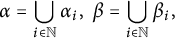 $$\begin{align*}\alpha=\bigcup_{i\in\mathbb{N}}\alpha_i,\; \beta=\bigcup_{i\in\mathbb{N}}\beta_i, \end{align*}$$
so that $\alpha ,\beta \in \mathcal {U}_X.$
We claim that
$\alpha ,\beta \in \mathcal {U}_X.$
We claim that $(\alpha , \beta )$
generates the diagonal right act of
$(\alpha , \beta )$
generates the diagonal right act of $\mathcal {U}_X.$
Indeed, let
$\mathcal {U}_X.$
Indeed, let $(\gamma ,\delta )\in \mathcal {U}_X.$
Define
$(\gamma ,\delta )\in \mathcal {U}_X.$
Define $\theta \in \mathcal {T}_X$
by
$\theta \in \mathcal {T}_X$
by
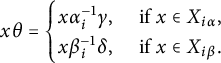 $$\begin{align*}x\theta=\begin{cases} x\alpha_i^{-1}\gamma,&\text{ if }x\in X_{i\alpha},\\ x\beta_i^{-1}\delta,&\text{ if }x\in X_{i\beta}. \end{cases}\end{align*}$$
It is clear that $\theta \in \mathcal {U}_X$
and that
$\theta \in \mathcal {U}_X$
and that $(\gamma , \delta )=(\alpha , \beta )\theta ,$
as required.
$(\gamma , \delta )=(\alpha , \beta )\theta ,$
as required.
We now consider the diagonal left act of $\mathcal {U}_X.$
For each
$\mathcal {U}_X.$
For each $i\in I,$
let
$i\in I,$
let
 $$ \begin{align*}\varphi_i : X_i\to \bigcup_{j\geq i}\bigl((X_i\times X_j)\cup (X_j\times X_i)\bigr) \end{align*} $$
be a bijection, and put
 $$ \begin{align*} \varphi=\bigcup_{i\in\mathbb{N}}\varphi_i : X\to X\times X. \end{align*} $$
It is straightforward to show that $\varphi $
is a bijection. Set
$\varphi $
is a bijection. Set $\alpha =\varphi p_1$
and
$\alpha =\varphi p_1$
and $\beta =\varphi p_2,$
where
$\beta =\varphi p_2,$
where $p_1, p_2$
are the projections onto the first and second coordinates, respectively. We claim that
$p_1, p_2$
are the projections onto the first and second coordinates, respectively. We claim that $(\alpha , \beta )$
generates the diagonal left act of
$(\alpha , \beta )$
generates the diagonal left act of $\mathcal {U}_X.$
Indeed, let
$\mathcal {U}_X.$
Indeed, let $(\gamma ,\delta )\in \mathcal {U}_X.$
Define a map
$(\gamma ,\delta )\in \mathcal {U}_X.$
Define a map
 $$ \begin{align*} \theta : X\to X, x\mapsto(x\gamma, x\delta)\varphi^{-1}. \end{align*} $$
Consider any $x\in X.$
Then
$x\in X.$
Then $x\in X_i$
for some
$x\in X_i$
for some $i\in \mathbb {N},$
and hence
$i\in \mathbb {N},$
and hence $x\gamma \in X_j$
and
$x\gamma \in X_j$
and $x\delta \in X_k$
for some
$x\delta \in X_k$
for some $j, k\geq i.$
It follows from the definition of
$j, k\geq i.$
It follows from the definition of $\varphi ^{-1}$
that
$\varphi ^{-1}$
that $x\theta \in X_m,$
where
$x\theta \in X_m,$
where $m=\min (j, k).$
Thus,
$m=\min (j, k).$
Thus, $\theta \in \mathcal {U}_X.$
Furthermore, we have that
$\theta \in \mathcal {U}_X.$
Furthermore, we have that
 $$ \begin{align*} x\gamma=(x\gamma, x\delta)p_1=(x\gamma, x\delta)(\varphi^{-1}\varphi)p_1=x(\theta\alpha), \end{align*} $$
so $\gamma =\theta \alpha .$
Similarly,
$\gamma =\theta \alpha .$
Similarly, $\delta =\theta \beta .$
Thus,
$\delta =\theta \beta .$
Thus, $(\gamma , \delta )=\theta (\alpha , \beta ),$
as required.
$(\gamma , \delta )=\theta (\alpha , \beta ),$
as required.
Finally, suppose for a contradiction that $\mathcal {U}_X$
has a minimal ideal, and let
$\mathcal {U}_X$
has a minimal ideal, and let $\alpha $
be any element of the minimal ideal. Fix
$\alpha $
be any element of the minimal ideal. Fix $x\in X_1$
and let
$x\in X_1$
and let $x\alpha \in X_k.$
Choose
$x\alpha \in X_k.$
Choose $\beta \in \mathcal {U}_X$
such that
$\beta \in \mathcal {U}_X$
such that $X\beta \subseteq \bigcup _{i\geq k+1}X_i.$
Now, there exist
$X\beta \subseteq \bigcup _{i\geq k+1}X_i.$
Now, there exist $\gamma , \delta \in \mathcal {U}_X$
such that
$\gamma , \delta \in \mathcal {U}_X$
such that $\alpha =\gamma \beta \delta .$
Since
$\alpha =\gamma \beta \delta .$
Since $(x\gamma )\beta \in \bigcup _{i\geq k+1}X_i,$
we have that
$(x\gamma )\beta \in \bigcup _{i\geq k+1}X_i,$
we have that $x\alpha =\bigl ((x\gamma )\beta \bigr )\delta \in \bigcup _{i\geq k+1}X_i,$
contradicting the fact that
$x\alpha =\bigl ((x\gamma )\beta \bigr )\delta \in \bigcup _{i\geq k+1}X_i,$
contradicting the fact that $x\alpha \in X_k.$
A wealth of further examples can be obtained by utilizing the constructions from the previous section, following this easy observation.
Proposition 8.2 For $S, T, I, J$
, and P as in Construction 7.1, the monoid
$S, T, I, J$
, and P as in Construction 7.1, the monoid $M=\mathcal {E}(S, T; I, J; P)$
has a minimal ideal if and only if T has a minimal ideal.
$M=\mathcal {E}(S, T; I, J; P)$
has a minimal ideal if and only if T has a minimal ideal.
Proof Suppose that M has a minimal ideal, say $K.$
Then K must contain an element of the form
$K.$
Then K must contain an element of the form $(i, a, j).$
Let t be any element of
$(i, a, j).$
Let t be any element of $T.$
Then
$T.$
Then $(i, a, j)=m(i, t, j)n$
for some
$(i, a, j)=m(i, t, j)n$
for some $m, n\in M.$
It follows that
$m, n\in M.$
It follows that $a\in T^1tT^1,$
so
$a\in T^1tT^1,$
so $a\leq _{\mathcal {J}}t.$
Thus,
$a\leq _{\mathcal {J}}t.$
Thus, $J_a$
is the minimal ideal of
$J_a$
is the minimal ideal of $T.$
$T.$
Conversely, suppose that T has a minimal ideal, say $L.$
We claim that the ideal
$L.$
We claim that the ideal $K=I\times L\times J$
is minimal in
$K=I\times L\times J$
is minimal in $M.$
Consider
$M.$
Consider $(i_1, u, j_1), (i_2, v, j_2)\in K$
, where
$(i_1, u, j_1), (i_2, v, j_2)\in K$
, where $u,v\in L$
,
$u,v\in L$
, $i_1,i_2\in I$
,
$i_1,i_2\in I$
, $j_1,j_2\in J$
. Since
$j_1,j_2\in J$
. Since $vp_{j_2,i_2}vp_{j_2,i_2}v\in L$
, there exist
$vp_{j_2,i_2}vp_{j_2,i_2}v\in L$
, there exist $y, z\in T^1$
such that
$y, z\in T^1$
such that $yvp_{j_2,i_2}vp_{j_2,i_2}vz=u$
. Note that
$yvp_{j_2,i_2}vp_{j_2,i_2}vz=u$
. Note that $yv, vz\in T$
, and
$yv, vz\in T$
, and
 $$\begin{align*}(i_1,u,j_1)=(i_1,yv,j_2)(i_2,v,j_2)(i_2,vz,j_1). \end{align*}$$
It follows that $(i_1,u,j_1)\ {\leq _{\mathcal {J}}} \ (i_2,v,j_2)$
, and, by symmetry,
$(i_1,u,j_1)\ {\leq _{\mathcal {J}}} \ (i_2,v,j_2)$
, and, by symmetry, $(i_2,v,j_2)\ {\leq _{\mathcal {J}}}\ (i_1,u,j_1)$
. Hence, the ideal K is a
$(i_2,v,j_2)\ {\leq _{\mathcal {J}}}\ (i_1,u,j_1)$
. Hence, the ideal K is a ${\mathcal {J}}$
-class as well, and hence it is a minimal ideal, as required.
${\mathcal {J}}$
-class as well, and hence it is a minimal ideal, as required.
It now follows that if we plug any T with no minimal ideal into Construction 7.1, while respecting the conditions of Theorem 7.3, we will obtain a right pseudo-finite monoid with no minimal ideal. Moreover, if we put S with no minimal ideal into Construction 7.6, while respecting the conditions stipulated there, we will obtain a monoid with no minimal ideal that is both right pseudo-finite and left pseudo-finite. These observations allow us to exhibit examples of pseudo-finite monoids without minimal ideals satisfying various prescribed properties. This will complement our findings from Sections 5 and 6 and show their natural limitations.
In Section 5, we discussed a number of subclasses of the class of regular monoids—inverse, completely regular, and orthodox monoids—and they all turned out to have (completely simple) minimal ideals when pseudo-finite. One therefore may wonder whether this can be extended to all regular monoids, or at least all idempotent-generated regular monoids. To answer these questions in the negative, we will resort to the variant $\mathcal {E}(S)$
from Construction 7.6.
$\mathcal {E}(S)$
from Construction 7.6.
Proposition 8.3 Let S be a monoid. Then the monoid $\mathcal {E}(S)$
is regular if and only if S is regular, and
$\mathcal {E}(S)$
is regular if and only if S is regular, and $\mathcal {E}(S)$
is idempotent-generated if and only if S is idempotent-generated.
$\mathcal {E}(S)$
is idempotent-generated if and only if S is idempotent-generated.
Proof Let $M=\mathcal {E}(S).$
The direct parts of the two statements follow from the fact that
$M=\mathcal {E}(S).$
The direct parts of the two statements follow from the fact that $S^1$
is a submonoid of M with an ideal complement.
$S^1$
is a submonoid of M with an ideal complement.
Now, suppose that S is regular. Clearly, any element of $S^1$
is regular in
$S^1$
is regular in $M,$
so consider
$M,$
so consider $(i, s, j)\in \mathcal {M}(S; I, I; P).$
There exists
$(i, s, j)\in \mathcal {M}(S; I, I; P).$
There exists $t\in S$
such that
$t\in S$
such that $s=sts,$
and hence, recalling that
$s=sts,$
and hence, recalling that $p_{j,0}=p_{0,i}=1_S$
, we have
$p_{j,0}=p_{0,i}=1_S$
, we have
 $$ \begin{align*}(i, s, j)=(i, s, j)(0, t, 0)(i, s, j),\end{align*} $$
completing the proof that S is regular.
Now, suppose that S is idempotent-generated. Then, certainly, $S^1$
is idempotent-generated. Note that all
$S^1$
is idempotent-generated. Note that all $(i, 1_S, 0), (0, 1_S, i)$
(
$(i, 1_S, 0), (0, 1_S, i)$
( $i\in I$
) are idempotents. For any
$i\in I$
) are idempotents. For any $(i, s, j)\in \mathcal {M}(S; I, I; P),$
we have that
$(i, s, j)\in \mathcal {M}(S; I, I; P),$
we have that
 $$ \begin{align*} (i, s, j)=(i, 1_S, 0)(0, 1_S, i_s)(i_{1_S}, 1_S, 0)(0, 1_S, j), \end{align*} $$
so that $(i, s, j)$
is a product of idempotents. Thus, M is idempotent-generated.
$(i, s, j)$
is a product of idempotents. Thus, M is idempotent-generated.
Taking S to be any (idempotent-generated) regular monoid with no minimal ideal, Corollary 7.7 and Propositions 8.2 and 8.3 together yield the following corollary.
Corollary 8.4 There exist (idempotent-generated) regular monoids that are both right pseudo-finite and left pseudo-finite but have no minimal ideal.
Given Corollary 5.14, it is natural to ask whether either of the properties of being periodic or being ${\mathcal {J}}$
-trivial is sufficient on its own to guarantee the existence of a minimal ideal in a pseudo-finite semigroup. Again, we apply Construction 7.6 to show that this is not the case.
${\mathcal {J}}$
-trivial is sufficient on its own to guarantee the existence of a minimal ideal in a pseudo-finite semigroup. Again, we apply Construction 7.6 to show that this is not the case.
Proposition 8.5 There exist ${\mathcal {J}}$
-trivial monoids that are both right pseudo-finite and left pseudo-finite but have no minimal ideal.
${\mathcal {J}}$
-trivial monoids that are both right pseudo-finite and left pseudo-finite but have no minimal ideal.
Proof Let S be a semigroup such that $S=XS^1=S^1X$
for some finite set
$S=XS^1=S^1X$
for some finite set $X\subseteq S,$
and
$X\subseteq S,$
and $a\notin S^1aS\cup SaS^1$
for each
$a\notin S^1aS\cup SaS^1$
for each $a\in S.$
(For example, we can take S to be the free semigroup on a finite set
$a\in S.$
(For example, we can take S to be the free semigroup on a finite set $X.$
) Fix
$X.$
) Fix $x\in X$
and let
$x\in X$
and let $M=\mathcal {E}(S, x).$
By Corollary 7.7, M is both right pseudo-finite and left pseudo-finite. Clearly, S is
$M=\mathcal {E}(S, x).$
By Corollary 7.7, M is both right pseudo-finite and left pseudo-finite. Clearly, S is ${\mathcal {J}}$
-trivial and has no minimal ideal. Thus, M has no minimal ideal by Proposition 8.2.
${\mathcal {J}}$
-trivial and has no minimal ideal. Thus, M has no minimal ideal by Proposition 8.2.
We now show that M is ${\mathcal {J}}$
-trivial. Suppose for a contradiction that M is not
${\mathcal {J}}$
-trivial. Suppose for a contradiction that M is not ${\mathcal {J}}$
-trivial. Let
${\mathcal {J}}$
-trivial. Let $T=\mathcal {M}[S; I, I; P].$
It is clear that the restriction of the
$T=\mathcal {M}[S; I, I; P].$
It is clear that the restriction of the ${\mathcal {J}}$
-relation on M to S is the
${\mathcal {J}}$
-relation on M to S is the ${\mathcal {J}}$
-relation on
${\mathcal {J}}$
-relation on $S,$
which is the equality relation since S is
$S,$
which is the equality relation since S is ${\mathcal {J}}$
-trivial, and no elements of S are
${\mathcal {J}}$
-trivial, and no elements of S are ${\mathcal {J}}$
-related to elements of
${\mathcal {J}}$
-related to elements of $T.$
Therefore, there must exist two distinct elements
$T.$
Therefore, there must exist two distinct elements $(i, a, j), (k, b, l)\in T$
with
$(i, a, j), (k, b, l)\in T$
with $(i, a, j){\mathcal {J}}(k, b, l).$
Then there exist
$(i, a, j){\mathcal {J}}(k, b, l).$
Then there exist $u, v, u^{\prime }, v^{\prime }\in M$
such that
$u, v, u^{\prime }, v^{\prime }\in M$
such that
 $$ \begin{align*} u(i, a, j)v=(k, b, l),\, u^{\prime}(k, b, l)v^{\prime}=(i, a, j). \end{align*} $$
There are two cases to consider.
(1) $u\in T$
or
$u\in T$
or $v\in T.$
Assume without loss of generality that
$v\in T.$
Assume without loss of generality that $u=(q, s, r)\in T.$
Then
$u=(q, s, r)\in T.$
Then
 $$ \begin{align*} (k, b, l)=(q, s, r)(i, a, j)v=(q, sp_{ri}a, j)v. \end{align*} $$
If $v\in S,$
then
$v\in S,$
then $b=sp_{ri}a.$
If
$b=sp_{ri}a.$
If $v=(q^{\prime }, t, r^{\prime }),$
then
$v=(q^{\prime }, t, r^{\prime }),$
then $(q, sp_{ri}a, j)v=(q, sp_{ri}ap_{jq^{\prime }}t, r^{\prime }),$
and hence
$(q, sp_{ri}a, j)v=(q, sp_{ri}ap_{jq^{\prime }}t, r^{\prime }),$
and hence $b=sp_{ri}ap_{jq^{\prime }}t.$
In either case, we have that
$b=sp_{ri}ap_{jq^{\prime }}t.$
In either case, we have that $b\leq _{\mathcal {J}}a,$
and
$b\leq _{\mathcal {J}}a,$
and $b\neq a$
since
$b\neq a$
since $a\notin S^1aS\cup SaS^1.$
Notice that $S^1(k, b, l)S^1\subseteq I\times \{b\}\times I.$
Therefore, since
$S^1(k, b, l)S^1\subseteq I\times \{b\}\times I.$
Therefore, since $a\neq b,$
we must have that
$a\neq b,$
we must have that $u^{\prime }\in T$
or
$u^{\prime }\in T$
or $v^{\prime }\in T.$
Then, by the same argument as above, we have that
$v^{\prime }\in T.$
Then, by the same argument as above, we have that $a\leq _{\mathcal {J}}b.$
But then,
$a\leq _{\mathcal {J}}b.$
But then, $a\,{\mathcal {J}}\,b,$
contradicting the fact that S is
$a\,{\mathcal {J}}\,b,$
contradicting the fact that S is ${\mathcal {J}}$
-trivial.
${\mathcal {J}}$
-trivial.
(2) $u, v\in S^1.$
In this case, we have
$u, v\in S^1.$
In this case, we have $u(i, a, j)v=(ui, a, jv),$
so
$u(i, a, j)v=(ui, a, jv),$
so $ui=k, a=b$
, and
$ui=k, a=b$
, and $jv=l.$
Since
$jv=l.$
Since $(i, a, j)\neq (k, b, l),$
it follows that
$(i, a, j)\neq (k, b, l),$
it follows that $i\neq k$
or
$i\neq k$
or $j\neq l.$
Assume without loss of generality that
$j\neq l.$
Assume without loss of generality that $i\neq k.$
Then
$i\neq k.$
Then $u\neq 1.$
Now, we must have that
$u\neq 1.$
Now, we must have that $u^{\prime }\in S^1,$
for otherwise, by the argument in case (1), we would have
$u^{\prime }\in S^1,$
for otherwise, by the argument in case (1), we would have $a\neq b.$
Therefore, we have that
$a\neq b.$
Therefore, we have that $(i, a, j)=(u^{\prime }k, b, l)v^{\prime },$
whence
$(i, a, j)=(u^{\prime }k, b, l)v^{\prime },$
whence $i=u^{\prime }k.$
Since
$i=u^{\prime }k.$
Since $i\neq k,$
we conclude that
$i\neq k,$
we conclude that $u^{\prime }\neq 1.$
We cannot have
$u^{\prime }\neq 1.$
We cannot have $i=0$
or
$i=0$
or $k=0,$
since this would imply that
$k=0,$
since this would imply that $i=k=0.$
Thus, there exist
$i=k=0.$
Thus, there exist $s, t\in S$
with
$s, t\in S$
with $s\neq t$
such that
$s\neq t$
such that $i=i_s$
and
$i=i_s$
and $k=i_t.$
It follows that
$k=i_t.$
It follows that $s=u^{\prime }t$
and
$s=u^{\prime }t$
and $t=us.$
But then,
$t=us.$
But then, $s\,{\mathcal {L}}\,t$
and hence
$s\,{\mathcal {L}}\,t$
and hence $s\,{\mathcal {J}}\,t,$
contradicting the fact that S is
$s\,{\mathcal {J}}\,t,$
contradicting the fact that S is ${\mathcal {J}}$
-trivial.
${\mathcal {J}}$
-trivial.
Proposition 8.6 For S and x as in Construction 7.6, the monoid $M=\mathcal {E}(S, x)$
is periodic if and only if S is periodic.
$M=\mathcal {E}(S, x)$
is periodic if and only if S is periodic.
Proof Clearly, periodicity is closed under subsemigroups, so S is periodic if M is.
Suppose that S is periodic. Since S is a subsemigroup of $M,$
every monogenic subsemigroup of M generated by an element of S is contained in
$M,$
every monogenic subsemigroup of M generated by an element of S is contained in $S,$
and is hence finite since S is periodic. So, consider
$S,$
and is hence finite since S is periodic. So, consider $m=(i, s, j)$
where
$m=(i, s, j)$
where $i, j\in I$
and
$i, j\in I$
and $s\in S.$
Since S is periodic, there exist
$s\in S.$
Since S is periodic, there exist $q, r\in \mathbb {N}$
such that and
$q, r\in \mathbb {N}$
such that and $(sp_{ji})^{q+r}=(sp_{ji})^q.$
Thus, we have
$(sp_{ji})^{q+r}=(sp_{ji})^q.$
Thus, we have
 $$ \begin{align*} (i, s, j)^{q+1+r}=(i, (sp_{ji})^{q+r}s, j)=(i, (sp_{ji})^qs, j)=(i, s, j)^{q+1}. \end{align*} $$
This completes the proof.
Taking S to be any periodic semigroup with no minimal ideal (such as a semilattice with no zero), Corollary 7.7 and Propositions 8.2 and 8.6 together yield the following corollary.
Corollary 8.7 There exist periodic monoids that are both right pseudo-finite and left pseudo-finite but have no minimal ideal.
We conclude this section by showing that there exist weakly right reversible monoids that are right pseudo-finite but have no minimal ideal.
Proposition 8.8 Let T be any right reversible monoid with no minimal ideal. Let I be a set such that $|I|=|T|,$
let
$|I|=|T|,$
let $J=\{1, 2\},$
and let P be a
$J=\{1, 2\},$
and let P be a $J\times I$
matrix such that
$J\times I$
matrix such that $p_{1,i}=1_T$
for all
$p_{1,i}=1_T$
for all $i\in I$
and every element of T appears in the second row. Then the monoid
$i\in I$
and every element of T appears in the second row. Then the monoid $M=\mathcal {M}[T; I, J; P]^1$
is right pseudo-finite, weakly right reversible, and has no minimal ideal.
$M=\mathcal {M}[T; I, J; P]^1$
is right pseudo-finite, weakly right reversible, and has no minimal ideal.
Proof Recall that $M=\mathcal {E}(\emptyset , T; I, J; P).$
Clearly, the conditions of Theorem 7.3 are satisfied, so M is right pseudo-finite. Since T has no minimal ideal, M has no minimal ideal by Proposition 8.2. We now show that M is weakly right reversible. Consider any infinite sequence
$M=\mathcal {E}(\emptyset , T; I, J; P).$
Clearly, the conditions of Theorem 7.3 are satisfied, so M is right pseudo-finite. Since T has no minimal ideal, M has no minimal ideal by Proposition 8.2. We now show that M is weakly right reversible. Consider any infinite sequence
 $$ \begin{align*} Mu_1, Mu_2, \dots \end{align*} $$
of principal left ideals of $M.$
Since J is finite, there exists
$M.$
Since J is finite, there exists $j\in J$
such that there is an infinite subsequence
$j\in J$
such that there is an infinite subsequence $Mu_{k_1}, Mu_{k_2}, \dots $
where the third co-ordinate of each
$Mu_{k_1}, Mu_{k_2}, \dots $
where the third co-ordinate of each $u_{k_p}$
is
$u_{k_p}$
is $j.$
For each
$j.$
For each $p\in \mathbb {N},$
let
$p\in \mathbb {N},$
let $u_{k_p}=(i_p, t_p, j).$
Since T is right reversible, for any
$u_{k_p}=(i_p, t_p, j).$
Since T is right reversible, for any $p, q\in \mathbb {N},$
there exist
$p, q\in \mathbb {N},$
there exist $v, w\in T$
such that
$v, w\in T$
such that $vt_p=wt_q.$
Picking any
$vt_p=wt_q.$
Picking any $i\in I,$
we then have that
$i\in I,$
we then have that
 $$ \begin{align*} (i, v, 1)u_{k_p}=(i, vt_p, j)=(i, wt_q, j)=(i, w, 1)u_{k_q}, \end{align*} $$
so that $Mu_{k_p}\cap Mu_{k_q}\neq \emptyset .$
Thus, M is weakly right reversible.
$Mu_{k_p}\cap Mu_{k_q}\neq \emptyset .$
Thus, M is weakly right reversible.
9 Open problems and future research
We conclude this paper with some open problems and possible directions for future research.
The notion of diameter has been a useful tool in this paper and is deserving of a more systematic investigation. As indicated in Section 3.1, this will be the topic of a subsequent paper.
A natural open problem arising from the work of this paper is to completely describe the minimal ideals in (right) pseudo-finite semigroups. To put it another way, which simple semigroups can be the minimal ideal of a pseudo-finite semigroup? Certainly, not all simple semigroups have this property, e.g., any simple monoid that is not pseudo-finite, such as the bicyclic monoid or any infinite group, by Corollary 4.3.
As noted in Section 1, in [Reference Dandan, Gould, Quinn-Gregson and Zenab5], several equivalent characterizations were given for a monoid S to have a finitely generated universal left congruence, including S satisfying the homological finiteness property of being type left- $FP_1$
. This raises the question as to whether the property of being pseudo-finite could similarly be described in homological terms.
$FP_1$
. This raises the question as to whether the property of being pseudo-finite could similarly be described in homological terms.


 Open access

