


December 10, 2023. On the fortieth anniversary of the beginning of the current democratic cycle in Argentina, Javier Milei, libertarian influencer and economist, took office as president. After receiving the attributes of command from the outgoing president, Peronist Alberto Fernández, according to custom and tradition he was supposed to deliver a speech to the legislative assembly – the meeting of deputies and senators in the National Congress. Instead, Milei decided to deliver a speech to his supporters on the esplanade of the Congress building, with his back to the chamber where he had just been applauded by congresspeople. His decision to speak to his followers shows the centrality of the anti-establishment dimension in his persona: criticism of the political elite, a “caste” (la casta) opposed to “well-bred Argentines” (los argentinos de bien), was a key resource for Milei to represent the dissatisfaction of a large part of voters with the two coalitions that until then had dominated the Argentine electoral scene. In fact, Milei became president after displacing in the first round the center-right coalition Juntos por el Cambio (Together for Change, JxC), led by the Republican Proposal party (PRO party), as the main opposition force, and after contesting the second round with Peronism, which he defeated by a wide margin (55.7% vs. 44.3%).Footnote 1 Just two years earlier, in the 2021 legislative elections, he had run for the first time in elections and was elected national deputy for the city of Buenos Aires, after coming in third place with a surprising 17 percent of the votes. What does Milei represent in terms of programmatic offer? What explains his rapid rise in Argentine politics? This chapter aims to answer those questions.
Milei is a case of a far-right leader with populist radical components. The main elements of his discourse are: (a) defense of a libertarian program of radical criticism of state intervention and strong criticism of the left’s distributive programs; (b) anti-establishment criticism of la casta, as opposed to the argentinos de bien, which is expressed both in the violence of his discourse and in corporal and aesthetic elements associated with anger against the political establishment; and (c) an opportunistic approach toward both morally conservative and “iron fist” positions regarding crime. Some elements typical of the European populist radical right are absent in Milei, such as anti-immigration positions. Others, such as climate-skeptic positions, take a very secondary place in his appeal. In sum, Milei’s case fits the usual definition of far right but does not fully fit the definitions of the extreme right (Mudde, Reference Mudde2002), or of the populist radical right as defined in the introduction of this volume.
Milei’s rise to power was a surprise, with a weak electoral vehicle, La Libertad Avanza (Liberty Moves Forward, LLA), a coalition formed by the new Libertario (Libertarian) and Unidos por la Libertad y la Dignidad (Unite for Freedom and Dignity) parties, and long-standing small conservative parties such as the Partido Demócrata (Democratic Party) and the Partido Renovador Federal (Federal Renewal Party). The coalition has an enthusiastic if small militant base made up of young libertarians who entered the public scene through demonstrations against restrictions during the COVID-19 pandemic, conservative groups active since the 2018 and 2020 anti-abortion demonstrations (Vázquez, Reference Vázquez, Pereyra Doval and Souroujon2023), as well as small groups defending the military accused of crimes against humanity (Salvi, Reference Salvi, Payne, Zulver and Escoffier2023). These groups form part of the growing grassroots of the political right in Latin America (Mayka & Smith, Reference Mayka and Smith2021). Added to this is the significant presence of conservative digital influencers and activists, highly engaged within the digital public sphere, who rose to prominence by disseminating messages and framing narratives linked to Milei beyond traditional media outlets (Kessler et al., Reference Kessler, Vommaro and Paladino2022). However, the political structure is weak. In the subnational elections that took place in 2023, the candidates supported by Milei obtained poor results. In some cases, Milei allied with small or declining subnational conservative forces. In other cases, he placed on the electoral lists leaders of Peronism or the Unión Cívica Radical (UCR) who were marginalized in their parties (Morresi & Ramos, Reference Morresi and Ramos2023). Certainly, starting in 2024, LLA began to benefit from the defection of PRO leaders who joined its ranks, as well as from the establishment of electoral coalitions with the PRO in some districts. Additionally, in the 2025 midterm elections, a team of political mediators associated with conservative Peronism was set in motion. This team maintained the strategy of creating local candidate lists by incorporating second- and third-tier leaders from traditional parties. None of the strategies implied a centralized control of the party discourse and program, a strategy that the mainstream right – the PRO party – used successfully in its territorial expansion in Argentina (Vommaro, Reference Vommaro2023a).
The reasons for Milei’s rise must be looked for elsewhere, especially in the historical context and in the content and form of his ideational strategy. In the following pages I maintain that the rise of Milei is based in the successful strategy of connecting a libertarian discourse against the state – not very popular in Argentina according to most opinion polls – with his criticism of the political elites.Footnote 2 The anticasta discourse, as well as his positions against the state, placed Milei as a spokesman for the discontent of a section of voters toward the two coalitions that had ruled Argentina in the previous two decades: the center-left Peronist coalition, led by Kirchnerism, and the center-right coalition JxC, led by the PRO. This is consistent with Stefanoni’s (Reference Stefanoni2021) argument about the capacity of the global radical right to express social discontent in our time. The discontent grew during the COVID-19 pandemic, especially with the restrictions that the government placed on the movement of people and economic activity, and with the prolongation of an economic crisis that began in 2018, during the government of PRO leader Mauricio Macri, and continued to 2023, with rising inflation rates (Oliveros & Vommaro, Reference Oliveros and Vommaro2022). It should be added that Milei emerged with the support of a center-right electoral base that was previously channeled by PRO and JxC, but which later showed itself willing to support more openly right-wing options (Gené & Vommaro, Reference Gené and Vommaro2023).
In the next sections, I proceed as follows. First, I briefly develop the characteristics of the dominant political offer and the socioeconomic situation that led to Milei’s rise. Then I present the figure of Milei and his party. Third, I develop his ideational building in relation to his opportunistic strategy of political growth and anti-establishment performance. I also show how this strategy encountered two propitious junctures – the COVID-19 pandemic and the prolonged social and economic crisis in Argentina – that allowed him to intersect an anti-establishment discourse with a libertarian program. In order to account for the adjustment of Milei’s ideological strategy, I also provide some indications of the positions of Argentine voters in general and Milei voters in particular regarding the issues that the libertarian leader included in his political appeal. I conclude with some final remarks concerning the relationship Milei has maintained with democracy and the mainstream right since coming to power.
2.1 Rise and Decline of Argentine Bi-coalitionism
After the 2001–2002 crisis, the Argentine political system was significantly reorganized. The crisis of the UCR and the dissolution of forces that had tried to make their way into Argentine politics in the 1990s from the center left (Frepaso) and the center right (Acción por la República) created an opportunity for the emergence of new parties and the reorganization of others.
With the arrival of Néstor Kirchner to power in 2003, Peronism, after the neoliberal turn of the 1990s, again made a programmatic shift, this time to the left. Not only did it recover part of its traditional program in favor of the development of the internal market through industrial protection and wage growth, but it also incorporated into its coalition three key sectors in the development of that movement in the years that followed: the popular organizations of the urban poor that had proliferated in the second half of the 1990s and consolidated in the following decade, after establishing a close relationship with the state; the human rights movement, key to the democratization process in the 1980s, which participated in the opposition to Carlos Menem’s conservative Peronism in the following decade; and the movements associated with gender demands (feminist and LGBTQ+), which were part of the regional wave of demands for advances in that field. These three sectors gained from the governments of Néstor Kirchner (2003–2007) and Cristina Fernández de Kirchner (2007–2015) policies that sealed their incorporation into the Peronist coalition. In all three cases, moreover, leaders of these movements held positions on electoral lists and in government offices. Peronism in the 2000s was the Argentine version of the left turn that took place in Latin America (Etchemendy & Garay, Reference Etchemendy, Garay, Levitsky and Roberts2011).
In the context of the 2001–2002 crisis in Argentina, a new center-right political force was formed. Businessman Mauricio Macri and a small group of long-standing political leaders from conservative parties, as well as UCR and Peronist leaders who had been sidelined from internal politics in their parties of origin, created the PRO party. The party also welcomed newcomers from the business world, foundations, and NGOs close to the economic elites (Vommaro et al., Reference Vommaro, Morresi and Bellotti2015).
The new party initially focused on the subnational level and gained power in the city of Buenos Aires in 2007. It then consolidated organizationally and programmatically. The party’s strategy involved expanding to other districts of the country, tightly controlled by the party’s dominant coalition. It also extended a network of close-to-the-party organizations, such as foundations that recruited businessmen and upper-middle sectors in elite universities (Vommaro, Reference Gené and Vommaro2023a).
However, it wasn’t until 2015, when the party established JxC, a coalition with the weakened UCR, that it became competitive at the national level. In that same year, the party won the presidency, making it the first center-right party to come to power through electoral means in Argentina. The party’s moderate economic program and lack of clear cultural conservatism were among the factors that contributed to its success (Vommaro, Reference Gené and Vommaro2023a).
The center-left Peronism, on the one hand, and the center-right JxC coalition, on the other, organized the electoral competition in the following years. They achieved important activist support and a significant national electoral reach: together they captured between 60 percent (with Peronism divided in the 2017 legislative elections) and almost 90 percent (with Peronism united in the 2019 presidential elections) of the votes in successive elections from 2015 to 2021. However, these coalitions had feet of clay: the economic performance of the governments of both coalitions was poor, particularly after the end of the commodities boom. Macri’s government (2015–2019), despite its promise of pro-market economic rationality, only intensified most of the inherited macroeconomic problems. His successor, the Peronist Alberto Fernández (2019–2023), performed even more poorly, due to the external indebtedness incurred by his predecessor, the effects of the COVID-19 pandemic, and the deterioration of the international context (Oliveros & Vommaro, Reference Oliveros and Vommaro2022). The result, in one case, was a failed market-oriented reformism and, in the other, a Peronism that, for the first time in its history since 1974–1975, was unable to offer society either political and social order or consumption capacity.
Since 2011, GDP in Argentina has had little significant growth and, after reaching its peak in millions of constant pesos (base 2004) in 2015, it began a slow decline in some years and accelerated in others, especially during the financial crisis of 2018 and during the pandemic of 2020. Thus, GDP in 2022 was, in millions of constant pesos, lower than seven years earlier. Likewise, starting in 2014, a cycle of accelerating inflation began, which had its first peak above 50 points in the last year of Macri’s government (53.9%), reaching 94.8 percent in 2022 and over 200 percent in 2023. Income poverty, accordingly, rose from 30.3 percent in 2016 to 39.2 percent in 2022 and, although unemployment did not grow significantly, jobs created between 2012 and 2023 were located mostly in the self-employed, formal, and informal sectors.Footnote 3
Argentina arrived at the 2023 presidential elections with an economy in crisis and a society in disarray due to high inflation. Far from being able to respond to these challenges, the two main coalitions were embroiled in a strong internal dispute: Peronism, due to its inability to coordinate between the different factions reunified in 2019; JxC, due to its difficulties in dealing with the internal dispute between the candidates for Macri’s succession.
2.2 From Television to the Electoral Arena: Milei’s Meteoric Rise
Milei is an economist and libertarian influencer who gained popularity in political variety shows on television, starting in 2018. His intense media exposure since then allowed him to establish a relationship of relative closeness with depoliticized audiences. Their radical positions on economic matters, his histrionics and aggressiveness, and his connection with mass audiences became marks of his public behavior, which constitutes what I call an anti-establishment performance capable of transferring the anti-establishment discourse to the level of a corporal truth. With this style, unlike the previous Argentine extreme right (McGee Deutsch, Reference McGee Deutsch1999), Milei managed to transcend the audience of the elites. In fact, Milei comes from a middle-class home and is linked to popular culture: he was a goalkeeper in a soccer club, he had a rock band, and, since his appearance on television variety shows, he has had affairs with a popular singer and, later, with an impersonator of celebrities and politicians.Footnote 4 In 2018, he transformed an economics column into a cable television show, called “El consultorio de Milei” (Milei’s office), and into a play directed by a well-known comedian and director. He toured this play around Argentina’s summer resorts in 2019.
Milei competed for the first time in the 2021 midterm elections in the city of Buenos Aires and obtained third place with 17 percent of the votes (see Table 2.1). Since then, LLA has been the third force at the local level and began its expansion at the national level, threatening the bi-coalitional structure of electoral competition that had existed for almost a decade in Argentina (Oliveros & Vommaro, Reference Oliveros and Vommaro2022). Convinced of the power of that direct contact with the public, the power of a “celebrity” (West & Orman, Reference West and Orman2002), Milei chose not to invest in building a political organization, even with the prospect of running in the 2023 presidential election. Instead, he launched a personal vehicle that maintained an aggressive communication strategy, run by his sister, a handful of young digital activists, and specialists in the management of social media. To build electoral lists at the subnational level, instead of promoting the formation of local support committees, a few second-line political brokers negotiated the establishment of a national coverage for LLA with local conservative leaders or with leaders marginalized by the traditional parties (González, Reference González2023). The weakness of this structure was demonstrated by its poor performance in the 2023 elections for provincial governor. At the end of the round of provincial elections, despite Milei’s ever-increasing popularity and voting intentions, LLA did not win a single governorship.
- 2021 legislative elections
LLA: 5.55% (17.03% in the city of Buenos Aires)
- 2023 primaries
LLA: 29.86%
- 2023 first round
LLA: 29.99%
- 2023 second round
LLA: 55.65%
Unlike Trump, who was a long-time businessman and managed to be nominated by the Republican party, and Jair Bolsonaro, who had been a federal deputy for the state of Rio de Janeiro between 1991 and 2018 and had the support of a good part of the armed forces and the evangelical churches (see Chapter 3 in this volume), Milei is a personalistic leader with a weak organization and very few political cadres.
A series of militant groups of different types began to coalesce around his leadership. These groups appeared on the scene in Milei’s various campaign events, and occupied the public space at the inauguration ceremony of the new president. About 35,000 people attended to listen to Milei’s speech and showed their enthusiasm for the arrival to power of a leader whose main resource is his public performance. Among those present was a sample of Milei’s support base, in line with what studies are beginning to show about the right-wing grassroots in Latin America (Mayka & Smith, Reference Mayka and Smith2021): small conservative anti-abortion groups (pañuelos celestes, light-blue scarfs), defenders of the military associated with the authoritarian past, young libertarians, and politically unaffiliated families, whose support for Milei is based on disenchantment and anger against the established political elites.Footnote 5 Likewise, a very active and well-organized group of conservative influencers and activists managed to coordinate the dissemination of messages and framing associated with Milei.
The context of Milei’s emergence offered a propitious opportunity structure for his programmatic proposal and for his public performance. At the same time, JxC and the PRO had left two important legacies that favored a radical right-wing appeal: first, after the failure of Macri’s administration, a current had grown inside the PRO that promoted radicalization of the program and discourse (Gené & Vommaro, Reference Gené and Vommaro2023); second, the JxC structure had organized and channeled the expansion of voters who identified with right-wing positions on both economic and security issues, which largely explains why JxC voters overwhelmingly supported Milei in the second round of the 2023 election (Calvo et al., Reference Calvo, Kessler, Murillo and Vommaro2024; Kessler et al., Reference Kessler, Vommaro, Assusa, Kessler and Vommaro2025).
In the following section I deal with the programmatic strategy and its interaction with this situation that favored Milei’s surprising rise.
2.3 An Opportunistic Far-Right Project
At Milei’s inauguration ceremony, his speech had foundational components: “Today a new era begins in Argentina. Today we end a long and sad history of decadence and decline and we begin the road to the reconstruction of our country. Argentines, in a resounding manner, have expressed a will for change that has no return. There is no turning back.” And it was almost exclusively based on a gloomy economic diagnosis supporting a proposed shock economic program: “The conclusion is that there is no alternative to austerity and there is no alternative to shock. Naturally, this will have a negative impact on the level of activity, employment, real wages, the number of poor and indigent […] this is the last straw to begin the reconstruction of Argentina.” A good part of his followers applauded passages of Milei’s speech where a severe austerity program with negative social consequences was announced. T-shirts with the inscription “No hay plata” (There is no money) were sold in the Congress square. Milei’s supporters wore them proudly. In his speech, Milei stated that there was no alternative, or rather that, “in the alternative case, the progressive mushy proposal, whose only source of financing is the issuance of money, will lead to a hyperinflation that will take the country to the worst crisis in its history.” At the same time, he promised that the austerity measures would affect the public sector and not the private sector, in an imprecise formula that echoed one of his main campaigns claiming: “the austerity program will be paid by la casta.” The speech ended with appeals to God and with the Argentine libertarians’ battle cry: “Viva la libertad, carajo!” (Long live damn liberty!).
Milei’s anti-establishment performance is based on an ideational strategy with two central and permanent elements, to which other elements mobilized opportunistically must be added. The first is a libertarian discourse with a strong anti-state bias and explicit theoretical references to the founding fathers of the Austrian School of Economics. From his first interventions in the media, Milei defined himself as a short-term “minarchist” – that is, an advocate of a minimal state in charge of only security and justice. In the long term, on the other hand, he claimed to support anarcho-capitalism, which implies the elimination of the state. During an interview on a political television program, Diario Popular, in July 2018 he stated:
The State is taxing you to death all year long and … what does it tell you that it gives you – security? The country is a bloodbath. It tells you it gives you education and we are in the seventh place in the Pisa [Program for International Student Assessment] tests in Latin America after being the first country to eliminate illiteracy. Health? 75% [of the population] in a sanitary emergency. Roads? Not even Superman dares to drive in […] But yes, we have rich politicians.Footnote 6
In 2021, the criticism of the state found an advertising image in line with Milei’s anti-establishment performance: the chainsaw. The chainsaw embodies anti-establishment rage in a tool for the destruction of the “privileges” of those who live at the expense of the state. In the campaign for the legislative elections of that year, Milei presented a libertarian plan of radical pro-market reforms called the “chainsaw plan,” which would be the platform of his presidential candidacy. It included the total elimination of public works, the flexibilization of the labor market, and charging fees for attending public universities.Footnote 7 According to Milei, in thirty-five years Argentina would again become a power – a nod to Donald Trump’ slogan: “Make America Great Again.” It was argued that for this plan to work it was necessary to continue the “cultural battle,” not defined in relation to cultural issues (abortion, LGBTQ+ rights, etc.), but in an anti-establishment version: as part of a “moral revolution” against the “parasitic, slutty, useless political caste that is sinking this country.”Footnote 8
Drastic cuts in public spending as a form of restorative justice against the privileges of the political establishment shaped most of the government’s positions on different agendas and has been the most systematic and permanent aspect of its program. In fact, according to research, the anti-state rhetoric is the common ground for Milei’s voters. (Gené et al., Reference Gené, Kessler and Vommaro2024; Nazareno & Brusco, Reference Nazareno and Brusco2023).
The second permanent component of his strategy is the anti-establishment dimension: a Manichean discourse –accompanied by a physical performance – that accuses the political elites of being largely responsible for the country’s problems, proposing their displacement as the solution. In the same way as in the economic field, criticism of the political elites allowed him to gain a greater audience when social discontent grew with the prolonged social and political crisis experienced by Argentina from 2018 (Murillo & Oliveros, Reference Murillo and Oliveros2024). Coinciding with the 2021 midterm elections, Milei began to systematically use the idea of a political caste, as suggested to him by a political consultant, imitating the experience of the Italian Five Star movement (González, Reference González2023), although the term had also been used by the leftist party Podemos in Spain. Before the stabilization of the “anti-casta” discourse, Milei had already used this term sporadically, to criticize the political class through libertarian arguments. In 2016, in a column published in a digital newspaper, he argued that Trump’s triumph in the US elections implied a defeat of the “casta that constitutes the political corporation,”Footnote 9 (para. 1), which he defined as “parasites” (para. 3). The following year, in the conservative newspaper La Nación, Milei published a column explaining libertarian thought in which he argued that “state collection” is theft carried out by the only authority empowered to obtain its revenues through coercion: the government. This explains, in his view, the creation of a “parasitic casta.”Footnote 10 As his public awareness grew, Milei accentuated the deployment of this anti-establishment discourse in his public appearances, with aggressive speeches and aimed at the political elites, embodied in expressions such as “You may see the SHITS of politicians fighting hard but they will always agree on one thing instantly: raise taxes on us. LITTLE SHITS LOWER PUBLIC SPENDING THEIR FUCKING MOTHERFUCKERS. THEY ARE SHIT. LONG LIVE LIBERTY DAMNED!”Footnote 11
In this vein, one of Milei’s 2021 campaign ads said: “the political class always puts itself ahead of you […] You come first.”Footnote 12 He also announced that if he was elected he would work pro bono. Fulfilling his promise, in January 2022 he staged an anti-casta show that consisted in donating his allowance as national deputy in a raffle among those who signed up to it. The first raffle was held in Mar del Plata, Argentina’s main seaside resort city, during the summer vacation period. It was replicated on his social media and allowed him to reach a million followers on his Instagram account. Although these performances did not include direct attacks on representative democracy, they were disloyal to representatives and always advanced the idea that all money destined to representative institutions was a form of theft. At this point, anti-state libertarianism became a kind of populism against the institutions of representative democracy. Over time, moreover, he began to use a term to refer to citizens as argentinos de bien, a formula that reinforced the binary division of society.
Why did the COVID-19 pandemic become a political opportunity for Milei’s ideological stance, as well as for making libertarian discourse a popular mode of expression of the discontent that proliferated among voters? First, because, especially during the first stage of restrictions, JxC leaders cooperated with the Peronist administration, leaving a vacancy for the expression of discontent against the government-imposed restrictions on the movement of people and commercial activity. As is well known, the growth tactic of radical right-wingers – both in the digital public sphere and in political competition in general – is largely based on occupying the space left vacant by moderate mainstream right-wingers (Borges et al., Reference Borges and Zanotti2024; Madariaga & Rovira Kaltwasser, Reference Rovira Kaltwasser2020). Second, because the discontent during the pandemic had as its main target the state, which took on an unusually central role in regulating people’s daily lives, and which was perceived by some as responsible for the negative economic and social consequences of the pandemic (Balsa, Reference Balsa2024; Semán, Reference Semán2023). This was especially true among young people, a segment where discontent proliferated and which Milei managed to penetrate with particular intensity (Nazareno & Brusco, Reference Nazareno and Brusco2023; Vázquez, Reference Vázquez, Pereyra Doval and Souroujon2023). In this context, the “lion” logo associated with the figure of Milei was born. It symbolized fury, but also fierceness. It gave back to his followers an image of strength in contexts in which the crisis made them particularly vulnerable. To the image of the lion, Milei added a slogan that went in the same direction: “I do not come to lead lambs, but to awaken lions.”Footnote 13 A well-coordinated group of conservative digital activists and influencers produced images and disseminated narratives and messages that helped spread the idea that Milei was the great challenger of the political establishment.
In other central issues of the public agenda and of the program of the far right, Milei displayed unpredictable – opportunistic – behavior, showing pragmatism in his public appeal. The debate around the legalization of abortion had a high profile in Argentina between 2018 and 2020. Milei chose to expose himself publicly on the issue only when he considered that there was an opportunity for gain. In a first stage of activity in traditional and digital media (2016–2018), cultural issues were not among the main topics of his discourse. While sexual allusions to criticize politicians or the state were frequent, the open debate on abortion and gender issues, such as inclusive language, were not seen as relevant.Footnote 14 In fact, in a newspaper article Milei defined libertarianism as a person with “no moral hang-ups,” who “doesn’t mess with who you trade with or who you get into bed with.”Footnote 15
From 2018 Milei began to position himself on gender and LGBTQ+ issues. In various interventions he took a position against inclusive language and the legalization of abortion. That same year, President Macri proposed that Congress deal with a Law on the Voluntary Interruption of Pregnancy (IVE, in Spanish). It was the first time the right to abortion was examined in Congress. Although the PRO did not support the measure in a unified way, the fact of promoting the debate caused a part of the conservative constituency to distance itself from the party. Social mobilization for and against the law increased during the first half of 2018. The pro-abortion movement consisted of a broad coalition of social movements that, following the National Women’s Conference in 2003, formed the Campaña Nacional por el Derecho al Aborto Legal, Seguro y Gratuito (National Campaign for the Right to Legal, Safe, and Free Abortion), established in 2005. The movement grew in terms of social support; the Ni Una Menos (Not One Less) movement against violence toward women was launched in 2015. Over the years, activists managed to influence most of the parties represented in Congress, and by 2018 they had built a multiparty coalition in favor of the IVE (Lopreite, Reference Lopreite2023). The bill was approved in the Chamber of Deputies in June 2018 (129 votes in favor, 125 against), but rejected in the Senate in August (38 senators against, 31 in favor).
During those months, Milei maintained a position of open opposition to abortion, but his public interventions in the matter were scarce and were limited to answering questions when interviewed. In fact, there is no record that he participated in the marches called by “pro-life” groups during 2018 parliamentary debates. However, coinciding with the fact that the conservative mobilization against abortion lacked political representation, after that juncture moral issues began to occupy more space in Milei’s discourse. In 2019 he began to respond to accusations that he was violent and offensive, claiming lack of political correctness. In turn, he increased the sharing of videos and quotes from conservative influencers. Imitating them, he adopted a more direct discourse against “gender ideology,” “abortionists,” and gender identity, and shared offensive political jokes about the LGBTQ+ community. The publications in which he aired his point of view through quotes from his public appearances were the ones with the highest number of “likes.” At the end of 2020, during the Peronist government of Alberto Fernández, the IVE was again discussed in Congress. On this occasion, Milei took a more active position. He participated in the International Congress “Hope and Life” organized by Provida Latam between December 9 and 11 of that year; he denounced the JxC deputies who voted in favor of the bill, and shared poems and slogans against the legalization of abortion. In addition, unlike the 2018 vote, this time Milei participated in the calls and marches led by the anti-abortion movement. Finally, for the 2021 elections he recruited as a candidate for deputy a pro-life activist, Victoria Villarruel, who became his running mate in the 2023 presidential election.
The cultural agenda ceased to occupy an important place in their discourse once the conservative mobilization lost strength. As pointed out in Chapter 1 of this volume, cultural backlash is not among the main causes of the rise of the far right in Latin America. In fact, the evidence is against the existence of a cultural backlash at the societal level (Maia et al., Reference Maia, Chiu and Desposato2023). Argentina is not an exception in this regard, as it has experienced a process of secularization in society’s positions on cultural issues. As has been shown, since the end of the twentieth century, positions on the main issues on the moral agenda have shifted toward more progressive values (Kessler et al., Reference Kessler, Vommaro and Assusa2023). Furthermore, studies show the low weight of cultural issues among the reasons for voting for Milei in 2023, as well as the fact that a large proportion of these voters, although more conservative than Kirchnerist Peronist voters, are not predominantly supporters of cultural backlash (Calvo et al., Reference Calvo, Kessler, Murillo and Vommaro2024; Gené et al., Reference Gené, Kessler and Vommaro2024; Nazareno & Brusco, Reference Nazareno and Brusco2023). However, while not standing still, resilient pockets of conservative positions remain (Kessler et al., Reference Kessler, Vommaro and Assusa2023). These pockets explain why Milei managed to add supporters to his weak organizational structure due to his public support for the anti-abortion movement. The Celeste Party, a small group very active in the creation of iconographies in the 2020 pro-life mobilization, joined Milei’s coalition. In short, there is no evidence that conservative positions have had a significant influence on the majority of Milei’s voters, but qualitative evidence shows that anti-abortion activism is one of the sources nurturing the support of conservative groups for LLA (Vázquez, Reference Vázquez, Pereyra Doval and Souroujon2023), in line with what has been indicated for other Latin American cases (Borges et al., Reference Borges and Zanotti2024).
Villarruel also brought together other minority but historically active groups on the Argentine right: those associated with the defense of the authoritarian period. Born into a military family involved in the last dictatorship, she is an activist of revisionism regarding state terrorism, which grew from the new impetus given to human rights policy during the years of center-left Peronist governments (Salvi, Reference Salvi, Payne, Zulver and Escoffier2023). Villarruel’s importance in Milei’s administration declined rapidly due to internal power struggles. Likewise, Milei’s voters do not show majority support for the authoritarian past (unlike far-right voters in Chile, as shown in Chapter 5 of this volume). However, the low relevance of the human rights agenda among these voters (who prefer to “leave these issues in the past”), as well as the primacy of a mano dura approach to crime and a repressive stance toward social protest by Milei’s government, reflects a shift in policies regarding the authoritarian past that should be closely examined (Gené et al., Reference Gené, Kessler and Vommaro2024).
Within a mano dura general approach to security issues, Milei also followed a trial-and-error strategy in this field. The organizing frame was “you do the crime, you do the time,” openly opposed to the non-punitive approach identified with Kirchnerist Peronism.Footnote 16 Likewise, following the PRO’s support for his candidacy in the second round of the 2023 presidential elections, Milei appointed the JxC presidential candidate, Patricia Bullrich, as minister of security. During Macri’s administration, Bullrich had promoted mano dura policies, including supporting officers accused of abuse of force, as well as a repressive approach to social protest. This approach guided the Milei government’s actions on security policy. However, on specific issues, such as the free carrying of guns, Milei’s position was ambiguous and vacillating. During the 2021 campaign, he openly declared himself in favor of the open carrying of guns: “If honest people carried guns, there would be less delinquency […] Criminals do not care if there is a permit or not, therefore they carry guns. If you say that guns are not allowed […] you leave them [honest people] misaligned in terms of defense.”Footnote 17 In 2022, Milei addressed the subject again, after a massacre in the state of Texas, in the United States, and this time he framed his defense of guns in the libertarian ideology: “I am in favor of the free bearing of guns, definitely. As a follower of Gary Becker [US economist], adherent to his theory and empirical evidence, when you lower the cost of an activity and increase the benefit, that activity expands.”Footnote 18
At the beginning of the 2023 presidential campaign, however, Milei’s position became more ambiguous. His running mate, Villarruel, pointed out that he did not intend for everyone to arm themselves. “We never said that. This is not the Wild West. We want the good citizen to be able to defend himself.”Footnote 19 Later, already the most voted-for candidate in the primaries, Milei argued that the free carrying of guns was not on the LLA platform, despite the fact that its treatment of the issue was ambiguous, with a proposal to deregulate the legal market and protect the “legitimate and responsible use of weapons by the citizenry.”Footnote 20 This issue also reveals another strategic trait that Milei shares with other far-right leaders: the proliferation of “trial balloons” in seeking to impact public opinion and reinforcing the disruptive character of these leaders (Forti, Reference Forti2021). After testing the support that these trial balloons receive, far-right leaders are willing to disavow them in the public sphere if the gains are less than the losses. In this case, qualitative evidence shows that Milei voters are not overwhelmingly in favor of the free carrying of guns, although their positions on security issues are far more punitive than those of Peronist voters (Gené et al., Reference Gené, Kessler and Vommaro2024).
Another important issue in radical-right leaders’ appeals, migration, is not mentioned in LLA’s manifesto for the 2023 presidential elections. When Milei referred to the issue, he did so in economic terms, indicating the need for foreigners to pay for public health and education services, and in terms of crime, promoting the expulsion of foreigners who commit crimes. Once in office, a reform of migration norms that Milei enacted by decree in May 2025, and was widely publicized by the pro-government media, promoted changes in the regulations governing the care of foreigners in the public health system and authorized national universities to charge tuition fees to students without Argentine passports.Footnote 21 Meanwhile, xenophobic rhetoric is absent from the official narrative and has so far had little resonance among Milei’s voters (Gené et al., Reference Gené, Kessler and Vommaro2024).
Finally, on issues with low salience in local public debate, such as climate change, Milei’s opportunistic strategy has been, even since becoming president, to address the issue in international forums, advancing his affiliation with the positions of the global far right, but to avoid talking about it in the domestic public sphere. In this vein, at the United Nations Assembly in September 2024, Milei stated that the 2030 Agenda for Sustainable Development was “socialist” and announced that Argentina would no longer support it.Footnote 22 Then, in January 2025, at the Davos Forum, Milei linked the climate change policies with “wokism” and days later announced that Argentina would leave the World Health Organization, in line with Trump’s policy.Footnote 23 Argentina’s unconditional support for Trump’s foreign policy is one of the main ways in which Milei’s government expects to maintain the economic support Milei has enjoyed since Trump returned to power, particularly through International Monetary Fund (IMF) aid and even through direct financial aid from the United States to address the country’s exchange rate instability, such as that received just before the midterm elections in 2025.
2.4 Conclusions
Milei’s victory in the second round of the 2023 presidential election put Argentine politics in shock. At least four elements fueled this. First, Milei’s rapid rise broke the organization of the electoral competition between the two hitherto dominant coalitions. Just as Argentina was on track to channel electoral competition in a relatively programmatic manner, the failure of the two coalitions’ political economy ultimately undermined this fledgling structure. Second, the new president is a true outsider who came to power with a weak electoral vehicle, without solid organizational resources or support at the subnational level. Milei’s victory is also surprising because of the radical nature of his discourse, in both form and content. The combination of libertarian components – radical anti-state positions that had always been marginal in Argentina – with a violent criticism of the political establishment, produced a combination that channeled much of the social discontent, also breaking with the moderation of the right that the PRO had initiated. The fourth surprise of Milei’s rise is the geographical and social extension of his vote. The LLA displaced PRO and JxC in their strongholds in the country’s productive center, showing that a large portion of mainstream right voters undermined this coalition “from below,” while many of its leaders undermined it “from above” by openly supporting Milei’s government and, in the case of the PRO, moving forward with the formation of an electoral coalition with LLA in the 2025 midterm elections. In this sense, Milei represents a continuity but also a renewal of the electoral right in Argentina. Due to its popular features, it also represents a challenge to Peronism, which found itself in difficulties in some of its electoral strongholds, especially in the northwest of the country.
The combination of organizational weakness and programmatic ambition produced a paradox: Milei is the president with the most ambitious economic agenda of the current democratic cycle, yet he has the fewest political resources to implement it. This raises some questions regarding the future of his project. The collaboration between the mainstream right and the far right has so far had clear advantages for Milei’s government, which has gained parliamentary support and territorial anchorage at the electoral level. But it is less clear whether the affectio societatis is strong enough to endure in less favorable times for LLA.
Milei’s fate is largely tied almost exclusively to the economic success or failure of his government. Without the resilience of party building or the establishment of a solid government coalition, it depends on his political expertise to solve the economic Argentine crisis and show results to the sectors that voted for him. So far, its support is growing as the government manages to reduce inflation. The Milei government has shown a combination of pragmatism – tax increases instead of decreases – with orthodox components – drastic reduction of public spending and liberalization of domestic prices. At the same time, non-economic issues were displaced in its agenda, which reduces the risks for democratic coexistence. On the other hand, economic difficulties remain. The end of the crisis that helped Milei rise to power is still uncertain. Milei’s voters’ trust in him could weaken if the economic situation gets worse, or it could get stronger if people keep focusing their anger on the opposition, which they see as a barrier to libertarian reform. Milei’s project was built on previous polarization and stirred up the anti-Kirchnerist Peronism sentiment that JxC had represented. Since coming to power, the president has not moderated his anti-establishment performance, which has kept alive the flame of anger against the political elites, and especially against Peronism, the main opposition. Furthermore, we know from the cases of Brazil and the United States that electoral support for the radical right, once established, can be resilient to failure in government. But we also know that radical-right leaders find it difficult to accept the failure of their projects, especially when these lead to defeats in the electoral arena.
Brazil has undergone consecutive and unrelenting episodes of economic crisis and political turbulence since 2013. Year after year, economic data indicated continued recession and inflation, an extremely disheartening combination, especially for the socially vulnerable. Indeed, the entire population suffered; an overall feeling of disappointment and disgruntlement took hold, especially after many prior years of economic prosperity and significant upward social mobility (Peixoto & Renno, Reference Peixoto and Rennó2011; Rennó et al., Reference Rennó, Avritzer and Carvalho2021).
In addition, political instability became endemic. Dilma Rousseff, Lula’s Workers’ Party (PT) successor, was impeached in 2016. Aécio Neves, the Brazilian Social Democratic Party (PSDB) president and presidential runner-up in the 2014 elections, who almost defeated Dilma, was implicated in corruption scandals and fell in disgrace. Dilma’s vice-president, Michel Temer, who took office after her impeachment, suffered the same fate. Both Neves and Temer were prematurely ousted from the 2018 presidential elections, caught in the whirlwind of the Lava-Jato Operation at the federal level. In fact, the Lava-Jato Operation devastated the Brazilian political landscape, exposing several corruption scandals and tainting all of the main political parties in power since 1995.
The population took to the streets, sometimes with diffuse and unclear demands, such as the protests of 2013; sometimes with more specific requests like the manifestations in favour of and against Dilma Rousseff’s impeachment, starting as early as 2015, only a few months into her second term.
Conditions were ripe for the perfect storm. The political vacuum generated by the joint economic and political crises was an invitation for the emergence of a political outsider – with an ‘us against them’ rhetoric in defence of a vague concept of the people – to again contend for national power, as the script for the rise of populist leaders dictates (Weffort, Reference Weffort1978). Jair Bolsonaro did not hesitate. He took advantage of the situation and as early as 2014, immediately after Rousseff’s successful re-election bid over Aécio Neves, launched his candidacy for the presidency.
Initially seen as an eccentric politician with no chance of winning, Bolsonaro stubbornly held on to his presidential bid, slowly but steadily gaining popular support. In mid 2017, he appeared in polls to be doing relatively well, but still was not taken seriously by his competitors or pundits. He had no political party, almost no budget, very little free television time in the campaign, and no mayors or governors to support him: he was depleted of all of the most important electoral resources, decisive in prior Brazilian presidential elections. Still, Bolsonaro won the 2018 elections with a very consistent and coherent conservative rhetoric, savvy use of social media, and the strong commitment and enthusiasm of a core group of ‘true believers’. He established himself as the far right in Brazil, based on issue positions and profiting on the rejection and resentment against all major political parties, especially the PT and the left, imprecisely described as communists.
Bolsonaro is a turning point in Brazilian political history because he single-handedly and persistently defended and advanced a coherent conservative agenda, at the national level, incorporating distinct policy dimensions simultaneously. He fits easily into the characterization of the far right, with a special emphasis on sociocultural factors (Rovira Kaltwasser, Reference Rovira Kaltwasser2023). Bolsonaro proposes a backlash against progressive cultural positions; a liberal economic agenda; is strongly against affirmative action for minorities groups and favourable to reducing state intervention in the economy; zero tolerance towards crime and delinquency, adopting a mano dura approach to law and order. Albeit strongly against affirmative action, Bolsonaro approached other social policies, especially conditional cash transfer programs, ambiguously (Rennó, Reference Rennó2020). He understood the electoral impact of the ‘Bolsa Familia’, a PT inheritance difficult to remove, but worked steadily to undermine and change it, aiming at establishing a new brand for a similar program.
His supply of a consistent and coherent far-right rhetoric resonated with parts of the public: issue positions on abortion, LGBTQ+ rights, and perceptions of crime are key attitudes among Bolsonaristas (Rennó, Reference Rennó2020, Reference Rennó2022). Indeed, Bolsonarismo can be understood as the far-right political alignment in contemporary Brazil, very much distinct from the mainstream right, embodied by the PSDB, or the catch-all, clientelist conservative parties of the past and present (Montero, Reference Montero, Luna and Rovira Kaltwasser2014).
It is important to highlight that the failure of the mainstream right in Temer’s unpopular government and its prior radicalization led by Neves of the PSDB when advancing the impeachment process further legitimized the far-right project advanced by Bolsonaro. A weakened mainstream right led by the PSDB and Brazilian Democratic Movement (MDB) (Temer’s party) was unable to offer a ‘third way’ in the 2018 and 2022 Brazilian elections. The failure in attenuating the economic problems while in government and involvement in successive scandals were strong determinants of the rise of the far right in Brazil, to the detriment of the traditional right.
Neves had a particularly significant role in undermining democracy when he questioned the results of the 2014 elections. The PSDB employed a private, third-party firm scrutinizing the election results, questioning the integrity of the electronic ballot. Once his claims were proven to be mistaken, he and his supporters were unwilling to acknowledge the results widely, leaving behind a mistrust in the Brazilian voting system that Bolsonaro was able to build upon.
Bolsonaro was able to produce an electoral alignment based on policy positions. His voters consistently agree with his harsh rhetoric – and actions while in government. Later, these came to incorporate other dimensions, such as strong rejection of science, spurred on while dealing with the COVID-19 pandemic, and a clear defence of anti-democratic positions, proposing a military coup to keep Bolsonaro in power.
In this sense, regarding the taxonomy proposed by Rovira Kaltwasser (Reference Rovira Kaltwasser2023), Bolsonaro adopts positions of the populist radical right as well as the extreme right – given his opportunistic ambiguity towards democratic backsliding. It can be said that Bolsonaro fluctuated from a populist radical-right position – within the boundaries of illiberal democracy – to the extreme right, especially after 2020. The deadly wave of COVID-19 in early 2021 severely damaged Bolsonaro’s image and affected his popularity. With a possible electoral defeat looming large on the horizon, the authoritarian temptation was irresistible. He became increasingly prone to promote authoritarian solutions to the country, only to back down when confronted by resistance from social and political groups defending democracy. This was the tone of his performance in office regarding democracy: bravado when among supporters; cowardice when confronted by defenders of the regime.
In this chapter, we describe Bolsonaro’s rhetoric during his rise to power and his tenure in office. We show how he has defended positions that are clearly associated with the proposed understanding of what the far right represents. We also discuss some of his actions in power, especially regarding the COVID-19 pandemic, but also his disruptive work, as Lawrence, Suddaby, and Leca (Reference Lawrence, Suddaby and Leca2009) define the concept, in specific areas, such as conditional cash transfer programs.
Our argument is that within the far right, Bolsonaro oscillates between a populist radical right and an extreme rightist, increasingly flirting with authoritarianism as his mandate progressed and the threat of losing re-election materialized as a very likely outcome. As the fear of losing increased, and the associated anticipation of possible punishments for his several challenges to the rule of law during his term, Bolsonaro increasingly moved to the extremist, authoritarian far right. In the end, it was this feeling of threat to democracy, of democratic crisis, that marked the 2022 Brazilian elections, when the defence and attack of the regime became an electoral issue (Rennó, Reference Rennó2022).
3.1 Bolsonaro as the Far Right
There is no question that Bolsonaro represents a rupture in the history of the contemporary Brazilian right. In 1989, Fernando Collor de Melo was the first civilian directly elected president after an electoral interregnum of twenty-nine years. He was impeached in 1992, on accusations of corruption. Collor has been classified as a right-wing populist, defending a heterodox economic agenda as candidate, but shifting to neoliberal policies when in government (Stokes, Reference Stokes2001; Weyland, Reference Weyland1999). He attempted to circumvent Congress in the policy-making process and turned to the streets to seek support. Unfortunately for him, his harsh economic policies, implemented by surprise early in his mandate, reduced popular support. The streets did not respond well to his call – instead of dressing in the Brazilian colours, as requested by the president on the eve of his impeachment process, students flocked to the streets in 1992 with painted faces and wearing black to demand his ousting. The ‘cara pintadas’ movement, as the students became known, were decisive in strengthening the congressional effort to oust the weakened president. Collor advanced a clear neoliberal agenda with an inclination to weaken democratic institutions, especially Congress, but never openly defended anti-democratic solutions. He could have been seen as populist, but not far right as it is understood today. At most, he was a defender of illiberal solutions.
Between 1995 and 2002, Brazil was governed by the mainstream right – with two consecutive Fernando Henrique Cardoso terms. The agenda was predominantly socioeconomic, focusing on the control of inflation and establishing the roots for macroeconomic stability, in line with the prescriptions of the Washington Consensus. The understanding was that attaining economic stability through harsh fiscal and monetary policies and establishing the basis for sustainable growth was the way to combat socioeconomic inequalities. In line with this goal, the focus shifted to inclusive social policies, but this came only in 2001, late in the second term of Fernando Henrique Cardoso. Probably too late to assure electoral success in the 2002 elections.
The two consecutive PSDB administrations of Fernando Henrique Cardoso between 1995 and 2002 were clearly of a moderate nature and could be classified as centre right. Cardoso deepened reforms following Collor’s neoliberal agenda, especially with the consolidation of a politics of privatization, but also of state reform to professionalize public administration and to increase incentives to assure fiscal discipline. The control of inflation and assurance of macroeconomic stability became the trademark of Brazilian social democrats. The downside of such policies was slow and exclusive growth. Unemployment and poverty were at the root of the PSDB’s defeat by Lula’s PT in the 2002 elections.
Bolsonaro had little to do with Collor de Melo and even less with the PSDB. In fact, in 2018, Bolsonaro was vehemently attacked by Geraldo Alckmin, the PSDB presidential candidate, in a final, desperate attempt to avoid his inevitable victory. Different from the mainstream right and his predecessors, Bolsonaro shifted the political agenda to sociocultural factors, leaving the socioeconomic agenda to a secondary position. Bolsonaro also differs from his predecessors on the right by strongly flirting with illiberal democracy and authoritarianism. This completely sets him apart from the PSDB. Collor did have centralizing inclinations and attempted to circumvent Congress, but never openly defended authoritarian solutions – at best, as stated, he was an illiberal populist. Bolsonaro also promoted a political platform that is coherent with modern-day conservatism: he brought together and promoted issues that the mainstream right avoided. Abortion, religion, disdain for human rights – issues the PSDB and Collor never openly discussed – became central in Bolsonaro’s far-right agenda. The emergence of this consistent alternative to the left and to the mainstream right was key to boosting Bolsonarismo to centre stage of Brazilian politics.
Bolsonaro, like most populists, thrives in conflict (Moffitt, Reference Moffitt2016), and he actively pursued controversial issues to set him apart from the competition. In doing so, he naturally activated the innate or dormant conservatism that was kept at bay during the fourteen years of PT rule (eight with Lula and six with Dilma Roussef). In fact, the concept of abashed right that Timothy Power (Reference Power2000) employed to describe post-authoritarian Brazil no longer applies to substantial portions of the population. On the contrary, parts of the public responded promptly, as Bolsonarismo, or the right-wing multidimensional electoral alignment in current Brazilian mass politics, has been surprisingly consistent over the years and with solid popular backing (Avritzer & Rennó, Reference Avritzer and Rennó2021; Chaguri & Amaral, Reference Chaguri and Amaral2023; Fuks & Marques, Reference Fuks and Marques2020; Fuks et al., Reference Fuks, Ribeiro and Borba2021; Rennó, Reference Rennó2020, Reference Rennó2022; Silva et al., Reference Silva, Fuks and Tamaki2022; Tanscheit, Reference Tanscheit2023; Tanscheit & Barbosa, Reference Tanscheit2023). As Rennó (Reference Rennó2020, Reference Rennó2022) has shown, significant parts of the population, one in five Brazilians, are ‘true believers’. This is enough to assure Bolsonaro as a force to be reckoned with at the national level, placing him and his allies as natural contenders for power and practically hegemonic on the right.
For instance, look at the 2022 elections. Even after disastrous management of the pandemic and a severe economic crisis, Bolsonaro entered the race with a very high electoral floor, fending off any competition on the right. Hence, what to some might seem low – 20 percent of the Brazilian voting population – is sufficient to promote Bolsonaro and Bolsonarismo as the main contestant on the right, becoming the strongest force to capture anti-Petismo, understood as a strong rejection of the PT (Samuels & Zucco, Reference Samuels and Zucco2018).
Bolsonaro constructed his career – from the early days as a Vereador (Council member) in Rio de Janeiro in 1988, when he received 11,062 votes – on an electoral stronghold based on retired military personnel (he was a former army captain and paratrooper). From 1991 to 2018, he held the office of Federal Deputy, representing the state of Rio de Janeiro. His agenda was purely clientelist, in favour of gaining and maintaining benefits and privileges for military personnel and their families. However, his constituency increased significantly as he gained notoriety as a hard-core conservative and defender of the military regime. His aggression against the left, and towards gender politics in particular, became a trademark from early on, as well as his obstinate defence of the harsh punishment of crime.
Bolsonaro’s electoral results as Federal Deputy show a staggering increase from the 67,041 votes received in 1990 to the 464,572 votes obtained in his last election for the Chamber of Deputies, in 2014. Over the course of his seven mandates as Federal Deputy, also a record among Brazilian politicians, his votes either remained stable or increased election after election, with a drop in 2002 and 2006, but regaining momentum in 2010 and then almost quadrupled in size in 2014. There is no doubt that Bolsonaro’s strategy to run for president is backed by his astonishing performance in 2014, given Brazilian standards. He was the most voted-for Federal Deputy in Rio de Janeiro after a long time in the office.
Bolsonaro is so influential that he got his three eldest sons elected to public office. Flavio Bolsonaro is a Senator of the state of Rio de Janeiro, elected in 2018, after four mandates as State Deputy, between 2003 and 2019. His second oldest son, Eduardo Bolsonaro, is a Federal Deputy of the State of São Paulo, first elected in 2015 and now on his third term. His third son, also publicly called by Bolsonaro ‘03’, is Carlos Bolsonaro, a six-term Vereador in the city of Rio de Janeiro, since 2001. Hence, Bolsonaro’s family has been in politics for a long time, signalling the force of the name in Brazilian politics, especially Rio de Janeiro.
Bolsonaro has also fared extremely well in electing allies beyond his family in the 2022 elections. Several of his ministers won office. Tarcisio de Freitas, Minister of Infrastructure in Bolsonaro’s cabinet was elected Governor of São Paulo. Damaris Alvez, former Secretary of Human Rights, was elected Senator by the Federal District. Ricardo Salles, Minister of Environment, was elected Federal Deputy by São Paulo. And the list goes on. His party, the Partido Liberal, elected ninety-nine federal deputies, becoming the largest party in the Chamber of Deputies, followed by the PT with eighty elected deputies. In the Senate, the president’s party elected fourteen senators and became the new largest party, after twenty-five years. Of the fifteen elected governors in the first round of 2022, nine supported Bolsonaro in the second round, including those elected in the larger and richer states: Minas Gerais and Rio de Janeiro. It is impossible to deny that Bolsonarismo remains strong after the 2022 elections. Even with the defeat in the presidential election, Bolsonaro himself received 49.1 percent of the vote in the second round – dividing the Brazilian electorate in half. In 2018, he obtained 49,277,010 votes in the first round and in 2022 he won 51,072,345 votes. Hence, his support remained significantly stable in the two electoral cycles, even after his controversial presidential mandate during the very harsh times of the COVID-19 pandemic.
Finally, Bolsonaro has switched parties many times. As president, he was for a long time unaffiliated to any party after he left the Social Liberal Party (PSL). He only joined the Liberal Party (PL) in November of 2021, where he still remains, a year before the 2022 elections. He was a member of eight different parties during his career. But he never really constructed a new personalist electoral vehicle for himself. The PSL, probably the smallest party he joined, was the closest he came. All of the parties he joined were already established organizations. Hence, Bolsonaro clearly falls into the appropriation of an existing party strategy, jumping between parties by convenience and using them to advance his own personal agenda. With the PL it has been a bit different, as his move to that party propelled it to become one of the largest in the country.
Given this impressive trajectory, what does Bolsonaro and Bolsonarismo stand for? What are the issue dimensions associated with Bolsonarismo, promoted by his incendiary rhetoric? We focus here on the supply side, provided by Bolsonaro himself, highlighting what he has been saying and defending over the years. It is clear that Bolsonaro and Bolsonarismo represent a shift in Brazilian politics, openly promoting agendas that the right had previously avoided. He has advanced a new alignment in Brazilian politics.
3.2 Bolsonaro Speaks
The study of the far right in Brazil has made steady headway since Bolsonaro’s debut as a central actor in the country’s political scene. Studies have turned their attention to the supply side of radical discourse, focusing on elite speeches, in addition to the growing literature on the demand side, on mass voting behaviour. The growing academic interest is just another indication of how Bolsonarismo represents a change in the undercurrents of Brazilian politics, introducing something that was not there before and that some insist on neglecting or stubbornly choose to ignore.
Studies about Bolsonaro’s rhetoric tend to focus on the question of whether or not he is a populist. Tamaki and Fuks (Reference Tamaki and Fuks2020) study Bolsonaro campaign speeches from July to October of 2018. They claim Bolsonaro promotes a mixture of populist, patriotic, and nationalist rhetoric. He ranks the highest among Brazilian presidents in the use of populist jargon, but much lower than his contemporary counterparts around world. Tamaki and Fuks (Reference Tamaki and Fuks2020) rely on Team Populism’s coding strategy to quantify populist rhetoric. The codification process, obviously, focuses on the presence of populist traits in Bolsonaro’s speeches, including, among others: a Manichean view of politics, exaltation of the will of the people, labelling enemies and fiercely attacking them. The authors use official speeches and Facebook live streams as sources to collect the data. People-centrism, vilification of the elite as selfish and corrupt, especially the PT, and a Manichaean division of Brazilian politics, stressing the polarization with the PT, are fundamental qualitative traits of Bolsonaro’s choice of words. This final division brings into the mix derogatory comments about communists, personified by the case of Venezuela in Latin America, on one hand, and a defence of traditional family values as being on the correct side of history, on the other. Hence, it is in the presentation of a simplistic division of Brazil between communists on the left and people of good will on the right that Bolsonaro’s conservative agenda emerges in the analysis of his populist inclinations.
Feres and colleagues (Reference Feres, Cavassana and Gagliardi2022) pose the exact same question – is or isn’t Bolsonaro a populist? – focusing on the 2022 elections, and come to relatively similar conclusions. They claim that Bolsonaro is not a ‘classic’ populist. Bolsonaro innovates, according to the authors, in his emphasis on the concept of corruption, alongside his strong anti-left stance, covering diverse areas of public policy while doing so. As was the case with Tamaki and Fuks (Reference Tamaki and Fuks2020), Feres and colleagues (Reference Feres, Cavassana and Gagliardi2022) argue that a notion of patriotism and nation are more central to the Bolsonarista rhetoric than that of the people, which distances Bolsonaro from the prototypical populist. Also, in accordance with Tamaki and Fuks (Reference Tamaki and Fuks2020), the Bolsonarista discourse ‘constructs a leftist scarecrow against which it articulates its stance as a champion of conservative, individualistic, God-fearing values’ (Feres et al., Reference Feres, Cavassana and Gagliardi2022, p. 7). Again, the left and the PT in particular are presented as communists who will turn Brazil into a chaotic and dictatorial Venezuela and must be confronted and defeated.
In addition, Bolsonaro relies heavily on the use of the word corruption, which cuts across all of the policy topics he mentions and is used to further distinguish himself from the PT. In spite of advocating for conservative Christian values, especially regarding issues of gender and LGBTQ+ politics, the latter are not seen as morally corrupt. Corruption is something that political elites in Brazil have repeatedly engaged in. It is not something of the people, even of those Bolsonaro clearly disagrees with on the basis of issues. Militarism becomes an antidote to corruption, in Bolsonaro’s rhetoric, linking the military presence in his government as a guarantee of honesty and dedication to the nation, free of the corrupt inclinations of the political class.
Hence, Bolsonaro is a populist of sorts, who relies on some traditional strategies that populists of the past used but introduces new themes and topics. In any case, he seems to weave together several aspects that move his populist appeal in a clear ideological direction, motivated by positions on issues. His aggressive anti-left rhetoric is constructed upon concrete policy themes. It is also through this strategy that Bolsonaro engages the ‘us against them’ approach, so common to populists (Feres & Gagliardi, Reference Feres, Gagliardi and Kohl2021). Therefore, if it is questionable whether Bolsonaro is a classic populist, there is no doubt that he represents a shift in the Brazilian right and embodies radical and extreme far-right issues.
According to Feres and Gagliardi (Reference Feres, Gagliardi and Kohl2021), Bolsonaro mobilizes factors that emerge repeatedly in his savvy and extensive use of social media as the preferred locus for his political communication, something he also pioneered in Brazilian politics. They go on to argue, similarly to prior studies, that Bolsonaro defends militarism and military rule as a solution to the corruption problems in Brazil. He associates himself with Christianity, in particular the moral agenda of Evangelical churches. He also demonizes the left and the PT. Bolsonaro exacerbates his vulgarity and crudeness, as a way to identify with the common man in the streets. He oversimplifies themes as a form of reaching out to the direct, everyday communication of mass politics. Hence, Bolsonaro has adopted certain ways of presenting himself that differentiate his political platform from all others in Brazil. He has chosen his words carefully and has become the spokesperson of a significant portion of the Brazilian public that holds similar ideas about politics.
Still, the studies above focus too much on Bolsonaro the populist. We are more interested in a less explored angle: Bolsonaro, the leader of the far right in Brazil and Latin America. The focus here is not on discussing if Bolsonaro is a populist. Instead, we want to map his positions on political issues – how different topics appear on his statements: therefore, we propose to map Bolsonaro’s political agenda according to how he describes it in his own words. The emphasis is not on a systematic, quantitative content analysis of expressions and words, as in the studies cited above. The chapter uses Bolsonaro’s own words, as they have appeared in media outlets, to exemplify his adherence to far-right ideas. Hence, the emphasis is on identifying how he has been portrayed by the media based on his own self-presentation: what he has said and done through the eyes of media outlets. In this way, we can advance on the findings of prior studies by more closely focusing on the right-wing content of Bolsonaro’s rhetoric. I also focus on what the media has echoed, and not just the analysis of what came out of Bolsonaro’s mouth. This provides insights about how third parties have seen Bolsonaro and associated him with certain topics and issues.
3.3 Penal Punitivism to Combat Crime and Corruption
First, Bolsonaro, as a military man himself, is in favour of harsh confrontation of crime and delinquency. Bolsonaro defends that policing should be repressive and that consideration of human rights should be a secondary concern. He clearly adopts a ‘mano dura’ approach to combating crime. In this sense, Bolsonaro clearly adopts a stance of penal punitivism, politicizing public security and relying on it as a central policy position in his agenda. Given that crime and corruption have consistently ranked very high among the main national problems in the population’s view and that there is significant support for punishing criminals (Renno, 2020, 2022), defending the harsh treatment of crime, disregarding human rights, is a favourable position for Bolsonaro.
Furthermore, Bolsonaro’s position fits well with Harig’s (Reference Harig2022) central thesis that the militarization of public security in Brazil is not driven by the military’s ambition to seize power, but by a ‘demand-side’ from politicians and society. According to Harig (Reference Harig2022), the public, disillusioned with failing civilian institutions (like the police), increasingly trusts the military and demands its deployment in internal security roles. Politicians, in turn, are persuaded to use the armed forces for public security because it is a popular and politically expedient option. The military, on the ‘supply-side’, agrees to these new roles because it justifies its budget and maintains its relevance. This creates a vicious cycle that further erodes civilian institutions and normalizes the military’s expanded role. There are many instances where Bolsonaro’s words reinforce penal punitivism. For instance, he has said on several occasions that killer cops should be rewarded and not punished: ‘The [policeman] enters, solves the problem, and, if he kills 10, 15 or 20, with 10 or 30 bullets in each one, he should be decorated and not put on trial.’Footnote 1
He went on, in his 2018 campaign, to argue that criminals are not normal human beings. They should not be respected or be seen as victims of society; instead, they should be killed. ‘This type of people (bandits), you cannot treat them as if they were normal human beings, ok? One who should be respected, who is a victim of society. We cannot allow that police officers continue to die at the hands of these guys.’Footnote 2
Bolsonaro also defended filling prisons with criminals by restricting measures that attenuate imprisonment, such as assuring family visits at Christmas. Criminals should rot in prison and should not be given any rights. ‘We have to make the punishment harsher for these guys. If it was for me, this guy would rot in jail.’Footnote 3 Indeed, his campaign symbol was a sign of a gun made with a hand gesture, with the index finger pointing straight and the thumb pointing up. He encouraged children to make the hand signal, a direct promotion of violence.Footnote 4
As a Federal Deputy in 2003, Bolsonaro repeatedly and openly defended the killing of criminals. In a speech in the Chamber of Deputies, he claimed that until the state has the courage to adopt the death penalty, killings by paramilitary groups should be welcomed. He invited groups from Bahia, where the incidents took place, to go to Rio de Janeiro, Bolsonaro’s state, to kill criminals there.
I want to say to our comrades in Bahia – I just heard a Parliamentarian criticize the extermination groups – that until the state does not have the courage to adopt the death penalty, the crime of extermination, in my understanding, will be very much welcome. If there isn’t space for it in Bahia, you can come to Rio de Janeiro. If it depends on me, they will have all my support, because in my state only the innocent people are decimated. In Bahia, by the information I have – of course they are illegal groups – marginality has decreased. Congratulations!Footnote 5
It is very important to highlight in this extract of Bolsonaro’s rhetoric the open defence of the death penalty. This is a clear policy position associated with Bolsonarismo, linked to the harsh view on law and order it promotes. If the death penalty is not introduced, given the cowardice of the state, people should take the law into their own hands and indiscriminately kill bandidos (bandits), obviously without any trial. Hence, the rule of law is obviously secondary until the law reflects exactly what Bolsonarismo defends.
Regarding the killing of hundreds of prisoners by policemen in Carandiru Prison, São Paulo, in 1992, he wished more had been killed. This was a tragic episode in Brazilian history in which the São Paulo police invaded Carandiru Prison, in the centre of the North Region of São Paulo, to contain an ongoing riot and massacred 110 prisoners, of whom 84 were still awaiting trial. Soon after, the prison was closed down and completely removed from the premises, providing space for a public park. Still, despite its traumatic consequences, Bolsonaro went on to defend the killings: ‘Few died. The Military Police should have killed a thousand.’Footnote 6
The theme, obviously, was part of the 2018 campaign, when Bolsonaro said he would propose laws that prevented policemen from being charged for having killed criminals in the line of duty. He went on to conclude that criminals would die like cockroaches in the streets if such a policy was adopted. ‘The guys will die in the street like coach roaches, yeah!’Footnote 7
As president, Bolsonaro very consistently followed through on his prior comments and went on to increase access to guns by the population to defend itself from criminals. He passed over forty decrees that facilitated access to gun ownership, which significantly increased the purchasing of weapons by Brazilian citizens during his administration.Footnote 8 He also defended the passage of laws that would reduce the age of criminal responsibility, another of his preferred policy positions. He failed in doing so during his first term, but promised to implement it if re-elected, especially because he expected a much more conservative Congress in his second term.Footnote 9
Thus it is clear that the discourse against human rights, when it comes to combating crime, is a central dimension of Bolsonaro’s far-right positions. The police should be allowed to kill, and citizens should be allowed to arm themselves to fend off criminals. There is no such thing as human rights in the Bolsonarista law-and-order rhetoric.
3.4 Anti-LGBTQ+ and Anti-Gender Politics
A second controversial and constant theme in Bolsonaro’s agenda is his fight against gender politics and LGBTQ+ issues. He has repeatedly criticized homosexuals and related homosexuality to a disease that can be cured – especially through strict disciplining by the father, a strong male figure. He has also adopted positions that are detrimental to women’s rights in the labour market and is strongly against the legalization of abortion, a theme that has become central to Bolsonarismo. In this case, the sociocultural dimension of Bolsonaro’s right-wing agenda clearly differentiates him from the moderate nature of the mainstream right – as does his harsh law-and-order rhetoric. The mainstream right in Brazil, with the PSDB as its main representative, has never openly defended intolerant positions towards minorities or ignored human rights. Similar to the left, when pressed to position itself on the theme in the 2010 elections, both the PT and the PSDB adopted ambivalent positions (Rennó & Ames, Reference Rennó and Ames2014). Again, similar to issues regarding public security and crime, abortion is a taboo that the left and moderate right have not found a clear way to position itself on.
Indeed, positions on LGBTQ+ rights and gender politics, especially abortion, are favourable topics for the right because of massive popular rejection of the latter and a divided electorate regarding the former, as Rennó (2020, 2022) has shown. Using public opinion data from Brazil, Rennó provides evidence of a majoritarian and temporally consistent popular rejection of the right to abortion, hovering above 80 percent between 2018 and 2021. Same-sex marriage and the adoption of children by same-sex couples is supported by about half of the population. In addition, when analysing the internal consistency of Bolsonarismo, by correlating support for Bolsonaro as composite measure combining vote for Bolsonaro and positive evaluations of his government with several issue positions, views on abortion and LGBTQ+ rights strongly correlate with Bolsonarism. These findings are consistent over time as well. In fact, in a more recent study that includes 2023, Rennó (Reference Rennó2023) finds that even once out of government, and facing substantial crisis, Bolsonarismo remained stable, internally coherent, and consistent over time.
Even if across Latin America, there isn’t a strong backlash against policy advances on gender and LGBTQ+ rights, as Abreu Maia, Chiu, and Desposato (Reference Abreu Maia, Chiu and Desposato2023) show, this does not mean that, in the particular case of Brazil, the topic was not extensively explored by Bolsonaro and that it did not resonate with his core electorate. Indeed, data above from Rennó (Reference Rennó2020, Reference Rennó2022, Reference Rennó2023) shows just the opposite: Bolsonarismo remains strong. Indeed, as will be clear here, Bolsonaro has consistently explored the topic in his speeches. Regarding gays, Bolsonaro repeatedly made homophobic statements as Federal Deputy. In 2010 he said that he preferred a dead son to a gay one. ‘For me, it’s death. I say more: I rather he dies in an accident than shows up with another guy with a moustache. To me he will have died anyway.’Footnote 10
In 2011, he stated that a boy who is starting to act like a ‘little faggot’ will change if beaten. Again, violence is the cure for homosexuality. It is also interesting how his concern is with male homosexuality, always making reference to gay man, never to gay woman. ‘The son starts to act like a little faggot, takes a beating, he changes his behaviour. Ok?’Footnote 11
He clearly positioned himself against the adoption of children by gay couples, stating that they will certainly become homosexuals and hustlers, call boys. Hence, a family cannot be constituted by same-sex partners. This is another issue that his supporters also back (Rennó, Reference Rennó2020, Reference Rennó2022), positioning themselves against adoption by same-sex couples. Once again, the reference here is to male homosexuality only: ‘90% of the adopted boys [by a gay couple] will become homosexuals and will be call boys for sure’.Footnote 12
Finally, he stated he would never help people with Aids because the majority became infected through sharing syringes and homosexuality. In other words, people’s so-called deviant behaviour caused their health condition and society should let them die. Notice also the use of foul language, another trademark of Bolsonaro. Also notice the pejorative, derogatory use of the term aidéticos to refer to people who are HIV-positive. In this sense, Bolsonaro and Milei are similar in their use of colloquial language that the population, or at least a part of the population that they share views with, also uses frequently. Foul language is part of this jargon, as it also reinforces these leaders’ image of strong, aggressive males, who do not hesitate to say things as they see them and how the everyday person, other men in particular, also sees them. ‘The guy comes to ask money to help people with aids [aidéticos]. The majority is because of sharing needles or homosexuality. No fucking way I will help! I will help the decent boy.’Footnote 13
Regarding gender issues, Bolsonaro has clearly positioned himself against the legalization abortion. As noted, in the 2010 elections, Marina Silva, an evangelical left-wing candidate, profited electorally when she adopted a clear position against abortion, in opposition to the moderate PSDB candidate and the then PT candidate, Dilma Rousseff (Rennó & Ames, Reference Rennó and Ames2014). This is a theme that has strong popular support, and Bolsonaro never hesitated to mobilize it.
He has also adopted misogynistic and sexist positions throughout his career. In a very well-known episode in the Chamber of Deputies, while in a very aggressive discussion with a female Federal Deputy from the Rio Grande Sul Workers’ Party, Maria do Rosário, he said: ‘I would never rape you because you don’t deserve it.’Footnote 14
He also justified women’s lower salaries because they get pregnant and employers have to pay for six months’ leave: ‘That is why the employer pays less to a woman (because she gets pregnant).’Footnote 15 This issue also came up in his important campaign interview with Globo TV in 2018, when he accused the broadcast station of paying different salaries to the male and female anchors who were interviewing him.Footnote 16
The two core themes of Bolsonarismo – penal punitivism as a zero-tolerance stance towards crime and anti-gender politics and gay rights – are the pillars of far-right ideology in Brazilian politics. These are political positions that most of the Brazilian population tend to agree with (Rennó, Reference Rennó2020, Reference Rennó2022). Hence, it is quite comfortable and natural for Bolsonaro to openly defend them in his campaign; something other candidates, especially on the mainstream right and left, hesitate to do and are ambivalent towards.
As president he was coherent with his past trajectory, as he had been outspoken about these topics throughout his career as a federal deputy. He was never taken seriously by fellow politicians and always considered an eccentric. However, what history went on to show was how in tune Bolsonaro was with a considerable part of the Brazilian population, who did not hesitate to elect him president with a safe margin in 2018 and almost re-elected him in 2022.
3.5 Anti-Left
Another defining trait of Bolsonarismo is anti-communism and anti-Petismo – resentment against the Workers’ Party, in particular, and the left in general. Bolsonaro also associates anti-communism with the glorification of the armed forces in Brazil, especially the army, and the 1964 coup. In this view, the military were responsible for avoiding the take-over of Brazil by communist forces. In addition, there is a religious connotation to Bolsonaro’s anti-communism, opposing it to the defence of the family and God.
In 2022, this issue came up in his re-election bid, in a speech in which the focus was attacking Lula, who he called a ‘cachaceiro descondenado’ (a de-convicted drunk). Bolsonaro ‘asks God daily that Brazil never feels the pain of communism’.Footnote 17 The link between Lula da Silva, and the PT, with communism is common in Bolsonaro’s rhetoric. Furthermore, he adds to it religiously charged language. For instance, in the 2022 campaign, he refers to Lula da Silva as ‘the devil that will instal communism in Brazil’.Footnote 18
On the same occasion, Bolsonaro indicated General Braga Netto as his vice-presidential candidate, substituting General Hamilton Mourão, who was vice-president on his slate in the first term and stepped down to run and win a seat in the Senate. Hence, the military has always been a strong ally and base of support for Bolsonarismo. Regarding Braga Netto, Bolsonaro said a vice-president cannot be somebody who conspires against you, a clear reference to Michel Temer’s relationship with Dilma Rousseff, and because of that he chose an army general. Hence, Bolsonaro uses anti-communism and anti-Petismo to praise the military, who are seen beyond any doubt as honest patriots. Again, in relation to Braga Netto, he refers to the military as the people’s army, which fights corruption and fraud: ‘Braga Netto is our army, it is the army of the people, who are in our side. It is the army that does not admit corruption, that does not admit fraud. This is the army that wants transparency: wants, no, will have.’Footnote 19
Anti-communism is used to criticize the left, with religious language relating it to the devil and the rejection of God, and to praise the military, who are trustworthy and reliable enemies of communism and defenders of the people. The army is above and beyond corruption.
For these reasons, the military was the backbone of the Bolsonaro government. He appointed many of them (Schmidt, Reference Schmidt2022), including to leading managerial and central cabinet positions. Additionally, for the first time after re-democratization, a general became Minister of Health during the pandemic. Bolsonaro’s vice-presidential candidates were both generals. Hence, his government was intrinsically linked to the army and brought the armed forces, once again, after an interregnum of almost forty years, to the centre of Brazilian public administration.
Indeed, during the Bolsonaro administration, Brazil has seen an unprecedented return of military personnel to prominent political roles (Amorim Neto & Acácio, Reference Amorim Neto and Acácio2020; Hunter & Vega, Reference Hunter and Vega2021). This heightened military involvement is not due to a traditional coup, but rather to an invitation from a democratically elected leader, marking a unique phase in Brazil’s civil–military relations. Both analyses highlight that President Bolsonaro, lacking a strong conventional political base, turned to the armed forces as a crucial source of support and stability for his government.
The military’s willingness to engage in this political alliance is explained by several converging factors (Amorim Neto & Acácio, Reference Amorim Neto and Acácio2020). Historically, the Brazilian armed forces possess an ‘internalist’ orientation and a self-perception as the ‘moral guardians of the nation’, often intervening in politics during times of institutional instability. They also sought to regain prestige and defend corporate interests, which they felt had been diminished under previous administrations through measures like cuts, the creation of a civilian-led Ministry of Defence, and the findings of the National Truth Commission that named alleged human rights perpetrators from the military regime. Bolsonaro, an ex-captain, appealed to these ideational and material motivations, promising to restore their standing and provide financial benefits and support for strategic defence projects.
However, this symbiotic relationship has generated significant concerns for the health of Brazilian democracy and the principle of civilian supremacy. Amorim Neto and Acácio (Reference Amorim Neto and Acácio2020) as well as Hunter and Vega (Reference Hunter and Vega2021) agree that placing military representatives, from an opaque and vertical organization, at the heart of a political regime based on transparency and horizontal relations inherently weakens civilian control and blurs the lines between military and civilian functions. This shift not only suspends the progress towards civilian supremacy but also risks pushing Brazil back to a stage where military intervention in political conflicts becomes a tangible threat. Furthermore, the military’s professional integrity is jeopardized when they are tasked with non-defence, often civilian, functions, particularly when associated with an increasingly unpopular government.
Despite the initial mutual benefits, the alliance has faced growing tensions as Bolsonaro’s approval ratings declined. The military leadership, recognized for its professionalism, has shown increasing reluctance to be drawn deeper into the political fray, especially when presidential demands threaten the institution’s cohesion and reputation (Hunter & Vega, Reference Hunter and Vega2021). This suggests a limit to the military’s backing, indicating a desire to protect their long-term institutional image, especially in anticipation of future political transitions.
3.6 Anti-Affirmative Action and Redistributive Policies
A final topic in Bolsonaro’s political platform is his critical position towards affirmative action and redistributive policies. Bolsonaro is a harsh critic of any type of quota system. He has openly criticized it throughout his career. For instance, Bolsonaro would never enter an airplane piloted by a ‘cotista’ – a person helped by affirmative action to enter the university – or agree to be treated by a ‘cotista’ doctor. Furthermore, he argues that those who use the quota system are admitting to being incompetent, to being less competitive and capable than those who don’t use the system. ‘Whoever uses quotas, in my understanding, is admitting to being incompetent. I would never enter an airplane flown by a “cotista”. Nor would agree to be operated on by a cotista doctor.’Footnote 20
As late as 2018, Bolsonaro argued that quotas treat minorities as if they were incompetent and should be pitied. In the extract below of Bolsonaro’s speech, all of his prejudices are exposed as he lists those who are incompetent, in his view, and that benefit from societies pity: black people, women, homosexuals, people from the Northeastern Region in Brazil, in particular from the state of Piaui, one of the poorest in the country. In this speech, Bolsonaro summarizes the set of prejudices that mark Bolsonarismo. Hence, the criticism of affirmative action is a vehicle to express discrimination and intolerance in its many forms: racism, sexism, prejudice against the northeast, against the poor. ‘This cannot continue existing. Everything is based on pity. Pity of the black, pity of the woman, pity of the gay, pity of the Northeasterners, pity of the Piauiense. Let’s end this.’Footnote 21
However, Bolsonaro is ambivalent towards the Bolsa Família, the Workers’ Party conditional cash transfer programme. Prior to his tenure in the presidency, Bolsonaro considered the Bolsa Família in a similar vein as affirmative action, as a way to unfairly reward the less competent. He tweeted in 2010 that ‘Bolsa-Farelo (bolsa-crumps) would keep the PT in power’.
He also stated that ignorant voters would be coopted by the PT with the Bolsa Família. Indeed, in this speech, Bolsonaro states his view that those who receive the Bolsa Familia are ignorant and pitiful, unable to be in control of their own lives, and are easy targets for PT clientelism. ‘More often than not, the poor thing, ignorant, while receiving the Bolsa Familia, become corralling (cabresto) voters of the PT.’Footnote 22
Finally, he anticipated somewhat his position as president, stating that there should be a transition of the Bolsa Familia to a new project because it removed money from those who work to those who don’t work: ‘The Bolsa Familia is nothing more than a project to remove money from those who produce and give it to those who don’t, to use their vote to maintain those in power. We should put if not a stop, a transition to an end to projects like the Bolsa Família.’Footnote 23
When in office, and following his predecessor, Michel Temer, Bolsonaro kept as Minister of Citizenship Osmar Terra, who had worked diligently to disrupt and undermine the Bolsa Familia programme through intensive scrutiny and accusations of corruption in the distribution of funds.Footnote 24 Alternative social policies were attempted. But when the pandemic hit, Bolsa Familia was fundamental to distributing funds as part of the Emergency Aid, which actually reduced inequality in the country in 2021 – amidst the pandemic. Emergency aid was also quite important to reverse Bolsonaro’s falling popularity in 2020 and 2021 (Rennó, Reference Rennó2022). In 2022, Bolsonaro changed the Bolsa Familia programme’s name to Brazil Aid, as he had done to other social programmes of the PT, aiming at establishing a new brand and shifting its electoral impact in his favour.Footnote 25 The same occurred with the Minha Casa Minha Vida Programme, the PT housing programme, which was changed to Casa Verde-Amarela (Green and Yellow House), alluding to the colours of the Brazilian flag. In the case of the Brazil Aid, the differences from Bolsa Familia were significant – conditionalities were weakened, exit doors were amplified, and merit rewards were introduced. Thus, as president, Bolsonaro acted consistently with his proposals and with ideas he has defended throughout his career.
3.7 Denialism
As president, a new defining trait of Bolsonarismo emerged: denial of the pandemic and of science. Bolsonaro has been a spokesperson of denialism in confronting the COVID-19 pandemic worldwide (Bertholini, Reference Bertholini, Ringe and Rennó2022; Borges & Rennó, Reference Avritzer and Rennó2021; Meyer, 2020; Rennó et al., Reference Rennó, Avritzer and Carvalho2021). He defended alternative cures and was against social distancing, the use of masks, and lockdowns. He actively participated in illegal rallies during lockdown, promoted social gatherings, and resisted the use of masks in public. He was actually fined in the state of São Paulo for not wearing a mask in public.
Politicizing the pandemic was a way for Bolsonaro to keep conflict as an active part of his political style and of maintaining himself in the political spotlight. Still, when the pandemic’s fourth and fifth waves hit the country hard in early 2021, Bolsonaro saw his popularity plummet and was fiercely criticized and accused of downplaying the pandemic, with tragic consequences to the population (Rennó, Reference Rennó2022). This was also a 2022 campaign topic that he had a very hard time responding to and it probably cost him re-election.
In 2020 he stated that the virus was not so destructive and that it was being exaggerated for economic reasons.Footnote 26 In March 2020, he said that COVID-19 was a minor flu (gripezinha) and that Brazilians would be immune to it because they swim in sewers and nothing happens to them. When death rates increased, he stated that Brazil should stop being a country of faggots (maricas).
Regarding vaccination, he strongly positioned himself against it, stating that it is very dangerous to mess with people’s immune systems, and that if you get vaccinated against COVID-19, you could transform into an alligator: ‘If you turn into an alligator, it’s your problem. If you turn into superman, if women grow beards or a man starts to have a shrill voice, they won’t have anything to do with it. Even worst: to mess with people’s immune system.’Footnote 27
Those who defend vaccinations ‘are idiots’. He went on to lie that ‘whoever got infected, became immunized’. Hence, Bolsonaro continuously reverted to lies and questionable humour to ridicule vaccination and to downplay the pandemic.
3.8 Radical-Right Populist, Extreme Right, or Both? Anti-Democratic Positions
There is no question that Bolsonaro represents the far right in contemporary Brazilian politics and that he is the first political leader who has been able to align right-wingers in the country around a clear, specific, and coherent ideological platform based on issues. Conservative leaders prior to him gained local prominence defending similar issues – Carlos Lacerda in Rio de Janeiro in the 1960s and Paulo Maluf in São Paulo in the 1980s – but none scaled up their support to the national level as Bolsonaro has or included such a broad spectrum of political themes (Rennó, Reference Rennó2022).
However, it is more difficult to classify Bolsonaro when it comes to the subdivision within the far right. Bolsonaro is clearly a radical-right populist – his conflict with the Supreme Court in Brazil, but within the realm of the constitution, which he likes to stress using a soccer analogy – ‘dentro das quatro linhas da constituição’ (within the four lines of the constitution) – leaves no doubt of that.Footnote 28 Nonetheless, Bolsonaro also significantly flirts with anti-democratic extremism. As president, he increasingly did so as the 2022 elections approached, and he saw Lula da Silva’s lead in polls increase. He raised issues about the integrity of the Brazilian vote counting system, claiming that it was prone to fraud, creating an environment disposed to questioning unfavourable election results if necessary.
In addition, from 2020 he participated in popular protests against lockdowns that demanded a military coup, only to reconsider his position and step back from his statements when criticized by the media and politicians for his authoritarian positions. It is true that as a federal deputy, throughout his career, he has always been a defender of the military dictatorship in Brazil and of the 1964 coup. He was also a defender of military torturers, saying that the dictatorship should have killed more socialists in the country. Bolsonaro contended that the military coup should be commemorated in Brazil as a new Independence Day: ‘31 March 1964, we should celebrate this date. In the end, it was a new 7 September (Independence Day) […] Brazil deserves the values of the military of 1964 to 1985.’Footnote 29
He thought the military regime should have killed more people: ‘The mistake of the dictatorship was to torture and not kill.’Footnote 30 He defends torture in general, stating that he, like the Brazilian people, is in favour of torture: ‘Torture works. I am favourable towards torture, you know that. And the people are favourable as well.’Footnote 31
As president he was silent on torture but packed his government – civilian positions – with military men and women. Towards the end of his tenure, he showed clear signs that he would not accept election results unfavourable to him – trying several times to change the electronic vote counting system in the country. He constantly encouraged his followers to doubt the election results. Indeed, after the 2022 elections, Bolsonaro and his party questioned the results.Footnote 32
The positions in favour of the military and the military regime were central to his government. When president, in a UN meeting he denied that the change in power in 1964 was a military coup. He defended the narrative of the military, that it was a legitimate movement backed by Congress and the judiciary as part of the fight against communism.Footnote 33
In particular, the celebrations of 7 September, Independence Day in Brazil, in 2021 were marked by a strong articulation in favour of a coup to keep Bolsonaro in power.Footnote 34 Bolsonaristas protested on the streets across the country and especially in Brasilia, where truck drivers loudly paraded into town. A strong intervention by the chief justice, Luiz Fux, was fundamental to avoiding an attempted invasion of the Supreme Court that night.Footnote 35 In fact, the Supreme Court worked diligently to avoid a military coup in Brazil in 2021.Footnote 36 Hence, another national symbol, one of the most important dates in Brazil, Independence Day, was politicized by Bolsonaro and became a day of Bolsonarista resistance in 2021 and 2022.
Brazil seems like a case in which a radical populist mutated into an anti-democratic extremist as his re-election prospects stalled: a case in which the authoritarian tendencies of the far-right populist naturally surfaced in the face of an adverse scenario. As it seems, populists instrumentalize democracy, using it to their benefit and then quickly shifting to undermine the regime when it is no longer useful for them. The line between delegitimizing democracy into its illiberal form and the actual defence of authoritarianism is a very thin one. Hence, we might want to reconsider the difference between radical populists and authoritarian extremists. Certainly, in the case of Brazil, it is difficult to tell where one starts and the other begins.
The evidence leaves no doubt that Bolsonaro inaugurated his government as a clear radical populist. In his first two years in power, he systematically avoided Congress, preferring to use decrees to govern. He was also a fierce critic of negotiating with or constructing a solid basis of support in Congress, criticizing coalition presidentialism – the term dubbed to classify Brazil’s multiparty presidential system. According to Bolsonaro, this was the basis for corruption in the country, and he would change how politics was done.
However, after significant threats of impeachment and a growing independence of Congress, with the Executive Branch tracking behind, Bolsonaro changed his relationship with Congress and engaged in a coalition with the traditional centrist parties that have always been essential for governability in Brazil. The second half of Bolsonaro’s term witnessed a smoother relationship with Congress. Bolsonaro shifted his artillery towards the Supreme Court in this second period, especially regarding the alleged attacks by the court against him on the question of fake news and his questioning of the reliability and integrity of the electronic ballot system. The Supreme Court and some justices in particular – Luiz Roberto Barroso and Alexandre de Moraes – both of whom presided over the Supreme Electoral Court from 2020 onwards, were the preferred targets. In fact, the Supreme Court itself was a victim of an attack by radical Bolsonaristas in 2020, with firecrackers simulating the sound of guns and protesters demanding if the justices ‘got the message’.Footnote 37
Finally, the movement in favour of a military coup to keep Bolsonaro in power was repeatedly present in manifestations against lockdowns during the pandemic. Bolsonaro participated in these movements enthusiastically and made initial statements supporting the idea, only to back down when pressed to clarify his statements.Footnote 38 This was a consistent pattern of behaviour in the Bolsonaro years: he pushed the envelope as far as he could in holding controversial and threatening positions towards democracy, only to roll back on his statements when reactions were negative.
His criticism of the vote-counting system appears as a legal and institutional claim at first, a stance to improve elections in Brazil and, therefore, completely legitimate. However, it hid an intent to delegitimize elections and create distrust in the system so that he could claim fraud if the results were unfavourable.
3.9 Conclusion
Jair Bolsonaro governed Brazil between 2019 and 2022. He won an election that followed deep political and economic crisis, with significant popular distrust of democratic institutions and dissatisfaction with democracy. Bolsonaro was strongly inspired by Donald Trump in the United States and followed his playbook by promoting democratic destabilization based on fake news and escalating conflict. It is no surprise that the aftermath of Bolsonaro’s electoral defeat is marked by clear attempts at overthrowing democracy in Brazil, something not seen since democratization in the late 1980s.
Bolsonaro’s administration represented a significant threat to democracy. The 2022 elections witnessed the discussion of regime stability as an electoral topic. Views on democracy were a factor that influenced voting behaviour (Fuks & Casalecchi, Reference Fuks and Casalecchi2025; Rennó & Avritzer, Reference Rennó and Avritzer2023). The crisis of democracy that intensified in the country after 2013 – with the violent and diffuse street protests being a watershed moment – peaked during the Bolsonaro years. The authoritarian element of the extreme far-right rhetoric and corresponding popular support for a military coup deepened, legitimized by Bolsonaro’s inflammatory rhetoric. The country will have to remain vigilant in the years to come. Democratic resistance is only needed when the regime is under stress, in crisis, and there is no denying that Brazilian democracy is under significant stress.
The criticism of the Brazilian voting system promoted by Bolsonaro, inaugurated by Aecio Neves’ PSDB in 2014, led to substantive street protests after the election in 2022. The conduct of radical Bolsonaristas based in army headquarters across the country in the months after the election, which culminated in the violent attacks on the Supreme Court, National Congress, and the Presidential Office on 8 January 2023, along with a handful of prior attempts against democracy, are the pinnacle of a prolonged process of democratic crisis in Brazil.
On a more theoretical note, the case of Bolsonaro in Brazil indicates the very thin line that distinguishes, on one hand, the effort of delegitimizing liberal democracy and pushing it into illiberal forms and the open defence of authoritarianism and the overturn of the democratic regime. In Bolsonaro’s Brazil, these differences have been blurred by the former president’s insistence on moving back and forth between them – one moment defending authoritarian solutions, only to back down, and then attempt some type of regime reform in line with illiberal rule. We might want to reconsider the difference between radical populists and authoritarian extremists: in Brazil, they were one and the same. Bolsonaro fluctuated between both positions.
Unquestionable, however, is the fact that Bolsonaro has been able to align the far right in Brazil. Bolsonarismo is issue-based: solid and consistent for two consecutive elections. Bolsonaro is clearly anti-abortion, anti-LGBTQ+ rights, pro-police killings of criminals and penal punitivism, economically liberal, and a distrust of science. Furthermore, he combines a pro-family religious discourse with patriotism backed by the armed forces, in a fight against communism and the left and, during his term in office, the Supreme Court.
Research on public opinion has shown that Bolsonaro’s core supporters hold identical positions to his own. Bolsonarismo – the right-wing alignment spearheaded by Bolsonaro – is issue-based. Bolsonaro supporters strongly embrace penal punitivism – there is a predominant view among Bolsonaristas that a ‘good criminal is a dead criminal’ – and support for the reduction of the age of criminal responsibility. Bolsonaristas are also strongly against the legalization of drugs. Additionally, a cornerstone of Bolsonarismo is its rejection of the legalization of abortion and opposition to LGBTQ+ rights of same-sex marriage and adoption of children (Rennó, Reference Rennó2020, Reference Rennó2022, Reference Rennó2023). The core Bolsonaro supporter is defined by Rennó as those who voted for Bolsonaro and positively evaluated his government – and they consistently hover around 20 percent of the population since 2018. This proportion, one in every five Brazilians, is more than sufficient to ensure that Bolsonaro, or someone supported by him, is a strong contender for the second round of any Brazilian presidential election. Hence, Bolsonaro has become the key player on the right in Brazil.
Indeed, on 11 September 2025, Jair Bolsonaro was convicted of leading a coup attempt in Brazil and sentenced to twenty-seven years and three months of incarceration. He is currently under arrest in a federal penitentiary in the Federal District. However, in polls held between October and December 2025, which still included Jair Bolsonaro, he appeared as the most competitive candidate on the right, in a race against Lula da Silva. In 2026, his eldest son, Senator Flavio Bolsonaro, has been indicated by Jair Bolsonaro as his successor, receiving the explicit support of other potential politicians that could occupy that spot – including the Governor of São Paulo, Tarcísio de Freitas, and former First Lady, Michele Bolsonaro. Flavio Bolsonaro now appears extremely competitive in the polls, in a close race against Lula da Silva.Footnote 39 Therefore, even facing a very adverse political setting, Bolsonaro remains a political giant, and there are no signs that his hold over the far-right vote will diminish.
Because of Bolsonaro’s authoritarian inclinations, intolerance towards gender and LGBTQ+, and his denial of science any agreement with the moderate, mainstream right seems impossible. The PSDB has always been deeply committed to democracy and to political tolerance, making them unlikely partners. Instead, Bolsonaro engaged in a coalition with the centrist, more clientelist parties that control a significant portion of seats in the Chamber of Deputies, but only in the second half of his term. He relied on the negotiation practices he so vehemently criticized as a candidate and in the early days of his mandate. But this was never done based on pragmatic rather than ideological terms. There was never any policy concession by Bolsonaro when he broadened his coalition. Unlike other leaders on the far right, Bolsonaro monopolized control over his coalition and always openly defended his ideological and political platform, without compromise.
Since the 2022 elections, developments have been adverse for Bolsonaro. The immediate aftermath of the election saw intense political turmoil. Bolsonaro unwillingly condemned highway blockages that followed the announcement of his defeat, given the negative repercussions. He did so reluctantly, as the video of his declarations clearly shows.Footnote 40 He was silent regarding the attacks on the Federal Policy Building in downtown Brasilia on 12 December 2022, when the elected representatives received their confirmatory diplomas, including President Lula, who was staying in a nearby hotel. He fled Brazil to Miami on 30 December to avoid formally transferring power to Lula. Finally, he had to repeatedly defend himself against accusations of involvement in the terrorist attacks on the buildings of Brazil’s key democratic institutions on 8 January 2023.
Bolsonaro has been trialled and convicted for abuse of political power by the Supreme Electoral Court and is unelectable for eight years.Footnote 41 He won’t be able to run for office until 2030. He has also been fined by the São Paulo government for illegal participation in social gatherings without masks.Footnote 42 Still, Bolsonaro has raised over R$17 million in donations from supporters to pay his fines.Footnote 43
The main platform of Bolsonaristas in Congress is the defence of an amnesty law for those involved in the acts of 8 January, in the hope that Bolsonaro would also benefit. Several political rallies and meetings have occurred in many Brazilian cities over the past years calling for Bolsonaro’s amnesty, with many of his allies present.
On 4 August 2025 another development rocked the political system in Brazil. Because of his disrespect for rulings by Judge Alexandre de Moraes in an investigation regarding Eduardo Bolsonaro, who is in the United States working to mobilize the Trump administration to pressure Brazil to grant amnesty, Jair Bolsonaro was placed under house arrest.Footnote 44 Part of the Bolsonaro family’s strategy has involved the United States government, which in an unprecedented move to impose taxes against Brazilian exports, clearly associating the policy change with the ‘witch hunt’ against Bolsonaro. In addition, the US government has imposed the Magnitsky Act against Judge Alexandre de Moraes – a punishment associated with war crimes and corruption. Hence, US policy has been designed to favour a specific Brazilian politician and influence another country’s domestic policies solely on ideological terms. This has never been seen before in the current democratic period of Brazilian history.
In protest against Bolsonaro’s arrest, members of his PL party seized and occupied the directing table of the Chamber of Deputies and Federal Senate, impeding the normal transaction of legislative business for over twenty-four hours.Footnote 45 Jair Bolsonaro remains in control of media attention and is extremely influential over a party that is becoming a national force. In fact, the performance of his PL in the 2024 municipal elections was astounding, winning the most overall votes in the country and gaining a substantial number of mayoral offices, performing especially well in big cities.Footnote 46
The increased tariffs on Brazilian exports had a somewhat negative impact on Bolsonaro and boosted President Lula’s faltering popularity.Footnote 47 Evaluation of Lula’s government improved along with vote intention, compared to Bolsonaro and his ally Tarcisio de Freitas. Both, however, remain very competitive, especially Jair Bolsonaro.
Even though unelectable, Bolsonaro has successors within the far right, and his support will be decisive to assure a good electoral outcome for Bolsonarismo in 2026. The 2022 elections saw significant victories of Bolsonarismo. The fact that Bolsonaro won 43.2 percent of the valid votes in the first round, much higher than polls forecast, and 49.1 percent in the second round – the highest vote of any defeated candidate in Brazilian history – shows how popular his agenda is. The fact that his party, the PL, elected the largest caucus in the Chamber of Deputies and that his supporters won difficult races for the Senate and governorship of several states including São Paulo, Minas Gerais, and Rio de Janeiro, shows the strength of the far right nationwide. The 2024 municipal elections confirmed the growing strength of the PL and Bolsonaro.
Jair Bolsonaro’s absence from the electoral competition while incarcerated brings back memories of Lula da Silva’s situation in 2018, when he was the official PT candidate even behind bars up to a month before the election. Lula remained influential, but obviously less so than if he were the candidate or if he were free to campaign for Fernando Haddad, who substituted him on the slate. The same fate might wait for Bolsonaro in 2026. What is clear is that Bolsonarismo will remain a strong electoral force in the upcoming presidential election of 2026, independent of who will finally be the candidate.
Advertised as ‘the largest and most influential gathering of conservatives in the world’, the 2024 Conservative Political Action Conference (CPAC) featured appearances by some of the most prominent champions of the international far right, including the likes of Nigel Farage, Javier Milei, and Donald Trump. Yet perhaps the most effusive welcome of all was reserved for the president of El Salvador, Nayib Bukele.Footnote 1 After taking the stage to a standing ovation, Bukele delivered a speech befitting the occasion: he railed against global elites (including ‘George Soros and his cronies’), boasted that globalism had been defeated in El Salvador, and warned that those same ‘dark forces’ were ‘taking over’ the United States. ‘Put up the fight’, he beseeched the American conservatives in the audience, ‘and you will have your country back’.Footnote 2 The speech reflected – and cemented – Bukele’s status as a ‘new hero on the right’.Footnote 3
It also marked the culmination of a striking political transformation. A little over a decade earlier, in 2012, Bukele had launched his political career as a self-styled ‘radical progressive leftist’.Footnote 4 Seven years later, he won the presidency as an anti-establishment populist with no clear ideological orientation. Only after becoming president in 2019 did Bukele begin to shift towards the (far) right.
What explains Bukele’s transition from self-proclaimed leftist to far-right standard-bearer? In this chapter, I argue that Bukele should be understood first and foremost as a populist.Footnote 5 And in the tradition of many of Latin America’s most notable populists – including Argentina’s Juan Perón, Brazil’s Getulio Vargas, and Peru’s Alberto Fujimori – Bukele has skilfully adapted his ideological appeals in response to evolving incentives, challenges, and opportunities. In other words, Bukele came to embrace (far) right positions because, beginning during his first presidential term, doing so constituted a rational – and remarkably effective – political strategy.
As the mayor of Nuevo Cucatlán (see Table 4.1), Bukele’s leftist rhetoric allowed him to become a rising star in the notoriously dogmatic Farabundo Martí National Liberation Front (FMLN) – and to win the party’s nomination for mayor of San Salvador, arguably the second most coveted elected office in the country. But with this nomination secured, and particularly as he began to eye a presidential bid, Bukele’s incentives changed. For reasons I describe below, by 2016 the FMLN leadership had signalled that it would not allow Bukele to be the party’s presidential candidate in 2019. Moreover, Salvadorans were beginning to grow increasingly disenchanted with the political establishment embodied by the FMLN and the right-wing Nationalist Republican Alliance (ARENA). With the FMLN blocking his presidential ambitions, and sensing an opportunity to appeal to disenchanted voters, Bukele embarked on what I refer to as his ‘populist turn’: he abandoned much of his leftist rhetoric, split from the FMLN, and redefined his message primarily around a populist anti-establishment narrative. This strategy set the stage for Bukele’s landslide victory in 2019.
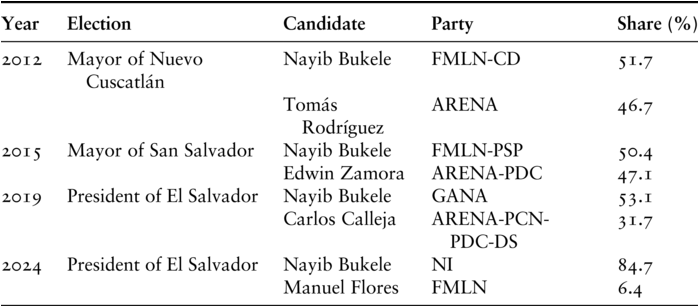
Table 4.1 Long description
The table has five columns titled Year, Election, Candidate, Party, and Share.
For the election of Mayor of Nuevo Cuscatlan in 2012, the candidates are Nayib Bukele and Tomas Rodríguez. The parties are FMLN-CD and ARENA, respectively. The corresponding shares are 51.7 and 46.7.
For the election of Mayor of San Salvador in 2015, the candidates are Nayib Bukele and Edwin Zamora. The parties are FMLN-PSP and ARENA-PDC, respectively. The corresponding shares are 50.4 and 47.1.
For the election of President of El Salvador in 2019, the candidates are Nayib Bukele and Carlos Calleja. The parties are GANA and ARENA-PCN-PDC-DS, respectively. The corresponding shares are 53.1 and 31.7.
For the election of President of El Salvador in 2024, the candidates are Nayib Bukele and Manuel Flores. The parties are NI and FMLN, respectively. The corresponding shares are 84.7 and 6.4.
The note below reads. Data are from the Supreme Electoral Tribunal. Only the top two candidates are included for each election.
Upon being elected president, Bukele’s objectives shifted once more. In a bid to concentrate power under the executive, Bukele declared open war on institutions of horizontal accountability. To help bolster and sustain his popular support, he adopted punitive anti-crime policies and conservative positions on social issues like abortion and LGBTQ+ rights (see Figures 4.1 and 4.2). Especially as a result of his mano dura security policies, the Salvadoran president soon attracted – and increasingly embraced – new allies and admirers among the international far right, as well as new enemies among NGOs, left-leaning governments, and the international press. These shifts were not only compatible with Bukele’s populist narrative, which remained at the core of his rhetoric, but in fact helped support and legitimize it. This was Bukele’s ‘right turn’. In short, I argue that Bukele came to embrace (far) right positions gradually and strategically in response to specific – and fairly mundane – political incentives.
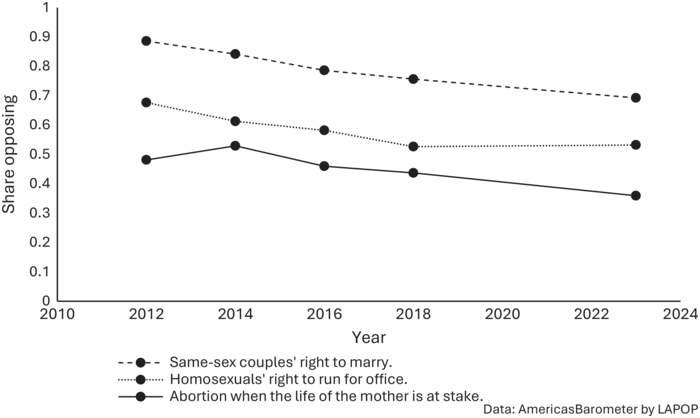
Figure 4.1 Long description
The chart shows three lines: a line for opposition to same-sex couples’ right to marry, a line for opposition to homosexuals running for office, and another one for opposition to abortion when the mother’s life is at stake. Opposition to same-sex marriage starts around 0.9 in 2012 and gradually declines to about 0.7 in 2023. Opposition to homosexuals running for office drops from roughly 0.68 to 0.53. Opposition to abortion in life-threatening cases decreases from about 0.45 to 0.35. Data source: AmericasBarometer.
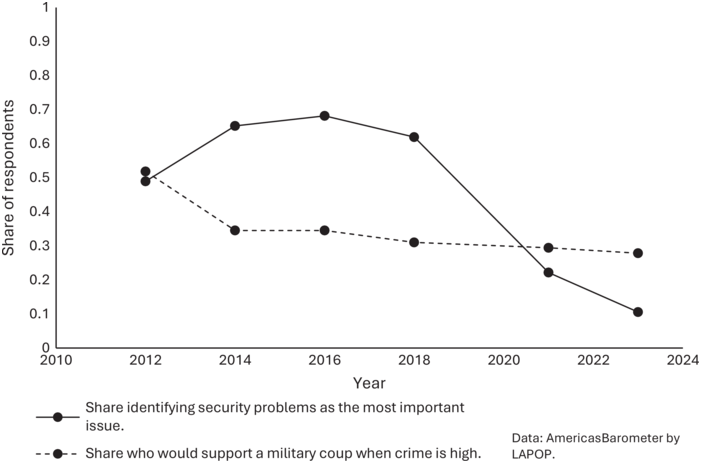
Figure 4.2 Long description
The graph shows two lines tracking the percentage of respondents over time.
The first line represents the share of Salvadorans who identified security problems as the most important issue facing the country. This percentage fluctuates across the years, showing varying levels of public concern about crime.
The second line shows the share of respondents who reported they would support a military coup in a scenario where crime is high. The trajectory of this line follows a similar pattern to the first.
Both data series are plotted against a vertical axis labeled "Share of Respondents" and a horizontal axis labeled "Year." The chart illustrates how these two public attitude metrics changed in relation to each other over the 13-year period. The data source is identified as the AmericasBarometer by LAPOP.
Below, I describe each stage of Bukele’s transformation in greater detail. My focus is on the period between 2012 (when Bukele first ran for elected office) and the end of 2023 (when he was entering the final months of his first presidential term). In the final section of the chapter, I briefly discuss how two subsequent events – Bukele’s re-election to an unconstitutional second term and the return of Donald Trump to the American presidency – have helped consolidate both Bukele’s turn to the far right and El Salvador’s descent into authoritarianism.
4.1 The Salvadoran (Far) Right before Bukele
Between the mid 1980s and the late 2010s, the history of the Salvadoran right was, by and large, the history of one party: ARENA. During the early 1980s – a period when widespread reforms promoted by a succession of military juntas and the rising FMLN guerrilla insurgency threatened the shared interests of economic elites, (para)military officers, and other right-wing actors – ARENA emerged as ‘a political expression of right-wing extremism’ (Wade, Reference Wade2016, p. 29). However, by the end of the decade, the party had moderated, abandoned many of its more extremist appeals, and refocused its agenda on three core prongs: security, neoliberal market policies, and social conservativism. This platform helped ARENA secure the presidency in 1989 and remain in power until 2009, when the FMLN won the presidency for the first time.Footnote 6
Once in the opposition, ARENA (and, by extension, the Salvadoran right) experienced two processes that would reshape Salvadoran politics and help lay the foundations for Bukele’s rise. First, ARENA lost the so-called granitic unity (Loxton, Reference Loxton2021, p. 126) that had helped it establish a near-monopoly over partisan right-wing politics. Most notably, after the presidential defeat of 2009, the party’s leadership accused President Antonio Saca (2004–2009) of having betrayed ARENA’s principles and swiftly expelled him. Saca and his closest allies, including several ARENA deputies, then formed a new centre-right party, the Grand National Alliance (GANA).Footnote 7
Second, and more importantly, ARENA began to experience a silent ideological crisis. Before winning the presidency in 2009, the FMLN had fiercely opposed ARENA’s conservative and neoliberal agenda. This constant clash between the (ruling) right and the (opposition) left helped define ARENA’s ideology and cement the party’s brand for a generation.Footnote 8 But after 2009, the two parties began to converge. Once in power, the FMLN largely favoured policy continuity over the far-reaching progressive reforms it had championed while in opposition. Consider the two issues that most preoccupied Salvadorans during this period: the economy and crime. On the economic front, FMLN governments left ARENA’s neoliberal policies largely untouched (Ching, Reference Ching and Holden2022, p. 559). And on the issue of crime, except for a short and ill-fated gang truce negotiated by President Mauricio Funes (2009–2014), the FMLN opted to adopt and expand the mano dura policies introduced by the previous two ARENA presidents (Aguilar Vásquez et al., Reference Aguilar Vásquez, Rodríguez, Santos, Casullo and Araúz2023, pp. 160–161). Between 2009 and 2019, then, ARENA, a quintessential right-wing party, found itself in the unexpected and unwelcome position of serving as the main political opposition to two successive administrations that had promised to rule from the left – and claimed to do so – but that in fact appeared to govern from the centre right.
As a consequence of its internal divisions and its (involuntary) programmatic convergence with the FMLN, ARENA’s brand as the undisputed standard-bearer of the right quickly diminished. To make matters worse, beginning in 2014, a string of high-profile corruption investigations plagued both ARENA and the FMLN, leaving many voters with the impression that the two parties were similar not only in their policy positions but also in their political modus operandi.Footnote 9 By 2018, more than 80 percent of Salvadoran voters said they agreed with the statement that ‘the parties of the left and right criticize each other a lot, but really they are the same thing’.Footnote 10 Within a year, Bukele would leverage these conditions to win the presidency and ‘upend the ARENA-FMLN duopoly’ (Meléndez-Sánchez, Reference Meléndez, Rovira Kaltwasser and Sajuria2021, p. 27).
4.2 The Leftist Mayor: Nuevo Cuscatlán (2012–2015)
In 2011 Bukele was chosen as the FMLN’s candidate for mayor of Nuevo Cuscatlán, a small municipality eight miles outside of San Salvador. The then thirty-year-old had never competed for public office and was largely unknown to the public. Like any other left-leaning politician with national ambitions, Bukele thus needed both to establish his reputation among Salvadoran voters and to secure the backing of the FMLN – which, together with ARENA, still dominated electoral politics.
Bukele sought to establish himself first and foremost as an innovative and highly effective administrator who could find practical solutions to his constituents’ most tangible needs. Most of the projects through which Bukele aimed to improve the ‘quality of life’ of Nuevo Cuscatlán citizens were relatively small in scale, including, for example, ‘[free health] clinics, scholarships and the construction of cultural and recreational spaces’ (Roque Baldovinos, Reference Roque Baldovinos2021, p. 241). Bukele also focused on improving access to and delivery of public services, particularly drinking water and trash collection. Bukele also launched a ‘security model’ that combined community policing, new technologies, and crime prevention strategies.Footnote 11 These and other municipal projects established Bukele’s initial reputation as a ‘centre-left’ mayor ‘committed to improving the living conditions of the most vulnerable’ (Roque Baldovinos, Reference Roque Baldovinos2021, p. 241).
While he focused on high-impact municipal projects in Nuevo Cuscatlán, Bukele became an increasingly outspoken participant in broader debates on the national scale. It was during this period that Bukele most often spoke of himself – and the issues of the day – in traditional ideological terms and declared himself a ‘radical progressive leftist’.Footnote 12 As he explained in a 2012 interview:
I identify with the left, which is those of us who believe that the state must guarantee opportunities for all: health, education, productive infrastructure. To sustain that we must tax private business, the people who have the most, with the end of subsidizing and carrying out the projects necessary for everyone to have the same opportunities.Footnote 13
‘“The right”, added Bukele, “believes in the law of the jungle, that there should be no rules and that business owners [should] do whatever they want, because in the end business owners will generate a surplus that will reach the poor.”’Footnote 14
Bukele railed against right-wing economic policies (‘The neoliberal model only brings inequality, poverty, and debt’Footnote 15 and against ARENA and ‘the oligarchy’, which, he claimed ‘had so hurt El Salvador’)Footnote 16 and now ‘yearn[ed] to reclaim political power’ from the FMLN.Footnote 17 In contrast, he noted, without the FMLN ‘our people would not be free’.Footnote 18 Bukele also publicly campaigned for Salvador Sánchez Cerén, the 2014 FMLN presidential candidate;Footnote 19 constantly critiqued the Salvadoran right (particularly ARENA and the business elites); and cheered on leftist candidates and governments across the region.Footnote 20 In since-deleted tweets, Bukele heaped praise on Nicaragua’s Daniel Ortega,Footnote 21 shared inspirational Che Guevara quotes,Footnote 22 and wrote that the left – represented by a photograph of Argentina’s Cristina Fernández de Kirchner, Chile’s Michelle Bachelet, and Brazil’s Dilma Rousseff – was Latin America’s path to the future.
During his time as mayor of Nuevo Cuscatlán, Bukele also positioned himself as a progressive on social issues. In 2014, Bukele said he believed that ‘the civil rights issue of our time is the LGBTQ+ community’. ‘I want to be on the right side of history’, he added, comparing the LGBTQ+ community’s efforts to obtain equal rights with the abolitionist and feminist movements in the United States. ‘Truly, I am an ally’, he continued. ‘I would like us to change society’.Footnote 23 Additionally, in a since-deleted 2013 tweet, Bukele appeared to distance himself from ‘pro-life’ abortion activists. Referring to the high-profile case of a twenty-two-year-old Salvadoran woman who was denied access to an abortion even though her life was at stake, Bukele asked: ‘Why don’t those who “defend life” defend Beatriz’s right to live? Maybe they defend fanaticism, which is different’.Footnote 24 Such explicitly progressive appeals were never a central component of Bukele’s rhetoric. Nonetheless, they were noteworthy and unambiguous statements, especially coming from a rising politician in a traditionally conservative society (see Figure 4.1).
Between 2012 and 2015, this was the first iteration of Nayib Bukele that Salvadorans were introduced to: in broad strokes, a highly effective and popular mayor who was unafraid to ‘speak truth to power’ and who, particularly via his online presence, positioned himself squarely on the left on economic, social, and partisan issues. Given the context, combining effective governance with leftist rhetoric was a particularly fruitful strategy. First, his good management of Nuevo Cuscatlán turned Bukele into one of the most visible and popular mayors in the country – no small feat for the mayor of a small municipality in a country that, at the time, remained deeply polarized along party lines. Simultaneously, his vocal commitment to left-wing ideas helped Bukele’s stock rise within the FMLN, which, at the time, retained its virtual monopoly on electoral politics on the left: the party was still ‘the only expression of the left in El Salvador’, per Bukele’s words.Footnote 25 Bukele’s strategy soon paid off, allowing him to secure the FMLN’s nomination for mayor of San Salvador – a common launching pad for presidential bids.
4.3 The Populist Turn: San Salvador (2015–2018)
As he moved from Nuevo Cuscatlán to San Salvador, Bukele continued to place visible, effective, and popular municipal projects at the core of his governing strategy. Bukele’s landmark policy in San Salvador was ‘Una Obra X Día’, roughly translating to ‘one public work per day’. Many of Bukele’s most popular accomplishments involved building or restoring public spaces. In particular, Bukele was able to clean up San Salvador’s overcrowded and crime-ridden city centre, a task that had long vexed the capital’s mayors. Doing so was no small feat: it involved relocating thousands of street vendors into formal markets, restoring the city centre’s built environment, and reducing violence in an area rife with inter-gang turf wars (Roque Baldovinos, Reference Roque Baldovinos2021, p. 242).
Above all, however, this was a period during which intra-party politics and evolving public attitudes provided Bukele with powerful incentives to shed his leftist rhetoric, break with the FMLN, and embrace populism.
In 2012, and again in 2015, the FMLN had given Bukele the best, if not the only, viable path to electoral victory in Nuevo Cuscatlán and San Salvador, respectively. But by 2016, Bukele stated publicly that the FMLN leadership would not allow him to run for president on the party’s ticket. ‘I view it as almost impossible’, said Bukele. ‘It is more likely that I choose not to run for personal reasons’, he added, ‘than for the … party to change a decision it has already made’.Footnote 26 According to one analyst, the party had refused to even consider Bukele as a vice-presidential candidate (Roque Baldovinos, Reference Roque Baldovinos2021, p. 242).
This development had major implications for Bukele’s aspirations: were he to seek the presidency, he would not only have to run outside of the FMLN, but also against it. In other words, Bukele would have to devise a strategy to defeat both the partisan right (ARENA) and the partisan left (the FMLN) – something no presidential candidate had come close to accomplishing in El Salvador’s modern political era.
But popular attitudes had also evolved in the short time since Bukele first ran for office: Salvadorans were becoming increasingly dissatisfied with the two major parties. Between 2012 and 2017, the share of Salvadorans who said they supported the FMLN declined from 26.4 (the most out of any party) to 16 percent. Meanwhile, the share of voters who said they did not support any political party climbed from 49.4Footnote 27 to 64 percent.Footnote 28 By 2018, 84.9 percent of Salvadorans thought that at least half of all politicians were involved in corruption and only 17.1 percent said they trusted the political parties.Footnote 29 And more than 80 percent of Salvadorans said they agreed that ARENA and the FMLN were ‘really the same thing’.Footnote 30
Against this backdrop, Bukele began to shed his FMLN identity almost as soon as he had secured the party’s nomination for San Salvador. In September 2014, during his first major event as candidate, Bukele launched ‘Nuevas Ideas’ (or New Ideas), a ‘citizen consultation’ that would serve as the foundation for his municipal campaign platform.Footnote 31 At the event, Bukele stood at a podium emblazoned with the Salvadoran shield, flanked by Salvadoran flags and against an imposing blue backdrop displaying the words Nuevas Ideas. There was no mention of the FMLN, and the overabundance of blue hues drew an implicit but powerful contrast with the Frente’s ubiquitous red branding.Footnote 32 The event set the tone for Bukele’s stint as mayor of San Salvador: even if Bukele was running on the FMLN ticket, he would not be an FMLN mayor.
Nor would Bukele continue to position himself as a leftist. During his first twenty-eight months as mayor of San Salvador, for example, Bukele wrote 1,719 tweets. None of them explicitly mention neoliberalism, the oligarchy, or structural economic reform. There are no mentions of abortion and only one passing mention of LGBTQ+ rights. Mentions of ‘left’ and ‘right’ were few and far between. In Nuevo Cuscatlán, Bukele had regularly taken to Twitter to cheer on the region’s leftists (and lightly mock their right-wing rivals). But after arriving in San Salvador, Bukele rarely commented on ideological debates at home or abroad – at least not in traditional ideological terms.
Instead, Bukele redirected his attention towards the Salvadoran establishment. During his time as mayor of San Salvador, 16.6 percent of his tweets mentioned establishment actors (compared to 9 percent from his time as mayor of Nuevo Cuscatlán), including ARENA, the FMLN, the media, business elites, and courts and prosecutors. Bukele tweeted about the establishment 408 times, almost four times as often as he tweeted about economic or security issues (105 and 103 tweets, respectively). The number of tweets about projects and accomplishments in San Salvador – nominally at the core of Bukele’s political strategy – also paled in comparison (254).
In these 408 tweets, Bukele began to craft a quintessentially populist narrative: he framed all establishment actors, and particularly ARENA and the FMLN, as indistinguishable elements of a morally corrupt elite that sought to protect its own interests at the expense of the people. Examples abound: ‘The FMLN should build ARENA a monument’, he mockingly tweeted;Footnote 33 ‘The only thing that’s missing is for many in the FMLN to start singing [the ARENA anthem] and put on [ARENA] vests’;Footnote 34 ‘One thing I have noticed’, he wrote in another tweet, ‘[is that] the FMLN and ARENA can be totally on the same page on something. As long as it doesn’t benefit the people’.Footnote 35 Bukele repeatedly accused the FMLN of forming pacts with ARENAFootnote 36 and siding with the oligarchy.Footnote 37 He took to referring to the FMLN simply as ‘ARENA 2.0’ – and ‘anyone who doesn’t see it’, he added ‘is because they are either for ARENA 1.0 or for ARENA 2.0’.Footnote 38 ‘Apparently there is no difference between ARENA and the FMLN’, he lamented. ‘How sad politics is in my country’.Footnote 39
Bukele relentlessly mocked, denounced, and villainized the establishment that ARENA and the FMLN epitomized under this new populist narrative. He routinely referred to El Diario de Hoy and La Prensa Gráfica – the country’s two main newspapers – as ‘pamphlets’ of the ruling class.Footnote 40 He accused the members of the Legislative Assembly, then led by FMLN stalwart Lorena Peña, of being ‘cowards’ eager to harm ‘the people’ but unwilling to hold establishment elites accountable.Footnote 41 He accused the attorney-general of working for ‘the same ones as always’ instead of for ‘the people’Footnote 42 and warned that the country’s electoral tribunal had lost all credibility.Footnote 43 He labelled all of his establishment critics ‘thieves, murderers, and losers’.Footnote 44 He accused the ‘same ones as always’ of having ‘pillaged’ the people and ‘[leaving] them without medicines, without schools, without jobs’.Footnote 45 ‘They will try to destroy any attempt for our country to belong to everyone’, Bukele warned his followers.Footnote 46
In short, beginning in 2015, Bukele abandoned his leftist positions and fully embraced an ideologically ambiguous, quintessentially populist narrative. Where he had once railed against conservative elites and right-wing ideas, Bukele now drew little distinction between the Salvadoran right and the FMLN-dominated left: both were part and parcel of a ‘corrupt and bureaucratized political class’ (Roque Baldovinos, Reference Roque Baldovinos2021, p. 102) that had conspired with economic elites to harm and subjugate the Salvadoran people. Narrative battlelines were redrawn: an ideological and partisan contest between left and right was eclipsed by a Manichean struggle between a deprived, unredeemed people and a depraved, irredeemable establishment. As befitted this new battle, Bukele no longer sought to present himself as a leftist (or indeed as a traditional ideologue of any kind), or as merely an effective administrator who could deliver tangible results, but rather as an authentic representative of the Salvadoran people who could vindicate ‘the population’s exhaustion, disenchantment, hopelessness, and indignation’ (Roque Baldovinos, Reference Roque Baldovinos2021, p. 102). This was Bukele’s populist turn.
It proved to be a winning strategy. The populist turn helped the presidential hopeful accomplish three key objectives. First, Bukele rewrote the logic of electoral competition in his favour. By portraying ARENA and the FMLN as twin enemies of the people, and by de-emphasizing traditional ideological cleavages, Bukele successfully began reframing the 2019 presidential election as a contest not between left and right but between the people and its morally bankrupt oppressors: in other words, Bukele transformed what might have been a difficult three-way race into a much more favourable up-or-down referendum on the status quo.
Second, the strategy helped Bukele position himself as the best-qualified candidate to meet the growing demand among voters for an alternative to the ARENA–FMLN ‘partyarchy’ (Roque Baldovinos, Reference Roque Baldovinos2021):Footnote 47 a politician of undeniable anti-party credentials (he was, after all, willing to disparage even his own party), who did not speak in the traditional ideological language of ARENA and the FMLN, and who had delivered results in Nuevo Cuscatlán and San Salvador while ‘the same ones as always’ had failed to solve the country’s most pressing problems.
Last but not least, the strategy helped Bukele free himself of the FMLN. In October 2017, with roughly six months remaining in his mayoral term, the party’s Ethics Tribunal voted to expel Bukele.Footnote 48 As Roque Baldovinos (Reference Roque Baldovinos2021, p. 243) notes, the FMLN’s decision ultimately provided Bukele with two major boosts. First, it allowed him to overcome a crucial legal hurdle: if Bukele had voluntarily left the party to run on another ticket, El Salvador’s recently enacted laws against party-switching could have prevented him from registering his candidacy. Second, Bukele’s expulsion from the FMLN greatly bolstered his populist, anti-establishment credentials. Despite building his political career within the FMLN, Bukele leveraged his expulsion from the party to perfect his image as an outsider. Bukele was no longer a mere ally in Salvadorans’ plight against the political establishment: he was, like them, a victim.
4.4 The Right Turn: Bukele’s First Presidential Term (2019–2024)
In October 2017, less than a week after being expelled from the FMLN, Bukele announced that he would run for president in 2019.Footnote 49 Doing so, however, required him to find a new party and register his candidacy on short notice. Initially, Bukele announced that he would form his own party: Nuevas Ideas (New Ideas, NI), a name repurposed from his San Salvador campaign platform.Footnote 50 But, predicting that Nuevas Ideas would be unable to clear a series of legal prerequisites in time for the election, Bukele began to explore an alternative strategy: launching a candidacy through one of a handful of small, pre-existing parties. Bukele ultimately secured his nomination through GANA, the party founded by Saca and his allies after the 2009 ARENA schism. At the time, GANA was nominally a centre-right party, but in practice operated as ‘a sort of non-ideological “party for hire”’ (Loxton, Reference Loxton2021, p. 157).
On the presidential campaign trail, Bukele’s appeals were dominated by the anti-establishment populism he had embraced in San Salvador. Table 4.2, for example, shows that 25 percent of Bukele’s tweets during the campaign mentioned establishment actors. This strategy allowed Bukele – already the undisputed frontrunner – to seal his victory by successfully framing the 2019 election as a referendum on the deeply unpopular political class embodied by ARENA and the FMLN.
As he entered the presidency in June 2019, Bukele’s objectives again evolved in a predictable direction. The central goal was no longer to obtain formal political power but to maximize and sustain it over time. Though widely popular, Bukele faced a legislature dominated by ARENA and the FMLN, courts and prosecutors that had gained significant independence over the previous decade, a constitutional ban on re-election, and other meaningful sources of horizontal accountability on the presidency. His relationship with GANA, meanwhile, was little more than an alliance of convenience, and, with legislative and local elections scheduled for 2021, his own party remained embryonic.
To navigate these challenges, Bukele expanded, complemented, and updated his populist narrative in at least four notable ways, which I examine in turn. First, Bukele began to attack not only the actors that constituted the political establishment but also core institutions of horizontal accountability. Second, Bukele adopted conservative positions on social issues (particularly on abortion and LGBTQ+ rights) and began to incorporate Christian rhetoric into his populist narrative. Third, and perhaps most famously, Bukele declared war on the country’s criminal groups, abandoning the more balanced approach he had advocated in Nuevo Cuscatlán and San Salvador in favour of punitive mano durismo. Finally, Bukele began to align himself with the international far right and to promote common anti-globalist tropes. Together, these four changes constituted Bukele’s rightward turn.
It was a strategy that helped Bukele consolidate power in at least two important ways. First, it brought him into closer ideological and programmatic alignment with the average Salvadoran voter. As I describe in more detail below, most Salvadorans viewed religion as important and self-identified as Christian. Abortion and LGBTQ+ rights were widely unpopular – or, at a minimum, deeply polarizing – issues. At the same time, an overwhelming majority of Salvadorans viewed security as the most important issue facing the country. It seems likely, therefore, that Bukele’s decisions to incorporate Christian rhetoric into his populist narrative, move toward the right on social issues, and adopt a hard-line approach to crime were motivated at least in part by a desire to bolster and sustain his public support.
Second, Bukele’s right turn allowed him to update and revitalize the populist narrative as circumstances evolved. Bukele built his original populist brand by framing ARENA, the FMLN, and the political establishment as the central enemies of the Salvadoran people. With his landslide 2019 victory – and especially after his party swept the 2021 legislative and local elections – these enemies had been virtually eliminated. But the right turn allowed Bukele to recast the populist narrative around two new enemies: the domestic ‘pest’ of criminal gangs and the ‘dark forces’ of globalism.
For these reasons, the right turn helped Bukele maintain his popularity, legitimized the concentration of power under the executive, and contributed to sweeping electoral Bukelista victories in 2021 and 2024.
4.4.1 ‘Pantomime Democracy’
Beginning on the presidential campaign trail, Bukele began to frame El Salvador’s political system writ large as a ‘false democracy’ that amounted to little more than a façade erected by ‘the same ones as always’ to advance their anti-majoritarian interests.
This was a subtle but consequential extension of Bukele’s populist narrative: what stood between the people and their redemption was no longer merely a cabal of self-interested elites but rather a set of formal political institutions. These institutions – and particularly those related to Salvadoran democracy’s horizontal or counter-majoritarian dimension – were little more than weapons of elite domination. Undoing them was a mandate of historical proportions.
‘For 200 years’, said Bukele in June 2021, ‘democracy was a pantomime. We had elections, yes, but when politicians got to power, they forgot about the people.’Footnote 51 This was because, he explained, ‘in our country there was always a powerful group behind the government, an invisible government that no one elected’. ARENA and the FMLN were merely ‘two sides of the same coin’, Trojan horses through which elites had weaponized left–right ideologies to ‘divide the people’ and legitimize their democratic pantomime. Underneath the façade of formal electoral competition, this ‘powerful group’ had controlled every branch of the Salvadoran government, sinking Salvadorans in ‘crime, corruption, inequality, and poverty’ to ‘increase the privileges of a few’. ‘Was that democracy? Of course not!’ ‘For the first time in our history, we Salvadorans are truly taking the reins of our own destiny’, he announced. ‘We are building a real democracy. We are not building a false democracy like the one installed by the forces of the status quo.’
Bukele attacked, undermined, and eventually captured or dismantled virtually every institutional check on the executive.Footnote 52 In February 2021, Bukele’s party and its allies won a supermajority in the Legislative Assembly. In May, a few hours after the new legislators were sworn in, Bukele used his supermajority to pack the constitutional court and replace the attorney-general. By November, Bukele had forced a third of the country’s judges into retirement. These blows against the judiciary allowed Bukele to undermine another crucial check on the presidency: the constitutional ban on presidential re-election. In September 2021, the new constitutional court – hand-picked by Bukele – issued a controversial ruling that cleared the path for him to seek re-election in 2024. During his first two-and-a-half years in power, Bukele also reduced and centralized funding for municipal governments; restricted access to public information; increased the executive’s control over sixty-nine autonomous or semi-autonomous agencies; and named loyalists to head nominally independent accountability bodies, including the electoral tribunal, the financial oversight court, and the human rights watchdog.
Bukele framed each move against institutions of horizontal accountability as a necessary step in ‘building a real democracy’: checks and balances were, under Bukele’s narrative, obstacles to the realization of the people’s will. For example, in May 2021, as his coup against the judiciary was unfolding, Bukele tweeted: ‘The people are now represented. And those representatives must deliver to the people. That’s all, it’s called DEMOCRACY. In 200 years, our people have not savoured it, [but] now we do’.Footnote 53
4.4.2 ‘An Instrument of God’
As Table 4.2 suggests, Bukele has generally used religious rhetoric sparingly. But the role, if not necessarily the frequency, of religious appeals changed during Bukele’s first term as president: he began to use religion strategically to frame his populist crusade not only as morally just but also as being aided – and indeed guided – directly by God.
Most tellingly, Bukele began to brand himself explicitly as ‘an instrument of God in our new history’ (Aguilar Vásquez, Reference Aguilar Vásquez2022, p. 172) – going as far as to imply that he could communicate directly with God, who in turn guided him in his battles against ‘the same ones as always’. This was a direct relationship with God that Bukele and his allies habitually emphasized during moments of crisis or amid conflicts with his political adversaries (Aguilar Vásquez, Reference Aguilar Vásquez2022, pp. 170–171).
The most high-profile example of this pattern took place in early 2020. For several weeks, Bukele and the opposition-held Legislative Assembly had been in a standoff related to his security initiative, the Territorial Control Plan. Bukele eventually threatened to dissolve the legislature. On 9 February, surrounded by soldiers and police officers, Bukele forced his way onto the Assembly floor and sat on the speaker’s dais, ready, it appeared, to carry out his threat. Instead, Bukele paused: ‘The decision we will make today, we will put in God’s hands’, he announced.Footnote 54 Bukele then closed his eyes, lifted his hands over his head, and sat in silent prayer for several seconds. In that moment, with the eyes of the country upon him, Bukele claimed that he had spoken to God: ‘I asked God directly’, Bukele soon told a crowd of his followers gathered outside the legislature. ‘And God said to me: patience. Patience. Patience’.Footnote 55 But, Bukele added, ‘if these scoundrels don’t approve the Territorial Control Plan this week, we will convene here again on Sunday, we will once again ask God for wisdom, and we will tell him: “God, you asked us for patience, but these scoundrels don’t want to work for the people.”’ ‘God is wiser than us’, he concluded over the crowd’s loud objections. ‘One week. One week. One week. No people who have disobeyed God have ever triumphed’.Footnote 56
Bukele also began to express support for conservative social values: to defend a sort of ‘religious morality’ (Aguilar Vásquez, Reference Aguilar Vásquez2022, p. 173). For example, in a March 2020 interview, when asked about his views on abortion, Bukele explained that he opposed interrupting pregnancies even in cases of rape,Footnote 57 adding that he ‘would never kill anyone … especially not someone who is defenseless’Footnote 58 and that abortion rights constituted ‘a great genocide’.Footnote 59 The following year, when rumours spread about the contents of a proposal to reform the constitution, Bukele clarified that he would veto any reforms ‘related to the right to life (from the moment of conception), to marriage (maintaining only the original design, [between] a man and a woman) or to euthanasia’. Salvadorans ‘need a constitution that brings us into the future’, he added, ‘but always maintaining our principles and our faith in God as the force that guides all of our actions. Because El Salvador will only be able to make progress if He wills it’.Footnote 60
Bukele most likely embraced this ‘religious morality’ at least in part because he could expect it to be widely popular among Salvadorans (see Figure 4.1). In 2018, 82.8 percent of Salvadorans said that religion was ‘very important’ in their lives, 85.6 percent of respondents identified as Christians of various denominations, and 72.5 percent said they attended religious services at least once a month.Footnote 61 More than three in four said they disapproved of same-sex couples’ right to marry, and only 9.7 percent expressed strong support for ‘homosexuals’ right to run for office’. In other words, most Salvadorans were, or at least claimed to be, deeply religious and predominantly conservative.Footnote 62 Bukele’s emphasis on Christian rhetoric and his shift towards the right on social issues almost certainly helped him consolidate his support among this electorate.
4.4.3 The War on Gangs
If religion and social issues provided Bukele with a straightforward opportunity to strengthen his popularity, no single issue had the potential to jeopardize it as much as crime. Though homicide rates were on the decline by the time Bukele became president, the maras remained a powerful threat: operating in (and exercising effective control over) much of the country’s territory, they ran extortion schemes and continued to inflict significant violence upon a large portion of the population. The year before he was elected president, more than 60 percent of Salvadorans said security issues were the most important problem faced by their country (see Figure 4.2).
In San Salvador, Bukele had advocated for a progressive approach to security. His 2015 platform identified ‘social vulnerabilities’ as the root cause of crime and vowed to improve security in the capital by ‘giv[ing] its inhabitants more and better opportunities’.Footnote 63 ‘The solution to insecurity is education, culture, and inspiration’, wrote Bukele in a September 2015 tweet. ‘The rest is like trying to stop the sea with a wall of sand’.Footnote 64 In a 2017 interview, he spoke eloquently about the importance of rebuilding the country’s ‘social fabric’ and articulated a firm critique of hard-on-crime approaches:
Here in San Salvador, the vast problem that we have cannot be tackled by police … You have a social problem. … But right now we’re just thinking that [gang members] are sociopaths that are wanting to kill so we have them arrested all [sic]. But that won’t solve the problem … we have to understand that … our social fabric is ripped, and we have to rebuild it again. And if we want to rebuild it then we have to understand the problem that we have, which is not a violence problem: [violence] is a consequence of our problems, which is huge, huge, huge inequality and social destruction of the fabric that makes our society work.Footnote 65
During the first three years of his presidency, Bukele’s security approach included three main components. The Territorial Control Plan, focused on law enforcement, aimed to strengthen and modernize El Salvador’s coercive apparatus (with a strong emphasis on the role of the military) and to gradually regain state control over gang territories. But, along with the Territorial Control Plan, Bukele emphasized a ‘root-causes’ approach that echoed his strategy in San Salvador. For example, his presidential platform noted that crime ‘must not be treated exclusively from the optic of fighting crime, because it is a social problem in which a lack of opportunities and life options produce a vicious cycle of poverty, crime, and violence’.Footnote 66 ‘Organized crime and criminal groups will be combated’, the document stated. ‘But special emphasis will also be given to the lack of opportunities that derive from the exclusionary economic model that has been in place in the country’.Footnote 67
The third – and arguably most consequential – component of Bukele’s early anti-crime strategy unfolded behind closed doors: Bukele and his team engaged in extensive negotiations with the country’s main gangs, expanding on a strategy they had first embraced in San Salvador. According to journalistic reports and US court filings, Bukele and the gangs struck a series of agreements through which, in broad terms, the gangs lowered homicide rates and provided Bukele and Nuevas Ideas political support in exchange for special privileges for incarcerated gang members, a reduction in repressive policing tactics, and the possibility of more permissive legislation.Footnote 68 Thanks in large part to this pact, homicide rates fell from 53 per 100,000 in 2018 – the year before Bukele became president – to 18 per 100,000 in 2021 (The World Bank, n.d.).Footnote 69
Then, in March 2022, Bukele’s gang pact collapsed. When the MS-13 launched a wave of retaliatory homicides – murdering eighty-seven people over the course of seventy-two hours – Bukele responded with what would amount to ‘one of the most intensive crackdowns against criminal organizations ever recorded in Latin America’.Footnote 70 On 27 March, Bukele and his legislative allies declared a national state of emergency, suspended a wide range of constitutional rights, and began conducting mass arrests. Soon, Bukele’s legislators also approved reforms that ‘instituted harsh new sentencing guidelines for gang-related crimes, lowered the age of criminal responsibility from 16 to 12, and introduced a gag rule banning journalists from spreading “gang messages”’.Footnote 71
The crackdown transformed Bukele’s rhetoric. As Figures 4.3 and 4.4 show, Bukele’s attention turned almost exclusively to the gangs, which he began to attack with the same intensity he had previously reserved for the members of the establishment. Bukele referred to gang members as ‘terrorists’,Footnote 72 ‘murderers’,Footnote 73 ‘idiots’,Footnote 74 and ‘Satan worshippers’.Footnote 75 He boasted that incarcerated gang members would not see ‘even a ray of sunlight’Footnote 76 and threatened to stop providing them with food.Footnote 77 He mocked the idea that gang members should have human rights.Footnote 78 Through this rhetoric, Bukele villainized and dehumanized the gangs, drawing a clear dichotomy between the ‘pest’Footnote 79 they represented and the ‘common’ and ‘honourable citizens’ who made up the true Salvadoran people.Footnote 80 Gang members, said Bukele, had murdered, extorted, and terrorized the Salvadoran people. Now, thanks to the crackdown, the people could finally ‘enjoy their rights’.Footnote 81 ‘When you catch a wolf, you save the sheep’, read one tweet.Footnote 82
As Aguilar Vásquez and colleagues (Reference Aguilar Vásquez, Rodríguez, Santos, Casullo and Araúz2023), Brown Araúz and Casullo (Reference Brown Araúz and Casullo2023), and others have noted, this rhetoric marked a qualitative shift in the orientation of Bukele’s populist narrative: its central enemy was no longer the establishment, but rather the country’s criminal gangs. In other words, Bukele no longer identified a powerful elite as the people’s main enemy. Instead, the populist crusade became a campaign to cleanse the population of the ‘pest’ of gang members. Put differently, if Bukele’s war-on-establishment populism most resembled the leftist populism of a Hugo Chávez or Rafael Correa, then his new war-on-gangs populism more closely mirrored the logic of the xenophobic populism of European far-right parties (e.g., Mudde, Reference Mudde2007, pp. 69–73).
At any rate, the emergence of a new enemy helped reinvigorate Bukele’s populist appeal. By March 2022, Bukele and his allies controlled virtually all public institutions, while ARENA and the FMLN had been reduced to minor parties. If populist appeals are only as powerful as the enemies they invoke, then the traditional political establishment presented Bukele with increasingly limited fuel for his populist narrative. By contrast, in the gangs Bukele found a fresh, powerful, and much-despised foe.
Above all, however, the crackdown strengthened Bukele because it succeeded in curbing crime. By March 2023 – a year after the crackdown began – Salvadoran authorities had arrested more than 70,000 people (equivalent to over 1 percent of the population), homicides and extortions had plummeted, the gangs were virtually ‘disarticulated’Footnote 83 and more than 85 percent of Salvadorans said they supported the crackdown.Footnote 84
4.4.4 ‘We Are Not Your Colony’
Bukele’s shift to the right soon spilled over into the international arena. Bukele’s choice to align himself with the international right was a fundamentally defensive and reactive tactic, triggered above all by growing criticism from ‘globalist’ actors. The international right provided Bukele with a ready-made arsenal of allies, tropes, and narrative devices with which to effectively reframe and counter these criticisms. Moreover, Bukele’s rightward turn abroad proved to be a natural – and useful – extension of the populist narrative: the Manichean logic of populism was easily adapted to frame foreign critics as enemies of the Salvadoran people, a move that, in turn, helped strengthen and reinvigorate Bukele’s populist appeal at home.
By late 2021, Bukele’s authoritarian manoeuvres were drawing criticism from a wide range of international actors, including NGOs, multilateral organizations, the international press, and left-leaning governments. Bukele responded by framing his international critics as meddlesome bullies who wanted to conspire with domestic elites to undermine the sovereignty and best interests of the Salvadoran people (Brown Araúz & Casullo, Reference Brown Araúz and Casullo2023, p. 103). In his 2021 Independence Day speech, for example, ‘Bukele accused the “international community” of “financing a perverse opposition who does not care if it harms children and the elderly”’ (Brown Araúz & Casullo, Reference Brown Araúz and Casullo2023, p. 103). Online, the Salvadoran president frequently mocked the international community,Footnote 85 disparaged its supposed hypocrisy,Footnote 86 and warned it not to meddle in El Salvador’s private affairs.Footnote 87 These attacks were increasingly tinted with far-right tropes and undertones. International human rights advocates, read one September 2021 tweet, ‘would rather impoverish the Salvadoran people, as long as they can achieve their political objectives and promote their globalist agenda’.Footnote 88 On several occasions, Bukele accused George Soros and his Open Society Foundations of financing an international campaign to discredit his government.Footnote 89
Bukele’s evolving relationship with the United States government is particularly illustrative of these trends. During Donald Trump’s first term in office, Bukele appeared to take great pride in his good relationship with the United States.Footnote 90 In September 2019, when Trump appointed a new ambassador to El Salvador, Bukele extended him an effusive welcome and noted that ‘our [countries’] priorities are the same and for that reason we will achieve great things together’.Footnote 91 By December, Bukele would boast that ‘our relationship with the United States [is] in its best moment’.Footnote 92
But this relationship quickly soured with the arrival of the Biden administration – particularly as Democrats in Congress and the White House, expressing concerns about some of Bukele’s authoritarian actions, moved to cut military support for El Salvador.Footnote 93 By December 2021, Bukele had gone on the offensive: ‘It is clear that the interests of the United States government have nothing to do with democracy, in any country’, he wrote.Footnote 94 ‘[It] does not accept collaboration, friendship, or alliance. It is complete submission or nothing’.Footnote 95 In February 2022, when a group of US senators introduced legislation to ‘mitigate potential risks’ to the US financial system posed by El Salvador’s adoption of bitcoin,Footnote 96 Bukele’s response was equal parts sardonic and pugnacious: ‘OK boomers’, he tweeted. ‘You have 0 jurisdiction on a sovereign and independent nation. We are not your colony, your back yard, or your front yard. Stay out of our internal affairs’.Footnote 97 Bukele’s jabs increasingly riffed on right-wing tropes: ‘US taxpayers should know that their government is using their money to fund communist movements against a democratic [sic] elected government in El Salvador’, he wrote, in English, in December 2021.Footnote 98 In January 2022, Bukele retweeted a New York Post article about shoplifting in the United States: ‘Is there a deliberate plan to destroy the United States from within?’.Footnote 99
Bukele’s right turn abroad intensified after March 2022. The war on gangs drew Bukele widespread international attention – both positive and negative. When human rights organizations and the international press began to report on widespread human rights abuses at the hands of Salvadoran authorities,Footnote 100 Bukele again went on the offensive. He claimed that human rights advocates ‘want to see our people bleed to death, that is their business model’,Footnote 101 accused his international critics of conspiring with the gangs (‘now the Salvadoran people will know who has been behind the blood their families and friends have spilled’),Footnote 102 warned that foreign politicians ‘want our country to return to a past of death and destruction’,Footnote 103 and attributed negative press coverage to the ‘Open Society media’.Footnote 104 At the same time, Bukele’s hard-on-crime approach held natural appeal among international conservatives and, as his CPAC appearance underscores, Bukele began to actively foster and embrace his new status in right-wing circles.
By the end of 2023 – as Bukele was embarking on the final months of his first term in office – the Salvadoran president, once a self-proclaimed leftist, had established himself as one of the most prominent figures of the international far right. Indeed, by this time, Bukele had adopted at least four common characteristics of the populist radical right: he (1) attacked counter-majoritarian institutions; (2) adopted religious rhetoric and conservative positions on social values; (3) drew increasingly on anti-globalist tropes; and, perhaps most notably, (4) embraced punitive populism, espousing attitudes towards gang members whose logic closely echoed the xenophobic populism of many European right-wing parties (Mudde, Reference Mudde2007, pp. 69–73).
However, as the discussion above has illustrated, this right turn was strategic and piecemeal. Bukele adopted these far-right positions not as a result of a cohesive agenda, a far-sighted strategy, or a guiding set of ideological commitments. Nor was Bukele’s transformation a case of cultural backlash against progressive ideas, actors, or policies – a recurring theme in this volume.Footnote 105 Rather, Bukele’s transformation was the cumulative result of many tactical responses to evolving political incentives, challenges, and opportunities. For this reason, Bukele’s right turn was also partial and selective. He skilfully embraced right-wing positions when doing so could help him consolidate power and bolster his public support. But when these objectives were best served by other means, Bukele was equally adept at staking out centrist (or even leftist) positions.
Two important developments during his first term help illustrate this point. The first is pension reform. In December 2022, Bukele announced a pension reform that increased monthly retirement payments by 30 percent for most recipients, raised the return rate on retirement savings by one percentage point, and allowed El Salvador’s pension administrators to invest 100 percent of their holdings in government bonds. This reform package was, at least on paper, progressive and redistributive. Not only did it increase benefits for all but the highest-earning Salvadorans, but it also paved the way for what would be, in practice, a nationalization of El Salvador’s pension system: measures, in other words, that would be difficult to reconcile with a pure far-right agenda. Crucially, Bukele turned to the left on pension reform because doing so could help address an important challenge: how to continue financing his heavily leveraged, cash-strapped government in the short term without resorting to more austere measures that could cut into his public support.Footnote 106
The second aspect of Bukele’s presidency that highlights his strategic ideological versatility concerns the economy. During his first term, Bukele began to promote a vision for El Salvador’s economic development that Marroquín Parducci (Reference Marroquín Parducci2023, p. 85) has memorably described as a ‘Central American techno-utopia’: ‘a technological future of great illuminated highways, beaches that welcome tourists, an army that delivers justice, a huge prison that punishes any threat, and cryptocurrencies that make everyone rich’. This was a vision that deftly blended right-wing and leftist ideas. Cryptocurrencies, foreign investment, and law-and-order values were among its central components. But the ‘techno-utopia’ model also called for the state to play an outsized role in directing the country’s development. And Bukele framed the vision in terms of progressive goals, such as ‘help[ing] provide financial inclusion to thousands outside of the formal economy’Footnote 107 and reducing transaction costs related to remittances, a key source of support for low-income Salvadorans.Footnote 108
This extraordinary track record of ideological adaptability highlights another central claim of this chapter: that populism has been the constant and defining characteristic of Bukele’s political discourse. On his path to the presidency, Bukele framed domestic elites as the central enemy of the Salvadoran people. By the beginning of his first term, these attacks on domestic elites had expanded to include institutions of horizontal accountability. The populist narrative then evolved to encompass two new villains – domestic ‘undesirables’ (i.e., the gangs) and ‘globalist’ international elites – and to embrace religious rhetoric. In ideological terms, these changes meant that, on the whole, Bukele veered sharply to the right during his first term. But populism remained the guiding principle and defining characteristic of Bukele’s legitimation strategy throughout.
4.5 From Radical to Extreme Right? Re-election, Donald Trump’s Return, and the Hardening of the Salvadoran Regime
Shortly after the period upon which I focus in this chapter, two developments ushered yet another stage in Bukele’s evolution: his re-election to an unconstitutional second term in 2024 and the return of Donald Trump to the presidency of the United States in 2025.
Bukele was re-elected in February 2024 with almost 85 percent of the vote. His party, meanwhile, won almost complete control of the Legislative Assembly, securing fifty-four of sixty seats. Bukele’s overwhelming popularity – bolstered in no small part by the successful gang crackdown – and the weakness (as well as unforced errors) of ARENA, the FMLN, and other opposition parties contributed to these resounding victories (Perelló & Navia, Reference Perelló and Navia2024).Footnote 109 But, as I have noted elsewhere, Bukele ‘had rewritten and circumvented the rules of the game to tilt the electoral playing field decisively in his favour’ well before election day: in addition to violating term limits – the Salvadoran constitution has long barred sitting presidents from seeking re-election – Bukele and his allies gerrymandered the electoral map to favour Nuevas Ideas and systematically abused the powers of the state to disadvantage their rivals (Meléndez-Sánchez, Reference Meléndez-Sánchez and Vergara2024). The ensuing vote count, too, was riddled with irregularities.Footnote 110
In practice, the 2024 election did little to change the balance of power: by the time it arrived, Bukele already held the presidency, boasted a legislative supermajority, and exercised de facto control over the courts and all other institutions of horizontal accountability. Nonetheless, Bukele’s willingness to tilt the electoral playing field in his favour marked a clear hardening of the Salvadoran regime: it not only cemented El Salvador’s descent into competitive authoritarianism, but also signalled that Bukele may be prepared, if necessary, to fully undermine the vertical (and not just the horizontal) dimension of democracy. More generally, Bukele’s re-election raised concerns that his second term would see a deepening of the ‘crackdown on dissenting voices that began under the state of emergency’ (Wolf, Reference Wolf2024, p. 315), as well as fresh efforts to further extend Bukele’s time in office (Perelló & Navia, Reference Perelló and Navia2024, p. 12).
The return of US President Donald Trump to the White House in January 2025 exacerbated these concerns. In Trump, Bukele found a natural ally with a much weaker normative commitment to democracy and to human rights than his predecessor. The result has been a hardening of both El Salvador’s competitive authoritarian regime and Bukele’s right turn, as evidenced by three major developments during the first six months of Trump’s second term.
In March 2025, Bukele and Trump reached an agreement to send immigrants deported from the United States to the Terrorism Confinement Center (CECOT), El Salvador’s notorious – and secretive – megaprison. Despite a US court ruling blocking the move, the Trump administration soon deported more than 200 immigrants – including at least 137 Venezuelans – to be imprisoned in the CECOT indefinitely and without due process.Footnote 111 Although the Trump administration initially claimed that most of the prisoners were members of the Venezuelan Tren de Aragua, the Salvadoran MS-13, or other criminal organizations, independent investigations found that almost none of those deported had criminal records or other known links to those groups.Footnote 112 These developments marked a stunning ‘transnationalization of El Salvador’s state of emergency’.Footnote 113
During the first months of 2025, Bukele also intensified his efforts to repress dissenting voices. Most notably, on 18 May, authorities arrested Ruth López, a prominent human rights activist and anti-corruption lawyer.Footnote 114 Her organization, Cristosal – El Salvador’s most high-profile human rights organization – soon pulled its entire staff from the country.Footnote 115 El Faro – the country’s most prominent investigative newspaper – followed suit after its leaders uncovered a plot to arrest them.Footnote 116 During this period, authorities also arrested at least half a dozen other high-profile activists, lawyers, and critics. The arrests amounted to a qualitative escalation in the regime’s repressive tactics. In the words of two of the exiled El Faro reporters, ‘May and June [of 2025] marked the great exodus of Salvadoran journalists and human rights and environmental activists. A growing exile had been trickling since Bukele came to power but had never been as massive and evident as it is now’.Footnote 117
Finally, in late July 2025, Bukele’s legislators approved a series of constitutional reforms that completely abolished term limits on the presidency and extended the length of the presidential term from five to six years. The reforms also replaced El Salvador’s traditional presidential run-off system with a single-round contest.Footnote 118 The move appeared designed to extend Bukele’s tenure indefinitely.
Bukele serves as a case study of how a savvy far-right politician, when boosted by high levels of popular support and a permissive international environment, can accelerate democratic backsliding and consolidate authoritarianism. Indeed, as recent developments suggest, El Salvador is likely to continue its downward slide into authoritarianism as long as Bukele remains in office. The country’s competitive authoritarian regime had already hardened significantly a little more than a year into his second term. Especially if Bukele’s popularity declines to the extent that the ballot box is no longer a reliable avenue to remain in power, or if serious challengers emerge from within the ranks of the opposition, the Salvadoran regime is likely to begin resembling a purer form of authoritarianism.

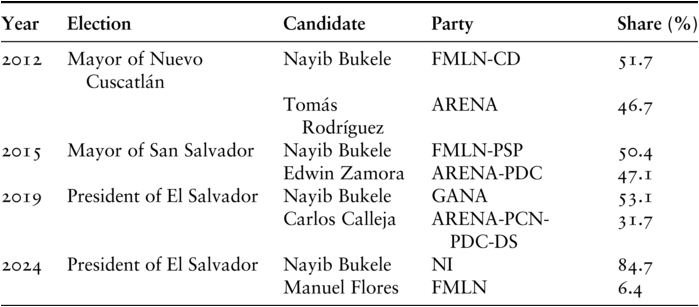
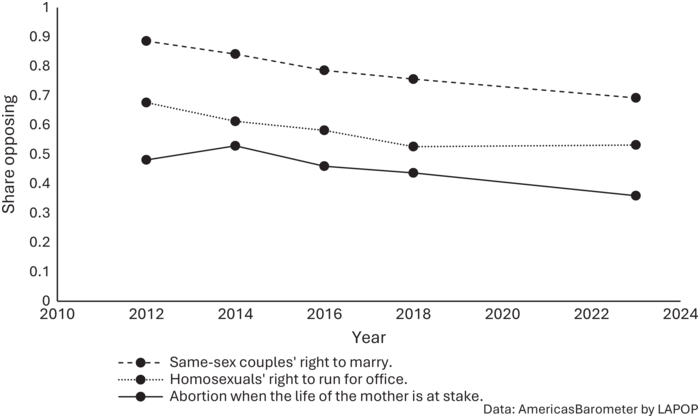
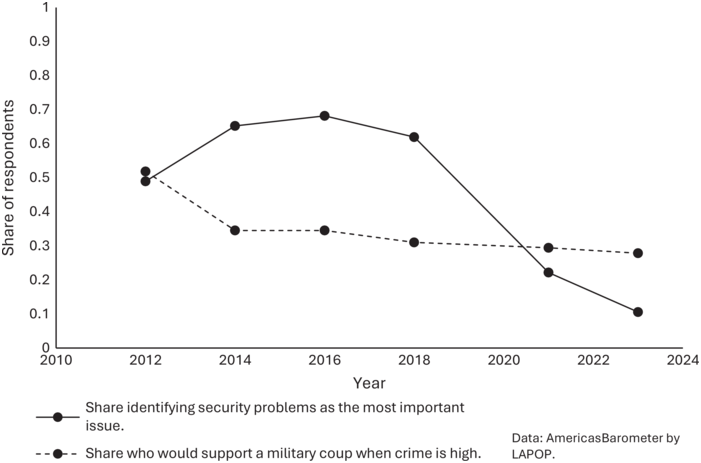

 Open access