




Introduction
Soil organic carbon (SOC) plays an important role in the carbon (C) cycle of terrestrial ecosystems, maintaining soil quality in agrocosystems (Balesdent et al., Reference Balesdent, Basile-Doelsch, Chadoeuf, Cornu, Derrien, Fekiacova and Hatté2018). SOC changes are usually used as an indicator of soil quality because SOC is tightly associated with the biogeochemical cycles of most major nutrients (N, P, and K) and provides energy and substrates for microbial activities (Li et al., Reference Li, Zhang, Pu, Li, Xu, Jia, Deing and Gong2016; Chen et al., Reference Chen, Song, Liu, Miao, Ding, Li, Zhang and Shi2024). A higher SOC content can improve soil quality and represents a substantial contribution via C sequestration that can reduce C emissions (Plaza-Bonilla et al., Reference Plaza-Bonilla, Álvaro-Fuentes and Cantero-Martínez2014). There is a close relationship between SOC content and soil microbial activity (Guo et al., Reference Guo, Zhang, Wang, Li and Cao2015). Therefore, it was a beneficial strategy for improving soil productivity and reducing greenhouse gases by increasing SOC content.
In recent years, some studies showed that soil labile organic carbon (LOC) was necessary for providing nutrient elements and energy for plant growth and microbial metabolism by its quick decomposition (Liu et al., Reference Liu, Yan, Mei, Zhang and Fan2013; Li et al., Reference Li, Wen, Li, Li, Yang, Lin, Song, Gooper and Zhao2018). Although many studies were focused on changes of total soil organic carbon (TOC) content (Zhang et al., Reference Zhang, Zhuang, Zhao, He, Yu, Shi and Xing2016; Han et al., Reference Han, Wiesmeier, Conant, Kühnel, Sun, Kögel-Knabner, Hou, Cong, Liang and Ouyang2018), more studies were needed on SOC content and its labile fractions, especially the changes in soil LOC fractions, such as the cumulative carbon mineralisation (Cmin), dissolved organic carbon (DOC), and microbial biomass carbon (MBC), permanganate oxidisable carbon (KMnO4-C), particulate organic carbon (POC), light fraction organic carbon (LFOC), which were more sensitive to the changes in field management practices, including differences in crop system, soil tillage, and fertiliser regime (Sheng et al., Reference Sheng, Zhou, Zhang, Kuzyakov, Zhou, Ge and Wang2015). Soil non-labile organic C fractions include highly humified inert components, which have long renewal cycles and are relatively stable. However, there is still a need to further explore the effects of soil tillage on SOC content and its labile fractions, soil microbial activity in paddy fields under a double-cropping rice system, including conventional tillage (CT), rotary tillage (RT), no-tillage (NT), and crop residue returning. Some SOC fractions were more sensitive to changes of soil environment than TOC content under short-term tillage conditions (Chen et al., Reference Chen, Song, Liu, Miao, Ding, Li, Zhang and Shi2024). Crop residue additions to soil long-term have been demonstrated to increase soil DOC and MBC contents (Xu et al., Reference Xu, Lou, Sun, Wang, Baniyamuddin and Zhao2011). Soil carbon management index (CMI) has been calculated to give an indication of the changes in the C dynamics of field ecosystem response relative to a paired reference soil (Blair et al., Reference Blair, Lefroy and Lisle1995). Meanwhile, soil microbial activities were increased under tillage and crop residue incorporation conditions (Tang et al., Reference Tang, Li, Cheng, Shi, Wen, Li and Xiao2021). Therefore, SOC fractions and CMI, soil microbial activity are usually regarded as an indicator to assess the potential of short-term crop residue incorporation with soil tillage to improve soil quality (Xu et al., Reference Xu, Lou, Sun, Wang, Baniyamuddin and Zhao2011; Ghosh et al., Reference Ghosh, Meena, Alam, Dogra, Bhattacharyya, Sharma and Mishra2016).
Rice (Oryza sativa L.) cultivation in the paddy system is the major agricultural land use in the tropical and subtropical monsoon climate region of Asia (Yang et al., Reference Yang, Ren, Sun and Zhang2012). Double-cropping rice production system (early rice and late rice) is the main crop rotation in southern of China, which was providing food for people around the world. It usually accepts that soil tillage (CT, RT, and NT) plays an important role in regulating soil quality and soil environment. Meanwhile, soil tillage with crop residue incorporation is a beneficial management for increasing soil quality and fertility in paddy fields. In the previous study, our results revealed that the different short-term soil tillage with crop residue incorporation managements had profound effects on soil properties (eg., soil pH, SOC content), which in turn influence soil physicochemical properties and grain yield of rice (Tang et al., Reference Tang, Xiao, Li, Tang, Cheng, Pan, Wang and Li2019). However, it is currently still not known how the different short-term soil tillage with crop residue incorporation treatments (CT: conventional tillage with crop residues incorporation; RT: rotary tillage with crop residues incorporation; NT: no-tillage with crop residues retention; RTO: rotary tillage with all crop residues removed as a control) have affected soil labile and non-labile organic C fractions under the double-cropping rice system in southern of China. Therefore, the aim of this study was: (1) to investigate effects of short-term (5 years) tillage and crop residue incorporation managements on proportions of labile (Cmin, MBC, DOC, POC, LFOC, and KMnO4-C) and non-labile C fractions in paddy soil; (2) to investigate effects of tillage and crop residue incorporation managements on SOC content and stocks in paddy fields; and (3) to choose benefit tillage and crop residue incorporation practices under the double-cropping rice system in southern of China.
Materials and methods
Sites and cropping system
This experiment was begun in November 2015. It was located in Ningxiang County (28°07′ N, 112°18′ E) of Hunan Province, China. The field experiment was located in the major production area of double-cropping rice. The annual mean precipitation and evapotranspiration in field experiment were 1553 and 1354 mm, monthly mean temperature was 17.2°C, respectively. Soil type of field experiment was a clay loam and it was developed from the quaternary red earth. At the beginning of this field experiment, soil chemical characteristics at plough layer (0-20 cm) were showed as following: SOC 22.07 g kg-1, total nitrogen (N) 2.14 g kg-1, available N 192.20 mg kg-1, total phosphorous (P) 0.82 g kg-1, available P 13.49 mg kg-1, total potassium (K) 13.21 g kg-1, available K 81.91 mg kg-1, and pH 5.79. The other more detailed information about crop system was described by Tang et al. (Reference Tang, Xiao, Li, Tang, Cheng, Pan, Wang and Li2019).
Experimental design
The experiment included four soil tillage treatments: conventional tillage with crop residues incorporation (CT); rotary tillage with crop residues incorporation (RT); no-tillage with crop residues retention (NT); and rotary tillage with all crop residues removed as a control (RTO). The area of each plot was 56.0 m2 (7 m×8 m), and each treatment was laid out in a randomised complete block design with three replications. NT treatment was applied with no-tillage practice, and the Chinese milk vetch and rice straw were returning to the surface in paddy field before transplanting of rice seedling. Before transplanting of rice seedling, CT treatment was applied with a moldboard plough tilled with depth of 15–20 cm and then rotovated tilled with depth of 8–10 cm, RT and RTO treatments were applied with rotovated tilled with depth of 8–10 cm. The detail information about tillage management with RTO treatment was similar with RT treatment, except that all crop residues were removed from paddy fields during early rice and late rice whole growth period. The other detailed information about soil tillage practices, crop residue incorporation and chemical fertiliser, cultivars of rice, date of transplant and harvest, and other field managements was described by Tang et al. (Reference Tang, Xiao, Li, Tang, Cheng, Pan, Wang and Li2019).
Soil sampling
Soil samples at 0–20 cm depth were collected by randomly taking six cores in October 2019 (after the late rice harvest) from each plot. Then the six soil cores were bulked to form a composite soil sample. Three soil samples were collected from each plot. After removing the visible organic materials, stones, and rice roots by hand, the soil samples were divided into two parts. One part of the fresh soil sample was passed through a 2 mm mesh sieve and was kept at 4 °C for measurement of soil dissolved organic carbon (DOC), MBC, and cumulative carbon mineralisation (Cmin) within 2 weeks, and the other part of fresh soil sample was air dried and sieved through a 0.15 mm mesh for estimation of SOC and permanganate oxidisable carbon (KMnO4-C) contents (Shang et al., Reference Shang, Yang, Gao, Wu, Liu, Xu, Shen, Zou and Guo2011) or a 2 mm mesh prior to measurement of soil POC and LFOC contents.
Soil laboratory analysis
Soil bulk density
Soil BD at 0–20 cm depth was determined by collecting undisturbed soil samples using metallic cores of known volume (having 15.0 cm internal diameter and 20.0 cm length). These soil samples were oven-dried at 105 °C for 24 h to a constant weight for calculating the dry weight of soil samples (Blake and Hartge, Reference Blake, Hartge and Klute1986).
SOC content and SOC stocks
SOC content was determined using the rapid titration method (wet combustion method) as described by Ellert and Bettany (Reference Ellert and Bettany1995). SOC stocks were calculated from the SOC content measured at 0–20 cm soil layer by multiplying them with the respective BD and the thickness of the soil layer and expressed as Mg ha-1.
Soil labile organic carbon fractions
Soil KMnO4-C content was measured with the method described by Blair et al. (Reference Blair, Lefroy and Lisle1995). Soil POC content was determined with the method described by Cambardella and Elliott (Reference Cambardella and Elliott1992). Soil MBC content was menstruated by the fumigation–extraction method and can be founded in Wu et al. (Reference Wu, Joergensen and Pommerening1990). Soil DOC content was determined with the method described by Jones and Willett (Reference Jones and Willett2006). Soil LFOC content was determined using the density fractionation method described by Janzen et al. (Reference Janzen, Campbell, Brandt, Lafond and Townley-Smith1992).
Soil carbon management index
Soil CMI was calculated based on the method described as by Blair et al. (Reference Blair, Lefroy and Lisle1995). The CMI = CPI×LI×100. Soil carbon pool index (CPI) was determined as follows: CPI = (Total organic C content in sample soil)/(Total organic C content in reference soil). Soil lability index (LI) was calculated as follows: LI = (lability of C in sample soil)/ (lability of C in reference soil). The lability of C (L) was calculated from: L = (KMnO4 oxidisable C content)/(Total organic C-KMnO4 oxidisable C content). In this study, the control treatment (RT) was used as a reference for the calculation of CMI.
Statistical analysis
The data of each treatment means was compared by using one-way analysis of variance (Anova) following standard procedures at the p < 5% probability level. All the statistical analysis was calculated by using SPSS statistical software (version 3.11). These results in the present manuscript were expressed as mean and standard error. When standard errors and confidence intervals were assessed by using Anova method, which were robust against deviations from the normal distribution and the homoscedasticity of errors. Moreover, redundancy analysis (RDA) was used to analyse the relationship between the proportions of each labile organic C fraction to SOC and CMI under all soil tillage treatments with Canoco version 4.5.
Results
Soil bulk density
Our results indicated that soil BD was significantly decreased (P<0.05) with crop residue incorporation treatments (NT, CT, and RT), compared with without crop residue input treatment (RTO). Soil BD ranged between 1.10 and 1.21 g cm-3 in all soil tillage treatments and was significantly lower in soils treated with CT and RT treatments compared to soil treated with RTO treatment, NT treatment had the highest BD (Table 1). Soil tillage with crop residue incorporation practices significantly decreased BD (1.10 g m−3 for CT, 1.14 g m−3 for RT). There was no statistically significant difference in BD between CT, RT, and RTO treatments.
Effects of different soil tillage treatments on soil bulk density (BD), soil organic carbon (SOC), and SOC stocks under the double-cropping rice system (0–20 cm)

CT: conventional tillage with crop residues incorporation; RT: rotary tillage with crop residues incorporation; NT: no-tillage with crop residues retention; RTO: rotary tillage with all crop residues removed as a control.
Different letters in the same column indicate significant difference at P < 0.05. The same as below.
SOC content and stocks
Our results revealed that SOC content and stocks were significantly increased (P < 0.05) with NT, CT, and RT treatments, compared with RTO treatment. As shown in Table 1, short-term continuous crop residue input significantly increase (P<0.05) SOC content and stocks after 5 years for all tillage treatments. Treatments which received crop residue (CT, RT, and NT) had higher SOC contents and stocks compared to RTO treatment, storing as much as 4.64 to 3.60 Mg ha−1 more C at 0–20 cm soil layer than that of the RTO treatment. Compared with RTO treatment, SOC contents were increased by 16.8%, 10.5%, and 3.9% in CT, RT, and NT treatments, respectively. Furthermore, SOC content and stocks were significantly increased (P < 0.05) with CT treatment, while there was no difference (P > 0.05) in SOC stocks between RT, NT, and RTO treatments. The lowest SOC content and stocks after 5 years were observed in RTO treatment.
Soil labile organic C fractions
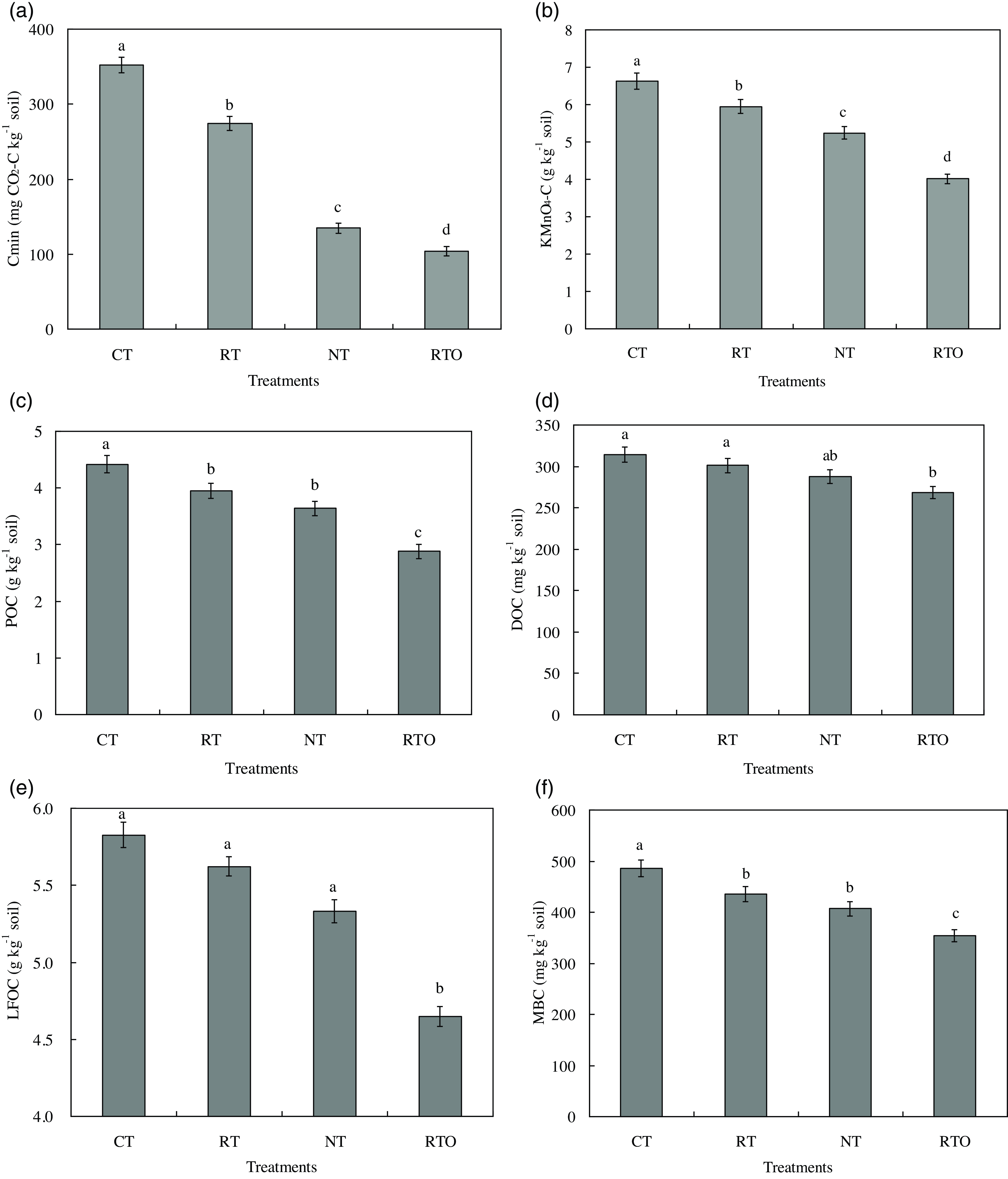
The effects of different soil tillage treatments for 5 years on soil labile organic C fractions (Cmin, MBC, DOC, POC, LFOC, and KMnO4-C) were shown in Figure 1. Meanwhile, the proportions of each labile organic C fraction relative to total SOC with different short-term soil tillage treatments are shown in Table 2. Our results revealed that proportions of each labile organic C fraction relative to total SOC were significantly increased (P < 0.05) with CT, RT, and NT treatments, compared with RTO treatment.
Effects of different soil tillage treatments on labile organic C fractions in soil at 0–20 cm depth under the double-cropping rice system. CT: conventional tillage with crop residues incorporation; RT: rotary tillage with crop residues incorporation; NT: no-tillage with crop residues retention; RTO: rotary tillage with all crop residues removed as a control. In (a), cumulative carbon mineralisation in a 21-day incubation experiment (Cmin). In (b), permanganate oxidisable carbon (KMnO4-C). In (c), particulate organic carbon (POC). In (d), dissolved organic carbon (DOC). In (e), light fraction organic carbon (LFOC). In (f), microbial biomass carbon (MBC). Values represent the mean of three replications. Error bars represent standard error of mean. Treatment means were compared by using one-way analysis of variance (Anova) following standard procedures at the p < 5% probability level.
Labile organic C fractions (Cmin, KMnO4-C, POC, DOC, LFOC, MBC) as a proportion of total SOC (%) with different soil tillage treatments

Cmin: mineralisable C; KMnO4-C: permanganate oxidisable C; POC: particulate organic C; DOC: dissolved organic C; LFOC: light fraction organic C; MBC: microbial biomass C.
Soil cumulative amounts of CO2-C (Cmin) were increased with soil tillage and crop residue incorporation treatments (352.4 mg CO2-C g−1 soil for CT and 274.3 mg CO2-C g−1 soil for RT), and the lowest Cmin content (103.8 mg CO2-C g−1 soil) was found in RTO treatment. Cmin content was significantly increased by 161.6% and 103.6% under CT and RT treatments, compared to NT treatment, respectively. Cmin content in CT, RT, NT, and RTO treatments was significantly different (P < 0.05) from each other (Figure 1, a). Cmin comprised very small proportions (0.5%–1.5%) of the total SOC, and the proportion of Cmin to SOC was significantly increased (P < 0.05) with CT and RT treatments, compared with NT and RTO treatments (Table 2).
Soil permanganate oxidisable carbon (KMnO4-C) content was significantly increased (P < 0.05) with CT, RT, and NT treatments, compared with RTO treatment (Figure 1, b). Compared with RTO treatment, the proportion of KMnO4-C to SOC was increased by 41.4%, 34.3%, and 25.8% in CT, RT, and NT treatments, respectively. The proportion of KMnO4-C to SOC varied from 19.9% to 28.2% with the mean value of 25.0% in all tillage treatments. The highest proportion of KMnO4-C was observed in CT treatment, followed by RT treatment, which was not significantly different from NT treatment (P > 0.05). CT treatment had the highest proportion of KMnO4-C and the lowest proportion was found in RTO treatment.
Our results revealed that soil POC content was significantly increased (P < 0.05) with CT, RT, and NT treatments, compared with RTO treatment. That is, POC content was increased under soil tillage with crop residue incorporation conditions (Figure 1, c). Compared with RTO treatment, proportion of POC to SOC was increased by 31.4%, 24.1%, and 21.7% under CT, RT, and NT treatments, respectively. The range of values for proportion of POC to SOC was from 14.3% to 18.8%, and the mean value was 17.1%. The highest proportion of POC was observed in CT treatment, followed by RT and NT treatments, which was significantly different from RTO treatment (P < 0.05).
Soil dissolved organic carbon (DOC) content was highest in tillage with crop residue incorporation soil and lowest in control soil. Soil tillage with crop residue incorporation results in higher levels of DOC with a content 1.17 and 1.12 times higher with CT and RT treatments compared with RTO treatment, respectively. Compared with RTO treatment, DOC content was significantly (P < 0.05) increased with CT, RT, and NT treatments (Figure 1, d). The values for proportion of DOC to SOC (1.3%–1.4%) were significantly affected by tillage treatments, with the highest proportion in NT treatment and the lowest in RTO treatment. Compared with RTO treatment, proportion of DOC to SOC was increased by 0.8%, 1.5%, and 3.0% in CT, RT, and NT treatments, respectively.
The short-term soil tillage with crop residue incorporation (CT, RT, and NT) results in a significant increase in soil LFOC content, compared to RTO treatment. At surface soil (0–20 cm), LFOC content was increased by 25.3%, 20.9%, and 14.7% with CT, RT, and NT treatments, compared with RTO treatment, respectively. But there was no statistically significant difference (P > 0.05) in LFOC content between CT, RT, and NT treatments (Figure 1, e). Compared with RTO treatment, the proportion of LFOC to SOC was increased by 7.3%, 9.5%, and 10.5% under CT, RT, and NT treatments, respectively. The proportion of LFOC to SOC ranged from 23.1% to 25.5% with an average value of 24.6% in all tillage treatments. Meanwhile, the proportion of LFOC to SOC was significantly increased (P < 0.05) with NT treatment, compared with RTO treatment.
Soil MBC content ranged from 354.17 to 485.64 mg kg−1, constituting about 1.8–2.1% of total SOC (Figure 1 f, Table 2). The short-term soil tillage with crop residue incorporation (CT, RT, and NT) results in a significant increase in MBC content, compared to RTO treatment. There was no statistically significant difference (P > 0.05) in MBC content between CT, RT, and NT treatments. Compared with RTO treatment, proportion of MBC to SOC was increased by 17.1%, 11.4%, and 10.2% in CT, RT, and NT treatments, respectively. The value for proportion of MBC to SOC as influenced by tillage treatments showed a similar trend to the MBC content with higher proportions in CT, RT, and NT treatments, and lower proportions in RTO treatment. Therefore, it were beneficial practices for increasing soil fertility (e.g., SOC content and proportions of each labile organic C fraction relative to total SOC) in paddy fields with NT, CT, and RT treatments.
Carbon pool index and carbon management index
The effects of different short-term soil tillage treatments for 5 years on soil CPI and CMI are shown in Table 3. Our results revealed that soil CMI and CMI were significantly increased with NT, CT, and RT treatments, compared with RTO treatment. Changes in CPI with different soil tillage treatments decreased in the order CT>RT>NT>RTO, with values ranging from 1.00 to 1.17. The impacts of different soil tillage treatments on soil CMI were similar to CPI, with the highest CMI in CT, RT treatments and the lowest in RTO treatment. The highest value of soil CMI was associated in soil tillage with crop residue incorporation practices (CT and RT), followed by NT treatment. There was a significant difference (P < 0.05) in soil CMI between CT, RT and NT, RTO treatments.
Effects of different soil tillage treatments on soil carbon management index (CMI) under the double-cropping rice system (0–20 cm)

CPI: soil carbon pool index; L: lability of C; LI: lability index; CMI: carbon management index.
Redundancy analysis of the proportion of each labile organic C fraction to SOC
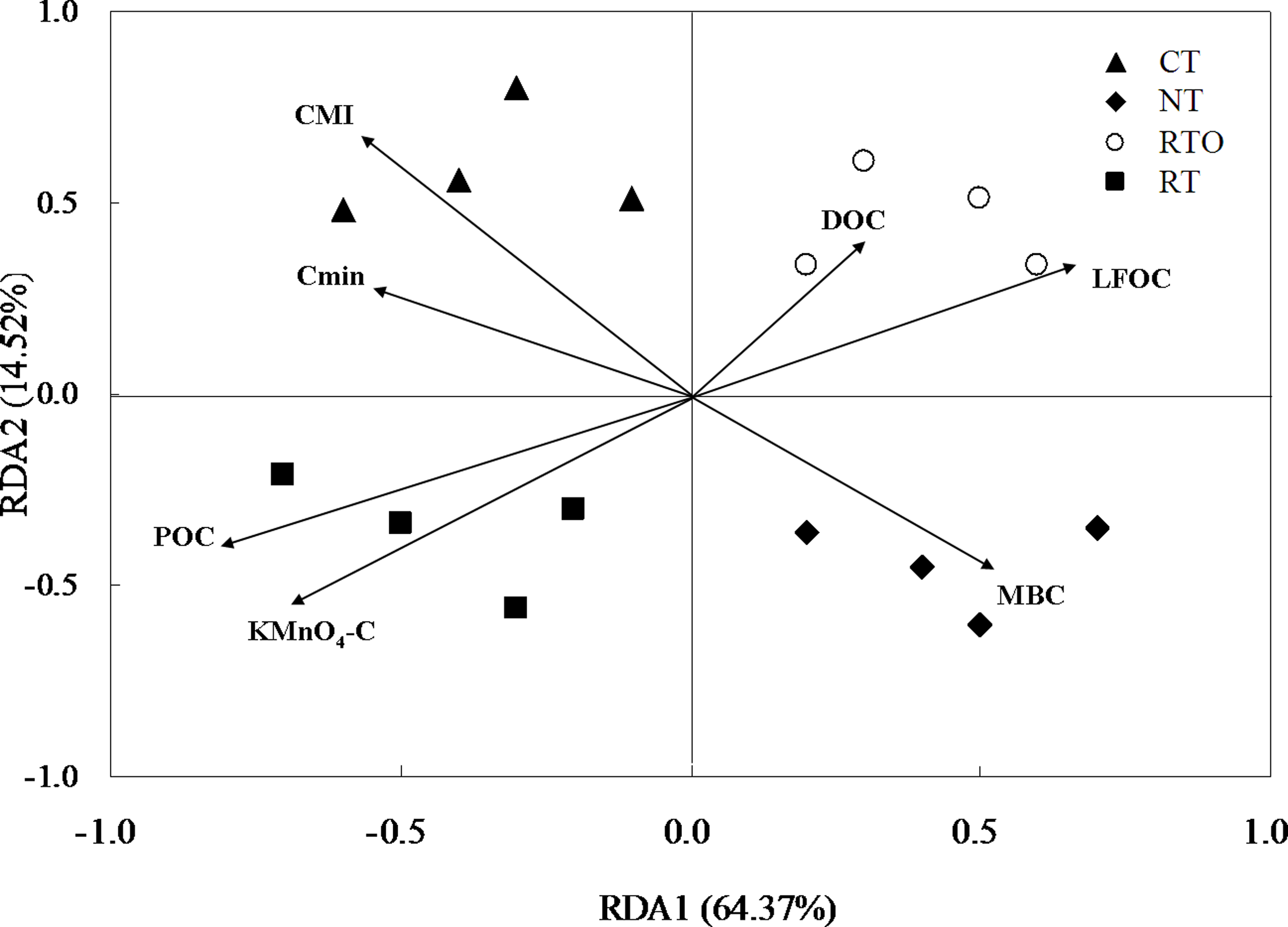
Redundancy analysis indicated that the proportion of each labile organic C fraction to SOC as well as CMI as responses was conducted to help us to understand which types of C were causing the changes in the labile organic C fractions (Figure 2). As shown in Figure 2, the first two axes accounted for 78.89% of total variation and all the explanatory variables had significant impacts on proportion of each labile organic C fraction in SOC and CMI (P < 0.05). Our results revealed that proportions of MBC, LFOC, and DOC to SOC were closely related to positive axis of axis 1. And the Cmin, POC, and KMnO4-C in total SOC as well as CMI were closely correlated with the negative axis of axis 1. Soil tillage with crop residue incorporation treatments (CT and RT) were significantly different from NT and RTO treatments along the negative axis of axis 1 and all of them were clearly separated from each other. NT treatment was significantly separated from other treatments along the positive axis of axis 1 and correlated with higher MBC content. RTO treatment was significantly separated from other treatments along the positive axis of axis 1 and correlated with higher DOC and LFOC contents.
Redundancy analysis (RDA) of the proportions of each labile organic C fractions (Cmin, MBC, DOC, POC, LFOC, KMnO4-C) to SOC as well as CMI under different soil tillage treatments. ▲CT: conventional tillage with crop residues incorporation; ■RT: rotary tillage with crop residues incorporation; ◆NT: no-tillage with crop residues retention; ○RTO: rotary tillage with all crop residues removed as a control.
Discussion
Effects of soil tillage management on soil BD, SOC content, and stocks
It usually accepts that soil BD was obviously changed under different soil tillage conditions (Verma et al., Reference Verma, Dhaka, Singh, Kumar, Choudhary, Kumar, Kamboj, Hasanain, Singh and Bhupenchandra2024). In the present study, our results revealed that soil BD was affected by short-term soil tillage treatments, especially in soil tillage with crop residue incorporation treatments. Soil BD was decreased under crop residue incorporation conditions, this could be due to the formation of macro-pores and macro-aggregates induced by the cementing action of organic acids and polysaccharides excreted by microorganism during the decomposition of the applied crop residue (Xu et al., Reference Xu, Lou, Sun, Wang, Baniyamuddin and Zhao2011; Li et al., Reference Li, Zhang, Pu, Li, Xu, Jia, Deing and Gong2016). These decreases may reflect higher levels of crop residue, rice root, and rhizodeposition inputs under soil tillage conditions compared to without crop residue input treatment (Table 1). Meanwhile, our results also indicated that the highest SOC content was correlated with the lowest BD in soil tillage with crop residue incorporation treatments (CT and RT), with the NT treatment having moderate level of SOC and the highest soil BD, and the lowest SOC and moderate soil BD with the control treatment. Lack of crop residue incorporation was the main reason results in increase soil BD at surface soil layer for that crop residue stabilises soil aggregates against slaking, dispersion and collapse (Ghosh et al., Reference Ghosh, Meena, Alam, Dogra, Bhattacharyya, Sharma and Mishra2016), which were agree with our results that increases in SOC content were related to decrease soil BD in soil tillage with crop residue incorporation treatments (Table 1).
Some studies have reported that SOC content was influenced by filed managements, such as soil tillage (Liu et al., Reference Liu, Teclemariam, Yan, Yu, Gu, Liu, He and Liu2014; Guo et al., Reference Guo, Zhang, Wang, Li and Cao2015), fertiliser practices (Shang et al., Reference Shang, Yang, Gao, Wu, Liu, Xu, Shen, Zou and Guo2011; Yang et al., Reference Yang, Ren, Sun and Zhang2012), and so on. In the present study, our results revealed that SOC content in soil tillage with crop residue incorporation treatments (CT and RT) was greatly increased after 5 years of double-cropping rice compared to initial soil levels (22.07 g kg−1), which agrees with the previous study (Guo et al., Reference Guo, Zhang, Wang, Li and Cao2015). The reason was attributed to an increase in root exudates from modern higher-yielding varieties and from the carbon (C) contained in the soil tillage with crop residue incorporation which were returned to paddy soil each year. At present, most of the above-ground residues removed from paddy fields have been adopted, these may be contributing to the decrease in soil C content in the control plots even though roots and part of crop residues were left in the paddy soil.
In recent years, some studies reported that SOC content and stocks in paddy soil were significantly influenced by soil tillage practices (Ghosh et al., Reference Ghosh, Meena, Alam, Dogra, Bhattacharyya, Sharma and Mishra2016). In the present study, our results also revealed that SOC content and stocks in paddy soil were influenced by soil tillage practices, which agrees with the previous studies (Yang et al., Reference Yang, Ren, Sun and Zhang2012; Tang et al., Reference Tang, Xiao, Li, Tang, Cheng, Pan, Wang and Li2019). Compared with the control treatment, SOC content was increased marginally in no-tillage and crop residue incorporation treatment, these results agree with the previous studies which the crop residue incorporation induced an increase in SOC content (Xu et al., Reference Xu, Lou, Sun, Wang, Baniyamuddin and Zhao2011; Guo et al., Reference Guo, Zhang, Wang, Li and Cao2015), and the similar seem to depend on the initial soil C status, field ecosystem, quantity, and quality of crop residue returned (Li et al., Reference Li, Zhang, Pu, Li, Xu, Jia, Deing and Gong2016). In the present study, the increases in SOC content and stocks at the topsoil layer in soil tillage with crop residue incorporation treatments (CT and RT) may be due to more available soil nutrients (e.g., N, P, and K) being provided for better crop growth, resulting in increased root residue and exudates being returned to paddy soil (Table 1), and more soil nutrients (C, N, P, K) were added from the crop residue return to paddy fields. Therefore, based on SOC content and its stocks in paddy soil, it were beneficial practices for increasing soil fertility and soil quality under the double-cropping rice system with soil tillage and crop residue incorporation treatments. These results have been supported by many reports from other long-term field experiments (Zhou et al., Reference Zhou, Gong, Wang, Su, Li, Li, Liu, Bai, Cong and Wang2024; Shen et al., Reference Shen, Zhang, Yang, Liu, Li, Han, Kuzyakov and Ning2024).
Compared with NT and RTO treatments, SOC contents and stocks were increased considerably in soil tillage with crop residue incorporation practices (CT and RT), which were possibly attributed to a larger proportion of organic compounds in crop residue (Liu et al., Reference Liu, Teclemariam, Yan, Yu, Gu, Liu, He and Liu2014). A larger input over output of organic matter was the main reason for the increase of SOC content in crop residue incorporation treatments. These results implied that a high amount of organic material input through crop residue incorporation was required for increasing soil organic C pools. Therefore, higher SOC stocks in paddy fields were attributed to both higher organic matter inputs and lower C decomposition rates (Kalbitz et al., Reference Kalbitz, Kaiser, Fiedler, Kölbl, Amelung, Bräuer, Cao, Don, Grootes, Jahn, Schwark, Vogelsang, Wissing and Kögel-Knabner2013). The significant increases in non-labile C in crop residue incorporation treatments soil (Table 3) indicated that crop residue addition could be a strategy to improve SOC stabilisation and soil quality in the double-cropping rice field (Li et al., Reference Li, Zhang, Pu, Li, Xu, Jia, Deing and Gong2016).
Effects of soil tillage management on soil labile organic C fractions
In the previous studies, many results indicated that labile organic C fractions were markedly increased under crop residue incorporation conditions (Xu et al., Reference Xu, Lou, Sun, Wang, Baniyamuddin and Zhao2011; Guo et al., Reference Guo, Zhang, Wang, Li and Cao2015). Meanwhile, our results revealed that labile organic C fractions were also increased with CT, RT, and NT treatments, which were consistent with previous findings (Xu et al., Reference Xu, Lou, Sun, Wang, Baniyamuddin and Zhao2011; Guo et al., Reference Guo, Zhang, Wang, Li and Cao2015). The reason may be attributed that soil labile organic C pool and microbial activities were changed under soil tillage with crop residue input conditions; therefore, more exogenous C carbon were entered paddy fields, and the conversion of plant residue-C into labile forms of organic C were also increased (Whalen et al., Reference Whalen, Gul, Poirier, Yanni, Simpson, Clemente, Feng, Grayston, Barker, Gregorich, Angers, Rochette and Janzen2014).
It is generally acceptable that Cmin, DOC, and MBC account for only a small proportion of SOC in agricultural soils, but they are usually regarded as sensitive indicators of soil quality and nutrient cycle (Benbi et al., Reference Benbi, Brar, Toor and Singh2015). In the present study, our results showed that soil Cmin, DOC and MBC contents in paddy fields were increased under soil tillage with crop residue incorporation conditions, which were disagree with the previous study (Guo et al., Reference Guo, Zhang, Wang, Li and Cao2015), suggested that soil tillage with crop residue incorporation had beneficial effects on the activity of microorganisms probably by providing a readily-available source of C substrate and improving the soil physical environment (Shen et al., Reference Shen, Zhang, Yang, Liu, Li, Han, Kuzyakov and Ning2024). In the present study, our results showed that soil MBC as a proportion of SOC were highest in crop residue incorporation treatments (Table 2), suggested that there were provided more plant residue-C for microbial biomass growth. On the other hand, inputs of C from roots/crop residue/rhizodeposition in those treatments promote growth of the microbial biomass but did not contribute as much to the total SOC, and similar result were also found by Li et al. (Reference Li, Zhang, Pu, Li, Xu, Jia, Deing and Gong2016) in China.
It is widely accepted that soil DOC is a vital source of C for microbial metabolic maintenance needs (Xu et al., Reference Xu, Lou, Sun, Wang, Baniyamuddin and Zhao2011). In this study, our results revealed that soil DOC in paddy fields was increased with short-term soil tillage with crop residue incorporation practices, which were in agreement with Guo et al. (Reference Guo, Zhang, Wang, Li and Cao2015), confirming that the primary source of DOC was root and crop residue (manure) input. Meanwhile, there were more DOC for microbial biomass growth in paddy fields under soil tillage with crop residue incorporation conditions. Our results showed that soil DOC as a proportion of SOC was highest in NT, RT, and CT treatments, it was lowest in RTO treatment, possibly reflecting the higher levels of decomposed organic C in crop residue incorporation treatments (NT, RT, and CT), as evidenced by its high proportion of DOC (Zhou et al., Reference Zhou, Gong, Wang, Su, Li, Li, Liu, Bai, Cong and Wang2024).
Soil POC and LFOC belong to physically uncomplexed organic matter which was isolated on the basis of particle size and/or density by using physical fractionation techniques (Chen et al., Reference Chen, Song, Liu, Miao, Ding, Li, Zhang and Shi2024). Our results revealed that proportions of POC and LFOC in paddy fields varied from 14.3% to 18.8% and 23.1% to 25.5%, respectively, reflecting the annual input of fresh C in all tillage treatments (Table 2). In the present study, our results showed that proportions of POC and LFOC in paddy fields were at the normal ranges in all tillage treatments, which agree with the previous studies (Yang et al., Reference Yang, Ren, Sun and Zhang2012; Chen et al., Reference Chen, Song, Liu, Miao, Ding, Li, Zhang and Shi2024), indicating that higher C input induced by fertility management results in significantly larger physically uncomplexed organic C (POC and LFOC) pools (Figure 1, c and e). Zhu et al. (Reference Zhu, Hu, Yang, Zhang and Zhang2014) also found that soil POC and LFOC contents were increased under ploughing tillage and crop residue incorporation conditions. Meanwhile, our results showed highest proportion of POC in crop residue input treatments (CT, RT, and NT) while the highest proportion of LFOC in CT, RT, and NT treatments (Table 2), the reason may be attributed to LFOC that contains more lignin derivatives, carbohydrate constituents, and aliphatic compounds than that of POC and was much more closely related to crop residues (Zhang et al., Reference Zhang, Zhang, Li, Qin, Hou, Li, Zhang and Li2024).
Soil KMnO4-C generally includes amino acids, simple carbohydrates, a portion of soil microbial biomass, and other simple organic compounds, and it is also usually considered as an important indicator of soil quality (Xu et al., Reference Xu, Lou, Sun, Wang, Baniyamuddin and Zhao2011). In the present study, our results revealed that KMnO4-C was higher in total and as a proportion of the total C in crop residue incorporation soil compared to without crop residue input soil, which were agree with the previous study (Sheng et al., Reference Sheng, Zhou, Zhang, Kuzyakov, Zhou, Ge and Wang2015), the reason may be attributed to that soil labile organic C pool and microbial activities were increased under soil tillage with crop residue input conditions, more exogenous C were enter paddy fields. Then the plant residue-C into labile forms conversion to organic C was also increased (Whalen et al., Reference Whalen, Gul, Poirier, Yanni, Simpson, Clemente, Feng, Grayston, Barker, Gregorich, Angers, Rochette and Janzen2014).
Effects of soil tillage management on soil CMI
It is widely accepted that CMI is regarded as an important parameter to assess the capacity of management to improve soil quality (Verma et al., Reference Verma, Dhaka, Singh, Kumar, Choudhary, Kumar, Kamboj, Hasanain, Singh and Bhupenchandra2024). Soil CMI, CPI, and lability index (LI) are usually used as an indicator of soil C sequestration and nutrient cycling potential in different paddy ecosystem. In the present study, our results revealed that soil CMI were increased with soil tillage with crop residue incorporation treatments (CT and RT), compared with without crop residue input treatment. These findings agree with previous studies based on long-term soil tillage field experiments (Xu et al., Reference Xu, Lou, Sun, Wang, Baniyamuddin and Zhao2011; Ghosh et al., Reference Ghosh, Meena, Alam, Dogra, Bhattacharyya, Sharma and Mishra2016). The reasons were attributed to increase in annual C addition and the changes in organic matter quality, soil tillage with crop residue incorporation, thus affecting the susceptibility of C to KMnO4 oxidation (Tang et al., Reference Tang, Li, Cheng, Shi, Wen, Li and Xiao2021). Soil CMI at 0–20 cm soil layer was also increased with NT treatment, compared with RTO treatment. The reason may be due to higher root C input, crop residue recycling, and other biological activities at soil layer under no-tillage with crop residue incorporation conditions (Chaudhary et al., Reference Chaudhary, Dheri and Brar2017). In the present study, our results revealed that soil CMI was highly correlated with the amount of each labile organic C fraction and total SOC content (P < 0.05). Therefore, these results reinforced the soil CMI as a reliable index to assess the quality of soil management under the double-cropping rice system in southern of China. However, there is still a need to further explore the effects of different tillage and crop residue incorporation managements on rhizospheric carbon resources utilised and soil microbial communities under the double-cropping rice system in southern of China.
Conclusions
Our results clearly revealed that soil BD was decreased, while SOC content and stocks, labile organic C fractions (Cmin, MBC, DOC, POC, LFOC, and KMnO4-C) were increased with soil tillage and crop residue incorporation managements under the double-cropping rice system in southern of China. Compared with the treatment without any crop residue (RTO), soil proportions of Cmin, KMnO4, POC, DOC, and MBC to SOC were increased by 196.1%, 41.4%, 31.4%, 0.8%, and 17.1% in CT treatment, respectively. It were beneficial practices for increasing C sequestration and nutrient cycling in soil ecosystem with conventional tillage, rotary tillage, and crop residue incorporation treatments, based on SOC content and stocks, soil CMI, CPI, and LI indexes. In conclusion, conventional tillage, rotary tillage with crop residue incorporation managements could be important strategies for improving SOC status and maintaining soil quality under the double-cropping rice system in southern of China. However, the effects of different tillage with crop residue incorporation managements on soil microbial communities under the double-cropping rice system based on long-term need to be studied further.
Acknowledgements
This study was supported by National Key Research and Development Project of China (2023YFD2301403), Hunan Science and Technology Talent Lift Project (2022TJ-N07), National Natural Science Foundation of China (U21A20187), Special Funds for the Construction of Innovative Provinces in Hunan Province (2023NK2027) and Hunan Province Agricultural Science and Technology Innovation Fund Project (2024CX39).
Competing interests
The authors declare there are no conflicts of interest.


 Open access

