


Introduction
Why do courts betray constitutional democracy? What mechanisms make this happen? This article explains the causes of democratic backsliding with an overlooked branch in literature: the judiciary. Control of judiciaries is a key feature of democratic backsliding, but the mechanisms of antidemocratic projects to gain such control vary. I look at the problem of courts in democracies, supposed and designed to be stopgaps against authoritarianism, and how they change their behavior and facilitate undemocratic projects. In this case study, I use process-tracing in the case of Guatemala to build a theory of how the design of judicial appointments creates perverse incentives that facilitate such backsliding.
Courts once defended constitutional democracy in Guatemala and later turned against it. I argue that a pluralist porous approach to judicial appointments opened the opportunity for “political entrepreneurs” to influence the process and profit from it. This type of entrepreneur engaged in capturing courts is the causal mechanism that led to democratic backsliding. Fearing independent judiciaries, elites captured the courts relying on the entrepreneurs of a legal-bureaucratic complex, removing the system of checks and balances. With courts captured, undemocratic elites subverted the courts’ functions and used them against democracy.
I rely on interviews with Guatemalan intellectual and political actors who were part of one or more of the following processes: constitutional design of 1984, reforms of 1993, reforms of 2009, part of the court stopping attempted coups in 1993 and 2003, and finally, members of the nomination committees. The interviews contrast the different potential reforms, the intentions, unintended consequences, and retrospectively analyze the outcomes.
I contribute to the literature in two ways. First, I warn against the sanguine idea that courts are the last hope for democracy and how a short-term justification of court-packing or redesign can make things worse. Second, I argue that the design of judicial appointments creates new interest groups that find reward in undermining democracy, which is an under-researched topic. This is a mid-range argument in which I am not studying a short-term court-packing that leads to authoritarianism. Neither am I focusing on the institutional design of authoritarian courts to protect interests in the long term. The first example explains the change via the populist way (Ginsburg and Huq Reference Ginsburg and Huq2018; Levitsky and Ziblatt, Reference Levitsky and Ziblatt2019; Staton, Reenock, and Holsinger Reference Staton, Reenock and Holsinger2022), and the latter explains the continuity of authoritarian institutions (Albertus and Menaldo Reference Albertus and Menaldo2017, Reference Albertus, Menaldo, Brinks, Murillo and Levitsky2020). This article explains the endogenous reversion of an institution from democratic to undemocratic. Entrepreneurs see benefits in capturing the judiciary, privatizing justice, and benefiting the highest bidder. This literature has been largely overlooked in political science despite its implicit use by prosecutors and anti-corruption officials, and sometimes in political economy and public choice theories. However, it can make important contributions to theories of court-packing and democratic backsliding.
The puzzle consists of two problems: 1) Why did parties create this weak and capturable judiciary? And 2) why were courts the critical factor in democratic erosion? I argue that economic and bureaucratic elites in the transition to democracy sought to secure their privileges in the judiciary. Sometimes rivals and sometimes allies, they kept each other in check while allowing a long and gradual transition from a counterinsurgent regime to a democratic one (Schirmer Reference Schirmer1998). This is known as the alliance that won the war, referring to the business elite and the military who fought the left guerrillas during the Cold War era.Footnote 1
Elites are the constitutional architects of a regime. These elites design the courts, and therefore, courts defend the elites’ views. If the elites are committed to democracy, courts will defend it. If the elites are not committed to democracy, courts will not be democratic. The problem we are looking at here is why courts change from the former to the latter. If courts in democracies are designed to resist anti-democratic projects, why do they stop backsliding at some point and not at others? The Guatemalan example offers a good illustration with its young and challenged democracy. It is the story of courts betraying the old democratic regime that created them, favoring authoritarians who did not find support in the population. The puzzle is why the same institution with minimal variation in its design changed its behavior.
The argument builds on the theory of political entrepreneurship and asserts that the design of the rules creates perverse incentives that reward authoritarian projects. I look at Guatemala, a young third-wave democracy that has struggled with legacies of violence and high levels of corruption. It is one of the less accomplished promises of the democratic turn in the 1980s. I advance this argument by proposing the theories of capture and political entrepreneurship. The isolation of judiciaries from presidential power created a capturable mechanism that facilitated democratic backsliding.
The intended pluralist approach of filters incorporated interest groups that legislators expected to filter and choose justices according to qualifications and merits. A new elite emerged from the skilled groups with government-granted privileges to influence judicial appointments, creating a legal-bureaucratic complex with vested interests in the political arena. Old and new elites threatened by a potential independent judiciary sought to capture it, first to secure impunity and later to use it against their rivals. The capture eliminated checks, balances, and competition, ultimately using courts to undermine the electoral process and civil liberties.
Since the process of democratic backsliding takes a long time to develop, understanding its origins and causal mechanisms requires examining critical points of tension between institutions. These are not critical junctures in the historical sense but rather, moments in which the institutions are tested according to the standards of their framers. Usually, democratic backsliding is hard to anticipate and notice in the early stages. Therefore, this project looks at the moment of democratic transition and the following process of erosion to understand how parties committed to democracy initially and how that commitment fell apart from within.
Today’s literature on democratic backsliding focuses on popular leaders undermining democracy from within. However, there is a gap in the literature on cases of unpopular leaders still operating from within to undermine democracy. It is important to recognize the difference between exogenous and endogenous threats to democracy. For example, coups and war are exogenous threats to democracy, whereas popular authoritarians are endogenous threats. By endogenous, I mean threats and actors that operate within the democratic framework. The military, for example, is limited to international defense in every liberal democracy and thus is not an endogenous threat. I draw this distinction as a subtype of endogenous institutional change (Mahoney and Thelen Reference Mahoney, Thelen, Mahoney and Thelen2010).
Courts, parties, social movements, and interest groups that participate in the democratic processes are endogenous because they are part of the daily democratic processes. While institutions are critical to preventing democratic erosion by populist authoritarians, this project presents a second warning on the hopes of a technical and juridical democracy. Making judiciaries a stopgap against popular authoritarianism will also make them prey to unpopular authoritarians. Guatemala’s case illustrates the harmful long-term consequences of distancing judicial appointments from democracy and leaving them to experts or non-representative groups.
The Guatemalan Case
Central America, particularly Guatemala, provides contemporary examples of judiciaries used for democratic erosion. The use of judiciaries to undermine democracies is occurring in innovative ways, with sophisticated schemes that legitimize a slow deterioration of the democratic order. Today, the military is rarely relevant in Latin America’s political change. Instead, across Latin America, especially in Central America, the scholarship discusses technical coups, legal coups, or constitutional breakdowns. All these variants require a level of complicity from the high courts (Lesgart Reference Lesgart2019; Teruel Reference Teruel2022).
Like many other Latin American countries, Guatemala transitioned into democracy in 1985, leaving the military regimes of the Cold War. The new constitution installed a model of filters to appoint the judges of the highest courts, from now on, “justices.” These committees included incumbent justices, lawyers, and legal scholars. The first democratic government (1985–1990) survived multiple attempted coups, but in 1993, the first populist threat attempted to dissolve Congress and was forced out of office by the courts. In 1996, the government signed peace agreements with the guerrillas, ending thirty-six years of war, and the democratic path seemed inevitable.
More critical events would test the constitutional system in the twenty-first century: another illiberal populist project in 2003, weakened by courts and the major corruption scandals of 2015, in which justices practiced self-restraint when lower court judges investigated the President and Vice President. Judicial independence was never completely achieved, but it improved gradually with time. However, after years of improvement, judicial independence plummeted. From 2017 to 2023, a coalition of old and new elites threatened by an anti-corruption commission and independent judges and prosecutors fired back with a successful capture of courts and the attorney general’s office. Agreeing to subvert their independence, they gave greater control of the state – especially of courts – to a non-elected, unpopular, legal-bureaucratic elite. Today, the courts are the main threat to democracy and an ally of the efforts of undemocratic actors to undermine and subvert an election. This is the lengthy process I look at in the project, understanding the change in the courts’ behavior.
Designing Courts and Judicial Independence
In 1983, Colonel Mejía Víctores deposed General Ríos-Montt and started a democratic transition. The transition involved a National Constituent Assembly (NCA) in 1984, with the first free elections in decades. Mejía Víctores did not step down until the NCA finished a constitution. The NCA was dominated by three parties: the conservative Movimiento de Liberación Nacional (MLN), the center-left Christian Democracy (DC), and the center Unión del Centro Nacional (UCN). The business elites were represented by some direct elite members in the assembly and indirectly by supporting the right and the center. The bureaucratic elite was largely behind doors, working with the military and lawyers to create the blueprint of the new constitution (Schirmer Reference Schirmer1998). The center-left party allied with military and business elites to advance their agenda. The left was absent; their leaders were persecuted, exiled, or murdered (Brinks and Blass Reference Brinks and Blass2018).
The economic elite needed substantial limitations on the state, primarily to protect private property. The military wanted to keep control of the armed forces and the security framework, limiting elected officials’ power over them. The preference for weak institutions, driven by a desire to secure privileges within the modern democratic state, superseded the preference for the rule of law, ultimately protecting the two major elite groups. This allowed political parties operating during the transition to democracy to secure privileges, creating an open system where more groups could join to get privileges, thus incorporating new elites in the long run; these are the elites that I will call entrepreneurs. A closed system would have created an order in which the strongest impose their will on everyone else, and a more open and democratic order would have left the elites unprotected. Thus, the mid-range corporatist model, allowing contestation and even sharing power with a growing number of parties, was the elites’ best choice in the transition to democracy because it permitted the transition while keeping their privileges. This does not mean it was their most preferred scenario, but the best they could do at the time (Moe Reference Moe2015).
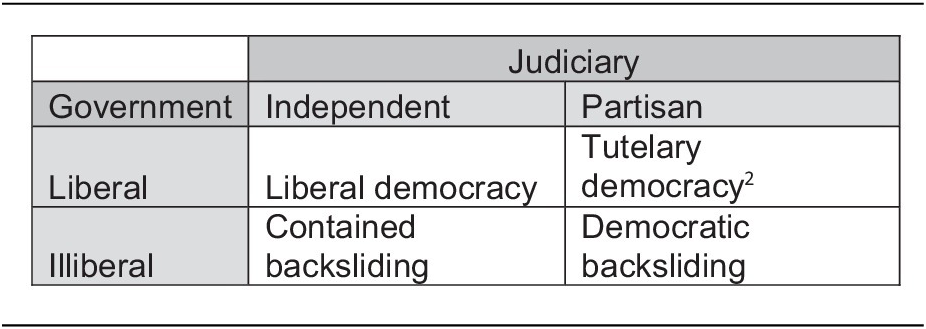
Ensuring privileges in the judiciary was one of the multiple steps in transitioning to democracy. For a few years, the constitutional order worked as a limited and tutelary democracy in which courts would protect the elite’s interests while guaranteeing contestation and power alternation (O’Donnell and Schmitter Reference O’Donnell and amd2005, 9). The new Constitution tried to protect the system by isolating judges from political parties through a pluralist filter known as “comisiones de postulación,” – from now on, nomination committees – for the Supreme Court and the Electoral Tribunal (see Table 1 for the possible combinations and outcomes of democracy). Committees included interest groups considered honorable and independent at the time: law schools, justices, and the Bar Association. As democracy advanced, threats to the constitutional order, such as the 1993 self-coup and attempted reelections, exposed the weak system. The 1993 crisis led to a reform of the number of Supreme Court justices, and a corruption scandal in 2009 made a subsequent reform to the committees, mostly to improve transparency, but without changing their composition.
Diagram of Possible Combinations.Footnote 2
Taking advantage of this new open and pluralist system created new elites out of the skilled lawyers and interest groups in their law schools and the Bar. These entrepreneurs used the porous system to compete for power, creating law schools and graduating a fast-growing number of lawyers. Once new elites were strong enough, they faced judicial limitations designed to secure old commitments because judiciaries still represented old elites. However, the 2015–2017 brief period of anti-corruption cases eventually made all the old and new elites assemble and push back against prosecution. The new coalition removed the independent judiciaries committed to the old elite’s view, facilitated by the original problem of an easy-to-capture judiciary. Now captured by anti-democratic actors, the judiciary made way for democratic backsliding.
As the fight against corruption became an international cause (Pozsgai-Alvarez Reference Pozsgai-Alvarez2022), the legal troubles brought against presidents and former presidents across the entire region shocked the democratic system, exposing the persistence of old-fashioned politics and providing opportunities for anti-system candidates to profit from a discourse against a political class. Corruption cases have brought more than ten presidents or former presidents to prison or trial in Latin America in the past fifteen years. In nearly every country with such experiences, sudden moments of democratic erosion have sparked. Part of the reason for connecting these two events is that, on the one hand, new politicians profit out of the corruption cases to launch anti-system proposals, and by that, they often embrace a position uncommitted to democracy, such as Bolsonaro’s rise in Brazil (Da Ros and Taylor Reference Da Ros, Taylor, Botero, Brinks and Gonzalez-Ocantos2022; Mota Prado and Rodriguez Machado Reference Mota Prado, Machado, Botero, Brinks and Gonzalez-Ocantos2022). On the other hand, the elites affected by corruption cases push back and undermine the rule of law and state institutions on the way. Solving such a puzzle for elites to commit to democracy and respect the rules of the game is a challenging task.
Guatemala is interestingly different in this respect because anti-corruption strategies have harmed unpopular leaders. In 2015, thousands of people went out to the streets asking for the resignation of the President and Vice President due to a corruption scandal. Guatemalans later explicitly supported the anti-corruption officials of the UN International Commission Against Impunity in Guatemala (CICIG), which enjoyed high popularity among the nation – higher than any other public institution – at 72% approval (Barreto Villeda Reference Barreto Villeda2019).
The tension between CICIG and the political elites kept rising, and eventually, the cases reached the economic elite. This last moment was the inflection point in which a broader coalition of equally – perceived – threatened political, economic, and bureaucratic elites retaliated against the judicial and prosecutorial independent actors and institutions to protect their impunity. This led to the coalition colloquially called the “pact of the corrupt” after an attempt by Congress to remove a clause of the criminal code that would drop charges against politicians and other criminals in 2017 (Figueroa Reference Figueroa2017; Isaacs and Schwartz Reference Isaacs and Schwartz2023). Beyond pushing back against judicial independence, this coalition led the efforts to dismantle the anti-corruption system, including the expulsion of CICIG, judicial purges, and the later persecution of independent judges and prosecutors. Not only did they stop the increase, but they also brought down the independence of the high courts to its lowest levels since democratization.
A critical factor of the anti-corruption campaigns in Latin America is that they provide opportunities for alignment for the boldest coalitions to backlash. Botero, Brinks, and González Ocantos (Reference Botero Cabrera, Brinks and Ocantos2022) have exemplified this by defining “the limits of judicialization.” The relevance of this aspect for the Guatemalan case is that judiciaries historically limited elected officials’ power, as both elites and civil society feared presidential power due to its abuses in the past, both against private property and human rights (Brinks and Blass Reference Brinks and Blass2018). Once the judiciaries reach higher independence and affect the elites, the latter will naturally align with presidential and political power to undermine democratic institutions. As Bowen states, “[W]hen previously powerful coalitions continue to operate through a transitional period, backlash against institutional reforms is all but inevitable.” (Reference Bowen, Cabrera, Brinks and Ocantos2022, 119) The alignment of elites and civil society will produce a liberal democracy, or at least a limited government. In contrast, aligning economic and political power will produce authoritarianism, which allows the state to predate on its citizens. The smaller the coalition, the less constrained the government needs to be (Bueno de Mesquita and Smith Reference Bueno de Mesquita and Smith2011).
This is an effort to better understand how judicial reform and the composition of the committees are part of a continued negotiation of elites. When breaking points change the formal or informal rules of the game, elites will find ways to stay on the field. In transitions to democracy, these reforms are more critical to ensure the regime’s survival, and these are usually formal changes in the law. Judicializing democracy, understood as the involvement of courts in politics to maintain the democratic order even when it implies anti-majoritarian activity, can be a tempting idea for constitution framers to protect their projects.
Changes in the arrangement of the courts will likely shape their behavior. These changes often occur through informal rules, like new legal strategies. Such changes represent further negotiations among groups competing for power. Therefore, we need a dynamic theory that explains how judges behave based on these coalition changes and, in Guatemala’s case, the committees’ composition. This flexible theory is essential for this project because it examines how actors can pursue privilege and power in controlling the courts, and why they lead to democratic erosion. I will refer to these actors as political entrepreneurs.
The following pages will discuss the process of reforming courts and how elites and interest groups organize themselves to influence and eventually capture them. Moreover, this article provides examples with implications that can be transposed to other places, building a theory that needs to be developed further and can apply to several democracies in the same precarious position. First, I review the literature on constitutional justice, the role of courts in defending democracy, and the theory of political entrepreneurship. These three frameworks are critical to understanding the argument applied in today’s context. Later, I examine the Guatemalan case with a historical perspective of its reform and add to the contemporary problems. Telling the story in a sequence of causal mechanisms will bring the information collected from interviews made with political elites who have seen and been part of the unfolding process from the transition to democracy in the 1980s until today.
Literature Review
Latin America is a region widely explored by comparativists and legal scholars in the comparative judicial politics enterprise. However, despite this prominent focus, Central America has been left behind by far in contrast to the attention given to Argentina, Brazil, Colombia, and Mexico. This project is focused on the motives of the constitutional design of the Guatemalan judiciary, the reforms, and the outcomes. To address both the design and the outcomes, this literature review will focus on three major areas explored in other countries: constitutional design, courts as bulwarks of democracy, and political entrepreneurship. The reasons are: First, constitutional design is a major area for addressing why framers make their choices, ranging from electoral laws and human rights to the structure of the state and division of powers. Second, courts as bulwarks of democracy is a question currently exploited by many authors addressing threats of populism and authoritarian parties. Beyond borrowing the title from Staton, Reenock, and Holsinger (Reference Staton, Reenock and Holsinger2022), the theory lies in the major question of how to achieve judicial independence and how it can be framed to serve the protection of democracy.
Third, political entrepreneurship is a theory of political economy applied to corruption, institutions, and the activities of wealth and prestige maximization in nonmarket settings (Baumol Reference Baumol1990). The theory of political entrepreneurship is innovative because it is dynamic, as has been the case for Guatemalan elites since democratization. This theory contributes to and fits within the literature of constitutional political economy, where judiciaries are still considered a forgotten branch (Voigt Reference Voigt2020). Political entrepreneurs are actors who find new uses in politics and laws to disrupt and increase their wealth or prestige. For Baumol, this entrepreneurship is usually unproductive because the wealth only moves to different hands.
When transitioning to democracy, many Latin American parties feared presidential power for its abuses and the judiciary for its complicity. For instance, Brinks and Blass (Reference Brinks and Blass2018) demonstrate that the constitutional courts were designed to limit general government power. They conclude that in cases with recent violent history, new constitutions would design more autonomous courts. Moreover, they emphasize how the constitution-making bodies created ways to see themselves in the courts, choosing models of appointments that resembled the assemblies. In these choices, many constitutions delegated powers to non-political bodies such as the Bar Association, academics, and special majorities within Congress. The lack of trust in political parties and a generalized skepticism of government in Latin America provided institutions for courts to rely on outside the political arena.
The literature addressing judicial appointments focuses on judicial independence more than on any other outcome. When researching judicial independence, scholars have focused on the ex-ante and the ex-post autonomies (Iaryczower, Spiller, and Tommasi Reference Iaryczower, Spiller and Tommasi2002; Melton and Ginsburg Reference Melton and Ginsburg2014; Linzer and Staton Reference Linzer and Staton2015; Brinks and Blass Reference Brinks and Blass2018; Voigt Reference Voigt2020; Hayo and Voigt Reference Hayo and Voigt2023). Therefore, the judicial appointment process is only a part of the ex-ante autonomy, often understood as the de jure autonomy, referring to what the law says and not what happens in reality (de facto). The main concept that the de jure definitions pursue is how much power political actors (mostly executives and legislatures) can exert over judiciaries. Lastly, as Helmke and Staton (Reference Helmke and Staton2010) state, courts can sometimes rely on public support from citizens when given, but this cannot last forever, especially after politicians constrained by courts launch attacks on the judiciary.
This is not a legal doctrine argument advocating a specific design of courts and constitutions. This project aims to understand why, in spaces where it is already assumed that courts are in charge of defending democratic order, they fail to do so. For these reasons, I develop the theoretical framework of this study around three traditions of research that have in common the assumption that actors are rational and wealth-maximizing, and that the only way to prevent power from being fully concentrated is by dividing it in a way that competing groups hold each other accountable and set limits to each other. This can be traced back to Cicero (Calabresi, Berghausen, and Albertson Reference Calabresi, Berghausen and Albertson2012), but it is mostly clear in Madison’s essay on factions in Federalist 10 (Madison Reference Madison1787). More recently, the shackled Leviathan of a “narrow corridor” developed by Acemoglu and Robinson (Reference Acemoglu and Robinson2020) is a better characterization of the paradox of power and a very specific point at which societies can reach a state of liberty. The authors argue that the state must be capable and strong to enforce peaceful coexistence, but it must also be restrained from acting despotically.
Madison’s solution to the problem of a group or faction gaining unlimited power was to design institutions where these would compete and negotiate. What Madison called factions has been applied today to political parties and social and economic groups that are their bases. This is what the literature today treats as interest groups (Holyoke Reference Holyoke2021). Factions and interest groups are also present in Brinks and Blass’s idea of constitutional design in Latin America, especially in the neoliberal type of court as an arbiter (2018).
The pluralist idea assumes that groups have confronting interests, and that creates a natural balance, but in the Latin American context, factions do not always have competing interests. Instead, they have shared interests that all groups may achieve on their own without facing restrictions from each other. For instance, the idea of biased pluralism that Olson (Reference Olson1967) as cited in Gilens and Page (Reference Gilens and Page2014) warns about what occurs to an extent in which an organization is coopted and captured in the same ways that regulatory agencies are captured by their regulated subjects (Stigler Reference Stigler1971; Whitehouse Reference Whitehouse2019)
It is worth noting that there has been limited research on whether the pluralist theory applies to interest groups that resort to the court system to pursue their interests. In his work “The End of Liberalism,” Lowi (Reference Lowi1979) argued that interest groups often turn to the judicial system when they cannot achieve their goals through political means. It is important to examine the theory of interest groups as both a driver of democratic growth and a potential cause of its collapse, even at the informal levels. Recent studies of judicial politics in Latin America have provided valuable insights that the United States is just beginning to consider. Lowi’s disappointment led to a proposal for a more idealistic juridical democracy that would keep the consensus static with legal institutions. However, this view has been criticized for having an authoritarian vein (Schmitter Reference Schmitter1974) and is highly susceptible to capture.
Pluralism and rational choice theories assume that groups with opposing interests will use the institutional channels to solve their disputes and that the bargain will produce a balanced outcome. This is not necessarily true for Latin America, especially when different industries and elites rely on similar institutions despite their productivity diversity. For instance, the most common assumption in the early United States was the division between northern industrial and southern agricultural states. In Latin America, for a while, both industrial and agricultural elites have relied on similar privileges of political connections, which does not lead to a pluralist outcome. This will have implications for this case study.
Research Design
This research is based on process tracing for theory testing while relying on archives and interviews for evidence. The data collection methods are interviews and archival research for gathering information used as evidence. The process tracing method is the logical explanation of events happening historically, paying attention to a causal mechanism leading to outcome Y while looking at variables X. In this case, I am using a definition of causal mechanism as “[a] complex system, which produces an outcome by the interaction of a number of parts” (Beach and Pedersen Reference Beach and Pedersen2019). When “explaining-outcome process-tracing, we try to establish a minimally sufficient explanation for why an outcome has been produced in a specific case. This type of process-tracing leans more heavily toward being a case-centric case study, interested in a particular country and testing a theory in a new setting” (Beach and Pedersen Reference Beach and Pedersen2013, 169).
This project applies the theory of political entrepreneurship in a new political and geographical setting. I consider theories of constitutional design and judicial review and complement them with the theory of political entrepreneurship. Beyond accepting the potential role of courts being bulwarks of democracy, I highlight the likely use of courts against democracy, and how reform and constitutional design processes are vulnerable to capture.
My independent variable is the commitment to maximizing elites, and I study how they negotiate through the laws in the constitution on how to appoint judges. This includes the constitutional provisions, the length of tenure, the majority of votes required, and the players. The 1985 constitution and subsequent reforms are examples of changes in the opportunity structure. The constitutional opportunity structure defines “what can be constitutionalized, judicialized, and delineates the roles a high court can play” (Kapiszewski Reference Kapiszewski, Helmke and Rios-Figueroa2011, 162). Therefore, the moments of reforming the law are part of the opportunity structure as much as the creation of a new university is. Entrepreneurs, therefore, operate within the structure.
The dependent variable is democratic backsliding and the connection between the two variables; in other words, the causal mechanism is the process of political entrepreneurship capturing courts and using them to undermine democracy. This is one single causal mechanism, but it may be divided into three steps: 1) the entrepreneurs join nomination committees; 2) capture of courts, in which the entrepreneurs bargain and offer judicial appointments to anti-democratic actors; and 3) the use of courts to undermine democracy.
There are two reasons to consider these three steps part of one single mechanism. First, because the entire process relies on the independent variable: the elite arrangement. The legal framework incentivizes the type of political entrepreneur we are interested in, shapes their negotiation arena, and offers an option to bypass (or capture) the filters of judicial appointments. Second, because the theory builds on the assumption that courts are supposed to defend democracy, and thus an anti-democratic actor should be interested in weakening or capturing them.
The interviewees in this study are representatives of the Constitutional Assembly and relevant actors in Guatemala’s contemporary judicial history. I conducted these interviews in the summer of 2023 in Guatemala. The moment these interviews occurred matters because precisely as they were happening, Guatemala was going through a historically surprising election with several attempts to overturn it through the courts.
Guatemala is a good case for understanding this phenomenon because it is a rare, deviant case (Bennett and Checkel Reference Bennett and Checkel2015; Seawright Reference Seawright2016; Gerring Reference Gerring2017). The rarity of Guatemala is, as mentioned earlier, a case in which courts successfully stopped populist threats, but unpopular elites captured and eroded institutions from within. Most of the literature today focuses, with good reason, on the need to strengthen courts to stop rising authoritarianism with popular support, building on the old visions of preventing tyrannies of the majority. However, looking at Guatemala’s path and outcome should encourage political scientists and constitutional scholars to think more about the strengthening of courts and the mechanisms to impose limits on democracy, because it can lead to a worsening scenario, at least in Guatemala’s case, making it worse off than it was in the beginning.
Moreover, this case is critical to study because it tests the theory of political entrepreneurship in a new setting. Thinking about the entrepreneurial mindset in politics should make political scientists more aware of creating and reallocating incentives for profit and the consequences for democracy. This is hard to study in well-established democracies where entrepreneurs are more constrained, but the literature may start identifying those outside of the electoral arena.
Theoretical Framework
There is a vast body of recent theories on what exactly produces independent courts and how states or societies build the rule of law. As judiciaries became more relevant in the world in the twenty-first century, a growing body of literature started examining the reasons and causes for this change in the political arena. I follow the idea of North, Wallis, and Weingast (Reference North, Wallis and Weingast2009) that the rule of law is the outcome of the elites needing a new mechanism to solve their disputes. I do not assume that Guatemala ever enjoyed a “credible commitment” to its constitutional justice system, such as in England or other long-lasting democracies (North and Weingast, Reference North and Weingast1989). However, if there was at least a partial commitment that lasted at least thirty years, a mid-range commitment sustained constitutional democracy and its system of checks and balances. Most importantly, what changed?
I will build on the theory of political entrepreneurship (Baumol Reference Baumol1990), understanding that the design of institutions shapes a society’s economic activity according to the incentives it produces. Therefore, the Guatemalan design of judicial appointments created an elite that would facilitate capture. Since this specialized elite relied on corruption in doing political favors in courts, it would inevitably sell to the highest bidder, the authoritarian project. I argue that entrepreneurs in judicial appointments are the mechanism through which the uncommitted elites were able to cause democratic backsliding. The argument is illustrated on a causal graph in Figure 1 using the models of Waldner (Reference Waldner2015) and Beach and Pedersen (Reference Beach and Pedersen2019).
Causal graph of the argument.
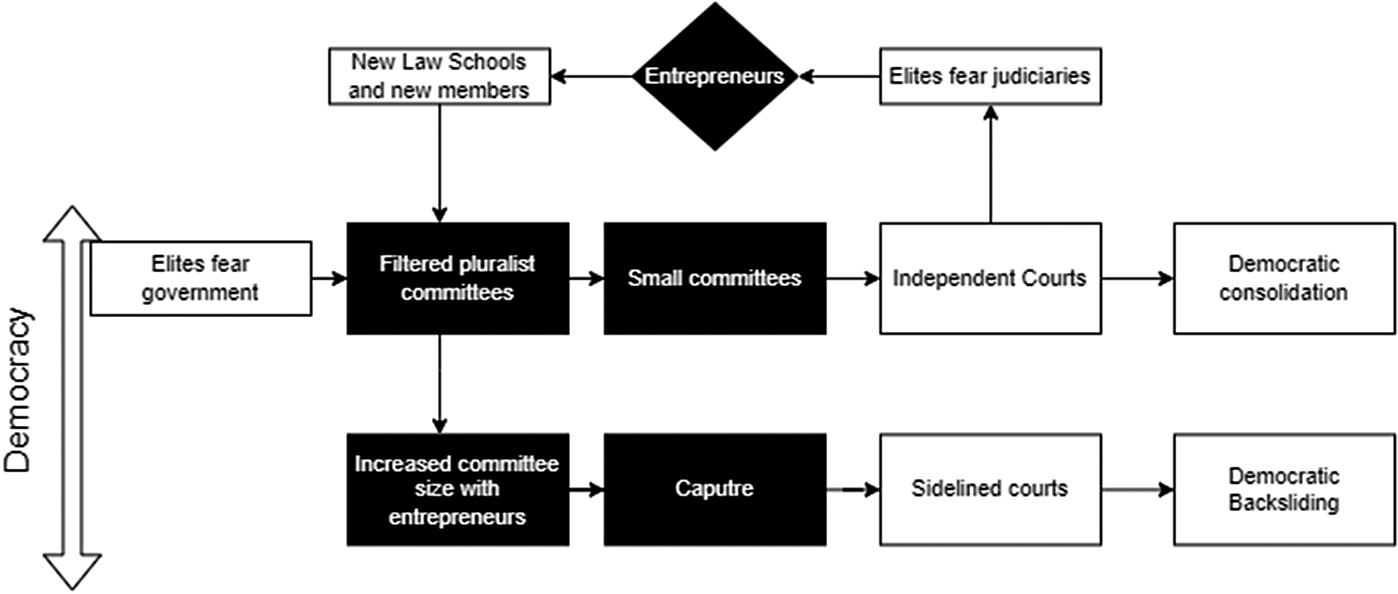
It is important to clarify two main concepts at this point. The uncommitted elites are not a static or delimited group. The level of commitment will vary from across groups and even at a personal level. However, in this case, I am interested in the general level of commitment, the sum of the preferences. Likewise, the definition of backlash specified in the literature review needs more development. Elites will not backlash as normally in every other contested process. Backlash means the elites have a profound disagreement with the judicial outcomes, and in my argument, I aim to explain how they achieve to overturn the results. If the rule of law is strong enough, the best elites can do is to reorganize themselves and stop reforms, but if it is weaker, they may be able to dismantle it. The open system of entrepreneurs in Guatemala is that specific weakness that once allowed for improvement and expansion of rights. However, as it grew, it favored corrupt and anti-democratic elites. The entrepreneur as a mechanism can also increase our understanding of when backlash may happen and when not.
The constitutional design was between at least three types of elites: the economic elite, the military, and the civil society represented by a political elite. These groups had a number of conflicting and compatible interests. First, as stated earlier, the alliance that won the war (the economic elite and the military) agreed on the counter-insurgent state and the defeat of the guerrillas. However, the growth of the military apparatus is at odds with public spending, and the war economy raised taxes and inflation, especially at the height of the war in the 1980s. Second, the economic elite and civil society agree on respecting civil liberties as long as these include protecting private property and enterprise. Still, their interests conflicted when it came to delimiting the uses of the state, weighing economic growth versus human rights. Third, the military and civil society do not agree on much. However, they share the fear of the economic elite because they both need public spending and economic intervention to fulfill their projects, either warfare or welfare. Balancing these interests in democratization produces an agreement in the constitution, and the factions will push to advance one or the other more, but with courts mediating the scale. President Serrano pushed these tensions to their limits, relying on a populist strategy to stay in power but turning the military and economic elites against him and using the courts to oust him.
The argument of political entrepreneurship explains the slow loss of power of economic and intellectual elites to political ones. This does not mean to say that economic elites favored democracy or were against corruption; they were, at its best, divided. However, why would elites support the accumulation of power by someone who can tax them, cause inflation, and compete with them? Political entrepreneurs can gain access to power by learning from old elites and social entrepreneurs’ mechanisms to use the state to their advantage. The institutions create entrepreneurs that will grow, masquerading themselves in legality, and their interests will slowly diverge from the old elites more committed to democracy. At some point, the strength of new entrepreneurs surpasses their rivals and changes the balance of power against democracy, making the old economic elites follow them.
My argument is agnostic and skeptical of labels such as good or bad elites. There are reasons for citizens to think that way, but such an explanation would not be able to tell the difference between why courts defend democracy and when they undermine it. This argument follows the literature that elites and rulers settle for specific reasons that they find convenient to protect their interests. The elites commit to democracy to protect their interests, constrain the government, minimize violence, gain access to international markets, and so on. Political entrepreneurs will not find those incentives; thus, they will vary in many ways: we may now include construction companies with political linkages, drug cartels, and the lawyers I refer to.
The political entrepreneurs observe, learn, and copy. They see how human rights activists go to court to influence policymaking, and they emulate them with a similar-sounding NGO. They see how intellectuals gain a seat on the committee through their law schools, and they may find a new one or buy an existing one. This constant expansion of influence creates a vicious cycle in which politicians who wish to win elections rely on the power of entrepreneurs; entrepreneurs stay in the background and are rewarded, and they can help the next in line. Increasing the size of the space in which they operate – such as the nomination committees by introducing new law schools and the Bar Association – increases their power compared to the old elites (North and Weingast Reference North and Weingast1989). With time, they occupy a larger portion of the ruling coalition of politicians and parties. The more this happens, the less the politicians have to rely on the electorate as they satisfy a smaller selectorate (Bueno de Mesquita et al. Reference Bueno de Mesquita, Smith, Siverson and Morrow2003).
The logic and the early years of the Guatemalan experience show that the economic elites fear unconstrained governments, yet somehow, in the aftermath of the anti-corruption scandals, they did not conform with the expulsion of CICIG as a result of backlash; they continued to lose power to a growing political-bureaucratic elite. The coalition they built in favor of impunity benefited them because it is better to lose power than to be in prison or lose it all. The entrepreneurs increased the power of the political elites, and the threat of anti-corruption cases increased the risks of an independent judiciary for both the economic and the political elites. Both groups worked to capture the judicial system, giving the government a blank slate. A now unconstrained government refused to concede power to the opposition and used courts to undermine the electoral process and democratic institutions such as freedom of the press and expression. The details of how this happened and the evidence in the case study are in the following section.
The Process
Imagining an independent judiciary
Tracing the design of the systems of judicial appointments in Guatemala from the constitutional moment of the democratic transition in 1984 to its present-day is critical to understand the moments of political change that led to the capture. While the argument is broad and relies on a long story, I focus on the decision-making processes of incorporating interest groups in judicial appointments, notably law schools and the Bar Association. This section presents a positive argument about why the changes occurred in the constitutional design and the outcomes of judicial appointments by relying on archival research and interviews. It aims to illustrate the original design of judicial appointments and why it happened. The section will provide an understanding of the layout that would later create entrepreneurs that changed the system itself.
When Guatemala transitioned to democracy, the constitutional convention focused most of its attention and debates on human rights and private property (Brinks and Blass Reference Brinks and Blass2018). The Constitutional Assembly had three major parties. Progressive legal scholars led the Christian Democracy party. Second, the conservative Movimiento de Liberación Nacional (MLN) was a party born in support of the 1954 coup and later reformed to a more democratic commitment. Third, the Unión del Centro Nacional (UCN) was a catch-all party claiming to be centrist and determining the outcome by balancing the former two. The party included representatives of varied ideologies and backgrounds, such as Gabriel Larios Ochaita, a well-known legal scholar, and Mario Taracena, godson of Mario Sandoval, the leader of MLN.Footnote 3
On the one hand, the recent violent history of the country with consecutive coups d’etat, a military regime of terror, political killings, and disappearances were the norm. Practiced both by the State and guerrillas, this violent history made the protection of human rights the leading cause for the Constitution.Footnote 4 On the other hand, the assembly’s most heated debate was about the “social function of private property” and whether that specification was needed.Footnote 5 The conservative party (MLN) vehemently opposed assigning the social function to private property because of its potentially arbitrary and broad interpretation. The UCN and some Partido Revolucionario (PR) members joined them to give the majority. The next day, private sector groups published press releases expressing thanks to the representatives who joined.Footnote 6
These parties dominated the convention, and when securing their commitment to the new constitution, they had to decide how to choose the judiciary. The result was a Constitutional Court separate from the Supreme Court of Justice. Each court had a different appointment model, but both relied on pluralism, co-optation, and legal mechanisms for interest groups to influence the appointments. The Constitutional Court has five justices: three appointed by each branch of the State, one appointed by the Bar Association, and one by the public university (Universidad de San Carlos). The appointment of the Constitutional Court is the first expression of direct de jure interest group influence in the court. First, the Bar (Colegio de Abogados y Notarios de Guatemala, now CANG) is a professional association with a legal monopoly for regulating the legal profession. Second, Universidad de San Carlos is the country’s only public university, with a historical reputation and relevance, and thousands of graduates yearly.
The selection of the Supreme Court is more complicated and has changed over time. Initially, the Constitution had the Supreme Court composed of nine judges, four directly appointed by Congress and five by Congress selecting from a shortlist provided by a nomination committee. The nomination committee is composed of the deans of all law schools in the country, an equivalent number of judges from the Court of Appeals, and an equivalent number of lawyers elected by the Assembly of the CANG, and lastly, one university president elected by their peers.
The reason for the “five arbitrary and four not-as-arbitrary” still deserves an explanation, which this study cannot address. The framers proposed a pluralist model that included different groups of lawyers to isolate courts from politics and ensure judicial independence. However, the long-term consequences of this model are porous to third parties that operate under the influence of presidential and political power, and different elites found a way to participate in the process, capturing the committees of neutral experts and making room for politicized courts.
Incorporating Interest Groups
The CANG: Lawyers as an interest group
As part of limiting the influence of government in the legal profession, the framers preferred to let lawyers keep regulating themselves rather than having a State determine who is in good standing with his or her peers. Holyoke (Reference Holyoke2021) points out that professional associations are the oldest form of interest group organization. Professional associations mostly regulate their activity, which implies their inner rules. Still, if there is an opportunity for them to get some privileges from the State, it is logical that they will pursue it. This is clearer when considering a legislating body composed of lawyers more than any other profession.Footnote 7
As a representative of the Christian Democracy mentioned, “[I]f the Constitution states that to be a justice or judge, you need to be a registered lawyer, we are allowing the CANG, in this case, to maintain control of the activity of all those lawyers who will exercise a jurisdictional career as magistrates or judges.”Footnote 8 This is a clear expression of the preference for an external body regulating the profession of lawyers and judges rather than the State.
In 1985, the CANG had less than three thousand lawyers, making it a small group where everybody knew each other and their trajectory. This also aligns with the constitutional requirement of “being of well-known (recognized) honorability.” In the words of one of the framers, “It is one characteristic of a provincial rural society in which people still know each other well and claim to be honest rather than anything else.”Footnote 9
Interestingly, the incorporation of a professional group by appointing a judge directly to the Constitutional Court was opposed by the most conservative parties, such as the MLN and its satellites. Although the elitist filters might seem a conservative strategy to put some barriers for people to become justices, the elites and conservative parties knew they had the resources to compete for power in the long-term and thus, risk some losses in politics instead of giving direct appointments to a group they do not necessarily control, such as the Bar or the public university.
The co-opted system for a Constitutional Court reflected the present moment of the political status quo by splitting the appointments between the three powers and adding two interest groups to which many framers belonged. Thus, the co-opted system started with seven justices in the constitutional court, splitting their appointments between the three branches of government and appointing some by popular election. The final decision excluded popular election and reduced the court to five justices appointed: one by the president, one by Congress, one by the Supreme Court, one by the CANG, and one by the public university, Universidad de San Carlos. That way, presidential power would be limited in the court; Congress would only sometimes have an absolute majority aligned with the President, and the Supreme Court would be one elected by the Congress of a period ago, usually displaying some ideological balance. The Bar and the university represented the less political, “more objective” interests.
Moreover, an interesting requirement for a judgeship was being honorable. The agreement between the parties was more explicit regarding a specific requisite of honorability, especially in high courts. This requisite, included in the constitution, would later disqualify candidates. The requirement of honorability meant that the right and the left would trust the institution as long as it appointed an honorable peer and not a politician or a politician’s friend.
“During the Árbenz Guzmán era, the current President of the Supreme Electoral Tribunal was dismissed because he complied with a provision in law. That is interference by the Executive before the Judiciary. That is historic. Let us continue with more examples…”Footnote 10
It is precisely the example of how the electoral court managed to be independent in the middle of a dictatorship and organize the elections for the constitutional convention at which they were. The president of that Electoral Court, Arturo Méndez Herbruger, was the last Supreme Court Justice before the coup in 1954 that interrupted democracy. Méndez Herbruger was seen and cited by both the right and the left as an example of an honorable judge. The conservatives liked him because he challenged and overturned the law of agrarian reform of President Arbenz. Arbenz would later impeach him, raising tensions for his illegitimate use of power.
Universities, private and public
Although the universities were not necessarily the most progressive actors in the country’s political affairs, they were certainly more trusted by the framers and most lawyers to check on political power, and thus seen as a prevention of the politicization of justice. The public university was one of the longest and strongest opposing institutions to the military dictatorships during the armed conflict. Many of the revolutionary leaders were students, often murdered, kidnapped, and intimidated by the State.Footnote 11 However, by the 1980s, the most radical wings of the university had already disbanded, and moderate leaders became the presidents and deans of the institution (Crespo and Andrés Reference Crespo and Andrés2013).
This allowed many political and economic elites to trust the university slightly better and gave a more solid space for contestation to a threatened left that had little insurance of its continuity. The representation of private universities in the Supreme Court commission resembles a balance to such ideological positions. Since the conservatives were initially generally opposed to the idea of universities and lawyers sitting on the commission, another inference is that the private sector felt more confident playing the game through the parties and the University or the Bar.
For the appointments of the Supreme Court justices, the Bar and the universities – private and public – were included in the nomination committee. However, the appointment became strictly a matter for Congress. In 1984, when the framers were working on the Constitution, there were only three private law schools in addition to the public ones. One of the framers acknowledged the possibility of new schools opening later on and the challenges that would pose.Footnote 12 The other three existing private law schools represented the interests of Guatemalan elite society: one Jesuit-Catholic university, one evangelical university, and one business-oriented school.Footnote 13
The nomination committee included these external groups as balances and checks on the power of Congress and justices who would be part of the committee. In the debates, the original proposal was for the incumbent justices to select the new ones. However, it changed to justices being on the shortlist and Congress appointing, allowing parties and elites to dispute appointments and limit terms to five years, replacing all justices at once. This indicates a lack of commitment to judicial independence because they can remove or reappoint according to their performance toward their interests.
“We made this with a completely healthy spirit. We believe that the Deans of the Law Schools are … people who should be honorable. We are starting on that basis; that is, there is no preeminence given to the law schools.”Footnote 14
The inclusion of law school deans was, at its best, an optimistic and naïve design, trusting that new universities would behave honorably and as well as the originals did. The Supreme Court justices of 1984 who drafted the proposal saw an opportunity for the universities as bodies that were distant enough from politics to restrict the politicization of justice. For the proposed project to have worked, two conditions would have been necessary: 1) that new universities would not be created to serve political interests; and 2) that they would stay honorable as they were seen at the time.
As a conservative party, the MLN still had more trust in the party system, as they opposed the selection committees in the first place. The progressive parties, such as PR and Christian Democracy, were less confident of their survival, as many of their leaders were persecuted and similar parties were banned in the recent past. In that sense, the agreement to let Congress choose from a shortlist of experts represents the equilibrium between the strong right and the left parties trying to secure a place outside of party politics in which scholars and lawyers like them were prominent.
We can see how representatives saw themselves shortly as part of the appointers. Some representatives expressed that the law school deans outnumbering and giving preeminence over the other actors, such as the lawyers from the Bar, was a cause for concern. From the beginning, the political elites saw themselves in the future as being constrained by universities and pushed against it. Eventually, the proposal changed, and instead of the law school deans outnumbering the other actors, they would set the number of seats. For instance, there would be four lawyers from the Bar and four justices on the committee if there were four schools. This opened the door beyond the problem of law schools capturing the committee. As time passed, the previous conditions remained, and so did the incentives to create law schools to influence the nominations. Each new law school meant two more new seats: one more judge from the Court of Appeals and one more lawyer from the Bar. Therefore, with each new law school, the number of seats increases by three (one new Bar lawyer and one new Justice of the Court of Appeals, plus the added law school dean). This phenomenon increased the opportunities for political entrepreneurs, opening new positions of influence.
The Courts in Action
For the first ten years of democracy, the courts enjoyed a reasonable reputation but struggled to maintain their independence from the presidential powers. By 1993, the first attempted coup occurred when President Serrano tried to dissolve Congress, failed to do so, and was therefore forced to resign by the Constitutional Court, proving independence and protection of the democratic regime (Sentencia no 225-93 de Corte de Constitucionalidad, 25 de Mayo de 1993 1993). President Serrano blames, until today, the economic elites for sabotaging him and orchestrating the Constitutional Court ruling against him (Serrano-Elías Reference Serrano-Elías2012).
After the crisis, Congress passed a constitutional amendment increasing the number of justices from nine to thirteen and requiring them all to be shortlisted by the nomination committee. This reform was passed after the Supreme Court was appointed by Serrano’s Congress and aligned with the President. The Supreme Court reform was among the most significant reforms approved in 1993. Another critical reform often quoted in the process was a constitutional prohibition for the Central Bank to lend money to the Government to prevent hyperinflation. This reform, strongly supported by economic elites, was in the interest of the conservative coalition, which exchanged it for giving progressive groups access to courts by forcing the shortlisting, led by mostly liberal universities.Footnote 15 This critical juncture represents the negotiation between the two major elites.
In the 1999 election, the Frente Republicano Guatemalteco (FRG) entered the scene. FRG was born out of the leadership of former dictator Ríos-Mott in the Christian Democracy. Ríos Montt was a young, progressive military officer. In 1973, he was feared as a communist by former dictator Lucas García and by the CIA of the United States.Footnote 16 With a more progressive platform and additional support from the evangelical Church, Ríos Montt would later coup Romeo Lucas and lead the most violent repression against guerrillas while simultaneously increasing public spending and taxation. This created a complicated relationship of mutual dependence with Guatemalan elites who feared his limitless rule but wanted him to win the war against guerrillas. After the armed conflict, Ríos-Montt kept representing the tension between the two groups ruling the country, but the face of the party was populist and left-leaning candidate Alfonso Portillo, a sworn enemy of CACIF, the conglomerate of Guatemalan business chambers.Footnote 17
Portillo won by a landslide (Nohlen Reference Nohlen2005), and with an absolute majority in Congress, Portillo as President, and an ally in the public university, FRG appointed a friendly Constitutional Court. Later, in 2003, Ríos-Montt tried to run for President, seeking reelection for FRG, which was unconstitutional because of a prohibition on former coup leaders assuming office.
The Constitutional Court allowed Ríos Montt to run for President, overturning the Electoral Court and Supreme Court rulings that banned him (Gramajo Castro Reference Gramajo Castro2017). Ríos Montt ran for office and lost the election. The next cohort of justices, appointed by a conservative and business-friendly government, decided to overturn that ruling, saying it had no validity for jurisprudence (Gramajo Castro Reference Gramajo Castro2017). Although the Constitutional Court did not resist populism at the time, two out of the three higher courts did – the Supreme Court and the Electoral Tribunal. Populism, however, was not strong enough to pose a threat to democracy as in other countries because Ríos-Montt did not make it to the run-off.
The involvement of courts in stopping coups and democratic backsliding in the early ages of Guatemalan democracy shows the willingness and commitment of their justices at the time. Moreover, their origins and affinities could help us understand why they were appointed. Justice Rodolfo Rohrmoser served in the Constitutional Court during the attempted coups and constitutional breakdowns of 1993 and 2003. His memoir shares stories of how the courts stopped the democratic backslide. However, he experienced being in the majority, stopping Serrano’s overhaul in 1993 and being in the minority in 2003, when he was one of the few in the Constitutional Court to deny Ríos Montt’s candidacy.
I was unable to leave home and go to the court, and the FRG mob was trying to get into my residential place, but I was a neighbor and friend of former President Arzú, and he sent his private security to the sentry box and instructed people to stop. I have been asked if what I did in those days was politics, and I think it was; I engaged in politics, but it was necessary to defend the constitution. Footnote 18
Interestingly, Rohrmoser defined himself as a social democrat and was first appointed to serve during the first term of the new Supreme Court. As told, they were personal friends with Arzú, and thus, he was appointed by the Supreme Court (chosen by Arzú’s party) after showing independence in Serrano’s self-coup. In 2023, Arzú had already passed away, but not without having explicitly pushed back against CICIG and the judicial independent coalitions; Arzú’s son was the leader of Congress during the major overhaul of the Constitutional Court and expulsion of CICIG, things Rohrmoser regrets.Footnote 19
Over the next decade, the paths would be different. The Constitutional Court would frequently overrule the Supreme Court; it would also face the problem of a growing population with a need for an ever-increasing judicial system and the rise of new organized crime groups that would attack its independence. This influence would eventually reach all other judges inside the judicial system, leading to colleagues increasingly favoring parallel groups. As Bowen (Reference Bowen2017) explains, the characteristics of judicial independence in Guatemala, unlike its neighbors, are the limitations imposed on it not by parties and government, but by external groups. The phenomenon is better understood by revealing corruption cases driven by the CICIG. At some point, the CICIG had accused more than twenty judges, including three Supreme Court justices, of favoring corrupt groups.
The Constitutional Court, however, became stronger, solidifying its position as the highest court and expanding its influence. The Constitution has a clause stating that no area is not subject to amparo and that all human rights treaties are considered constitutional law. This created a growing number of cases brought to the court to dispute policies, taxes, and the judicialization of mega-politics beyond the specific judicial review for which it was created. Hirschl (Reference Hirschl2007) defines mega-politics as “matters of outright and utmost political significance that often define and divide whole polities.” The judicialization of mega-politics has made courts gain attention and brought new concerns about judicial activism, which increased as the Constitutional Court gained independence after a progressive government in 2008–2012 appointed many independent judges as part of a commitment to tackle corruption.
The different paths that the courts took can be traced to their history of judicial appointments. Although they are unlikely to have different results in quality or judgment, I argue that their differences can be explained by their moment of design and reform, and that they have different consequences. The differences led to a more independent and empowered Constitutional Court that lasted longer, and a less independent Supreme Court that was weakened and lacked consequential decisions.
Political Entrepreneurship, Courts, and Backsliding
“In the proposal of the Supreme Court of Justice, the desire, I believe, is the depoliticization of the judiciary, but I see the President of the CANG, who you know, is a politician, indisputably.”Footnote 20
Courts gained power in Guatemala, becoming part of a larger trend in Latin America and the world of the judicialization of politics. In most of the countries, this judicialization was perceived as good (Botero Cabrera, Brinks, and González Ocantos 2022), as part of democracies maturing and crystalizing many of the undelivered promises; this trend also gained some recognition in Guatemala, making the courts an even more attractive prey for entrepreneurs. The more influential the court, the more attractive it would be to capture it.
While the model for selecting judges lasted, questions about its results were raised. With crime rising in the country and the incorporation of the CICIG, the need for an independent judiciary and the evidence that the constitutional commitment was not achieved became a priority. This gained special attention in 2008 when massive fraud led to a loss of ten million dollars in Congress (Prensa Libre 2017), and later that year, the President was accused of orchestrating the murder of a famous lawyer (Grann Reference Grann2011).
At that juncture, representative Montenegro led the movement of civic society organizations to regulate the nomination committee for judges. The law passed in 2009 and regulated the specifics of the process. Among them is allowing citizens to present objections and publicize the sessions. Montenegro says that his reform was neglected and archived by nearly every party for a long time, and there was no interest in reforming the judicial appointments process until the scandals erupted.Footnote 21
The new law did not reform the political part of judicial appointments, but created a set of regulations for the committees to comply with. This approach was largely praised by many civil society organizations, especially because it enforced publicity of sessions, which helped increase accountability for a short time. This reform exposed many of the regular activities that occurred in the commissions before. The new law heavily relied on principles of objectivity and neutrality, such as giving specific scores according to the candidate’s merits. Moreover, many NGOs advocated for independent judges, but naturally, this opened the space for every interest group to advocate for judges aligned with their values. In the same way that judicial independence can mean many things if the judge aligns with a group’s interest, the idea of merit and objectivity is hard to believe when the scores are given by the same group, which ends up being political.
For instance, interest groups with opposed political beliefs often clash in these commissions. The Myrna Mack Foundation, a prominent human rights organization named after a murdered anthropologist and led by her sister, became a protagonist in these processes. They had technical knowledge of how the judicial system worked due to their experience in the trials against the murderers of Myrna.Footnote 22 At the same time, the new arena for challenges caused some astroturfing. The National Civic Movement (MCN) started with protests against the president accused of murder. It later became a small group of students and activists promoting conservative causes and “non-ideological motivations” in the courts.Footnote 23
Organizations such as MCN were critical of Mack’s strategies claiming their litigation is malicious, sometimes with the consequence of delaying appointments. Likewise, they have questioned conflict of interest when some of their members have aspired to judgeship.Footnote 24 Thus, MCN challenges candidacies, claiming they are not qualified for different reasons, but does not make further litigation in the courts. MCN is just one of the multiple NGOs created to counterbalance the activism of organizations such as Mack’s and is a good example of how interest groups follow the avenues opened to civil rights organizations in a similar way to the conservative legal movement in the United States (Decker Reference Decker2016).
The Myrna Mack Foundation has presented amparos based on challenging the honorability of aspiring judges multiple times. In 2014, they presented an amparo regarding conflicts of interest in the election of the Supreme Court (CICIG 2014); in 2018, they presented another amparo to impede former Attorney General Conrado Reyes from becoming Constitutional Court justice (Expediente 3300-2018 2020), and in 2019, they presented several amparos regarding the timing of the starting of the process (Apelación en Sentencia de Amparo Expediente 6528-2019 2019), claiming an extreme formalism that the law says Congress should start the call for candidates only four months before the date of renewing the Court. The last amparo in 2019 exposed the foundation’s political aims. Civil society criticized them for delaying the process so that a new, more progressive Congress could appoint the next Court. Instead, the next ruling coalition managed to leave the justices from the previous period in place, breaking the constitutional term of five years and not changing them until 2023. This was Mack’s last and lost battle in the Constitutional Court.
The experience of Guatemala is different from that of the United States, in which the use of the court’s judicial review started with cases of civil liberties led by the ACLU and the NAACP and was later exploited by companies and interest groups (Decker Reference Decker2016). From the beginning, the Constitutional Court was an ally of private interests in Guatemala. As of 2019, 52% of the cases decided in the Constitutional Court of Guatemala were economic affairs (Lemus Reference Lemus2020). Historically, the Court favored the private sector, at least in taxation cases, until the 2015–2019 period, in which it saw some limitations to that influence, bolstered by the progressive Court of 2011–2016 appointed by the more progressive party Unidad Nacional de la Esperanza (UNE).
The Constitutional Court catered to the economic elites for most of its history. It could be argued that the departure from that tradition influenced the backlash it suffered from the private sector and a broad coalition later on. The Constitutional Court gave some favorable cases to CICIG, targeting mostly political actors. However, as CICIG started prosecuting more cases against the private sector, a coalition of interests around impunity was formed to expel CICIG from Guatemala, succeeding in 2019 with President Jimmy Morales leading the coalition (Isaacs and Schwartz Reference Isaacs and Schwartz2023).
This opening of arenas for challenging the government to secure the interests of political parties and economic elites in the 1980s allowed other groups of new elites, such as government contractors and criminal groups, to use the same strategies (Gutiérrez Reference Gutiérrez2016). Brinks, Levitsky, and Murillo (Reference Brinks, Levitsky and Murillo2020) argued that institutional weakness is more than a bad coincidence; it is a design to keep issues contestable in an oftentimes winning scenario. These interest groups influenced judicial appointments and secured positions in decision-making processes to keep privileges in the less harmful scenario, or undermine the rule of law in the worst.
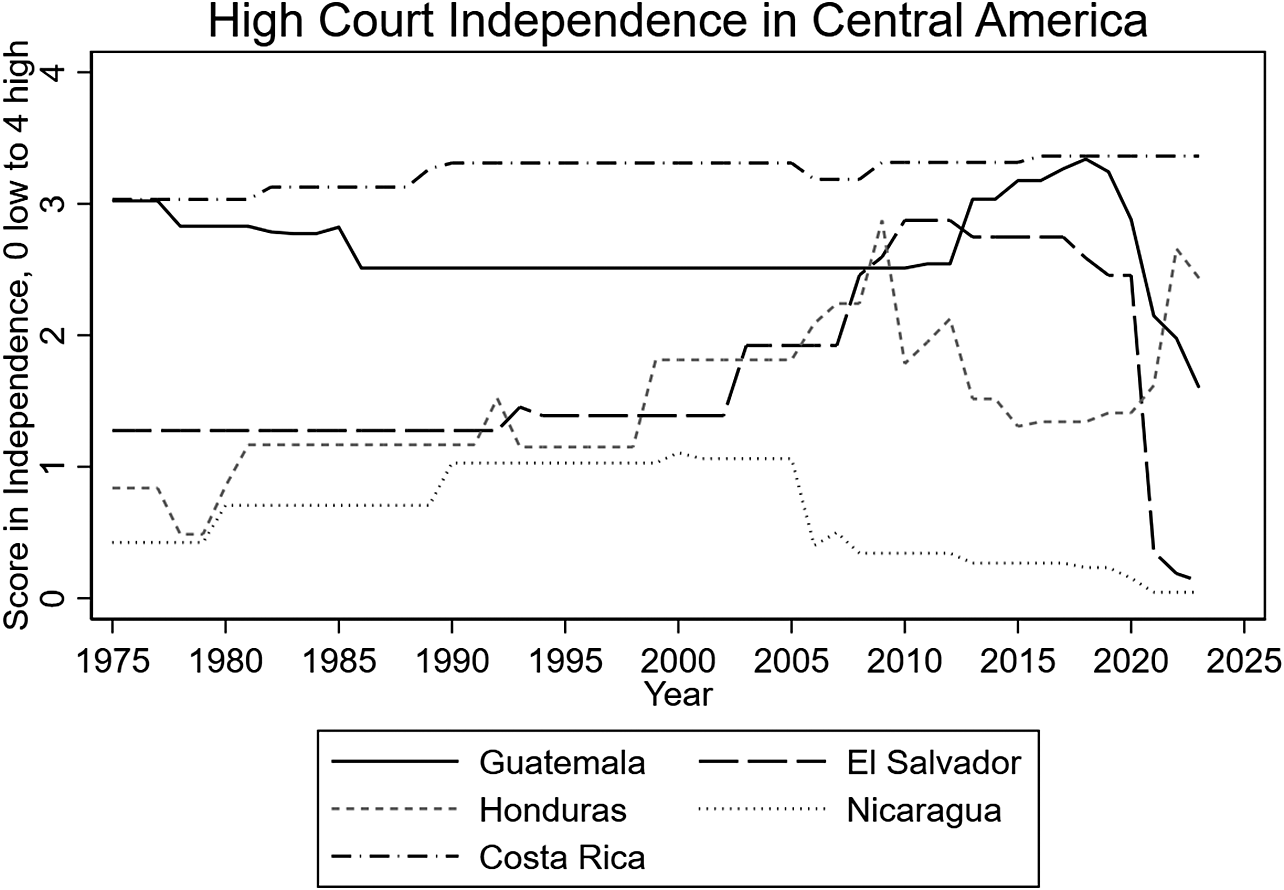
The changes in the judicial appointment mechanism match the explanations for backlash after the short-lived judicial independence (see Figure 2) at the beginning of this article. Shortly thereafter, judicial independence fell to its lowest levels in democratic history, and it should be no surprise that immediately after its decrease, the attacks on democracy began. The way I propose the entrepreneurs capture the system is a process that takes time to accomplish a full capture. However, full capture is not needed for them to be rewarded in the beginning, as CICIG showed in the corruption cases; full capture matters for this article only as a cause for democratic backsliding.
High Court Independence in Central America.
Source: Author’s elaboration with data from V-Dem (Coppedge et al. Reference Coppedge, Gerring, Knutsen, Lindberg, Teorell, Altman, Angiolillo, Bernhard, Borella, Agnes Cornell, Steven, Fox, Gastaldi, Gjerlow, Glynn, God, Grahn, Hicken, Kinzelbach, Krusell, Marquardt, McMann, Mechkova, Medzihorsky, Natsika, Neundorf, Paxton, Pemstein, Pernes, Rydén, von Römer, Seim, Sigman, Skaaning, Staton, Sundström, Tzelgov, Wang, Wig, Wilson and Ziblatt2024) Central American countries are included for reference.
Increasing the number of lawyers and law schools and, thus, of committee members, is the mechanism of capture that eventually leads to backsliding because it destroys the original intent of having a pluralist approach with opposing interests, creating a balanced outcome. There is an interrelated connection between these allocations of seats. More universities will mean more lawyers, especially at a faster rate; these new lawyers will vote and create parties in CANG and compete for representation in the committee choosing judges. The judges (chosen by a similar committee) will represent the same groups, and the process of capture will grow exponentially.
There are no records of the nomination committees prior to the 2009 reform, and the ones after the law did not keep the roll call of the committee members. Thus, one cannot tell with certainty if the deans in the past behaved more honorably than today, which is the conventional wisdom. However, as Figure 3 shows, in the voting patterns in the commission for the 2019–2024 Supreme Court, most of the old universities voted together and were very distant from the rest of the justices, the lawyers of the Bar, and the new universities. Using the Poole et al. (Reference Poole, Lewis, Lo and Carroll2011) model, I show that the three oldest private universities (UFM, URL, and UMG) were voting together and leading a minority coalition in the left pane. As predicted correctly by the framers, who feared the overrepresentation of universities, the model rapidly created new law schools and increased membership in one direction. For each new university founded, only one member of the Bar aligned with them; all the other members voted in the right pane with the incumbents in the Court of Appeals and many committee members who were also accused of corruption and found negotiating with an imprisoned broker in the case “Comisiones Paralelas 2020” (Sandoval Reference Sandoval2021). The universities being outnumbered and distanced from the other members shows the control entrepreneurs acquired of the system, especially when noting that the public university (USAC), subject to political control, and the newer law schools are closer to the right pane.
Voting positions of committee members for the Supreme Court appointments 2019–2024.
Source: Authors elaboration with data from Guatemala Visible, 2020, using the design from (Poole et al. Reference Poole, Lewis, Lo and Carroll2011).

Even if the purpose of universities and the Bar in the nomination committees or directly appointing judges is to prevent politicians from influencing courts, the rational inference is that now politicians will try to influence universities to have aligned justices. Even worse, as representative Téllez pointed out, placing the CANG was already a political process because of the Bar’s nature. One could easily extend this inference to the public university, where the President and the Council are elected among large groups and with expensive campaigns. This also promotes the acceleration of graduates, because students who politically favor the incumbent (dean or president) graduate fast so they can quickly start teaching and have votes in the councils, and they replicate these dynamics.Footnote 25
Blocking access to power acquisition of incumbents is challenging because they can restructure themselves and capture the new supposed check on them.
“In one of these commissions, we discussed adding points to the grade for having a doctoral degree; that would be a good filter and keep some better candidates up. The next year, everybody had a doctoral degree from one of these universities. Everybody.” Footnote 26
More than ten new universities have been created since 1984, seven of which have a law school. Three are evangelical universities, two are Catholic, and the others are secular.Footnote 28 The most recent example is Universidad Regional, which infamously had a committee seat without a single graduate lawyer in 2019 (Coronado and Mejía Reference Coronado and Mejía2020). These universities have been consistently pointed at as examples of having a seat in committees as their main purpose.Footnote 29 Again, this implies that universities will behave as brokers of interest groups – negotiating, shortlisting, and promoting candidates.
While the population of Guatemala doubled thirty-nine years after democratization, the number of lawyers increased thirteen-fold compared to its population in 1985 (see Figure 4). The accelerated pace of growth is noticeable after the 1993 reforms and, in particular, after the 2009 reform. While law schools do not need any number of graduates to have a seat on the committee, they still produce large cohorts of lawyers. The allure of a legal career is attractive everywhere. However, the political benefits of doing it in this context are large, especially because, as a matter of credentials, being a collegiate is all that matters. The quality of legal education does not matter when it comes to being a political operator, and there is no Bar examination; the graduate’s university is the only institution that matters to speak for them.
Figure showing the growth of the CANG members and Law Schools through time.
Source: Author’s elaboration with data collected from surveys and CV examinations.Footnote 27
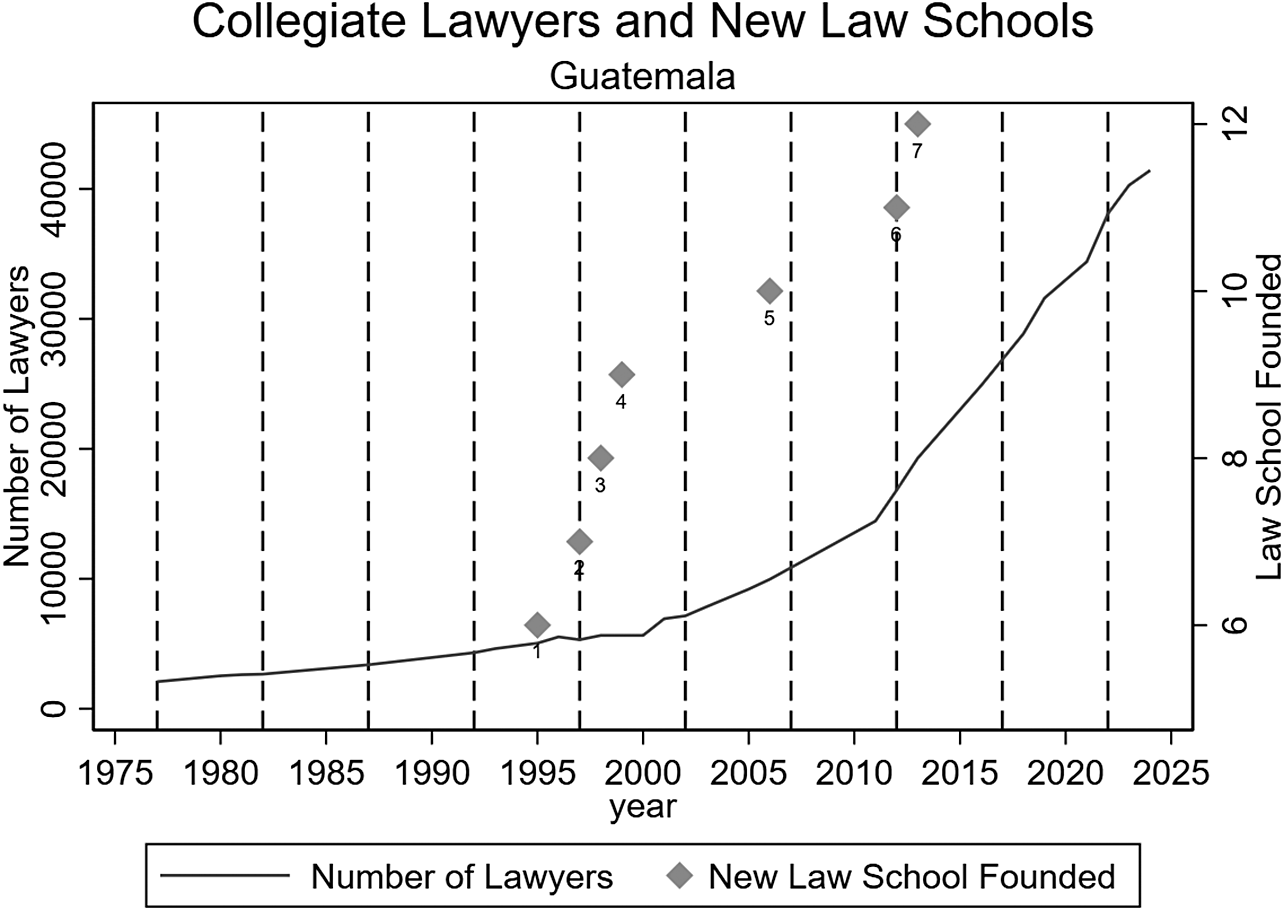
This is a theoretical assumption, but examples can be found in many cases. For instance, some lawyers spend their entire careers in these circuits of judicial appointments. Many lawyers have been part of law schools, ran to be a committee member representing the Bar, and applied for judgeship, among other jobs in the legal structure of Government.
Baumol (Reference Baumol1990) noted that if economic entrepreneurs are praised for their productive innovation led by personal interests, we can also think of entrepreneurs who use innovative political ways, such as legal strategies, to gain wealth or power, even if these are unproductive. As such, groups usually influencing Congress found a pathway to replicate the behavior in courts: financing campaigns in the CANG, creating new universities with law schools, or astroturfing with creative NGOs bringing cases to the committees to disqualify their competitors. The investments are smaller and less scrutinized than when influencing Congress because there is no regulation of the campaigns, and the votes are easier to get with a smaller population with very specialized interests.
The evidence of these dynamics became clearest when CICIG revealed twice how parallel groups financed campaigns for the CANG (which are unregulated) and met with nominators and candidates alike. In 2018, CICIG revealed the case of parallel commissions, in which brokers would sell votes and negotiate them with condos and other assets for candidates and sitting judges during the process of appointing Supreme Court Justices in 2014 (CICIG 2014). Later, after CICIG was expelled, the prosecutor who worked alongside CICIG in the case, as mentioned earlier, released Comisiones Paralelas 2020, a case in which the same dynamics were repeated with some old and new brokers (Sandoval Reference Sandoval2021).
Thirty-nine years after democratization, the three highest courts were working in tandem to favor the political-economic alliance in the 2023 election. The business elite supported President Giammattei’s successful efforts to capture every judicial institution. The courts disqualified the radical left party of Thelma Cabrera and the conservative party of elite defector Roberto Arzú, who are gaining popularity. Later, they disqualified Carlos Pineda after seeing his lead in the polls. On the night of June 25, 2023, Bernardo Arévalo, leader of the fiercest opposition party and son of Guatemala’s socialist icon Juan José, surprisingly made it to the run-off. The Attorney General’s office started prosecuting the party, party members, and the Electoral Tribunal. The Supreme Court allowed attacks and defended the judge taking the case. The Constitutional Court ordained recounting the votes twice and later confirmed the results but suspended the party, forbidding Arévalo from gaining control of Congress.
Conclusion
I have argued why constitutional framers introduce specific interest groups in the de jure judicial appointments. Parties unsure of their survival in the long term, and distrusting the political system, secured their position for influence in appointing judges. They did it by formally recognizing non-political groups to which they belonged and tried to frame the competition in an open arena for the long-term game. Instead of agreeing on independent judiciaries, elites preferred weak judiciaries with easy removals. The inclusion of groups such as the CANG and the law schools developed political competition mechanisms inside the institutions. It provided scrutinized spaces for parallel groups connected to parties, politicizing the institutions that were supposed to prevent the politicization of justice.
The story of Guatemala is a story of improvement, ambition, and wrong turns. It may be inevitable to think that political parties are impossible to fix, and that the country should aim for other ways of saving democracy instead. However, Guatemala shows that those attempts to close the political avenues to solve political problems have had the opposite effect of the intention. Judiciaries are key elements in the survival of constitutional orders, but they cannot handle the task alone, and surrendering to the idea that democracy will be saved only through courts and without parties has dire consequences for democracy. The role of courts as protectors of democracy needs to rely on broad consensuses, protections for justices to decide freely, and mechanisms to prevent judges from being purged after denying too many of their political ambitions.
Increasing openness and participation for civil society and fewer political groups does not have to be such a corrupting process, but as long as no mechanisms are limiting the powers of the competing groups, power will find its way. Crafting a pluralist regime committed to democracy requires long-term commitments and mechanisms of enforcement of the agreed upon rules.
As Guatemala experiences the collapse of its pluralist model of judicial appointments, the rest of the world can look at similar cases and find the opportunities for profit that political entrepreneurs might seek in each system that is reformed. Blocking those avenues in which entrepreneurs uncommitted to democracy can play should be a priority in every society trying to reform its judicial system. The dangers of court-packing and undemocratic actors capturing institutions should not be treated as unintended consequences, but as part of an ongoing process in which elites compete and secure arenas of contestation for their immediate and long-term futures.
The once-designed model of judicial appointments based on skepticism of elites toward each other allowed for parties to keep each other in check. For a short period of time, institutions of good reputation, such as law schools and an old CANG, contributed to this model by filtering and nominating judges without having a direct conflict of interest. However, those interested in capturing power demonstrated their effectiveness and quickly took the lead, crafting majorities and capturing courts to serve their interests. The few wise representatives of the Constitutional Assembly who noted this were not listened to enough, and history has proven them right, with very little credit and attention.
On the other hand, political entrepreneurs emerged out of a group of skilled individuals who may be serving a specific set of values that is not the entire subject of this research project. However, it has been proven that their interests have consistently been against the preservation of the constitutional order and the development of democracy. The theory of political entrepreneurship applies very well to the Guatemalan judiciary, but it also should be considered in many other institutional settings in Latin America. Outside of the scope of this project, a starting point for future studies is to find these different types of entrepreneurs in Latin America. It is a challenge to the widespread idea of a very small elite ruling most of a country. Instead, what we see more and more is a dynamic and diverse network of elites in which many entrepreneurs join and collaborate, seeking power and undermining institutions in the process.
Supplementary material
The supplementary material for this article can be found at http://doi.org/10.1017/jlc.2024.31.
Data availability statement
Replication materials for this article are available at the Journal of Law and Courts’ Dataverse archive https://dataverse.harvard.edu/dataverse/jlc
Acknowledgements
I would like to thank Nancy Maveety, Rachel Schoner, David Smilde, and Juan Ortega for their comments and feedback on this project. Interviews and archival research for this project were possible thanks to the support of the Center for Inter-American Policy Research and the Stone Center for Latin American Studies at Tulane University.
Competing interest
The author declares no competing interests.


 Open access

