

Introduction
It is now widely accepted that women, across most times, places, and offending contexts, constitute a minority of those charged with criminal acts (Heidensohn and Gelsthorpe Reference Heidensohn, Gelsthorpe, Maguire, Morgan and Reiner2007; Steffensmeier and Allan Reference Steffensmeier and Allan1996; Van der Heijden Reference Van der Heijden, Knepper and Johansen2016). This “gender gap” persists in group offending contexts, where women’s participation is not only marginal but is also often relegated to supporting roles as auxiliaries, accomplices, or “molls” (Adler Reference Adler1975; Beare Reference Beare2010; Campbell Reference Campbell and Ronald Huff1990; Selmini Reference Selmini2020; Simon Reference Simon1975, Reference Smith2019; Smith and Papachristos Reference Smith and Papachristos2016). Despite this lower visibility, women can be found participating in many forms of group offending, with recent scholarship highlighting their presence within street gangs, drug and human trafficking networks, and organized crime groups (OCGs) (Alkemade Reference Alkemade2014; Batchelor Reference Batchelor and Goldson2011; Davies Reference Davies1999; Gambetta Reference Gambetta1993; Hopper and Moore Reference Hopper and Moore1990; Ingrasci Reference Ingrasci and Faindaca2007; Kleemans and Smit Reference Kleemans, Smit and Paoli2014; Pizzini-Gambetta Reference Pizzini-Gambetta, Gartner and McCarthy2014; Siebert Reference Siebert1996; Siegel Reference Siegel2014; Smith Reference Smith2019; Smith and Papachristos Reference Smith and Papachristos2016; Wijkman and Kleemans Reference Wijkman and Kleemans2019). However, such studies typically focus on women’s involvement in mixed-sex and largely male-dominated criminal groups, with less attention paid to all-female groups – an unsurprising gap given that such offending contexts remain exceptionally uncommon.
The present study focuses on the rare case of an all-female criminal group, a British gang known as the “Forty Elephants” that operated primarily from the 1910s to the 1940s.Footnote 1 The Forty Elephants specialized in property offenses, including shoplifting, robberies, and burglaries, and later became associated with so-called “smash-and-grab” raids; press reports also alleged that the gang’s activities extended into “moral” crimes such as drug dealing, brothel-keeping, and prostitution in later years. Offending activities were largely concentrated in central London during the gang’s earlier years of operation, but in later decades, members expanded their offending operations across the country to improve anonymity. This increased geographic mobility coincided with intensified police crackdowns from the mid-1920s onward – spearheaded by Scotland Yard’s Flying Squad – as authorities intensified efforts to capture core gang members.
Although numerous women have been regarded as core members, only two women were described by the press as “leaders” of the group. The first, serving from the mid-1910s until 1926, was Alice Diamond, a prolific offender dubbed the “Queen of the Forty Elephants” and “the Elephant Queen.” Also important was Maggie Hill, sister of the notorious gangster Billy Hill and described as Diamond’s “chief lieutenant.” However, an alleged shift in leadership occurred following a violent internal conflict (the “Lambeth Battle”) between former members and those still active in the gang, resulting in the incarceration of Diamond, Hill, and several other prominent women. The press thereafter identified a second alleged leader, Lilian Goldstein – labeled the “Bobbed-Haired Bandit” – whose activities were documented from 1926 until the early 1940s. However, Goldstein’s precise role within the group remains unclear; while research confirms her reputation as a skilled getaway driver and motor bandit of the twentieth-century criminal underworld (Brown Reference Brown, Nash and Kilday2020), it is unclear if she exercised any genuine leadership within the Forty Elephants, held significant influence within the group, or was merely associated with the group in a more limited capacity.
The Forty Elephants have been variously described as a “gang,” “syndicate,” “organization,” and “network,” both in contemporary newspaper reports and more recent popular histories: Brian McDonald’s popular history of the group (Reference McDonald2015) presented the Elephants as both a gang and a syndicate, while twentieth-century newspapers applied terms such as “the Forty Elephants gang,” “a criminal syndicate of women,” and “female organized criminals” – sometimes even within the same article. Such inconsistent labeling reflects broader uncertainty about how the group operated, how it was structured, and whether it maintained a cohesive organizational identity over time. For the purposes of this study, the Forty Elephants are treated initially as a gang, reflecting evidence of leadership, stable membership, and acts of co-offending in the group’s early years. However, whether the group retained this structure or evolved into a looser, more flexible co-offending network over time is a central issue that this study seeks to address. This question is particularly important in light of the gang’s leadership changes and growing law enforcement pressures during the interwar period.
This examination of the Forty Elephants draws on methods from social network analysis (SNA), an approach that focuses on the social structure of relations and interactions among individuals, groups, and other entities. SNA has been widely adopted in criminology, where it has been used to examine a variety of group offending contexts, including crime syndicates, motorcycle gangs, co-offending networks, trafficking rings, collaborative vehicle thefts, and terrorist cells (e.g., Bright et al. Reference Bright, Greenhill, Reynolds, Ritter and Morselli2015, Reference Bright, Whelan and Morselli2020; Chen and Lu Reference Chen and Lu2018; Englefield and Ariel Reference Englefield and Ariel2017; Krebs Reference Krebs2002; Morselli and Petit Reference Morselli and Petit2007; Ouellet et al. Reference Ouellet, Bouchard and Hart2017; Tenti and Morselli Reference Tenti and Morselli2014). It has also gained traction among historians, particularly within social, economic, and cultural history, where scholars have used it to trace, for example, kinship networks, political alliances, trade routes, intellectual exchanges, religious networks, and communication flows (e.g., letter-writing networks).Footnote 2 However, crime historians and historical criminologists have been slower to adopt the SNA perspective, with only a handful of studies applying network analysis to historical offending contexts (DellaPosta Reference DellaPosta2017; Di Méo Reference Di Méo2023; Krajewski et al. Reference Krajewski, DellaPosta and Felmlee2022; Smith Reference Smith2019; Smith and Papachristos Reference Smith and Papachristos2016) – with even fewer applying such techniques to historical criminal networks involving women.
The study examines how hierarchy, leadership, and collaboration were established and maintained within an all-female criminal group. It has three objectives: first, to analyze the broad structural properties of the gang across two phases of its operation; second, to identify the key players within the network, examining how influence was distributed among individual members; and finally, to assess whether the group operated as a cohesive gang throughout its operations or whether its structure evolved into a looser, more flexible network over time. In addressing these questions, the study makes contributions to crime history, historical criminology, and digital humanities by offering one of the first network reconstructions of an all-female historical criminal group. It also highlights how computational methods such as SNA can enhance historical crime research, particularly in cases involving under-documented groups such as female offenders, and offers new insight into how women’s criminal networks adapted to internal and external pressures over time.
The article begins with a review of existing research on women, gangs, and organized crime, as well as studies that apply SNA to criminal networks. The subsequent methodology section outlines the sources, data collection process, and analytical techniques used for this study. The results and discussion sections then present a comparative analysis of the Forty Elephants’ network across two periods: the leadership of Alice Diamond (1915–mid-1926) and the later years associated with Lilian Goldstein (late-1926–1940). The conclusion summarizes the study’s findings and limitations and reflects on its broader implications for historical and criminological research. Ultimately, in the article, it is argued that the Forty Elephants initially operated as a relatively structured and hierarchical gang, yet in its later years exhibited a looser structure, with leadership becoming less centralized and collaborations becoming more dispersed. The article also offers some tentative explanations for this structural shift, including factors related to internal gang conflict, law enforcement pressures, and changes in offending patterns.
Literature review
Women, gangs, and organized crime
Organized crime remains a “fuzzy and contested umbrella concept” (Paoli Reference Paoli and Paoli2014: 3), with understandings of which activities fall under this label constantly changing. This debate extends to the distinction between organized crime groups (OCGs) and gangs: as noted by Decker and Pyrooz (Reference Decker, Pyrooz and Paoli2014), some scholars differentiate these concepts based on factors such as structure, motive, continuity, and specialization, while others emphasize the fluidity between them. For instance, Miller (Reference Miller1975) views gangs as cohesive, coordinated groups that resemble OCGs, whereas Densley (Reference Densley2012) suggests that gangs may follow an evolutionary trajectory, with some remaining small, disorganized, and localized, while others later develop into OCGs. These definitional complexities remain relevant in the case of the Forty Elephants, who have been variously described as a gang, crime syndicate, OCG, and criminal network across sources. In light of these debates, this review examines existing historical and criminological research on group-based offending, including both gangs and OCGs. It begins with literature on women’s participation in such groups before turning to scholarly use of SNA in the study of collective criminality.
Historical research documents the nature and prevalence of gangs and organized crime in Britain during the nineteenth and twentieth centuries, particularly the emergence of phenomena such as “racecourse wars,” urban street gangs, “motor bandits,” and a growing underground market (Brown Reference Brown2011; Chinn Reference Chinn2019; Davies Reference Davies1998, Reference Davies1999; Emsley Reference Emsley2008; Roodhouse Reference Roodhouse2013; Shore Reference Shore2011, Reference Shore, Knepper and Johansen2016). Although much of this research has focused on male offenders, several studies have examined women’s involvement in group offending contexts. Moss’s (Reference Moss2019) study of female “cat burglars” in modern Britain highlights women’s participation in sophisticated property crime schemes, while Davies (Reference Davies1999) draws attention to female participation in late-Victorian “scuttling gangs” (violent, youth-based street gangs). Bland (Reference Bland2013) and Kohn (Reference Kohn1992) also provide examples of women whose lives intersected with the world of organized crime in twentieth-century Britain. However, despite these contributions, women’s roles within all-female offending groups remain underexplored.
Despite its status as an all-female gang, historical research on the Forty Elephants remains limited. Brown (Reference Brown, Nash and Kilday2020) offers a detailed examination of Lilian Goldstein’s criminal career, focusing particularly on her associations with notorious gangster and former lover Ruby “Sparkes”; however, this study does not directly address Goldstein’s involvement with the Forty Elephants. Meier’s (Reference Meier2011) research on shoplifting in modern Britain briefly mentions the Forty Elephants but does not engage with the organization’s internal operations, broader impact, or historical significance, while Di Méo’s (Reference Di Méo2024) study provides an account of the gang’s activities and prosecutions, but focuses primarily on media portrayals of the gang. In addition to these academic studies, McDonald’s (Reference McDonald2015) popular history provides an account of the Forty Elephants’ activities. However, since the work is centered on personal and inherited sources, and has a notable focus on the affiliated, male-dominated ‘Elephant Boys’ gang, critical analysis of the Forty Elephants themselves is comparatively limited. Together, these pieces make valuable inroads into uncovering the history of the Forty Elephants, yet significant gaps remain regarding the group’s internal operations, leadership dynamics, and membership – gaps this study seeks to address.
Although historical research on women, gangs, and organized crime remains sparse, the topic has received more attention among criminologists. Early contributions from feminist scholars laid valuable groundwork, with Adler’s (Reference Adler1975) seminal research on female criminality in the USA in the 1970s demonstrating that women participated as high-level dealers in illicit drug markets through romantic relationships. More recent studies have expanded this scope, addressing women’s involvement in gangs (Batchelor Reference Batchelor and Goldson2011; Hopper and Moore Reference Hopper and Moore1990), mafia groups (Gambetta Reference Gambetta1993; Ingrasci Reference Ingrasci and Faindaca2007; Longrigg Reference Longrigg1997; Pizzini-Gambetta Reference Pizzini-Gambetta, Gartner and McCarthy2014; Siebert Reference Siebert1996), yakuza organizations (Alkemade Reference Alkemade2014; Otomo Reference Otomo and Fiandaca2007), and human and drug trafficking networks (Kleemans and Smith Reference Kleemans, Smit and Paoli2014; Mancuso Reference Mancuso2014; Siegel Reference Siegel2014; Wijkman and Kleemans Reference Wijkman and Kleemans2019; Zhang et al. Reference Zhang, Ko-Lin and Miller2007). These studies typically address one or more of three key questions: why women are less likely to participate in group offending than men; what factors lead women to join (and leave) gangs or criminal organizations; and what roles women occupy within these groups.
Addressing the first question, research indicates that women form a minority of those actively involved in both gangs and OCGs (Arsovska and Allum Reference Arvsovska and Allum2014; Beare Reference Beare2010; Diviák et al. Reference Diviák, Coutinho and Stivala2020). However, scholars have questioned whether criminal statistics fully capture the extent and nature of women’s participation. Women can play important roles within criminal groups – such as acting as facilitators, brokers, or intermediaries – but their involvement is often underreported, particularly when they operate in informal or auxiliary roles. For instance, women in mafia families may wield influence behind the scenes yet remain classified as “unofficial” members, leading to their participation being dismissed as “not actually integral to the criminal operations” (Beare Reference Beare2010: 32). Additionally, female involvement in gangs and organized crime may be underestimated because women are less likely to be arrested than men – whether due to law enforcement leniency, policy priorities, or more sophisticated methods of evading detection (Beare Reference Beare2010; Selmini Reference Selmini2020).
Despite the limitations of crime statistics, scholars broadly agree that women engage in gangs and OCGs less often than men. One prevailing explanation for this disparity is that structural gender inequalities – such as restricted economic opportunities and patriarchal control – limit women’s pathways into serious offending, confining them to minor forms of crime (Adler Reference Adler1975; Messerschmidt Reference Messerschmidt1986; Selmini Reference Selmini2020; Simon Reference Simon1975). Another explanation focuses on trust and exclusion, with some scholars suggesting that male offenders view women as unreliable or indiscreet, leading to their exclusion from criminal organizations (Adler Reference Adler1975; Gambetta Reference Gambetta1993; Siebert Reference Siebert1996); however, others studies have found that criminal men sometimes consider women – especially their wives – to be more trustworthy than male associates (Dino Reference Dino and Fiandaca2007; Pizzini-Gambetta Reference Pizzini-Gambetta, Gartner and McCarthy2014; Selmini Reference Selmini2020). It is also possible that women’s participation in gangs and OCGs is lower due to a reluctance to be involved in large-scale, violent criminal organizations (Ingrasci Reference Ingrasci and Faindaca2007).
Research has not only explored the gender gap in gangs and OCGs but also examined the factors that encourage women to engage in such groups in the first place. Evidence suggests that some women join and leave these groups for reasons similar to men – including exposure to gang culture, experiences of social exclusion, financial hardship, and limited legitimate opportunities (Miller Reference Miller2001). However, gendered motivations also play a significant role: studies indicate that women may enter criminal groups seeking protection, to escape victimization, or through romantic relationships with male members (Batchelor Reference Batchelor2009; Campbell Reference Campbell2008; Moore and Hagedorn Reference Moore and Hagedorn2001; Schwartz and Steffensmeier Reference Schwartz, Steffensmeier and Zaplin2008; Smith Reference Smith2019). Other driving factors include poverty, family pressures, exploitation, migration, and substance abuse (Guerreiro et al. Reference Guerreiro, Sousa and Gomes2022; Selmini Reference Selmini2020).
Importantly, the presence of women in criminal groups does not necessarily equate to power, autonomy, or influence. Even in cases where women make up a notable proportion of a gang or OCG, they often remain in lower-status roles (Diviák et al. Reference Diviák, Coutinho and Stivala2020). Studies suggest that conventional gender roles are often reproduced in criminal organizations, with women taking on auxiliary or stereotypically “feminine” roles that receive lower (if any) financial compensation, such as undertaking sex work, luring male victims, bookkeeping, street-level drug dealing, or acting as “moral influencers” and emotional supports to male family members involved in crime (Ingrasci Reference Ingrasci and Faindaca2007; Smith Reference Smith2019; Zhang et al. Reference Zhang, Ko-Lin and Miller2007). Women are rarely found in leadership or managerial roles, with such exceptions typically occurring only when women adopt masculine traits, have particularly strong connections, or stand in for an incarcerated or deceased male partner – and, even then, their authority is often temporary, challenged, or symbolic (Adler Reference Adler1975; Campbell Reference Campbell2008; Ingrasci Reference Ingrasci and Faindaca2007; Longrigg Reference Longrigg1997; Selmini Reference Selmini2020). All-female groups such as the Forty Elephants present an important counterpoint, offering rare examples where women may have held leadership roles – the nature and extent of which will be discussed in later sections.
Social network analysis, gangs, and organized crime
Over recent decades, SNA has gained increased popularity among criminologists. Given its focus on social ties and interactions, it is particularly well-suited to studies of group offending. Scholars have used this approach to examine how criminal groups are structured, the contexts in which they emerge, and the social dynamics that shape co-offender collaborations (e.g., Bastomski et al. Reference Bastomski, Brazil and Papachristos2017; Bouchard and Malm Reference Bouchard and Malm2016; Bright et al. Reference Bright, Whelan and Morselli2020; Chen and Lu Reference Chen and Lu2018; Joseph and Smith Reference Joseph and Smith2021; Krajewski et al. Reference Krajewski, DellaPosta and Felmlee2022; Mancuso Reference Mancuso2014; Morselli Reference Morselli2009; Smith Reference Smith2019; Smith and Papachristos Reference Smith and Papachristos2016). Although much of this research focuses on contemporary/recent organized crime and gang examples, some studies have demonstrated how SNA can uncover hidden structures within historical criminal networks (e.g., Di Méo Reference Di Méo2023; Krajewski et al. Reference Krajewski, DellaPosta and Felmlee2022; Smith Reference Smith2019). Alongside its analytical benefits, SNA also offers practical applications for crime prevention, enabling law enforcement agencies to identify key individuals and relationships within criminal networks to inform targeted disruption strategies (Bichler et al. Reference Bichler, Malm and Cooper2017; Bright et al. Reference Bright, Greenhill, Reynolds, Ritter and Morselli2015; Frydensberg et al. Reference Frydensberg, Ariel and Bland2019; Morselli and Petit Reference Morselli and Petit2007).
Network structure remains a focal point in SNA studies of OCGs and gangs, particularly in exploring the extent to which formal hierarchies within such groups are reflected in actual patterns of collaboration between members. Drawing on declassified dossiers from the US Federal Bureau of Narcotics, Krajewski et al.’s (Reference Krajewski, DellaPosta and Felmlee2022) study of historical mid-twentieth-century Italian American mafia groups demonstrated that official organizational charts often failed to reflect actual patterns of criminal collaboration: rather than forming a centralized, vertical network with members working under formal leaders, mafiosi tended to collaborate with others of similar status, producing a flatter, more decentralized network. Similarly, Morselli’s (Reference Morselli2009) network study of Quebec’s Hell’s Angels chapters found that formal roles were not always reflected in members’ actual collaborative ties, while Tenti and Morselli’s (Reference Tenti and Morselli2014) study of drug trafficking in Italy identified a network that was not centralized under the governance of a powerful few but instead structured in a chain-like formation whereby influence and importance were distributed across the network. Importantly, these studies contrast with more traditional depictions of gangs and organized crime by demonstrating that formal governance charts may not be replicated at the “ground” (i.e., network) level.
However, in relatively decentralized networks, there tend to be one or more agents acting as “key players”: individuals who hold the most social capital by possessing or controlling more resources – such as information, money, trust, and opportunities – than others in the network. Studies of OCGs and gangs often seek to identify these key players by calculating centrality scores, which measure participants’ prominence within the network in different ways and typically include degree centrality, betweenness centrality, closeness centrality, and eigenvector centrality (e.g., Bichler et al. Reference Bichler, Malm and Cooper2017; Bright et al. Reference Bright, Greenhill, Reynolds, Ritter and Morselli2015; Englefield and Ariel Reference Englefield and Ariel2017; Tenti and Morselli Reference Tenti and Morselli2014). This “key player” approach helps scholars to identify individuals who may exert considerable influence within gang or organized crime networks despite not always being formally recognized in organizational charts or police intelligence reports.
Although there is a growing body of work applying SNA methods to the study of gangs and organized crime, many studies have excluded women or focused on male-centric networks. However, recent contributions are beginning to address this gap. Diviák et al. (Reference Diviák, Coutinho and Stivala2020) analyze the structural positions and roles of women in a Canadian organized crime network, highlighting that women, while present, often occupy positions lacking power and are mediated by male counterparts. Mancuso’s (Reference Mancuso2014) research on the role of “madams” in Nigerian sex trafficking networks underscores the importance of individual women in such operations, while Kleemans and Smith (Reference Kleemans, Smit and Paoli2014) demonstrated that females, although a minority of offenders, can act as crucial brokers in transnational organized crime through their social and familial connections. More recently, Niezink and Campana’s (Reference Niezink and Campana2023) study on violence related to organized crime events highlights the heightened threats and vulnerabilities faced by female participants in criminal networks.
Despite these advancements, few studies have applied SNA to historical contexts of female participation in organized crime. One notable exception is Smith’s (Reference Smith2019) monograph on women’s participation in the criminal underworld during the Progressive and Prohibition eras in Chicago. Smith’s analysis traces the gradual marginalization of women within these networks, highlighting how the nonhierarchical nature of the Progressive Era underworld provided accessibility for female participants, whereas the transition to a more vertical, hierarchical network with a core of “bosses” during the Prohibition period increased gender inequalities and led to women’s near-exclusion from criminal networks. Collectively, such studies demonstrate the value of applying a gendered lens to network analysis, illustrating how structural transformations within criminal networks can shape the visibility, power, and roles of women – issues central to understanding historical female gangs such as the Forty Elephants.
Sources and methods
This article contributes to scholarship on women, gangs, and criminal networks by offering an SNA of the Forty Elephants. Several research boundaries were placed on the study, including the decision to consider the full range of offenses alleged to be perpetrated by the gang, such as shoplifting, burglary, robbery, pickpocketing, assaults, grievous bodily harm, and deception. In selecting individuals for inclusion, the study applied two criteria: women had to be either (a) directly identified as members of the Forty Elephants in news accounts or (b) have co-offended with a known member on at least two occasions, suggesting close affiliation with the group (and potential membership). Only female offenders were included in the dataset: while male associates occasionally appeared in news reports (sometimes as fences for stolen goods or accomplices in burglaries), the evidence suggests they were not formal members. Notably, male relatives and affiliates of the “Elephant Boys” were involved in the “Lambeth Battle” of 1925, but this remained an isolated event rather than a sign of regular male participation in the Forty Elephants.
Additionally, the study focuses on activities occurring between 1915 and 1940, as there is little evidence of the gang operating outside this period. Some sources claim the Forty Elephants originated from the late-Victorian “Forty Thieves” gang led by Mary Carr (McDonald Reference McDonald2015), yet there is little evidence to confirm a connection between these groups. “Forty Thieves” was a widely used label for gangs at the time (likely inspired by Ali Baba and the Forty Thieves), and the use of this term in relation to the Forty Elephants does not necessarily indicate group continuity. Furthermore, preliminary research for this study found no familial, social, or co-offending ties between Carr’s associates and the Forty Elephants.Footnote 3 This study therefore begins in the 1910s, when the earliest press references to the “Forty Elephants” as a distinct group appeared.
While official sources such as police, court, and prison records exist for this period, they can be fragmented, inconsistently digitized, and difficult to obtain. The Forty Elephants’ geographical mobility meant that prosecutions were scattered across multiple magistrates’ jurisdictions, making relevant records hard to track in local archives; such records can be uncatalogued, are seldom digitized, are difficult to access, and are frequently patchy in survival. Some higher-profile cases reached the Old Bailey, although these were very limited in number and relate only to more serious offenses, offering an incomplete picture of the gang’s activities. No relevant case files appear to be held at The National Archives, neither in the London Metropolitan Police records (MEPO) nor in the Director of Public Prosecution files (DPP). Additionally, while digitized official records such as Calendars of Prisoners and Habitual Criminal Registers do cover part of the research period, they primarily contain biographical data on individual offenders (i.e., attributional data such as age, sentencing, previous convictions, etc.) rather than relational data on co-offending. Since SNA requires relational data to map criminal connections, these sources were unsuitable for reconstructing the Forty Elephants’ network. Additionally, those sources require individuals to have been convicted in order to be recorded, meaning they provide little information on the Forty Elephants, whose members were notorious for escaping conviction.
Given these constraints, this study relies on twentieth-century British newspapers as primary source materials. These included a range of local, regional, and national publications accessed via digital repositories such as the British Newspaper Archive, the Times Digital Archive, and the Telegraph Historical Archive. Newspapers were chosen because they provide detailed coverage of arrests and prosecutions; additionally, unlike many official records, which often lack relational detail (such as prison registers), press reports provide information on who was arrested or prosecuted together – including sometimes giving accounts of women’s collaborations over several occasions. While this allows for the reconstruction of connections that some official records might miss, it also introduces certain biases: media coverage was shaped by journalistic imperatives, meaning that some crimes and individuals were sensationalized, overlooked, or misrepresented (Carter Wood Reference Carter Wood, Knepper and Johansen2016; Roodhouse Reference Roodhouse2019; Rowbotham et al. Reference Rowbotham, Stevenson and Pegg2013). News reports were therefore cross-referenced to reduce the effects of such distortions.
Over fifty newspaper titles were included in the study, representing a range of political leanings, geographical origins, and publishing frequencies. This selection included several prominent London-based popular press outlets known for their extensive crime reporting and sensationalist style, including Reynolds’ Newspaper, Weekly Dispatch, Illustrated Police News, and Daily Mirror. Coverage from national broadsheets, including the Daily Telegraph and The Times, was also examined. Regional publications such as the Belfast Telegraph, Manchester Evening News, and Yorkshire Evening Post were also included in the study; these were particularly valuable for reporting on Forty Elephants cases that occurred outside of London, which were sometimes overlooked or omitted by the London press. A complete list of newspaper articles used in this study is available online in the Supplementary material.
Search terms related to the gang were entered into the news databases to identify individual members and their offenses. The names of identified women were then used as additional search terms to uncover further potential members and related cases, which were then used to generate additional searches.Footnote 4 This iterative process continued until no new names or cases emerged from the records. Given the nature of digitized newspaper archives, some cases may have gone undetected due to optical character recognition (OCR) errors, inconsistent name spellings, or, as aforementioned, reporting biases. Consequently, while newspapers remain invaluable for researching the Forty Elephants, they carry inherent limitations that may have influenced how the network data were collected and interpreted.
The dataset was constructed by cataloging cases in which two or more women were described as co-offenders. Since SNA relies on relational data, two tables were created during this process, the first being a node list, which recorded all individuals (nodes) affiliated with the Forty Elephants. Nodes represented only one type of individual (i.e., co-offenders linked with the gang), making this a one-mode network. The node list included each woman’s name, any known aliases, and the total number of cases she was associated with; however, biographical details such as age, marital status, address, and occupation were inconsistently recorded in the sources, preventing them from being incorporated into the analysis. The second table was an edge list, which documented all co-offending ties (edges) between these individuals. Co-offending ties were recorded when two (or more) women were reported as acting together in a criminal event – either through (a) being prosecuted together or (b) being pursued by the police together but evading arrest. For instance, the dataset recorded a co-offending edge between Maud Seymour and Mary Gibbs (each represented by a node) based on a report describing their prosecution together for a shoplifting spree at Harrods department store (Birmingham Daily Gazette 1927). Similarly, a co-offending edge was recorded between the nodes representing Maggie Hill and Lilian Goldstein, based on a Penrith Observer (1934) report documenting their joint prosecution for shoplifting furs.
Several considerations were required when recording co-offending edges. First, all edges were treated as binary (unweighted), meaning that a tie between two women who co-offended multiple times held the same weight as a single instance of co-offending. Since the aim was to analyze structural patterns rather than the frequency or strength of collaborations, no weighting was required. Second, edges were undirected, as sources rarely specified which woman may have instigated an offense. Third, edges were recorded as uniplex, meaning they captured co-offending relationships without distinguishing between offense types: whether burglary, shoplifting, pickpocketing, or another type of offense, all acts were recorded under a single “co-offending” category.Footnote 5 As such, the dataset comprises a one-mode, uniplex, unweighted, and undirected network, in which nodes represent individual offenders and edges represent co-offending ties, irrespective of their frequency, offense type, or directionality.
Recognizing that networks are dynamic rather than static phenomena, the dataset was divided into subnetworks representing distinct time periods. The first phase (T1: 1916–mid-1926) represents the leadership of Alice Diamond, while the second phase (T2: late-1926–1940) marks the period following her incarceration, during which Lilian Goldstein was described by the press as the gang’s new leader. This event-based framing is grounded in criminological research indicating that the removal of leaders and other key figures can serve as turning points for OCGs and gangs, sometimes leading to the group’s dissolution or a reconfiguration in membership and/or hierarchies.Footnote 6 By segmenting the dataset around this upheaval – the imprisonment of Diamond and several other members after the Lambeth Battle – the study aims to identify structural changes in the gang, including shifts in leadership centrality, group cohesion, and patterns of criminal collaboration.
A further methodological decision involved focusing exclusively on the main components for both the T1 and T2 subnetworks. While most women in the dataset were part of the main component in at least one time period, a few formed smaller, disconnected groups that did not share edges with the core Forty Elephants network: in T1, eight women formed two small peripheral clusters, while in T2, just two women formed a separate component. These peripheral components may have emerged due to either (a) mistaken press identification, where journalists incorrectly associated some offenders with the Forty Elephants, or (b) women being genuine associates (or members) of the gang but whose collaborations with others in the main component went unreported. In the latter case, even if these individuals were part of the gang, their position and influence in the network cannot be reliably determined due to missing data on co-offending relationships. By restricting the focus to the main component in both T1 and T2, this study improves the chances that all individuals included in the analysis were meaningfully connected to the group.
Excluding these smaller components, the dataset consisted of 59 women and 139 co-offending edges between them.Footnote 7 In T1, the main component contained 41 women and 91 edges, while in T2, it included 34 women and 47 ties. Some women – 16 in total – appeared in the main components for both T1 and T2, while 25 and 18 women were unique to T1 and T2, respectively. While full sociodemographic data are unavailable, most members appear to have been young women from working-class districts of South London, areas then associated with gang-related and organized crime (Shore Reference Shore2011). The gang’s cohesion may have been reinforced not only through criminal collaborations but also familial and neighborly ties, with many members sharing such connections. This aligns with broader historical research on the role of kinship and intergenerational relationships in criminal offending (Godfrey et al. Reference Godfrey, Cox and Farrall2007; Williams and Godfrey Reference Williams and Godfrey2014), as well as criminological network research highlighting how multiplex ties shape organized crime structures (Diviák et al. Reference Diviák, Coutinho and Stivala2020; Smith and Papachristos Reference Smith and Papachristos2016).
Ties serve as the main unit of analysis for this study, requiring a dyadic approach to examining organized crime (i.e., focusing on pairs rather than individual units or persons). Analysis was undertaken using Python’s NetworkX library, an open-source package for conducting SNA on small- to medium-sized networks. Descriptive statistics were calculated for both partitions (T1 and T2) of the network, including but not limited to size (the total number of nodes in a network), density (the overall level of connectivity), degree (the number of ties each participant has), number of triangles (instances where three nodes are interconnected), diameter (the longest “shortest path” between any two nodes in the network), and the clustering coefficient (the extent to which nodes form tightly connected groups). Together, these descriptive measures capture important structural characteristics of the Forty Elephants network.
Alongside this structural analysis, the study involved key player analysis by examining centrality scores to identify influential members of the gang. Four centrality measures were considered: degree, betweenness, closeness, and eigenvector centrality. Degree centrality measures the number of direct ties an individual holds, reflecting their level of activity and potentially acting as a marker of popularity. Betweenness centrality highlights individuals who act as intermediaries, controlling the flow of information or resources between otherwise unconnected members. Closeness centrality assesses how efficiently an individual can reach all others in the network, with those positioned closer to others typically having greater autonomy and influence. Finally, eigenvector centrality assesses whether actors are well-connected to other influential actors and potentially suggests that they may be embedded within the network’s “core” group.
For each subnetwork (T1 and T2), women were assigned centrality scores across all four measures; women who appeared in both subnetworks thus received separate scores for each timeframe. Raw centrality scores, rather than normalized ones, were used to avoid distortions given the relatively small size of the dataset. In addition, a “composite centrality” score was calculated for each woman by averaging her scores across degree, betweenness, closeness, and eigenvector centrality; these composite scores helped identify the overall top-ranking participants in each network. Importantly, however, while these measures – both individually and in aggregate – offer insights into a woman’s position in the network, high centrality does not necessarily equate to leadership or decision-making power. Apparent centrality (or the lack thereof) may instead reflect strategic offending behaviors, the evasion of law enforcement, or media biases that shaped how individuals were reported, ultimately affecting their visibility within the network.
Results
Structural characteristics of the Forty Elephants network
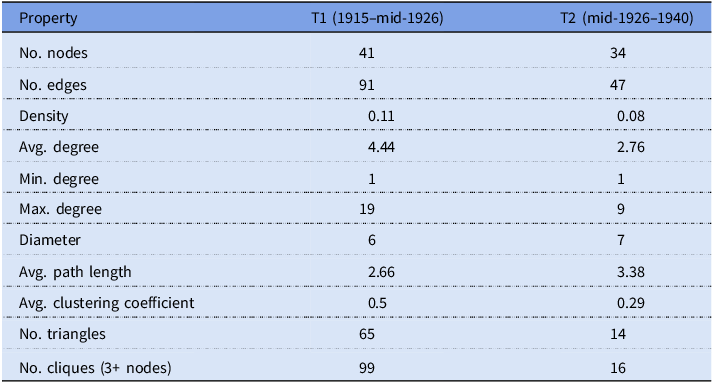
The Forty Elephants underwent notable structural shifts across the two periods of examination. Under Alice Diamond’s leadership (T1: 1915–mid-1926), the network’s main component comprised 41 women with 91 co-offending ties, whereas in the later period under Lilian Goldstein (T2: late-1926–1940), it was significantly smaller, featuring 34 women and 47 ties (see Table 1). Although both networks were relatively sparse, density was higher in T1 (0.11) than in T2 (0.08), indicating that a greater proportion of possible ties were present in the earlier period. This reduction in both density and total ties suggests that the gang’s structure had become less cohesive in T2, with members forming fewer co-offending ties.
Structural properties of the Forty Elephants network (main component) in T1 and T2

Beyond density and size, another structural shift in the network was the decline in local group cohesion. Under Diamond’s leadership (T1), members were more likely to collaborate within tightly interconnected subgroups, as indicated by a high clustering coefficient (0.50) and the presence of 65 triangular relationships (i.e., sets of three women who co-offended with one another). In contrast, the network under Goldstein (T2) had a notably lower clustering coefficient (0.29) and just 14 triangles, suggesting a reduced tendency for women to collaborate in tight-knit subgroups. This shift is further reflected in the declining number of cliques (fully connected subgroups with three or more nodes, including triangles and larger groups), which dropped from 99 in T1 to just 16 in T2. These findings indicate that the Forty Elephants potentially shifted from a structure dominated by highly clustered subgroups toward a more loosely connected network.
Beyond clustering and subgroup formation, patterns of connectivity also highlight key shifts between the two subnetworks. One notable change was the decline in average degree, which dropped from 4.44 in T1 to just 2.76 in T2, indicating that members had fewer direct connections (or collaborators) in the later period. Similarly, the increase in average shortest path length, rising from 2.66 in T1 to 3.38 in T2, indicates that members of the Goldstein network had to navigate through more intermediaries to reach others. As such, while Diamond’s network had a more direct, efficient structure, the Goldstein network was more diffuse, potentially requiring additional steps for collaboration and information flow. Additionally, the maximum degree for any one individual was 19 in T1 (held by Diamond herself) but only 9 in T2, suggesting the absence of a single, dominant, highly connected figure in the later period – a decline in individual connectivity that will be explored further in the following section.
Taken together, these findings suggest a potential shift in the Forty Elephants’ organization. Under Diamond’s leadership, the network was larger, denser, and more cohesive, with relatively strong clustering and tightly interconnected subgroups potentially facilitating efficient collaboration. By contrast, the network later became more fragmented, with fewer connections, reduced clustering, and longer paths between members, indicating a shift toward a more diffuse structure. While these changes suggest a move away from the more interconnected and cohesive structure of the earlier period, they do not indicate complete dissolution; rather, the network may have evolved into a more flexible structure that allowed members to adapt to changing conditions and pressures.
Key players in the Forty Elephants network
Having outlined the broad structural characteristics of the Forty Elephants subnetworks, we now turn to the question of individual influence within the gang. While network structure indicates how a group functions, it is often shaped by key figures who occupy “central” positions and exert disproportionate influence over others. The following discussion identifies women who potentially held key roles within the Forty Elephants, using centrality analysis to determine those who had the greatest connectivity (degree centrality), efficiency (closeness centrality), brokerage (betweenness centrality), and ties to other influential figures (eigenvector centrality).
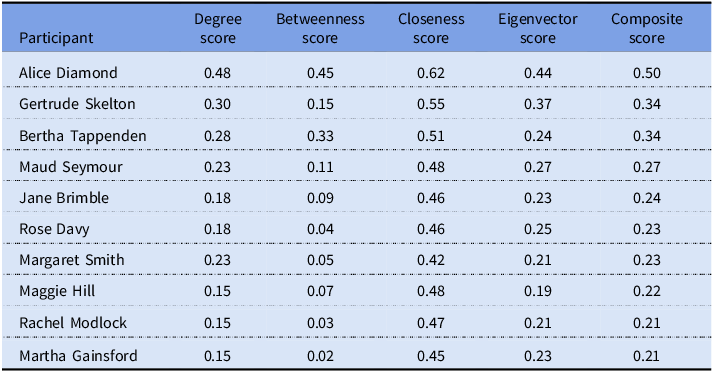
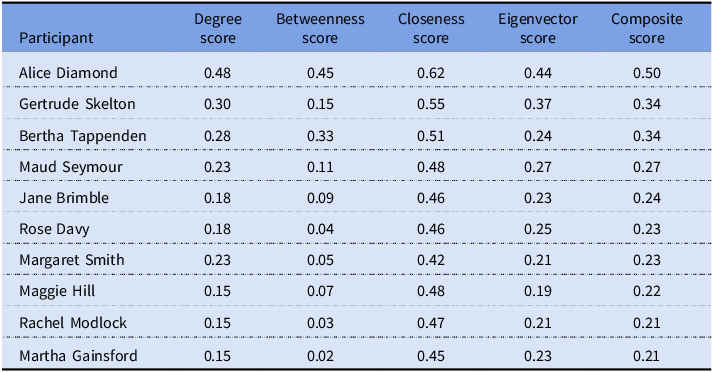
The Forty Elephants network during Diamond’s leadership (T1) was largely structured around a central figure, with Alice Diamond herself emerging as the dominant member of the gang. She held the highest scores across all four centrality measures, with a composite centrality score of 0.50 – the highest in the network, with the second highest at just 0.34 (see Table 2). Her high degree centrality confirms that she had the most co-offending ties, while her betweenness centrality highlights her role as a broker, serving as a bridge between otherwise disconnected members. Additionally, her closeness centrality suggests she was the best-positioned woman to reach all members of the gang, while high eigenvector centrality indicates that she was embedded among other well-connected individuals, reinforcing her influence beyond her immediate ties. These findings align with contemporary press portrayals, which frequently described her as the gang’s dominant leader – one newspaper, for example, described her as “the brains of the gang” to whom “every member of the Forty Elephants gang reports to” (Weekly Dispatch 1925). Her network position thus suggests her leadership was not just about visibility but also about direct involvement in coordinating activities, with no other gang member matching her level of connectivity and centrality.
Centrality measures for top 10 participants in T1 (sorted by composite score)
Note: Composite score was calculated as the average of degree, betweenness, closeness, and eigenvector centrality.
Alongside Diamond, a handful of other women were identified as prominent network participants, forming what could be considered an “inner circle” of highly connected members. Bertha Tappenden emerged as one such figure, ranking joint-second in composite centrality (score: 0.34) alongside Gertrude Skelton. Tappenden was a frequent co-offender of Diamond, and her high betweenness score suggests she played a key role in bridging otherwise unconnected groups; for example, she formed a co-offending group comprising her sister-in-law and several other women, serving as the only link between them and Diamond – and, by extension, the wider network. In contrast, Skelton ranked highly in closeness and eigenvector centrality rather than betweenness, suggesting that she was able to efficiently reach others in the network, especially those who were themselves influential members. Maud Seymour also held a relatively central role, ranking among the top members for degree and betweenness centrality. While most other high-ranking members formed stable co-offending partnerships, Seymour appears to have adopted a more adaptable offending strategy, never collaborating with the same woman more than once (explaining her high degree centrality). This suggests that some women, rather than operating within a single clique, expanded their reach across multiple co-offending groups, contributing to the network’s structural flexibility.
Interestingly, Maggie Hill, frequently portrayed as Diamond’s right-hand woman, presents a contrast between historical accounts and network analysis. Contemporary press reports often depicted her as Diamond’s enforcer, with one article, for example, describing her as Diamond’s “chief lieutenant” (Reynolds Newspaper 1926). However, her composite centrality rank places her eighth overall, suggesting a more moderate structural position in the network. This discrepancy raises important methodological considerations: while historical sources position Hill as a figure of power and influence, network data suggest that her operational role in co-offending collaborations may have been more limited. This reinforces the need to critically assess how sources depict hierarchies within criminal groups, as network analysis can sometimes reveal that gang and OCG structures are less rigidly organized than contemporary narratives imply (Krajewski et al. Reference Krajewski, DellaPosta and Felmlee2022).
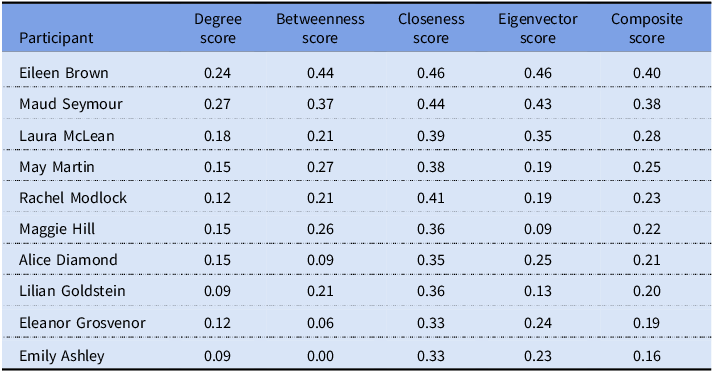
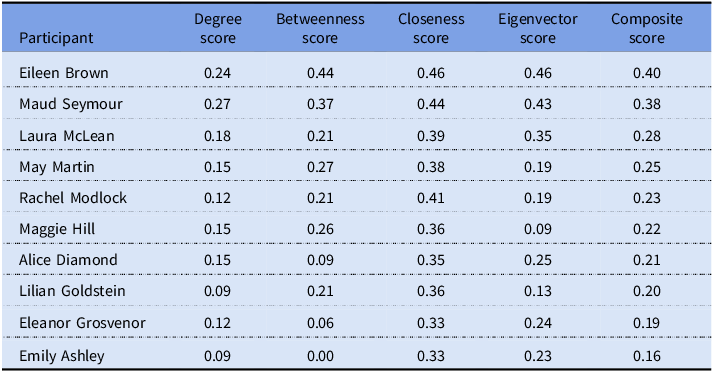
While Diamond appears to have been the key figure during the first period of analysis (T1), centrality scores for the later subnetwork (T2) suggest a notable shift. In this period, Goldstein was portrayed in the press as a dominant leader, with one newspaper describing her as “[the] girl gang leader who control[s] one of the most dangerous mobs” (Weekly Dispatch 1940). However, Goldstein did not occupy a structurally central position in the Forty Elephants network; her relatively low scores across all centrality measures – degree, betweenness, closeness, and eigenvector – placed her only eighth in the composite centrality ranking (see Table 3). Several explanations may account for this apparent lack of structural influence. First, the press may have misidentified her as the gang’s leader, attributing influence she did not possess. Second, her leadership style may have differed from Diamond’s: for example, while Diamond may have been a criminally active collaborator, Goldstein may have played a more strategic, behind-the-scenes role. Third, she may have functioned merely as a “figurehead” – a symbolic or nominal leader without substantial operational authority. In any case, the network data again mark a contrast with newspaper accounts by presenting differing views of women’s positions in the gang, suggesting the need to be cautious when working with primary (especially historic) source materials.
Centrality measures for top 10 participants in T2 (sorted by composite score)
Note: Composite score was calculated as the average of degree, betweenness, closeness, and eigenvector centrality.
Rather than Goldstein, centrality scores during T2 suggest that other women played more structurally significant roles, pointing to a shift away from a single dominant leader toward a more distributed structure. While no figure replicated the apparent level of influence held by Diamond in T1, Eileen Brown emerged as the most central participant in T2, ranking highest for betweenness, closeness, eigenvector, and overall composite centrality (score: 0.40). This contrasts with her lower-ranking position in T1, where she did not rank among the top 10 – indicating a rise in importance following the fragmentation of earlier structures. Maud Seymour also ranked highly at this time (composite score: 0.38), making her the only woman to feature in the top five across both periods and suggesting that she maintained influence across leadership transitions. Laura McLean, meanwhile, rose to third place in the rankings, despite playing a more peripheral role in the earlier network. It is also noteworthy that Alice Diamond continued to exert some degree of influence, with her particularly high score for eigenvector centrality (fourth overall) indicating she remained connected to other key figures, and she continued to rank slightly higher overall than Goldstein. Crucially, the continued presence of several actors – especially central figures such as Seymour, Hill, and Diamond – across both periods suggests a degree of continuity in membership and collaboration, reinforcing the argument that, while the group’s structure evolved, it did not disappear altogether.
While some women retained or expanded their roles, others who had been prominent under Diamond’s leadership became less influential. Gertrude Skelton, who ranked second overall in T1, disappeared entirely from the Goldstein-era network. The reasons for her absence are unclear but may include withdrawal from the gang, imprisonment, death, or simply a lack of coverage in press reports. Meanwhile, Bertha Tappenden dropped to fourteenth place, suggesting a decline in her importance. The diminished prominence of these formerly influential members, alongside the rise of Brown, McLean, and others, reflects a reconfiguration of power within the group, not only structurally but also in terms of which individuals held influence.
Findings from the structural and centrality analyses reveal a nuanced but important transformation in the Forty Elephants’ network over time. Under Diamond’s leadership, the network appeared more hierarchical, with power concentrated in a dominant leader and a tightly connected inner circle. By contrast, no single figure emerged to replicate Diamond’s influence in the subsequent Goldstein-era network. Instead, structural roles were more widely distributed across multiple members, with Goldstein herself ranking only moderately in terms of centrality. These changes invite important questions about continuity and transformation: it is possible, for example, that the cohesive, centralized gang structure observed under Diamond dissolved following her imprisonment. Yet the continued evidence of a connected network with some clustering, the persistence of ties between former and newer members, and the ongoing prominence of several actors across both periods suggests that, while the network evolved, it did not vanish entirely. Rather, the Forty Elephants gang appears to have adapted their structure in later years. The following section considers how this structural transformation – or adaptation – may have been shaped by broader forces, including internal changes and external pressures.
Discussion
While the structural and centrality results offer insights into the organization of the Forty Elephants, the limitations of historical data mean that explanations for these patterns remain tentative. Sources rarely document official organizational procedures such as the appointment of new leaders or other decision-making processes, nor do they disclose individual women’s personal reasons for joining, engaging, or leaving the gang. Nonetheless, the results suggest a shift from a more centralized, cohesive structure under Diamond to a looser, more distributed network in the later period. To understand what may have influenced this change, this section draws on evidence from newspaper reports to explore three potential factors: internal conflict, law enforcement, and offending methods.
Internal conflict offers one explanation for the changes observed in the Forty Elephants’ network structure. One notable incident was the aforementioned “Lambeth Battle” of 1925, a violent internal dispute that resulted in the incarceration of several key figures. The conflict stemmed from tensions over a gang member marrying outside the group’s inner circle – an act seemingly against gang policies (McDonald Reference McDonald2015) – and leaving the group. In response, several remaining members, including Diamond, Hill, Hill’s sister, Skelton, and Tappenden, mobbed outside the woman’s home, broke in through the windows, and assaulted her and members of her family. The incident resulted in the imprisonment of Diamond, Hill, Skelton, Tappenden, and others for violence and rioting, with sentences ranging from six months to two years’ hard labor. This event appears to have triggered a disruption: network analysis indicates that, in addition to the temporary loss of several central figures, some women never offended together again after the incident, suggesting longer-term fractures in co-offending relationships. This echoes findings from criminological research showing that the removal of key players can disrupt – or even dissolve – criminal networks (Bright et al. Reference Bright, Greenhill, Reynolds, Ritter and Morselli2015; Frydensberg et al. Reference Frydensberg, Ariel and Bland2019).
Law enforcement interventions may also have played a role in reshaping the Forty Elephants’ network, particularly during the gang’s later phase. From the mid-1920s onward, the Metropolitan Police’s Flying Squad escalated its campaign against the group, using increasingly sophisticated surveillance tactics to monitor and disrupt their activities; wireless radio stations and the newly invented “autogyre,” for instance, were used to track the gang’s movements across the country. Much of this effort was directed at Lilian Goldstein, who was then dubbed the “Bobbed-Haired Bandit” and portrayed by the press as “the brains behind London’s most dangerous gang” (Weekly Dispatch 1925). In response to increased law enforcement scrutiny, the gang may have become more strategic in evading the police and reducing visibility: Goldstein, for example, reportedly disguised herself as a male chauffeur while acting as a getaway driver, a tactic that may have made her appear less central in the network than she was in practice. More broadly, efforts to avoid visibility may have prompted members to reduce repeat collaborations or avoid tight-knit co-offending groups, contributing to the more diffuse, less clustered structure observed in the later network.
However, the crackdown on the Forty Elephants cannot be understood solely as a response to their criminal activities; it also reflected broader anxieties about female autonomy and transgressive femininity in interwar Britain. Just as male gangs of the late nineteenth and early twentieth centuries were associated with working-class codes of masculinity and “toughness” (Davies Reference Davies1998), the Forty Elephants were cast as “doubly deviant”: violating not only the law but also societal expectations of female behavior. Their emergence coincided with the rise of the “modern woman” – a figure whose independence and public visibility challenged traditional domestic ideals (Bingham Reference Bingham2003; Bland Reference Bland2013; Todd Reference Todd2005). Female criminals, in particular, came to symbolize the “dark side” of this new femininity, used to caution against the perceived dangers of (particularly middle-class) women’s expanding social and economic freedoms (Bland Reference Bland2008, Reference Bland2013; Brown Reference Brown, Nash and Kilday2020; Wildman Reference Wildman2016). This was reflected clearly in press reports of the Forty Elephants: reporting on a case involving the “Bobbed-Haired Bandit,” for example, the Nuneaton Chronicle (1926) commented that “women are achieving triumphs in business, as well as in sport, and some, unfortunately, appear to be taking to crime as a career … they seem likely to give the Police some trouble if they take to the burgling profession as thoroughly as women have done in most other spheres of activity.” Additionally, Goldstein’s aforementioned use of cross-dressing as a male chauffeur came to be regarded in the press as a threatening subversion of gender roles, again resonating with contemporary fears around dangerous femininity (Di Méo Reference Di Méo2024). As such, law enforcement campaigns and women’s response to such efforts may have stemmed not only from gang members’ criminality but also from their symbolic challenge to gender norms.
Along with internal conflict and criminal justice interventions, offending patterns provide another potential factor behind structural changes in the Forty Elephants network. While earlier operations often involved large-scale shoplifting with multiple “decoy” members, newspaper reports indirectly indicate that the gang adopted smaller groups and more agile methods in later years, including a shift towards “smash-and-grab” raids. These newer tactics increasingly relied on automobiles, which were becoming more accessible to the public and increasingly adopted by “professional” criminals (Brown Reference Brown2011). Cars enabled the gang not only to carry out fast-paced smash-and-grab offenses but also to undertake burglaries across the country, expanding their offending range and facilitating rapid escapes. As the Sunday Mirror (1926) reported, the women were using “high-speed motor cars – mostly stolen,” and “by falsifying the number plate, and then abandoning the car, the police are left with little to work.” However, vehicles also imposed logistical constraints, typically limiting participation to two or four individuals, often split between a decoy car and a getaway car. These, among other changes in offending methods, may help explain the reduced clustering and looser structure observed in T2: rather than indicating a breakdown of gang operations, the network shift could reflect a strategic adaptation to new criminal opportunities, ones that required a more flexible and decentralized structure.
Conclusion
This article contributes to the history of women, gangs, and criminal networks by examining an all-female criminal group operating in interwar Britain. By comparing the Forty Elephants’ configuration under two alleged leadership periods, the analysis reveals a shift from a centralized, boss-led structure under Alice Diamond to a more distributed and flexible network in later years. While the network did not dissolve or decentralize completely, influence appears to have been more evenly spread across multiple figures rather than concentrated in a single dominant leader. Notably, Lilian Goldstein – often described in press reports as the gang’s leader – did not occupy a structurally central position, raising questions about whether she operated in a covert or adaptive fashion or may have been mistakenly identified as a leader altogether. The article also explored several possible explanations for structural shifts, including the aftermath of internal conflict, the incarceration of key figures, intensified law enforcement scrutiny, and the adoption of new criminal methods such as car-enabled burglaries. Ultimately, rather than signaling the gang’s decline, the research underscores the fluidity of criminal organizations; instead of presenting the Forty Elephants as a static, hierarchical entity, this study reveals them as a dynamic network that may have responded to both internal and external pressures.
A key limitation of this study stems from the challenges of collecting data on illicit networks. Given the covert nature of criminal activities, gaps in records are inevitable, meaning that the network presented here is likely incomplete – a shortcoming often noted in studies of criminal networks (e.g., Bright et al. Reference Bright, Greenhill, Reynolds, Ritter and Morselli2015; Krajewski et al. Reference Krajewski, DellaPosta and Felmlee2022; Tenti and Morselli Reference Tenti and Morselli2014). Some members and ties may be missing due to underreporting, such as when individuals evaded the police or used pseudonyms or when their co-offending relationships went undocumented. While such issues also affect recent SNA studies of crime, they are even more pronounced in historical research, where scholars are typically limited to what survives in the archives: sources such as newspapers, court records, and police files may be fragmentary, selectively preserved, or affected by transcription and digitization errors, all of which shape the networks we are able to reconstruct. A further complexity arises when studying historical networks involving women, whose activities are often underrepresented in surviving records; tracing women across time is also complicated by name changes after marriage or in common-law partnerships, making it more difficult to follow women’s offending trajectories. These limitations highlight the need for careful cross-referencing when applying network analysis to historical cases, especially those involving marginalized figures.
Challenges associated with the records pose a further limitation: they may distort centrality scores. Contemporary newspaper reporters, editors, and law enforcement officials may have disproportionately focused on certain individuals (such as Diamond and Goldstein), thereby inflating their perceived prominence in the network (Bright et al. Reference Bright, Greenhill, Reynolds, Ritter and Morselli2015). This study mitigated such distortion by drawing on a wide range of newspaper sources rather than relying on a single publication in case priorities differed across publications; while future projects could further reduce this issue by incorporating additional sources, such as court records and police files, the limitation cannot be entirely eliminated. Moreover, network studies inherently risk downplaying culture, agency, and context due to their emphasis on structural patterns over individual experience (Smith and Papachristos Reference Smith and Papachristos2016) – a challenge this study sought to address by combining SNA methods with a qualitative discussion of the underlying contextual factors.
This study sets a precedent for future research by demonstrating the value of applying SNA to historical studies of crime. One important direction for further work involves incorporating multiplexity, examining how overlapping social, familial, and economic ties shaped the organization and persistence of criminal groups. Kinship, in particular, may play a key role, especially given the relevance of intergenerational offending in historical contexts (Godfrey et al. Reference Godfrey, Cox and Farrall2007; Williams and Godfrey Reference Williams and Godfrey2014); future work could also explore the extent to which criminal groups maintained ties with the legitimate (non-criminal) world for enterprise purposes (Smith and Papachristos Reference Smith and Papachristos2016). Although multiplexity was beyond the scope of this project, there is tentative evidence that several Forty Elephants members shared familial or neighborly ties, raising questions about how such relationships may have influenced gang recruitment and cohesion. Additionally, future studies could examine how historic criminal groups connected with one another, since gangs and OCGs may have held not only intragroup but also intergroup connections. In the case of the Forty Elephants, McDonald (Reference McDonald2015) suggests that certain members of the gang had ties with the Birmingham Boys, the Elephant Gang, and the Sabini Gang – a claim that could be explored more systematically through network analysis by mapping reported interactions between members of these groups. Examining such intergroup relationships could offer insight into the extent to which groups like the Forty Elephants operated independently or were integrated within a broader criminal underworld.
This study makes several contributions to the fields of history and criminology. First, it offers one of the first systematic reconstructions of an all-female criminal network using SNA, challenging stereotypes of female offenders as peripheral actors and highlighting the value of studying female-only offending groups. Second, it demonstrates how structural and positional change in criminal networks may be shaped by historical context: in this case, the Forty Elephants’ shifting structure coincided not only with internal reorganization but also with broader interwar anxieties around women’s autonomy, law enforcement efforts, and societal responses to female transgression. This raises wider questions about how internal and external pressures shape the organization, visibility, and resilience of criminal groups. Finally, the study demonstrates the value of SNA for historical crime research, showing how researchers can use computational methods to uncover hidden patterns of co-offending. In doing so, it offers broader relevance to historical scholarship by providing a transferable methodological framework for exploring past social structures and relationships.
Supplementary material
The supplementary material for this article can be found at https://doi.org/10.1017/ssh.2025.10119.


 Open access

