

Introduction
The cultural landscapes of prehistoric Europe in the third millennium cal bc have traditionally been classified in archaeological discourse in terms of extraordinarily large cultural units, including those of the Bell Beaker, Corded Ware, Yamnaya, or Globular Amphora cultures (Figure 1), which are thought to represent comparably uniform sets of material culture (Szmyt, Reference Szmyt1999; Anthony, Reference Anthony2007; Harrison & Heyd, Reference Harrison and Heyd2007; Vander Linden, Reference Vander Linden2006, Reference Vander Linden2007a; Shishlina, Reference Shishlina2008; Furholt, Reference Furholt2014). These successive iterations of archaeological cultures were attributed in the early days of the discipline to wholesale migrations of prehistoric peoples (Kossinna, Reference Kossinna1910; Childe, Reference Childe1925; Glob, Reference Glob1945). Since the 1970s, shifts in cultural groups have been refashioned as reflecting changes in social and economic systems (Kruk, Reference Kruk1973; Sherratt, Reference Sherratt, Hodder, Isaac and Hammond1981; Damm, Reference Damm1991; Müller, Reference Müller, Gohlisch and Reisch2001; Raetzel-Fabian Reference Raetzel-Fabian, Czebreszuk and Müller2001; Hübner, Reference Hübner2005; Kadrow Reference Kadrow, Dörfler and Müller2008), as ideological packages and spheres of interaction (Shennan, Reference Shennan, Lanting and van der Waals1976), or as referring to distinct marriage or elite networks, or less concretely defined interaction networks (Czebreszuk & Szmyt, Reference Czebreszuk and Szmyt1998; Czebreszuk, Reference Czebreszuk and Müller2002; Strahm, Reference Strahm and Müller2002; Furholt, Reference Furholt2003; Vander Linden, Reference Vander Linden2007a). Lately, more sophisticated migration models have emerged (Kristiansen, Reference Kristiansen1989, Reference Kristiansen, Fowler, Harding and Hofmann2015; Anthony, Reference Anthony1990, Reference Anthony2007; Prescott, Reference Prescott, Bergerbrant and Sabatini2013; Prescott & Glørstad, Reference Prescott, Glørstad, Prieto Martínez and Salanova2015), which have most recently been reinforced by the new aDNA studies.
Simplified map showing the extent of the most important archaeological units of classification in the third millennium cal bc in Europe discussed in this text.

Although these new aDNA data are overwhelmingly convincing, the interpretational frameworks associated with them require more discussion. In a critique of the traditional culture-historical approach, two major achievements in how the linkages between material culture and socio-cultural entities are conceptualized should be highlighted. The first broke the assumption that shared cultural material could be equated with a single culture group (best expressed in relation to Beakers and Corded Ware in Clarke, Reference Clarke1968 and Shennan, Reference Shennan, Lanting and van der Waals1976). The second breakthrough came with the realization that the variability and multiplicity of social phenomena and agencies that constructed those seemingly homogenous material cultural groups were in fact underscored by diverse approaches to subsistence, settlement patterns, social practices, and ritual expressions (see Furholt, Reference Furholt2014). How far these two achievements have truly been accepted in the mainstream discourse of European archaeology is, however, open to question. An inclination to equate archaeological classification units (e.g. archaeological cultures) with distinct social phenomena (e.g. a population, an identity or ethnic group, a network, an ideology) and a tendency to view such social phenomena as clearly bounded and internally homogeneous remain widespread, even dominant, features in considerations of European prehistory (as discussed in Furholt, Reference Furholt2014). I argue that the renewed emphasis on migration as an explanatory framework, as it is expressed in the recent publications of aDNA studies, promotes an approach to the archaeological material that neglects these two central achievements.
The ‘aDNA Revolution’
‘The four successive genetic shifts highlight the biological cohesiveness of archaeological cultures such as the LBK [Linearbandkeramik], FBC [Funnel Beaker], CWC [Corded Ware], and BBC [Bell beaker] cultures …’. (Brandt et al., Reference Brandt, Haak, Adler, Roth, Szécsényi-Nagy and Karimnia2013: 261)
‘Our results support a view of European prehistory punctuated by two major migrations: first, the arrival of the first farmers during the Early Neolithic from the Near East, and second, the arrival of Yamnaya pastoralists during the Late Neolithic from the steppe.’ (Haak et al., Reference Haak, Lazaridis, Patterson, Rohland, Mallick and Llamas2015: 4)
Our picture of human population dynamics during the third millennium cal bc has changed dramatically in recent years with the explosion of aDNA research (Brandt et al., Reference Brandt, Haak, Adler, Roth, Szécsényi-Nagy and Karimnia2013; Lazaridis et al., Reference Lazaridis, Patterson, Mittnik, Renaud, Mallick and Kirsanow2014; Allentoft et al., Reference Allentoft, Sikora, Sjögren, Rasmussen, Rasmussen and Stenderup2015; Haak et al., Reference Haak, Lazaridis, Patterson, Rohland, Mallick and Llamas2015; Mathieson et al., Reference Mathieson, Lazaridis, Rohland, Mallick, Patterson and Roodenberg2015) indicating that the third millennium was a period of profound demographic change. These works have squarely placed the question of prehistoric mobility and migration back on the table and sparked lively discussions among archaeologists (e.g. Bánffy et al., Reference Bánffy, Brandt and Alt2012; Müller, Reference Müller2013; Hofmann, Reference Hofmann2014; Sjögren et al., Reference Sjögren, Price and Kristiansen2016; Vander Linden, Reference Vander Linden2016). One matter of debate is that these aDNA publications link specific archaeological cultures to biological populations. For example, Haak et al. (Reference Haak, Lazaridis, Patterson, Rohland, Mallick and Llamas2015) assert that a massive migration of a larger group of people from the area of the Yamnaya culture (located in present-day Russia and Ukraine) into central Europe led to the transformation of the latter region through the addition of steppe-related pastoralist ways of life to the traditional agricultural communities of central Europe. Among these were elements of a pastoral economy, distinct mortuary practices involving individual burials under small barrows emphasizing gender differences, and the new social role of male warriors, as expressed in burial customs connected to Corded Ware (Anthony, Reference Anthony2007; Kristiansen, Reference Kristiansen, Fowler, Harding and Hofmann2015). Additionally, Haak et al. (Reference Haak, Lazaridis, Patterson, Rohland, Mallick and Llamas2015) and Allentoft et al. (Reference Allentoft, Sikora, Sjögren, Rasmussen, Rasmussen and Stenderup2015) suggest that the hypothesis that at least some Indo-European languages had originated in the steppes is supported by the new data. This is not the place to discuss the Indo-European issue (but see, for example, Prescott, Reference Prescott, Bergerbrant and Sabatini2013; Heggarty, Reference Heggarty, Bowern and Evans2014a, Reference Heggarty2014b; Vander Linden, Reference Vander Linden2016). Here, I want to concentrate on the relationship between social processes and the molecular biological data and the tensions arising from the differential perspectives of archaeological and biological research. The articles mentioned above provide exciting new insights into prehistoric demographic processes that were previously undetectable by traditional archaeological approaches, but there remains an imbalance in the elaboration of molecular biological work and statistical inferences on the one hand, and social theory applied to interpret these results in the context of prehistoric social and cultural phenomena on the other.
Such an imbalance seems to be a widespread pattern and source of tension between the genetic and the archaeological perspective. Already, in the context of the use of modern mtDNA studies for the understanding of prehistoric processes (Ammermann & Cavalli-Sforza, Reference Ammerman and Cavalli-Sforza1984; Renfrew & Boyle, Reference Renfrew and Boyle2000), Bandelt et al. (Reference Bandelt, Macaulay, Richards, Bellwood and Renfrew2003) criticize the weakness of the concept of population in general, and specifically how populations are constructed in these studies, where they are more or less equated which modern nation states. They also criticize the use of simplistic assumptions used to model population history (‘models of random-mating populations of constant sizes’), which speaks of ‘an insufficient attention to the resources of other disciplines’, a kind of positivism with which the data are used, and a lack of any archaeologically or anthropologically informed theory to take into account social and cultural factors that are known to influence population history (Bandelt et al., Reference Bandelt, Macaulay, Richards, Bellwood and Renfrew2003: 103).
It seems that the problems pointed out by Bandelt et al. have persisted into the newer aDNA studies; indeed, they very much reflect the main issues discussed, especially the problematic definition of populations, and the simplification of assumptions and concepts about social groups and processes through a lack of engagement with archaeological and anthropological theory. The early articles (for example Bramanti et al., Reference Bramanti, Thomas, Haak, Unterlaender, Jores and Tambets2009; Haak et al., Reference Haak, Balanovsky, Sanchez, Koshel, Zaporozhchenko and Adler2010) that used prehistoric mtDNA found a marked and stunning discontinuity between European hunter-gatherers and Early Neolithic individuals. These studies were, however, also criticized for constructing a hunter-gatherer population where individuals were scattered in space and time (e.g. Bánffy et al., Reference Bánffy, Brandt and Alt2012). Although overwhelming genetic evidence has made the case for the introduction of Neolithic ways of life into Europe being associated with a substantial demographic influx (see e.g. Hofmann, Reference Hofmann2014), the underlying block-like concepts of hunter-gatherers vs farmers and the monolithic use of terms like migration vs diffusion actually obscures the Neolithisation process in all its complexity and diversity (as has been suggested, for example, by Schade & Schade-Lindig, Reference Schade-Lindig, Schade, Gronenborn and Petrasch2010; Bickle & Whittle, Reference Bickle and Whittle2013; Thomas, Reference Thomas2013; Hoffmann, Reference Hofmann2014). The same simplifications are also applied in studies on the third millennium, and there they become even more problematic because of the more complicated situation regarding archaeological classification in this period.
It should be stressed that the imbalance between the perspective of the natural sciences and the anthropological view described here is in part also due to conceptual problems within the archaeological discourse. The reification of classification units, the construction of homogeneous and clearly bounded cultural groups, the lack of elaboration in the conceptualization of migration as a social process can be, and have been, issues raised against archaeological research on the third millennium (e.g. by Kristiansen, Reference Kristiansen1989; Shennan, Reference Shennan and Shennan1989; Anthony, Reference Anthony1990; Roberts & Vander Linden, Reference Roberts and Vander Linden2011; Furholt, Reference Furholt2014), where they nevertheless persist as dominant frameworks of reference.
The 3rd millennium bc aDNA evidence
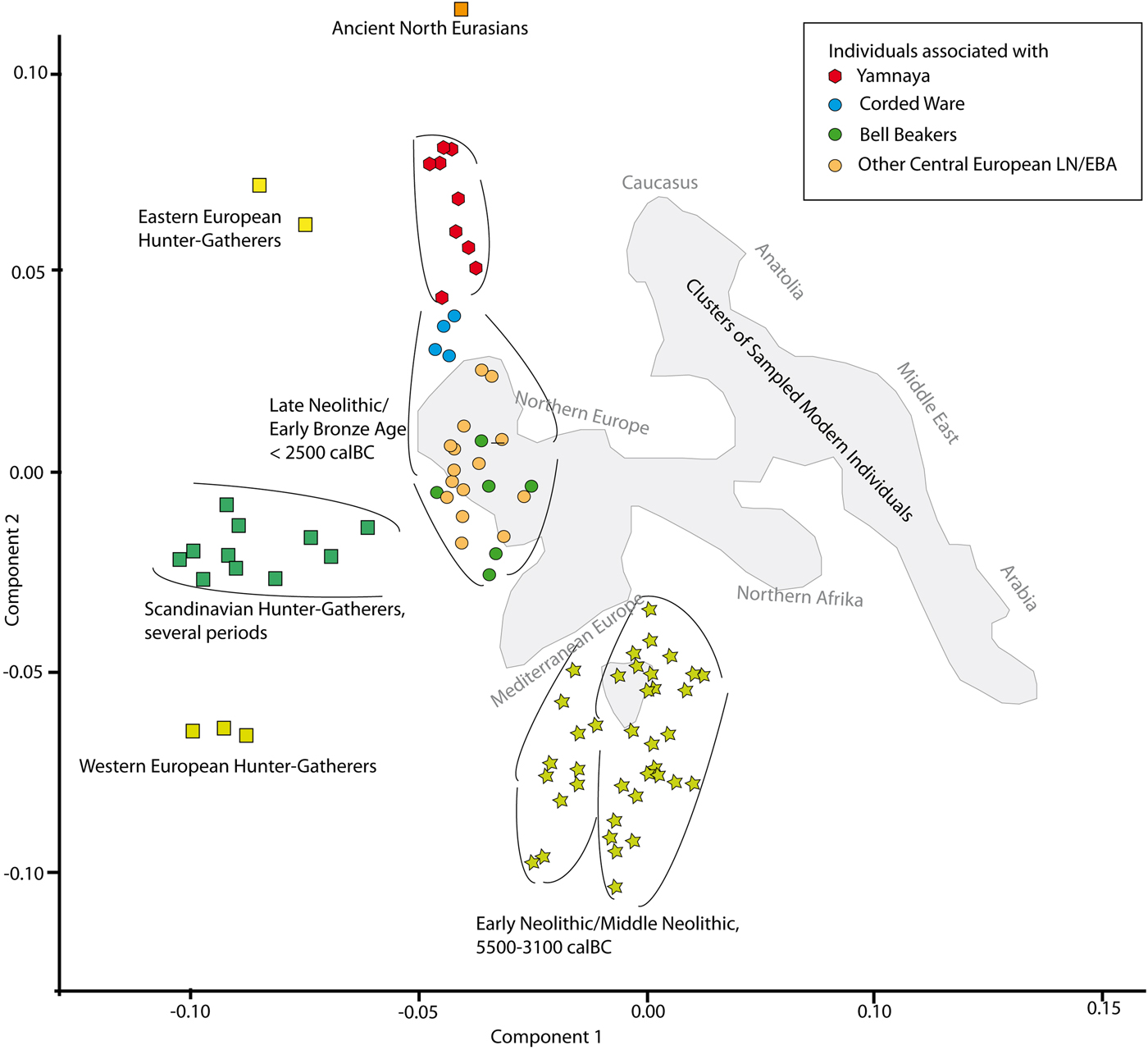
Brandt et al. (Reference Brandt, Haak, Adler, Roth, Szécsényi-Nagy and Karimnia2013) already highlighted the significance of third-millennium transformations using mtDNA, pointing to two major events in population dynamics affecting their central German sample, which they identify with genetic influx from the east, connected to the archaeological Corded Ware and Kurgan, or Yamnaya, cultures, and from the West, linked to the archaeological Bell Beakers (Brandt et al., Reference Brandt, Haak, Adler, Roth, Szécsényi-Nagy and Karimnia2013: 261). This immediately seemed convincing, given the geographical location of these archaeological units of classification, the Corded Ware and Yamnaya encompassing central and eastern Europe, the Bell Beakers stretching from Morocco and the Iberian peninsula into central and northern Europe (see Figure 1). Not much later, Lazaridis et al. (Reference Lazaridis, Patterson, Mittnik, Renaud, Mallick and Kirsanow2014), Haak et al. (Reference Haak, Lazaridis, Patterson, Rohland, Mallick and Llamas2015), and Allentoft et al. (Reference Allentoft, Sikora, Sjögren, Rasmussen, Rasmussen and Stenderup2015) presented patterns of similarities/distances of nuclear SNPs (single nucleotide polymorphisms) of a constantly growing number of prehistoric individuals from the Palaeolithic to the Early Bronze Age, and convincingly argued that the modern central and northern European gene pool can best be explained when three distinct sources are assumed. These are: 1) the Early Neolithic farmers of Europe; 2) European hunter-gatherers (western European and Scandinavian); and 3) ancient north-Eurasian hunter-gatherers (Lazaridis et al., Reference Lazaridis, Patterson, Mittnik, Renaud, Mallick and Kirsanow2014) or eastern European hunter-gatherers (Haak et al., Reference Haak, Lazaridis, Patterson, Rohland, Mallick and Llamas2015). These three sources are represented as clusters or isolated instances of samples when they are projected onto the first two axes of a principal component analysis (PCA) of a dataset of 2345 modern western Eurasian individuals (see Figure 2) and ADMIXTURE analysis. Since in the Haak et al. (Reference Haak, Lazaridis, Patterson, Rohland, Mallick and Llamas2015) sample all individuals dating to after 2500 cal bc—starting with four Corded Ware individuals—are clustered separately from the Neolithic individuals dating to before 3000 cal bc, the impact of the third source, the northern Eurasian/eastern European source, must have reached central and northern Europe at that time. However, in line with what Patterson et al. (Reference Patterson, Moorjani, Luo, Mallick, Rohland and Zhan2012) and Gómez-Sánchez et al. (Reference Gómez-Sánchez, Olalde, Pierini, Matas-Lalueza, Gigli and Lari2014) had previously indicated, these new nuclear SNP studies did not replicate the Brandt et al. (Reference Brandt, Haak, Adler, Roth, Szécsényi-Nagy and Karimnia2013) finding of a genetic influx from the Iberian peninsula into central Europe in connection with Bell Beakers. Consequently, they place a new emphasis on migration from the east.
The main similarity patterns indicated by a principal component analysis (PCA) for modern and prehistoric samples as published by Haak et al. (Reference Haak, Lazaridis, Patterson, Rohland, Mallick and Llamas2015), re-drawn from their fig. 2. The most important feature for the third millennium cal bc is the gap between the Early and Middle Neolithic cluster and the Late Neolithic and Early Bronze Age cluster, closer to the Yamnaya cluster.
The findings of Haak et al. (Reference Haak, Lazaridis, Patterson, Rohland, Mallick and Llamas2015) were replicated, with a constantly growing base of individuals sampled, by Allentoft et al. (Reference Allentoft, Sikora, Sjögren, Rasmussen, Rasmussen and Stenderup2015) and Mathieson et al. (2015). However, when it comes to working out the processes underlying the social, economic, or demographic phenomena that could explain these patterns, all these studies contain issues that require more discussion from an anthropological and archaeological point of view.
To illustrate some of these problems, I shall concentrate on Haak et al. (Reference Haak, Lazaridis, Patterson, Rohland, Mallick and Llamas2015), because they most explicitly spell out their premises and arguments.
The first major issue is that the use of archaeological cultures as indicators of human biological populations has its problems (Clarke, Reference Clarke1968; Shennan, Reference Shennan and Shennan1989; Wotzka, Reference Wotzka1993; Furholt, Reference Furholt2008a). One can argue that such a procedure is acceptable as a heuristic tool to provide some spatial and temporal proximity in a sample of individuals, but there is a real and high danger of reifying these populations—to start treating them as genuine biological and even social groups. This can be seen, for example, in formulations like ‘a new social and economic formation, […] named Corded Ware’ (Allentoft et al., Reference Allentoft, Sikora, Sjögren, Rasmussen, Rasmussen and Stenderup2015: 168), or ‘a new class of master artisans known as the Sintashta culture emerged in the Urals’ (Allentoft et al., Reference Allentoft, Sikora, Sjögren, Rasmussen, Rasmussen and Stenderup2015). It is also visible in the following quotation, which interprets and contextualizes the similarity of the genetic profiles shown in Figure 2:
‘The Corded Ware shared elements of material culture with steppe groups such as the Yamnaya, although whether this reflects movements of people has been contentious. Our genetic data provide direct evidence of migration and suggest that it was relatively sudden.’ (Haak et al., Reference Haak, Lazaridis, Patterson, Rohland, Mallick and Llamas2015: 2)
This illustrates very well some of the main points which distort our archaeological debates on third-millennium social and cultural processes, and these (primarily archaeological) issues are, it seems, adopted into the interdisciplinary approach. A first issue concerns the four individuals from a single cemetery in Esperstedt, central Germany, taken to represent the whole Corded Ware culture; this unit of classification for archaeological features and finds is implicitly treated as if it represented a specific group of people. One can agree that a high degree of genetic similarity in samples that are located 2600 km from each other is an indication for some kind of long-distance movement, but what is being proposed here in decisive terms is a very specific scenario. The Yamnaya, a term referring to a set of specific traits of burial practice and material culture, and the Corded Ware, also referring to particular types of pottery, weapons, tools, and burial practices, are used as if they represent distinct social groups, as becomes clear in the language used: ‘The Corded Ware are genetically closest to the Yamnaya’ (Haak et al., Reference Haak, Lazaridis, Patterson, Rohland, Mallick and Llamas2015: 2).
The equation of biological groups with archaeological cultures claimed by Kossinna (Reference Kossinna1911) had already been dismissed by Childe (Reference Childe1929). Moreover, the notion that archaeological cultures could represent even distinct social groups has also been dismissed, as anthropological research has shown that the relationships between material culture and social identities are much more complex (Hodder, Reference Hodder1982; Wotzka, Reference Wotzka1997; Hahn, Reference Hahn2005; Brather & Wotzka, Reference Brather, Wotzka, Burmeister and Müller-Scheeßel2006). It should not be claimed that there is absolutely no connection between cultures (or better, traits of material culture) and social identities (e.g. Barth, Reference Barth1982), but anthropology shows us that material culture may be linked to diverse and changing layers of identities, may be actively used for different purposes by social actors, and may have a different and changing impact on social interaction. Additionally, archaeological cultures like the Corded Ware, with a distribution area extending from Switzerland to Russia (see Figure 1) and a considerable variability of things and practices within this area, are highly unlikely to represent a particular social group or population (Furholt, Reference Furholt2014). The same is true for the Bell Beakers (Vander Linden, Reference Vander Linden2006, Reference Vander Linden2007a).
The argument that the Corded Ware phenomenon ‘shares elements of material culture with steppe groups, including Yamnaya’ is correct, but should be seen in the light of Corded Ware actually sharing elements of material culture with more or less every contemporary, preceding, or subsequent archaeological unit, be it Funnel Beakers, Pitted Ware, Globular Amphora, Baden, Bell Beakers, Unetice, Mierzanowice, and others (Beran, Reference Beran, Buchvaldek and Strahm1992; Bertemes et al., Reference Bertemes, Heyd, Bartelheim, Krause and Pernicka2002; Furholt, Reference Furholt2003; Hübner, Reference Hübner2005; Włodarczak, Reference Włodarczak2006).
Finally, the argument about whether these shared elements of material culture actually reflect movements of people illustrates an underlying (and very common) conceptual problem. What the debates really should address is what specific kinds of movement we are dealing with. All too often this question is reduced to a binary choice between migration and diffusion, as if only these two scenarios were possible. Our conceptions of the movement of people are sorely underdeveloped, which applies as much to those who have favoured migration as an explanatory framework as to those who have opposed it. It is one of the great achievements of studies like Haak et al. (Reference Haak, Lazaridis, Patterson, Rohland, Mallick and Llamas2015) to make clear that we must confront such migration phenomena, but the challenge is to realize that there is no such thing as a migration that would either occur or not occur; instead there is a wide range of processes involving human mobility, which are subsumed under the concept of migration (e.g. Anthony, Reference Anthony1990, Reference Anthony, Chapman and Hamerow1997; Chapman & Hamerow, Reference Chapman and Hamerow1997; Burmeister, Reference Burmeister2000; Prien, Reference Prien2005; Cabana & Clarke, Reference Cabana and Clark2011; Cameron, Reference Cameron2013; Kaiser & Schier, Reference Kaiser and Schier2013; van Dommelen, Reference van Dommelen2014; Brettell, Reference Brettell2014) and that of diffusion. In archaeological discussions, migration is all too often seen as a unified and clearly bounded phenomenon—a single-event mass migration—in the same way as the Yamanya culture is seen as a single social entity, and the Corded Ware culture a different one, and this paradigm of ‘wholeness’ (Greenblatt, Reference Greenblatt2009) clearly forms the background of the emphasis laid on this specific form of migration.
It seems that in the current boom in aDNA studies, this specific model of migration—the single-event-mass migration—is dominant, as the term ‘massive migration’ features prominently in the title of the Haak et al. (Reference Haak, Lazaridis, Patterson, Rohland, Mallick and Llamas2015) article, and they stress that ‘this migration was relatively sudden’ (Haak et al., Reference Haak, Lazaridis, Patterson, Rohland, Mallick and Llamas2015: 2).
This argument has, however, some flaws. The time between the latest individual of the Middle Neolithic without the eastern European genetic component (dating to between 3300 and 3100 cal bc) and the earliest Corded Ware individual sampled in Haak et al. (Reference Haak, Lazaridis, Patterson, Rohland, Mallick and Llamas2015; dating to around 2560 cal bc to 2470 cal bc) is about 700 years. The argument for a relatively sudden event rests on the time assigned to whole archaeological cultures, in the sense that, if the signal of eastern European influence is present in one individual connected to one culture (like the Corded Ware), then it is present during the whole period covered by that culture. This is stated in the following sentence, which only makes sense if archaeological cultures are seen as reflecting biologically uniform populations:
‘If continuous gene flow from the east, rather than migration, had occurred, we would expect successive cultures in Europe to become increasingly differentiated from the Middle Neolithic, but instead, the Corded Ware are both the earliest and most strongly differentiated from the Middle Neolithic population.’ (Haak et al., Reference Haak, Lazaridis, Patterson, Rohland, Mallick and Llamas2015: 2)
If we leave the level of whole archaeological cultures and take a closer look at the individuals sampled, there is no evidence to suggest a period of continuous gene flow shorter than several centuries. Allentoft et al. (Reference Allentoft, Sikora, Sjögren, Rasmussen, Rasmussen and Stenderup2015) have sampled additional Corded Ware individuals, some dated to between 2800 and 2600 cal bc, who show a strong affinity to the contemporary Yamnaya samples (although less so than the Esperstedt individuals presented by Haak et al., Reference Haak, Lazaridis, Patterson, Rohland, Mallick and Llamas2015), so that one could make a case for a shorter ‘gap’ between the samples, but this is not the main point. The argument of Haak et al. (Reference Haak, Lazaridis, Patterson, Rohland, Mallick and Llamas2015) rests on the assumption that the Corded Ware represents a single distinct population and that one would need evidence of Yamnaya affinity in an earlier archaeological culture to make a case for a continuous gene flow. This model seems to exclude the possibility that such a continuous gene flow could take place within the Corded Ware, which lasts for up to 800 years.
From an archaeological perspective, there is evidence that would speak in favour of a longer-term process. For example, the appearance of steppe-related elements in south-eastern and central Europe, like kurgan graves and specific burial rituals, can be traced back to the fifth millennium cal bc with the so-called early ochre graves, or Suvorovo-Novodanilovka graves in Romania and Hungary (Govedarica, Reference Govedarica2004; Anthony, Reference Anthony2007), regions in which we later find Yamnaya graves (Frînculeasa et al., Reference Frînculeasa, Preda and Heyd2015).
This could provide a suitable archaeological basis for a model envisaging a long-lasting, continuous gene flow.
The real issue here is that the authors do not make explicit what they mean by the term migration. The suggestion that continuous gene flow would be something different from migration is not consistent with the archaeological debates on the matter. One of the authors in Haak et al. (Reference Haak, Lazaridis, Patterson, Rohland, Mallick and Llamas2015), David Anthony, has explicitly elaborated on the concept of migration (e.g. Anthony, Reference Anthony1990, Reference Anthony, Chapman and Hamerow1997) and described it as a well-structured social process which involves different actors and follows different stages, including scouting for potential areas and routes, flows of information between regions, return migration, and so on; in any case, it is a continuous process of varying duration. Among different variants of migration, Anthony also names migration streams, thus clearly undermining the opposition created between continuous gene flow and migration.
To back up the claim of a massive and rapid migration, Haak et al. (Reference Haak, Lazaridis, Patterson, Rohland, Mallick and Llamas2015) use an additional argument, namely the high degree of similarity between individuals connected to the Corded Ware and Yamnaya material cultures, seen in the data clusters in the PCA (Figure 2) and in the values achieved by ADMIXTURE analysis, as opposed to the other Late Neolithic and Bronze Age individuals. As the PCA shows, the four individuals assigned to the Corded Ware from Esperstedt are said to be the earliest individuals, and they are additionally placed closest to the ten individuals connected to Yamnaya and furthest away from the Early and Middle Neolithic individuals. Haak et al. (Reference Haak, Lazaridis, Patterson, Rohland, Mallick and Llamas2015) interpret this as consistent with a single migration event and a successive resurgence of the local population, visible in the position of the Late Neolithic and Early Bronze Age individuals closer to the earlier, Early and Middle Neolithic individuals. This interpretation of the patterns seems to overstate the explanatory powers of the PCA. The notion of a generally closer connection of Corded Ware individuals to Yamnaya individuals than the other Late Neolithic samples is much less clear in a different study using different samples connected to Corded Ware (Allentoft et al., Reference Allentoft, Sikora, Sjögren, Rasmussen, Rasmussen and Stenderup2015). Here, seven individuals with Corded Ware connections from Sweden, Poland, the Baltic, and southern Germany are placed just within the Late Neolithic/Early Bronze Age cluster, more clearly separated from the Yamnaya cluster (Allentoft et al., Reference Allentoft, Sikora, Sjögren, Rasmussen, Rasmussen and Stenderup2015: fig. 2). Allentoft et al. write:
‘Although European Late Neolithic and Bronze Age cultures such as Corded Ware, Bell Beakers, Unetice, and the Scandinavian cultures are genetically very similar to each other [and placed clearly outside the Yamnaya cluster; addition by author], they still display a cline of genetic affinity with Yamnaya, with highest levels in Corded Ware, lowest in Hungary, and central European Bell Beakers being intermediate.’ (Allentoft et al., Reference Allentoft, Sikora, Sjögren, Rasmussen, Rasmussen and Stenderup2015: 169)
Thus, although Allentoft et al. (Reference Allentoft, Sikora, Sjögren, Rasmussen, Rasmussen and Stenderup2015) also subscribe to the notion of highest genetic affinity between individuals connected to Corded Ware and those connected to Yamnaya, in this respect there are clear differences between the individuals sampled by Haak and colleagues and those sampled by Allentoft's team. This reflects a marked variance in the genetic composition of individuals subsumed under the Corded Ware label, a variance comparable to that between all the individuals assigned to the numerous archaeological cultures within the period between 2500 and 1000 cal bc. This undermines the assumption of genetic homogeneity between individuals connected to specific archaeological cultures, which again shows up in the way the Corded Ware individuals are uniformly characterized by Allentoft et al.
In Mathieson et al. (Reference Mathieson, Lazaridis, Rohland, Mallick, Patterson and Roodenberg2015: fig. 1), the Late Neolithic-Early Bronze Age cluster has, through the increase in sample size, been extended so much that it almost touches the Early Farmers cluster; especially the Central Late Neolithic, including Corded Ware individuals, show a remarkable diversity. Unfortunately, it is not possible from the publications to identify individuals sampled within each cluster, which would be very helpful for the debate.
Based on multiple statistical analyses and tests, Haak et al. (Reference Haak, Lazaridis, Patterson, Rohland, Mallick and Llamas2015) deduce that the ancestry of the Corded Ware was 79 per cent Yamnaya-like, 4 per cent western hunter-gatherer, and 17 per cent Early Neolithic (Haak et al., Reference Haak, Lazaridis, Patterson, Rohland, Mallick and Llamas2015: 4). These findings are then implicitly connected with a statement concerning the evident ‘magnitude of population turnover’ (Haak et al., Reference Haak, Lazaridis, Patterson, Rohland, Mallick and Llamas2015: 4) that occurred, as ‘the steppe migrants might well have mixed with eastern European agriculturalists on their way to central Europe. Thus we cannot exclude a scenario in which the Corded Ware arriving in today's Germany had no ancestry at all from local populations’ (Haak et al., Reference Haak, Lazaridis, Patterson, Rohland, Mallick and Llamas2015: 4).
Arguably, this is a possible scenario, but it is also rather extreme. Again, we are lacking some more concrete and in-depth considerations about what specific social processes are assumed, which would be helpful for the argument. The authors advocate a scenario in which the four individuals from Esperstedt assigned to Corded Ware do not have any local ancestry, which of course could be the case for these four individuals. However, as Haak et al. (Reference Haak, Lazaridis, Patterson, Rohland, Mallick and Llamas2015) take these individuals to be representative of the whole Corded Ware, which is seen as one uniform population, the argument of a population turnover becomes more serious when one thinks about the scenario suggested. Although we do not know how many people actually lived in central Europe towards the end of the Middle Neolithic, we might assume that it was somewhere around 1 or 2 million (Müller, Reference Müller, Kristiansen, Šmejda and Turek2015). A sudden turnover of the whole population, as suggested by Haak et al. (Reference Haak, Lazaridis, Patterson, Rohland, Mallick and Llamas2015), would be a truly dramatic, even genocidal, event, which is a possibility. But it is also a quite extreme scenario, for which one would like to have some additional arguments. If, on the other hand, we argue solely on the level of biological ancestry, populations, and the timing of events or processes, much less dramatic scenarios should have the same probability. For example, one could ask how many newcomers would be required to create a population turnover of 79 per cent, or even a total exchange of populations by 2500 cal bc, assuming 1 million inhabitants in central Europe around 3000 cal bc. Given the characteristics of exponential growth, the number of newcomers is close to being irrelevant. Considering the length of the period in question, the crucial variable is the population growth rate, or rather the difference between the growth rates of two populations. For example, if we have a 3.5 per cent annual growth rate in the newcomer population, 200 newcomers would be enough to reach a population of 1 million after about 250 years, and after 300 years it would exceed 6.5 million. Such an annual growth rate is rather high (Hassan, Reference Hassan1981) and it being continuous over 300 years is probably also unrealistic; nevertheless, this calculation illustrates that there is a possibility that this population turnover does not have to involve the kind of massive migration suggested by Haak et al. (Reference Haak, Lazaridis, Patterson, Rohland, Mallick and Llamas2015). If we, for whatever reason, see stagnation or a negative growth rate in the native population or lineages, a difference in growth rates of the order of 3.5 per cent between two lineages would be more realistic. For example, one lineage could have a biological evolutionary advantage over the other. Allentoft et al. (Reference Allentoft, Sikora, Sjögren, Rasmussen, Rasmussen and Stenderup2015: 171) have found a remarkably high rate of lactose tolerance among individuals connected to Yamnaya and to Corded Ware, as opposed to the majority of Late Neolithic individuals. Different immunity rates to contagious diseases could have played an even more drastic role (e.g. Yersinia pestis or bubonic plague: Rasmussen et al., Reference Rasmussen, Allentoft, Nielsen, Orlando, Sikora and Sjögren2015). Apart from biological factors, cultural, economic, or social patterns could also cause different growth rates between lineages, which of course would be harder to identify archeologically. But they could be integrated into models of diverse nutrition, social status, or political power between, for example, people found in Corded Ware burials and others (see, for example, Sjögren et al., Reference Sjögren, Price and Kristiansen2016). Such kinds of models should be discussed and compared to others, if we want to understand processes of transformation in the third millennium. We need a debate about which scenarios are conceptually convincing and empirically verifiable.
A further issue is that the current debate concentrates too much on the Yamnaya culture as the only possible source for the eastern European genetic component in central Europe. Other potential routes of migration are not considered. For example, in their Supplementary Information 2, Haak et al. (Reference Haak, Lazaridis, Patterson, Rohland, Mallick and Llamas2015) demonstrate that three individuals connected to the Pitted Ware culture in Sweden (taken from Skoglund et al., Reference Skoglund, Malmström, Raghavan, Storå, Hall and Willerslev2012) are clearly under that eastern genetic influence. The pottery, after which this archaeological culture is named, shows a much stronger connection with the vast areas of north-western Eurasia (Iversen, Reference Iversen2010; Piezonka, Reference Piezonka2015) than is the case with the Corded Ware connection to Yamnaya. Pitted Ware appears in northern Denmark between 3100 and 2600 cal bc (Iversen, Reference Iversen2010), while in Sweden and the eastern Baltic it is already known from the early fourth millennium, and it can be connected to much older pottery traditions in the east (Piezonka, Reference Piezonka2015).
Overall, regardless of a convincing identification of a significant eastern European input into central European populations sometime before 2500 cal bc, the preference for the social scenario that favours a single-event mass migration is much less well backed up by the archaeological data than has been suggested. It will need a more elaborate discussion of the archaeological and conceptual background.
Lessons from the aDNA Studies
The aDNA studies discussed here have convincingly demonstrated that movements of people from one social context to another (migration) play a much more important role in the third millennium cal bc than most archaeologists, including the current author, would have admitted, and also that the input of eastern European lineages is most crucial. The studies of Haak et al. (Reference Haak, Lazaridis, Patterson, Rohland, Mallick and Llamas2015), Allentoft et al. (Reference Allentoft, Sikora, Sjögren, Rasmussen, Rasmussen and Stenderup2015), and Mathieson et al. (Reference Mathieson, Lazaridis, Rohland, Mallick, Patterson and Roodenberg2015) reproduce the main patterns, and there are good reasons to believe that the still relatively small sample size (230 individuals in Mathieson et al., Reference Mathieson, Lazaridis, Rohland, Mallick, Patterson and Roodenberg2015) provides a robust picture of biological relatedness in time and space. Critiques of culture history in archaeology have given rise to widespread scepticism against migration as an explanatory factor, and thus encouraged the mainstream to neglect all kinds of issues related to the movement of people in prehistory (but see Kristiansen, Reference Kristiansen1989; Anthony, Reference Anthony1990, Reference Anthony1992; Burmeister, Reference Burmeister2000; Prien, Reference Prien2005; Prescott, Reference Prescott, Bergerbrant and Sabatini2013; Prescott & Glørstad, Reference Prescott, Glørstad, Prieto Martínez and Salanova2015). The new aDNA evidence has demonstrated that it is possible to identify periods and regions with differential human migration processes, and even main directions in which movement took place.
One major reason for the abandonment of migration as an explanatory concept in archaeology was the crudeness of its conceptualization and application in archaeology. It often constructed an artificial and unrealistic opposition between migration (meaning the stereotypical single-event mass migration) and ‘non-migration’, or diffusion, and, in applications to the archaeological evidence, it built on long-disproved notions which equated archaeological cultures with specific social groups (e.g. Brather, Reference Brather2004; Brather & Wotzka, Reference Brather, Wotzka, Burmeister and Müller-Scheeßel2006). These hypothetical social groups are frequently portrayed as homogeneous social units with a collective agency, and thus the expansion or movement of material culture traits is taken to be the result of mass migrations (for a critique, see Chapman & Dolukhanov, Reference Chapman and Dolukhanov1992; Furholt, Reference Furholt2008b). Often the link between migration theory and its archaeological application is the main problem. Even though pioneers like Kristiansen (Reference Kristiansen1989), Anthony (Reference Anthony1990), or Burmeister (Reference Burmeister2000) have formulated elaborate models of migration as complex and highly variable processes, the mainstream migrationist argument often falls back to a Kossinna-like approach of taking the appearance of similar material culture in two regions as an indication of a single-event mass migration from one region to another, while their opponents (e.g. Furholt, Reference Furholt2003) would likewise reject migration as if it constituted a binary yes-or-no question. With all theoretical subtlety gone, a block-like movement of Yamnaya people, based on some typological premises of material culture or burial customs, is used in support of a migration or its supposed opposite, be it diffusion, contacts, trade, or networks. This prevalence of wholeness and homogeneity in our conceptualization of social phenomena, although it seemed to have been overcome by post-modern critique, has proved to be much more resilient (Goldstein, Reference Goldstein, Canuto and Yaeger2000; Bernbeck, Reference Bernbeck, Wendrich and Barnard2008; Greenblatt, Reference Greenblatt2009), and it has been at the core of many archaeological debates.
It would be useful to elaborate on precisely what kinds of migration and mobility are likely to have taken place, especially in the light of our well-studied archaeological record, approached from the perspective of anthropological theory (Hahn & Klute, Reference Hahn and Klute2007; Greenblatt, Reference Greenblatt2009; Vertovec, Reference Vertovec2010; Cabana & Clark, Reference Cabana and Clark2011; Cohen & Sirkeci, Reference Cohen and Sirkeci2011; Brettell, Reference Brettell2014). It does not help to presuppose or reject an ill-defined, rather stereotypical migration concept (single-event mass migration) or to deny the role of migration altogether, substituting human mobility with airy concepts like diffusion. The articles discussed (Brandt et al., Reference Brandt, Haak, Adler, Roth, Szécsényi-Nagy and Karimnia2013; Allentoft et al., Reference Allentoft, Sikora, Sjögren, Rasmussen, Rasmussen and Stenderup2015; Haak et al., Reference Haak, Lazaridis, Patterson, Rohland, Mallick and Llamas2015; Mathieson et al., Reference Mathieson, Lazaridis, Rohland, Mallick, Patterson and Roodenberg2015) have not given answers to our questions about the social processes involved in the transformations deduced from the archaeological record, but they have opened new perspectives, given us additional information, and raised more questions.
In order to understand the social phenomena connected to the fascinating new data obtained by molecular biologists, the discussion of the archaeological evidence from local and regional contexts is as important as ever. Perhaps it is even more important for our view of the third millennium cal bc, since the long shadow of Kossinna and ethno-essentialism in archaeology seems to be gaining ground once again in the slipstream of the aDNA revolution (see also Müller, Reference Müller2013). In fact, studies like those of Brandt et al. (Reference Brandt, Haak, Adler, Roth, Szécsényi-Nagy and Karimnia2013) and Haak et al. (Reference Haak, Lazaridis, Patterson, Rohland, Mallick and Llamas2015) clearly show a remarkable and highly relevant image of population admixture and heterogeneity generating new epochs, but their results have been presented to the public (e.g. Schöne, Reference Schöne2013; Barras, Reference Barras2015) as if they buy into the narrative of whole and homogeneous cultures representing distinct biological populations with a single unified agency embarked on migration, accompanied by maps suggesting ethnically closed populations sweeping across the European continent.
This is especially critical in the current socio-political situation, where citizens of many European countries, unsettled by economic and political crises and now directly confronted with the phenomenon of large-scale immigration, are increasingly turning to stereotyping, ethnic essentialism, and racism (e.g. Worth, Reference Worth2013; O'Hara, Reference O'Hara2014; Genova, Reference Genova2017; Sierp & Karner, Reference Sierp and Karner2017) which fits into long defunct concepts of cultural wholeness. In this situation, the archaeological discussion just described, on whether we conceptualize prehistoric communities as whole, uniform, and bounded entities or whether we see them as constituted by individual actors with potentially diverse and heterogeneous backgrounds and intentions, and individual agencies, becomes a highly political issue. The same is true for the conceptual blurring of genetic descent and cultural identity. By integrating such residues of Kossinna-like ethno-essentialism and biologism, whether intentional or not, into models of population history that are combined with cutting-edge scientific methods, we run into the danger of providing supposedly scientific support for political forces who build their demagogies on exactly those assumptions about the nature of societies, ethnic identities, and biologic relatedness. As scientists dealing with these topics, we need to be more actively aware of the political dimension of our work.
Outlook
Within the interdisciplinary effort required to deal with the new aDNA data, it is especially important to further develop our anthropological and archaeological concepts and their application. To acknowledge that migration occurred tells us nothing about social realities, unless we engage in greater detail with the wide spectrum of phenomena subsumed under this term. We need to deal with the impact these phenomena had on prehistoric communities, and how it is reflected in our archaeological data. A fundamental step consists of rejecting the level of whole and bounded groups on a European scale, abandoning the narrative of unified groups of people jointly migrating from one area to another. Instead, although there may be overarching reasons or incentives to migrate, migration is borne by individual actors and affects individual communities in different ways. While migration is often treated as an external driver for social or cultural change, migrants and migration phenomena should, I argue, be studied as an internal factor in the development of the communities in whose context migration takes place.
Migration can obviously take very different forms (e.g. Cameron, Reference Cameron2013). There can be individuals migrating into local communities, or groups of people. They may or may not maintain contacts with the communities from which they originated, they may travel back and forth, they may stay in one community or continue to migrate into further communities. Whole residential communities might break up, or merge together in processes of fission and fusion (Leppard, Reference Leppard2014). Migrants may only partly take on cultural characteristics of the new communities they live in and maintain continuous contacts with other migrants in other communities, or they may become totally assimilated. Although we often tend to see migration as something exceptional, we must also reckon with periods and areas in which migrative behaviour is the norm (Hahn & Klute, Reference Hahn and Klute2007). All these possibilities will obviously affect community structures and the ways in which communities interact with each other.
A way forward would be to systematically investigate four main sources of information, namely: 1) the composition of local communities with regard to their homogeneity or diversity of economic and social practices and things produced, which can potentially indicate the presence of people with different social backgrounds; 2) their genetic signatures in order to assess potential biological relatedness; 3) the patterns of mobility of individuals connected to these communities; and 4) the structure of local and regional networks as inferred from similarities in material culture, ideally in a diachronic perspective. With these data available, it should be possible to distinguish between different scenarios of migration, which can be pre-formulated, or modelled along the lines touched on above.
Given the potential diversity of migration scenarios, it is clear that we will not be able to investigate the third-millennium cal bc evidence from a top-down perspective. For example, the local communities which are classified as belonging to the Corded Ware demonstrate a huge variety of subsistence strategies, settlement patterns (Dörfler & Müller, Reference Dörfler and Müller2008), community structures, and local and regional networks (see Furholt, Reference Furholt2014). In the same way, it can be shown that Corded Ware material culture plays very different roles in different regions (Furholt, Reference Furholt, Furholt, Grossmann and Szmyt2016). It is also to be assumed that the mechanisms with which such things and practices enter and become common in these communities, and the kinds and impact migration had, are potentially diverse. In order to identify these mechanisms, we need to study local communities from a bottom-up perspective.
Fortunately, such data are already available. Sjögren et al. (Reference Sjögren, Price and Kristiansen2016) have recently demonstrated that isotopic evidence from several German Corded Ware cemeteries indicates a considerable variability with regard to nutrition between sites and within sites, as well as a high percentage of non-local individuals, who seem to persist over several generations. This is in line with the variable patterns of diet among individuals connected to the Corded Ware groups of the Baltic states and Poland (Eriksson et al., Reference Eriksson, Lõugas and Zagorska2003; Antanaitis-Jacobs et al., Reference Antanaitis-Jacobs, Daugnora and Richards2009; Pospieszny, Reference Pospieszny2015), and with the substantial proportion of mobile individuals in southern central European Bell Beaker burial contexts (Price et al., Reference Price, Knipper, Grupe and Smrcka2004). Several new studies have been able to shed light on the markedly diverse structure of local Corded Ware communities (for example Müller et al., Reference Müller, Seregély, Becker, Christensen, Fuchs and Kroll2009; Smit et al., Reference Smit, Brinkkemper, Kleijne, Lauwerier and Theunissen2012; Kleijne et al., Reference Kleijne, Brinkkemper, Lauwerier, Smit and Theunissen2013; Beckerman, Reference Beckerman2015), and the regional structure of material culture has been studied by Hübner (Reference Hübner2005), Furholt (Reference Furholt, Hansen and Müller2011), and many others. All these works point towards a high degree of social heterogeneity at local and regional scales.
Thus, notwithstanding the necessity of a bottom-up approach, a more top-down observation of the data at hand could be that the widespread (relative) homogeneity of material culture behind terms like Yamnaya, Corded Ware, or Bell Beakers (Figure 1) is connected to a widespread change in community composition and regional social relations. This change may be interpreted as a transition from a more immobile, stable, and homogeneous state of settled communities to a situation where movement between communities (migration) becomes much more common, resulting in both social heterogenization of communities and homogenization of material culture. Such phenomena have been discussed for the third and early second millennia cal bc by Vander Linden (Reference Vander Linden2007b, Reference Vander Linden, Allen, Gardiner and Sheridan2012), Frieman (Reference Frieman2012), and Furholt (Reference Furholt, Furholt, Grossmann and Szmyt2016). It is a change from a system dominated by small-scale social relations, in line with the smaller-scale archaeological classification units in the fifth and fourth millennia cal bc, from less mobile individuals and a lesser degree of population intermixture to a widespread culture of migration in the third millennium.
As a reviewer and now discussant, I read Martin Furholt's important article ‘Massive Migrations? The Impact of Recent aDNA Studies on our View of Third Millennium Europe’ with great interest. I fully support this crucial dialogue and hope this publication and its discussion will motivate and foster many future collaborative studies that aim to integrate archaeology, anthropology, genetics, and perhaps linguistics. In what follows, I will add a few technical points for consideration:
Martin Furholt directly engages with work done by myself and my colleagues in the ancient DNA field, writing ‘Allentoft et al. (Reference Allentoft, Sikora, Sjögren, Rasmussen, Rasmussen and Stenderup2015) have sampled additional Corded Ware individuals, some dated to between 2800 and 2600 cal bc, who show a strong affinity to the contemporary Yamnaya samples (although less so than the Esperstedt individuals presented by Haak et al., Reference Haak, Lazaridis, Patterson, Rohland, Mallick and Llamas2015)’ (p. 8).
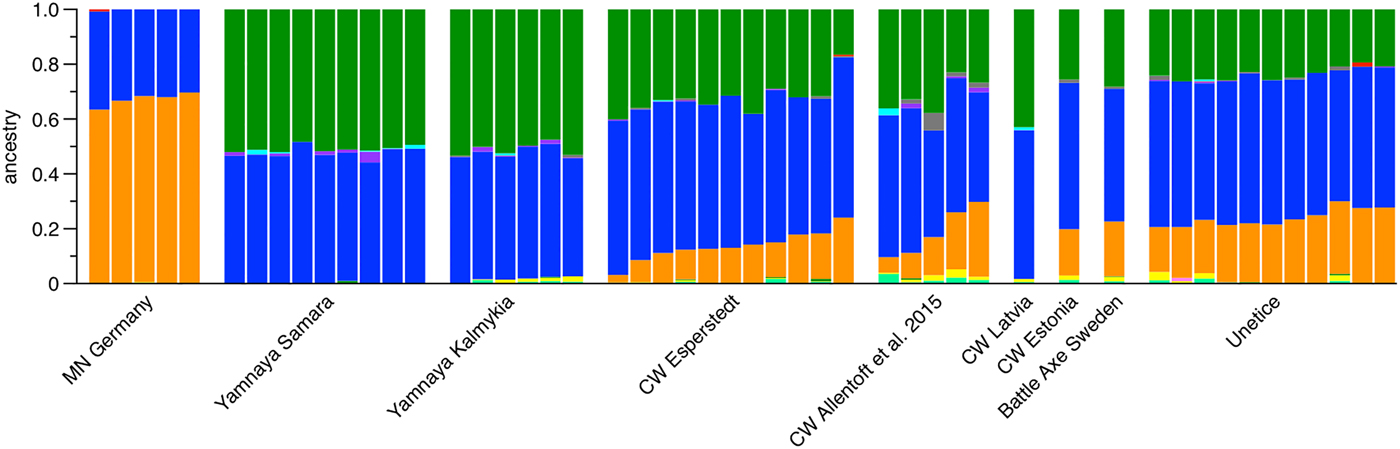
It is important to co-analyse data from the two studies in order to make direct comparisons. As shown in Figure 1, all Corded Ware-associated individuals published to date show very similar proportions (and can be shown to form a clade to the exclusion of other ancient individuals by formal statistics). Of note, the amount of ‘early European farmer’-ancestry (orange component) also varies among the individuals from Esperstedt. For comparison, I also include data from additional Corded Ware-associated individuals from the Baltic region (Allentoft et al., Reference Allentoft, Sikora, Sjögren, Rasmussen, Rasmussen and Stenderup2015; Jones et al., Reference Jones, Zarina, Moiseyev, Lightfoot, Nigst and Manica2017). Additional data from Baltic Corded Ware individuals will be available shortly (Saag et al., Reference Saag, Varul, Scheib, Stenderup, Allentoft and Saag2017; Mittnik et al., Reference Mittnik, Wang, Pfrengle, Daubaras, Zariņa and Hallgren2017). Admixture proportions (linkage disequilibrium-pruned; k = 12) show that in both central Europe and the Baltic region, CW-associated individuals are the first group to carry ‘Yamnaya-like’ steppe ancestry (a blend of the blue and green component) and ‘early European farmer’-ancestry. The latter ancestry is varying during the time-span and geographic area covered by these individuals, which is seen both in the Baltic region as well as central Europe (Mittelelbe-Saale and Bavaria), and suggests that the period of the Corded Ware is the time of admixture of ‘Early Farmer’ and ‘Steppe’ ancestry, a process that eventually results in more balanced proportions in the subsequent Únětice-associated individuals of the Early Bronze Age.
ADMIXTURE plot of select ancient individuals (data from Allentoft et al., Reference Allentoft, Sikora, Sjögren, Rasmussen, Rasmussen and Stenderup2015; Haak et al., Reference Haak, Lazaridis, Patterson, Rohland, Mallick and Llamas2015; Mathieson et al., Reference Mathieson, Lazaridis, Rohland, Mallick, Patterson and Roodenberg2015; Jones et al., Reference Jones, Zarina, Moiseyev, Lightfoot, Nigst and Manica2017). CW = Corded Ware; MN = Middle Neolithic.
As Furholt continues his argument, much of his subsequent debate revolves around the term ‘migration’ and (as opposed to) ‘gene flow’ as, for example, when he writes, ‘The argument of Haak et al. (Reference Haak, Lazaridis, Patterson, Rohland, Mallick and Llamas2015) rests on the assumption that the Corded Ware represents a single distinct population and that one would need evidence of Yamnaya affinity in an earlier archaeological culture to make a case for a continuous gene flow. This model seems to exclude the possibility that such a continuous gene flow could take place within the Corded Ware, which lasts for up to 800 years’ (p. 8); and, additionally, ‘the real issue here is that the authors do not make explicit what they mean by the term migration. The suggestion that continuous gene flow would be something different from migration is not consistent with the archaeological debates on the matter’ (p. 8).
I agree that there is no clear definition of migration in our manuscript, which, as the author admits, remains an elusive term. However, the model proposed in Haak et al. is based on the possibility of distinguishing between migration and continuous gene flow, wherein the latter becomes somewhat easier to demarcate. Under the assumption of continuous gene flow between the east (here, the north Pontic steppe) and the west (here, central Europe), we would not expect such a clear distinction between the genetic profiles of both. Instead, we would expect to see a gradient of shared ancestry in which the respective proportions would be maximized on one side (here ‘Early Farmer’ ancestry in the west and ‘Iranian Neolithic’ ancestry in the east), minimized in the opposite direction, but present nonetheless. However, this is not the case, as seen from individuals that span the time frame 8000-3000 bp. Ancestry profiles remain exclusive until the time of the Corded Ware.
Of note, new data from Globular Amphorae-associated individuals from Poland and the Ukraine show no steppe ancestry, that is, they very closely resemble the Middle Neolithic farmers in Figure 1 (Mathieson et al., Reference Mathieson, Alpaslan Roodenberg, Posth, Szécsényi-Nagy, Rohland and Mallick2017, available on biorxiv: http://biorxiv.org/content/early/2017/05/09/135616), which is intriguing given the geographical proximity and contemporaneity with Yamnaya individuals. Likewise, as also seen in Figure 1, one individual associated with the Corded Ware in the Baltic region lacks ‘farmer-ancestry’ (CW Latvia from Jones et al., Reference Jones, Zarina, Moiseyev, Lightfoot, Nigst and Manica2017) and, thus, resembles the steppe ancestry profile of Yamnaya individuals.
Both observations narrow down the remaining time window for the expansion of steppe ancestry into central Europe to a few hundred years at best or perhaps five to ten generations. Given that we do not observe the signal of continuous gene flow over longer time periods (where the formation of steppe ancestry 5000–6000 years ago would pose a time constraint), we were inclined to call this process ‘migration’. Given the time window between the Globular Amphorae individuals with no ancestry and the earliest Corded Ware individuals with very large proportions, this process is still considered ‘rapid’ in biological terms and ‘massive’ in comparison.
As a further consideration, Furholt argues that, ‘this interpretation of the patterns seems to overstate the explanatory powers of the PCA. The notion of a generally closer connection of Corded Ware individuals to Yamnaya individuals than the other Late Neolithic samples is much less clear in a different study using different samples connected to Corded Ware (Allentoft et al., Reference Allentoft, Sikora, Sjögren, Rasmussen, Rasmussen and Stenderup2015)’ (p. 8). PCA and ADMIXTURE are qualitative methods that are used to characterize the ancestry profiles of prehistoric individuals. All observations from PCA and ADMIXTURE are backed by formal statistics (f- and D-statistic, etc.), which are quantitative methods and which were described in detail in the respective papers. As such, formal admixture tests were carried out to explain the genetic profiles of Corded Ware-associated individuals and the likely source populations (e.g. Haak et al., Reference Haak, Lazaridis, Patterson, Rohland, Mallick and Llamas2015: Supplementary Information 7, page 75 onwards and Supplementary Information 9, page 101 onwards). The observed ancestry components as well as the positioning of Corded Ware individuals in principal component space are reliable and remain stable in all subsequent studies, which include these datapoints (e.g. Günther & Jakobsson, Reference Günther and Jakobsson2016; Jones et al., Reference Jones, Zarina, Moiseyev, Lightfoot, Nigst and Manica2017; Mittnik et al. Reference Mittnik, Wang, Pfrengle, Daubaras, Zariņa and Hallgren2017, http://biorxiv.org/content/early/2017/03/03/113241; Saag et al., Reference Saag, Varul, Scheib, Stenderup, Allentoft and Saag2017).
Finally, I would like to address Furholt's statement that ‘for example, in their Supplementary Information 2, Haak et al. (Reference Haak, Lazaridis, Patterson, Rohland, Mallick and Llamas2015) demonstrate that three individuals connected to the Pitted Ware culture in Sweden (taken from Skoglund et al., Reference Skoglund, Malmström, Raghavan, Storå, Hall and Willerslev2012) are clearly under that eastern genetic influence’ (p. 10). Supplementary Information 2 describes the mitochondrial DNA data. Individuals associated with the Pitted Ware show high proportions of mtDNA U4 and U5 lineages (~74%), which are very common among all Holocene hunter-gatherer individuals reported so far. This mtDNA profile thus equates to the blue component of the autosomal data and not to ‘steppe ancestry’ per se.
Overall, I welcome this opportunity of interaction and open discussion. It is important that archaeologists shed a critical light on the recent findings of archaeogenetics in order to put these into a balanced and well-contextualized perspective. Likewise, I am grateful for the opportunity to clarify a few technical aspects of our genetic work, which might relativize some of Furholt's arguments.
Although this paper is focused on the Corded Ware, it makes several excellent points about aDNA data and their interpretation in archaeology generally. This is a topic of obvious interest both to researchers and to the wider public, but archaeologists have been uncertain how to react to the flood of new information and the associated interpretations. On the one hand, genetics have been enthusiastically embraced as part of a third science revolution which will finally free us from self-absorbed theorizing and mere ‘storytelling’ (e.g. Kristiansen, Reference Kristiansen2014; Gerbault et al., Reference Gerbault, Allaby, Boivin, Rudzinski, Grimaldi and Pirs2017), but alongside the explicit critical voices (see e.g. Niklasson, Reference Niklasson2014) many colleagues have preferred to remain on the sidelines of the debate.
As Furholt points out, this is largely because they feel uncomfortable with the ‘Kossinna-like’ interpretative shorthand employed in such studies (see also Heyd, Reference Heyd2017). Also, assumptions inherent in the methodologies are often difficult to pinpoint and critique for those not familiar with statistical or genetic terminology. For instance, the closedness of the ‘populations’ under study, their internal homogeneity, and the timings and speed of gene flow are all far from proven (as Furholt recognizes), although they are written about with considerable assertiveness. Sometimes, the number of individuals taken as representative for a given ‘culture’ is extremely low and/or from a restricted area; and it is not yet possible to investigate trends over the whole duration of often long-lived cultural phenomena. As a result, we seem to be re-creating the internally homogenous and static ‘cultures’ which then need a revolutionary event to be transformed—the population revolution which goes with our science revolution in an increasingly hyperbolic rhetoric.
Furholt's paper takes an important and necessary step in highlighting the potential archaeological contribution to the mobility and migration debate. This is especially so because he does not stop at criticism, but sketches plausible alternatives to the scenarios proposed on the basis of genetic work. These can now be researched further. In particular, the idea that more mobile communities will be internally more heterogeneous and, therefore, materially more uniform is interesting and deserves to be compared with other case studies making similar points, for instance for the LBK (Hofmann, Reference Hofmann2016) or the lake village horizon (Ebersbach et al., Reference Ebersbach, Doppler, Hofmann and Whittle2017), and probably well beyond the Neolithic, too.
But there remains a general sense of dissatisfaction with how archaeological interpretations are generated by those outside the discipline. Even in times of inter- and increasingly trans- or even meta-disciplinarity, communication does not appear to be working terribly well, at least not at the scale beyond individual research projects (see e.g. Bánffy et al., Reference Bánffy, Brandt and Alt2012). Indeed, as social/‘soft’ and natural/‘hard’ scientists, we have caricatures of each other firmly in mind: one lot are fluffy storytellers, obsessed with details, who only claim to be worried about new results because they don't understand the maths, the other lot are boors, unaware of their own inbuilt subjectivity, who just want the fame of solving an age-old mystery, ideally on the front page of the right magazine. I'll leave you to figure out who's who.
Thus, although the entrenched oppositions between the humanities and sciences have been declared over (e.g. Robb, Reference Robb, Whittle and Bickle2014), the truce seems a little uneasy in places. This may not be a bad thing. Disagreements are, after all, fertile ground for new research endeavours. For the purposes of the present discussion, two aspects deserve to be drawn out.
First, to work together better, we need to find common concerns and vocabularies. From an archaeological perspective, if our theoretically aware models have been ignored, we are a little bit to blame ourselves. It is not just that, as Furholt outlines, some theoretically less enthusiastic archaeologists have continued to use cultures as an all-too-convenient shorthand. There has also been a tendency among some of those who do enjoy theorizing to remain aloof with regard to scientific approaches and to refrain from ‘big questions’ concerning ‘origins’, widespread material culture patterns, or convergent social trends at the continental or global scale. These topics brush over local nuance, which so many of us are accustomed to put centre-stage. Because geneticists, partly by training and partly due to the available data, tend to look at broad timescales and large regions, there is a mismatch of scales here.
This is only a problem if the genetic data as a palimpsest of timescales and regions are interpreted in terms of short-term ‘events’, but with a sketchy grasp of the details, or, indeed, if the increasingly detailed material entanglements archaeologists write about disregard a wider and potentially unsettling context. As Furholt points out, it should be possible for geneticists to write about scenarios other than an implicitly bloodthirsty replacement of one set of populations by another. Yet, by the same token, it should be possible to write narratives of power imbalance, exploitation, and upheaval within symmetrical, network, and similar approaches. As yet, the overwhelming majority of these (and I must admit this is largely an outsider's perspective) seem to prefer a cosier view. We have moved away from debates in which we passionately argued about the differences between people, things, and practices to writings in which all capacity for action is diffused across very complex but ultimately similar networks (or meshworks, etc.), largely ignoring the social constellations supporting them, including institutions, norms, and power relations (as criticized e.g. in Strathern, Reference Strathern1996; Glørstad, Reference Glørstad, Glørstad and Hedeager2008; Burmeister, Reference Burmeister2013). This lends itself most easily to narratives of sedate paces and steady flows, as for instance in Neolithisation debates (e.g. Cummings & Harris, Reference Cummings and Harris2011; Jones & Sibbesson, Reference Jones, Sibbesson, Alberti, Jones and Pollard2013) and recreates human actors as the ‘faceless blobs’ long critiqued in feminist writing (Tringham, Reference Tringham, Gero and Conkey1991: 94). It is good to have this comfort challenged, also to reveal the full potential of these theoretical approaches.
Second, power differentials are not just part of the pasts we study, but also of the research contexts within which we work. There is no point denying that, in the current climate, archaeologists feel very much like the junior partner, with funding and fame on the side of the geneticists. Joining in the debate more actively, therefore, holds the promise of considerable gains; but this does not mean that we have to act as mere sample providers and ‘culture consultants’. Instead, we must be genuinely interested in outcomes, find a vocabulary that makes sense to others and brings our concerns across clearly, and also stand by those concerns, even if they are temporarily unfashionable. Indeed, this kind of debate is something several archaeogeneticists explicitly value (e.g. see Haak's comments on this article).
One can only agree with Niklasson (Reference Niklasson2014: 59) that we need to question and critique the reasons archaeogenetics are so popular right now, and why these ‘facts’ are happily accepted within an otherwise allegedly facts-hostile climate. We must also continue to challenge the idea that greater simplification always makes better explanations (Gerbault et al., Reference Gerbault, Allaby, Boivin, Rudzinski, Grimaldi and Pirs2017; for criticism see e.g. Mizoguchi, Reference Mizoguchi2017: 20). As we are no longer in a position in which choosing a bottom-up instead of a top-down approach will gain anything, we have to argue clearly why diversity and internal complexity is the more fascinating question, at whatever scale (local community or ‘culture’) we are seeking the answer.
Judging from the controversies surrounding other newly introduced techniques (for instance, 14C-dating or strontium isotopes), we can expect that, after an initial phase of unbridled enthusiasm, it will become clear that the new technique does not serve easy answers up on a plate. That is the point at which common ground can be found, and it is a process we can actively initiate and shape. Papers like Furholt's are key first steps. My hope is that this will inspire more people from across the theoretical spectrum to incorporate the results of genetics explicitly into their own writings, identifying and working through alternative perspectives and scenarios. Then we'll have plenty to talk about.
In the present manuscript, the author revisits the contribution of recent ancient DNA studies to the knowledge of third millennium cal bc societies in Europe while stressing their main conceptual flaws. The main critique revolves around the equation of archaeological cultures and biological/genetic population distinctiveness, and three main aspects are highlighted: a) the (lack of) representativeness of the studied samples; b) the lack of biological/genetic homogeneity of the members of a particular archaeological culture; and c) the ambiguous use of the term migration in those publications.
I find this paper both timely and necessary. It comes at a time when the popularity of ancient DNA studies has transcended the scientific community to seize the holders of popular media in a time of economic and political instability, where the debate on immigration and its subsequent ramifications are on the table. Hopefully, this manuscript will serve as inspiration for a constructive dialogue between geneticists and archaeologists in the search for a more holistic and realistic interpretation of the dynamics of prehistoric populations.
One of the practices criticized by the author of this manuscript is the use of a handful of samples as representative of a whole period or archaeological culture, and he cites the four individuals from Esperstedt that signify the whole Corded Ware culture in Haak et al. (Reference Haak, Lazaridis, Patterson, Rohland, Mallick and Llamas2015) as an example. While this is a widespread practice in ancient DNA studies, it should be seen as a result of the limitations imposed by the small working sample size. It is important to highlight at this point that ancient DNA results are heavily constrained firstly by the availability of suitable samples and, ultimately, by their bio-molecular preservation. While this bias is insurmountable, it is our responsibility to recognize the limitations of the data, and I agree with the author that some of the cited papers have failed in adequately integrating the obtained genetic data with the evidence from other sources.
Turning into other sources of evidence to fill in the gaps and using the author's words ‘engagment with archaeological and anthropological theory’ (p. 4) is undoubtedly the right path to follow; however, I feel that much more can be done from the genetics side itself. Even with a limited sample size, two independent teams have reported that a new genetic component nearly absent in the preceding European populations appears in several individuals belonging to the Corded Ware culture, thus indicating an exogenous genomic influence during the third millennium cal bc (Allentoft et al., Reference Allentoft, Sikora, Sjögren, Rasmussen, Rasmussen and Stenderup2015; Haak et al., Reference Haak, Lazaridis, Patterson, Rohland, Mallick and Llamas2015). The questions to be answered are: 1) how much of the original genetic diversity that existed in these cultures has been captured by the studied samples; and 2) if a pan-cultural pattern can be inferred, as defended by the authors of these studies.
Ultimately, this leads us to the question of how the resolution of these studies can be improved. In my opinion, in a time where ancient genomic studies have gained considerable success due to new technical advances and a targeted sampling of certain skeletal elements, we should aim for a more complete chronological and geographical genetic dissection of the different cultural/populational sub-units as a way to assess the genetic substructure of these big cultural units (e.g. Corded Ware or Yamnaya). This can only be achieved through a combined effort of archaeologists and geneticists towards an informed sampling protocol followed by a holistic interpretation of the data.
During the time of revision of the present paper, interesting additions to the debate have been published. The most significant one is the work of Kristiansen et al. (Reference Kristiansen, Allentoft, Frei, Iversen, Johannsen and Kroonen2017) in Antiquity. In this paper, some of the authors of Allentoff et al. (Reference Allentoft, Sikora, Sjögren, Rasmussen, Rasmussen and Stenderup2015) re-theorize their original ‘massive migration’ hypothesis towards an integrative model that places more emphasis onto ‘social’ factors rather than on migration and assimilation to explain the observed connections between the Yamnaya and the Corded Ware people. This reworked version of the original paper incorporates some of the lacking “cultural and social elements to explain population history” and is more in line with the views of the author of this manuscript about a constant genetic flow between both cultural units, explained by Kristiansen et al. (Reference Kristiansen, Allentoft, Frei, Iversen, Johannsen and Kroonen2017) through a pattern of female exogamy.
However, the most revealing paragraph brings up a point that is also central to the present manuscript, the recognition that ‘the exact source [referring to the eastern genetic component found in the studied Corded Ware individuals] could have been another, yet unsampled group of people’ (Kristiansen et al., Reference Kristiansen, Allentoft, Frei, Iversen, Johannsen and Kroonen2017: 335). This illustrates very well some of the limitations of genetic data as a single predictor of past population movements. Ultimately, human population genetics needs to feed more strongly on other disciplines to be able to disentangle the biological, social, and cultural mechanisms behind the observed genetic patterns.
Hardly a single week seems to pass without the publication of another aDNA paper on later European prehistory, bringing its sense of repetition in terms of methods and, most worryingly, results and limited archaeological contextualization. And yet, despite the magnitude of this data-cascade, archaeological reactions remain comparatively limited and subdued (but see Hofmann, Reference Hofmann2014; Vander Linden, Reference Vander Linden2016). From this point of view, this important contribution by Martin Furholt, and the decision by the EJA editorial team to attach to it a full discussion, must be applauded. Obviously, the relevance of Furholt's piece reaches well beyond its mere existence and lies first and foremost in its intrinsic quality and the key points it raises.
Furholt rightly stresses the uncomfortable position of archaeologists regarding aDNA. On the one hand, here is a method which demonstrates exquisite technical refinements, but, on the other hand, its interpretations are plagued, at least to the archaeologist's trained eye, by an outdated framework which treats migrations as securely identified historical events to be mapped and documented, rather than explained and understood. Even if these papers are published in the highest-ranking journals, one is left with the uneasy feeling that, in archaeological terms, very little has actually been learned. Whether for the Early or the Late European Neolithic, the existence of migrating populations has indeed been long suspected; although, as any student of our discipline knows all too well, their exact role in explaining change in past human societies has been systematically minimized since the 1960s.
The point is simple. As processual archaeology rose from the ashes of the pyre it had set on migration, the topic became, until relatively recently, a no-go area for most archaeologists. Furholt might be able to invoke several key papers when advocating a more complex take on migration, but the field remains in its infancy. Likewise, the excessive liberty taken by geneticists with archaeological cultures reflects, in a distorted way, the unease of our discipline with this core concept and, beyond that, how poor we generally are at describing material variability, let alone interpreting it (see Shennan, Reference Shennan2013). All in all, Furholt's outlook reflects the state of uncertainty where the discipline has been lingering for too long.
In many respects, thus, we created a void waiting to be filled, which geneticists did on the back of undeniable technical prowess. This being said, it is obvious that geneticists do not engage that much with archaeology and archaeologists, the latter often appearing as passive sample providers rather than active intellectual contributors in these publications. At the core of the problem lies the assumed identity between biological populations and archaeological cultures, both considered as expressions of coherent, self-bounded units, a fallacy denounced fifteen years ago when modern DNA was hailed as revolutionary (e.g. MacEachern, Reference Maceachern2000). Two simple points, also made by Furholt, demonstrate the negative impact of this simplistic and false assumption.
Firstly, aDNA papers often stem from a limited number of samples, from which any pattern is then generalized across the entire geographical and temporal extent of the corresponding archaeological culture. The nature of aDNA data partly overcomes this problem (Li & Durbin, Reference Li and Durbin2011) and further—hopefully more systematic—sampling will by definition improve the resolution. However, the limitations of this approach are obvious as the narrow range of samples does not allow one to explore possible differences within the geographical and temporal lapse of a given archaeological culture. Secondly, the question of relatedness between populations is central to the genetic entreprise, and reflected in ADMIXTURE and PCA graphs which provide statistically-informed depictions of this measure. The reasons for this preference lie deeply in the project of describing and understanding the variation of the modern Europe genetic variation. The difficulty lies when one attempts to translate biological relatedness in social terms, materialized by archaeological artefacts. This tension is well exemplified when genetic relations between central and eastern European third millennium bc samples are linked to corresponding material affinities between the Yamnaya and Corded Ware complexes while, as Furholt elegantly reminds us, the latter is pretty much typologically-related to all archaeological cultures before, after, and around it.
The above remarks arguably stem from a genuine lack of archaeological sophistication in most aDNA papers, in many ways repeating and prolonging the mistakes made by archaeologists for several decades. Are we thus in a theoretical impasse? Or is it that aDNA can only provide information with which we cannot do much? Most surely not. The bulk of the work has, so far, been carried out in a deceptively empirical way, taking advantage of a so-called golden phase where each sample is bound to tell us something that we by definition did not know about the genetic make-up of past populations. This strategy, while efficient in the short term, is hardly sustainable. The only viable alternative lies in complex hypotheses, informed and tested by several categories of evidence, all considered on equal footings.
Population history, including migration, provides a robust framework for such hypotheses to be elaborated. Indeed, the main result gained from aDNA, as well as from other studies, is that Neolithic populations were in constant flux, as suggested by ever-changing levels of admixture. This simple observation opens countless possibilities for future research. For instance, reading the literature, one can be left with the impression that the Early and Late Neolithic migration events were interchangeable, while they obviously happened under different demographic regimes, under different logistics, that is, in fundamentally different ways. Were small or large groups moving? Did the migration involve all categories of people, or were they sex-biased? Both questions can partly be answered by bioinformatic treatments of the data (e.g. Pemberton et al., Reference Pemberton, Absher, Feldman, Myers, Rosenberg and Li2012; Goldberg et al., Reference Goldberg, Günther, Rosenberg and Jakobsson2017). Further fine-grained structure in these migrations will, without doubt, be unravelled by re-examining in parallel the aDNA and wider archaeological records. However, when doing so, and as hinted at by Furholt, we need to drive away from our implicit will to align neatly all signals to write simple, elegant, yet inherently faulty narratives. Genes and material culture, in their own complexity, do not operate in the same spheres of action, nor do they unfold upon the same spatial and temporal scales. We need to take advantage of their respective complexity to test alternative hypotheses, and get towards a more textured representation of the past.
To conclude, aDNA is, without any doubt, a fantastic technique, whose amazing potential we only begin to grasp. It is, however, worth remembering that this potential only applies to a narrow part of the archaeological agenda (e.g. Kintigh et al., Reference Kintigh, Altschul, Beaudry, Drennan, Kinzig and Kohler2014) and will only be unfolded by testing proper hypotheses, rather than chasing ghosts of our discipline's past. Of all social sciences, archaeology has assuredly the best track record at inter-disciplinarity and, thus, at overcoming a range of responses from extreme confidence to total disenchantment with new techniques. In this sense, the difficulties we encounter with aDNA are hardly new. Let us just not forget that any improvement will not simply come from ‘us’ teaching ‘them’, but also from us giving a hard look at ourselves in the mirror.
The comments from two archaeologists and two geneticists represent a spectrum of critique, approval, and extension of the main issues discussed in my article, and will hopefully help to push forward the necessary interdisciplinary dialogue. Wolfgang Haak defends his view that the data indicate a rather rapid migration process that would coincide with the beginning of the Corded Ware, arguing that the ever-increasing number of samples has now confirmed that all individuals connected to Corded Ware so far analysed have steppe ancestry, while those connected to the slightly earlier Globular Amphora Complex do not. Of course, it is not impossible that the first appearance of steppe ancestry in central Europe coincides sharply with the first appearance of Corded Ware, and I have no problem with this interpretation, as long as it is empirically proven. What I criticize in my paper is the presupposition of a biological similarity of individuals connected to specific units of archaeological material. This is a premise that derives from and feeds into an unholy reification and biologisation of cultures as closed and homogeneous social units. More importantly, it is empirically false. Looking at the clusters of samples on the PCA in Figure 2 (i.e. the Early/Middle Neolithic cluster or the Late Neolithic/Steppe ancestry cluster), one can see that they contain a mix of samples associated to different archaeological cultures. This is even more obvious in the newer, updated versions of the same PCA (i.e. Mathieson et al., Reference Mathieson, Alpaslan Roodenberg, Posth, Szécsényi-Nagy, Rohland and Mallick2017: fig. 1). These clusters represent units in space and time (i.e. sixth to fourth millennia bc in southern and central Europe, or third and second millennia bc in central Europe); they do not differentiate between archaeological cultures. Clearly, by the third millennium cal bc, a major change in the genetic pool of central Europe has taken place; but the data do not, at present, suggest a very rapid, event-like process. Nine individuals from two sites connected to Globular Amphora from Poland and Ukraine without steppe ancestry do not adequately represent the entire pre-Corded Ware situation in Europe. As I argue in the article, and as was recently stressed by Volker Heyd (Reference Heyd2017) archaeologically, steppe influence, which is visible in burial rites among other practices, can be traced back to the fifth millennium cal bc in south-eastern Europe and the Carpathian basin; and it clearly played an important role during the fourth millennium cal bc in different parts of Europe. The study Haak mentions (Mathieson et al., Reference Mathieson, Alpaslan Roodenberg, Posth, Szécsényi-Nagy, Rohland and Mallick2017) also presents two individuals from Bulgaria who date to the fifth millennium cal bc (Varna I and Smyadovo) and show a stronger steppe ancestry component in the ADMIXTURE plot. All this indicates the possibility of a deeper, longer-term history of interaction, characterized by regular and repeated human movement between the steppes and south-eastern and central Europe, instead of a rapid, massive migration event.
However, to move forward it is not enough to dissect the details of every data point and archaeological observation. It is about creating a better interdisciplinary discussion. Daniela Hofmann's commentary broadens the perspective of the scientific and social context in which this discussion should be viewed. She targets the apparent opposition between broad-stroke narratives and detailed critiques. The assessment of regional and diachronic patterns should go hand in hand with the exploration of local and historical variability. I agree with her argument that both the top-down and the bottom-up perspectives would profit from a more direct engagement with real social processes, which involve active individuals, social norms, institutions, and power relations. Without such an engagement ‘migration’ will remain a hollow phrase. This resonates well with Marc Vander Linden's call for more elaborated migration scenarios, testing of complex hypotheses, and the exploration of the social consequences of mobility for prehistoric communities. Vander Linden rightly warns us against the tendency to choose the simplest possible explanation of a set of data.
However, as Eva Fernández-Domínguez makes clear, the geneticists also have to deliver in order to enable a more sophisticated interdisciplinary discussion, be more aware of the limitations of their datasets, and take seriously the conceptual pitfalls—sample size, the reification of cultures, ambiguous use of the term migration—and work on ways to avoid them through a more intensive collaboration across disciplinary borders. She positively evaluates the new paper by Kristiansen et al. (Reference Kristiansen, Allentoft, Frei, Iversen, Johannsen and Kroonen2017) as an example of a more elaborated re-theorization of the Allentoft et al. (Reference Allentoft, Sikora, Sjögren, Rasmussen, Rasmussen and Stenderup2015) migration narrative. This new scenario—Corded Ware being formed as a consequence of migration of individuals with steppe ancestry into central Europe, followed by interaction with local individuals, adaptation, admixture, and hybridization—is a hypothesis that can be tested against the biomolecular and archaeological datasets. For example, in such a scenario, we should expect to find steppe ancestry in central Europe connected to pre-Corded Ware archaeological complexes. Yet, to return again to Hofmann's and Vander Linden's commentaries, although Kristiansen et al. (Reference Kristiansen, Allentoft, Frei, Iversen, Johannsen and Kroonen2017) provide an appealing broad-stroke narrative, and propose concrete social mechanisms (female exogamy), it is a one-size-fits-all approach that should be elaborated by incorporating a stronger acknowledgement of and emphasis on local variability and potentially different social mechanisms that are strongly suggested by the variability visible in the archaeological record.
Although discussions of these topics are already gaining speed, we still have a long way to go until we will have developed an anthropologically informed integration of bio-molecular and archaeological data, yielding an identification of realistic social processes. While a stronger bottom-up component is surely crucial, we should also explore a broader range of anthropologically studied mechanisms of mobility, migration, and population circulation, and systematically explore the ways in which such phenomena are discernible by studying the archaeological record and genetic datasets.



