


1. Introduction
Modern products are increasingly multi-domain, combining mechanical structures, software, electronics, and service components. Many companies—especially in B2B markets—also aim to deploy these products across several sectors to increase scalability and resilience. To reduce costs, firms pursue platform-based strategies, standardzing components across product variants. Yet, in practice, “full” commonality is often achieved only within a single domain (e.g., shared software across mechanically different smartphones), limiting the benefits of true multi-domain platforming. Achieving cross-domain integration remains difficult because it requires close coordination among diverse engineering disciplines. Artificial Intelligence (AI), and particularly co-intelligence approaches where AI acts as a reasoning partner, offer new opportunities to support such coordination (Reference Nüßgen, Degen, Irmer, Richter, Boström and RuschitzkaNüßgen et al., 2024; Reference Jonuschies, Siewert, Michaelsen and GerickeJonuschies et al., 2025). This paper, therefore, reviews the literature at the intersection of AI and multi-domain platform development, addressing the following questions:
-
1. In which domains does current AI research support platform design most strongly?
-
2. Which phases of the platform lifecycle are supported?
-
3. What models of human–AI collaboration are used?
-
4. What types of research contributions dominate the field?
-
5. What challenges must be addressed to evolve from computational assistance to AI-enabled co-intelligence for cross-domain platform integration?
The remainder of the paper proceeds as follows. Section 2 describes the research methodology, including the systematic mapping approach and the classification framework applied in the study. The analysis was first conducted on a corpus of 89 papers addressing AI in platform contexts, covering both single-domain and multi-domain settings. This provided a broad overview of how AI is positioned within platform research. The focus was then narrowed to 21 in-scope papers explicitly addressing multi-domain platforms, enabling a more detailed structural analysis of AI roles, contribution facets, research types, and lifecycle phases in cross-domain contexts.
Section 3 presents the current state of the field (“what is now?”), first summarizing patterns across the full dataset and then examining the dominant archetypes and white spots emerging from the 21 multi-domain studies. Section 4 discusses emerging research opportunities (“what is next?”), highlighting key gaps and future directions for AI in multi-domain platform design. Finally, Section 5 concludes the paper by summarizing the main findings and reflecting on future research avenues.
2. Methodology
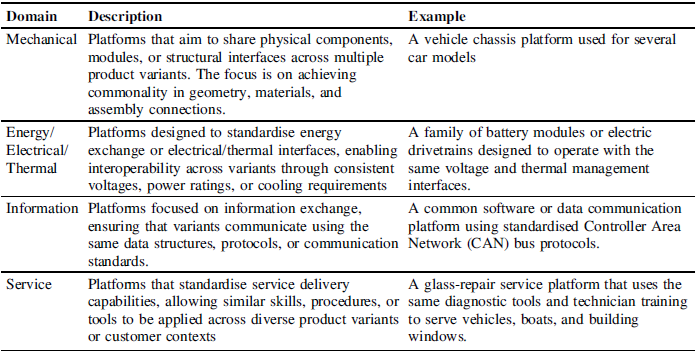
This study applies a systematic mapping method (Reference Petersen, Feldt, Mujtaba and MattssonPetersen et al., 2008; Reference Bertoni and BertoniBertoni & Bertoni, 2022), combining qualitative synthesis with a quantitative survey of research activity. Scopus was selected as the primary database due to its broad coverage of peer-reviewed engineering, computer science, and management research. The search strategy was designed to capture studies located at the intersection of product platform research and artificial intelligence (AI), with explicit relevance to early and mid-stage engineering activities. The final search string was: TITLE-ABS-KEY (“product platform*” OR “product famil*” OR “Product Line Engineering”) AND TITLE-ABS-KEY (“artificial intelligence” OR “machine learning” OR “data-driven” OR “AI” OR “deep learning”) AND (“design” OR “development”). The use of TITLE-ABS-KEY ensured that both platform-related and AI-related concepts were central to the publications. Wildcards allowed for terminological variations, while the inclusion of both general (AI, data-driven) and specific (machine learning, deep learning) terms balanced recall and precision. This query yielded 201 documents. A multi-stage screening procedure was applied. First, non-peer-reviewed items such as editorials and notes were removed. Second, duplicates were eliminated. Fourth, abstracts—and full texts when necessary—were screened to exclude studies focusing on single products while misusing platform terminology, papers applying AI in general engineering contexts without explicit platform logic, and preliminary positioning works lacking substantive methodological or empirical contributions. After screening, the final dataset comprised 89 peer-reviewed papers. To analyse how technological context shapes AI-supported platform research, each paper was classified into one or more of four application domains (Table 1). These domains reflect the technological or functional locus through which platform commonality and variability are realised.
The four domains based on platform objectives

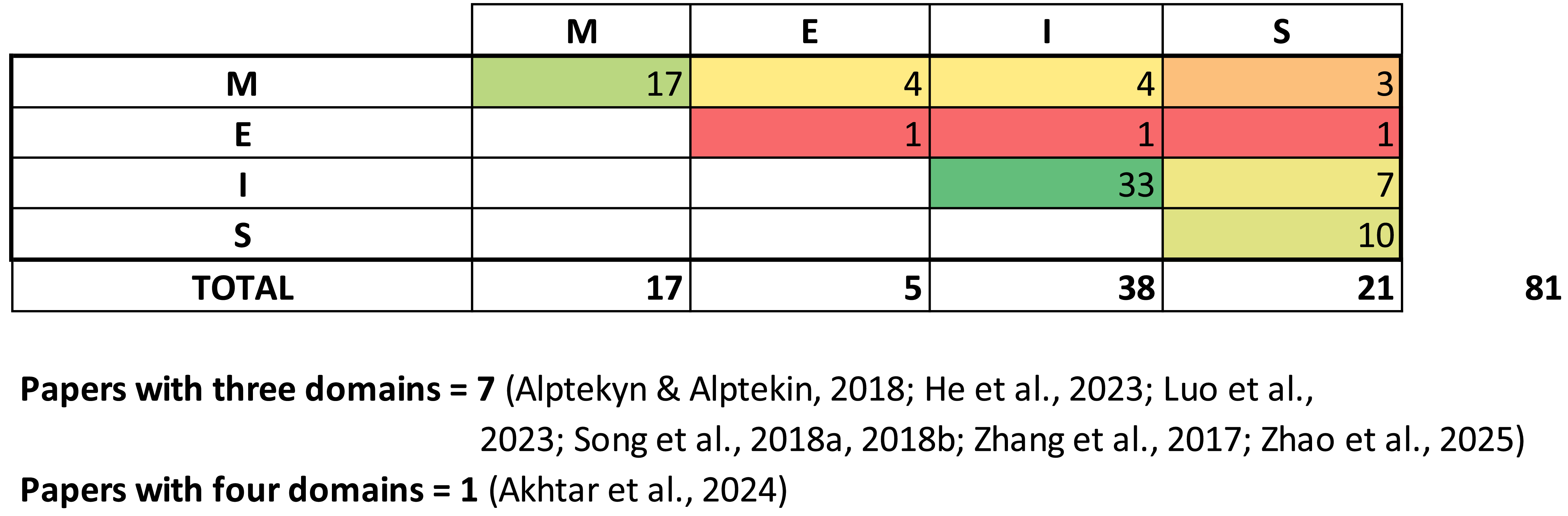
This classification clarifies how technological domains shape AI-supported platform research by revealing where mechanical, electrical, informational, or service-related challenges influence modular system design. Four papers were labelled “generic” because they did not specify a target domain; these were excluded as preliminary positioning works.
Figure 1 presents the domain distribution in matrix form. The diagonal cells represent single-domain studies, that is, papers addressing only one of the four domains (Mechanical, Energy/Electrical/Thermal, Information, or Service). These diagonal entries clearly dominate, confirming that most contributions situate AI applications within a single technological context. In contrast, the off-diagonal cells represent double-domain studies, where two domains are addressed simultaneously. These are considerably fewer (21 papers out of 89), and only a very small number of papers extend beyond two domains (Seven papers address three domains, and only one spans all four). This distribution highlights the strong disciplinary concentration of existing research and the limited presence of cross-domain integration.
Literature contributions with AI in multi-domain platforms

Given this structure—and the integrative focus of the present study—the analysis proceeded in two stages. In the first stage, all 83 papers were analysed to identify general patterns of AI application across platform engineering. Each paper was coded according to AI role (e.g., prediction, optimisation, knowledge extraction, generative support, decision support) and lifecycle phase (e.g., concept design, architecture definition, detailed design, configuration, operation). This comprehensive mapping revealed that AI applications predominantly target isolated, domain-specific analytical tasks. Typical uses include performance prediction, parameter optimisation, behavioural modelling, ontology construction, and feature extraction. Even in cases where multiple data sources are analysed, AI is generally applied to enhance performance within a single domain rather than to synthesise knowledge across heterogeneous domains. Overall, AI currently functions primarily as a technical assistant within bounded engineering contexts. In the second stage, a more focused analysis was conducted exclusively on the 17 multi-domain papers (i.e., those represented in the off-diagonal cells). These papers were further classified by research type (e.g., solution proposal, validation research, evaluation research) and contribution type (e.g., method, model, framework, tool). This deeper examination aimed to assess whether multi-domain work reflects genuine integrative AI capabilities. The results indicate that truly cross-domain contributions remain rare. Although a small number of studies demonstrate emerging potential for AI-supported coordination across mechanical, electrical, informational, and service domains, such efforts remain exploratory and limited in scope. Overall, while AI adoption in platform design is increasing, it has not yet matured into a fully integrative, system-level mechanism capable of bridging heterogeneous engineering domains.
2.1. First stage (89 papers in all domains): classification based on development stages and AI roles
Domain classifications were mapped against a simplified product-platform lifecycle (adapted from Reference Otto, Hölttä-Otto, Simpson, Krause, Ripperda and Ki MoonOtto et al., 2016) to ensure consistent coding, with the following reference phases (PH):
-
• PH1 – Market Evolution Analysis: Identify stakeholder needs and how they change.
-
• PH2 – Requirements/Sub-system Mapping: Translate requirements into system elements and dependencies.
-
• PH3 – Product Architectures Generation: Develop and explore alternative architectures.
-
• PH4 – Product Architectures Analysis: Assess trade-offs and lifecycle performance.
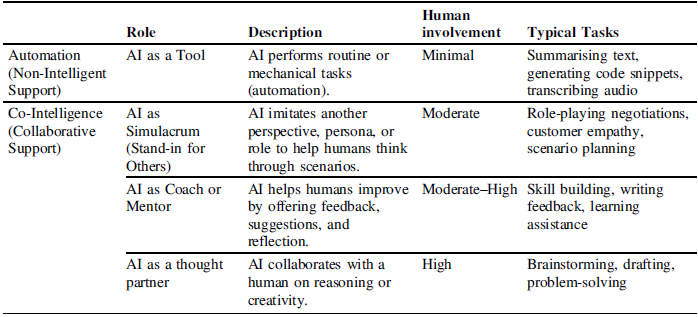
A third analytical dimension examined the role of AI in relation to human designers, distinguishing automation from co-intelligence. The study adopts the Four Roles of AI framework (Reference Randazzo, Lifshitz-Assaf, Kellogg, Dell’Acqua, Mollick, Candelon and LakhaniRandazzo et al., 2024), which spans from routine automation to higher-level collaboration. Only the first role represents basic automation; the other three involve co-intelligent behaviour, where AI supports reasoning, creativity, or acts as a stand-in for human decision-making (Table 2).
Focus facet: the four roles of AI (Adapted from Reference Randazzo, Lifshitz-Assaf, Kellogg, Dell’Acqua, Mollick, Candelon and LakhaniRandazzo et al., 2024)

This framework was selected because it enables a systematic mapping of how AI contributes to different design tasks and phases in multi-domain product platform engineering.
2.2. Second stage (21 papers focused on more than one domain): research types and contribution facets in AI in multi-domain platforms
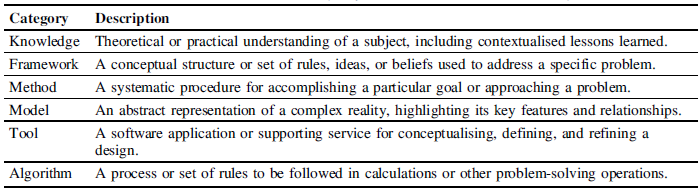
To characterise what each study contributes, papers were coded according to Contribution Facets, adapted from Reference Petersen, Feldt, Mujtaba and MattssonPetersen et al. (2008). These facets classify the type of deliverable or prescriptive result provided.
Contribution facets (adapted from Reference Petersen, Feldt, Mujtaba and MattssonPetersen et al., 2008)

As noted by Reference Petersen, Feldt, Mujtaba and MattssonPetersen et al. (2008), individual studies may fall into more than one category, even if certain combinations are uncommon. For instance, a paper might introduce a new technique, provide a rigorous validation of its performance, and conclude with a reflective discussion offering the authors’ perspectives on future research directions.
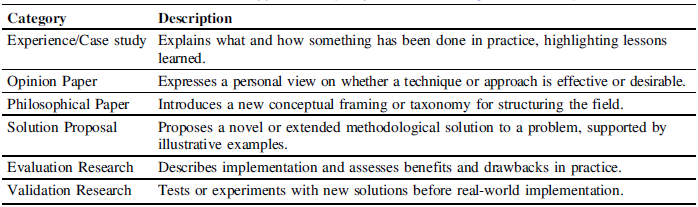
To assess how the research is conducted, the Research Type Facets defined by Reference WieringaWieringa et al. (2014) and Reference Petersen, Feldt, Mujtaba and MattssonPetersen et al. (2008) were used. These capture the methodological maturity and evidence orientation of each contribution.
Research type facets (adapted from Reference WieringaWieringa et al., 2014)

Finally, the emerging challenges and opportunities from all papers were extracted and grouped thematically. As noted by Reference Petersen, Feldt, Mujtaba and MattssonPetersen et al. (2008), a single paper may fall into multiple categories, even though certain category combinations are less common. For example, a study may introduce a novel technique, provide a rigorous validation of its effectiveness, and conclude with a reflective discussion offering recommendations or perspectives for future research directions.
3. What is now? The role of AI across domains and the platform development process
3.1. AI across domains and the platform development process (89 papers)
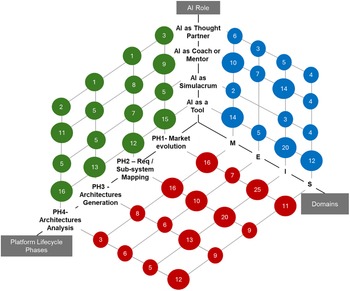
Figure 2 shows that most AI-enabled contributions focus on single-domain applications across the Mechanical, Electrical, Information, and Service domains. AI is typically used for isolated analytical or optimisation tasks—such as predicting performance, extracting domain knowledge, or modelling sub-system behaviour.
Experiences with AI for platform development (analysis conducted on the full dataset of 89 papers focused on single or multiple domains). Note: some papers fall into multiple categories

For example, Reference He, Li, Liu, Zou and WangHe et al. (2023) analyse data from multiple sources, but their AI application still targets domain-specific performance prediction rather than cross-domain synthesis. Similar patterns appear in Information-domain studies (e.g., data processing, ontology building, feature extraction) and in Mechanical-domain work (e.g., parameter optimisation, behavioural modelling). Overall, this indicates that AI is still used mainly as a technical assistant, not as an integrative mechanism across heterogeneous engineering domains. Across the intersection of domains, AI role and lifecycle phases (Figure 2 shows this intersection only), most papers cluster around “AI as a Tool” supporting PH3–PH4 activities in predominantly mechanical and information domains. Typical examples include automated configuration or optimisation of product families for manufacturing or production planning in mechanical–electrical systems (Reference Wong and WynnWong & Wynn, 2024; Reference Funk, Legat and BusboomFunk et al., 2024) and data-driven adaptation of product families in digitally transformed factories (Reference Teriete, Langenfeld, Erlach and BauernhanslTeriete et al., 2024). In these contributions, AI is mainly used to search large design spaces, cluster or rank variants, and optimise platform parameters once the core architecture is largely fixed, thereby assisting designers in refining product families rather than rethinking them across domains. Designer-oriented AI roles—such as “Thought Partner” or “Coach/Mentor”—are far less common and scattered across lifecycle phases. Examples include Reference Thomas and JaßThomas and Jaß (2024), who use AI to help engineers explore and validate perception-system architectures for autonomous trains (PH1–PH3), and Reference Alptekyn and AlptekinAlptekin and Işiklar Alptekin (2018), who use AI to interpret IoT and customer data when configuring service-rich platforms (PH1–PH2). Coaching-style systems, such as those by Reference Arjomandi Rad, Martinsson Bonde, Isaksson, Panarotto, Wärmefjord and MalmqvistArjomandi Rad et al. (2026), mainly appear in PH2 and PH4 to support comparison of architectural alternatives. The rarest case is “AI as a Simulacrum”, seen in Reference Bashari, Bagheri and DuBashari et al. (2018), where AI simulates alternative service compositions in PH3. Overall, these patterns show that AI is still used mostly for optimisation and automation in later phases, while genuinely collaborative or role-playing AI supporting early, cross-domain reasoning remains uncommon.
3.2. Contribution and research facets of AI in multi-domain platforms (21 papers)
Figure 3 shows that most work in multi-domain platform development clusters around AI as a Tool supporting methods and frameworks, showing that AI is still used mainly as a computational engine for automating or optimizing defined tasks.
Contribution facets of AI research in multi-domain platform development (analysis on 21 papers focused with more than one domain. Note: some papers fall into multiple categories

Figure 3 Long description
A diagram representing the intersection of AI roles, contribution facets, and research types in multi-domain platform development. The diagram is structured in a 3D grid with three axes: AI Role, Contribution Facet, and Research Type. The AI Role axis includes categories such as AI as Thought Partner, AI as Coach or Mentor, AI as Simulacrum, and AI as a Tool. The Contribution Facet axis includes categories like Algorithm, Tool, Model, Method, and Framework. The Research Type axis includes categories such as Knowledge, Experience, Opinion, Philosophical, Solution, Evaluation, and Validation. Each intersection point is represented by a circle, with the size of the circle indicating the number of papers in that category. The circles are color-coded: green for AI as Thought Partner, blue for AI as Coach or Mentor, yellow for AI as Simulacrum, and orange for AI as a Tool. The diagram shows that most papers cluster around AI as a Tool supporting activities in predominantly mechanical and information domains.
Across the 21 multi-domain studies, the dominant configuration is clearly AI as a Tool × Method × Solution Proposal. This intersection appears most frequently and significantly outnumbers all other combinations. It is followed by AI as a Tool × Method × Evaluation Research, and then by combinations involving algorithms or models framed as solution proposals. In other words, the literature on AI in multi-domain platforms is strongly method-oriented and solution-driven, with AI predominantly positioned as a computational instrument (Reference Luo, Du, Chen and ZhangLuo et al., 2023; Reference Wong and WynnWong & Wynn, 2024; Reference Safdar, Yue, Ali and LuSafdar et al., 2019). The AI systems described in these studies are primarily used to automate formalizable tasks: architecture configuration, design space exploration, subsystem optimization, performance forecasting, clustering of variants, or constraint inference (Reference He, Li, Liu, Zou and WangHe et al., 2023; Reference Song, Luo and WoodSong et al., 2018a; Reference Song, Luo, Mohan and WoodSong et al., 2018b; Reference Turki, Jouini, Jemai and HeidsieckTurki et al., 2024). The role of AI is therefore instrumental and procedural. It is introduced as a mechanism to increase efficiency, reduce manual workload, search large combinatorial spaces, or quantify trade-offs (Reference Tarkian, Ölvander, Feng and PetterssonTarkian et al., 2011; Reference Suzianti, Fileinti and PoetriSuzianti et al., 2016; Reference Safdar, Yue, Ali and LuSafdar et al., 2019). This framing explains why “AI as a Tool” dominates the dataset. Moderately recurring intersections involve model-based contributions and evaluation-oriented research, but these remain secondary (Reference Ma and KimMa & Kim, 2015; Reference Arjomandi Rad, Martinsson Bonde, Isaksson, Panarotto, Wärmefjord and MalmqvistArjomandi Rad et al., 2025). Contributions categorized as “Framework” or “Tool” appear less frequently, and philosophical or experience-oriented research types are comparatively rare in multi-domain contexts (Reference Sousa, Ries and GuelfiSousa et al., 2024; Reference Jonuschies, Siewert, Michaelsen and GerickeJonuschies et al., 2025). Even when conceptual work discusses broader AI roles, it seldom translates into empirical multi-domain engineering validation. More revealing than what appears frequently is what does not appear at all. Several theoretically plausible intersections are completely absent:
-
• AI as Simulacrum × Method × Evaluation Research
-
• AI as Simulacrum × Algorithm × Evaluation Research
-
• AI as Coach or Mentor × Algorithm × Validation Research
-
• AI as Thought Partner × Method × Evaluation Research
This result highlights a substantial lack of contributions aimed at robustly evaluating and measuring the actual benefits generated by AI. When lifecycle phases are analysed separately, a clear structural white spot emerges: AI as Simulacrum does not appear in PH2 (Requirements/Sub-system Mapping). Collaborative AI roles are also rare in PH3 (Product Architecture Generation), where automation-driven solution proposals dominate (Reference Wong and WynnWong & Wynn, 2024; Reference Krahe, Bräunche, Jacob, Stricker and LanzaKrahe et al., 2020; Reference Luo, Du, Chen and ZhangLuo et al., 2023). This sparsity reflects how the literature frames multi-domain platform challenges. These are typically described as problems of subsystem coupling, cross-domain integration, lifecycle coordination, and uncertainty management (Reference Tarkian, Ölvander, Feng and PetterssonTarkian et al., 2011; Reference Galizia, ElMaraghy, Bortolini and MoraGalizia et al., 2019; Reference Han, Li, Wang, Ding and QinHan et al., 2019). Uncertainty is treated as epistemic and only partially integrated across modelling approaches (Reference Han, Li, Wang, Ding and QinHan et al., 2019; Reference Biswas, Chakrabortty, Turan and ElsawahBiswas et al., 2023), while stakeholder conflicts and requirement complexities remain difficult to formalise (Reference Chen and LiuChen & Liu, 2020; Reference Soltani, Asadi, Hatala, Gasevic and BagheriSoltani et al., 2011). Information overload and relevance filtering further reinforce a technical problem framing (Reference Niu, Wang and QinNiu et al., 2021). Because these challenges are articulated in technical and integrative terms, AI is predominantly positioned as an optimisation and automation mechanism rather than as a cognitive collaborator. Consequently, the dominant archetype—AI as a Tool × Method × Solution Proposal—emerges as a structural outcome of the way the problem space is defined. Overall, AI contributions in multi-domain platforms remain strongly automation-centric, while collaborative and cognitively augmentative roles appear only marginally.
4. What is next? Research directions from the literature
The structural analysis reveals both maturity and limitation. While the literature demonstrates substantial progress in algorithmic and methodological automation for multi-domain platform design (Reference Luo, Du, Chen and ZhangLuo et al., 2023; Reference Safdar, Yue, Ali and LuSafdar et al., 2019; Reference Wong and WynnWong & Wynn, 2024), it also exposes significant white spaces. First, there is a clear need to move from automation toward cognitive augmentation. Current research overwhelmingly treats AI as a computational mechanism that replaces manual search, optimisation, or analysis. However, many of the challenges identified in the literature are epistemic rather than purely computational. These include:
-
• Cross-domain knowledge integration across the full lifecycle (Reference Han, Li, Wang, Ding and QinHan et al., 2019)
-
• Automatic identification and reconciliation of stakeholder requirements (Reference Soltani, Asadi, Hatala, Gasevic and BagheriSoltani et al., 2011; Reference Chen and LiuChen & Liu, 2020)
-
• Integration of rough and fuzzy uncertainty models beyond random uncertainty (Reference Han, Li, Wang, Ding and QinHan et al., 2019; Reference Biswas, Chakrabortty, Turan and ElsawahBiswas et al., 2023)
-
• Managing information overload and determining relevance (Reference Niu, Wang and QinNiu et al., 2021)
These challenges involve interpretation, negotiation, and reasoning across heterogeneous domains. They suggest a research direction where AI could serve as a Simulacrum for stakeholder perspectives, a Coach supporting human reasoning and reflection, or a Thought Partner enabling collaborative architecture exploration (Reference Zhao, Xu, Zou, Xi and LiuZhao et al., 2025). Second, PH2 (Requirements/Sub-system Mapping) remains comparatively underdeveloped in collaborative AI terms. While automation-based feature configuration and planning techniques are present (Reference Soltani, Asadi, Hatala, Gasevic and BagheriSoltani et al., 2011; Reference Lameh, Dubray and JankovicLameh et al., 2025), there is little evidence of AI being used to simulate stakeholder conflicts, support requirement trade-off discussions, or facilitate cross-domain knowledge translation. Given that requirement misalignment often propagates complexity downstream, strengthening AI support in PH2 is a promising direction. Third, uncertainty modelling remains fragmented. Although epistemic uncertainty is acknowledged (Reference Han, Li, Wang, Ding and QinHan et al., 2019), current approaches emphasise random uncertainty and formal models (Reference Biswas, Chakrabortty, Turan and ElsawahBiswas et al., 2023). Integrating hybrid uncertainty representations and propagating cross-domain epistemic uncertainty through platform architectures represents a significant opportunity for future work. Fourth, the integration of mechanical, electrical, informational, and service domains in platform architectures requires more than optimisation. It requires harmonisation of standards, coordination of interfaces, lifecycle alignment, and negotiation among competing objectives (Reference Galizia, ElMaraghy, Bortolini and MoraGalizia et al., 2019; Reference Kumar and AlladaKumar & Allada, 2007). These socio-technical aspects are currently addressed primarily through formalised constraints and computational search. Future research could explore how AI can support multi-domain reasoning in more dialogic and reflective ways. Finally, the empirical validation of collaborative AI roles remains limited. Conceptual discussions of AI as a Thought Partner or Coach appear in the literature (Reference Zhao, Xu, Zou, Xi and LiuZhao et al., 2025), but rigorous evaluation in real multi-domain engineering contexts is rare. Establishing empirical evidence for human–AI co-design effectiveness would significantly advance the field.
5. Conclusion
This study examined 21 in-scope multi-domain papers to analyse how AI is positioned in the design and development of multi-domain product platforms. The findings reveal a highly concentrated contribution landscape dominated by the archetype AI as a Tool × Method × Solution Proposal, often extended with evaluation-oriented studies. AI is mainly used for automation, optimisation, configuration, and forecasting. While this demonstrates technical progress, it also highlights structural limitations. Collaborative AI roles—Simulacrum, Coach, and Thought Partner—are rare and fragmented, with some intersections, such as Simulacrum in requirements mapping (PH2), entirely absent. The sparsity of the contribution space indicates that future research should advance integrative, cross-domain, human–AI collaborative approaches, particularly by strengthening AI support in requirements mapping, improving uncertainty integration, and empirically validating AI as a cognitive partner in architecture design.
This study is subject to several limitations. Beyond the inherent subjectivity of literature classification and interpretation, the AI research landscape is evolving rapidly, with new contributions emerging continuously. As a result, the review reflects the state of knowledge at the time of analysis and may not capture very recent developments. Additionally, the classification of AI roles was based on the framework proposed by Reference Randazzo, Lifshitz-Assaf, Kellogg, Dell’Acqua, Mollick, Candelon and LakhaniRandazzo et al. (2024), which, while useful, is not yet fully established or widely validated. Future research would benefit from adopting or developing a more comprehensive and empirically grounded ontology of AI roles in engineering design contexts.


 Open access

