


Strong Feelings, Deep Memories, Long Distance
The Rhine to Landsberg Prison, 1814–1925
After the Great War, a former volunteer in the Bavarian army recollected his experience of August 1914 – the railway transport from Munich to the Western Front along the Rhine, and the initial charges on Flemish battlefields.
Finally, the day came when we left Munich in order to start fulfilling our duty. Now for the first time I saw the Rhine as we were riding towards the west along its quiet waters, the German river of all rivers, in order to protect it against the greed of the old enemy. When through the delicate veil of the dawn’s mist the mild rays of the early sun set the Niederwalddenkmal [Niederwald Monument] shimmering before our eyes, ‘Die Wacht am Rhein’ [The Watch on the Rhine] roared up to the morning sky from the interminably long transport train and I had a feeling as though my chest would burst.
What set the soldiers singing was a huge statue near Bingen overlooking the Rhine, erected to celebrate the unification of the German Reich in 1871 following their victory in the war against France in 1870–1871. Finished in 1883, the statue was a cherished landmark: the huge, imposing figure of a personified victorious ‘Germania’ goddess, twelve meters high, standing out on a lofty terraced setting overlooking the steep banks of the Rhine, visible from far away as part of the picturesque landscape (Figure 1.1). The Germania figure had become (and still is) a popular tourist destination. Its universal acceptance as a symbol of the German nation is demonstrated by the fact that in 1893 the chocolate manufacturer Stollwerck had exhibited a three-meter-high chocolate model of it at the Chicago World’s Fair.
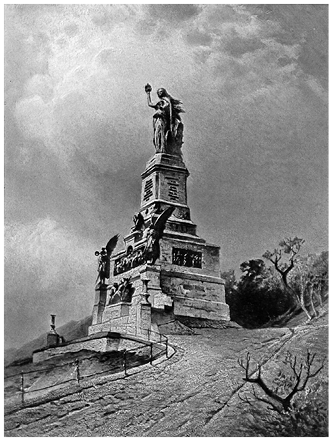
Figure 1.1 Germania monument at Niederwald near Bingen (drawing by Nikolai von Astudin, 1920).
On the plinth of the monument, the full text of ‘Die Wacht am Rhein’ was engraved on bronze plates. That song had been the semi-official anthem of the 1870–1871 war, and it was now reprised by the passing soldiers, with its refrain ‘Dear Fatherland, you may rest assured, firm and faithful stands the Watch on the Rhine.’ Indeed, the outbreak of the war in 1914 was said to have been greeted with fervent joy by the men who sang ‘with feelings as though their chests would burst’ as they made their way to the fields of Flanders. Although some historians now query the ubiquity and fervour of that widely reported war enthusiasm, there were singing crowds, and there were many patriotic postcards from the early war years depicting merry soldiers singing ‘Die Wacht am Rhein’ in front of the Germania statue, keeping a felt experience in circulation like the one attested to in this wartime memoir – an influential one, at that, because the 1914 volunteer reminiscing here was Adolf Hitler, and the quoted passage is from Mein Kampf.1
What was it that raised the soldiers’ spirits? The singing and the heaving chests were inspired not by a calculated endorsement of realpolitik or of strategic war aims but by remembered glories, a nationally iconic landscape in the sunrise, a lavish statue that had become a landmark for all passers-by to admire, and a song that was familiar to and singable by everybody. And behind it all lay the collective sense that, as a nation, the singers were facing an ‘old enemy’ – that this war was the latest instalment in something transgenerational, an eternally renewed national challenge.
The same affects return in the continuation of Hitler’s reminiscences. Against the terror and courage of the battlefield is set the inspirational value of an old song.
Then at last came a damp, cold night in Flanders through which we marched silently, and when the day began to emerge from the fog, suddenly an iron salute came whizzing over our heads towards us and with a sharp report the small bullets struck between our rows, whipping up the wet earth; but before the small cloud had dispersed, out of two hundred throats the first hurrah roared a welcome to the first messenger of death. But then it began to crackle and roar, to sing and howl, and with feverish eyes each one of us was drawn forward faster and faster over turnip fields and hedges till suddenly the fight began, the fight of man against man. But from the distance the sounds of a song met our ears, coming nearer and nearer, passing from company to company, and then, while Death busily plunged his hand into our rows, the song reached also us, and now we passed it on : ‘Deutschland, Deutschland über alles, über alles in der Welt!’
Is this even genuine? Is it the recall of an authentic, factual experience, or is it embellished grandstanding? It matters little: this is how Hitler’s purple prose invokes national traditions in order to make the past relatable and inspirational. Hitler presents the events to his readers in terms that to him, and them, meaningfully suggest themselves. The cultural references that he uses to tie his narrative and his experience together were immediately familiar to all his readers, a clear and immediate presence in their minds and in their cultural frame of reference. But their chronology and combination is telling.
The Rhine’s picturesque, quintessential Germanness, and the need to defend it against an ‘old enemy’: these had been tropes ever since the Napoleonic Wars of 1806–1815, especially in E. M. Arndt’s seminal The Rhine, Germany’s River, but Not Germany’s Boundary (Reference Arndt1813a). The two songs that are name-checked as being spontaneously sung and shared by the comrades-in-arms are from the 1840s. ‘Die Wacht am Rhein’ was written in 1840 by one Max Schneckenburger, defying France and its expansionism by asserting that the German nation was ready to defend its quintessential river in arms. ‘Das Lied der Deutschen’ (The Song of the German People, known from its opening line as ‘Deutschland, Deutschland über alles’) was penned in 1842 by August Heinrich Hoffmann von Fallersleben, yearning in exile for his country’s unification. The Niederwald Monument celebrating the victory of 1871 had been erected in 1883.2
All these dates, 1813, 1840, 1842, 1871 and 1883, are simultaneously recalled and invoked as a single compound – indeed, in the root sense of the term, a ‘commonplace’ – in a narrative that, set in 1914, was written down in 1925 while Hitler was serving a prison sentence at Landsberg. These dates ‘hang together’ culturally, not only in their recall but also in their gestation. They were not isolated offshoots of different circumstances at separate historical moments. As I shall argue in greater detail towards the close of this book (Chapter 11), these successive moments of crisis were experienced, even at the time, as a concatenated, ongoing and iterative whole; and it is that iterative whole that formed the memoryscape and the Weltanschauung of Hitler’s reminiscences. Arndt’s tract on the cultural geopolitics of the Rhine had been echoed in many reprints across the nineteenth century and, let it be stressed, also as war propaganda (a pocket edition was distributed to soldiers in 1914–1918); Schneckenburger’s song was written under Arndt’s shadow and with his endorsement, with reactivations in 1870, 1883 and 1914. To see these as momentary cultural flare-ups triggered separately by the different political crises of 1814, 1840, 1870 and 1914 is to deny their ongoing presence and persistent, mashed-up availability as a cultural repertoire. Indeed, it is this cultural persistence that made it possible to experience the very different crises punctuating the century from 1814 to 1914 as an ongoing struggle between a timeless Germany and its ‘old enemy’. Both Germany and France, as states, had gone through repeated, drastic regime changes in those 100 years, but the enduring cultural repertoire made it feel as if it was always the same France, always the same Germany (nations, indeed, rather than states), in an ongoing struggle.
Nor do the iterative and self-stoking reverberations end there. By 1925–1927, when Hitler wrote Mein Kampf, ‘Das Lied der Deutschen’ had become Weimar Germany’s national anthem. Propagandistic reports that it had been sung in battle led to the ‘Myth of the Battle of Langemarck’, about the heroism displayed on 10 November 1914 as a result of the anthem’s inspiring power. Hitler’s account obviously resonated with that myth. Initially reported in a propagandistic despatch from the Oberste Heeresleitung (supreme army command), and intended to raise the morale of the home front, the Langemarck myth developed into a memory cult after 1918. Veterans and revanchists gathered to commemorate their heroism in a war whose ruinous outcome they could not come to terms with, and the recall of Langemarck became a veritable cult among revanchists in the Weimar Republic in precisely the years when Mein Kampf was written. There were mass commemorations and fresh monuments and memorializations, which persisted into the Third Reich. In 1943, a Flemish contingent within the Waffen-SS was formed under the name Sturmbrigade Langemarck.3
Strasbourg to Casablanca, 1792–1942
As to ‘Die Wacht am Rhein’, modern readers are probably most familiar with that song from the movie Casablanca (1942). In Rick’s café, the song is chauvinistically belted out by a new generation of German soldiers, Nazi officers this time. It is, however, drowned out as ‘La Marseillaise’ is defiantly, triumphantly intoned by a united chorus of refugees from all over Europe. Among the many stranded nationals, all trying to escape from Nazi tyranny, one young Frenchwoman, Yvonne, stands out. Jilted by Rick, she has become dissipated and promiscuous and has been degrading herself with Germans; but she now finds her true moral compass and identity as, tearfully and passionately, she sings the anthem that is hers more than anyone else’s, and concludes with a shouted ‘Vive la France!’ (Figure 1.2).
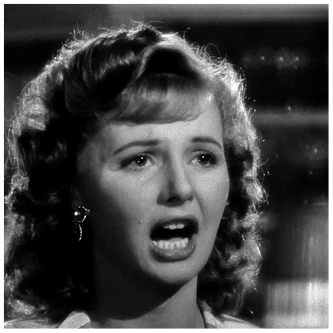
Figure 1.2 Yvonne (played by Madeleine Lebeau) tearfully shouting ‘Vive la France!’ after singing ‘La Marseillaise’ in the film Casablanca (1942).
The tears were not just acted: the French actress Madeleine Lebeau, who played the Yvonne character in the Hollywood studio, had in real life lived the plight of the fictional Casablanca refugees. She and her Jewish husband, Marcel Dalio (who played a croupier in Rick’s café), had been forced to flee Nazi-occupied France and on dodgy passports had wandered from Lisbon via Mexico and Canada to Hollywood. The role and the actress merged in the very real passion of this scene. Madeleine Lebeau, too, in a bitterly ironical twist of twentieth-century history, experienced that ‘feeling as though my chest would burst’.4
The power of ‘La Marseillaise’ to inspire such passion is almost proverbial. Composed by Charles Joseph Rouget de Lisle in Strasbourg on the eve of the Battle of Valmy (1792), it became an icon of popular defiance and battle-readiness. The Romantic historian Jules Michelet canonized the moment of its creation (Figure 1.3) as an almost metaphysical, spiritual moment of self-realization:
Rouget de Lisle, for he it was, burst into the room, wrote it all down, music and words. He returned singing the stanza ‘Come, children of the fatherland!’ (Allons enfants de la patrie!). It was like a burst of light from the sky. Everyone was moved, excited, all recognized the song even as they heard it for the first time. They all knew it, they all sang it, all of Strasbourg, all of France. The world, for as long as there will be a world, will forever sing it.
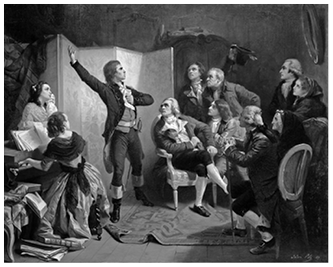
Figure 1.3 Claude Joseph Rouget de Lisle singing ‘La Marseillaise’ (Isidore Pils, 1849; Musée historique de Strasbourg).
To the Romantic transcendence of this magic moment, Michelet adds an explanation of his own: in its combination of battle fury and magnanimity, this song is more than a mere rhetorical contrivance. It is a direct manifestation of the very soul of the French nation. ‘Such indeed was the soul of France, moved by imminent combat, violent against its obstacle, yet wholly magnanimous, with a youthful and naive grandeur; even at the height of anger, above anger.’ That sublime rhetoric is vintage Michelet, who habitually saw in the glories of Revolutionary events the glory of France itself. But precisely in that oft-repeated flourish, Michelet proves himself a Romantic. He constantly extrapolates from the concrete to the metaphysical, from event-based factualism to the transcendent. And while history is a series of concrete events, the informing power that drives and experiences it – the nation, the ‘soul of France’ – is transcendent, metaphysical, eternal. That rousing power of ‘La Marseillaise’ makes it the mother of all national anthems.Footnote * Indeed it was – and in a historical sense too.5
People who, at moments of crisis, invoke the nation in a national anthem, attune themselves to the superhuman power that the nation is held to possess. The ecstatic fervour that can result, the ‘feeling as though one’s chest might burst’, is what in this book I call charisma.
Agincourt to D-Day, Novgorod to Leningrad
There is something poignant and uncomfortable in the realization that the author of Mein Kampf and the defiant anti-Nazi refugees in Casablanca could both share the same affect: the charismatic fervour derived from dedication to one’s nation and to the ideals that the nation stands for. National fervour is obviously an affect that can inspire very different ideologies and that can be found in many different countries. Let me briefly add, for good measure, examples from the other two main belligerents in World War II: imperial Britain and Stalin’s Russia.
In 1944, around the time of the Normandy landings, Lawrence Olivier was commissioned to turn Shakespeare’s Henry V into a government-funded, morale-boosting film.6 The film was dedicated to the ‘Commandos and Airborne Troops of Great Britain, the spirit of whose ancestors it has been humbly attempted to recapture’. That ‘spirit of the ancestors’ involves a set of cultural remembrances telescoping first 350, then 500 years back in history. The film’s opening shots set the scene at William Shakespeare’s own theatre in London. At the Globe, sometime in 1600, Shakespeare’s play The Chronicle History of King Henry the Fifth with His Battell Fought at Agincourt in France is to be produced. That framing device is gradually abandoned and the play-as-staged-in-early-modern-London dissolves into the play-as-set-in-medieval-France. After the initial framing minutes, Olivier’s Henry V moves from 1600 London to 1415 France.
First staged in 1600, a fraught year in Elizabeth I’s reign, Shakespeare’s history play recalled and celebrated an expedition during the Hundred Years’ War that culminated in England’s glorious victory at Agincourt (1415). Henry V is studded with rousing speeches, familiar and quotable sound bites, spurring on the combatants (‘Once more unto the breach, dear friends, once more’) and glorifying them as ‘We few, we happy few, we band of brothers’. That last speech is a masterstroke of time-travel back and forth: for Shakespeare, in recalling 1415, is putting a prophecy into Henry’s mouth foretelling how the battle of 1415 will be remembered and celebrated in the future.
And so the spirits of the Agincourt ancestors travel from 1415 through the Shakespearean amplification of 1600 into Olivier’s 1944 film; in the process they canonize the Normandy landings as an iteration of England’s heroic history. The battles were waged against France (in Henry V’s time), against Philip II’s Spain (in Shakespeare’s time) and against Hitler’s Germany, but England is always England.
A film that channelled memories from an even deeper past was Sergey Eisenstein’s Alexander Nevsky of 1938. It was commissioned by Stalin at a precarious juncture, when Eisenstein was absolved from an ideological ban during the ongoing purges of the time and before the Molotov–Ribbentrop Pact, which imposed a brief truce between Nazi Germany and the USSR. In that year, Eisenstein filmed a historical novel in the patriotic ‘defence of the fatherland’ mode, culminating in the defeat of the Teutonic Knights in 1242 on Lake Peipus at the hands of the Russian leader Alexander Nevsky, Prince of Novgorod and Kiev. The stature of Alexander Nevsky in Russian historical consciousness had been assured by his canonization as a saint of the Russian Orthodox Church. In the post-Napoleonic nineteenth century, some fourteen Russian Orthodox churches had been built and dedicated to Alexander Nevsky around the edges of the empire: from Vilnius (1865) to Tbilisi (1871), from Łódż (1884) to Baku (1888), from Warsaw (1894) to Novosibirsk (1896) and from Tallinn (1900) to Yalta (1902), as well as in Paris (1861) and Belgrade (Serbian Orthodox, 1877). The national celebration of thirteenth-century Nevsky was as familiar to communist Russia as that of Henry V was to Britain. In the event, Eisenstein’s film conformed to the ideological requirements of the time by combining a strong leader (Stalin-style) with idealized stalwarts from the common people. What united them was the German threat coming from the west.7
All these cases combine rousing war propaganda with elements that are both culturally produced and culturally disseminated: anthems, theatre, commemorations. The formula is strikingly similar across profoundly diverse ideologies (Fascist, republican–democratic, imperial, communist). The culturally platformed appeal to nationality also encompasses countries and locations far apart in space – the placenames mentioned here reach from Hollywood to Novosibirsk and from London to Baku. And the cultural texts produced in a very short time span (Mein Kampf, 1925; Alexander Nevsky, 1938; Casablanca, 1942; Henry V, 1944) can effortlessly activate memories from a time span ranging from 100 to 150 years before (Mein Kampf, Casablanca) to five centuries (Henry V) or even seven (Alexander Nevsky). The process is obviously one of condensation, even compression. That is what the cultural element in nationalism does: it consists of a vast, diffuse set of symbols and references but can condense and pack all of that into a tight political punch, concentrating the nation’s time and space into a single thing – timeless, topical, ubiquitous.
From Reverence to Charisma
Civic Religion and History-Makers
Love of one’s country is a very ancient affect, and in the spectrum of human virtues and emotions it has since Cicero been linked to the concept of filial piety: we love our country the way we love our parents, with a sense of reverence and an acknowledgement of their superiority and our subservience. There is a religious, devotional element in this relationship between an individual and their country. In 1762, Jean-Jacques Rousseau’s Du contrat social (The Social Contract) pinpointed it: ‘Jamais État ne fût fondé, que la Religion ne lui servit de base’ (never was there a state founded without religion having served as a basis). Religion and the state share protocols, ceremonies, hallowed spaces and a sense of permanence transcending the lives of individual people. They share cults: the churches have their saints, the states their Great Men, and statues, shrines and commemorative feasts honour both. For Edmund Burke, it is the superhuman longevity of the state and of its institutions that inspire awe and reverence. A social contract, yes; but one much more august than ‘a partnership agreement in a trade of pepper and coffee, calico or tobacco, or some other such low concern’. It is a universal rather than a particular one, stretching over ‘many generations’, and for that reason it is to be looked upon with ‘reverence’:
it becomes a partnership not only between those who are living, but between those who are living, those who are dead, and those who are to be born. Each contract of each particular state is but a clause in the great primeval contract of eternal society.8
Burke’s sense of pious reverence towards the state as a sublime edifice of social permanence is still classical, rooted in the Ciceronian ethics of proper citizenship. In the course of the nineteenth century, this would morph into a tearful, chest-constricting pathos inspired by the nation.
Burke’s assertion of the state’s awe-inspiring stability responded to a rising tide of subversion: the quotation is from his Reflections on the Revolution in France (1790). That revolution put paid, much to Burke’s dismay, to the time-hallowed endurance of the old order. As the French Revolution swept custom and tradition aside and rebooted the state, its new leaders felt that their position was like that of the early statesmen of the emerging states of classical antiquity, unburdened by established tradition and free to shape society as they saw fit. They started a new calendar and year-count, to begin with, and developed a personality cult of the strong political visionary. Robespierre considered himself a ‘lawgiver’ in the mode of the primordial legislator of ancient Sparta, Lycurgus. Napoleon was universally seen, in dread or admiration, as a superhuman Titan and crowned himself like a new Julius Caesar. His stature is strikingly expressed in the proto-Fascist art of his tomb in the Invalides, where he is depicted as dispensing laws, roads, canals, weights and measures, institutions – creating the state in a continuous act of superhuman willpower. The cult of personality around Stalin, Hitler, Ceauşescu et hoc genus omne is a direct continuation of this tradition. It combines omnipresence with absence: portraits are everywhere, mass rallies part of the pageantry repertoire, but with the Great Leader himself usually at a safe distance.9
As we shall see in Chapter 3, the decades that saw the political turmoil of Robespierre and Napoleon also saw the cultural onset of Romanticism. The most prominent philosopher of the time, Georg Wilhelm Friedrich Hegel, was deeply concerned with the historical turbulence of his times, and Napoleon loomed large in his thought. His Lectures on the Philosophy of History (delivered in the 1820s and published posthumously in 1837 and 1840) were primarily concerned with the rise and fall of states – the stability of the Burkean state was well and truly obsolete by now. Hegel argues that the self-perpetuating power and grandeur of the state (the thing that had so impressed Burke and the Burkean conservatives) was susceptible to drastic change, but only if that change emanated from outside its own order. Truly revolutionary and history-moving impulses are given from outside the state through the personal instrumentality of specifically ‘clear-sighted’ and powerful individuals who, though concerned with their individual vision rather than with their institutional context, at the same time actualize a higher, world-changing purpose. These order-changing supermen Hegel called by the ancient Greek name of ἡρωες, heroes: demigods, offspring of a divine/human couple, often mythically standing at the beginning of a dynastic lineage.
Such [i.e. such as Julius Caesar] are all great historical men – whose own particular aims involve those large issues which are the will of the World-Spirit. They may be called Heroes, inasmuch as they have derived their purposes and their vocation, not from the calm, regular course of things, sanctioned by the existing order; but from … that inner Spirit, still hidden beneath the surface, which, impinging on the outer world as on a shell, bursts it in pieces, because it is another kernel than that which belonged to the shell in question. … Such individuals had no consciousness of the general Idea they were unfolding, while prosecuting those aims of theirs; on the contrary, they were practical, political men. But at the same time they were thinking men, who had an insight into the requirements of the time – what was ripe for development.
In other words: the order of things was made, and from time to time unmade and remade, by Great Men with a superhuman purpose and power. Their power to shape history, rather than to be shaped by it, was what made mutations in the world order possible: the downfall of existing empires, the rise of new ones. Hegel obviously had Napoleon in mind.
This was the very Truth for their age, for their world; the species next in order, so to speak, and which was already formed in the womb of time. It was theirs to know this nascent principle; the necessary, directly sequent step in progress, which their world was to take; to make this their aim, and to expend their energy in promoting it. World-historical men – the Heroes of an epoch – must, therefore, be recognized as its clear-sighted ones; their deeds, their words are the best of that time.10
Alongside this political philosophy of history, Romanticism also created a poetic philosophy of history. The poetics of Romanticism (discussed more fully in Chapter 3) sets the creative spirit apart from the common individual. What makes the artist special is not just accomplished craftsmanship but also a power to reach higher states of awareness and to intuit transcendent truths. The inspired artist is the essence of Romanticism, and like the primordial lawgivers he, too, is traced back to the dawn of civilization. His typology goes back, by way of Ossian, to the mantic bards who explore liminal spaces and who, in Shelley’s words, are ‘the unacknowledged legislators of the world’. What they produce is, in Thomas De Quincey’s distinction, a ‘literature of power’ rather than a ‘literature of knowledge’.
This intuitive, visionary power means that the Romantic artist, heir to Homer and Ossian, can stand alongside political state-makers such as Robespierre or Napoleon, heirs to Moses, Lycurgus and Caesar. The Romantic artist in his ‘literature of power’ articulates the nation, brings it into being through his capacity to channel and capture its essence and to express its character in inspired, poetic language. Moses, Jesus and Muhammad founded religions; Lycurgus, Caesar and Napoleon established empires, states; Homer, Dante and Shakespeare can create civilizations, cultural communities, nations.
Hero-Worship: Carlyle to Weber
The twinning of political and cultural ἡρωες-supermen, initiators of new orders, was made explicit by Thomas Carlyle in his On Heroes, Hero-Worship, and the Heroic in History (Reference Carlyle1841). Carlyle provided a moral compass for a timidly secularizing world. What, if not religion, could make us good, and make us better people? Carlyle argued that we should realize the best in our humanity by trying to live up to the great ἡρωες and the example they set us. Hero-worship was the next best thing to the worship of a divine godhead.
For Carlyle, as for Hegel, ‘heroes’ is a word redolent with its original Greek root meaning: superhumans occupying an intermediate, indeed mediating position between humanity and the gods, often born from a union between a god and a mortal. Their awe-inspiring power provides their descendants with a lasting reservoir of moral pride and collective idealism. Hero-worship, accordingly, was held up by Carlyle as a just and necessary pedagogical principle, enabling individuals to rise above their mean level by emulating lofty examples.
Carlyle found some modern-day equivalents of the Greek Kadmos and Theseus figures, or the Hebraic Moses, in the powerful, history-changing cases of the prophet Muhammad and Frederick the Great of Prussia. (Hegel himself had identified three: Alexander the Great, Caesar and Napoleon.) Carlyle’s history of the French Revolution, anti-French and anti-Revolutionary though it was, showed surprising respect for the strong, inspired leadership of Robespierre and Napoleon, capable of taming the forces of anarchic discord.11
Alongside such political history-changers, however, Carlyle recognized that the same role could be played by writers: hypercanonical writers such as Homer, Shakespeare and Dante, who provided the Greeks, English and Italians with a lasting cultural identity as strong as any religion or state. ‘The Great Man here too, as always, is a Force of Nature. Whatsoever is truly great in him springs up from the inarticulate deeps.’ Carlyle canonizes Shakespeare into an essential cornerstone of the English presence in world history: an Everyman (‘our poor Warwickshire Peasant, who rose to be Manager of a Playhouse, so that he could live without begging’), not a primeval mythical deity like Odin, and yet, ‘in spite of the sad state Hero-worship now lies in’, the most cherished cultural presence ‘in this land of ours’, for ‘millionsof Englishmen’. More cherished and precious, even, than Britain’s colonial empire in India.
For our honour among foreign nations, as an ornament to our English Household, what item is there that we would not surrender rather than him? Consider now, if they asked us, Will you give up your Indian Empire or your Shakspeare, you English; never have had any Indian Empire, or never have had any Shakspeare? Really it were a grave question. … should not we be forced to answer: Indian Empire, or no Indian Empire; we cannot do without Shakspeare! Indian Empire will go, at any rate, some day; but this Shakspeare does not go, he lasts forever with us; we cannot give up our Shakspeare!12
One of the most important followers of Carlyle, Matthew Arnold, picked up this idea in his Culture and Anarchy of 1869. Arnold, like Carlyle, saw a new responsibility for public intellectuals in a secularizing age: to dispense life-lessons, to give ethical and intellectual guidance. Arnold located this responsibility primarily in the field of culture, which in his outlook almost takes the place that had been left behind by an evaporating religiosity. Culture for him was ‘the best that is known and thought in the world’ and a necessary ingredient in lifting humans above the level of mere cogs in a socio-economic machinery. He idealized the Greek world for the ‘sweetness and light’ of its culture – poetically indicating that the hard work of a beehive is not an end in itself but provides the world with honey (sweetness) and candlewax (light). This provides a saving grace without which Arnold’s dour, pragmatic, wealth-obsessed Victorian contemporaries would become (his word) mere philistines. What society needed was public intellectuals (‘critics’) who could ‘learn and propagate the best that is known and thought in the world’. What is more, it was ultimately through the instrumentality of culture that societies could become harmonious wholes, rather than merely transactional exchange networks. Indeed, culture was ultimately a necessary safeguard against social disintegration – hence the ‘Culture and Anarchy’ title of his book.13
Thus Carlylean thought accorded an increasing ‘national’ importance and authority for writers. Many, from Pushkin, Mickiewicz and Petőfi on, saw themselves as sacral prophet-figures, as champions articulating or channelling their nations’ wishes, aspirations and collective imagination. Even where they themselves did not develop Romantic pretensions to become Heroes in the Carlylean sense, they did attract the hero-worship of their readers, who following their deaths proved quite ready to canonize them and to create a cult in their memory. By 1916, James Joyce sarcastically imputed to his adolescent persona Stephen Dedalus the ambition to ‘forge in the smithy of his soul the uncreated conscience of his race’ (A Portrait of the Artist as a Young Man); Joyce was by then already beginning to see through this lofty sentiment as a commonplace.
If we look at the cult of great heroes of the nation, we see that artists and writers feature surprisingly prominently – given their lack of political agency or actual raw power. Indeed, their lack of political power is compensated for by a surplus of cultural authority, and in the long run this may give cultural saints, as opposed to political leaders, a greater historical permanence; for political leaders are usually caught up in political struggles that leave political losers and victims in their wake, as well as hard feelings. Artists and writers are feel-good heroes. They serve as consensus figures and have fewer enemies. There were many, many statues erected to Lenin and Stalin in Russia between 1920 and 1990, but the ones to Pushkin and Rimsky-Korsakov have survived. In the historical portrait gallery of twentieth-century French banknotes, Napoleon makes only a fleeting appearance (and that only in his early-career status as general in the service of the Directoire); his presence on French twentieth-century banknotes is drowned out by a huge company of writers, painters and composers.14
Carlyle’s notion of the hero-figure as an inspiration to society was followed and amplified by Emerson’s lecture series on ‘Representative Men’ and in Nietzschean thought. It kept a cultural life in nineteenth-century historiography, where the organizational narrative model of arranging important developments under the rubrics of heroic ‘Great Men’ was notoriously predominant. ‘Men’ they were, of course; the shining exception being Joan of Arc, who was rediscovered by the Romantics after Schiller’s play Die Jungfrau von Orléans and, celebrated by Michelet and his followers, became a national cult figure in France as a truly supernatural agency for the country’s salvation, embodying (depending on the historian’s secular or religious proclivities) either the transcendent, imperishable spirit of France or God’s solicitude for that chosen nation.15
From the field of culture the Carlylean hero model returns to the field of politics around the end of World War I, when Max Weber introduced the notion of charisma into his analysis of political leadership (Herrschaft). Weber distinguished three type of rule: dynastic and institutional (those two being the ones already operative in Burke’s sense of state authority) and a third one, non-Burkean and close to that of Hegel’s Heroes. To that third form of leadership, a mesmerizing, crowd-mobilizing force of personality, he gave the Greek name of charisma. The examples he gave were the Bavarian socialist leader Kurt Eisner (who had turned Bavaria from a kingdom into a republic), the American religious prophet Joseph Smith and the German poet Stefan George, who had gathered a cult-like coterie around himself.16
Tellingly, charisma was originally a theological term, denoting the gracious disposition of divinity that elicits joy among worshippers and attracts the warmth of their devotion. Weber’s direct inspiration, the theologian Rudolf Sohm, had used it to explain how early Christians were motivated to endure and overcome massive repression. Early Christians were inspired, Weber argued, by the guidance of a leadership displaying
a certain quality of an individual personality by virtue of which he is set apart from ordinary men and treated as endowed with supernatural, superhuman, or at least specifically exceptional powers or qualities. These as such are not accessible to the ordinary person, but are regarded as of divine origin or as exemplary, and on the basis of them the individual concerned is treated as a leader.
Weber died in 1920, before he could fully elaborate his theory of charismatic leadership, bequeathing little more than this thumbnail sketch to posterity. Brief though it is, it does betray the traces of Carlylean thought, which in the previous half-century had become widespread all over Europe. (In Germany, Carlyle had been revered for his hero-worshipping biography of Frederick the Great of Prussia – apparently one of the chosen books to provide reading material, until the very end, in Hitler’s bunker in 1945.) The social acceptance of charismatic leadership is explained by Weber in Carlylean terms: ‘It is recognition on the part of those subject to authority which is decisive for the validity of charisma. This is freely given and … consists in devotion to the corresponding revelation, hero worship, or absolute trust in the leader [my emphasis].’
Charismatic Leaders, Charismatic Nations
Historians have wondered if and how Weber’s idea of charismatic leadership could be applied to the new leaders, totalitarian and otherwise, that emerged out of the Great War and after Weber’s death in 1920. The mass appeal of Mussolini and of Hitler himself strongly suggests an analysis in Weberian terms;17 but the question ‘What would Weber have thought of that?’ is as moot as it is unavoidable. It does make sense, however, to place the fervour with which a charismatic leader is embraced in the context of what Wolfgang Schivelbusch (Reference Schivelbusch2004) has aptly termed a ‘culture of defeat’. (For that reason, many scholars see a tension between the appeal of charismatic leadership and the actual ‘routinized’ running of state affairs.18) People unable to stomach the grinding mortification of a lost war, who find themselves in disarray or in parlous circumstances, will eagerly, and joyfully, embrace unexpected saviour-figures. The veterans who clung to their Langemarck myth, the people to whom Hitler’s Mein Kampf appealed, found such a figure initially in the gruff paternal figure of Field Marshal von Hindenburg, last president of the Weimar republic and Bismarck lookalike. He had commanded at Germany’s greatest victory in 1914–1918, the Battle of Tannenberg on the Eastern Front. He it was who, in an inquest conducted by the new Weimar authorities on the conduct of the war effort, launched the notorious ‘stab in the back’ legend; and he spread that myth also through his self-serving but massively popular book of reminiscences. It was Hindenburg most of all (more than the erratic fanatic Ludendorff) who leveraged, well before Hitler, Germany’s post-1918 political bitterness into his political leadership and into a veritable cult of personality. Hitler’s own upgrade from street fighter to chancellor was effected by the accolade from the august war hero Hindenburg (who, as an aristocratic general, scorned the Austrian corporal as a vulgar upstart).19
Following four years of total war, the generals of those wars emerged after 1918 with an almost Napoleonic aura of authoritative power, and many of them became state leaders. Alongside Hindenburg in Germany we see strongmen such as Mustafa Kemal Pasha (the future Atatürk) in Turkey (Figure 1.4), Horthy in Hungary, Metaxas in Greece, Piłsudski in Poland, Pétain in France; as well as the more complex figure of Mannerheim in Finland.20 Their aura of military authority was envied by their more vulgar emulators, Mussolini in Italy and Hitler in Germany. Although they could not claim to have held any field command they also affected military uniforms and style. The cult of uniforms, salutes, parades, flags and insignia suffused these states’ official display culture post-1918. That contributed to the general militarization of politics and to the decline of parliamentary and constitutional rule (civic and civilian as that was) in most post-1918 European states.
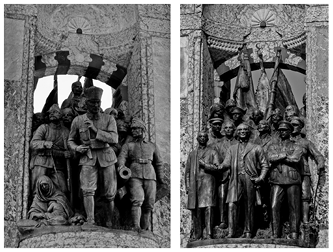
Figure 1.4 Mustafa Kemal Atatürk depicted twice on two sides of the Monument of the Republic, Gezi Square, Istanbul (1928): as wartime general (left) and as postwar statesman (right).
However, the charismatic leaders post-1918 were not just military commanders in a Napoleonic lineage (in Weberian terms they would have embodied ‘institutional leadership’, albeit embellished with a personal heroic aura). As the venerable Burkean empires crumbled in the Great War, the leaders that emerged in the vacuum they left behind were, predictably, of the ‘charismatic’ type, and many of them came from the cultural field as well. The new states arising from the wreckage of 1914–1918 were, certainly at first, represented highly effectively by men who had gained status as a result of their achievements in the field of culture, or at least outside the field of inherited or institutionally established lineages of power. They include Thomas Masaryk, public intellectual, lawyer and historian, who became the first president of an independent Czechoslovakia; Fridtjof Nansen, polar explorer and apologist for Norwegian independence, who became a highly respected international statesman; and Ignacy Paderewski, piano virtuoso and composer, who became the first prime minister of a newly independent Poland.21 As charismatic leaders, they derived their political authority from cultural achievements.
So whom, Piłsudski or Paderewski, Mussolini or Masaryk, might Weber have been thinking of? It is far from easy to pinpoint the type of statesman that fits Weber’s bill as a charismatic leader. With that, I return to the question of what or who it was that gave people that sense as if their chest would burst; and I return to the tears on Madeleine Lebeau’s face in Casablanca. Casablanca attempts to build up an element of hero-worship around the figure of Viktor Laszlo, leader of the anti-Nazi resistance (played by the Austrian exile Paul Henreid). Laszlo is supposed to be one of the most redoubtable enemies of Nazi rule, and it is he who initiates the singing of ‘La Marseillaise’ and the collective multinational show of defiance. Ingrid Bergman goes dewy-eyed at seeing his rousing strength of character. However, his presence pales besides that of the brooding, Byronic Rick; next to Humphrey Bogart, Henreid is, in fact, a bit colourless. And it is neither Viktor Laszlo nor Rick who moves Yvonne to tears and to her defiant exclamation. That is the work of the song itself, the words and lyrics of ‘La Marseillaise’; and what Yvonne exclaims is, accordingly, a passionate commitment, not to this or that leader, but to her national identity: ‘Vive la France!’
This is what lies behind the title of this book. It is the nation itself (not the state or its leaders) that has become the most compelling charismatic force in politics.22 It is the nation, as an abstraction, timeless and ubiquitous, that can rouse people into something that goes far beyond Burkean reverence. The ecstatic assertions of love and devotion that sent young men such as Hitler singing into battle, that made them enlist as they sang their respective national anthems, with feelings as though their chest would burst: all that was inspired by the nation, which had itself acquired charisma in the century after Burke and Napoleon.
‘Beyond Politics’: The Unpolitical Nation
An early example of charismatic leadership in Ireland was Charles Stewart Parnell, whose scandalous political downfall and untimely death in 1891 left a sense of tragic bereavement. It is generally accepted that in that political void, Douglas Hyde’s lecture on ‘The Necessity for De-Anglicising Ireland’ (1893) started a process of cultural (rather than parliamentary–political) nationalism, calling for a reinvigoration of Ireland’s traditional cultural pursuits: music, dance, sports and, most importantly, the declining Gaelic language. This cultural revival movement eventually radicalized and politicized, preparing the ground for the Easter Rising of 1916 and the Irish War of Independence (1919–1921). As far as Hyde himself was concerned, that radicalization and politicization was an unintended aberration. He denounced the growing politicization of the Gaelic League (the association that his lecture had kick-started and which he chaired). He went as far as withdrawing from its chairmanship over this very issue in 1910. But by 1903, under his guidance and presidency, the League had already declared a ‘War on Anglicisation’; and in retrospect the move from Hyde’s cultural revivalism and regenerationism towards a political rejection of English hegemony seems perfectly straightforward. That impression is confirmed, it would seem, by the fact that it was Douglas Hyde who was later chosen to become the first president of the independent Irish Republic. All in all, the developments seem a typical illustration of Miroslav Hroch’s model of how national movements develop from initial cultural consciousness-raising (‘Phase A’) to social and political activism.23
Hyde’s 1893 lecture denounces and rejects the predominance of English culture in Ireland and calls for a return to the country’s native Gaelic roots. Contemporary readers will be puzzled at Hyde’s simultaneous assertion that this agenda of ‘de-anglicisation’ is in fact not political at all. For a discourse carrying such a – not altogether unpolitical-sounding – title, that comes as a surprise. Is it crafty rhetoric or blithe ingenuousness? Hyde concludes as follows:
I would earnestly appeal to every one, whether Unionist or Nationalist, who wishes to see the Irish nation produce its best – and surely whatever our politics are we all wish that – to set his face against this constant running to England for our books, literature, music, games, fashions, and ideas. I appeal to every one whatever his politics – for this is no political matter – to do his best to help the Irish race to develop in future upon Irish lines, even at the risk of encouraging national aspirations, because upon Irish lines alone can the Irish race once more become what it was of yore – one of the most original, artistic, literary, and charming peoples of Europe.24
Readers will recognize the echoes of Matthew Arnold’s Culture and Anarchy. Hyde argues that culture is a force of moral improvement and regeneration for a nation, and that this cultural mission is itself a moral one and therefore politically uncontentious. It ought to be endorsed by all morally upright people, whatever their party-political preferences. Strengthening the national culture is as unpolitical as denouncing child abuse and will be agreed upon by all: socialists, liberals or conservatives. The national culture and its improvement are seen by 1893 as a categorical imperative, a self-evident moral duty. This turns cultural nationalism from a political agenda into a virtue plain and simple – something above ‘politics’.
Hyde was utterly sincere about this, as his 1910 resignation as president of his Gaelic League bears out. His came from a Protestant, English-descended background, and he saw a turn to Gaelic culture as joint venture for Ireland’s two classes: the Protestant Anglo-Irish elite and the Catholic, Gaelic-descended (though no longer Gaelic-speaking) underclass and emerging petty bourgeoisie. Hyde’s vision can be compared to that of the Fennomans in Finland, descended from a Swedish elite but now adopting Finnish culture and the Finnish language in an act of cultural self-rearticulation.
Twenty years after Hyde’s lecture, the nationalist invocation of an ‘unpolitical’ nation was made more stridently in Thomas Mann’s Betrachtungen eines Unpolitischen (Observations of an Unpolitical Man, 1918). In the fervour of the 1914 moment, a wave of opinion-making had broken loose over Germany, with public intellectuals asserting to the general public the necessity and justness of Germany’s belligerence and war aims (see Chapter 11). One of these volunteer propagandists was Thomas Mann. His justifications of Germany’s wartime conduct were published in 1918 as ‘unpolitical’ observations (Mann Reference Mann2012). That, again, may surprise a contemporary reader, and for two reasons. For one thing, as with Hyde, the book is nothing if not political – it is, in fact, war propaganda wrapped up in moral reflections. As with Hyde, it is ‘unpolitical’ (as we shall translate the German unpolitisch here) only in the sense that Mann claims to stay aloof from party politics, in fact following Wilhelm II’s battle cry of 1914: ‘Now I no longer recognize parties – I only recognize Germans!’.
The other startling thing about this book is that Mann is now known as a dignified, courageous opponent of the Hitler regime, who, though cherished and celebrated as a Nobel-prize winning novelist, preferred to exile himself rather than to live in a Nazi-ruled country. A wartime chauvinist, he? Yes: the liberal humanism for which Mann is now known and admired was a post-1918 conversion.25 In his earlier years, Mann was a committed German patriot, who expressed his attachment to nationally German values in terms of the ethnotypes (ethnic stereotypes) that were commonplace around 1910 and that were becoming virulently xenophobic around 1914.Footnote * Germans, so the ethnotype goes, are earnest and profound, as opposed to the frivolous and superficial French and the cynically self-serving British. That, too, is how Mann defended the German war effort. ‘Politics’ in the republican, democratic sense was a French invention and boiled down to the transactional bickering between interested parties; while politics, British-style, was only a coldly calculating concern with economic advantage and power expansion. Germans, so Mann asserted, had no truck with those ‘politics’. Instead, their sense of being part of a larger societal whole was profound, almost anthropological, based on the awareness of a deep, shared culture. In this context, the war was not a political thing but an engagement of the entire nation as a whole, including its spiritual values and culture. Mann, in seeing German Kultur as a set of spiritual values, opposed that profound, moral sense of national identity against French civilisation, which consisted of good manners polishing the mere surface of social relations. And in collectivizing the war into a totalizing national engagement beyond politics, Mann lifted his commitment to the German nation – and its war aims, and even its methods of submarine torpedo warfare, which Mann defended – out of the realm of politics and into what he terms ‘unpolitics’: it was a question of fundamental identity and as such a moral rather than a political principle.Footnote * These national-characterological ethnotypes couch historically specific social or political structures in a generic, anthropological assertion that ‘that is just how people are’.
Here, then, is a conundrum. On the one hand, commitment to the nation is being generalized into a general human virtue, like fidelity to one’s spouse, or kindness to children, or being true to one’s identity. On the other hand, it is a powerfully strong mobilizing – and antagonizing – force, capable of inspiring battle courage in soldiers and strenuous defiance in civilians.26 ‘Die Wacht am Rhein’ can be sung en route to battle or as a jolly convivial outburst in Rick’s café. Much of this book will deal with this ambivalence, so characteristic of nationalism. Both in culture and in politics, the idealized, charismatic nation can be a mellow feel-good factor, or bestow moral edification, or justify bitter antagonism, often in rapid alternation.
Versailles, Berlin, Belfast, Odessa
What is the Third Estate? Everything.
What has it been in the political order so far? Nothing.
What does it demand? To become something.
The formative moments in the emergence of the nation as a political principle were 1789 (Versailles) and 1808 (Berlin).1 In June 1789, delegates of the French Third Estate gathered in Versailles as the French Revolution was forming in the air. That ‘Third Estate’ was a container term for those who were neither prelates nor noblemen. In the words of the seminal pamphlet by Emmanuel Sieyès, Qu’est-ce que le tiers état?, the Third Estate had always been ‘Everything’ in socio-economic terms, had amounted to ‘Nothing’ in the running of the state, and now demanded, politically, to ‘become Something’ (Figure 2.1). As the political events of mid-1789 unfolded, this Third Estate constituted itself into a mandate-giving representative body. That body christened itself, at the suggestion of the same Sieyès, the Assemblée nationale, and thereby gave the word nation a new political meaning. The nation was the Something that the Third Estate aspired to become. Their assemblée was the rump continuation of a meeting of the Estates General that, convoked by King Louis XVI, had disbanded when Louis found the delegates too fractious and rebellious. The First and Second Estates (clergy and nobility) obeyed the king’s dissolution of the Estates General and disbanded, but the Third Estate vowed to remain in session until they had given France a constitution. It was this decision that formed the actual beginning of the French Revolution; the storming of the Bastille took place almost a month later (14 July). In August 1789 the Assemblée nationale voted for the abolition of feudalism and enacted the Declaration of Human and Civil Rights. In the space of two months, the nation had definitely managed to become Something.
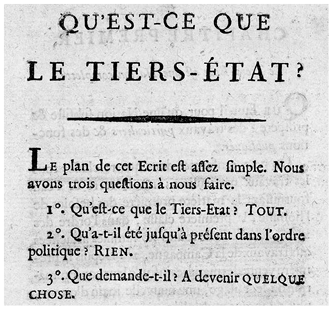
Figure 2.1 Opening page of Emmanuel Sieyès’s What Is the Third Estate? (Reference Sieyès1789).
In 1808 in Germany, the nation also became Something; in this case, it became the principle that was called upon to fill the void left by the imploding Reich. Following the imposition of Napoleonic overlordship, the thousand-year-old empire (formally known as the Holy Roman Empire of the German Nation, das Heilige Römische Reich Deutscher Nation) had abolished itself in 1806. At that juncture, the celebrated philosopher Johann Gottlieb Fichte held public lectures (Reden an die deutsche Nation, Reference Fichte1808), in which he addressed the bereft ‘Deutsche Nation’; he implicitly redefined them as the subsisting body politic of the now-defunct empire. He, too, tried to turn the nation into Something: a continuity principle,2 a cultural community, autonomously existing as such on the basis of a common language, a common past and shared values. That nation, now culturally rather than constitutionally defined, was to become the focus of the political loyalty and aspirations of the German Romantic generation. Fichte’s Reden followed and consolidated a line of argument already thought out by Schiller in 1797, when territorial losses had begun to threaten the millennial fabric of the Holy Roman Empire:
Can the German, with head held confidently high, take his place among the nations? Yes he can! The German Reich and the German nation are two different things. The Germans’ majesty never rested on the head of their monarch. Outside the realm of the political, Germans have established a dignity unto themselves, and even were the Empire to go under, that German dignity would remain unimpeached. It is a moral quantity, residing in the nation’s culture and character, which is independent of its political vicissitudes.3
This emergence of the nation as a political Something was provoked, in France and in Germany, by constitutional crises requiring a redefinition of the relations between the state and its taxpayers. But there was a new force at work as well, and it was operative in various places along the edges of the European monarchies and empires: people were rejecting state rule altogether because it was considered an alien imposition. A separatist, republican rebellion took place in Ireland in 1798; an anti-Ottoman secret society was founded by Greek merchants in Odessa in 1814. Both invoked the right of the people to secede from, or to rise against, a government they considered tyrannical. In that respect they were both inspired by the American and French Revolutions of 1776 and 1789 and by the notion of popular sovereignty. But in these cases, popular sovereignty was invoked to secede from states whose governments were denounced not only as despotic but also as a foreign yoke (English and Turkish, respectively) on their own nation (Irish, not English; Greek, not Turkish). The aim was not to reform the state but to secede from it; and unlike the Founding Fathers in the United States, they aimed not to start a new state afresh but rather to re-establish an ancient one that in the course of history had been vanquished and conquered.
Belfast to Odessa: the European span does not get much wider, either in space or indeed in time. Those two cities have remained flashpoints in Europe’s national conflicts ever since. Everywhere along the tectonic faultlines of Europe, the seismic tremors were noticed, along the grinding edges of the British, Spanish, French, Habsburg, Romanov and Ottoman Empires. The political seismographs register violent regime changes and internal conflicts, fluttering between sullen disaffection and open rebellion. In the Southern Netherlands (present-day Belgium) anti-Austrian resistance was distributed evenly between radical and traditionalist factions; in the Balkans, Serbian and Romanian resistance against Ottoman rule was no less vehement than in Greece; in the Tyrol, the enforced transfer from Austria to Bavaria in 1805 was hotly resented and led to a rebellion; in Scandinavia, where in 1809 Finland was moved from Sweden to Russia and in 1814 Norway was moved from Denmark to Sweden, both Norway and Finland strove to maintain constitutional liberties in the process; in Spain, the Carlist wars affected the Basque and Catalan fueros (local autonomies) and provoked regionalist consciousness-raising.
States, Subjects, Secret Societies
The epicentre of all this was Napoleon, who vanquished and abolished ancient realms and created new ones at will. In the span of a few years, he put an end to the Papal States and to the Venetian, Swiss and Dutch republics; conquered Spain and Naples and humiliated Prussia; reduced and annexed sovereign German lordships, temporal and ecclesiastical; and drove the venerable Holy Roman Empire to self-abolish as he crowned himself an Emperor of the French. And then his own empire crashed and burned – not once, but twice. First at the Battle of Leipzig (1813), which sent him off to Elba, and then again at Waterloo (1815), which sent him off to St Helena.
The European state system staggered out of the Napoleonic upheavals with a desperate need for, above all else, stability. The congress system devised by Austria’s chancellor Clemens von Metternich attempted to provide this. The balance of power in Europe was regulated by diplomats who at crisis moments would convene to work out solutions, first at the Congress of Vienna (1814), then at further follow-up congresses. The one at Aachen (1818) was notable for taking repressive measures (such as censorship) against democratic activism and aspirations. This persecution of ‘demagogues’ affected many of the Romantic intellectuals who had supported the insurrection against Napoleonic hegemony: the pamphleteer and versifier Ernst Moritz Arndt, the theologian Friedrich Schleiermacher, the gymnastics organizer Friedrich Ludwig Jahn, the folksong collector Werner von Haxthausen, the student activist Hans Ferdinand Maßmann. For indeed the Napoleonic period had left Europe sharply divided ideologically: the restored monarchical governments aimed above all to return to their old authoritative positions and abhorred the French liberté, égalité, fraternité as a sinister force of anarchism and upheaval. A ‘democrat’ in their understanding of the word was a fanatical sans-culotte itching to unleash the terreur of the guillotine. But many populations in Europe, though they had come to abhor Napoleon as a warmongering despot, had tasted the benefits of a state that was based not on the privileges of the aristocracy but on a constitution with citizens’ equality before the law. After an anti-Napoleonic honeymoon period of 1813–1817, that friction between princes and peoples became apparent again. The reinstated monarchs, who had initially agreed to rule constitutionally rather than absolutely, tended to ignore the constitutions they had half-heartedly accepted, to whittle them away or even to abolish them.4
Signs of unrest at this reactionary trend flared up at various points on the European map. As early as 1817, a commemorative feast at the Wartburg Castle, bringing together students who had seen military action in 1813, turned into an act of defiance; in its wake, a participating student activist murdered a writer who was seen as an advocate of reactionary absolutism, and this in turn triggered the repressive measures of the Aachen Congress. Semi-private societies, modelled on the German Tugendbund (an anti-Napoleonic organization in Prussia in 1808–1809) and on the template of masonic lodges, kept the idea of patriotic civic empowerment alive.Footnote * As they were regarded with increasing suspicion by the authorities, these organizations retreated into discreet obscurity and in the process acquired the aura of sinister secret societies. At the Polish-Lithuanian University of Vilnius, now under Russian rule, a group of liberal-minded intellectuals was active in the early 1820s, with a visible outer layer known as the Philomaths harbouring a more radical inner circle, the Philarets. They were disbanded and harshly sentenced by the Russian authorities in 1823; but they were a first sign that the Polish intelligentsia would not abide by the continuing dismemberment of what once had been a separate realm (the united Kingdom of Poland and Grand Duchy of Lithuania). Ex-Philarets in exile who would continue their advocacy for a separate Polish nationality were the poet Adam Mickiewicz and the historian Joachim Lelewel. The university itself was closed down after the Polish Uprising of 1831. (Ironically, its books were distributed among newly founded universities in the Ukraine, which would later on become seedbeds of Ukrainian nationalism.) Meanwhile Russia itself had experienced the shock of the Decembrist revolt of 1825, which hastened the tsar’s paranoid withdrawal into reactionary absolutism. At the same time, however, Russia’s geopolitical rivalry with the Ottoman Empire (which had been excluded from Metternich’s congress system) developed into a semi-mystical mission to re-establish Christianity in Jerusalem and Istanbul; disaffected subjects of the Ottoman sultan were welcomed and supported in Russia on the basis of their shared orthodox religion. Macedonians, Bulgarians, Romanians and Greeks could find refuge and succour in Moscow or Odessa, and it is in the latter city that another secret society with nationalist aims was founded: the Greek Filiki Eteria (Φιληκη εταιρια: literally, ‘Friendly Society’).5 Pushkin, in provincial exile from Moscow, became an early sympathizer and was enrolled as a member. The euphemistic high-mindedness of that name recalls the German Tugendbund (‘Virtue Association’) and the Philomaths and Philarets (‘Friends of Science’/‘Friends of Virtue’). Similarly, the groups behind the Decembrist revolt of 1825 called themselves the ‘Union of Salvation’ in 1816, morphing into a ‘Society of True and Loyal Sons of the Fatherland’ in 1817 and into a ‘Union of Prosperity’ in 1818. These were obviously what Tolstoy had in mind when, at the end of War and Peace, he mentions Pierre Bezukhov’s project for a reformist association:
‘And what position [Nikolai Rostov asks] will you adopt toward the government?’
‘Why, the position of assistants. … We join hands only for the public welfare and the general safety.’
‘Yes, but it’s a secret society and therefore a hostile and harmful one which can only cause harm.’
‘Why? Did the Tugendbund which saved Europe … do any harm?’Footnote *
Meanwhile, in Italy, where absolute rule had been restored in the Kingdom of Naples and the Papal States, a group called the Carbonari resisted; there were imitators of that resistance in restoration France, the Charbonnerie. In time the Carbonari would evolve into the Young Italy movement led by Mazzini and Garibaldi. That, in turn, would inspire a number of national reform movements across the century, from Junges Deutschland to the Young Turks.6
In Germany, anti-absolutism initially took a more coded, cultural form: a cult of Schiller commemorations in the 1820s recalled how that great poet had celebrated the unification and revolt of the Swiss cantons under Wilhelm Tell (see Figure 10.1) and how he had passionately asserted the right to freedom of thought in his Don Carlos. A popular song, ‘Die Gedanken sind frei’, had been published in Achim von Arnim and Clemens Brentano’s anthology Des Knaben Wunderhorn in 1808, and it remained a widespread, subversive inspiration well into the twentieth century: it was distributed in the Commersbuch student songbooks (see Chapter 9), played by Sophie Scholl to her imprisoned father in 1942, and sung by demonstrators in blockaded Berlin in 1948.7
The anti-Napoleonic restoration tried to obliterate the memory of democracy; but the memory was kept alive in semi-clandestine cultural form. It would become a programme not just of political emancipation but of national liberation.
Uprisings
The Metternich system was rocked on its foundations by a number of revolts. The earliest of these (Serbia in 1816; Greece and Romania, masterminded by the Filiki Eteria, in 1822) were anti-Ottoman in character and took place in the Turkish-ruled Balkans; as such, they could still be seen as external to the congress system’s remit. But the ongoing decline of that alien Islamic empire would nonetheless affect Europe deeply. A wave of sympathy for the Greek cause – philhellenism – swept across Europe in the 1820s, and provided a coded outlet for anti-Metternich feeling among progressives. Some young men took active service to support the Greek cause, but most foregrounded was the cultural and moral–intellectual support, expressed in poetry, painting (Delacroix) and philology (Claude Fauriel editing collections of Greek insurrectionist songs in 1824). The symbolic culmination came when the Romantic poet Byron, who had become famous with dramatic poems set in the Ottoman-ruled Levant, embarked for Greece and died in besieged Missolonghi in 1824 (Figure 2.2).8
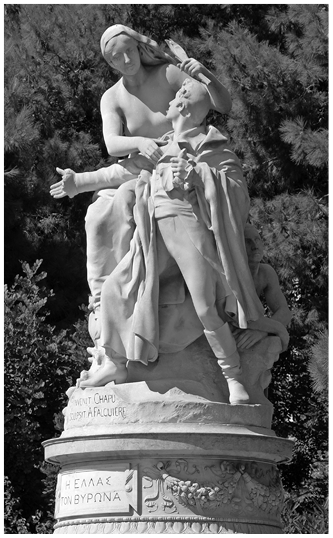
Figure 2.2 Statue of Byron in Athens (Henri-Michel Chapu and Alexandre Falguière, 1896): the Greek goddess of fame pulls the dying poet heavenwards.
Finally in 1832, the European powers, despite their ingrained mistrust of popular sovereignty, came down on the side of the Greeks and agreed to sponsor the establishment of an independent Greek kingdom: this took the place of the Hellenic Republic of 1822, the first new European state in the century of nationalism.Footnote *
The Hellenic Republic was followed by Belgium. In 1830, liberal anti-restoration revolts broke out in many European states. In France, the reactionary autocrat Charles X was replaced by the constitutional ‘bourgeois king’ Louis-Philippe. Revolts in Brunswick, Hanover and Saxony enforced constitutional changes. But the Southern Netherlands went further: rechristening themselves ‘Belgium’, they formally seceded from the United Kingdom of the Netherlands and its reactionary king Willem I and proclaimed a separate state. After some geopolitical balancing between neighbouring Germany and France, Belgium was internationally recognized, under a king from the German house of Saxe-Coburg-Gotha, brother-in-law to the future English queen Victoria and son-in-law to the French king Louis-Philippe. The country’s neutrality was internationally guaranteed – something that would become a casus belli when German armies, singing ‘Die Wacht am Rhein’ and on their way to defend that river against the perfidious French, invaded the country in 1914.
In 1830, again, the French and Belgian examples inspired an uprising in the Russian portion of partitioned Poland. Like the Greek one, it triggered a wave of sympathy among European progressives. Its own battle slogan (‘For our freedom and yours’) played into this sense that the cause of defending the people’s (‘national’) liberty against autocratic rule was a universal one. Indeed, the uprising was triggered by the refusal of Polish officers to be deployed for the intended repression of the Paris and Brussels revolts. The Polish Uprising was doomed, and henceforth the tsar became a despised symbol of tyranny and oriental despotism among European progressives everywhere. (He would in 1848 send troops to repress the anti-Habsburg revolt in Budapest, following the logic of the Metternich system.) A renewed Polish uprising in 1863 was equally unsuccessful, with many participants and sympathizers being sent to Siberia, but the cause of Poland was by now firmly accepted by liberal European opinion, thanks in no small part to its artists and intellectuals in exile: Mickiewicz, Lelewel, Chopin. The internationalism of the freedom fighters of 1830 became a universalist messianism: the sufferings of Poland were sufferings on behalf of Europe’s liberty generally. The Polish anthem ‘Not Yet is Poland Lost’ was adapted to become that of Croatian nationalists as well.9
1848 and the End of the Congress System
Belgium apart, it was only in the Balkans that the cause of national self-determination made any headway during this time, and that was largely thanks to the decrepitude of the Ottoman Empire. In the mid-century decades, Serbia and the Danubian provinces gained in autonomy and Greece began a process of territorial expansion. Elsewhere in Europe, national movements failed to wrest power from the state but, in the process of trying, gained influence and public sympathy for their principles. Sociability increased – choirs, athletic societies, book clubs and cultural societies with periodicals – and increasingly became platforms for the proclamation of national ideals. The political secret societies of yore were evolving into grass-roots cultural associations. Europe was now replete with self-defining nations with memories of ancient (feudal or pre-modern) autonomy. As their historical consciousness deepened (discussed in Chapter 7), these erstwhile realms and fiefdoms were beginning to chafe at the their contemporary subaltern and disempowered positions: Iceland, Norway, Ireland, Catalonia, Bohemia, Poland, Croatia, Hungary, Bulgaria. And in Germany, philologists and historians refused to acquiesce altogether to the abolition of the Holy Roman Empire with its vestiges of deep tribal–ancestral traditions. Its abolition was felt as an irksome and wrongful truncation of historical continuity, and a Reichsidee subsisted culturally as a vaguely felt nostalgia.10
A revolutionary upheaval came in 1848, when activists attempted to unify Germany politically by means of a Nationalversammlung (National Assembly) in the Free Imperial City of Frankfurt. (The patriotic Germans, by now habituated into a firm dislike of everything French, would have been aghast had they realized that they owed both the template and the name of this National Assembly to Emmanuel Sieyès.) The Nationalversammlung, in which intellectuals of the Romantic generation – Jacob Grimm, Ernst Moritz Arndt, Ludwig Uhland – took pride of place (Figure 2.3), failed to realize these unifying aims; the delegates had little or no standing with the autocratic German princes, were split between a radical left and a traditionalist right wing, and were divided even on the question as to which lands of the former Holy Roman Empire, north and/or south of the Alps, were to be included as ‘German’ in the new, national sense. But what they did achieve was to revive and turbocharge the dormant Reichsidee, the notion that the abolition of the Holy Roman Empire was merely a suspension, an interregnum, and that the Reich was in abeyance, awaiting its future revival and reconstitution.11
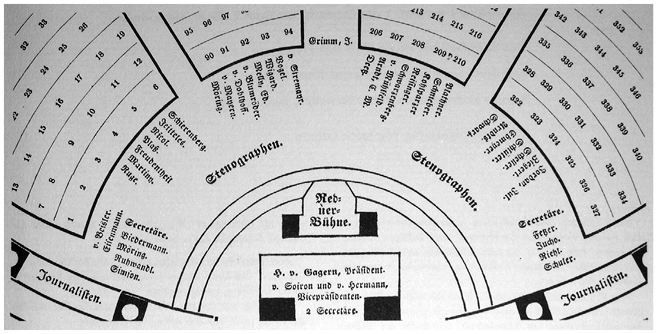
Figure 2.3 Seating plan of the Frankfurt National Assembly (1848). Jacob Grimm occupies an impartial seat of honour, centrally in the front row.
One imperial crown land that had been invited to attend, Bohemia (under Habsburg rule), used the occasion to firmly opt out of this once-and-future Reich. Its invited representative, the Czech historian František Palacký, declined the invitation, stating that as a Slav and as representative of the Czech Slavs of Bohemia, he had no reason to come to Frankfurt to join a German national love-in. Palacký and fellow Slavs even set up a rival to the Frankfurt Parliament in Prague: the Slavic Congress. It was attended by Czechs, Slovaks, Slovenians, Croatians, Serbian, Bulgarians, Sorbians and Poles, who proclaimed the unity of all Slavic nations in Europe, and their ambition to ‘become Something’.12
Both the Slavic and the Frankfurt assemblies foundered in the disordered revolutionary events of 1848. That year saw the overthrow of kings Louis-Philippe of France and Ludwig of Bavaria. Habsburg power tottered (and Metternich’s career finally ended) as Hungarian nationalists, inspired by the poet Petőfi and led by Lajos Kossuth, rose in arms to claim self-determination.13
All these revolutions failed – only in France was a republic established, and it was soon to be hijacked by Napoleon III. The Habsburg regime post-1848 strenuously discountenanced any form of nationalist activism in its many non-German provinces, Slavic and Italian. And with Metternich gone and France (briefly) a republic, the old congress system of 1813 broke down.14
A war between Russia and the weakened Ottoman Empire soon followed, with some of the heaviest action taking place on the Crimean peninsula. It saw France and the United Kingdom intervene, strange to say, on the Turkish side, worried as they were about Russian expansionism around the shores of the Black Sea. The Ottoman Empire had enacted its Tanzimat reforms in 1837 and was modernizing; Russia, on the other hand, had proved itself to be ruthlessly autocratic. It was now moot who the true oriental despot was. The Crimean War of 1853–1856 signalled the beginning of an uneasy jockeying for position between the European powers, each seeking to strengthen its position through shifting and constantly renegotiated alliances.
In those unsettled circumstances, Italy was able, with covert support from France, to finally achieve a united statehood in 1861 under the rule of the King of Sardinia, Vittorio Emmanuele – much to the disgust of the original republican instigators of the Risorgimento, Mazzini and Garibaldi. Bismarck engineered the rise of Prussia to become a major European power with a cunning combination of diplomacy and carefully calibrated wars: against Denmark (1864), against Austria (1866) and finally against France (1870). Now it was time for Denmark, Austria and France to live through their own ‘culture of defeat’. In Denmark, dreams of becoming the centre of a Scandinavian Union evaporated, and the country settled into post-imperial domestic disenchantment. In France, revanchist resentment against Germany grew over the loss of Alsace-Lorraine; during the toxic and relentlessly protracted Dreyfus affair, anti-Semitism mixed with ultramontanist Catholicism and reactionary conservatism to spawn something for which the journalist Maurice Barrès coined the word nationalisme. He introduced the term in an article in Le Figaro in 1892 (‘La querelle des nationalistes et des cosmopolites’), and it was thenceforth used to define a system of thought centred on the exaltation of the national idea and anti-cosmopolitanism. His trilogy of novels Les déracinés (1897), L’appel au soldat (1900) and Leurs figures (1902) continued to exhibit this combination of xenophobia, chauvinism and conservatism, which also found an outlet in the movement/newspaper L’Action française (cofounded by Barrès in 1899). Barrès’s impact on public opinion was acknowledged by his election to the Académie française in 1906.15
Austria’s defeat by Prussia in 1866 forced it to marshal its inner resources and to make concessions to its minority nationalities, especially the Hungarians; it reinvented itself as a ‘dual monarchy’, consisting of an autonomous Hungarian Kingdom in personal union with an Austrian Empire. Over the next decades, the dual monarchy cultivated the idea of a Vielvölkerstaat, a multi-ethnic empire where all nationalities would happily coexist in common loyalty to a paternal monarch. (This model was attractive to moderate Irish nationalists, who wanted to achieve a similar autonomy for their country in an imperial British setting.) Strauss’s operetta Die Fledermaus (1874) accordingly contained ballet music combining a Viennese waltz, a Hungarian csardas, and a Bohemian polka yoked with a Polish mazurka.
This operetta model cast a golden sheen over what in hindsight became known as the belle époque. Younger sons from German dynasties (Wittelsbach, Saxe-Coburg-Gotha, Hohenzollern and Battenberg) were placed on the thrones of the newly created kingdoms of Greece, Romania and Bulgaria. Alongside the princes of Serbia and Montenegro from the native dynasties of Obrenović and Njegoš, their courts, set in Ottoman-style or neo-Gothic palaces, presented to western onlookers a theatrical and slightly gimcrack aspect, summarized in the notion of ‘Ruritania’ or ‘operetta state’.Footnote * At the same time, a fairy-tale glamour began to be attached to the queens of the European monarchies, who represented the sentimental ‘soft power’ of their dynastic houses: Queen Louise of Prussia of revered memory, (young) queen Victoria, Empress Sissi, Queen Elisabeth of Romania (a poet under the pen name of Carmen Sylva, née von Wied); such soft power was also wielded by the gender-bending, extravagant Ludwig II of Bavaria.16 The iconography of ‘Disney Princesses’ and the continuing appeal of sentimental monarchy kitsch derives from the twin ancestry of Grimm’s fairy tales and these Romantic queens – witness the design of the castle of Disneyland, modelled after Ludwig of Bavaria’s Neuschwanstein.
Underneath this Ruritanian glamour, geopolitical wars in the Balkans would continue, with Austria annexing Bosnia-Herzegovina to thwart Serbian expansionism, Bulgaria achieving independence in 1878, Greece eating progressively into Ottoman territory, and the newly independent states jostling for territory.
This continued until the very eve of the Great War. In March 1914, Prince Wilhelm of Wied mounted the wobbly throne of a newly created Principality of Albania; less than four months later, the Habsburg archduke Franz Ferdinand was shot in Sarajevo. In August, young Adolf Hitler passed the Germania monument on the Rhine as a member of the Bavarian forces deployed on the Western Front.
The Nation-State and the Unmaking of Empires
Russia’s defeat by Japan in 1904 presented a similar crisis for the Russian empire to that which Austria had experienced in 1866. In 1905, Russia’s autocracy was relaxed and we see a drive towards autonomy accelerate in the empire’s western provinces: Finland, Estonia, Lithuania, Ukraine. Once again, achieving national autonomy was a question of opportunism, making use of the weakening of imperial power following a defeat. The final opportunity presented itself when the Russian empire collapsed into revolution in 1917, with its minority nationalities on the periphery achieving autonomy; many of them (Ukraine, Armenia, Georgia) were later eaten up by the new Bolshevik USSR, but Finland, the Baltic states and Poland maintained their independence, Poland and Lithuania immediately entering into hostilities over the city of Vilnius. At the Paris Peace conference, the American president Woodrow Wilson introduced the principle of ‘national self-determination’ as a cogent principle that served to dismember the vanquished Ottoman and Habsburg Empires. The nation had definitely become Something: if you were a nation, you were entitled to an autonomous state. By 1918, many provincial peripheries of Europe’s empires, from Helsinki to Novi Sad and from Gdańsk to Trieste, were freed from their imperial subservience and achieved independence. Of the western minority nations, only Ireland was able to fight the battle-weary British Empire into a standoff and an uneasy compromise, which left the issue of Ulster/Northern Ireland unresolved and sparked a civil war in the newly independent Irish Free State. In France and neutral Spain, the Catalans, Basques and Bretons were left out of the Wilsonian principle of the ‘self-determination of peoples’. And the application of that principle to non-European populations in the imperial peripheries and colonies was even more haphazard and ill-considered.
As Robert Gerwarth (Reference Gerwarth2016) reminds us, the armistice of 11 November 1918 did not end the hostilities of that war. Not only was there the standoff between Poland and Lithuania over the city of Vilnius, there were ongoing armed conflicts in Finland, between Greece and Turkey, in Ireland, in Fiume/Rijeka (where Gabriele D’Annunzio set up the first Fascist statelet of Europe), and around irregular militias in Germany’s lands and former possessions. Now Germany, Hungary and Turkey experienced their ‘culture of defeat’ and developed a rancorous nationalism that bitterly refused to come to terms with the indigestible truth: that the war had been lost.
1918 was the crowning achievement of many national movements in Europe. All the new nation-states of 1918–1920 benefited from the defeat of their former overlords and all of them could trace their emergence back to a nineteenth-century movement. And in all cases, that movement had begun with, and relied on, the cultural identity of the nation, its separate and authentic language, history and folk life as asserted in the crisis moments of Europe’s empires. As a political force, nationalism from 1805 on had failed and failed again, except in a few countries such as Greece and Belgium; but it failed better every time. As an outlook, it had indoctrinated and saturated all of Europe by 1900. That outlook held that the state should ideally be based on the sovereignty of the people; that that people should ideally be bonded by a common culture; and that therefore, as people with a common culture deserved a sovereign state of their own, each state should ideally be a nation-state, embody the nation’s essential identity and rest on the nation’s common culture: one state (and not more than one) for each nation. The political sovereignty of the state was derived from the unpolitical, cultural identity of the nation.
Even during the high point of 1848 and in the Polish Uprisings of 1831 and 1863, the mobilizing power of nationalism was limited to relatively small insurgency units aided by street barricades in the cities. After 1848, it became increasingly clear that real mobilizing power was wielded by social reformists and revolutionaries defined by class rather than by ethnicity, and that it was the state itself that could most successfully harness national sentiment to its armies and propaganda machinery. The influence of nationalism lay, then, less in its power to overthrow the state than in the ability to convince the state of its ideals. Nationalism wielded more influence than power; it shaped the outlook, the self-image and the institutions of existing and emerging states by persuasion rather than coercion, by cultural allure rather than clout, by bestowing charisma rather than by enforcing authority.
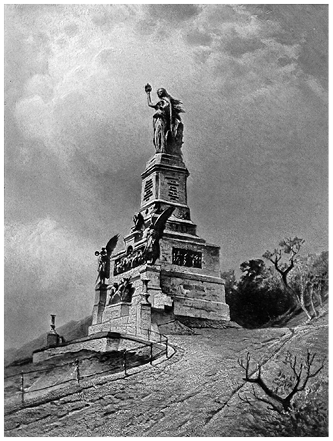
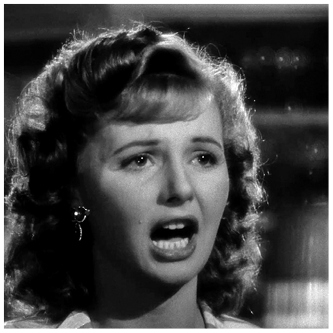
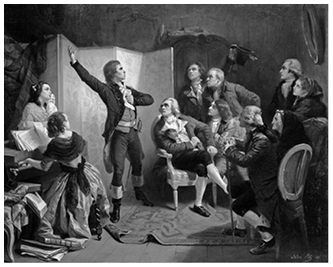
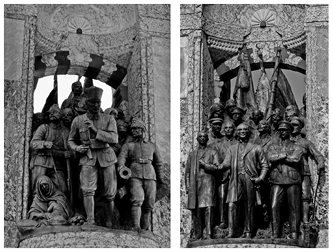
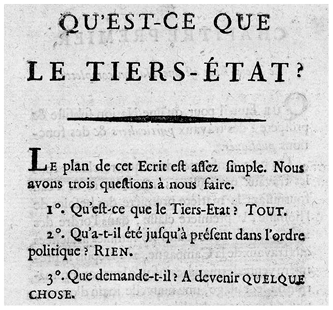
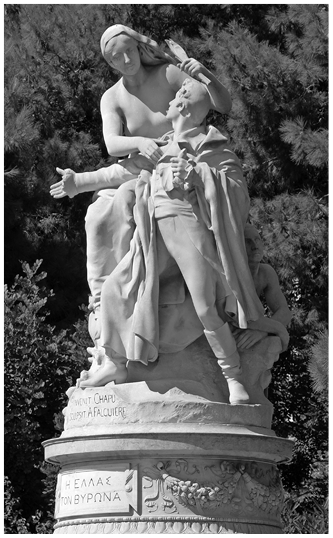
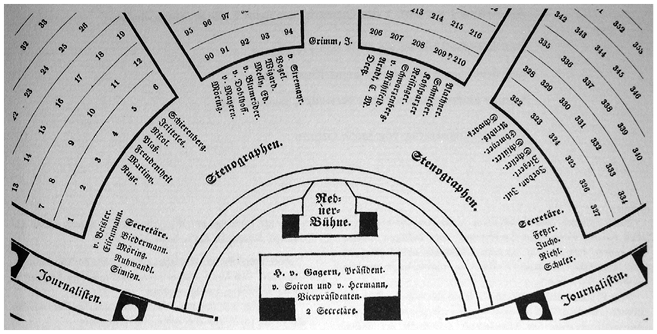

 Open access