



Working memory is a foundational component of information processing and problem-solving.Reference Baddeley1 Working memory deficit is a key feature of schizophrenia, which emerges before the onset of illness and persists even after symptomatic remission, leading to a lifelong cognitive burden. Considerable evidence points to working memory deficit being an important endophenotype seen in both patients with schizophrenia and their unaffected siblings who share their genetic liability.Reference Agnew-Blais and Seidman2,Reference Braff, Greenwood, Swerdlow, Light and Schork3 Unlike patients, siblings are free from the influence of antipsychotics and chronic disease course. Therefore, studying unaffected siblings reduces the treatment and illness confounds when investigating the genetically mediated pathophysiology of working memory deficits.
Brain state transitions
When executing a working memory task, systematic transition through various global brain states (i.e. stable or quasi-stable, condition-dependent organisation of whole-brain connectivity profile/patterns that support adaptive functions)Reference Kringelbach and Deco4 along with an adaptable reconfiguration of brain-wide interactions appear to be necessary.Reference Menon and Uddin5–Reference Shine, Bissett, Bell, Koyejo, Balsters and Gorgolewski7 Evidence indicates that patients with schizophrenia exhibit notable alteration in this working memory-related reconfiguration. When performing working memory tasks, patients often exhibit an inefficient topological arrangement within the comprehensive brain connectome. This inefficiency manifests as heightened segregation among brain networks, accompanied by a shift in the distribution of network degrees towards a more uniform pattern of connectivity.Reference Yang, Pu, Wu, Chen, Lee and Liu8 When working memory-related dynamic (time-varying) brain network characteristics are considered, patients exhibit unstable activity,Reference Braun, Harneit, Pergola, Menara, Schäfer and Betzel9 disrupted connectivityReference Wu, Zheng, Li, Zhang, Li and Wu10 and inappropriately heightened network flexibility.Reference Braun, Schäfer, Bassett, Rausch, Schweiger and Bilek11 The heightened network flexibility is also seen in unaffected relatives, albeit to a lesser extent than in patients with schizophrenia, potentially representing a network-based intermediate phenotype associated with genetic susceptibility to schizophrenia.Reference Braun, Schäfer, Bassett, Rausch, Schweiger and Bilek11 We can obtain novel insights into the genetically mediated failure modes in the dynamic working memory system by studying functional network reconfigurations during task performance in patients and siblings.
Application of control theory
Classical control theory offers a mathematical framework for understanding how the brain's connectivity changes over time.Reference Li, Yao, You, Liu, Deng and Li12 Its principles, originating from engineering, suggest that the brain transitions between different functional states or operating modes in response to energy input; this enhances the system's functionality in response to demands.Reference Li, Yao, You, Liu, Deng and Li12,Reference Gu, Pasqualetti, Cieslak, Telesford, Yu and Kahn13 By analysing functional magnetic resonance imaging (fMRI) data, we can identify these different brain states and how the brain's network structure enables transitions between them.
Average controllability and modal controllability stand out as the most frequently utilised indicators of controllability.Reference Li, Yao, You, Liu, Deng and Li12 Average controllability signifies the reciprocal of the average pulse response energy (control input) required to facilitate the brain's transition to easily attainable states.Reference Jeganathan, Perry, Bassett, Roberts, Mitchell and Breakspear14 Nodes exhibiting higher average controllability demand less energy to change from their current state, thereby indicating excellent flexibility in manoeuvring their operating mode in the ongoing brain state.Reference Li, Yao, You, Liu, Deng and Li12,Reference Cai, Ryali, Pasumarthy, Talasila and Menon15 Conversely, modal controllability serves to evaluate the nodes' capacity to transition to demanding brain states. Regions with higher modal controllability are positioned to drive the dynamics of a brain network towards hard-to-reach states, which imposes low energy costs for completing complex goal-specific operations.Reference Li, Yao, You, Liu, Deng and Li12
Previous fMRI work in healthy individuals indicates that during working memory tasks, several nodes within the salience network exhibited the highest average controllability across the entire brain.Reference Cai, Ryali, Pasumarthy, Talasila and Menon15 Meanwhile, the average controllability of the salience network, frontoparietal network (FPN) and default mode network (DMN; i.e. triple network) decreased with the escalation of the task loadReference Cai, Ryali, Pasumarthy, Talasila and Menon15 (i.e. more input signals are required to enable transition). First-episode never-treated patients with schizophrenia show higher average controllability and lower modal controllability in the dorsal anterior cingulate cortex compared to healthy controls at the resting state.Reference Li, Yao, You, Liu, Deng and Li12 However, the control characteristics of the functional connectome during working memory tasks are bound to differ from those in the resting state; this has not yet been studied in schizophrenia. We also do not know whether the disrupted brain controllability would be observed in unaffected siblings and thus influenced by the genetic predisposition related to schizophrenia.
Objectives
The objective of this study was to characterise the functional network controllability during working memory tasks in patients with schizophrenia and unaffected, genetically related siblings. We employed the tools of the control theory and investigated the brain controllability across the brain in patients, their siblings and matched healthy controls.Reference Sun, Jiang, Dai, Dufford, Noble and Spann16 We tested whether the degree of controllability of regions showing inter-group differences varied with the observed working memory performance and individual clinical characteristics. We also conducted an out-of-sample imaging transcriptomic analysis to explore the genetic relevance of regional aberrations in brain controllability that are shared between patients and their siblings.Reference Park, Jeon, French, Dempster, Chakravarty and MacKinley17
Method
Participants
The study cohort comprised 172 patients with schizophrenia, 43 unaffected siblings and 102 healthy controls. All participants were right-handed native Chinese speakers and signed written informed consent to participate in this study. The authors assert that all procedures contributing to this work comply with the ethical standards of the relevant national and institutional committees on human experimentation and with the Helsinki Declaration of 1975, as revised in 2013. All procedures involving human participants were approved by the medical ethics committee of the Second Xiangya Hospital, Central South University, reference (2021) National Review (Science and Technology) No. (015). Detailed information for recruitment is provided in Supplementary Material 1, available at https://doi.org/10.1192/bjp.2024.225.
Magnetic resonance imaging data acquisition and preprocessing
Magnetic resonance imaging (MRI) data were acquired using a Siemens Allergra 3-T scanner. A working memory paradigm was implemented in the scanner. Detailed scanning parameters and preprocessing procedure are provided in Supplementary Material 2.
There were 11 patients with schizophrenia, six unaffected siblings and six healthy controls excluded owing to large head motion and failures in the normalisation and registration to Montreal Neurological Institute space. The final analysis cohort comprised 161 patients with schizophrenia, 37 unaffected siblings and 96 healthy controls. No significant differences were observed in the overall count of interpolated displaced volumes among all groups (mean ± s.d.: patients with schizophrenia 10.9 ± 15.2, unaffected siblings 9.9 ± 13.7, healthy controls 10.1 ± 14.1, P = 0.661).
Working memory task paradigm
We adopted the n-back task as the working memory paradigm, and the ‘zero-back’ and ‘two-back’ loads were applied in our research. A detailed description of this paradigm is given in Supplementary Material 3 and Supplementary Fig. 1.
Controllability calculation
Before calculating the average and modal controllability, we reorganised the preprocessed fMRI data. For each participant, we separately concatenated the fMRI volumes obtained under the four blocks of the ‘zero-back’ load and the four blocks of the ‘two-back’ load, and we generated these two loads of fMRI data with 80 volumes each. We extracted the mean time series from each of the 264 nodes using 6 mm spheres defined by the Power atlas,Reference Power, Cohen, Nelson, Wig, Barnes and Church18 and generated a 264 × 264 symmetric matrix for each participant by computing the Pearson correlation coefficients between the time series for each pair of regions of interest (ROIs). The resultant matrix was converted to normally distributed scores by using Fisher's z transformation.
Then, we computed the average and modal controllability in the matrix that was constructed on ‘zero-back’ and ‘two-back’ loads, separately. Calculation of controllability was based on prior neuroimaging studies and employed control theory notations.Reference Li, Yao, You, Liu, Deng and Li12 Network controllability reflects the ability of external control energy to drive the current network state to other desired target states (see Fig. 2). Average controllability measures the ability of a node to drive the brain to all possible easy-to-reach configurations by considering the average input energy cost. Higher average controllability of a node indicates a more crucial role in enabling transitions of the network system between states. Modal controllability mathematically evaluates the ability of a node to control all the dynamic modes of the network. Higher modal controllability of a node indicates a stronger ability to drive the dynamics towards hard-to-reach configurations. Details of the computation of these metrics are provided in Supplementary Material 4.
Statistical analysis
We utilised SPSS statistical software (version 22 for Windows) to compare demographic and clinical characteristics as well as working memory task performance across groups. Differences in age, years of education, accuracy and response time under the ‘zero-back’ and ‘two-back’ loads were analysed using one-way analysis of variance (ANOVA) tests. Gender differences were assessed using χ2 tests.
For the statistical analysis of controllability metrics, we employed MATLAB 2018 software for Windows (Mathworks, Natick, Massachusetts, USA; https://www.mathworks.com/). Controllability data for each participant were subjected to group analysis using the one-way ANOVA test to examine group differences. Gender, age, years of education and head motion parameters were included as covariates in the analysis of controllability metrics to account for potential confounding factors. We corrected all data for multiple comparisons using false discovery rate (FDR) correction at P < 0.05. Then, post hoc tests were performed between each two-group pair using a threshold at P < 0.05 with Tukey correction to examine the distinction of the controllability among patients with schizophrenia, unaffected siblings and healthy controls groups respectively.
We performed correlation analyses to investigate whether the regionally altered controllability (i.e. excluding the effects of gender, age, years of education and head motion parameters) correlated with cognitive performance (including n-back task performance, Wechsler Adult Intelligence Scale (WAIS) information, and WAIS digit symbol subscales) or clinical characteristics (scores of Scale for Assessment of Positive Symptoms (SAPS), Scale for Assessment of Negative Symptoms (SANS), illness duration and antipsychotic dosage) in schizophrenia.
Exploratory analysis
We further conducted an imaging transcriptomic analysis estimating the spatial correlation between the regions with shared changes between patients with schizophrenia and unaffected siblings and an established gene expression atlas. These ROIs were defined as the regions in which both the patients with schizophrenia and unaffected siblings showed significant controllability difference (post hoc t-test (P-Tukey < 0.05) after F-test (P-fdr < 0.05)) compared to healthy controls, in the same direction (i.e. the controllability in both groups was higher or lower than that of healthy controls).
Imaging transcriptomic analysis
We used the Brain Annotation Toolbox (BAT; version 1.1 for Windows, Institute of Science and Technology for Brain-Inspired Intelligence, Fudan University, Shanghai, China; http://istbi.fudan.edu.cn/bat/index.html) to perform genetic and functional annotation analysis on the selected regions.Reference Liu, Rolls, Liu, Zhang, Yang and Du19 BAT was employed to extract functional information from Neurosynth and gene expression profiles from the Allen Human Brain Atlas (AHBA). This process was based on brain regions defined by clusters of voxels. The permutation analysis was performed 5000 times to ensure robustness. Other parameters for genetic and functional annotations included a ROI size set at 6 mm and a minimal sample size of five. These parameters were chosen to optimise the functional and genetic annotation process and enhance the reliability of the results.
Enrichment analysis
The derived differentially expressed genes were uploaded to the Database for Annotation, Visualization, and Integrated Discovery (DAVID) (https://david.ncifcrf.gov/). Gene Ontology database analysis was conducted, specifically focusing on three domains: the biological process, cellular component and molecular function. In addition, the Kyoto Encyclopedia of Genes and Genomes (KEGG) database for Homo sapiens sets was utilised for gene function and pathway enrichment analysis. To determine statistical significance, the threshold for significance was set at a FDR-adjusted P-value of less than 0.05. This approach controlled type-1 error from multiple tests and ensured that the identified gene functions and pathways were less likely to be false positives.
Results
Participants characteristics
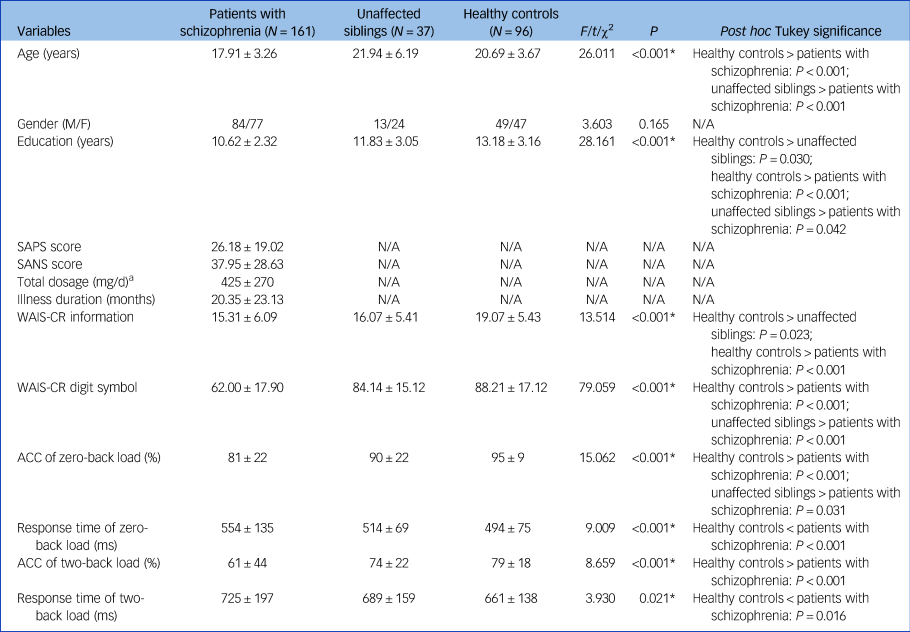
Demographic and clinical findings of this study cohort are presented in Table 1. Patients with schizophrenia were younger than unaffected siblings (P < 0.001) and healthy controls (P < 0.001). Besides, there was a ‘ladder’ pattern of education years among the three groups (F = 28.161, P < 0.001; healthy controls > unaffected siblings: P = 0.030; healthy controls > patients with schizophrenia: P < 0.001; unaffected siblings > patients with schizophrenia: P = 0.042). In terms of working memory task performance, the healthy controls performed better than the patients with schizophrenia at both the ‘zero-back’ (P < 0.001) and ‘two-back’ (P < 0.001) loads. The difference between the siblings and the other two groups was not significant for the two-back load. For the ‘zero-back’ load, unaffected siblings performed better than the patients with schizophrenia (P = 0.031). Detailed information is presented in Table 1.
Demographic, clinical and neurocognitive information

N/A, not applicable; SAPS, Scale for Assessment of Positive Symptoms; SANS, Scale for Assessment of Negative Symptoms; WAIS-CR, Wechsler Adult Intelligence Scale-Chinese Revised; ACC, accuracy.
a. Antipsychotic dosage refers to dose equivalents for chlorpromazine calculated using the classical mean dose method.Reference Leucht, Samara, Heres, Patel, Furukawa and Cipriani20
* P < 0.05.
Controllability metrics
Average controllability
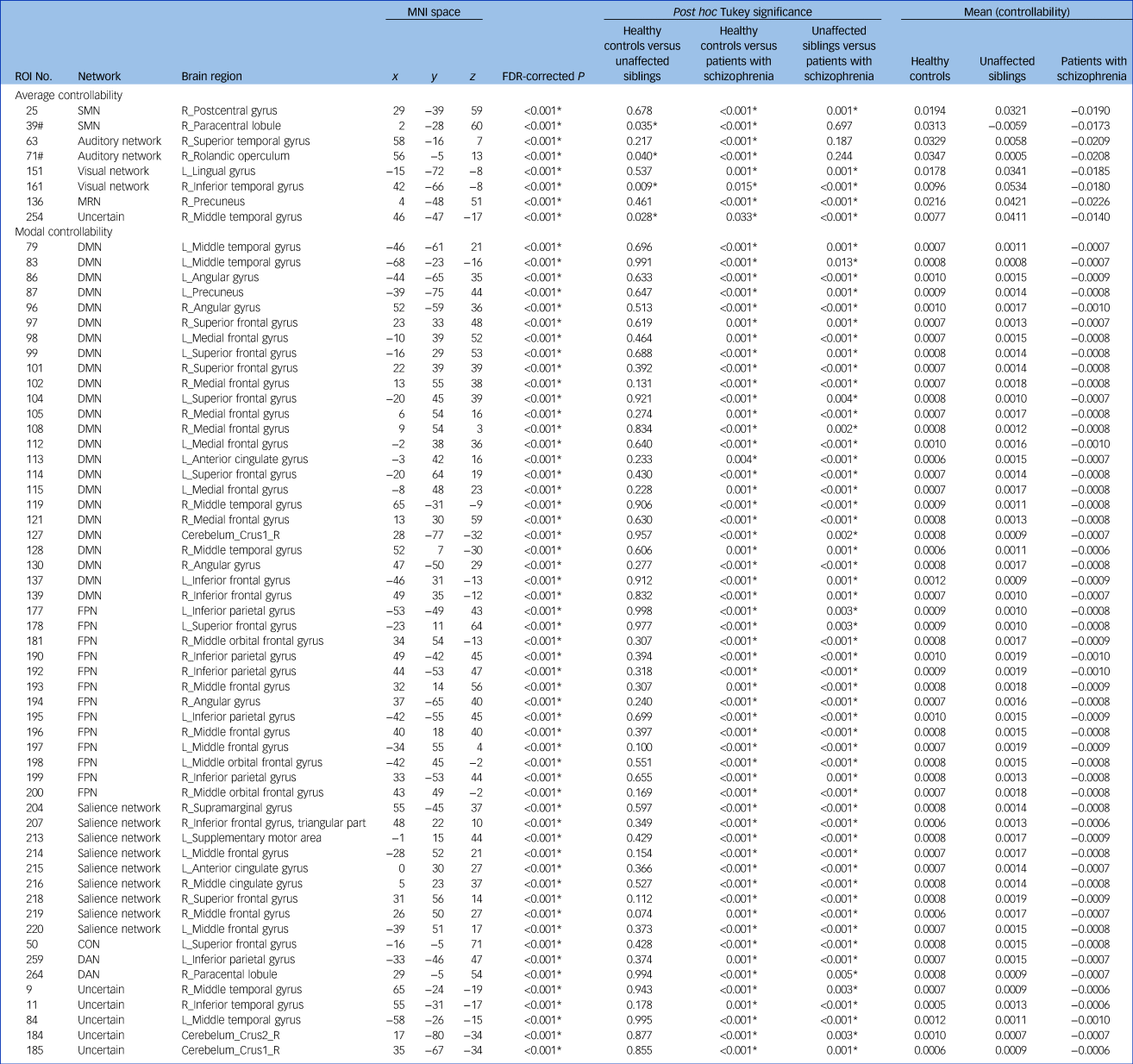
Under ‘zero-back’ load, one-way ANOVA revealed a significant omnibus difference of average controllability across all diagnostic groups in the visual network (node numbers 2) and ventral attention network (VAN, node numbers 1) (see Supplementary Table 1 and Supplementary Fig. 3); under ‘two-back’ load, one-way ANOVA revealed a significant omnibus difference of average controllability across all diagnostic groups in the sensorimotor network (SMN, node numbers 2), auditory network (node numbers 2), visual network (node numbers 2) and memory retrieval network (MRN, node numbers 1) (see Table 2 and Fig. 1).
Controllability difference across patients with schizophrenia, unaffected siblings and healthy controls at the ‘two-back’ load

ROI No., index number of the node in the Power Atlas;Reference Power, Cohen, Nelson, Wig, Barnes and Church18 MNI, Montreal Neurological Institute; SMN, sensory/somatomotor network; MRN, memory retrieval network; DMN, default mode network; FPN, frontoparietal task control network; CON, cingulo-opercular task control network; DAN, dorsal attention network; ROI, region of interest; FDR, false discovery rate; L, left; R, right.
* P < 0.05. The controllability values mentioned above are all the residual values of the de-covariant variables.
Brain regions with group differences in average and modal controllability across all groups under ‘two-back’ load (omnibus test): (a), (f) distribution of whole-brain controllability; (b), (g) distribution of each large-scale brain network controllability; (c), (h) brain regions showed significantly different controllability across all groups; (d), (i) proportion of detected nodes in each large-scale network; (e), (j) heat map of average controllability and circle heat map of modal controllability each node across all groups. DAN, dorsal attention network; VAN, ventral attention network; FPN, frontoparietal network; MRN, memory retrieval network; DMN, default mode network; CON, cingulo-opercular network; SMN, sensory/somatomotor network; HCs healthy controls; SBs, unaffected siblings; SZs, patients with schizophrenia.

Modal controllability
Under ‘zero-back’ load, one-way ANOVA revealed a significant omnibus difference of modal controllability across all diagnostic groups in the DMN (node numbers 2) and FPN (node numbers 1) (see Supplementary Table 1 and Supplementary Fig. 4); Under ‘two-back’ load, one-way ANOVA revealed a significant omnibus difference of modal controllability across all diagnostic groups in the DMN (node numbers 24), FPN (node numbers 13), salience network (node numbers 9), cingulo-opercular network (CON, node numbers 1) and dorsal attention network (DAN, node numbers 2) (see Table 2 and Fig. 1).
Interestingly, patients with schizophrenia exhibited lower average and modal controllability in all detected regions compared to healthy controls and unaffected siblings. Unaffected siblings generally exhibited increased controllability compared with healthy controls in most detected regions. Under ‘two-back’ load, compared with healthy controls, patients with schizophrenia and unaffected siblings both showed lower average controllability in the right-hand paracentral lobule (P-fdr = 0.035) and the right-hand Rolandic operculum (P-fdr = 0.035). Details are shown in Table 2 and Fig. 2. To examine the influence of gender and antipsychotic dose, we also conducted a stratified analysis and observed no significant differences in controllability between genders or dose-based subgroups in patients (see Supplementary Tables 2–5).
Regions where aberrant controllability occurs in both patients with schizophrenia and unaffected siblings, with the results of subsequent genetic and functional analysis: (a) brain nodes that showed common differences in average controllability shared by patients with schizophrenia and unaffected siblings; (b) average controllability gradient across all groups; (c) word cloud map of functional annotation analysis; (d) result of genetic enrichment analysis. KEGG, Kyoto Encyclopedia of Genes and Genomes.

In the Pearson correlation analysis, the average controllability during both ‘zero-back’ and ‘two-back’ loads showed poor correlation with cognitive performance and clinical characteristics among patients. However, higher modal controllability in some of the affected regions (‘zero-back’: two nodes in the DMN; ‘two-back’: 13 nodes in the DMN, five nodes in the salience network and one node in the FPN) was seen in association with better performance of the corresponding task load. Besides, higher modal controllability of certain regions (‘zero-back’: one node in the DMN and one node in the FPN; ‘two-back’: five nodes in the FPN, two nodes in the DMN and two nodes in the salience network) was associated with lower prescribed antipsychotic dose. In two DMN regions, modal controllability was negatively correlated with the scores of SANS (‘two-back’). We also performed the correlation analysis in unaffected siblings and healthy controls. Unaffected siblings shared a similar correlation relationship between working memory performance and modal controllability in several nodes (one node in the DMN and one node in the FPN) under ‘two-back’ load. Detailed information is shown in Supplementary Tables 6–13, and Figs. 5 and 6. However, no significant correlation relationship survives FDR correction.
Exploratory analysis
The right-hand paracentral lobule and right-hand Rolandic operculum both showed shared changes in controllability in both patients with schizophrenia and unaffected siblings; imaging transcriptomic analysis was focused on these ROIs.
The functional annotation analyses identified nine functional labels consistently related to the regions showing aberrant average controllability – nociceptive, pain, sensation, multisensory, touch, pressure, somatosensory, primary somatosensory and secondary somatosensory functions (see Fig. 2). However, no significant results were observed after FDR correction.
The genetic annotation analyses identified 36 genes with spatially relative overexpression for regions with aberrant average controllability (P-fdr < 0.05). For the Gene Ontology enrichment analysis, in terms of the molecular function, calmodulin binding (P-fdr = 0.015, RGS4, NOS2, ADCY1, CAMK2G, KCNH1) represented statistically significant enrichment. In terms of the KEGG pathway, insulin secretion (P-fdr = 0.014, ADCY1, ATP1A1, CAMK2G) represented statistically significant enrichment (see Fig. 2). No prominent enrichment was observed in terms of biological processes and cellular components. Detailed information on genetic annotation analysis is provided in Supplementary Tables 14 and 15. We also performed post hoc enrichment analysis for regions with altered controllability in patients but not in siblings (compared to healthy controls) to gain insights into illness-specific biological mechanisms; the significantly enriched gene expression abnormalities identified in the gene enrichment analysis are predominantly associated with synaptic functions (see Supplementary Material 5 and Supplementary Fig. 7).
Discussion
We report four novel findings on the controllability of the functional connectome during a working memory task in patients with schizophrenia, unaffected siblings and healthy controls. First, controllability differs between groups during task performance, especially when there is higher working memory demand (two-back). Patients show reduced average controllability compared with healthy controls and siblings, especially in the unimodal sensory networks (visual network, auditory network and SMN). This indicates reduced flexibility in shifting to task-free (relatively easy-to-reach) brain states. Second, lower modal controllability in patients is predominantly seen in the triple network regions of the default mode, frontoparietal and salience network, indicating that these regions require more ‘energy’ (in the sense of external inputs) to reach the relatively demanding states needed for complex cognitive operations. Third, at an uncorrected threshold, lower modal controllability relates to poor working memory task performance in some regions and higher dose of antipsychotics in other regions. Fourth, unaffected siblings had preserved controllability metrics that were numerically higher than healthy controls across most brain regions. Nonetheless, like patients, they also had reduced controllability in the paracentral lobule and Rolandic operculum when compared to healthy controls. Spatial correspondence of gene expression revealed associations with calmodulin binding and insulin secretion pathways. Taken together, these observations provide a nuanced mechanistic framework for working memory deficits in schizophrenia.
We observed large scale inter-group differences in controllability across patients with schizophrenia and unaffected siblings versus healthy controls during two-back tasks. Compared to healthy controls, patients with schizophrenia exhibited a decline in controllability (both modal controllability and average controllability) at all identified regions. Our finding suggests that when manipulating items in working memory, patients with schizophrenia may have a poorer ability to control brain state transitions compared to healthy controls, giving rise to performance deficits that increase with demand. In contrast, unaffected siblings demonstrated an insignificant tendency for increased controllability in the majority of regions compared to healthy controls. Similar distinctive alterations in brain function have been previously reported in studies focused on unaffected siblings and are considered a potential manifestation of resilience/compensation to the disease.Reference Guo, He, Liu, Linli, Tao and Palaniyappan21,Reference Mizuno, Wartelsteiner and Frajo-Apor22 The inter-group differences in controllability during working memory tasks extended to a broader range of regions with an increased task load. This finding suggests that higher working memory task loads may elicit a greater number of disease-related functional aberrations, aligning with findings from previous research.Reference Xi, Liu, Zeng, Tan, Sun and Yang23
When examining the two controllability metrics – modal and average controllability – distinct differences in inter-group brain regions are notable. Modal controllability assesses the capability of brain nodes to transition into states that are relatively challenging to attain, such as cognitively demanding states.Reference Li, Yao, You, Liu, Deng and Li12 The involvement of the triple network system – the DMN, FPN and salience network – in reduced modal controllability among patients is consistent with its critical role in the execution of working memory and its proposed involvement in the working memory deficits of schizophrenia.Reference Menon24 During the working memory tasks in healthy controls, there is a decrease in functional connectivity within the DMN and an increase in functional connectivity within the FPN, and the salience network serves a modulatory role in the functional connectivity changes within these two networks.Reference Menon and Uddin5,Reference Niendam, Laird, Ray, Dean, Glahn and Carter25 Compared to healthy controls, patients with schizophrenia fail to suppress DMN activity and show higher DMN–FPN functional connectivity during task execution,Reference Pu, Luo, Palaniyappan, Xue, Yao and Feng26 which may relate to aberrant signals from the salience network.Reference Luo, Pan, Gu, Simmonite, Francis and Liddle27 Our current findings indicate that triple network dysfunction during working memory tasks in patients with schizophrenia may arise from the higher energy requirements to attain the functional states necessary for performing working memory tasks.
Another notable finding is that, in patients with schizophrenia, the modal controllability in selected regions of the DMN and salience network was lower in those with reduced working memory performance, but these correlations were only shared in part with unaffected siblings. Unaffected siblings have the most pronounced controllability values among the three groups; thus, the relationship between controllability and cognitive function might be more complex, possibly involving nonlinear/compensatory factors in this group. Besides, the modal controllability in regions of the FPN was lower in those receiving higher antipsychotic dosage. This implies that either a higher dose of antipsychotics may preferentially reduce the modal controllability of the FPN or lower FPN controllability may result in a clinical profile that eventually gets higher prescription doses of antipsychotics. This is consistent with the prior observations of the impact of antipsychotic medication on the activity and functional connectivity of the FPN.Reference Schlösser, Gesierich, Kaufmann, Vucurevic, Hunsche and Gawehn28,Reference Honey, Bullmore, Soni, Varatheesan, Williams and Sharma29 It is important to note that these results did not survive FDR correction, and a dose-based split group analysis revealed no differential dose effect. But in the absence of data on adherence to treatment and cumulative exposure, we cannot rule out the effect of antipsychotics on FPN controllability. Longitudinal studies that compare the controllability among medicated and unmedicated patients are required for more definitive theories to emerge.
Average controllability evaluates the average capacity to transit into states that are more readily achievable.Reference Li, Yao, You, Liu, Deng and Li12 Disparities in average controllability between groups are predominantly localised in regions associated with primary sensory perception functions, including the auditory network, visual network and SMN, implying a potential deficiency of state transitions in sensory subsystems (compared to transmodal/multimodal regions), especially when cognitive load is higher. Prior work indicates that during working memory tasks, the visual network and SMN in patients with schizophrenia exhibit distinct temporal profiles of segregation and integration compared with those in healthy controls.Reference Fransson, Schiffler and Thompson30 The somatosensory cortex not only selectively retains corresponding sensory information temporarilyReference Pasternak and Greenlee31 but also demonstrates flexible recruitment by the FPN during task execution to complement the completion of working memory under different sensory patterns.Reference Michalka, Kong, Rosen, Shinn-Cunningham and Somers32 The well-documented sensorimotor and sensory gating impairments in patients with schizophrenia are attributed to their inability to effectively filter out irrelevant external and internal stimuli. This deficiency may result in misperceptions, sensory overload, distractibility and cognitive fragmentation.Reference Zarghami, Zeidman, Razi, Bahrami and Hossein-Zadeh33 We have previously reported a link between working memory deficits in schizophrenia and aberrant functional connections in brain regions contributing to the integration of sensory and motor resources.Reference Wang, Xi, Liu, Deng, Zhang and Cao34 The findings of this study may contribute new insights into the role of sensorimotor regions in the working memory deficits observed in schizophrenia.
Unaffected siblings and patients with schizophrenia share a decline in controllability in the paracentral lobule and Rolandic operculum compared to healthy controls. This finding suggests a potentially relevant association with the vulnerability observed in unaffected siblings. Grey matter volume (GMV) loss of the paracentral lobule has been reported in patients with schizophrenia and their concordant twin pairs.Reference Borgwardt, Picchioni, Ettinger, Toulopoulou, Murray and McGuire35 Interestingly, the operculum showed GMV increase in first-episode schizophrenia and in those at genetically high risk for schizophrenia,Reference Chang, Womer, Bai, Zhou, Wei and Jiang36 but reduced functional connectivity during cognitive tasks in patients with schizophrenia.Reference Wu, Zheng, Li, Zhang, Li and Wu10 We note specific gene expression patterns in these affected regions that may be relevant to uncover the bioenergetic pathways contributing to schizophrenia. The gene enrichment analysis suggested that the detected areas are involved in the molecular function of calmodulin binding. Calmodulin was suggested to be a central integrator of synaptic plasticity, and its unique regulatory properties allow the integration of several forms of signal transduction and the regulation of contextual memory.Reference Han, Cooke and Xu37 It is important to note that the shared alteration in controllability in patients and siblings does not imply genetic causation, but may result from shared environmental influences as well as gene–environment interactions.
The enrichment of the insulin secretion pathway observed in transcriptomics analysis is relevant to schizophrenia. Insulin plays important roles in neuronal circuitry formation, synaptic maintenance, neuronal survival, dendritic arborisation and learning and memory.Reference Lee, Zabolotny, Huang, Lee and Kim38 While gene enrichment related to insulin secretion has been reported in schizophrenia, it is typically associated with peripheral metabolismReference Arruda, Khandaker, Morris, Smith, Huckins and Zeggini39 with limited insights to date on its impact on the brain function. Besides, we found that the differences between patients with schizophrenia and healthy controls were associated with a gene enrichment and expression pattern related to the synaptic function, which aligns with previous findings linking synaptic dysfunction, neural function and the pathogenesis of schizophrenia.Reference Dickman and Davis40
Our study has some notable limitations. First, we were unable to collect a large sample of age-matched siblings, reducing the variability in this group, although we had sufficient power to demonstrate regional group differences in unaffected siblings versus healthy controls. Second, the effects of medication and the duration of illness cannot be disentangled from the severity of illness per se in schizophrenia. As antipsychotic medication was used only in the patients with schizophrenia, we were unable to eliminate this confound in inter-group comparisons. We did not observe a dose-related effect on controllability for most regions in patients with schizophrenia. Nevertheless, we cannot entirely discount the influence of medication. Longitudinal studies preferably in drug-naive participants are needed for conclusive proof. Because of the limited n-back loads used (zero- and two-back), we were not able to study state transitions (controllability) at higher loads. Finally, we lacked in-sample gene expression data from the brain tissue of the same participants who undertook working memory fMRI; gene annotations from public databases may not correspond to the actual regional expression in individual patients.
In conclusion, patients with schizophrenia show lower controllability of multiple brain functional networks during working memory tasks, with these differences intensifying under heightened task load. The differences in modal controllability manifest in the DMN, FPN and salience network, while the differences in average controllability are concentrated in the visual network, auditory network and SMN. Shared regional abnormalities in controllability in siblings and patients occur in regions with higher expression of calmodulin binding and insulin secretion pathway genes; this effect may arise from shared genetic/environmental influence within families. Our work distinguishes the nature of control signal aberrations in sensory processing versus transmodal regions in working memory deficits in schizophrenia. It also raises the question of the role of insulin signalling, calcium dynamics and more broadly bioenergetic aberrations in the cognitive features of schizophrenia.
Supplementary material
Supplementary material is available online at https://doi.org/10.1192/bjp.2024.225
Data availability
Network control theory code can be found at https://complexsystemsupenn.com/s/controllability_code-smb8.zip. Other custom analytic codes supporting the findings are available from the corresponding author upon reasonable request. The data supporting the findings are available from the corresponding author upon reasonable request.
Acknowledgements
We would like to thank all participants in this study.
Author contributions
Jie Yang, Z.L. and L.P. designed the research. F.W., J.W., X. Li, Y.P., Jun Yang, P.C., F.S., W.T., D.H., J.Z., X. Liu, M.Z. and G.W. collected the data. F.W. and Jie Yang analysed the data and wrote the manuscript along with L.P. Z.L. and L.P. revised various versions of the manuscript. All authors reviewed the manuscript and approved the submitted version.
Funding
This work was supported by grants from the National Natural Science Foundation of China (82201663 to Jie Yang; 82071506 to Z.L.), the Training Program for Excellent Young Innovators of Changsha (kq2306008 to Jie Yang), the Scientific Research Program of Hunan Provincial Health Commission, China (B202303095947 to Jie Yang) and the Scientific Research Launch Project for new employees of the Second Xiangya Hospital of Central South University to Jie Yang. L.P.'s research is supported by the Canada First Research Excellence Fund, awarded to the Healthy Brains, Healthy Lives initiative at McGill University (through a New Investigator Supplement to L.P.) and Monique H, Bourgeois Chair in Developmental Disorders. He receives a salary award from the Fonds de recherche du Québec-Santé (FROS).
Declaration of interest
L.P. reports personal fees for serving as chief editor from the Canadian Medical Association Journals, speaker/consultant fee from Janssen Canada and Otsuka Canada, SPMM Course Limited, UK, Canadian Psychiatric Association; book royalties from Oxford University Press; investigator-initiated educational grants from Janssen Canada, Sunovion and Otsuka Canada outside the submitted work. All other authors report no potential conflicts.




eLetters
No eLetters have been published for this article.