


Introduction
The accelerated evolution of information and communication technology (ICT) use at work by means of different devices (e.g., desktop computers, laptops, smartphones, and tablets) and digital technologies (e.g., video-conferencing and geolocation software) has stimulated an unprecedented change in the contemporary labor landscape (Fréour et al., Reference Fréour, Pohl and Battistelli2021). This technological revolution has significantly altered the essence of work, creating a continuously changing work environment (Cascio & Montealegre, Reference Cascio and Montealegre2016). In 2021, 56% of EU companies reached the basic level of digital intensity (Eurostat, 2021)Footnote 1. According to the World Economic Forum’s report on the future of employment in 2023 (World Economic Forum, 2023), it is anticipated that one-quarter of jobs will undergo transformation due to technologies, with 86% of organizations continuing to adopt such technologies. Moreover, it is estimated that the additional value to the economy resulting from the implementation of digital technologies will reach $100 trillion by the year 2025 (World Economic Forum, 2016).
Despite the growing use of ICT in the labor context, a substantial problem persists in understanding the implications that these technologies have for employees (Barley, Reference Barley2015; Parker & Grote, Reference Parker and Grote2022). Recent research has shown that ICT use can have both positive and negative relationships with certain work characteristics (see Wang et al., Reference Wang, Liu and Parker2020 for a review). Considering the empirical evidence and theories about the relationship between work characteristics and well-being (Demerouti et al., Reference Demerouti, Bakker, Nachreiner and Schaufeli2001; Humphrey et al., Reference Humphrey, Nahrgang and Morgeson2007), all this suggests that the relationship between ICT use and employee well-being is complex, involving multiple mediators and has the potential for simultaneous positive and negative indirect effects. Identifying and distinguishing the mediators that transmit the benefits of ICT use for employee well-being from those mediators that potentially trigger its drawbacks is important for theoretical and practical reasons. Theoretically, identifying the mechanisms that explain why two variables are related in different ways helps advance knowledge because it provides a detailed and fine-grained understanding of the investigated relationship (Preacher & Hayes, Reference Preacher and Hayes2004). Practically, identifying the different mediators involved offers a solid basis to suggest ways to promote the functional impact of ICT use on employee well-being and mitigate its dysfunctional influence. As Parker and Grote (Reference Parker and Grote2022, p. 1189) stated, “the more that we can map out how, what, and why technology affects work design, the more we will gain important insights into how to optimize technology’s benefits and mitigate its potential dysfunctional effects.” Thus, the first goal of this study is to identify some of the mediators that intervene in the positive and negative relationships between ICT use at work and employee well-being.
Furthermore, the relationship between ICT use and employee well-being may depend on boundary conditions (Coovert & Thompson, Reference Coovert and Thompson2013; Parker & Grote, Reference Parker and Grote2022). Identifying these moderators is important from a theoretical and practical perspective. Theoretically, it will allow us to understand and predict the influence of ICT use on employee well-being under different boundary conditions (Wang et al., Reference Wang, Liu and Parker2020). This will also help improve and extend related theoretical models by refining their detail and scope. Practically, identifying moderators suggests potential levers that may be useful to boost the positive impact of ICT use on employee well-being and buffer its negative influence. Therefore, the second goal of this study is to determine whether employee age moderates the positive and negative relationships between ICT use at work and employee well-being.
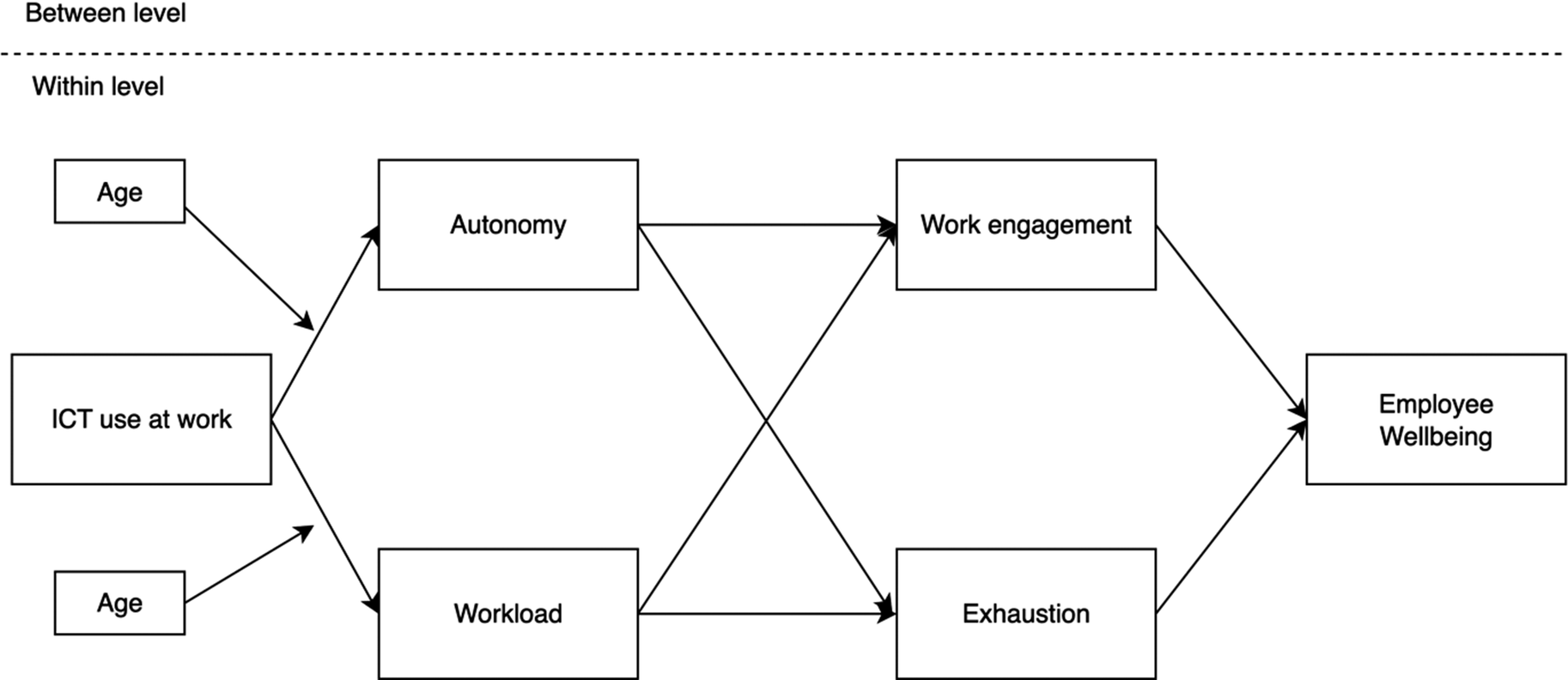
Our research model (see Figure 1) is, to a great extent, based on the job demands-resource (JD-R) theory (Bakker & Demerouti, Reference Bakker and Demerouti2007). This model considers two key types of work characteristics: job demands and job resources. Job demands (e.g., workload) are aspects of the job that require constant physical or psychological effort and consume energy. Job resources (e.g., job autonomy) are aspects of the job that facilitate the achievement of work goals and foster personal growth, learning, and development (Bakker et al., Reference Bakker, Demerouti and Sanz-Vergel2023; Bakker & Demerouti, Reference Bakker and Demerouti2007; Demerouti et al., Reference Demerouti, Bakker, Nachreiner and Schaufeli2001). The JD-R model posits that job demands and resources trigger two distinct processes: a health-impairment process and a motivational process, respectively (Bakker & Demerouti, Reference Bakker and Demerouti2007). The health-impairment process indicates that long-term exposure to high job demands leads to job burnout and employee strains, which negatively affect employee well-being. The motivational process points out that job resources can boost employee engagement, which in turn will lead to improved employee well-being (Bakker & Demerouti, Reference Bakker and Demerouti2018). The original JD-R model (Demerouti et al., Reference Demerouti, Bakker, Nachreiner and Schaufeli2001) considered these two processes to be independent. However, several studies (e.g., Davcheva et al., Reference Davcheva, González-Romá, Hernández and Tomás2024; González-Romá et al., Reference González-Romá, Valls and Hauth2020; Schaufeli & Bakker, Reference Schaufeli and Bakker2004) and meta-analyses (Alarcon, Reference Alarcon2011; Crawford et al., Reference Crawford, LePine and Rich2010; Lee & Ashforth, Reference Lee and Ashforth1996) have provided empirical evidence about the existence of cross-links between the variables involved in the two processes. These cross-links show that job resources are also negatively related to employee exhaustion and strains, whereas job demands are also negatively related to motivational states such as work engagement.
The research model.

We focused on job autonomy (i.e., the extent to which a job allows freedom, independence, and discretion to schedule work, make decisions, and choose the methods used to perform tasks; Morgeson & Humphrey, Reference Morgeson and Humphrey2006) and workload (i.e., the degree to which employees perceive their task demands exceed their capacity; MacDonald, Reference MacDonald2003) because they are two of the most important work characteristics within the JD-R model (Bakker et al., Reference Bakker, Demerouti and Sanz-Vergel2023). Moreover, previous research has shown that autonomy is strongly and positively related to work motivation and outcomes (Hackman & Oldham, Reference Hackman and Oldham1976; Humphrey et al., Reference Humphrey, Nahrgang and Morgeson2007; Parker et al., Reference Parker, Morgeson and Johns2017). In addition, workload is a variable that currently characterizes jobs that use technology (Van Den Broeck et al., Reference Van Den Broeck, Elst, Baillien, Sercu, Schouteden, De Witte and Godderis2017) and can have important consequences for employee well-being (Wang et al., Reference Wang, Liu, Qian and Parker2021). Regarding the psychological states considered, we focused on work engagement (i.e., “a positive, fulfilling, work-related state of mind that is characterized by vigor, dedication, and absorption”; Schaufeli et al., Reference Schaufeli, Salanova, González-Romá and Bakker2002, p. 74) and job exhaustion (i.e., a state of physical and emotional fatigue produced by the work one performs (Maslach et al., Reference Maslach, Jackson and Leiter1996), which is generally considered the core dimension of burnout (Halbesleben et al., Reference Halbesleben, Zellars, Carlson, Perrewé and Rotondo2010; Maslach, Reference Maslach1982). We did so because they are two key states involved in the motivational and health-impairment processes within the JD-R theory, respectively (Bakker & Demerouti, Reference Bakker and Demerouti2007). Finally, we chose employee well-being (i.e., a person’s cognitive and affective evaluations of his or her life; Diener, Diener et al., Reference Diener, Lucas and Oishi2002) because it is a relevant employee outcome within the JD-R theory (Bakker et al., Reference Bakker, Demerouti and Sanz-Vergel2023) and has been recently highlighted as an ultimate criterion for organizational sciences (Tay et al., Reference Tay, Batz-Barbarich, Yang and Wiese2023).
As potential a moderator of the relationships between ICT use at work, on the one hand, and job autonomy and workload, on the other hand, we considered an individual-level variable (age). We focused on age for two reasons. The first one is related to the aging of the global population. In the year 2030, one in six people will be 60 years old or older (World Health Organization [WHO], 2017). This is causing and will cause more older people to be in the workforce and, therefore, interacting with ICT. Second, it has been proven that over the years, skills and cognitive capabilities change (Charness, Reference Charness2019). Thus, there may be differences between age groups in how ICT use at work is related to work characteristics.
Some recent studies have used the JD-R model to examine how ICT use relates to job characteristics and employee outcomes. For example, Leitner and Stöllinger (Reference Leitner and Stöllinger2022), in a working paper, analyzed public data from European countries and showed that digital technologies are related to several work characteristics and work engagement and exhaustion. Our study differs from Leitner and Stöllinger’s (Reference Leitner and Stöllinger2022) investigation in several ways. First, we included employee well-being as a final outcome, which allowed us to examine the indirect effects on ICT use at work and this variable. The outcome variables in Leitner and Stöllinger’s (Reference Leitner and Stöllinger2022) study were work engagement and exhaustion. Second, we examined the cross-links between the variables included in the motivational and health-impairment processes embedded in the JD-R model. These cross-links were not investigated in Leitner and Stöllinger’s (Reference Leitner and Stöllinger2022) working paper. Third, we considered the nested structure of data (employees nested within countries) and analyzed data using multilevel modeling methods. Fourth, we investigated a moderator (age) that helped understand to what extent the investigated relationships depend on individual factors. Leitner and Stöllinger’s (Reference Leitner and Stöllinger2022) model did not include any moderator. These differences show that our study goes above and beyond previous studies about the addressed topic and aims to offer more detailed and nuanced knowledge about the relationship between ICT use, work characteristics, and employee well-being.
Our investigation aims to contribute to literature in several ways. First, our study contributes to identifying the mechanisms through which ICT use is linked to employee well-being. The identification of the mediators through which two variables are related “is often an increase in knowledge and an important refinement of the theory” (Spencer et al., Reference Spencer, Zanna and Fong2005, p. 846). Second, our investigation helps extend the JD-R model by including ICT use as an antecedent of a specific demand and resource. Third, on a related note, our study also contributes to extending the JD-R model by providing additional empirical evidence about the existence of cross-links between the motivational and health-impairment process. Fourth, we show that the use of ICT at work is a “double-edged sword” that involves both positive and negative indirect relationships with employee well-being. Thus, our study points out that the potential influences of ICT use at work are complex and multifaceted. Fifth, by investigating the moderating role of employee age in the relationship between ICT use at work and the two work characteristics considered (autonomy and workload), we offer a more detailed and nuanced perspective of the investigated phenomenon, showing that the aforementioned individual variable plays an important role.
Theoretical Background and Hypothesis Development
The JD-R model provides an appropriate theoretical framework to investigate the mediated relationships (indirect “effects”) embedded in our research model. Next, we justify the expected relationships and present our research hypotheses.
In this study, ICT use at work refers to the frequency with which employees interact with basic digital tools and technologies (e.g., computers, tablets, smartphones) as part of their job. This operationalization is based on a single item from the EWCS 2021.
The Positive Indirect Effect of ICT Use on Employee Well-being Through Autonomy and Work Engagement
We posit that ICT use has a positive indirect effect on employee well-being via the sequential mediation of autonomy and work engagement. First, ICT use at work fosters job autonomy by promoting a more decentralized decision-making structure. This is because ICT facilitates a broader dissemination of information (Fréour et al., Reference Fréour, Pohl and Battistelli2021; Parker & Grote, Reference Parker and Grote2022). Employees using ICT devices can access necessary resources and information digitally, allowing for greater flexibility in when and where they work (Raghuram et al., Reference Raghuram, Hill, Gibbs and Maruping2019). This includes working outside traditional hours, collaborating virtually with teams, and even telecommuting. Finally, ICT empowers employees to organize their work with increased temporal and spatial flexibility (Ninaus et al., Reference Ninaus, Diehl, Terlutter, Chan and Huang2015), promoting greater autonomy. This aligns with the findings from Kraan et al. (Reference Kraan, Dhondt, Houtman, Batenburg, Kompier and Taris2014) on how computer-based ICT use in a large multinational sample (18,723 workers) increased autonomy in choosing schedule work and methods.
Second, we posit that autonomy is positively related to work engagement. This relationship is grounded in the self-determination theory (SDT), which emphasizes the role of intrinsic motivation in fostering positive work outcomes. According to the SDT, individuals are more likely to be engaged and motivated when their basic psychological needs for autonomy, competence, and relatedness are satisfied (Deci & Ryan, Reference Deci and Ryan2000). In the workplace context, environments that support these needs—particularly autonomy—enhance employees’ self-driven motivation and are associated with higher levels of work engagement (Gagné & Deci, Reference Gagné and Deci2005). When employees feel control over their work (autonomy), it fuels their intrinsic motivation, leading to greater work engagement (Rahmadani et al., Reference Rahmadani, Schaufeli, Ivanova and Osin2019). This aligns with the meta-analysis of Christian et al. (Reference Christian, Garza and Slaughter2011), which found that autonomy is an antecedent of work engagement.
Third, we posit that work engagement is positively related to employee well-being. Following the motivational process path of the JD-R model, workers with high work engagement experience greater psychological employee well-being due to an increase in positive emotions associated with intrinsic motivation (Schaufeli & Taris, Reference Schaufeli, Taris, Bauer and Hämmig2014). Furthermore, according to the Self-Determination Theory, when individuals exhibit high levels of engagement, their basic psychological needs for autonomy, competence, and relatedness tend to be satisfied. The fulfilment of these needs is directly associated with the generation of positive emotions and enhanced overall well-being (Van den Broeck et al., Reference Van den Broeck, Vansteenkiste, De Witte and Lens2008). This aligns with the perspective of Bakker and Oerlemans (Reference Bakker, Oerlemans, Cameron and Spreitzer2011), where work engagement is characterized by high energy, positive emotions, and a sense of accomplishment at work. These positive work experiences, as noted by Culbertson et al. (Reference Culbertson, Mills and Fullagar2012), can contribute to general well-being. A comprehensive meta-analysis conducted by Mazzetti et al. (Reference Mazzetti, Robledo, Vignoli, Topa, Guglielmi and Schaufeli2023) identified employee well-being as a significant outcome of work engagement.
Based on all the arguments and empirical evidence presented above, we hypothesize the following:
Hypothesis 1: ICT use has a positive indirect effect on employee well-being through autonomy and work engagement, so that ICT use is positively related to autonomy, which in turn is positively related to work engagement, which in turn is positively related to employee well-being.
The Negative Indirect Effect of ICT Use on Employee Well-being Through Workload and Job Exhaustion
We posit that ICT use has a negative indirect effect on employee well-being via the sequential mediation of workload and job exhaustion. First, we argue that ICT use at work is positively related to workload based on several reasons. ICT has the capability to accelerate both task speed and volume, leading to an increased perception of workload (Carlson et al., Reference Carlson, Carlson, Zivnuska, Harris and Harris2017; Day et al., Reference Day, Paquet, Scott and Hambley2012; Zeike et al., Reference Zeike, Choi, Lindert and Pfaff2019). Moreover, ICT may contribute to blurring the boundaries between work and non-work time, facilitating employees taking work home after their regular working time (Barber & Santuzzi, Reference Barber and Santuzzi2015). This can contribute to increasing their perceived workload. Finally, because ICT provide faster communication, ICT use raises expectations for immediate responses from employees, which in turn may increase employees’ perceived workload (Scholze & Hecker, Reference Scholze and Hecker2024). Empirical evidence from quantitative (Chesley, Reference Chesley2014) and qualitative (Towers et al., Reference Towers, Duxbury, Higgins and Thomas2006; Zacher & Rudolph, Reference Zacher and Rudolph2024) studies supports the positive relationship between ICT use and perceived workload.
Second, according to the health-impairment process suggested by the JD-R theory, we posit that workload is positively related to job exhaustion. This theory suggests that high workload leads to increased employee effort. This increased effort stems from the lack of time to efficiently complete tasks. As a result, employees may experience a depletion of their physical, emotional, or cognitive resources, potentially leading to increased exhaustion (Demerouti et al., Reference Demerouti, Bakker, Nachreiner and Schaufeli2001). The health-impairment process is well-supported in the literature (Alarcon, Reference Alarcon2011; Christian et al., Reference Christian, Garza and Slaughter2011; Crawford et al., Reference Crawford, LePine and Rich2010; Halbesleben et al., Reference Halbesleben, Zellars, Carlson, Perrewé and Rotondo2010). For instance, Avanzi et al. (Reference Avanzi, Fraccaroli, Castelli, Marcionetti, Crescentini, Balducci and van Dick2018) analyzed a sample of 2685 Swiss teachers and found that workload was positively related to exhaustion.
Third, we posit that job exhaustion is negatively related to employee well-being. This hypothesis is based on the theory of conservation of resources (COR, Hobfoll, Reference Hobfoll1989). According to this theory, people seek to obtain, retain, and protect what they value (e.g., material, social, personal, or energetic resources). This theory proposes that the stress experienced by individuals can be understood in relation to potential or actual loss of resources. When workers experience high levels of exhaustion, it indicates a decrease in their personal resources. This situation prevents them from investing in acquiring new resources, creating an imbalance between job demands and available personal resources, which leads to a decrease in psychological well-being (Hobfoll et al., Reference Hobfoll, Halbesleben, Neveu and Westman2018). Furthermore, according to the COR theory, this phenomenon can be intensified due to a “loss spiral,” where the inability to cope with additional stressors contributes to a further deterioration of psychological well-being (Hobfoll, Reference Hobfoll2001). Hakanen and Schaufeli (Reference Hakanen and Schaufeli2012), in their study with three waves of data over 7 years, found a negative relationship between emotional exhaustion, depersonalization and employee well-being.
Based on the arguments and empirical evidence presented above, we propose the following hypothesis (Hypothesis 2):
Hypothesis 2: ICT use has a negative indirect effect on employee well-being through workload and exhaustion, so that ICT use is positively related to workload, which in turn is positively related to exhaustion, which in turn is negatively related to employee well-being.
The Positive Indirect Effect of ICT Use on Employee Well-being Through Autonomy and Exhaustion
This indirect effect (ICT use → Autonomy → Exhaustion → Employee Well-being) is based on the existence of cross-links between the variables involved in the motivational and health-impairment processes embedded within the JD-R theory (see Alarcon, Reference Alarcon2011; Crawford et al., Reference Crawford, LePine and Rich2010; Davcheva et al., Reference Davcheva, González-Romá, Hernández and Tomás2024; González-Romá et al., Reference González-Romá, Valls and Hauth2020; Lee & Ashforth, Reference Lee and Ashforth1996; Schaufeli & Bakker, Reference Schaufeli and Bakker2004). In this case, the cross-link involves the negative relationship between work autonomy and job exhaustion. This relationship is based on the following arguments. According to the COR theory, employees that have more resources, such as autonomy, demonstrate lower susceptibility to resource loss and greater potential for resource gain. Therefore, autonomy serves as a resource that allows employees to conserve their resources and energy and prevent the emotional and physical exhaustion (Hobfoll et al., Reference Hobfoll, Halbesleben, Neveu and Westman2018). Previous research with healthcare workers has supported this hypothesis, showing that autonomy is negatively related to stress (Havermans et al., Reference Havermans, Boot, Houtman, Brouwers, Anema and Van Der Beek2017). Additionally, Shoman et al. (Reference Shoman, Marca, Bianchi, Godderis, van der Molen and Guseva Canu2021) conducted a systematic review that indicated that increasing autonomy can serve as a protective factor against exhaustion. Moreover, several studies have reported negative correlations between job resources and burnout (Hakanen et al., Reference Hakanen, Schaufeli and Ahola2008; Schaufeli & Bakker, Reference Schaufeli and Bakker2004).
Based on the aforementioned arguments and those outlined in the previous sections, we propose the following hypothesis:
Hypothesis 3: ICT use has a positive indirect effect on employee well-being through autonomy and exhaustion, so that ICT use is positively related to autonomy, which in turn is negatively related to exhaustion, which in turn is negatively related to employee well-being.
The Negative Indirect Effect of ICT Use on Employee Well-being Through Workload and Engagement
As above, this indirect effect (ICT use → Workload → Engagement → Employee Well-being) is based on the existence of cross-links within the JD-R theory (Alarcon, Reference Alarcon2011; Davcheva et al., Reference Davcheva, González-Romá, Hernández and Tomás2024; González-Romá et al., Reference González-Romá, Valls and Hauth2020; Lee & Ashforth, Reference Lee and Ashforth1996). In this case, the cross-link involves the negative relationship between workload and work engagement. This relationship is based on the following arguments: According to the COR theory, a high workload induces a depletion of personal resources (Hobfoll et al., Reference Hobfoll, Halbesleben, Neveu and Westman2018). This produces a decrease in the resources available to be invested at work, which reduces work engagement (Hakanen et al., Reference Hakanen, Bakker and Demerouti2005). This phenomenon is particularly significant given the first principle of the COR theory: “Resource loss is disproportionately more salient than resource gain” (Hobfoll et al., Reference Hobfoll, Halbesleben, Neveu and Westman2018, p. 106). In this context, resource acquisition becomes progressively more challenging, potentially initiating a cyclical pattern of resource loss, which leads to a decrease in work engagement. A meta-analysis by Nahrgang et al. (Reference Nahrgang, Morgeson and Hofmann2011) revealed a negative association between job demands and work engagement. A subsequent study with teachers in China corroborated this finding, demonstrating that a high level of workload negatively impacts work engagement (Wang, Reference Wang2024). Considering the arguments presented in this and the previous sections, we formulate the following hypotheses:
Hypothesis 4: ICT use has a negative indirect effect on employee well-being through workload and work engagement, so that ICT use is positively related to workload, which in turn is negatively related to work engagement, which in turn is positively related to employee well-being.
The Moderating Role of Age
We propose that age moderates the relationship between the use of ICT at work and autonomy. This hypothesis is based on research on cognitive aging. The results of this research show decline in memory and the acquisition of new skills after early adulthood as individuals age (McGrew, Reference McGrew, Flanagan and Harrison2005; Salthouse, Reference Salthouse2010). These declines present potential barriers for older workers, affecting their ability to solve new problems, use working memory effectively, and maintain processing speed, all of which are crucial for learning to use new technologies (Beier et al., Reference Beier, Teachout, Cox, Hedge and Borman2012). Thus, these declines pose challenges for older workers in the development of new skills related to the use of ICT. By contrast, younger workers show greater openness to ambiguity and a greater willingness to experiment with new technologies (Hauk et al., Reference Hauk, Hüffmeier and Krumm2018), which can help them to maximize the benefits of using ICT at work. Thus, we posit that the relationship between the use of ICT at work and autonomy is moderated by employee age, so that the relationship is weakened as age increases.
Considering this expected moderator effect of employee age on the relationship between ICT use and job autonomy, on the one hand, and the indirect effects in which the ICT use-autonomy relationship is involved (Hypothesis 1: ICT use → autonomy → work engagement → employee well-being; and Hypothesis 3: ICT use → autonomy → exhaustion → employee well-being), on the other hand, we propose the following hypotheses concerning conditional indirect effects:
Hypothesis 5: The positive indirect effect of ICT use at work on employee well-being through autonomy and work engagement is moderated by employee age, so that the indirect effect is weaker as age increases.
Hypothesis 6: The positive indirect effect of ICT use at work on employee well-being through autonomy and job exhaustion is moderated by employee age, so that the indirect effect is weaker as age increases.
Second, we posit that age moderates the relationship between ICT use at work and workload. Research suggests that biological and psychological changes associated with aging can make it more challenging for older adults to utilize and adapt to new technologies (Chen & Chan, Reference Chen and Chan2011; Phang et al., Reference Phang, Sutanto, Kankanhalli, Li, Tan and Teo2006). For instance, Saunders et al. (Reference Saunders, Wiener, Klett and Sprenger2017) discovered that older users reported feeling more overwhelmed by information generated by ICT than younger users. These authors suggested that this might be related to older users’ lowered cognitive skills, which make it harder for them to manage several simultaneous information streams. Given how ICT use generally increases the amount of information flow, older workers may perceive a greater workload from ICT use than their younger counterparts. This is because the former may struggle more than the latter with handling the amount of information associated with ICT use. Thus, we posit that the relationship between the use of ICT at work and workload is moderated by employe age so that the relationship is enhanced as age increases.
Considering the expected moderator effect of employee age on the relationship between ICT use and workload, on the one hand, and the indirect effects in which the relationship ICT use-workload is involved (Hypothesis 2: ICT use → workload → exhaustion → employee well-being; and Hypothesis 4: ICT use → workload → work engagement → employee well-being) on the other, we propose the following hypotheses concerning conditional indirect effects:
Hypothesis 7: The negative indirect effect of ICT use at work on employee well-being through workload and exhaustion is moderated by employee age, so that the indirect effect is stronger as age increases.
Hypothesis 8: The negative indirect effect of ICT use at work on employee well-being through workload and work engagement is moderated by employee age, so that the indirect effect is stronger as age increases.
Method
Sample
The individual-level data analyzed come from the seventh European Working Conditions Survey (EWCS) conducted by the European Foundation for the Improvement of Living and Working Conditions in 37 European countries between March and November 2021. The respondents were randomly selected. Random probability sampling using telephone numbers was employed to create nationally representative samples of each country. The survey included questions about work and employment conditions, health, and employee well-being. After removing the self-employed subjects, those with a part-time job, and missing observations, the final sample comprised 7,900 employees. The study sample was composed of roughly equal proportions of men (55.0%) and women (44.9%). The majority of participants (54.0%) were between 35 and 55 years old, 32.6% were younger (under 35 years), and 13.4% were older (over 55 years). According to educational level, 27.83% had completed upper secondary education, 25.37% held a master’s degree or equivalent, and 23.28% had a bachelor’s degree or equivalent. According to economic sectors, 15.63% were employed in manufacturing, 11.03% in financial and insurance activities, 9.80% in education, and 8.99% in human health and social work activities. The sample size varied across countries: the smallest one was collected in Switzerland (N = 79) and the largest one in Germany (N = 457).
Measures
Use of ICT at Work
In the EWCS, this variable was measured by asking individuals how often their primary paid job involves the use of technology devices (“How often does your main paid job involve working with computer, laptop, tablet, smartphone?”). The scale response ranges from 1 (never) to 5 (always). This question has been used before to measure ICT use at work (Barrientos-Marín et al., Reference Barrientos-Marín, Fu, Millán and van Stel2021; Joling & Kraan, Reference Joling and Kraan2008; Menon et al., Reference Menon, Salvatori and Zwysen2020; Millán et al., Reference Millán, Lyalkov, Burke, Millán and van Stel2021). For instance, Menon et al. (Reference Menon, Salvatori and Zwysen2020) analyzed how the use of ICT at work affects work intensity and work discretion in 15 European countries between 1995 to 2015.
Job Autonomy
The EWCS measures job autonomy by using the following three questions: “In your main job, are you able to choose or change…: (1) your order of tasks? (2) your methods of work? (3) your speed or rate of work?.” The scale response ranges from 1 (never) to 5 (always). This measure has been previously used in empirical studies (e.g., C.-H. Wu et al., Reference Wu, Luksyte and Parker2015; Y.-J. Wu et al., Reference Wu, Xu and He2021). The reliability coefficients in the study sample (within level) were McDonald’s omega = .74 and composite reliability = .74.
Workload
The EWCS measures workload by using the following two questions: “Does your job involve working to tight deadlines?” and “Does your job involve working at very high speed?.” The scale response ranges from 1 (never) to 5 (always). Previous investigations by Hakanen et al. (Reference Hakanen, Ropponen, De Witte and Schaufeli2019), Tsen et al. (Reference Tsen, Gu, Tan and Goh2023), and Zappalà et al. (Reference Zappalà, Swanzy and Toscano2022) have used this scale. The reliability coefficients at the within level were McDonald’s omega = .64 and composite reliability = .64.
Work engagement
Work engagement was measured with the three items composing the Utrecht Work Engagement Scale (UWES-3) (Schaufeli et al., Reference Schaufeli, Shimazu, Hakanen, Salanova and De Witte2019): “At work I feel full of energy” (vigor), “I am enthusiastic about my job (dedication),” and “Time flies when I am working” (absorption). The items are answered on a Likert scale that ranges from 1 (never) to 5 (always). Hakanen et al. (Reference Hakanen, Ropponen, De Witte and Schaufeli2019) used the same questions and survey (EWCS) in their study. The reliability coefficients in the study sample (within level) were McDonald’s omega = .70 and composite reliability = .70.
Job Exhaustion
The EWCS measures exhaustion by using two items from the Maslach Burnout Inventory (Schaufeli, Reference Schaufeli1996): “I feel physically exhausted at the end of the working day” and “I feel emotionally drained by my work.” This dimension was selected due to its identification as the core symptom of burnout (Schaufeli et al., Reference Schaufeli, Leiter and Maslach2009). The scale response ranges from 1 (never) to 5 (always). The reliability coefficients at the within level were McDonald’s omega = .59 and composite reliability = .59.
Employee Well-being
The EWCS measures this variable by using the World Health Organization Well-being Index (WHO-5) (Staehr, Reference Staehr1998). This index is a concise, validated self-report questionnaire comprised of five assertions that respondents evaluate based on their subjective well-being over the last 2 weeks (Topp et al., Reference Topp, Østergaard, Søndergaard and Bech2015). The questions are as follows: Over the last 2 weeks, how often have you been feeling …: (1) “cheerful and in good spirits”; (2) “calm and relaxed”; (3) “active and vigorous”; (4) “fresh and rested when you woke up”; and (5) “that your daily life has been filled with things that interest you.” The response scale ranges from 1 (at no time) to 6 (all of the time). McDonald’s omega within reliability coefficient was .81, and composite reliability was .82.
To evaluate the potential impact of common method bias, we applied both Harman’s single-factor test and a confirmatory factor analysis (CFA) comparing a one-factor model with the hypothesized five-factor model, as recommended by Podsakoff et al. (Reference Podsakoff, MacKenzie, Lee and Podsakoff2003) and Hulland et al. (Reference Hulland, Baumgartner and Smith2018). The exploratory factor analysis revealed that a single factor accounted for only 22.5% of the total variance, which is well below the commonly accepted threshold of 50% (Harman, Reference Harman1976). Furthermore, the CFA comparison demonstrated a poor fit for the one-factor model (CFI = .65, TLI = .58, RMSEA = .12, SRMR = .01), whereas the five-factor model showed better fit (CFI = .96, TLI = .95, RMSEA = .04, SRMR = .03).
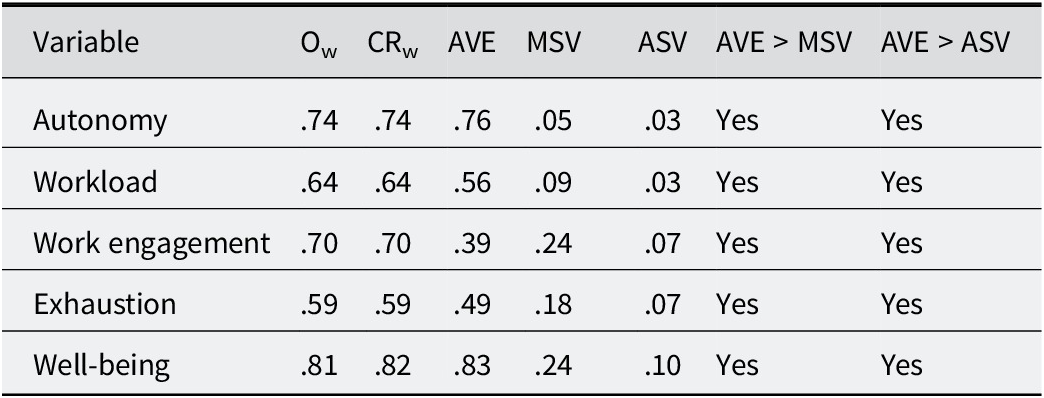
To assess the constructs’ convergent and discriminant validity and reliability, we calculated the average variance extracted (AVE), maximum shared squared variance (MSV), and average shared variance (ASV), McDonald’s Omega at the within level (OW) and composite reliability (CRw) at the within level. These results can be found in Table 1. All constructs exhibited acceptable CR values (≥ .65), except exhaustion and workload, and satisfied the criteria AVE > MSV and AVE > ASV, supporting discriminant validity (Fornell & Larcker, Reference Fornell and Larcker1981). Although engagement and exhaustion showed relatively lower ω and AVE values, they still met the minimum requirements for convergent and discriminant validity. In contrast, the well-being construct demonstrated excellent psychometric properties, with ω = .82, CR = .96, and AVE = .83.
Reliability, convergent validity, and discriminant validity indicators for each variable

Note: Ow = McDonald’s omega at the within level; CRw = Composite reliability at the within level; AVE = Average variance extracted; MSV = Maximum shared squared variance; ASV = Average shared squared variance. Following Fornell and Larcker’s (Reference Fornell and Larcker1981) criteria, “AVE > MSV” and “AVE > ASV” indicate evidence for discriminant validity when AVE is greater than both MSV and ASV.
Age
To measure age, the EWCS asked participants to respond to the following open question: “How old are you?”
Control Variables
To ensure the robustness of the model and to avoid potential confounding effects, we included educational level as a control variable. Prior research has shown that educational attainment is closely linked to digital competence and ICT usage patterns (Van Deursen & Van Dijk, Reference Van Deursen and van Dijk2011), as well as to employee well-being outcomes in the workplace (Solomon et al., Reference Solomon, Nikolaev and Shepherd2022). The educational level was measured using a categorical indicator ranging from 1 to 9, reflecting increasing levels of formal education, from incomplete primary education to doctoral studies.
Analysis
Given the nested nature of the analyzed data, we employed multilevel structural equation modeling (ML-SEM) methods (Preacher et al., Reference Preacher, Zyphur and Zhang2010, Reference Preacher, Zhang and Zyphur2016) as implemented in Mplus 8.10 (Muthén & Muthén, Reference Muthén and Muthén2017) to test the study hypotheses. The intraclass correlation coefficient [ICC (1)] calculated for our model’s outcome variable (employee well-being) was .059, indicating that 5.9% of its variance is attributed to differences between groups (i.e., countries). As all our hypotheses involved employee-level (Level 1) relationships, we group-mean centered the Level 1 predictors, mediators, and moderator in our model. This process eliminates the between-group variance in these variables and precludes obtaining conflates estimates of individual-level relationships (Preacher et al., Reference Preacher, Zyphur and Zhang2010, p. 215).
First, we examined the indirect effects implicated in Hypotheses 1, 2, 3, and 4 by fitting a 1/1-1-1-1 model (Preacher et al., Reference Preacher, Zyphur and Zhang2010) using maximum likelihood estimation techniques. Subsequently, we tested the hypothesized indirect effects by calculating their 95% confidence intervals via the Monte Carlo method (Preacher & Selig, Reference Preacher and Selig2012). Second, to examine the moderator and conditional indirect effects (CIEs) implicated in our individual-level hypotheses, we incorporated age as a Level 1 moderator of the “use of ICT at work → autonomy” and “use of ICT at work → workload” relationships. Then, we estimated all the CIEs hypothesized.
Results
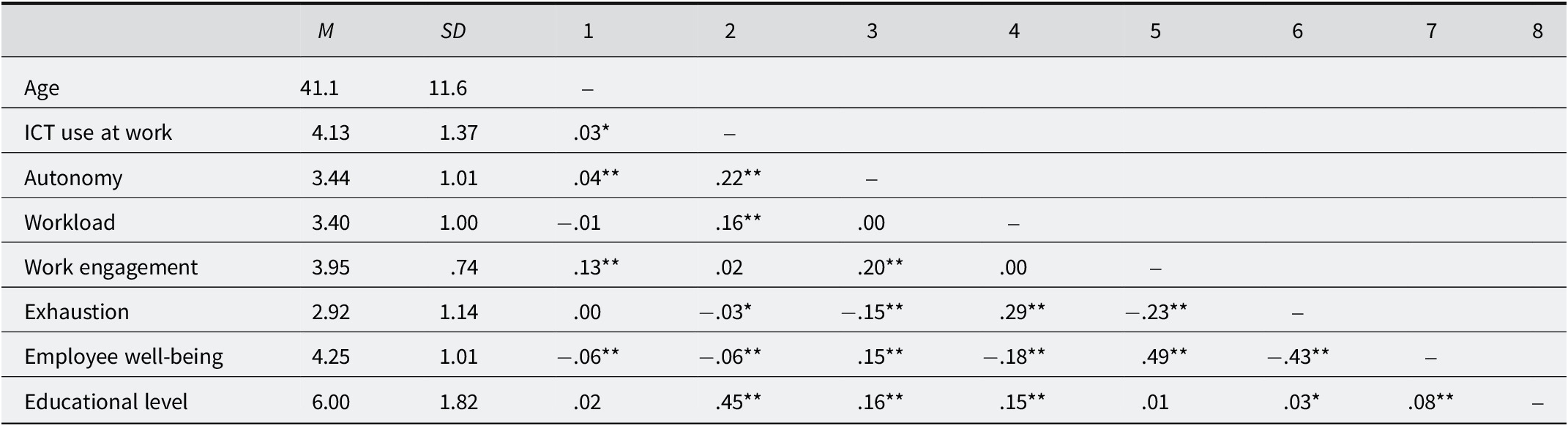
Table 2 presents the means, standard deviations (SDs), and correlations among the study variables.
Means, standard deviation, and correlations between individual level variables

Note: N = 7900. *p < .05; **p < .01.
Indirect Effects of ICT use at Work on Employee Well-Being
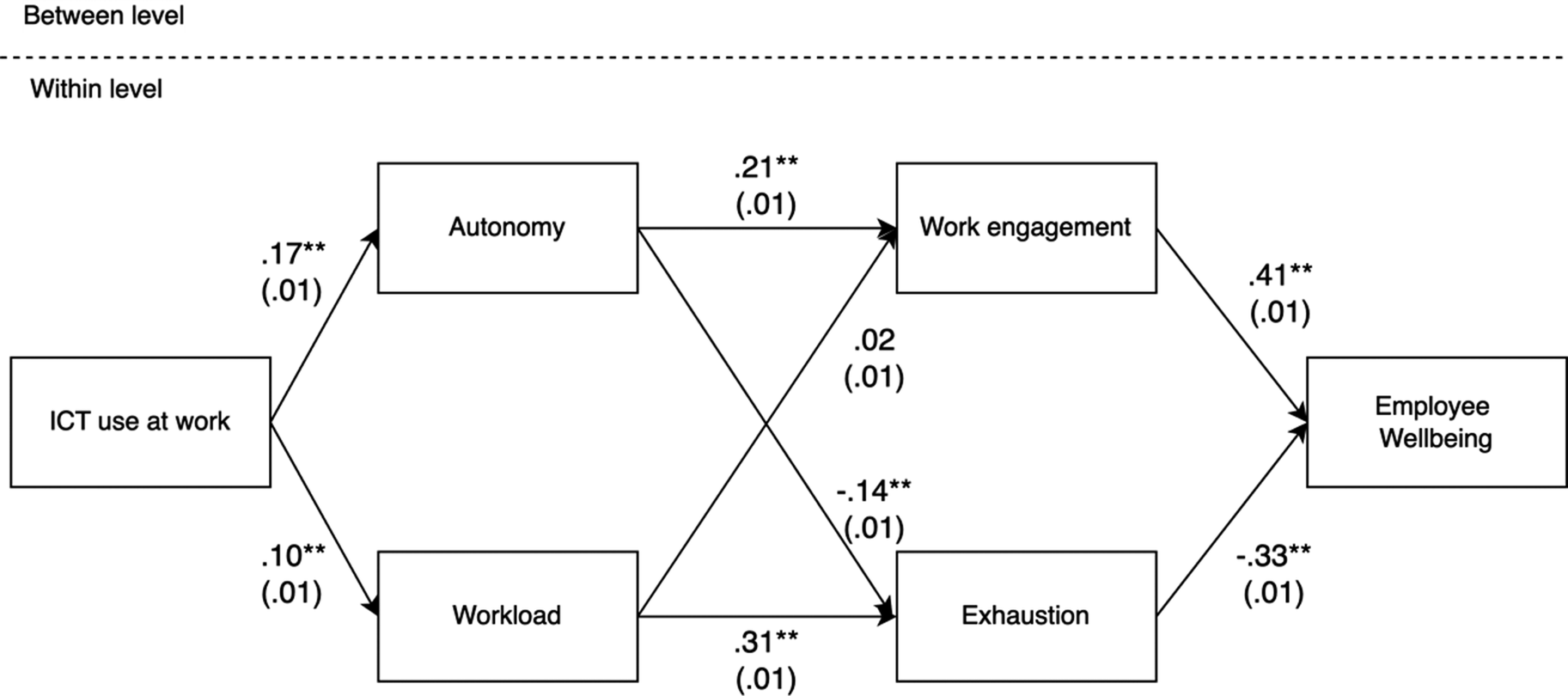
The Level 1 (i.e., within) model specified to test Hypotheses 1, 2, 3, and 4 is depicted in Figure 2. Considering that level-specific indices must be used to assess the fit of multilevel SEM models (González-Romá & Hernández, Reference González-Romá and Hernández2017), we obtained the standardized root mean square residual (SRMR)-within provided by Mplus to assess the fit of this model. The value obtained was .05, indicating a good model fit, as it was less than .08 (Marsh et al., Reference Marsh, Hau and Wen2004). The completely standardized parameter estimates for the hypothesized relationships are also shown in Figure 2. The use of ICT at work had a positive relationship with autonomy (.21, p < .01). Autonomy was positively associated with work engagement (.22, p < .01), and work engagement had a positive relationship with employee well-being (.42, p < .01). Moreover, the use of ICT was positively related to workload (.15, p < .01), which in turn had a positive relationship with exhaustion (.31, p < .01), and the latter was negatively associated with employee well-being (−.34, p < .01). Finally, autonomy was negatively related to exhaustion (−.14, p < .01), but workload did not.
Model with the hypothesized indirect effects at the employee level (Level 1).
Note: ** p < .01, two-tailed tests. Bold arrows show the significant relationships involved in the investigated indirect effects. The parameter estimates shown are standardized. Values within parentheses are standard errors.

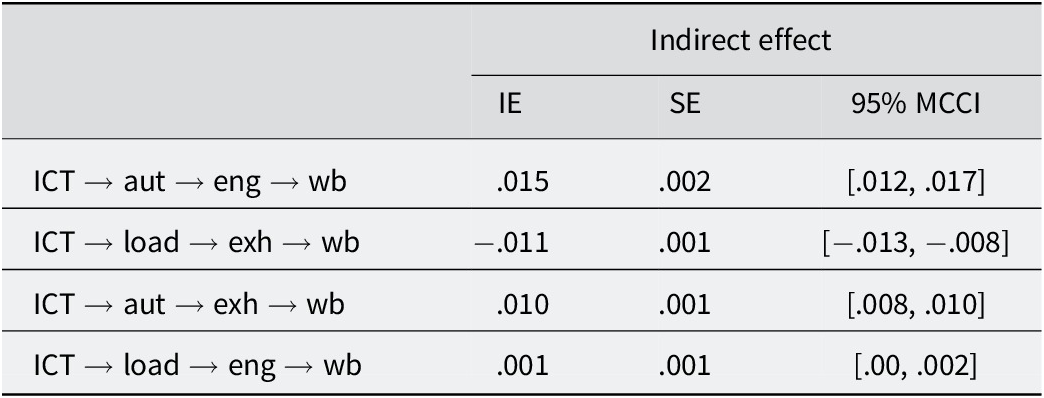
The indirect effect of ICT use at work on employee well-being through autonomy and work engagement was positive (.015, SE = .001) and statistically significant given the 95% Monte Carlo confidence interval (MCCI) did not include zero 95% MCCI [.012, .017]; see Table 3). Consequently, Hypothesis 1 was supported. The indirect effect of ICT use at work on employee well-being through workload and exhaustion was negative (−.011, SE = .001) and statistically significant 95% MCCI [−.013, −.008]. Thus, Hypothesis 2 was supported. The indirect effect of ICT use at work on employee well-being through autonomy and exhaustion was positive (.010, SE = .001) and statistically significant 95% MCCI [.008, .010]. Thus, Hypothesis 3 was supported. Finally, the indirect effect of ICT use at work on employee well-being through workload and work engagement (.001, SE = .001) was non-significant 95% MCCI [.00, .002]. Therefore, Hypothesis 4 was not supported.
Completely standardized indirect effects of ICT use at work on employee well-being

Notes: ICT: use of ICT at work, aut: autonomy, load: workload, exh: exhaustion and wb: employee well-being. IE = indirect effect point estimate; SE = standard error; MCCI = Monte Carlo confidence interval.
The Moderator Role of Employee Age
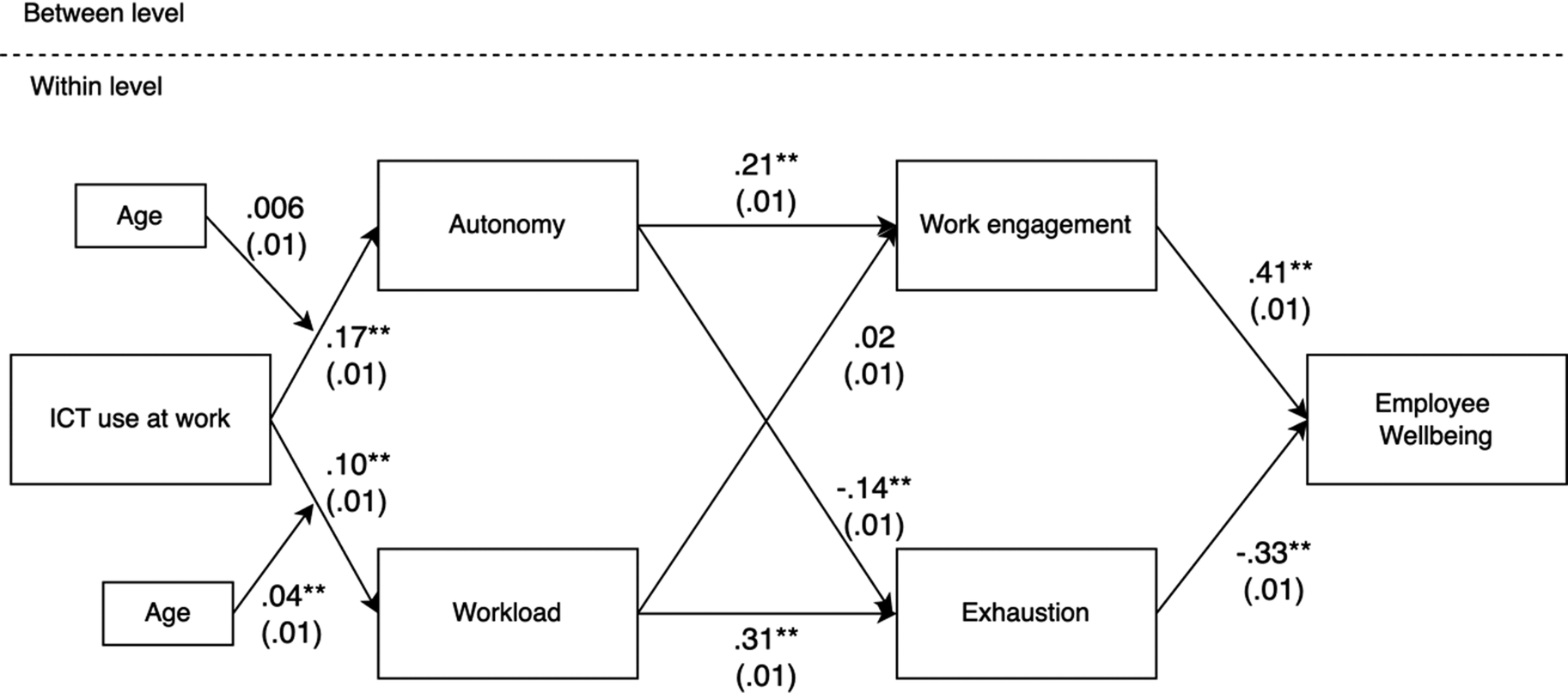
To test Hypotheses 5, 6, 7, and 8, we incorporated employee age into the within-level model shown in Figure 3 as a Level-1 moderator of the relationships between ICT use at work, on the one hand, and autonomy and workload, on the other hand (see Figure 3). The model with the moderator showed a good fit to the data (SRMR-within = .029). Moreover, it had a value for the Akaike Information Criterion (AIC = 169939.61) smaller than the AIC obtained for the model without the moderator (AIC = 169953.0). This indicated that the model using employee age as a moderator (Figure 3) provided a better fit to the data than the mediated model without it (Figure 2).
Model including employee age as employee level (Level 1) moderator.
Note: **p < .01, two-tailed tests. Bold arrows show the significant relationships involved in the investigated indirect effects. The parameter estimates shown are standardized. Values within parentheses are standard errors.

The results obtained for the parameter estimates revealed that employee age did not moderate the relationship between ICT use at work and autonomy (.006, p > .05). This result implied that the conditional indirect effects involving this non-significant moderation (Hypotheses 5 and 6) were non-significant too.
Employee age did moderate the relationship between ICT use at work and workload (.04, p < .01). This moderator role is represented in Figure 4. This figure shows, as expected, that as employee age increases, the positive relationship between ICT use at work and workload increases, too.
Plot of the moderator role of employee age in the relationship between ICT use at work and workload.
Note: This figure shows, as expected, that the positive relationship between ICT use and workload (y-axis) was stronger as age (x-axis) increased.

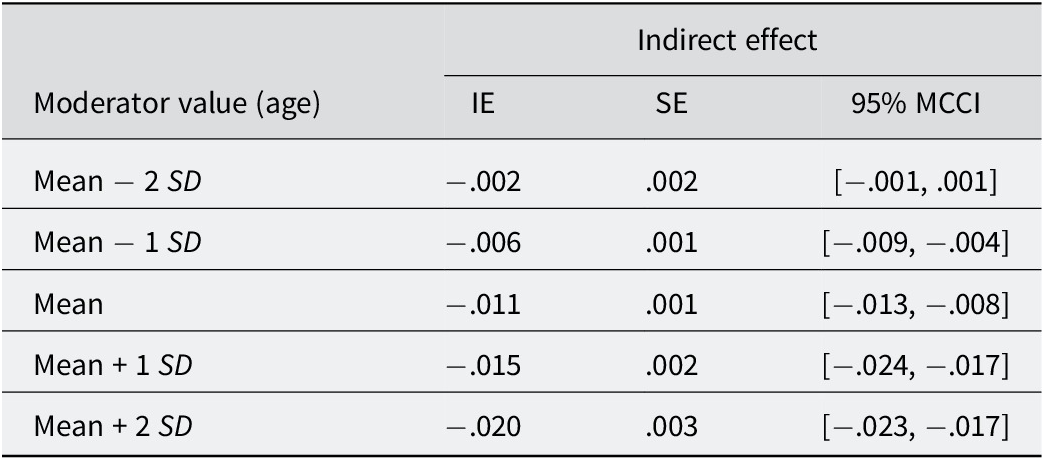
Next, we focused on the only indirect effect of ICT use at work on employee well-being involving workload that was statistically significant (ICT use at work → workload → exhaustion→ employee well-being) and tested whether it depended on employee age (Hypothesis 7Footnote 2). To do so, we did several things. First, we computed the index of moderated mediation (Hayes, Reference Hayes2015). The results obtained showed this index was statistically significant (−.004; p < .05; 95% MCCI = −.007, −.002). Second, we utilized Mplus to represent the moderator role of employee age in the negative indirect effect of ICT use at work on employee well-being via workload and exhaustion (Figure 5). This figure shows, as expected, that this negative indirect effect (y-axis) was stronger as age (x-axis) increased. Third, we computed the CIEs from ICT use at work to employee well-being via workload and exhaustion for different values of the moderator (employee age). The estimated CIEs are presented in Table 4. These results show that the indirect effect “ICT use at work → workload → exhaustion → employee well-being” was statistically significant for all five age values considered. In line with our expectations, the negative indirect effect was stronger as age increased. These findings lend further support to Hypothesis 7.
Plot of the conditional indirect effect involved in Hypothesis 7: “ICT use at work → workload → exhaustion → employee well-being” across age standardized values.
Note: Indirect represents the value of the following indirect effect: ICT use at work → workload → exhaustion → employee well-being. Age was standardized. The red line represents the point estimate of the indirect effect across the range of age values. The blue lines define the corresponding 95% confidence interval.

Completely standardized indirect effects of ICT use at work on employee well-being through workload and exhaustion for different values of age

Notes: IE = indirect effect point estimate; SE = standard error; MCCI = Monte Carlo confidence interval; SD = standard deviation.
Discussion
The goal of this study was to examine the complex relationship between ICT use at work and employee well-being. The results obtained showed that, on the one hand, ICT use was positively related to job autonomy, which in turn was positively related to work engagement, which in turn was positively related to employee well-being. Moreover, ICT use at work showed a positive indirect effect on employee well-being via job autonomy and work engagement. On the other hand, ICT use was also positively related to workload, which in turn was positively related to exhaustion, which in turn was negatively related to employee well-being. Based on these relationships, ICT use at work showed a negative indirect effect on employee well-being via workload and job exhaustion. Additionally, because job autonomy was negatively related to job exhaustion, we identified a second positive indirect effect of ICT use at work on employee well-being via job autonomy and job exhaustion. Finally, we examined age as a moderator. The results obtained showed that age moderated the positive relationship between ICT use and workload, making this relationship stronger as age increases. Similarly, age also moderated the indirect effect of workload on employee well-being via workload and job exhaustion. Next, we elaborate on the theoretical and practical implications of these findings.
Implications for Theory and Research
This study has several theoretical implications for the understanding of how ICT affects employee well-being. First, responding to the call for understanding the complex relationship between ICT use and employee well-being (Barley, Reference Barley2015; Parker & Grote, Reference Parker and Grote2022; Wang et al., Reference Wang, Liu and Parker2020), this study contributes to theoretical knowledge by demonstrating that ICT use has an indirect relationship with employee well-being through both positive and negative pathways, mediated by key work characteristics. ICT use can foster a job resource: job autonomy. ICT use enables greater flexibility in work scheduling and decision-making, which increases employees’ perceived control over their tasks (Raghuram et al., Reference Raghuram, Hill, Gibbs and Maruping2019). This autonosmy, in turn, fosters work engagement, a psychological state linked to greater motivation, energy, and positive emotions (Schaufeli et al., Reference Schaufeli, Salanova, González-Romá and Bakker2002), which contributes to improved employee well-being. However, ICT use also fosters a job demand: workload, which contributes to job exhaustion (Scholze et al., Reference Scholze and Hecker2024). These dysfunctional relationships occur when employees feel overwhelmed by the additional volume of tasks associated with ICT use, leading to higher exhaustion and, consequently, poorer well-being (Van den Broeck et al., Reference Van Den Broeck, Elst, Baillien, Sercu, Schouteden, De Witte and Godderis2017). Thus, this study advances our understanding by showing how ICT use can simultaneously promote job autonomy as a resource that enhances employee well-being through engagement, whereas also presenting risks to employee well-being by increasing workload and exhaustion, illustrating the dual-edged nature of ICT in the workplace.
Second, the inclusion of ICT as an antecedent in our research model extends the JD-R theory by showing how a specific technological factor (i.e., ICT use at work) is related to concrete job resources and demands. Specifically, our findings extend the motivation process embedded within the JD-R theory by showing that ICT use at work fosters a job resource (autonomy), which in turn promotes employee motivation (work engagement). This finding is also consistent with the self-determination theory (Deci & Ryan, Reference Deci and Ryan2000), which emphasizes that autonomy is a core psychological need. When this need is satisfied, it enhances intrinsic motivation, leading to greater engagement. Our results also extend the health-impairment process proposed by the JD-R theory by showing that ICT use at work fosters a job demand (workload), which in turn promotes employee strain (job exhaustion). This result aligns with the COR theory (Hobfoll et al., Reference Hobfoll, Halbesleben, Neveu and Westman2018), which posits that individuals strive to retain, protect, and build resources and that stress occurs when these resources are threatened or lost, such as when ICT-related demands exceed one’s capacity to manage them. Moreover, the negative relationship observed between job autonomy (resource) and job burnout (strain variable) suggests, along with previous research (Alarcon, Reference Alarcon2011; Crawford et al., Reference Crawford, LePine and Rich2010; Havermans et al., Reference Havermans, Boot, Houtman, Brouwers, Anema and Van Der Beek2017; Shoman et al., Reference Shoman, Marca, Bianchi, Godderis, van der Molen and Guseva Canu2021), that there are cross-links between the variables involved in the motivational and health impairment processes that the JD-R theory should incorporate.
Finally, our study uncovered a boundary condition (employee age) of the positive direct relationship between ICT use and workload, on the one hand, and the negative indirect relationship between the former variable and employee well-being, on the other hand. These relationships were stronger for older employees. These findings are consistent with previous research that suggests that age-related declines in cognitive resources may make it more difficult for older workers to manage the increased demands associated with ICT use (Phang et al., Reference Phang, Sutanto, Kankanhalli, Li, Tan and Teo2006). The moderation effect of age on the ICT–workload relationship also aligns with the boundary conditions suggested by the JD-R model, which posits that individual characteristics may influence employees’ perceptions and responses (Bakker & Demerouti, Reference Bakker and Demerouti2017). Identifying this moderator role of age is relevant for future theoretical development, as it emphasizes the need to consider how demographic factors shape the relationship between technology and employee well-being. While previous research has applied the JD-R framework to investigate how digital technologies relate to employee outcomes (e.g., Leitner & Stöllinger, Reference Leitner and Stöllinger2022), our study builds on and extends this line of work by incorporating a key moderator and employee well-being as an ultimate outcome.
Practical Implications
The results of this study have important practical implications. First, as our findings show that ICT use is positively associated with workload and job exhaustion, it is essential for managers and Human Resource professionals to design and implement strategies aimed at mitigating the potentially dysfunctional consequences of ICT use on the aforementioned variables, particularly for older employees who are more vulnerable to these issues when engaging with such technologies. To address this issue, organizations can implement training programs specifically designed to equip older workers with the necessary tools and skills to use ICT effectively in their jobs. These training sessions should focus not only on teaching employees how to use the technologies efficiently but also helping them understand when it is most appropriate to use them in their daily tasks. By doing so, companies can reduce the risk of job exhaustion and its negative impact on employee well-being (Chesley, Reference Chesley2014; Scholze et al., Reference Scholze and Hecker2024). Second, another practical implication is related to leveraging the positive influence of ICT use on job autonomy to enhance work engagement and employee well-being. ICT allows employees to have more control over when, where, and how they perform their work, which can lead to greater engagement and employee well-being. By promoting autonomy through ICT use, organizations can foster a more motivated and engaged workforce, which is positively linked to employee well-being (Deci & Ryan, Reference Deci and Ryan2000). However, they should do it in an appropriate way that prevents increasing employee workload. For instance, setting clear disconnection times outside work can be helpful in this regard.
Strengths and Limitations
This study has several limitations that should be considered when interpreting the results. First, ICT use was measured using a single item, which may limit the content validity of the measure. However, this limitation is due to the use of a publicly available dataset with predetermined survey questions, and it is not possible to modify or expand these measures. Previous studies that have used the same single-item measures of ICT use (Barrientos-Marín et al., Reference Barrientos-Marín, Fu, Millán and van Stel2021; Menon et al., Reference Menon, Salvatori and Zwysen2020; Millán et al., Reference Millán, Lyalkov, Burke, Millán and van Stel2021) provide empirical evidence supporting its validity. Nevertheless, future studies should replicate these findings by using multi-item scales with broader content coverage. Additionally, future studies should investigate whether different types of ICTs (e.g., communication tools, productivity software) impact work characteristics and employee well-being differently. This would provide a more nuanced understanding of how specific technologies influence employee outcomes.
Second, the cross-sectional design of this study does not allow us to make causal interpretations of our findings. Longitudinal studies are required to obtain stronger evidence about the causal relationships between ICT use, job characteristics, and their combined relationship on employee well-being. However, the relationships hypothesized in our study have a sound theoretical foundation based on a well-established theory (the JD-R model) in our science.
Third, the indirect effects observed in this study were relatively small, which is common in non-experimental research (Champoux & Peters, Reference Champoux and Peters1987). Nonetheless, small effects can hold significant practical importance (Aguinis et al., Reference Aguinis, Gottfredson and Culpepper2013). In this regard, it is worth saying that a slight increase in employee well-being can significantly enhance their quality of working life. Our findings suggest that improving job autonomy and reducing workload are effective strategies to boost employee well-being. These consequences can be particularly more pronounced among older individuals when addressing the workload associated with ICT use.
Finally, a limitation of the present study concerns the reliability of the workload and exhaustion measures, whose omega values were low (.64 and .59, respectively). Although this may be partly due to the short length of the scales (two items each), it is also possible that the wording and formulation of the items themselves contributed to the lower reliability. Future editions of the EWCS should consider not only increasing the number of items but also reviewing their quality to ensure greater scale reliability.
This study also has some strengths that we want to highlight. First, we analyzed a large multinational sample. Respondents were randomly selected using probability sampling, ensuring nationally representative samples across 37 European countries. This design enhances the generalizability of the findings and allows for a comprehensive analysis of the relationships between ICT use and employee well-being across different countries. Second, the use of multilevel structural equation modeling (ML-SEM) allowed us to account for the nested nature of the data, and prevent obtaining parameter estimates conflating within and between components (Preacher et al., Reference Preacher, Zyphur and Zhang2010).
Conclusion
Our study contributes to improving our understanding of the complex ways in which ICT use at work is related to employee well-being. Our findings suggest that ICT use fosters employee well-being by enhancing job autonomy and work engagement. However, ICT use also hinders employee well-being by fostering workload and job exhaustion, especially among older workers. Organizations, managers, and HR professionals should carefully consider these results and implement strategies to promote the functional outcomes of ICT use while buffering its dysfunctional ones. By doing so, they will improve the quality of working life for employees in contemporary organizations.
Data availability statement
The data used in this study are publicly available from the European Working Conditions Survey (EWCS) conducted by Eurofound. The dataset can be accessed at https://www.eurofound.europa.eu/en/surveys-and-data/surveys/european-working-conditions-survey/ewcts-2021, subject to the terms and conditions established by Eurofound. The analytical procedures used in this study are available from the corresponding author upon reasonable request.
Author contribution
Matías Arriagada-Venegas: Conceptualization, Methodology, Formal analysis, Writing—original draft, Writing—review & editing. Eva Ariño-Mateo: Methodology, Writing—review & editing. Vicente González-Romá: Methodology, Writing—review & editing, Supervision.
Funding statement
This research was supported by Conselleria d’Educació, Cultura, Universitats i Ocupació of Generalitat Valenciana (CDEIGENT/2021/003), including Prometeo Grants (Prometeo2021/048 and CIPROM2024/76).
Competing interests
The authors declare no conflicts of interest.



 Open access

