
Skip to main content Accessibility help
×
  • Cited by 13
    • Show more authors
    • You may already have access via personal or institutional login
    • Select format
    • Publisher:
      Cambridge University Press
      Publication date:
      21 December 2009
      10 January 2005
      ISBN:
      9780511552472
      9780521834827
      9780521047913
      Dimensions:
      (228 x 152 mm)
      Weight & Pages:
      0.7kg, 352 Pages
      Dimensions:
      (228 x 152 mm)
      Weight & Pages:
      0.539kg, 352 Pages
    You may already have access via personal or institutional login
  • Selected: Digital
    Add to cart View cart Buy from Cambridge.org

    Book description

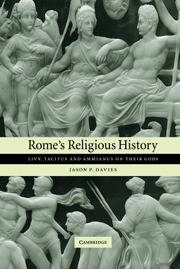
    This book explores the way in which three ancient historians, writing in Latin, embedded the gods into their accounts of the past. Although previous scholarship has generally portrayed these writers as somewhat dismissive of traditional Roman religion, it is argued here that Livy, Tacitus and Ammianus saw themselves as being very close to the centre of those traditions. The gods are presented as a potent historical force, and a close reading of the historians' texts easily bears out this conclusion. Their treatment of the gods is not limited to portraying the role and power of the divine in the unfolding of the past: equally prominent is the negotiation with the reader concerning what constituted a 'proper' religious system. Priests and other religious experts function as an index of the decline (or restoration) of Rome and each writer formulates a sophisticated position on the practical and social aspects of Roman religion.

    Reviews

    ‘The book is well-produced … A full index locorum and a useful subject index serve the reader well.’

    Jan den Boeft - Vrije Universiteit, Amsterdam

    ‘This is a comprehensive and interesting piece of informed research … So very thorough and thoroughly referenced, confidently explored and argued …’

    Source: The London Association of Classical Teachers Newsletter

    'Davies' sensitivity to the interpretive strategies of the ancient authors allows for sympathetic reconstructions of the cultural contexts which inform the historical works. … In sum, this is an erudite, powerful, and invaluable interpretation of Roman religion and historiography.'

    Source: Journal of Roman Studies

    Refine List

    Actions for selected content:

    Select all | Deselect all
    • View selected items
    • Export citations
    • Download PDF (zip)
    • Save to Kindle
    • Save to Dropbox
    • Save to Google Drive

    Save Search

    You can save your searches here and later view and run them again in "My saved searches".

    Please provide a title, maximum of 40 characters.
    ×

    Contents

    Metrics

    Altmetric attention score

    Full text views

    Total number of HTML views: 0
    Total number of PDF views: 0 *
    Loading metrics...

    Book summary page views

    Total views: 0 *
    Loading metrics...

    * Views captured on Cambridge Core between #date#. This data will be updated every 24 hours.

    Usage data cannot currently be displayed.

    Accessibility standard: Unknown

    Why this information is here

    This section outlines the accessibility features of this content - including support for screen readers, full keyboard navigation and high-contrast display options. This may not be relevant for you.

    Accessibility Information

    Accessibility compliance for the PDF of this book is currently unknown and may be updated in the future.
