

1. Introduction
Beijing has recalibrated its policy towards the Hong Kong Special Administrative Region (HKSAR) since the 2019 anti-extradition law amendment bill (anti-ELAB) movement. Perceiving its sovereignty was challenged by the unprecedented political mobilisation, Beijing tightened political control over the city through the imposition of the national security law (NSL) in July 2020. Since then, the boundary of political and civil liberties in the city has been reset. Following the mass arrests of political leaders and activists, the disbandment of non-governmental organizations (NGOs) and the closure of major pro-democracy media outlets, political dissent has been channelled through low-risk defiance and adaptive resilience (Lee et al., Reference Lee, Yuen and Tang2024). Nevertheless, the state expanded traditional forms of political repression into the economic sphere. The phenomenon of ‘economic repression’ is primarily directed at entities whose political positions are incongruent with the regime’s to curtail subtle forms of resistance. Both businesses and individuals can be worse off by economic repression. This paper highlights the economic pressure on dissenting businesses, as changes in their behaviour will have far-reaching effects on the political and economic landscape.
This paper pays special attention to four high-profile cases, namely Cathay Pacific, Taipan Bakery, Apple Daily, and Chickeeduck, that faced an array of economic punishments due to their political stances in 2019–2021. Alongside the complexity of economic repression encountered by these firms, they were well-known corporations in their respective industries: aviation, bakery, media, and clothing retailing.Footnote 1 The relentless economic pressure exerted on Cathay Pacific in August 2019 was the bellwether of a paradigm shift in Hong Kong’s business environment. Taipan Bakery’s business in China had been suppressed until it was acquired by a patriotic businessman in 2021. Apple Daily was forced to shut down in 2021. Chickeeduck eventually left the city in 2022. Economic repression in the four cases may not reflect the experience of other companies at large, whereas it indicates a remodelling of the HKSAR’s political economy and sheds light on the behaviour of other firms that are not directly targeted. This paper seeks to provide insight into these two questions: What were the major tactics involved in economic repression? How did they progress to achieve the intended outcomes?
This study contributes to the contentious politics scholarship on two fronts. Theoretically, it offers conceptualisation of economic repression of businesses – a set of strategies designed to eliminate, convert, and/or silence dissenting entities. Drawing inspiration from Jennifer Earl’s political repression typology that distinguishes between political coercion and political channelling, it introduces an economic repression framework that identifies nuances between economic duress and economic channelling (Earl, Reference Earl2003). Economic duress embodies overt political repression in the marketplace, such as violence and closure orders inflicted on the targets. By contrast, economic channelling represents covert political repression in the business sector, such as administrative inspections or severance of economic relations with a target. Empirically, the paper applies the economic repression framework to Hong Kong-based companies when China-Hong Kong relations entered a new era. The four cases demonstrate that economic channelling was usually deployed first, followed by economic duress and, in some instances, overt political coercion if those measures did not achieve their intended goals.
The remainder of the paper is structured as follows: the second section offers a nuanced understanding of political repression through economic means and discusses the motivations and tactics of economic repression. The third section underlines the evolution of Beijing’s approaches to local business, from co-optation to coercion in the 1980s–2010s. It also discusses how the rise of Chinese capital in Hong Kong might impact Beijing’s strategy. Then, the paper turns to the four empirical cases to illustrate the operations of economic repression amid the anti-ELAB movement. The conclusion explores the ramifications of economic repression for the pro-democracy movement and assesses the prospects for businesses’ political neutrality in the post-NSL era.
2. Economic repression: why and how?
Repression is broadly defined as a spectrum of demobilisation tactics that aim at cracking down on political challenges to the powerholders. It operates to discourage dissent by increasing individuals’ cost of participation in contentious politics (Tilly, Reference Tilly1978) and reshaping participants’ cognitive beliefs of action outcomes (Tarrow, Reference Tarrow2011). Tarrow (Reference Tarrow2011) underlines physical coercion directed at challengers as hard repression, for example, protest management with excessive force, political assassination, and mass arrests of protesters. While political repression is likely to curb political opposition, it might also inadvertently provoke more resistance, radicalise a cause, and tarnish a regime’s legitimacy (della Porta & Diani, Reference della Porta and Diani2006). Acknowledging the drawbacks of overt repression, the powerholders also adopt covert and non-violent forms of political control, commonly known as ‘soft repression’.
Scholars offer divergent interpretations of soft repression. della Porta (Reference della Porta1995) differentiates between hard and soft forms of repression based on the degree of the use of force. Ferree (Reference Ferree, Davenport, Johnston and Mueller2005) depicts the concept as the marginalisation of movement participants through discursive means, such as labelling, stigmatisation, and silencing. García (Reference García2014) refers to the use of apolitical regulations, administrative measures, identity checks, and other mobilisation barriers as soft repression tactics. Hui (Reference Hui2020) characterises the concept as an erosion of institutional safeguards that impede civil and political rights, the deterioration in the rule of law, a politically neutral bureaucracy, and the freedom of the press.
2.1 Definition of economic repression
This study defines economic repression as a spectrum of instruments employed by a government and its non-state supporters to escalate the economic costs of a target’s direct or indirect involvement in political opposition. Repressive agents attempt to eliminate a non-compliant target, reverse its position, and/or induce self-censorship among other entities that are not currently targeted by the authorities (O’Connell, Reference O’Connell2022). In other words, economic repression aims to eliminate, convert, and/or deter dissenting businesses from defying a regime under the shadow of economic repercussions. Economic repression can be adopted independently or concomitantly with other demobilisation measures, including arrests, propaganda, and negotiations (see Gerschewski, Reference Gerschewski2013).
The articulation of economic repression in this study is closer to the depiction of soft repression by García (Reference García2014) and Hui (Reference Hui2020), which includes ostensibly administrative instruments designed to change the private sector’s operational environment. The concept does not precisely correspond to the features underlined by della Porta (Reference della Porta1995) and Ferree (Reference Ferree, Davenport, Johnston and Mueller2005). Despite a lack of physical violence, economic repression could still have severe consequences on a target, including business closure and unemployment. Additionally, state and non-state repressive agents’ censure is often accompanied by tangible economic punishments (Chan, Reference Chan, Ren and Hillman2024a; Reference Chan2025). As such, their discursive power not only marginalises the opposition but also incurs financial ramifications. Both businesses and individuals could be subject to economic repression. This study focuses on business entities because their shift in political orientations would have profound impacts on the political and economic environment.
Soft repression gives a regime leeway to evade responsibility for political repression (Ong, Reference Ong2018). Additionally, economic repression intends to achieve at least one of the following objectives. First, economic repression impedes resource mobilisation in political contention. Resource mobilisation theory highlights the importance of aggregated resources, for instance, money, manpower, facilities, and legitimacy, in facilitating movement expansion (McCarthy & Zald, Reference McCarthy and Zald1977). Some of the businesses that are sympathetic to a political cause may make a donation (Ho, Reference Ho2023). Economic punishments that target defiant businesses can presumably weaken a movement’s mobilisation capacity by making them unwilling or unable to provide financial support to it. Second, it stifles political consumerism, in which pro-democracy consumers convey their public opinions through political boycotting in the marketplace (Chan, Reference Chan2022). The supply of like-minded companies is a prerequisite for political boycotting. Economic repression deters businesses from supporting the opposition forces and therefore hinders political consumers from making political statements through their consumption. Third, it motivates apolitical and profit-seeking shareholders to hold a company accountable for its political behaviour. Investors who perceive that a company’s dissenting political opinions could generate financial loss will demand that the company change its stance. Fourth, it empowers counter-movements to crowdsource new targets and tactics to amplify the threats in the economic domain, as many companies’ activities are publicly accessible (Dillard, Reference Dillard2013). Fifth, it discredits a target’s integrity by politically motivated criminal prosecutions. Convictions of commercial crimes or fraud charges can damage the opposition forces’ reputation and moral standing (Rogov, Reference Rogov2018).
2.2 Tactics of economic repression
Economic repression in authoritarian contexts is ubiquitous. Existing contentious politics literature touches on repressive measures, such as employment discrimination and funding denial (Gerschewski, Reference Gerschewski2013; Tilly & Tarrow, Reference Tilly and Tarrow2015), but does not review the economic dimension of political repression systematically. Moreover, the nuances of instruments in economic repression are underexplored. This study engages with Earl’s repression typology in analysing tactics that eliminate, convert, and/or deter business entities’ non-compliant positions in political contention. Earl (Reference Earl2003) underpins that state actors, such as police, military, and administrative authorities, and non-state actors, such as state-affiliated counter-movement members and thugs, can impose political repression on challengers.Footnote 2 Furthermore, repression encompasses both overt coercion in terms of physical violence and mass arrests and subtle channelling tactics that curtail political and resource mobilisation. The classification of repressive agents and repressive tactics generates four types of repression: (1) state actors’ political coercion, (2) state actors’ political channelling, (3) non-state actors’ political coercion, and (4) non-state actors’ political channelling.
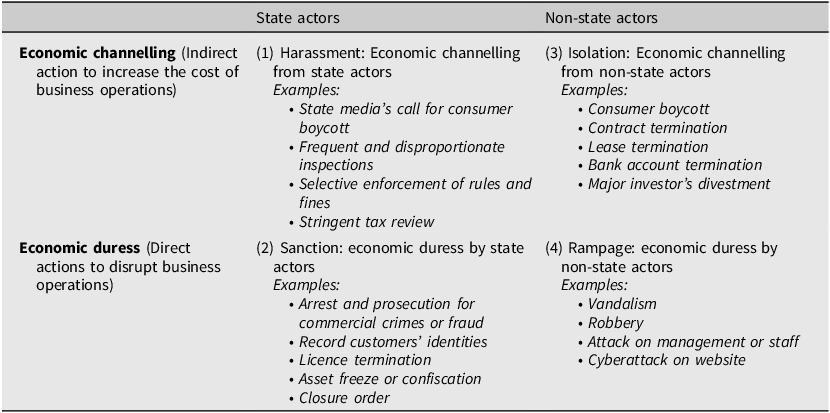
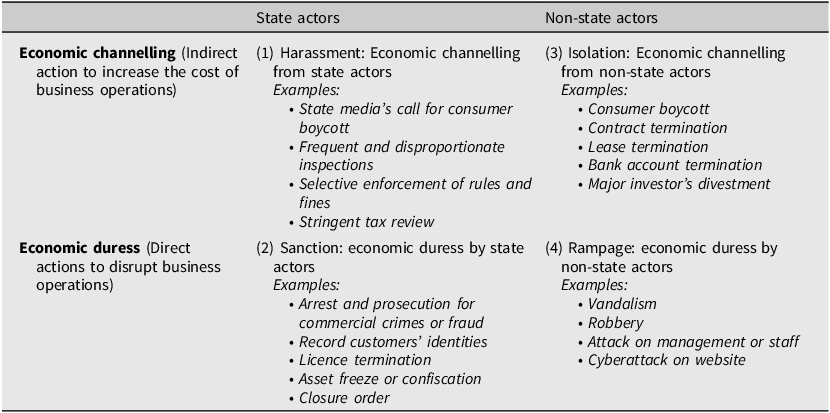
Building on Earl’s repression typology, this study contends that both state actors, including administrative authorities, politicians, and state media, and non-state actors, including commercial entities, individuals, or even triad groups that support the regime or are commissioned by regime allies, could engage in economic channelling and economic duress (coercion). Economic channelling involves indirect actions to increase a targeted business’s operational costs through administrative and commercial instruments that are often under the guise of impartial or independent actions. Meanwhile, economic duress encompasses direct actions to disrupt a target’s operations, which signal political consequences by legal prosecution or physical violence (see also Chan, Reference Chan2025). Economic duress in this study is distinguished from economic coercion, a well-established concept in the international political economy scholarship, which refers to negative economic actions that a state imposes on another state to change the target’s behaviour. The framework produces four forms of economic repression: (1) state actors’ economic channelling (harassment), (2) state actors’ economic duress (sanction), (3) non-state actors’ economic channelling (isolation), and (4) non-state actors’ economic duress (rampage). Adopting an inductive approach, this study employs empirical examples to illustrate four types of economic repression in non-democratic contexts (see Table 1).
-
(1) Harassment: State actors deploy economic channelling to weaken a target’s financial position through indirect actions. In economic harassment, the authorities, state media, and other state-controlled agents leverage administrative measures and market forces to inflict financial loss on a targeted business. Government officers may frequently inspect a company’s fire safety, operating licence, hygiene, noise level, and so on, and selectively enforce regulations. In some instances, disproportionate punishments are imposed if irregularities are found (van der Vet, Reference van der Vet2018). Funding exclusion and stringent tax reviews are also typical measures to decrease a defiant business’s revenue or increase its operational costs (van der Vet, Reference van der Vet2018). Similar to state-mobilised consumer nationalism that boycotts an opponent country’s goods to achieve foreign policy objectives is prevalent (Castelló & Mihelj, Reference Castelló and Mihelj2018; see also Chan, Reference Chan2024b), state media can call for a consumer boycott to punish a politically non-compliant business at the domestic level. A sudden revenue shortfall can destabilise a company and force it into financial distress.
-
(2) Sanction: State actors engage in economic duress to disrupt a business’s operations through direct actions. In economic sanctions, police, judiciary, and other state agents resort to arrest and prosecution to create a sudden financial instability for a targeted company. Under authoritarian rule, the arrest of the owner and senior management in corruption, tax evasion, or fraud cases often triggers a crisis for a business (Burrett, Reference Burrett2020). These actions are often accompanied by the confiscation of documents, goods, and equipment during a raid on the ground of crime investigation (Rochlitz, Reference Rochlitz2014). Prosecution can result in a closure order, licence revocation, and asset freeze that immediately suspends or ends a targeted business’s operations. While anti-corruption campaigns and crackdowns on commercial crimes are legitimate, they may serve as legal means for political ends (see Chow, Reference Chow2015). Furthermore, the court’s ruling could be subject to the law-politics nexus in an authoritarian context (Kubal, Reference Kubal2024) and therefore to a dissenting business’s disadvantage.
-
(3) Isolation: Non-state actors leverage economic channelling to weaken a business’s financial position through indirect actions. In economic isolation, commercial actors and individuals, such as landlords, contractors, business partners, and consumers, sever economic ties with a targeted business owing to their political stance, self-censorship, or external pressure. A landlord may end the lease or refuse to lease premises to a targeted business (Xu, Reference Xu2013). Suppliers and banks may also stop providing services to it (Chau, Reference Chau2021). Economic isolation from business partners hampers a targeted company’s continued operations. Moreover, pro-regime organisations, sometimes also mobilised by state media, may call on consumer boycotts to hurt a defiant business’s revenue (Chan, Reference Chan2025). On some occasions, other commercial actors, associated with a target company, are coerced into endorsing the state’s position and make a targeted business’s goods and services less accessible on the market (see BBC News, 2021).Footnote 3
-
(4) Rampage: Non-state actors employ economic duress to disrupt a target’s operation by direct actions. In an economic rampage, state-affiliated or state-sponsored private actors resort to violence to induce anxiety in a targeted business. A counter-movement may disrupt a targeted business’s operations by vandalism, robbery, or assault on staff and management (see Rogov, Reference Rogov2018). Although they may not be sufficient to force a targeted business to close, they usually engender an atmosphere of fear and insecurity among employees. Cyberattacks that paralyse a company’s website operations or the theft of sensitive information from its server could also achieve similar objectives in the internet sphere (Gandhi et al., Reference Gandhi, Sharma, Mahoney, Sousan, Zhu and Laplante2011).
This paper introduces the four distinct forms of economic repression, based on the types of actors involved and the nature of the instruments deployed, and illuminates the sophistication of the political control strategies. While the types of repressive agents are easier to determine, the nature of the instruments could sometimes be elusive. A state’s comprehensive capacity correlates with its coercive power (Hanson, Reference Hanson2017). The levels of the state’s penetration into the market and society facilitate the implementation of economic repression. State capability helps to mobilise the business allies and pro-regime social networks to impose channelling tactics on targets whose political stances are incongruent with the state’s. Rewards will be distributed to members in the counter-movement accordingly (Cheng, Reference Cheng2020). It is important to note that this typology does not account for the impacts or outcomes of economic repression, as these effects are evaluated on a case-by-case basis.
3. Evolving Beijing’s approach to the business sector in Hong Kong
The regime-business partnership has been based on mutual benefits since the 1980s. Notwithstanding a divergence in ideology, the Chinese Communist Party (CCP) began co-opting Hong Kong capitalists in the early phase of China’s economic reform. Recognising the contributions of Hong Kong capitalists to the mainland’s economic development and the city’s political stability, Beijing was more willing to reward the business elites with economic opportunities and political appointments. In the 2010s, the asymmetric economic power between Hong Kong and Mainland China drastically reversed. When Hong Kong corporations have become more reliant on the Chinese market, their value to the regime has diminished significantly. Additionally, Beijing’s growing assertiveness over the HKSAR’s governance explains a paradigm shift in the city’s business environment. Following the unprecedented anti-ELAB movement that resisted Beijing’s political control in Hong Kong, pressure rather than enticement was deployed to extract local businesses’ allegiance (see Summers, Reference Summers2021).
3.1 Co-opting Hong Kong businesses before 2019
Before 1997, Beijing cultivated extensive patron-client networks in colonial Hong Kong. Xinhua News Agency was tasked with promoting the communist ideology and recruiting followers through organisations that spanned labour unions, the media, the education sector, the film industry, and so on (Lee, Reference Lee2020). The Beijing-Hong Kong capitalist partnership, however, was embedded in pragmatism. For Beijing, it was eager to capitalise on Hong Kong investments for the country’s economic modernisation against the backdrop of China’s economic reform and political crisis (Hung, Reference Hung, Lui, Chui and Yep2018).Footnote 4 It also counted on local capitalists to boost confidence in the city’s economy under the shadow of British conglomerates’ divestment amid the sovereignty transition and expected them to counter Hong Kong citizens’ demand for democratisation (Ma, Reference Ma2016). For local capitalists, they looked up to the regime to sustain their class privileges in the city and protect their businesses in China (Fong, Reference Fong2014; Wong, 2015). They were formally co-opted into Chinese political institutions, including the National People’s Congress (NPC), the Chinese People’s Political Consultative Conference (CPPCC), the Basic Law Drafting Committee, the Basic Law Consultative Committee, and the Selection Committee of the Chief Executive of the HKSAR.Footnote 5 Such political appointments to Chinese institutions enabled them to gain policy access to advance their business interests in Hong Kong and Mainland China (see Fong, Reference Fong2014).
In the post-1997 era, an increasing number of Hong Kong business elites were appointed as members of the NPC and the CPPCC (Cheng, Reference Cheng2020). The HKSAR government also inherited the practices of political co-optation from the colonial administration. Local business elites were selected for the Legislative Council (LegCo) through elections in functional constituencies, in which seats were reserved for designated corporate sectors. Lawmakers from the business sector firmly defended a low-tax system and delayed the introduction of the minimum wage (Ma, Reference Ma2016).Footnote 6 Hong Kong business elites were also included in the cross-border economic cooperation platforms under the national social and economic development framework. An intensifying asymmetric economic interdependence enabled Beijing to exercise more influence over the HKSAR’s business sector in the patron-client relations (Summers, Reference Summers2021).
The tightening of Beijing’s control over Hong Kong in the 2010s can be attributed to the development of a Hongkonger identity, the surge in state capacity, and the change in the CCP’s leadership. After nearly two decades of self-resistance to overt interference in the HKSAR’s governance (Fong, Reference Fong2017), Beijing reaffirmed its sovereignty over the city in response to the Occupy Central, a looming occupation movement (later transformed into the 2014 Umbrella Movement) (Chan, Reference Chan2015) that demanded universal suffrage. Beijing reinterpreted the framework of “One Country, Two Systems” (OCTS) in an authoritative white paper, emphasising the primacy of the ‘one country’ principle over the ‘two systems’ doctrine. Since then, the HKSAR’s autonomy has been subject to Beijing’s ‘comprehensive jurisdiction’ (State Council of the People’s Republic of China, 2014). Before 2019, state actors generally refrained from employing economic repression on businesses (see Summers, Reference Summers2021). Nevertheless, the Apple Daily (a subsidiary of Next Media), which took an interventionist approach to strive for democracy, stood as a rare target of economic harassment, isolation, and rampage (see Hanitzsch et al., Reference Hanitzsch, Vos, Standaert, Hanusch, Hovden, Hermans, Ramaprasad, Hanitzsch, Hanusch, Ramaprasad and de Beer2019).Footnote 7 The economic pressure on the pro-democracy media outlet intensified further after the outbreak of the anti-ELAB movement.
3.2 Recalibrating relations with business elites after 2019
The anti-ELAB movement marked a watershed of the political economy in Hong Kong. The ELAB, which would enable China to request criminal suspects from the HKSAR, unleashed swelling political upheavals in the city. Fearing that the bill would undermine the rule of law, a cornerstone of the OCTS, more than a million pro-democracy citizens took to the streets. Protesters called for the withdrawal of the bill, an investigation into the police’s protest management, and political reform. Agitated by the sustained mass political mobilisation, Beijing accused the anti-ELAB movement of having ‘color revolution characteristics’ (Cheng, Reference Cheng2019a) and cracked down on the resistance with multi-faceted political repression. Since then, political control has trumped economic calculation in Beijing’s HKSAR governance.
Traditional Hong Kong business elites did not favour universal suffrage due to their vested economic interests in the existing political structure. They, however, conceded that the rule of law, an impartial bureaucracy, and a free market constituted institutional safeguards for their businesses to thrive (Hung, Reference Hung2022). The cost-benefit analysis compelled some local business elites in the pro-Beijing coalition to push back the extradition bill in 2019 (Cheng, Reference Cheng2020). Other prominent conglomerates did not condemn the anti-ELAB movement or obstruct staff members from participating in it (Chan, Reference Chan2024c). Displeased by the business sector’s ambiguous stance in the anti-ELAB movement, Beijing unequivocally required the Hong Kong government to ‘stop violence and end chaos’ in a Shenzhen meeting with 550 political and business elites in early August. Within days, numerous Hong Kong-based business elites and conglomerates concertedly issued statements on major newspapers’ front pages to denounce violence in the anti-ELAB movement (Chan & Pun, Reference Chan and Pun2020). Despite political reassurances from local business elites, Beijing began to cultivate Chinese business elites as new agents in its ruling coalition in the HKSAR.
3.3 The rise of red capital in Hong Kong
The red capital’s penetration in the city has gradually reshaped the operational environment of Hong Kong-based businesses (Wang-Kaeding & Kaeding, Reference Wang-Kaeding and Kaeding2019). In the early years of the sovereignty transition, Beijing leveraged Hong Kong’s investments for Mainland China’s development. Then the semi-autonomous HKSAR successfully positioned itself as an international investors’ gateway to China and China’s window to the global economy. In the 1990s–2000s, Hong Kong served as China’s offshore market to raise global capital for Chinese companies, especially the politically privileged but inefficient state-owned enterprises (SOEs) (Hung, Reference Hung, Lui, Chui and Yep2018). China often channelled its foreign direct investment (FDI) to Hong Kong and redirected it to other destinations in order to enjoy more freedom of flow of capital (Hung, Reference Hung, Lui, Chui and Yep2018). Moreover, Beijing designated Hong Kong as a major offshore wholesale centre of the renminbi, which turned the city into a global hub for settling renminbi trade and bonds (Meyer, Reference Meyer, Lui, Chiu and Yep2018).
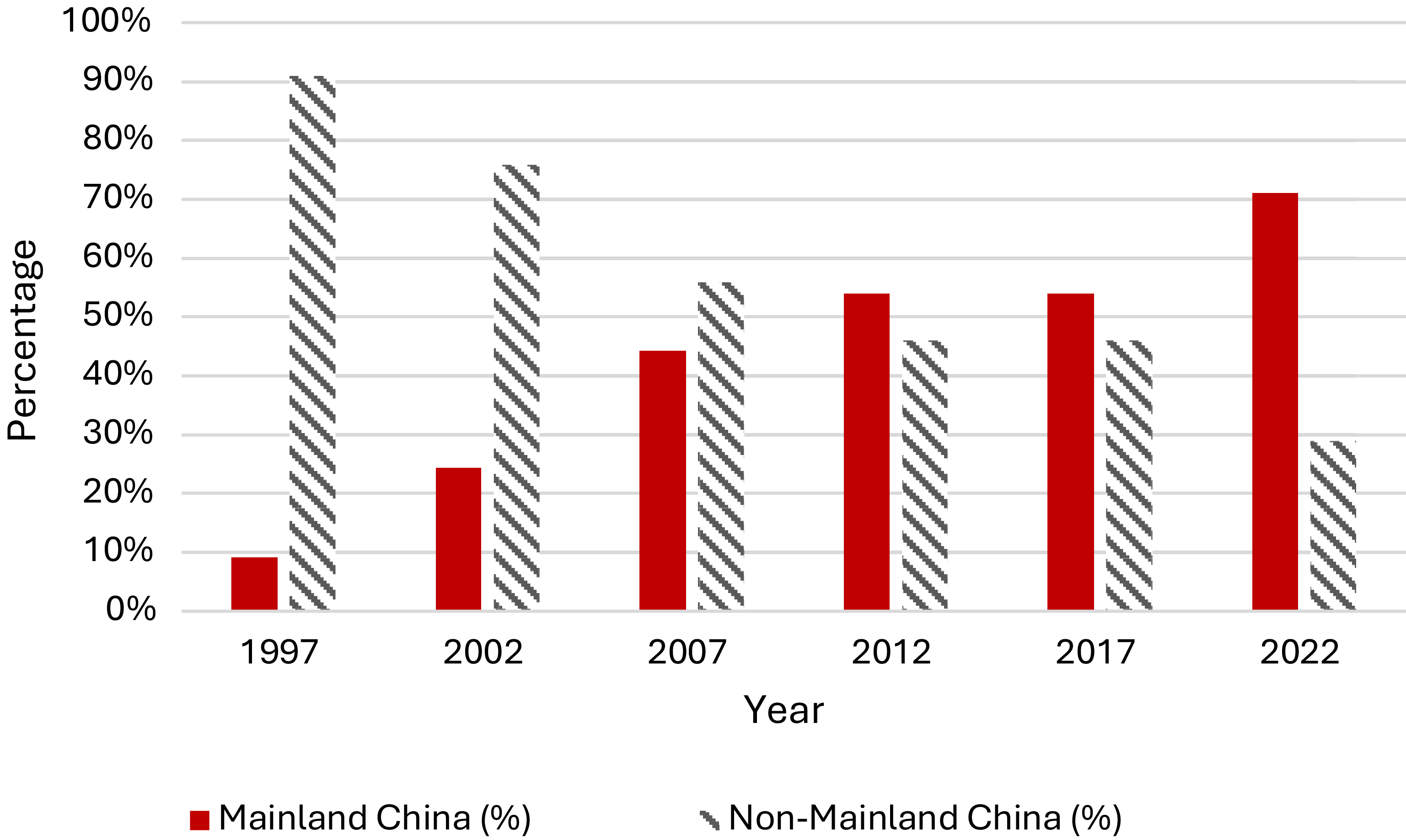
In the 2010s, Chinese businesses’ economic influence surpassed Hong Kong’s in the local economy. This was evidenced by the domination of the Chinese capital (red capital), both SOEs and private companies, in the Hang Seng Index (HSI) constituents in the Hong Kong Stock Exchange (HKSE). In July 1997, only 3 out of 33 HSI constituents, or 9%, were Chinese companies. In 2012 and 2022, Chinese firms made up 53% and 71% of the HSI constituents, respectively (see Figure 1) (Hang Seng Indexes Company Limited, 2023). Furthermore, Chinese developers won half of the HKSAR government’s land auctions in 2015-2016 (Bland, Reference Bland2018), which ended the Hong Kong capitalists’ monopoly in the real estate industry.
Number of Chinese and non-Chinese companies in the Hang Seng index constituents (1997–2022). Data source: Hang Seng Indexes Company Limited. Author’s illustration.

In China’s state capitalism, state-led economic measures offer incentives and impose structural constraints on the business environment to ensure political allegiance, including loans, subsidies, political co-optation, taxation reviews, financial penalties, and asset freezes (see also Bremmer, Reference Bremmer2010; Pearson et al., Reference Pearson, Rithmire and Tsai2023). Considering Chinese business elites as more trustworthy agents in the HKSAR, more members affiliated with Chinese SOEs and China-born immigrants have supplanted the local business elites in the NPC, the CPPCC, the LegCo, and other consultative bodies (Cheng, Reference Cheng2020; Hung, Reference Hung2022). Against the backdrop of the shift in operational environment, punishment superseded rewards in extracting the compliance of the local business sector.
4. Defiant companies in a new repressive political environment
The pro-democracy camp did not contemplate an economic strategy to advance its cause in the first two decades after the sovereignty transition. During the anti-ELAB movement, participants, however, actively engaged in economic resistance, including labour strikes (Chan & Lau, Reference Chan and Lau2023), market strikes, and politics-driven consumption (Chan & Pun, Reference Chan and Pun2020), with an attempt to amplify their political message and enhance their bargaining power. Consumers rewarded pro-democracy businesses that supported the movement with moral and financial resources, such as donations to humanitarian funds, public display of political posters, and job opportunities for arrested protesters (Chan, Reference Chan2022; Li & Whitworth, Reference Li and Whitworth2023b). Adopting the yellow colour code of the pro-democracy camp, approximately 5,700 businesses were known as yellow businesses in support of the anti-ELAB movement (Lee, Reference Lee2022). The supply and demand for a pro-democracy business network helped to consolidate in-group members’ identities and solidarity.
Censure from Chinese state media outlets signalled the forthcoming economic repression. Hong Kong-based newspapers Wen Wei Po and Ta Kung Pao accused the yellow economy of engaging in ‘soft resistance’, a term first employed in 2021 by the then Central People’s Government in the HKSAR Liaison Office’s director Huining Luo that denoted perceived threats to national security through cultural means (Gong et al., Reference Gong, Zhou and Huang2021; Ho, Reference Ho2024; see also Wong, Reference Wong, Ortmann, Lau and Chan2025a). Regardless of their scale, defiant businesses were monitored in the expansion of political repression. Small and medium-sized enterprises (SMEs) were more often exposed to economic harassment and isolation, including exclusion from opportunities, breaches of lease agreements, and frequent inspections from authorities (Ruwitch, Reference Ruwitch2024; Sum, Reference Sum2022). Meanwhile, bigger corporations usually encountered more complex and intense economic repression, comprising economic harassment, isolation, sanctions, and rampages, with limited prospects for mitigation.
This paper utilises four empirical case studies to analyse economic repression’s tactics and their broader implications. Cathay Pacific, Taipan, Apple Daily, and Chickeeduck are selected for two reasons. First, each entity experienced a variety of economic repression tactics, demonstrating the complexity of the phenomenon. Second, they were the iconic firms in their respective sectors that faced more intense economic pressure than other yellow SMEs. The impacts of economic repression on them would be a bellwether for the evolving political and business environment. Process tracing techniques are adopted to examine the interactions between the repressive agents and the targeted businesses. This study does not purport to generalise the behaviour of all companies in Hong Kong. It, however, sheds light on changes in the political and economic landscape resulting from escalating economic pressure on commercial actors. Cathay and Taipan apologised and reversed their political stances on the 2019 protests, whereas Apple Daily and Chickeeduck stood by their positions and closed down. The study believes that economic repression is likely to induce self-censorship among companies that are not directly targeted by economic repression. It does not investigate self-censorship cases because it is hard to determine whether a company’s silence results from its apolitical policy or risk-averse strategy. How economic repression deters businesses from conveying their political stances can be a future research topic.
4.2 Position reversal: Cathay Pacific and Taipan Bakery
Cathay Pacific and Taipan Bakery did not overtly support the anti-ELAB movement. They became targets of state and non-state actors’ economic channelling as their members were deemed sympathetic or involved in political resistance. In both cases, economic pressure originated predominantly from Mainland China, while the involvement of the Hong Kong authorities and their supporters was less pronounced. Significant revenue of the two companies came from the Chinese market, which made them more susceptible to economic pressure from Chinese state and non-state actors.
Hong Kong’s flagship carrier, Cathay Pacific, is the subsidiary of British conglomerate Swire Pacific. Swire and state-owned Air China owned 45% and 30% of Cathay’s shares, respectively. Despite Air China’s significant stake, direct oversight by Chinese authorities into Cathay’s daily operations was not noticeable. On 5 August 2019, a political strike was organised to reinforce political mobilisation in the anti-ELAB movement. Some 2,300 aviation workers joined the strike, including 1,200 Cathay Pacific staff, which led to about 230 flights being cancelled. Cathay’s stock price in mid-August tumbled to ‘lowest levels in a decade’ (Whitley & Zhao, Reference Whitley and Zhao2019). In the same month, the airline’s passengers decreased by 11.3% compared to August 2018, with the Chinese market disproportionately affected (Cathay Pacific, 2019). Cathay chairperson John Slosar publicly defended employees’ political opinions notwithstanding the airline’s substantial financial loss. No punitive measures were imposed on employees who took part in the strike (The Standard, 2019).
Economic harassment in the form of concerted state media censure implied escalating economic repression. People’s Daily, CCTV, China News, and Ta Kung Pao castigated Cathay’s leadership for their tolerance of staff participation in the anti-ELAB movement (The Standard, 2019). Moreover, Chinese netizens weighed in to call for a boycott. A hashtag, #BoycottCathayPacific, created on the Chinese social media Sina Weibo has attracted 17 million views. Netizens stated that Cathay must pay the price for its position on the protests, which they characterised as riots (The Standard, 2019). State media’s reports on netizens’ boycott threats produced a spiral of economic harassment and isolation (Wang & Wang, Reference Wang and Wang2019). Arguably, considerable netizens were self-motivated to criticise a company for its unfavourable political stance, but digital nationalism is often empowered by the state. Critical online messages that deviate from state policies will be censored to indicate the state’s disapproval of further discussion about the incident (Chan, Reference Chan2025; Fu, Reference Fu2023; Weiss, Reference Weiss2014). As such, in the Cathay case, both state actors and regime supporters joined hands to fortify the state-sponsored consumer boycott to increase the airline’s costs for its politically non-compliant stance in the anti-ELAB movement. By the end of 2019, Cathay’s revenue dropped by 3.7% compared to the previous year (Cathay Pacific, 2020), which indicated the impact of China’s national consumerism.
Additional economic harassment was imposed by the Civil Aviation Administration of China (CAAC), which announced new administrative measures to ban Cathay crew members who participated in the 2019 protests from working on flights to Mainland China or flights that passed through China’s airspace (Chan, Reference Chan, Ren and Hillman2024a). In some instances, Cathay crew members who landed in China claimed that their luggage and electronic devices were checked by Mainland authorities, believed to be procedures to examine their political orientations (Mahtani & McLaughlin, Reference Mahtani and McLaughlin2019). Cathay was caught between a rock and a hard place when the Chinese state actors intensified their economic pressure on the airline. Compliance would undermine staff’s morale, but non-compliance would have huge ramifications for the airline’s financial position.
Before the state-sponsored boycott took effect, the economic threats successfully compelled Cathay to prioritise the company’s revenue over its corporate culture. It swiftly backtracked its position on the political crisis through statements and personnel shake-ups (Chan, Reference Chan, Ren and Hillman2024a; Reference Chan2025). The chief executive, Rupert Hogg, and the chairperson, John Slosar, resigned two weeks and one month after the political strike, respectively. Contrasting with its initial sympathetic stance on staff who participated in the political strike, Cathay categorically showed its support of the OCTS framework, denounced protest violence, and endorsed the police’s protest management on Sina Weibo that attempted to pacify Mainland consumers’ sentiment (The Central News Agency, 2019). The management issued at least six internal emails between 9 August and 22 August dissuading staff from joining illegal protests, or they would face dismissal. Meanwhile, over 30 pilots, flight attendants, ground crew, and other staff were dismissed, including union chair Rebecca Sy, in the second half of 2019. Their dismissals appeared to be attributed to their stance on the anti-ELAB movement, for instance, arrests at demonstrations and views on social media. Furthermore, the airline encouraged employees to use a whistleblowing mechanism to report colleagues suspected of breaching company conduct guidelines. This policy fostered distrust among personnel and contributed to self-censorship, leading staff members to withhold their political views (Conifer, Reference Conifer2019). Furthermore, the Swire Group has repeatedly joined other corporations to sign statements to support the government (Yiu, Reference Yiu2019). Despite its more politically compliant positions, Cathay’s goodwill was not reciprocated in Mainland China. In another discrimination scandal in 2023, the airline was strongly denounced by the Chinese state and non-state actors, citing controversies in 2019. As part of the company’s reform, more flight attendants were recruited from Mainland China (Chan, Reference Chan, Ren and Hillman2024a; Siu & Master, Reference Siu and Master2023).
Taipan, a Hong Kong-based bakery that also operated in Mainland China, experienced economic harassment and isolation in the form of state-sponsored political boycotting following a director’s social media posts in support of the anti-ELAB movement. Garic Kwok, a director of Taipan, praised the peaceful human chain in the anti-ELAB movement and ridiculed the intellectual abilities and character of pro-regime supporters on his Facebook account. These posts were firstly reported by Hong Kong-based state media Wen Wei Po and Ta Kung Pao. Economic pressure escalated when People’s Daily, Global Times, China Daily, and other Chinese state media outlets denounced Taipan and reported about netizens’ boycotts. The scale of economic isolation expanded when leading private e-commerce platforms, including Taobao, Temu, and Jingdong, removed Taipan’s products from their websites (Global Times, 2019a). Although Taipan did not encounter economic punishment in Hong Kong, state-sponsored boycotting in China resulted in substantial financial loss to the bakery during the mooncake sale season, which was vital for the company’s annual revenue.
The company immediately backed down after the state-media censure and private actors’ boycotts. Kwok deleted the social media posts and apologised but failed to de-escalate the backlash in China. Taipan issued a statement on Sina Weibo that disassociated the company from Kwok’s personal opinion and claimed that the company had no political stance (Global Times, 2019b). The boycotts were sustained in China until a pro-regime businessman acquired Taipan in June 2021. The whole management team was replaced, and the company was rebranded as a patriotic company. The new chairperson frequently attended national security education events and sponsored the Hong Kong Police Force’s activities to assure the company’s political compliance (Taipan, 2023). Taipan’s sales in China resumed under a new owner’s high-profile nationalistic campaign.
4.3 Persistent defiance: Apple Daily and Chickeeduck
Apple Daily and Chickeeduck were forced to cease operations owing to state and non-state actors’ economic channelling and economic duress in 2019–2021. Both companies unequivocally supported the anti-ELAB movement and severed economic ties with China. Jimmy Lai, the founder of Next Digital (Apple Daily’s parent company), had previously divested his apparel company, Giordano, whose supply chain was based in China, during the 1990s in order to diminish China’s political and economic influence over the media organisation. Herbert Chow, owner of Chickeeduck, similarly divested his commercial interests from Mainland China in 2020. Their open political stances rendered them susceptible to multifaceted forms of economic pressure from repressive agents. While economic channelling did not silence the companies, mounting economic duress eventually forced the companies to shut down.
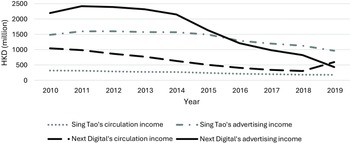
Founded in 1995, Apple Daily was the pre-eminent pro-democracy newspaper in Hong Kong and became an explicit target of economic repression even before 2019. Owing to its resounding support for the 2014 Umbrella Movement, the media group was exposed to economic isolation and other repressive economic measures from 2014 until its eventual closure. Although the revenue of traditional mass media generally dropped in the age of social media, Next Media’s advertising revenue plummeted disproportionately compared to its competitors, for instance, Sing Tao Newspaper Group (see Figure 2).Footnote 8 Management attributed the advertisement withdrawal to Beijing’s political pressure that prompted many Apple Daily’s long-term clients, including major property developers, banks, and conglomerates, to engage in economic isolation to signal their political compliance (Curran & Yung, Reference Curran and Yung2014). Private actors further escalated the economic rampage against Lai and the media organisation in 2014. Lai’s home and Next Digital’s headquarters were attacked with Molotov cocktails. Furthermore, the pro-Beijing camp also besieged the media organisation’s printing plant to block it from distributing newspapers (BBC News, 2015).Footnote 9
Revenue of Next Digital and Singtao Group (2010-2019). Data sources: Next Digital’s annual reports and Sing Tao Media Group’s annual reports. Author’s illustration.
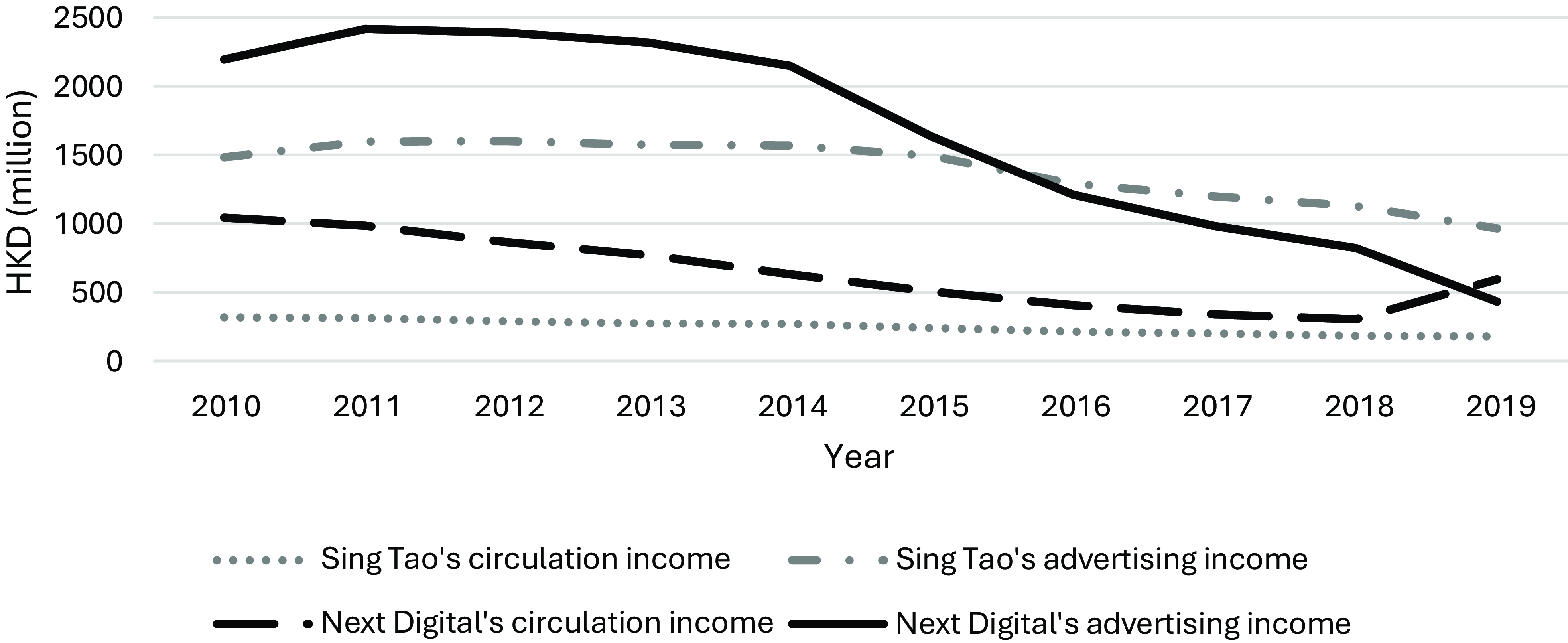
In 2019, Apple Daily encountered more evident economic repression from state actors. Former Hong Kong chief executive and incumbent CPPCC vice-chair Chun-ying Leung accused a political commentary in the newspaper of disrespecting a late NPC member. His Facebook page subsequently publicised those companies that placed full-page advertisements in Apple Daily (Cheng, Reference Cheng2019b), causing further commercial withdrawal. Apple Daily introduced an online subscription programme in 2019 that boosted the circulation revenue amid relentless economic isolation. Notwithstanding the rise in readership, advertising income was meagre.
Economic rampage was directed at Apple Daily amid the anti-ELAB movement. Unknown people attacked a female journalist who covered protest news in September 2019. Four assailants mentioned Jimmy Lai during the attack. Moreover, she was doxxed and harassed by suspicious phone calls prior to the incident (Hong Kong Journalist Association, 2019). Physical violence against staff attempted to generate fear among the workforce and hinder its journalism.
Apple Daily was a bastion of independent media in Hong Kong despite controversies over some of its tabloid-style content. Dozens of political organisations disbanded, and many dissidents left Hong Kong overnight after the NSL took effect in July 2020. Apple Daily kept up its critical reporting. Lai anticipated that he would be one of the first NSL arrestees, but he insisted on speaking up in Hong Kong. He was arrested for colluding with foreign forces under the NSL in August 2020 (Torode & Pomfret, Reference Torode and Pomfret2020). In addition to prosecutions against Lai for participating in illegal assemblies, the HKSAR government also tarnished Lai’s integrity with fraud charges. Lai was prosecuted for breaching a land lease agreement with a public corporation in late 2020 for operating a private company, Dico Consultants, at Next Digital’s headquarters. Lai was sentenced to five years and nine months and fined HKD2 million (about USD257,000) in the case.Footnote 10
The HKSAR government’s economic sanction finally ended Apple Daily’s existence in June 2021. Five hundred police raided Next Media’s headquarters and arrested five senior management team members, including the editor-in-chief, under the NSL on 17 June 2021. Apple Daily, however, vowed to continue operations in an open letter. The next day, its front-page headline was ‘We Must Fight On’. The authorities also invoked the NSL to freeze HKD18 million (about USD2.3 million) and suspend the listing of the media group on the HKSE. The asset freeze was the last straw that forced the prominent newspaper to close, as the media group was unable to pay its staff and suppliers (Davidson, Reference Davidson2021). Without the HKSAR government’s closure order, the media group announced the end of its operations on 23 June. Readers lined up shortly after midnight for the last issue of the pro-democracy newspapers. A million copies were sold on 24 June.
The closure of Chickeeduck, once a major children’s clothing retailer in Hong Kong with approximately 20 outlets at its peak, illustrated a salient case of drastic changes in the city’s business landscape. Its owner, Herbert Chow, was a pro-Beijing businessman and opponent of the 2014 Umbrella Movement. Comprehending the importance of the rule of law to the OCTS and witnessing political repression during the anti-ELAB movement, he dramatically shifted his political stance in 2019. Upon selling his ice rink business in China in May 2020, Chow became vocally supportive of the pro-democracy movement (BBC News, 2020). As a result of its pushback to the NSL, Chickeeduck experienced multiple forms of economic repression operated by state and non-state actors. Instead of retreating, Chickeeduck responded to the state media’s censure with resilience. It established new outlets in 2020 and 2021 to promote protest-themed products, exhibit protest statues, and welcome customers to post solidarity messagesFootnote 11 inside the premises.
Chickeeduck experienced a chain of economic repression that began with censure from state media. The Global Times and Ta Kung Pao accused the business of inciting secession, an act proscribed under the NSL. In 2021, the Food and Environmental Hygiene Department, police, and other authorities prohibited the display of a protest statue in front of a Chickeeduck’s store in an operation combating shop front extensions (Chau, 2021b). The administrative measure reflected the authorities’ attention to the company’s activities. While these economic harassments failed to deter Chickeeduck’s public political stance, economic isolation engineered by non-state actors non-state actors’ economic isolation effectively stifled Chickeeduck’s operations. Many of Chickeeduck’s outlets, situated in shopping malls, initially faced fewer administrative intrusions. This advantage could not be sustained. On the day the NSL was passed, a shopping mall operator notified Chickeeduck that its lease would not be renewed. This decision was preceded by a formal warning letter demanding the removal of a protest statue from the premises. Other landlords also declined to renew leases with Chickeeduck. This pattern did not appear to be coincidental. Consequentially, the chain retailers downsized from some twenty stores to just five in late 2021 (Ng, Reference Ng2021). Parallel to the landlords’ actions, Chickeeduck’s supply chain was also disrupted, exacerbating challenges in continued operations. Chow claimed that not only were his Chinese suppliers contacted by the authorities to sever ties with Chickeeduck, but even manufacturers in Indonesia also received similar warnings (Chau, Reference Chau2021).
In addition to economic pressure, Chickeeduck also faced outright political repression, including a raid by 40 national security police in May 2021. Consumers’ identities were recorded while the store was cordoned off (Shum, Reference Shum2021). By extending intimidation to individual consumers, the police deterred people from supporting the pro-democracy business through direct action in the form of economic sanction. Chow left Hong Kong in 2022. Foreseeing mounting pressure in their operations, all the Chickeeduck stores eventually closed in the following year.
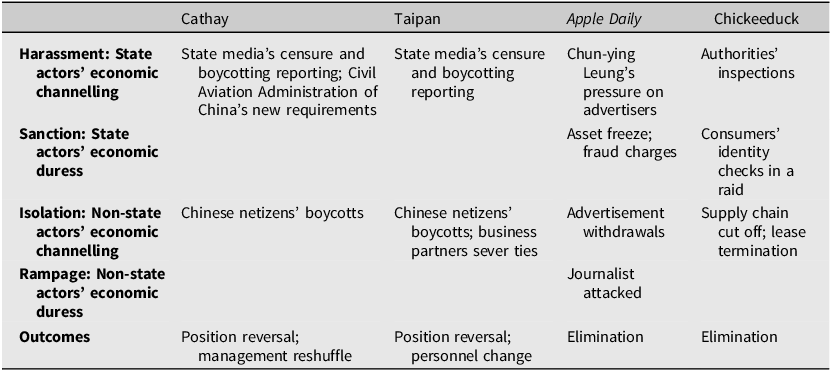
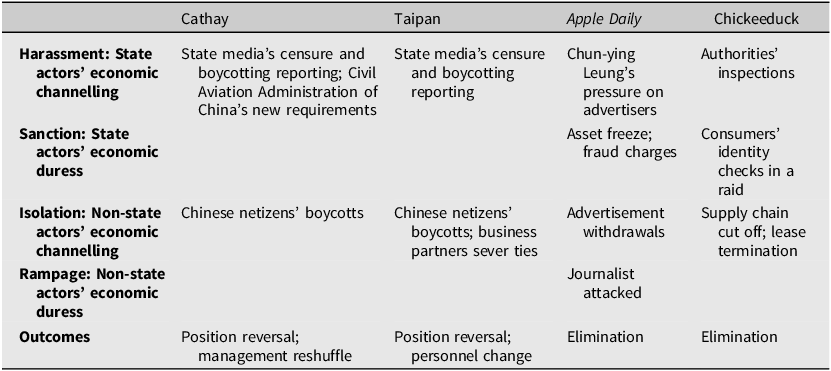
This study reviews the four companies that were the primary targets of economic repression during Hong Kong’s political upheavals. Economic repression is operated to eliminate and convert dissenting businesses as well as to deter other businesses from supporting or showing sympathy towards the opposition (see Table 2). Cathay and Taipan were converted against the backdrop of economic channelling. In contrast, Apple Daily and Chickeeduck ceased operations when pressure from economic channelling was compounded by economic duress. The four empirical cases underscore the influence of the Chinese market on a company’s political positioning. Chinese state and non-state agents would also have greater leverage over a Hong Kong-based business if it operated in China. Cathay and Taipan were susceptible to economic channelling, as they heavily depended on revenue from the Chinese market. Apple Daily and Chickeeduck were better insulated from Chinese actors’ punitive measures. Nonetheless, they were still subject to economic duress and political repression for their steadfast support for the pro-democracy movement.
Self-censorship is the third type of outcome of economic repression. Nonetheless, establishing direct causal links between the repression of one business and the self-censorship of others remains methodologically complex. A company could be innately concerned about profits over other social and political values, or it could also be dissuaded from making any political stance after witnessing the repercussions faced by other targeted businesses. Future research can explore the relationship between economic repression and businesses’ self-censorship behaviour.
Tactics of economic repression of business entities
Author’s illustration.
Tactics of economic repression of business entities
Author’s illustration.
5. Conclusion
This study of economic repression of Hong Kong-based companies is embedded in the city’s evolving political environment from 2019 to 2021. It reviews the economic pressure exerted on Cathay Pacific, Taipan Bakery, Apple Daily, and Chickeeduck that were involved or perceived to be sympathetic towards the anti-ELAB movement. The former two reoriented their political stance to align with the government’s, while the latter two preserved their democratic advocacy. Although the four cases could not generalise sophisticated operations of political control through economic means in the market sphere, they offer some insight into common patterns of economic repression. This study contributes to the contentious politics scholarship on two fronts. Theoretically, it conceptualises the economic dimension of political repression in which repressive agents seek to eliminate, convert, and/or deter businesses’ dissenting opinions. It also classifies nuanced economic repression tactics in the forms of economic harassment, sanctions, isolation, and rampage. Empirically, it highlights how the various forms of economic repression are intertwined and details the interactions between the regime and the targets of economic repression in the four high-profile cases in Hong Kong. It is observed that economic channelling is often deployed first and reinforced by economic duress and overt political repression if a target does not conform to the new operational expectations.
Economic repression aims at protest demobilisation by changing companies’ behaviour. In the post-NSL era, pro-democracy citizens have largely maintained their political values (Kobayashi et al., Reference Kobayashi, Song and Chan2021; Wong, Reference Ortmann, Lau and Chan2025b) but adapted to the political environment by turning to low-risk protest repertoires, including supporting the yellow economy (Lee et al., Reference Lee, Yuen and Tang2024; see also Chan, Reference Chanin press). The survival of pro-democracy businesses is a prerequisite for keeping the initiative alive. In other words, economic repression of defiant businesses has not only changed their behaviour but also stifled consumers’ resistance in the marketplace. Furthermore, the closure and conversion of pro-democracy businesses have implied dwindling financial and organisational resources available to the movement (see Cheng & Yuen, Reference Cheng and Yuen2025; Ho, Reference Ho2023), such as political donations, employment of like-minded people, and visibility of political resistance in the commercial spaces. The study of economic repression of Hong Kong businesses sheds light on other authoritarian contexts.
The year 2019 ushered in a new political and economic order in the HKSAR. Not only did the local conglomerates profess loyalty to Beijing through public statements, but also multinational corporations (MNCs), such as HSBC, Standard Chartered, and Jardine Matheson, openly supported the NSL. In 2022, a considerable number of MNCs, among them EY, Deloitte, KPMG, PwC, Hysan, and Swire, placed congratulatory advertisements in state-affiliated media to herald the appointment of John Lee as the fifth Chief Executive of the HKSAR. These symbolic gestures indicated a climate of pre-emptive political compliance in the city (AFP, 2022b). Despite the business sector’s strategic political alignment, many of them downsized their operations in the city and relocated their regional headquarters to other countries. With the recalibration of investment decisions by MNCs and traditional local conglomerates in the post-NSL era, the HKSAR’s economy has become more integrated into China. Consequently, the international financial city’s competitiveness in the global economy appears to have eroded in tandem with its diminishing political freedoms.

 Open access

