1 Unitary Federalism
More than any moment in the last century, the beginning of Donald Trump’s second presidency upended relationships between the federal, state, and local governments. Some of the shifts have been subtle, often buried under the tsunami of war and other headlines. All have had seismic implications for the core values of federalism, which lie at the very core of American democracy.
This seismic shift happened along four fronts. First, Trumpism not only cut back on the funding of many federal programs but also made funding for future projects far less predictable. That had profound implications not only for state and local budgets but also for the lives of many people who depended on federal support.
Second, it upended the basic questions of who-does-what in a host of key programs, often shifting much greater responsibility to state governments before giving them a chance to build the capacity to deliver. That not only disrupted state and local government roles but also put many program recipients at risk.
Third, Trumpism stirred up new clashes, especially in immigration and law enforcement. The president put troops on American streets. His aggressive deportation campaign caused heartache in many communities, undermined local law enforcement’s traditional roles, and cost the lives of Americans. American tradition had left domestic law enforcement, for the most part, in local hands. Trumpism upended that.
Finally, Trumpism upset the fundamental foundation of federalism that had governed the system for the previous 125 years, since the beginning of the twentieth century.
The twentieth century’s pattern of federalism had been like a pendulum, swinging back and forth between periods of centralization, like the New Deal and Great Society, which drew more power to Washington, DC, for making big domestic policy decisions, and times of decentralization, like Richard Nixon’s New Federalism, when policymakers sent more money to state and local governments along with more responsibility for determining how best to spend it. Trumpism melded a bit of both, centralizing some action while pushing more responsibility to state and local governments for other programs. It fit no model that Americans had previously understood.
Reform Based on Power, Not Philosophy
In Trumpism, there was no consensus on just where the balance between federal, state, and local power ought to sit. Indeed, it was an unprincipled policy change – not in the sense that it was immoral but, rather, in the sense that it did not have a strong base in the principles of American political thought. Franklin D. Roosevelt and Lyndon B. Johnson shared deeply held convictions that the federal government was responsible for solving problems that state and local governments could not (or would not). Nixon believed that the federal government had grown too large and powerful, and that the country needed to shift funding and responsibility back to state and local governments. When previous presidents introduced policy changes to shift the pendulum, they set sail with the wind of principles at their back, even if sometimes it was rhetorical.
Trump, in contrast, had no philosophy about how to drive decentralization and centralization. His approach to federalism was fundamentally about power, wrapped up in his effort to pull more power from state and local governments, at least on the issues he cared about, to Washington, DC; within the federal government, from Congress and the courts to the executive branch; and within the executive branch to the White House. This approach, in turn, was deeply interwoven into his broader instinct that the president ought to have primacy over the executive branch and, through that, to the policies that mattered most to him.
Trump was not a philosopher who had sought to live the unitary executive approach to government, but he was heavily influenced by writers who were. They promoted the idea, originally discussed in the first years of the republic, but which had virtually disappeared until the Reagan revolution, when right redeveloped it with great energy.
The unitary executive theory held that Article II of the Constitution made the president supreme over the executive branch,Footnote 1 and Trump believed that conveyed great power, including sending troops to American cities. “Not that I don’t have – I would – the right to do anything I want to do,” Trump said. “I’m the president of the United States.”Footnote 2
Trump conceived of federalism in the same sense, as a system in which he was the unitary executive: a system of unitary federalism. That label, of course, is an oxymoron. Federalism is inherently a concept about shared power, defined by a covenant among its members.Footnote 3 A system with a single individual shaping policy isn’t – and can’t be – federal. The story of how Trump nevertheless attempted to do just that prompted deep tensions in American democracy and has proven one of the most important legacies of the Trump era.
For generations, decisions about intergovernmental policy rested in the hands of policy entrepreneurs, who could fashion transformative ideas out of the big collection of Legos that defined intergovernmental programs. During FDR’s New Deal, officials such as Harry Hopkins, Frances Perkins, and Harold Ickes created new programs in relief, social welfare, and infrastructure.Footnote 4 Lucius Clay, a retired general who had headed logistics for then-general Dwight D. Eisenhower, established the grand interstate highway system and justified the cost as a program to help the military move equipment and troops. Bold policy entrepreneurs shaped Lyndon B. Johnson’s Great Society and the War on Poverty. New Haven Mayor Richard Lee saw New Haven as a model city. In New York, Mayor Robert F. Wagner, Jr., helped give the antipoverty programs shape. In the decades that followed, Tommy Thompson made a national reputation for his welfare-to-work initiative that he led as Wisconsin’s Republican governor. The federal grant system, whether its pendulum swung toward centralization or decentralization, opened the door to innovative entrepreneurs.
In the workings of Trumpism, a new central force took shape. The budget cuts and uncertainties about what was going to happen next created enormous challenges, where command rested in the hands of agile leaders throughout the system.Footnote 5 Gone were the hard-driving innovators, replaced with nimble steps of state and local leaders who sought to keep programs alive, politically and fiscally. Theirs was a world of policy disruptions, and no one was sure where that would lead – and who would lead the way.
Swirling around the background of these large strategic issues was a series of tactical steps whose very volatility was important in shaping Trump’s unitary federalism. For example, by June 2025, the daily target tripled for deportations of migrants in the country illegally, from 1,000 to 3,000, under pressure from White House deputy chief of staff Stephen Miller.Footnote 6 The administration opened a detention center in the middle of the Florida Everglades, christened “Alligator Alcatraz,” where sharp-toothed reptiles were guards, reporters pointed out. Trump was so taken with the idea that he visited it soon after its opening. Soon, however, critics contended that conditions inside were inhumane, ranging from inadquate climate control to overcrowding, and Florida quietly shut the facility down. The administration shifted to arresting and detaining migrants in big cities. That led to violent confrontations in Minnesota and the death of two Minneapolis residents, neither of whom was a migrant. The enormous blowback led the administration to end its surge into Minnesota.
The administration also campaigned against waste, fraud, and abuse in federal grants, a strategy that came directly out of the 900-page game plan for the administration’s second term, Project 2025, produced by the Heritage Foundation. The federal government’s medical care program for the poor, Medicaid, was “a prime target for waste, fraud, and abuse,” the report said.Footnote 7 (The federal government’s other principal medical program, Medicare, provided coverage for the elderly.) The report was correct. The US Government Accountability Office regularly produces its own analysis of “improper payments” in federal programs (“payments that should not have been made or that were made in the incorrect amount,” typically for more than was due, according to GAO). Medicaid ranked high in improper payments among all federal programs, at $31.1 billion in fiscal year 2024, second only to Medicare, at $54.3 billion. Together, just these two programs accounted for 53 percent of all the federal government’s improper payments.Footnote 8
These numbers reinforced the argument that conservatives had been making for decades: that the federal government was rife with fraud and that programs such as Medicare and Medicaid were prime drivers. And if that was true, then cutting back or eliminating the programs seemed the only cure. The argument drove the administration’s campaign to transform Medicaid, which had become the largest federal grant program, but high-stakes political battles pushed the fraud issue to the background. It also set up fierce combat with blue state California, even though some red states had much bigger problems.Footnote 9
The Trump administration counted on the federal judiciary to push back against state and local government policies that had angered many on the right, like allowing transgender individuals to compete on women’s swim teams. Local officials contested the Trump administration’s decision to send troops into many cities, all of which had Democratic leaders. Trump claimed the troops were needed to fight crime and deal with unrest caused by illegal immigrants. Local leaders countered that Trump administration officials were engaged in racial profiling and retribution against local progressive leaders. The courts became the battleground for that battle, and the administration had a spotty batting average in those contests.
The Transformation of American Federalism
All of these issues swirled in a mélange that transformed American federalism more fundamentally than at any time in more than a century. In the sections that follow, I will explore these issues, starting with the role that federalism played in the development of democracy in the United States.
Since the nation’s founding, democracy hinged on the balance of power, not only among the three branches of government but also between the federal government and state and local governments. All democracies have struggled to find the balance between centralized and decentralized power, but none have done so in a more complex political environment than in the US. There have been efforts by scholars to simplify the peculiarly American balance of powers, but none of those efforts have had much success for long because the underlying political tensions have prevented any kind of analysis from being stable for long.
There have also been multiple efforts to characterize American federalism, but those theories have rapidly changed as well.
What characterizes American democracy is the sharing of power among the different levels of government. What characterizes this sharing is a constant muddying of the lines between the layers. Rarely throughout American history have the lines been muddier than during the second Trump administration.
Throughout the study of federalism starting in the twentieth century, academics have developed a series of metaphors to describe federalism. There was “layer-cake federalism” and “dual federalism,” to suggest that the responsibilities of each level of government were separated into layers. That contrasted with “marble-cake federalism,” which argued – powerfully – that the functions of federalism became swirled into the levels of government.Footnote 10 There were theories of “cooperative federalism,” in which there was substantial collaboration among the levels of government; “pragmatic federalism,” where governments carefully navigated their way to pursue their own interests; “non-centralized federalism,” with substantial devolution to lower levels of government; and nation-centered federalism, which was largely the reverse.Footnote 11 There is “partisan federalism,” the result of hyperpolarization, and “executive federalism,” in which the president’s use of executive orders undermined collaboration among the levels of government.Footnote 12
Thomas J. Anton wrote, “[W]e need to develop analytic concepts capable of organizing the wealth of available information [about American federalism] into general statements regarding system structure and change.”Footnote 13 That has been the goal – and the challenge – of academic work on federalism for decades. The descriptors and metaphors have been constantly changing because federalism has proven an especially dynamic part of the American political system. It is the singular issue that almost tore the nation apart during the Civil War, the tension that shaped the country’s response to the Great Depression, the center of the battle over Civil Rights, the engine driving the War on Poverty, and then in the Trump administration one of the major battlegrounds as he sought to gain control over domestic policy.
We don’t have general statements regarding system structure and change, except that we understand the players, the importance of the president’s role in a system involving so many players at different levels of government, the underlying and ongoing tensions in the system, and the role of federalism in shaping democracy in America.
2 Federalism and Democracy in America
The debate about the role of the American states dates from well before the American revolution, when they were British colonies. In the 1750s, the French were making forays along the Ohio River just as the British were seeking to expand their territory and economic trade. Ongoing skirmishes made a larger conflict inevitable, and the American colonists worried about being caught in the middle. Should each colony go its own way? Or should the colonies band together to help the British and to ensure someone was speaking for their interests?
If the colonies split, Benjamin Franklin worried that disaster awaited. Already a major figure in the colonies and the publisher of the Pennsylvania Gazette, he believed that separate strategies from each of the colonies risked undermining all that they had worked for. As part of his campaign, he published a cartoon that quickly became famous: a snake, cut into pieces, with each piece labeled with the name of a different colony, and with the caption, “Join, or Die.” Would “the present disunited State of the British Colonies,” as Franklin put it, make the people vulnerable to aggression from the French, who had ambitions on the promising territories? In the interest of avoiding a major war, would the British negotiate with the French to carve the colonies up? Or should the colonies band together in common defense, as he hoped?Footnote 14 The cartoon rallied the colonies to unity in supporting the British against the French in the French and Indian War (1754–1763). It remains a popular seller in t-shirt shops and on Amazon.
The Americans proved able fighters in the war, and that made the British take the colonies far more seriously, not only as allies but also as potential opponents. It also strengthened the confidence of the leaders in the colonies. Moreover, the war greatly increased Britain’s debt, and the British imposed new taxes on the American colonies to finance it. To the British, that only seemed fair, since they had incurred the debt in part to defend the colonies against the French. The taxes, of course, fed the growing antagonism of the colonies toward the British crown.
Skirmishes broke out in Lexington and Concord in 1775. Six months later, King George III gave a speech in which he referred to the tensions simply as “the present situation in America,” a “situation” becoming more difficult despite “my affection for my people.” American rebels had “assumed to themselves legislative, executive, and judicial powers, which they already exercise in the most arbitrary manner.” He was both concerned and puzzled, he said, because his subjects were “the freest member of any civil society in the known world.” He sadly reflected on the prospects of a “rebellious war,” led by the Americans, even though he was “ready to receive the misled with tenderness and mercy.”Footnote 15 (Fans of the Broadway musical Hamilton will recognize echoes of George III’s solo in which he sings, “You’ll be back/Soon, you’ll see/You’ll remember you belong to me/And when push comes to shove/I will send a fully armed battalion to remind you of my love!”)
The colonists were reluctant to proclaim themselves a new nation. They pledged to each other a “firm league of friendship,” with the colonies in “perpetual union.”Footnote 16 But their grievances grew and that led them to declare independence. Several things are fascinating about their Declaration of Independence. One was that it was a declaration of the states; they did not hold themselves up as colonies, submissive to the crown, any longer. The other was that they began the document with “The unanimous Declaration of the thirteen united States of America.” The states were united, as Franklin had hoped, but they did not yet see themselves as the United States of America.
Their bold move seemed even riskier as the British troops closed in on Philadelphia and the leaders fled west, eager to put the Susquehanna River between themselves and the advancing army. But the French, eager to challenge the British again in North America, came to the states’ aid. Against enormous odds, a new nation was born.
The victorious Americans then faced the decision about what to call themselves, a decision both supremely symbolic and enormously practical. In drafting the preamble to the Constitution, Gouverneur Morris came up with a ringing turn of phrase. He began with the elegant, “We the People of the United States.” This time the “U” was capitalized, signifying the country’s emerging unity, and with the document issued by the people, not the states. While we take the phrase for granted now, this double shift – to the people speaking for a United States – was an enormously important political statement. Morris subtly reinforced the Federalists’ position by his clever choice of language, but not everyone in the newly independent country shared his view. Thus, federalism rose to the surface with the very first words of the new Constitution.
Ratification of the new Constitution was certainly not a foregone conclusion. As they debated the document, officials in several state legislatures – in the North, including Massachusetts, New Hampshire, and New York, and in the South, including North and South Carolina – refused to sign on without an explicit pledge of at least partial state sovereignty. Madison thought that the Constitution was clear and did not need amendment: the national government’s powers were laid out clearly, and the remaining powers naturally rested with the states. He also worried that opening up the document for amendment would lead to other demands. That, in turn, he feared, would unravel hard-earned compromises.
He finally became convinced that a specific statement clarifying which powers were reserved to the states was necessary:
I find, from looking into the amendments proposed by the State conventions, that several are particularly anxious that it should be declared in the Constitution, that the powers not therein delegated should be reserved to the several States. Perhaps words which may define this more precisely than the whole of the instrument now does, may be considered as superfluous. I admit they may be deemed unnecessary: but there can be no harm in making such a declaration, if gentlemen will allow that the fact is as stated. I am sure I understand it so, and do therefore propose it.
Madison concluded that there was nothing in the proposed amendment “that can endanger the beauty of the Government in any one important feature.”Footnote 17 Because it didn’t do any harm and it brought the Constitution the support it needed, he agreed to support the amendment. The Tenth Amendment, therefore, became a somewhat odd addition to the Bill of Rights, a statement of what many founders thought was the obvious division of power amid ringing declarations of human rights: “The powers not delegated to the United States by the Constitution, nor prohibited by it to the States, are reserved to the States respectively, or to the people.”
Madison was so right about so many things, but he could not have been more wrong in suggesting that the Tenth Amendment was “superfluous.” It tiptoed around wrenching issues that, seventy-five years later, almost destroyed the union that he and the other founders had worked so hard to establish. Even a civil war did not fully settle the issue. Another amendment to the Constitution – this time the Fourteenth, guaranteeing “equal protection of the laws” – only paved the road for more conflicts in the generations to come. If the Constitution was about balancing powers, it did not resolve the question of balance between the federal government and the states.
Democracy and Federalism
This quest for balance thus became one of the most-often recurring themes in American political life. Indeed, it shaped the fundamentals of American democracy more than any other feature of the Constitution, including the separation of powers. That made the United States unique among the world’s democracies. There have been other federal systems. The Swiss have had semi-sovereign cantons since the thirteenth century, and the Canadian federation was created in the mid-nineteenth century. However, no country has been as large, with more reliance on state governments, for as long a period of time, with such a commitment to democracy, as the US.
The peculiarly American form of federalism drew French intellectual Alexis de Tocqueville to tour the US from 1831 to 1832 in search of an understanding about what made the country’s democracy tick. Tocqueville traveled from New York to the western wilds, in what is now Michigan, before heading down the Mississippi River by steamboat to New Orleans, and then back north to Washington, DC, and Philadelphia. He detailed his trip and his findings in a masterful two-volume book, Democracy in America. It was a tale of the central importance of democracy in the new and growing country.Footnote 18
This was a special point of curiosity for Tocqueville. Europe was dominated by strong central governments. Local governments were essentially branch offices of the center, and local officials were agents of the national government. America presented a fascinating alternative for Tocqueville: how a governmental system might function with a central government exercising a defined set of powers through a constitution and with state and local governments shaping most of their own policy. This was a very different model than what he knew in Europe. He wanted to understand democracy in America, what the chances were that it would succeed, and whether Europeans could copy the model.
Tocqueville knew that centralization of power in a national government was always a temptation. In the US, however, devolution of power to the states safeguarded the “sovereignty of the people” and created the fundamental – and unique – strength of the American republic.Footnote 19 “The sovereignty of the Union is an abstract being, which is connected with but few external objects; the sovereignty of the States is hourly perceptible, easily understood, constantly active; and if the former is of recent creation, the latter is coeval with the people itself,” he wrote. Tocqueville praised “municipal institutions which limit the despotism of the majority, and at the same time impart a taste for freedom and a knowledge of the art of being free to the people.”Footnote 20 Democracy in America, he concluded, depended on the people for its strength, and local governments were the instrument of the people’s power.
The growing size and complexity of the country, however, created an increasing challenge to the local governments that were at the core of Tocqueville’s America. A depression ninety years after his travels, for example, demanded of local governments a response they could not provide. They had neither the money nor the administrative capacity to provide relief to people whose lives had been upended. President Herbert Hoover believed that the job rested with the state and local governments and that the Tenth Amendment tied his hands in providing federal aid.
Franklin D. Roosevelt won the 1932 election on the promise of a “New Deal” that would bring relief to Americans. That inevitably required a stronger role for the federal government, but like Hoover he faced the constraints of the Tenth Amendment. He relied on a clever work-around, through a vast expansion of federal grant programs. State and local governments badly needed money to help their people; the federal government could not force them to adopt expanded programs. Nor, he believed, could the federal government do so directly. But with federal grant programs, state and local governments had the choice about whether to accept the money, although given the problems they and their people were suffering, the federal government knew they would gladly take it. So the state and local governments voluntarily became partners of the federal government in administering federal programs without sacrificing their Tenth Amendment legal autonomy.
The strategy was pragmatic, not principled, and it fundamentally transformed the democracy that Tocqueville had observed.
Federal grants were not new. In fact, two ordinances – the Northwest Ordinances of 1785 and the Northwest Ordinance of 1785 – had set aside a portion of the land in new states, which local townships could then either sell or lease to support local schools.Footnote 21 The strategy expanded during the nineteenth century, especially through the Morrill Act of 1862, which sent land grants to any state that established a college devoted to agriculture and mechanical arts.Footnote 22 The grants funded the creation of universities such as Cornell, MIT, Penn State, Ohio State, Wisconsin, Purdue, Texas A&M, and the University of California, Berkeley. Then in 1890, Congress passed a second Morrill Act to establish land grants for historically Black colleges and universities, including Tuskegee University, Alcorn State University, and Kentucky State University. It’s a fair statement that, without nineteenth-century land grants, college football stadiums on Saturday afternoons would be very different places – many of the nation’s football powerhouses would not exist to field teams.
With FDR’s New Deal, the grant system pivoted from land grants to cash grants, increasing from $119 million in 1929 to $2.3 billion in 1935.Footnote 23 Scholars have called the system that emerged “cooperative federalism,” in which federal, state, and local governments joined in achieving public goals and in which the responsibilities of the three levels of government overlap.Footnote 24
With growing concern about civil rights in the second half of the twentieth century, the federal courts became far more involved in federalism, especially with the 1954 Supreme Court decision Brown v. Board of Education.Footnote 25 In a stroke, unanimously decided, the Court ruled that “separate but equal” facilities were inherently unequal. The Court thus asserted jurisdiction over local schools – and by extension over all other state and local government policy. That, John Kincaid contended, made the system less cooperative and more coercive, with state and local governments holding less discretion about the role the federal government expected them to play.Footnote 26 The balance of power in federalism had shifted from one where each level had relative autonomy to one where the federal government had far greater leverage through its grant programs and then, ultimately, to one where federal courts asserted a far stronger role.
The New Deal model therefore did not resolve the tensions between central power and local autonomy. It simply transformed the arena in which they played out, especially through the transfer of money, and it enormously increased the stakes, financial and legal. Traditional conservatives attempted to rein in federal power by relying on the Tenth Amendment and restraining federal power. Progressives continued to expand the federal government’s ambition, drawing state and local governments ever closer to the federal government and increasingly blurring the boundaries.
Since before the country’s launch, federalism has been at the core of the American story. Through grants, both land and cash, as well as court decisions, the balance of federal, state, and local power has changed, with a steady course through centralization – but with constant debates about whether and how to reset the balance. That quest to define the balance is the story of federalism and democracy in America.
The Eternal Debate over Balance
No leader in the history of the world has succeeded in running a country effectively from the capital. Different parts of every country are different – with varying problems, varying people, and varying resources – and they require distinctive governance strategies. Some degree of decentralization is therefore inevitable. Moreover, in a democracy, no leader could long survive by allowing local governments each to go their own ways. Some degree of centralization is therefore essential.Footnote 27 History demonstrates that there is no single, correct answer to the question of how best to set the balance. And then, as governments seek solutions, none remains stable for long, so the balance shifts over time.
Ancient Chinese emperors discovered that they could not rule from Peking without fitting their policies to the widely varying conditions across the vast empire. The Qin dynasty, which ruled from 221 to 207 BCE, solved the problem by creating a civil service. A century later, emperor Wudi established a university designed to train officials in the bureaucratic skills they would need – and on a testing process to ensure they had learned them.Footnote 28 The founders of America’s new country, two millennia later, added a new element to the underlying tension between centralization – shared rule of the entire country – and decentralization – self-rule by the people – to define the overarching theory of federalism in American democracy.Footnote 29
Every nation that has tried to establish unity has struggled with the need to surrender control to local government. Students of Latin can recite by heart the beginning of Julius Caesar’s account of his Gallic wars, to bring what is now France into the Roman empire: “Gallia est omnis divisa in partes tres,” or “All Gaul is divided into three parts.” To conquer Gaul, he had to deal with three different tribes: the Aquitani, the Belgae, and the Celts (or Gauls). The three different cultures brought him three different problems, as he describes in his Commentarii de Bello Gallico.Footnote 30 It was a challenge that repeated itself as the Roman empire expanded: how to bring a measure of national unity to a sprawling empire spread across many different cultures.
In England, King John faced a different problem in 1215. He had stumbled badly in expensive military campaigns, financed by heavy taxes on the country’s nobles but ultimately losing the property in France he was fighting for. The nobles, whose power and wealth came from owning large areas of land, were unhappy with both, and their opposition threatened to break out into civil war. The king agreed to meet with the nobles in an open meadow about twenty-five miles west of London, just a few miles away from today’s Heathrow Airport. Under their enormous pressure, he agreed to a “Great Charter,” or Magna Carta, which laid out the basic rights of the people, including the right to a fair trial, protection against unlawful imprisonment, and a prohibition against selling justice on the side.Footnote 31 The copy currently displayed in the magnificent Salisbury Cathedral captured all sixty clauses on a parchment of just fourteen by seventeen inches, in a remarkable script from a cathedral scribe.
Everyone who studies the history of democracy knows about the Magna Carta. Its short-term impact, however, was ironically minor. Two months after the agreement was signed, Pope Innocent III ruled that the agreement was illegal because the king had signed it under duress. King John never had to live up to its terms because he died the next year, and for a century kings and queens mostly ignored it. But the ideas in it had taken root in the country and framed the basic principles of English common law, especially this one: there were limits on just how broadly the central government could impose its will.
The Conservatives’ Approach to Federalism
In the modern American experience, there have been two major approaches to federalism and the role of the central government. The first was sorting out: conservatives, preferring a smaller government in general and a smaller federal government in particular, developed a principled approach, in the spirit of the Tenth Amendment. They sought strategies for defining the roles of government’s layers, both to determine who ought to do what and about how to prevent the blurring of boundaries. Their goal was to reduce federal intrusion into state and local government affairs. They sought to identify a function and then identify which level of government could – and should – best perform it.
This approach never took root in its pure form. During the twentieth century, the model of “dual federalism” it represented, with the federal and state governments performing different roles, gradually gave way to a “marble cake” model, in which the functions of government were swirled among different levels of the American system, as Morton Grodzins put it.Footnote 32 Scholars disagreed about whether the “dual” model ever described reality, but by mid-century the label gave way to an approach characterized by cooperation among the levels.
The “sorting out” issue became an important puzzle in post–World War II America. The New Deal had so dramatically transformed just about everything about government, including federalism, and reformers were eager to take a breath – to consider which functions ought to be left to the federal government and which to states and localities. The Eisenhower administration, for example, created the Joint Federal-State Action Committee, a body designed to improve highway safety. It brought together officials from all levels of government. Eisenhower had told governors that he thought the country needed legislation “to eliminate hodge-podge duplication and waste in existing federal-state relations affecting government functions and taxation.” He noted, “For a long time I have thought that there must be a clarification of the responsibilities of the state and federal governments in many fields of public activity.”
The goal, Eisenhower said, ought to be “to reallocate certain of these activities between federal and state governments,” which would make them “more effective instruments serving the security and welfare of our citizens.”Footnote 33 Which programs needed federal support? Which activities ought best be left to the states? Sorting out the roles of different governments was the logical next step, Eisenhower believed. And, of course, it was the logical if gentle push-back to FDR’s expansionist ideas for the federal government’s role.
And which governments dominated which areas? Daniel J. Elazar developed a map of American federalism, that in turn answering the question.Footnote 34 Elazar made perhaps the strongest argument in favor of the “sorting out” approach, suggesting that the job ought to be easy: “simply have the federal government return or turn over certain functions to the states, free certain revenue sources to accompany them, and reduce federal regulatory interventions into state affairs and the process of state governance.” Martha Derthick used case studies to demonstrate how functions varied across different levels of government and how strengthening that approach offered the opportunity for a new theory of federalism.Footnote 35
In practice, the cross-pressures in the American federal system derailed most of these discussions, which never turned out to be easy. Conservatives never theless kept at the goal of lessening the power of the federal government by sorting out government functions. That would, of course, mean both shrinking and then limiting the federal government’s power.Footnote 36 This model’s approach to the Constitution is originalist; it seeks constantly to move back toward what the founders designed – or, at least, what the approach’s proponents believe that the founders intended, which only indirectly matched what the founders really said.
The Progressives’ Approach to Federalism
The other approach is pragmatic: progressives, preferring a larger federal role, developed an approach founded in pluralism and devoted to advancing the Fourteenth Amendment’s promise of equal protection. They contended that any effort to make America’s inherently messy system into a neat separation of functions was doomed to failure. They pointed to programs where functions spread across intergovernmental boundaries, such as environmental protection, in which the federal government might define basic standards for clean air and clean water but where problems varied tremendously, depending on prevailing winds, the direction in which waterways flowed, the nature of a pollution’s source, and the technologies available for limiting it. In this world of economists’ externalities, what worked best was what could be made to work. This was FDR’s approach, one focused on problem solving, not ideology.
Supported by this approach, intergovernmental grants became far more important to the federal government, in shaping state and local governments’ policy decisions and as a source of state and local government revenue. The grants pay for things that state and local governments want to do but would struggle to finance on their own, from providing mass transit to running public health care programs. The federal government, on the other hand, can steer state and local government policy in improving access to health care, for example. This approach takes a far more dynamic view of the Constitution. By relying on grants as incentives, the pragmatic approach does not contest the roles of different governments but simply offers them incentives for doing what the federal government wants, even if the incentives are such that the only realistic choice is no choice.
Scholars have often described federalism as a pendulum, swinging between the extremes of national power and centralization, on the one hand, and state and local power, with decentralization, on the other.Footnote 37 That framework has powerfully shaped the analytical approach of scholars, analysts, and practitioners for generations – until, that is, the launch of the second Trump administration, when the pendulum model no longer fit.
3 Trump’s Radical Federalism
Trump’s enthusiasm for the “unitary executive” approach to policy shaped his approach to federalism just as it did the rest of his agenda. The approach which holds that the founders intended the president to have full control of the structure of the executive branch and of the administration of laws once Congress passes them.Footnote 38 The historical roots of this argument are weak. Indeed, the evidence is that the founders paid relatively little attention to a theory of administrative power because they paid little attention to administration and, when it came to the debate among the founders, the primary focus was precisely the reverse, with the Tenth Amendment, which sought to reserve powers to the states.
The Trump team, however, believed that the Constitution gave the president full power over the executive branch, including its structure, policy, and budget. This assertion of power, in turn, built the case for giving the president great leverage over state and local governments and over forcing state and local governments into sync with the administration’s policies. That was especially the case for blue states that had not supported Trump in the 2024 election, such as California and Minnesota. This approach, of course, has always been extremely contentious. It did not sync with the policies of previous presidents, but it guided Trump and his senior officials in fashioning federal policy. This tactic fashioned the hybrid model of federalism that Trumpism pursued (Table 1).
| Conservatives: sorting out | Progressives: pragmatic | Trumpism: hybrid | |
|---|---|---|---|
| Federal role | Principled: limited | Principled: expansive | Power-based |
| Tenet | Constitution differentiates the roles of levels of government | Functions are inherently messy | Federalism is yet another arena for political contest |
| Goal | Self-government | Equality | Strengthen presidential power |
| Tool | Tenth Amendment | Grants as incentives | Unitary executive |
| Role of core theoretical principles | Strong | Weak | None |
| View of constitution | Originalist | Dynamic | Tactical: advance presidential power where possible |
| Importance of state and local government administrative capacity | Less | More | None |
In federalism, as in the rest of the government, Trump operated tactically and transactionally, not strategically and theoretically. What distinguished Trump on these issues is the power of the cynical side of the equation, as well as the absence of broader ideological or theoretical propositions guiding his actions.
The administration’s approach to federalism emerged from the Heritage Foundation’s Project 2025, the nearly 900-page report that served as the administration’s playbook.Footnote 39 Peppering the report were criticisms of many existing programs, including FEMA, federal civil rights policy outlined in Title IX, administered by the Department of Education, EPA, and environmental policy, which the authors said undermined “cooperative federalism.”
Most important of all was the report’s overall policy argument about the executive office of the president, written by Russ Vought, who became director of the Office of Management and Budget (OMB) in the second Trump administration, a post he held in the first Trump administration as well. The chapter was the core of the administration’s game federalism strategy. Strengthening federalism, he wrote, was important “so that state regulatory and fiscal operations are not commandeered by the federal government through so-called cooperative federalism programs.”Footnote 40
Vought also called for a strengthening of Executive Order 12630, issued in Clinton’s second term, which aimed “to guarantee the division of governmental responsibilities between the national government and the States that was intended by the Framers of the Constitution.”Footnote 41 The executive order held that problems should be addressed at the level of government closest to the people, and it reiterated the central role of the Tenth Amendment. If the federal government oversteps these principles, this position held, its actions violated the principles of federalism held by the founders. The federal government should intervene in state and local government affairs, the executive order concluded, only when there is “a problem of national significance” and, even then, the states should have “the maximum administration discretion possible.” The executive order gave OMB substantial authority to review federal agencies’ work that had implications for federalism.
In practice, however, the administration’s approach was precisely the reverse. The administration sought to shut down some grant programs, shift major administrative responsibilities to the states, and intervene directly in local law enforcement to advance its mass immigration policies. The realities of Trumpism in the president’s second term were thus in sharp opposition to strategies his most important advisors had previously sketched out.
Executive Action Disrupts the Balance
In naming Vought to direct OMB, two weeks after the 2024 election, Trump said, “Russ knows exactly how to dismantle the Deep State and end Weaponized Government, and he will help us return Self Governance to the People.”Footnote 42 Trump did not have a theory of federalism to promote democracy as much as a theory of power advanced through federalism. That theory of power, in turn, relied heavily on officials such as Vought, who knew exceptionally well how to dismantle the existing centers of power, regulatory and financial, and how to couch the initiative in the mantle of originalism. He did not share the quest for equality of the progressives or the effort to sort out functions by levels of government of previous conservatives.
Trump’s singular goal was to re-center power in the presidency, and he relied on Vought to do that. In many cases, Trump’s approach to federalism picked up tools from wherever he found them, to exact retribution on blue states and blue cities, to pursue his policy goals, and to reclaim budget dollars where useful to pay for tax cuts – in general, to rely on a tactically useful hybrid approach, devoid of theory or ideology, with the sole purpose of shuffling the federalism deck in ways that met Trump’s singular approach to government.
Many analysts from both the right and the left suggested that, as the administration unwound the federal government’s administrative capacity through personnel cuts, more power would inevitably flow to the states. At Cato, the conservative think tank, Victoria Litman asserted, “The United States constructed a legal system that depends on federal enforcement, and its scaffolding is crumbling.” As a result, the Trump administration instituted a constitutional approach where the Tenth Amendment was no longer meaningful, with “post-supremacy federalism: a legal regime in which federal law remains formally binding, but it no longer governs in practice.”Footnote 43 From the left, William G. Gale and Darrell M. West wrote in a Brookings blog post that Trump’s policies could produce “a renaissance in state actions,” in which they “take matters into their own hands.”Footnote 44 The notion was that Trumpism had hollowed out federal agencies and that this hollowing-out would inevitably empower the states.
Some scholars, moreover, pointed to Supreme Court decisions that both weakened the power of executive branch agencies to interpret the law and created a tool “to weaken and dismantle the administrative state.”Footnote 45 A weakened federal hand might even create a “policy vacuum,” full of “uncertainty and risk,” that might also create opportunities for more initiatives by state governments.Footnote 46
That uncertainty and risk emerged just days into Trump’s second term. OMB announced a “temporary pause” in federal grants to state and local governments. OMB targeted, in particular, programs that advanced “Marxist equity, transgenderism, and green new deal social engineering policies,” which OMB asserted were “a waste of taxpayer dollars” that failed to “improve the day-to-day lives of those we serve.”Footnote 47 OMB required every federal agency to freeze grant spending, review each program for its fit with Trump’s policy priorities, and send a list of its programs to OMB. To ensure compliance with the administration’s aims, its guidance insisted that every agency assign each federal grant program to a “senior political appointee” with the power to cancel any that didn’t match with presidential priorities. More than 2,600 programs were frozen.
State and local officials, who had already folded those grants into their budgets for the year, were stunned. The ranking Democrat on the US House Appropriations Committee, Rosa DeLauro, and vice chair of the Senate Appropriations Committee, Democrat Patty Murray, challenged OMB, writing that “The scope of what you are ordering is breathtaking, unprecedented, and will have devastating consequences across the country.” They contended that the administration had no power to take back money that Congress had appropriated and wrote, “The law is the law – and we demand you in your role as Acting OMB Director reverse course.”Footnote 48
Nothing brings Republicans and Democrats together faster than a threat to money flowing to every congressional district. Opposition to the freeze exploded across the country. State and local officials raced to the federal courts, won an injunction against the freeze, and OMB withdrew the freeze. The administration, however, had demonstrated it was prepared to act on a scale previously unimaginable, with a speed that hinted at what was to come.
Did Trumpism create a vacuum into which state and local governments might reassert power? Or was the administration signaling in its first days that it was prepared to bully state and local governments to pull power away from them?
If nothing else, the administration was upsetting existing patterns of power, out of a firm conviction that great uncertainty gave the president more maneuvering room. The strategies that the administration’s short-lived Department of Government Efficiency reinforced its steps, with the federal government’s relationship with state and local governments just a small part of the much bigger plan. Federalism had long been a playing field on which it could shuffle the locus of power and transform domestic policy.
Trumpism did not follow the historic path on federalism, seeking a different balance between centralization and decentralization. Instead, it sought far more powerful levers over state and local government policy and administration. It pulled – hard – in bringing some issues to the center. It pushed – hard – to send other issues to state governments. Like so much else in the second Trump administration, it was a strategy that upset much of what had become established wisdom and practice in the quest for bringing more decision-making into the federal executive branch and, within the executive branch, into the Executive Office of the President.
The administration set out to redefine the typical centralization–decentralization swing of the pendulum, with some programs heavily centralized, others pushed out to the states, the life of some programs squeezed out while others saw a big push, often through very nontraditional ways. Presidents since Nixon have rolled out their own “new federalism” programs. Trump’s version of “executive federalism” was dramatically different from what the country had previously seen, not only in recentering the balance of power between the levels of government but also in fundamentally shifting who within the federal government had control over intergovernmental policy – and with it, the domestic policy agenda.
Congressional Acquiescence
Not only did Trump play a very different role than previous presidents, including during his own first term. Congressional behavior radically changed as well. In earlier eras with big policy changes, members of Congress joined forces with state and local government officials and the organizations that represented them in Washington, DC, the “Big Seven” (the National Governors Association, National Conference of State Legislatures, Council of State Governments, National League of Cities, US Conference of Mayors, International City/County Management Association, and the National Association of Counties).Footnote 49 The Big Seven, in turn, connected their congressional work with the White House Office of Intergovernmental Affairs. Their concerns were twofold: winning increases in federal aid to state and local governments and pushing for decreases in federal restrictions on how they could spend that money.
The powerful role for state and local governments in Washington, DC, had already begun to unravel before the Trump presidencies. Medicaid had gobbled up an ever-larger share of federal aid to state and local governments, so there were fewer other grants for state and local governments to haggle over. Their focus shifted as a result away from Congress and the pursuit of new programs to the executive branch and the regulations controlling the program.
At the same time, Congress became increasingly polarized. Members increasingly focused on maintaining their narrow hold on the House of Representatives and on a supermajority in the Senate. The days of the 1960s and 1970s, when state and local governments could get the attention of members of Congress on grant formulas and special projects melted away, especially as Congress sought, with only partial success, to shut down pork-barrel spending. The White House matched that transformation, as its Office of Intergovernmental Affairs pivoted away from building partnerships with state and local governments as co-equals in the federal system to treating them as one more supplicant seeking the president’s favor.
The Big Seven dramatically fell in influence on Capitol Hill. Several of the organizations, especially the National Governors Association, splintered along partisan lines, with the Republican and Democratic Governors Associations gaining more leverage than their previously robust parent. The National Attorneys General Association, once an organization devoted to procedural coordination on judicial matters, broke completely along partisan lines. In the Biden administration, the Republican attorneys general allied on court challenges to the administration’s policy on issues such as reproductive rights and student loans.Footnote 50 Their Democratic counterparts waged a campaign in the federal courts to stop the Republican campaign against abortion, environmental protection, and food assistance – filing more than 100 lawsuits against the second Trump administration in its first fourteen months.Footnote 51
Federalism issues thus drifted away from Congress and toward state legislatures and the federal courts. The close adherence of so many Republican members of Congress to Trump’s policies – and the administration’s blunt threat to primary any members who did not – further weakened Congress’s role in intergovernmental relations, in this and in so many other areas of American policy.
Federalism Fireworks
After the federalism fireworks of Trump’s first weeks in office, as the administration unfroze its freeze, the conflicts seemed to settle down.
Buried in the original announcement of the “temporary pause” was the assertion that federal officials “have a duty to align Federal spending and action with the will of the American people as expressed through Presidential priorities.” That launched an unprecedented effort to reshape federal aid. The Trump administration’s management agenda, released in December 2025, reinforced that assertion. Although the agenda is just two pages long, it upended sixty years of federal policy.Footnote 52
Since the Civil Rights Act of 1964, Congress and successive administrations have been attaching a Christmas tree’s worth of conditions to federal grants. State and local governments never want to give up the chance for cash, but to get it, they’ve had to follow a lengthening list of “crosscutting requirements,” ranging from the civil rights standards to rules for environmental review, health and safety, labor standards, rehabilitation programs, anti-ageism, and a host of others. In 1980, the OMB tabulated fifty-nine different requirements, but no one really knew how many there were.
The more grant programs grew – from 387 in 1968 to 1,274 in 2018 – the harder the money was to turn down.Footnote 53 That made the requirements a grippy Velcro for even more federal mandates.
For decades, state and local governments complained about these strictures; they wanted to get rid of them but, of course, keep the money. Trump gave them part of what they wanted – but not, as it turned out, what everyone wanted, and at a higher price than almost anyone wanted to pay. Trump’s management agenda promised to “eradicate woke and weaponized programs across government,” which meant ending requirements devoted to diversity, equity, and inclusion (DEI), among them ones attached to federal aid.
The US Department of Education told the states that it viewed DEI standards, which it didn’t define, as violations of the civil rights law because they provided preferential treatment to selected groups. It asked state officials to certify that they weren’t using DEI. Republican officials happily and quickly complied. Democratic officials refused to sign and headed to the courts.
It was the first time any president had tried to use federal grant programs to remove grant requirements instead of adding new ones – something for which state and local officials had been campaigning for years. But there was a huge catch, and it proved a federalism flash point.
For decades state and local officials had not only sought to remove crosscutting requirements but also to loosen federal control over the money. The Trump administration had very different ideas. The December management agenda reinforced the message of an August executive order requiring all federal agencies to name a senior political appointee to ensure that grant decisions “are consistent with agency priorities and the national interest,” that grant programs had to “demonstrably advance the President’s policy priorities,” and that political appointees had to revise grant programs “to permit termination for convenience,” especially if “the award no longer advances agency priorities or the national interest,” defined of course by presidential policy.Footnote 54
That fundamentally redefined accountability in federal grant programs. Every president, of course, has awarded grants to jurisdictions that favor the president’s wishes and delayed or canceled grants to governments that opposed the president. The Biden administration followed that instinct, but its work came primarily through enforcing existing rules rather than aggressively strip-mining money away from programs that didn’t fit the administration’s policies.
Trump cut a string of education grants, work–study aid for college students, grants to nonprofits for victims’ services and substance abuse, and aid for housing programs designed for the homeless – all because the programs didn’t match his goals for what the federal government ought to be doing, or because they served DEI, in the administration’s view.
But beyond these discretionary programs, as I will show a bit later, the administration took aim at entitlements as well. The One Big Beautiful Bill Act in 2025 stripped $1 trillion from Medicaid over the following decade. SNAP funding – the federal government’s food assistance program – was reduced by as much as $300 billion. These amounted to the biggest cuts in the programs at any time in their history. State governments faced the choice of making up the difference or dealing with recipients losing their support.
In just a few months, the Trump administration boldly put its mark on federalism. It eliminated at least one major crosscutting requirement that had come along with grant programs for the last sixty years. With a wink, it said it was sending power to the states but made the states responsible for programs the feds had been paying for and added new administrative responsibilities to the programs. It crossed the line that once protected entitlements.
And, most fundamentally, it redefined accountability, away from the law and from the crosscutting goals that endured across administrations. It pivoted instead to the broader policy mandate that Trump asserted. It’s impossible to find any administration in recent memory that created more federalism fireworks.
4 Finance
Federal grants to state and local governments go back almost to the country’s start, but the tides on this sea have steadily been rising for ninety years as the governments became more dependent on federal aid.
Grants for State and Local Projects
Before the beginning of the Great Depression, nonprofit organizations and local governments had primary responsibility for social service and housing programs. With the enormous increase in unemployment, housing problems, agricultural setbacks, and hunger, they quickly ran out of money. The New Deal changed that: it relied on many of the existing organizations, funded them to expand their operations, sidestepped the Tenth Amendment’s restrictions, and vastly expanded the federal government’s footprint in state and local government policy.
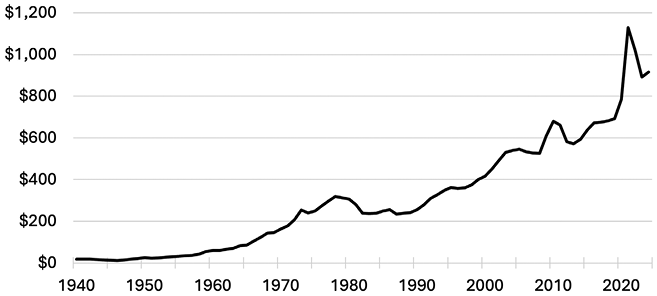
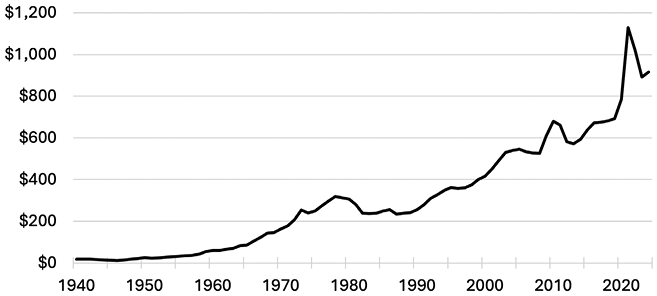
The strategy expanded rapidly through the rest of the twentieth century and spilled into the twenty-first. After accounting for inflation, federal grants grew more than fiftyfold from 1940 to 2024 (Figure 1). This growing flow of federal money also increased state and local government dependence on federal grants, which tripled from 13 percent of state government general revenue in 1942 to 37 percent in 2022.Footnote 55 (There was a short-term increase in the early 2020s with Covid relief money. Even after the grants ended, federal aid resumed its steady growth.)
Federal Grants (in billions of constant 2017 dollars)
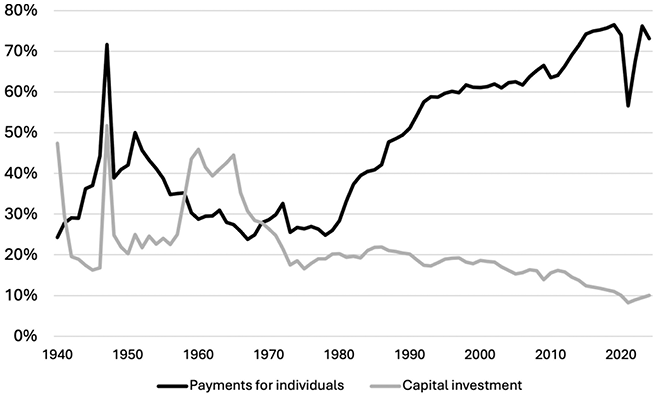
Most of the earlier grants were for capital investment and infrastructure, ranging from roads to bridges – more than half of all grants in 1940, in fact (Figure 2). Following World War II, there was a brief spike in grants for payments to individuals, as the federal government provided veterans with money to help ease their way back to civilian life, with programs administered through state governments. The pattern soon returned to a focus on grants for capital investment, especially for the interstate highway system, launched by the Eisenhower administration in 1956. Those highway grants were a terrific deal for the states: the federal government paid 90 percent of the cost for the increasingly car-loving population. Grants for other roads and bridges soon followed.
Federal grants for payments to individuals and for capital investment
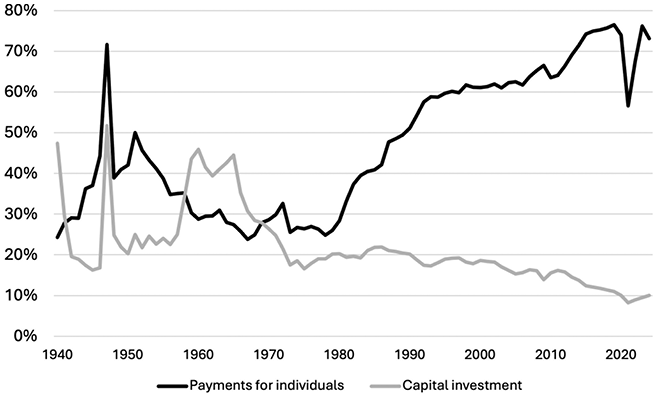
In the 1970s, however, the pattern shifted. Federal grants for capital investment such as roads and bridges shrank as a share of the total as grants for payments to individuals rapidly increased. Grants to state and local governments for payments to individuals, especially for health care, food stamps, and welfare, exploded and came to dominate the system. Over the next quarter of a century, these grants for payments to individuals made up nearly 80 percent of all grants.
Medicaid became the single most dominant federal grant program. Spending for the program grew from 11 percent of all federal grants in 1970 to 57 percent in 2023, through an especially complex program. The federal government set minimum standards and provided a core grant to each state. State governments were permitted to provide additional coverage, funded through state revenue. They had the responsibility for administering the program, but they contracted that work out to private companies that processed claims from health care providers on behalf of program recipients, bundled reimbursements and collected funds from the federal government, and then distributed the money to the health care providers. This tangled system made it impossible to determine who actually was responsible for what. Then, when problems inevitably popped up, it was difficult to determine who was responsible for fixing them. The feds paid two-thirds of the program’s total cost, with the states responsible for the rest.Footnote 56 Federal grants grew from 23 percent of all state revenue in 1990 to 36 percent in 2023, largely because Medicaid had grown to consume so many state tax dollars.Footnote 57
In 1982, the Reagan administration proposed to simplify the tangled web of funding and administration with a swap. The federal government would assume the full cost of Medicaid, while the states would pick up welfare costs. Reagan called it “a financially equal” swap, but the governors thought they smelled a trap.Footnote 58 Reagan had already been reaping political capital from his tales of “welfare queens” taking advantage of the programs, and the governors feared they would inherit the political baggage that Reagan had created. Many governors feared that Reagan was trying to saddle them with an ever-more-expensive and increasingly unpopular program, and their negotiations with the administration never went far.
Moreover, the Reagan administration had concentrated on the federal-state program/budget swap and paid little attention to the complex dynamics between state legislators and mayors, which often generated enormous heat. The governors, in addition, didn’t trust OMB to keep the hands-off promise for welfare and worried that more federal strings might materialize down the road. The negotiations bogged down and the administration never proposed a bill to Congress. The proposal evaporated, and the decision has haunted state officials ever since. Medicaid costs spiraled up much faster than welfare. They would have been much better off had they taken the deal.
In 1996, Bill Clinton forged an unlikely – and short-lived – partnership with Republican House Speaker Newt Gingrich to pass welfare reform. The federal entitlement to welfare ended. The feds moved more administrative responsibility to the states, especially for ensuring that welfare recipients met work requirements. Funding to administer the program shifted to block grants, where the states had much more discretion about how the money should be spent. The number of people on welfare dropped by nearly 60 percent within a few years, and dependence on welfare dropped.Footnote 59
That made the states’ decision to reject Reagan’s offer even more painful. If the states had taken the deal, the big federalism issues dominating Trump’s agenda, especially funding Medicaid, would have been the federal government’s problem to deal with. Instead, the program cast an increasingly large shadow across state budgets.
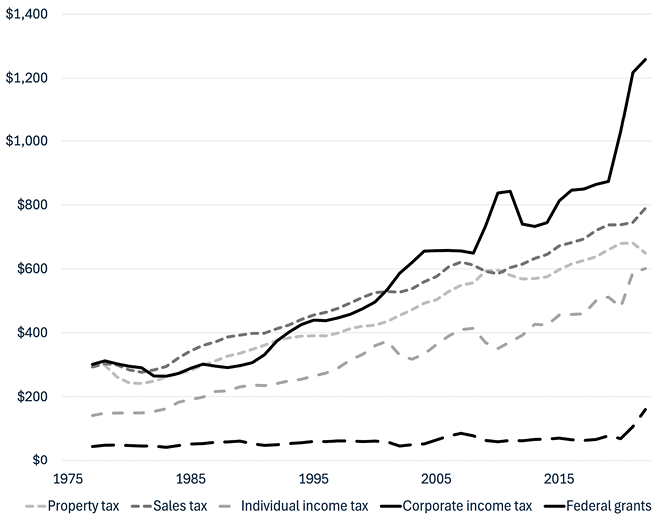
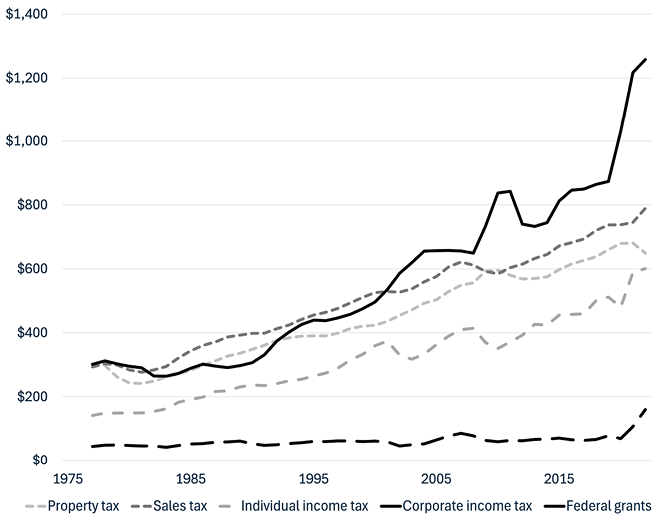
Since 1992, federal grants have been the single largest source of all state and local revenue (see Figure 3), larger than property, income, or sales taxes. Then Obamacare provided more aid for states that decided to opt in to expansion of Medicaid benefits, and this further accelerated the growth of grants in general and health care grants in particular.
Federal grants have grown as a revenue source for state and local governments
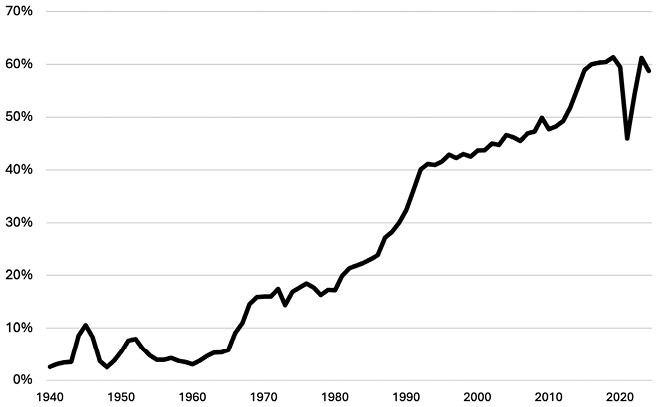
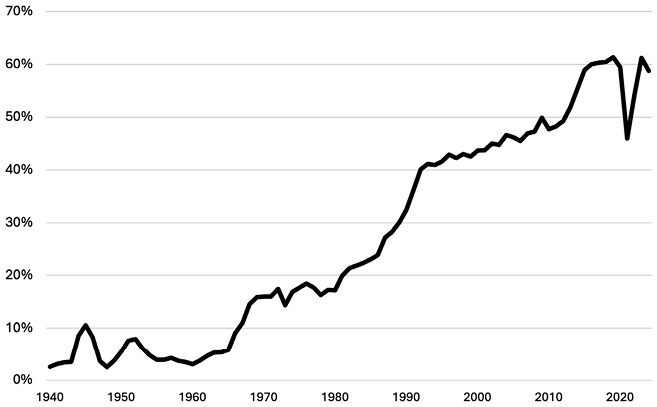
Federal grants in general have not only accounted for a larger share of state and local government revenue but also have grown to more than a third of all state government revenue because of the growth of Medicaid (Table 2). Grants for health programs, mostly Medicaid, became 60 percent of all federal grants to state and local governments (Figure 4).
| Percentage of state and local government revenue | Percentage of state government revenue | |
|---|---|---|
| FY1993 | 15.6 | 22.0 |
| FY2002 | 20.0 | 28.9 |
| FY2012 | 19.4 | 27.4 |
| FY2022 | 26.6 | 36.1 |
Grants for health as a share of total grants
The 2025 Revolution in Grants
The second Trump administration came into office determined to reverse these trends. After the grant freeze in its first weeks the administration followed in July 2025 with the “One Big Beautiful Bill Act” – its actual title, shortened later to simply OBBA. It was an example of “winning, winning, winning,” he said.Footnote 60 Members of Congress representing states whose residents had high property values, such as California, Connecticut, Illinois, New Jersey, and New York, won a substantial restoration of the deduction for state and local taxes, from $10,000 to $40,000. There were big increases in depreciation for research and development as well as real estate investment, among many changes in the nearly 900-page act, estimated to cost about $3 trillion in the next decade. The changes made it far more difficult for state and local governments to estimate their tax receipts.
On the spending side, OBBA cut federal funding for SNAP (food stamps), climate and energy programs, community development grants, and especially for Medicaid, where OBBA increased work requirements and eligibility standards and pushed more responsibility to the states for administering the program. States faced the choice of cutting the program or making up the difference from their own tax dollars.
OBBA changed the intergovernmental structure “unlike any other period since the Great Society programs of the 1960s, or perhaps even the New Deal of the 1930s,” a consultant to state and local governments, Eric B. Schnurer, observed. The bill introduced enormous uncertainty into state and local budgets and dramatically changed their roles and responsibilities. The result was a “sea change,” Schnurer concluded.Footnote 61
Medicaid was a special problem for federal and state budgeters and for conservatives in particular. The administration’s script came from the Heritage Foundation report, Project 2025, which argued:
Over the past 45 years, Medicaid and the health safety net have evolved into a cumbersome, complicated, and unaffordable burden on nearly every state. The program is failing some of the most vulnerable patients; is a prime target for waste, fraud, and abuse; and is consuming more of state and federal budgets. The dramatic increase in Medicaid expenditures is due in large part to the ACA (Obamacare), which mandates that states must expand their Medicaid eligibility standards to include all individuals at or below 138 percent of the federal poverty level (FPL), and the public health emergency, which has prohibited states from performing basic eligibility reviews.
It proposed to hold states more accountable for determining who was eligible to receive benefits, to make recipients more accountable for health care choices by giving families cash payments to buy their own coverage from private insurers, to increase work requirements for able-bodied individuals, and to increase state responsibility for reducing fraud and finding program savings.Footnote 62
Much of what Project 2025 concluded was correct. The program had indeed become enormously complicated, and some vulnerable patients slipped through the cracks. Medicaid was indeed a prime source of fraud, waste, and abuse. In 2023 alone, the US Government Accountability Office estimated that Medicaid was responsible for more than $50 billion in improper payments, some but not all of which constituted fraud.Footnote 63 It did consume more of both federal and state budgets. All of this made the program a tempting target for Trump officials.
Everyone agreed that some change needed to be made. Democrats wanted to invest more federal money in the program. Republicans were eager to cut spending and to deflate the forces driving costs up, in sync with Project 2025, which called Medicare and Medicaid together “the principal drivers” of the national debt. That analysis called for “a more flexible, accountable, predictable, transparent, and efficient financing mechanism to deliver medical services,” along with the end of the “Medicaid expansion” option that had come along with Obamacare in 2010 and that was helping drive up costs.Footnote 64
OBBA targeted the program with cuts of more than $900 billion in the following decade. A third came from tougher work requirements. Recipients had to engage in eighty hours of work or community service per month, except for parents with children under the age of thirteen, individuals who were “medically frail,” and women who were pregnant or postpartum. The job of determining whether individuals met these requirements fell to the states, both when individuals initially applied and then every six months when they needed to reestablish eligibility.
But that left a host of questions to be answered: what constituted “work” or “community service”; what “medically frail” meant; how to let recipients know about the new requirements; and what to do when a state couldn’t verify an individual’s compliance, especially whether to continue them in the program as the state attempted to track them down or whether to cut them off and risk leaving them without health care at a critical time.Footnote 65 For their part, states had to decide whether to invest extra money into the program to make up for the federal cuts – or leave millions of Americans previously covered by Medicaid without coverage.
The work requirement rule proved especially difficult to manage. The law contained a “look back” provision, which allowed states to consider an applicant’s work history for multiple months before the review. States could use data such as payroll records to decide whether an individual met the standards without talking to individuals before cutting them off. If an individual received a notice of termination from the project, there was a thirty-day appeal period. If the individual wanted to get back into the program, the compliance process began all over again, including determination of current work status and whether the individual had been working for the previous several months. If an individual was declared ineligible for Medicaid, the individual was also ineligible to receive subsidies in the Obamacare marketplace, so the implications were doubly draconian. If states chose to do so, they could impose even tighter review requirements.
Both the Congressional Budget Office and the Kaiser Family Foundation determined that, by 2034, ten million people or more would be without health insurance, with the impact highly uneven. The number of reinsured Americans would rise 1 percent in Alabama, Mississippi, and South Carolina; in Kentucky and Oregon, the increase would be 5 percent. Other policy changes in the works could increase the number of uninsured even more, by 14 million, Kaiser estimated, but with very different effects in different states: an increase in the rate of uninsured by 7 percent in Louisiana and 6 percent in Florida, but just 2 percent in Wisconsin, South Dakota, and Idaho.Footnote 66
The implications were stark: more people would lose health care coverage; the states would have to pick up more administrative responsibilities, which would strain their capacity; the cost of the program would shift more from the federal government to the states; and the impact – on both state budgets and ultimately on those receiving medical care under the program – would vary enormously. From its first week in office, the Trump administration worked to unravel the assumptions on which the intergovernmental system had grown for decades.
States had long been responsible for reviewing the eligibility of Medicaid recipients, but OBBA imposed tougher standards for eligibility, increased state responsibility for reviewing eligibility, and created greater compliance burdens on applicants – and reapplicants. The definitional questions, including what “work” meant, were complex. The challenges for applicants in demonstrating eligibility had increased, as was their need to continually reestablish their eligibility – or start all over again if removed from the program. For the states, meanwhile, the administrative burdens escalated.
That drove many of them to private contractors for management support, including managing the work requirements. In turn, that further increased the administrative complexity of the program. The federal government defined the program’s basic rules and supplied much, but not all, of the money. State governments decided whether to add additional benefits and how much of their own money to contribute. The states were responsible for running the program, but virtually all states depended on private contractors for paying claims, enrolling providers, creating systems for deciding who is eligible for what, and managing the data systems. In both Florida and Texas, contractors carry almost all the administrative responsibility.Footnote 67 They, in turn, collect bills from health care providers – hospitals, clinics, physicians, and other experts – process payments to them, and bill the government, state and federal, for the amount due.
Individuals seeking insurance through the Medicaid program had to be approved for the Medicaid program and find a provider who accepted Medicaid; not all did. Then, following OBBA, they also had to regularly reestablish eligibility, often through private contractors or through government officials operating under guidance created by the contractors. As I found in earlier research, many Medicaid recipients work their way through the system without ever encountering a government employee, federal or state. In fact, in helping my mother-in-law in the last months of her life, the complexity of an eariler version of the system meant that my wife and I had to weave together the system’s elements and often had to make the ultimate decisions about what care she would receive. The experts dealt with the puzzle over what Medicaid would pay for, but not what would most benefit her. As gatekeepers, we essentially made the decisions that determined how much money the government spent on her. All that got vastly more complex in the OBBA.Footnote 68
Accountability in a Sprawling Grant System
In such a sprawling process, accountability proved exceptionally difficult, since no one ultimately is responsible for anything; a large collection of players, loosely coordinated at best, contributes to different parts of the care system. With OBBA, the accountability problems multiplied, especially since contractors played an increasingly important role.
OBBA also imposed new work requirements for recipients in SNAP (the Supplemental Nutrition Assistance Program, which used to be known as food stamps).Footnote 69 The program imposed a requirement for eighty hours of work a month on those getting help. It also expanded those who had to meet the requirement: the age limit increased from fifty-four to sixty-four; it included those experiencing homelessness; and it eliminated the previous exemption for veterans.
Here again, the responsibility for determining eligibility was left to the states, with similar problems of sorting through the complex requirements, and reliance on private contractors. States that had higher error rates, of 6 percent or more, would have to pick up between 5 percent and 15 percent of the program’s cost. The Congressional Budget Office estimated that this would shift $35 billion in spending from the federal government to the states, especially because the short timeline for getting the changes into place increased the chance of implementation errors. These changes, CBO projected, would reduce participation in SNAP by 2.4 million people.Footnote 70 All of this was in sync with Project 2025’s recommendations.
The idea of providing relief through food stamps started in 1939, when the federal government intended it as one more short-term program to help the poor out of the Great Depression. The federal government at the beginning actually distributed stamps, which then could be traded for food at markets. After a relatively short shutdown, the program resumed and then became permanent in the 1970s. The basics were constant: the federal government defined standards for who was eligible for the program, and those standards were uniform across the country; if individuals were able-bodied and not spending most of their time on childcare, they had to meet work requirements; and a household’s cost for the program was defined by its income.
The federal government paid for the food stamps, state governments administered the program, and the federal government reimbursed them for their costs. To streamline administration in the 1980s, the federal government ended the issuance of stamps and provided benefits instead on refillable debit cards. In 2008, Congress, always staffed by experts with an ear for a good acronym, changed the name to the Supplemental Nutrition Assistance Program. The nomenclature gradually switched from “food stamps” to “SNAP,” although for the most part only insiders – recipients, administrators, and policymakers – recognize SNAP as the acronym for a program that goes back to the New Deal.Footnote 71
The program, however, has always been subject to attack from those who saw it as one of the most out-front forms of welfare. When there were stamps or vouchers, every grocery store shopper had waited in line behind someone purchasing items with food stamps – and many shoppers complained that food stamp recipients were using tax money to buy things they shouldn’t. That undermined political support for the program. The switch to benefit cards made transactions more anonymous – SNAP recipients swiped the cards the same way credit card shoppers did – but even then clerks might have to hold up the line to ask SNAP recipients for a different form of payment to cover the cost of ineligible items or pull those items off the conveyor, and that’s a problem that grew even larger as states began reclassifying many items like soda and candy as ineilgible for SNAP. For many Americans not receiving welfare benefits of some kind, this was the closest they came to a welfare program, and it often led to grumbling.
OBBA to imposes tougher work requirements because SNAP benefits were among the most visible to all taxpayers (in supermarket lines, customers mumbled, “Gee, that person doesn’t look poor, or that person is buying steak – why are taxpayers providing support?”) and to pass more responsibility onto the states (“States that allow problems of waste or eligibility ought to be responsible for cleaning them up”). On average, states faced an increase of two to three times of what they previously had been spending on SNAP. In fifteen states, the Georgetown Law Center on Poverty and Inequality estimated, increases would more than quadruple. Costs were projected to increase by 540 percent in New Mexico, 650 percent in Alaska, and 770 percent in Florida.
As a result, the Georgetown Law report concluded, states would be “left with no good options: they will have to shift funding away from other priorities – like education and health care – to preserve SNAP, raise new revenues, reduce SNAP enrollments by adding red tape, or end their SNAP programs entirely.” Any of these options would most affect children, seniors, and rural residents.Footnote 72
OBBA marked one of the biggest changes in the program’s history. Moreover, SNAP was one of what economists have called “automatic stabilizers” that kick in during a recession. Policymakers didn’t need to do anything to help people hurt by an economic downturn; the eligibility standards would sweep them into the food support program. It provided them with one of the basics of life, did it quickly, and pumped extra money from food markets into local economies. Most of the SNAP changes enacted in OBBA would undercut these steps.Footnote 73
In just its first few months, the second Trump administration thus made clear it would transform the fiscal side of federalism. The administration took aim at programs it viewed as supporting DEI, including rental assistance. Block grant program such as the ones for Community Development (established in 1974) and Community Services (created in 1981), both the product of Republican presidencies (Nixon and Reagan), were eliminated.
The disinvestment in public health claimed other grant programs, while other grant programs targeted by Project 2025, such as grants from FEMA and the Department of Education, suffered cuts. The reductions in education grants, moreover, were also part of the strategy to cut and transfer as many programs as possible as part of the effort to eliminate the department. Of course, only Congress can create, change, and eliminate departments. But then in mid-November 2025, it announced a plan to outsource most of the Department of Education’s functions to other federal agencies, leaving only a skeleton staff at the department’s headquarters.Footnote 74 Experts debated whether the department could hollow itself out, but it showed the administration’s determination to dramatically cut the federal government’s education footprint – and it also demonstrated its extraordinary ingenuity in advancing tactics that no administration previously had tried.
Put together, the administration used complex tactics to advance its strategy: eliminating some programs completely, especially block grants and aid for programs to the poor; reducing discretionary programs; and offloading costs and responsibilities on state and local governments.
The administration also showed a strong instinct for finding state and local anecdotes that reinforced its strategy. In Minnesota, for example, allegations of mismanagement of social service grants and the SNAP program led to a series of intergovernmental skirmishes, between the administration and the state in both administrative avenues and in the courts, over cutting off the state’s funds. The fight dragged on, but the headlines had two dramatic political impacts: it led Minnesota Governor Tim Walz, the Democrats’ vice-presidential candidate in 2024, to announce he was withdrawing from his bid for a third term as the state’s governor, and the Trump administration used allegations that program benefits were going to undocumented migrants to justify its deployment of armed federal forces. Five other states – California, Colorado, Illinois, Minnesota, and New York – filed another suit demanding that the administration unfreeze social service grants. The administration countered that it was concerned about “widespread fraud and misuse of taxpayer dollars.”Footnote 75 At the bottom of these struggles was a remarkable irony: the higher Trump’s share of the vote in 2024, the more dependent a state was on federal grants, as Figure 5 shows.
Federal grants as a share of state revenue vs. Trump’s share of the 2024 vote
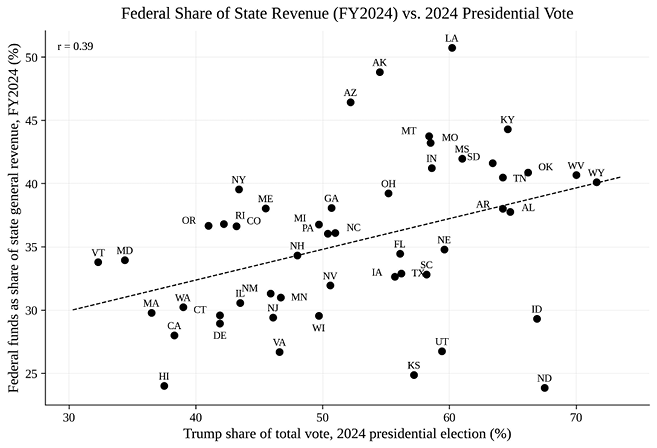
It was part of the constant intergovernmental battle at the core of Trump’s domestic policies. Federalism became the forum for advancing the administration’s policies and consolidating its power. In just a few months, Trumpism reversed the two generations of federal grants that had emerged since the 1960s. Trumpism accelerated the downshift of project grants, just as grants for payments to individuals, especially Medicaid and SNAP, suffered big cuts. Responsibility for administering the programs, which long had rested with the states, became even greater – and so did their financial responsibility for making up the federal cuts or for facing the responsibility for not doing so. That brought an even greater reliance on contractors to carry the administrative load that states could not.
OBBA not only made major cuts but also injected major uncertainty into the intergovernmental fiscal picture. State and local governments simply did not know and could not project the implications of Trump’s decisions for their own budgets. The administration’s uprooting of requirements to examine DEI accomplished one thing for which state and local governments had been campaigning for decades: reduction of crosscutting requirements across all federal grants But these requirements typically were not the ones that had bothered them most, and many of the most burdensome requirements, including environmental reviews and labor wage standards, remained virtually untouched.
For nearly a century, the rise of federal grants in the intergovernmental system had followed a steady and relatively predictable trajectory, oscillating between patterns of centralization and decentralization. Trump changed all that. There was no core strategy except disruption and, some critics suspected, retribution against Democratic cities and states. Disruption swept through every corner of the federal grant system, leaving the finances of all levels of government radically changed and on an especially unpredictable footing.
5 Force
Trump was as eager to rattle local law enforcement in blue cities as he was to drain governmental coinboxes.Footnote 76 Following the demonstrations that erupted across the country after George Floyd’s murder in 2020, he dispatched the National Guard and federal law enforcement officials to Washington, DC, and sent federal officials to Portland, Oregon, and Seattle, Washington, DC. Tactical teams deployed to other cities, from New York City and El Paso to Detroit and Los Angeles, for crowd control – twenty-five teams from eighteen different agencies, according to an analysis by the US Government Accountability Office. They came equipped with everything from rifles and shotguns to tactical robots and armored personnel carriers.Footnote 77
In his second administration, Trump switched strategy but amped up the tactics. He had promised “mass deportation” during the 2024 campaign and launched the effort with deployment of the National Guard to Los Angeles, followed by backup from a contingent of Marines. They swarmed throughout places migrants congregated, often to places such as Home Depot parking lots, which frequently served as hubs for day laborers who, in turn, often were undocumented migrants.
That campaign cascaded into the distribution of federal troops to Washington, DC, this time with the broad but explicit mission of reducing crime. Trump said that crime was “out of control” in the nation’s capital. In Portland, Trump said that troops were needed “to protect War ravaged Portland, and any of our ICE Facilities under siege from attack by Antifa, and other domestic terrorists.” Troops arrived in Memphis, where the president said was “suffering from tremendous levels of violent crime that have overwhelmed its local government’s ability to respond effectively.”Footnote 78 All these communities had at least one thing in common: Democratic mayors.
Then came the biggest surge of agents from the Department of Homeland Security in Minneapolis. The city was an irresistible target. Allegations of fraud had swirled around government-financed childcare centers. The Department of Justice identified Minnesota as a “sanctuary jurisdiction,” and its governor was Democrat Tim Walz, who was vice president on the Democrats’ 2024 ticket that challenged Trump.Footnote 79 These forces combined to make Minneapolis the flash point in the administration’s mass deportation campaign. The aggressive tactics ICE used led to the shooting deaths of two Minneapolis citizens, both white and both American citizens. Democrats rallied to oppose the administration’s strategy, refusing to fund the Department of Homeland Security until the administration backed down. The standoff led to a partial government shutdown and a continuing battle between the administration and Congress over DHS funding. Then in October 2025, Trump threatened to send federal troops to San Francisco to “make it great again.” Cities such as San Francisco with Democratic mayors were “unsafe,” and he pledged to use the troops to deal with crime and “woke” city leaders.
The Insurrection Act
To justify the force, Trump asserted that he had “unquestioned power” to send in the National Guard under the 1807 Insurrection Act. Half of all presidents had used it, he claimed, and he threatened to do the same.Footnote 80
In fact, just fifteen presidents had invoked the Insurrection Act, with five presidents using it since 1945: Eisenhower (1957) to enforce school desegregation in Little Rock; Kennedy (1962–1962) for desegregation crises in Mississippi and Alabama; Johnson (1965–1968) to protect voting rights and then to deal with urban riots; Reagan (1987), to quell an uprising by Cuban detainees in an Atlanta who had taken hostages; GHW Bush (1989), to put down unrest following Hurricane Hugo and then (1992) in response to rioting in Los Angeles following the acquittal of white police officers in the beating of motorist Rodney King. Across the decades since the act’s passage, it had been invoked thirty times.Footnote 81 This certainly did not match Trump’s claim.
Did the president have the power to federalize the National Guard and send it to an American city? In October 2025, a federal appeals court found that the president’s use of troops – 200 members of the Guard to guard the federal building – a “measured response” and, therefore, legal.Footnote 82
The story of the Insurrection Act goes back almost to the country’s founding. In the 1790s, Congress passed militia acts that empowered the president to call out state militias to put down conflict. The Insurrection Act itself dates to 1807, in a tale full of almost unbelievable ironies. In the first presidential elections, the presidency went to the candidate who won the most electoral votes, and the vice presidency went to the runner-up. In 1800, however, Thomas Jefferson and Aaron Burr tied in the electoral vote, which created a crisis that the founders had not anticipated. On the 36th ballot, the House of Representatives, charged with making the choice, swung to Jefferson, largely because Alexander Hamilton nudged a few members of his Federalist Party to vote for Jefferson in the Democratic-Republican Party. As fans of the Broadway musical Hamilton know, frictions between Hamilton and Burr were growing, and Hamilton did not want to see Burr as president.
Just in time for the 1804 election, the controversy convinced the country’s leaders to amend the Constitution to require separate electoral votes for president and vice president. By that point, Jefferson had developed his own frictions with Burr, who had a hard time making and keeping friends because of his unmistakable ambitions. He decided he didn’t want Burr on his ticket and worked with George Clinton to coast to an overwhelming victory over South Carolina’s Charles Cotesworth Pinckney.
Burr worried that his political career was over because of his dispute with Hamilton, whom he killed in a duel just before the 1804 election, and because of his frictions with Jefferson. He concocted a bizarre plan to reverse his fortunes. He would settle in the new Louisiana territory, provoke Mexico into battle, raise a small army to defend the territory, and then keep the captured land for himself. That would finally make him rich. Or so reports to Jefferson suggested – no one knew for sure what Burr was up to, but the reports genuinely worried Jefferson.
Jefferson wondered whether he could dispatch the army to quell a rebellion like Burr’s on American soil. His fellow Virginian, Secretary of State James Madison, counseled that a president could use federal troops to repel invasions from outside powers but not from forces within the country.Footnote 83 Given his role in drafting the Constitution, Madison surely knew more about the nooks and crannies of the document than anyone.
Jefferson decided he needed separate authority to dispatch federal troops. He went to Congress with a letter from one of Burr’s conspirators and won legislation authorizing him to send federal troops into domestic action against internal insurrectionists. The law was the Insurrection Act of 1807. Burr was arrested for treason but was never convicted. He decided to leave the country but, true to form, he had to borrow money to do so. The Insurrection Act became perhaps his most lasting but least known legacy.
The Insurrection Act – actually a series of amendments that continued to be revised until 1871 – allows the president to deploy troops on the request of a governor or a state legislature to “suppress rebellion”; or suppress “any insurrection, domestic violence, unlawful combination, or conspiracy” that threatens the rights of the people. The decision about whether a particular case is indeed a “rebellion” or “domestic violence” justifying the use of federal troops is the president’s call, according to an 1827 US Supreme Court case.Footnote 84 That, the Brennan Center for Justice has concluded, made the law “dangerously overbroad and ripe for abuse,” which is precisely what fueled arguments over the scope of Trump’s power to deploy troops in American cities.Footnote 85
There’s a profound irony here. Trump repeatedly threatened to use military power under the Insurrection Act, as Jefferson used it to control Burr, that to stimulated just the kind of conflict that prompted Jefferson’s action to begin with. And there’s one more irony. Among all the founders, Hamilton made the strongest case for the exercise of executive power, but Burr shot him. Burr then turned around to embrace the very power he had complained about. Trump followed in the same model, which Hamilton, the founder most supportive of executive power, surely would have opposed. Hamilton approved of a strong executive, but always one under the tight control of democratic institutions.
Posse Comitatus
Trump’s dispatch of troops touches on another point of history, this one the election of 1876, which ranks among the nastiest in American history. The Republican candidate, Ohio’s Rutherford B. Hayes, was a compromise candidate when the party’s frontrunner, Maine’s James G. Blaine, couldn’t marshal enough support to win the nomination. Hayes went up against Samuel J. Tilden, a New York Democrat. Tilden won the popular vote but ended up one electoral vote shy of winning the White House.
Furious Democrats charged that federal troops, still in the South as part of Reconstruction and responsible for guarding polling stations during the election, had helped Republicans steal the election. Republicans countered that they deserved to be awarded the outstanding electoral votes from four states – Florida, Louisiana, Oregon, and South Carolina. That would give them the presidency, but the Democrats pointed to their popular vote majority and did not want to give in.
The two sides eventually bargained out a compromise. Democrats reluctantly agreed to count the electoral votes from these four states for Hayes, which would give him the presidency. In exchange, Hayes agreed to end Reconstruction and pull federal troops from the South. To seal the deal, Congress two years later passed a relatively obscure law, the Posse Comitatus Act, which prohibited the use of the Army and, later, other military branches for domestic law enforcement. That ended Reconstruction, long a fundamental Democratic goal in the South.
The roots of the strange-sounding “posse comitatus” principle go back to the ninth century of England. The king was exploring ways of government but he did not have – and could not afford – a large standing army. He relied, therefore, on his sheriffs (or his “shire-reeve,” the king’s representative in each shire, or county). The sheriff could call for a “posse comitatus,” or “power of the county,” from able-bodied male residents. Joining the posse was not like posses in Westerns. If a person summoned to the posse refused, he could lose his property, slide into servitude, and become an outlaw (i.e., be placed outside the protection of the law, which was always dangerous at a time when civilization was just taking hold).
English common law provided the foundation for the Posse Comitatus Act, although what emerged was a mirror image of the English tradition. In medieval England, the local county sheriff had the power to conscript civilians to keep domestic order. The Posse Comitatus Act did the reverse: it prohibited the use of the Army (and other military branches, later) for domestic law enforcement.
Trump wanted to create a show of force and federalized California’s National Guard, without consulting either Governor Gavin Newsom or Mayor Karen Bass, to put troops on the streets. The last time that happened was in 1965, when Lyndon B. Johnson sent federal troops to Alabama to protect civil rights protesters against violence. According to the provisions of the 1878 act, federal troops could support law enforcement but could not directly engage in enforcing the law.
Johnson knew that Democrats would pay at the voting booth for his decision. When his vice president, Hubert Humphrey, ran for president in 1968, he not only lost Alabama but also the rest of the South. Former Governor Alabama George Wallace, against whom Johnson deployed the troops, won the Deep South, and Republican Richard Nixon picked up the rest of the region through his “Southern Strategy.” Without Johnson’s deployment of troops, along with the rest of his civil rights strategy designed to sweep away Jim Crow, America might well not have endured the trials of Watergate or the enduring problems of trust that created the tinder that the federal troops on the streets of Los Angeles ignited.
Since Nixon’s presidency, the federal regulatory involvement of the states became even stronger: environmental standards, as well as workplace requirements through OSHA, wage and hour rules through the Fair Labor Standards Act, regulations governing access for the disabled to public facilities, educational rules through No Child Left Behind, and ongoing civil rights rules. But all these regulatory policies are more or less standardized around the country. No one could ever seriously claim there isn’t a partisan spin to some of these regulations, but none are punitive steps aimed at particular groups, focused on individual jurisdictions, or designed to appeal to a political base excited about both.
With Trump’s focus on deporting those in the country illegally, a very different conflict developed. Trump’s border czar, Tom Homan, threatened to arrest California Governor Gavin Newsom for resisting the administration’s immigration policies. After Homan threatened to arrest Newsom, a Fox News reporter asked Trump if he agreed. “I would do it if I were Tom,” Trump replied. “I think it’s great.” Newsom, he said, is a “nice guy” but is “grossly incompetent.”Footnote 86
Newsom shot back to Homan, “He’s a tough guy, why doesn’t he do that? He knows where to find me.” There hasn’t been this kind of personal dare since Wallace stood in a doorway of the University of Alabama to keep two black students from enrolling. It had echoes of Hamilton’s duel with Burr.
“We’re gonna have troops everywhere. We’re not going to let this happen to our country,” Trump said, but “everywhere” meant just in the backyards of the woke.Footnote 87 Trump’s decision resurfaced the painful memories of the 1876 election, when the goal of posse comitatus was to put an end to the use of federal troops for the domestic role Trump envisioned.Footnote 88
The tensions over the administration’s mass deportation campaign festered to the point that they became a political liability. In April 2025, 34 percent of Americans strongly disapproved of the president’s immigration policy. By early February 2026, the number had grown to 49 percent. His overall approval dropped to about the same level as approval of immigration and border security, as they became an anchor dragging the administration down. The administration quietly began withdrawing federal troops and ICE agents from Los Angeles, Chicago, and Portland, Oregon, and soon thereafter from Minneapolis, which had become the flashpoint for the struggle.
Trump’s decision to send in the troops was a hallmark of his strategy of executive federalism. He turned federalism into a tool of confrontation, aimed at just some states. It told Trump’s base just what it wanted to hear, provoking just the kind of actions that would warrant an even more aggressive response and creating a license for an even broader deployment of troops.
Federalizing Elections
Along the way, however, Trump opened another avenue for attack on federalism with his surprising threat in February 2026 to federalize elections. “The Republicans ought to nationalize the voting.” When criticism of his statement arose on all sides, he doubled down. If states “can’t count the votes legally and honestly, then somebody else should take over,” he said.Footnote 89
Trump’s argument for national control of elections went farther than anything Republican presidents have ever broached, but there was nothing new in Republican claims that Democrats have stolen elections, claims that stretched back many years. For example, in the 1960 presidential election, Republicans were sure that Chicago Mayor Richard J. Daley had committed fraud to tip Illinois to the Democrats. At a Christmas party a few weeks after the election, the losing Republican candidate, Richard Nixon, told guests, “We won but they stole it from us.”Footnote 90 Nixon had a point. Researchers have since determined that there was indeed voter fraud in Illinois. However, they concluded, there was not enough voter tampering to flip the state and, even if Nixon had won Illinois, he still would not have had enough electoral votes to win the presidency.
Complaints about the Chicago Democratic machine go back even longer. In 1955, election official Sidney “Short Pencil” Lewis was accused of erasing primary votes cast for the mayor, Martin Kennelly, and changing them to votes for Richard J. Daley, who won and then used the victory to build his twenty-year control of city hall. “Short Pencil” Lewis had a bag of tricks for the days before voting machines, including putting short pencils on a short string that made it exceptionally hard to vote for individual candidates – and far easier to check one box to vote straight Democratic.Footnote 91
In the aftermath of the 1960 election, furious Republicans called for investigations of fraud in the states, but they did not call for federalizing voting. They took Article I, Section 4 of the Constitution very seriously. It says, quite simply, “The Times, Places and Manner of holding Elections for Senators and Representatives, shall be prescribed in each State by the Legislature thereof.” The US Supreme Court underlined that principle in a 1932 ruling in Smiley v. Holm. “It cannot be doubted that these comprehensive words embrace authority to provide a complete code for congressional elections,” the Court held.Footnote 92
In writing the Constitution, why did the founders put control of elections for federal officials in the hands of the states?
Part of the reason was simply pragmatic. As colonies, the states had already created their own election administration systems and their own systems of courts. The founders had enough on their hands as it was, so it was easiest to ask the states to continue doing what they had already figured out how to do
In Federalist 59, Alexander Hamilton said it would have been impossible that “an election law could have been framed and inserted into the Constitution, which would have been always applicable to every probable change in the situation of the country.” Putting elections into the hands of the federal government, he worried, could prove “a premeditated engine for the destruction of the State governments.”
But that didn’t satisfy Steve Bannon in 2026. “We’re going to have ICE surround the polls come November. We’re not going to sit here and allow you to steal the country again.” In fact, he was willing to call up the 82nd and 101st Airborne Divisions under the Insurrection Act.Footnote 93
When Republicans last used troops at polling places, however, it did not work out well for them, in the election of 1876. It tipped the electoral balance in the South to the Democrats, and they did not recover until the 1960s.
The Constitutional Roots of Federal Troops
The history of using federal troops in elections is thus a wild tale – and it stands as a warning of the political costs that could come to anyone challenging the Constitution’s prescription of state control over the election process. In December 2025, the Court ruled against the Trump administration’s contention that he needed to nationalize the Illinois state National Guard and send in National Guard troops from Texas to deal with what he said was violence on the streets of Chicago. With very rare exceptions, such as Lyndon B. Johnson’s decision to send in the Guard to protect advocates for civil rights in Alabama, federalizing the state Guard requires the consent of the governor. Illinois Governor J. B. Pritzker refused to grant permission, but Trump insisted he had the right to send in the troops anyway, to protect federal facilities from protesters.
Within hours of being sent to an ICE facility, U.S. District Judge April Perry issued a temporary restraining order blocking the federal government from using federal troops for local law enforcement. The administration appealed, but the U.S. Supreme Court ruled 6–3 against the administration in granting an extension of the lower court judge’s stay.Footnote 94 The majority opinion said, “the Government has failed to identify a source of authority that would allow the military to execute the laws in Illinois.” The administration had not tried to invoke the Posse Comitatus Act. Instead, the president relied “on inherent constitutional authority that, according to the Government, allows him to use the military to protect federal personnel and property.” The Court rejected that argument. Then, because the administration had failed to establish a basis in law, the Court refused to lift the lower court’s stay. That, Pritzker said, was “a big win for Illinois and American democracy.”Footnote 95
The administration backed away from the plan to make Chicago the center of its law enforcement actions and sent the Texas troops back home. It quietly withdrew troops from Los Angeles and Portland, Oregon. Border czar Tom Homan told reporters that the administration was ending its “Operation Metro Surge” in Minnesota and sending most National Guardsmen home. The operation had been a massive federal intervention in local law enforcement, with more than 3,000 federal troops on the streets of the Twin Cities, a number that swamped the 600 local police officers in Minneapolis.
The administration had faced fierce opposition to its use of federal troops in cities across the US, in part because of the long-established principle in Posse Comitatus that federal troops could not be used in local law enforcement except in rare circumstances, and in part because of the political opposition that the killing of two Minneapolis residents generated. On the one hand, Trump demonstrated his willingness to get tough in Democratically controlled urban centers. On the other hand, he discovered that both the Constitution and the existing body of legislation created guardrails on the use of federal power – and that even his appointees to the US Supreme Court were willing to reinforce those guardrails.
There was a profound paradox here. The administration’s use of force attracted big headlines but ended up being more important for the symbols it generated. On the other hand, the big changes in the grant programs attracted far less publicity but were destined to have much more staying power. This combination generated far more friction than during any administration in generations – and together fundamentally upset the law, finances, and traditions of federalism in ways that matched none of the existing theories of American intergovernmental relations.
6 Federalism, Trumpism, and Democracy in America
Since even before the country’s first days, there has always been friction between the federal government, on one side, and state and local governments, on the other. There was the question of whether the country had been created by the states – as the “United States of America” – or by “We the People.” States have insisted on autonomy, at least over some issues. The federal government, on the other hand, has constantly searched for tools to shift the balance of power into its hands. And when problems have arisen, such as the Great Depression, there has always been the challenge of how the federal government can lead without trampling over state and local government power.
These tensions have grown out of the inherently unsteady balance that the founders built into the Constitution – or, put differently, that were the product of issues they simply could not resolve as they built and then tried to sustain the uneasy unity of America’s states.
Trumpism, however, took a very different course. It did not seek to create yet another “new federalism” with a different set of tactics to shift the balance and to steer policy. Rather, an explicit shift in the balance was an integral part of Trumpism: seeking the president’s policy goals by pulling power to the federal government; within the federal government to the executive branch; and within the executive branch to the White House. He shifted the role of federal grants from the goal of policy leverage to the pursuit of power and control. He did not hesitate to back up that pursuit with the application of armed force. That was the core of his executive federalism.
With the goal of mass deportation of immigrants, the aggressive tactics of ICE and Customs and Border Protection, and threats to use the military to control elections, Trump discovered that there were limits – practical and, especially political, even among members of his party – to his fierce campaign to shift the balance of power in federalism. He constantly threatened, backed away, and then pressured, in ways state and local officials could not anticipate and often could not counter.
At the core, however, was the basic fact that Trump’s approach to federalism was unlike that of any previous president. Trumpism did not have an ideological vision of what the balance of intergovernmental power ought to be, as was the case with Eisenhower (federal support for fast-changing national goals such as highways), Johnson (legislation and grants to nudge the states toward attention to equality), Nixon (block grants to shift power away from the federal government), Clinton (tipping the balance in welfare), G. W. Bush (working to ensure no child was left behind), and Obama (with Obamacare). There was no such vision in Trumpism. Rather, Trumpism was about disrupting the patterns of power in federalism – and seizing as much of that power as possible, wherever possible.
Moreover, federalism reforms for a generation had focused on improving coordination between federal, state, and local governments. Sometimes those reforms were real. At other times, they were half-hearted and occasionally just rhetorical. But, in general, collaboration has been the keystone of federalism for decades. The Intergovernmental Cooperation Act (1968), for example, mandated that the federal government work closely with state and local governments to ensure full information about federal programs. That requirement has been modified since, but the fundamental policy has remained constant. In development assistance, for example, the law requires, “To the maximum extent practicable, each executive agency carrying out a development assistance program shall consult with and seek advice from all other significantly affected executive agencies in an effort to ensure completely coordinated programs.”Footnote 96
The aggressive, confrontational approach to federalism in the Trump administration flies in the face of that policy, and coordination even among federal agencies on issues affecting state and local governments often was missing.
In February 2026, for example, the FAA announced it was closing down airspace over El Paso because of “special security reasons.” It turned out, however, that the military had been testing a new laser-based technology to shoot down drones, such as the ones that Mexican drug cartels had been increasingly using. Earlier that week, the military had used the anti-drone system, which locked in on and destroyed what the system thought was a possible threat. That threat actually was a party balloon. The military had not coordinated with the FAA over the tests; the FAA in turn worried that the system put commercial aviation and emergency medical evacuation helicopters at risk. The FAA decided to shut down the airspace, but they did not alert officials in the Pentagon, the Department of Homeland Security, or the White House – or in El Paso – in advance. The FAA had the authority to close the airspace, but it had not done so since the September 11 terrorist attacks. The El Paso airport was virtually shut down, flyers struggled for alternatives, and city officials worried about the impact of the shutdown on the economy.
Just about everyone involved was furious, and the issue quickly kicked up to the White House. A few hours later, the FAA lifted the air space shutdown. Renard Johnson, El Paso’s mayor, told a news conference, “I want to be very, very clear that this should’ve never happened. You cannot restrict air space over a major city without coordinating with the city, the airport, the hospitals, the community leadership.”Footnote 97 It was a case in which no one was coordinating with anyone, with dramatic implications for everyone involved.
Then there was the intense controversy in 2026 over the invitation for the nation’s governors to attend the traditional nonpartisan meeting at the White House. Trump decided to invite only the Republican governors. The National Governors Association said it would no longer be part of the scheduling for the annual meeting, which had a long bipartisan tradition going back decades. The NGA then announced that all of the governors would be invited to a White House breakfast, but two Democratic governors said their invitation to a dinner had been rescinded. The other Democratic governors said none of them would attend if all weren’t invited.Footnote 98 The administration later papered over the conflict, but not until after it laid bare the underlying frictions that were splitting the federal system into red- and blue-state versions.
That drove a deeper partisan divide among the nation’s top elected officials and further undermined intergovernmental collaboration. Many of the differences were rhetorical, with federalism caught up in the broader-scale polarization that had crippled American politics. But some of these differences were fundamental, dealing not only with the blunt exercise of power but also with the fiscal patterns that had cemented cooperative federalism for a century.
On the financial front, there was a deep irony: the states that had been the strongest supporters of Trumpism had become the most dependent on federal aid and stood to suffer most from the most enduring parts of the president’s approach to federalism. The states most vulnerable to his cuts in grants were those most firmly in his base.
Trumpism developed a very different kind of federalism than America had seen. The president saw it as a tool for advancing his political aims, especially in shifting power from blue states to red, and in pulling decision-making into the federal government from the states; within the federal government, to the executive branch; within the executive branch, to the Executive Office of the President; and within the EOP, to the president and his key aides, especially in the OMB. He pushed some decisions out into the states, but these principally were for functions and costs, such as Medicaid, that he wanted to offload. Other presidencies celebrated devolution of power, like Nixon’s New Federalism. Some featured more centralized control, such as LBJ’s Great Society. But no presidency had combined such a mixture of centralization, decentralization, and exercise of raw political power.
How to get this right was a fundamental concern of Tocqueville during his grand tour of the US. He identified two kinds of centralization: political and administrative. In organizing the political system, he wrote, “I cannot conceive that a nation can enjoy a secure or prosperous existence without a powerful centralization of government.” In administrative matters, he believed exactly the reverse:
I am of opinion that a central administration enervates the nations in which it exists by incessantly diminishing their public spirit. If such an administration succeeds in condensing at a given moment, on a given point, all the disposable resources of a people, it impairs at least the renewal of those resources. It may ensure a victory in the hour of strife, but it gradually relaxes the sinews of strength. It may contribute admirably to the transient greatness of a man, but it cannot ensure the durable prosperity of a nation.
In fact, he concluded, “the collective strength of the citizens will always conduce more efficaciously to the public welfare than the authority of the Government.” In fact,
However enlightened and however skillful a central power may be, it cannot of itself embrace all the details of the existence of a great nation. Such vigilance exceeds the powers of man. And when it attempts to create and set in motion so many complicated springs, it must submit to a very imperfect result, or consume itself in bootless efforts.Footnote 99
Tocqueville would have found himself at home in discussing Trumpism and democracy. He would have recognized the president’s instinct to centralize political power to define the country’s direction. But he would have strongly objected to the administration’s scattered approach to administration. He would have worried about the Trump administration’s efforts to pull key decisions to Washington, DC. “In no country in the world do the citizens make such exertions for the common weal,” Tocqueville noted. He would have suggested that Trumpism’s strategies for policymaking would have weakened citizens’ “exertions for the common weal.”Footnote 100 And he would have worried about the erosion of support for grassroots democracy.
And for Tocqueville, that closes the circle on political and administrative decentralization. The devolution of power to local governments through administration brought with it substantial political decentralization as well. He wrote,
It is not the administrative but the political effects of the local system that I most admire in America. In the United States the interests of the country are everywhere kept in view; they are an object of solicitude to the people of the whole Union, and every citizen is as warmly attached to them as if they were his own.
This led him to his fundamental conclusion. “The only nations which deny the utility of provincial liberties are those which have fewest of them; in other words, those who are unacquainted with the institution are the only persons who pass a censure upon it.”Footnote 101
The distinctive character of democracy in America, Tocqueville concluded, came from the vitality of local governments and of the country’s willingness – indeed, its eagerness – to embrace it, both through administrative decentralization and the political power that flowed from it. One can debate where on the centralization–decentralization spectrum Trumpism lies, but the effort does not match the way previous administrations approached the puzzle or the more fundamental formulation that Tocqueville developed. Trumpism drew much of its power from community-based constituencies but, having captured power, it was reluctant to trust those communities themselves with the exercise of power – or, at the least, to trust American pluralism and the celebration of differences that lay at its core.
That leads to four important conclusions about federalism, Trumpism, and democracy in America. One is that neither Tocqueville nor those who developed modern forms of federalism would recognize what Trumpism produced. Second, Trumpism’s effort to selectively seize power over some policies while pushing other decisions to state and local governments is an inconsistent governance strategy even though it is a perfectly consistent political one. Third, Trumpism trusted only the local decisions that came from the president’s political base. For those that did not, the president was prepared to drain grant money and deploy troops. Fourth, none of Trumpism’s strategies and tactics advance the democracy in America that Tocqueville celebrated in the middle of the nineteenth century and that endured for generations afterward.
It would be easy to stylize Trumpism as a straw man and to celebrate an idealized version of federalism past that never existed in practice. A careful look at Trumpism and democracy, however, reveals a large gap between the distinctive elements of democracy in America and the version of federalism that Trumpism developed. Previous presidents had their own versions of federalism, of course, and their successors had little compunction in pushing them aside in fashioning their own version, at a different point in the pendulum’s swing. But because Trumpism is so different – not so much a new point on the pendulum but tactics that didn’t fit the pendulum to begin with – it is that much harder to forecast what the implications of Trump’s executive federalism for future presidents will be.
As with so many other elements of Trumpism, however, it will prove hard for future presidents to return to variations on old themes. For better or worse, they will need to reckon with the issues that Trumpism freshly surfaced, with their own approach, of course, but on turf that Trump has redefined. American democracy will have to reckon with new puzzles, the foremost of which will be whether a truly cooperative model of federalism will return and whether the increasing muddle of intergovernmental finance will make it far harder to produce programs that are both effective and accountable.
These are just some of the puzzles that federalism and Trumpism frame for democracy in America. Few are more important, however, than how Trump’s approach fits within the framework that Tocqueville laid out so clearly generations before. The future of America’s distinctive brand of governance and approach to democracy hinges on it.
Robert Christensen
Brigham Young University
Robert Christensen is the George W. Romney Professor of Public and Nonprofit Management at Brigham Young University.
Jaclyn Piatak
University of North Carolina at Charlotte
Jaclyn Piatak is co-editor of NVSQ and Professor of Political Science and Public Administration at the University of North Carolina at Charlotte.
Rosemary O’Leary
University of Kansas
Rosemary O’Leary is the Edwin O. Stene Distinguished Professor Emerita of Public Administration at the University of Kansas.
About the Series
The foundation of this series are cutting-edge contributions on emerging topics and definitive reviews of keystone topics in public and nonprofit administration, especially those that lack longer treatment in textbook or other formats. Among keystone topics of interest for scholars and practitioners of public and nonprofit administration, it covers public management, public budgeting and finance, nonprofit studies, and the interstitial space between the public and nonprofit sectors, along with theoretical and methodological contributions, including quantitative, qualitative and mixed-methods pieces.
The Public Management Research Association
The Public Management Research Association improves public governance by advancing research on public organizations, strengthening links among interdisciplinary scholars, and furthering professional and academic opportunities in public management.