


This article, a summary of part 1 of the author’s new book (Mesa-Lago, forthcoming), compares and evaluates performance of two main current socialist socioeconomic models. One is Cuba’s central plan, characterized by state large enterprises predominant over the market and private property, with mild market-oriented structural reforms that are ineffective in generating sustainable economic-social development.Footnote 1 The other model is the successful Sino-Vietnamese “socialist market” typified by small, median and some large private enterprises and the market, all predominant under a decentralized plan (more a guideline than a central plan) and with the state regulating the economy and controlling the largest enterprises.
The article explores whether the three countries are truly comparable. In examining a series of indicators (e.g., the human development index, area and population size, demographics), it is found that the countries are similar in many ways with a few differences; counterarguments are discussed, leading to the conclusion that the divergent indicators are not an obstacle. Thus, the countries and their models are comparable. The five major economic policies of the two models are contrasted: ownership of the means of production; agrarian reform; industrialization; employment, open unemployment, and underemployment; and currency- and exchange-rate unification. The economic-social performance of the two models and three countries are compared using twenty-seven indicators: fifteen are economic and twelve are social. Based on a selection of the most relevant twenty indicators (ten economic and ten social), a composite average is elaborated to rank the three countries’ economic-social performance. Potential methodological problems in the ranking are identified and discussed. The literature does not have a similar comparison and hence the article faces significant obstacles, such as homologizing diverse statistical series from the three countries, absence of key indicators, and lack of data for the same period. Because of those difficulties, this article should be considered only a preliminary exploration; further research is needed.
Sources used in the article are statistical yearbooks from the three countries (statistical reliability is evaluated in the book); interviews with scholars and experts on China and Vietnam; questionnaires sent by the author; technical reports from national institutions and international organizations; academic literature on economics and social policy from the countries; and newspapers, magazines and blogs.Footnote 2
Similarities among the three countries
Pertaining to this area of research, there are about ten similarities among the three countries. They have communist regimes that were the result of popular uprisings (a significant difference from Central and Eastern European socialist countries, where communism was imposed by the Soviet Union); all are unitary states (the three have provinces) and “one-party authoritarian” political systems (Domínguez Reference Domínguez2021).Footnote 3 They also have socialist economies, albeit of two types: After sixty-four years and despite some modest reforms, Cuba retains a predominantly centrally planned economy. Cuban officials refer to reforms as an “updated model,” meaning that they did not transform the existing planned model but just mended or actualized it. Conversely, the two Asian countries are mixed economies that blend state and private ownership of the means of production, with the market having a key role under decentralized planning.Footnote 4
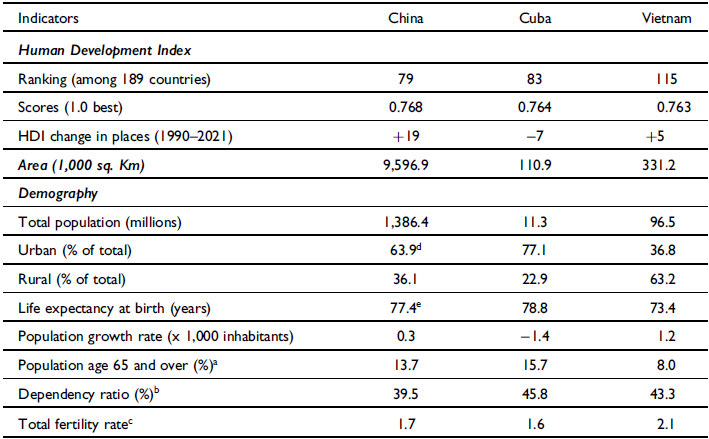
The three countries currently have relatively similar rankings and scores in the UN Development Programme’s (UNDP) Human Development Index for 2021 (Table 1; the higher the score the better): The three are classified in the second group as “high human development.” Their scores are relatively close to one another: China, 0.768; Cuba, 0.764; Vietnam, 0.763. These scores have a maximum difference of 0.580 points with Switzerland (highest human development) and South Sudan (lowest human development). Among 191 ranked countries, China ranks 79; Cuba, 83; and Vietnam, 115. Cuba and China are separated by only four places (equivalent to about 2%, based on the total number of countries), whereas the difference is wider for Vietnam at thirty-two places (16%).
Human Development Index, area, and demographic indicators in China, Cuba, and Vietnam, circa 2021
a Over total population.
b Aged 14 and under plus aged 65 and older, divided by aged 15–64.
c Number of children born alive to women in their child bearing years.
d The “hukou” system of household registration complicates this calculation.
e Year 2021.
Sources: Based on UNDP 2022; China from NBSC, 2021a, 2021c, He, 2022; Cuba from ONEI, 2020, MINSAP, 2021, ONEI/CEPDE 2021; Vietnam from GSO, 2019, 2022b; others OECD, 2018; World Bank, 2021a, 2021b, 2021c.
Table 1 also shows fairly similar demographic indicators in the three countries. Life expectancy at birth is seventy-nine years in Cuba, seventy-seven in China, and seventy-three in Vietnam.Footnote 5 Dependency ratios are 45.8 in Cuba, 43.3 in Vietnam, and 39.5 in China. Total fertility rates are close in China and Cuba—1.7 and 1.6, respectively—and higher in Vietnam at 2.1. Percentages of the population age 65 years and older are 15.7% in Cuba, 13.7% in China, and 8.0% in Vietnam. In 2019, Cuba’s population decreased by 1.4 per thousand inhabitants while China’s population grew 0.3 and Vietnam’s 1.2. Cuba is the oldest country of the three, closely followed by China, where the ageing population has been affected by the one-child policy that was in place for thirty-six years. Ageing in Vietnam is moderate but expanding (Table 1). According to the International Labour Organization (2018, 3), Vietnam will move at a “very high pace of ageing” by 2035, much sooner than France and the United States. The “window of opportunity” or demographic bonus has closed in Cuba and China but will not close in Vietnam until 2042 (World Bank 2021c).
The three countries share their antagonism with the United States (though much less in Vietnam, after the war was over, than in the other two) and NATO in particular, as well as fair relations with Russia (although China experienced a period of confrontation with the Soviet Union for world hegemony). The three countries have supported liberation movements in colonial countries on several continents; they also endured significant emigration after their communist takeover, which afflicted their human capital endowment (such exodus was continuing in Cuba in 2023). Both Vietnam and Cuba have suffered an embargo imposed by the United States, although in Vietnam this ended in 1994. In Cuba it still exists and was substantially strengthened under the Trump presidency.
Differences among the countries and counterarguments for comparison
As relevant to the exploration in this article, there are five main differences among the three countries. China’s territorial area is eighty-six times the size of Cuba and twenty-nine times that of Vietnam; Vietnam is three times as large as Cuba. In addition, China’s population is 123 times larger than Cuba’s and 14 times larger than Vietnam’s; Vietnam’s is 8.5 times larger than Cuba (Table 1). The US embargo has lasted much longer and has been stronger in Cuba than in Vietnam, which could result in more adverse effects for the former. The urban-rural distribution of the population in Cuba (77% and 23%, respectively) is much bigger than in China (64% and 36%) and virtually the inverse of Vietnam (37% and 63%). In Vietnam, agriculture accounted for a higher share of gross domestic product than in Cuba; these factors could have made structural reforms easier in Vietnam than Cuba. Vietnam had the smallest state sector and the largest number of small enterprises, hence the transition from central planning to the socialist market was not as complex as in Cuba, which has very large state enterprises. The three countries are oil producers, and Vietnam is an oil exporter; since the 1970s China has been a big oil importer and Cuba is a net oil importer too. In this, Vietnam has an advantage. These differences, as potential advantageous factors for China and/or Vietnam vis-à-vis Cuba, are analyzed below.
The larger area size and population of China, and to a lesser extent Vietnam, does not prevent comparison with Cuba for two reasons. First, the large populations living in the two Asian countries, particularly in China, suffered famine and millions of people died of hunger; it was not until the socialist-market model was adopted that agricultural production significantly rose and eliminated starvation. Second, small countries, both in area and population, such as Switzerland, the Netherlands, Denmark, and Estonia have been quite successful in reaching very high levels of human development despite having territorial area less than half that of Cuba and a smaller population (UNDP 2020). Still, China’s large domestic market may have a competitive edge in attracting foreign investment and technology transfer.
The US embargoed Cuba for a longer period than it did Vietnam (the United States imposed an embargo on China in 1949–1972, but this was restricted to military technology sales), another potential obstacle for comparison.Footnote 6 Not to disregard the embargo’s adverse effects on Cuba and its people, under rapprochement in the Obama’s presidency, the embargo continued but was much less harmful than it had been previously. Trump strengthened the embargo in 2017–2020, yet Cuba traded with more than one hundred countries (including the United States, which ranked eighth in imports to Cuba, with 16% of food imports in 2019) as well as investment from several nations (ONEI 2020). Furthermore, the embargo’s adverse effects on Cuba were estimated at US$130 billion in 2021 (Reuters 2021), largely compensated by substantial economic aid and price subsidies from the Soviet Union (US$65 billion in 1960–1990) and Venezuela (US$100 billion in 2005–2017) (Mesa-Lago Reference Mesa-Lago2000; Mesa-Lago and Vidal Reference Mesa-Lago and Vidal2019). In addition, Cuba’s foreign debt with most external creditors was forgiven by US$42.4 billion: 100% of US$10 billion from China, 90% of US$25 billion from Russia, 80% of US$11 billion from the Paris Club, 80% of 1.4 billion from Japan suppliers’ creditors, and 70% of US$500 million from Mexico (Mesa-Lago and Vidal Reference Mesa-Lago and Vidal2019; Mesa-Lago Reference Mesa-Lago2023). Canada has steadily been Cuba’s fourth major trade partner, major investor, and leading sender of tourists. Improved economic relations with and credit from the European Union has been another compensatory factor (Bye Reference Bye2020). On the other hand, Vietnam suffered twenty-seven years of war with both France (1946–1954) and the United States (1955–1973), which devastated the Vietnamese economy, making it among the poorest in the world. Neither Cuba nor China engaged in such prolonged and catastrophic wars. Vietnam’s agricultural reform (1986) began when that country was not a member of international financial organizations (Vietnam became a member of the International Monetary Fund and the World Bank in 1994), yet the fruits of reform were tangible (agriculture contributed 1% to GDP growth in 1987–1993). Le (Reference Le1994) asserts that the decline of the Soviet aid and the continued US embargo on Vietnam in the 1980s, combined with the lack of aid from international financial institutions, were external constraints for economic development. The only suitable solution was a change to the socialist-market economic model: “Thanks to the reforms, Vietnam could not only survive the collapse of the USSR and the East European socialist countries but also expand and diversify the international economic relations. The reforms contributed relevantly to the lifting of the US embargo [and also to normalize] relations with international financial organizations” (Le Reference Le1994, 9, 41). Despite the US embargo, Vietnam was able to implement the successful socialist-market model that turned around its economic situation and contributed to the embargo being lifted.
It is also argued (Vidal Reference Vidal2016) that structural reforms were easier in China and Vietnam because they were mostly agricultural economies and their populations mainly lived in rural areas, whereas Cuba is less agricultural and predominantly urban (see Table 1). Two counterarguments are as follows. First, the initial agricultural reform in Cuba in 1959 distributed land ownership (small and medium-size parcels) to two hundred thousand peasants who already lived on and worked the land. But instead of expanding that successful policy, soon the government imposed restrictions on private farmers (there were 97,341 in 2019; ONEI 2020), seized the medium-size private farms, transformed cooperatives into state farms, took away common plots in state farms, and then shifted back to co-ops. Both state farms and co-ops were quite ineffective and responsible for dismal agricultural performance, the Achilles’s heel of the economy and the perennial cause of food scarcity, particularly in the 1990s and currently. Cuba’s second agricultural reform (under Raúl Castro) transferred idle state land in usufruct to small farmers, again with many restrictions and disincentives. When that experiment failed, successive laws amended the ill-conceived initial law but without improving agricultural output. It is revealing that 17% of Cuba’s employed labor force in agriculture generates only 2.6% of GDP, the result of extremely low labor productivity when compared with China and Vietnam (ONEI 2021). If instead the government had followed the three golden rules of the successful Sino-Vietnamese agricultural reforms (allowing all agricultural producers to decide what to sow, to whom sell produce, and to set prices by supply and demand), it would have led to powerful incentives for food-deprived workers in urban areas to shift to agriculture. In a short period, Cuba could have substantially risen output, achieved food self-sufficiency, and generated a surplus for export.Footnote 7
Regarding the idea that the predominance of small enterprises in Vietnam facilitated reforms (Vidal Reference Vidal, Brundenius and Torres2014, Reference Vidal2016), from the beginning of the revolution, the government confiscated thousands of small businesses, including homes that were rented out, and started concentrating large state enterprises. In 1968, fifty-six thousand micro family enterprises (many of them street stands) were seized, virtually completing full collectivization in less than a decade, probably the fastest of the three countries. Given the failures of these policies, Raúl Castro’s reforms in 2007–2018 tried to curtail the gargantuan state sector by allowing expansion of the nonstate sector but with many restrictions, taxes, inspections, and policy reversals that impeded its proper development. For instance, university graduates cannot practice as self-employed in their careers, although they can do so in low-skilled jobs, which is a waste of substantial state investment in their academic training. Furthermore, if microbusiness had been more developed before monetary unification, some adverse effects would have been cushioned (Mesa-Lago Reference Mesa-Lago2018). Thus, government policy rather than unfavorable structural factors was at the heart of Cuba’s flop.
Oil production in Vietnam is eleven times greater and China six times greater than in Cuba (GSO 2021; NBSC 2021a; ONEI 2021). However, in per capita terms, Vietnam has the highest output (0.23 tons per capita), followed by Cuba (0.19 tons) and China (0.01 tons). Thus, Vietnam is a net oil exporter, and China and Cuba are net oil importers (China is the biggest oil importer in the world). This is an important advantage for Vietnam over Cuba, but it should be noted that oil deposits were not discovered in Vietnam until the 1990s. Even more important, in 1960–1990, the Soviet Union provided all the oil that Cuba needed with subsidies and on credit (the debt was never repaid) and allowed Cuba to export any oil not consumed to the world market. After insufficient Cuban oil production and imports in the 1990s, Venezuela began to supply oil to Cuba in the early 2000s in exchange for professional services (that involve a substantial hidden subsidy). Venezuela also built Cuba’s oil refinery in Cienfuegos and supplied it with crude oil. Part of the output was sent back to Venezuela, but Cuba kept the surplus and exported it to the world market. The crisis in Venezuela has reduced oil supply to Cuba—Russia also provides oil at preferential prices (Mesa-Lago Reference Mesa-Lago2000, Reference Mesa-Lago2023). Finally, if Cuba had been able to generate enough non-oil exports to finance its oil imports (like many non-oil-producing countries in Europe and Asia), insufficient oil output would not have been a major obstacle.
Prerevolutionary Cuba’s advantage in economic-social development over China and Vietnam
Before the Cuban Revolution of 1959, eighty indicators showed that Cuba’s economic-social situation ranked among the top two or three in Latin America, meaning that it was fairly developed in the region (Mesa-Lago Reference Mesa-Lago2009). There are no systematic comparisons of Cuba, China, and Vietnam at the time of their revolutions (1959, 1949, and 1945, respectively) or when each started economic reforms. Nevertheless, historical statistics strongly indicate that the two Asian countries had much lower development than Cuba. For instance, in 1978, when China began reforms, per capita GDP was one-twelfth that of Cuba. In 1986, when Vietnam’s transformation started, per capita GDP was one-sixth that of Cuba (Monreal Reference Monreal2018). The two Asian countries had to make greater efforts to raise their levels of economic-social development and living standards to close any gap with Cuba and then surpass it. In the past three decades, they also have been advancing at a faster pace (see Tables 1 and 3).
In conclusion, it is acceptable to compare the three countries despite their differences. Cuba’s higher development at the time of the revolution compensates for the rest of the factors.
Brief history of the reforms
Revolutions took over in 1945 in Vietnam, in 1949 in China, and in 1959 in Cuba. Socialism was officially proclaimed in Cuba in 1961; the two Asian countries proclamation were in 1947 and 1951, respectively. All three countries first copied the traditional Soviet model of central planning and virtual total state ownership of the means of production, as in all other socialist countries.Footnote 8 After the failure of that model, market-oriented structural economic reforms began (in China, first was Mao’s disastrous Great Leap Forward away from the market) but they took a long time: twenty-two years in China, forty-one years in Vietnam, and forty-nine years in Cuba. China and Vietnam did not follow the big-bang approach typical to Central and Eastern Europe but instead used a gradualist approach. Nevertheless, the pathways and rhythm of the process have been much faster and deeper than in Cuba.
After dire economic performance during the Mao era (particularly the Great Leap Forward and the Cultural Revolution), under Deng Xiaoping, Jiang Zemin, and Zhu Rongji, China developed a “socialist market” model where the private sector, markets, and foreign investment combine with an indicative plan and decentralized decision making. This has spurred the highest economic growth rates in the world (Wu Reference Wu2005; Huang Reference Huang2008). Reforms were conducted in two stages. In 1978–1984 (six years, where Raúl Castro’s unsuccessful reforms took ten), Chinese leaders mandated the division of agricultural communes into private plots, opened to foreign investment, allowed entrepreneurs to start businesses that rapidly increased their share in industrial output, and established several economic development zones, thereby authorizing and expanding private property. In the second stage, between 1984 and 2005, leaders implemented state decentralization and increasing transfer of power to local governments, townships, and villages that legally owned enterprises but in fact were private, and the privatization and contracting out of much state-owned industry, although state monopolies in oil and banking continued (Brandt and Rawski, Reference Brandt and Rawski2008).Footnote 9 A Communist Party meeting in 2013 agreed to push forward new reforms, thwarting the party bureaucracy and resistance to deeper economic changes. The market was to play a decisive role in financing and the allocation of resources; competition was strengthened and restrictions on land ownership overhauled (Buckley Reference Buckley2013). However, there has been a reversal in this since the tenure of Hu Jintao. Xi Jinping has retreated from the market opening, global cooperation, and private initiative and has instead supported state enterprises, top-down decision-making, and party involvement in business management, significantly strengthening his political control and expanding his power (Brandt and Rawski Reference Brandt, Rawski, Ma and Von Glahn2022; Rudd Reference Rudd2022).
With the severe crisis of the 1990s, Fidel Castro introduced timid reforms that halted sharp GDP decline and spurred a partial recovery, but he reversed them after Venezuela began providing help at the start of the twenty-first century. After a gravely ill Fidel transferred power to his more pragmatic brother Raúl, in 2007 the latter began “structural reforms” (his term) that continue under President Miguel Díaz-Canel. But Raúl’s reforms occurred at a very slow pace, with some interruptions and reversals. Thus, they were significantly less impactful than in the two Asian countries (Mesa-Lago and Pérez-López Reference Mesa-Lago and Pérez-López2013; Vidal and Alonso Reference Vidal and Alonso2022). Currently, Cuba and North Korea are the only two socialist economies in the world where the plan and state property have the largest role and the market and private property the smallest.
Vietnam reforms (known as Doi Moi, meaning “restoration”) began in 1986 and rapidly moved the country toward a “socialist-oriented market economy,” encouraging private business (more than thirty thousand were created in six years), foreign investment, and foreign-owned enterprises. Agricultural cooperatives were abolished as was state control over agricultural production in the private sector, which sold on the market and could fix prices. In 2000, the Vietnamese communist party approved a ten-year plan to enhance the role of the private sector, and in 2003, private enterprises controlled more than 25% of industrial output. The 2000 bilateral trade agreement with the United States facilitated the transformation of a predominantly agricultural economy into a manufacturing-based one. Furthermore, Vietnam has become an active member of many international economic and financial free-trade agreements (personal communication with Ca Tran in 2022; Minh 2022).
Comparative key policies and their results
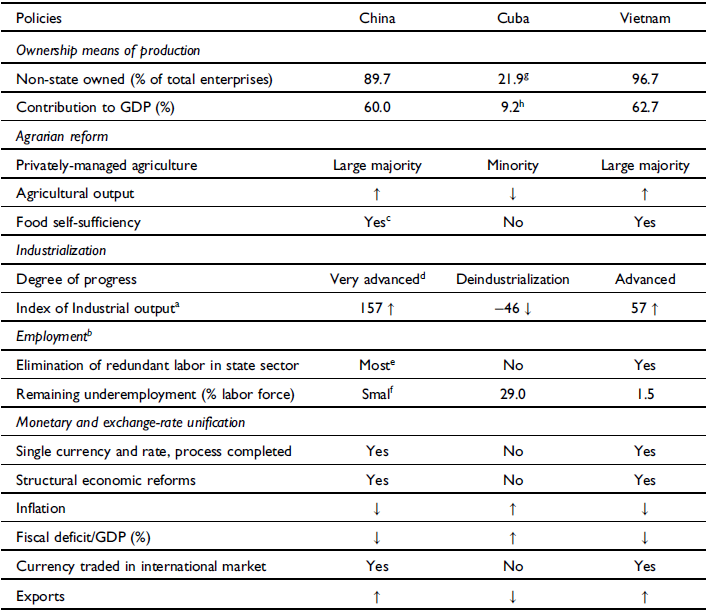
Five key policies are compared in the three countries: ownership of the means of production; agrarian reform; c) industrialization; employment, unemployment, and underemployment; and monetary- and exchange-rate unification.Footnote 10 Table 2 summarizes the major features of such policies and their results in the three countries. On fifteen indicators, Cuba ranks third in all, whereas China and Vietnam are virtually tied. Further research is needed to gather quantitative data on most indicators.
Economic policies and their results in the three countries, different time periods
Note: Arrows indicate tendency.
a China and Vietnam 2010–2020, Cuba 1989–2020.
b For open unemployment see Table 3.
c Considerable self-sufficiency but with big imports of wheat (Canada, Australia) and soybeans (United States).
d But labor productivity, TFP, and quality control remain far from global frontiers.
e However significant white-collar workers in state-controlled coal mines and possibly in electricity.
f But substantial unemployment among young urban workers.
g Percentage of total employment.
h There are no official data, the figure is computed by Vidal and Alonso, Reference Vidal and Alonso2022.
Source: Based on China from NBSC, 2021a; Cuba from ONEI, 2020; Vietnam from GSO, 2019, 2022b; also analysis in the text; other sources from Mesa-Lago, Reference Mesa-Lagoforthcoming.
Concerning ownership of the means of production, in Vietnam 96.7% of the total number of enterprises are non-state owned plus 2.8% foreign-owned hence only 0.5% are state owned. In China 89.7% of enterprises are private (but most are small) and 1.3% are state owned (many are large). Cuba does not provide data on the ownership distribution of enterprises, but 67.6% of total employment is in the state sector and only 21.9% in the private sector. The remaining 10.5% is in tightly controlled agricultural cooperatives. In China 60% of GDP is generated by the private sector and 62.7% in Vietnam (42.7% domestic nonstate and 20% by the foreign-owned sector); there are no official Cuban data on the nonstate sector’s contributions to GDP, but one foreign estimate is 9.2% (Vidal and Alonso Reference Vidal and Alonso2022)
For China’s and Vietnam’s reforms, virtually all agriculture is privately managed (with fifty-year contracts or for an indefinite time); agricultural producers can plant whatever they want, deliver to whom they want, and sell their produce at market prices. Agricultural output has steadily risen, chronic famines are of the past, and both countries are food self-sufficient—Vietnam more than China; Vietnam is the second world exporter of rice. The key feature of Cuba’s agricultural reforms in 2008 and 2012 was usufruct, where the state maintains land ownership and the usufruct farmer tills the land (under a twenty-year contract) and keeps the fruits of their labor but commits to selling a large part of the crop to the state at prices set by the government below the market price. The rest of agriculture is operated by the state and cooperatives, save for a tiny private sector that shrunk by half in 1959–2020 but still produces much of the food. Agriculture’s contribution to GDP decreased from 5.7% to 2.6% in 2007–2020, and Cuba has to import food (22% of total import value) that it could otherwise produce domestically.
Under the socialist-market model, China and Vietnam rapidly industrialized, applying fairly similar strategies: expansion of the private sector in manufacturing and its exports, deregulation, domestic and trade liberalization, reliance on low-skilled, low-cost labor, development of economic zones, incentives to attract foreign direct investment (FDI, including from the diaspora), government subsidies and incentives to key industrial lines, rural-development industry, and so forth. China achieved increasingly higher annual industrial growth, ranging from 10.2% to 13.8%, whereas Vietnam steadily rose both in the UNIDO Index of Competitive Industry and in its industrial share of GDP. In 1959–1963, Cuba pursued the import substitution industrialization strategy typical of the Soviet centrally planned model, but this had failed by 1964 so it returned to its historical dependency on sugar production and exports. After a planned ten-million-ton sugar harvest failed in 1970, another policy shift took place toward exporting professional medical services, foreign remittances, and tourism, all three in sharp decline due to the economic crisis of 2017–2022. There has been severe deindustrialization since 1989. The Index of Industrial Output in 2010–2020 rose 157% in China and 57% in Vietnam, while it declined by 46% in Cuba in 1989–2020.
China’s labor reform of 1998 was geared toward reducing redundant workers in the state sector; to avoid massive open unemployment in state enterprises, a basic livelihood scheme to support laid-off workers was implemented, which helped to reduce open unemployment to 3.6% in 2019 and virtually eliminated the surplus, increasing labor productivity and wages. Conversely, Cuba sharply reduced open unemployment by expanding underemployment at the cost of decreased productivity and wages; in 2010–2015, the government estimated redundant labor in the state sector at 1.8 million workers, or 36% of the labor force; it planned to eliminate such surplus by expanding the nonstate sector, mainly self-employment, without a social scheme to support laid-off employees; in reality, only 418,000 workers were dismissed because self-employment rose only 18% (instead of the 100% needed to absorb the state labor surplus). As a result, in 2019 there was 1.2% open unemployment but 29% underemployment. Vietnam reduced open unemployment to 5.6% and underemployment to 1.5% of the labor force in 2019, 5% Cuba’s underemployment); self-employment increased to 36% of the labor force (almost three times Cuba’s 13%).
Vietnam’s monetary and exchange-rate unification was accomplished much faster than in China; both countries were implementing structural economic reforms when the unification process began. China started unification shortly after 1949 and in 2010–2013 made the yuan internationally convertible; currently, the yuan is the eighth most-traded world currency. Inflation peaked at 24% in 1994, decreased to 8% in 2008, and to 2.5% in 2019–2020. The fiscal deficit was 1.2% of GDP, whereas exports increased significantly after monetary unification. In 1980, China became a member of the International Monetary Fund and the World Bank. Vietnam unification was done in 1986–1989, and by 1989 it had achieved a single exchange rate; initially inflation rose to and peaked at 350%, but it was controlled and fell to 2.8% by 2019. The fiscal deficit relative to GDP peaked at 7.5%; exports rose at 25% annually in 1989–1993. Vietnam took the South Vietnam seat at the International Monetary Fund and the World Bank in 1975 but did not receive loans for monetary unification, although it did get some aid from the Soviet Union. After announcing unification, it took Cuba one decade to start it in 2021, amid severe economic crisis; a single currency was created, but it is not traded at the international market, whereas structural economic reforms have not been implemented; a one-year transition period was decreed so that state enterprises with losses (one-third of the total) keep receiving government subsidies to avoid shutting them down and increasing open unemployment; the official fixed exchange rate since unification until July 2022 was 24 pesos (CUP) per US dollar, but in the informal market it traded three times higher. In August the official rate was raised to 110 CUPs per dollar, but the informal rate rapidly peaked at 240; the official inflation rate was 400% in 2021, and foreign estimates are even higher. The fiscal deficit was 18% of GDP, and exports declined 17% in 2020 and were 68% below the 2013 level. Cuba belongs neither to the World Bank nor to the International Monetary Fund. The monetary reform is far from completed and it has had negative results.
The unification process in China was done very rapidly after the revolutionary takeover, but in Vietnam unification took three years. Since Cuba has had a little more than two years, it could be argued that the results cannot be properly compared. Even so, China and Vietnam had two currencies at the time of their revolution, whereas Cuba had only one and later introduced two currencies and use of the US dollar; the dual (triple) monetary system has provoked significant economic-social distortions that did not exist before. After withdrawing the US dollar and unifying the domestic currency, Cuba reintroduced the US dollar and other hard currencies. China began to take steps to unify its currencies even before the revolutionary takeover and Vietnam began it parallel with the socialist-market-model inception. Conversely, Cuba waited twenty-six years (since the first official announcement in 1995) to start the unification process despite domestic academic economists’ and foreign experts’ strong recommendation to do it earlier. China and Vietnam started their profound structural economic reforms simultaneous to unification, while Cuba has not, creating a severe obstacle to the success of unification. The two Asian countries devalued their currency rapidly and steadily. Cuba, after the initial devaluation, has set a fixed exchange rate that significantly overvalues the unified currency. Finally, Cuba postponed any potential positive effects of unification by establishing at least a year of transition to avoid the shutdown of unprofitable enterprises and a surge of open unemployment.
Evaluation of economic and social performance
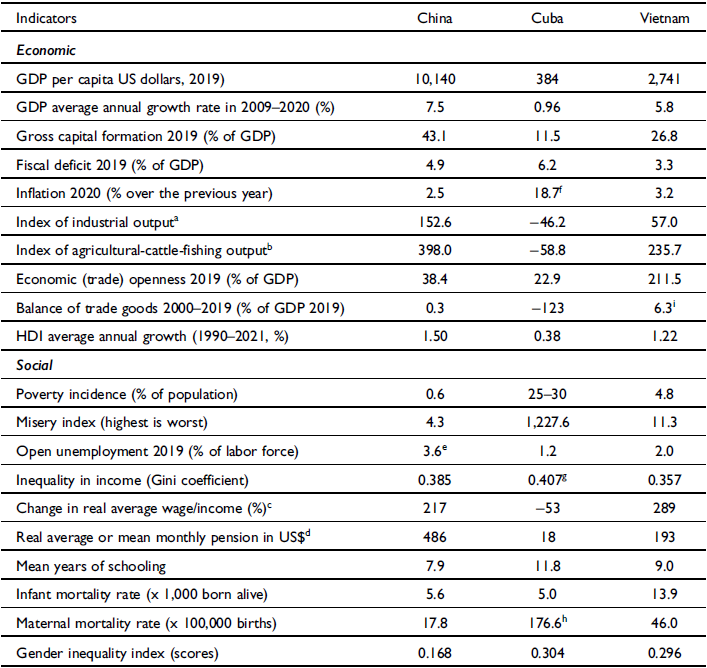
The performance of the two models and three countries was first assessed by twenty-seven indicators, fifteen economic and twelve social. But data were not available for some indicators for all countries or there were comparability problems, so a selection was done of the twenty available most relevant indicators (Table 3).
Economic-Social Performance Indicators in the Three Countries, circa 2019–2020 unless specified.
Note: Most data are from official statistics cited in the sources; some figures in the Table have been criticized by scholars but it is impossible in this article to explain all the related problems; the book devotes a long section to assess statistical reliability and specifically discusses many of those issues in all three countries.
a China 2010–2020, Cuba 1989–2020, Vietnam 2010–2020.
b China 2000–2019, Cuba 2014–2021, Vietnam 2016–2020; fishing and forestry are included in China and Vietnam and excluded in Cuba but both products are a tiny proportion of the total.
c China 2009–2019, Cuba 1989–2019, and Vietnam 2008–2018.
d China urban employee scheme in 2020; Cuba mean pension in 2020; Vietnam in the mandatory system in 2022.
e In 2020 decreased to 2.5%.
f In 2021 inflation rose to 400%.
g Estimate for 2016 by Espina, Reference Espina2022.
h 2021 (ONEI, 2022).
i 2010–2020 as percentage of GDP in 2020.
Sources: Based on China from NBSC, 2021a, 2021b, 2021c, 2022a, MOHRSS, 2020, Keqiang, Reference Keqiang2021; Cuba from ONEI, 2018, 2020, 2021, 2022, Espina, Reference Espina2022; Vietnam from GSO, 2021, IMF, 2021, Dinh, Reference Dinh2021; other data from UNDP, 2022; World Bank, 2020, 2021a; Hanke Reference Hanke2022.
Economic indicators
GDP per capita in US dollars in 2019 was calculated by converting the national currency into dollars based on the official exchange rate: US$10,140 in China, US$2,741 in Vietnam, and US$384 in Cuba. The UNDP (2020) substantially overestimates Cuba’s gross national income per capita at international US dollars (PPP; Mesa-Lago Reference Mesa-Lago2020b, Reference Mesa-Lago2022), so it was disregarded. Furthermore, China’s annual GDP at constant prices in 2009–2020 grew 7.5%; Vietnam’s, 5.8%; and Cuba’s, 0.96% (Figure 1). COVID-19 affected economic growth in all three countries, but in 2020, Vietnam grew 2.9% and China 2.3%. Cuba’s economy shrank by 10.9%.

Gross capital formation as a percentage of GDP shows an increasing trend in China and declining in Cuba: in 2019 it was 43.1% in China, 26.8% in Vietnam, and 11.5% in Cuba (down from 25% in 1989, on the eve of the crisis of the 1990s). The fiscal deficit as a percentage of GDP in 2019 was 3.3% in Vietnam, 4.9% in China, and 6.2% in Cuba; the latter rose to 18% in 2020 (ONEI 2021). Inflation in 2020 was 2.5% in China, 3.2% in Vietnam, and 18.7% in Cuba. As a result of monetary unification, inflation in Cuba in 2021 (measured as deflator of GDP) was officially reported as 401.6% (ONEI 2022), whereas in Vietnam it declined to 1.8% (GSO, 2022a).
With Cuba’s deindustrialization, the index of industrial output declined by 46.2 percentage points in 1989–2020—manufacturing’s contributions to GDP decreased at an annual rate of 12% in 2019–2021 (ONEI 2021, 2022). Conversely, China’s industrial index rose 157 points in 2010–2020 and Vietnam’s index rose 57 points in 2010–2019. Agriculture, cattle, and fishing output in China increased 398% in 2000–2019 and 235.7% in Vietnam in 2016–2020, whereas it decreased by 58.8% in Cuba in 2014–2021.Footnote 11
Economic openness (foreign trade divided by GDP) in 2019 was 211.5% in Vietnam, 38.4% in China, and 22.9% in Cuba (decreasing from 44% in 2013). There is no data on Cuba’s balance of payments, so we must rely on the balance of foreign trade (goods) as a percentage of GDP. In 2000–2019, China had a steady annual surplus accumulated in the period of US$44.2 billion equivalent to 0.3% of the GDP of 2019, whereas Cuba had a steady annual deficit accumulated of US$127 billion in 2000–2019, equivalent to 123% of the GDP in 2019. Vietnam’s trade balance was negative in 2000–2011 but became positive in 2012. By 2020 it had accumulated a surplus of US$17 billion, or 6.3% of GDP of 2020. While China’s and Vietnam’s governments have extensive links with their communities abroad, a significant source of direct foreign investment (particularly China with Hong Kong and Macau), Cuba has none.Footnote 12 Cuba does not publish any data on international reserves and only partial data on the external debt, so these variables could not be compared.Footnote 13
In 1990–2021, the Human Development Index (a combination of economic and social variables) rose by annual average of 1.50 points in China, 1.22 in Vietnam, and 0.38 in Cuba (Table 3).Footnote 14
Social indicators
The poverty incidence in China was 0.6% of the population in 2019 (declining from 97.5% in 1978), whereas it was 4.8% of households in Vietnam in 2020, decreasing from 60% in 1990 (World Bank and State Council of the PRC 2022; GSO 2021). Under the revolution, Cuba has not published statistics on poverty;Footnote 15 we also lack a figure for 1958 before the revolution. There is broad consensus, however, that revolutionary policies reduced poverty significantly until the end of the 1980s, but the severe crisis of the 1990s reversed the previous trend (Añé Reference Añé2007). The Cuban sociologist Espina (Reference Espina2008) estimated the poverty incidence in Havana at 20% in 2000 and roughly 25%–30% in 2016 (Espina Reference Espina2022), forty-one to fifty times that of China in 2019 and five to six times that of Vietnam.Footnote 16 Cuban poverty must have increased under the current economic crisis.
The misery index ranks 156 countries based in four indicators: unemployment plus inflation plus bank lending rate, minus real economic growth rate; in 2021 Cuba’s score was 1,227.6 (ranked worst at 156), whereas Vietnam’s score was 11.3 (ranked 99) and China’s score was 4.3 (ranked 143, above Switzerland). Cuba’s misery index, then, was 285 times worse than China and 108 times worse than Vietnam (Hanke Reference Hanke2022).
Open unemployment in 2019 was 1.2% in Cuba, 2% in Vietnam, and 3.6% in China. The Cuban rate was the smallest among the three countries and one of the lowest in the world, but underemployment in Cuba was estimated at 29.2% and increasing (Mesa-Lago, Reference Mesa-Lago2022), whereas in Vietnam it was 1.5% (no data available for China).
Another vacuum on Cuban data exists for income inequality. According to the UNDP (2020), income inequality in 2010–2018 was lower in Vietnam (18.1) than China (27.4), the respective Gini coefficients were 0.385 and 0.357. UNDP does not publish those two figures for Cuba. In 1989, Cuba was probably the most egalitarian society in Latin America and among many Eastern European socialist economies, but the structural reforms since 2007 have upturned that situation. Estimates of Cuba’s Gini coefficient showed an increase from 0.250 in 1989 to 0.407 in 2016, but excluding transactions in convertible pesos (CUC) and external remittances, so the real coefficient should have been higher (Espina Reference Espina2008, Reference Espina2020; Monreal Reference Monreal2018). Romanò and Barrera (Reference Romanò and Barrera2021) showed that Fidel’s timid reforms in the second half of the 1990s resulted in a sharp increase in inequality; thus, Raúl’s structural reforms have most likely expanded such inequality. In 2015, the income from most lucrative microbusinesses were 236 to 229 times the state’s mean salary (Mesa-Lago Reference Mesa-Lago2015; Bye Reference Bye2020); therefore, current inequality in Cuba should exceed that of China and Vietnam. Table 3 shows the Gini coefficient for China and Vietnam based on the Human Development Index and Espina’s calculation for Cuba in 2016, which underestimates the Gini for the reasons already explained.
The mean salary in the state sector, annually adjusted for inflation, decreased 53% in Cuba in 1989–2019, but the average salary rose 217% in China in 2009–2019 and 289% in Vietnam in 2008–2018 (equal periods for comparison are not available). Cuba’s decrease in purchasing power largely explains the deterioration in living standards since the 1990s crisis vis-à-vis the substantial improvement in the two Asian countries. The average/mean monthly pension per capita in 2020–2022 was US$486 in China, US$193 in Vietnam, and US$18 in Cuba, where it does not cover basic food needs.
Literacy rates in the three countries are virtually universal so were not used in the comparison. Means years of schooling are close: 11.8 in Cuba, 9.0 in Vietnam, and 8.2 in China. Infant mortality rates per thousand children born alive are similar in Cuba (5.0 in 2019, decreasing from 10.7 in 1990 but rising to 7.6 in 2021; ONEI 2022) and China (5.6, declining from 50.2% in 1991), but higher in Vietnam (13.9, shrinking from 32.6 in 1990). The maternal mortality rate (per hundred thousand births) was lowest in China (17.8, declining from 80 in 1991). In Cuba it was 176.6 in 2021 (the highest on record), rising from 32.6 in 1991. Vietnam’s was 46 in 2019, declining from 233 in 1990.
Health indicators for China and Vietnam have increased steadily since the early 1990s, while the Cuban population’s access to (and the quality of) public facilities and personnel have severely deteriorated. Access has declined because of the exportation of physicians and nurses to foreign countries (e.g., half of the country’s primary-care doctors), which is the first source of hard currency for Cuba. Services worsened during the crisis of the 1990s, and despite a partial upturn, some indicators have not recovered. The current economic crisis and COVID-19 have contributed to the virtual collapse of the health system (Mesa-Lago and Díaz-Briquets Reference Mesa-Lago and Díaz-Briquets2021).
The gender inequality index among 189 countries is lowest in China (ranked 39), while Vietnam and Cuba are much higher and almost similar (ranked 65 and 67, respectively).Footnote 17
Ranking of the three countries based on the twenty selected indicators
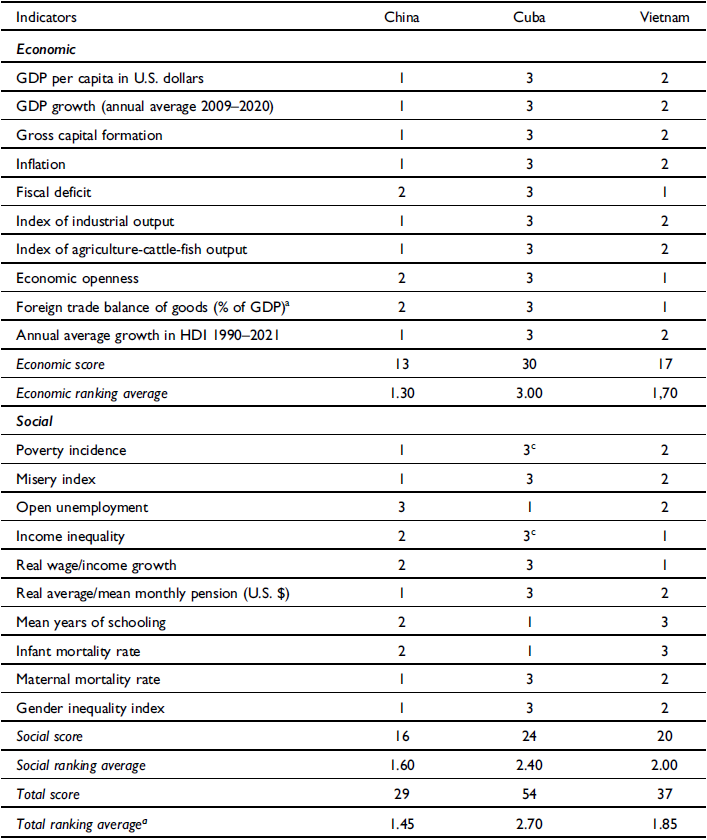
From Table 3 we selected the most relevant and comparable ten economic indicators and ten social indicators to elaborate a ranking of such indicators for Table 4. In eleven indicators, the higher the number, the better; in nine indicators, the lower the number, the better (inflation, fiscal deficit, poverty incidence, income inequality, gender inequality index, open unemployment, misery index, infant mortality rate, and maternal mortality rate).
Ranking of the Three Countries based on 20 Economic-Social Indicators, circa 2019–2020 b
a A trade surplus is positive while a deficit is negative.
b The lower the number the better the situation; total scores in the 20 indicators were divided by 20 to obtain the average.
c No official figure on this indicator, it is based on a Cuban expert estimate and the analysis in the text.
Source: Based on Table 3 and analysis in the text.
Total scores (the lower score the better) are 29 in China, 37 in Vietnam, and 54 in Cuba, and the average rankings of the indicators are 1.45, 1.85, and 2.70, respectively. China is first, followed by Vietnam, with Cuba lagging behind. The maximum difference in the ranking is 2 points; the distance between Cuba and China is 1.25 points and from Vietnam 0.85 points. There are only 0.40 points between China and Vietnam. Cuba ranked third on all economic indicators, whereas on the ten social indicators it ranked third on seven and first on three; these indicators were open unemployment (but with a very high underemployment rate), infant mortality (but showing an increasing trend, the opposite of China and Vietnam), and years of schooling (fairly similar in the three countries). In averaging social indicators, Cuba performed a little better than in the economic indicators with a shorter gap vis-à-vis the other two countries. China ranked first on twelve indicators, second on seven and third on one, whereas Vietnam ranked second on thirteen indicators, first on five and third on two. The two Asian countries performed much better on economic than on social indicators but still well ahead of Cuba.
Analysis of some methodological problems
The comparisons face some methodological problems. First is the lack of Cuban official statistics on poverty incidence and Gini coefficient; these indicators were analyzed in the text, and scholars’ estimates were provided for the ranking. Another missing indicator was underemployment in China, which led to its elimination from the comparison.
Second is the need for better standardization in periods of comparison. Of the twenty indicators, fifteen relate to the performance in the most recent available year, whereas only five refer to performance in a time period (annual average Human Development Index growth; industrial output growth; agricultural, cattle, and fish output growth; foreign trade balance of goods; and real wage growth). Ideally, we would have compared all twenty indicators within a particular time period, the year the model began and the most recent year, but this was not possible with the different starting years of the two models in the three countries and the lack of comparable data on the starting point. Nevertheless, the comparisons show consistent orders in the three countries in the twenty key economic-social indicators, allowing for a fair average ranking among them.
Third, because there are only three countries, the ranking range is quite narrow: from 1 to 3 (from best to worst). The ideal would have been to include more countries, but that was not feasible because, after the collapse of the Soviet Union and the Eastern European countries, there are very few socialist economies left in the world. Laos that follows the socialist market and North Korea that adheres to the centrally planned model would have been good candidates, but there is little data available on the former and virtually none on the latter.
Fourth, the ranking does not properly measure relative distance among the three countries, but scores are given in all rankings, which better detect said distance in most indicators. In a couple of them, the three countries have relatively close scores; for example, in infant mortality, the distance between China and Cuba is only 0.6 percentage points. To cope with this problem, a more sophisticated ranking was elaborated (see my forthcoming book) on the basis of standardized scales, which measure the space among each indicator, comparing unusualness in a batch. The results were (the higher score the better) China (0.38), followed by Vietnam (0.28), and Cuba is third (–0.65). So, the ranking is the same, but space between Cuba and the two Asian countries, as well as between them, are slightly reduced. Another snag is that each indicator has the same weight for calculating the ranking. Ideally, a weight should be assigned, but this would require a level of subjectivity (to determine which indicator is more important than other and by how many points).
Fifth, it cannot be assumed that the performance of the three countries is the exclusive result of the model itself or its policies, as factors outside the system might play a role in the outcome, such as differences in endowment and development. An important factor is the sheer size of China (and to a lesser extent Vietnam), but it was noted that several small countries, such as Cuba, are among the most developed in the world despite their size. In addition, Vietnam has the highest oil output per capita (0.23 tons per capita), followed by Cuba (0.19 tons) and China (0.01 tons); Vietnam is a net oil exporter whereas China and Cuba are net oil importers. A compensatory factor is that the Soviet Union and Venezuela supplied oil to Cuba above its needs and under generous terms. A second compensatory factor is that, before its revolution, Cuba enjoyed substantially higher economic-social development than China and Vietnam. The most important factor is exogenous: the action of external powers (in a positive or negative sense) on the economies of the three countries. China and Vietnam have received significant FDI (including from the United States), while Cuba has been under US embargo since 1961. A third compensatory factor is that Cuba received huge, virtually free economic aid from the Soviet Union in 1960–1990 (the largest granted by the Soviets to any partners), but that aid ended in the early 1990s, when the socialist camp collapsed, and the US embargo further intensified under the Trump administration. And yet Cuba enjoyed an even more generous aid from Venezuela until that country entered a grave economic- social crisis since 2017, which reduced the aid but did not stop it completely. So, this leaves a five-year period in which Cuba was most vulnerable: 2018–2022, when the embargo probably was most harmful. It can be argued, however, that if Cuba had followed the Sino-Vietnamese model of socialist market, it could have increased its domestic production and generate a surplus to export, reducing the adverse impacts of any external factors. In summary, these nonsystemic factors cannot be quantified or controlled to measure their potential impact on performance in the three countries, but the most important have been assessed herein.
Conclusions and future research agenda
The indicators and analysis in this article show that the two models and the three countries share more similarities than differences, and the latter are not an insurmountable barrier for the comparison; Cuba’s model five key policies systematically ranked third in implementation and results; and the socialist-market model of China and Vietnam has had a better economic-social performance that the Cuban model of predominant central plan and modest structural economic reforms, despite the fact that the two Asian countries started with a much lower development than Cuba.
My forthcoming book explores the reasons Cuba did not follow the Sino-Vietnamese path, despite its success and the fact that the communist party remains in full control in both countries. Political rather than economic causes likely explain this. The delegation of economic power from the state to the private sector is perceived as a serious danger: The armed forces, through the military-economic conglomerate GAESA, which owns and controls all the tourist facilities in Cuba, as well as many other large enterprises, is afraid of its power eroding. Fidel Castro systematically objected to the Chinese model because of its delegation of economic power. Raúl Castro visited China several times and publicly acknowledged its progress, but after assuming the presidency, he cautiously said that Cuba did not want to copy a foreign economic model again, but he did not ignore the experiences of other countries and learned from them. Raúl probably wanted to follow the Sino-Vietnamese model, but he lacked the absolute control that Fidel enjoyed and had to share power with other leaders who stubbornly opposed that model, which largely explains why the Cuban reforms have been partial and slow, with ups and downs and interruptions, and also ineffective.
Relying on the successful Sino-Vietnamese policies and performance, the following recommendations for Cuba are proposed. First, transfer dominant state ownership of the means of production to small and medium enterprises (SMEs) as well as private farmers, with proper legal guarantees; make all cooperatives fully independent from the state. The government can keep control over the most vital enterprises for the nation and play a regulatory role, but with flexibility and providing incentives to key production lines. It can also transform the central plan into a decentralized plan as a guide for development.
Second, give priority to agrarian reform based on three golden rules: all producers are free to plant what they want, sell to whom they want, and set prices according to supply and demand. Cuba should reorient investment from tourism to agriculture—any investment in tourism should focus on improving quality of food and services and developing entertainment facilities, all with fundamental SME involvement.
Third, expand the nonstate sector in industry (save for the most strategic industries), and make FDI more attractive by allowing foreign investors (including by the diaspora) to directly hire workers and pay their wages. Allow SMEs and the rest of the nonstate sector to import and export without government intermediaries; the state should set a reasonable regulatory legal framework for investment and labor protection.
Fourth, authorize university professionals to work in their fields and compete with state services; eliminate redundant employment in the state sector, transferring the surplus to the expanding non-state sector; introduce unemployment insurance.
Fifth, a new monetary and exchange-rate unification (eliminating the current fixed exchange of the peso and allowing it to float) must be preceded by the needed structural reforms. Shut down enterprises with losses (stop the current transition period), and transfer unemployed workers from terminated state enterprises to nonstate jobs. As in Vietnam, the previous reforms would facilitate negotiations with the United States and the European Union, opening the way to the elimination of the embargo and Cuba’s membership in the International Monetary Fund, the World Bank, and the Inter-American Development Bank.
The future research agenda should gather statistics that cover longer periods in the three countries and at the start of their revolutions and their reforms; find homologous quantitative data in key indicators concerning policy results; fill gaps on key indicators of performance especially in Cuba (poverty incidence, Gini coefficient); explore ways to assign objective weights to the indicators of socioeconomic performance and to better measure the distance in the rankings; and design techniques to better assess the impact of nonsystemic factors on performance.


 Open access

