

Introduction
Broad support for higher public spending on education has been widely demonstrated (Busemeyer, Garritzmann et al., Reference Busemeyer, Garritzmann and Neimanns2018; Busemeyer and Garritzmann, Reference Busemeyer and Garritzmann2017; Neimanns et al., Reference Neimanns, Busemeyer and Garritzmann2018). Such diffuse support is epitomised by Ansell’s well–known phrase that education is an ‘archetypical crowd–pleaser’ (Reference Ansell2010, p. 136). However, spending preferences may change when citizens face trade–offs across welfare domains. What if higher investment in education comes at the expense of retrenchment in other domains? How would individuals with varying interests in distinct welfare domains respond to such trade-offs?
In this paper, we tackle preferences towards public spending on education in a multi-dimensional setup.Footnote 1 Given that individuals often find themselves in situations where they must make trade-offs, we have enquired whether a trade-off between education and other welfare domains, namely healthcare, pensions and unemployment benefits, would diminish support for education spending. We have sought to explore the support for education spending on the basis of a survey experiment undertaken in five Organisation for Economic Co-operation and Development (OECD) member countries, namely Greece, Italy, Mexico, Spain and Turkey. Education is a prevalent issue in all five cases linked to underinvestment, poor learning outcomes and skill deficiencies. We present results from an original survey conducted in 2023, where respondents were randomly assigned to one of four experimental conditions. We tested the effects of age, gender, income, ideology and labour market positioning on attitudes towards education spending in the presence of trade-offs. In line with the literature, we found robust support for public education spending. More importantly, we found that this support diminished when trade-offs are introduced.
Support for education spending is contingent upon the nature of the trade-offs and their impact on distinct stakeholder groups. Our findings are broadly aligned with the ‘narrow self-interest’ argument. When trade-offs linked to cuts in other welfare domains were introduced, support for education spending diminished notably. Our contribution lies in fleshing out these nuances where stakeholders of specific domains respond to our experimental conditions. Additionally, we found that labour-market positioning and income are important factors in shaping preferences when facing trade-offs linked to higher education spending.
The impact of political ideology on preferences appears tenuous at best when the trade-offs are introduced. Unlike what other studies suggest (e.g. Busemeyer, Garritzmann et al., Reference Busemeyer, Garritzmann and Neimanns2018; Calzada and del Pino, Reference Calzada and Del Pino2016; Fernández–Albertos and Kuo, Reference Fernández-Albertos and Kuo2016; Rueda and Stegmueller, Reference Rueda and Stegmueller2019), our findings demonstrate that left–wing ideology is not linked with an increased likelihood to support higher education spending when individuals face a trade-off. However, we concur with studies that demonstrate ideology’s dissipating influence in the presence of trade-offs regarding welfare attitudes (Jensen and Petersen, Reference Jensen and Petersen2017) and education attitudes, more specifically the studies of Busemeyer et al. (Reference Busemeyer and Lober2020) and Busemeyer and Lober (Reference Busemeyer and Lober2020). Our analytical framing based on stakeholders speaks to the literature investigating the roles of distinct ‘risk profiles’ vis–à–vis social programs and consequent policy implications (Jensen, Reference Jensen2012). It is also linked to the literature on diverging and converging preferences of such profiles when they are confronted by external shocks, tax constraints and/or welfare recalibration (Bremer and Burgisser, Reference Bremer and Bürgisser2023; Häusermann et al., Reference Häusermann, Kurer and Traber2019; Naumann, Reference Naumann2018).
By focusing on trade-offs between education and other welfare domains, we seek to contribute to the literature on welfare state recalibration and preferences in education (Busemeyer et al., Reference Busemeyer, Lergetporer and Woessmann2018; Bremer and Burgisser, Reference Bremer and Bürgisser2023; Häusermann et al., Reference Häusermann, Kurer and Traber2019; Naumann, Reference Naumann2018; Jensen and Petersen, Reference Jensen and Petersen2017). This literature primarily draws on Western Europe and Scandinavia. We provide evidence on education attitudes and welfare trade-offs from countries beyond this small subset by focusing on three Southern European countries (Greece, Italy and Spain) and two upper–middle–income countries (Mexico and Turkey), all of which are OECD members. These five cases share specific characteristics, including relatively lower public spending and higher private spending on education and mediocre education outcomes compared with the OECD averages – and reflected in public debate – as discussed in the case selection. They similarly share the challenges of high dropout rates and skill deficiencies. Finally, they have characteristics of Mediterranean or Southern European welfare states, although Mexico is geographically distant (Ferrera, Reference Ferrera1996; Gal, Reference Gal2010). On the basis of these traits, we expect that increasing education spending would be more of a ‘crowd–pleaser’ (Ansell, Reference Ansell2010, p. 136) in these countries than in those in Western and Northern Europe.
Public spending, trade-offs and preferences
Literature on welfare and education attitudes finds strong citizen support for public investment in education (Ansell, Reference Ansell2010; Busemeyer et al., Reference Busemeyer, Lergetporer and Woessmann2018; Busemeyer, Garritzmann et al., 2018; Neimanns et al., Reference Neimanns, Busemeyer and Garritzmann2018). Scrutinising the priorities of individuals across policy areas, several studies on welfare recalibration investigate the effects of multidimensional trade-offs across welfare domains, delineating individuals’ priorities across distinct domains (Bonoli, Reference Bonoli2007; Bonoli and Häusermann, Reference Bonoli and Häusermann2009; Bremer and Burgisser, Reference Bremer and Bürgisser2023; Naumann Reference Naumann2018).
Häusermann et al. (Reference Häusermann, Kurer and Traber2019) demonstrate a strong opposition against the retrenchment of public spending on education, as its benefits cut across diverse social groups. Analysing the public’s multidimensional priorities, Bremer and Bürgisser (Reference Bremer and Bürgisser2023) also find high support for education vis à vis pensions, passive and active labour market policies, childcare and child benefits, pointing to a diffuse support coalition behind education spending. Yet, the broad support for social investment partially collapses when trade-offs are introduced, and self–interest is central to forming multidimensional priorities in the face of trade-offs. Likewise, Neimanns et al. (Reference Neimanns, Busemeyer and Garritzmann2018) find that individuals are more likely to support policies that enhance their or their families’ material self–interests. This strand of the literature suggests that specific policy constituencies have more significant support for higher spending on the policy domains from which they are the direct beneficiaries (and are more sensitive than others to the cuts in the domains from which they directly benefit).
Studies on redistributive preferences highlight education as a prioritised policy domain. Drawing on a survey in the USA, Macchia and Ariely (Reference Macchia and Ariely2021) show that people across different demographic groups prefer more equal distributions in education and healthcare. However, they accept higher levels of wealth inequality. Baslevent and Kirmanoglu (Reference Baslevent and Kirmanoglu2011) argue that self–interest determines redistributive preferences in welfare provision in Europe.
The narrow self–interest perspective stems from the political economy models, which assume that individuals primarily care about economic well–being (Persson et al., Reference Persson, Roland and Tabellini2000). Hence, individuals’ welfare attitudes are extensions of self–interest linked to their existing labour market conditions and risks associated with those (Fernández and Kuo, Reference Fernández-Albertos and Kuo2016; Rehm, Reference Rehm2016). Margalit (Reference Margalit2013) demonstrates that personal experience of economic hardship linked to job loss has a significant (albeit transient) effect on increasing support for welfare spending across the ideological divide.
Drawing on the survey results without experimental conditions, Busemeyer, Garritzmann et al. (Reference Busemeyer, Garritzmann and Neimanns2018) find sustained support for higher public investment in education, even when the respondents are forced to choose between education and other welfare domains. However, we do not expect maintained support for education spending notwithstanding the trade-offs. Concurring with Busemeyer and Lober (Reference Busemeyer and Lober2020), whose research expands upon diminishing support in the face of trade-offs, we hypothesise that such trade-offs would affect individuals’ preferences, curtailing their support for higher education spending.
H1: Support for higher public spending on education diminishes when it is attached to a trade-off (decreasing spending on other welfare domains).
Regarding the role of income as a strong predictor of individuals’ welfare attitudes, several studies indicate that income and support for welfare states in general and public spending in a specific welfare domain are inversely associated (Busemeyer and Garritzmann, Reference Busemeyer and Garritzmann2017; Svallfors et al., Reference Svallfors, Kulin and Schnabel2012). Lower–income individuals have stronger preferences for higher public spending on different policy domains in which unemployment benefits are particularly highlighted (Kumlin et al., Reference Kumlin, Goerres, Spies, Béland, Morgan, Obinger and Pierson2021; Rueda and Stegmuller, Reference Rueda and Stegmueller2019; Soroka and Wlezien, Reference Soroka and Wlezien2010; Svallfors et al., Reference Svallfors, Kulin and Schnabel2012). Yet, other studies show that individuals with higher social status may also support welfare spending (Baslevent & Kirmanoglu, Reference Baslevent and Kirmanoglu2011). Jensen (Reference Jensen2012) distinguishes between labour–market-related and life–course–related social policies (healthcare, pensions and maternity) as risk profiles that shape respective attitudes.
Jensen and Petersen (Reference Jensen and Petersen2017, p. 69) maintain that ‘health care and unemployment are similar in their sociodemographic risk profiles’, i.e., individuals with lower income levels run much greater health risks than others. Elo (Reference Elo2009) demonstrates the impact of social class on health and mortality outcomes. Similarly, we conjecture that low–income groups would prioritise public spending on healthcare over education; hence, such prioritisation would crystallise when these groups face a trade-off.
H2: Low-income individuals are more sensitive to the trade-off of public spending on education versus healthcare than high-income individuals. Therefore, support for higher education spending diminishes when this increase comes at the expense of health spending.
Tackling the psychology of social policy attitudes, Jensen and Petersen (Reference Jensen and Petersen2017) demonstrate that attitudes on healthcare are strikingly different from those on unemployment protection, as they are much more psychologically constrained. Accordingly, they assert that healthcare spending has broad–based, popular support for government spending, as individuals across ideological divides and national cultures are psychologically biased towards perceiving the sick as more deserving than the unemployed.
Broadly situated in the narrow self–interest perspective, the ‘life cycle’ view underscores the preferences contingent upon individuals’ ages and how they perceive risks associated with various welfare domains. Accordingly, age strongly affects welfare preferences, and resulting intergenerational conflict may entail notable policy implications (Brunner and Johnson, Reference Brunner and Johnson2016; Busemeyer and Lober, Reference Busemeyer and Lober2020; Sørensen, Reference Sørensen2013; Vallée–Dubois, Reference Vallée-Dubois2023). Therefore, younger individuals would prioritise public spending on education, whereas older people would support higher spending on pensions and healthcare. Cattaneo and Wolter (Reference Cattaneo and Wolter2009) show that younger people, especially parents with children in school, are more likely to support higher education spending than older people. Similarly, Busemeyer and Lober (Reference Busemeyer and Lober2020) indicate that older people are less likely to support higher education spending when facing a pension cutback. Brunner and Johnson (Reference Brunner and Johnson2016) argue that older individuals are markedly less supportive of higher education funding than younger ones. Vallée–Dubois (Reference Vallée-Dubois2023) shows that seniors favour the status quo regarding public spending slightly more than younger adults do, and support for education spending decreases notably over one’s life cycle.
Notwithstanding the dominant theoretical framework of the narrow self–interest perspective in welfare attitudes, age–based self–interest as motivation is theoretically and empirically criticised for over–simplification (Busemeyer et al., Reference Busemeyer, Goerres and Weschle2009; Street & Cossman Reference Street and Cossman2006; Tepe & Vanhuysse Reference Tepe and Vanhuysse2009). Analysing longitudinal survey data from 22 countries, Sørensen (Reference Sørensen2013) suggests that individuals’ spending preferences change only moderately over their life cycle, and the main driver of variation in welfare attitudes is cross–national, contextual and institutional differences in welfare regimes. Blekesaune and Quadagno (Reference Blekesaune and Quadagno2003) argue that support for age–specific programs varies only slightly by age, and older people are as supportive of labour market policies, such as unemployment benefits, as young adults. In line with this literature, we formulate our third hypothesis:
H3: Older individuals would be more sensitive to the trade-off between public spending on education versus pensions compared with younger individuals, so their support for higher education spending would decrease when this increase comes at the expense of spending on pensions.
Individuals’ risk perceptions are important indicators of their respective welfare attitudes (Rehm, Reference Rehm2016). The labour market position of individuals, especially unemployment, is closely associated with supporting redistributive policies (Margalit, Reference Margalit2013). Expectedly, the predictive power of labour market positioning in individuals’ welfare attitudes increases during economic hardship and crises. Studies drawing on the impact of the Great Recession highlight the pronounced preferences of unemployed individuals and those with precarious employment (Fernández and Kuo, Reference Fernández-Albertos and Kuo2016). Naumann et al. (Reference Naumann, Buss and Bähr2016) also highlight the experience of unemployment as an important determinant of individual welfare preferences. Investigating redistributive preferences in 41 developing countries, Haggard et al. (Reference Haggard, Kaufman and Long2013) reveal the importance of occupation regarding redistributive preferences of low–income groups. Hence, we present the following hypothesis:
H4: Unemployed individuals would be more sensitive to the trade-off between public spending on education versus unemployment benefits compared with others. Thus, their support for higher education spending would diminish when this increase comes at the expense of spending on unemployment benefits.
We use ideology and gender as control variables. The literature predominantly argues that left–wing individuals prefer higher public spending on welfare, including education, than their right–wing counterparts. This is linked to their stances towards the role of the state in the economy and its tax implications (Busemeyer et al., Reference Neimanns, Busemeyer and Garritzmann2018; Garritzmann, Reference Garritzmann2015; Calzada and del Pino, Reference Calzada and Del Pino2016; Fernández–Albertos and Kuo, Reference Fernández-Albertos and Kuo2016; Rueda and Stegmueller, Reference Rueda and Stegmueller2019). Nonetheless, a growing strand of the literature reveals new findings in this respect. Busemeyer and Lober (Reference Busemeyer and Lober2020, p. 439) state that ‘when benefits for distinct groups of recipients are traded against each other, left–wing and right–wing people no longer differ significantly in their preferences.’
Other studies show that some welfare domains, such as unemployment protection and social assistance, are more ‘ideologised’ than others (Jensen, Reference Jensen2012; Van Oorschot et al., Reference Van Oorschot, Laenen, Roosma, Meuleman, Nelson, Nieuwenhuis and Yerkes2022). Jensen (Reference Jensen2012) shows the convergence between left- and right–wing governments’ provision of life–course–related social policies (such as healthcare, pensions and maternity) as opposed to unemployment protection to meet the median voter’s demands. This view assumes that the median voter may be exposed to life–course–related risks while low–income individuals are markedly more exposed to labour–market risks. Hence, they would demand unemployment protection. Jensen and Petersen (Reference Jensen and Petersen2017, p. 80) maintain that ‘the influence of ideology is confined to unemployment.’ In contrast, healthcare is not influenced by ideology, as ‘universal nature of the cognitive constraints on perceptions of the uncontrollable nature of health risks could leave little room for ideological conflict.’ Jensen and Naumann (Reference Jensen and Naumann2016) also show that the link between right–leaning ideology and opposition to welfare spending gets much weaker when it comes to healthcare.
Moreover, Branham and Jessee (Reference Branham and Jessee2017) point out limited polarisation in preferences towards public spending across ideological positions. Bonica (Reference Bonica2015) asserts that individuals’ self–reported ideologies and budgetary preferences are strongly correlated solely for military but not welfare spending. Similarly, Busemeyer et al. (Reference Busemeyer, Garritzmann and Neimanns2020) show the relative convergent support of left- and right–wing individuals for higher education spending. Education and pensions tend to cause less discrepancy across the ideological spectrum (Feldman and Johnson, Reference Feldman and Johnston2014; Neimanns, Reference Neimanns, Busemeyer and Garritzmann2018)
Several studies have found that women support higher levels of government spending in a wide range of welfare domains than men. Women in social democratic welfare regimes are more supportive of welfare programs than men (Svallfors, Reference Svallfors, Kulin and Schnabel2012).
Case selection
In our research focus (Greece, Italy, Mexico, Spain and Turkey), there is underinvestment in public education linked to austerity and political choices, resulting in poor learning outcomes and skill deficiencies. While the OECD average of public spending to GDP (primary to tertiary levels) is 4.3 per cent, it is between 3.3 per cent and 4 per cent in our five cases.Footnote 2 Private (household) spending on primary education to GDP is 51 per cent higher than the OECD average of 0.101 per cent.Footnote 3 Private spending is, on average, 51 per cent higher than the OECD average. Austerity programs have been implemented in Greece, Italy and Spain since the Great Recession, which has led to declining public investment in education. Underinvestment persists as a broad trend, generating negative feedback effects. Mexico and Turkey suffered persistent limited public investment in education. Although these two countries recently underwent major welfare reforms, education has not benefited from expansion, except in the early 2010s in Turkey.Footnote 4 Both countries experienced long episodes of austerity juxtaposed with a partial expansion of the welfare state in distinct dimensions (Arza et al., Reference Arza, Castiglioni, Martínez-Franzoni, Niedzwiecki, Pribble and Sánchez-Ancochea2022; Hunter, Reference Hunter, Kapiszewski, Levitsky and Yashar2021; Özel and Yildirim, Reference Özel and Yildirim2019).
The Programme for International Student Assessment (PISA) scores of the selected countries in mathematics and science are lower or close to the OECD average (Table 1),Footnote 5 including middle-income countries (two from our sample and also Colombia and Chile, for instance) with poor PISA scores. This implies that Greece, Italy and Spain perform mediocrely compared with their peers (high-income countries).
PISA scores (2018; 2022)

Source: For 2022: https://shorturl.at/KTnrA, accessed on 25 July 07/2024. For 2018: https://shorturl.at/cOABU, accessed on 25/07/2024.
Their share of high levels of youth unemployment (except Mexico) is a common challenge, often linked to poor quality of and underinvestment in education, in addition to external shocks such as immigration. In 2023, the youth unemployment rate was 26.7 per cent in Greece, 22.7 per cent in Italy, 5.9 per cent in Mexico, 28.9 per cent in Spain and 17.5 per cent in Turkey.Footnote 6 Accordingly, there is likely a high demand for public investment in education.
Dominant welfare arrangements in these cases are amalgams of the Southern European–Mediterranean and conservative welfare regimes (Esping-Andersen, Reference Esping-Andersen1990; Hall and Soskice, Reference Hall and Soskice2001; Ferrera, Reference Ferrera1996; Moreno, Reference Moreno2002). Gal (Reference Gal2010) indicates that an extended family of Mediterranean welfare regimes is characterised by the ineffectiveness of social protection and inequality, universal healthcare, a strong private market for healthcare and clientelism. Family’s prominent role as a welfare provider persists in all five cases to varying degrees. Modern welfare regimes’ respective maturity, composition and generosity differ across the cases. Without a doubt, the welfare regimes of the high–income European cases (particularly in Italy and Spain) are older and more extensive than others (Mexico and Turkey). This latter group showcases the recent rise of partial welfare states in middle–income countries, where social assistance programs have expanded drastically, in addition to healthcare benefits (Arza et al., Reference Arza, Castiglioni, Martínez-Franzoni, Niedzwiecki, Pribble and Sánchez-Ancochea2022; Hunter, Reference Hunter, Kapiszewski, Levitsky and Yashar2021; Özel and Yildirim, Reference Özel and Yildirim2019). Based on these traits, the likelihood of public education spending becoming a priority would be greater in these five countries than in Western Europe since the stakes are high and the need and gap are profound.
Data and method
This paper utilises an experiment in a twelve-minute, average online survey targeting adults in Greece, Italy, Mexico, Spain and Turkey. The survey was written in Spanish, Italian, Greek, Turkish and English for pre-registration purposes.Footnote 7
The web survey was conducted between 15 April and 9 June 2023. In Turkey, Spain and Greece, the fieldwork was completed before general elections to ensure that the responses reflected evaluations of current government spending. The surveys were carried out by NetquestFootnote 8 in Italy, Mexico and Spain and Purespectrum in Greece and Turkey. We employed random selection within each stratum and controlled for age, gender and education level. Respondents signed a consent form where the study was summarised, and they received “points” that could be converted into cash or donations to non-profit organisations involved in social causes. The pre-analysis plan was registered on the Open Science Framework (OSF) on 14 April 2023.
When it came to determining the experiment’s analytical power, we lacked pilot results to calculate the mean and standard deviation. Therefore, we assumed internal validity (α = 0.05 and analytical power = 80 per cent) for an initial sample of 5,000 interviewees, or 1,000 per country. For each country, we divided the sample into a control and three treatment groups of 250 interviewees. We do not claim the generalisability of the results to voting-age populations in these countries. Our focus is on the experimental results that have high internal validity.
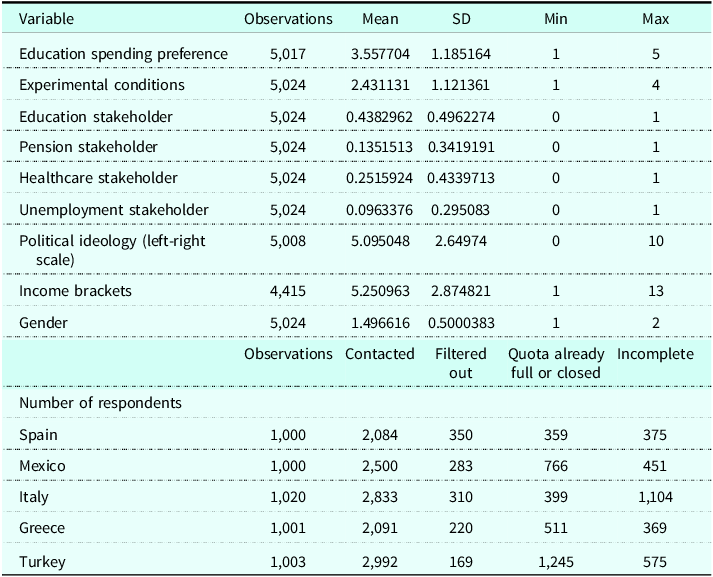
Table 2 presents descriptive results, and Table 3 compares the sample distribution with other face-to-face surveys. In regard to income, ideological position, age and gender distribution, our country samples greatly approximate other survey studies.
Summary statistics

Note: SD = standard deviation.
Comparison of the article’s online samples and other surveys

Sources: World Value Survey (WVS), Comparative Study of Electoral Systems (CSES), and International Social Survey Program (ISSP).
Note: SP = Spain; GR = Greece; IT = Italy; MX = Mexico; TR = Turkey
a ISSP 2020.
b WVS Wave 7.
c CSES Module 5.
Some minor differences exist between our sample and other surveys (Table 3).Footnote 9 First, our sample does not display a systemic difference in ideology, except for a little greater proportion of left-wing respondents in Turkey and a few more right-wingers in Greece. Second, our thirteen-point scale for the income variable, when rescaled to eleven points, as in International Social Survey Program (ISSP) or World Value Survey (WVS) surveys, gives a slightly higher proportion of lower-income respondents. Furthermore, our sample is somewhat younger than the mean age in these five countries. The difference between other surveys and ours is 6.5 years on average. Finally, there is no systemic difference in gender distribution. In Spain and Greece, our sample consists of fewer women compared with other surveys conducted in these two countries. However, no other observable difference exists in Mexico, Italy and Turkey.
Additionally, our online surveys had attention checks to reduce respondents’ likelihood of randomly answering the questions. In Spain (7 + 190), Mexico (28 + 190) and Italy (4 + 249), respondents were filtered out when they failed either the company’s attention check (first figure) or ours (second figure). In addition, 96 Greek and 233 Turkish respondents failed our attention check.
The experiment’s outcome measures the participants’ preferences for public spending on education (see Appendix 1 [A1] for the wording of the experiment question), which we assessed using a five-point ordinal scale. The lowest score of 1 reflects that the respondent supports reduced public spending on education. The highest score of 5 indicates a preference for ‘much more’ education spending than the current level. The treatment – the trade-off between public expenditure on education and pensions, healthcare and unemployment benefits – was randomly assigned to the respondents, and the experiment was placed randomly within the survey.
We included age, gender, educational attainment, income, country and ideology as covariates in the regression models to check for the robustness of the treatments (Busemeyer & Garritzmann, Reference Busemeyer and Garritzmann2017; Busemeyer & Lober, Reference Busemeyer and Lober2020; Neimanns et al., Reference Neimanns, Busemeyer and Garritzmann2018). We codified the variables 0 = female, 1 = male and 2 = other, as well as age as a continuous variable and nominal country values. We recoded the national educational levels into four categories: 1 = primary and/or no formal education; 2 = secondary education including high school in academic and vocational schools; 3 = professional education, including tertiary vocational education; and 4 = academic education, including bachelor’s and post–graduate degrees. The survey questions on income and ideology are shown in Appendix A1, A2 and A3.
Our initial analyses involved two-means t-tests to compare the control group with each experimental group. Furthermore, we conducted multivariate regressions and ordinal logistic regressions using each experimental group as a dummy variable to combine all the findings and compare their effects to the control group. We anticipated negative coefficients for all these baseline results. In this experiment, not including trade-offs was expected to enhance people’s agreement with the statement. In Appendix 2, we provide alternative specifications and robustness checks.
To operationalise stakeholder groups, we created several sub–samples based on socio–demographic variables. Our strategy resembles the ‘specific policy constituencies’ of Neimanns et al. (Reference Neimanns, Busemeyer and Garritzmann2018) and the ‘risk profiles’ used by Jensen (Reference Jensen2012) and Jensen and Petersen (Reference Jensen and Petersen2017). We assumed that respondents with school children and students (education stakeholders) would be less affected by the trade-off since they would likely prefer education spending anyway. However, we also anticipated this effect to be moderated by the parents’ age because older parents with teenagers at school might think about retirement. The trade-off experiment might also be moderated among retired respondents and those approaching their retirement age, whom we call ‘pension stakeholders.’Footnote 10
For healthcare, we anticipated age and income to be relevant, as older individuals and individuals in the low–income bracket might be exposed to greater health risks than the others (i.e., ‘healthcare stakeholders’), and the income bracket might indicate public healthcare demands against private healthcare spending.Footnote 11 As Jensen and Petersen (Reference Jensen and Petersen2017, p. 69) sustain, ‘health care and unemployment are quite similar in their sociodemographic risk profiles,’ i.e., individuals with lower–income levels run greater health risks than others. For the healthcare stakeholder group, we included all respondents above 60 years of age and those below the twentieth percentile of the income distribution.
For unemployment benefits, we considered currently unemployed individuals, those looking for their first jobs and those indicating their incapacity to work to be ‘unemployment stakeholders.’ This stakeholder group is more exposed to labour market risks than the others and, hence, more sensitive to the trade-off of higher public spending on education at the expense of unemployment benefits.
Findings
As expected, we found strong support for higher public spending on education in all five cases without the trade-offs. Only 3.3 per cent average of our control group disagreed with higher education spending. However, when the survey participants were provided with a trade-off in one of our three experimental conditions, the proportion disagreeing with greater spending increased more than seven times to 25.6 per cent (from 14.75 per cent in Turkey – the lowest – to 33.7 per cent in Italy – the highest). Figure 1 presents the percentage of respondents across the control group and three treatment groups in all five countries.
Preferences on government spending on education.
Source: Cross-country survey experiments conducted by the authors.

Although we do not focus on country-specific analyses, Fig. 1 demonstrates variation across the five countries. Support for higher education spending diminished notably when respondents were reminded of the associated trade-off. In Italy and Spain, a neutral position on the spending question became the modal category.
Evaluating the experimental condition’s effect in detail, Table 4 presents results from three models that estimate the experiment’s impact and control it with country-level effects (Model 2) or ideology and income (Model 3). Further robustness checks collating (strongly) disagree, neutral and (strongly) agree as a three-point ordinal scale are presented in Table A2.1 Appendix 2. Substantive results remained the same with this alternative construction of the dependent variable.
Experimental findings and alternative correlates of education spending support

*p < 0.05.
**p < 0.01.
***p < 0.001.
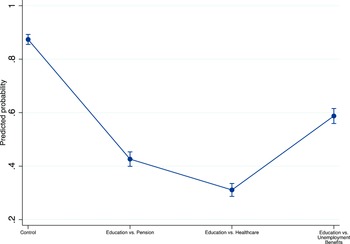
Results from Table 4 indicate that preferences in education spending depended on specific criteria, and respondents had specific ordered preferences. When presented in an experimental trade-off setting, respondents’ likelihood of preferring greater education spending diminished. Across all treatment groups, compared with the control group, respondents were less likely to support higher spending on education. Figure 2 plots the likelihood of agreeing with higher education spending preference across experimental categories after controlling for country effects, ideology and income (Model 3). It shows that healthcare spending was as important as education, as the predicted percentage of agreeing with higher spending and disagreeing with it were equal. In the healthcare spending trade-off treatment group, respondents were estimated to be 33 per cent likely to remain neutral when choosing between healthcare and education and equally likely (10.3 per cent) to either strongly support or oppose education spending vis-à-vis healthcare. The trade-off related to pension spending also indicates the positional nature of education spending.
Predicted likelihood of (fully) agreeing to increase education spending.
Source: Cross-country survey experiments conducted by the authors.

Our results suggest that education and healthcare are equally crucial with regard the respondents’ preferences in public spending, followed by pensions. Unemployment benefits diverged at this point. Although the trade-off between unemployment benefits and education diminished support for spending on the latter, it was less substantive than pension- or healthcare-related trade-offs in respondents’ preferences.
Two striking findings go against the prevalent arguments in the existing literature. First, ideology lost its predictive power in spending-related preferences when the respondents were presented with a trade-off of cuts in other domains. Second, women were not more likely to support additional public spending on education than men when facing such trade-offs.
Another finding (Models 2 and 3) concerns country-specific effects. Controlling for the experiment and other covariates, we estimated the probability of strongly agreeing with higher education spending to be 39.2 per cent in Turkey, 28.4 per cent in Mexico, 26 per cent in Greece and 20.1 per cent in Italy and Spain. Our analysis revealed that the support for higher public spending on education was stronger in Mexico and Turkey than in other countries. This is consistent with our initial assumptions regarding the depth of the need for and the gap in public spending.
We used Model 3 from Table 4 as our baseline for the four welfare domains to evaluate the stakeholder effects. We introduced interactions between the experimental condition and a dummy for relevant “stakeholder” groups to estimate whether being a stakeholder impacted our experiment (Table 5). To evaluate the substantive impacts of these findings, we plotted the predicted likelihoods of strongly agreeing and disagreeing with higher education spending for each stakeholder group (see the predicted probabilities in Fig. 3).
Stakeholder effect as mediation for the experiment

Note: Ordinal logistic regression, additional controls include country dummies, ideology and gender. Full model specifications are given in the Appendix.
*p < 0.05.
**p < 0.01.
***p < 0.001.
Stakeholder effect across experimental groups.
Source: Cross-country survey experiments conducted by the authors.

Model 4 (Table 5) and Panel A (Fig. 3) present interactions of the experimental effect and education stakeholder groups. Results show that this sub-sample was more likely to prefer higher education spending than other individuals when provided with a trade-off between education and healthcare or pension rates. One potential reason why this was not the case for unemployment benefits may be that a part of the education stakeholder sub-sample was students above 18 years of age. These individuals may also prefer potential unemployment benefits since they will join the labour market soon. To evaluate whether this is the case, we built an alternative education stakeholder group, excluding students and focusing only on parents with school-age children. The results of this alternative are reported in Appendix 2 (Tables A2.2 and A2.3). As suspected, parents were more likely to support higher education spending in the unemployment benefits treatment group than the rest of the sample.
Model 5 (Table 5) and Panel B (Fig. 3) consider pension stakeholders. When presented with a trade-off between spending on pensions and education, this sub-sample was less likely to support higher education spending than the rest. This effect did not spill over to other domains, such as healthcare or unemployment, which may not be relevant to pension stakeholders.
Model 6 (Table 5) and Panel 3 (Fig. 3) identify healthcare stakeholders. One potential concern in this construct is a spillover effect because 45 per cent of this stakeholder group also belonged to the pension stakeholders. While these stakeholders preferred less education spending when provided with a trade-off with healthcare, this also was the case for pensioners. Therefore, results may be inflated for healthcare stakeholder groups due to their overlap with pensioners. To evaluate whether older individuals had stronger preferences in this respect, we conducted further robustness checks by leaving older individuals (above 60) out of the healthcare stakeholder group and focused only on low-income individuals. Results in this alternative specification showed that it was not the older individuals per se who strengthen the effect of the trade-off experiment. Healthcare was as important as education across the five countries’ public preferences. It reduced the prominence of education categorically rather than only in the case of a specific stakeholder group.
Lastly, Model 7 (Table 5) and Panel D (Fig. 3) show that, as expected, unemployed individuals were less likely to prefer higher education spending compared with others when the trade-off was between education and unemployment benefits.
Discussion and conclusions
This paper examines attitudes towards public spending on education, drawing on the analysis of a survey and a split-sample experimental design conducted in five countries that are understudied in the literature. The experimental condition focused on education spending to test the support for higher spending, i.e., whether high public support persists regardless of individuals’ potential priorities in other welfare domains. It was designed to force a perception of loss in another welfare domain (pensions, healthcare or unemployment benefits) tied to higher public spending on education.
First, our results align with the existing literature that supports higher education investment in advanced countries (Ansell, Reference Ansell2010; Busemeyer and Garritzmann, Reference Busemeyer and Garritzmann2017; Neimanns et al., Reference Neimanns, Busemeyer and Garritzmann2018; Busemeyer, Garritzmann, Reference Busemeyer, Garritzmann and Neimanns2018). Compared with the selected high–income Southern European countries (Greece, Italy and Spain), support for higher public spending on education was even more substantial in Mexico and Turkey. This might be caused by persistent underinvestment in education and high private investment, which appears to be compensation for limited public spending, exemplifying a strong negative feedback effect. Also, the median age was significantly lower in Mexico and Turkey (26.4 years) compared with the other three countries (45.6 years). However, when the trade-off was introduced, such support dwindled considerably in the countries where we conducted the experiment. The experimental conditions framed the preferences of the respondents effectively. Thus, we found strong support for our first hypothesis.
Our findings reveal that stakeholders with immediate concerns in a specific welfare domain were more influenced by the experimental conditions provided. A narrow self–interest perspective held in all five countries. Individuals’ support for higher education spending dwindled considerably when faced with a trade-off between education and other welfare domains that may be a priority based on self–interest. These findings concur with other studies’ findings (Bremer and Bürgisser, Reference Bremer and Bürgisser2023; Busemeyer and Lober, Reference Busemeyer and Lober2020; Neimanns et al., Reference Neimanns, Busemeyer and Garritzmann2018).
Our empirical analysis supports the other hypotheses. Low–income individuals were more sensitive to the trade-off between education and healthcare (the second hypothesis), older individuals were more sensitive to the trade-off between education and pensions (the third hypothesis), and those who were unemployed were more sensitive to the trade-off between education and unemployment benefits (the fourth hypothesis) compared with the others. Findings concur with those of Jensen and Petersen (Reference Jensen and Petersen2017) and Jensen (Reference Jensen2012) regarding support for healthcare spending.
Some key correlates of preference for education spending, such as ideology and gender, were not as strong as we expected. Our experiment similarly influenced individuals’ preferences in different parts of the left–right political ideology scale. Ideology has been indicated to be an important factor in shaping individuals’ preferences towards public spending on education and other welfare domains (Calzada and del Pino, Reference Calzada and Del Pino2016; Fernández–Albertos and Kuo, Reference Fernández-Albertos and Kuo2016; Jaeger, Reference Jaeger2006; Rueda and Stegmueller, Reference Rueda and Stegmueller2019). These studies generally found a strong correlation between the ideological positions of individuals and their attitudes towards public spending. Our experiment revealed different findings that align with Busemeyer et al. (Reference Busemeyer, Garritzmann and Neimanns2020), who flesh out the dissipating divide of left versus right regarding support for higher education spending.
Likewise, women, often indicated to be stronger supporters of higher welfare spending (Kumlin et al., Reference Kumlin, Goerres, Spies, Béland, Morgan, Obinger and Pierson2021; Ordine et al., Reference Ordine, Rose and Giacobbe2023), were as affected by our experiment as their male counterparts. Our results resemble those of Funk and Gathmann (Reference Funk and Gathmann2015), who underscore the absence of a significant gender gap in public education spending preferences.
Our findings have implications for social policy scholars and practitioners, as the spending-related trade-offs reflect the reality of policymaking shaped by persistent austerity measures in varying degrees. First, high support for higher public spending on education was not as robust as one might expect when exposed to trade-offs. Nevertheless, this finding does not necessarily explain how support for public spending on other welfare policy areas would fare in the face of similar trade-offs. We need further research focusing on different policy areas to assess their cross-sector variation in the context of trade-offs and how they differ from or are similar to education.
Second, the robustness of support for public spending on education (even in the context of trade-offs) may be contingent upon countries’ income levels. The five countries where we conducted our original survey share the challenge of welfare budgets that are relatively smaller than those of higher-income countries. Such a small welfare budget may lead to greater sensitivity of citizens to trade-offs compared with the preferences in higher-income countries. An outcome of this may be that the political priority of education spending may diminish in countries with similar budgetary traits.
Third, trade-offs regarding welfare policies can determine where priorities should be placed, although these priorities are contingent upon material interests relevant to specific stakeholder groups. The socio-demographic and labour market indicators of particular countries can help identify the most likely trade-offs impacting preferences. For instance, labour market protection would be contingent upon the following factors: unemployment levels and their links to external shocks (forces of globalisation, most notably immigration), governments’ ideological positions and the way in which governments frame unemployment.
Fourth, researchers and governments should go beyond traditional surveys and engage in experimental design to assess trade-offs and how preferences differ among policy fields. Experiments offer a more nuanced profile of policy preferences. While experiments conducted in several countries provide a broad view of preferences shaped by trade-offs, experimental conditions tailored to specific countries might yield more substantiated findings to inform policy.
Finally, if policy is assumed to align with attitudes, stagnation or regression of public spending on education might have adverse developmental consequences. Although an aging society might curtail strong preferences for education spending, governments may still want to invest more in education to boost economic growth, social mobility and international competitiveness. Future research will show the impact of varying alignments of stakeholders’ preferences and policy outcomes.
Supplementary material
To view supplementary material for this article, please visit https://doi.org/10.1017/S0047279425100883.
Acknowledgements
This study was supported by the Ministry of Science and Innovation of Spain under the Grant #PID2019-111511GB-I00 (Title: ‘Demand for Education: Determinants and Equilibria in Preferences’). Funding for APC has been provided by the Universidad Carlos III de Madrid under the Agreement CRUE-Madroño 2025.
Competing interests
The authors declare no competing interests.





 Open access

