


1. Introduction
The democratization of Generative Artificial Intelligence (GenAI) has led to a widespread use of these tools in design practice and an enthusiasm for applying and integrating them into everyday creative workflows (Reference McGuire, De Cremer and Van De CruysMcGuire et al., 2024). Incorporating GenAI tools into the design process changes how we develop, explore, and visualize ideas, reshaping the creative process across all phases of artifact development. As GenAI tools have evolved from an assistant role to an active collaborator (Reference Vinchon, Lubart, Bartolotta, Gironnay, Botella, Bourgeois-Bougrine, Burkhardt, Bonnardel, Corazza, Glăveanu, Hanchett Hanson, Ivcevic, Karwowski, Kaufman, Okada, Reiter-Palmon and GaggioliVinchon et al., 2023), they are refining how humans and GenAI collaborate across the design process by introducing a non-human partner that influences the creative outcome. This AI collaborator extends human capabilities and enables new modes of content generation (Reference Chompunuch and LubartChompunuch & Lubart, 2025), opening new ways to approach creative outcomes.
This shift not only affects the nature of creative outcomes but also the design process itself and the creative experience creatives have when working with GenAI tools. Creative outcomes are therefore no longer solely in the hands of humans and their ability to use programs; they emerge from hybrid dialogues and shared exploration between human and GenAI tools. In this process, humans play a specific role, as do GenAI tools. Existing research has already tried to define and classify AI roles in co-creation settings, for example, by conceptualizing different AI archetypes (Reference McComb, Boatwright and CaganMcComb et al., 2023) or by evaluating how people perceive predefined AI roles (Reference Kim, Molina, Rheu, Zhan and PengKim et al., 2023). However, these roles have often not been naturally explored or observed within a real creative context. Furthermore, existing literature often treats AI roles independently of human roles, rather than examining them together to gain a more holistic understanding of human-AI interaction.
To shed more light on the creatives’ side of human-AI co-creation and gain a more holistic view of the roles involved, our study qualitatively explores how creatives experience these roles during the design process when working together with GenAI tools on a creative task. The following research questions (RQ) guide this exploration:
-
• RQ1: How do creatives perceive their own role and the role of GenAI in shaping creative outcomes?
-
• RQ2: How do creatives’ perceptions of GenAI roles vary across different GenAI tools?
To address these research questions, an interview study was conducted with architecture students (n = 19) about their experiences using GenAI tools for a creative task in a design futuring class. The interview study revealed insights into their experiences with GenAI tools and their perceptions of their roles during co-creation. Based on the insights gained, 18 distinct roles for humans and AI during co-creation could be identified. These roles provide an initial understanding of how roles are experienced in creative collaboration. The insights gained and the roles derived aim to contribute to a better understanding of the human experience in human-AI co-creation, while providing a foundation for future research.
2. Related work
2.1. Generative AI in creative work
Incorporating Artificial Intelligence (AI) into daily life represents one of the most significant technological changes in recent years (Reference De Vreede, Singh, De Vreede and SpectorDe Vreede et al., 2024). This transformation has also extended to the design practice, where designers are increasingly incorporating GenAI tools into their creative workflows. They can be used for a variety of tasks, from idea generation to concept design and prototyping, and inspire creatives across the design process. The use of GenAI tools, therefore, opens up new possibilities for enhancing human creativity and broadening creative possibilities (Reference O’Toole and HorvátO’Toole & Horvát, 2024). Existing research has already explored potential applications of GenAI across the creative process. According to a literature review by Reference HwangHwang (2022), AI-driven tools are primarily used to support idea generation and execution in the creative process. Increased use of GenAI can also be observed in prototyping. Reference Edwards, Man and AhmedEdwards et al. (2024) have, for example, explored how GenAI can support conceptual design and prototyping. Further, Reference Thoring, Huettemann and MuellerThoring et al. (2023) provide an overview of GenAI application spaces in creative contexts by showcasing a broad possibility spectrum of outputs suitable for prototyping from text (e.g., ChatGPT) and images (e.g., Midjourney), to video (e.g., RunwayML), speech (e.g., ElevenLabs), sound (e.g., Suno), and even 3D elements (e.g., Meshy). As GenAI becomes increasingly integrated into creative workflows and shapes creative work, understanding how humans and AI co-create has become more important than ever.
2.2. Human-AI co-creation
Beyond changing creative workflows, GenAI’s role is shifting from being just a supportive tool to a more active collaborator in the creative process. According to Reference Vinchon, Lubart, Bartolotta, Gironnay, Botella, Bourgeois-Bougrine, Burkhardt, Bonnardel, Corazza, Glăveanu, Hanchett Hanson, Ivcevic, Karwowski, Kaufman, Okada, Reiter-Palmon and GaggioliVinchon et al. (2023), creativity is increasingly assisted by AI today, and existing research often refers to this as human-AI co-creation or co-creativity. Human-AI co-creation refers to the joint development of creative outcomes by humans and AI. In contrast, co-creativity goes one step further by incorporating mutual inspiration and idea generation throughout the creative process (Reference Rezwana and MaherRezwana & Maher, 2023). This shift has also been recognized in research, with more attention now being given to the collaborative nature of this paradigm (Reference McGuire, De Cremer and Van De CruysMcGuire et al., 2024). Indicating that current research is moving beyond its primary focus on evaluating AI’s ability to be creative (Reference Köbis and MossinkKöbis & Mossink, 2021) or how it can enhance human creativity (Reference Doshi and HauserDoshi & Hauser, 2024). In addition, there is a greater emphasis on the GenAI perspective rather than on the human side of human-AI co-creation, and a more holistic view on both sides is yet rarely addressed in research.
2.3. Human and AI roles
As GenAI becomes a more active collaborator in the creative processes, it is important to understand how both humans and AI contribute. Prior research has identified a range of roles GenAI can take in human-AI interaction (Reference Kim, Molina, Rheu, Zhan and PengKim et al., 2023; Reference McComb, Boatwright and CaganMcComb et al., 2023; Reference Palani and RamosPalani & Ramos, 2024; Reference SiemonSiemon, 2022) For example, Reference McComb, Boatwright and CaganMcComb et al. (2023) introduce the 2x2 AI-Human Teaming Matrix, which categorizes AI’s role in teams along two key dimensions: focus (process vs. problem) and mode (reactive vs. proactive). This results in four archetypical roles for AI: AI-as-Tool, AI-as-Analytics, AI-as-Partner, and AI-as-Guide. Other work proposes predefined AI role typologies, such as Reference Kim, Molina, Rheu, Zhan and PengKim et al. (2023) and Reference SiemonSiemon (2022), while Reference Palani and RamosPalani & Ramos (2024) examine role constellations specifically in creative collaboration. These studies offer valuable insights into human-AI interaction, but also have limitations, leaving room for further exploration. First, some of these roles are employed through a deductive approach, starting with predefined roles drawn from literature (Reference Kim, Molina, Rheu, Zhan and PengKim et al., 2023; Reference McComb, Boatwright and CaganMcComb et al., 2023; Reference SiemonSiemon, 2022). This can result in roles being overlooked or biased based on the chosen literature. Second, most research focuses only on the role of AI and neglects the human counterpart in the collaboration (Reference Kim, Molina, Rheu, Zhan and PengKim et al., 2023; Reference McComb, Boatwright and CaganMcComb et al., 2023; Reference SiemonSiemon, 2022). This is important to consider, as humans and AI play distinct yet complementary roles in this collaboration (Reference Song, Zhu and LuoSong et al., 2024). Third, many existing studies define roles in a more general context rather than focusing on a specific one, such as creative collaboration (Reference Kim, Molina, Rheu, Zhan and PengKim et al., 2023; Reference McComb, Boatwright and CaganMcComb et al., 2023; Reference SiemonSiemon, 2022). This is necessary to consider, as application areas and tasks involving AI vary, leading to different collaboration experiences. A notable exception is Reference Palani and RamosPalani & Ramos (2024), which considers both human and AI roles in the creative context. However, they are evaluating participants from diverse backgrounds and experience with AI, identifying two roles for humans and two for AI, leaving room for further exploration and more nuanced roles. To overcome the limitations of prior work, we take an inductive approach to identify a spectrum of both AI and human roles in the creative collaboration process by deriving roles from participants’ lived experiences in a creative context. This human- and context-centered approach enables a more nuanced understanding of how roles evolve through interaction during a creative task.
3. Methodology
To explore the co-creation experience between humans and GenAI and to identify how creatives perceive their own role and the role of GenAI, an interview study was conducted with master’s students in architecture. All students participated beforehand in a two-day workshop titled “AI-Supported Design Futuring” in mid-2025, where they used GenAI to collaboratively develop future ideas on the topic of “Future of Work”. The workshop went through the entire design process and combined design futuring methods with GenAI usage, allowing participants to generate and visualize their ideas using ChatGPT (GPT-4o), FigJam (OpenBeta), Midjourney (v6.1), and Runway (Gen-4). These tools were chosen because they reflect GenAI tools currently used in the design field and allow students to engage with different forms of GenAI assistance, while supporting distinct stages of the design futuring process. The aim was to assist students in creating a final video that showcased their envisioned future of work.
The interview study was conducted with 19 architecture students (12 female, 7 male) aged 22-35, each with at least three years of study experience. Recruitment was conducted through an in-class announcement, after which interested students were invited to voluntarily join the study. Prior to the study, informed consent was obtained from all participants.
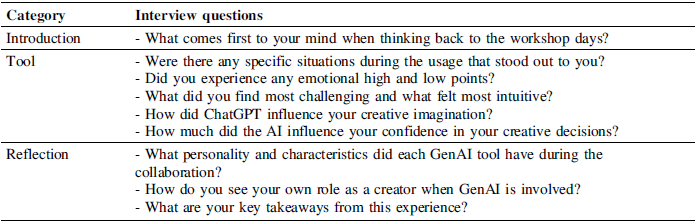
An interview study was chosen to get in-depth insights (Reference Brinkmann and KvaleBrinkmann & Kvale, 2015), about their co-creation experience. A semi-structured interview guide, including both closed- and open-ended questions, was developed, allowing for flexible question order. Each interview began with a reflection on the workshop, followed by a tool-specific discussion of how each GenAI influenced creativity, emotions, and sense of control during the design process. Participants were also asked to describe the personality and characteristics of the GenAI tool during co-creation. The interview concluded with a more general reflection. Table 1 offers an exemplary overview of the interview questions.
Exemplary interview questions

All interviews were conducted online and lasted an average of 57 minutes (1083 minutes in total). They were transcribed and analyzed through a thematic analysis. A single researcher coded the data inductively using a qualitative data analysis software (ATLAS.ti), and the codes were iteratively refined throughout the analysis. Then, the segments of the coded interviews related to the roles humans and GenAI play in co-creation were analyzed in two distinct stages.
First, all identified roles and their associated characteristics were grouped according to the specific GenAI tool they referred to or categorized as human roles. Since each participant described the personality and characteristics of the GenAI tools used during the co-creation process, one role per participant and per tool could be identified for ChatGPT, Midjourney, and Runway. For FigJam, two participants did not engage with the tool during the workshop and did not assign a role to it. This means that one participant could contribute to multiple roles across the study, but they did not assign multiple roles to the same tool. Additionally, participants were encouraged to define their own roles and the AI’s roles in their own words. No predefined list of roles was provided for them to choose from. This approach provided an overview of the experienced roles and their distribution across GenAI tools and human roles, highlighting how frequently each role was mentioned and enhancing our understanding of the dynamics involved in co-creation.
Second, all identified roles were clustered based on commonalities, regardless of whether they referred to human or AI, revealing that roles emerge across various GenAI tools and humans. This process led to 18 role clusters, each serving as the basis for a distinct role defined by characteristics, a description, and an interaction mode. To ensure the roles were named authentically, the researcher selected the role label that participants mentioned most frequently as the final role name. If no dominant label emerged, the most representative label based on the role characteristics was chosen. Based on insights from the interview study, the role characteristics, descriptions, and interaction modes were defined, resulting in a comprehensive set of 18 distinct roles for humans and GenAI in human-AI co-creation.
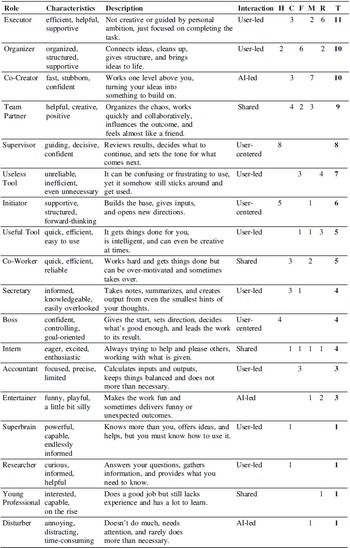
Although there are 18 roles and 19 participants, it is important to note that many roles were mentioned by multiple participants across different tools (see Table 2). Given the exploratory nature of this study, the goal was to develop a foundational typology rather than an exhaustive catalogue. The identified set captures the core variations in how participants experienced human-AI co-creation across tools. While the number of roles is high relative to the sample size, the distribution in Table 2 demonstrates recurring patterns across different individuals. We expect that additional participants would likely reinforce or nuance the existing roles rather than significantly expand the role set, as the current findings represent a diverse range of co-creative dynamics.
4. Results
This section presents the results of the 19 interviews. The subsection ‘Identified Roles’ addresses RQ1, while ‘Role Variations’ explores RQ2. Table 2 summarizes the identified roles, including their three main characteristics, descriptions, and interaction modes. It also shows the distribution of the roles across humans and the GenAI tools, as well as the total number of times each role was mentioned.
Overview of human and GenAI roles identified and corresponding associations (H=Human, C=ChatGPT, F=FigJam, M=Midjourney, R=Runway, T=total mentions per role; numbers show how often interviewees linked each role to humans or to a specific GenAI tool)

4.1. Identified roles
From the analysis of the interviews, 18 distinct roles during human-AI co-creation emerged, reflecting how participants perceive their own roles and GenAI’s roles across the creative process. The following paragraphs provide a more detailed description of these roles.
The Executor was described as someone efficient, helpful, and supportive, but lacking creativity and personal ambition, focusing instead on task completion. This efficiency helped participants test ideas quickly, but it also influenced their creative imagination. As noted by one participant, “it expanded [my creative imagination] because […] it gave me some ideas […]. But I would also say it limited my creativity because it was still like I didn’t need to think at all”. This led to a weaker sense of authorship, with another interviewee stating, “it was not me who really designed it”. Overall, this role enhances productivity and experimentation while presenting mixed views on creativity and authorship.
The Organizer was defined as someone who is organized, structured, and supportive, connecting ideas, cleaning up, providing structure, and ultimately bringing ideas to life. Interviewees characterized it as less focused on generating new ideas and more on “connecting ideas differently”. Moreover, this role is often seen as distinctly human, with one interviewee highlighting the need “to figure out how to put them all together”. Overall, this role supports organization and structure and can be executed without relying on GenAI.
The Co-Creator was characterized as fast, stubborn, and confident, working one level above the user and turning ideas into something to build on. One participant noted, “it’s never going to create exactly what you imagine”. Others expressed a similar ambivalence; as one interviewee summarized, “it guides you so much that you’re really influenced by it, so you’re not really making your own decisions”. This dynamic can lead to GenAI taking over the creative process. Overall, this role embodies an AI-led interaction, contributing creatively while challenging the user’s sense of authorship and control.
The Team Partner was characterized as helpful, creative, and positive, someone who organizes chaos, works quickly and collaboratively, influences outcomes, and feels almost like a friend. One interviewee noted, “the results were pretty good like better than I thought”. Another one described mixed feelings: “When ChatGPT came up with something very completely different, I really felt frustration […] I also had some emotionally high points when I got something very unexpected”. Overall, this role embodies a shared interaction where AI acts as a supportive and motivating partner, while sometimes redirecting the user.
The Supervisor was described as a guiding, decisive, and confident figure who reviewed results, determined what to continue, and set the tone for what comes next. This role is human-centered, overseeing the AI’s output and curating results. As one participant noted, “You can control it if you dislike something. You can change it […]. It gives you just examples, and you decide which ones to choose”. However, another participant noted the limits of this control: “I think I want to see my role as a supervisor […]. At the same time, the experience felt different, and I felt like I was guided more, and it was more like equal or more, even a little bit more towards AI.”. Overall, this role focuses on evaluation and decision-making, with the user as the primary authority considering AI’s influence.
The Useless Tool was described as unreliable, inefficient, and even unnecessary. Participants found it confusing and frustrating, as its outcomes often did not meet their expectations. One interviewee stated, “it was quite frustrating, actually, because it did not really create what I wanted it to”. This perceived lack of meaningful contribution led to feelings of wasted effort. One participant expressed, “I was really unhappy and felt that I had wasted my time”. Overall, this role involves a challenging interaction, making it hard to achieve creative results.
The Initiator was characterized as someone supportive, structured, and forward-thinking, creating a foundation and guiding new directions. One interviewee summarized this as follows: “I would say I’m the person or I’m the one who created these creativity tasks. And all the other tools were just helpers to, yeah, make them more specific or check out another direction”. Another participant commented, “I think like without me, the tools wouldn’t know what to do”. Interestingly, Midjourney was also seen in this role, as its outputs sparked new ideas and made it “easier to think about new ideas”. Overall, this role can be seen as crucial in initiating the creative process, and participants predominantly described it as a human role.
The Useful Tool was described as quick, efficient, and easy to use. Interviewees noted that it helps accomplish tasks, demonstrates intelligence, and can even show creativity, emphasizing a user-led experience. One of the interviewees stated, “you have to give me [the GenAI] the information you want, and then I [the GenAI] will produce”, and reflected further that this was “maybe […] a better creative process, because you were deciding how the scene [/the outcome] should look”. Overall, this role supports creativity while keeping the user in charge and allowing them to make the final decisions.
The Co-Worker was described as quick, efficient, and reliable, working hard and getting things done, but can be over-motivated and sometimes wants to take over. One interviewee noted, “you could just be the one giving him what you need, and he would […] do all the work for you”. Another mentioned, “it kind of like drove me into a different direction I originally wanted, but at the same time, I think it was also kind of cool because it came up with ideas that I didn’t thought about first”. While the AI’s ideas were appreciated, many participants felt their contributions became secondary. Overall, this role represents a shared yet occasionally AI-led interaction, where the AI is efficient but can overshadow the user’s creative agency.
The Secretary was described as informed, knowledgeable, and easily overlooked, someone who takes notes, summarizes, and creates output from even minimal input. Participants saw it as helpful but secondary, emphasizing that it is not a central part of the team. One interviewee noted it “knows about everything you know”, while another mentioned it “is creating texts of my thoughts, and I just have to give some input, and it is filling in the blanks”. Overall, this role helps to organize and inform the process while remaining supportive in the background.
The Boss was described as confident, controlling, and goal-oriented, setting the starting point, determining the direction, deciding what is acceptable, and leading the work to its outcome. One participant noted,” I think the human is right now necessary to produce something good out of it. And to bring it into the right direction”, and stated, “if this boss is able to prompt it the right way and give the right instruction to the tools, it can produce something really nice”. Overall, this role reflects a strongly user-centered interaction, where the human takes charge of direction and decision-making, while the GenAI executes tasks under its supervision.
The Intern was characterized as eager, excited, and enthusiastic, while always trying to please others and working with what is given. One noted, “you really need to question everything that it generates”. Another expressed frustration, saying, “either the way I was saying it or the way that the AI was understanding it wasn’t quite what I was intending”. This led to mixed feelings, with one interviewee describing it as “really surprising and funny and frustrating at the same time”. Overall, this role reflects an eager AI that lacks the experience and autonomy to effectively guide the process.
The Accountant was described as focused, precise, and limited. Interviewees mentioned that it primarily involves taking inputs, calculating appropriate outputs, maintaining balance, and avoiding unnecessary actions. One interviewee noted, “it very systematically helped me […] in my ideas”. Another one described the role as “very focused but also very limited” and “more machine-like, less personified”. Overall, this role helps to organize ideas efficiently but leaves little space for creativity.
The Entertainer was characterized as fun, playful, and a little bit silly, making work fun and sometimes delivering unexpected outcomes. While acknowledging that the tool sometimes fails, participants found humour in its failures and one noted, “sometimes it was funny to see it just create some things that are like, no, what?” Overall, this role shows that GenAI can introduce humour to the process while rarely contributing to achieving outcomes.
The Superbrain was described as powerful, capable, and endlessly informed, knowing more than the user, offering ideas, and being helpful in the process. One interviewee described it as “super powerful and helpful”. However, it can also be frustrating and limiting, as it “only uses the things that already exist […], so it was not something really new”. Overall, this role supports users effectively in many ways but relies on their guidance and input.
The Researcher was described as someone curious, informed, and helpful, providing answers to questions and gathering all necessary information. One participant noted feeling “overwhelmed that the task was already answered that good” and mentioned, “I didn’t expect that I could finish this task like in seconds”. However, this also redirected his creative imagination, as he said, “I already had something in my head, […], and out of these different options, I thought, okay, maybe it could also go this way”. Overall, this role was perceived as helpful but could also overwhelm and redirect users from their ideas.
The Young Professional was described as interested, capable, and on the rise, but still lacks experience and has much to learn. As one participant noted, “it’s working even better than you thought of, and sometimes it’s not able to create the easiest things, so it feels like luck”. This inconsistency was attributed to inexperience. Overall, this role involves shared interaction, where the AI performs well but still requires human guidance to deliver good results.
The Disturber is characterized as annoying, distracting, and time-consuming to work with, as he does little, requires attention, and rarely does more than necessary, thereby disrupting the creative flow. One interviewee compared it to an “annoying kid in class […] that comes in and says something weird or interrupts you in a strange way”. This constant flow of unwelcome ideas and interruptions was perceived as irritating. Overall, this role reflects an AI-led interaction in which the AI hinders rather than helps, demanding attention but offering little meaningful contribution.
The 18 roles derived from the interviews illustrate a broad spectrum of roles humans and GenAI tools can adopt during co-creation. Across these, common themes emerged, including emotional responses, perceived control, and creative engagement. Suggesting varying levels of confidence, agency, and trust in working with GenAI, along with experiences of frustration, flow, and cognitive overload. Together, these findings highlight the complex dynamics and experiences involved in co-creating with GenAI.
4.2. Role variation
In addition to the various roles, the frequency and nature of these roles differ across the GenAI tools used. The following paragraphs illustrate these variations and shifting perceptions among the tools.
The participants perceived their human role as guiding and initiating the process, setting directions, and curating the outcomes. They are the decision-makers who determine which results are good enough and which are not, and aim to maintain authorship, though this can sometimes be challenging. Human roles included being a Supervisor (8), Initiator (5), Boss (4), and Organizer (2), reflecting participants’ sense of control and creative authority, even though outcomes sometimes did not match their expectations fully. It is important to emphasize that the roles of Boss and Supervisor were seen solely as human roles, and participants did not view GenAI as capable of fulfilling them.
ChatGPT was overall perceived as supportive, knowledgeable, and collaborative, though it sometimes steered ideas in directions not intended. The experience was predominantly user-led and shared, with the GenAI acting as a Team Partner (4), Executor (3), Co-Worker (3), Co-Creator (3), Secretary (3), Researcher (1), Intern (1) and Superbrain (1) reflecting participants’ experience of a collaborative dynamic that blended human direction with AI contributions, while blurring the boundaries of authorship and agency.
FigJam was overall perceived as structured, supportive, and organized It helped organize and connect ideas, providing clarity and order. The experience was predominantly user-led, with the GenAI acting as an Organizer (6), Accountant (3), Useless Tool (3), Team Partner (2), Secretary (1), Intern (1), and Useful Tool (1), reflecting participants’ experience of providing structure and order rather than inspiration and creative input.
Midjourney was overall perceived as creative, fast, and visually powerful, but often unpredictable and challenging to control. The experience was mainly shared and AI-led, with the GenAI acting as a Co-Creator (7), Team Partner (3), Co-Worker (2), Executor (2), Initiator (1), Intern (1), Useful Tool (1), Entertainer (1) and Disturber (1), reflecting participants’ experience of a creative but tension-filled dynamic, where creative control often shifted towards AI, shaping outcomes beyond users’ intentions.
Runway was overall perceived as powerful, yet challenging to control and unpredictable. It provided production support but made a limited creative contribution. The experience was predominantly user-led, with the GenAI acting as Executor (6), Useless Tool (4), Useful Tool (3), Organizer (2), Entertainer (2), Intern (1), and Young Professional (1), reflecting participants’ experience of an operator that elicits mixed emotions between occasional surprise and frustration.
Examining the roles associated with each GenAI tool revealed that the relationships with the tools differ, and that some roles are better suited to specific tools than others. Moreover, user roles stand mostly apart from the other roles. Additionally, some tools are clearly more user-led than others, which influences how creatives experience the co-creation process.
5. Discussion
Our exploration of creatives’ experiences and perceived roles in human-AI co-creation revealed 18 distinct roles for humans and AI. These were derived inductively from creatives’ lived experiences while working on a creative task. Unlike previous role sets, such as those by Reference SiemonSiemon (2022), Reference Kim, Molina, Rheu, Zhan and PengKim et al. (2023), and Reference McComb, Boatwright and CaganMcComb et al. (2023), our role set stands out due to its inductive approach. This approach enriches our role descriptions by incorporating emotional and metacognitive reflections, providing a more nuanced view of roles in a creative context. In contrast to previous studies that developed their roles inductively in the creative context, such as Reference Palani and RamosPalani & Ramos (2024), our more homogeneous participant group led to a more differentiated, context-sensitive perspective and a wider variety of roles humans and AI can take. This inductive, experience-driven approach enabled us to uncover, on the one hand, a richer set of 18 roles and, on the other hand, to identify GenAI tool-specific variations in role perceptions and collaboration dynamics during human-AI co-creation.
To further connect our findings with existing research, we mapped our 18 roles onto Reference McComb, Boatwright and CaganMcComb et al. (2023) 2x2 AI-Human Teaming Matrix, which identifies four archetypical roles for AI: AI-as-Tool, AI-as-Analytics, AI-as-Partner, and AI-as-Guide. Useful Tool, Accountant, Secretary, Executor, Intern, and Useless Tool align with AI-as-Tool, reflecting reactive, problem-focused interactions. Researcher and Organizer resonate with AI-as Analytics, supporting process structuring without direct intervention. Co-Worker, Team-Partner, Initiator, Superbrain, and Young Professional fit into AI-as-Partner, highlighting proactive contributions to the creative process. Co-Creator, Disturber, and Entertainer align with AI-as-Guide, as they redirect or disrupt creativity. We did not align the Supervisor and Boss roles with the matrix proposed by Reference McComb, Boatwright and CaganMcComb et al. (2023); however, their guidance remains strong. The reason for this decision is that participants perceived these roles as exclusively human, indicating that humans still want to have control over AI. This distinction, along with the participants’ naming of roles across human and AI, highlights the importance of considering both human and AI roles in co-creation.
Furthermore, our study identifies areas for future research in this context, such as emotional responses, experiences of creative flow, and tensions surrounding authorship and control. The findings suggest that the way humans and AI co-create on a creative task is not only functional but also deeply affective, influencing their metacognitive experiences, particularly their perception of agency, self-efficacy, and authorship. The findings highlight how different human-AI co-creation experiences can be, as well as the variety of roles humans and AI can play. Attempting to reduce these roles to smaller clusters may thus not effectively capture the complex nature of the interaction. The 18 roles derived from the creatives’ experiences in our study contribute to a more holistic view of human-AI co-creation, while also highlighting the need for further exploration of human experiences in this context.
The study further provides valuable insights for design education, practice, and research. For design educators, the derived insights and roles highlight the importance of preparing future designers to use GenAI tools while critically reflecting on their relationship with them. The 18 roles can support novice designers as they navigate the emotional and cognitive challenges of co-creating with AI. For example, they could help them to recognize more directly how the co-creation impacts their feelings or sense of agency or authorship. This also applies to creative practitioners, who can, in addition, gain insights from the study to better understand GenAI tools and recognize the varying experiences among them. The identified roles might further help them reflect on how GenAI can support their creative work and strengthen their own role within the co-creation process. For design research, the findings of this study highlight the importance of investigating the human side of human-AI co-creation more deeply, as it can be considered a relation, context-sensitive, and experience-driven interaction process.
As we explored the experiences of creatives in mid-2025, it is important to consider the rapid advancement of GenAI tools and their implications for our findings. To address this, our study focuses on these lived experiences and the metacognitive dimension, while identifying roles that provide an overview of the relational structures and underlying interaction logics in co-creation, regardless of the specific AI tools. This approach ensures the transferability of our findings for future technological developments. Our set of 18 roles can serve as a base for future research, enabling researchers to track the evolution of human-AI co-creation and shifts in role perceptions as GenAI capabilities advance.
Overall, our study enhances understanding of human-AI co-creation in the creative field by introducing 18 distinct roles that humans and AI can take on in the process and by showcasing variations in these roles across different tools used in the creative process. This provides valuable insights for design education, practitioners, and researchers.
6. Conclusion
The study presented offers insights from interviews with 19 architecture students who used different GenAI tools for creative tasks. It identified 18 distinct roles humans and GenAI can assume during co-creation. In addition, the study identified variations across tools in how participants perceive them and which roles are associated with them, underscoring that roles in human-AI co-creation are highly context-specific. Thus, the study contributes to a more human- and context-centered view of human-AI co-creation in the creative fields.
The study’s key strengths lie in this human- and context-centered approach within the creative domain as well as in the manifold insights generated from the interviews. However, one limitation is that the study only examined one group of creatives, and experiences and perceptions of roles might differ slightly across creative sub-disciplines. Furthermore, the small sample size of 19 participants and the fact that only a single researcher coded the interview data can also be seen as a limitation. Nevertheless, the study results provide meaningful insights that inform current research on human-AI co-creation in the creative field, and the 18 roles derived can serve as a starting point for further research. Specifically, these roles could be further validated and refined by applying them, for example, to a creative task from the outset, or by examining their transferability to other creative subdomains. Furthermore, as this study highlights relational roles in AI-human co-creation, future research could explore how these 18 roles relate to the broader discussion of AI’s advantages and disadvantages in human-AI collaboration. The roles we derived offer a nuanced lens for better understanding how GenAI supports or hinders the creative process. Beyond this, often emerging themes in the interviews, such as emotional responses, creative flow, self-efficacy, and agency, leave room for further exploration in the context of creative human-AI co-creation.
Overall, this paper contributes to a broader understanding of human experiences during human-AI co-creation in the creative field, while highlighting the complexity of roles, emotions, and experiences that shape these experiences.

 Open access

