

For a dictator interested in staying in power, there is arguably no task more important than managing their ruling coalition. The dynamics of ‘authoritarian power sharing’ (Svolik Reference Svolik2012) are crucial to shaping autocratic survival. Members of the ruling coalition (hereafter, elites) can sometimes challenge the autocrat via a coup (Singh Reference Singh2014), but their support is also fundamental to helping the dictator navigate threats from the people and foreign states (Greitens Reference Greitens2016; Talmadge Reference Talmadge2015). Dictators possess various management tools to keep their ruling coalition in line, including the ability to appoint new officials (Shih, Adolph, and Liu Reference Shih, Adolph and Liu2012), rotate personnel (Woldense Reference Woldense2018) and purge elites (Sudduth Reference Sudduth2017). Purges – when a dictator forcibly removes an individual from the regime's ruling coalition – are the subject of a nascent but growing body of research (Bokobza et al. Reference Bokobzaforthcoming; Boutton Reference Boutton2019; Bove and Rivera Reference Bove and Rivera2015; Easton and Siverson Reference Easton and Siverson2018a; Sudduth Reference Sudduth2017; Sudduth Reference Sudduth2021; van der Maat Reference Van der Maat2020; Wong and Chan Reference Wong and Chan2021). However, we know comparatively little about why dictators target specific elites or why dictators purge them in certain ways.
Understanding these within-regime individual-level variations in elite purges is substantively important to the study of authoritarian survival.Footnote 1 Dictators fall to coups more than any other method of exiting power (Goemans, Gleditsch and Chiozza Reference Goemans, Gleditsch and Chiozza2009), and elite purges may be able to help them avoid this fate. However, we contend that it matters not only whether dictators purge elites, but also who they purge and how. These details help explain how dictators retain sufficient competence in their ruling coalition to mitigate threats from outside the regime, as well as how dictators use elite purges to avoid coups. In sum, understanding individual-level variations in the identity and outcome of elite purges is essential to the study of authoritarian survival, both including and beyond how dictators avoid coups. We therefore ask two distinct but related questions: ‘Why do dictators purge specific elites but not others?’; and ‘Why do dictators purge these elites in certain ways?’
To our knowledge, these questions have never been directly examined.Footnote 2 We posit a theory that explains which elites dictators are likely to purge and why dictators are likely to purge them in a certain manner. The most significant threat to an autocrat's survival may come from their elites, but not all elites are equally threatening. Elites who enter the inner circle upon the establishment of the regime – ‘first-generation elites’ – pose a larger threat than others. One might think that first-generation elites are loyal due to their shared experiences with the dictator when they attained power, but, in fact, they threaten the dictator for three reasons. First-generation elites benefit from greater access to power upon entry, gained from negotiating their offices from a stronger starting position vis-à-vis the dictator. They also have strong vertical linkages with their subordinates, who rely on them for jobs, and pre-existing horizontal relationships with other top elites, which were developed prior to their seizure of the regime. These aspects give first-generation elites powerful capabilities and bases of support that can be leveraged to challenge the dictator, as compared with subsequent elites, who rely on dictators for their positions and inherit diminishing shares of power from their predecessors. This difference in power shares between elites makes first-generation elites more dangerous to dictators and therefore more likely to be purged.
Once a dictator decides to purge a dangerous first-generation elite, they must decide how to purge them. These outcomes include exile, imprisonment, execution, or removal with no further punishment. However, elites who face no punishment or are sent into exile are not effectively disconnected from supporters in the regime, allowing them to foment discontent against the dictator. Execution severs these connections, but it may provoke their supporters to challenge the dictator. Imprisoning a dangerous, purged first-generation elite helps the dictator forge a middle path between these threats, keeping the elite from plotting revenge while also not making them a martyr. We therefore expect that dictators tend to incarcerate purged first-generation elites, rather than sending them into exile, executing them, or removing them without further punishment.
We test these hypotheses with an original individual-level dataset of civilian and military autocratic elites holding offices within sixteen ruling institutions between 1922 and 2020. Data identifying these elites and their demographic and professional characteristics come from thousands of primary and secondary sources; they provide a revealing window through which to examine the opacity of autocratic elite politics across the world. Scholars have recently introduced important datasets relating to autocratic elite purges of military officials across regimes (Sudduth Reference Sudduth2021) and cabinet ministers within regimes (Bokobza et al. Reference Bokobzaforthcoming; Nyrup and Bramwell Reference Nyrup and Bramwell2020). However, our dataset is the first to include a sample of the civilian and military elites within key ruling institutions across a range of dictatorships. Consistent with our theory, we find that dictators are significantly more likely to purge first-generation than non-first-generation elites. Among purged elites, there is moderate evidence that dictators are more likely to incarcerate first-generation elites, especially instead of executing them.
The article contributes to research on authoritarian survival in several ways. First, while most research on autocratic elite management focuses on whether individuals are promoted (Shih, Adolph, and Liu Reference Shih, Adolph and Liu2012), shuffled (Woldense Reference Woldense2018) or removed (Wong and Chan Reference Wong and Chan2021), we integrate this with analysis of how dictators manage individuals differently. Secondly, the article suggests that dictators are careful and strategic with using violence against regime elites; just as many dictators surgically select victims for targeted repression (Xu Reference Xu2021), they are also precise in using violence against their supporters to avoid negative repercussions (Sudduth Reference Sudduth2017). Thirdly, the article joins a growing literature (Bokobza et al. Reference Bokobzaforthcoming; Nyrup and Bramwell Reference Nyrup and Bramwell2020; Woldense Reference Woldense2018) that uses innovative data on autocratic elites to expose the secretive inner workings of dictatorships, showing how dictators manipulate the internal balance of power to survive in office (relatedly, see Pepinsky Reference Pepinsky2014; Svolik Reference Svolik2012).
The article proceeds as follows. We first review what existing research shows about individual-level purges, highlighting the gaps that our study fills. We then outline our theory, before introducing our novel individual-level data on autocratic elites across sixteen ruling institutions. We present results from tests of our hypotheses, before concluding with a brief discussion of the implications of the findings and suggestions for future research.
Existing Research
Prior research argues that autocrats purge elites to consolidate power (Svolik Reference Svolik2012). However, despite some initial assumptions to the contrary (Bueno de Mesquita et al. Reference Bueno de Mesquita2003), recent work has shown that individual elites are not interchangeable (Bokobza et al. Reference Bokobzaforthcoming). Elites possess different strengths and weaknesses; they offer varying competencies to assist dictators in governing, but they also exhibit varying inclinations towards (dis)loyalty (Zakharov Reference Zakharov2016). Combined with the fact that dictators fall to coups more than any other method (Goemans, Gleditsch and Chiozza Reference Goemans, Gleditsch and Chiozza2009), understanding which elites dictators purge is important to better understand authoritarian survival. However, due in some part to data availability, we have little evidence about which individuals dictators target and how purges are carried out.
Most empirical research on autocratic purges has been cross-national and does not examine within-regime individual-level variations. Put differently, scholars have tended to study why some dictators are more likely to purge than others (Boutton Reference Boutton2019) and the country-level consequences of purges (Easton and Siverson Reference Easton and Siverson2018b). Perhaps most notably, Jun Koga Sudduth (Reference Sudduth2017) shows that dictators are more likely to purge military elites when retaliation is less likely. Overall, however, none of these studies explain why dictators purge certain elites but not others.
A few recent exceptions examine within-regime individual-level variations in purges, but important gaps remain. Bokobza et al. (Reference Bokobzaforthcoming) show that dictators are more likely to purge cabinet ministers in the wake of a failed coup, and at these times, they are more likely to target high-ranking cabinet members. These ministers have greater control over the armed forces or other strategic resources, so they are more likely to pose a coup threat. Bokobza et al. (Reference Bokobzaforthcoming) also critique extant literature for focusing almost exclusively on military elites at the expense of civilians. There is one exception to this critique: Wong and Chan's (Reference Wong and Chan2021) study on purges in ancient Chinese imperial dynasties. However, their study examines purges in a specific historical context, where the findings may not apply to modern regimes. However, generally, the aforementioned critique is valid and important: civilian and military elites are crucial to the occurrence of coups d’état (Kroeger Reference Kroeger2020), suggesting that studying management of both kinds of elites is important to understanding authoritarian survival.
However, we must also be careful not to assume that cabinet ministers are the most important elites within dictatorships. In regimes like the Soviet Union, the cabinet (though containing some notables) included large numbers of technocrats who were co-opted by the regime to administer the state (Laird Reference Laird1986). Studying purges of only cabinet ministers may miss expulsions of key elites who were not in a ministerial position, but were part of the regime's true locus of power, like a party executive committee or military board. To better understand why dictators purge specific elites, we need to examine civilian and military elites within key ruling institutions, which may or may not be the cabinet.
We address one additional gap in the literature on the individual-level study of purges: the method of purging. To our knowledge, existing research is yet to probe why dictators purge elites in specific ways. Although purges are often associated with violence, this is not a necessary criterion. When they purge elites, dictators can execute, imprison or exile them, or strip them of all their titles to the extent that they are no longer part of the ruling coalition. But why do dictators choose one outcome and not another? Given that certain types of purges may be more likely to encourage retaliation than others, and that elites can be rehabilitated from certain types of purges but not others, the question prima facie appears important to understanding elite politics in dictatorships and its implications for authoritarian survival. In summary, we conduct the first within-regime individual-level analysis across multiple regimes that examines why dictators purge specific civilian or military elites, as well as why they purge them with certain outcomes.
Theory
Many dictators consolidate power, but they cannot rule alone (Bokobza et al. Reference Bokobzaforthcoming). Despite perceptions of ‘Stalinist Russia’ being ruled by one man, even Joseph Stalin relied on allies to administer the Soviet Union (Fitzpatrick Reference Fitzpatrick2015). Rather than consolidating every office of the state under their supervision, dictators co-opt individuals to fill these offices (Magaloni Reference Magaloni2008). In exchange for taking over functions of the regime through an institutional portfolio, these notables are vested with authorities and material privileges to reward their status as an ‘elite’.
However, elites are not equal; rather, some acquire positions of greater power and authority than others based on their personal or professional capabilities (Aaskoven and Nyrup Reference Aaskoven and Nyrup2021). For instance, some are able to negotiate control over state security organizations or the armed forces, which gives them command over institutions capable of deploying violence (Greitens Reference Greitens2016; Talmadge Reference Talmadge2015); others oversee weaker civilian apparatuses charged with technocratic management, such as an economic planning board or social ministry (Shih, Adolph, and Liu Reference Shih, Adolph and Liu2012). Roessler and Verhoeven (Reference Roessler and Verhoeven2016, 239) describe the context behind these elite office allocations in Kabila's Congo: ‘the distribution of power was governed by the exigencies of elite bargaining, in which military clout, individual cunning, personal ties and informal deals determined appointments’. Based on the positions they leverage through capabilities and their own personal dynamism, elites' powers vary considerably, leading to different perceptions of their threat capability by the dictator on a person-by-person basis.
When co-opting elites, dictators are mindful of how much power they negotiate away from their personal share (Geddes, Wright and Frantz Reference Geddes, Wright and Frantz2018). Previous literature conceptualizes this consideration as a balance of power between dictators and their elites, where each side attempts to press their advantage to the other's detriment (Acemoğlu, Egorov and Sonin Reference Acemoğlu, Egorov and Sonin2008; Svolik Reference Svolik2009; Svolik Reference Svolik2012). The direction of this balance has important consequences. For dictators, shoring up greater power over elites ensures that none can credibly challenge the leader. For elites, a favourable balance of power helps ensure their safety against the risk of being purged. Thus, dictators consider the consequences of this balance when co-opting elites into their ruling group, aiming to not give away so much power as to disadvantage their own share.
Consideration of this balance means that dictators are wary of elites who become too powerful relative to themselves (Paine Reference Paine2021). To avoid a challenge by a powerful adversary, dictators can purge elites by removing them from the positions that grant them power and authority. Purging a powerful elite allows the dictator to decide how to redistribute their power sources, that is, whether to keep their positions for themselves or to bestow them on another individual (Slater Reference Slater2003). If the dictator chooses the second option, they can manage how much power is allocated to the newly co-opted elite, negotiating a diminished share for promotion compared to that which was offered to the original co-opted elite (Snyder Reference Snyder1992). In exchange for this promotion, the new successor elite enters their office more beholden to the dictator, realizing that they are subordinate rather than co-opted on more equal terms.
Since elites are not equal in terms of power, how do dictators identify which elites pose the greatest threats to their survival? We contend that one heuristic dictators use is whether an elite belongs to the cohort that entered their positions alongside the dictator at the start of the regime, when power arrangements were yet to be established. These ‘first-generation’ elites have several characteristics that endow them with shares of power closer to the dictator's. In the following, we describe these characteristics that make first-generation elites perceived as more threatening by dictators and thus more likely to be purged. We also discuss how this status affects the manner through which they are purged, based on the dictator's desire to minimize the future threat a purged first-generation elite may pose after being expelled from office.
First, upon entering the nascent regime, whether through violent or non-violent means, first-generation elites can negotiate greater autonomy as a condition for their participation. Dictators need elites to help rule, which gives those willing to participate the ability to negotiate greater power at the dictator's expense. Forced to accept these conditions so that the regime can function, the dictator permits a shift in the balance of power that favours elites. This exchange creates a cohort of elites who enter the ruling circle with greater individual capacities and power, reflecting ‘contested autocracy’ (Svolik Reference Svolik2012, 55). After this concession and positions are occupied, the autocrat may look to rebalance this arrangement by purging first-generation elites whose power share makes them threatening. This arrangement should be contrasted with the entry of non-first-generation elites, whose powers are more allocated by than bargained for with the dictator. These candidates are more likely to be thoroughly pre-screened by the dictator for qualities like loyalty and will therefore likely be less critical of the regime's extant power allocation shares and procedures should they be selected to enter the ruling coalition as one of many candidates.
Secondly, when first-generation elites are co-opted, they can build out the bureaucratic capacity of their assigned portfolio, offering jobs that create strong vertical linkages between themselves and subordinates. The commanding elite for each sector needs to co-opt new officials for their sector of administration as much of the prior regime is either removed or marginalized by the new one. Elites often recruit individuals from groups they trust and who they wish to reward for prior support (Albrecht and Ohl Reference Albrecht and Ohl2016). Providing critical government jobs becomes a form of rent distribution for the elite's supporters and loyalists, packing institutions with individuals who then owe their positions directly to that elite and whose survival becomes critical to their own (Scharpf and Gläßel Reference Scharpf and Gläßel2020). Although non-first-generation elites can promote supporters, they are more restrained by an inherited bureaucracy that they cannot fully redesign, having been promoted into the management of a system that has already institutionally developed and whose occupants are less dependent on the leader for their continued survival and privileges, or who may even undermine them for their own advancement (Decalo Reference Decalo1989).
Thirdly, first-generation elites enter office with horizontal linkages between themselves. Whether through a coup or battle for independence, seizures of power begin with a conspiracy, which is coordinated between committed individuals (Singh Reference Singh2014). They plan this seizure and future rule together. The secrecy requires trust between plotters, which can forge strong bonds that endure into power (Sutter Reference Sutter2000). Even if these relationships are not positive, experiences with one another provide valuable information about capabilities and intentions. Non-first-generation elites ascend from within the regime, rather than entering the elite as a cohort, which limits their information about other elites when they enter the group. They do not have relational experience with other elites when they enter the ruling group, leaving them less able to assess their position relative to others, and they are often pushed into adversarial intra-elite behaviours by the dictator as a means of controlled competition (Chen and Hong Reference Chen and Hong2020). Compared to successor elites, first-generation cohorts are better able to coordinate plots because they possess better information about the credibility and capability of their peers.
These points describe how first-generation elites threaten dictators and explain why dictators are more likely to purge them than non-first-generation elites. However, these same factors could also make it harder for dictators to purge first-generation elites precisely because they are more powerful (Sudduth Reference Sudduth2017).Footnote 3 In spite of the dangers, we expect that a dictator's incentive to purge first-generation elites trumps any barriers to doing so due to the structural aspects of autocracies. The secretive nature of autocratic elite politics means that dictators tend to have greater information than elites, so they can select the optimum time to purge threatening elites. The finite number of resources available to dictators to distribute to elites also encourages elites to maximize opportunities for advancement when a dictator purges a colleague, rather than rallying around the targeted colleague (Svolik Reference Svolik2012, 3, 177). Overall, then, the three characteristics that make first-generation elites more threatening motivate our first hypothesis:
Hypothesis 1: Dictators are more likely to purge first-generation elites than non-first-generation elites.
Although purging a dangerous first-generation elite removes them from their positions of power, it does not necessarily reduce the immediate threat to the dictator. Without further punishment, a first-generation elite can leverage their networks and freedom of movement to plot revenge against the dictator. Additionally, exiling a purged first-generation elite means that they can agitate against the dictator from abroad. The exiled elite may be able to interact with networks within the regime to attack the dictator. Although this point could apply to all purged elites, it is especially relevant for purged first-generation elites, who are more dangerous based on the three points preceding Hypothesis 1. We expect that dictators aim to prevent purged first-generation elites from being able to plot revenge domestically or in exile.
An illustration of the danger of not punishing purged elites comes from Angola in the 1970s, when the ruling party suffered a rift in its membership between those loyal to President Aghostino Neto and those siding with hard-line Interior Minister Nito Alves. Neto orchestrated Alves' expulsion from the Politburo on accusations of factionalism but, pending further investigation, released Alves (Fauvet Reference Fauvet1977, 94). Alves, undeterred from his desire to take over the ruling party and align it more with the Soviet Union, began plotting a coup, which was launched prior to a scheduled hearing on Alves' further punishment (Birmingham Reference Birmingham1978, 560–1). Although the coup was defeated, Alves' death squad executed seven elite hostages, a major blow to the regime in its infancy. Learning from his previous mistake of letting Alves go, Neto had Alves executed and purged the party of his alleged associates (Saul Reference Saul2014, 609). Neto's initial lenience towards his purged colleague created conditions for a coup plot, demonstrating the risk of this more forgiving approach.
Exiling purged elites also presents future dangers for the dictator, as illustrated by the case of Leon Trotsky. Following Vladimir Lenin's death in 1924, leadership within the ruling Soviet elite became a clash of personalities. Although Stalin became Lenin's successor, Trotsky still commanded a strong following and held significant power through his military leadership (Kotkin Reference Kotkin2015, 537). However, Stalin's machinations eventually resulted in Trotsky being incrementally purged from all offices and sent into exile (Fitzpatrick Reference Fitzpatrick2015, 42). Free to pursue revenge abroad, Trotsky undermined Stalin as a corrupter of the communist movement through literature and speeches, setting up an alternate tendency for dedicated communists who distrusted Stalin (Getty Reference Getty1986, 30). Within the Soviet Union, Trotsky's influence persisted, resulting in the trials of individuals accused of ‘Trotskyism’ that weakened the regime's support base, demonstrating the long-term challenges that his exile created for Stalin (Dobrenko Reference Dobrenko2010, 91).
Dictators may recognize that releasing purged first-generation elites without punishment or through exile leaves them vulnerable to future challenges. Dictators can therefore choose a more extreme option to settle the account: execution. If dictators execute a first-generation elite, the elite's ability to threaten the regime has been eliminated and this performative act sends a warning to other elites who may consider plotting against the leader (Easton and Siverson Reference Easton and Siverson2018b). However, executing first-generation elites risks confirming other elites' concerns about the dictator's disregard for the implications of power sharing and raises the question of whether any of them are safe from violence (relatedly, see Magaloni Reference Magaloni2008, 724; Wig and Rød Reference Wig and Rød2016, 793). Seeking to avoid a similar fate as executed elites, others may plot pre-emptive coup or assassination attempts (Sudduth Reference Sudduth2017).
The fate of Francisco Macías Nguema of Equatorial Guinea illustrates these dangers. Macías ruled for a decade with brutal repression, which he increasingly turned against his own elites (Sá and Sanches Reference Sá and Sanches2021, 86). An International Commission of Jurists report estimated that ten of twelve ministers in Macías' first cabinet were murdered at his direction (Artucio Reference Artucio1979). Fearing he would be the next to suffer his relative's wrath, Macías' nephew and Deputy Minister of Defence Teodoro Obiang Nguema successfully launched a coup in 1979 that captured Macías (Baynham Reference Baynham1980, 65). Obiang then seized executive power and put Macías on trial, executing him by firing squad (Yates Reference Yates2017, 351). Macías' ruthlessness towards his elites eventually provoked retaliation that culminated in his execution, illustrating the dangers of relying on this violent purge outcome.
Imprisonment may be a safer alternative for dictators who wish to reduce the long-term threat of purged first-generation elites, compared with the outcomes described earlier. Imprisonment involves agents of the state arresting the elite and placing them under house arrest or in prison. Imprisonment strikes a balance between release, exile, and execution because it inhibits the threatening purged first-generation elite's ability to coordinate revenge against the dictator within the country, does not send them abroad where they can also foment dissent and does not provoke retaliatory violence or assassination by the executed elite's followers or allies. Incarcerating a purged first-generation elite for some time helps reduce the strength of their linkages – followers must seek out new patrons, and their relations with other elites weaken – and leaves open the possibility of rehabilitation, which other elites may see as leniency on the dictator's part compared to more extreme punishment.
The benefits of imprisoning first-generation elites are illustrated by the early years of Yugoslavia under Josip Broz Tito. Tensions over Tito's growing independence after the Second World War eventually led to his ruling Communist Party of Yugoslavia (KPJ) being expelled from the Communist Bloc in 1948 (Procacci et al. Reference Procacci1994). Although Tito commanded considerable loyalty, some elites questioned whether his pariah status would make the regime vulnerable to invasion by the Soviet Union (Armstrong 1951). Despite this challenge, the KPJ's ruling Politburo remained mostly unified, with the only exception who dared to challenge Tito being Sreten Žujović, a former partisan commander and member of the party's leadership since prior to The Second World War (Pirjevec Reference Pirjevec2011, 28). Žujović attempted to speak out against Tito at a plenum of the KPJ Central Committee but was overwhelmingly denounced and accused of being a Soviet spy (West Reference West1994). After a brief investigation into his motives, Žujović was purged and imprisoned, effectively ending the threat against Tito from within the party leadership (Banac Reference Banac1988). These theoretical arguments and case illustrations of purge outcomes motivate our second hypothesis:
Hypothesis 2: Dictators are more likely to incarcerate first-generation elites than purge them via other outcomes.
Research Design
We test our hypotheses with new individual-level quantitative data on members of sixteen autocratic ruling institutions between 1922 and 2020.Footnote 4 Each ruling institution exists in the possible universe of cases: one of the 294 regime spells identified as autocratic by Geddes, Wright, and Frantz (Reference Geddes, Wright and Frantz2014), with the exception of Nazi Germany.Footnote 5 A ruling institution is defined as the formal organ that was the regime's key de facto decision-making body. Regimes often have multiple institutions that may hold substantial powers and contain notable elites (that is, a cabinet and a party executive committee); however, between them, one can usually be identified qualitatively as being paramount in guiding state policy, even if it is not their official portfolio.Footnote 6 Although we acknowledge that ruling coalitions may extend beyond membership in a single institution, we intentionally sample elites from the de facto ruling institution to ensure observations include only elites that are part of the most powerful ‘inner circle’ and not defanged technocrats or lesser figures in other autocratic institutions. Our individual-level dataset has limitations, such as studying over-time effects or broader societal conditions that may motivate purges, but this structure matches our individual-level hypotheses and our non-time-varying key independent variable.
Identifying power centres in autocracies can be challenging due to their institutional diversity and opacity (Gandhi and Sumner Reference Gandhi and Sumner2020). Taking a rigid institutional approach to identification is risky because it relies on formal state arrangements, which many dictatorships ignore or minimize for de facto arrangements. For example, many dictatorships have executive powers formally vested with the presidential or ministerial cabinets of ministers, similar to democracies. However, in many cases, only focusing on cabinets as the locus of autocratic power would miss other organs that are, in practice, more important and contain more central figures, such as a ruling party's political bureau. Rather than relying on a strict cross-national identification rule that could miss the nuance of certain informal or irregular institutional arrangements of power across autocracies, we remained flexible in identifying the central ruling institution, drawing upon historical accounts of power centres and the institutional membership of key figures, rather than basing inclusion on formal legal rules that often do not provide satisfactory context in the realm of autocratic politics.Footnote 7
Utilizing this method of identifying the centres of power in autocracies, we selected a sample of ruling institutions from which we drew our roster of elites (see Table 1). Our selection of ruling institutions is intentionally not random; rather, we aimed to ensure an inclusive sample that reflected important diversities across autocratic regime subtypes. We also assessed inclusion to account for diversity across ruling institutions' temporal survival and geographic location, as well as considering source information availability. This strategy led us to a sample of 16 ruling institutions that included five ministerial cabinets, four party executive committees, and six military boards (juntas).
Ruling institutions
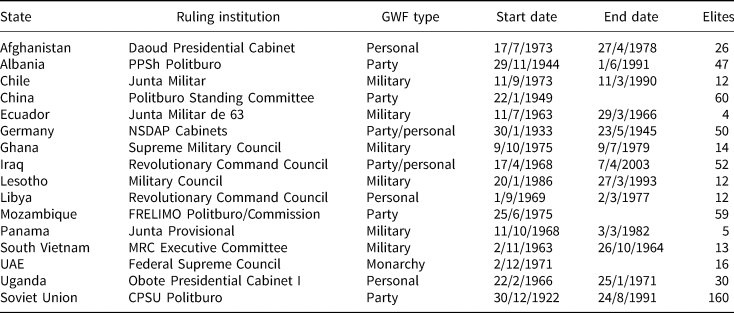
PPSh = The Party of Labour of Albania; NSDAP = National Socialist German Workers' Party; FRELIMO = Liberation Front of Mozambique; MRC = Military Revolutionary Council; CPSU = Communist Party of the Soviet Union.
The military boards were usually the smallest in membership size and the shortest in temporal duration, while party executive committees were the most durable and contained the largest number of elites. These findings on duration by type between party and military institutions are consistent with existing findings (Geddes, Wright and Frantz Reference Geddes, Wright and Frantz2014). We therefore include slightly more military boards in our sample to help capture the effects of these organs amid the larger average size of the other two types.
After ruling institutions were selected, we populated our individual-level dataset with elites who occupied candidate or full membership in these bodies over the institutions’ existence.Footnote 8 These elites serve as our data points and were identified from thousands of pieces of source material, including radio broadcasts, newspaper articles, meeting minutes, scholarly publications, social media presences, general web searches, edited information aggregation sites, foreign intelligence reports, and many other formats. We coded data for each spell of the elite's time in the ruling institution; should an individual leave the group and then re-enter at another time, we coded two separate entries. All data were hand coded by one of the authors, who drew upon extensive source material research to aggregate the relevant variables into a single dataset.
Dependent Variables
We test our hypotheses with data on an elite's exit and their post-exit fate. The first dependent variable is a dichotomous indicator, Purge, which equals 1 if the elite was expelled from the ruling institution (and all other state/party/military leadership positions) and 0 otherwise. A total of 15.9 per cent (91 out of 572) of elites in our sample were purged.Footnote 9 This was based on various exit types in our sample of elites, of which only expulsion adequately captured the nature of purging according to our definition. Possible exit types were coded as: Died in office (natural, combat related, accidental and assassinated by individuals not acting as agents of the regime); Demotion (retained membership in other regime institutions); Expulsion; Regime/ruling institution change; Resignation; and Still in office (those who were still in the ruling institution at the conclusion of our data sample). To reiterate, this variable only reflects whether the individual is purged, which can be followed with or without punitive violence. Purges are sometimes sequential events, with elites being deprived of one position after another until they are fully removed from all positions of power. To capture these progressive purges, we utilize a one-year window to examine the ‘final’ treatment of the elite after they are removed from the ruling institution.
Our second dependent variable is Purge outcome, which captures the treatment an elite receives from the regime after they are expelled from the ruling institution. This treatment can take one of four outcomes: Execution, Incarceration, Exile, and No further punishment. As purged elites can suffer multiple punitive outcomes sequentially (that is, incarceration prior to execution), we code the most severe punishment given within three years of their formal exit date.Footnote 10 Execution involves the elite losing their life at the hands of the state. Incarceration is when the elite's post-exit fate entails forcible detention by state authorities, including temporary or permanent detention in a designated facility (jail, prison, or work camp) or house arrest. Exile entails the elite being forced to leave the country following their exit from the ruling institution. This can be forced through a specific punitive order or the elite fleeing abroad into de facto exile, with the understanding that returning would be met with a more severe punishment. If an elite is not exiled, incarcerated or executed within a span of three years after leaving the ruling institution, we code them as having received no further punishment.
Independent Variable
Our hypotheses rest on the theory that ruling elites who enter in the regime's first cohort pose the greatest threat to a dictator. We hypothesize that this status positively affects their likelihood of being purged and later being incarcerated. We code as First generation those elites in the initial entry cohort of the regime's ruling institution. The temporal point to establish this initial entry date was drawn from the regime start dates given by Geddes, Wright and Frantz (Reference Geddes, Wright and Frantz2014). If an individual was either a full or candidate member of the ruling institution on that date (as some of these bodies existed prior to seizing power), they are coded as a first-generation elite; all others are considered successor elites. First-generation elites take a value of 1 and successors who entered after the regime start date equal 0.
Control Variables
We control for several personal, professional, and structural variables that could also explain an elite's likelihood of being purged and punished. Previous research on purges has theorized that the professional histories of elites could affect whether they are perceived as credible threats to the dictator (see, for example, Wong and Chan Reference Wong and Chan2021). Those who served in the armed forces, militias, or state security forces are perceived as having greater access to professional networks with access to the means of violence. Leveraging these linkages, these elites could credibly convince violent forces to back them during a leadership challenge (Sudduth Reference Sudduth2017). We control for an elite's previous Military/security experience by identifying the last major office held by the elite prior to entering the ruling coalition and then coding the affiliation of that position. Military, military-industrial, and security force professional histories are coded as 1; others equal 0.Footnote 11
Dictators may use age to target adversaries, purging older elites to revitalize the ruling institution. Alternatively, dictators may prefer older elites, whose seniority could be interpreted as posing less of a threat than younger elites with greater aspirations. We account for these possibilities by controlling for Exit age, which is calculated as the time in years between the elite's birth and their exit from the ruling institution.Footnote 12 Longer tenures in the ruling institution could also signal an elite's ability to navigate the dangers of autocratic power games, either as shrewd manipulators or as powerless hangers-on. We model an elite's Tenure as the time in years between their entry into the ruling institution and their date of exit.Footnote 13
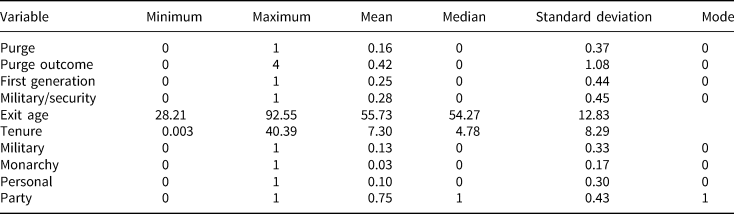
Finally, the characteristics of certain types of autocracies could influence the likelihood of elites being purged and punished. Personalist regimes are more likely to rely on internal repression, which could affect elite survival, while single-party regimes create stability through greater institutionalization (Frantz and Kendall-Taylor Reference Frantz and Kendall-Taylor2014). We control for the effects of regimes' characteristics by utilizing discrete dichotomous indicators for Military, Monarchy, Personal, and Single-party regimes (Geddes, Wright and Frantz Reference Geddes, Wright and Frantz2014). Summary statistics are in Table 2.
Summary statistics
Analysis
Descriptive statistics for our key variables provide support for Hypotheses 1 and 2. Table 3 shows that dictators are more likely to purge first-generation than non-first-generation elites, consistent with Hypothesis 1. Dictators in our sample purged 31.72 per cent of first-generation elites but only 10.54 per cent of non-first-generation elites, indicating that there is a substantive difference in purge target selection based on this characteristic. Consistent with Hypothesis 2, a plurality of first-generation elites who were purged were subsequently incarcerated (50.00 per cent; 23 out of 46), while fewer non-first-generation elites suffered a similar fate (17.78 per cent; eight out of 45). Drawing initial support for our hypotheses from these descriptive statistics, we now examine whether these findings are robust to accounting for alternative explanations.
First-generation elites, purges, and purge outcomes

We continue our analyses by more rigorously testing the finding that dictators are more likely to purge first-generation than non-first-generation elites. Figure 1 summarizes the results from a series of logistic regression models that sequentially add in the control variables described earlier: Military/security, Exit age, Tenure, and dummy variables for autocratic regime subtypes. We cluster heteroscedastic-robust standard errors by country to account for the variance of the error term being mis-specified. We estimate logistic regression models with and without country fixed effects to ensure that country-specific idiosyncratic factors are not biasing the results; these are analogous to regime fixed effects as all the countries included cover just one ruling institution.
Correlates of first-generation elites and purges.
Notes: First generation coefficients, with 95 per cent confidence intervals. N ranges from 496 to 572. For the full results, see Table A1 in the Online Appendix. FE = fixed effects.
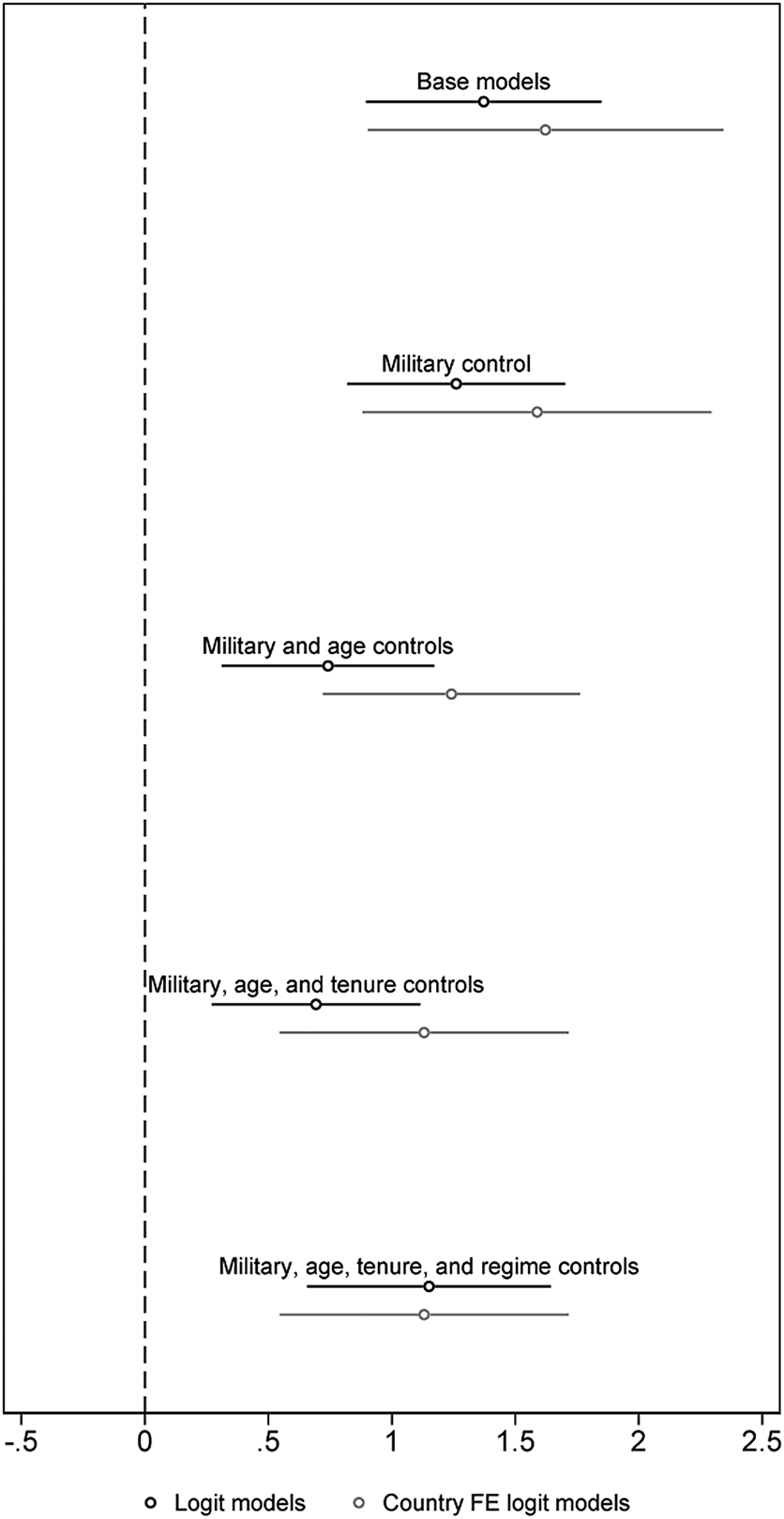
The results, summarized in Figure 1, show strong support for Hypothesis 1. The coefficients for First generation are, as expected, positive and statistically significant at least at 99 per cent confidence across all ten models. In other words, the finding that dictators are significantly more likely to purge first-generation than non-first-generation elites is robust to accounting for alternative explanations.
Substantively, these effects are non-trivial. Further analysis using the observed values approach based on the logit models suggests that, on average, being a first-generation elite raises the probability of being purged from 0.10 (between 0.06 and 0.16) to 0.205 (between 0.02 and 0.22). These shifts represent 147 per cent to 1,266 per cent increases in the probability of a dictator purging a first-generation elite (Hanmer and Kalkan Reference Hanmer and Kalkan2013). Although the range of the substantive effects across the models is broad, the overall picture is clear: dictators are far more likely to purge first-generation than non-first-generation elites within their ruling institution.
The control variables are not depicted in Figure 1 (for the full results, see Table A1 in the Online Appendix), but they contain some interesting findings. We find little evidence that a dictator is more likely to purge elites from the military or security apparatus than those from affiliations without direct access to the apparatuses of violence. The coefficient for Military/security is consistently positive but does not reach conventional levels of statistical significance. This may appear surprising given that scholars emphasize that dictators must guard against military elites to prevent coups (Sudduth Reference Sudduth2017). However, the finding supports Bokobza et al.'s (Reference Bokobzaforthcoming) evidence, which shows that dictators must guard against military and civilian elites, as both can threaten autocratic survival (Kroeger Reference Kroeger2020).
Elsewhere, older elites are less likely to be purged; this may be because dictators can more easily trust older elites, or because they pose less of a threat to the dictator due to advanced age or poor health (relatedly, see Bueno de Mesquita and Smith Reference Bueno de Mesquita and Smith2017). However, we find no evidence that the length of time that an elite has been in the ruling institution affects their propensity to be purged. This contrasts with Bokobza et al.'s (Reference Bokobzaforthcoming) finding that dictators keep veteran cabinet ministers in post after failed coups. The difference between these findings may be due to Bokobza et al. (Reference Bokobzaforthcoming) examining the purges of cabinet ministers exclusively, whereas we study civilian and military elites that hold offices in the regime's top ruling institution. We also find no evidence that military dictators are more likely to purge elites, but we do find some evidence that personalist dictators are less likely to purge elites. We are wary of over-interpreting these latter findings, however, as they are based on one model.
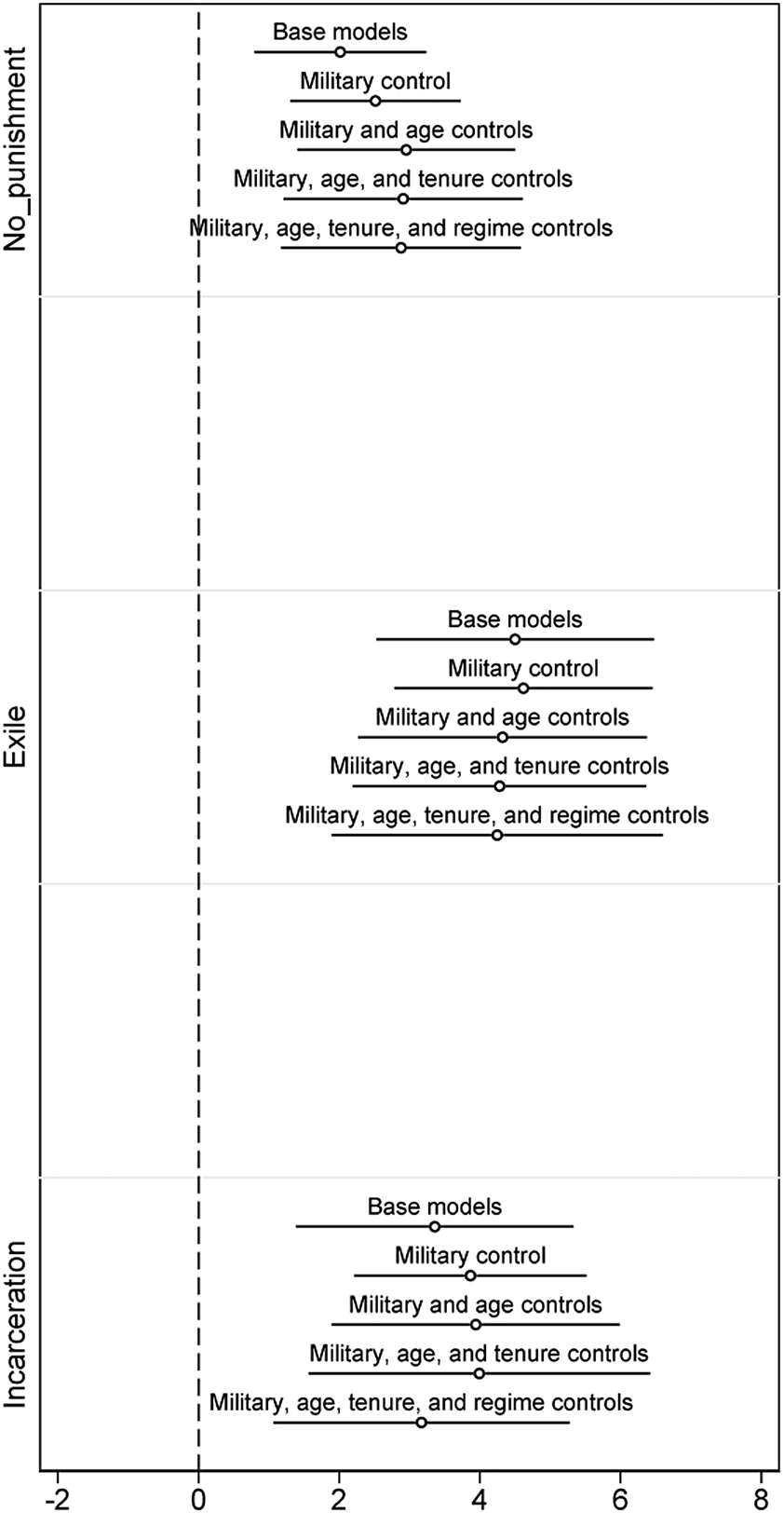
We next examine whether the finding that dictators are more likely to incarcerate purged first-generation elites is robust to accounting for alternative explanations (Hypothesis 2). As before, we estimate a series of models where we sequentially add in our control variables; again, standard errors are clustered by country. As we are only interested in the varying outcomes of elites who were purged, we restrict our sample to purged elites. The dependent variable is Purge outcome, the categorical variable that captures whether elites were purged either without further punishment or then exiled, executed, or incarcerated. We therefore estimate multinomial logistic regression models where the base category is that an elite was incarcerated.
Figure 2 summarizes the relationship between First generation and Purge outcome. Overall, the models provide some evidence consistent with Hypothesis 2: first-generation elites who are purged are more likely to be incarcerated than executed, and there is some evidence that they are more likely to be incarcerated than purged without any further punishment, though this latter finding is made with weaker confidence; however, purged elites are not more likely to be incarcerated than exiled. We use the Clarify program to demonstrate the substantive effects of an elite being in the first generation on different purge outcomes (King, Tomz, and Wittenberg Reference King, Tomz and Wittenberg2000). We run 1,000 simulations and draw predicted values from a multivariate normal distribution. We find that a purged elite being in the first generation, compared to a non-first-generation purged elite, leads to an increase of 0.30 (between 0.19 and 0.49) to 0.33 (between 0.21 and 0.54) in the probability of incarceration. These figures represent 155–6 per cent increases in the probability of a purged elite being incarcerated.
Correlates of first-generation elites and purge outcomes.
Notes: First generation coefficients, with 95 per cent confidence intervals. N ranges from 90 to 91. For the full results, see Table A2 in the Online Appendix. Base category is Incarceration.
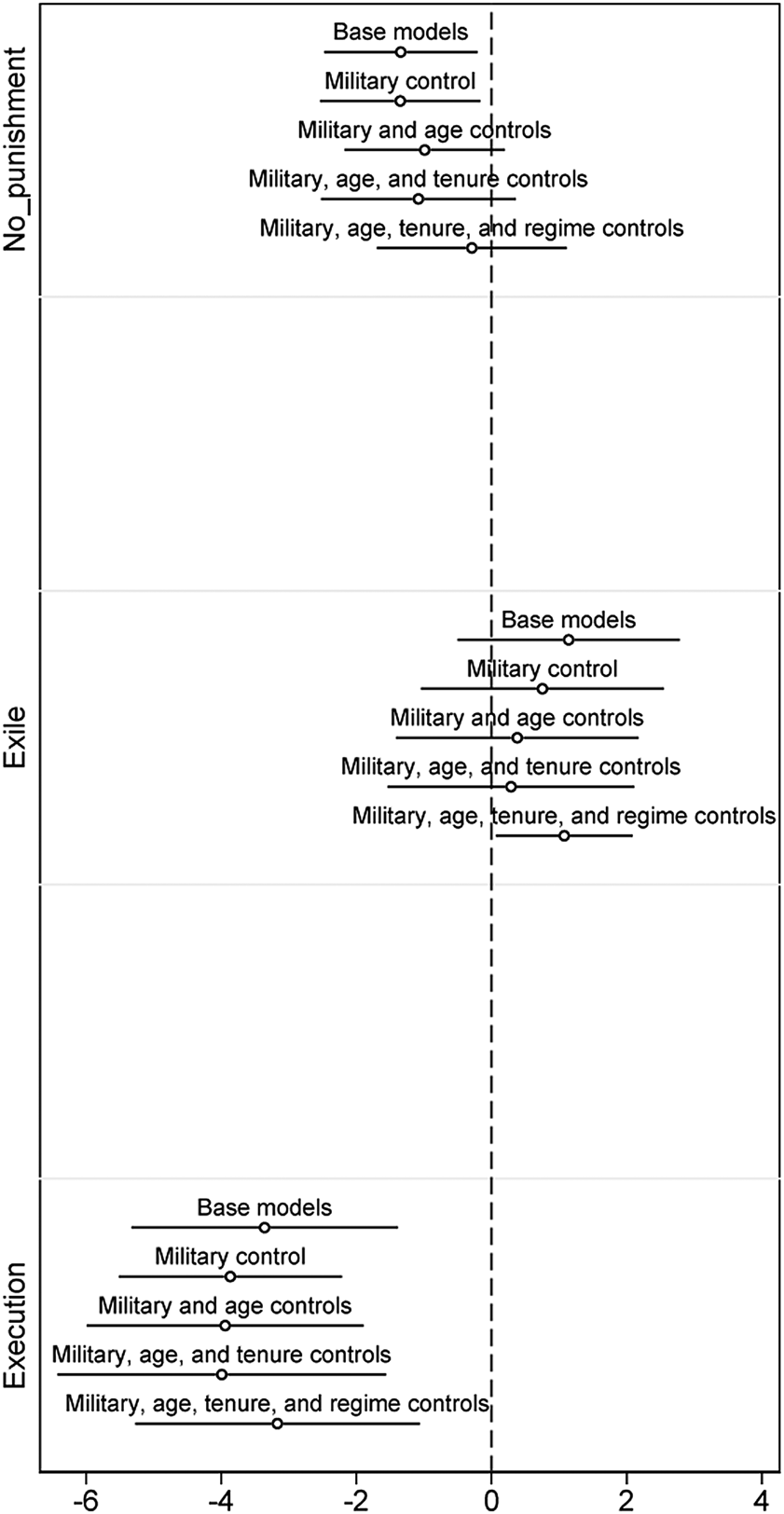
To better understand the relationship between first-generation elites and different purge outcomes, we further investigate, based on the simulations, how the likelihood of different purge outcomes interrelates. The findings are presented in Table 4. The simulations show that the increase in purged elites being incarcerated when they come from the first generation comes mainly at the expense of executions. This is consistent with our argument that dictators do not want to make a martyr out of high-profile rivals. To further illustrate this, we re-estimate our multinomial logit models with Execution as the base category (see Figure 3). We find strong evidence that dictators are less likely to execute an elite than they are to purge them without further punishment, exile them, or imprison them. This lends some evidence to the warning presented in the earlier case from Equatorial Guinea, suggesting that many dictators recognize the blowback that can occur if executions are used too readily on purged first-generation elites.
Percentage of purge outcomes for simulated scenarios
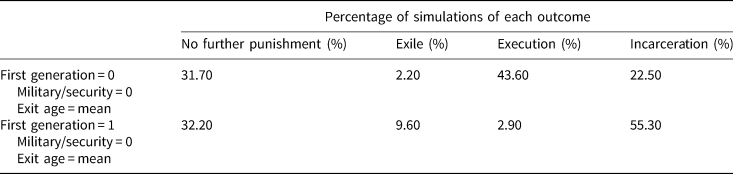
Notes: Results come from simulations based on a multinomial logit model, with controls for military and age. See Model 3 in Table A2 in the Online Appendix.
First-generation elites and executions.
Notes: First generation coefficients, with 95 per cent confidence intervals. N ranges from 90 to 91. For the full results, see Table A2 in the Online Appendix. Base category is Execution.
From the control variables of the multinomial logit models, there are a few noteworthy findings. Older elites are less likely to be exiled, and longer-serving elites are less likely to be incarcerated. Elites in military regimes may be more likely to be incarcerated, and elites in personalist regimes may be less likely to be executed. Again, this last finding is based on a single coefficient, so we are wary of over-interpreting the result. The full results of the multinomial logit models are presented in Table A2 in the Online Appendix.
We check the sensitivity of the results with several robustness tests. First, we check that our findings are robust to selection effects by estimating a two-stage model of purges and purge outcomes (see Table A3 in Online Appendix E).
Secondly, are purges and the manner of purges affected by whether the elite participated in a coup attempt against the dictator (Bokobza et al. Reference Bokobzaforthcoming)? For instance, a dictator may feel compelled to execute, rather than incarcerate, a first-generation elite who participates in a coup attempt. We therefore re-estimate the models accounting for this possibility (see Tables A4 and A5 in the Online Appendix). Thirdly, we re-estimate the logit models with leader fixed effects to check whether the results are driven by the time-invariant characteristics of leaders (see Table A6 in the Online Appendix).
Fourthly, our theory specifies that dictators are more likely to purge first-generation elites, ceteris paribus. It is possible, however, that the mechanisms underpinning our theory only or especially occur at the start of a regime as dictators seek to quickly remove threatening elites (Sudduth Reference Sudduth2017). We therefore re-estimate the logit models with an interaction term for First generation × Tenure to test whether dictators are more likely to purge first-generation elites at certain times during the latter's membership in the ruling institution. We find little evidence that dictators are more likely to purge first-generation elites early in the regime's existence (see Table A7 in the Online Appendix). Fifthly, and relatedly, we re-estimate the models concerning which elites dictators purge using hazard models, finding that dictators are always more likely to purge first-generation than non-first-generation elites (see Table A8 and Figure A1 in the Online Appendix).
Sixthly, our mechanisms underpinning who dictators purge may apply specifically to regimes that came to power through violence, including by revolution. In the theory, however, we argued that the characteristics that make first-generation elites more threatening – greater power and stronger vertical and horizontal linkages – do not just apply to elites in regimes born out of violence. We test this possible objection by re-estimating the logit models with a binary indicator for revolutionary regimes (Lachapelle et al. Reference Lachapelle2020) (see Table A9 in the Online Appendix).
Seventhly, our results may be driven by issues relating to regime type. The shorter duration of military or personalist regimes (Geddes, Wright and Frantz Reference Geddes, Wright and Frantz2014), for instance, may affect the results, or pre-power purges, which may be more common in party regimes, mean that the ruling coalition is more stable upon taking power, thus diminishing the need for purges of first-generation elites. We accounted for regime type in the logit models, but the dichotomous regime-type indicators were omitted in the country fixed-effects models, as they do not vary within countries. We therefore re-estimated the fixed-effects models and the multinomial logit models by omitting each regime type.Footnote 14
Finally, as the selection of regimes was not random, the results could be an artefact of characteristics unique to these regimes. We probe this concern by dropping each ruling institution and re-estimating the models.Footnote 15 Overall, the results across these tests are unchanged, with strong support for Hypothesis 1 and moderate support for Hypothesis 2.
Conclusion
A renewed focus on elite politics in dictatorships has improved our understanding of how these regimes function and endure (see, for example, Sudduth Reference Sudduth2017; Woldense Reference Woldense2018). However, our understanding of the micro-politics that shape the crucial balance of power between a dictator and his elites remains limited. This includes the study of purges, where we have only nascent comparative knowledge of who dictators purge and how they purge them (see, for example, Bokobza et al. Reference Bokobzaforthcoming). As the number of autocracies in the world swells (Alizada et al. Reference Alizada2021), developing theories explaining political interactions between dictators and their elites takes on increasing importance, with these events having the potential to motivate significant domestic-level changes and shifts in international behaviour by the regime.
We argue that dictators use a heuristic to identify dangerous elites. First-generation elites – who acquire greater shares of power during co-optation and stronger vertical and horizontal linkages with supporters and other elites – tilt the regime's balance of power towards ‘contested autocracy’, which dictators perceive as threatening their political survival (Svolik Reference Svolik2012, 55). Examining original data on ruling institutions from sixteen autocracies, we show that dictators are more likely to purge first-generation elites and are more likely to incarcerate them, especially instead of executing them, as they seek to mitigate short- and long-term dangers that could follow these contentious events.
This article's theoretical and data contributions suggest several avenues for future research. First, comparative individual-level data on autocratic regimes remain scarce; those included in our analyses represent a subset of the possible universe of cases. Continuing the collection of these data could better facilitate research on several important areas of authoritarianism, such as elite descriptive representation, ruling coalition composition over time or factors leading to elite turnover. Secondly, while these purge events appear important to understanding authoritarian survival, dictatorships ‘do more than endure’ (Pepinsky Reference Pepinsky2014, 650–1). How, then, can the selection of different purge targets or outcomes affect the onset of subsequent connected events, such as coup plots, repression towards civilians or the implementation of economic policies that affect citizens' lives? Questions such as these represent only a few made possible through the contributions of this article, presenting new avenues to better understand the dynamics of authoritarian power sharing and how their recalibrations can affect the billions of people who reside within these systems.
Supplementary Material
Online appendices are available at: https://doi.org/10.1017/S0007123421000569
Data Availability Statement
Replication data files can be found in Harvard Dataverse at: https://doi.org/10.7910/DVN/4LVL7Y
Acknowledgements
We would like to thank Laron K. Williams for his advice, and Dogus Aktan for helpful comments. A previous version was presented at the 2021 annual meeting of the Midwest Political Science Association. We are also grateful to two anonymous reviewers and the editor, who provided insightful comments that helped improve the manuscript. We are responsible for all errors.
Financial Support
Edward Goldring acknowledges funding from the Hong Kong Research Grants Council, PDFS2021-6H02.
Competing Interests
None.


 Open access

