


Introduction
In the light of the global extinction crisis and the continuing increase in the number of globally threatened species (e.g. Thomas et al. Reference Thomas, Telfer, Roy, Preston, Greenwood, Asher, Fox, Clarke and Lawton2004), prioritising conservation action and funding it are arguably more important than ever (e.g. Brooks et al. Reference Brooks, Mittermeier, da Fonseca, Gerlach, Hoffmann, Lamoreux, Mittermeier, Pilgrim and Rodrigues2006). However, assessing the conservation status of a species in the first place is often not as straightforward as it may seem because of problems of bias and inaccuracy in monitoring data (Sutherland Reference Sutherland and Sutherland2000). This situation is intensified by limited amounts of available data owing for example to the rarity or elusiveness of a species, or remoteness and inaccessibility of its habitat, limitations in the number of well-trained survey personnel, non-standardised survey methods, temporal and geographical gaps between surveys or the difficulty in obtaining unpublished survey reports.
One such species is the Western Tragopan Tragopan melanocephalus (subsequently referred to as ‘Tragopan’), an endemic and extremely elusive pheasant of the Western Himalayas, occurring during its breeding season on steep north-facing forested slopes at altitudes between 2,400 and 3,600 m (Ali and Ripley Reference Ali and Ripley1987). It has a relatively small geographical range, from Indus Kohistan, northern Pakistan, east through Kashmir and Himachal Pradesh to Uttarakhand in north-west India (Ali and Ripley Reference Ali and Ripley1987). This galliform species is classified as ‘Vulnerable’ on IUCN Red List because its small and sparsely distributed population is declining and becoming increasingly fragmented in the face of continuing forest loss and degradation throughout its restricted range (BirdLife International 2014, IUCN 2014). Current estimates suggest a global population of at least 5,000 individuals, derived from Gaston et al. (Reference Gaston, Garson and Hunter1981) and McGowan and Garson (Reference McGowan and Garson1995), which is thought to be roughly equivalent to 3,300 mature individuals. This number may however be smaller than previously thought, in light of which the species may warrant uplisting to Endangered (BirdLife International 2014).
Throughout its range the Tragopan is called ‘the King of Birds’ among the local communities, it is the national bird of Himachal Pradesh (HP) and among the Western Himalayan birds one of the most intensively surveyed species. Among local authorities it is therefore commonly regarded as the most important ‘flagship species’ for the fragile mountainous forest ecosystem where it occurs (Awan and Buner pers. obs. 2014).
We reviewed all published and unpublished Tragopan literature available for Azad Jammu and Kashmir, which covers c.30% (6,382 km2) of the 21,000 km2 of the species’ global range (BirdLife International 2014). We examine the difficulties and limitations in interpreting and comparing past and recent field survey data and the abundance estimates that were drawn from those. We list all locations where the species has been confirmed by surveys to date together with sites where the species has been reported by local herdsmen and wildlife staff. We then summarise the current distribution in AJ&K using a simple GIS model based on altitudinal range of the species, aspect and forest cover. Based on this review we attempt a minimum and maximum population estimate for the species in AJ&K, stress the need for standardised and better coordinated surveys across its range and highlight significant research gaps in the species’ ecology that preclude more sophisticated population estimates. We finally formulate research needs to inform policy development work for the conservation of this threatened species throughout its global range.
Study area
The state of Azad Jammu and Kashmir (AJ&K) is situated mainly in the lower foothills of the Western Himalayas from 33o to 36o N and 73o to 75o E (AJK 2011). The region stretches arc-like from the south-east to the north-east, covering an area of 1,330,000 ha. The north and north-western part of the state borders Khyber Pakhtunkhwa, formerly the North West Frontier Province (NWFP), Punjab to the south and the Line of Control (LOC) between Pakistan and India to the east, an area of severe political instability during the past decades. The climate across the state ranges from generally dry sub-tropical in the lowland valleys and foothills to temperate in the north and alpine with increasing elevation from 275 to 6,325 m.
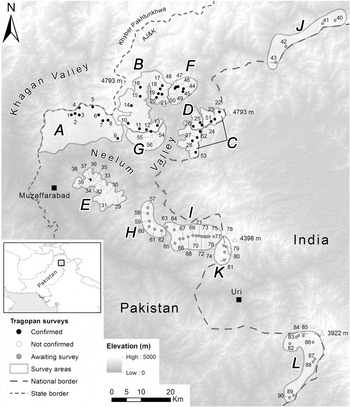
The surveys described in this review were mainly conducted within the side valleys of the Neelum river, which forms the main valley of Azad Kashmir, and the Jagran valley, the main north-western side valley. Additional surveys were conducted in the Jhelum valley to the south-east of Muzaffarabad where the Jhelum river joins the Neelum river (see also Figure 1). There are seven protected areas within the study area that together cover an area of 24,209 ha: Machiara National Park (13,532 ha), Salkhala Game Reserve (859 ha), Moji Game Reserve (3,860 ha), Qazi Nag Game Reserve (4,830 ha), Mori Said Ali Game Reserve (273 ha), Phalla Game Reserve (472 ha) and Hillan Game Reserve (384 ha). For the latter three Game Reserves there is uncertainty about their exact boundaries and hence we were unable to show these in Figure 1.
Confirmed and likely Western Tragopan presence in Azad Jammu and Kashmir, Pakistan. Black dots = species’ presence confirmed at standardised point count locations, white dots = species surveyed but not confirmed, grey dots = species likely to be present based on reports by local herdsmen and wildlife staff but not surveyed to date. The numbers next to the point count locations refer to the survey location numbers in the text and Appendix. A = Machiara National Park, B = Jagran Valley, C = Outside Salkhala Game Reserve, D = Salkhala Game Reserve, E = Pir-Chinasi/Pir-Hasimar area, F = Katha Peeran, G = Jura, H = Moji Game Reserve, I = Qazi Nag Game Reserve, J = Upper Neelum Valley, K = Leepa Valley, L = Haveli Kahuta.
Methods
We used a multi-stage process to review the Western Tragopan literature for AJ&K. First we used Google Scholar to search for articles that included either ‘Western Tragopan Kashmir Pakistan’, ‘Western Tragopan Azad Kashmir’, or ‘Western Tragopan survey, habitat use, abundance or distribution’. Second we used Zoological Records (1978–2015) at http://wok.mimas.ac.uk/ using the same search criteria. Third we added our own collection of published and unpublished material, in particular unpublished technical and field progress reports as well as prosecution and hunting reports that are typically not available on the web. Our review also includes unpublished information on the species’ presence in the region based on interviews conducted among local herdsmen and hunters, where field surveys have not been conducted so far. We finally compiled and structured previous work on Tragopan in AJ&K into 12 well-defined regions based on their geographical location and amount of data available (see Figure 1 and Appendix 1). We used ArcGIS 10.2.1 (Esri 2014) to estimate the distribution and total number of Western Tragopan in AJ&K, based on the data reviewed here together with three simple landscape criteria where the species has been recorded, 1) altitude (2,400–3,600 m), 2) aspect (restricted to slopes facing 0o –135o and 225o –360o, to exclude south-facing slopes) and 3) forest cover (40–100%). Aspect and elevation were derived from USGS’s Global Digital Elevation dataset Version 2 (NASA LP DAAC 2001). For forest cover we utilised the Global Forest Change 2000–2013 dataset Version 1.1 (Hansen et al. Reference Hansen, Potapov, Moore, Hancher, Turubanova, Tyukavina, Thau, Stehman, Goetz, Loveland, Kommareddy, Egorov, Chini, Justice and Townshend2013). Resolution of all datasets was the pixel corresponding to a c.25 x 25-m square. Using ArcGIS raster calculator, all three quantities (altitude range, aspect and forest cover) were used to create a simple binary species distribution model (SDM) where all three coincided.
Results
Literature search
Via Google Scholar we located four peer-reviewed papers, four conference proceedings, five published reports, one unpublished report and one book that fitted our search criteria. The Zoological Records search found four peer-reviewed papers and two published reports, only Mirza et al. (Reference Mirza, Aleem and Asghar1978) was not found using Google Scholar. Our own collection of literature, accumulated as a consequence of our field research on Western Tragopan, personal contacts with the respective authors together with organizations such as the World Pheasant Association (WPA) and wildlife authorities in AJ&K, included six peer-reviewed papers, five conference proceedings, six published reports, 15 unpublished reports and three books. The online literature located no literature that we were not already aware of.
Habitat use
During the breeding season (April–June), Tragopans are characteristically associated with little-disturbed mixed coniferous mountain forests between 2,400 and 3,600 m, on steep north-facing forested slopes in the transition zone between the moist and dry temperate climatic zones (Ali and Ripley Reference Ali and Ripley1987, Buner and Connell 2010, Awan Reference Awan2014). However, there are regional differences in the species’ altitudinal migration and habitat selection owing to the topographic complexity of its mountainous environment (Madge and McGowan Reference Madge and McGowan2002). Mirza (Reference Mirza1998), based on his surveys in AJ&K, describes the association of Tragopan with dry temperate forests and the following tree species: West Himalayan spruce Picea smithiana, blue pine Pinus wallichiana and deodar Cedrus deodar. Awan (Reference Awan2010) describes Tragopan habitat in Salkhala Game Reserve as being associated with Himalayan birch Betula utilis, West Himalayan fir Abies pindrow, West Himalayan spruce and Indian maple Acer caesium. In winter, the Tragopan makes local altitudinal or lateral movements during heavy snowfall, to grassy or shrubby gullies with less snow cover, between 1,750 m and 3,000 m (BirdLife International 2001), presumably because more sunshine results in less snow cover and therefore provides easier access to food sources (Whale Reference Whale1997).
Survey data
The first Tragopan officially mentioned in Pakistan in a written report was by Wayre (Reference Wayre1971), who recorded the species in Khagan valley to the north-west of Azad Kashmir. The first systematic pheasant survey in Pakistan was conducted in Azad Kashmir in 1977 by Mirza et al. (Reference Mirza, Aleem and Asghar1978), who pioneered galliform research in Pakistan.
Machiara National Park (Area A)
Mirza et al. (Reference Mirza, Aleem and Asghar1978) surveyed the comparatively simple topographical terrain within the Machiara Game Reserve (established in 1982) where they recorded seven males (five adults, two juveniles) and six females using the beating method within an area of 7.8 km2 at an altitude of 2,825 m (area A, location 8, Figure 1). No further surveys were conducted in Azad Kashmir until Islam (Reference Islam1982) returned to Machiara (14 birds within 8.8 km2, seven males heard and three flushed, one female heard and three flushed; locations 7 and 8). These two surveys subsequently led to the creation of the Machiara National Park in 1996, now classified as an Important Bird Area (PK017, Chan et al. Reference Chan, Crosby, Islam and Tordoff2004). Further surveys were conducted in Machiara during April and October 1983 (Islam and Crawford Reference Islam and Crawford1987) using the same methodology as Islam (Reference Islam1982), yielding a recorded minimum of 22 individuals. No systematic Tragopan surveys were conducted during 1990–2000 owing to the cross-border conflict between India and Pakistan. However some areas were visited mainly for general biodiversity assessments by Pakistani Wildlife Department staff and university students and their unpublished reports contain information about Tragopan. From Machiara National Park, Ahmad (Reference Ahmad1997a) reported five and estimated a total of 16 Tragopans. In 2004 an ornithological survey in the park by the Wildlife Department recorded 15 individuals and estimated 75 between 1,960 and 2,890 m, by combining field data with local reports (Hassan Reference Hassan2005). A second survey the following year by Anwar et al. (Reference Anwar, Zaman and Minhas2006) attempted a more standardised method. Here the average number of birds flushed within an unspecified area and number of 1-km transects was calculated and then multiplied by the total amount of habitat available. However, the report fails to explain which habitat criteria were used. A total of 26 Tragopans were flushed and 91 birds estimated for the whole Park. In May 2008, nine point count locations covering an approximate area of 300 m radius (c.28 ha each) were established across the park within suitable habitat (mixed coniferous forests with dense understorey, especially those with pockets of birch if present), exposition (north to north-east or north-west, never south to south-east or south-west) and altitude (2,400–3,500 m), based on published literature and unpublished reports together with information obtained from hunters and local herdsmen (Awan and Buner Reference Awan and Buner2010). At each survey point, monitoring was done once at dawn (around 04h30) and lasted until 20 min after the first Tragopan male was heard calling, following a method first used and described for Tragopan by Duke (Reference Duke, Hill, Garson and Jenkins1989). A total of 22 calling males within a total combined area of 2.5 km2 were recorded (locations 1–9).
Jagran valley (Area B)
At Kutton, within the Jagran Valley (a side valley of the Neelum Valley), Mirza et al. (Reference Mirza, Aleem and Asghar1978) recorded nine birds based on point call counts and seven males and four females flushed in an area of 26 km2 (locations 12 and 13). Whether the flushed males were previously monitored during the call counts remained unknown. Islam (Reference Islam1982) also visited Jagran valley but reported only two calling males or five birds in total within 3.2 km2; within the same area. In 2012 Awan (Reference Awan2013) conducted 12 Tragopan surveys in Jagran valley (locations 10–21) using the same call count method described by Duke (Reference Duke, Hill, Garson and Jenkins1989) and used by Awan and Buner (Reference Awan and Buner2010), but this time, each point count location was additionally monitored at dusk (18h30–19h30) and hence each survey point was monitored twice according to a standardised method used by Buner and Lewis (Reference Buner and Lewis2006), Buner (Reference Buner2007) and Buner and Connell (Reference Buner and Connell2008) in Palas Valley. Among the 12 newly established survey plots a total of 23 calling males were recorded in a combined area of 3.4 km2 of suitable habitat. Based on those data, together with those obtained at Pir-Chinasi/Pir-Hasimar (see below), neither the dawn nor the dusk counts resulted in higher average abundance estimates but in 50% of cases one of the two counts recorded one individual more than the other (see Appendix S1 in the online supplementary materials for details). Within the area of Kutton (locations 12–13) the number of Tragopans recorded was 2–9 males, depending on year and surveyor, with no difference in number recorded between Islam (Reference Islam1982) and Awan (Reference Awan2013).
Salkhala Game Reserve (Area D) and surrounding area (Area C)
In and around Salkhala Game Reserve Mirza et al. (Reference Mirza, Aleem and Asghar1978) recorded 12 calling males and flushed two males and four females in an area of 31.2 km2 at elevations ranging from 3,000 to 3,175 m in May (area C and D). At Salkhala Game Reserve, Islam (Reference Islam1982) observed 10 birds within 14.5 km2, location 26, based on 1-km transects. As in Machiara, Islam and Crawford (1987) visited Salkhala Game Reserve during April and October 1983 where they recorded a total of 17 individuals along 1-km transects. Sabir et al. (Reference Sabir, Awan and Anwar1999) reported six birds from within the Game Reserve. A hunting report from Gail near Salkhala Game Reserve (location 27) was submitted to the AJ&K Wildlife Department (Anonymous 2000), providing the first documented evidence that the species was also present outside the protected area since Johnsgard (Reference Johnsgard1986) first mentioned the species from Bugna to Phalakan based on knowledge provided by locals (locations 22, 23, 27, 28 and 51–53). Surveys conducted by the AJ&K Wildlife Department in June 2003 reported the species at Purzaan (2,566 m, location 26), Thapla (2,682 m) and Urnian (2,370 m, both location 25b), where a total of eight individuals were flushed (Anonymous 2003). A second survey by the same team (Anonymous 2005) flushed another 16 individuals from two additional sites within the reserve at Rian (2,163 m) and Hakam Dunga (2,955 m, both location 25c). Awan et al. (Reference Awan, Ali and Lee2012) recorded seven male Tragopans in May and six in June at location 25, which was part of a general bird survey in the Reserve in 2007. In 2010, two standardised point-count locations were established by Awan (Reference Awan2010) within the Reserve (24 and 26) and another four (22, 23 and 27, 28) in close proximity to the reserve. Using the dawn count method described in Awan and Buner (Reference Awan and Buner2010), this survey recorded a total of 13 calling males (location 22-24 and 26-28) within a combined total area of 1.7 km2 of suitable habitat (Awan and Buner Reference Awan and Buner2014). In May and early June 2014 Awan (Reference Awan2014) surveyed an additional three previously unexplored side valleys in proximity to Salkhala Game Reserve (locations 51, 52 and 53), where a further four Tragopan males in a combined area of 0.84 km2 were recorded.
Pir-Chinasi/Pir-Hasimar area (Area E)
Islam (Reference Islam1982) first reported the species within this area based on reports by locals from only two unidentifiable locations. A visit by Islam (Reference Islam1991) to Pir-Chinasi in the late 1980s did however not confirm the species and hence he concluded that it might have gone locally extinct, owing to large areas of forest being cleared, a general lack of ground vegetation and highly degraded remaining forested areas. However, a hunting report submitted to the AJ&K Wildlife Department provided evidence that the species was still present in this area (Anonymous 1998). Awan (Reference Awan2012) subsequently monitored 11 point count locations in Pir-Chinasi/Pir-Hasimar (locations 29–39) using the same dawn and dusk count method applied in Jeelum valley in the same year. Only three calling males were recorded within 0.6 km2 at two of 11 plots (Awan Reference Awan2012).
Katha Peeran (Area F) and Jura (Area G)
Based on reports from local herdsmen and the proximity to already known Tragopan sites at Machiara National Park (area A) and Jagran Valley (area B), Awan (Reference Awan2014) surveyed seven locations in Katha Peeran (locations 44-50) and three at Jura (54-56). At Katha Peeran, 10 calling Tragopans were recorded among five survey points (44-48), and none at 49 and 50. At Jura, two Tragopans were recorded at location 54, whereas at 55 and 56 forest exploitation and heavy grazing by local herdsmen was the most obvious reason for failing to confirm Tragopans.
Moji Game Reserve (Area H)
Ten Tragopans were sighted and a population of 20–30 estimated during a Wildlife Department biodiversity survey based on transects (Ahmad Reference Ahmad1997b) and a second survey by Ahmed et al. (Reference Ahmed, Awan and Anwar1999) in May-July 1998 estimated 14 birds from the same area based on the call count method described by Gaston (Reference Gaston1980). Neither report gives details about exact location, number of transects nor survey points and time of day of census. No surveys have been conducted in this area since.
Qazi Nag Game Reserve (Area I)
In this area, the species was first reported by Islam (Reference Islam1982), and Qureshi et al. (Reference Qureshi, Awan and Anwar1999) estimated 20 Tragopans, both based on reports received either from local herdsmen or wildlife staff; but no standardised surveys have confirmed the species to date.
Upper Neelum Valley (Area J), Leepa Valley (Area K) and Haveli Kahuta (Area L)
Based on geographical location and potential availability of suitable habitat together with reports from local herdsmen and hunters, it is likely that the species also exists in these areas. Islam (Reference Islam1982) first reported the species from Leepa valley and The Deputy Director of Wildlife of AJ&K, Dar (Reference Dar2006), based on reports from wildlife staff, mentioned the presence of Tragopans in three protected Game Reserves in Haveli Kahuta (Mori Said Ali, location 82; Phalla, location 83 and 84; Hillan, location 87 and 88); however, these have not been confirmed by any survey.
General population estimates
Based on the surveys by Mirza et al. (Reference Mirza, Aleem and Asghar1978) and Islam (Reference Islam1982) and a published review by Gaston et al. (Reference Gaston, Islam and Crawford1983), Qayum (Reference Qayum1987), then Director General of Wildlife in AJ&K, broadly estimated the number of Tragopans in the region at 378 individuals. Referring to the same data published by Mirza and Islam, Roberts (Reference Roberts1985) estimated a total of 100 individuals for Machiara National Park and Salkhala Game Reserve combined but revised the number to 85 individuals in Roberts (Reference Roberts1991). Chaudhry (Reference Chaudhry and Jenkins1992), the Director General of Wildlife in Punjab, mentions a verbal communication by Qayum in 1990 who estimated 100–150 birds in Machiara, 100–150 individuals in the area encompassing Salkhala, Moji, Qazi Nag and Hillan Game Reserves and 200 individuals in the Leepa valley (remarks from authors: Moji is part of Leepa valley but we presume Qayum meant the area outside Moji), corresponding to a total of 400–500 individuals, although no surveys had been conducted in the latter areas at that time (BirdLife International 2014). Based on more recent standardised surveys (Awan and Buner Reference Awan and Buner2010, Awan Reference Awan2012, Reference Awan2013, Reference Awan2014, Awan et al. Reference Awan, Ali and Lee2012), Awan estimated 70–80 individuals for Machiara and 20–24 for Salkhala, or 90–104 individuals combined for both protected areas, which is remarkably similar to the estimate of Roberts (Reference Roberts1985). Awan further estimated 60–70 individuals for the area adjacent to Salkhala Game Reserve, 6–10 for the Pir-Chinasi/Pir-Hasimar area, 80–90 for Jagran valley, 20–30 for Katha Peeran and 4–6 for Jura; or 260–310 Tragopan males. Assuming a male/female sex ratio of 0.6/0.4 (Islam and Crawford Reference Islam and Crawford1993), who used flush counts in Machiara, Salkhala and Kuttan using dogs, these correspond to 433–516 birds for the total area surveyed.
Western Tragopan density estimates
Mirza (Reference Mirza and Savage1980), based on Mirza et al. (Reference Mirza, Aleem and Asghar1978), estimated the density in suitable habitat in the Neelum Valley at 0.8–1.6 birds/km2 and hence considered the species ‘still common’ in some ‘pockets’ of Azad Kashmir. Based on his results, Islam (Reference Islam1982) estimated 1.5 birds/km2 in Machiara and a density of 1.3 individuals/km2 was estimated from Islam’s data in 1982 (Gaston et al. Reference Gaston, Islam and Crawford1983). Awan and Buner (Reference Awan and Buner2010), Awan et al. (Reference Awan, Ali and Lee2012), and Awan (Reference Awan2012, Reference Awan2013, Reference Awan2014) recorded 84 male Tragopans among 39 standardised survey plots between 2007 and 2014 covering a combined total area of c.10.9 km2 in suitable habitat for the species in: Machiara National Park 22 males (n = 9 survey plots), Salkhala Game Reserve 10 males (n = 3 survey plots) and 14 males in its adjacent valleys (n = 7 plots), Jagran valley 23 males (n = 12 plots), Pir-Chinasi three males (n = 2 plots), Katha Peeran 10 birds (n = 5 plots) and Jura two males (n = 1 plot). To analyse the effects of area protection on the number of Tragopans, we fitted a GLM with over-dispersed Poisson error and logarithmic link to the total number of Tragopans surveyed per count point plot as the response variable, with type of protection (protected or non-protected) as explanatory variable. There was no difference in the number of Tragopans per survey plot (28 ha each) between protected areas (avg. 2.4 males, SE = 0.43, n = 19) and unprotected areas (avg. 1.9 males, SE = 0.23, n = 20, F(1,37) = 1.71, P = 0.199). Hence, across all survey plots where the species was confirmed, an average of 2.2 (SE = 0.18) calling Tragopan males per plot were found. Assuming that the average number of Tragopans recorded per survey plot is equal to the number of Tragopans per km2 - justifiable by the highly patchy distribution of suitable habitat - and a male/female sex ratio of 0.6/0.4 (Islam and Crawford 1992), this equates to 3.1 birds/km2, more than any other previous estimate. However, when considering all 52 survey plots, including the 13 locations where no Tragopans were found, there were significantly fewer plots that detected Tragopans in unprotected areas (62%) than in protected areas (100%; chi-square = 10.37, df = 1, P < 0.01).
Simple binary species distribution model (SDM)
Based on the data reviewed above we evaluated the potential distribution of the Western Tragopan in AJ&K using a simple SDM (Figure 2). The average amount of forest cover within the c.28 ha survey points that confirmed Tragopan was 46%. Therefore, a threshold of 40% forest cover was considered an appropriate value for Tragopan preference. For the SDM we combined the forest cover of 40–100% with the altitude and aspect criteria to generate a pixel-level map of suitable habitat (close-up of Machiara National Park in Figure 2).
Predicted Western Tragopan distribution in AJ&K based on suitable elevation, aspect and forest cover. Black squares (n = 641) = 1-km2 squares containing 40–100% of suitable habitat; dark grey squares (n = 653) = 1-km2 squares containing 20–40% suitable habitat. The continuous light grey shaded areas indicate the altitude of 2,400–3,600 m where the species can potentially be found during the breeding season. Inset map – detail around Machiara National Park illustrating the three quantities of the binary habitat suitability model – Forest cover [dark grey], aspect [mid-grey] altitude range [light-grey] – and where all three coincided [black].
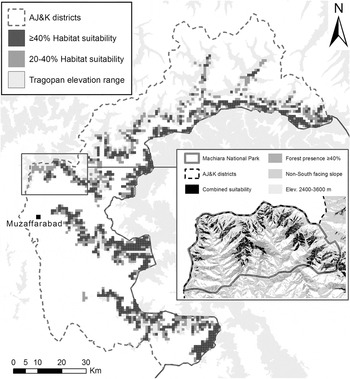
We then created a 1-km2 grid over the state of AJ&K and calculated the proportion of suitable habitat within each. There were 641 km2 containing 40–100% of suitable habitat. Closer inspection revealed that areas of the SDM where Tragopans were recorded had not been selected because they had been bisected by the 1-km2 grid. To overcome this problem all 1-km2 squares containing 20–40% of the SDM were also selected. This added a further 653 km2 or a total of 1,294 km2 with potential suitable habitat (Figure 2). Among the 39 survey points that confirmed Tragopan within a 300-m radius (Awan and Buner Reference Awan and Buner2010, Awan et al. Reference Awan, Ali and Lee2012, Awan Reference Awan2012, Reference Awan2013, Reference Awan2014), 21 intersected the 1-km2 squares with 40–100% suitability, 16 intersected those with 20–40% suitability and two did not overlap either area. Furthermore, 90% of 1-km2 squares where Tragopans were confirmed by surveys and 84% of those where the species can be expected based on reports by local herdsmen and wildlife staff fell within the area identified as potentially suitable for Tragopans (Figure 1). We therefore believe that the predicted distribution in Figure 2 is realistic. The districts that hold suitable Tragopan habitat in AJ&K are Neelam, Muzaffarabad, Hattian, Haveli and Bagh. The total area covered by the five districts is 6,382 km2.
Discussion
The data summarised here are presumably a typical example of the quality and quantity of survey data available for a little known bird species. In this case the lack of knowledge is largely because of the elusiveness of Tragopans, the topographically challenging environment, and the species’ restricted global distribution between north-eastern Pakistan and north-western India. Furthermore, neither region has a coordinated bird monitoring scheme in place, be it because of a lack of funding, suitable research institutes or well-trained field ornithologists. Hence, the surveys summarised here arose through a variety of different local or foreign initiatives rather than well-organised standardised monitoring. This resulted in a wide range of survey methods used, geographical bias in areas surveyed and consequently population and abundance estimates based on subjective rather than objective criteria. Of all 32 references cited in the Results section, 47% are unpublished, and two are written in Urdu. Only one of the 15 unpublished reports was available online. They are hence of very limited accessibility to international institutions such as BirdLife International, which assesses the status of the world’s bird species on a professional basis (IUCN 2014). Many of these reports remained vague about the localities visited and used local names that usually cannot be understood nor verified by non-residents. As an unavoidable consequence, previous attempts to summarise the distribution and abundance of this species for AJ&K included incorrect and uncertain citations to which other authors subsequently refer. For example BirdLife International’s Tragopan species factsheet states that Pir-Hasimar is in the Kotli district when in fact it is in the Muzaffarabad district; Pir Hari-Mor is not possibly but definitively in Pir-Hasimar and Pir-Chinari should read Pir-Chinasi (BirdLife International 2014). Also impossible to verify without the help of thorough reviews is the quality of verbal communications such as that by Qayum (Reference Qayum1987) who described the species as ‘rare’ in AJ&K. This statement was subjective and based on authority rather than scientific scrutiny, as this review reveals. Nevertheless, Pakistani Wildlife authorities now officially consider the Tragopan as highly threatened as a result of ongoing national decline (Awan pers. obs. 2013), neither of which is an obvious conclusion from the results of this review.
Western Tragopan distribution in AJ&K
Tragopan surveys in AJ&K span a period of four decades during which Machiara National Park, Salkhala Game Reserve, Jagran valley and the Pir-Chinasi area have been monitored repeatedly (Mirza et al. Reference Mirza, Aleem and Asghar1978, Islam Reference Islam1982, Islam and Crawford Reference Islam and Crawford1987, Ahmad Reference Ahmad1997a, Hassan Reference Hassan2005, Anonymous 2003, 2005, Anwar et al. Reference Anwar, Zaman and Minhas2006, Awan Reference Awan2010, Reference Awan2012, Reference Awan2013, Awan and Buner Reference Awan and Buner2010, Reference Awan and Buner2014, Awan et al. Reference Awan, Ali and Lee2012,) and the areas adjacent to Salkhala Game Reserve, Katha Peeran and Jura for the first time in recent years only (Awan Reference Awan2010, Reference Awan2014). Based on these surveys the confirmed presence of the Tragopan within AJ&K can be mapped (black dots in Figure 1). Apart from Pir-Chinasi where the species was recorded as extinct by Islam and Crawford (Reference Islam and Crawford1987) but ‘rediscovered’ by Awan (Reference Awan2012), all repeated surveys reviewed here consistently confirmed the species in the areas monitored during the past 40 years (see Appendix S1 for details). This indicates that the species’ distribution within the surveyed areas in AJ&K has not undergone any detectable range contraction during the period reviewed. However, apart from the surveys undertaken in Jagran valley, all surveys before 2010 were undertaken in the protected areas of Machiara National Park and Salkhala Game Reserve or along the Line of Control between Pakistan and India which highly restricts movements and hence disturbance by local communities. More recent surveys (Awan Reference Awan2010, Reference Awan2012, Reference Awan2014) include previously unsurveyed and unprotected areas, where a different picture emerges. Here, at 13 (62%) of 21 point count locations the Tragopan was not confirmed despite predicted presence based on suitable habitat, altitude, aspect, proximity to confirmed Tragopan presence or supposed sightings by local herdsmen and hunters (white dots in Figure 1). For example at Pir-Chinasi where locals reported Tragopans during the winter months into early spring at 11 localities, subsequent surveys by Awan (Reference Awan2012) confirmed the species at only two of those during the breeding season; at Jura Tragopan presence was confirmed at only one of three suitable locations (Awan Reference Awan2014). Are these the first reported signs of a range contraction outside the protected areas? Although no direct evidence exists, it appears plausible that increased numbers of livestock and human disturbance during the breeding season together with increasing habitat destruction are the reason for this, as already indicated by Islam and Crawford (Reference Islam and Crawford1987) and more recently by Awan (Reference Awan2012, Reference Awan2014) and Awan and Buner (Reference Awan and Buner2014). For the area around Machiara National Park for example, Cochard and Dar (Reference Cochard and Dar2014) have reported annual human population growth of more than 2.3% among > 55,000 farmers who traditionally used park areas for grazing livestock and extracting forest products before the National Park was established in 1996. Farmers around Machiara National Park indicated slowly declining fodder supplies for their livestock, of which the number of sheep and goats (which often use marginal pastures inside the park) had increased by 46–50% between 2004 and 2010. The same farmers further reported that, in order to collect timber, fuelwood and medicinal plants, they had to walk 3–5 times as far in 2010 as they did in 1980 (5–6 km as compared to 1–2 km). Current fuelwood consumption per household was estimated to be above sustainable levels of most Himalayan forest types, and is likely to severely affect forest rejuvenation (Cochard and Dar Reference Cochard and Dar2014). Overall, the human population in AJ&K has grown from 2.97 million in 1998 to 4.06 million in 2011, of which 88% live in rural areas (AJK 2011).
Based on reports by local herdsmen and hunters in combination with the available information reviewed here, all of which indicate Tragopan presence, we suggest an additional 38 survey plots where the species is likely to occur but where no systematic surveys have been conducted to date, notably the upper Neelum valley (locations 40–43), Leepa valley outside Moji Game Reserve (locations 64–77) and Haveli Kahuta (locations 82–90). At Moji Game Reserve (locations 57–63) as well as Qazi Nag Game Reserve (locations 78–81) the species has been observed in the late 1990s (Ahmad Reference Ahmad1997b, Ahmed et al. Reference Ahmed, Awan and Anwar1999), see grey dots in Figure 1.
Until more accurate field data become available (see also next section) we recommend using only basic criteria such as altitude, aspect, forest cover and known presence, based on a 1-km2 grid as described above, to map Tragopan distribution (Figure 2). The simple binary species distribution model presented here indicates that the distribution of the Western Tragopan in AJ&K is substantially larger than previously reported anywhere in the published or unpublished literature, ranging between 10% and 20% of the 6,382 km2 covered by the districts where the species was confirmed (Figure 2). Given that the global distribution of the Western Tragopan is broadly estimated at 21,600 km2 (BirdLife International 2014), the total area covered by AJ&K’s districts that harbour Western Tragopan equals c.30% of the species’ range.
Western Tragopan abundance in AJ&K
Unfortunately, owing to the variety of survey methods used, such as flushing birds with the help of beaters with dogs, transects of varying length, point call counts, or a combination of these, Tragopan density comparisons between studies or even periods are problematic. Uncertainty in terms of survey locations or amount of area covered, double counting of calling and flushed birds in areas where different survey methods were combined or indeed overestimation of calling individuals owing to inexperienced local surveyors (Buner pers. obs. 2006, 2007, 2008) together with the difficulty in accurately estimating the distance between observers and calling birds in a topographically complex environment, all render the existing data very ‘noisy’. Interpretation of point count survey data is further complicated by a lack of crucial biological data for meaningful density estimates such as the number of unrecorded males per survey plot (i.e. the number of males that do not call during the survey event), the number of females present (female Tragopans hardly ever call), the social status of calling males and the number of repeat surveys needed to estimate the number of calling males accurately.
Against this background it might not surprise that even for the best and most surveyed area, Machiara National Park, a number of different estimates of abundance exist ranging from 100–150 birds (Qayum 1990), 85 (Roberts Reference Roberts1991), 75 (Hassan Reference Hassan2005), 91 (Anwar et al. Reference Anwar, Zaman and Minhas2006), and 70–80 (Awan and Buner Reference Awan and Buner2010). Keeping in mind that the estimate of Qayum (Reference Qayum1987) was little more than a wild guess, the estimates are surprisingly similar, leading to the conclusion that numbers have remained fairly constant during the period covered. In case of the Salkhala Game Reserve, the existing data are no different. Here, the estimates range from 20 birds (Mirza 1987) to six (Sabir et al. Reference Sabir, Awan and Anwar1999), eight (Anonymous 2003), 16 (Anonymous 2005), and back to 20–24 (Awan and Buner Reference Awan and Buner2014). Again, a direct comparison between estimates is not possible but based on the data available it seems plausible that numbers have remained stable also here.
The situation is further exacerbated when considering suitable habitat, as different authors defined it differently or not at all. This is of importance as the Tragopan, at least in Pakistan, is highly selective in its breeding habitat use, preferring relatively small pockets of deciduous forest with dense undergrowth in combination with conifer forests at an altitude of 2,400–3,600 m on north-facing slopes (Islam Reference Islam1982, Buner and Connell Reference Buner and Connell2008, Awan Reference Awan2010, Reference Awan2013) and not continuous blocks of habitat. It therefore seems neither advisable nor sensible to express density estimates as numbers per km2 as these ‘blur’ a representative picture of the species’ abundance, which has led to misleading distribution maps based on landscape-level analysis (Ramesh Reference Ramesh2006, Reference Ramesh2008, Ali et al. Reference Ali, Akram and Awan2011, Saqib et al. Reference Saqib, Malik and Von Wehrden2013, Anonymous 2014), especially when detailed habitat survey information and a knowledge of minimum suitable habitat size necessary to hold at least one Tragopan territory is lacking.
Until more detailed habitat and ecological data become available, we therefore recommend only the use of data obtained from well-documented standardised dawn and dusk point count surveys located in suitable habitat, altitude and aspect to estimate Tragopan abundance. Such surveys for Tragopans were first proposed by Duke (Reference Duke, Hill, Garson and Jenkins1989) and were consequently used for the 52 standardised point count surveys by Awan summarised here (Awan and Buner Reference Awan and Buner2010, Awan et al. Reference Awan, Ali and Lee2012, Awan Reference Awan2012, Reference Awan2013, Reference Awan2014). These plots can be easily revisited for repeated surveys as all their GPS locations have been recorded and represent the most up-to-date and continuous dataset for Western Tragopan across its entire range. The density estimates obtained at these plots suggest that as long as they contain suitable habitat large enough to attract Tragopans, the average number of calling males is 2.2/28 ha. Although the minimum suitable habitat patch size necessary to provide at least one territory remains unknown, the fragmented nature of suitable habitat and the location of survey points in prime habitat suggests that there are unlikely to be more males within the 1- km2 square containing the survey point. In what follows we assume that the number of calling males is 2.2 per 1- km2 square.
Keeping in mind the outlined limitations of the quality of the data reviewed here, we attempted a broad population estimate for AJ&K using the abundance data of all the standardised point counts only. The current minimum population estimate for AJ&K is the total number of confirmed and predicted male Tragopans at all recently surveyed locations plus an additional 40% females, i.e. 433–516 birds (cf. General Population Estimates section). Using the predicted distribution mapped in Figure 2, the maximum number of Tragopans was calculated based on the number of 1-km2 squares with potentially suitable habitat (i.e. 40–100% habitat suitability based on altitude, aspect and forest cover as the lower maximum estimate and the latter plus all squares with 20–40% habitat suitability as the upper estimate, cf. Simple Binary Species Distribution Model section). Given that recent surveys have not confirmed the species in large parts of Pir-Chinasi and Jura, we excluded 53 km2 from area E and 28 km2 from area G for the total population estimate. Assuming that a minimum of 3.1 adult birds/suitable km2 are present, the maximum population of Western Tragopan in AJ&K ranges from 1,875 to 3,760 adult birds. As AJ&K represents c. 30% of the global distribution of the species, the current population estimate of 5,000 (BirdLife International 2014), might therefore need reconsideration.
Conservation implications
This first comprehensive review of Western Tragopan survey literature for any region of its global distribution shows that the data accumulated over the past four decades are complex and our understanding of the species still largely incomplete. The results of the surveys summarized here suggest that 1) the species persists at naturally low densities in naturally fragmented habitat and 2) the population of Tragopans in AJ&K is much higher than previously thought, despite first signs of local declines outside protected areas.
However, despite the typical lack of uninterrupted time series of sufficient length to reflect social-ecological dynamics (Carpenter et al. Reference Carpenter, deFries, Dietz, Mooney, Polasky, Reid and Scholes2006), there are worrying signs of growing human impacts on the species’ environment. Around 88% of the population of AJ&K is rural and the people depend on forests for their livelihood. This is reflected by the concessions granted to local farmers for unrestricted grazing of livestock even inside protected areas (Shafiqe Reference Shafiqe2008, Awan and Buner Reference Awan and Buner2014, Cochard and Dar Reference Cochard and Dar2014). Together with the common local practice of maximising livestock numbers for reasons of honour and prestige instead of quality, overgrazing of alpine pastures and the surrounding forests leads to widespread suppression of forest regeneration. In a country where only around 2% of its total territory is forest (Government of Pakistan 2000, FAO 2010) significant demands are being made on this natural resource, worsened by illegal logging by logging companies (Awan Reference Awan2008, Ali and Nyborg Reference Ali and Nyborg2010, Awan and Buner Reference Awan and Buner2014). Furthermore, illegal hunting and weak law enforcement add to the major regional conservation issues. Poaching is done using different techniques and traditional pitfall traps were found to be used in and around Salkhala Game Reserve, Jagran valley and the Pir-Chinasi area (Awan Reference Awan2009). This overall situation is of concern for the entire mountain ecosystem within the region. Given the Tragopan’s local status as flagship species and its highly restrictive habitat selection within this fragile ecosystem, we recommend promoting and supporting conservation capacity-building projects and the use of modern technology such as radio or satellite telemetry together with detailed GIS habitat mapping additional to standardised repeated galliform point count surveys as first described by Duke (Reference Duke, Hill, Garson and Jenkins1989).
Supplementary Material
The supplementary materials for this article can be found at jounals.cambridge.org/bci
Acknowledgements
This study was possible thanks to grants provided by James Goodhart via the Oriental Bird Club and WWF-Pakistan who enabled Mohammed Naeem Awan to undertake Western Tragopan surveys, and the organisers of the International Student Conference held in April 2013 in Cambridge, UK who facilitated his internship with the Game and Wildlife Conservation Trust (GWCT), Fordingbridge, UK under the supervision of Francis Buner. Special thanks go to Brig. (Rtd.) Mukhtar Ahmad for his continuous support and encouragement for research and conservation of pheasants in Pakistan. We would particularly like to thank Wildlife Department officials and field staff and all the community members for their help in collecting field data and locating unpublished reports. The GWCT provided the facilities and time for Neville Kingdon to produce Figures 1 and 2. We finally thank four anonymous referees, Nicholas Aebischer and in particular Phil McGowan, Associate Editor, for their comments on an earlier manuscript which helped to improve this paper.



