





1. Introduction
Within emotion theory, social construction is traditionally contrasted with theories that describe emotions as innate and universal (such as Ekman, Reference Ekman and Cole1972, Reference Ekman, Dalgleish and Power1999). The latter theories tend to associate emotions with bodily responses, and, correlatively, social constructionists have traditionally downplayed the body, dismissing physiological responses as unimportant (Averill, Reference Averill, Plutchik and Kellerman1980a, Reference Averill and Harré1986). More recent constructionist theories have assigned a more significant role to the body, but bodily responses are described as inconsistent and ambiguous in ways that make them ill-suited for understanding and differentiating emotions. This is a tenet of Lisa Feldman Barrett’s Conceptual Act Theory (Barrett et al., Reference Barrett, Wilson-Mendenhall, Barsalou, Barrett and Russell2014, Barrett Reference Barrett2017a). Within prevailing constructionist accounts, little attention has been paid to the way embodiment can be a site of norms and meaning. Here we defend an updated formulation of social construction that assigns the body a more central role. We propose that a social constructionist framework is necessary to understand emotion properly. And contrary to both earlier accounts of the social construction of emotion and Conceptual Act Theory, we propose a social constructionist framework of emotion that takes the body into account in robust ways. Our approach builds on both earlier and recent constructionist theories, while also adopting lessons from theories that have been traditionally at odds with social constructionism.
1.1. Universality and Variability–The Pendulum Swing
Our motivation to provide another social constructionist approach to emotion is that we are unsatisfied with extant social construction theories of emotion. We are also unsatisfied with theories that reject social construction, such as theories that argue for universality and innateness. Over the last 150 years or so, the pendulum has swung back and forth between these poles. Darwin’s (Reference Darwin1872) book on emotional expression inaugurated the modern biological approach and included the first cross-cultural study of facial expressions. Not long after, William James (Reference James1884) and Carl Lange (Reference Lange1885) developed what became known as the James-Lange theory, which associates emotions with innate bodily responses. Efforts to associate emotions with innate bodily responses were made and challenged throughout the 20th century. By mid-century, efforts to find universal bodily correlates of emotions had floundered (LaBarre, Reference LaBarre1947), and researchers doing cross-cultural comparisons tended to emphasize differences (e.g., Mead, Reference Mead and ln1963). It was against this background that Paul Ekman entered the debate. Since the late 1960s, Ekman has been a central figure in emotion theory associated with defending the universality and innateness of emotions. Ekman’s initial claim was that we have six basic emotions (cf. Ekman, Reference Ekman and Cole1972; he now posits more candidates: Ekman & Cordaro, Reference Ekman and Cordaro2011).
Many empirical challenges have been raised, arguing for cross-cultural differences in emotions and against the universality and innateness of basic emotions (e.g., Russell, Reference Russell1994, Barrett, Reference Barrett2009, Reference Barrett2011). There is work investigating differences in emotion vocabulary (Wierzbicka, Reference Wierzbicka1986; Russell Reference Russell1991), the cultural specificity of emotional expressions (Garcia-Higuera et al., Reference García-Higuera, Crivelli and Fernández-Dols2015; Crivelli et al., Reference Crivelli, Jarillo, Russell and Fernández-Dols2016; Gendron et al., Reference Gendron, Roberson, van der Vyver and Barrett2014), the variability of antecedents of emotions (Scherer, Reference Scherer, Hamilton, Bower and Frijda1988), differences in action tendencies resulting from emotions (Redford, Reference Redford, Lonner, Dinnel, Forgays and Hayes1998; Boiger et al., Reference Boiger, Ceulemans, De Leersnyder, Uchida, Norasakkunkit and Mesquita2018), and variabilities of valence (An et al., Reference An, Ji, Marks and Zhang2017, Suh et al., Reference Suh, Choi, Diener, Oishi and Tay2018, Tsai, Reference Tsai2007, Shaver et al., Reference Shaver, Wu, Schwartz and Clark1992, Dion & Dion, Reference Dion, Dion, Steenberg and Barnes1988, Fung, Reference Fung1999, Tangney, Reference Tangney1991). We do not review this work here. Instead, we take it as given that the responses associated with emotions (expressions, antecedents, action tendencies, and valence) vary in ways that challenge strong forms of nativism—the view that emotions are innate. Emotions do not seem to be fixed and universal, but rather vary across cultures and contexts. What theory can best accommodate such variation?
1.2. Social Construction
The existing critiques of defenses of the universality and innateness of emotions and the many studies on cross- and intra-cultural variations of emotions, emotional expressions, and behavior associated with emotions, have motivated some scholars to generate social constructionist accounts of emotions. Haslanger (Reference Haslanger1995: 97) defines social constructions as products of social practices and distinguishes constitutive and causal constructionism: constitutive constructions occur where the definition of the kind must make reference to social factors; causal constructions are kinds that are brought into existence or made what they are by social factors. Social constructionists about emotion are generally causal constructionists. In fact, the concept of constitutive construction may not be well suited to distinguish constructionism from nativism, since nativists might gladly admit that some innate emotions are social by definition (anger and shame, for example). Social constructionists about emotions say that social forces contribute to making emotions what they are. Sometimes that means bringing new emotions into existence. Call these “socially created emotions.” For example, social forces might bring emotions into existence by verbally demarcating boundaries that would not otherwise exist, and then subjecting states within those boundaries to social attention that impacts their salience, prevalence, and symptomology. Social constructionists also posit what might be called “socially tuned emotions”: they say widely shared emotions take on highly specific sociocultural variants. Examples of culturally created emotions might include religious zeal, patriotism, or emotions alleged to be culturally specific, such as saudade in Portugal (a melancholic feeling of incompleteness, associated with absence of a person, place, or thing) or amae in Japan (a pleasurable feeling of indulgent dependency). To illustrate a socially tuned emotion, consider anger. The features of anger can vary with class, gender, historical period, and geography. Here, culture can be said to causally impact the identity conditions of emotions. Arguably, eliciting conditions, felt qualities, and action tendencies are among the features that matter for any given emotion’s identity, and these, some constructionists will insist, can be culturally shaped. Cultural variants of anger often overlap, so that at some level of abstraction they can be co-classified, but there are also crucial differences. For example, in some social groups, anger is characteristically aggressive, and, in others, it is sullen and brooding.
Social Construction 3.0, which we here endorse, builds upon and, we submit, improves upon social construction 1.0 and 2.0 in ways we will explain. We use this software metaphor because we do not aim to refute prior theories; the version of social construction that we favor can be regarded as a recommended upgrade.
2. Social Construction of Emotions 1.0
2.1. What is Social Construction of Emotions 1.0?
This section is concerned with early approaches to the social construction of emotions (e.g., Averill, Reference Averill, Plutchik and Kellerman1980a, Reference Averill1982, Reference Averill and Harré1986; Harré, Reference Harré1986; Hochschild, Reference Hochschild1983; Lutz, Reference Lutz1988; McCarthy, Reference McCarthy1994; Shweder & LeVine, Reference Shweder and LeVine1984; de Sousa, Reference De Sousa1987; Solomon, Reference Solomon, Shweder and LeVine1984; Thoits, Reference Thoits1989). Early constructionist approaches emphasize cognitive elements of emotion and downplay physiological responses. They recognize that emotions are occasioned by bodily changes, but they tend to regard these as generic and unnecessary. In the following, we discuss Averill’s social constructionist account of emotion as a representative exemplar for social construction 1.0. After explaining Averill’s claims and arguments, we provide objections to them.
The core of Averill’s approach (Reference Averill, Plutchik and Kellerman1980a, Reference Averill, Gergrn and Davis1985, Reference Averill and Harré1986) is the claim that there is no essence to an emotion. Instead, he defines emotions as “socially constituted syndromes (transitory social roles) that include a person’s appraisal of the situation and that are interpreted as passions rather than as actions” (Averill, Reference Averill, Gergrn and Davis1985, p. 98; see also Reference Averill, Plutchik and Kellerman1980a, p. 312). Let’s unpack this. Syndromes, for Averill, consist of multiple components. Those can be behavioral, cognitive, and physiological. These collectively comprise social roles. One of Averill’s main examples is romantic love (1985), another is anger. The roles are variable. In discussing anger roles, Averill (Reference Averill, Plutchik and Kellerman1980a, p. 317) mentions both brooding and revenge; grief roles can include wallowing and mourning (p. 317, p. 327). They are also context-sensitive: it is easier to get angry in a bar, he says, than in a church (p. 323).
Most of the elements in emotion syndromes are contingent: each emotion can occur without some of its typical symptoms. Two components are necessary, however: appraisals and the experience of passivity. Both of these are cognitive, and these are what distinguish emotions from other transitory social roles. Averill thinks that emotions always involve appraisals. Appraisals are evaluative judgments that identify the object of the emotion and specify its personal significance (Averill, Reference Averill, Plutchik and Kellerman1980a, p. 310). Appraisals help us to distinguish between different emotions: if I sweat both when angry and when afraid, the accompanying appraisal will settle what emotion I’m experiencing.
Passivity is also explained cognitively on Averill’s view. Emotions are necessarily (and erroneously for Averill) experienced as passive (Averill, Reference Averill, Plutchik and Kellerman1980a, p. 311-12). This is an “interpretation” based on social factors (Averill, Reference Averill, Plutchik and Kellerman1980a, p. 328f). The belief that emotions are something that happens to us and something that is difficult to control helps the emotion to fulfill its various functions. According to Averill, an angry person who has an outburst can distance themselves from the outburst by saying that they were “overcome” by anger and the outburst happened because the emotion took over. Individuals can thereby violate social norms, such as norms against harming others, and escape responsibility by claiming their actions were involuntary (Averill Reference Averill and Rorty1980b, p. 66-7).
In contrast to appraisals and judgments of passivity, physiological symptoms are not necessary for emotions on Averill’s view. Anger might occur with an increased heart rate, but it also might occur without such a bodily perturbation (Reference Averill, Plutchik and Kellerman1980a, p. 307). Moreover, increased heart rate does not necessarily indicate anger. One might have an increased heart rate during a panic attack or during physical activity – these different contexts provide our phenomenological experience with different objects, and the object of an emotion differs from individual to individual (cf. Averill, Reference Averill, Plutchik and Kellerman1980a). Averill (Reference Averill1982, p. 201) counsels, “There is little reason to believe… that such expressive reactions are specific… or even that they are especially common…. Similar considerations apply to internal physiological changes.” For Averill, physiological changes can contribute to the intensity of emotions, but even there the symbolic significance of these symptoms may be more important than the symptoms themselves (Reference Averill, Plutchik and Kellerman1980a, p. 317). In that respect, cognition is preeminent over embodiment and bodily perception in his theory.
2.2. Objections to Social Construction of Emotions 1.0
Social construction 1.0 offers a promising avenue for dealing with some of the variability that casts doubt on nativist and universalist theories. For example, it allows for the possibility that emotions manifest differently across cultures in contrast with the view that emotions are innate and biologically fixed (Averill, Reference Averill1982: chap. 3). It grants that there may be a pancultural expression that indicates “aggressive intent”, but the expression is neither necessary nor sufficient for anger (Averill, Reference Averill1982, p. 50). Social construction 1.0 was an important step in the right direction, but it has limitations.
Social construction 1.0 downplays the role of the body in feeling, displaying, interpreting, and acting on emotions. Averill does not offer any detailed analysis of how emotions as social roles are enacted, exhibited, or experienced through our bodies. Averill says that social roles are governed by “cognitive structures.” He says that these organize and monitor behavior (Reference Averill, Plutchik and Kellerman1980a, p. 306), but he does not list behavior among the “differentia” of emotions (p. 309). Furthermore, he implies that behaviors are often just ways to make emotions convincing to others (as with his example of wallowing in grief, p. 317).
When talking about physiological changes, Averill tends to assume the bodily concomitants of emotion are rooted in biology. For that very reason, he regards them as a threat to his constructionist theory. He addresses the threat by suggesting that such responses play a minor role and are highly ambiguous. For example, he says physiological arousal is not a major factor in angry aggression (1982: p. 134). But this effort to dismiss physiology backfires, since aggression itself is a physiological response. An angry outburst is a dramatic physical display, that impacts potentiated actions in both the angry person and observers. Averill might counter that anger is associated with highly diverse responses (p. 191), and the urge to physically aggress is absent in most cases (p. 198). But this shows only that anger can be embodied in different ways (glaring, yelling, sulking, brooding, venting to third parties, and so on). Each of these embodiments carries social meaning, and each may be readily recognized.
Averill also misses out on how emotion interacts with other aspects of social identity. For example, a body that is perceived as masculine will get interpreted differently from a body that is perceived as feminine when displaying specific emotions (Brody et al., Reference Brody, Hall, Stokes, Barrett, Lewis and Haviland-Jones2016) or engaged in caregiving roles (Hess et al., Reference Hess, Thibault, Adams and Kleck2010). Women are perceived as less angry than men, and women’s anger is perceived as being inflected by sadness (Plant et al., Reference Plant, Hyde, Keltner and Devine2000). In America, anger displays are more prevalent in low-status individuals, and, in Japan, anger is more prevalent in those with higher status (Park et al., Reference Park, Kitayama, Markus, Coe, Miyamoto, Karasawa, Curhan, Love, Kawakami, Boylan and Ryff2013); this can impact assessments of when outbursts are appropriate. In neglecting such differences, Averill neglects the political dimensions of emotion. Third-party perceptions of emotions often reflect biases against certain social groups, which can also be sites of injustice (Pismenny et al., Reference Pismenny, Eickers and Prinz2024). Return to Averill’s example of someone who has an outburst. A Black woman’s outburst may meet with unwarranted resistance (Lorde, Reference Lorde and Lorde1984), whereas a white woman’s anger may seem to warrant immediate redress. Averill has the resources to address this, but his neglect of social identity and the body indicate that his approach could be extended in important ways.
3. Social Construction of Emotions 2.0
3.1. What is Social Construction 2.0?
For social construction 2.0 we focus on Lisa Feldman Barrett’s work and influence. There are other researchers contributing to the social construction 2.0 movement, such as Kristen Lindquist (Lindquist & Barrett, Reference Lindquist and Barrett2008, Lindquist & Gendron, Reference Lindquist and Gendron2013), Joseph LeDoux (LeDoux Reference LeDoux2012), and James Russell (Reference Russell2003; Reference Russell2009). Lindquist and LeDoux largely follow Barrett’s lead and make use of the constructionist framework that Barrett has been developing, and Russell’s theory largely parallels Barrett’s and was developed in tandem.
A core claim in Barrett’s account of emotions, often referred to as Conceptual Act Theory, is that emotions involve conceptual acts (Barrett et al., Reference Barrett, Wilson-Mendenhall, Barsalou, Barrett and Russell2014, Barrett, Reference Barrett2017a): something becomes an emotion only if it is conceptualized a certain way. In early formulations, she says that emotions have two ingredients: concepts and “core affect”, the latter of which is defined as a combination of valence (pleasantness or unpleasantness) and arousal (Barrett, Reference Barrett2006, p. 30-31). Concepts transform otherwise non-emotional bodily states into emotions: “(an) emotion results from conceptualizing a very basic form of affective responding” (Barrett, Reference Barrett2006, p. 21). In later formulations, Barrett is more expansive about basic responses, including “sensory, motor, and somatovisceral features” (Barrett, Reference Barrett2011, p. 365, n.1). Sometimes she refers to such responses as exteroceptive and interoceptive states (Barrett, Reference Barrett2017b). These include some of the innate physiological changes mentioned in biological theories, such as the fight-or-flight response. She refers to these as “neural circuits for behavioral adaptations” (Barrett, Reference Barrett2012). Building on Barrett’s theory, LeDoux (Reference LeDoux2012) labels the physiological correlates of emotions “survival circuits”—implying that they are products of natural selection. Both Barrett and Ledoux insist that these do not qualify as emotions on their own: “physical changes… become real as emotion (as fear, anger, etc.) when they are categorized as such” (Barrett, Reference Barrett2012, p. 420).
To explain how emotions are categorized, Barrett relies on a predictive coding approach to concepts. She thinks concepts are prediction mechanisms: they encode information that allows us to predict visceral, motor, skeletomotor, and sensory signals (Barrett, Reference Barrett2017a, p. 9). Thus, an emotion concept will include a prediction that your body is going to respond in various ways. For example, the fear concept might predict that you will freeze in your tracks or try to flee. Recall that the bodily responses we predict are not themselves emotions for Barrett. If you freeze when in a scary-seeming situation, that freezing response and the experience of it is not yet the emotion until it has been classified as fear. A consequence of this is that animals and infants lack emotions, except insofar as we interpret them that way: “From the perspective of (a growling) dog, anger does not exist (although clearly there are states that correspond to embodied, situated states of affect). A similar point could be made about infants…” (Barrett, Reference Barrett2012, p. 423, n.12).
Another core tenet of Barrett’s theory is that bodily changes associated with any given emotion category are highly variable. The mapping between emotion concepts and sensorimotor patterns is many to many (Barrett, Reference Barrett2006, p. 23). The same emotion can occur with diverse bodily symptoms, and each symptom can occur with diverse emotions. For Barrett, this variation is the strongest evidence for her thesis that emotions require concepts (Barrett, Reference Barrett2017a). Labels are necessary since no bodily response can settle on its own what emotion is taking place.
The incorporation of physiological responses can be regarded as an advance over social construction 1.0, which downplays the body. Barrett agrees that no specific physiological response is necessary for a given emotion, but she concedes that such responses are component parts of emotions: an emotion is a constellation of changes, including bodily changes, that has been conceptualized.
2.2. Objections to Social Construction 2.0
Conceptual Act Theory offers a genuine alternative to social construction 1.0, but it faces objections of its own (Arnaud & Prinz, Reference Arnaud, Prinz, Young and Jennings2021). Concepts can certainly impact emotions, but the claim that they are necessary is implausible. We often have emotions that we don’t label. Some people fail to realize when they are angry or depressed. In addition, there is a psychiatric condition called “alexithymia” in which individuals struggle to accurately identify their own emotions even when they are readily recognized by others. More generally, people sometimes mislabel emotions, which should be impossible if labels determine meaning. Barrett herself tells an anecdote in which she reluctantly went out on a date and mistook a fluttering feeling in her stomach for romantic interest, only to discover later that it was food poisoning (Barrett, Reference Barrett2017a, p. 30).
There is also an internal tension between Barrett’s claim that physiological patterns can’t differentiate emotions and the claim that emotion concepts are predictions of physiological changes. If each emotion is differentiated by the range of physiological patterns that it predicts, then it would seem that there is, for each emotion, a range of patterns that indicate the emotion is occurring. If so, then emotions can, in principle, be equated with such patterns, foregoing the need for category labels (cf. Colombetti, Reference Colombetti2009).
Furthermore, unlike Averill, Barrett tends to neglect the role of culture. Arguably emotion concepts derive from the norms, attitudes, and the value systems of the societies we live in. Rather than merely making physiological predictions, emotion concepts may prescribe actions, and these prescriptions may causally impact behavior.
Another critical point concerns Barrett’s claim that our bodily states are radically ambiguous. Research shows that we can find consistent patterns in the body and in interoceptive brain areas for individual emotions (Kreibig, Reference Kreibig2010; Kragel & Lebar, Reference Kragel and LaBar2015). Barrett counters that these patterns are inconsistent across studies (Siegel et al., Reference Siegel, Sands, Van den Noortgate, Condon, Chang, Dy, Quigley and Barrett2018, p. 350). But the existence of multiple patterns does not entail that each pattern underdetermines the emotion. Anger might be expressed in many ways: by yelling, speaking sternly, suddenly snapping, throwing things, raising fists in the air, and so on, but each is unambiguous. Multiplicity does not prove that bodily responses need to be labeled to qualify as emotions. By analogy, there are many ways to swim, but they each qualify as swimming without the application of that concept.
Barrett also exaggerates the ambiguity of bodily responses. To make her point she reproduces a photo of Serena Williams’ face that might be easily misinterpreted as angry, and then she reveals, by zooming out, that the tennis star is experiencing joy (Barrett, Reference Barrett2012). Far from supporting her case, however, the full photograph shows that ambiguous faces are interpretable when more bodily information is available.
For both Averill and Barrett, there is a separation between bodily components—e.g., physiological arousal or survival circuits– and a socio-cultural overlay – social roles or conceptual labels. One of those components is taken to be plastic and symbolic, and the other is taken to be more biologically fixed. That brings to mind the now contested distinction between sex and gender. In mid-century feminist theory, “gender” was distinguished from “sex”, which was associated with biology. However, this distinction was later challenged (Butler, Reference Butler1986, Reference Butler1990; Wittig Reference Wittig1981; Fausto-Sterling, Reference Fausto-Sterling2000a, Reference Fausto-Sterling2000b; Ásta, Reference Ásta and Witt2011). There are multiple criteria that could be used to divide sexes, e.g., chromosomes, gametes, gonads, genitals, secondary sex characteristics, potential roles in reproduction, current physical capacities to play those roles, dispositions to play those roles, other social roles, sexual preferences, and so on. The choice to define sex using any one or more of these dimensions is not dictated by the world. The category “sex” is impacted by our classificatory schemes and social norms. Likewise, we think, bodily schemes of emotions are always already social. The bodily dimensions of anger are not biologically fixed; they are impacted by social norms. We spell this out more in what follows.
4. Social Construction of Emotions 3.0
4.1. Overview
We think social constructionist theories of emotion need an upgrade. Previous accounts assume a dichotomy between the body and the social, and leave the body under-explored because it is regarded as incapable of differentiating emotions. Social construction 1.0 and 2.0 treat bodily states as biological and meaningless without interpretation (Averill Reference Averill, Plutchik and Kellerman1980a: 314) or conceptualization (Barrett et al., Reference Barrett, Wilson-Mendenhall, Barsalou, Barrett and Russell2014, Barrett, Reference Barrett2017a). We think that bodies are shaped by socialization and can bear meaning. Moreover, bodies are not generic, as previous constructionists imply, and bodily differences have different social implications.
Social construction 1.0 and 2.0 also neglect important aspects of sociality. Averill discusses cultural differences but neglects group-based differences within a society. Barrett generally ignores social norms. In addition, both approaches neglect political dimensions of emotions.
Social construction 3.0 is based on the premise that societal norms materialize in bodily states and, in so doing, construct emotions. Our approach combines aspects of approaches 1.0 and 2.0, while also departing from each. The key elements of our account are: (1) the social – here we center social norms and contextual information, (2) the body – here we focus on embodied enactments, and (3) socio-corporeality – which is how the social materializes in the body. We call the resulting theory socio-corporeal constructionism.
4.2. The Social
In both social construction 1.0 and 2.0, the social is undertheorized. Averill (1.0) discusses cultural differences, but he neglects the ways that social norms depend on social categories such as gender, race, and class. Barrett (2.0) collaborated on empirical work that establishes cultural differences in emotion recognition, but does not identify their normative underpinnings (Gendron et al., Reference Gendron, Roberson, van der Vyver and Barrett2014). She offers a bit more analysis in a paper on gender bias in emotion recognition; Barrett and Bliss-Moreau (Reference Barrett and Bliss-Moreau2009) show that participants are more likely to attribute emotions to feminine faces, as compared to masculine faces, and they offer a tentative explanation in terms of something like “mansplaining” (p. 565). But these studies do not describe how groups can fall under different social norms. In this section, we indicate why we think social norms must play a more overt role in understanding the social construction of emotions.
A number of theorists have argued that emotions have important social functions (e.g., Griffiths & Scarantino, Reference Griffiths, Scarantino, Robbins and Ayede2009; Fernández-Dols & Ruiz-Belda, Reference Fernández‑Dols and Ruiz‑Belda1995). Parkinson et al. (Reference Parkinson, Fischer and Manstead2005, p. 188) point out that even so-called basic emotions, such as fear and joy, are heavily influenced by social relations. We are more likely to feel and show fear towards out-group members than in-group members, for example (1995). These social functions are regulated by social norms, and these can vary across multiple dimensions, such as context and social identity.
First, consider the impact of social context on emotional expression (Hess & Hareli, Reference Hess, Hareli, Mandal and Awasthi2015, Crozier & De Jong, Reference Crozier, De Jong, Crozier and de Jong2013, Gendron & Barrett, Reference Gendron and Barrett2018). For example, anger displays in the workplace will look different from anger in intimate relationships. Social context also affects emotion perception. A smile from a coach can mean approval; from a friend it can indicate affection or support, from a flirtation partner it can signal romantic interest. This also has political implications (Pismenny et al., Reference Pismenny, Eickers and Prinz2024). For example, Black men are commonly misperceived as being furious when they are not (Kleider-Offutt et al., Reference Kleider-Offutt, Bond and Hegerty2017), and black children are socialized to suppress anger to subvert racial discrimination (Dunbar et al. Reference Dunbar, Zeytinoglu and Leerkes2021). Anger is also more tolerated in men than in women (e.g., Kogut et al. Reference Kogut, Langley and O’Neal1992; Lewis, Reference Lewis2000).
Second, consider social norms. Social identity, roles, group membership, etc. determine which norms apply to us, including our emotions. Social norms impact which emotions we are likely to have. Men have been observed to express emotions linked with power more frequently than women—such as anger, disgust, and pride—while women are more likely to express emotions considered to signal weakness — like sadness, fear, and shame (Fischer & Manstead, Reference Fischer, Manstead and Fischer2000; Fischer et al., Reference Fischer, Rodriguez Mosquera, van Vianen and Manstead2004). Gender norms affect how we experience and express our emotions (Brody et al., Reference Brody, Hall, Stokes, Barrett, Lewis and Haviland-Jones2016). There are also emotion norms around race (Leboeuf, Reference LeBoeuf, Cherry and Flanagan2018), class (Alexander & Wood, Reference Alexander, Wood and Fischer2000; Park et al., Reference Park, Kitayama, Markus, Coe, Miyamoto, Karasawa, Curhan, Love, Kawakami, Boylan and Ryff2013; Parkinson et al., Reference Parkinson, Fischer and Manstead2005), and social status (Tiedens, Reference Tiedens2001; Tiedens et al., Reference Tiedens, Ellsworth and Mesquita2000; van Kleef Reference Van Kleef2016). Van Kleef (Reference Van Kleef2016) showed that “high-status individuals are expected to respond with anger (…) to negative outcomes and with pride (…) to positive outcomes” (Van Kleef Reference Van Kleef2016, p. 74). Such group-based norms also govern emotion regulation. For example, when a middle-aged male professor expresses anxiety during a conference, this may be considered strange whereas when a young female student expresses anxiety during a conference, this may be considered apt (albeit unjustly). The male professor may feel pressure to restrain his feelings, whereas extant norms may encourage the female student to feel and openly display self-doubt (for more examples see Frijda and Mesquita, Reference Frijda, Mesquita, Kitayama and Markus1994, Cherry, Reference Cherry, Cherry and Flanagan2018, Reference Cherry2019; Pismenny et al., Reference Pismenny, Eickers and Prinz2024; Eickers, Reference Eickers2025). Such examples underscore that emotion norms are potentially unjust.
Emotion theorists disagree about how profoundly social norms impact emotions (Eickers, Reference Eickers2024). At one end of the spectrum, Ekman (Reference Ekman and Cole1972) locates much of this influence in display rules, according to which socialization merely causes us to occasionally conceal public expressions of already-present, intact private feelings. But the influence of social norms goes deeper than impacting outward expression. Those who adhere to a constructionist perspective adopt a markedly divergent stance with regard to how profoundly social norms permeate emotion. Consider Hochschild’s (Reference Hochschild1979) work on feeling rules (i.e., what one should feel). According to her, such rules govern the intensity, direction, and duration of emotions. They can be occupational (flight attendants must be cheerful), situational (sadness at a funeral), and group-based (women are expected to have nurturant feelings toward children).
In summary, social context and social norms affect when and how emotions occur, how emotions are expressed and communicated, and how emotions are recognized by third parties. That is, multiple dimensions of the social profoundly influence emotions themselves, contributing to their construction and to how they are being constructed.
4.3. The Body
Social construction 1.0 and 2.0 treat emotions as essentially cognitive, such that appraisals and concepts are, respectively, necessary for emotions, and bodily states, which are inherently meaningless, are too varied to differentiate emotions. We disagree.
First, we think that the body is always already social. Recall our analogy with critiques of the sex-gender distinction. The body is not a “natural” entity, untouched by culture, but rather, it is “a peculiar nexus of culture and choice,” reflecting different “corporeal styles” (Butler, Reference Butler1986, p. 45). We offer a similar critique of the social-body distinction. The body is neither fixed nor passive; it is fundamentally cultural. From this perspective, it is not surprising that expressions of emotion vary across culture and identity. As pointed out above, social norms impact how and when anger is expressed, including the specific facial displays that are mostly likely to occur, vocal tones (which can be classed, raced, and gendered), as well as culturally specific signals and actions, such as obscene gestures, and slamming doors. Culture can introduce new forms of emotional embodiment, such as ritualized wailing in grief, dancing for joy, clapping, bowing, clasping hands in prayer, and placing hands on one’s heart to express gratitude.
We are not the first to suggest that social forces operate on the body in the domain of emotions. In philosophy, this idea has been explored by some defenders of “4E” approaches to emotion. This includes defenders of embodied theories (Prinz, Reference Prinz2004); embedded (or “situated”) theories (Griffiths & Scarantino, Reference Griffiths, Scarantino, Robbins and Ayede2009; Slaby, Reference Slaby2016; von Maur Reference von Maur2021), extended theories (Colombetti & Roberts, Reference Colombetti and Roberts2015; Krueger & Szanto, Reference Krueger and Szanto2016; Slaby, Reference Slaby, Salmela and Von Scheve2014; Stephan et al. Reference Stephan, Walter and Wilutzky2014), and enactive theories (Colombetti & Thompson, Reference Colombetti, Thompson, Overton, Muller and Newman2008; Colombetti, Reference Colombetti2014). These authors recognize the social forces have an enduring, or “diachronic” impact on emotions (e.g., Griffiths & Scarantino, Reference Griffiths, Scarantino, Robbins and Ayede2009; Krueger, Reference Krueger, von Scheve and Salmela2014; von Maur Reference von Maur2021), though few explicitly invoke the concept of social construction (for an exception, see Prinz, Reference Prinz2004). Embodiment and social construction have been brought together more explicitly in anthropology. For example, Michelle Rosaldo (Reference Rosaldo, Shweder and LeVine1984) referred to emotions as “embodied thoughts”, and Abu-Lughod and Lutz (Reference Abu-Lughod, Lutz, Lutz and Abu-Lughod1990) talk of “body techniques” (cf. Mauss Reference Mauss1935/Reference Mauss1973; Lyon, Reference Lyon1997). One of our aims here is to reframe this work as proving foundations for taking the body seriously in social construction.
Second, the body is a site of meaning. Here we draw on Giovanna Colombetti (Reference Colombetti2014: chap.4), and other defenders of embodiment and enactivism. Elsewhere we have defended and elaborated such approaches (Shargel & Prinz, Reference Shargel, Prinz, Naar and Teroni2017; Prinz, Reference Prinz2025; Reference Prinz2026). Bodies play a key role in creating social realities. Deferential displays make a dignitary respected, laughter makes a joke funny, sexual arousal makes a lover desirable, and taking offense makes something offensive (see Sartre Reference Sartre1948). Many emotion theorists think this requires disembodied judgments, but the body can be a locus of emotional meaning, as in the case of sexual arousal. Indeed, one might even argue that the judgments associated with emotions lack meaning unless grounded in the bodily disposition.
Third, embodiment can be used to differentiate emotions. In this sense, bodily states can qualify as emotional without needing to be labelled as such. As noted, we reject the inference from variable embodiment to the conclusion that the body underdetermines emotion categories. There are many ways to show anger, affection, respect or grief. These vary with culture, context, and group membership. Yet, those who know the operative social codes have no difficulty recognizing these emotions. In line with 4E approaches, we reject the thesis that emotions need conceptual labels to be differentiated into discrete emotion category. We are not denying that emotions can have cognitive components or be cognitively elicited. In psychology, some researchers claim that emotions always result from antecedent appraisal judgments (e.g., Scherer, Reference Scherer, Scherer, Schorr and Johnstone2001). For present purposes, we are neutral about that, though we suspect that emotions are sometimes elicited perceptually (Prinz, Reference Prinz2004). We also note that there are many strategies for integrating cognitive and embodied theories (e.g., Prinz, Reference Prinz2026; Scherer, Reference Scherer2005; Barlassina & Newen, Reference Barlassina and Newen2013; Colombetti, Reference Colombetti2014; Maiese Reference Maiese2014). Here, our main claim is that—however elicitation occurs—the resulting bodily responses often have enough specificity to qualify as discrete emotions without any cognitive overlay. Barrett, who is also neutral about emotion elicitation, says emotions must have conceptual labels because bodily states lack emotion specificity. Averill agrees about the lack of bodily specificity, and this leads both theorists to neglect the body as a target of emotional socialization. We claim, in contrast, that emotions can often be differentiated somatically. We can distinguish many emotions through various bodily modalities, including facial expressions, breathing, vocal tone, gestures, gait, and posture (e.g., Dael et al., Reference Dael, Mortillaro and Scherer2012). Each alone provides ample information for discrimination, and together they can make it clear which emotion is instantiated. Moreover, bodily reactions are not arbitrary. When one stiffens with fear, shouts in anger, reels back in disgust, or embraces a lover, those are methods of coping with something, and present the eliciting object in a certain light (Hufendiek, Reference Hufendiek2018; Prinz, Reference Prinz2025). In this respect, bodily responses also convey emotional significance.
This approach is consistent with Averill’s claim that emotions instantiate social roles; we simply insist that those roles are typically embodied. Social forces do not just tell us how to think or interpret situations, but how to act and display our feelings to others. Take his example of love: with adequate cultural knowledge, we can sometimes scan a room and visually detect who is in love. An affectionate couple need not label their behavior as love; the way they sit together, make physical contact, and look at each other reveals their embodied emotions. Such embodiments can be mediated by cultural artifacts as when couples wear matching clothes, exchange gifts, or add emojis to their notes. There is a tension between Averill’s recognition that social roles matter and his tendency to downplay the body, since social roles are usually physically instantiated. When talking about the body, Averill tends to focus on basic physiological states, such as arousal, and Barrett tends to talk about neural circuits, interoception, and, sometimes, facial expressions. For us, the body includes all these things as well as overt behavioral patterns and underlying action tendencies. All these levels of embodiment work together—they are different facets of the same response patterns—and, on our view, all of them are socially conditioned. Embracing the role of the body in a constructivist account of emotion means acknowledging that bodies are not simply biological entities but also social entities. Social constructionism 3.0 does not eschew concepts or appraisals, but it sees the body as a central locus of emotional socialization.
4.4. Socio-Corporeality
On our 3.0 approach, it is crucial that emotions are both embodied and socially constructed. To establish this, we need to say more about how the social materializes in the body.
Recall Butler’s view: for them, bodies are inextricably linked to social roles and norms (such as gender norms). In a word, phenomena such as sex or emotions are fundamentally socio-corporeal. Butler (Reference Butler1988) employs the notion of performativity to explain how the social materializes in the body, echoing Goffman’s (Reference Goffman1959) dramaturgical account of social behavior. Some social constructionists have used the concept of performance in their theories of emotion, but the details are rarely worked out in a bodily way (e.g., Armon-Jones, Reference Armon-Jones and Harré1986; Sarbin, Reference Sarbin and Harré1986; Grima, Reference Grima2004). Our view is that the body plays a central role in emotional performativity. Take flight attendants who are trained to smile, or children who are conditioned to embody states of interest rather than fidgety restlessness in the classroom, or cultures in which people are conditioned to bow in precise ways reflecting different degrees of deference. “Performative” should not be taken to imply that emotional embodiments are always acted out intentionally. There are cases where we intentionally act out an emotion under social pressure, as when a parent tells a child to apologize. There are also cases where we “work ourselves up” (James, Reference James1884, 197-8), engage in emotion work (Hochschild, Reference Hochschild1979), exhibit emotions strategically (Griffiths, Reference Griffiths, Cruse and Evans2004; Griffiths & Scarantino, Reference Griffiths, Scarantino, Robbins and Ayede2009), and effortfully transform emotional dispositions through therapy. We also exercise some choice in how to act once an emotion arises, and we can engage in effortful emotion regulation. For these reasons, there is something right about approaches that liken emotions to intentional actions. But often, emotions seem to be unbidden. They can even arise against our wishes, as when we feel envy for a friend, get bored at a lecture, or lose patience. Averill would have us believe that this impression of passivity is an illusion. We think it’s more plausible that emotions lie on a continuum between passivity and activity.
The socio-corporeal approach can explain both active and passive dimensions. Passivity is the consequence of the way we are socially conditioned to respond (Scheer, Reference Scheer2012). It is axiomatic in psychology that repeated responses can become automatic (Schneider & Shiffrin, Reference Schneider and Shiffrin1977). Emotions become somatic habits that take hold of our bodies. But they occur in contexts that include goals, social pressures, and novel circumstances, which demand some active regulation and control.
The term “performative” can be used, provided we resist sharp dichotomies between control and automaticity. Emotional performances run the spectrum from deliberate (performing anger to get better service) to habitual (exhibiting interest at a lecture) or even reflex-like (smiling when smiled at). The term “socio-corporeal” captures the fact that these are contingent, socially tuned behaviors, and that they are also characteristically on display for others to see.
There are many ways norms can get translated into bodily responses. In childhood, embodied emotions are socialized through expressive language, parental facial expressions, modeling normatively expected emotions, physically steering the body, and touch (e.g., Cekaite, Reference Cekaite2010). Embodied emotions can also be “scaffolded” by physical environments (Colombetti & Krueger, Reference Colombetti and Krueger2015). School desks and church pews encourage bodily obedience, museums afford reverent attention, and amusement parks offer many ways to embody exhilaration and delight. Social contexts are impactful as well. At protest marches social cues evoke sentiments through collective chanting, fist raising, and steady, sometimes rhythmic, strides forward (Scheer, Reference Scheer2012; see also Angkasa, Reference Angkasa2023).
Familiarity with such contexts make emotional embodiments feel natural and automatic. This is true even when the norms are unjust, as when women are conditioned to make statements with an uncertain, interrogative tone. Social Construction 3.0 characterizes emotions as socio-corporeal constructs. In advancing this view, we are not taking a stand on whether emotions are mere bodily states, lacking in cognitive components or causes. Our claim is that emotions have bodily components, and these are conditioned by social norms and can be used to differentiate emotions. This marks a shift from prevailing approaches to embodiment. Bodily responses have been interpreted as largely biological on some accounts (e.g., Ekman’s basic emotion theory), as inessential to emotions on others (Social Construction 1.0), and as too inconsistent in their association with emotion categories to have much significance in emotion individuation (Social Construction 2.0). Departing from these perspectives, we assign the body a central place as both a core component of emotions and a locus of social influence. This opens up new avenues for investigating political dimensions of emotion as well. Social norms determine who gets to rage and who gets to cry.
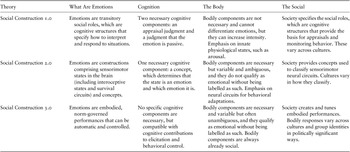
The differences between the three approaches to social construction are summarized in Table 1.
Three approaches to the social construction of emotions compared

5. Conclusions: Social Construction of Emotions 3.0 Defined
In sum, we side with those who argue that emotions are socially constructed. Our goal was not to defend constructionism against opposing theories so much as to distinguish different approaches to construction. The approach that we prefer builds on prior work, but places greater emphasis on bodily aspects of emotions. The social constructionist theories that have dominated discussion hitherto regard bodily responses as radically ambiguous and in need of conceptual overlays. Averill hardly mentions the body, and Barrett discusses the body primarily in an effort to show that bodily states are inadequate. Much of her theoretical and empirical output has been dedicated to showing that bodily responses under-determine emotions. Both 1.0 and 2.0 (especially LeDoux’s Reference LeDoux2012 version) echo anti-constructionists in treating the body as a biological given. These theories also say too little about social norms, and shy away from some of the more political aspects of emotional socialization. Social construction 3.0 aims to bring together existing work on social norms and embodiment. We focused on three dimensions, which can be used to summarize the approach we favor.
Socio-corporeal Constructionism (Social Constructionism 3.0)
-
1. Sociality: Social context and norms strongly influence our emotional response, including norms that apply differently to individuals depending on their social roles and social identities.
-
2. Corporeality: Emotions are embodied states that include overt behaviors, preparation for action, internal states that orchestrate such responses, and experiences thereof.
-
3. Socio-Corporeality: Social norms not only influence emotion but also fundamentally shape the body. Emotions—including the social norms they are impacted by—are expressed and performed via the body in ways that reflect context and social identity. That is, social norms and bodily responses are interdependent.
In summary, emotions are constructed via social norms that materialize in bodily states. Social forces do more than change how and when emotions are expressed (see also Scheer Reference Scheer2012; Parkinson, Reference Parkinson1995, Reference Parkinson1996). Some of the views we draw on here—including views in the 4E tradition—allow culture to impact the conditions under which an emotion occurs, while simultaneously resisting the conclusion that emotions are socially constructed. On such interpretations, emotions could be regarded as biological universals that occur under culturally determined conditions. We advocate a stronger view. If bodily responses are partially constitutive of emotions and altered by culture, then emotions themselves take on a cultural cast.
Some emotions, such as fear, may emerge out of biological dispositions. Still, fear can be described as a construction in so far as its specific embodiments, and the norms that regulate those embodiments and their elicitation conditions, are socially tuned. For example, fear of roller coasters, fear of failing exams, and fear of supernatural forces depend on cultural conditions and are each embodied differently. One might call fear a biocultural emotion (Hinton, Reference Hinton1999). Other emotions may emerge without specific biosocial dispositions. Consider religious fervor, patriotic feelings, and art appreciation, which each depend on cultural institutions. Those who grant that social norms condition when and how an emotion arises should also grant, for that very reason, that emotions themselves are socially conditioned. For the socio-corporal constructionist, this is tantamount to concluding that emotions are social constructions. Few constructionists would say emotions are socially or culturally fabricated ex nihilo; it’s unclear what that would even mean. Rather constructionism is more charitably defined as the view that socio-cultural forces shape emotions themselves, and not just, say, their eliciting conditions or display rules. One might try to challenge socio-corporeal constructionism by distinguishing emotions from the physical responses that ensue when we experience them. For example, Durkheim (Reference Durkheim1912/Reference Durkheim1995: 400) discusses mourning behavior, such as funerary weeping and self-harm, and he concludes that “generally there is no relationship between the feelings felt and the actions done…” This is untenable. Socialized bodily responses often become automatic, and, even when effortfully performed, they contribute to how we feel and how we are perceived to feel. They also impart emotional significance to the eliciting situation. There can be no sharp separation between emotion and performance. Some might insist that emotions are inner states and do not include outward behaviors. We could concede this stipulation, while insisting that the two generally unfold in tandem and are highly interdependent.
Social Construction 3.0 invites researchers to see the body as a central focus for emotion research rather than a minor and dispensable concomitant (1.0), or an anarchic assemblage united only by conceptualization (2.0). Bodily responses contribute to both action tendencies and how emotions feel, so it is important for constructionists to actively explore how they are socially impacted. We think social factors can bring new emotions into existence by inculcating new bodily patterns, though many cases of construction probably involve altering extant patterns. Grief, for example, might be socially conditioned to include rhythmic weeping or falling to one’s knees and throwing dust over one’s head. Such conditioning can have political dimensions. Societies dictate who can grieve and for how long, and some expressions of grief are gendered. Social construction provides a framework for investigating such norms. Prior versions of social construction neglect bodily dimensions of socialization, and biological theories treat emotional embodiment as universal. Social Construction 3.0 aims to correct both tendencies, reminding us that emotion norms impact how we physically react and interact. Emotional embodiments can express cultural identities, and they can be used to reinforce social hierarchies. Neglecting the body or treating it as biologically fixed can obscure these facts. Social constructionism would benefit from a corporeal turn.
Acknowledgements
We are very grateful for the helpful comments and suggestions from the editor and referees.

 Open access

