


Introduction
Societies in Europe and elsewhere are experiencing deep and intertwined changes unsettling citizens’ perceptions of their economic and employment security. Among the many sources of economic worries, globalization, technological change and international migration stand out. These structural changes have had a deep impact on western industrial societies: workers may be afraid that employers will relocate firms abroad to reduce employment costs, or may fear unskilled migration exerting downward pressure on wages, or may dread technological change that might make many jobs redundant.
Such worries about globalization, technological change and migration have long been found to influence policy preferences, particularly for national-level policies that address economic risks commonly connected to addressing such worries. Exposure to and worries about globalization have been found to play a central role in, among other political and policy preferences, spurring support for social policy (see Walter Reference Walter2021 for a broad review). More recently, experiences with and worries about technological change and migration have also been found to matter similarly for attitudes towards social protection and redistribution – with automation tending to spur support for redistribution and social protection (Thewissen and Rueda, Reference Thewissen and Rueda2019; Busemeyer and Sahm, Reference Busemeyer and Sahm2022). And migration has also been found to significantly influence social policy preferences, though often in ways that contrast the effects of globalization and automation: Here, worry about and/or exposure to migration has often been found to dampen support for social protections, either on grounds of deservingness or of concerns about fiscal sustainability (Alesina and Glaeser, Reference Alesina and Glaeser2004; Mau and Burkhardt, Reference Mau and Burkhardt2009; Burgoon and Rooduijn, Reference Burgoon and Rooduijn2021).
We know, hence, plenty about how key sources of labour market shocks play out, respectively, for national social policy provisions. We know much less, however, about how shocks compare with one another in shaping social policy attitudes, and even less about how they affect attitudes towards policies at political levels beyond the national level – particularly the European Union-level social policy development that is a major realm of policy innovation for EU member-state polities. Given how polities face multiple risks simultaneously and how policy responses at the EU-level are increasingly a part of the ways polities respond to such risks, this lack of attention in existing studies is an important silence.
This article seeks to provide such a perspective on multiple sources of risk playing out for attitudes towards EU-level unemployment-related social provisions. It does so by developing arguments about how the distinct character of labour market risks associated with globalization (trade and capital openness), technological change/automation and migration can be expected to spark preferences for distinct kinds of realistically debated EU-level social protection. And it then tests these arguments on an original dataset involving a conjoint experiment on support for different dimensions of EU-level unemployment protection in the face of respondent worries about globalization, automation and migration. The arguments and empirical exploration are at the intersection of political economy literature on how subjective risk perceptions affect specific policy preferences and European integration literature on the determinants of support for EU-level action addressing crises.
The expectations build on the literature on how perceptions of vulnerability are associated with support for social policy (Walter and Maduz, Reference Walter and Maduz2009; Emmenegger, Reference Emmenegger2009; Burgoon and Dekker, Reference Burgoon and Dekker2010; Vlandas, Reference Vlandas2020). Thinking through the distinct features of globalization, automation and migration, however, we expect that worries or perceptions associated with each of these risk sources should play out differently for key aspects of EU social policy design. For instance, globalization and automation should tend to positively affect support for EU policy design, promising more generous domestic welfare provision (generosity, conditionality, taxation), while concerns about migration should negatively affect support for these same features.
We test these and other expectations on data from a conjoint experiment in 13 European countries on a hypothetical European-level social policy: European Unemployment Risk Sharing (2018 EURS survey: see Vandenbroucke et al, Reference Vandenbroucke, Burgoon, Kuhn, Nicoli, Sacchi, van der Duin and Hegewald2018; Burgoon et al, Reference Burgoon, Kuhn, Nicoli and Vandenbroucke2022). This dataset combines individual-level measures of subjective concerns about three different sources of labour market competition with a survey experiment on citizens’ preferences for European-level unemployment insurance. While other derivative studies have explored the role played by attitudes towards European integration on preferences for alternative unemployment risk-sharing designs (e.g. Kuhn et al. Reference Kuhn, Nicoli and Vandenbroucke2020; Nicoli et al. Reference Nicoli, Kuhn and Burgoon2020), the relationship between broader socioeconomic concerns of respondents and public preferences on risk–sharing designs remains under-studied.
By combining experimental and observational data, we can explore the extent to which concerns about different sources of labour market competition alter individual preferences for social protection. It also allows us to simultaneously differentiate between key sources of perceived labour market competition and between different policy preferences for a large sample of individuals with diverse economic and demographic profiles. Importantly, the policy discussion of unemployment benefit schemes at the European level had a relatively low salience in 2018. The preferences revealed through the experiment can be seen as ‘pre-political’ (Vandenbroucke et al, Reference Vandenbroucke, Burgoon, Kuhn, Nicoli, Sacchi, van der Duin and Hegewald2018; Burgoon et al, Reference Burgoon, Kuhn, Nicoli and Vandenbroucke2022), before becoming politicized through media and political interventions. If and when the proposals at the center of the survey become subject to more ‘high-stakes’ debate, public support could well shift, not least because political entrepreneurs would seek to mobilize electorates, such as by activating national identities (Hooghe and Marks, Reference Hooghe and Marks2009). On the other hand, pre-‘politicized’ preferences are possibly more genuine, as they are registered before external influences on one’s opinion take place.Footnote 1
In any event, the results of our pre-political assessment of preferences broadly corroborate our expectations on the moderating effects of different types of concerns about perceived sources of labour market competition on the features of preferred European-level social policy. Concerns about competition stemming from globalization and automation are strongly associated with preferences for more generous, unconditional, progressive policy packages, while fears of migration are associated with the opposite. On the other hand, concerns about migration and globalization are both associated (with some nuances) with preferences for packages with less cross-country redistribution and more nationalized governance, while concerns with automation are not. These results have significant policy implications, suggesting more fully how different policy tools can be politically effective in addressing different economic risks.
Social policy demands and perceived sources of labour market competition
Workers are today exposed to a number of potential challenges to the security of their employment. Many of them stem from global economic integration, from migration flows, or from automation, which has long been seen as disruptive for labour markets (Goldin and Sokoloff Reference Goldin and Sokoloff1982; Acemoglu Reference Acemoglu1998; Autor et al, Reference Autor, Dorn, Hanson and Majlesi2020). As people, goods, services and machines move around the globe, and automation gathers pace in many industries, the employment stability of many individuals becomes perceived as increasingly vulnerable; the risks affect labour markets in diverse ways: automation and globalization, for instance, affect (domestic) labour demand, while migration (both inbound and outbound) affects labour supply. Automation, furthermore, is often associated with effects on the quality and content of employment, leading to potential processes of ‘de-skilling’ but also forcing individuals to compete with increasingly effective automated solutions. Ultimately, though, these processes make workers vulnerable in the labour market, and likely furthermore, these perceived vulnerabilities at times reinforce each other (Dancygier and Walter, Reference Dancygier, Walter, Beramendi, Häusermann, Kitschelt and Kriesi2015; Kaihovaara and Im, Reference Kaihovaara and Im2020). This, in turn, is reflected by people’s fears and concerns vis-à-vis labour market competition (Milner, Reference Milner2021), as well as in their demands for social protection (Sacchi et al, Reference Sacchi, Guarascio, Vannutelli, Careja, Emmenegger and Giger2021; Kurer and Häusermann, Reference Kurer, Häusermann, Busemeyer, Kemmerling, Van Kersbergen and Marx2022; Guarascio and Sacchi, Reference Guarascio, Sacchi, Busemeyer, Kemmerling, Van Kersbergen and Marx2022). In short, structural economic changes are linked with changing public demand for forms of social protection from activation policies towards more social assistance (Hemerijck, Reference Hemerijck2013; Garritzmann et al, Reference Garritzmann, Häusermann and Palier2022), even though individuals themselves might not be always able to precisely distinguish between sources of risk affecting them, a problem known as risk misattribution (Wu Reference Wu2021; Zhang Reference Zhang2022; Kaihovaara and Im Reference Kaihovaara and Im2020).
The introduction of the European pillar of social rights paved the way to a supranational intervention aimed to mitigate the growing economic insecurity (Vesan and Corti, Reference Vesan and Corti2019). In light of this renewed commitment of the EU to social protection, we fielded the EURS survey in 2018 (Vandenbroucke et al, Reference Vandenbroucke, Burgoon, Kuhn, Nicoli, Sacchi, van der Duin and Hegewald2018), which mainly focuses on the features and demands for social policy at the European level. Furthermore, it asks respondents to qualify the extent to which they worry about the three main sources of perceived labour market competition: automation, globalization and migration. We exploit this information to assess the extent to which individual concerns with diverse sources of competition differently moderate demands for specific forms and features of social protection. Although this information does not amount to an objective measure of labour market exposure, it allows us to identify the subjective dimension of specific risks, which are a fundamental mediator between objective threat and social policy preferences (Burgoon and Dekker, Reference Burgoon and Dekker2010)Footnote 2.
While interconnected, these measures of concern are distinct from each other and associate with different social policy demands. Concerns with the employment effects of automation fundamentally relate with the increasing pace of technological change. With few exceptions (Dekker et al, Reference Dekker, Salomons and van der Waal2017; Sacchi et al, Reference Sacchi, Guarascio, Vannutelli, Careja, Emmenegger and Giger2021; Busemeyer et al, Reference Busemeyer, Gandenberger, Knotz and Tober2023; Gallego et al, Reference Gallego, Kuo, Manzano and Fernández-Albertos2022; Guarascio and Sacchi, Reference Guarascio, Sacchi, Busemeyer, Kemmerling, Van Kersbergen and Marx2022; Kurer and Häusermann, Reference Kurer, Häusermann, Busemeyer, Kemmerling, Van Kersbergen and Marx2022), existing research on fears of automation usually focuses on objective risks rather than subjective ones. In a survey conducted at the EU level, even though Europeans have a generally positive view of automation, about 70 percent of the surveyed population agreed with statements like “robots steal people’s jobs” (European Commission, 2012: 9), and the subjective perception of being in competition with machines is particularly strong among unemployed workers. Realistically, individuals concerned with the risk of automation-induced labour displacement tend to see themselves as victims of technological transition and therefore are likely to have generally positive views of welfare provisions to support workers at risk of displacement (Busemeyer et al, Reference Busemeyer, Gandenberger, Knotz and Tober2023; Guarascio and Sacchi, Reference Guarascio, Sacchi, Busemeyer, Kemmerling, Van Kersbergen and Marx2022; Kurer and Häusermann, Reference Kurer, Häusermann, Busemeyer, Kemmerling, Van Kersbergen and Marx2022, but see Gallego et al, Reference Gallego, Kuo, Manzano and Fernández-Albertos2022, for contrasting results).
Conversely, concerns with the adverse economic and employment effects of globalization are much more studied in the literature, particularly rooted in comparative and international political economy classics suggesting that greater market openness fosters new social risks that fuel demands for welfare expansion (Cameron Reference Cameron1978; Katzenstein Reference Katzenstein1985; Ruggie Reference Ruggie1982). The so-called “compensation hypothesis” has been also investigated at the individual level through public opinion studies that have been piling up (Busemeyer et al, Reference Busemeyer, Goerres and Weschle2009; Autor et al, Reference Autor, Dorn and Hanson2016, Reference Autor, Dorn, Hanson and Majlesi2020). In the specific European context, De Vries and Hoffmann (Reference De Vries and Hoffmann2016) show that not only fear of globalization is widespread in the European Union, but also that is an important determinant of voting for nationalist forces (Colantone and Stanig, Reference Colantone and Stanig2019; Barone and Kreuter, Reference Barone and Kreuter2021; Caselli et al, Reference Caselli, Fracasso and Traverso2020; Milner, Reference Milner2021; Nicoli et al, Reference Nicoli, Walters and Reinl2022). Fundamentally, high fears of globalization relate with one’s fear that world trade is increasingly making workers in the country of residence worse off. Choices over borders and international agreements affect the extent to which a country is exposed to globalization. Globalization and labour mobility are inherently a cross-country phenomenon: global and international openness are seen as a part of the problem by those highly concerned with globalization-induced employment competition. De Vries and Hoffmann (Reference De Vries and Hoffmann2016) show that working class respondents are much more likely to be concerned with globalization than middle class respondents; globalization is also much more likely to generate ‘anxiety’ in working-class respondents than in middle-class ones. This resonates with Walter (Reference Walter2017), who finds that the impact of globalization on risk perceptions and demands for social protection is strongly mediated by skills levels.
Finally, respondents may be concerned with the migration of workers into their countries. Even though the majority of research on migration has shown that attitudes towards migration flows are not necessarily driven by material factors (see Hainmueller and Hopkins, Reference Hainmueller and Hopkins2014), migration attitudes could still affect policy preferences. Migration flows could be seen as having similar effects to offshoring in terms of decreasing equilibrium wages, both because migrants widen the pool of the labour force and increase labour supply, and because newcomers may have lower reservation wages, forcing native-born workers to decrease their claims if they want to remain competitive (Borjas and Hilton, Reference Borjas and Hilton1996; Boeri, Reference Boeri2010). Furthermore, migrants can be perceived as a threat not only when they compete for jobs, but also when they do not, since they may access social protection such as unemployment benefits (Hanson et al., Reference Hanson, Scheve and Slaughter2007). Concerns about migration are associated with far-right voting (Lucassen and Lubbers (Reference Lucassen and Lubbers2012) and decreasing support for the welfare state (Mau and Burkhardt, Reference Mau and Burkhardt2009; Burgoon and Rooduijn, Reference Burgoon and Rooduijn2021), and subsequent research has inquired into both possible implications of concern with migration (Häusermann et al, Reference Häusermann, Kurer and Schwander2015; Garand et al, Reference Garand, Ping and Davis2017; Burgoon and Rooduijn, Reference Burgoon and Rooduijn2021). The literature on welfare chauvinism (see Schumacher and Van Kersbergen, Reference Schumacher and van Kersbergen2016; Kros and Coenders, Reference Kros and Coenders2019) further supports the view that there is a connection between attitudes towards migration and the welfare state. Individuals who are very concerned with competition stemming from migration flows often believe that the flow of migrants into one’s country would put strains on the labour market, dilute the country’s native-born culture and especially weaken the amount of welfare state benefits available for natives. (Alesina and Glaeser, Reference Alesina and Glaeser2004; Cremaschi et al, Reference Cremaschi, Rettl, Cappelluti and De Vries2023; Alesina et al, Reference Alesina, Miano and Stantcheva2023; Lutz and Bitschnau, Reference Lutz and Bitschnau2023; Eick and Busemeyer, Reference Eick and Busemeyer2023).
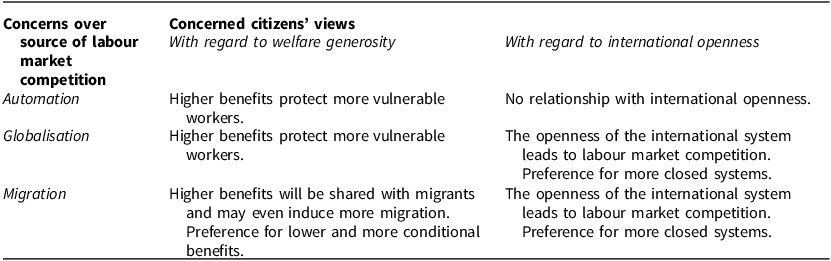
Hence, even though migration could be a form of labour market competition, classical instruments of compensation– for instance generous benefits – are likely less appreciated, since migrants would be perceived as beneficiaries, while natives would pay with their taxes. From this point of view, extending the welfare state may mean favouring migrants; research consistently finds that higher concerns with migration are associated with lower preferences for generous welfare provisions (see Kros and Coenders, Reference Kros and Coenders2019). In sum, migration could be seen by some as economically negative: either newcomers will take over local jobs, exerting labour market competition, or will receive social benefits, exerting welfare competition. Therefore, we expect higher fears of migration (differently from other sources of labour market competition) to lead to a preference for lower, rather than higher, unemployment insurance. Furthermore, migration is seen – like globalization – as a phenomenon fundamentally associated with international openness. Hence, individuals with high fears of migration will have negative views of stronger, more open international institutions and are likely to support nationalist and chauvinist parties (Lucassen and Lubbers, Reference Lucassen and Lubbers2012; De Vries and Hoffmann, Reference De Vries and Hoffmann2016; Nicoli and Reinl, Reference Nicoli and Reinl2020).
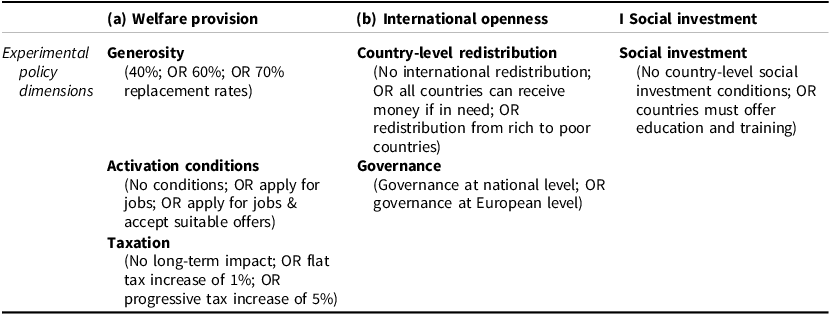
Based on this research, we can construct a typology of how concerns over these different sources of potential labour market competition relate with preferences over domestic welfare provision and the degree of internationalization of the system (Table 1). Table 1 reports our overall priors, while the specific policy dimensions of the EURS are presented in Table 2.
Subjective sources of labour market competition and citizens’ views
Components of the EURS
EU-level social protection and concerns with global societal change
Concerns with labour market competition constitute a particular challenge for social protection. While no other area of the world has gone so far on the path of economic, monetary and cultural integration, as the EU, the Union has long prioritized ‘negative’ integration, aiming at market integration by removing elements of distortion and by constraining what governments can achieve (Scharpf, Reference Scharpf, Rhodes and Mény1998). In recent years, the introduction of a European pillar of social rights and protection has been widely discussed (Vesan and Corti, Reference Vesan and Corti2019), also as part of the broader debate for the euro-area reform along with several other proposed policies such as the Banking Union or Eurobonds (Quaglia, Reference Quaglia2019). Recently, the first (short-term) form of European unemployment guarantee (SURE: temporary Support to mitigate Unemployment Risks in an Emergency) was introduced as a reaction to the 2020 COVID-19 outbreak (Andor, Reference Andor2022), followed by the Recovery and Resilience Facility (Howarth and Quaglia, Reference Howarth and Quaglia2021). Following an initial proposal by the then-President of the European Council, Herman Van Rompuy, in Reference Van Rompuy2012 (Van Rompuy et al. Reference Van Rompuy2012) many others have suggested a form of European-level support for unemployed people across the continent (see for instance Dullien, Reference Dullien2014; Beblavý et al, Reference Beblavý, Lenaerts and Maselli2017). These contributions propose alternative ‘European Unemployment Risk Sharing’ schemes (EURS), but, to date, no such policy has yet been agreed at the European level. In this article, we make a novel use of the experimental data collected by Vandenbroucke et al (Reference Vandenbroucke, Burgoon, Kuhn, Nicoli, Sacchi, van der Duin and Hegewald2018) in the EURS project, which tests European citizens’ opinion towards hypothetical alternative forms of EU-level unemployment support. Vandenbroucke et al (Reference Vandenbroucke, Burgoon, Kuhn, Nicoli, Sacchi, van der Duin and Hegewald2018) and Burgoon et al (Reference Burgoon, Kuhn, Nicoli and Vandenbroucke2022) show that a substantial overall support for EURS existed in 2018, in particular for ambitious designs marrying high generosity and strict conditionality. Kuhn et al (Reference Kuhn, Nicoli and Vandenbroucke2020) show that the respondents’ political identities affect which alternative options are preferred; Nicoli et al (Reference Nicoli, Kuhn and Burgoon2020) show that patterns of national, European and regional identity influence respondents’ preferences. Here, even though we build on these results, we depart from the political identities approach adopted by our colleagues, pivoting instead towards a political economy rationale. We look at how preferences for alternative unemployment scheme designs vary according to the perceived intensity of the labour market competition of respondents from different sources: globalization, migration and technological change. The survey includes individual-level answers on the extent the respondents are concerned with sources of labour market competition: technological change (e.g. Robotics), economic globalization (e.g. increases in trade flows) and increased migration into the respondent’s country of residence. The key feature of this article, then, is to assess how individuals who are concerned with different sources of labour market competition differ in their preferences for supranational unemployment protection.
Sources of competition and welfare provision
Labour market pressure originating from automation or globalization is likely associated with preferences for stronger protection. Within the context of the survey experiment, this means that we expect individuals who are particularly concerned with labour market competition stemming from globalization or automation to favour policies with higher levels of protection for recipients (domestic welfare generosity). More specifically, we expect that individuals concerned with these sources of labour market competition will want immediate and generous social protection, hence demanding higher replacement rate, lower individual conditions attached to the scheme and possibly more progressive taxation. On the contrary, individuals concerned with migration may pay more attention to the beneficiaries of this plan, fearing the competition with migrants, who can be attracted by higher and universal benefits. Hence, we expect individuals with high levels of concern for migration to be wary of generous schemes, to favour stronger conditionality and to oppose additional taxation. Accordingly, we raise hypothesis H1:
Hypothesis 1: Concerns about (a) globalization and (b) automation positively moderate the effects of policy dimensions pertaining to domestic welfare provision (generosity, conditionality, taxation) on support for European Unemployment Risk Sharing, while concerns about migration negatively moderate such effects.
Sources of competition and international openness
Further, we have argued that migration and globalization as labour market concerns associate with a rather negative perception of international governance. Also, we expect concerns over competition stemming from globalization and migration to be associated with fear of retrenchment of the national welfare state, and thus a relevant factor in moderating respondents’ preferences for European-level social policy. Accordingly, we expect both migration and globalization concerns to negatively affect support for packages inclusive of cross-country redistribution. Similarly, we expect that – on average – increased concerns with globalization and migration would lead to preferences for national regulation vis-à-vis European-level regulation. On the other hand, we expect automation to be perceived as a process, where countries are not automatically better or worse off. Hence, we do not generally expect automation fears to be associated strongly with those policy dimensions concerning the international footprint of the schemes. On these grounds, we raise hypothesis H2:
Hypothesis 2: Concerns about (a) globalization and (b) migration negatively moderate the effect of dimensions pertaining to international openness (cross-border redistribution, governance) on support for European Unemployment Risk Sharing, while concerns about automation do not.
Sources of competition and social investment
Finally, we put forward a separate hypothesis on individual preferences for social investment requirements, presented as an additional provision of education and training in the survey experiment. Our mainstream expectation is that respondents who are very much concerned with labour market competition stemming from technological change will be strongly in favour of any policy targeted to the upskilling of workers and the expansion of human capital. Our hypothesis is based on a rational-choice approach, which prompts us to expect that individuals would ask for more training as a response to the fear of skill obsolescence and technological replacement. However, many contributions show that the automation risk, largely proxied with individual occupational conditions, is strongly associated with short-term preferences for passive social protection over long-term investment policies (Busemeyer & Sahm, Reference Busemeyer and Sahm2022; Kurer & Häusermann, Reference Kurer, Häusermann, Busemeyer, Kemmerling, Van Kersbergen and Marx2022). Nonetheless, as in this paper we consider the subjective dimension of that risk, we expect the individual awareness of replaceability – and the underlying perceptions of skill obsolescence – to foster self-interested preferences for training measures (Borwein et al., Reference Borwein, Bonikowski, Loewen, Lee-Whiting and Magistro2023; Bobzien et al., Reference Bobzien, Kalleitner and Schlögl2024).
Naturally, a case could be generally made for a similar reasoning to be valid for globalization and migration as well: in the case of globalization, higher human capital would increase the competitiveness of domestic workers; in the case of migration, upskilling would lower the long-term burden migrants allegedly pose on the welfare state. However, we believe the connection is feebler in these two cases than it is for automation. Furthermore, some may believe that investing in human capital is just another arrow in the quiver of alternative policies to deal with globalization and migration, including all the gamut from labour market liberalization to fortress Europe. By contrast, we find it hard to identify remedies to automation-led skill obsolescence that are unanchored, in the long-term, from better education and more qualified human capital. Accordingly, we raise hypothesis H3:
Hypothesis 3: Concerns about automation positively moderate the effect of social investment on support for European Unemployment Risk Sharing, more than concerns about globalization and migration do.
We test these hypotheses by means of the experiment embedded in the EURS dataset, as discussed in the next section.
Data and methods
The design of the conjoint experiment
Conjoint experiments are increasingly being exploited to experimentally assess ex-ante public opinion regarding alternative policy options. To name but a few, conjoint experiments have been used to assess attitudes towards labour market reforms (Gallego and Marx, Reference Gallego and Marx2017), pension reforms (Häusermann et al, Reference Häusermann, Kurer and Traber2019), migration reforms (Hainmueller and Hopkins, Reference Hainmueller and Hopkins2014), bailouts (Bechtel et al, Reference Bechtel, Hainmueller and Margalit2017), welfare state recalibration (Bremer and Bürgisser, Reference Bremer and Bürgisser2023), climate agreements (Bechtel et al, Reference Bechtel, Genovese and Scheve2019), an EU fiscal union (Franchino and Segatti, Reference Franchino and Segatti2019), support for the Euro (Baccaro et al, Reference Baccaro, Bremer and Neimanns2021) and EU institutional reform (Hahm et al, Reference Hahm, Hilpert and König2020).
All conjoint experiments rely on a similar mechanism: the possible variations over a specific policy are disentangled in dimensions, each of which can have different values. These values represent the treatment of the experiment; for each dimension, a specific value is randomly administered to a representative sample of respondents. The specific combination of values of all dimensions constitutes a package. Each individual is administered, in each experiment, two randomly sorted packages (i.e., combinations of values for each dimension) side-by-side; the respondent is then tasked to choose which package is preferred and rate each package independently. Hence, the experimenter can test both the relative effect of each specific treatment on choice and on rating, as well as the effect of different bundles (or packages).
The conjoint experiment at the centre of the EURS dataset asks respondents to evaluate randomly sorted alternative packages of Unemployment Risk-Sharing Schemes. Vandenbroucke et al (Reference Vandenbroucke, Burgoon, Kuhn, Nicoli, Sacchi, van der Duin and Hegewald2018) provide an extensive summary of the design of the survey experiment. By construction, every conjoint experiment needs to strike a difficult balance between three conditions: adherence to the reality of the policy debate, a sufficient simplification to ensure that respondents understand the content of the options and a clear depiction of the fundamental trade-offs at stake. Hence, the EURS experiment simplifies the debate around the establishment of unemployment reinsurance into the six dimensions discussed in the previous section: generosity, social investment conditions, cross-country redistribution, taxation, level of governance and individual-level activation conditions. These six dimensions, each of which can take different values, compose ‘packages’ that respondents have to evaluate. More precisely, each respondent will see three pairs of these randomly composed packages, and she/he will have to rate (positively or negatively) each of these six policies and will have to indicate which ones in each pair they preferFootnote 3. Some of these dimensions have direct welfare effects like determining the number of benefits, the amount of extra taxation and the degree of conditionality recipients must comply with. Other dimensions look at the international openness/closure of the system, capturing its governance and the cross-country redistribution features. Finally, we consider social investment provisions (that is, making the provision of training and education a condition for its operation) as a stand-alone dimension.
More in detail, the first dimension regards generosity, and models different replacement rates, i.e. the share of the unemployed last wage that is covered by the scheme. In practice, the experiment includes three levels: a low (40 percent), a middle (60 percent) and a high (70 percent) replacement rate. The second dimension regards individual-level conditionality, i.e. the amount of activation effort required by welfare recipients. In practice, the experiment differentiates between no conditions, weekly job applications and weekly job applications complemented by compulsory acceptance of suitable offers. The third dimension includes options regarding the financing of the EURS through domestic taxation, with three alternatives: no long-term impact, a flat tax-increase, or progressive taxation. Fourth, existing proposals vary with respect to whether and to what extent they involve cross-country redistribution. Three alternatives are possible in the experiment: no long-term redistribution, some redistribution from rich to poor countries, or possible redistribution towards any country in need (rich or poor). The fifth dimension focuses on the levels of governance, which can be primarily European or primarily national. Finally, the last dimension models social investment, i.e. the conditions bestowed on the member states regarding the provision of education and training for the unemployed.
The levels of these dimensions are chosen to be representative of the main lines of the policy debate and yet accessible and understandable by a sample that ought to be representative of the public opinion. It is worth noting that not all these 324 different packages are internally consistent: for instance, very generous packages with cross-country redistribution would not be consistent, in many countries, with zero increases in the long-run tax burden. Yet we prefer to control for such inconsistent packages ex-post, rather than violating randomization ex-ante.
Data collection and experiment administration
The survey was administered online to a sample of 1,500 individuals in 13 European countries, for a total of 19,500 individuals. Data collection was carried out by IPSOS on their representative online panels in the two weeks between October and November 2018. Even though IPSOS online panels are already quite representative of the population at large, quotas were introduced to make sure that the sample respected the adequate proportions of the population for gender, age, education and regional distribution. The 13 European countries (DE, IT, NL, BE, FR, AT, PL, EE, ES, HU, DK, IE and FIFootnote 4) were chosen in such a way as to provide coverage with regard to Euro Area Membership, the impact of the Eurocrisis, the outstanding levels of debt and unemployment, the welfare state model and the geographical positioning.
Each individual was first confronted with a short text introducing the situation at hand, where the experiment is introduced and the policy at stake quickly described. Each individual is then confronted with 3 iterations of the experiment. In each iteration, the respondent sees two different, randomly sorted packages side-by-side; they must first indicate which package is preferred and then rate each package independently on a five-point scale, before moving to the next iteration. These questions represent the main dependent variables in the study. The first question represents package choice, as respondents choose one package or the other. While package choice usually delivers statistically neat results, it suffers from forced-choice bias, as respondents cannot reject both packages if they do not like either. To moderate that, the package rating variable explicitly allows for negative rating of both packages; in other words, the rating of one package is independent from the rating of the other package. We primarily use package rating as dependent variable in this study.
The experiment is complemented by a long battery of questions aimed at profiling the respondents vis-à-vis their political opinion, their socioeconomic background and other standard public opinion items. These questions usually work as controls in the experimental set up. However, they can also be used as means to split the sample and see whether there are statistically significant effects between subgroups, or run interaction effects as we do in this article.
Research design of the article
We follow the approach of other EURS derivative works, looking at how group differences regarding fears of globalization, migration and automation influence the effect of the treatments. To do so, we exploit a battery of questions in the EURS survey that reads as follows:
“On a scale of 0 to 10 (where 0 is not at all worried and 10 is extremely worried), how worried are you for yourself and/or (#Country) about the following developments?”
The individual is prompted to respond with regard to “globalization (e.g., trade)”; “technological change (e.g. robotics)”; and “migration into (#country)”, where #country is a variable element dependent on the respondent’s location. On average, respondents show weaker concerns for technological change, with a mean score of the corresponding variable of 4.7; migration is the most concerning, with a mean score of 6.1; globalization sits in between, with a mean score of 5.4Footnote 5. While respondents tend to be clustered around the mean for globalization concerns, the higher standard deviations of automation- and migration- related concerns show a stronger polarization of views on these phenomena.
To test our hypotheses, we proceed with a series of econometric models where we run interaction effects between concerns over sources of labour market pressure and the experimental treatments, that is, the values each dimension of the conjoint can take.Footnote 6 These models are reported in Tables A1.1 and A1.2 in the online Appendix,Footnote 7 while in the next section we focus the core of the analysis on the graphical representation of the interaction effects (Figures 1a-1c). All models we run have standard errors clustered at the individual level, to account for how every individual is confronted with 6 packages and include individual-level controls as well as country fixed effects (omitted from the Tables). In particular, in the main models we control for income, education, age and gender; in the robustness models, we also include whether individuals are dependent on welfare and their general concern with job losses. These models are reported in the Appendix: Table A1.1 provides baseline models without interactions, using both an OLS and a Logit regression on a binary transformation of package supportFootnote 8. Table A1.2 introduces interaction effects with concerns over globalization, automation and migration. These interaction effects are the key tests of our three hypotheses, based on the direction and significance of the respective interaction terms involving worry about automation, globalization and migration.Footnote 9 In this work, we do not systematically investigate differences in policy preferences across countries. A wide literature explores these cross-national variations, often traced back to policy feedback effects (Busemeyer and Sahm, Reference Busemeyer and Sahm2022; Busemeyer and Tober, Reference Busemeyer and Tober2023; Gingrich and Ansell, Reference Gingrich and Ansell2012; Jæger Reference Jæger2006; Larsen, Reference Larsen2008)Footnote 10.
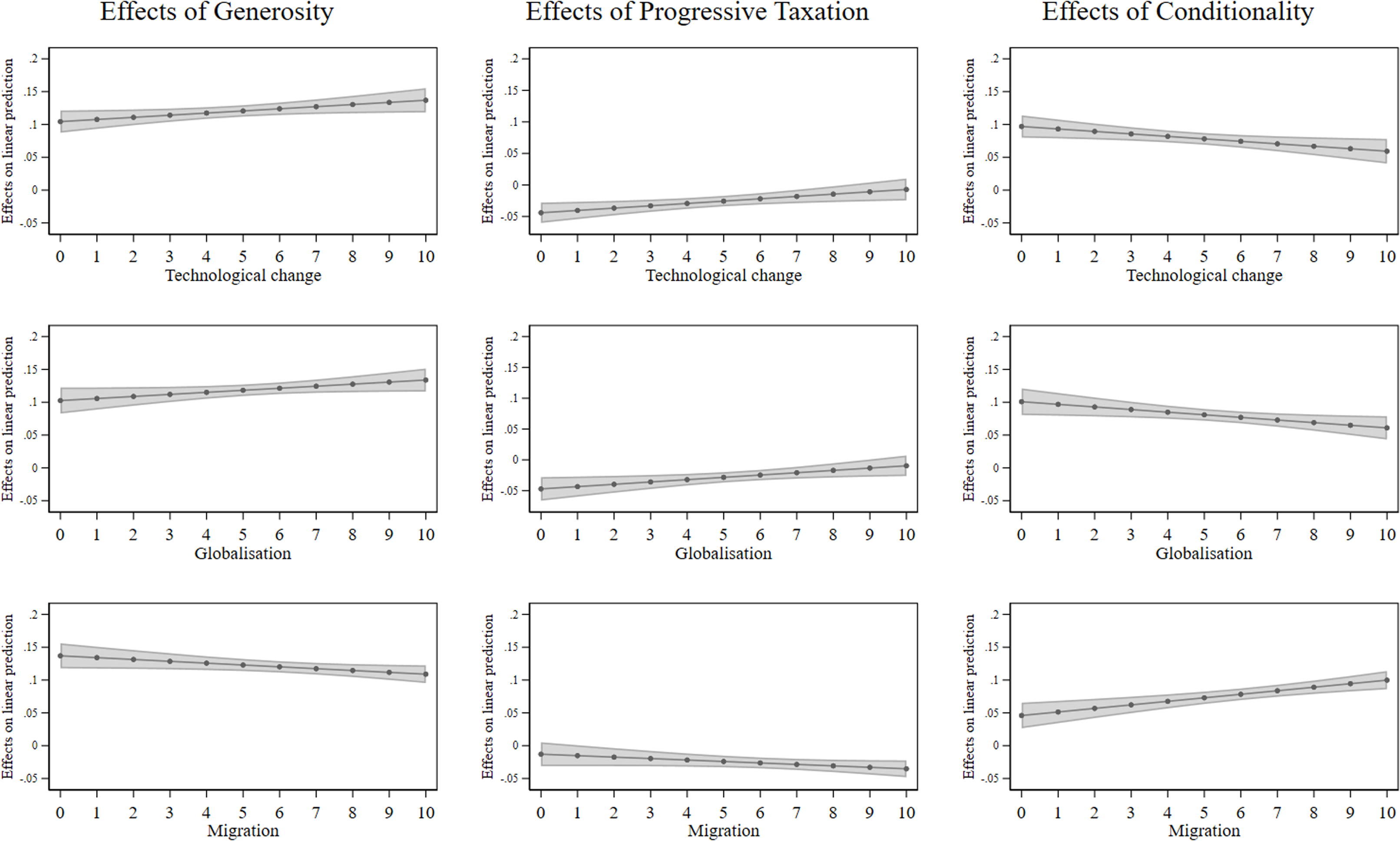
Labour market concerns and EURS dimensions related to welfare provision.
Note: the graphs show the average marginal effects of different policy dimensions – generosity, progressive taxation, and conditionality – on the individual support for the package (binary), conditional on the level of fear for technological change, globalization, and migration.
Note: the graphs show the average marginal effects of different policy dimensions – high generosity, progressive taxation, and mid-level conditionality – on the individual support for package (binary), conditional on the level of fear for technological change, globalization, and migration. For generosity and conditionality, the experiment includes two alternative levels: 60% generosity rather than 70%, and “apply for jobs and accept the first suitable job offer” (high conditionality) rather than simply “apply for jobs” (middle conditionality). The figure reports the effect of those dimensions for which results are clearer, namely high generosity (70%) and middle conditionality.
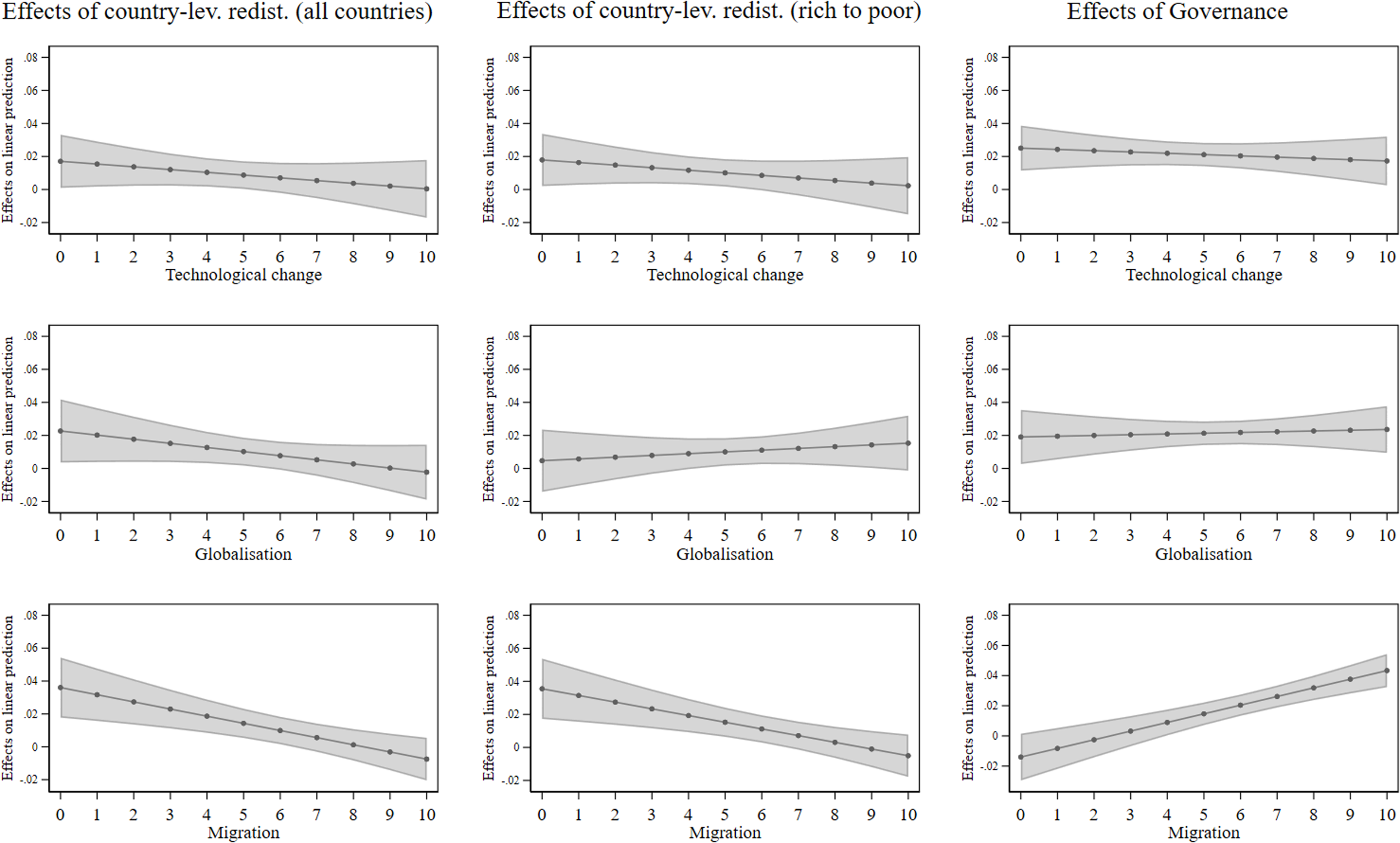
Global concerns and EURS dimensions with an international footprint.
Note: the graphs show the average marginal effects of different policy dimensions on the individual support for the package (binary), conditional on the level of fear for technological change, globalisation and migration.
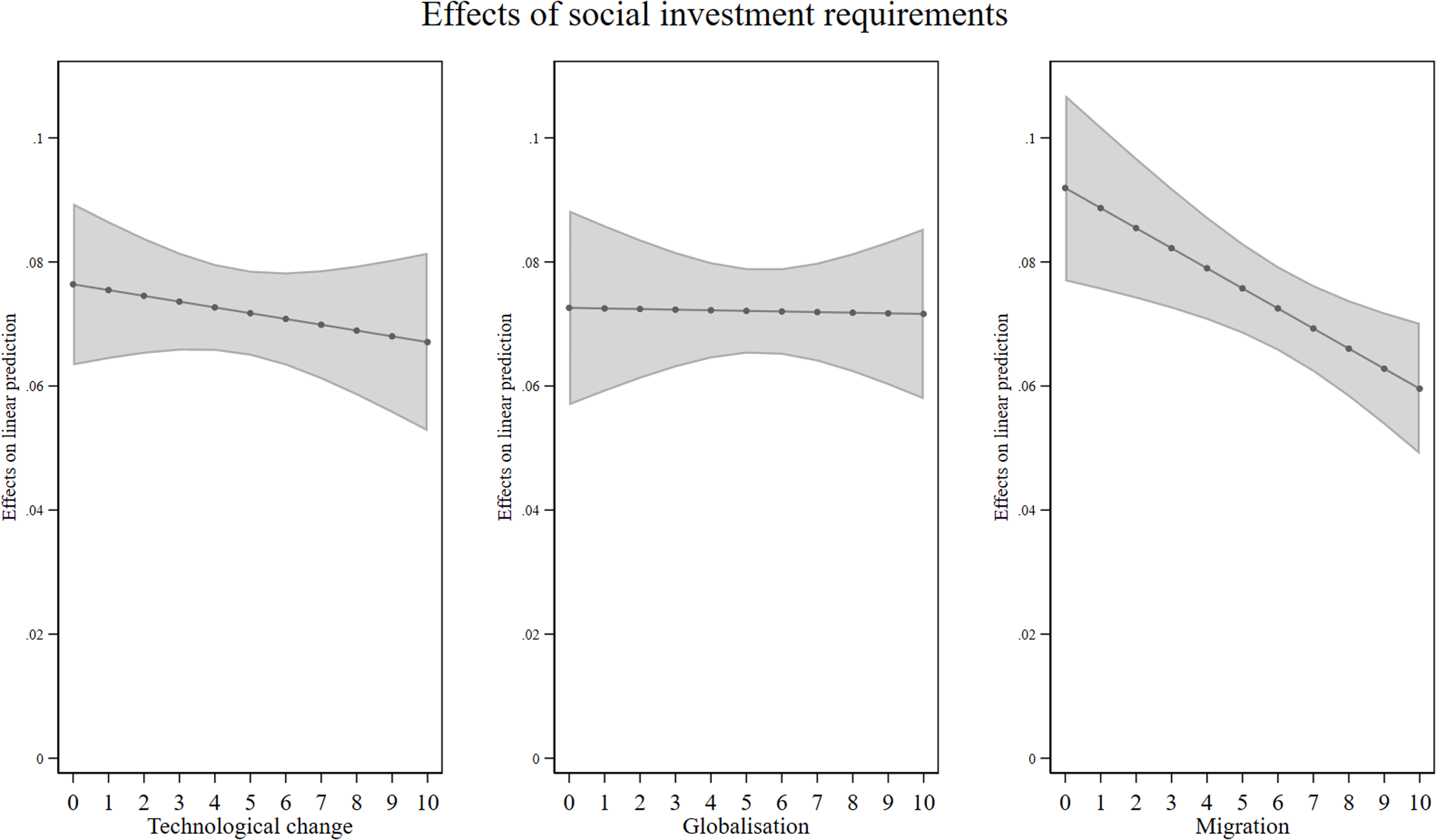
Social investment.
Note: The graphs show the average marginal effects of the social investment requirements on the individual support for the package (binary), conditional on the level of fear for technological change, globalisation and migration.
Social policy demands and sources of concern
Labour market competition concerns and the welfare dimension of EURS
To test our hypotheses, we run two sets of interaction effects. These interaction effects are estimated using a binary transformation of the package rating variable (often called ‘support’), where packages rated negatively or neutrally are assigned a value of 0, and packages rated positively are assigned a value of 1 (see footnote 4). Figures 1a-1c plot the effect of having a certain attribute as contrasted to the baseline attribute in the same dimension, on the likelihood of supportFootnote 11.
The first set of interaction effects (Figure 1a) allows us to test H1. H1 suggests that when it comes to the effect of more generous and least constraining welfare arrangements on support/opposition for EURS, concerns with globalization and automation moderate preferences similarly: the higher the concern, the stronger the effect on support, while the opposite is true for migration. Looking at interaction effects, this means that we expect the slope of the interaction between automation/globalization and the welfare-related dimensions to be positive for more progressive, less conditional packages, while we expect the slope to be negative for the interaction between concerns for migration. These interactions are reported in Figure 1a: the panels in the first column report the interaction for the effects of the most generous dimension, those in the second column for the most progressive type of taxation and those in the third column for conditional packages. The estimates reported in Figure1a demonstrate a strong support for H1, as all slopes follow the expected pattern. The coefficients of these interactions are generally significant (see Table A1.2). Not only do the interactions of the welfare-related dimensions with automation and globalization concerns have the same sign of the slope, while the interaction with migration has the opposite slope; the direction of the effects also aligns to our expectations. That is, the higher the concerns with globalization or automation, the stronger the effect on support of having a generous, unconditional and taxation-progressive package, as opposed to the alternative. Similarly, the higher the concern with migration, the lower is the effect on support of being faced with generous packages and the higher the effect of individual-level conditionality.
Note that lower support does not necessarily translate into negative support: as can be read on the y-axis, individuals who are extremely concerned with migration still prefer, for instance, generous packages over non-generous packages, although to a lesser extent compared to respondents that do not fear migrants. These differences are starker when looking at individual-level conditionality, i.e., labour market activation conditions bestowed upon the unemployed: the positive effect of activation on support is halved for individuals highly concerned with automation or globalization, as compared to their non-concerned peers, while doubling for individuals highly concerned with migration as compared to their unconcerned peers. In sum, the estimates reported in Figure 1a strongly support H1: when it comes to the dimensions of social policy that directly relate with welfare provision, there are substantial similarities between the effects attributable to globalization and automation fears, whereas concerns with migration have an opposite effect.
Societal concerns and the international footprint of EURS
We now move to a second set of interaction effects, allowing us to test H2 (Figure 1b). H2 suggests that, since both concerns with globalization and with migration originate in the country’s interaction with the rest of the world, very high concerns in these two areas will be strong, negative moderators of the effect of those EURS dimensions embodying a more open, internationally oriented system: i.e. the possibility for between-country redistribution (with different conditionalities) and the level of governance (EU or national). Accordingly, we expect that slope for the interaction between globalization/migration concerns and (any kind of) redistribution will be negative, while it will be positive for the interaction with national level of governance. Conversely, we expect the slope of the interaction between automation concerns and redistribution to be either flat or positive and the slope of the interaction with governance to be either flat or negative.
The results, reported in Figure 1b, provide only qualified support for H2. Migration concerns certainly behave as expected: a very strong effect follows the predicted path, with strong, negative and highly significant slopes for the interaction with both levels of the redistribution dimension and a strong, positive slope for the interaction with national level of governance.
However, interactions with globalization and automation do not quite align with our expectations. They are all statistically not significant. Despite this, the slope for the interaction between globalization concerns and governance and between automation concerns and governance have the predicted sign, suggesting that individuals more concerned with globalization attach higher value to maintaining a national oversight of the EURS system. The slope for the interaction with cross-country symmetric redistribution is negative as predicted for concerns over globalization, but the interaction with the redistributive dimension from rich to poor countries displays a significantly different path: the curve has a slightly positive inclination, contrary to our expectations. This trend does not seem to be driven by self-interest preferences of individuals from net recipient EU member states (A6.6). By the same token, the slope is negative also for the interaction of both types of redistribution and concerns over technological change, while the expectation was somewhat different (although as mentioned the null hypothesis cannot be rejected).
We also note that the confidence intervals for the interactions between automation and globalization with the international footprint dimensions are substantially wider than both the confidence intervals for migration, and those of the estimates for the interactions with the social policy dimensions (seen in Figure 1a). This necessarily implies that a great variety of opinions exist among people who are highly concerned with globalization and automation when it comes to the international footprint of EURS schemes, while respondents that share a common concern for migration are much closer to each other in their policy preferences than their peersFootnote 12. Overall, the interaction models reported in Figure 1b amount to a qualified support for H2. While individuals with high globalization and migration concerns share some common opposition to schemes with a strong international footprint, the latter are much closer to each other in their opinions, while individuals concerned with globalization are not only more varying in their opinion, but they also seem to have a slightly positive view of cross-country redistribution insofar as it remains directed towards helping poor countries.
Labour market competition concerns and the social investment dimension of the EURS
Finally, we move to test H3, which suggests that the interaction between automation concerns and social investment will be positive (the higher the concern, the stronger the support for social investment), while no strong relationship is envisaged regarding the other two concerns. We test H3 in Figure 1c, which displays the interactions between the three concerns under study and social investment.
H3 is strongly rejected by our analysis, indicating that the alternative conjecture raised in the literature pointed in the right direction (Busemeyer et al., Reference Busemeyer, Gandenberger, Knotz and Tober2023; Busemeyer & Sahm, Reference Busemeyer and Sahm2022; Kurer & Häusermann, Reference Kurer, Häusermann, Busemeyer, Kemmerling, Van Kersbergen and Marx2022). All three concerns display flat or negatively sloped interaction with social investment requirements: higher levels of concerns tend to be associated with lower support for social investment, even though only the interaction with migration concerns is statistically significant. Generally speaking, the overall effect of social investment remains positive (that is, even individuals that are highly concerned with migration prefer packages inclusive of social investment than packages not including it, and all the more so for those concerned with globalization or automation). However, our analysis shows that H3 is rejected: individuals who are concerned with automation do not display significantly different preferences from their non-concerned peers (see also Busemeyer et al, Reference Busemeyer, Gandenberger, Knotz and Tober2023; Kurer and Häusermann, Reference Kurer, Häusermann, Busemeyer, Kemmerling, Van Kersbergen and Marx2022).
Limitations and Conclusions
This article set out to explore how subjective risk perceptions towards global societal change – such as technological change, globalization and migration – affect individual preferences for supranational social protection. Building on the intersection between the political economy literature on risks exposure and the European politics literature on specific policy preferences, we formulated expectations concerning the impact of perceived risks on EU policy preferences. We expected that individuals with different concerns might share preferences towards some aspects of social protection but differences towards others. We expected individuals highly concerned with automation to prefer strong, supranational action; we expected individuals who fear globalization to prefer strong, national action; while we expected those who fear migration to generally prefer weaker, conditional, domestic actions.
We formulated these expectations as three hypotheses, and we tested them using a semi-experimental set-up. We exploited the conjoint experiment on preferences for a European Unemployment Risk-Sharing initiative contained in the 2018 EURS survey, fielded in 13 European countries in October/November 2018, returning a representative sample of 19500 respondents. Since the salience of European Unemployment Benefits Schemes was modest in 2018, we can consider these preferences as ‘pre-political’, less affected by cueing coming from institutions, political actors and discourse, and therefore more genuine, although not necessarily indicative of how public preferences would evolve if and when the policy in question becomes politicized (see Vandenbroucke et al, Reference Vandenbroucke, Burgoon, Kuhn, Nicoli, Sacchi, van der Duin and Hegewald2018 and Burgoon et al,. Reference Burgoon, Kuhn, Nicoli and Vandenbroucke2022 for a discussion of the implications of pre-political opinions in the context of EURS). We proceeded in testing our hypotheses by means of interaction effects between a battery of questions on the respondents’ level of concern on global phenomena and the different dimensions of the EURS as tested in the conjoint experiment.
We found strong evidence in favour of our first hypothesis (H1): high levels of concern for technological change and for globalization largely have the same positive effect when it comes to support for more progressive EURS alternatives (generous packages, progressive taxation and low conditionality), while high levels of concern for immigration lead to relatively less support for progressive EURS alternatives. These findings corroborate literature showing that the perceived threats from technological substitution and market openness foster preferences for redistributive and protective policies (Thewissen and Rueda Reference Thewissen and Rueda2019, Guarascio and Sacchi Reference Guarascio, Sacchi, Busemeyer, Kemmerling, Van Kersbergen and Marx2022, Busemeyer et al Reference Busemeyer, Gandenberger, Knotz and Tober2023, Walter Reference Walter2017, Rehm Reference Rehm2009), whereas deservingness and fiscal concerns associated with fears of migrants undermine the support for an encompassing welfare state (Alesina et al Reference Alesina, Miano and Stantcheva2023, van Oorschot Reference van Oorschot2006, Eick and Busemeyer, Reference Eick and Busemeyer2023, Hanson et al Reference Hanson, Scheve and Slaughter2007).
We found only qualified support for our second hypothesis (H2): while high levels of concern for migration strongly associate with lower preferences for internationally-open EURS alternatives, this applies only in part to concerns for globalization; individuals who are highly concerned with globalization seem to display quite a wide range of attitudes towards schemes that have a strong supranational footprint, witnessed both by the confidence intervals of estimates (even when the effect is the one we expect, the confidence intervals are quite wide) and by the surprisingly positive interaction between globalization concerns and explicit redistribution from rich to poor countries. More broadly, building on the compensation hypothesis literature (Burgoon Reference Burgoon2001; Katzenstein Reference Katzenstein1985), we can speculate that generous welfare protection might undermine the Euroscepticism of globalisation-concerned individuals, who end up being less adverse to cross-country redistribution than expected. In other words, although the results suggest caution, the qualified support for H2 may indicate a moderating effect of welfare expansion on the globalization backlash (Schaffer and Spilker Reference Schaffer and Spilker2016).
Furthermore, we reject our third hypothesis (H3) on preferences for social investment. While we expected individuals with high concerns for automation to have a positive view of conditions regarding social investment (for instance, provision of education or training schemes to the unemployed), our estimates support the view that respondents highly concerned with automation or immigration are less favourable towards social investment packages than are their non-concerned peers. These results speak to the diverse literature that emphasizes the trade-off in political demands between social-investment and consumption-oriented policy approaches that emerged following the “recalibration” of advanced welfare states toward activation policies (Foster and Frieden Reference Foster and Frieden2019; Häusermann Reference Häusermann2018) and permanent austerity (Ferrera & Hemerijck, Reference Ferrera, Hemerijck, Zeitlin and Trubek2003; Pierson, Reference Pierson1994). The social coalition supporting the social-investment turn appears mainly confined to highly educated individuals – more likely to benefit from these policies (“Matthew Effect”, European Commission 2019) – with left-libertarian views (Garritzmann et al. Reference Garritzmann, Busemeyer and Neimanns2018, Häusermann et al. Reference Häusermann, Pinggera, Ares and Enggist2022). Concerning automation, some contributions show that at-risk mid-skill workers prefer protective and compensatory measures over investments in training, the latter being less likely to enhance employability and socioeconomic status, particularly for middle-aged workers (Busemeyer & Sahm, Reference Busemeyer and Sahm2022; Kurer & Häusermann, Reference Kurer, Häusermann, Busemeyer, Kemmerling, Van Kersbergen and Marx2022). Furthermore, these workers tend to show conservative postmaterialist values (Kurer Reference Kurer2020) that further undermine the initial expectations concerning their support for training programs. Our work undermines the expected differences in the effects exerted by subjective and objective risks of technological replaceability on individual policy preferences (Borwein et al., Reference Borwein, Bonikowski, Loewen, Lee-Whiting and Magistro2023; Bobzien et al., Reference Bobzien, Kalleitner and Schlögl2024). In other words, regardless of risk awareness, the proximity to automation fosters preferences for short-term protection and compensation, rather than long-term uncertain policy solutions.
While our results contribute to advance our knowledge of how different labour market vulnerabilities associate with different perceived labour market vulnerabilities, this article does have some important limitations. First-off, we cannot be sure that the preferences and relationships revealed in this experiment are stable over time. Since the salience of European Unemployment Benefits Schemes was limited in 2018, we can consider these preferences as ‘pre-political’, less affected by cueing coming from institutions, political actors and discourse, and therefore more genuine, although not necessarily indicative or representative of how public preferences would evolve if and when the policy in question becomes politicized (see Vandenbroucke et al, Reference Vandenbroucke, Burgoon, Kuhn, Nicoli, Sacchi, van der Duin and Hegewald2018 and Burgoon et al,.Reference Burgoon, Kuhn, Nicoli and Vandenbroucke2022 for a discussion of the implications of pre-political opinions in the context of EURS). In particular, given that citizens in European countries are typically fond of their welfare arrangements, attempts to Europeanize these might become politicized by political entrepreneurs, even more so when individuals feel vulnerable due to their exposure to risks.
Second, we only capture individual perceptions, therefore respondents might ‘mis-attribute’ the risk they are exposed to or otherwise improperly grasp differences between labour market risks stemming from globalization, automation, or migration. In this dataset, we cannot match individual-level perceptions of labour market competition with objective information, because we lack detailed information on the economic sector and occupation of our respondents. This prevents us from detailing the objective vulnerability of respondents to shocks, avoiding the risk of misattribution. In future work, we plan to collect new data on respondents’ sector and occupation, allowing assessment of both their individual-level exposure to shocks via the Routine Task Index and/or other measures of exposure to trade, as well as exposure of the regions in which respondents live. Relatedly, this experiment is not geared to directly identify a causal link between sources of labour market pressure and policy preferences. It is notoriously complicated to randomly assign such sources of labour market shock since these conditions cannot be easily manipulated in an experimental setup. Nonetheless, a dedicated survey experiment can identify the effect of different shocks. Furthermore, future research should not only look at public demands, but also study how the political “supply” proposed by parties in their electoral manifestoes is matched by public preferences and voting patterns, possibly across a wider range of policies.
Finally, external validity remains a concern in absence of an independent replication, even though several design choices alleviate this concern. For instance, full randomization fosters substantial internal validity; the high quality of the stratification offered by the survey provider, and low levels of discrepancy between the sample and the population over four demographic quotas signals representativeness of the sample; finally, the stability of the results across thirteen independent national samples suggests that additional replications would likely yield similar results. However, intertemporal validity is a real concern, since two major shocks – Covid-19 and the Russian invasion of Ukraine – have occurred since data collection. Even more so, as policy debate has evolved in the wake of the pandemic, policy arrangements which might eventually be debated or adopted likely differ from those tested here. Hence, despite these design choices, only a new iteration of the experiment can fully dispel concerns over the external validity of the experiment.
Despite these limitations, our results strongly suggest that policy preferences for social policy at the European level are differentially moderated by concerns over labour market pressure. Concerns with globalisation, migration and automation are substantively different and associate with different demands over the type of social protection, yielding different preferences regarding the generosity and conditionality of unemployment risk-sharing and over the degree of international openness it features. This article paves the way for future research aimed at better understanding preferences and conditions for European-level social policy. While some of our results may have implications for national policies as well, the experimental results are tailored to alternative designs for EU-level social policy, and as such, provide evidence for policy-makers aiming to build a supranational layer of social protection sensitive to how distinct threat perceptions shape the policy designs preferred or opposed by citizens.
Supplementary material
The supplementary material for this article can be found at https://doi.org/10.1017/S1755773924000316.
Acknowledgements
We thank the three anonymous reviewers, as well as the members of the Bruegel think tank, in particular Jeromin Zettlemeier and Stephen Gardner, for their comments and useful feedback on the working paper version of this manuscript.


 Open access

