

What does it mean to be morally complicit? It’s a hard question to answer because complicity is an umbrella term, and there’s no agreement about the range of behaviors and relations it covers. Here’s a starter definition: Moral complicity refers to a reproachable or regrettable involvement with a wrong or social harm. But what counts as involvement? The question is not merely analytically thorny but socially divisive because moral complicity bears a moral judgment and makes moral claims on the accused. Charging a person, group, or institution with moral complicity requires drawing moral lines: What sorts of involvement with a wrong or social harm warrant moral criticism and demand accountability, and which don’t? What sorts of ties to a wrongdoer invite blame or transmit moral taint? How much guilt, shame, or regret should attach to different kinds and degrees of involvement? What kinds of penalty or intercession do different intensities of involvement call for?
Seen this way, as a ground for moral critique and intervention, it’s easy to see why the idea of moral complicity has generated debate and controversy for over 300 years. For reformers seeking to end a sin, a wrong, an injustice, or another social harm that involves many, perhaps a multitude of, contributors, it matters a great deal whom to call out, and for what. It matters which behaviors, institutional practices, and social processes merit censure and require revision in order for those wrongs and harms to end or abate. For those who don’t see those acts, practices, or social conditions as morally wrong or noxious, or who hold more circumscribed views of moral accountability, complicity accusations by activists and moralists may seem dangerously broad and misdirected. For those charged with complicity who see themselves (or the groups, institutions, businesses, or nation with which they’re affiliated) as undeserving of moral critique or correction, complicity’s application will seem perniciously inclusive.
Complicity and the Antebellum Moral Imagination is about this contentiousness and controversy in the United States between roughly 1830 and 1860, when across a range of moral arenas – reform, religion, media, economics, politics – new conceptions of moral complicity sparked fierce debates. Adapting a phrase by Joel Pfister, I refer to this varied discourse of moral indictment and protest as complicity critique. The term points to this discourse’s frequent attention to social and institutional arrangements, the social evils they introduced and supported, and the moral dangers and demands they imposed on individuals and groups lodged within them. To those investigating and arguing over the nature and scope of moral complicity, the stakes of complicity critique appeared monumental. The fate of Christendom, the future of American slavery, the dream of Black North American independence, the redemption of American democracy, and other far-reaching outcomes hung in the balance.
In common speech today, complicity typically refers to causal involvement in a wrong or social harm. It exists where a wrong or harm is enabled, abetted, or maintained with the cooperation, collusion, connivance, consent, compliance, or quiescence of individuals, groups, or institutions. When individuals act singly or in numbers, complicity might, for example, refer to purchasing cheap clothes produced in sweatshops, investing in a company whose parent corporation supports a reprehensible cause, or relying on technologies that harm the environment. Depending on the political vantage and ethical sensitivity of the observer, complicity might also refer to moving into a gentrifying neighborhood or failing to disrupt institutions that entrench unearned social advantages and disadvantages. In these examples, these individuals are not the primary wrongdoers. They do not exploit laborers or endorse the reprehensible cause. Nor do they cause the harm alone or directly. The harm – to the planet, to displaced residents, to people constrained by institutional inequities – results from a complex web of causal factors, of which individuals’ aggregate and combined actions, shaped by economic processes, political policies, and institutional norms, are only a part. In the case of businesses, governments, and cultural institutions, complicity might refer to any practices, policies, or organizational ties that help to bring about or buttress harms or injustices.
To some observers, the meaning of complicity extends to contributory behavior that is unwitting, unchosen, or coerced, like paying taxes that fund an immoral war. For some, the idea stretches even further and encompasses relations to a wrong or harm that may not involve contributing to it at all but nonetheless invite criticism, prompt feelings of shame, or demand some redressive response. So stretched, complicity might include benefiting, even indirectly, from a wrong one did not commit. Or complicity might include bearing some unchosen but morally tainting affiliation with the wrongdoer, such as holding citizenship in a nation whose government commits deplorable acts. The list of wrongs and harms enabled or sustained by the associated or combined acts of people and institutions is of course endless. So is the list of wrongs benefiting people and institutions who took no part in the wrongdoing. Indeed, as Adam Kelly and Will Norman note, “once one begins to think about complicity, one sees it everywhere” (“Literature” Reference Kelley673). No doubt this is one reason Dictionary.com chose complicit as its Word of the Year in 2017. To Americans “awakened to complicity,” complicity seemed ubiquitous and, to many, inescapable.
The capaciousness of the complicity concept is central to this book. It looms behind the arguments and imaginings of the antebellum propagandists, fiction writers, reformers, market activists, and political insiders I examine in the following chapters. Indeed, for them, as for many activists today, the concept’s breadth outside the realm of criminal or civil law, where it is defined more narrowly, was essential to its critical force. The moral warrant it offered for social critique and intervention reached far beyond what the law, devoted to explicit, adjudicable conceptions of responsibility, guilt, and wrongdoing, allowed.1 Since at least the eighteenth century, this widened moral accounting has both tantalized and frustrated moral philosophers, political theorists, religious authorities, jurists, and others in the Anglophone world. Using a variety of terms to capture the concept, these analysts have parsed moral complicity’s variations and argued over their applicability to different kinds of crimes, sins, injustices, and social harms. They have debated how to assign responsibility and reproach for different kinds and degrees of moral implication. Their arguments often pivot around variables such as how voluntary, witting, lawful, controllable, causally direct, or consequentially significant the connection is between the implicated agent – individual, group, or institution – and the primary wrong, wrongdoer, or harm.2 Aware that enablers and abettors of a wrong or harm might act in willful cooperation, unwitting combination, networked interdependency, contingent seriality, or some other associative alignment, complicity analysts have battled over how to map the distribution and transmission of moral liability across different social bodies, institutions, matrices, and systems.3
This book focuses on these arguments and mappings. Rather than organize this literary and cultural study around different wrongs and harms during the antebellum period, a potentially endless project, I have structured it around different social bodies and associative forms, or moral ensembles, across which sin, guilt, or moral taint appeared to fall or flow. In Chapters 1 and 2 I discuss conspiracies, social networks, and urban social structures; in Chapters 3 and 4, organic sociolegal regimes and what reformers controversially labeled “the slave system”; in Chapters 5 and 6, commodity markets and the Atlantic cotton trade; and in Chapters 7 and 8, democratic politics and American federalism. I do not aim to offer a comprehensive survey or history of antebellum complicity critique. Instead, dwelling on these moral ensembles, I show how new ideas about moral complicity’s character and compass gained sensational expression, animated new literary forms, generated bitter cultural and political controversy, and anchored a quixotic plan to transfigure the Atlantic economy.
As a study of antebellum complicity, this book is unusual in a few ways. In addition to being organized around the idea of moral ensembles, it convenes diverse arenas of sociomoral analysis and judgment, including imaginative literature, religion, economics, and politics. In doing so it draws on a wide range of cultural materials such as popular novels, convent tell-alls, religious print battles within antislavery, political economy lectures, Black nationalist exhortations, abolitionist visual art, and congressional debates. Although I am a literary scholar, imaginative literature occupies only a part of this study. I begin with fictional anti-Catholic convent exposés that, framed around revelations of illicit sex and sex talk, steered attention to the gendered and purportedly pestilential danger of complicity critique itself. I also devote chapters to George Lippard’s pioneering network novel and bestselling urban apocalypse, The Quaker City, or The Monks of Monk Hall (1845), and Harriet Beecher Stowe’s galvanizing antislavery blockbuster Uncle Tom’s Cabin (1852). Rather than offering a critical genealogy or broad historical thesis about complicity fiction, I show how the effort by several imaginative writers to capture new kinds of moral ensembles – themselves imaginative and narrative constructions – spurred important innovations in literary form and, in the case of Stowe, a redefinition of moral realism.4
Finally, Complicity and the Antebellum Moral Imagination concentrates on cultural figures, debates, and texts that have received less scholarly attention by complicity scholars. In studies of antebellum antislavery, the most conspicuous arena of complicity discourse between 1830 and 1860, the subject of complicity often either looms as a persistent backdrop, occasionally becoming the focus of discussion, or receives sustained attention in relation to a single figure, historical event, or cultural domain. I do not devote chapters to Frederick Douglass, Henry David Thoreau, Ralph Waldo Emerson, the Fugitive Slave Law, higher law jurisprudence, or abolitionist anti-constitutionalism, all canonical objects of antebellum antislavery scholarship.5 Rather, I home in on Edward Beecher and the largely forgotten organic sin controversy; the transatlantic Free Produce movement and William Lloyd Garrison’s remarkable turn against complicity critique in market matters; Martin Delany and Henry Highland Garnet’s offer to free Britain from its complicity with American slavery by reorienting the Atlantic cotton trade around Black emigrant entrepreneurship in Africa; abolitionist iconography, including a panoramic art exhibition by William Wells Brown, emphasizing the American public’s complicity in slavery in the District of Columbia; and Joshua Giddings, the pugnacious antislavery Ohio congressman who antagonized proslavery firebrands as well as Garrisonians by insisting that northern states and citizens had a para-constitutional right not to be made politically complicit in southern slavery.
Partaking of Other Men’s Sins
Centered on eradicating social evils, avoiding the guilt or shame of implication in them, and reproving those who helped sustain them, moral complicity critique in the antebellum period was originally religious. Rooted in eighteenth-century Quaker perfectionist belief and practice, emergent evangelical Protestant views of sin and salvation, and orthodox sermonic traditions such as the New England jeremiad, this hortatory discourse was spurred by activist leaders’ intense biblicism and their attention, in particular, to the New Testament injunction against participatory sin, or being a “partaker of other men’s sins” (1 Timothy 5:22). The injunction appears twice in the Bible, most memorably in Revelation, which exhorts Christians to “come out” of the iniquitous city of Babylon so “that ye be not partakers of her sins, and that ye receive not of her plagues” (18:4). Secular arguments over the meaning and scope of moral complicity, revolving around the directives of natural law and conscience rather than the Bible and Christ, would become prominent after 1840, especially in relation to American slavery. They drew their authority from sources such as the US Constitution, higher law jurisprudence, and moral libertarianism. My final three chapters are devoted to some of these arguments. But I want to begin with the scriptural injunction because moral reformers, abolitionists, boycotters, anti-Catholic alarmists, Quaker pacifists, religious “come-outers,” and other American social critics animated by Christian conviction routinely drew on it to name and call out forms of complicity in social wrongs ranging from sexual licentiousness to war-making. Voiced across protest platforms, the phrase “partaking of others’ sins” (and cognates such as “partnering in the guilt of others”) offered antebellum reformers more than a common vocabulary and sacred warrant for their complicity critiques. The phrase also initially defined the kinds of participatory behaviors, social ties, and moral idleness that, casting or communicating guilt, demanded religious reproof and intervention. For this reason, it offers an entry point for understanding the breadth of the complicity concept in antebellum sociomoral discourse. It is only an entry point, however, since moral complicity critics would adapt the phrase, extending and debating the meaning of participatory guilt and other forms of moral implication, especially in relation to America’s most consuming sin, slavery.
Since at least 1700, Protestant and Catholic sermons, religious dictionaries, and exegetical lectures in Great Britain and the United States had parsed the injunction against partaking of others’ sins, outlining how it embraced not only forms of “second-hand sin” (Fitz-Gerald Reference Fitz-Gerald86) such as “commanding, exciting, or hiring men to sin” but also forms of encouragement such as “defending, extenuating, or commending” others’ wrongdoing (Brown, Dictionary Reference Brown382). It also included “sharing the profits and pleasures” of others’ transgressions. Glosses of the prohibition gave special emphasis to sins of influence and suggestibility, especially in domains such as politics and church policy. Explications condemned not only authorities – unjust political leaders, wayward ministers, cowardly magistrates, slack parents, secular businessmen – who inclined others to sin through their evil example, but also everyone who wittingly and unwittingly emulated these dangerous exemplars or who echoed sinful social fashions. “Whether we follow, or lead Others, we both ways become Partakers of their Sins,” explained one sermon (Sacheverell Reference Sacheverell13).
Crucially, partaking of others’ sins included not only active wrongdoing and benefiting but also forms of permissiveness that allowed others’ sins and the moral harms they fueled to flourish. Christian exegetes delineated different forms this religious negligence took, including “winking at others in their wickedness” (“connivance”), allowing sins that one might hinder (“sufferance”), knowingly taking company with sinners (“countenance”), and, above all, failing to reprove, or bear witness against, sin. To remain inert in the face of others’ sins constituted not simply a failure of a religious duty but a positive violation, since moral inattention and disinterest signified disobedience to God, extending sin’s empire. “To further sin – nay, to beget and produce and be the parents of iniquity – you have only to sit still and do nothing,” the American Anti-slavery Society explained (“Sixth Annual Report” 23). Anticipating taxonomies of complicity today, Christian exegetes detailed how different kinds of participatory actions and attitudes bore different degrees of guilt. Bidding others to sin, for example, incurred more guilt than being spurred to sin unconsciously or under constraint.
Ministers warning against participatory sin introduced it as a novel, or at least widely unrecognized, category of sin. They cautioned that individuals who committed no sinful deed of their own might mistakenly see themselves as guiltless, “not once thinking that there is such a thing as partaking of other men’s sins” (“On Being Partakers” 146). Several features of this second-order sin made it unfamiliar. First, unlike personal sin, partaking of others’ sins constituted a social sin, an iniquity rooted in social connection and civil association rather than in isolated wrongdoing.6 Once a synonym of complicit, the word complicated, which evokes the idea of multiple people and actions folded together (Latin: com-plicare, to fold together), appears frequently in early glosses of this sociality. As one exegete put it, “Tho’ the Sin considered in itself may be Single, and Uncompounded, yet with respect to the Multitude engag’d in it, it may be also of a Complicated Nature” (Sacheverell Reference Sacheverell4). Because aiding, encouraging, emulating, or tolerating other people’s sinfulness produced moral and social harms that could radiate across an entire community or nation, many Christian analysts deemed participatory sin more damnable than personal sin. Indeed, evangelical Protestant leaders placed the avoidance of participatory sin at the center of practical holiness. The influential preacher Lyman Beecher, for example, insisted that evangelical morality required only two things, that Christians do no wrong in obedience to social custom, and “that we will not be accessory to the wrong done by others” (“Resources” Reference Beecher285–Reference Beecher286).
The breadth of the definition of partaking of other men’s sins pointed to nearly limitless possibilities for participatory guilt, a problem compounded by the manifold ways in which individuals might be connected to social evils in a modernizing society. Ministers zeroed in on this menacing multiplicity. “We are connected with our fellow creatures so intimately, and by such numerous ties, that there are very many ways in which we may become accomplices, or at least partakers, in their sins,” warned the New England minister Edward Payson (“Participation” Reference Payson451). Indeed, according to Payson, “a large proportion of every man’s guilt is contracted by sharing in the guilt of others.” Consumers were connected by their purchases to moral harms – for example, slavery – committed far away from them in a densely networked Atlantic economy, as abolitionists proclaimed. White men were linked by their votes and taxes to a representative government that, acting in the people’s name, legally tolerated, even imperiously compelled, unconscionable behavior, as pacifists argued. Citizens who out of cowardice or indifference failed to cry out against the social causes of vice rampant in their cities were charged with its guilt, as moral reformers argued. Indeed, given the broad conception of participatory guilt implied by the injunction against partaking of others’ sins, moral complicity in social evils could appear to be a default condition of social existence, one escaped only by the most strenuous moral vigilance and activism, as I’ll discuss below.
The idea of a morally sovereign self accountable only for its own active choices – a foundation of political liberalism and a legal tradition wed to the idea of persons as culpable only for the changes they, and they alone, make in the world – had little place in this vision of individuals morally constituted by their activity, connectedness, or dependency within a social, political, or economic matrix. “It is absurd for any man to style himself ‘Independent,’” a lecture on urban sin explained in 1856, since “we are bound up in relations to others” (Chapin Reference Chapin177, Reference Chapin186). Seeded and spread by association, influence, imitativeness, or indifference, “the sins of an individual become the sins of many,” and those sins redounded on other individuals (Payson Reference Payson451). Sin might spread without its partakers even being aware of it, deepening its danger. Activists regularly homed in on this heedlessness. The author of Moral Aspects of City Life (1856), E. H. Chapin, prodded his audience, “How many of us are implicated, unconsciously it may be, with these very immoralities which all so unhesitatingly condemn?” (Reference Chapin114). The danger was not simply that morally upstanding residents overlooked widespread vice in their cities. The deeper threat, anticipating modern analyses of people’s unthinking perpetuation of “cultures of sin” such as racism (Block), was that “customs and opinions maintained unconsciously” trained these citizens to view the ungodliness around them as morally unremarkable or harmless (Chapin Reference Chapin114). Not just public immorality, a familiar orthodox target, but also moral blindness, criminal and catastrophic, embedded itself in culture this way. “All partake, in a measure, of the errors of the community in which they live,” wrote the abolitionist William Ellery Channing; “to be educated in injustice is almost necessarily to be blinded by it” (Slavery 115). This was how injustice and social harms took root and reproduced.
Moral Contact Tracing
American writers dwelled on complicity long before the antebellum period. Complicity was a core concern of theologians such as Jonathan Edwards who, like New England Puritans since the seventeenth century, argued over the nature of the transmission of Adam’s guilt across humankind. Complicity was also the anxious preoccupation of generations of New England preachers whose jeremiads warned that in participating in and tolerating others’ sins, Americans would bring divine punishment on their communities and undercut America’s crowning role in the Protestant redemption of the world. Complicity was the target of political polemicists such as Thomas Paine, who insisted that any accommodation to British rule made Americans complicit in tyranny. And complicity was the subject of eighteenth-century Quaker abolitionists such as Anthony Benezet, the French-born Philadelphian who rebuked Great Britain’s government and citizens for condoning and encouraging the moral horror of the slave trade.7
In the antebellum period, reform activism offered an especially fertile space for imagining and theorizing moral complicity. Indeed, of the many religious and worldly commitments inspiriting antebellum moral protest, the duty to avoid, expose, admonish, and end complicity in others’ wrongdoing was among the most cited, controversial, and consequential. This duty was not only a call for conscientious self-scrutiny (“Does the voice of my brother’s wrongs cry unto Heaven against me?”) but also a spur to moral action, social transformation, and national regeneration (“Report of the Board”). In the 1820s and 1830s, evangelical Protestant and Quaker-inspired moral activists based in northeastern cities and Ohio, appealing to audiences roused by the wide-reaching religious revivalism of the 1820s, launched the first national campaigns to combat particular religious vices and moral evils. Rather than concentrating on public sinfulness generally, as earlier orthodox authorities had done, the new national reform organizations targeted specific sins such as intemperance, sabbath breaking, prostitution, Catholicism (condemned by many mainstream Protestant authorities as a threat to Protestant America), militarism, Indian removal, capital punishment, labor exploitation, and, most famously and consequentially, slavery. Antebellum complicity critique bloomed amid this burst of national reform enterprises.
This bloom was nurtured by a “new brand” of reformers who demanded that individuals and institutions make no accommodation with these sins (M. Young Reference Young83). As Michael Young details in Bearing Witness against Sin, these Christian perfectionists, aiming to bring individuals, institutions, and the social system into perfect conformity with God’s law, carried forward the galvanizing work of populist revivals that moved participants to discern, publicly confess, and openly repent their own sinfulness. “Ultraist” reformers steered this spiritual anxiety toward reform ends. Highlighting the urgency of personal and national redemption, these activists exhorted individuals not only to renounce their own sin – to sever all personal connection with the liquor trade, for example – but also to feel personally the religious imperative to end the iniquities targeted by reform campaigns. Evangelical reformers pressed readers and listeners to “take moral responsibility for these problems in their own lives and in society at large” (M. Young Reference Young197). Complicity critique followed directly from this demand, since terminating the touch of these social evils required that all forms of participatory sin be recognized, reproved, and abandoned.
These reform campaigns were not only corrective, working practically to end the cankerous moral and social effects of specific social evils. They were also, above all, regenerative, aimed at spiritually reforming the nation, civil society, and individuals. To advance this millennial project, evangelical reformers sought to “make everyone feel as though upon him rested all the responsibility of the regeneration of a world lying in wickedness” (“Individual Responsibility”). Worldly regeneration and individual accountability converged around the problem of participatory sin. Because “members of civil communities partake of all the sins which they might, but do not prevent,” as evangelical sermons on participatory sin regularly pronounced (Payson Reference Payson451), individuals had not only to search their own consciences for signs of spiritual negligence, as Protestants had always done, but also to gaze over the social, economic, and political landscape to surveil the worldly paths, however circuitous, by which complicity extended its tendrils and touched them, their communities, and the nation.
Doing this demanded a special form of sociomoral vigilance. Guided by the injunction to expose, avoid, and root out participatory sin, reformers set about systematically identifying the kinds of social ties, arenas, ensembles, processes, and systems that cast or communicated complicity. Indeed, as Young observes, these ultraists “tracked the serpentine extensions of these evil mediations like few before them ever had” (M. Young Reference Young3). The range of connections they surveyed was vast. At one end of the spectrum were concrete social ties that could be seen, as it were, with the naked eye. Such ties implicated, for example, ministers who failed to rebuke sinners in their congregation. Farther along the spectrum were connections forged by adventitious encounters within institutional structures of law, politics, and print. Such connections implicated voters who placed craven politicians in office and newspaper readers who relished rather than reproved exposés of urban sexual vice. And farthest along the spectrum were ties that were invisible if not inapprehensible in their geographical scale or cognitive abstraction. These were the ties forged by individuals’ common membership in religious denominations and polities, their joint participation in far-flung economic processes, and their linked placement in political, economic, and social structures that produced or protected social evils.8
Religious and moral alarm over seething city vice spawned one strand of antebellum complicity investigation. Starting in the 1830s, in moral reform journals, urban underworld fiction, sensational newspaper exposés, and empirical investigations devoted to the causes and contagion of urban vice, evangelical moral reform activists and an opportunistic urban press methodically mapped the matrices of social and commercial connection that made participatory sin an existential hazard of metropolitan life. Women’s illicit sex dominated this discourse. As many historians and literary scholars have discussed, male and female moral crusaders, sanctifying female chastity as “the corner-stone of society,” centered their alarm on the sexual seduction of unmarried white women and its expected aftermath, the disgraced woman’s turn to prostitution (Bourne, Slavery Reference Bourne34). Where earlier republican seduction narratives confined responsibility to the principal players in the seduction drama and the sometimes murky mix of desire, will, and acquiescence propelling the female protagonist’s “fall,” antebellum urban moral reformers extended their sociomoral critique to reputable city men, male licentiousness, and an array of agents and social constraints driving the female victim to prostitution.
Leading the way among these complicity critics was John McDowall, a young orthodox Presbyterian missionary who in the early 1830s established himself as the nation’s most zealous crusader against prostitution and pornography. Writing and preaching at the height of a religious revival sweeping the city, McDowall produced detailed reports documenting New York’s sex industry, case histories of prostitutes and single women abandoned by seducers, and apocalyptic warnings about the pervasiveness of sexual licentiousness in the city and elsewhere.9 Living and working in New York’s poorest districts, McDowall charted the coils of complicity that wound through the city’s bustling sex industry. He traced how the guilt surrounding the prostitute’s illicit sex work radiated outward and touched the “tens of thousands of concealed confederates” who occasioned and abetted it (Magdalen Facts Reference McDowall73). These included brothel owners who lived off the economic desperation of their tenants, stylish madams who coaxed women down the slippery slope toward permanent whoredom, and, above all, well-heeled seducers who abandoned their unmarried lovers, causing the women to be cast from respectable society and forced to turn to prostitution to subsist. Around each seducer complicity spread in widening arcs, encompassing the companions who connived to cover his crimes, the families who shunned his victims, the lawmakers who refused to legislate against his villainies, and the population at large, especially its upper class, that winked at his crimes and allowed an entrenched system of male sexual license and female moral ruin to flourish in its midst. As Jennifer Greeson has observed, in the 1840s and 1850s, structural explanations for the seduced white woman’s turn to prostitution widened this complicity vision, presenting the “fallen” female as the prisoner of an economically coercive and callously gendered “social order beyond her personal control” (Greeson Reference Greeson278). According to this script, “the superhuman forces of corrupt urban capitalism had deprived the prostitute of freedom of choice, forcing her inevitable sexual capitulation” (Reference Greeson281).
Popular penny newspapers, city “mysteries and miseries” fiction, and the evangelical Protestant press routinely drew on the alarmist affordances of conspiracism and gothic prurience to give imaginative shape to the matrix of agents and social forces leading once-virtuous women to submit to sex work. Anti-Catholic propagandists built on this sensational complicity literature. Beginning in the 1830s, evangelical Protestant writers drew on descriptions of New York’s sex trade to delineate the supposed sexual criminality overseen in convents by parish priests and convent matrons. McDowall’s complicity critique looms directly behind the blockbuster Awful Disclosures of the Hotel Dieu Nunnery (1836) and its depiction of the sexual enlistment of Protestant teenage girls into a Catholic conspiracy bent on advancing Rome’s demoralizing designs in America (the subject of Chapter 1).
These explicitly gendered threads of northern antebellum complicity critique dwelled obsessively on young white women. Twined with these threads was another that centered on captive Black women on southern plantations who were subject to male enslavers’ sexual coercion. Here the complicity charge homed in on white women in the South who allowed this moral horror to flourish without rebuke. In Slavery Illustrated in Its Effects upon Woman and Domestic Society (1837), George Bourne, a possible ghostwriter of Awful Disclosures, outlined different ways white female relatives and associates of enslavers allowed or abetted this depredation. He demanded that these women publicly testify against this “coerced pollution” by withdrawing from churches that, allowing enslavers as members, tacitly countenanced slavery (52, 71). Every woman who voluntarily remained part of such an “ungodly confederacy,” he declaimed, was “an accessory to all the rapes and lewdness which fill the slave-driver’s domains with infamy and despair” (105, 127). Northern women, too, were called out as “participators” in enslavers’ crimes against enslaved women (Appeal to the Women Reference Zimmerman23). Addressing the first American convention of antislavery women in 1837, southern-born abolitionist Angelina Grimké outlined how northern middle-class white women, through their household purchases, marriage to enslavers and other financial stakeholders in the slave system, support for Colonization, and racism at home, helped to further bind captive African Americans and palliate slavery’s moral atrocity, including the trauma to enslaved women who were “forcibly plundered of their virtue” (Appeal to the Women Reference Zimmerman13).
For these reformers, the duty to reprove and reform the persons and social systems harming specific classes of sexual women morally implicated Christians who, shown these harms by reformers, remained idle or apathetic. For some reformers, this duty and the “heavy load of guilt” incurred by neglecting it fell most heavily on middle-class Protestant women because of their wide identification as moral custodians of home and family (Appeal to the Women Reference Zimmerman52). Others insisted it was a universal Christian duty falling equally on all individuals. For many, moral shaming was instrumental to this duty, since only if male enslavers and other perpetrators “rightly fe[lt] their criminality” could true reform take hold (Bourne, Slavery Reference Bourne123). Less circumscribed than guilt, shame was a morally fluid affect that, drifting and adhesive, could also bring enablers and bystanders, female as well as male, to “feel right” – a common antislavery trope most famously voiced at the end of Uncle Tom’s Cabin – and act on the conscientious duty this “right feeling” made palpable. The wide cultural resonance of the figure of the “fallen” woman, her own shame triggering mortification in others, surfaces in complicity critiques even in the formal political sphere. Addressing the Massachusetts state legislature, for example, Lydia Maria Child blasted the state’s accommodation to the federal Fugitive Slave Law by sentimentally equating the legislature’s moral failure with the “sin and … shame” of a sexually “fallen” woman (Child, Duty Reference Child23). Remarkably, Child equates herself, a native of the state excluded from voting, with a daughter who is made to witness and “weep for the crimes” of her “beloved mother.” Shaming the legislature for “tamely submit[ting]” to unconscionable federal demands, she also indicts the feminized Commonwealth for compelling her to experience its “everlasting shame” as her own – for causing its “daughters [to] weep over her degeneracy and disgrace” (20, 5, 23). This circuit of feminized disgrace and familial mortification leads directly to her religious warning against the legislature’s complicity: “If you continue to be accomplices in violence and fraud, God will not save” the Commonwealth (23).
Although calls to sympathize with sufferers of injustice often accompany antebellum complicity critique, sympathy – a touchstone of antebellum literary and cultural scholarship for several decades – plays little role in my study.10 For antebellum complicity critics, igniting and stoking sympathy was only a first step in arousing audiences to recognize and rectify their role in supporting a social evil. In this mostly prosecutorial discourse, sympathy and benevolence play a secondary role to individual and collective shame, guilt, and other convicting moral emotions. Complicity critics mobilized a wide range of other affects as well, depending on their audience and arena – religious alarm, Black nationalist confidence, entrepreneurial optimism, and, where complicity was imposed by law or federal charter, smoldering indignation.
Antebellum complicity critics of course extended their investigative gaze beyond cities and sexual sin. Upending secular norms that limited personal guilt to harms individuals directly or willfully caused, reformers sought to ignite in audiences a goading feeling of guilt for remote wrongs and social harms they indirectly allowed or enabled. To do this, reformers sought in sermons, lectures, fiction, poetry, visual images, song, and other media to stimulate their audiences’ sociomoral imagination, to awaken in them a capacity to see and feel (and in some cases taste and hear) their implicating connection to geographically and socially distributed evils. Above all, they sought to rouse their audiences to recognize how moral demands and responsive duties extended across geographical distances and intermediating agencies, binding individuals and institutions to other people’s sins. An awareness of thickening social ties and causal webs across widening spheres of social, economic, and political activity amplified the urgency of this requirement. A growing and mobile US population, broadening communication and print networks, the expansive scale of slave capitalism (e.g., the nationwide and global distribution of slavery’s products and profits), the intrusive reach of federal laws supporting slavery – these and other developments animated antebellum reformers’ sensitivity to the ways individuals were implicated in seemingly remote or opaque social harms.
Abolitionism, the most conspicuous and controversial arena of antebellum complicity critique, placed this extension of sociomoral vision at the center of its preaching and pedagogy. Chapters 3–8 in this book are devoted to facets of this extension. Addressing audiences across the non-slaveholding states, abolitionists routinely led with the question, What have we to do with slavery? They sought to stir white middle-class northerners who, believing slavery to be exclusively a southern atrocity, resignedly wrung their hands about it, indifferently ignored it, or sanctimoniously castigated the South, imagining “free” states and their citizens to be clear of slavery’s sin. Beginning in the late 1820s, African American and white abolitionists cursed how northerners “participate in the guilt” of slavery (Garrison, “Address” Reference Garrison and Cain66). Even before fugitive slave laws, embroiling northerners in the capture of freedom-seeking slaves, exploded into national controversy, abolitionists pressed northern church leaders, Colonization advocates, cotton consumers, voters, legislators, and others to admit their complicity so often that some antislavery voices protested that the focus on northern white complicity displaced attention from the oppression of three million enslaved African Americans, hobbling abolitionism’s practical work. Even as late as 1860, faced with the incendiary threat of southern secession, abolitionist ministers such as Henry Ward Beecher preached that “our duty to-day is not to find fault with the South or to attack our brethren of that region, but to consider this sin of Slavery only as it concerns ourselves, our responsibility in it, our profit from it” (“Henry Ward Beecher’s”). Such research, he insisted, would reveal that slavery’s multifarious sins “cannot be rolled up into a cloud to overhang the South alone. Every one of us have something to confess.”
To advance this confessional project, abolitionists trained their northern listeners and readers to scrutinize ties to slavery that made them “participators,” however indirectly, unwittingly, or unwillingly, in its evil. In An Appeal to the Women of the Nominally Free States, as I have noted, Angelina Grimké canvassed the “manifold and monstrous relations” her audience bore to slavery (Appeal Reference Zimmerman6). Fixing on the question “Have Northern women, then, nothing to do with slavery[?]” (15), Grimké and cowriters Lydia Maria Child, Abby Kelley, and Grace Douglass urged northern women to conceive of themselves as network beings, nodes at which many kinds of ties to slavery came together. These ties were at once religious (since northern women failed to honor God when they allowed enslavers to deny captive workers a religious education), economic (since the clothes and fabrics they purchased were threaded with cotton produced by enslaved workers), and affective (since they naturally sympathized with slavery’s female victims). These ties were political as well. Despite women having no electoral voice, the authors prodded, “Have women no country … no liabilities in common peril – no partnership in a nation’s guilt and shame?” (6). Every northern woman could help assemble petitions to Congress to end slavery on federal land. Gender itself constituted a tainting tie. Far from requiring their public silence, northern women’s gender made them morally response-able for – that is, obligated to respond to and testify against – the crimes of all women who ever buttressed the slave system, whether as owners of human property, consumers of slave-cotton goods, or believers in slavery’s benignity. The Appeal demanded that listeners and readers learn to see, and, once seeing, feel, the social world as a tapestry of potentially implicating connections. It was an exacting pedagogy, involving social inquiry and imaginative audacity. Slavery was “a complex and delusive system of social evil,” as Harriet Beecher Stowe’s brother Edward put it, and northern women needed to see how politics, law, religion, economics, sentiment, gender, geography, race, nationality, and public opinion shaped social relations and how social relations, in turn, registered and ramified across all of these arenas (“Dr. Beecher on Organic Sins. – No. VII”). Because moral and religious personhood did not exist independently of tainting relations but rather was constituted in and through them, the commitment to Christian purity and the responsibility to root out sins within their remedial influence required that northern women, “whatever may be [their] color or [their] creed,” become social researchers, if not also social theorists (Appeal Reference Zimmerman59).
The extensiveness and density of ties between the slaveholding and non-slaveholding states fueled and complicated this pedagogical work. To convey the scope and saturation of participatory guilt across the North and beyond, abolitionists routinely produced long lists cataloging “the thousand ties of politics, trade, blood relationship, friendship and religion that interlaced the South with the North,” as Stowe put it (Men of Our Times Reference Stowe181). A signature antislavery genre, these complicity compendia aimed to make this vast inculpating net legible while also suggesting both the tautness and boundarylessness of its grasp. These lists scanned church organizations that permitted fellowship with enslavers; political bodies that caved to anti-abolitionist pressure; white male citizens whose votes or military service supported the federal “military-cotton complex” (Beckert Reference Beckert106); and mainstream print media that promoted commercial union and political compromise with the South. Because millions of economic actors, including consumers of slave-cotton goods, had indirect and often opaque ties to the slave system as abettors and beneficiaries, complicity compendia also catalogued professional trades and commercial sectors propelling the flow of slave cotton, captive labor, capital, and credit across the national and Atlantic economy. In 1836, for example, when the slave-cotton economy fueled almost half the nation’s economic activity (Baptist Reference Baptist322), the Executive Committee of the American Anti-slavery Society directed readers to “count the men who have direct intercourse with the South, and then take into account the circles of their northern friends – each intersecting or touching other circles” (quoted in Rothman, “Contours” Reference Rothman, Beckert and Rockman143). Studying these secondary and tertiary convergences, readers would find “that there was not an individual in the whole country whose opinion is not in a greater or less degree acted on by an influence which was set in motion by a southern bribe.” White public opinion, ever willing to compromise with sin, followed the spoils of slavery. “Northern merchants, northern mechanics, and manufacturers, northern editors, publishers, and printers, northern hotels, stages, steamboats, railroads, canal boats, northern banks, northern schoolmasters, northern artists, northern colleges, and northern ministers of the Gospel, all get their share of emolument from this general robbery” (Rothman, “Contours” Reference Rothman, Beckert and Rockman143–Reference Rothman, Beckert and Rockman144).11
Surveying this “monstrous fabric of iniquity” (a pun threaded throughout cotton complicity discourse), such complicity compendia made clear the impossibility of dividing, materially, morally, or cognitively, the slave economy from the rest of the national (and, indeed, global) economy (“Virtues” 248). As Stowe put it, “our mercantile world was truly and in fact one firm with the South” (Men Reference Stowe182). In Britain, where almost a fifth of workers depended indirectly or directly on the cotton industry for their income, abolitionists compiled similar compendia, extending Stowe’s conclusion across the Atlantic: “We are partners with the Southern planter.… We are Mr. ‘Legree’s’ agents for the manufacture and sale of his cotton crop” (“Letter on American Slavery”). Political economists widened the cartography of complicity even further. Reading trade tables as moral documents, antislavery economists exposed how cotton capitalists, banks, insurance houses, speculators, and other agents in “London, Liverpool, Edinburgh, Glasgow, Paris, Vienna, Berlin, Brussels, Hamburgh, Stockholm, Amsterdam, and St. Petersburgh, as well as of Philadelphia, New York, Boston, Pittsburgh, and Cincinnati,” all aiming to squeeze profit from southern cotton, were “implicated in the guilt” of slavery “equally” with enslavers (Christy, Lecture Reference Christy64).
Many historians, journalists, and institutional memory projects, following the lead of antebellum complicity researchers, have illuminated the myriad ways Atlantic slavery profited northern colonies, industries, institutions, families, and the United States as a whole, and how many of these benefits ramified across future generations to the present. My aim here is not to reprise those arguments, which have galvanized the modern reparations movement and provoked vehement cultural and political controversy in the United States and beyond. In my chapters discussing antislavery complicity critique, my focus is instead on how new complicity questions animated and were animated by antislavery turbulence. My immediate point is that antebellum abolitionism, pushing white and sometimes Black northerners to discern their material and moral entanglements in domestic slavery, nurtured new and contentious ways of conceptualizing moral complicity.12
To orient audiences within this vast implicating matrix and bring them to recognize and remedy their part in slavery’s “systematic crimes” (Fitz-Gerald Reference Fitz-Gerald102), complicity critics, whether employing the evangelical grammar of participatory sin, the secular moral language of clean conscience, the higher-law discourse of natural justice, or another framing script, homed in on different moral ensembles – commodity production chains, legal systems, political structures, and other assemblages – and zealously spelled out how moral liability flowed or functioned within them. These explications, analytical, monitory, prosecutorial, and prophylactic, unfolded novel kinds of moral accounting particular to the “social topography” of each assemblage (P. Reynolds 42). As each of my chapters shows, these inculpating accounts drew moral and conceptual lines that, delimiting new or unconventional zones and degrees of participatory guilt and exemption, ignited bitter controversy and protest. Complicity activists developed these accounts not only in newspapers, books, and lectures for sympathetic audiences but also in rancorous public and print debates against opponents inside and outside the antislavery movement.
Take one example. Antislavery factions battled over how to describe and assess the moral and religious liability of enslavers whose antislavery inclinations were stymied by the proslavery regime they lived under. If injustice was rooted in the legal institutionalization of slavery rather than in the behavior of individual enslavers, where precisely did guilt and responsibility lie? The question suggests why antebellum complicity critique constituted a fertile form of social theory. Studying what it means to be charged with “the guilt of a system,” as Edward Beecher put it, opens for analysis the role that individuals, separately and jointly, through their actions, assents, omissions, entitlements, and immunities, play in maintaining the institutions and laws that structure a community’s social, political, and economic relations (“Dr. Beecher on Organic Sins. – No. III”). Studying moral complicity reveals how individuals might embrace their role or position willingly, obeying social custom, eschewing dissent, and performing the “ritualized compliances” that bolster an institution or social order (Docherty Reference Docherty10). Seen this way, complicity offers a companion concept to cultural hegemony, which is concerned with how the values and interests of dominant groups gain broad acceptance. Likewise, studying antebellum complicity reveals how, depending on their social position or occupation, individuals might participate in a system’s evil without wishing or willing to do so. Writing about involuntary owners of human property, Beecher insisted, for example, that the slave system “creates and perpetuates relations independently of the will of the individuals who stand in them” (“Dr. Beecher on Organic Sins. – No. IV”). But did this mean that these individuals were cleared of the guilt of the system, or did it mean that they bore a faultless, even tragic, responsibility for the system’s harms? Were individuals morally liable for inhabiting invidious hierarchies and bearing unjust privileges they neither chose nor had the ability to throw off? (Beecher’s sister Harriet and others would take up a companion question: What responsive and activist obligations did individuals under such regimes bear?) How did one determine where the sphere of full moral accountability ended and the sphere of morally mitigating social constraint began?
Complicity and the Antebellum Moral Imagination
I have assembled this book around what I call moral ensembles. A moral ensemble is the set of actors, including individuals, groups, and institutions, who bear some morally reproachable or tainting connection to a perceived wrong or harm. A moral ensemble is an analytical and imaginative construction, the product of an assessment of, or intuition about, how widely moral responsibility or taint falls, how it distributes across those actors, and on what basis. The novelty of the concept is that it allows us to consider the scope, spread, and character of complicity in any arena, regardless of the number of actors (a moral ensemble can comprise two people or a billion) or the nature of their connection to the wrong or to each other. I use the term because there exists no word or phrase, in English at least, that does this embracing work. We have words and phrases that describe particular kinds of moral ensembles: a criminal partnership, a plotted conspiracy, a committed collective, an industrial complex, an institutional network, a socioeconomic system, and so on. But we have no term that encompasses every social shape that moral complicity takes or that allows us to discuss these shapes together. For a study such as mine that examines how moral complicity was imagined and debated in different arenas (religious, social, economic, and political), the concept is particularly useful, since at issue in these debates was precisely how far, to what degree, and on what basis moral blame, reproach, taint, redress, or other kinds of moral liability should extend in connection with a perceived harm or sin.
Moral ensembles can be loosely divided into causal and noncausal ensembles. Causal ensembles comprise individual, group, and institutional actors who bear a morally salient causal relation to a wrong or harm. Moral theorists studying participatory harms routinely distinguish among different kinds of causal ensembles – whether they are structured or unstructured, convened around intended or unintended harms, bound by shared participatory commitments among contributors or different degrees of participatory awareness and agency, to name just a few features. A causal ensemble widens or shrinks depending on the evaluator’s sense of the proper limits of blame or reproach, a moral and often political determination that depends on the evaluator’s characterization of the harm at issue, whether it is a discrete event (say, a gun murder) or an enduring pattern of harm (gun violence); on the sort of responsibility or liability the evaluator is assigning (e.g., backward-looking accountability or forward-looking redress);13 the moral relevance the evaluator attaches to fractional, indirect, constrained, and unwitting causal contributions; and whether moral stillness – inattention and apathy, for example – enters this evaluation. The work of ensembling will also depend on the aims and perspective of the evaluator. Responding to the same event, a criminal prosecutor applying the law, victims seeking historical redress, protesters mobilizing outrage, and reformers working to prevent similar harms from happening in the future might construct ensembles that, while touching at points, look very different.
Noncausal ensembles comprise individuals, groups, and institutions who do not bear a morally significant causal connection to a wrong but are viewed, or view themselves, as bearing some morally sullying connection to those who do. These subjects aren’t blamable for the wrong, since blame, outside of casual speech, is typically tied to causal responsibility. Nonetheless, the moral offensiveness of the wrongdoing, or some degree or facet of it, attaches to them, opening them to reproach, stigma, or mortification. The character and scope of this moral contamination and the moral response it calls for depend on the relation the subjects bear to the wrongdoer(s) or wrong. Where the affiliation is chosen (e.g., where someone privately subscribes to an immoral cause), the warrant for extending reproach or stigma might be clear. Where the affiliation is involuntary or historically or politically mediated, however, the warrant may be opaque and controversial. A person might be born, for example, into an accused nation, class, gender, or other social group and suffer the reproach or stigma collectively cast on it. Here, the wrongs of other members, especially if these wrongs are committed in the name of the group or are symptomatic of the group’s power or privilege, can taint the entire group, including wrongs performed in the past. A protester may feel a curdling sense of shame as a member of a polity that openly supports an injustice. A white American may experience their racial membership as a moral weight that obliges them to help repair historical wrongs that abetted white supremacy. At the extreme, as in Karl Jaspers’ vision of metaphysical guilt or Christian visions of original sin, the moral stain of affiliation may extend across humanity.14 In a noncausal ensemble, the dispositions, social positions, behaviors, and relations to wrongdoers that open a subject to moral reproach or mortification may lie anywhere between fully willed and unwilled extremes.
The following eight chapters of this book are divided into four pairs that focus on different moral ensembles. Chapters 1 and 2, focusing on anti-Catholic convent exposés and George Lippard’s The Quaker City, illuminate sensational gothic imaginings of the gendered linguistic environments and social structures abetting complicity in men’s sexual criminality. Chapters 3 and 4 explore efforts by Edward Beecher and Harriet Beecher Stowe to freshly parse the relation between personal sin and slavery as a social, legal, and economic system. Chapters 5 and 6 concentrate on cotton markets and the opportunities antebellum activists saw in the cotton trade for ending complicity with slavery. And Chapters 7 and 8 examine slavery in the District of Columbia and the battles outside and inside the United States Capitol over the proper scope of democratic answerability for this federally maintained atrocity. Across these chapters, dwelling on moral ensembles that might seem to constrain, even overwhelm, individual moral agency, I home in on complicity critics and activists who in different ways claimed for themselves and their audience the power to mobilize in and against those ensembles.
Literary Ensembles
Imaginative literature is the focus of several of this book’s early chapters. “The literary offers both a rich archive of experience for the imagination to work upon and a means of modeling the kind of imaginative processes that might allow us to grasp and conceptualize states of complicity,” Kelly and Norman observe (“Literature” Reference Kelley681). They make this point in relation to complicity literature after 1945, but it holds equally for antebellum literature. Complicity critics between 1830 and 1860 capitalized on the aesthetic and affective capacities of imaginative literature to enlighten, discomfit, admonish, and activate readers. I concentrate on imaginative narrative literature because, emphasizing sociomoral interconnectedness, novels and other storytelling forms were particularly suited to foreground moral ensembles and stir readers to recognize their own and others’ place within them.
My concentration on moral ensembles suggests an important way my angle of vision diverges from much literary scholarship focusing on the nineteenth-century novel. Until recently, scholars have commonly viewed the popularity of the Anglophone novel in the eighteenth and nineteenth centuries as helping naturalize the modern idea of the sovereign individual. Even fictional forms that worried over the autonomy and integrity of the individual – gothic novels, for example, revealing how the seemingly sovereign bodies and minds of individuals could be riven from within and without – remained fixated on individuals, if only to document their vulnerability. Building on the work of Sandra Macpherson, Siân Silyn Roberts, and others, I suggest that beginning around 1800, a body of American novels, constructed around wrongs and social harms, set aside the individual as the central unit of social, moral, and literary analysis. These novels emphasized instead the causal and moral interrelatedness among networks of agents, intermediaries, and associates. This sociomoral emphasis encouraged readers to take a synoptic view of the moral liabilities flowing or distributed across these ensembles.15 In American fiction, the most significant early example of this literary challenge to individualist understandings of moral agency and accountability is the fiction of Charles Brockden Brown, the nation’s first major gothic novelist and crime fiction writer. Writing at the turn of the nineteenth century, Brown devoted several novels and stories to imagining the transmission of culpability and moral liability across networks, classes, and populations of individuals. Indeed, his philosophical and literary fascination with complicated human action nets and the uncertain line between perpetrators and accomplices drove his fiction’s gothic weirdness and formal innovation. Establishing the novel as a powerful form for assembling and analyzing moral ensembles, Brown paved the way for later complicity writers who broadened the affordances of narrative literature to envision previously unseen or unexamined conspiracies, criminal networks, and oppressive social systems.
Chapters 1 and 2 of Complicity and the Antebellum Moral Imagination discuss how from the 1830s through the 1850s, lurid anti-Catholic propaganda, warning against Rome’s widening influence in the United States, and sensational socioreligious fiction, warning against deepening cultural and moral corruption across American cities, sought to capture the character, scope, and spread of Americans’ willed and unwilled participation in systemic villainy. Harnessing the revelatory contrivances of popular gothic fiction and the voyeuristic appeal of McDowall’s brothel investigations, these electrifying complicity studies were among the most widely read literature in the United States at the time.
During these decades, American writers, seeking to comprehend the conscious and unconscious ways that individuals became party to social evil and oppression, fixated on the real and imagined dangers of conspiracies and on the processes by which women and men came to serve their designs as willing accomplices and unwitting instruments. Focusing on bankers, aristocrats, Jewish merchants, Catholic priests, enslavers, enslaved people, and an array of other groups, conspiracy narratives conveyed that responsibility for threatening social changes could, in principle, be specified and traced to plotting human agents. Sidestepping more complex theories of social causation, behavior, and belonging, they gave melodramatic legibility to the alleged operations by which not only organized groups such as fraternal clubs but also less easily defined collectivities such as economic classes maintained their dominance.
Applied to designing insiders and their willing helpers, the conspiracy label works straightforwardly. However, applied to individuals at the margins of the conspiracy, those outsiders who aid or abet the conspiracy without wanting or meaning to – that is, who find themselves impressed, recruited, or co-opted into advancing the designs of the conspiracy – the conspiracy label becomes more complex and revealing. It is at the conspiracy’s edge, where outsiders become implicated in the plots of insiders, that many antebellum sociomoral analysts sought to conceptualize how individuals come to serve the aims and interests of powerful groups. What does it mean to become part of a conspiracy? Take teenage Protestant girls in Catholic convent schools who were allegedly made to answer the prurient, prying questions of lecherous priests in the confessional. Were these girls somehow complicit in extending a Catholic conspiracy that, according to Protestant propagandists, aimed to morally corrupt and control the United States? Suffering but sustaining the sexual come-ons “breathed into their ears by the polluted and polluting lips of licentious priests,” con-spiring this aural pollution with Rome’s agents, were these girls conspirators (Extracts, “Preface”)?
Chapter 1, “Conspiracy, Contagion, and Catholic Sex Talk,” examines how the anti-Catholic press presented and plumbed these incendiary questions. The first half of the chapter centers on Awful Disclosures of the Hotel Dieu Nunnery (1836) by Maria Monk, a spectacularly popular account, invented but meant to be taken as documented fact, of the narrator’s captivity in a Montreal convent and, until her escape, her complicity in the sexual and imperial designs of conspiring priests and, behind them, the Vatican. As a conspiracy study, Awful Disclosures warrants attention because it focuses on the moral gray zone at the conspiracy’s edge where Protestant girls find themselves participating in Catholic turpitude, enduring while advancing the plots of the conspirators. As a complicity study, Awful Disclosures merits attention because it examines the central role that female speech and public print play in abetting Rome’s supposed designs. It details how sexual interrogations in the Catholic confessional lead to sexual intercourse and infection, a system of complicity and corruption that transforms young women into both victims and agents of others’ moral ruin. Monk’s text and the media controversy it ignited allow us to see how antebellum authors and media critics understood the linguistic dimensions of hegemony – the ways certain classes of women, by employing, even merely being exposed to, certain kinds of morally contaminated language, or by speaking from within morally contaminated linguistic environments, become part of oppressive regimes and complicit in their expansion. The second half of the chapter studies the dilemma that preoccupied every Protestant publisher who sought to expose the purported sexual dangers of Catholicism and auricular confession: How could one contain Rome’s defiling designs if by exposing Catholicism’s contagious carnality one risked infecting one’s readers and adding them to the conspiracy’s ranks? How could one expose the Catholic conspiracy without making oneself and one’s readers complicit in its work?
Chapter 2, “Structure, Network, Apocalypse,” turns to George Lippard’s potboiling city mysteries novel, The Quaker City, or The Monks of Monk Hall: A Romance of Philadelphia Life, Mystery, and Crime. Like Monk’s text, Lippard’s novel extends the work of the evangelical Protestant pulpit and press in warning against a socially opaque system of organized, hidden sexual vice.16 But in this chapter I am more interested in complicity critique’s spur to aesthetic experimentation than its instantiation of cultural controversy. This chapter examines the formal innovations Lippard employs to convey the structure and dynamics of systemic sexual villainy and moral corruption in American cities.
For urban moral reformers, complicity spread not just across city-wide webs like the sex trade but also through the infectious immediacy of personal contact with social acquaintances. City life thickened the web of social relations, affording individuals countless opportunities to interact with new people such as coworkers, church sisters, fraternity brothers, and tenement neighbors, any of whom might be a practiced sinner. Ministers warned audiences against the moral dangers of such extensive, if local, connectedness. Timothy Dwight, for example, detailed how keeping company with evil men, especially in the urban haunts where they congregated, inexorably led innocent men to become “loaded with sin” (“Danger of Frequenting” Reference Dwight142). Sinfulness percolated within every individual, needing only the spark of a companion’s evil example to erupt, and in the “sequestered retirements of darkness and sin” that honeycombed every city, evildoers encouraged new companions “to every guilty perpetration” (141, 140). Dwight exhorted his audience to discern the “contrivances, deceits, encouragements and examples, with which [men] become mutual corrupters,” and to do this he insisted that his audience survey the urban arenas, especially the “hidden retreats of iniquity” where young men out of necessity or ignorance risked becoming partners in others’ sinfulness (142). In short, to protect others from sinning – and to protect themselves from inculpation in others’ sins they might have prevented – Christians had to become moral criminologists. And to do this they had to become students of the hubs and structures of social connection that bred complicity.
For Dwight, this research required more than religious zeal. It also required aesthetic innovation, since new representational forms were required to convey the nature, scope, and dynamics of this contagion of sin. He asked: “Were prophets of GOD, were even honest historians, … faithfully to pourtray [sic] the characters, and relate the actions, which take place in the dark retreats, in which these persons customarily assemble; what, think you, would be the appearance of the portrait?” (“Danger” Reference Dwight145). The question hangs unanswered, since “unfortunately for the young, the gay, the giddy, no such historians are found, to present to them this dreadful picture.” Only from “analogy and conjecture” could morally upright men, experientially and residentially remote from such nests of vice, hope to apprehend the sinfulness conceived and communicated there, but Dwight despaired that analogy and conjecture, even when joined with discoverable facts, could never furnish information compelling enough to keep the young and innocent from entering the social orbit of corrupters. Some more embracing and imaginative form of exposure was required.
Lippard filled this aesthetic and analytical vacancy. The bestselling novelist in the United States in the 1840s, Lippard is familiar to literary scholars because he helped launch the popular genre of the “city mysteries and miseries” novel in America. Wedding moral sociology and urban social analysis, he helped to create a new kind of novel whose thickly interlaced plotlines, vertiginous structure, and generic layering conveyed social and moral dimensions of urban experience inaccessible to more conventional literary and journalistic modes of picturing the city. In unfolding how its two male heroes research and come to apprehend forms of urban complicity in sexual and other criminality, the novel self-consciously seeks a fresh narrative form, or what the sociologist Charles Tilly calls a “non-standard story,” capable of illuminating the sociomoral dimensions of an increasingly opaque urban social landscape (Tilly Reference Tilly25–Reference Tilly44). Canvassing the criminal partnerships, conspiratorial webs, corrupt institutional crossties, class confederacies, and other forms of nefarious association tethering and tainting Philadelphia’s citizens, The Quaker City focuses on two social “shapes” participatory sin can take, structural complicity and network complicity, and devotes major plotlines, each featuring a distinct narrative form, to the investigation of each. Each kind of complicity imposes crucial aesthetic constraints on its own narrativization, and these constraints are overcome, the novel suggests, only when these two narrative forms, one presenting structural complicity’s spatial fixity and one presenting network complicity’s temporal flow, are subsumed within a totalizing vision of Christian eschatology, or apocalypse.
The Slave System
In Moral Capital: Foundations of British Abolitionism, Christopher Brown observes that British and American propagandists during the Revolutionary era, calling out particular groups and institutions for the evils of transatlantic slavery, “invented the notion of complicity,” at least in relation to the Atlantic slave system (152). These crisis years, Brown notes, awakened “a preoccupation with affixing blame” for slavery’s injustice and injury. Chapters 3–8 of Complicity and the Antebellum Moral Imagination show how this preoccupation with affixing blame – as well as imagining its distribution, grading its variants, and mobilizing its moral charge – consumed antislavery activists in the United States in the antebellum decades, exploding at times into bitter controversy not only outside but also within the antislavery movement. Conservative antislavery voices and radical abolitionists argued over how to define the sin of slavery and, what amounted to the same thing, how broadly to cast guilt and reproof in connection with it. These clashes remind us that conceptions of sin and moral liability and the norms defining the proper ground and scope of their application are historically specific, articulated and shaped within particular material contexts and cultural locations. Practices of moral judgment and critique, and the moral concepts animating them, change. New moral accounting tools emerge when existing moral norms and lexicons appear inadequate to address new (or newly visible or actionable) kinds of harms, to capture new scales of influence and interdependency, or to mobilize appropriate responses to these harms. With regard to American slavery, such innovation was conceived in the heat of conflict and controversy.
Chapter 3, “Systems: Organic Sin,” centers on efforts by Edward Beecher and Harriet Beecher Stowe to develop accounts of participatory sin that wed the moral critique of the slave system – the sociolegal and economic structures enabling and enforcing the dominion of enslavers over the enslaved – to the moral assessment of individuals occupying diverse roles in the system. The siblings’ formulations of complicity, Beecher’s forged in a lengthy print debate with the abolitionist Amos Phelps in 1845 and Stowe’s staged seven years later across Uncle Tom’s Cabin and its Key (1854), ignited controversy within and beyond the antislavery movement because they deliberately staked a middle ground between conservative Christian antislavery voices (called “conservatives”) and radical reformers (“abolitionists”). Rather than confining their moral critiques to the wanton acts of enslavers, as many conservatives directed, and rather than damning all enslavers as irredeemably guilty, as Garrisonians insisted, these antislavery moderates carved out an analytical zone that redefined enslaver morality from a system perspective. They emphasized that moral guilt and religious liability attached not only to the sovereign choices of unencumbered individuals but to the placement of (non-enslaved) individuals within a matrix of constraining and enabling institutional relations. In short, they emphasized that sin and responsibility must be rethought in terms of system participation.
In different ways and using different media, Beecher, a minister and theologian, and Stowe, a fiction writer and essayist, helped seed what C. Wright Mills coined the “sociological imagination,” an analytical perspective that understands personal experiences, privileges, and vulnerabilities as molded by institutional forces, social structures, and the constitutive rules determining positional relations within those structures. Unlike materialist social critics, however, these evangelical reformers understood their own sociological imagining as fundamentally moral and religious. The first half of Chapter 3 discusses how Beecher’s sociological imagining was catalyzed by his exasperation with radical abolitionist fanaticism, especially the demand that churches across the major Protestant denominations in the United States expel all enslavers. To carve out an extenuating niche for reluctant and involuntary enslavers whose antislavery feeling abolitionists refused to acknowledge or nurture, Beecher, joined briefly by Stowe’s husband, contrived a category of sin, organic sin, that located slavery’s primary evil in the political and legal regime that established and enforced the oppressive slave relation.
Carefully picking up a contentious thread of abolitionist argument, Beecher argued that enslavers’ dominion over their captive workers could not be only a personal sin, since the ownership relation was a political and legal creation, licensed and regulated by the body politic. Owning human property under this system was not like committing murder or fornicating, sins explicitly prohibited by scripture that an individual could choose not to commit. The sinfulness of the system, for Beecher, was partly rooted in this moral incapacitation: With regard to slavery, organic arrangements kept conscientious individuals from extricating themselves from wrongdoing. Crucially, Beecher insisted that the systemic nature of organic sin did not repudiate the idea of enslavers’ personal guilt but rather recast it, defining it in relation to the more fundamental sinfulness of the body politic. He outlined how degrees of personal guilt attached to the participatory choices and outcomes afforded to individuals by the system.
Beecher’s conception of the body politic – a coordinated sociopolitical legal racial regime established to secure the unjust hegemony of enslavers – is much narrower than modern notions of social structures or systemic processes, which tend to emphasize macrolevel social relations and causal dynamics that are unintended, emergent, and recursive. Instead, for Beecher, the organic system is equivalent to a collective, deliberating, sinful agent. In Uncle Tom’s Cabin, Harriet Beecher Stowe took pains to illuminate a somewhat wider vision of the slave system, one that, while emphasizing the force of legislation and court rulings, also included economic interdependencies and cultural pressures beyond the governance of any single collective agent. Like her brother, Stowe battled rigid individualists who dismissed system thinking as methodologically and morally misguided. Frustrated by how tightly they circumscribed the proper domain of moral judgment around individual behavior, she figured the entire slave system as a moral object whose interdependent operations and relational effects demanded moral examination and critique.
The second half of Chapter 3 discusses how the literary offered Stowe a capacious means to perform this exposure and critique. Moving beyond the capacities of the sermon and debate essay, the webbed, multiplot form of Uncle Tom’s Cabin allowed Stowe to plumb a more expansive moral reality, an arena of intimate social and affective experience shaping and shaped by social relations, legal structures, political institutions, and economic forces. This widened moral realism exposed the “real condition, embarrassments and difficulties” of reluctant enslavers, but it also foregrounded the behavioral inducements of the system itself, especially how the legal license to hold unchecked power over other human beings disposed enslavers to despotism (Stowe, Key Reference Stowe120). This corrupting temptation might be repressed by morally resolute individuals, but such contingency only confirmed Stowe’s conviction that the evils of slavery, not only the tyrannous ownership relation but also the wanton behavior of individual enslavers toward their captive workers (behavior all religious factions agreed was a disciplinable sin), were structurally inherent to the system. Against conservative critics who mocked the idea of the slave system as a conceptual hallucination, an abstraction with no moral properties of its own, she followed more radical abolitionists in insisting that personal sin and moral deformation were ineluctable concomitants of the system. Personal sin was not merely a private possibility but also a statistical inevitability once slavery’s “systematic arrangements for sinning” came into moral view (Dunlop Reference Dunlop13).
Stowe’s and Beecher’s commitment to complicity critique is different from calls for systemic critique informing humanities discourse today in at least two respects. First, these religious writers conceived of social structures and systems as fully moral ensembles, saturated with moral meaning and Christian consequence, as I noted. To wage systemic critique meant mobilizing moral and religious judgments. It meant describing the harms produced by system dependencies and dynamics as breaches of moral and religious requirements and thus goads to immediate action. Second, Beecher and Stowe saw the role and responsibility of moral individuals as an integral part of system analysis. Like the other complicity critics I discuss in this book, Beecher and Stowe emphasize that knowing agents make structural and systemic harms possible. Institutional laws and reified forces such as market pressures might explain the persistence of systemic harms, but always there are sinners or villains to point to: lascivious priests, criminal conspiracies, urban libertines, willing enslavers, slave merchants, proslavery legislators, and other wrongdoers. In modern accounts of structural harms there is often no sinner and no personal sin to call out – no rapacious landlord, no war-bent president, no sexual predator. There are sometimes only impersonal social processes involving multitudes of individuals whose individual actions, perhaps faultless on their own, combine in complex, perhaps opaque ways to entrench enduring patterns of social advantage and disadvantage or produce other social harms.17
Chapter 4, “Tolerance Complicity and Uncle Tom’s Cabin,” turns from Stowe’s panoramic construction of the slave system as a networked whole to her vision of a more intimate kind of moral involvement in the system: tolerance complicity. Tolerance complicity, a term I draw from the philosopher Julia Driver, is the moral indifference or insensitivity that allows a person to morally tolerate wrongs and harms they witness or know to occur (“Kantian Complicity”). For Stowe, the bearers of tolerance complicity are not people who have been so morally dulled by residence in the slave system that they see nothing wrong with it. Rather, they are white southerners and northern readers who feel slavery’s wrongness at some level or in some decisive moment and fail to act rightly in response to that feeling. Like her brother, Stowe carefully assesses the moral responsibility of racially privileged insiders who are discomfited, if not morally sickened, by the system, but the kind of responsibility guiding her assessment is response-ability, the future-directed obligation to respond properly to the inward prick of Christian conscience.
Driving her assessment is a desire to awaken the ability of white system participants and bystanders, women as well as men, to feel the system’s implications – its complicities and consequences – and respond conscientiously to this feeling. Crucial to this awakening is individuals’ openness to personal moral shame. This kind of shame registers system participants’ awareness, however dim, of their failure to adequately attend to and act on their moral principles or intuitions in the face of system injustices to others. Moral shame, in other words, is not a hermetically self-regarding emotion but an affective and moral orientation within and toward the system, an orientation that looks inward and outward at once. For Stowe, this was moral shame’s transformational potency, what made it a critical affective resource. A form of intimate moral influence readily available (indeed, tasked) to middle-class Protestant women, moral shaming, a little discussed feature of the “feminization” of antebellum American Protestantism, is the central work assigned to the novel’s conscientious white women protagonists. Mrs. Bird and Ophelia bear no culpability for Senator Bird and Augustine St. Clare’s morally stunted treatment of enslaved people, but the women keenly feel their own response-ability in connection with it. The women are impatient witnesses of the men’s tolerance for the injustice and suffering they perpetuate, and both women conjure moral shame to spark the men’s moral self-reappraisal and spur a conscientious response.
Stowe’s moral realism does more, then, than map extensive complicities across the system. It also allows readers to imaginatively and affectively inhabit these complicities, recognize themselves as system participants and witnesses, feel the moral claims made on them by system victims, and finally be moved by their own simmering moral sense to overcome their own prior unresponsiveness. System critique, for Stowe, thus involves more than the third-person moral calculus offered by her brother. It also involves more than sympathizing with slavery’s victims. It requires the intersubjective experience of recognizing oneself as the “you” called out by Christian witnesses and system sufferers who see your moral delinquency, exposing you to yourself. It requires, too, persistent moral self-vigilance, a cultivated readiness to respond rightly to the requirements of conscience and Christ in the face of present and future system harms. This bridging of affect and sociomoral abstraction hardly confines northern middle-class women’s response-ability to “a world of private thoughts, leanings, and gestures,” a charge leveled by many modern critics of sentimental reform fiction (Berlant, “Poor” Reference Berlant297). Rather, for Stowe, as for Grimké and many other antislavery women, it commits northern women to assemble political petitions, arrange antislavery speeches, and work for abolition in other public, collective ways available to them (Stowe, “Appeal”).
Markets
Markets notoriously blur the cartography of complicity. Market harms confound traditional moral accounting because everyday conceptions of accountability, based on the ostensibly legible link between intentional acts and outcomes, offer “no language for describing the responsibility we bear as individuals for the harms that come to others as a result of impersonal market workings” (Hirschfeld Reference Hirschfield and Finn151). Trade currents, investment flows, market turns, and other macroeconomic dynamics shape and are shaped by the behavior of innumerable actors, including consumers, investors, businesses, industries, and governments. Channeled by politics, law, and other variables, these interlinked behaviors radiate economic effects, including injustices and injuries, across geographical distance, social relations, and historical time. For this reason, market harms and wrongs can involve countless people as indirect enablers, contributors, and beneficiaries. Mapping and measuring their moral liabilities is complicated by the different levels of participatory awareness and voluntariness fostered by markets’ causal complexity. Extensive interdependencies, mediating agencies, overdetermining structures, and far-reaching, sometimes unforeseeable effects all refract the “line between permissible and blameworthy” involvement in remote market activities and outcomes (Barrera Reference Barrera2). Cumulative harms “in which acts that seem benign at the individual level become terribly injurious at an aggregated level” further cloud determinations of moral complicity and reproachability (3).18
Of course, antebellum slavery was not this kind of cumulative harm. It was not like the carbon pollution co-produced by more than a billion gas cars today, an unintended, undirected, emergent mass outcome. American slavery was a targeted atrocity whose direct perpetrators – enslavers and slave traffickers – were, for antislavery observers, manifestly guilty of a moral crime. Nonetheless, the problem of mapping and measuring participatory guilt remained. Beyond this criminal cohort, across the vast complexity of the Atlantic cotton economy, how far and fully did moral complicity extend? In a transcontinental market dominated by the production, distribution, and consumption of slave cotton – more than a billion pounds annually by the early 1850s – how tightly did the taint of the enslaver’s sin cling to the commodity along its path from field to fabric?
Antebellum free-produce activism, the focus of Chapter 5, “Cotton Complicity: Markets and Moral Objects,” is significant because it demanded that millions of consumers, geographically and seemingly morally remote from slavery’s despotism, see themselves as materially implicated in slavery and its sinfulness. As Lawrence Glickman observes, “by depicting Northerners not as observers of suffering but as causes of it, free-produce campaigners radically extended and relocated the concepts of obligation and responsibility” (Glickman Reference Glickman896). Other encounters with slavery in free states such as witnessing the capture of a fugitive slave might trigger moral feelings such as national embarrassment or religious indignation, but these encounters did not damn northerners (not directly at least) as the motive force driving the slave system and the suffering it caused. In contrast, free-produce advocates in the antebellum decades arraigned northern buyers of slave-cotton products, including Black buyers, as key associates in the wrong done to enslaved workers. Mobilized in part by Quaker women such as Lucretia Mott and African American lecture agents such as Frances Watkins Harper, Henry Highland Garnet, and William Wells Brown, free-produce activists branded northerners who wore cotton coats, knotted cotton thread, or lit cotton wicks as the virtual employers of enslavers, co-partners in their theft of enslaved labor, and co-beneficiaries of the spoils of this injustice.
Historians and literary scholars writing about free-produce activism emphasize how the movement, beginning in Britain in the 1780s and building on Quaker testimony, radically widened the geographical scope of moral attention, implication, and actionability. This widening spurred Anglophone audiences on both sides of the Atlantic to see more vividly the criminality from which their slave produce issued and to feel more intimately the human cost of that criminality.19 Anxious to “wash away the guilt of Slavery from their consciences, and if possible, from the world,” free-produce advocates urged audiences to recognize the moral and phenomenological residues of that distant injustice and suffering in their own homes, private comforts, and daily activities (“First Annual Report of the Boston”). Scholars have detailed how free-produce literature gave sensuous and sentimental form to these residues. Free-produce poetry and prose demanded that audiences hear the affecting appeal voiced by West Indian table sugar, for example, and the sob of the captive southern fieldworker emanating from the cotton shirt. My focus in Chapter 5 is related but different. I examine how free-produce writings imagined the stickiness of moral taint, how slave cotton was seen to be morally toxic across its life as a commodity. These writings argued that southern cotton’s transubstantiations and travels across the value chain connecting planter and consumer made every participant along the pathway complicit in the enslaver’s sin. The cotton did not merely contain moral toxin but also spread it, inculpating and entangling others. The cotton’s status as a commodity was key to this moral ensembling, since it was only as a market object that slave cotton effected this transmission. For free-produce writers, the production paths, distribution chains, credit webs, and financial exchanges propelling the cotton to the consumer formed a single moral circuit that conducted moral guilt without interruption or loss.
For free-produce advocates, this tight moral circuitry made clear what consumers could do to disrupt, if not dismantle, cotton slavery: Boycott slave-cotton goods and support free-labor sources. In actuality, the effort to boycott slave-cotton goods gained no popular traction and had no effect on enslavers’ bottom line. But the “principle of non-participancy” offered at least a moral minimum for the scrupulous and self-scrutinizing: It suggested a way to maintain a clear conscience. The problem, however, as even movement sympathizers pointed out, was that slave cotton was everywhere woven into individuals’ material environments and activities. Given this enmeshment, any attempt to fully quarantine oneself from moral contamination would lead to paralysis, or what Ralph Waldo Emerson, commenting on this abstemiousness, called “stand[ing] still” (“Man” Reference Emerson and Sherman318).
That was one reason William Lloyd Garrison turned against the Free Produce movement. What good was an injunction that vaingloriously demanded the impossible? A second reason, ideological rather than pragmatic, had to do with what Garrison saw as the sanitizing effect of free market transactions. This is the focus of the second half of Chapter 5. Unlike in the political sphere, where Garrison famously declaimed that the nation’s citizens were “all alike guilty” in upholding slavery (“Address” Reference Garrison and Cain69), in the economic sphere, Garrison came to critique only those who participated directly in the labor wrong done to enslaved workers. The Garrisonian American Anti-slavery Society, emphasizing the political-legal basis of slavery, insisted that “we must … look elsewhere than to the plantation for the power which makes the plantation what it is” (Revolution 4). But in the commercial realm, the market libertarian Garrison rejected any system critique and restricted guilt to the plantation. Spurning the idea of tainted commodities spreading moral contamination across the economy, he confined slavery’s economic sin to the enslaver’s theft of the enslaved laborer’s rightful pay and product, the raw cotton. Cloth, clothes, paper, and other cotton goods were not such products, he argued, since they issued from a lengthy series of manufacturing operations and business transactions bridging the Atlantic, activities that were themselves “perfectly innocent” (“Free Produce Question”). Individuals and firms profiting at each step of the cotton’s market journey did not “[keep] back by fraud or force the hire” of those laborers. Only the enslaver did.
Where Chapter 5 centers on accounts of cotton consumers as personal contributors to the immiseration of captive Black laborers, Chapter 6, “The Complicity Windfall: The Black Market and African Cotton,” studies the reparative vision of African cotton production promoted by advocates of voluntary Black emigration to the Niger Delta. Between 1858 and 1862, the African Civilization Society, led by Black emigrationist leaders Henry Highland Garnet and Martin Delany, sought to pry the Atlantic cotton economy from its dependence on enslaved African American labor by helping Black Americans and Canadians journey to Yorubaland in present-day Nigeria to become cotton producers. Offering a substitute for American slave cotton, these Afro-imperial leaders envisioned – in fact, piloted – an audacious reorientation of the transatlantic economy toward what I call the Black market, a political economic vision convened around African industrial cotton production, Black emigrant entrepreneurship, and indigenous African labor. According to Garnet and Delany, the Black market, underwriting the development of a commercially sovereign Black nation, would launch Black commercial modernity and, with it, Black cultural ascendence and geopolitical respect. Seeing little chance of achieving the systemic overhaul needed to secure Black equality and opportunity in the United States – this message of “doubt and retreat” was one reason Frederick Douglass and other Black leaders at home sharply opposed the Society – these cotton nationalists envisioned the Black market as both an arena and instrument for Black flourishing and Afro-Atlantic worldmaking (Douglass, “African”).
While my other chapters focus on complicity as a moral problem, this chapter centers on complicity as a political-economic, racial, and rhetorical resource, something literally to capitalize on. The British economy’s deepening dependency on American slave cotton, coinciding with revelations of prolific cotton harvests close to the commercial port of Lagos, offered these Black emigration leaders and allied organizations a stunning windfall. Society officers insisted that only North American Black emigrants could complete the circuit between British metropolitan capital and indigenous African labor, free Britain from “from her bondage to the slave-grown cotton of America,” and help Britain pay down its debt to Africa and people of African descent (“African Civilization Society of New York”). Delany, Garnet’s successor as Society president, gushed to African American audiences how Britain’s deepening cotton dependency ensured the economic sovereignty, even supremacy, of the envisioned cotton-rich Black republic. Cotton was “the great commodity of the world,” he proclaimed, and Black selling power coupled with an insatiable market – think of oil today – assured membership and transactional respect within a racially adversarial global political economy (Official Report Reference Delany59). Garnet, insisting to skeptical Black audiences at home that the laws of trade and commerce all pointed toward the imperial capitalization of Africa, exhorted African Americans to claim the windfall before white merchants monopolized it.
For the purposes of my study, two features of this complicity windfall stand out. First, centering on inexorable industrial demand, not consumers’ personal choices, the turn to African cotton emerged from a vision of impersonal, imperial economic dynamics vastly different from the object-oriented account of personal participancy conjured by free-produce writers. Second, Black market visionaries had faith that the very market mechanisms and commodity relations that constrained and reduced Black life under slavery also promised Black sovereignty, success, and redress. For Black North Americans, cotton signified subjugation, but in Yorubaland the commodity would be what one wealthy Black Society officer called “the great FULCRUM of freedom” for all diasporic Africans (Whipper). These market liberals believed that unfettered entrepreneurial opportunity in Africa would deliver to Black emigrants the rights and privileges of global economic citizenship. Garnet and Delany never doubted the potential of owu capitalism (owu, Yoruba for cotton) to mitigate the disadvantaging effects of white supremacy. Ignoring capitalism’s contradictions, these cotton futurists were neither Afro-pessimists nor Afro-optimists during these years but Afro-pragmatists. To them, global capitalism, coupled with the seemingly providential convergence of a British cotton deficit and an untapped cotton supply in the Niger Delta, offered space, limited but sufficient, for Black national flourishing despite the “white race’s” “determined aim … to crush the colored races, wherever found” (Delany, Political Destiny Reference Delany42, Reference Delany41). This bullish vision rested on a concept of transactional agency not typically identified with cultural self-determinism. Black people were indeed to be the “instrumentalities” of their own “redemption,” as Delany declaimed, but this redemption took place in and through the necessary interdependencies of global commerce (Condition Reference Delany182). Market codependency offered the surest ground for Black power and respect.
Politics
Chapters 7 and 8 continue the focus on the moral cartography of complicity in US slavery, but the moral ensemble at issue in these chapters is political and domestic. Ensembling is a defining dimension of any political imaginary, especially in democratic contexts. Democratic authority, legitimacy, belonging, association, activism – all of these revolve around the conjuring, coordinating, and cordoning of assemblages. This is true not only in the formal and informal boundarying of the political field – who is included in the abstraction We the People, for example – but also in the formation of unstructured and structured associations such as constituencies, movements, and publics. Chapters 7 and 8 center on the political, legal, and sociomoral structure framing the relation between the federal and state governments in the antebellum United States, an ensemble comprising non-slaveholding and slaveholding states, national citizens and regional loyalists, and federal lawmakers as a congressional body and as local spectators of the slave trade. These chapters concentrate on the mapping of democratic complicity across this ensemble. Democratic complicity can mean many things, but in these chapters it refers to the political guilt, moral taint, and reparative duty transmitted across this federal ensemble because of Congress’s ongoing authorization of slavery in the most prominent domain where northern citizens, through their federal representatives, could abolish it: the District of Columbia.20 These chapters illuminate how antebellum observers outside and inside the national Capitol building pictured (Chapter 7) and battled over (Chapter 8) the warrant and reach of this complicity.
“Democratic citizenship is inevitably accompanied by complicity in political outcomes,” observes Nora Hanagan (Democratic Reference Hanagan22). Democracy threatens always to implicate citizens as accessories, authorizers, bystanders, or beneficiaries of government actions they consider to be immoral or unjust. These different relations bind citizens to government wrongs in multiple ways, shaping how moral blame, shame, taint, or answerability attaches to citizens as individuals, electoral constituencies, counterpublics, and residents of different sites within the governance structure. Judging the nature and reach of these attachments is a political as well as moral determination, since it depends on how citizens understand and experience representative government to be theirs. It depends on how they conceive of their own authorizing and agential role in the acts of their leaders and lawmakers; whose interests and injuries they see as proper objects of political concern; how voluntary they feel the costs and duties of national allegiance to be; and other ways they understand democratic obligation and answerability.
The most legible way democratic citizens who oppose a government wrong appear complicit in that wrong is when they are causally involved in it – for example, when the government, with popular support, requires citizens who oppose a wrong to materially abet that wrong. Scholarship on democratic complicity in the antebellum period typically centers on this instrumentalization and its compulsoriness, often framing it as a moral clash between the moral liberty of individuals and the legal authority of the federal government or between sovereign personal conscience and majority hegemony, as Thoreau famously anatomized in “Resistance to Civil Government” (1849).21 Concentrating on canonized libertarians, higher law arguments, and Black and white reaction to the Fugitive Slave Law of 1850, which made northerners see that “there was no evading their complicity,” scholars have written extensively on dissenters’ legal, moral, and material confrontations with federal actions or policies (wars, taxes, laws) that directly or indirectly aided or extended US slavery (Delbanco Reference Delbanco9). In Chapters 7 and 8, I discuss street-level encounters between northerners and slavery in the District of Columbia, but these encounters are revealingly different from northerners’ confrontations with the Fugitive Slave Law, the most dramatic example of slavery’s federalization in non-slaveholding states. Famously, the Fugitive Slave Law’s enforcement became spectacularly visible in northerners’ own streets, sometimes in violent conflicts between crowds of local citizens and federal deputies. These civic face-offs imposed urgent practical, psychological, and juridical demands on spectators and participants that made their individual and shared responsibility for the nation’s support of slavery – their choice to tolerate or resist federal intervention – suddenly and sensationally palpable. In contrast, in the District of Columbia, which until 1847 included a prominent slave-trading depot, the federalization of slavery was an established local horror, not a singular collision with an outside authority. It implicated northern citizens vicariously through the action or idleness of Congress, not directly through the summons of a deputy.
Moral liability for government wrongs can follow not only from citizens’ causal involvement in those wrongs but also from the rationale or feeling that the government is in some sense theirs, however much they abhor the government’s current behavior. To the question “What has the North to do with slavery?,” Douglass’s North Star bitterly answered: The government that jailed scores of enslaved residents of the nation’s capital when they attempted to flee to freedom “is ours” (“What Has the North”). Here, moral taint, mortification, or disgrace follows not from anything northern citizens do directly but from their membership in a polity that shamelessly tolerates such wrongs. The District of Columbia served as a foundational arena for this strand of complicity critique because, more fully than any other locale in the United States, it was in every sense a representative national site. It was the geographical home of Washington City, the nation’s capital, a reputed showcase of national values and identity. It was the political seat of citizens’ congressional representatives. It was a federal district under the plenary power of Congress. And its public centerpiece, the national Capitol building, where Congress deliberated and passed federal laws, was a national emblem and celebrated embodiment of publicness itself. In all these ways, insisted DC abolitionists, the District belonged to the nation’s citizens. As the “common possession of the nation,” the District’s active slave commerce and odious Black laws cast guilt and disgrace on “the whole people” (Mann Reference Mann150). Every citizen bore responsibility. “These are our slaves, yours and mine, kept in our jail, in our city,” the Liberator declared (T.W.H.).
Chapter 7, “The Coffle and the Capitol,” focuses on abolitionist accounts and images of this “congressional slave trade” and the moral liability thrust on northern citizens because of its many kinds of publicness – its support by public money, its authorization by public representatives, its public visibility, and its operation around venerated public sites (Giddings, “Pacificus” Reference Giddings10). From the 1810s to the early 1850s, these depictions, central to “the emergence of a new and urgent politics that relied on visualization of slavery” (Lockard xxiv), returned repeatedly to the jarring image of a slave coffle being led past the national Capitol (see Figure I.1), a juxtaposition that punctured American freedom boasts and posited the assemblage of chained captives as the more representative – more truly illustrative and emblematic – national assembly. Compulsively reprised by political sightseers and DC abolitionists, including formerly enslaved individuals such as Solomon Northrup and William Wells Brown, renderings of the Capitol coffle positioned white northern readers as idle onlookers of a federal crime and parties to a government and nation that indifferently allowed this public atrocity. Even more than guilt, many of these images conjured and exploited democratic shame. In connection with democracy, shame has often been discussed as a means of policing the putative line between private behavior and civic norms, but here it attached to the very publicness of those norms. Readers saw congressmen looking complacently at slave coffles and at auctions of “unclaimed” African Americans. To abolitionists, the shamelessness of Congress in maintaining the public horror and hypocrisy of the DC slave trade dissolved any moral distance citizens in northern states might feel, since moral shame, unlike guilt, is “a floating affect” aligned with moral taint (Limon Reference Limon550). The taint of the DC slave trade’s publicness swirled from citizens through Congress to other citizens, from the wrong’s maintainers to its opponents, from its public perpetrators to its complacent observers, merging all citizens into a soiled collective. Abolitionist renderings demanded that white northern readers, confronting scenes of the capital trade, experience the mortifying shock of democratic self-recognition as a goad to action.
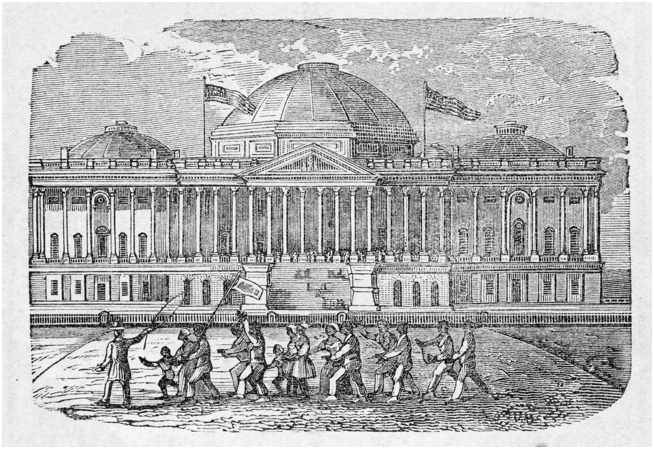
No renderings of the DC slave trade exposed the racialized limits of national democratic self-recognition more searingly than William Wells Brown’s Original Panoramic Views of the Life of an American Slave (1849). In the final section of Chapter 7, I focus on the opening images in this art installation and how they anatomize the relation between public sight, public sites, and the public authorization of federal slavery in the District. Prismatically deconstructing the republican tenet that “the business of government is public business” (Waldron Reference Waldron20), these “views” (of which only the companion description survives) assemble the DC slave trade from different racial and spatial perspectives to show how Black people, captive and free, are publicly legible in this national public space only in their visible exclusion from the idea of the national public being visually and ideologically constructed here.
Moral taint shadows democratic membership not only when democratically supported government wrongs make national hypocrisy and shamelessness so patent. Moral liability – not culpability and accountability, but mortification, odium, and response-ability – also attaches to democratic belonging when government wrongs appear to have citizens’ collective authorization. This happens when acts of representative government are said to be performed “in the name” of “the people” regardless of any particular individual or constituency’s moral opposition to or causal remove from those acts. The democratic shibboleth “in our name” frames the relation between citizens and political representatives as a principal–agent relation in which citizens contingently authorize their representatives to act as their political agents. The defining feature of this relation is not that political representatives act in the interest of their principals but that they act on their authority. As scholars of republican governance and democratic representation regularly observe, what this authorization means for political ethics is puzzlingly ambiguous. Who is the collective “we” implied in “in our name”? How much decision-making latitude does this relation grant to delegated agents individually or jointly as a deliberating body? Even if we accept the idea of an abstract subject called “the people” being collectively answerable for the laws enacted by the deliberative body it collectively authorizes to make its laws, how does this answerability devolve to citizens as individuals and groups, especially to those who openly oppose those laws?
Focusing on responsive obligations rather than blameworthiness is one way of answering the question. In this view, citizens, including dissidents, having yielded certain powers and prerogatives to the state, are obligated to respond in morally adequate ways when representative government acts unjustly or immorally in their name.22 At the extreme, citizens might withdraw their allegiance. This is the path famously exhorted by Garrison, who precipitated a schism within the antislavery movement by insisting that abolitionists be impelled by the motto, “No Union with Slaveholders!” In the early 1840s, he began urging antislavery citizens to renounce the present Constitution, declare void the historical compact that bound free and slave states in a proslavery federal union, and forswear allegiance to the federal government until a new Constitution should be established that, as one contemporary gloss put it, was “so free from complicity with slavery” – impossible to envision under the present union – “that [the voter] can approve it and desire his candidate to carry out its provisions” (“Political Complicity”). The Constitution notoriously gave enslavers disproportionate congressional power, licensed enslavers to seize fugitive freedom-seekers in “free” states, and protected the slave system in other ways. To support a government so enrooted in slavery, or serve under it or vote others into office, was to share in the guilt of “all the crimes which flow from the system” and become “the accomplice of all the Legrees and Haleys in the land who perpetuate their crimes” under the government’s protection (Revolution 10, 5).23 Accordingly, as the American Anti-slavery Society emphasized, abolitionism’s “first great work is to cut this Gordian knot, the Union, – and set free the northern conscience from the restraints of the constitutional oath” (16–17).
For Ohio Congressman Joshua Giddings, the House of Representative’s loudest antislavery voice in the 1840s and the focus of Chapter 8, “Purity Rights and the Congressional Slave Trade,” setting free the northern conscience did not mean repudiating the Constitution but restoring what he argued was the charter’s founding guarantee: that the federal government would not involve the free states in supporting slavery in any way beyond the bare requirements specified in the Constitution. Like others in the “freedom national” vanguard, Giddings insisted that the federal government had no constitutional authority to establish or support slavery anywhere within its jurisdiction beyond its explicit constitutional commitments. But Giddings framed this limitation in a singular way, as a foundational right to noncomplicity granted to northern states by the framers of the US government. Chapter 8, moving inside the Capitol, focuses on this notion of a northern purity right and its driving role in Giddings’ congressional brawls with proslavery adversaries and northern anti-abolitionists over federal authority to end slavery in the District of Columbia.
Giddings told a unique constitutional origin story that placed the northern right to democratic innocence at the core of the US government’s federal structure. In his telling, southern and northern delegates to the Constitutional Convention agreed to a tacit constitutional bulwark quarantining the federal government from slavery, delimiting the immorality and shamefulness of slavery, at least politically, within existing southern states. He cannily framed this grand bargain as a matter of states’ rights: Southern states gained the right to maintain slavery without federal interference, and northern states gained the “reciprocal” right to not be compelled by federal laws, taxes, or policies to support slavery beyond the constitutional minimum. Across his two decades in office, Giddings hammered against the persistent betrayal of this alleged bargain. He argued that the repeated battering of this structural firewall by the federal government and its southern handlers illicitly cast political guilt, odium, and disgrace on non-slaveholding states and their citizens. In this view, democratic complicity fell on northern citizens illegitimately through the federal structure itself, channeled by the formal parceling of powers and protections between federal and state governments.
The District of Columbia played a central role in his argument and his defiant floor confrontations with the bellicose proslavery caucus and its northern appeasers. The text of the Constitution left notoriously open who had authority to regulate slavery on federal land, and proslavery lawmakers reacted at first with dismay and then with fury to mounting claims that slavery in the District was a national concern and subject to federal regulation. Whatever common custodial concern and shared moral investment northern citizens felt in ending human captivity there was misplaced, they insisted, since the holding of human property in DC was a matter belonging exclusively to enslavers who enjoyed the same property rights in the shadow of the Capitol as they did in southern states. Only in this sense was DC a commons: The common rights of white property owners remained secure only if the existing laws protecting slave commerce and residential slavery in the District remained intact – that is, only if Blackness remained wed to unfreedom and vulnerability. Giddings, the House’s leading crusader for DC abolition in the 1840s and a member of Washington’s interracial activist community, would have none of it. The federal crime lay in originally legalizing slavery in DC, not in regulating it. Slavery’s “vices, its crimes, its guilt and its disgrace” were southerners’ alone, he emphasized, and “we will not contaminate our moral or our political purity by any participation in them” (“Speech of Hon. J. R. Giddings”). He pounced on the proslavery argument that northerners had no political standing or constitutional warrant to meddle with DC slavery. Throwing states’ rights arguments back at the proslavery caucus, he argued that the South’s imperious violation of northern purity rights amply offered that warrant.
No event made federal guardianship of slavery in the nation’s capital, or northern citizens’ involvement in it, or Giddings’ casting of this complicity as a political crime against northern citizens, more visible than the sensational attempt by over seventy-five enslaved Washingtonians to flee the nation’s capital aboard The Pearl in April 1848. The freedom seekers were captured within a day and marched to the federal jail in Washington, where Giddings visited with the ship’s officers and stared down an anti-abolitionist mob, setting off a whirlwind of anti-abolitionist rioting, fevered congressional argument, and national controversy. Discussion of DC slavery had been stymied in the House for over a decade, and Giddings seized the opportunity to protest defiantly against congressional slavery and the Slave Power, earning lavish praise from Douglass and Garrison, who credited Giddings with giving antislavery talk in Congress, despite its constitutional fealty, a new, uncowed aggressiveness.
Two months later, William Wells Brown gave a lecture damning the federal treatment of the Pearl freedom-seekers. One abolitionist in the audience despaired that Brown’s listeners, temporarily jolted into recognizing their own accountability for that federal wrong, would soon forget the pang of that conviction. Connecting this wrong to the iconic image of manacled African Americans in front of the Capitol, the abolitionist lamented, “Yet how much do we think of these things?” (T.W.H.). This was the aim of DC abolitionists and, indeed, all antislavery complicity critics: to spur audiences to think persistently and deeply about what it meant to be morally implicated in slavery, to think about the implications of that implication for slavery’s victims and for themselves, and to be moved by outrage, obligation, guilt, or shame to help end the social evil in which so many participated.
Moral imagining was central to this thinking in and beyond antislavery. What does it mean to partake of others’ sins? By what routes and on what grounds do moral guilt, shame, taint, and response-ability for social wrongs fall on individuals, groups, and institutions across different participatory realms and relations? To answer these questions is necessarily to excite the moral imagination, to envision “the traces of our own agency” in wrongs and harms perpetrated by others, to feel the reach of moral claims made on us by injuries and injustices that may appear experientially remote or causally distant (Zakaras, Individuality Reference Zakaras93). The religious alarmists, moral reformers, conspiracists, apocalypticists, network analysts, system critics, come-outers, market visionaries, personal shamers, and political gadflies I discuss across my chapters sought to arouse and train this moral imagining. They demanded that audiences widen their moral worlds by imagining previously unseen or unconsidered forms of moral participation and connection – moral ensembles – that transmitted, transferred, and cast complicity. Tracking complicity’s mediation and refraction, delineating its distribution and reach – these and other ensembling acts were not merely cartographic gestures. They were also generative. Making new traceries of moral taint and liability legible, complicity critics were assembling the moral, to adapt Bruno Latour’s phrase.24 They convened new aggregations – not only imaginary conspiracies but also freshly conceived collocations like the streams of participancy charted by free-produce writers – into analytical being. Through this moral worlding, complicity critics sought to arouse, alarm, educate, and activate their audiences. Demanding that audiences recognize themselves not as insular sovereign agents but as moral media – bearers, conduits, and enablers of others’ iniquity – complicity critics developed urgent arguments and admonishments that were at once ethical, analytical, affective, and aesthetic. In innovative story forms, jolting iconography, deconstructive art, compendious moral audits, commodity trade tables, vitriolic political debate, and other genres, antebellum complicity critics adapted old imaginative grammars and developed new ones to capture new forms of moral enmeshment and convey their dynamics and dangers.