Introduction
In this Element, I examine printed portraits that accompany Renaissance translations as materials containing rich signs for the moral and intellectual qualities of the subjects and of their collaborators. Typefaces, faces, and textual poses work together to signal the identity of the humanist translator and their collaborators. Countless Renaissance prefaces and letters to the readers reveal that, when translating, humanists felt compelled to justify and articulate their translation strategies and the skills required to fulfil the task in a way that would satisfy their intended readers.
Specifically, I investigate how Renaissance humanist translators used the printed page to construct a trustworthy persona and persuade readers of their translations’ value. These portraits did more than decorate books – they shaped the public identity of translators, lent credibility to their work, and positioned them within broader networks of cultural authority. As the early modern book trade expanded, portraits became key instruments in establishing recognisability – what we might now call a ‘brand’ – that reassured readers and patrons alike. By revealing how trustworthiness was deliberately performed and circulated in print, this Element reframes the role of translators in Renaissance culture and offers new insights into the social and symbolic economies of early modern trust.
1 Typeface and Face Types
In his translation of Saint Augustine’s Confessions (1631), clergyman and translator William Watts (c. 1590–1640) informs his readers that to produce his version he relied on an earlier translation of the Latin text. Watts also reveals that the unknown earlier translator (‘who was the author of it, I assuredly know not’) had misled him ‘when I too much trusted him’. Watts’s new translation, he adds, might contain some slips here and there, but ‘not so many by many [sic] as those of the former translation’.Footnote 1 Watts’s preface echoes a strong protestant, anti-popish polemic. Yet it also evidences a concern that was widely held by early modern readers and humanists – namely, a concern about the trustworthiness of translators and the reliability of translated texts.
One of the earliest and most significant Renaissance expressions of exactly this concern is found in Leonardo Bruni’s preface to his translation of Plutarch’s Vita Marci Anthonii (1405–6): ‘Who, when reading translations, does not consider the text of the first author brilliant, and will consider the translation to be full of absurdities because of the translator? … And I do not speak for myself, for sure, but for the common cause of the translators’.Footnote 2 After Bruni, several others from among the most eminent European humanists felt compelled to defend their decision to take up the role of cultural mediators through translation. As a correlate, they also felt obliged to explain their translative strategies to readers and patrons, and the reliability of the resultant versions. From the early 1500s, expressing such a compulsion in prefaces to printed translations became a convention associated with the publications they produced.
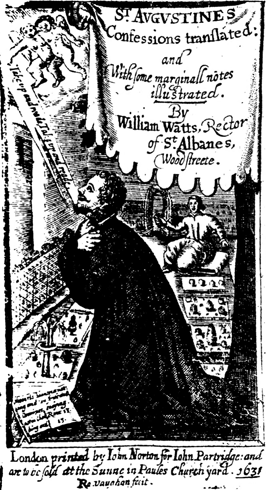
Returning to Watts’s translation, the 1631 edition has a title page almost entirely occupied by a portrait of the translator himself (Fig. 1). A swelling cloud carries the book’s title and credits, visually presenting the Confessions as a revelation or divine utterance. In a walled garden (trellis at left, fountain below), Watts kneels, arms crossed over his chest, eyes lifted. Above him hover two putti, unfurling a diagonal scroll inscribed repeatedly with the phrase ‘Take up and read’ (the Englishing of tolle lege, the command that prompted Augustine, at a time of great spiritual turmoil, to open the Bible). The diagonal banner operates as a visual vector guiding the eye from heaven to the translator’s attentive face. At the bottom left, propped open on a stand, a small book shows the biblical verse that, as narrated in the Confessions, triggers Augustine’s full conversion, Romans 13:13 (‘Not in rioting and drunkenness … not in strife and envying’), here abbreviated and hyphenated to fit the tiny page. The inclusion of the text stabilises the iconography, linking image and narrative with unusual specificity.
Watts, William. St. Augustines Confessions Translated: and With some Marginall Notes Illustrated (London: John Norton, for John Partridge, 1631), title page.
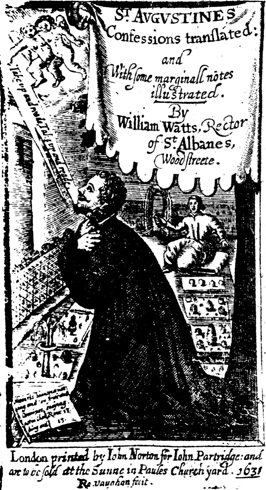
On the right mid-ground, a childlike figure seated on cushions raises one hand and holds a small hoop or wreath in the other – an allusion to the child’s voice that Augustine hears chanting tolle lege in a neighbouring garden. Below this figure descend three small tablets of miniature heads/medallions; they read as memory-panels. Whether they evoke teachers, the crowd of witnesses, or simply the plenitude of printed authority, they underline the act of choosing the right book at the decisive moment. In this rich image, the translator embodies Saint Augustine, and his translation becomes the reliable text for the devout readers of his time.
Watts’s preface and engraved portrait provide an ideal point of entry into the central question of this Element: what do portraits of and accompanying text by Renaissance translators strive to communicate to their readers? I ask this question for two reasons: first, in my research (2017 and 2019), I have found more than 100 portraits of Renaissance translators, which have not yet received the sustained scholarly attention they deserve. Second, as Watts’s example shows, these portraits are invariably given context by statements – in prefaces, letters of dedication, and similar material accompanying printed translations – whereby translators claim their reliability and skills as mediators of knowledge. If not made in the first person, such claims are made for a particular translator by their publisher, editor, patron, or peer.
Given the vastness of portraiture as a field, I need to be clear: in this Element I do not dwell on the rich ways in which the Renaissance painted, sculpted, and medal portraiture developed. Further, I do not focus on the numerous printed collections of lives and portraits of leaders (popes and emperors, predominantly), professionals (lawyers, physicians, and artists) which most scholars would agree began with Hartmann Schedel’s Liber chronicarum (known as ‘Chronicle of Nuremberg’, printed in Nuremberg, 1493). These publications were commercially successful and reached a significant development with Paolo Giovio (1483–1552) and his Elogia virorum illustrium.Footnote 3 The key goal of such collections was to memorialise and celebrate the intellectual and political elite of the time. In the course of the sixteenth century, requests for painted or printed collections of portraits extended beyond the highest echelons of society, and this growth worked side-by-side and in competition with literary praise.Footnote 4 I do not have room to discuss the lively Renaissance debate about the superiority of a literary portrait versus that of a painted portrait.Footnote 5 Suffice to say here that these debates centred on the relationship between word and image, typeface and face, questioning which of the two could best represent the moral, intellectual, and leadership qualities of the subjects.
As a category of ‘sitter types’, Renaissance humanists were highly concerned with visual (as well as literary) portraits of themselves. Erasmus of Rotterdam and Pietro Aretino are perhaps the most renowned examples of humanists who took particular interest in their image and reputation.Footnote 6 In this Element, I am not focused on humanists as authors. Instead, I focus on the men and women who were less widely renowned and influential than Erasmus, who produced translations, adaptations, or rewritings of earlier authors and, in doing so, felt the need to defend or promote their cultural mediators. Renaissance translators defended their work by trying to convince readers of their unique role in disseminating knowledge through textual means: prefaces, dedications, and similar word-based paratextual material.Footnote 7
Bruni’s passage, quoted previously, addresses the perception that the work of translators is thankless, and an easy target for their critics and competitors – and this perception is an enduring one. In his preface to the Rime (after 1424), Domenico da Prato (1389–ca. 1432) criticises humanists of his time for producing mainly translations instead of original works. It is his view that ‘fame is reserved to authors of works, not translators’ (‘la fama è delli inventori delle opere e non delli traduttori’).Footnote 8 da Prato’s words imply that translators should not compete against authors for fame, but produce reliable versions of earlier works and, by corollary, act as trustworthy agents of mediation. This need to reassure readers of the reliability of the translation, and the translator’s trustworthiness is expressed concisely in a preface written by the English Jesuit Robert Parsons (1546–1610) for his translation of King James’s Basilikon Doron (1598) into Italian for Pope Clement VIII. Here Parsons describes himself as ‘the priest who translated it is a learned and trustworthy man and he has tried to express the true meaning of the author, translating the sense rather than literally’ (‘il padre che l’ha tradotto è huomo dotto et confidente et s’ha sforzato d’esprimere la vera sentenza dell’autore, et reddere sensum sensui’).Footnote 9
Parsons’s self-description exemplifies Renaissance translators’ keen awareness of the context in which they operated and sought to publish their work. On the basis of such awareness, they adopted contingent strategies to reassure or convince patrons and readers of their good service. By ‘contingent strategies’ I mean proactive and highly adaptive approaches to the way each of their printed translations and accompanying portraits were presented in published form. Not unlike the official dragomans who worked for the Republic of Venice (Rothman, Reference Rothman2021), humanist translators fashioned themselves as necessary and trustworthy to their audience and the elite patrons who used their services. Furthermore, these prefatory statements echo the medieval oath of fidelity, which was a symbolic ‘creation or confirmation of an interpersonal bond’ (Reynolds, Reference Reynolds2012, 8).
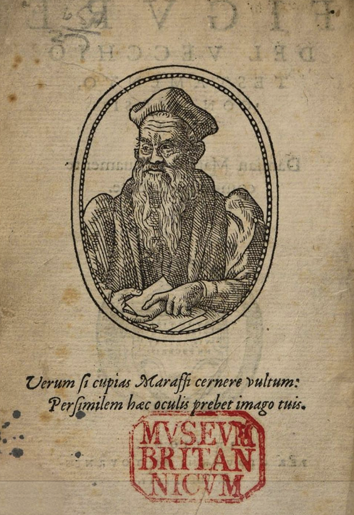
Returning to the central question of this Element: if written paratexts by humanist translators are aimed at reassuring or convincing readers of their reliability, what is the relationship between prefaces and portrait images, typefaces and face types, when these are published together as part of a printed translation? In other words, what do the translators’ portraits add to their written claims of reliability or trustworthiness? A printed portrait of Damiano Maraffi (l. 1550s) helps me begin to pursue this question: the frontispiece given to his Florentine rendering of passages from the Old Testament, first published in 1554 with the title Figure del Vecchio testamento con versi toscani per Damian Maraffi nuovamente composti, illustrate, Lyon-based printer Jean de Tournes was the publisher (Fig. 2). Maraffi is known to have worked closely with de Tournes, especially in his capacity as a translator. The 1554 frontispiece consists of a framed woodcut portrait of the translator floating above the following caption:
Figure del Vecchio testamento con versi toscani per Damian Maraffi nuovamente composti, illustrate (Lyon: Jean de Tournes, 1554), frontispiece.
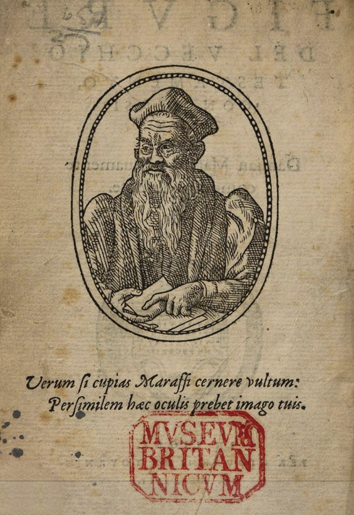
If you’d like to see Maraffi’s appearance, you have before your eyes this very lifelike image
(Verum si cupias Maraffi cernere vultum: Persimilem haec oculis prebet imago tuis).Footnote 10
The translator is represented in a three-quarter pose, as a long-bearded, wise, and be-robed old scholar. Maraffi points to the translated text, his own work. He gazes beyond the oval frame and picture plane in a way that suggests a symbolic conversation with the dedicatee, Margaret of Valois, Duchess of Berry (1523–1574). The printed caption alludes to the dual function the portrait fulfils: ‘vultum’ in Latin refers to not only the face of the subject, but also their personality. In the words of Cicero, ‘The face is the image of the soul; the eyes are its interpreters’ (‘imago animi vultus est, indices oculi’) (De legibus, 1, 9, 27). In Book Two of his 1435 treatise De Pictura, a text that still held sway in the mid sixteenth century, Leon Battista Alberti indicates that the portraitist must balance two competing objectives: producing a portrait that resembles the face of the sitter, while arguably tempering physical and moral imperfections (Woods-Marsden, Reference Wilson and Martin2008, 360–361). In the 1554 Figure del Vecchio testamento, this is what the portrait of Maraffi does. Together with the clear indications of his advanced age, his formal bearing and gesture convey his intellectual and moral stature, while the caption encourages readers to believe in the image’s veracity. The frontispiece is followed by a letter of dedication to the Duchess of Berry in which the translator professes his modesty: the translation is a ‘little work’ (‘operetta’) worthy of reading not because of his skills and knowledge (‘non già per mio artificio, ed ingegno’), but because of ‘its content and foundation’ (‘propria natura e fondamento’). Even if this portrait is stylistically very different from that of Watts (Fig. 1), both images emphasise their subjects’ moral probity and modesty. Both also grant the translator visibility to a degree that almost supplants mention of the translated author or material.
Such a contrast between the humanist translator’s visibility in a portrait and the modesty they profess in accompanying text has been recently described as the ‘paradox of print in the Early Modern period’ (Belle and Guénette, Reference Marie-Alice, Marie-France, Karen and Miguel Puga2024, 24). Modesty, captatio benevolentiae, and subordination, if not subservience to the author and patron, are key textual poses adopted by Renaissance translators, men and women. I will elaborate on this paradox (and the related paradox of exemplarity) in Section 3 of this Element. More broadly, scholars have shown how early modern portraits, both printed and in paint, make rhetorical claims about power, agency, and gender (Simons, Reference Shearman1992; Woods-Marsden, Reference Wilson and Martin2008; Pearson, Reference Pearson2008; Beranek and ffolliott, 2021). As summarised not long ago, ‘A portrait was expected to do something beyond its existence … and communicate ideas with subtlety or spectacle through the representation of physical appearance and a simulated presence’ (Mansfield, Reference Mansfield and Griffey2022, 321). Although the following example is a painted and not a printed portrait, it illustrates this point: it is a representation of Thomas Bodley, founder of the Bodleian Library in Oxford. Painted in 1598, the half bust image has on the bottom rail of its frame a rectangular painted cartellino that completes the top dedicatory tablet and the armorials on the side rails. The cartellino reads ‘This image portrays the mortal Thomas Bodley, but the library [represents] his vast soul’ (‘Thomae Bodlaei quicquid mortale Tabella ingentem animam Bibliotheca refert’).Footnote 11
Going back once more to the central question, the hypothesis I test in this Element is that translators’ portraits and accompanying written material penned by the translators themselves – or their editors, printers, patrons, or fellow humanists, henceforth called ‘collaborators’ – served the key purpose of making the translators look trustworthy. Translators literally agreed or decided to put their faces on the printed page to strengthen their claims to trustworthiness. The call to trustworthiness arose from the nature of the role translators played: as now, as in the Renaissance, translators were cultural and interlingual negotiators who needed to convince their patrons, printers, and readers of their suitability to interpret the translated text, and, if necessary, improve it. As Brian Richardson notes, ‘The need to generate authority for a text and to defend it against possible criticism was probably more acute for translators than for other authors, because their task was open to accusations of untrustworthiness’ (2018, 13). They defended their work through a balancing act between professed respect towards the first author and practical, assertive adaptation of the source text.
A clear example of translators’ self-defence against possible accusations of unreliability comes from a letter of dedication written by Remigio Nannini (1518–1580), a Dominican friar and prolific Italian translator. In the preface to his translation of Ammianus Marcellinus’s Res gestae (1550), Nannini addresses Antonio Altoviti, Archbishop of Florence.Footnote 12 He concedes that his translation is a ‘poor effort’ (‘bassa fatica’) and ‘inferior’ to the Latin source text. He goes on to write that, although he did not match the ‘purity’ of Marcellinus’s work, he did not steer too far from the Latin narrative. In fact, Nannini argues, he managed to ‘support, embellish, and elevate’ Marcellinus’s art with his own skills. He then asks his patron Altoviti to ‘appreciate and defend this labour of mine’ (‘gradire et difendere questa mia fatica’) against the suspicion or distrust of readers.Footnote 13
In the same preface, Nannini compares himself to ‘inexpert painters, when depicting living men or women, or a statue or a drawing by a better master than themselves, do not represent them exactly’.Footnote 14 The result is, in Nannini’s view, that the portrait will not be exactly the same (‘a punto’): due to the painters’ lack of expertise, such portraits will diminish the natural beauty of the subjects, but still convey their appearances. This view echoes Alberti’s advice to balance, as competing objectives, ‘resemblance’ with ‘tempering … imperfections’. Nannini’s comparison is highly relevant to this Element: the translator’s painterly analogy reveals the Renaissance translators’ anxieties about their translations, and their concerns of not being seen as reliable. Nannini’s strategy to fend off any criticism is twofold, and reflects the above-mentioned ‘paradox of print’: he seeks to pre-empt disapproval by means of modesty; he invokes the authority and protection of the dedicatee to discourage others from slating his work. Nannini did not resort to self-portraiture to articulate his reliability, but his use of painted portraiture as a metaphor for modesty and trustworthiness is a useful reference point for this Element.
Before I move to introducing the three key aspects of this Element (trustworthiness, printed portraiture, and humanist translators), it is useful to clarify further the approach I take in this Element. First, my analysis of Renaissance printed portraits and their accompanying textual poses centres on a representative selection of such materials produced between 1520 and 1650 primarily in Italy and England, with some further examples from elsewhere in Europe.Footnote 15 The textual and visual evidence I discuss in this Element is organised thematically, not chronologically. My discussion, therefore, considers multiple expressions of the complex dynamics between visual and textual images of Renaissance translators, and between translators, printers, patrons, and readers with reference to the social and symbolic economies of early modern trust. Second, I approach the printed portraits as a scholar of literature and translation, with a strong interest in how image and text interact and, during the first 150 years of Western print culture, reflect collaborative practices in translation and publishing. Of course, portraiture has long been considered a subject for art historians, who approach portraits as artworks and also social and political instruments, documenting and shaping ideas about identity, power, status, and gender. Meanwhile, much Renaissance scholarship on portraiture – by social historians and literary critics alike – tends to reassert binary frameworks. Such binaries obscure the very multiplicity this Element seeks to foreground. Author versus translator, individualism versus anonymity, and celebrity versus modesty are some long-standing oppositions. Attempts to overcome them have, in some cases, resulted in abstruse and unhelpful concepts. Take, for instance, ‘transla[u]t[h]orship’ coined by Nathalie Hancisse and Stéphanie Vanasten in 2015, and picked up by Anne Coldiron (Reference Court2018, 53 and 56) and Tahsin Çulhaoğlu (Reference Dearnley2017). The term is meant to bridge the ‘author versus translator’ divide by acknowledging a practice of authorship in which author and translator are the same person, thus comprising a distinct and visible category of authorship.
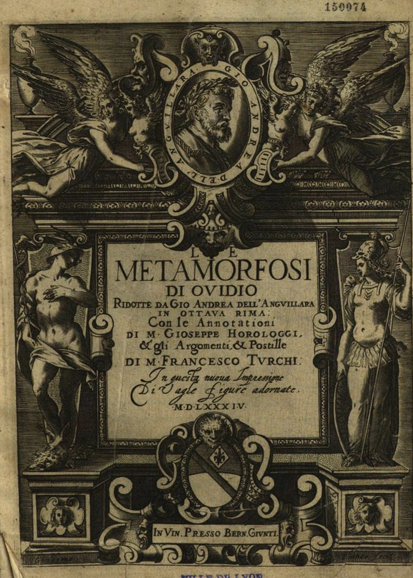
I carefully avoid this dichotomy and follow the well-established view that the author is a context-dependent construct (Foucault, Reference Foucault1979). Yet I also notice how scholarship on printed author portraits in printed books remains typically focused on individuals and on the conventions used to depict them. The ‘death of the author’ proclaimed by Roland Barthes in 1967, and echoed by Foucault a few years later, provocatively intersects with the ‘birth of the individual’ long claimed as essential to the Renaissance in Western Europe. Here I argue that the intermediary role served by Renaissance humanist translators – and their shifting strategies for representing trustworthiness – points instead to a fluid and collaborative model of translation. Returning to the portrait of Maraffi discussed earlier, the same woodcut reappears in his 1554 translation of Polydore Vergil’s De Prodigiis and Julius Obsequens’s Prodigia. This was a two-part (continuously paginated) volume, printed in Lyon by Jean de Tournes, the same year as the Figure del Vecchio testamento first edition. The visibility and primacy given to the translator in the portrait for the latter volume are tempered, in this instance, by the inclusion of Vergil and Obsequens’s names on the title page (Fig. 2) and in a letter to readers. In this letter, the French printer de Tournes describes ‘our present work’ (‘nostro presente volume’) as having been written by three authors (‘tre Auttori’). He thus bestows authorship on Maraffi while calling attention to the collaborative nature of the edition.
Throughout these first pages, I have made reference to trustworthiness. It is useful here to explain my reliance on this term and its pertinence to the presentation of humanist translators.
1.1 Trustworthiness (in the Face of Distrust)
Distrust was rife in Renaissance societies. As we have seen with Watts’s preface to his translation of Saint Augustine’s Confessions, distrust between translators and the translator’s fear of being distrusted were a common concern in Renaissance Europe. In his Libri della Famiglia, Alberti has one of his characters say that ‘the world is full of deceit’ and ‘everything in the world is profoundly unsure. One has to be far-seeing, alert, and careful in the face of frauds, traps, and betrayals’ (Rubin, Reference Rubin2007, 5). The same Florentine society Alberti addressed in his work strongly believed in the importance of maintaining a good reputation. As the wealthy fifteenth-century Florentine Giovanni Rucellai told his sons, money was not enough to establish a solid reputation. Good relations and good work were the bedrock of any cultural, social, and economic success. Fifteenth-century Italian humanists wrote thousands of pages on the importance of being honestum (morally good or honourable), which was determined by trustworthiness and social standing (Kircher, Reference Kircher2012, 266). Several of these humanists relied on Cicero’s words that, regarding moral duties, ‘The foundation of justice, moreover, is good faith [‘fides’] – that is, truth and fidelity to promises and agreements’ (De officiis, I.7.23, 24–25). Steven Shapin remarks that premodern elites adopted another significant way to signal positive reputation and trustworthiness – through aspects of physical presentation: ‘physiognomy, costume, gesture, posture, patterns of speech, and facial expression’ (1994, 151).
Closer to the scope of this Element, in Europe from the sixteenth century onwards the exponential growth in the number and circulation of printed texts created an ‘endemic distrust’: piracy and plagiarism were fuelled by fierce competition between printers and created a strong perception of instability and insecurity on the part of early modern readers (Pabel, Reference Pabel, Enenkel and Neuber2005, 217). This feeling of distrust emerged from the early days of the printed word. In 1470, for instance, the humanist Niccolò Perotti wrote that, while the invention of the printing press was ‘a great and truly divine benefit’ (‘magnum quoddam ac vere divinum beneficium’), the editors who curated the ancient texts for printing corrupted them. Perotti called for strict standards of editing and translating.Footnote 16 This strong sense of distrust continued well into the sixteenth century, and throughout Europe.Footnote 17 Brian Richardson has offered two main reasons behind this profound distrust of the printed word: on the one hand, the workers involved in the manual production of printed texts were not as well educated as authors and scribes; on the other hand, editions were often rushed with little or no time given to authors and translators to review the proofs. As circumstances for a printed volume, these two reasons were often connected. For instance, in his 1547 translation of Boccaccio’s Genealogia deorum gentilium, Giuseppe Betussi (ca. 1512–ca. 1573) expresses his disappointment to the dedicatee, on the basis that his printers did not wait for his return to Venice. They printed the text before he could see the proofs, leaving the task to unreliable proofreaders.Footnote 18 Likewise, another humanist translator, Lodovico Dolce, expresses disappointment that he was not given enough time by his printer, Gabriele Giolito, to review his vernacular version of the life of Apollonius of Tyania (La vita del gran philosopho Apollonio Tianeo, composta da Philostrato scrittor Greco, 1549–1550). Dolce’s printer did allow him to voice his complaint, however, in a letter to Anton Giacomo Corso that was published at the end of his translation:
oltre che gli impressori cominciarono a darlo alle stampe prima che io havessi posto fine al primo libro, onde ne fu bisogno di compartire il lavoro dì per dì, in modo che loro pienamente servisse, da che ne nacque ch’io non poteva rivederne carta, sì avenne ancho che, per non lasciare il volume imperfetto, fui sforzato a seguitarlo nel tempo che, come sapete, io mi sentiva aggravato da moltissima febbre. A questo s’aggiungono diversi errori avenuti nello imprimere, come agevolmente potrà conoscere chiunque non si sdegnerà di leggerlo
(the printers began to give it to the press before I had finished the first book, and thus the job had to be divided day by day to give them a full workload, and as a result I could not correct a single leaf; moreover, it happened that, to avoid leaving the volume imperfect, I was obliged to follow its progress at a time when, as you know, I was suffering from a high fever. On top of this, various errors occurred during printing, as can be easily seen by anyone who does not mind reading it).Footnote 19
These examples evidence distrust between printers and authors or translators, and it may seem extraordinary from our contemporary perspective that such tensions were publicly voiced in print. If printers needed to publish before competitors took their initiative, humanists were afraid that their work would be corrupted in the process and, as a result, cause irreversible damage to their reputation. This situation prompted printers and humanists to address such ‘profound problems of credit’ (Johns, Reference Johns1998, 31) and adopt several means to build credit or trust before their audiences and investors. As we will see in the third section of this Element, claims to diligence, hard work, and other skills and moral qualities were very important to communicating trustworthiness. Nevertheless, some printers were still happy to make a quick profit by reprinting or plagiarising works that promised or showed to be commercially successful.
From the literature of the social sciences, trustworthiness has long been recognised as more important than trust: the latter cannot exist without the former. Economic and social historians have argued the importance of the establishment and strengthening of trust between traders, merchants, diplomats, and rulers. They have identified and discussed the context-based ways in which premodern merchants and their interlocutors created a language of trustworthiness to enable trust between communities.Footnote 20 As cultural mediators key to the book trade, humanist translators felt compelled to signal their trustworthiness before their patrons and readers against a backdrop of stiff competition between humanists and the exponential growth of the print industry, which often attracted suspicion and distrust from readers and investors.Footnote 21
To enable trust, humanists and their collaborators made much effort to facilitate their readers’ and dedicatees’ trust and create or strengthen a cultural and linguistic bond.Footnote 22 My focus is not on trust, but on the trustworthiness of humanist translators for two reasons. The first reason relates to feasibility, since historical evidence of the act of trust is extremely hard to find and evaluate, leading often to conjecture. Trust, or the act of trusting (thus trusting readers’ or patrons’ reception of a translators’ work), involves cognitive, affective, and behavioural responses to the person(s) who are trusted or distrusted in a risk situation, and such responses were mostly silent. The second reason is a personal preference: I am interested in examining how Renaissance European translators and their agents chose to present themselves as reliable, authoritative, and even prestigious mediators before their intended readers or clients.
The performance of trustworthiness has been defined as necessarily preceding the act of trust (Mayer, Davis, and Schoorman, Reference Mayer, Davis and Schoorman1995, 727) and is based on a series of characteristics including benevolence (positive motivations on the part of the trustee or translator in our case), competence, integrity (a set of moral, cultural, and social principles readers would approve of) and predictability (perceived consistency of actions). Twentieth-century organisational sociologists have written much about these characteristics (Rompf, Reference Rompf2015, 43–44), which cannot be applied wholesale to Renaissance cultures. I recognise that every society has different cultural and social principles, values, and norms. However, the empirical evidence I have gathered indicates that these modern characteristics do align with those early modern ways of signalling trustworthiness that I examine in this Element. In particular, management and cognitive psychology studies have shown that individuals’ display of ‘trustworthiness’ indicates that they can be trusted (Fawcett et al., Reference Fawcett, Jin, Fawcett and Magnan2017). Such a display can be behavioural and, more broadly, communicative, as the Renaissance humanist translators show in their textual and visual poses. It is time now to move to print portraiture and how it relates to trustworthiness (and distrust).
1.2 Looks in Printed Books
How does portraiture in printed books relate to these manifestations of distrust and trustworthiness? To answer this question, I need to take a step back and briefly consider, as a broader context, what portraits meant to humanists and their printers and readers. As early as 1518, and thanks to the growing success of printing, portraits and letters were no longer confined to the private sphere. When picked up and adapted for the book trade as materials for circulation in print, portraits and letters enabled a semi-public dialogue in which readers could become key participants. As Lina Bolzoni has shown, such a form of dialogue was unthinkable before the establishment of the print industry in the first three decades of the sixteenth century.Footnote 23
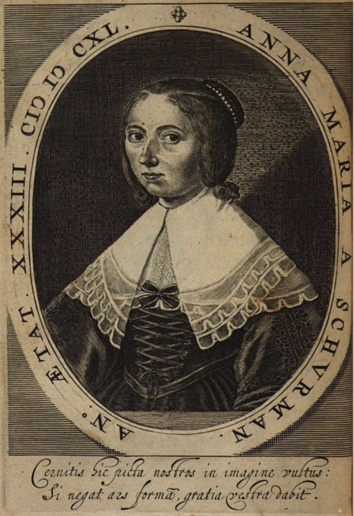
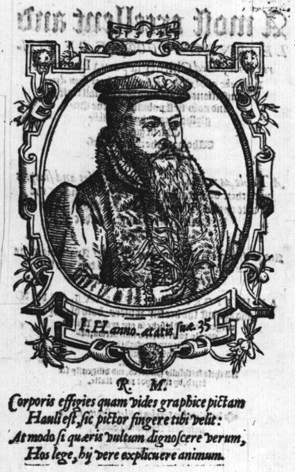
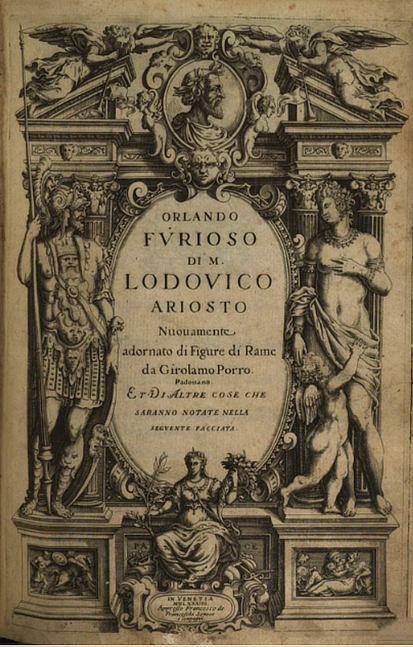
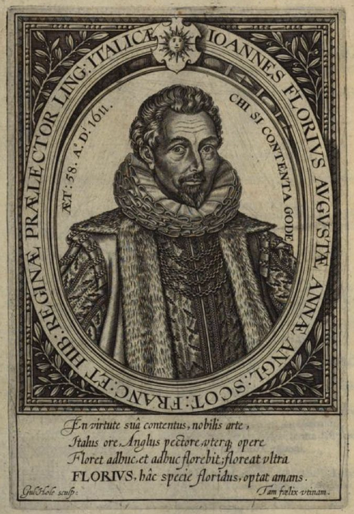
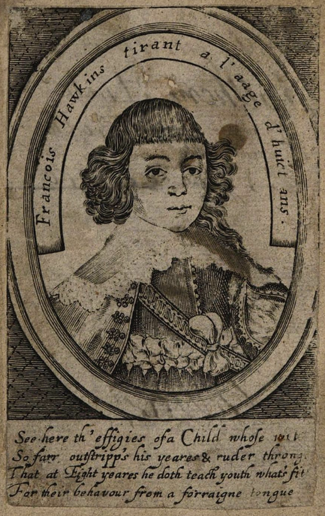
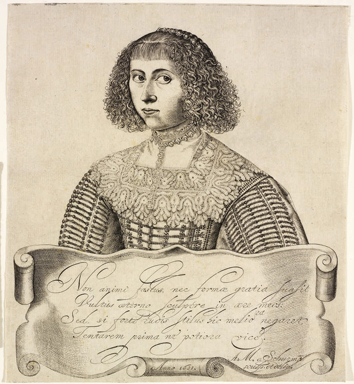
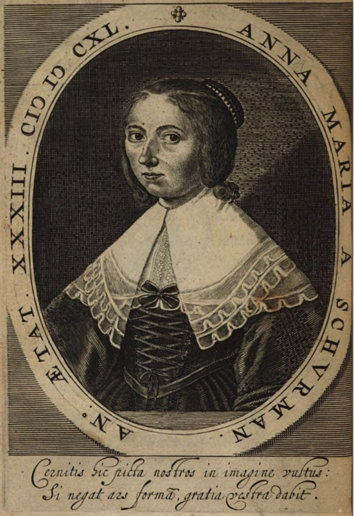
With respect to print culture, another significant development from the third and fourth decades of the sixteenth century was the practice of accompanying a printed text with an author portrait. Countless published works in the Renaissance carried a portrait image. For the period I consider in this Element, from 1520 to roughly 1650, the most common style features a medallion frame surrounding a half-bust portrait, and showing the name and age of the subject at the time the portrait was made (Fig. 3). This particular style of self-fashioning harks back to a long-standing hagiographic manuscript and visual tradition of historical figures and leaders who fascinated Renaissance scholars and readers (Larsen, Reference Larsen2016, 183). More specifically, in an Italian context, the portrait of Ludovico Ariosto in the 1532 edition of his Orlando Furioso, printed in Venice by Francesco Rossi da Valenza, is an early example of the new trend. The portrait is unusually placed at the end of the poem, inviting the reader to meet the author face to face. Bolzoni has convincingly argued that this portrait, like several other sixteenth-century author portraits, is the author’s speculum animi (mirror of soul), which helps to create a ‘dialogue between Ariosto and his reader, who may now compare it to the ideal portrait that the act of reading has painted in their mind’. This view echoes the already mentioned understanding from Cicero that ‘the face is the image of the soul’. Portraits, in this sense, offered readers the chance to have a ‘personal encounter’ with the author.Footnote 24
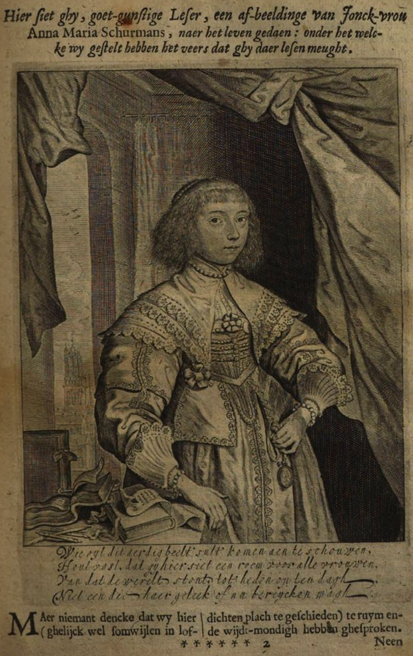
van Schurman, Anna. Opuscula Hebræa, Græca, Latina, Gallica: prosaica & metrica (Leiden et al., 1650), frontispiece.
Renaissance readers and thinkers tended to believe that only intellectuals of exceptional merit should be remembered through their writings and portraits (Waquet, Reference Waddington1998; Rößler, Reference Rößler2021, 124). Yet printers and investors were motivated to elevate the prestige of all their authors, since this increased a book’s overall value – much as an attractive frontispiece was intended to enhance appeal. During the first half of the sixteenth century, printed author portraits were not confined to the title pages or frontispieces of the works of long-deceased, authoritative writers like ancient philosophers and historians.Footnote 25 That is, early examples of author portraits included those of Italian humanists, whose faces decorated manuscripts they presented to their noble patrons. The humanistically trained Martin Luther (1483–1546) is perhaps the most renowned and influential pioneer of this practice. In the seventeenth century, a portrait was typically featured as a frontispiece for a volume of collected works. By the eighteenth century, the frontispiece portrait acquired such a social significance that no serious scholar could afford to be without one (Rößler, Reference Rößler2021, 124–127).
If printers invested in portraits to confer prestige on their authors, the key question becomes not only where and when these images appeared, but what kinds of mirror or image of the authors’ souls (to use Cicero’s metaphor) they were designed to communicate. Much secondary literature offers in-depth studies of sitter types (such as scholar, saint, and classical author) and the style, technique, and conventions used to portray them (Zappella, Reference Wubs-Mrozewicz1988; Mortimer, Reference Mortimer1996). However, less consideration has been given to the representation of sitters’ moral qualities. For instance, Giuseppina Zappella has provided a thorough description and classification of portraits printed in sixteenth-century Italy, but has given relatively little attention to iconographic elements that might shed light on the sitters’ virtues or skills such as the clothing, hairstyling, and details of the portrait setting.Footnote 26
Closer to the topic of this Element, what about humanist translators and their portraits? First, little data exist on how many translator portraits were included in books printed in Renaissance Europe. Based on the existing surveys of printed portraits (Zappella, Mortimer and Redier, as discussed in this Section), it is clear that there are fewer portraits of translators than there are of authors. Second, evidence from humanist translators themselves shows that they understood their task as being more treacherous than that of writers of original works, which could at first explain a reticence to reveal their own speculum animi through visual portraits. For instance, Bernardino Pino da Cagli (c. 1530–1605), an Italian poet and translator, made a direct comparison between the two tasks in his preface to a 1581 translation of the Latin playwright Terence. He wrote that ‘the work of a good translator is as great, or perhaps greater, than that of a good poet’. A translator, he explained, is like an actor on a stage, tasked with perfectly embodying another’s words and emotions, while a poet only has to write the script.Footnote 27 This argument highlights the performative and interpretive nature of translation, suggesting that the translator is inevitably exposed to criticism and distrust. Lodovico Dolce (1508–1568) in the preface to his translation of Ovid’s Metamorphoses (1553) notes the scepticism of readers of translations, who will inevitably find fault with the new version of the source text.Footnote 28
This perceived risk mattered for images. It helps account both for the relative scarcity of translator portraits and for the distinctive work those portraits were asked to do. Whereas the authors’ visual portraits were intended to enable a dialogue with the reader, the fewer portraits of translators cannot do so, at least not directly. In every published translation, the possible sources of dialogue with the reader are at least several, since by nature the book will invoke (if not involve) more than one contributor. Therefore, any dialogue between the translator and reader is often mediated through the translated author and, potentially, also the dedicatee or patron, who is routinely invited by the translator to guarantee the reliability of the translation. The translator portraits, I argue, add an extra layer to the more ubiquitous portraits of authors: they needed to create a dialogue between author, translator, and the new readership, in which the intermediary role of the translator is articulated, defended, and promoted – even accorded high authority.
As included in his 1554 translation of De Prodigiis and Prodigia, the already discussed woodcut portrait of Maraffi is a poignant example of how a translator portrait enables a complex dialogue with the reader, author, and dedicatee: what may seem, at first, to be an emphatic and fairly typical ‘author portrait’ is immediately tempered by clear statement of fluid collaboration and co-authorship. In Medieval and Renaissance Europe authorship was a collaborative, shared practice which involved several agents working at different or synchronous stages of text production. For this context, then, authorship is well described as ‘a set of linked activities … which are sometimes performed by a single person but will often be performed collaboratively or by several persons in succession’ (Love, Reference Love2002, 39). As discussed shortly, humanist translation, however, adds another dimension to this shared authorial practice. Even when the printed portrait offers the illusion of a sole author-creator (by emphasising the dominant role played by the first author), very often the title page, frontispiece, and other paratextual elements of a Renaissance printed text deliberately alter or supplement this illusion, by reminding the reader of the shared nature of book production.
Before this virtual dialogue between translators, authors, printers, and readers could take place, readers needed to be enticed to pick up and buy or borrow the printed translation. The design of title pages played a crucial role in transforming the Renaissance book trade into an economy of mass production (Smith, Reference Smith2000, chapter 5; Olson, Reference Olson2016, 619). Growing print runs (sometimes in the hundreds) required effective promotional strategies to entice buyers. The title page served as a key means to present and promote the newly published editions. Booksellers spotlit their merchandise by displaying the title page of an unbound book so that browsing clientele could easily peruse and pick their preference. Sometimes the title page was also posted on walls or street corners like a playbill (Olson, Reference Olson2016, 620). Title pages and prefaces enticed readers to frequent bookshops, as humanist Marc’Antonio Sabellico vividly demonstrates when writing about a friend who could not bring himself to leave the bookshops of Venice:
As often happens, it happened to our friend Julius here: today, I took him to booksellers (‘bibliopolas’) of the Rialto bridge, after he had spent between early in the morning and the third hour of the day between the German emporium and Mercerie. Whether by hook or crook, he could not be removed. He remained fixated on the book lists, and he left me waiting forever, something I never thought would happen. When I eventually decided to return to my private lodging, he was still in the bookshops, busier than ever
Booksellers influenced buyers not only by arranging the unbound books (display copies) and exhibiting lists of books or title pages but also through extensive conversations with their clients. Booksellers and cartolai were persons of culture who often established a direct relationship with their clientele. Scholars frequented booksellers’ shops not just to purchase books but also to socialise with peers. In his 1593 La Piazza Universale di tutte le professioni del mondo (an encyclopaedia of all early modern professions), Tommaso Garzoni describes bookshops as social venues frequented by physicians, theologians, humanists, and doctors of law, among others (Garzoni, Reference Garzoni1593, 832). Not all bookshops across Europe, though, attracted intellectuals and gave buyers time to browse and socialise before making a purchase. In 1594, author Thomas Churchyard complained that some book punters in London made their choice after reading only two lines from title pages (Olson, Reference Olson2016, 621): ‘Some readers awhile, but nothing buyes at all, / For in two lines, they giue a pretty gesse’. Competition and fear or anxiety about distrust, as demonstrated by Watts’s preface to his translation of St Augustine’s Confessions, put strong pressure on translators and their printers, and made them particularly self-conscious. Such self-concern directly affected the book trade (Mortimer, Reference Mortimer1996, 8) and encouraged the enhanced visibility of authors, printers, and, as I discuss in this Element, translators. Significant investments into print technology, during a period Walter Benjamin described as an ‘age of mechanical reproduction’ (Randolph, Reference Ray2003, 1), facilitated the transition from coarse and anonymous woodcuts to lavish and highly individuated engraved portraits.
1.3 Humanist Translators
What do I mean by ‘humanist translators’? Firstly and fundamentally, as humanists of the Renaissance, they were readers and writers with a strong interest in ancient and contemporary works mostly in Latin but increasingly in European vernaculars (Celenza, Reference Celenza2018, 2). Their leaning was based on the ancient Latin texts (studied both in the original and in translation). They followed an increasingly institutionalised pre-university curriculum, which focused on studying ancient and Renaissance letters and orations, as well as grammar, rhetoric, poetry, and moral philosophy (Kristeller, Reference Paul Oskar1979, 22; Grendler, Reference Grendler2006). Whether their studies led to recognition as humanists or became a beloved pastime, Renaissance men and women who were trained in such studies became humanista: scholars, students, teachers, printers, and also occasional authors, translators, and editors.
Translation was a key intellectual practice fostered by the humanistic curriculum, not only for learning languages but also for developing skills in textual criticism and the ability to interpret texts and ideas in ways that often challenged established ideas and norms. Philologists and scientists recovered and improved ancient knowledge and teachings that had been previously corrupted or misinterpreted. For instance, many collaborative translations by medical humanists of texts attributed to Galen culminated in the 1541 edition published by the Giunti Press after a painstaking recovery of more reliable Greek versions of the ancient Greek physician’s work (Grendler, Reference Grendler1993, 84). Translation allowed the recovery and deeper understanding of past texts, cultures, and practical know-how. For this reason, humanists were authors as well as translators. Even when they did not produce a full translation of an ancient or contemporary text, they practised translation as part of their dedicated authorial and scientific study and work.
Recognising that translation was part and parcel of the work humanists undertook, in this Element I discuss cases that do not fit into our modern, narrow understanding of translation: nowadays, certain humanist works might be considered more akin to interpretations, paraphrases, summaries, adaptations, or rewritings. Readers and fellow humanists of their time understood them as translations. As articulated by Leonardo Bruni, in the early fifteenth-century prefaces to his Latin translations and rewritings of classical texts, several terms were available to humanists to describe the ways they engaged with earlier texts: ‘interpetri’ described the literal translators, ‘componitori’ referred to the authoritative user of sources, and ‘traducendo’ was used in the context of a confident adaptation of the source text (Rizzi, Reference Rizzi2017).
Take, for instance, the Neapolitan humanist Laura Terracina (c. 1519–c. 1577). Terracina is now recognised as by far the most published woman of the European Renaissance. Among her several poetry collections and her two-part Commentary on the Opening of Each Canto of the Orlando Furioso (first published in 1549), her work can still be found in more than forty editions and reprints. She also became a member of the Neapolitan Academy of the Incogniti. This membership represented a form of contemporary intellectual recognition which was given to only a handful of sixteenth-century women (Ray, Reference Ray2024, 111–114). Her Commentary is a feat of bravura: each first stanza of Ariosto’s cantos is reinterpreted and rewritten with the powerful effect of transforming Ariosto’s writing into a combative defence of women. For example, her rewriting of the thirty-seventh canto is an incisive condemnation of male privileges. By addressing women directly, Terracina implores them to drop their pastimes and focus instead on learning:
Oh, if only women would give up needle, thread, and cloth / and take up the weight of study, / I think they would do some real damage to you writers.
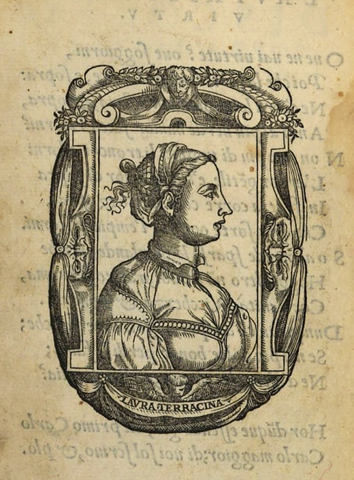
Terracina addresses women by inviting them to act, through literary means, against misogyny and other social and cultural obstacles of the time. As a woman who married late in life and gained recognition and reputation among the Neapolitan elite and peripatetic intellectuals such as Lodovico Dolce, Lodovico Domenichi, Anton Francesco Doni, and Marc’Antonio Passero, Terracina was a model of socio-intellectual freedom for women of her time. Beyond conventions dictated by the modesty and propriety rigorously expected of women, Terracina is one of the very few female humanists to have her portrait printed in several editions of her work. Notably, the first edition of her Commentary was printed by Giolito de’ Ferrari in Venice in 1549. Giolito’s approach to publishing was reputedly highly competitive, and also creative, particularly in the ways he sought to appeal to a female readership (Dialeti, Reference Dunlop2004). Back to her 1549 edition of the Commentary, we find a half-page, profile-view portrait of Terracina (Fig. 4) focusing on her virtue and modesty. This can be seen in the way Terracina is dressed: the neckline is notably high, the collar small, closed, and undecorated, which represents a more conservative neckline than the low necklines increasingly associated with Italian noblewomen’s dress (Griffey, Reference Griffey2019, 95–116).
Terracina, Laura. Discorso sopra tutti li primi canti d’Orlando Furioso fatti per la signora Laura Terracina (Venice: Gabriel Giolito, 1549), frontispiece after the author’s letter to Virtue (Aiib).
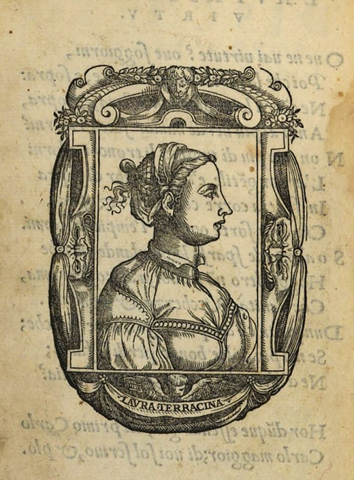
Between the title page and the frontispiece, the 1549 edition of the Commentary features a dedication by Terracina to the personification of Virtue: here she laments her virtue-deprived times and calls herself ‘foolish’ (‘stolta’) for trying to make use of Virtue’s efforts as she will never succeed (Terracina, Reference Terracina1549, Aiir). In this edition, Terracina’s self-professed modesty and sense of inadequacy stand in stark contrast to the prominent positioning, and strongly classicising style of her portrait. Her roles as reticent and modest rewriter of Ariosto’s poem and source of inspiration not for Petrarch but for women readers are cleverly juxtaposed.
This juxtaposition would have been evident to contemporary readers, as demonstrated in another portrait by Vico, also published in Doni’s Medals: here an image of Petrarch’s Laura (one of the most iconic sources of poetic inspiration) is dedicated to ‘the most virtuous S[ignora] Laura Terracina of Naples’.Footnote 29 Laura, the sixteenth-century writer, is connected to Laura, the muse of the father of Italian love poetry. As an author herself of Petrarchan poetry, Terracina’s balancing act between Petrarchan poetry (and therefore a virtuous, chaste, and established repute) and ambitious if not bold antagonising of male cultural dominance plays out in her portraits. On the surface, she is another Laura ready to inspire male-authored poetry. Yet based on a close reading of her Discorso, Terracina’s portrait can be described as the image of an assertive and despondent rewriter of male-dominated chivalric poetry who was encouraging women of her time to emulate her literary achievements.
Returning to translation’s central place in Renaissance humanism: as the humanist curriculum accrued intellectual prestige and wider cultural sway, printers and patrons increasingly sought reliable translations. The significant increase in the number and range of translations published across Renaissance Europe was also spurred by the unearthing of ancient and medieval texts from monastic libraries and other collections. These works were mostly in ancient Greek, Latin, Arabic, or Hebrew, and were soon translated into European vernaculars such as Italian varieties, French, Spanish, and English. It should not surprise, therefore, that the Renaissance has been well described as a veritable golden age of translation (Burke and Hsia, Reference Burke and Hsia2007). Another key factor in the growth of translations was the establishment of the print industry, which facilitated the consumption of translations, while also stimulating competition between printers, editors, and translators. Success in this ever-more vigorous market required context-based, innovative, and technologically advanced marketing strategies. And printed portraits represented a particularly effective self-promotional tool, as this Element discusses.
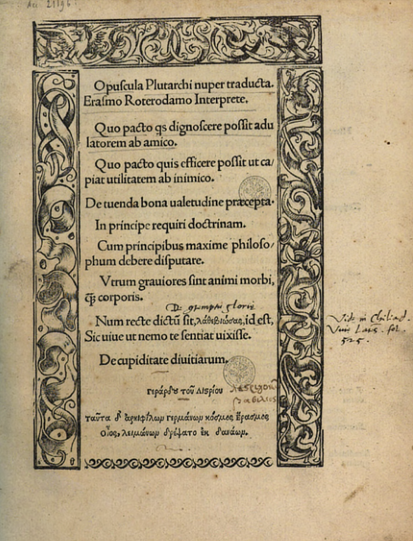
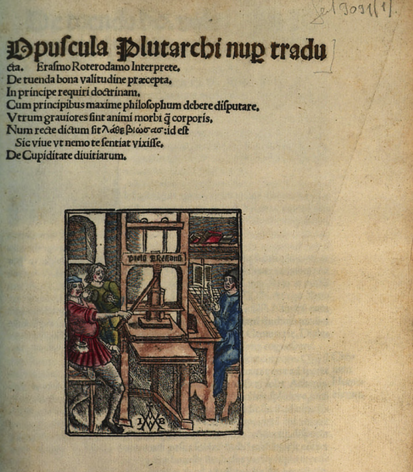
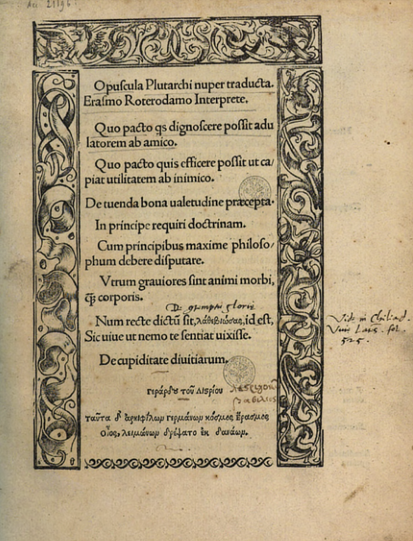
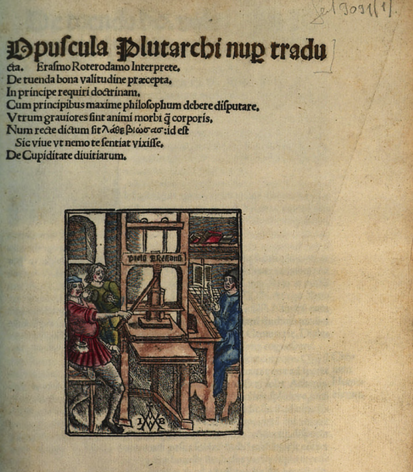
Printers and patrons often perceived and promoted translators and authors as contributors of equal significance in the Renaissance humanistic culture. Such a perception is evidenced in the typography used for individual names in the frontmatter of printed books. For instance, and famously, on the title page of Desiderius Erasmus’s partial translation of Plutarch’s Moralia (Basel: Froben, 1514) the printer gives the translator’s name the same prominence as the author’s by using the same size of typeface for each (Fig. 5). This was a different presentation from Badius Ascensius’s shorter version printed in Paris in 1513 or early 1514 (Ledo, Reference Ledo2019, 266–270): here, the printer gives prominence to Plutarch’s name while that of the translator is accorded a smaller-sized typeface (Fig. 6). This example shows how printers sometimes afforded the same status to both authors and translators: here undoubtedly because Erasmus was a celebrity humanist who gave much thought to his image and reputation, and by doing so he influenced European humanists and perceptions around their work.
Plutarch. Opuscula Plutarchi nuper traducta Erasmo Roterdamo interprete (Basel: Froben, 1514), title page.
Plutarch. Opuscula Plutarchi nuper traducta Erasmo Roterdamo interprete (Paris: Badius Ascensius, ca. 1513), title page.
In 1524, Erasmus sent the latest version of his translation and annotation of the works of Jerome’s Opera Omnia to its dedicatee, the Archbishop William Warham of Canterbury. He also included a portrait of himself painted by Hans Holbein the Younger in oil and tempera on wood. This portrait has received much scholarly attention (Jardine, Reference Jardine1993, 166; Pabel, Reference Pabel2008, 2–11) and does not fit the scope of this Element. However, it demonstrates Erasmus’s entrepreneurial and self-promotional approach to his writing, as well as the opportunist ways many humanists mobilised the skills of printers and artists to promote their own visibility. The mise-en-page of the Froben title page provides an early visual example of how writers and their translators were represented as sharing a comparable stature.
While all Renaissance writers defended their skills and achievements, humanists presenting themselves explicitly as translators or rewriters of earlier texts were bound to either compete with or build on the authority and reputation of those whose work they translated, while also competing against other contemporary translators. The use of portraits was a key strategy for humanist translators to enhance their trustworthiness and reputation. Still – even as such a claim is patchily documented – it is important to note that several Renaissance humanists adopted both self-effacing and highly visible postures in their writing and publishing career.
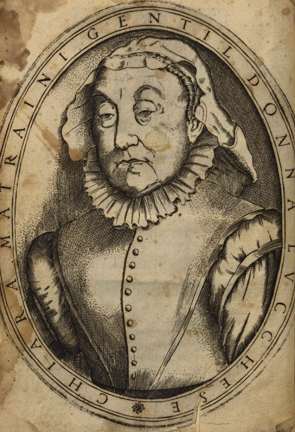
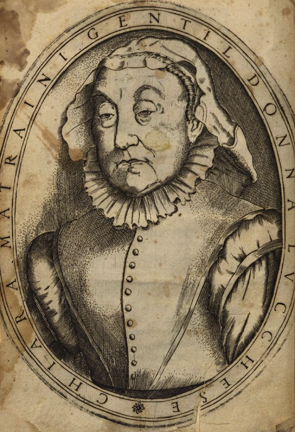
Take, for instance, Chiara Matraini (1515–1604), who authored the Considerationi sopra i Sette Salmi Penitentiali del gran re et Profeta Dauit (‘Reflections over the Seven Penitential Psalms of the Great king David’) in 1586. This edition contains two portraits: the first is a highly stylised woodcut presenting Matraini in a devotional pose before an altar. She is shown kneeling in three-quarter profile, hands raised in prayer, head veiled, and gaze directed towards a crucifix and framed image above an altar niche. The architectural setting is complete with pilasters, drapery, and an image within an image, and recalls the visual language of domestic devotion, where private chapels and home altars were common among patrician families. In the context of Matraini’s Rime spirituali (1595) and later devotional works, this image functions as a self-representation of moral integrity: her words emerge from prayer and divine inspiration, rather than from literary ambition. The image domesticates authorship through the visual grammar of piety. The second image (Fig. 7) is a copperplate engraving showing a bust-length portrait of Matraini within an oval frame, surrounded by an inscription that reads: ‘Chiara Matraini Gentil Donna Lucchese’. The oval format recalls medals, cameos, or humanist portrait engravings of learned figures (see Figs. 2, 3, and 9). Her features (and aged face, prominent ruff, and coif) emphasise dignity, gravity, and experience. The plain dress and sober expression reject eroticised conventions of female portraiture and align her instead with the donna saggia or virtuosa.Footnote 30
Matraini, Chiara. Considerationi sopra i sette salmi penitentiali del gran re, e profeta Dauit, di m. Chiara Matraini
By contrast, Matraini’s direct translation, a printed commentary on scripture, is the 1555 A Demonico (Orazione d’Isocrate a Demonico figliuolo d’Ipponico, circa a l’essortazione de’ costumi, che si convengono a tutti i nobilissimi giovani: di latino in volgare tradotta) and contains no portraits of Matraini.Footnote 31 As this example reminds us, humanist scholars did not tend to be concerned with insisting on a definitive distinction between their translative and authorial activities: paraphrasing, rewriting, abridging disparate texts, and authorial writing are very often combined practices. It seems notable, though, that, in the case of Matraini, the absence of portraits in a clearly demarcated translation indicates a self-effacing modesty before the authority of the first author.
A substantial corpus of premodern humanist printed portraits has survived. Thérèse Redier’s Reference Reid1999 and Reference Reid2007 surveys of sixteenth- and seventeenth-century printed portraits of ‘men and women of knowledge’ held in the Print and Photography Department of the Bibliothèque Nationale de France yielded 5,600 portraits, of which she has published a very small sample. Nonetheless, this rich corpus demonstrates the growth of self-representational portraits through the course of the European Renaissance. Redier’s research has opened the way for a fresh interest in portraits of humanists from this period, from Titian’s paintings of the Tuscan writer Pietro Aretino (Waddington, Reference Waddington2018) to a recent translation of Paolo Giovio’s gallery of portraits of learned men (Giovio, Reference Giovio2023). Importantly for any study of translators, this recent scholarship has put humanists and their collaborators sharply into the picture of Renaissance self-representation and trust-building.Footnote 32
In her survey, Redier categorises the men and women portrayed as ‘humanists’. They include scientists, artists, authors, translators, jurists, and teachers. Social and book historians have tended to see the development of portraiture (not just in printed books, but also in single sheet prints and, of course, in painted and sculpted portraits) as having been spurred by a new sense of individualism that developed in the fifteenth century (Chartier, Reference Coldiron1989, 52; Burke, Reference Burke and Hsia1998; Howe, Reference Howe2008).
Literary and book historians, meanwhile, have focused their attention on the verifiable identity of the particular author portrayed. In this light, printed portraits of humanists are expressions of ‘authorship’; that is, the agency that made the text possible. The printed portrait represents the rise of authors’ visibility (Howe, Reference Howe2008, 469) and particularity, which are articulated through degrees of lifelikeness and approximate likeness: from what Anne Coldiron calls the ‘anonymous visibility’ of sitter ‘types’ that are often reused (2018, 57) to highly individuated and lifelike portraits. The visibility of Renaissance authors and translators was a common feature of printed texts: as I have already discussed, portraits were meant to transmit something of an author’s moral qualities and skills. The examples I present in this Element show much care in articulating the role any author played in the production of a specific edition – and their connectedness to ‘humanism’. In the printed portraits I examine here, I am less interested in individuality and likeness and more engaged with how the humanist portraits signal the sitter’s social, cultural, and intellectual status and moral qualities and skills. Section 2 discusses briefly the key functions of Renaissance portraiture as a way to contextualise the many rich ways in which translators (through their printers) communicate and perform their trustworthiness.
2 Faces and Types of Trustworthiness
Since antiquity, portraits were understood as instrumental to idealising the identity of the sitters and kindling ‘the souls of those that come after, to virtue and glory’.Footnote 33 Portraits both commemorate and inspire: they are exhortatory in the sense of being oriented towards the past and the future. Printed portraits were no different. Art historians have observed that commissioned portraits were understood as being performative in the sense that they allowed the sitter, artist or both to represent themselves within specific social and cultural conventions (Campbell, Reference Casini1990; Dunlop, 2014). Inevitably, such performativity required a selective and idealised interpretation of an image that would enhance the sitter’s moral and physical features. In the words of seventeenth-century Dutch humanist Constantijn Huygens, portraits ‘Perform a noble work […] reading or hearing stories about someone’s life and character […] is made easier by looking at his portrait’ (Adams, Reference Adams2006, 46).
At the same time, though, portraits needed to be believable to pre-empt any concerns about dissemblance. Renaissance authors like Cardinal Gabriele Paleotti (1522–1597) exposed the self-promotional practices of men and women who used their portraits to present themselves as what they could not be (in Paleotti’s elitist view).Footnote 34 Paleotti asserts that the key function of a portrait is to ‘honour others and preserve their worthy memory’ (‘honorare altri et conservarne degna memoria’) (Paleotti, Reference Paleotti1582, 153). Self-portraits are ‘silly and vain’ because virtues need to be commended and verified by others, not by the sitters themselves. Self-promotion is censured by Paleotti and Gian Paolo Lomazzo (1538–1592), among others, but, as we will see next, humanists generally disregarded these elitist views and explored diverse ways to promote themselves through printed portraits and the accompanying written text.
I have already mentioned Book Two of De Pictura, where Alberti remarks how paintings bring dead people alive and close. As Alberti theorised, when likeness was balanced with idealisation of the subject’s appearance and moral qualities, the resultant representations could be seen as valid and authentic, even when they were clearly not a true representation of the sitter. This logic was in play when Lorenzo Valla exposed the inauthenticity of the Donation of Constantine, a forged document that transferred to the Pope authority over Rome. Valla did not doubt the authenticity of two icons representing apostles Peter and Paul that apparently convinced Constantine to donate Rome to Pope Sylvester. The two icons were altered over the centuries, but for Valla their authenticity trumped the fact that the panel on which each icon was painted was ‘not the original one given by Sylvester to Constantine’ (Nagel, Reference Nagel and Falomir2008, 423). This example shows how likeness and authenticity did not need to align as long as they ‘spoke’ to readers.
In the cases I discuss in this Element, humanist translators’ printed portraits convey a sense of proximity and connection with the translated author, reader, or patron. In Renaissance literature, portraits speak to their viewers to share truths about life, deeds, and significant topics, including feelings. A thriving production of iconic Renaissance epigrams harked back to ancient Greek poetry. In this literature, authors enter into dialogue with statues, tombs, and portraits (Shearman, Reference Shearman1992, 113–115). Renaissance artists and writers like Michelangelo di Lodovico Buonarroti and Niccolò Machiavelli picked up this tradition. In a short poem that reinterprets an ancient Latin epigram, Machiavelli pretends to hold a conversation with the statue of Chance and asks her: ‘Who are you? You do not appear to be a living woman’ (‘Chi se’ tu, che non par’ donna mortale’) (Machiavelli, Reference Machiavelli and Martelli1971, 987). Portraits brought sitters back to life, and to the viewer’s present. An earlier and influential example of authors speaking to an image is in Petrarch’s sonnets LXXVII and LXXVIII where the poet converses with a portrait of Laura. However, humanists knew that paintings and statues decayed over time, whereas literary portraits were deemed to be timeless. Lodovico Ariosto famously remarked in his Orlando Furioso that it is thanks to authors that the memory of ancient figures survives (I, 1–4).
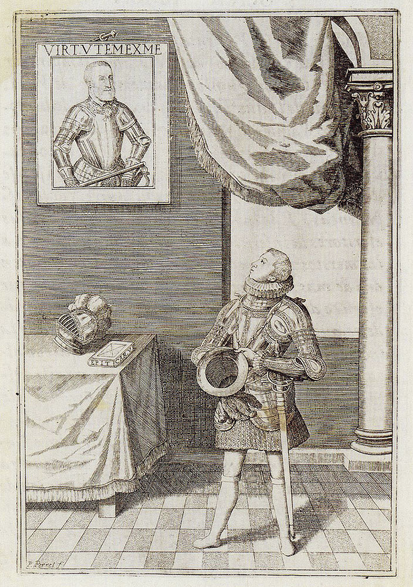
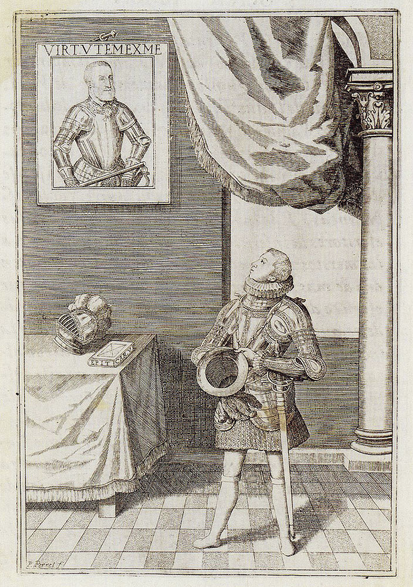
Finally, portraits of distinguished men and women stimulated readers and viewers to follow in their footsteps. Portraits of ancestors and ancient political and cultural leaders enhanced the possibility of learning important lessons from the lives of such forebears. From ancient Roman author Pliny the Elder to Giorgio Vasari and Paolo Giovio, there was a strong belief that collecting images of illustrious men and women inspired virtues in viewers (Fletcher, Reference Fletcher2008, 432). A demonstration of the inspirational function of portraiture is an engraving by Pedro Perret in the ‘Epitome of the life and deeds of Charles V’ (Epítome de la vida y hechos del invicto emperador Carlos V), which shows the grandson of the emperor looking up to his powerful ancestor (1622) (Fig. 8). Found only in the Madrid National Library copy of the Epítome, this portrait is framed with an inscription that invites the child to ‘learn virtue from me’.Footnote 35 A helmet and a book on a table below the portrait elaborate on the emperor’s passions and skills that the grandson should emulate: humanist knowledge and the art of war. Following Petrarch’s view that ‘nothing moves us more than the examples of famous men’ (Familiares II, 665), the engraving of Charles V shows how word and image work together to fashion an aspirational example. As recently suggested, ‘exemplarity relies on ahistorical treatments of its subjects, on the belief that narrating them in digestible and emotive parcels is the pathway to persuasion’.Footnote 36
de Vera y Figueroa, Juan Antonio. Epitome de la vida y hechos del invicto emperador Carlos V (Madrid: Martin, 1624), frontispiece in copy held in Biblioteca Nacional, Madrid, 2/59709 (source: www.pubhist.com/w3129).
I add that exemplarity required the portrayed subject to be credible. ‘Credibility’ is one of three meanings given to the French word crédit (credit) by Antoine Furetière in his 1689–1699 dictionary (Fontaine, Reference Fontaine2014, xii). One gains credibility ‘in the eyes of the world as a result of one’s virtue, integrity, sincerity, and merit’ (Fontaine, Reference Fontaine2014, xii). Renaissance printed portraits visually complemented the subject’s name and underscored their accountability for the quality of the text. In other words, portraits played a role in establishing reputation. The practice of including an author’s image in their texts goes back to antiquity. Pliny the Elder described the first public library in ancient Rome as decorated with portrait statues of the authors whose texts were available in the collection (Bury, Reference Cagnolati2008, 455). Medieval manuscripts are often illuminated or decorated with portraits of their writers. Clearly, premodern readers enjoyed seeing as well as reading authors.
In the foregoing paragraphs, I have just touched on credibility as a key requirement for exemplarity and as a term semantically close to trustworthiness. I will return to exemplarity through word and image in Section 3. Before that, I want to consider the wide range of ways in which translators signalled their trustworthiness to their readers.
2.1 Performing Trustworthiness (and Distrust)
Against the backdrop, explained in the previous section, of endemic distrust in the printing industry – and the need for translators, printers, and investors to appear trustworthy before their readers – the following case study shows a translator very vividly signalling his trustworthiness. The case is Cesare Cesariano’s translation from Latin into Italian of De Architectura, a multi-volume treatise by the ancient Roman architect and engineer known as Vitruvius (first century BCE). Printed in Como in 1521, this Italian edition is also one of the earliest translations of Vitruvius’s work into a European vernacular language. The translated text is nestled within images and commentary, which offer detailed and often updated knowledge on architecture. Sophisticated and lavish woodcuts ‘translate’ the Italian version of Vitruvius’s text, making the Vitruvian work and the extensive commentary more accessible. Several of these etched drawings were signed by Cesariano. Throughout the text, Cesariano showcases his skills and knowledge as a translator, architect, and artist, as I discuss next.Footnote 37
According to Cesariano, it took him twenty years to (almost) complete this translation project (Coccia, Reference Coldiron2015). Unfortunately, Cesariano’s intention to be the sole master of this publication, which was supported financially by Milanese noble Luigi Pirovano and the Como lawyer Agostino Gallo, was quashed one year or so before the text was published. While Cesariano was working on chapter seven of Book Nine, Pirovano and Gallo enlisted the intellectual assistance of two translators and scholars: Benedetto Giovio and Bono Mauro. Offended and enraged by this forced collaboration, Cesariano abandoned the project and Pirovano and Gallo swiftly confiscated his notes and drafts. Cesariano sued Pirovano and Gallo: the case dragged on for seven years, the court eventually ruling in favour of Cesariano. In the meantime, Giovio and Mauro completed the translation and commentary and produced a glossary of architectural terms, while the two investors penned two prefaces to accompany the main text: Pirovano addressed Milanese patricians, and Gallo dedicated the translation to the King of France François I (1494–1547). The paratextual material and the vernacular version of the Ten Books with commentary and woodcuts were published in 1521.
These editorial vicissitudes are known to Italian Renaissance scholars and specialists of Vitruvius. But less known are the printed text’s elaborate signs of trustworthiness (from Cesariano) and distrust (by the investors and their new team of scholars). In particular, Cesariano managed to signal his trustworthiness in the opening of the translation, which comes after the prefatory material just described. He did so in a way that seems to have escaped the attention of patrons Pirovano and Gallo, but most likely not the printer nor his contemporary readers.
In the prefatory material, Cesariano is both sidelined and distrusted. The title page of the translation mentions only Vitruvius and the Belgian, Milan-based printer Gottardo da Ponte (his original name was likely Gothard van der Bruggen). In his preface to the Milanese nobility, Pirovano asserts that he has asked several painters and engravers to produce the images for this edition. Pirovano also reveals that he enlisted several learned men to carry out this edition, singling out Bono Mauro ‘who translated [Vitruvius] and explained an infinite number of difficult and obscure passages and restored them to their original order’. Similarly, Gallo, the other patron of this vernacular version of Vitruvius, presents the translation and its exegesis to the King of France as the work of ‘learned men’. Like Pirovano, Gallo presents himself as the manager and leader of this editorial endeavour.
Here, either Cesariano is demoted as just one of the many scholars working on the text or he is removed altogether. In his glossary of difficult and ‘incongruous’ terms, Mauro openly criticises Cesariano’s translation. Under the term ‘Abscedentia’, Mauro explains that there are passages in the text that have been ‘corrupted’ by ‘Caesare Ciserano (who likes to be called “Caesariano”)’. The sleight of hand with which Cesariano is criticised for the style of his translation and teased for his name reveals the awkward position Mauro and Giovio must have found themselves in and their need for self-aggrandisement to the detriment of Cesariano’s work and reputation. The closing words of the translation and commentary (colophon) take the erasure of Cesariano’s (and the other translators’) agency a step further: here, all translators and artists are omitted in favour of the investors: ‘THE END. Here ends the illustrious work of Lucius Vitruvius Pollio on Architecture translated from Latin into (Italian) vernacular, illustrated and commented [on] thanks to the investment of the magnificent messer Agostino Gallo … and of the noble messer Luigi da Pirovano’.
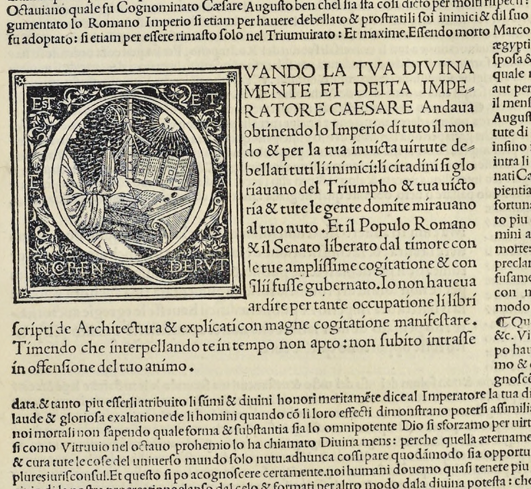
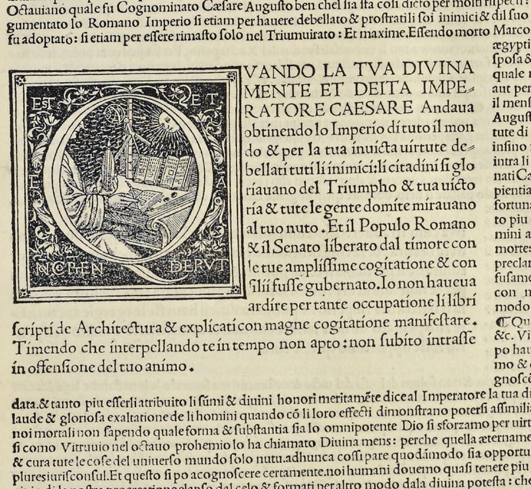
Let us focus now on Cesariano’s own signalling of trustworthiness in the text and through images. Surprisingly, the translation itself begins with a clear attribution to Cesariano himself: ‘Here begins the First Book of On Architecture by Lucius Vitruvius Pollio, translated into the vernacular language, commented and illustrated by Cesare Cesariano, citizen of Milan and Professor of architecture etc.’ This attribution is further supported by a portrait of the translator working at his desk. The portrait is situated inside the capital letter Q with which the translation begins (Fig. 9). Since all images in this edition are curated by Cesariano, there is no reason to believe that this portrait was not. At first glance, the reader might be led to believe that the portrait represents the author Vitruvius rather than the translator Cesariano. The male figure at his desk holds a stylus to write and draw on a book, while also grasping an instrument on his left-hand side. But the presence of two open books in front of him, both containing drawings and writings, clearly indicates that this man is translating from Vitruvius and other sources. A sun with a human face is shining on the translator, connecting the image to the written text inside the initial letter Q that paraphrases the Christian Gospel of John 1:5: ‘During that time [i.e. when Vitruvius was writing], they did not understand the word of God’. The translator’s desk is cluttered with materials pertaining to the intellectual work underway: astronomical and architectural tools, including an astrolabe, are balanced precariously at the edge of the writing desk. These tools signal that the translator was keen to represent himself as an architect and artist as well as a translator. Indeed, in 1528, the governor of Milan elected Cesariano the official architect of the city.
Vitruvius Pollio. Di Lucio Vitruvio Pollione De architectura libri dece traducti de latino in vulgare affigurati: Commentati & con mirando ordine insigniti (Como; Gottardo da Ponte, 1521), A1.
Before his translation of Vitruvius, Cesariano decorated the sacristy of the Benedictine abbey of St John Evangelist in Parma, Italy, and other churches in northern Italy. The image of the translator as a trustworthy Christian translator who sheds light on Vitruvius’s knowledge while also updating and improving the ancient text through his own practice (in the image he is holding the astrolabe) is reinforced in Cesariano’s extensive commentary to the translation. While the font used for the translated text is larger than that given to the commentary, the latter offers several opportunities for the translator to promote his own work as an architect. For instance, where Vitruvius states that architects need to be fluent in several other disciplines including the law and statutes that regulate construction in a given city or town, Cesariano calls upon the authority of a fourteenth-century legal expert, Bartolomeo of Sassoferrato, to strengthen this point, and gives the example of how in 1518 he was engaged to address the flooding of the river Tanaro by rectifying its course in consultation with a legal team.
Why did the patrons and the printer leave Cesariano’s name on the first page of the translation and commentary? How did they fail to remove it? Except for his initials appearing in some of the woodcuts, this is the only heading that names Cesariano. The answer is in a note to the readers that follows a list of corrections (errata). Here, Gallo and Pirovano explain that, in 1521, just before the translation was completed, Cesariano had decided to suddenly leave Como and his work. Having already invested substantially in this commercial endeavour, Gallo and Pirovano decided to engage Giovio and Mauro, who were not well versed with Vitruvius and architecture, but nevertheless agreed to help. In what appears to be a statement carefully drafted by a legal team, the two investors make it clear that it was Cesariano who had ‘abandoned the prey’ and therefore ‘it was no longer his’, as civil law stipulates. The investors were therefore legally entitled to finish the work ‘without any injury to the aforementioned Cesare’.
There it is: a justification of why new translators and editors were engaged, but also a recognition of Cesariano’s trustworthiness. It was Cesariano who had a thorough-going knowledge of Vitruvius’s work, not Giovio and Mauro. For this reason, Cesariano’s authorship was toned down or even undermined in the paratextual material in order to promote the efforts of the editorial team and the investors. The work of Cesariano, Pirovano suggests in his preface to the Milanese nobility, needed improvement and intervention. But undermining and erasing the trustworthiness and authority of Cesariano would have placed the whole project at risk. Therefore, the signals of distrust towards Cesariano in the prefatory material, which are justified by the investors in their note to the readers, coexist with Cesariano’s own signalling of trustworthiness: he presents himself as an expert and successful architect and artist with a deep knowledge of Vitruvius that the scholars who replaced him ultimately could not match.
This case study reveals, first of all, conflicting signs of trustworthiness and strong evidence of mutual distrust between translators, printer, and investors appearing within the same text –providing compelling evidence of the humanist translator’s need to resort to visual and textual strategies to signal his trustworthiness within a fraught and litigious collaboration. It also reveals that trustworthiness and the resulting trust or distrust are a historical product requiring empirical research to understand and explain (Tilly, Reference Smith2005; Rizzi, Lang, and Pym, Reference Rizzi, Lang and Pym2019). In the context of cultural and linguistic mediation, trust is a value or a moral principle that binds the mediator to a network of readers and patrons.
Cesariano’s translation is helpful in showing yet another aspect of trust in translation: risk and how it is managed. Gallo and Pirovano’s concern that their substantial investment may not yield the desired return pushes them to engage two new collaborators. Poor (and poorly paid) translations have economic and cultural implications: printers, patrons, and investors lose money from translations made and produced in ways deemed inadequate or ‘bad’ by the target culture and audience. More broadly, the production of any cultural good or service involves risks that are quintessentially financial and reputational (Nelson and Zeckhauser, Reference Jonathan K and Zeckhauser2023). I will shortly offer an example of the risks involved in the production of expensive Renaissance translations. Humanist translators also risked their reputations every time they accepted a request or commission to undertake and circulate a translation. Together with Anthony Pym and Birgit Lang, I describe this as ‘credibility risk’ (2019, 12). Readers and patrons accepted the risk that the texts they paid for may not be reliable or accurate.
Context, local purpose, and a set of cultural beliefs or principles inform what a ‘good’ translation is for a specific culture, society, and intended purpose (Rizzi, Lang, and Pym, Reference Rizzi, Lang and Pym2019, 12). For Renaissance humanists, reputation was too important a credit to risk. This does not mean that they did not try to fool their readers for a quick profit. In 1526, Erasmus of Rotterdam attacked printers who published and sold unreliable texts by persuading readers in the prefaces that their work was diligent and accurate (Pabel, Reference Pabel2008, 219). Erasmus blames lack of diligence and the rush to publish as key reasons for distrust (I will come back to diligence later). Renaissance humanist translators interpreted texts, images, and ideas in a constant and sometimes plainly treacherous task of assigning equivalences. Inevitably, this work of mediation risked disrupting the meaning and coherence of the cultural product in play. Rather than being negative (per the translator–traitor paradigm), the many, varied ways of claiming, sharing, defining, and verifying authorship – also re-proposing views about it – allowed for new meanings and new forms of authorship and authority. The malleability of the translated material could be matched by the malleability of claims about agency.
2.2 Collaborative and Shared Trustworthiness
Contrary to the evidence of mutual distrust I have revealed in Cesariano’s translation, the next case from seventeenth-century England reveals a humanist and his printer making a concerted effort to signal the translator’s trustworthiness. In 1565, Thomas Marsh published an English translation of the thirteenth-century surgeon Lanfranco of Milan.Footnote 38 The translator is John Hall (c. 1529–c. 1569), as clearly stated on the title page:
A most excellent and learned vvorke of Chirurgerie, called Chirurgia parva Lanfranci, Lanfranke of Mylayne his briefe: reduced from dyvers translations to our usuall frase, and now first published in the Englyshe prynte by Iohn Halle Chirurgien who hath thereunto necessarily annexed …. All these faithfully gathered, and diligently set forth, by the sayde Iohn Halle.
This title reveals the complex project John Hall undertook: he used several editions of Lanfranco’s work to produce the translation, while also adding complementary and explanatory texts (a glossary of diseases, a compendium of anatomy, and an exposé of surgeons’ and physicians’ abuse during his time) to enhance the reading and understanding of the translated text. Hall is described in the title page as having ‘faithfully gathered, and diligently set forth’ a range of texts and versions of Lanfranco’s work. The message is clear: Hall is presented as both a humanist and a scientist, which explains why the volume’s frontispiece includes his portrait (Fig. 10) dated 1564 (a year before the book was printed). Below the decorated cartouche that encapsulates the portrait sits a caption, variants of which appear in several other early modern printed portraits:
The figure of the body that you see depicted in the image is Hall’s, this is how the painter wishes to represent him to you. But if you want to discern his true face, read these [written words]: they truly explain his soul.
(Corporis effigies quam vides graphice pictam Hauli est, sic pictor fingere tibi velit: at modo si quaeris vultum dignoscere verum, hos lege, hii vere explicuere animum.)Footnote 39
As the caption explains, readers should use the portrait as a gateway to the ‘true’ nature (soul’s image to use Cicero’s metaphor once more). If they wish to learn more about the credentials and credibility, readers ought to focus on the book’s paratextual apparatus that follows the frontispiece. Before they can learn more about Hall, expert readers need to demonstrate their own trustworthiness and expertise: the first prefatory section is ‘The book’s verdict’ (a verse preface to the text that follows the frontispiece), explaining that this edition is an essential tool for expert readers who wish to learn the art of healing the sick and sore. It is important, therefore, this preface adds, that this work does not fall into the hands of readers who are not competent, so that the book does not become a ‘sworde put in a mad mans hande’. One can read these verses as a warning to the unintended readers: before looking at Hall in the face, look at thyself. This message warns readers that trustworthiness needs to be rewarded with trust, not distrust, and that trustworthiness attracts trustworthiness.
Lanfranco of Milan. A most excellent and learned woorke of chirurgerie, called Chirurgia parva (translated by John Hall) (London: Thomas Marsh, 1565), frontispiece.
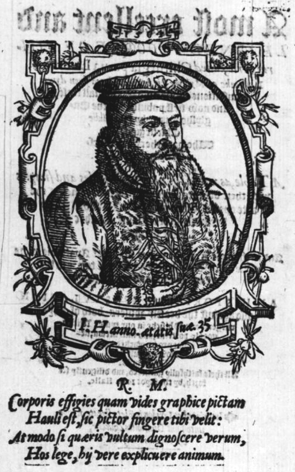
The next paratext in this edition is a dedicatory letter by Hall to the London brotherhood of surgeons, of which the translator was a member. Hall’s fellow surgeons are expressly asked to give their ‘ayde, helpe, succor, tuition, and defence’ (Lanfranco, 1565, n.p.) to him and his work. His translation, explains Hall, is a collaborative effort: by calling on his own expertise and the authority of several persons, Hall created ‘this excellent work’ that offers ‘publique profit’. It is worth quoting the passage in full:
I haue nowe not only reduced to our vsuall speache, by changyng or newe translating suche wordes, as nowe be inueterate, and growne out of knowledge by processe of tyme, but also conferred my labours in this behalf with other copies, both in Frenche and latin: namely with maister Bacter, for his latine copie, and Symon Hudie for his frēch copie, and other English copies: of the which I had one of Iohn Chāber, & an other of Iohn Yates, both very auncient, with other mo[re] whose good helpe hath not a little farthered me in these thinges, to the intēt that it might perfectly come forth to a publique profite, whiche to doe I was constreigned, not only because I would not truste to muche to myne owne rude iudgementes: but also that by the authoritie of dyuers men of knowledge, this excellent worke (as it is worthy) may ye more effectually be alowed and accepted.
Hall goes on to write that he decided to dedicate his work to his fellow surgeons because they are the most competent defenders of their profession (and his own work) through persuasion and instruction. Lanfranco, the first author of the text, does not lack ‘authoritie of truthe’, but Hall is concerned about his own lack of reputation (‘faintnes of name’) and so once again he seeks his fellow surgeons’ aid, support, and help to strengthen the present work and to encourage Hall ‘for my part, to enterprise other things vtile and nedefull’. Hall is seeking endorsement not only for the translation he dedicated to his fellow surgeons but also for his future work. Like his portrait, this paratext serves the purpose of convincing his prospective readers that he is to be trusted for his ‘good will’, his ‘owne experience’ and ‘truthe being our weapon, and good science our armoure’. After Hall’s dedication to his fellow surgeon, Cunningham praises the way his friend ‘purged and made pure’ William Lanfranco’s work ‘so that henceforth, I may rightly call it Halles Lanfranke’. By claiming to have purged and purified the source, the translator positions himself as both healer and judge of Lanfranco’s text, much as a physician diagnoses and treats a patient. A few lines below, Cunningham adds that Hall is an ‘author’ who had just completed a book against vice (The Courte of Vertue, London, Thomas Marsh, 1565). Finally, another friend and fellow surgeon comes to Hall’s support: Thomas Gale encourages Hall not to fear his detractors and to publish his work without hesitation. The aim of this paratextual section is to anticipate and influence the readers’ response to Hall’s publication: ‘euery good man will embrase and with great gladnes reuolue ouer your boke as sone as it is published, and wil at the first sight of your good trauell haue you in more estimacion then euer they had’.
Together, Hall’s visual and textual poses signal the translator’s trustworthiness and the reliability of his work. As implied by Hall’s reference to future work, this edition of Lanfranco demonstrates the personal and professional reliability of the surgeon translator. Beyond the de rigueur modesty and praise of the dedicatees, Hall and his supporters argue his trustworthiness by presenting his work as useful, needful, pure, and supported by the authority of ancient and contemporary authors. As the passage quoted previously indicates, Hall pre-empts criticism from enemies and critics: even if he modestly claims not to trust his own rude judgement, his connections with scholars and scientists and his ability to draw on his own expertise and experience produced an ‘excellent worke’ that will yield more fruits in the future.
In the final piece of paratext, Hall’s letter to his readers, the humanist surgeon is at pains to distinguish himself from the peddlers, tinkers, rat catchers, and vagrants who pretend to know and perform surgery. He details the fundamental skills surgeons need to possess: be learned, have good discretion, good memory, sound judgement, and diligent practice. His fellow surgeons’ endorsement of his character and work assures the readers that Hall possesses the physical and moral integrity required to be a trustworthy surgeon and translator. The purging and purification of the translated text go hand in hand with the work of a skilled surgeon who purges and heals a sick patient.
Moving on from Hall’s examples, a different way for a humanist translator to convey trustworthiness was to have their portrait positioned beside, below, or above that of the translated author on a leading page of their printed translation. The most common approach was to represent the authority of the author and that of the translator as shared, even fairly equal in key ways. By this approach, the translator could smoothly gain credibility and repute for their translative work.
Abū l-‘Abbās Ahmad b. Muhammad b. Kathīr al-Farghāni, known in Latin as Alfraganus, was a ninth-century astronomer from present-day Uzbekistan whose influential interpretation of Ptolemy’s scholarship was well known to Dante Alighieri and medieval and Renaissance Western scholars through Gherardo of Cremona’s Latin translation (Abdukhalimov, Reference Abdukhalimov1999). The 1493 edition of Alfraganus’s Compilatio Astronomica, a compendium of his Almagest published in Ferrara by Andrea Belfort, is prefaced by an image with an author with a smaller figure next to him and a caption revealing his identity: ‘heremita’ (Fig. 11). L. S. Olschki interpreted this name as referring to twelfth-century translator Gerardo of Cremona, who did indeed translate al-Farghāni’s text. Giuseppina Zappella confuses this Gherardo with the thirteenth-century astronomer Gherardo da Sabbioneta (Zappella, Reference Wubs-Mrozewicz1988, I, 26). The Bayerische Staatsbibliothek copy I consulted clarifies, in the colophon, that ‘Alfraganus’ produced (‘edidit’) the text and the text was improved (‘emendavit’) with great care and diligence by ‘an honourable representative of the Eremiti family of our times’ (‘heremitarum huius temporis decus’), ‘a most famous physicist and mathematician’ (62).
Alfraganus. Brevis ac perutilis compilatio Alfragani astronomorum peritissimi totum id continens quod ad rudimenta astronomica est opportunum (Ferrara: Andrea Galli, 1493), frontispiece.
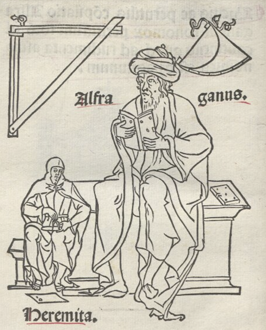
From this colophon, it is clear that Gherardo of Cremona is indeed the man represented here, and that his name is most likely intentionally disguised to strike an improbable and flattering genealogical connection between the Ferrarese Hermit friars and Gherardo. In the only image in the 1493 incunable, the translator/editor is represented as a subordinate agent, testing and translating the knowledge read out by al-Farghāni. The process of translating is therefore represented dynamically: the first translator (al-Farghāni) reads his version of the Almagest while Gherardo sits on a lower bench next to him and tests the information he hears from al-Farghāni by taking measurements with his compass before writing down the verified and updated version on a paper lying at his feet. In this printed portrait, reading, testing, and writing are represented simultaneously as key phases in the translation process. This double portrait recognises the authority of the first translator by depicting al-Farghāni as a more grandiose figure, while also crediting the Latin translator for his technical knowledge and ability to test and transfer the knowledge onto the new page.
The co-existence of portraits appearing on title pages could indicate a less straightforward relationship between author and translator. Take, for instance, Richard Haydock’s translation of Paolo Lomazzo’s 1584 Trattato dell’arte della pittura, scultura et architettura (Fig. 12). Produced while Haydock was still a medical student at New College, Oxford, this translation into English was published in 1598 by Joseph Barnes.Footnote 40 The translator’s engraved, half-length portrait sits below that of the Italian author and shows Haydock looking at English readers in a fashion very similar to the next case I discuss – John Harington’s. Even so, the title page design for the printed treatise shows a significant difference, in that the name of Lomazzo’s translator is not made explicit. Rather, acknowledgement of the translator is given as follows: ‘ENGLISHED BY / R.H. Student in Physik’. Haydock’s full name first appears only at the end of his letter of dedication to Thomas Bodley, who was his patron and the founder, in 1602, of the Bodleian Library at Oxford University (2v). As such, the translator’s identity is temporarily withheld from his readers, while the portrait will have asserted his identity to contemporaries who knew him. If the name of the translator is not made immediately explicit, his skills and moral integrity are articulated on the title page: just above Haydock’s portrait, the motto ‘In the handes of the skilfull shall the worke be approved’ with a reference to Ecclesiasticus (9.19).Footnote 41 acts like a caption to the translator’s image. The ‘skilfull hands’ implicitly belong to the man pictured. The portrait and motto together claim peritia (technical competence) for the Englishing. Further, the flanking heraldry (Oxford’s device is on the left side of the biblical motto) folds the portrait into a university frame, converting private visage into public warrant. It says: this translation is academically vetted.
Lomazzo, Giovanni Paolo. A tracte containing the artes of curious paintinge carvinge building (Oxford, Joseph Barnes, 1598), title page [PDM 1.0]
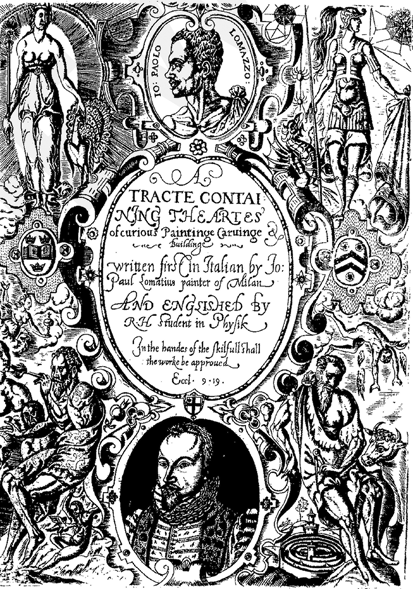
Haydock’s identity and, more importantly, his approach to the translation, become apparent in the written paratext that follows the title page. In his lengthy introduction to the readers, Haydock declares that the purpose of his translation is ‘apparent. See now (in a word) why. My finall reason is plaine: the increase of the knowledge of the Arte’ (5). The translator affirms that he carefully omitted and added material when he considered it necessary to make the reading pleasant and interesting. Thus, Haydock writes, he ‘warily’ followed Lomazzo, making sure that he would hold up the author when he tripped and direct his feet when he lost his way (1v). As I will show shortly, Haydock’s profession of trustworthiness is less openly worded than that of Harington, most likely because of his status as a student and amateur artist. Nevertheless, Haydock’s portrait facing the English readers communicates key signs of trustworthiness: competence, integrity (a set of moral, cultural, and social principles readers would approve of), and predictability (perceived consistency of actions). Haydock is presenting himself as a learned, socially credible, Oxford-anchored professional; his face, mottos, and insignia assures the readers that the Italian original has been competently made English while also elevating the translator from behind the scene mediator to a co-authorial presence, thus crafting a persuasive image of trustworthiness and skill precisely where the reader decides whether to believe and buy the book.
The engraved portrait of John Harington included in his 1591 translation of Ariosto’s Italian epic poem Orlando Furioso (Fig. 13) shows an even more socially credible and assertive co-existence, in which the translator recognises the presence of the author while establishing his own authority and status before the readers. As with Haydock, the translator gazes out towards the English readers. On the title page, the image of Ariosto hovers above the words of the title whereas the half-length figure of the translator is placed at the bottom of the page’s cartouche, suggesting a hierarchical relationship between author and translator (Reid, Reference Reid2020, 153). Harington’s three-quarter portrait, though, differs substantially and meaningfully from that of Ariosto: the medallion bust of the Italian poet, flanked by trumpeting Fame, announces authorial glory and emulates ancient, classical portraits of poets and emperors. It also follows the idealising profile portrait format evocative of ancient portrait coins, which was popular throughout the sixteenth century. Instead, Harington’s is noticeably larger, showing the translator as a gentleman-courtier. Costume, beard, and confident gaze signal status (gravitas), telling the buyer the translator carries court sanction –underscored by the Horatian motto about pleasing leading men (‘Principibus placuisse viris non ultima laus est’). A frontal gaze can signal confidence: it is more direct, and here introduces a more personal mood, a quality also attested by the presence of Harington’s dog, Bungey, at the lower right corner of the page. The figure of the dog is connected to Harington’s by means of a scroll-motto ‘until the time comes’ (‘fin che vegna’). The dog sits in front of its owner’s portrait, thus collapsing the boundaries between text, translation, author, and translator. The same scroll also connects Harington and his personal life to Ariosto’s poem, since the motto is taken from canto 41 of the poem.
Ariosto, Lodovico. Orlando furioso: in English heroical verse (translated by John Harington) (London: Richard Field, 1591), title page [Boston Public Library].
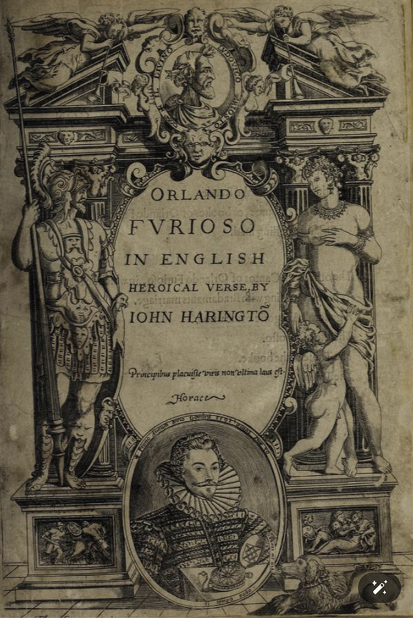
Incidentally, another dog appears in an earlier printed portrait of Bernardino Corio (1459–c. 1519) (Fig. 14). Today Corio is known mainly for his 1503 History of Milan (Patria Historia), but he also produced a Milanese rendering of Leon Battista Alberti’s Deifira, which is titled Utile dialogo amoroso (1502). The same portrait of Corio appears twice in his 1503 Historia published in Milan by Alessandro Minuziano: as a full-page woodcut on the verso of the fifth folio and again at the end of the last section of the book. The portrait is framed by stone columns, the lower one displaying a caption by Stefano Dolcini: ‘The Insubres [i.e. Milanese] are clear that they owe you, Bernardino, no less than the glorious Rome owes to the great Titus’. The other sections of the frame display mottos to convince the reader of Corio’s virtues and beliefs: truth, endurance, and abstinence. At the centre of the frame Corio is shown in a cell-like study, where a bookshelf emphasises each visible wall; he is seated at his desk working on his book. The loyal dog Apathes accompanies Corio, resting at the writer’s feet – a reference to Trimalchion’s dog in Petronius’s Satyricon (I CE). As the animal’s printed name implies, Corio’s canine companion symbolises his master’s sense of tranquillity and his freedom from passions. This portrait effectively visualises the prefatory material included in the edition: first, Milanese readers are invited to preserve Corio’s memory, praise his skills and virtues, and keep in mind how much they owe to him.Footnote 42 The subsequent letter of dedication that Corio addressed to Ascanio Maria Sforza provides the context for his isolation in his narrow study: the nefarious plague that struck Milan in 1485. This portrait, and those I will discuss next, demonstrate how portraiture visualised the moral and ‘professional’ integrity of humanists, thus signalling their trustworthiness to their readers and patrons.Footnote 43
Corio. Bernardino. Dello eccellentissimo oratore messer Bernardino Corio milanese Historia continente da lorigine di Milano tutti li gesti, fatti, e detti preclari, e le cose memorande milanesi in fino al tempo di esso autore (Milan: Alessandro Minuziano, 1503), frontispiece.
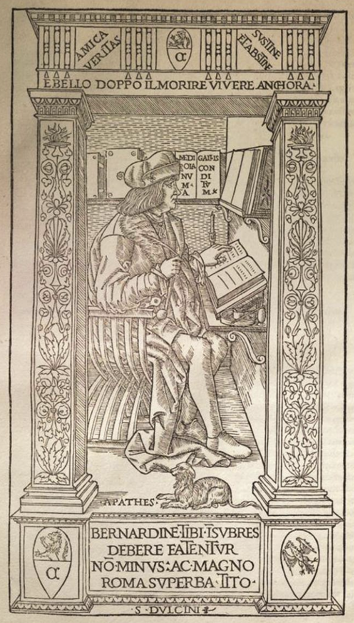
Returning to the elaborate title pages of Haydock and Harington’s translations, they vividly picture a dynamic relationship between the author and the translator, in which the translator asserts aspects of their personality in competition with the authorship and authority of the translated author. The face-to-face gaze between Haydock, Harington, and their readers is an effective strategy to invite readers’ acceptance of the translator’s decisions to modify and update the translated texts and their readers’ taste and to promote the translators’ careers. Robert McNulty and Massimiliano Morini have argued that the portrait of Harington replaced the image of Fortune in the bestselling 1584 Venetian edition of Ariosto’s poem published by Francesco De Franceschi. More likely, Harington preferred to superimpose the image of his own face onto part of the page design that once included a Tuscan coat of arms, a detail presumed less meaningful to English readers. With reference to his praxis of translation, the translator might be said to be sitting ‘side by side’ with the author, adding, expunging, and modifying the narrative as he deemed appropriate for his English readers.
Harington’s translation localises Ariosto’s poem by making certain drastic changes to the text: he cut at least 700 stanzas and added domesticity and familiarity to the poem by including anecdotes and references to his own family and friends. On the title page, the two portraits act as complements by representing distinct eras and stages of writing: Ariosto is the classical and authoritative poet, while Harington is the contemporary, familiar, and reliable author and translator. Tellingly, the heading of the translation’s preface describes Harington as ‘Author and Translator of this Poem’ (Ariosto Reference Ariosto1591, 4). In part of the paratext, Harington puts himself forward as a trustworthy translator by explaining why he made changes to the poem. These were necessary for his readers: For my omitting and ab[b]reviating some things, either in matters impertinent to us, or in some too tedious flatteries of persons that we never heard of, if I have done ill, I crave pardon: for sure I did it for the best. (Ariosto, Reference Ariosto1591, 16).
In this apology, the English translator refers specifically to trust. He is so confident (as indeed he appears on the title page) that he does not need ‘countenance of any great state to bolster it …: my meaning is plainly and bona fide’ (Ariosto, Reference Ariosto1591, 4–5, my italics). Harington’s intent is genuine and sincere, so he can look at readers ‘in the eye’, full of poise in assurance that he will be trusted for his work, as his portrait proposes.
2.3 Competing for Trustworthiness
Sometimes the printed portrait of a Renaissance humanist translator serves to embody or ‘stand in’ for the face of the original author. This is the case in Gabriel Simeoni’s version of Ovid’s Metamorphoses (1559), where we find only the translator’s portrait on the title page, positioned where the author’s would be expected (as we have just seen in Harington’s translation). The medallion portrait on the title page depicts a portrait bust of Simeoni as an ancient author (Fig. 15). Here, to replace the author’s portrait with an image of the translator is to present the latter as someone who experienced comparable life vicissitudes; and indeed, both Ovid and Simeoni lived as exiles, but Simeoni with less recognition and fame.Footnote 44 Hence the positioning of the translator’s portrait becomes an opportunity to attract trust from his dedicatee and readers. By presenting himself in a classical, authorial guise Simeoni invites a direct comparison between himself and the ancient author Ovid.
Ovid. La Vita et Metamorfoseo d’Ovidio, Figurato et abbreviato in forma d’Epigrammi da M. Gabriello Symeoni (Lyon: Jean de Tournes, 1559), title page.
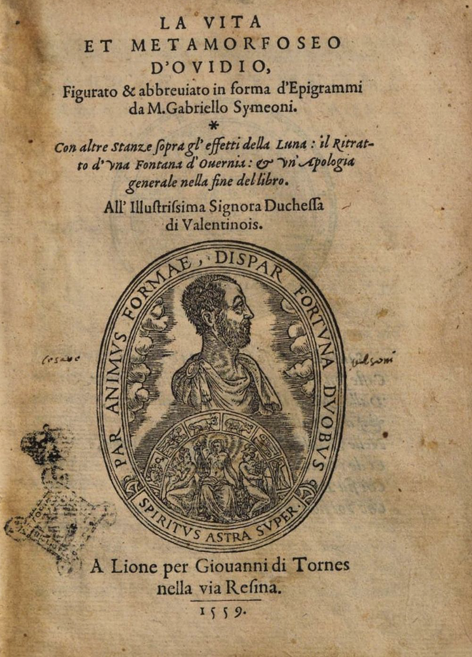
The title page unequivocally describes the translation as an abridged version: ‘Illustrated and summarised by means of Epigrams’ (‘Figurato & abbreviato in forma d’Epigrammi’) (Simeoni, Reference Simeoni1559, 1r). It acknowledges Ovid’s authorship, but the motto accompanying the portrait ‘equal in character, unequal in fortune’ (‘Par animus formae, dispar fortuna duobus’), strikes an analogy between Simeoni and Ovid’s lives or, perhaps, between him and the dedicatee of this edition, Diane de Poitiers, Duchess of Valentinois, whom Simeoni represents as the ancient Roman goddess Diana in a medallion portrait on the verso of the title page. Simeoni’s voluntary exile from Florence to France connects him to Ovid’s exile from Rome, but it is more likely that Simeoni is comparing himself to his dedicatee: they share a similar fate, but Simeoni has not been as fortunate as the Duchess. In his preface to Diane de Poitiers, Simeoni explicitly bemoans that he had not yet reaped fruits from his labours, whereas others who ‘perhaps are more arrogant or lucky have’. (Simeoni, Reference Simeoni1559, 3)
If Ovid is clearly presented as the author of the translated text, Simeoni takes the centre stage on the title page, and on the very next page he reminds readers of his other works. In twenty-first-century terms, this title page and its verso seem designed to serve a function very similar to a business card, with all credentials presented as signs of trustworthiness.
Simeoni’s portrait and his translation are followed by a symbolic portrait (Fig. 16). Here the translator features on the title page of a text that accompanies this version of Ovid’s Metamorphoses: the Apologia generale addressed to Simeoni’s friend Matteo Balbani, a banker from Lucca whose family had resided in Lyon for several years. A male figure stands naked, holding a sword with his right arm and framed by a cornice with the following inscription: ‘With this I write and destroy the insults’ (‘Con questa scrivo et le calunnie rodo’). Surrounding the inscription is the ancient Greek word ‘endokias’ (good will). This symbolic portrait is clearly a companion piece to the portrait on the first title page of the volume: the classicising portrait of an Ovid-like Simeoni becomes, in this second portrait, Perseus, who has slain his enemy with his pen/sword – a dead Medusa lies on the ground. From an author portrait the translator is transformed to a combative fighter who showcases his bravery and skills against all odds. In the Apologia, Simeoni attacks his detractors by calling them ‘censors’ (‘censori’), ‘antiquarians’ (‘anticarii’), ‘blinded by envy’ (‘accecati dall’invidia’), ‘ridiculous’ (‘scioccherelli’), and ‘tasteless and brainless’ (‘senza gusto et senza intelletto’). Simeoni opens this text by informing Balbani that his original idea was to pick up the pen and write about topics worthy of Balbani’s merits and Simeoni’s scholarship. Instead, Simeoni continues,
Because I am distracted by some lazy men [who are] absolute enemies of the virtue you are such a supporter of …, I am forced to change my task. Please forgive me if, by engaging in duel with my censors, I will turn the present discussion into an Apology to defend my case and, perhaps, also to defend some of yours.
Simeoni, Gabriele. ‘Apologia Generale di M. Gabriello Symeoni contro à tutti i Calumniatori et Impugnatori dell’Opere sue passate, presenti et future’. In Ovid. La Vita et Metamorfoseo d’Ovidio, Figurato et abbreviato in forma d’Epigrammi da M. Gabriello Symeoni (Lyon: Jean de Tournes, 1559), title page (n.p.).
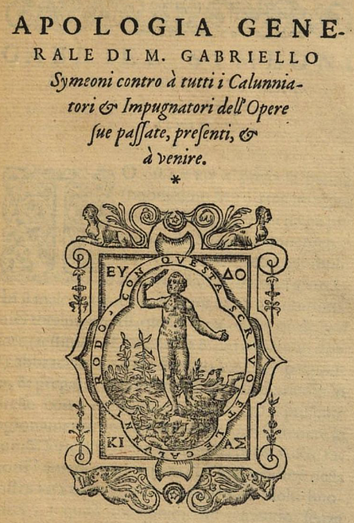
Simeoni then addresses the specific and mostly pedantic criticisms leveraged by the unidentified censors from his own vast corpus of works: the Satire alla bernesca (Turin, 1549), the Illustratione de gli epitaffi et medaglie antiche (Lyon, 1558), the Discorso della religione antica dei Romani (a translation from French into Italian, Lyon, 1558), and his version of the Metamorphoses. Simeoni responds to these criticisms one by one, proving that his versions and interpretations are indeed correct.
There is no evidence to suggest that the Apologia was a direct response to specific criticism; however, Simeoni’s reference to pedants dissecting his previous work is reason enough for a defensive stance. It is likely, I suggest, that the Apologia serves the dual purpose of pre-empting criticism and promoting Simeoni’s own knowledge and published works. The most interesting passages in the Apologia are, in my view, those where the author describes himself to Balbani and the readers. Take, for instance, the passage where Simeoni writes that ‘I am not one who, out of hope for reward or fear, tends to flatter and praise people, or, out of hatred, vengeance, and envy, speak ill of them’ (‘io non sono di questa sorte d’huomini, i quali con Speranza di premio o per paura sogliono adulare et lodare le persone, o per odio, vendetta, et invidia dirne male’). Particularly relevant to my discussion is the way Simeoni rebuts the criticism that his work is derivative. His response presents him as an artist, translator, author, and scholar more broadly engaged in reinterpreting, reinventing and reorganising material from disparate sources. The emphasis Simeoni puts is on ‘fitting [the sources] into new formats’ (‘accommodarle con modi nuovi’). Here is the full passage, which follows a long list of ancient Roman characters and objects:
I have not, like some, pieced together an imperfect work from other people’s interpretations and labours (as some have done imprudently). Rather, I sought out, studied, portrayed, interpreted, and adapted the material using new methods and order to fit my narrative and purpose, so if this book was translated into any other language, the description and envisioning of that same journey would resemble my own.
(Tutte le quali cose io non ho ritratte, scritte, et composte imperfettamente (come alcuni senza giuditio hanno fatto le loro) servendomi delle interpretationi et fatiche d’altri: ma io medesimo ho preso pena di cercarle, trovarle, studiarle, ritrarle, interpretarle, et accommodarle con modi nuovi, et nuovo ordine al discorso et proposito mio, che all’hora con ragione si potrebbe chiamare vecchio et non nuovo, ch’ei si trovasse un altro libro che in qual si voglia lingua, che nella descrittione et osservatione del medesimo viaggio et figure somigliasse il mio).
Simeoni renders his acts of writing, editing, and translating undistinguishable from one another. As his allegorical portrait on the first title page illustrates, his approach to writing and translation entails a reorganisation and modernisation of the material gathered and interpreted to shed light on and make accessible ‘here and there’ the otherwise ‘unknown and obscure memories of so many past illustrious people’. For this reason, Simeoni wears Ovid’s clothes in a symbiotic fashion: author and translator become one, forging a new text that is both faithful to the source and yet, paradoxically for us today, new.
As further evidence of this symbiotic relationship between author and translator, Simeoni vehemently denies having translated Ovid from an earlier, anonymous French version, the Métamorphose d’Ovide figurée, which was printed only two years before Simeoni’s version:
Will you not say that it [the translation of the Metamorphoses] was first composed by someone else in French? Certainly not, as my said book (entirely different from the French version and enriched by fourteen additional tales) will fully attest, along with Ovid’s text, that it is entirely mine.
(Non direte voi che egli [the translation of the Metamorphoses] è stato prima composto da un’altro in Franzese? Così certo, come il detto mio libro (diverso interamente dal Franzese et di xiiii favole acresciuto) farà piena fede col testo d’Ovidio, che egli è tutto mio).
Simeoni asserts the originality and authority of his translation and denies that he has copied or followed the existing French translation.Footnote 45 Whether or not Simeoni was responding to real criticism about his translation of Ovid, he must have felt the need to reassure his readers of his abilities and reliability in the context of growing competition for Italian versions of Ovid.
The pressure Simeoni and his printer must have felt justifies such a fervent defence of their 1559 edition. It probably also explains why the Apologia generale was republished as a stand-alone text between 1559 and 1560. In Venice, the Giolito press had published Ludovico Dolce’s Trasformationi (1553), while in Paris Giovanni Andrea dell’Anguillara’s version of the first three Books of the Metamorphoses was published by Wechel in 1554, with the complete translation appearing in Venice in 1561. In short, Simeoni’s approach reveals a competitive relation with the translated author, as we see his rhetoric challenging assumptions about the translated author’s precedence – in favour of ascribing greater authority to the translator.
The next case shows perhaps the strongest case of trust signalling on the part of the translator in competition with the first author’s authority and repute. In the 1550s, Giovanni Andrea dell’Anguillara and his printer Bernardo Giunti collaborated intensively on translating Ovid. They produced a series of partial editions of the Metamorphoses (1553, 1554, 1555, and 1558), in 1561 Anguillara completed a full vernacular translation of the Latin text, which was published without a portrait by Giovanni Griffio in Venice. It took a few more editions of this translation before a portrait of the translator was added, in 1584, by Giunti. The portrait – by Venice-based artist Giacomo Franco – appears at the top of the edition’s title page (Fig. 17), giving the impression that Anguillara, not Ovid, was the author of this work. A comparison with the stylistically similar title pages of Lodovico Ariosto’s Orlando Furioso (published by Francesco de’ Franceschi, Venice 1584) (Fig. 18) reinforces this impression: the two title pages share the same mise-en-page, the only key difference being that in the Ariosto’s text the author is portrayed in the medallion above the cartouche whereas in the 1584 Italian translation of Ovid, the translator occupies that spot, not the author.
Ovid. Le Metamorfosi di Ovidio ridotte da Gio. Andrea dell’Anguillara in ottava rima: con le annotationi di M. Gioseppe Horologgi, et gli argomenti, et postille di M. Francesco Turchi. In questa nuova impressione di vaghe figure adornate (Venice: Bernardo Giunti, 1584), title page.
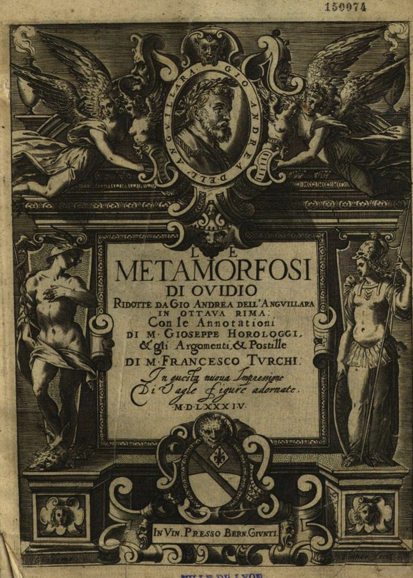
Ariosto, Lodovico. Orlando furioso di M. Lodovico Ariosto nuovamente adornato di figure di rame da Girolamo Porro padovano et di altre cose che saranno notate nella seguente facciata (Venice: Francesco de Franceschi, 1584), title page.
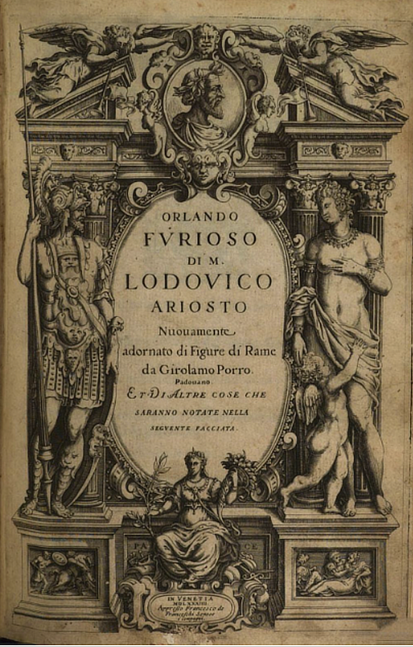
From a twenty-first-century vantage point, Anguillara’s portrait on the title page of his translation of Ovid is unexpected, if not jarring: it encroaches Ovid’s authorship by placing the face of the translator where a reader would typically find the picture of the author. Anguillara and his printer Giunti must have agreed to promote the growing reputation of the translator by presenting the humanist as an author: translator and author are in effect indistinguishable. This overlap is as much visual as textual: on the title page, the name of Anguillara is printed in a smaller font than Ovid’s, but this hierarchy is undermined on the same page by the translator’s portrait being the only one in the cartouche. In a similar fashion, the printer’s dedication to Camillo Baglioni that immediately follows the title page mentions Ovid only at the opening, whereas Anguillara gets three mentions: immediately after Ovid is presented, in the middle of the letter, and at the closing, where the printer effectively attributes the work to the translator: ‘I have once again been compelled to dedicate these present efforts made by Anguillara’ (‘mi sono nuovamente indotto a dedicate le presenti fatiche, fatte intorno all’Anguillara’, Ovid, Reference Ovid1584, n.p.). In the same letter, the printer Giunti uses the word ‘Auttor’ twice: first he acknowledges the work of the engraver Giacomo Franco who is presented as ‘author’ of the images that decorate this edition. Second, Giunti’s dedication letter to Camillo Baglioni asks him to ‘enhance the Author’s reputation, and authenticate my [printed] decorations’ (Ovid, Reference Ovid1584, 2v). Perhaps surprisingly, by ‘Author’ Giunti is here referring to Anguillara, not Ovid, underscoring his investment in the translator’s reputation and skills. The author referred to here is certainly Anguillara, not Ovid.
Considering Anguillara’s title pages with the 1584 edition of the Orlando Furioso, we see that these two works present their translators in a radically different fashion. In the 1584 Italian edition of the Orlando Furioso, Ariosto’s image sits above the title, which undisputedly attributes the authorship to him. The only other name mentioned on the title page is the illustrator’s, Girolamo Porro. For any other details on the production of this edition, readers are invited to turn the page, where they find a list of editors and authors who produced several paratexts accompanying the main text. In this edition of Ariosto’s Italian text, the authorship and authority of the author are undisputed. In the case of Harington’s title page, as we have seen, the author’s portrait still holds the place of honour by appearing above the title, but the translator encroaches on the page, albeit being hierarchically and spatially placed below the author.
The next sections of this Element focus more closely on how humanist translators used printed portraits to represent their moral and intellectual demeanour as signs of trustworthiness. In particular, I wish to dwell on how they used portraits and paratextual words to articulate their integrity, meant as a set of moral, cultural, and social principles Renaissance readers would approve of.
3 Virtue in View: The Soul’s Image
In Ancient Greece and Rome, politicians, rhetoricians, and philosophers (they were often the same person) were keen to be seen as trustworthy not solely through their words but also through their demeanour. Recollecting Cicero’s discussion in De officiis, much emphasis is placed on the deep connection between self-presentation and personhood.Footnote 46 Cicero refers to four personae or roles informing the individuality of all human beings: the persona of universal or rational nature; that of the individual; the persona moulded by socio-cultural context, and the persona each chooses for themselves by means of judgment and will. It is a humanist and classical commonplace that our own words are an image of who we are. Words transmit the natural image of our minds. Ancient philosopher Socrates asked a man to ‘speak so that I may see you’.Footnote 47
The printed materials discussed below were arguably designed to respond to this call for performative transparency. As we have seen in nearly all cases discussed so far, printed portraits were a crucial tool for humanists to visualise their craft and skills, their translative project, and their suitable trustworthiness. Their visibility, though, required careful curation to avoid the risk of looking too conspicuous and untrustworthy. This ideal of balancing certain qualities and accomplishments when they are performatively conveyed through one’s outer behaviour can be traced back to Petrarch, who disparaged portraits because, in his view, no exterior likeness reveals the inner persona. At the same time, however, Petrarch appreciated how portraits ‘inspire and urge toward virtue – since tepid minds are rekindled, as it were, by the memory of noble deeds’ (Dunlop, Reference Dunlop2008, 87).
By looking at portraits, viewers believed they could read the sitters’ inward qualities (Wilson, Reference Wilson and Martin2007, 452–453), and trust the individuals portrayed. This is exemplified by Dutch humanist Jan van den Wouwer (1576–1636) when he wrote to Federico Borromeo that
To judge at the same time the spirit of the authors by their books and bodies, face and physiognomy … excites a generous soul.Footnote 48
Wouwer indicates that the body of knowledge and the body of the author represented on the printed page excited Renaissance readers (the ‘generous souls’). This ‘excitation’ corresponds to a state described by Lodovico Dolce in connection with viewing portraits:
When they [ancient Roman Quintus Fabius and Publius Scipio] beheld the statues of their ancestors, they found their souls ablaze with ardor …. So the images of the best men excite virtue and good actions.
In the cases of translator portraits discussed below, this excitement was meant to encourage trust. In this section I show how the portraits of humanist translators (and accompanying textual descriptions) served two distinct purposes. First, the portraits were intended to persuade the reader that translators embodied positive qualities such as reliability, expertise, and moral integrity; second, the mediating contribution or role of the portrait artist is also pressed into the reader’s awareness (Adams, Reference Adams2006, 25). In this relationship, the reader is invited to appreciate the moral dispositions of the translator.
3.1 Modesty and Self-confidence
I have already discussed cases of modesty and self-confidence (see Nannini and Terracina). For this reason, I include just one more case; an example that evidences yet another rhetorical strategy that reflects the ‘paradox of print’: the strategy, that is, of having recourse to irony and wit. Anglo-Italian linguist and lexicographer John Florio (1553–1625) is represented in a portrait (Fig. 19) that appears on the verso of the opening leaf of his translation of Michel de Montaigne’s Essayes (specifically, the second edition, London: Bradwood, 1613), and in Queen Anna’s New World of Words or Dictionary of the Italian and English tongues (London: Bradwood, 1611).Footnote 49 This portrait by William Hole shows a confident and assertive Florio: his current role as Reader of Italian at the court of Anne of Denmark, Queen of England and Scotland (1603–1619) is revealed in the cornice, and the caption below his portrait posits him as successful and content:
Queen Anna’s New World of Words or Dictionary of the Italian and English Tongues (London: Bradwood, 1611), frontispiece after The names of the authors and books that have been read (n.p.).
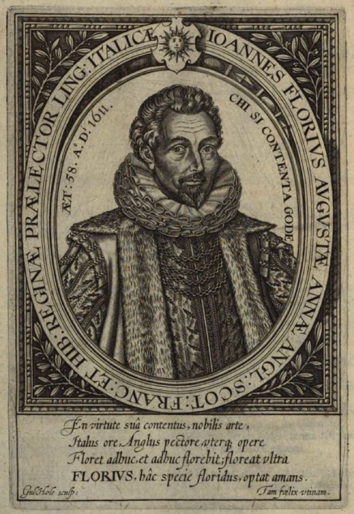
Content with his own virtue [and] noble skill, / Italian in speech, English at heart, both flourish through work; / FLORIO still flourishes, will flourish, and will flourish more, / flourishing in this way, good wishes
(in virtue sua contentus, nobilis arte, / Italus ore, Anglus pectore uterque opere / Floret adhuc, et adhuc florebit: floreat ultra / FLORIVS, hac specie floridus, optat amans).Footnote 50
The position of the portrait within the text also signals the translator’s assertiveness. In the translation of Montaigne’s Essayes, Florio’s portrait appears immediately after Montaigne’s address to the reader, where the French author professes the private and familiar nature of his work:
Had my intention been to forestall and purchase the worlds opinion and favour, I would surely have adorned my self more quaintly or kept a more grave and solemn march. I desire therein to be delineated in mine owne genuine, simple and ordinarie fashion, without contention, arte or studie; for it is my selfe I pourtray.
I quote this extensive passage to demonstrate how Florio’s portrait responds to Montaigne’s professed little interest in pursuing the favour of the world, which is accurately rendered: the translator is content with the English court’s recognition of his service. Florio plays a delicate balancing act here between confidence and modesty. The portrait’s caption communicates wit (quick and inventive use of language to amuse) and irony while also eschewing gravity and solemnity, as Montaigne claims in his own preface. Florio’s self-posturing closely aligns with the author’s underscoring of assertiveness and confidence. This example shows a strategic closeness of appearance and behaviours between author and translator, which signals a balanced confidence to the reader: Montaigne’s self-posturing before the readers is enacted and appropriated by the translator.
3.2 The Paradox of Exemplarity
I now return to exemplarity as a pathway to trustworthiness. Similar to the paradoxical contrast between a translators’ visibility in a portrait and their professed modesty in a written self-presentation – the cases of exemplarity I discuss below reveal another, related paradox: portraits and accompanying text offer established or even dogmatic paradigms of moral integrity while also revealing intellectual creativity and innovation.Footnote 51 Conformity and differentiation together create a tension that is rhetorically sustained through co-dependence, or a cyclical logic, each quality reliant on and reinforcing the other.Footnote 52 More broadly, such a contrast between tradition and freedom connects with the humanist translators’ ongoing challenge of balancing apparently contradictory assertions, claims, and counterclaims to establish trustworthiness, while using topically – thus morally – acceptable means. The humanists discussed below each met this challenge quite differently in the printed works I discuss.
For at least four decades of the seventeenth century, the printed portrait of child translator Francis Hawkins (1628–1681) accompanied editions of three translations he made: Youth’s Behaviour, or Decency in Conversation amongst Men (first published in London by William Wilson, for William Lee, in 1646 – or perhaps 1641 as Ingram Reference Ingram, Clarke and Corran2021, 64, suggests – with at least seven editions between 1646 and 1661), the An Alarum for Ladyes. By the sieur de la Serre, historiographer of France. Nevvly turn’d out of Franch [sic] into English, by Francis Hawkins, dravving on to the tenth yeare of his age. (Paris, chez Nicolas de la Coste and Jean de la Coste, 1638), and The mirrour of complements. Or a manuell of choice, requisite and compendious ceremonies, and courtly practice of expressions of each ones notions as well by voice, as missive letters. Newly turn’d out of French into English by Francis Hawkins (London, for Thomas Harper sold by Lawrence Chapman, 1637).Footnote 53 These texts variously summarise views and advice on education for the young people and women by Erasmus, Giovanni Della Casa, Stefano Guazzo, and other influential humanist writers (Ingram, Reference Ingram, Clarke and Corran2021). The text of Youths Behaviour is highly legalistic and contains detailed precepts on what to do and not do, ordered alphabetically for ease of search and use. For instance, it prescribes that, when seeing a flea, one should not kill it, and
if thou seest any filth on the ground, as some thick spittle or the like, put thy foot thereon dexterously if thou canst: if that were upon the clothes of thy companion, show it not to others: but if thou canst put it off neatly, yet without his taking notice thereof, if it may so be; and if another do for thee the like office, show thyself unto him with tender of thanks.
The 1646 edition of the Youths Behaviour (and any other earlier edition that may have existed) did not originally include a frontispiece with the portrait of the boy translator. Chronologically, the third of Hawkins’s translations to have been formally published within nine years, it is plausible that, by 1651, a pre-existing engraved portrait was added to editions of Youths Behaviour from his earlier published translations, which did indeed enjoy some popularity. There is also evidence of further, more sophisticated portraits of Hawkins circulating independently of his translation.Footnote 54 The 1654 edition (held in the British Library) has a portrait of him as an eight-year-old boy (Fig. 20), whereas in the frontispiece of the 1661 edition he is ten (Fig. 21). The portrait of a ten-year-old Hawkins also features in the numerous re-editions of the An Alarum. Even as these portraits differ, however, they are printed with an identical caption. Positioned below the portrait roundel, and spread the width of the printed page frame, the caption insists upon the boy’s exemplarity: he is a child whose wit exceeds his tender age and that of other children the same age:
Youths Behaviour, or, Decency in Conversation amongst Men. Composed in French by grave persons, for the use and benefit of their youth. Now newly turned into English by Francis Hawkins (London, William Lee, 1654), frontispiece.
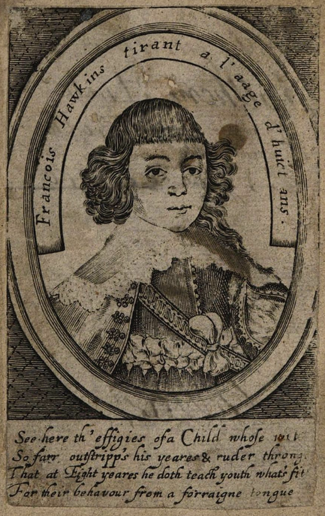
Portrait of Francis Hawkins by John Payne, line engraving, 1654 (© National Portrait Gallery, London) printed in Youths Behaviour, or, Decency in Conversation amongst Men. Composed in French by grave persons, for the use and benefit of their youth. Now newly turned into English by Francis Hawkins (London, William Lee, 1661), frontispiece.
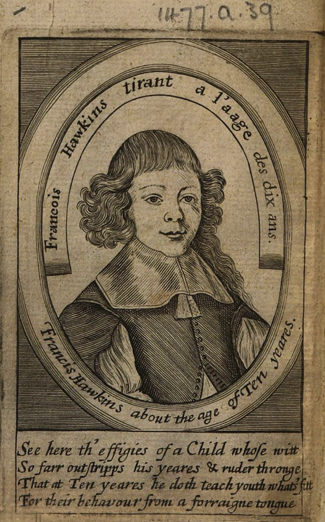
See here the’ effigies of a Child whose wit so farr outstrips his yeares & ruder thronge that at ten yeares he doth teach youth what’s fitt for their behaviour from a forraigne tongue.
These portraits were clearly intended to encourage parents as well as children of similar age to take Hawkins as a paradigm, a standard, in his translative efforts to explain and embody civility for citizens of all ages. The prefaces that accompany the portraits of Hawkins reveal the scope of the images. All editions of Youths Behaviour contain Hawkins’s address to the youthful reader: the translator humbly apologises for his age and ambitiousness, and asserts that his work will be for ‘the singular benefit of many a young spirit’ (Youths Behaviour 1654, A3r). This preface is then followed by an anonymous poem (signed with the initials J. S.) in praise of the translator, who is described as ‘author’: the verses in this poem emphasise the wondrous feat of this child who managed to make ‘this work his own / (since he that can translate and please, / Must needs command two Languages)’.Footnote 55 Hawkins’s ability to command two languages at such a young age allowed him to ‘own’ the source text – which was known to be the 1595 Bienséance de la conversation entre des hommes, compiled by members of the Jesuit college at Pont-à-Mousson.
The same prefatory praise also marvels at what such a small branch will achieve when it becomes a mature tree. This natural analogy – a branch growing to become a tree – emphasises Hawkins’s youth, yet also his vulnerability. Thus, it contrasts with the half-length portrait, which shows a young boy posing as a confident and trustworthy author. In Fig. 20 Hawkins wears a decorated lace collar and doublet with ribbons, whereas in Fig. 21 he sports a less richly decorated attire. Both renditions of his clothes and face show a young figure who is meant to ‘look like’ a grown-up and trustworthy humanist. The contrast between the young figure and the deferential oval cartouche that frames the portrait is made even starker considering that at least six years had passed since Hawkins was ten years old. The branch did not need to be shown as having become a tree in order to convince readers of Hawkins’s translations.
These two portraits operate at once as an author portrait and a moral exemplum. The engravings portray Hawkins as a prodigy who not only masters moral wisdom but teaches it to others – an act of extraordinary precocity. The portraits’ combination of youthful likeness, bilingual inscription, and moral verse would have appealed to mid seventeenth-century readers seeking models of learned piety.
Portraits also sought to inspire readers to emulate the translator’s Christian religious faith or religio-spiritual attitude of faith they brought to their translative work when concentrated on liturgical texts. In 1514, Count Kristóf Frangepán – one of emperor Maximilian’s high-placed commanders – was taken prisoner by Venice and incarcerated in the same city. With the help and support of his wife Apollonia Lang von Wellenburg, who followed him in the relatively comfortable prison of Torresella near the Doge’s Palace, Count Frangepán produced a full translation into German of the Roman Breviary, with the collaboration of Franciscan monk Jacob Wyg (Jurković, Reference Jurković2023). The translation was published by Venetian printers and brothers Giovanni and Gregorio de Gregoriis in 1518 with a print run of 400 copies. A woodcut portrait of Count Frangepán and his wife – probably designed by Giovanni Andrea Vavassore – is at the end of a series of indices and tables, before the actual Breviary begins. The image represents a scene akin to those found in an altarpiece of the Coronation of the Virgin (Fig. 22) and donor portraits (Mortimer, Reference Mortimer1996, 63–65). The composition’s architecture – a hybrid of frame and tabernacle – shows the influence of printed altarpieces, turning the page into a portable shrine. The upper scene depicts the Trinity crowning the Virgin Mary: God the Father and Christ the Son place the crown upon her head, while the Holy Spirit, in the form of a dove, hovers above. The Virgin is enthroned amid clouds, cherubim, and angelic witnesses. This was one of the most beloved Marian themes of the late Gothic and early Renaissance period, symbolising the Virgin’s exaltation as Queen of Heaven and her intercessory power. Below the heavenly scene are two kneeling figures identified by nameplates: ‘CHRISTOFORV[S]’ and ‘APOLONIA’, referring to Christof Frangepan (Kristofor Frankopan), the noble patron of the book, and his wife Apolonia Lang von Wellenburg.
Deutsch romisch Brevier welliches auss dem lateiniscehn romischen durch Bruder Jacob Wyg (Venice: Gregorio De’ Gregori, 1518), frontispiece after the table of contents, before the first hymn (n.p.).
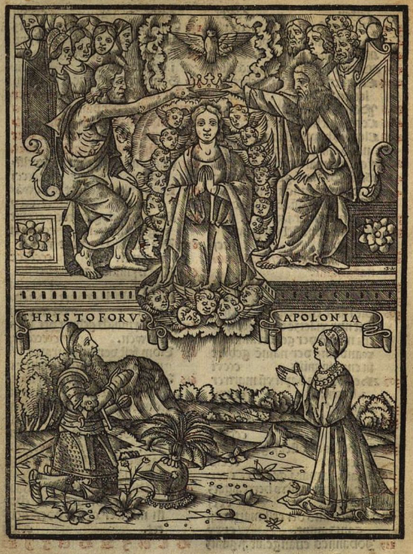
Both Frangepáns kneel below the Virgin Mary, representing their faith and the vow they made to the Blessed Virgin that they would build an altar should they return from their captivity in Venice. Both Frangepán eventually managed to escape from his captivity, whereas his wife succumbed to illness near Padua. The Count did manage to fulfil his ex voto by commissioning a triptych from painter Jan van Scorel, and having it hung in Falkenstein circa 1520. In the printed portrait of him and his wife, the translator and patron represent themselves as models of religious piety and devotion, while also offering their readers a carefully and reliably translated prayer book:
This German breviary is derived from the Roman Latin breviary, translated with great care into good, common German, according to the true and correct order of the Roman Church. Four hundred books were made at the expense and initiative of Christoph von Frangepan, Prince and Count of Zengg and Modruš, with the gracious assistance of his beloved wife Apollonia.
Readers and Christian devotees were supposed to be inspired by the visual and textual faith and accurate rendering of the Breviary. In the text’s preface, readers are expressly told that the translation was carried out so that those ‘who, due to their natural abilities, cannot learn this [i.e. the Latin] language, may nevertheless pray and devote themselves spiritually’. (Brevier 1518, A2r)
Clearly, the Frangepáns wanted to connect this portrait to the common dedication scenes in which translators and authors offer their work to their patrons. In this case, however, this image acts as an ex voto, a public commitment made by the translator and his wife to thank the Blessed Virgin for her protection, and a profession of faith and service made to their readers as an invitation to ‘pray and devote themselves spiritually’ (Brevier 1518, A2r). Even as it was conditioned by the Frangepáns unique vicissitudes, their portrait also visualises the couple’s exemplary piety and devotion. Finally, their gestures of humility and supplication visually enact what translators often declared verbally in prefaces – usefulness, modesty, and trustworthiness. Just as the translator mediates between the first text and the reader, the donor mediates between heaven and earth. Both claim authority through humility. In this sense, the Frangepán woodcut portrait prefigures the rhetorical posture later adopted by John Florio: visible yet deferential, instrumental but exceptionally inspired.
In good part because of their perceived exemplarity, editorially successful women humanists were the subjects of portraits that served to amplify recognition of their humanist achievements and their skills as translators. As we have seen with Terracina, presupposed tensions between modesty and public visibility entailed a balancing act – the ‘paradox of print in the Early Modern period’ I discussed earlier. Another significant humanist is German-born Anna van Schurman (1607–1678). Van Schurman indicates how trust was a major concern for her and for women intellectuals in her position. In the letters published under the Opuscula Hebraea, Graeca, Latina, Gallica. Prosaica et Metrica (Leiden: Elzevir, 1648), she frequently calls upon friends and correspondents’ trust to keep her and her reputation safe from detractors. For instance, in a letter to André Rivet she implores him not to divulge her work yet: ‘Therefore, again and again, I implore your trust, that you may allow them to remain hidden within private walls for the time being, until a more favourable opportunity should smile upon us’ (‘Proinde etiam atque etiam fidem tuam imploro, ut eas tantisper intra privatos parietes latere sinas, dum aliquando plausibilior nobis arriserit occasio’, van Schurman, Reference van Schurman1648, 177). These supplications were a device through which van Schurman performatively connected her ‘proper’ vulnerability and subservience with her manifest intellectual potency and power, sourced through skilled engagement with the Republic of Letters.
Significantly, van Schurman was also an artist who produced fifteen self-portraits, including a drawing (pastel on paper, c. 1640) and twelve engravings (between 1633 and 1640). A fervent Calvinist (and later in life a follower of French Pietist Jean de Labadie and his religious community), from the 1630s van Schurman became a significant and well-recognised literary and intellectual figure. Her extensive correspondence and meetings with intellectual leaders of her time, including French philosopher René Descartes, as well as monarchs (for instance, the Queens of Sweden and Poland), made her a key contributor to the Republic of Letters. Several copies of the engravings still exist, since van Schurman presented them to numerous correspondents. One of these is the 1633 etching (Fig. 23) in which van Schurman has portrayed herself as young, wearing an elaborately and fashionably embroidered dress, an elaborate lace collar, and a French hairstyle (with a fringe and frizzed hair at her temples) enhanced by a row of pearls.Footnote 56 This half-figure portrait is accompanied by a justification in Latin, which follows the genre of the deprecatory epigram often used by humanists: ‘It was neither pride of spirit nor the charm of beauty that persuaded me / to engrave my face in eternity. But if this unpolished style denies better things, I would not dare to strive for greater results on a first attempt’ (‘Non animi fastus, nec formae gratia suasit / Vultus aeterno sculpere in aere meos. / Sed si forte rudis stylus hic meliora negaret, / Tentarem prima ne potiora vice’). Modesty and inner beauty are here represented both visually and textually, thus creating an impression of a balanced and reliable young humanist, nonetheless unafraid of putting herself forward before established intellectuals who were mostly men.
van Schurman, Anna Maria. Self-Portrait, 1633. Engraving (16.5 × 15 cm), Risd Museum, Jesse Metcalf Fund
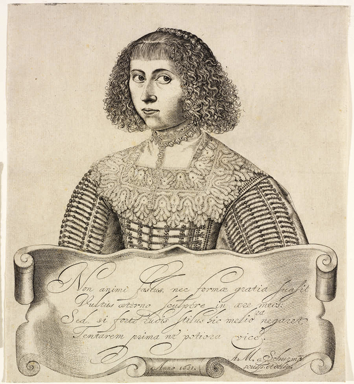
An engraved self-portrait that van Schurman made in 1640 was first published in the multilingual collection of her poems, letters, and tributes Opuscula (Fig. 3). Several copies of this later self-portrait were made, with slight changes (Larsen, Reference Larsen2016, 181–182). Here, van Schurman crafted her own image as a humanist, wearing a more simply laced-up bodice. A white collar covers her shoulders, and the hairstyle is less mundane and elaborate than the 1633 portrait. Van Schurman’s expression is serious and her gaze is directed away past the viewer (Larsen, Reference Larsen2016, 1).
While the first edition of the Opuscula does not contain direct translations of earlier texts per se, several of the works therein include unmistakable paraphrases or translations. Indeed, the Opuscula has several Latin translations of passages from Plato, Pindar, and biblical scripture, showing van Schurman’s deep engagement with ancient and Christian texts in their source languages. She analyses translations from Hebrew to Latin and Greek, focusing on lexical and semantic intricacies.
The Opuscula also includes letters and epigrams through which van Schurman actively promotes translations by other women, such as her epigram in praise of Danish humanist Brigitte Thott (1610–1662), who translated Seneca into Danish. The intellectual significance and excellence of van Schurman’s interpretation and discussion of multilingual texts is underscored by Frederic Spanheim, professor at Leiden University and her close friend and supporter, who contributed a preface to the Opuscula:
What is presented to you here has been more drawn out of her than offered by her voluntarily. Some contributions have been taken from the writings of others, who preserve the elegant and truly incomparable style, the same way Picus [son of Saturn] guards his gold.
(Et sane quæ hic tibi exhibentur, exorta illi potius sunt, quam ab ea impetrata. Accessere quaedam ex aliorum scriniis, qui elegantissimam et vere incomparabilem in omni charactere manum, ut Pici aurum suum custodiunt).
Given this intellectually rich, philologically impressive collection of writings by van Schurman – and by contemporary humanists, friends, and connections – the half-figure portrait of van Schurman provides the visual cues regarding her skills and virtues. Framed within an oval cornice recording her name and her age at the time the portrait was made, the portrait shows van Schurman as an authoritative, virtuous, modest, and exemplary writer. The framing is similar to that of other portraits already discussed (Simeoni, Anguillara, and Hawkins). They all establish a parallel between the authority of the translated or interpreted sources and the reliability and author-status of the portrayed interpreters. As in the cases of Hawkins and Terracina, van Schurman’s portrait underscores her exceptionality: a thirty-two-year-old woman is a model author and interpreter who, through her studies, writing, and self-representation, intends to inspire other women to follow in her footsteps. That van Schurman was portrayed as a unique example is made even clearer in a slightly earlier portrait of her (Fig. 24) printed in Jacob Cats’s Reference Cats1637 Wedding Ring (‘s Werelts begin, midden, eynde, besloten in den trou-ringh), a Dutch didactic poem about marital issues. The image (described by Cats in the accompanying caption as a self-portrait) appears at the end of the book’s introductory material and is accompanied by three captions. In one of them Cats writes that
Whoever comes to gaze upon this noble image, / Know that you see here the glory of all women / Since the world began until this very day, / Not one has been like her, nor can any match her.
(Wie oyt dit defdig beelt zult komen aen le schouwen; / Hout vast, dat jy hier siet een roem voor alle vrouwen).
This image shows van Schurman positioning herself in front of a curtain. Most likely, this aspect of the portrait alludes to the rector of the University of Utrecht, Gisbertus Voetius, having allowed her to ‘attend’ lectures from a purpose-built cubicle intended to screen her from male students (van Schurman, Reference Anna Maria van and Irwin1998, 5). Yet the same image can be said to show van Schurman proudly emerging from behind the curtain into the limelight of the Republic of Letters. The book, paper, and pencil depicted beside and behind her are the tools of her intellectual trade, and reinforce her authority and recognition as a trustworthy and uniquely skilled humanist of her time.
Cats, Jacob. ‘s Werelts begin, midden, eynde, besloten in den trou-ringh, met den proef-steen van den selven (Amsterdam, Nicholas van Ravesteyn, 1637 [first edition 1611]), full-page portrait at the end of paratextual material (n.p.).
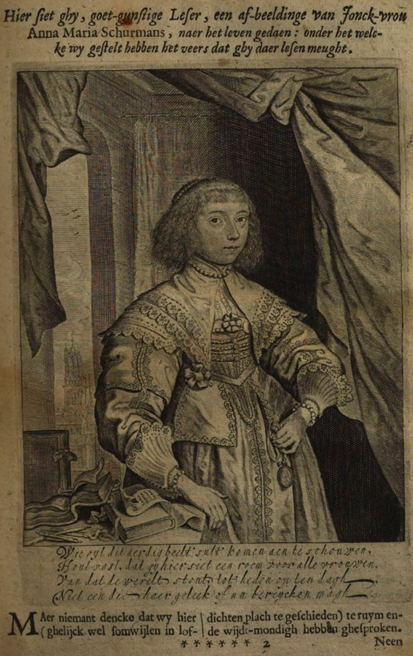
This uniqueness was evidenced by van Schurman’s ability to produce her own portraits and thereby curate how she wished to be perceived by her contacts and readers. ‘Uniqueness’ is also key to the way in which her supporters and editors wished her readers to see her. Another passage from Spanheim’s preface to the Opuscula presents van Schurman as the most accomplished and therefore authoritative humanist of the time:
You have here, Reader, a Work such as previous generations have not seen, and which, as it relates to the honour and glory of our age, will thus someday continue to contribute to the admiration of posterity. At the same time, the Low Countries display a Maiden to you not only instructed in the erudite languages, which belong to the learned exclusively, but also in nearly every aspect of learning.
These statements and, most relevantly, her portraits, reflect van Schurman’s awareness of the delicate balance between sharing her intellectual work and maintaining her integrity and reputation in the scholarly and public domains. Signalling trustworthiness in works in which she discussed delicate religious and philosophical concepts was a significant means to avoid prosecution and being silenced. Van Schurman is rightly remembered for her collaborative efforts to build and sustain an image of a celebrated seventeenth-century female humanist whose qualities encompassed modesty, positive and high repute, and exceptional talents of mind that extended to facility with numerous languages and their translation.
The next case shows another Renaissance humanist being presented as a model not only through her work as a humanist but also through the representation of her struggles and faith. Born in Ferrara, Olimpia Fulvia Morata (1526–1555) grew up surrounded by humanist scholars and with a deep interest in the Reformation. In this context, where her father, Fulvio Pellegrino Morato, and his friends were established humanists, Morata became a highly celebrated Latin humanist in the Ferrara court. Still in her teens, Morata wrote poetry in Latin and Greek, produced commentaries of ancient works, and translated two of Boccaccio’s stories from the Decameron into Latin. Her public readings and orations so impressed the members of the Ferrara court that she was described as a ‘miracle’ (Ray, Reference Ray2024, 103). She recited poetry before international audiences of protestants and reformers who found in the Duchess of Ferrara, Renée of France, protection and encouragement. After a change of the religious climate in Ferrara, Morata decided to follow her husband to the Bavarian town of Schweinfurt, where she maintained her intellectual connections with Protestant humanists and her family. A key connection was a close friend of her father, Caelius Secundus Caro (1503–1569), who decided to collect Morata’s writings after her death and produce a brief collection published in Basel by Peter Perna in 1558 and 1562. Expanded and revised editions appeared in 1570 and 1580, respectively.
These posthumous editions contain an unusual frontispiece that emulates devotional and eulogistic portraits (Fig. 25). This image appears towards the end of the 1558 and 1562 editions, immediately after the letter of dedication to Elizabeth I ‘Queen of England, France, and Spain’ and a glossary of Greek terms. The frontispiece contains an epitaph in Latin that celebrates Morata’s intellect and virtues:
To Olympia Fulvia Morata Grunthler, a woman of extraordinary beauty, intellectually greater than men, she embraced Christ with her whole soul, despising worldly things. [Woodcut] by Basilius Ioannes Harold, a citizen of Heaven. She lived 29 years. In December 1555, she triumphed eternally.
Morata, Fulvia. Olympiae Fulviae Moratae mulieris omnium eruditissimae Latina et Graeca, quae haberi potuerunt, monumenta, eáque planè divina, cum eruditorum de ipsa judiciis et laudibus. Hippolytae taurellae elegia elegantissima. Ad Ill. Isabellam Bresegnam (Basel: Peter Perna, 1558), 110.
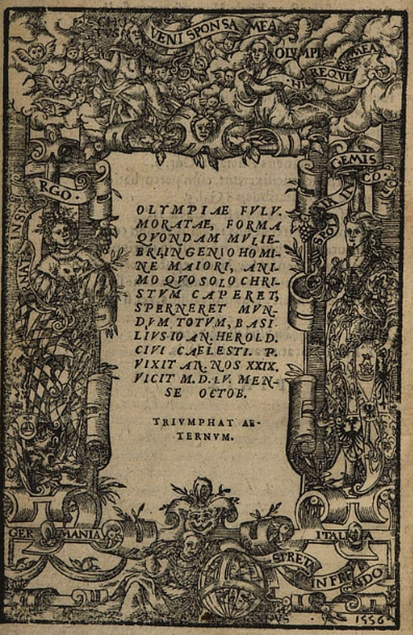
The epitaph is framed by two female figures representing two distinct aspects of Morata’s life: the one to the right refers to her life in Germany culminating with the dramatic siege and destruction of Schweinfurt, where she was living with her husband. The couple narrowly escaped death by fleeing the city and walking for miles to find safety. The cartouche above the woman reads ‘Stripped, I lament’ (‘Spoliata, ingemisco’). As a complement and contrast, the female figure on the left (wearing a laurel crown to represent her poetic and intellectual recognition) holds a cartouche that reads: ‘Honoured, I rise’ (‘Ornata, insurgo’). Above the two figures are the Heavens, where Morata is portrayed kneeling before Christ, who blesses her, and, according to another cartouche, calls ‘Come, my bride. Rest here, my Olympia’ (‘Veni, sponsa mea. Hic requi[escit] mea’).
This frontispiece acknowledges Morata’s intellectual achievements with reference to her troubled life following the death of her father and her eventual move to Germany. It serves as a companion piece for the title page, which emphasises the erudition that made her humanist work no less than ‘holy’: ‘The Latin and Greek works, truly divine, of Olympia Fulvia Morata, the most learned woman of all, that could be gathered, along with the judgments and praises of scholars about her’. Printed in Basel, the collection of Morata’s writings and translations clearly curates an image of Morata that was meant to serve as a model for Protestant readers and women. As Catherine Des Roches writes about Morata in her Dialogue de Placide et Severe (1583), ‘But what shall I say of Morata, who worthily received from heaven the name of Olympus?’ (Morata, Reference Morata and Parker2003, 35).
The printed portrait image constructs fides – faith and trust – as Morata’s exemplary virtue. In the wake of Reformation polemics, the portrait substitutes physical resemblance with verbal integrity. The subject’s moral and intellectual authority is guaranteed by the credibility of the written word. The woodcut thus participates in a Protestant visual culture that distrusted idolatry yet sought trustworthy exempla.
In this final case, exemplarity and trustworthiness represented a necessary struggle and sacrifice affecting the health and appearance of the humanist translator. This is the case of Conrad Gessner, who, in a letter, complains about the demands of a bookseller:
Frobenius (the bookseller) in Basel demands that I compare for him the Latin translation of Galen’s complete works with the Greek original text (a work that demands an immeasurable amount of labour), and I have to give him my decision within a month. Froschauer (the famous printer in Zurich) asks me to make for him an excerpt from my three large volumes of the natural history of animals. Exhausted from so many exertions, emaciated, enfeebled, half blind and sometimes not quite conscious of myself (how could it be otherwise, since I am forced to write so many, variegated, and wide-ranging works), I shall now again take this yoke upon me, shall again take on a work that would not let me breathe freely for two or three full years. Would you, my friend, advise me to do this?Footnote 57
This example is significant because it shows how contemporaneous biographies helped to sustain the reputation of humanist translators as diligent, hardworking, and trustworthy. In the case of Dutch humanist Willem Canter (1542–1575), there are no portraits of the translator and editor accompanying his version of the dramas by Sophocles, Euripides, and Aeschylus.Footnote 58 But there are descriptions of Canter’s skills, habits, and appearance that offer readers the opportunity to appreciate his devotion to ancient literature and his trustworthy rendering of classical texts. For instance, in his miscellaneous 1571 work in which he translated and commented on diverse ancient texts (Eight Books of New Readings by Gulielmus Canter of Utrecht or Gulielmi Canteri ultraiectini Novarum lectionum libri octo, Antwerp: Christophorus Plantinus, 1571), an epistolary exchange between Carlo Sigonio and Canter himself reveals the former’s appreciation of the latter’s skills and dedication:
I have always admired you greatly, most kind Canter, and even before, I had a strong affection for you, because I could already perceive in your writings – of which I was a great enthusiast – brilliant signs of extraordinary genius and exquisite learning. Indeed, to speak truthfully, I owed you nothing except in the public name of letters, which you, with your remarkable industry, had greatly enhanced and adorned … I will begin by proclaiming the excellent benefit you have shown towards me and add many praises of your great achievements and your noble efforts toward immortality and glory.
Sigonio speaks truthfully about Canter’s industriousness and learnedness, thus encouraging readers to trust Canter’s work.
4 Translators at Work: A Conclusion
As discussed throughout this Element, the visual representations of humanists’ credibility, skills, and virtues entailed first and foremost depicting (or evoking something of) their physical appearance. Face, bodily figure, and gaze are key to the ways these intellectual mediators offered their credentials through printed portraiture. By certain details of page design, composition, and style, such portraits are often implicitly ‘in conversation’ with earlier author portraits and symbols that were meant to help readers and patrons understand the humanists’ roles and reputations. The humanist translators (and their collaborators) understood that readers needed to be convinced that their versions of earlier texts (whether direct translation, paraphrase, or rewriting) were trustworthy. In a recently published study of medical-astrological books in Dutch for the period 1500–1550, Andrea van Leerdam investigates how Netherlandish printers selected woodcut images as visual means of persuasion. Similarly – albeit often in collaboration with the translators themselves – printers of the translations considered here employed visual strategies aimed at encouraging the readers’ trust or ‘enough of their trust to potentially retain them as future clients’ (van Leerdam, 2024, 195).
As a way of bringing this Element to a close, I would like to examine some of the most visually rich and original portraits of humanists I have come across in my research thus far. The selection discussed here offers a window on more singular strategies of self-presentation and trustworthiness signalling as part of a clear quest for new, creative ways to establish brand credibility and excellence. The cases in this final section seem designed to do two things: intensify readers’ effort to interpret the portraits and heighten the distinction accorded to the depicted humanist translators.
4.1 Seeing Virtue, Reading Credibility
The first case is that of Daniele Barbaro (1514–1570) and the portrait printed together with his own translation and commentary of Marcus Vitruvius Pollio’s first-century BCE De architectura. This translation was first published in Venice in 1556 by Francesco Marcolini, and given a revised edition in 1567. Barbaro’s illustrious career as Venetian ambassador (1549–1552), patriarch-elect of Aquileia, and, from 1560, official historian of the Republic of Venice, gave him ample visibility and recognition. Paolo Veronese’s painted portrait of him (now in Amsterdam’s Rijksmuseum) celebrates his leadership and architectural knowledge. To understand how Barbaro chose to represent himself in his translation of Vitruvius, we need to consider other contemporaneous translations of Vitruvius and of Leon Battista Alberti’s On Architecture (De re aedificatoria, written in the 1430s and first printed in the 1480s). Barbaro’s translation was spurred by growing interest in architectural treatises by Vitruvius, Alberti, and Sebastiano Serlio (1475–1554). Several vernacular translations of both Vitruvius and Alberti’s work appeared from the mid sixteenth century. I have already discussed Cesare Cesariano’s 1521 translation of Vitruvius and the translator’s portrait that appears, discreetly, at the first title letter of his translation (Fig. 9). Another translation into Italian was produced in 1524, made by Francesco Lucio Durantini, and published by Giovanni Antonio and Pietro Nicolini da Sabbio in Venice; this was reprinted in 1535 (in Venice by Niccolò Zoppino). There is no portrait of Durantini in these editions, and no mention of him appears on the title page. A radical shift happens with Gianbattista Caporali in his 1536 translation into Italian of Vitruvius (printed by Giano Bigazzini in Perugia). Probably inspired by Cesariano’s self-presentation, Caporali makes himself more visible and authoritative than the earlier translator.
The title page of Caporali’s translation (Fig. 26) centres on a triumphal arch where Architecture, personified as queen of the arts, is seated on the entablature. A decorative frame with squared corners represents allegories of Literature, Painting, Music, and Mathematics. Midway on the left side of the frame, there is a medal portrait of the translator with his first name below it. His surname is on the opposite end of the frame, just below what appears to be his city’s coat of arms. Bearded and balding, Caporali’s portrait is similar to authorial portraits we have already encountered (Figs. 12, 13, and 17). His name is clearly stated on translation’s title: ‘Vitruvius (and its images and commentary) translated in the vernacular tongue by Messer Gianbattista Caporali from Perugia’ (‘Con il suo commento et figure Vetruvio in volgar lingua raportato per M. Gianbatista Caporali di Perugia’). Caporali’s self-representation and authorial stance here can be considered a radical change from the earlier Italian translations of Vitruvius. Whereas the only concern of pre-1536 translations of Vitruvius appears to be the credibility and usefulness of Vitruvius’s work, Caporali’s self-representation seems to emphasise his role as a respected and reputable interpreter of the ancient Roman work. His reputation as a trustworthy translator is therefore articulated on the title page and in the statement of publication rights that follows. He clearly sought to be perceived as a reliable and authoritative interpreter of Vitruvius, and to achieve this, he represented a dynamic and mutually rewarding relationship with his patron, the condottiere Giano Bigazzini. In the statement of publication, a representative of the papal State, in the name of Pope Clement VII, gives exclusive printing and sale privileges to Caporali for his translation, commentary, and images. In particular, the licensing document praises Caporali’s skills and the importance of actively safeguarding his reputation:
Since we have learned that our beloved son, Giovanni Battista Caporali of Perugia, has recently translated the books of Vitruvius on architecture from Latin into the vernacular Italian language, having corrected and amended them with the greatest precision, and has adorned them with commentary and illustrations never before printed, intending to publish them for the common utility of all …. Therefore, wishing to protect the integrity of Giovanni Battista, we hear his prayers.
(Cum sicut accepimus dilectus filius Ioannes Baptista Caporalis Perusinus, libros Vitruvii de architectura de latino in vulgare idioma Italicum novissime translatos & per eum accuratissime correctos & emendate (sic) cum suis in illo commentariis ac etiam figuris nunquam antea impressis ad communem omnium utilitatem edere intendat …. Nos ipsius Ioannis Baptistae indemnitati consulere, ut æquum est volentes, precibusque huiusmodi inclinati).
Caporali further develops his self-posturing in the preface he addresses to Bigazzini, who subsidised the printing of Caporali’s translation (Fig. 27). In this paratext, the translator acknowledges the earlier efforts of Cesariano and the Milanese editors who took over from Cesariano. Caporali views Cesariano’s translation as the version most directly competing with his own, and for this reason, reveals its key shortcoming: Cesariano’s rendition is inaccessible to ‘uneducated men’ (‘huomini senza lettere’). To address this limitation, Caporali did his best to make Vitruvius accessible and enjoyable to those without formal education (‘persone di mano’) by adding more explanatory illustrations (‘aggiontovi di molte altre figure chiarezza’).
Vitruvius, Pollio. Architettura, con il suo commento et figure. Vetruvio in volgar lingua raportato per M. Gianbatista Caporali di Perugia (Perugia: Iano Bigazzini, 1536), title page.
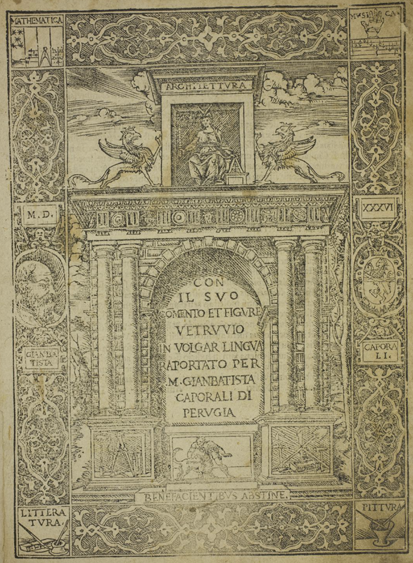
Vitruvius, Pollio. Architettura, con il suo commento et figure. Vetruvio in volgar lingua raportato per M. Gianbatista Caporali di Perugia (Perugia: Iano Bigazzini, 1536), 3.
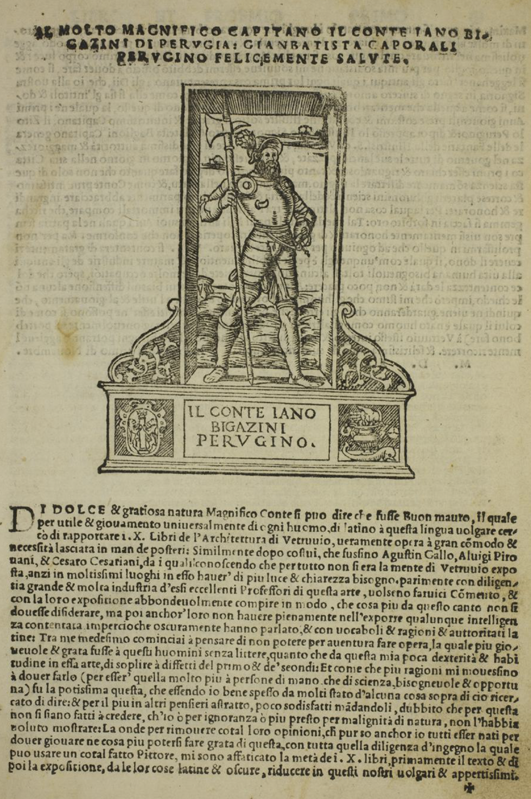
Ten years later, in 1546, Vincenzo Valgrisi published Pietro Lauro’s translation into Italian vernacular of Alberti’s De Re Aedificatoria. Its title page does not reveal the identity of the translator, whose name first appears in the heading of the dedicatory letter. More or less contemporaneously, in France, Jean Martin’s 1547 French translations of Vitruvius (as L’architecture ou l Art de Bien Bastir printed by the widow and heirs of Jean Barbé in Paris) and Alberti’s work (published after Martin’s death in Paris, Jacques Kerver, 1553) are presented as team efforts: the illustrator, editor, translator, and printer are recognised and praised in the paratextual material of both translations. Writing to the King of France, Martin thanks Jean Barbé, his editor and printer, for encouraging him to carry out the translation; he also thanks Jean Goujon for the illustrations (Vitruvius, Reference Vitruvius1547, n.p.). A portrait of Jean Barbé takes the centre of the 1547 translation’s title page. Like Caporali, Martin also acknowledges Cesariano’s 1521 translation (which was dedicated to King of France’s father, François I). Finally, Florence-based printer Lorenzo Torrentino published, in 1550 and 1565, two editions of Cosimo Bartoli’s vernacular translation of Alberti’s work. In both editions, the title page acknowledges both the author and translator, and a frontispiece encompasses a medallion portrait of Alberti (an image also adopted in Martin’s 1553 translation). Bartoli’s edition includes no portraits of the translator; it seems he did not wish to obfuscate Alberti’s authority. He does, however, impress upon Duke Cosimo de’ Medici, the dedicatee of the work, that he amended several passages from Alberti’s text based on several Latin sources (Alberti, Reference Alberti1550, 4).
As this brief overview of vernacular translations of architectural treatises shows, translators before Barbaro took two different approaches: an authoritative or collaborative approach. In the first one, we see translators such as Cesariano, Caporali, and Bartoli presenting themselves as experts in architecture and scholarship. They used portraits (as Cesariano and Caporali did) to assert their status as authors. The collaborative approach shows Martin and Lauro taking on a mediatory role, clearly recognising the authority of Vitruvius or Alberti rather than asserting their own.
Barbaro takes a third, and radical approach. The title page of his 1556 translation and commentary bears a similar style to several contemporary editions of architectural treatises (not only by Vitruvius but also Alberti, Sebastiano Serlio, and Andrea Palladio) with an archway crowned by the queen of virtues, Architecture personified. The frontispiece that follows the title page is a full-page etching (Fig. 28) representing an elaborate landscape with two male figures. It is generally accepted (Cellauro, Reference Cellauro1998) that the standing figure at the left, holding a sceptre in his left hand, is Archimedes: the crown refers to the law of buoyancy, which the mathematician used to demonstrate that a crown was not made of gold as suspected by Hiero II of Syracuse. The seated male figure at the right is either Vitruvius looking very much like Barbaro, or, most probably, Barbaro himself. The fact that this figure is shown working with a compass while inspecting architectural ruins suggests it is indeed intended to be understood as Barbaro, shown studying the ancient Roman ruins from a Renaissance vantage point. The presence of a cartouche at the top of the frontispiece displaying the Barbaro family’s coat of arms reinforces the likelihood that this is a portrait of Barbaro in action, surveying the history of architecture.
Vitruvius Pollio. I dieci libri dell’architettura di M. Vitruuio tradutti et commentati da monsignor Barbaro eletto patriarca d’Aquileggia. Con due tauole, l’una di tutto quello si contiene per i capi nell’opera, l’altra per dechiaratione di tutte le cose d’importanza (Venice: Francesco Marcolini, 1556), frontispiece following the dedication to Ippolito d’Este (n.p.).
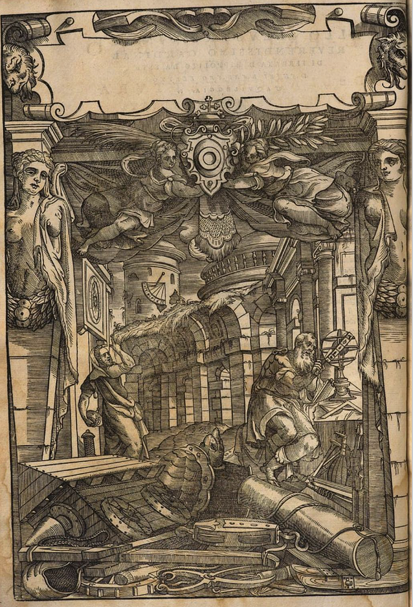
Either way, this tantalising image of Vitruvius/Barbaro suggests a symbiotic relationship between the author and translator: both are united in the search for knowledge and understanding, are authorities in the same field, and share the same professional tools – musical instruments, which are necessary for the education of architects, and a crane, pair of tongs, a pulley, a tortoise (an ancient war machine designed to fill moats to enable the breaching of city walls during sieges) and a small-scale water wheel, which are described by Vitruvius in Book X.
Moving from architecture to medicine, Nathaniel Highmore’s Corporis humani disquisitio anatomica (The Hague: Samuel Broun, 1651) (Fig. 29) offers a tantalising portrait of the translator as a reputable interpreter of ancient medicine. The book’s title page is a full-page engraving showing the flayed skin of the god Janus pinned to the facade of an archway. Three-dimensional figures of Hippocrates and Galen, fathers of medicine and anatomy respectively, occupy both sides of the archway. The ancient scientists are taking the pulse of the flayed skin, with aphorisms tattooed on the arms they are examining. The title of the work and its author are written on Janus’s skin. Below Galen a two-dimensional portrait of Highmore himself gazes at the readers to underscore his role as a crucial mediator between ancient knowledge of anatomy and his contemporaries.Footnote 59
Highmore, Nathaniel, Corporis humani disquisitio anatomica (Hanau, The Hague: Browne, Samuel, 1651), title page.
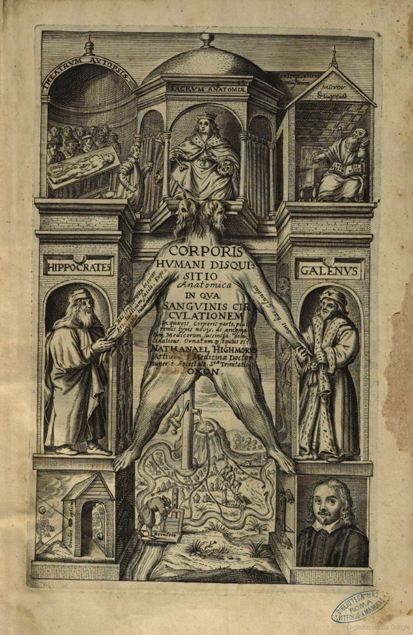
As a visually rich example of the functionality and aesthetics of prefatory materials in Renaissance printed texts, Highmore’s engraved title page organises a visual representation of his role as reliable interpreter of ancient medical knowledge: while the portraits of Galen and Hippocrates are placed above him, the title page suggests that Highmore is collaborating with the ancient physicians, sharing the same goal endorsed textually in the accompanying explicatory poem addressed to the reader. In these verses Highmore encourages the reader to ‘Stop! and pay attention to the door before you examine the house’.Footnote 60 Highmore’s address provides an essential key to the symbolic representations, metaphors, and literary references depicted in the title page. It also entices the reader to literally open the book’s gateway: ‘stop’ and ‘enter’ … ‘you have the rest inside’.Footnote 61 Images and text reinforce each other and elicit a multisensorial and dynamic experience. The image’s architectural setting – marked ‘Theatre of Dissection’ (Theatrum Autopsiae) – recalls the anatomical theatres of Padua and Leiden, sights of demonstrations of verified truths. This frontispiece enacts a fascinating hierarchy of trustworthiness: the Ancient authors (Hippocrates, Galen) embody the authority of tradition; modern experimenters (William Harvey, represented observing the circulation of blood, and Highmore himself) perform the verification of experience, and the central body, both open and sacred, visualises the union of divine design and human reason.
By placing his own image among these figures, Highmore positions himself as a trustworthy anatomist-translator whose reliability stems from reverent obedience to scientific truth.
4.2 Face Types and Type Faces
The humanist translators’ visibility and calls for the readers to stop and enter, as we have just seen with Highmore, gave an appearance of credibility and, as a result, attempted to elicit their readers’ trust. The effect of appearance mattered in Renaissance Europe. Appearance can be described as the initial ‘capital’ of the humanist translators who used their portraits and textual poses to literally stop readers from walking away from bookshops, and, instead, ‘enter’ the translated text.
As activated through the title page or frontispiece, the encounter between a reader and translator was an opportunity for the latter to convey their trustworthiness and secure credibility for future translational endeavours. The humanist translators examined in this Element felt compelled to visualise their status and reputation, just as Renaissance merchants showed by their appearance that they worked well, and were commercially successful (Fontaine, Reference Fontaine2014, 268). Printers and editors expanded the reach of the print industry and therefore required translators, more than authors, to signal their trustworthiness as mediators and interpreters of earlier texts. Translators performatively represented their trustworthiness on the first pages of their work with the aim of convincing the potential readers of their credibility, reputation, and skills. Renaissance individuals gained credibility by performing their ‘virtue, integrity, sincerity, and merit’ (Fontaine, Reference Fontaine2014, xii). This included what Belle and Guénette have described as the ‘paradox of print’: modesty and subordination to the author and patron may seem contradictory to us today, but such qualities were part of the personality of the premodern trader, ‘whose interest required that he [sic] be at the same time coldly calculative and warmly compassionate’ (Fontaine, Reference Fontaine2014, 277).
This Element has shown how the performance of trustworthiness on the printed page aimed to convince readers that the humanist translators were self-effacingly committed to ensuring the quality and relevance of their work, and, indeed, that they were eminently best placed to fill future mediatory roles. Humanist translators took great lengths to establish themselves as reputable, skilled, and modest. They did so because, like their printers, they understood that sometimes words were not enough to convince buyers to trust them. Evidently, they needed to convey more signs of trustworthiness pertaining to appearance, intellectual talent, social status, skills, and virtue, while also relying on paper quality, page layout, inks, and typeface. Economic historian Craig Muldrew quotes Puritan Reverend Richard Baxter (1615–1691) to articulate how trust functioned at the time:
Among sober persons in Civil Societies and Converse, we must in reason and charity expect some truth and honesty, and not presume them to be all lyars and deceivers, that we may seem to have allowance to be such ourselves. Indeed, we trust them not absolutely as Saints, but with a mixture of distrust, as fallible and faulty men: And so as to trust our own circumspection above their words when we know not the person to be very just.
Words might not have been sufficient, but the interplay between text and the carefully curated portraits of humanist translators crafted their trustworthiness – an orchestrated performance that underscored their skill, credibility, and indispensability in the Renaissance worlds of intellectual exchange. Their portraits and paratexts were not simply declarations of sincerity, but experiments in credibility, designed to reconcile the competing demands of trustworthiness and craft, reliability and invention.
In this light, the interplay of text and image, between face types and type faces, emerges as a site of negotiation where trustworthiness was made visible. Human faces (portraits) interact with typefaces: they are reproducible, stylised, conveying legibility and reliability. Printed type (letters) behaves like faces – expressive, capable of embodying personality, virtue, and tone. Portraits and text did not merely illustrate reliability and virtue; they enacted them, translating moral and intellectual virtues into the language of form and matter.
This Element has traced that dynamic field in which creativity and conformity coexisted: translators were empowered by the visual and textual technologies of print to reimagine their fluid agency and collaborations. The early modern page thus became a stage where trustworthiness could be performed, questioned, and remade – an arena where translators, their collaborators, and their audiences continually renegotiated the boundaries between humility and authority, imitation and originality, faith and interpretation.
Acknowledgements
As always, friends, family, and colleagues make any book possible, and this project is no exception. While serving as Associate Dean (Research), I received generous support from the Research Office team in the Faculty of Arts at the University of Melbourne, which enabled me to advance the long gestation of this Element. I am grateful to Liz Horodowich for inviting me to New Mexico State University in 2024 to discuss several of the ideas that inform this Element, and to Tim McCall for reading and commenting on an early draft. I also thank Michael Rocke for his generous hospitality in Florence, as well as for his friendship, which made research for this Element both possible and enjoyable. My thanks also go to Nick Terpstra and the Melbourne–Toronto project team for opportunities to present and discuss parts of this work at the 2025 Renaissance Society of America conference and at a workshop in Toronto later that year. I am deeply grateful to Cynthia Troup for her expert, wise, and unfailingly generous support. I also thank the series editors, Jonathan Nelson and John Henderson, assistant editor Sarah McBryde, the two anonymous reviewers, and the editorial staff at Cambridge for their careful guidance and assistance throughout the publication process. Last, and most importantly, my deepest thanks go to Oliver and Christina, whose trust was a form of avowal that gave the deepest meaning to care and support during this project.
John Henderson
Birkbeck, University of London, and Wolfson College, University of Cambridge
John Henderson is Emeritus Professor of Italian Renaissance History at Birkbeck, University of London, and Emeritus Fellow of Wolfson College, University of Cambridge. His recent publications include Florence Under Siege: Surviving Plague in an Early Modern City (2019), and Plague and the City, edited with Lukas Engelmann and Christos Lynteris (2019), and Representing Infirmity: Diseased Bodies in Renaissance Italy, edited with Fredrika Jacobs and Jonathan K. Nelson (2021). He is also the author of Piety and Charity in Late Medieval Florence (1994); The Great Pox: The French Disease in Renaissance Europe, with Jon Arrizabalaga and Roger French (1997); and The Renaissance Hospital: Healing the Body and Healing the Soul (2006). Forthcoming publications include a Cambridge Element, Representing and Experiencing the Great Pox in Renaissance Italy (2023).
Jonathan K. Nelson
Syracuse University Florence
Jonathan K. Nelson teaches Italian Renaissance Art at Syracuse University Florence and is research associate at the Harvard Kennedy School. His books include Filippino Lippi (2004, with Patrizia Zambrano); Leonardo e la reinvenzione della figura femminile (2007), The Patron’s Payoff: Conspicuous Commissions in Italian Renaissance Art (2008, with Richard J. Zeckhauser), Filippino Lippi (2022); and he co-edited Representing Infirmity. Diseased Bodies in Renaissance Italy (2021). He co-curated museum exhibitions dedicated to Michelangelo (2002), Botticelli and Filippino (2004), Robert Mapplethorpe (2009), and Marcello Guasti (2019), and two online exhibitions about Bernard Berenson (2012, 2015). Forthcoming publications include a Cambridge Element, Risks in Renaissance Art: Production, Purchase, Reception (2023).
Assistant Editor
Sarah McBryde, Birkbeck, University of London
Editorial Board
Wendy Heller, Scheide Professor of Music History, Princeton University
Giorgio Riello, Chair of Early Modern Global History, European University Institute, Florence
Ulinka Rublack, Professor of Early Modern History, St Johns College, University of Cambridge
Jane Tylus, Andrew Downey Orrick Professor of Italian and Professor of Comparative Literature, Yale University
About the Series
Timely, concise, and authoritative, Elements in the Renaissance showcases cutting-edge scholarship by both new and established academics. Designed to introduce students, researchers, and general readers to key questions in current research, the volumes take multi-disciplinary and transnational approaches to explore the conceptual, material, and cultural frameworks that structured Renaissance experience.