




Introduction
Idioms make up an essential part of all languages, and children acquire idioms as part of their linguistic repertoire (Cacciari & Levorato, Reference Cacciari and Levorato1989; Levorato et al., Reference Levorato, Roch and Nesi2007). Developmental research suggests that children as young as five semantically analyze and comprehend the literal meaning of idioms (Gibbs, Reference Gibbs1987; Hsieh & Hsu, Reference Hsieh and Hsu2010). Psycholinguists note that people’s idiom usage marks their speech style, manifests their language expressivity, and reflects their thought patterns (Gibbs, Reference Gibbs, Geeraerts and Cuyckens2010). Notably, in Chinese, proficiency in idioms (chengyu) is considered a sign of scholarly knowledge and linguistic competence (Liu & Cheung, Reference Liu and Cheung2014; Xie et al., Reference Xie, Fang, Wu and Nguyen2022). Despite the attention to idioms in philology, psycholinguistics and experimental psychology, we know little about how children are exposed to idioms in natural discourse, nor the associations between such exposure and child language development. In this study, we extend the psycholinguistic understanding of idiom usage to the domain of child language development, drawing upon the principle of social-interactionist theory (Snow, Reference Snow1977; Vygotsky, Reference Vygotsky1978). This theory posits that children develop language through interaction with knowledgeable others, emphasizing language interactions and parental language as critical fodder in child language development. Thus, this study examines the relationships between features of mother-child interactions and children’s language development, with a specific focus on mothers’ idiom usage.
Idioms and child language
Idioms, such as 若有所思 ‘lost in thought’, are conventionalized phrases that often have meaning beyond each word combined. They are rich in meaning and expressive in nature. Both contemporary dictionaries and corpus studies suggest that idioms are ubiquitous and naturally occurring (Erman & Warren, Reference Erman and Warren2000; Gibbs, Reference Gibbs, Geeraerts and Cuyckens2010). Apart from pervasiveness, idioms have a peculiar stand in language. On the one hand, they are part of the lexicon, obtained through word-learning mechanisms (Di Sciullo & Williams, Reference Di Sciullo and Williams1987). On the other hand, they employ multi-word sequences that often require syntactic understanding (Liu & Cheung, Reference Liu and Cheung2014). To understand how learners process the distinctive features, a robust body of research has focused on idiom comprehension and identified the factors that affect idiomatic understanding: age (Cacciari & Levorato, Reference Cacciari and Levorato1989; Gibbs, Reference Gibbs1987), transparency (or analyzability; Gibbs et al., Reference Gibbs, Nayak and Cutting1989; Liu & Cheung, Reference Liu and Cheung2014), familiarity (Hsieh & Hsu, Reference Hsieh and Hsu2010; Nippold & Taylor, Reference Nippold and Taylor2002), and context (Cacciari & Levorato, Reference Cacciari and Levorato1989; Hsieh & Hsu, Reference Hsieh and Hsu2010). Namely, children develop their knowledge of idioms over time, and idioms that are transparent (semantically analyzable), familiar, and supported by rich context are better understood.
Furthermore, previous studies have shown associations between children’s knowledge of idioms and their language and literacy skills (e.g., Cain et al., Reference Cain, Oakhill and Lemmon2005; Levorato et al., Reference Levorato, Roch and Nesi2007; Nippold et al., Reference Nippold, Moran and Schwarz2001; Smith, Reference Smith, Christison and Saville2020; Xie et al., Reference Xie, Fang, Wu and Nguyen2022). For example, Levorato et al. (Reference Levorato, Roch and Nesi2007) examined a group of 6-year-old Italian-speaking first graders’ idiom comprehension and text comprehension and found that children with better text comprehension exhibited better idiom comprehension, and this correlation was maintained eight months later. They speculated that the inferential process could serve as a determining factor when navigating across sentences in a text and distinguishing between the literal and figurative meaning of idioms (Levorato et al., Reference Levorato, Roch and Nesi2007). More recently, Smith (Reference Smith, Christison and Saville2020) conducted a study comparing 7-to-10-year-old English monolingual and bilingual children, revealing a significant relationship between their idiom knowledge and reading ability. She proposed that this relationship could be attributed to shared factors, such as general vocabulary and exposure to written text. While the underlying mechanism remains underexplored, these studies highlight the associations between children’s idiom knowledge and their language and literacy skills, underscoring the importance of idiom knowledge in child language development.
Chinese idioms, also known as chengyu, are idiomatic expressions that are notable in several linguistic and cultural features. First, the great majority of Chinese idioms have a fixed form of four characters (i.e., four-syllable and four-morpheme; Liu & Cheung, Reference Liu and Cheung2014), making them condensed in meaning, compact in structure, and prominent when used in discourse (Wu, Reference Wu1995). Second, Chinese idioms are rooted in historical allusions and classic literature. In fact, many scholars exclude idioms formed in contemporary times from being classified as Chinese idioms, and argue that a strict criterion for delimiting Chinese idioms from other idioms is their origin in ancient and classical literature (Wu, Reference Wu1995; Xu, Reference Xu1997). Last but not least, because of their historical and literary roots and their ubiquity in the oral and written language, Chinese idioms mark users’ language proficiency and education level (Liu & Cheung, Reference Liu and Cheung2014; Xie et al., Reference Xie, Fang, Wu and Nguyen2022). Studies on Chinese idioms extend beyond their cultural and literary significance, revealing connections with broader language skills. For instance, Xie et al. (Reference Xie, Fang, Wu and Nguyen2022) conducted a two-year three-wave cross-lagged study looking into third-graders’ compound awareness and idiom comprehension. They found that students’ ability to identify and combine morphemes appropriately predicted their idiom comprehension, and reciprocally, their idiom comprehension also predicted compound awareness (Xie et al., Reference Xie, Fang, Wu and Nguyen2022).
While these studies shed light on the significance of idioms in the language development of school-age children, we have limited knowledge of these processes in early childhood. As Nippold and Taylor (Reference Nippold and Taylor2002, p. 384) stated, “idiom understanding begins in early childhood and gradually improves throughout the school-age years, adolescence, and well into adulthood.” Exploring the early idiom exposure in pre-literate children is necessary for a deeper understanding of children’s later idiom knowledge and language and literacy development. Moreover, most of the aforementioned idiom studies were conducted in experimental settings; observational studies on how children are exposed to idioms are sparse. A few exceptions were conducted in school settings (Kerbel & Grunwell, Reference Kerbel and Grunwell1997; Lazar et al., Reference Lazar, Warr-Leeper, Nicholson and Johnson1989; Liang, Reference Liang2012; Nippold, Reference Nippold1991). For example, Kerbel and Grunwell (Reference Kerbel and Grunwell1997) videotaped 11 primary school teachers and found they frequently used idioms while teaching. Liang (Reference Liang2012) counted the instances of idioms in Chinese textbooks, where she discovered that idioms appeared in the textbook starting from Grade 1 and became more frequent and integrated into text reading activities by Grade 3. In addition to observational studies, practitioners reported on idiom-related activities in preschool settings and shared anecdotal evidence that preschoolers were exposed to idioms at home (e.g., Wang, Reference Wang2018). Nonetheless, to our knowledge, no studies have yet looked into parental idiom usage with preschool-age children in home settings.
Shared book reading and child vocabulary development
Within the realm of natural home activities, we chose to focus on shared book reading. Parent-child shared book reading offers important benefits for children’s overall development (for a review, see Grøver et al., Reference Grøver, Snow, Evans and Strømme2023), and is a commonly practiced literacy activity at home in both Western and Eastern contexts (For reviews, see Chang & Liu, Reference Chang and Liu2011; Dowdall et al., Reference Dowdall, Melendez-Torres, Murray, Gardner, Hartford and Cooper2020). Compared to other home settings, such as free play and meal time, children were more likely to be exposed to diverse vocabulary and complex syntax in shared reading (Weizman & Snow, Reference Weizman and Snow2001), regardless of sharing a book with or without text (Noble et al., Reference Noble, Cameron-Faulkner and Lieven2018). This literary nature of shared book reading aligns with the literary origin of Chinese idioms. Besides, in the Chinese context, book reading is often regarded as a valuable teaching opportunity, with parents taking the lead during the interaction (for reviews, see Chang & Liu, Reference Chang and Liu2011; R. Luo et al., Reference Luo, Tamis-LeMonda and Song2013). As a result, while there is limited empirical research on idiom usage in home environments, we found practitioner reports and general guidelines in Chinese early children education that recommend parents expose their children to idioms through shared reading at home as it is a fun activity to learn language and culture (e.g., Duan, Reference Duan2023).
Vocabulary knowledge is a proxy for children’s early oral language skills and a predictor of later literacy skills (Lervåg & Grøver Aukrust, Reference Lervåg and Grøver Aukrust2010). Numerous empirical studies have investigated the relations between child vocabulary skills and shared book reading, suggesting shared book reading as an effective way to enhance children’s early vocabulary skills, both for monolingual (Mol et al., Reference Mol, Bus, de Jong and Smeets2008) and bilingual children (Fitton et al., Reference Fitton, McIlraith and Wood2018), in both Western and Eastern context (e.g., S. Chen et al., Reference Chen, Lawrence, Zhou, Min and Snow2018). It is well documented that children acquire vocabulary through various processes during shared book reading, which we summarized as explicit and implicit word learning.
In the context of explicit word learning, when encountering words and concepts that might be novel for children during shared book reading, parents employ different strategies to facilitate their word learning. These strategies include labeling, simply naming the words, as well as engaging in more elaborate discussions and explanations, such as providing definitions, synonyms, and establishing connections with pictures or real-life examples (Evans et al., Reference Evans, Reynolds, Shaw and Pursoo2011; Korat et al., Reference Korat, Segal-Drori and Spielberg2018). Many intervention studies on shared book reading reported improvement in targeted vocabulary, suggesting the effectiveness of teaching word meaning during shared book reading (Dowdall et al., Reference Dowdall, Melendez-Torres, Murray, Gardner, Hartford and Cooper2020). However, observational studies have shown that most novel words during shared book reading are used without explanation or discussion (Evans et al., Reference Evans, Reynolds, Shaw and Pursoo2011; Korat et al., Reference Korat, Segal-Drori and Spielberg2018).
While parents may not provide explicit definitions or explanations, children can pick up an implicit meaning of unfamiliar words as they navigate the context. Shared book reading offers rich opportunities for children and parents to engage in conversations and abstract talk, such as inferring, predicting, and reasoning (Hammett-Price et al., Reference Hammett-Price, Van Kleeck and Huberty2009). These interactions during shared book reading are embedded in meaningful contexts (e.g., a story or a specific topic), enhancing children’s language comprehension and vocabulary learning (Mol et al., Reference Mol, Bus, de Jong and Smeets2008). Accordingly, many studies demonstrate that the quantity and the quality of the parental language input, such as the amount of talk (Hart & Risley, Reference Hart and Risley1995), lexical diversity (Weizman & Snow, Reference Weizman and Snow2001), syntactic complexity (Anderson et al., Reference Anderson, Graham, Prime, Jenkins and Madigan2021), and abstract talk (Hammett-Price et al., Reference Hammett-Price, Van Kleeck and Huberty2009), as well as the degree of child participation in the conversation (Grøver et al., Reference Grøver, Snow, Evans and Strømme2023), are associated with child vocabulary skills.
Therefore, in aiming to investigate maternal idiom usage within natural discourse, and its associations to child vocabulary, this study also incorporates various maternal talk features (i.e., talk amount, lexical diversity, and syntactic complexity) as well as an interaction index (i.e., degree of child participation). The rationale for the inclusion is twofold. Firstly, these talk features are well-documented for their crucial role in facilitating child vocabulary development (Anderson et al., Reference Anderson, Graham, Prime, Jenkins and Madigan2021; Rowe, Reference Rowe2012; Rowe & Snow, Reference Rowe and Snow2020). By examining their relationship with maternal idiom usage, we intend to gain deeper insights into how idioms are employed within maternal language, in comparison with other features. Secondly, considering maternal idiom usage as only one component of broader talk features, including a range of other components enables a more comprehensive exploration of mother-child shared book reading and its contribution to child vocabulary development.
The present study
This exploratory study examined idiom usage as a maternal talk feature in a naturally occurring home setting – shared book reading. Our sample was drawn from Chinese children in Norway. Currently, over 13,000 Chinese people live in Norway (Statistics Norway, 2023). Many came to Norway for professional reasons, either for study or work, classifying them as a notably resourceful immigrant group (Yang et al., Reference Yang, Lawrence and Grøver2023). This highly educated immigration group resembles many recent Chinese immigrant populations in other countries (Curdt-Christiansen, Reference Curdt-Christiansen2009; Echeverria-Estrada & Batalova, Reference Echeverria-Estrada and Batalova2020). In our study, we observed 33 Chinese preschoolers in Norway engaged in shared reading with their mothers at the onset of the study, and we assessed their receptive and expressive vocabulary skills in Chinese three times over a year. Previous studies on idioms primarily had an experimental design, and the few exceptions documented the frequency of idiom occurrence in the school context; little is known about the frequency or context in which idioms spontaneously appear in children’s homes (Reuterskiöld & Van Lancker Sidtis, Reference Reuterskiöld and Van Lancker Sidtis2013). Thus, this study had three goals. First, we examined the frequency of maternal idiom usage, and whether they were explicitly taught during shared book reading. Second, we explored the relationship between maternal idiom usage and other linguistic and interactional features during shared book reading. Third, we aimed to examine the relationship between maternal idiom usage and children’s Chinese vocabulary development. In line with social-interactionist theory, we hypothesized that children with mothers who used more idioms would exhibit greater vocabulary growth over time. The research questions were addressed as follows:
-
1. With what frequency and in what ways do mothers use idioms during shared book reading?
-
2. What is the relationship between mother’s idiom usage and other talk features during shared book reading, including maternal talk amount, diversity, complexity, as well as the degree of interactivity?
-
3. Does Chinese mothers’ idiom usage during shared book reading predict children’s Chinese vocabulary skills growth across one year?
Methods
Sample
Thirty-three bilingual children (21 girls and 12 boys) and their mothers participated in the study. The children’s mean age at the onset of the study was 50 (range 36–65) months. All the children were born in Norway and attended Norwegian preschools from the mean age of 17 (range 10–30) months. Twenty-four of the children were from Chinese–Chinese families where both parents spoke Chinese to the child, and nine children came from transnational families where the father spoke Norwegian and the mother spoke Chinese to the child.
We approached our sample through Chinese communities in two major cities in Norway, using social media (i.e., WeChat and Facebook) and snowball sampling. The recruitment information was in Chinese, ensuring participating mothers were native Chinese speakers. The sample included two sets of siblings, so we had 31 mothers in total. On average, these mothers were 35 (range 31–43) years old and had been in Norway for over nine (range 2–18) years. The vast majority were highly educated: only one mother (3%) had high school education (12 years of education), nine mothers (27%) had a university bachelor’s degree (16 years), 15 mothers (45%) had a master’s degree (18 years), and eight mothers (24%) had a doctoral degree (22 years).
Materials
We used a wordless picture book for the mother-child shared reading. The reason was twofold. First, without the support of text, wordless picture books encourage spontaneous and everyday maternal talk. Second, compared to books with text, wordless books elicit more parent-child interactions (Petrie et al., Reference Petrie, Mayr, Zhao and Montanari2021). We chose the book I Walk with Vanessa: A Story about a Simple Act of Kindness by Kerascoët. It was about a girl named Vanessa who was bullied on her first day at a new school. A classmate witnessed what happened and decided to help Vanessa by walking with her, and they became friends. The book (i.e., the title, tagline, blurb, etc.) was translated and published in Chinese a year prior to the study, and none of the mothers in the sample had read it before. Although the book was also available in Norway, it was in English, making it unlikely that children had encountered it at preschools.
Procedure and measures
We visited the families three times in one year. At the first visit, we informed the mothers that the study was to investigate how mothers and children usually shared reading. They signed a written consent form and answered a questionnaire on demographic information and the home literacy environment, such as books at home and frequency of shared book reading. For the shared reading, we asked the mother to read the wordless picture book with the child as they normally would. To ensure naturalistic observations, we instructed the mothers to record the reading by themselves and to upload the audio through an encrypted mobile application. All mothers uploaded the recording within two weeks after the first visit. At each visit, a Chinese-speaking researcher (the first author) assessed the child’s Chinese vocabulary skills. We collected three waves of longitudinal data to fit multilevel models for child vocabulary growth (Singer & Willett, Reference Singer and Willett2003).
Maternal talk measures
The audiotapes of the mother-child shared book readings were transcribed verbatim, adhering to the transcription conventions of the Child Language Data Exchange System (CHILDES; MacWhinney, Reference MacWhinney2000). The utterance unit was delimited by the change of intonation or customary pause. The word unit was segmented based on the Chinese lexicon in the MOR program. Note that these dual language learners and their mothers had occasional code-switching. On average, 0.3% (SD = 0.005) of the total words by mothers were in Norwegian, while 6.5% (SD= 0.121) of the total words by children were in Norwegian. The total Norwegian words used were marginal (1.3%).
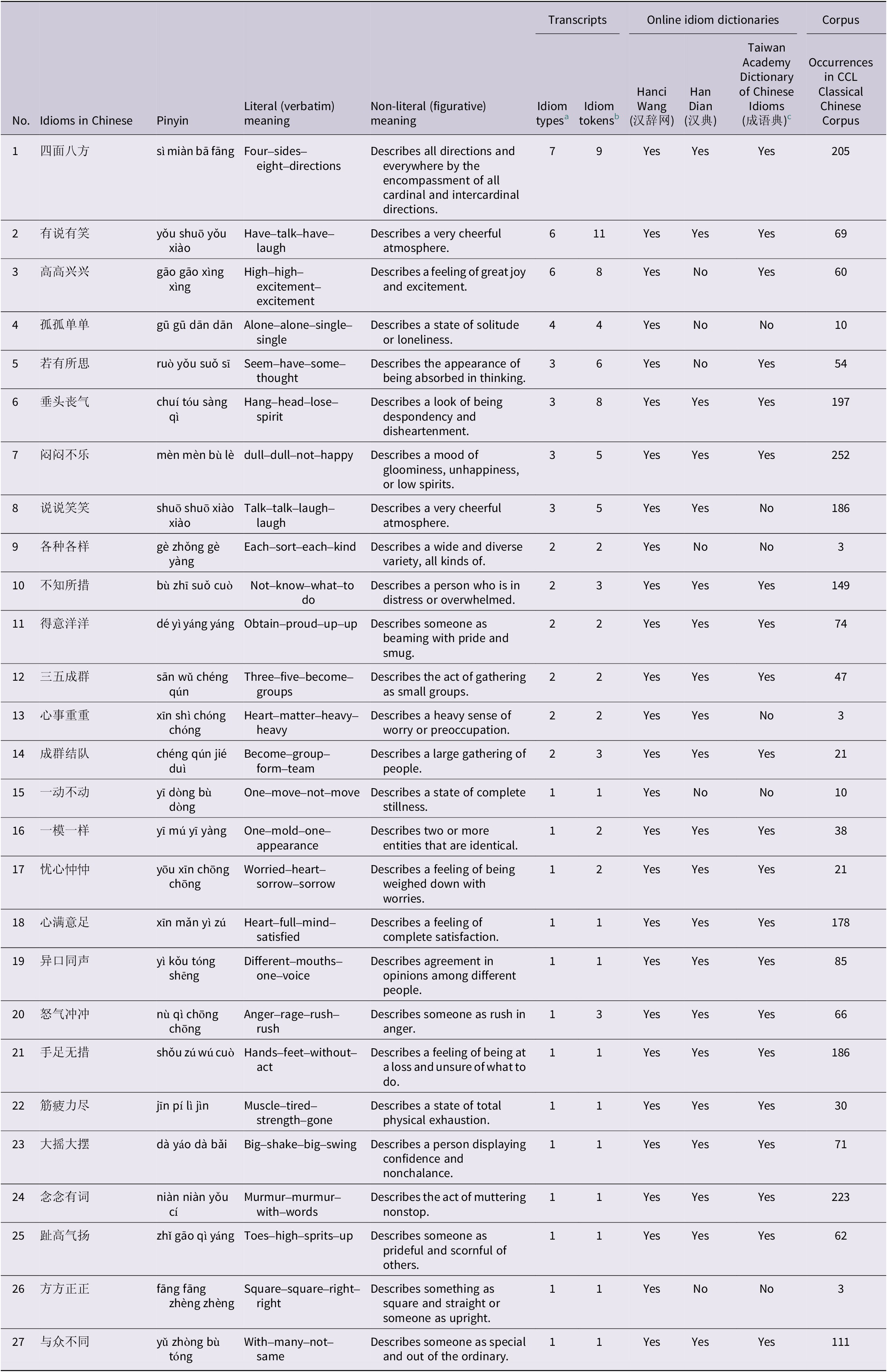
Since Chinese idioms were identified as word units in the program, we hand-coded occurrences of Chinese idioms. First, we handpicked all four-character phrases from the transcripts. Next, since there is no single exhaustive dictionary of Chinese idioms (Xu, Reference Xu1997), we checked three different online dictionaries and included those that appeared in at least one idiom dictionary. Then, we followed the strict delimitation of Chinese idioms reviewed in the introduction by testing the historical origins of these phrases in the Center for Chinese Linguistics (CCL) Corpus of Chinese Texts (Zhan et al., Reference Zhan, Guo, Chang, Chen and Chen2003). If a four-character phrase has entries in classical Chinese literature, we categorized it as a Chinese idiom. Note that two children in the observations used Chinese idioms; one used an idiom initiatively, and another repeated an idiom the mother used. So, we removed the one Chinese idiom that was used by the child initiatively for the focus of maternal idiom usage. Ultimately, we identified 27 Chinese idioms that mothers used in the shared book reading (see Table 1 and see supplementary materials for the list of excluded phrases). Given the low frequency of the idioms and the variation across transcripts, an interrater reliability check was conducted on a 40% randomly selected subset of the transcripts. The agreement among raters in identifying Chinese idioms was .84 (Cohen’s κ).
A list of Chinese idioms in the transcripts and overview
Note:
a “Idiom types” refers to the occurrences of the idiom across transcripts, namely, the number of mothers that use the idiom;
b “Idiom tokens” refers to the total occurrences of the idiom in all transcripts.
c idioms are represented in traditional characters in the Taiwan Academy Dictionary of Chinese Idioms, but for consistency, they are in simplified characters in the table; CCL is Center for Chinese Linguistics.
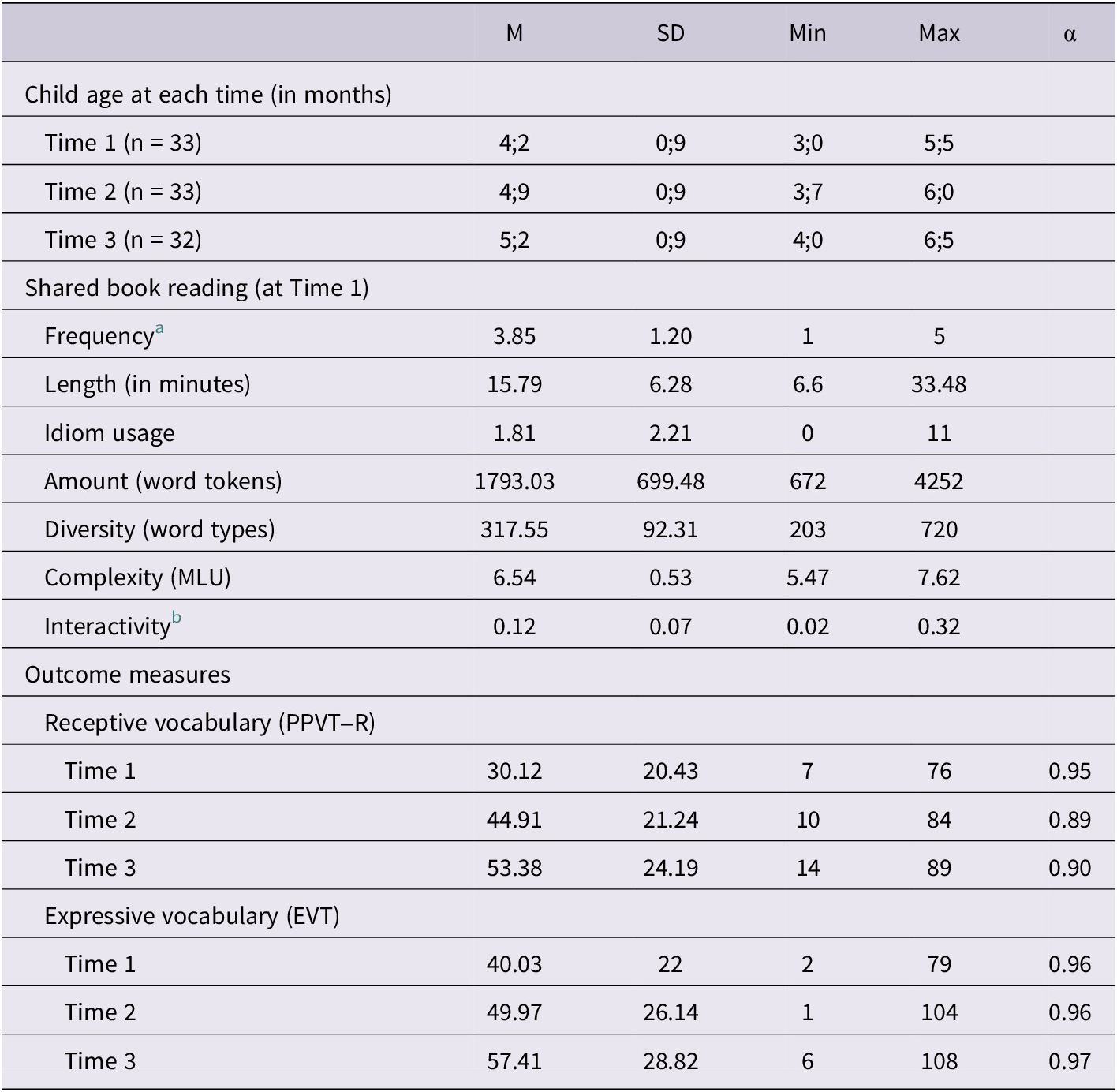
For the talk features, talk amount, lexical diversity, syntactic complexity, and the degree of interactivity, we used the KIDEVAL command in Computerized Child Language Analysis (CLAN; MacWhinney, Reference MacWhinney2000) to extract the relevant data. Maternal talk amount was measured by the total number of words (word tokens) the mother produced. Maternal lexical diversity was their total number of different words (word types). Maternal syntactic complexity was measured by the mean length of utterance in words. The interactivity of the shared book reading was represented by the ratio between the total words produced by the child and the total words produced by the dyad.
Child’s Chinese vocabulary skills
We assessed the child’s receptive vocabulary skills in Chinese using the Peabody Picture Vocabulary Test-Revised (PPVT-R; Dunn & Dunn, Reference Dunn and Dunn1981), translated and validated in Taiwan (Lu & Liu, Reference Lu and Liu1998). In the PPVT-R, the child was presented with a series of pictures and asked to point one out of four pictures corresponding to what the assessor (the first author) read out. Their expressive vocabulary was assessed by the Expressive Vocabulary Test (EVT; Williams, Reference Williams1997), which was translated and used in previous studies of Chinese dual language learners (e.g., S. Chen et al., Reference Chen, Lawrence, Zhou, Min and Snow2018). In the EVT, the child named the picture shown one at a time. We followed the EVT manual (Williams, Reference Williams1997) and accepted synonym items as correct alternatives. We used standard instructions, stop rules, and scoring manuals in both tests. Since our targeted children were dual language learners, we did not apply the start rule but started from the beginning for all children. The tests lasted from 10 to 30 minutes. Cronbach’s alpha reliabilities of the tests were excellent (see Table 2).
Descriptive statistics of child age, outcome measures, and maternal talk features during shared book reading
Note: All the outcome measures are presented in raw scores.
a Frequency of shared book reading ranging from 1 = Less than once a week; 2 = One or two times a week; 3 = Three or four times a week; 4 = Five or Six times a week; 5 = Every day.
b Interactivity is the ratio of the child’s word tokens and the total word tokens by dyad.
The data collection was conducted from fall 2020 to fall 2021. Due to the COVID-19 pandemic, most visits were outdoors (i.e., balcony, house yard, or a nearby park or playground), while we guaranteed a quiet and comfortable environment for the child. The second data collection was postponed due to the national rules for infection control; therefore, on average, there was a seven-month interval between the first and second data collection, and a five-month interval between the second and third data collection. The attrition rate was low; one child missed the last visit because of a trip to China. The dyads received a gift card worth NOK 200 (approx. USD 20), and the child got the book they read for their participation. All the data collection and processing complied with the Personal Data Registers Act and was approved by the Norwegian Centre for Research Data AS.
Data analysis
For the first research question, we referred to Evans et al. (Reference Evans, Reynolds, Shaw and Pursoo2011) and coded the conversational context of idiom instances. We counted the idiom type as the frequency of unique idioms used since mothers usually reiterate the idioms or use them for explanation immediately. After reading the transcripts multiple times, we categorized the mothers’ manner of referring to the idioms into three groups: (A) the mother asked if the child knew the meaning, (B) the mother provided the meaning, and (C) the mother reiterated the idiom or moved on without any discussion. For idioms explained (i.e., A and B), we further categorized the strategy that mothers used for the explanation into three groups: (a) the mother provided a synonym, (b) the mother provided a definition, and (c) the mother linked the idiom to information in the picture.
For the second research question, we consulted a zero-order correlation matrix to examine the relationship between maternal idiom usage and other talk features during shared book reading. Additionally, we included demographic variables in the table to demonstrate overall relationships among the variables and to identify the potential control variables for later analyses.
For the third research question, we applied individual growth modeling to the three waves of data to model the change in the children’s Chinese vocabulary skills (for details, see the Appendix). Individual growth models analyze both within-individual and between-individual change, allowing us to identify variables that predict differences among children in their vocabulary growth (Singer & Willett, Reference Singer and Willett2003). The exploratory analyses of empirical growth plots and fitting data with linear and quadratic specifications suggested that a linear growth curve was appropriate. We re-centered the time variable to the onset of the study, so that time indicates the number of months that have elapsed since the first wave of data collection. Because of the small sample size, we used restricted maximum likelihood estimation (RML) for all models (Bryk & Raudenbush, Reference Bryk and Raudenbush2002). The model fit was assessed by the deviance statistics (-2 log-likelihood, or -2LL). Nonetheless, since we applied RML to fit the model, the deviance statistics can only be tested for variance components; we also included AIC and BIC statistics for reference (Morrell et al., Reference Morrell, Brant and Ferrucci2009; Singer & Willett, Reference Singer and Willett2003).
We followed the guidelines of Singer and Willett (Reference Singer and Willett2003, pp. 105–106) for developing a taxonomy of fitted models. The model building involved the following steps. First, we fit the unconditional means model and unconditional growth model. Next, we added the key predictor, maternal idiom usage, in the model and tested its effect on both the initial status and rate of change. Then, we fit secondary models by iteratively entering demographics variables as controls for the initial status and rate of change to enhance the generalizability of the finding. We compared the model fit and assessed significance levels at each step to arrive at the final fitted model. All analyses were conducted in STATA.
Results
Research question 1. With what frequency and in what ways do mothers use idioms during shared book reading?
In the 33 observations, 22 mothers collectively used 27 idioms, a total of 60 times. While shared reading the same wordless picture book, 33% of mothers (n = 11) did not use idioms, 15% (n = 5) used one idiom, 27% (n = 9) used two idioms, 18% (n = 6) used three or four idioms, and 6% (n = 2) used five or more idioms; thus, on average, the mothers used 1.81 (SD = 2.21) idioms (see Table 2). Table 3 displays the categories of mothers’ strategies for explaining the meaning of idioms with examples. We found that no child asked for the meaning of the idiom, and two-thirds of idioms (n = 41) occurred without any explanation. For the other one-third of idioms, the mother always initiated the discussion. In one occurrence, a mother asked if the child knew the meaning (see the second example in Table 3), while in the other occurrences (n = 18), mothers provided the meaning of the idiom to the child. Their most common approach for the explanation was to offer a synonymy along with the idiom (n = 13). Only a few mothers gave a full definition (n = 3) or linked the meaning of the idiom to the picture in the book (n = 3). It is worth noting from the examples that the mothers contributed to most of the conversations when discussing idioms. This high degree of the mother talking corresponds to the low interactivity rate of mother-child shared book reading as shown in Table 2.
Categories of mothers’ explanations of idioms with examples
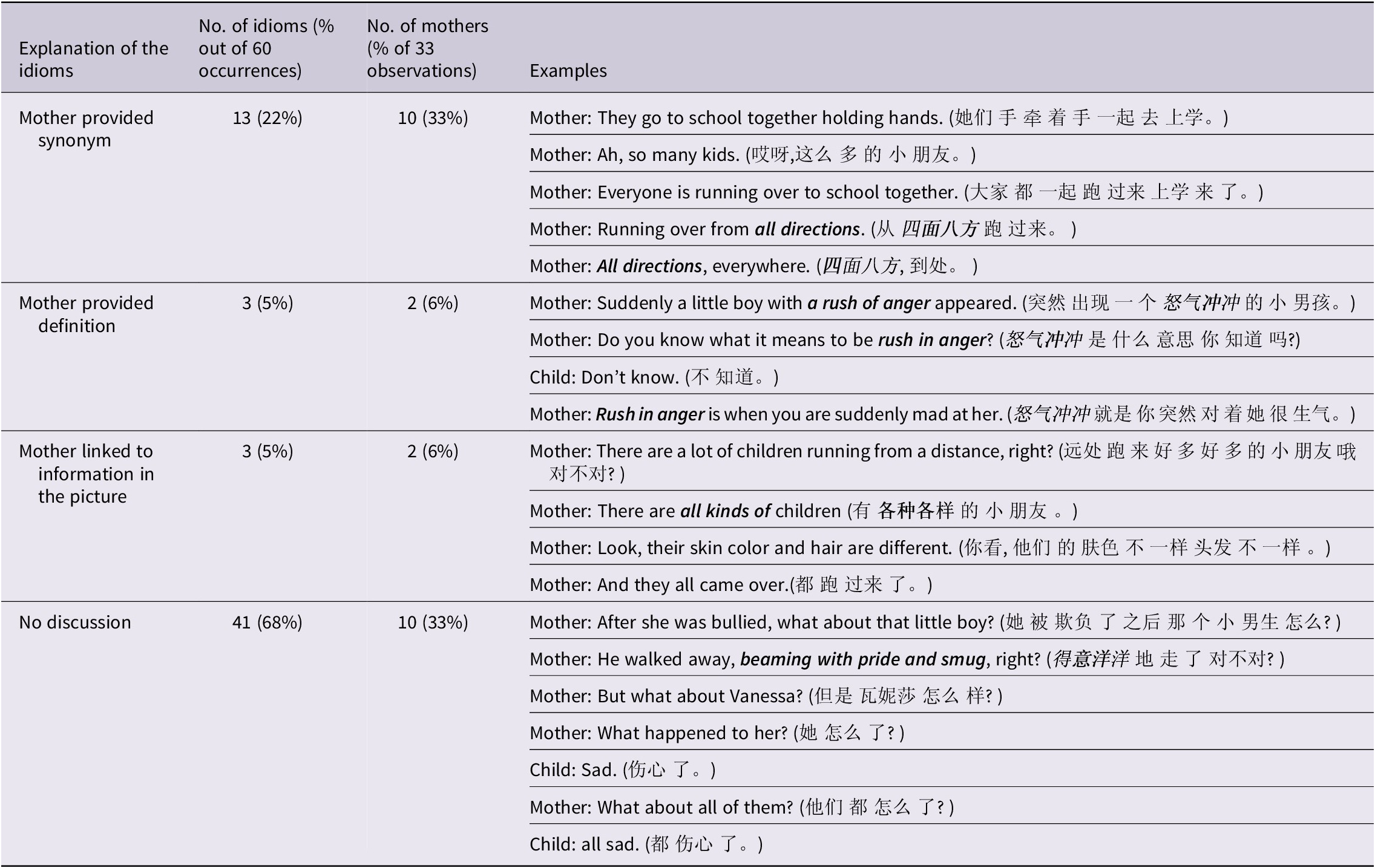
Note: Idioms are in bold and italics.
Research question 2. What is the relationship between maternal idiom usage and other talk features during shared book reading, including maternal talk amount, lexical diversity, syntactic complexity, as well as the degree of interactivity?
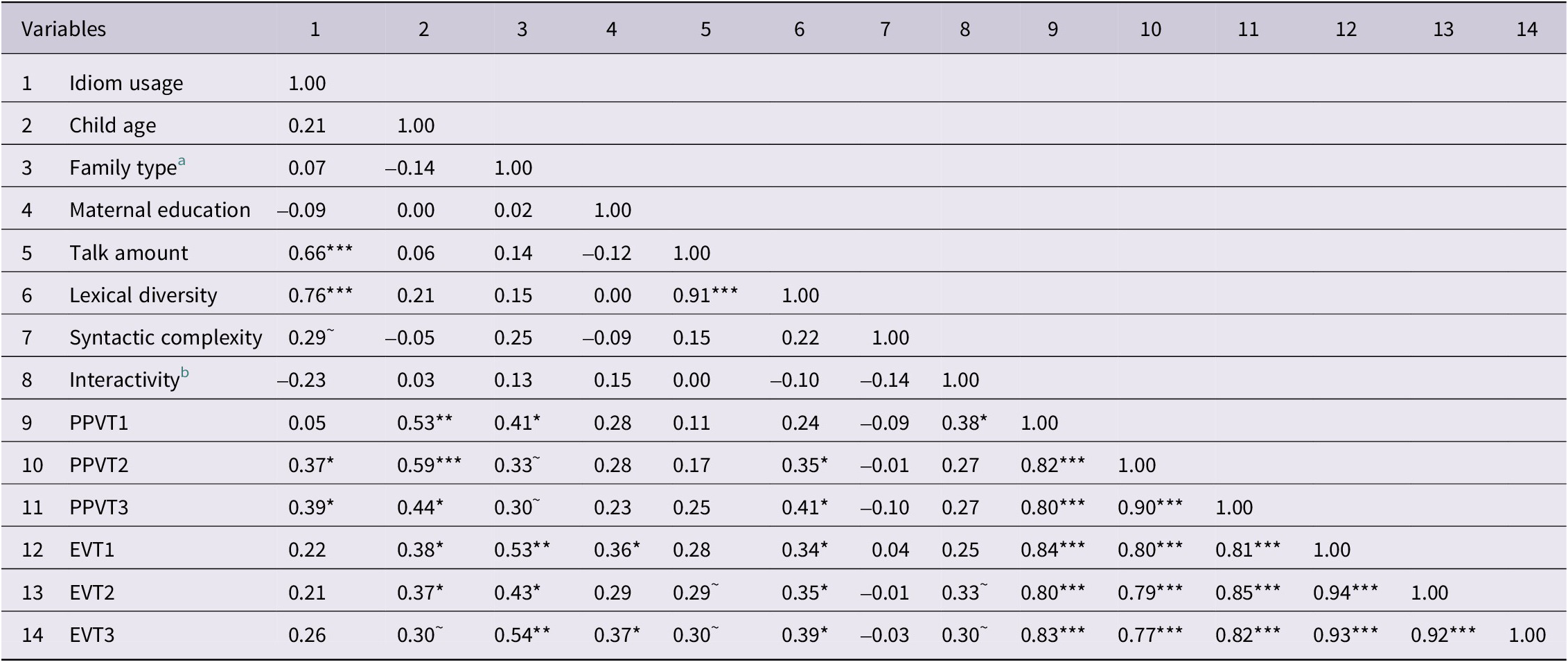
Table 4 presents the correlations between demographics, maternal talk features and child vocabulary skills. Idiom usage was highly correlated with talk amount and lexical diversity (r = .66 and .76, p < .001), indicating that mothers who used more idioms were also more talkative and used more diverse words. Idiom usage and syntactic complexity showed a marginal correlation (r = .29, p < .10), suggesting that mothers who used more idioms tended to be the ones who produced longer sentences. While the correlations between idiom usage and interactivity were not significant (r = −.23, p > .05), its direction suggested that mothers who used more idioms had children who spoke less. Further, as shown in the correlation matrix, child vocabulary skills in Chinese were associated with child age, family type (i.e., the child has one or both parents speaking Chinese), and maternal education, so we included these as control variables.
Zero order correlation matrix of maternal idiom usage, demographics, other talk features during shared book reading, and child vocabulary skills
Note: ~p<.10,* p<.05, ** p<.01, *** p<.001;
a Chinese-Chinese families coded as 1 in family type;
b Interactivity is the ratio of the child’s word tokens and the total word tokens by dyad.
Research question 3. Does Chinese mothers’ idiom usage during shared book reading predict children’s vocabulary skills growth across one year?
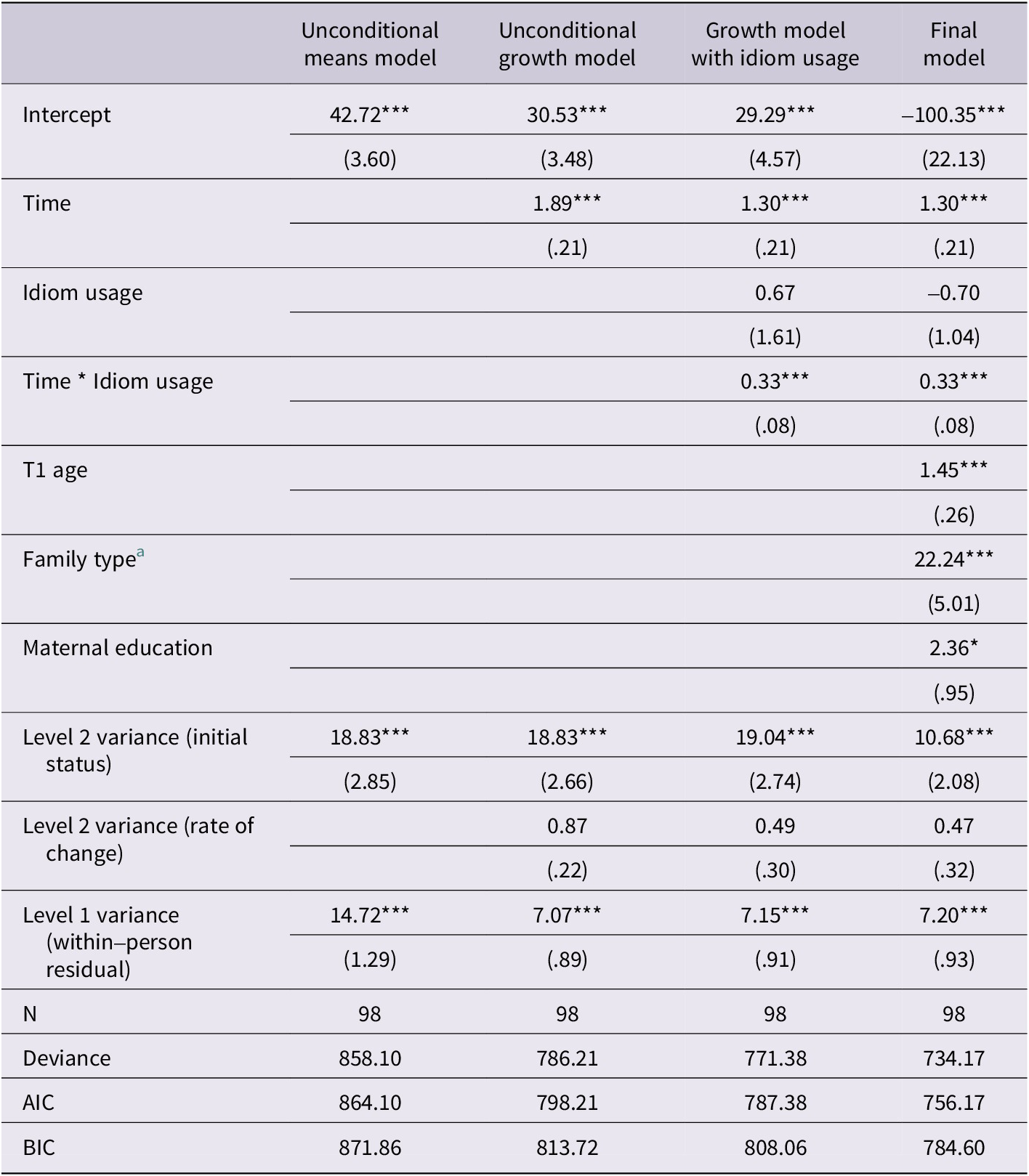
We fit a series of multilevel models predicting children’s Chinese receptive vocabulary (PPVT-R) across one year (see Table 5). In the unconditional means model (first column) and the unconditional growth model (second column), the relatively high variance in both level 2 and level 1 implies that the children differed from each other in their baseline receptive vocabulary, and their receptive vocabulary varied over time. The parameter estimate associated with idiom usage (in the third model) indicates that the idiom usage did not explain children’s baseline receptive vocabulary, but it predicted children’s receptive vocabulary growth across the year. After introducing the demographic variables, the model fit of AIC and BIC statistics suggests the Final model (last column) in Table 5 to answer the research question. As seen in the Final model, on average, the children gained 1.30 points every month since the start of the study (p < .001). The number of Chinese idioms the mothers used predicted the children’s receptive vocabulary growth over one year: for every idiom the mothers used, the children gained 0.33 points by month in their PPVT-R scores ( $ p<.001 $
). The children who were older at the onset of the study (
$ p<.001 $
). The children who were older at the onset of the study ( $ {\gamma}_{03}=1.45, $
p < .001), whose parents were both Chinese (
$ {\gamma}_{03}=1.45, $
p < .001), whose parents were both Chinese ( $ {\gamma}_{04}=22.24, $
p < .001), and whose mothers were more educated (
$ {\gamma}_{04}=22.24, $
p < .001), and whose mothers were more educated ( $ {\gamma}_{05}=2.36, $
p < .05) scored higher in Chinese receptive vocabulary at the onset of the study.
$ {\gamma}_{05}=2.36, $
p < .05) scored higher in Chinese receptive vocabulary at the onset of the study.
A taxonomy of multilevel models for change predicting children’s Chinese receptive vocabulary (PPVT-R) across three-time data collection
Note: SE in parentheses; * p<.05, ** p<.01, *** p<.001;
a Chinese-Chinese families coded as 1 in family type.
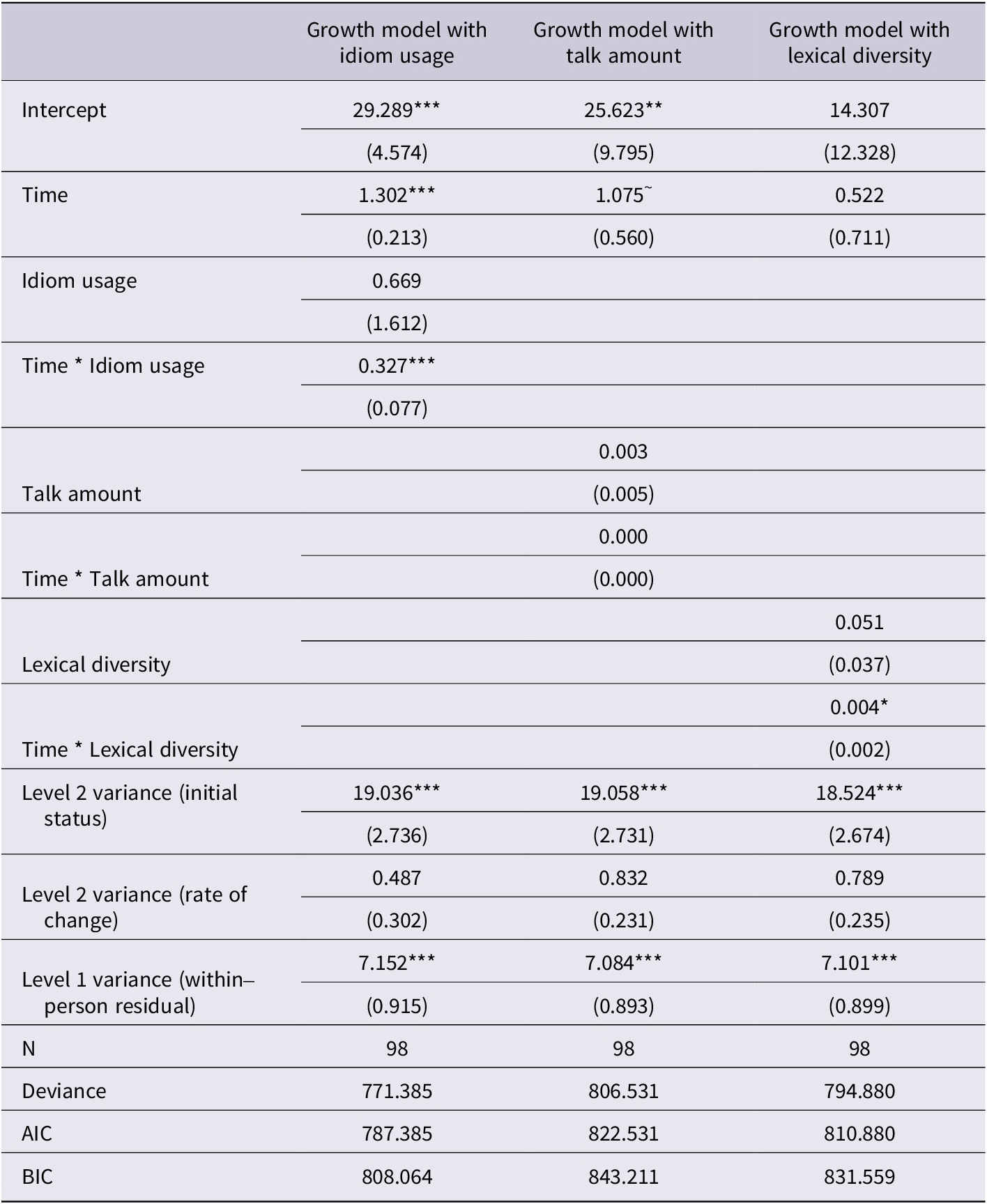
Given that maternal idiom usage was highly correlated with maternal lexical diversity and talk amount – features established to assess support in child language learning – we fit the growth model with these variables, respectively, for comparison with the model including idiom usage (see Table 6). The results showed that maternal talk amount was not a significant predictor while maternal lexical diversity significantly predicted receptive vocabulary growth. However, the model fit (−2LL = 794.880) was not as good as the one with maternal idiom usage (−2LL = 771.385), implying that idiom usage has greater relevance in child vocabulary growth than lexical diversity.
A taxonomy of multilevel models: comparing growth model with idiom usage, talk amount, and lexical diversity
Note: SE in parentheses; ~p <0.10, * p<0.05, ** p<0.01, *** p<0.001.
Similarly, we fit a series of multilevel models predicting children’s Chinese expressive vocabulary (EVT) across one year (for models, see supplementary materials). Idiom usage was neither predictive for children’s expressive vocabulary at the onset of the study nor for growth over time.
Figure 1 depicts a spaghetti plot of children’s PPVT-R scores over one year. Each line plot represents a child’s trajectory in Chinese receptive vocabulary; children represented by blue lines have mothers who used two or more idioms, while children represented by red lines have mothers who used less than two idioms. The thick lines are the mean for each group. From the thick lines, we can see that the average PPVT score at the onset of the study (i.e., the intercept) was comparable, while children whose mothers used more idioms in the shared book reading had greater growth on average (i.e., steeper slope).Footnote 1
Spaghetti plot of children’s Chinese receptive vocabulary (PPVT-R raw scores) across one year.

We conducted a series of robustness tests to check the results of the third research question: does Chinese mothers’ idiom usage during shared book reading predict children’s vocabulary skills growth? First, mothers in the sample varied considerably in the number of idioms they used. We questioned whether the high-idiom-use mothers unduly influenced the findings, so we dropped the 6% of mothers who used five or more idioms and reran the analyses. Second, the children are heterogeneous, particularly from different family types: Chinese–Chinese and transnational families. Even though we controlled for family type in the model, we worried the sheer difference in their language environment and development could be overlooked. Therefore, we ran the test within the two family types, respectively. Third, we adopted a strict delimitation of idioms, which excluded contemporary-formed idioms and those misspoken, possibly due to mothers’ performance errors. To see if the delimitation would shift the result, we included all the idioms of uncertainty and repeated the analyses. In all aforementioned cases, the finding that maternal idiom usage predicted children’s Chinese receptive vocabulary growth remained consistent (for more details, see supplementary materials).
Discussion
This study explored an understudied area, mothers’ idiom usage in children’s naturally occurring home settings, and yielded three main findings. First, on average, Chinese mothers used one or two idioms during shared book reading, and even though they were reading the same wordless book, these mothers varied in the number of idioms they used, and one-third of the idioms used were explained. Second, mothers’ idiom was highly correlated with their total amount of talk and lexical diversity, and marginally connected to their syntactic complexity. The last, yet essential, finding is that the idioms the mothers used – despite two-thirds not being explained – predicted their children’s Chinese receptive vocabulary development across one year. This result was not obtained for their Chinese expressive vocabulary. In the remainder of this section, we discuss previous studies to contextualize and interpret our findings, discuss the limitations of the evidence, and provide implications for parents and future research.
The three-to-five-year-old children in this study heard an average of 1.8 idioms during a mother-child shared book reading session. As no prior study has examined the frequency of idioms exposure in home settings, we have limited studies to compare against. Lazar et al. (Reference Lazar, Warr-Leeper, Nicholson and Johnson1989) reported that 4.7% of kindergarten teachers’ utterances directed to students contained at least one idiom. However, they adopted a broader definition of idioms in English that included commonly used expressions such as come back and touch on (Lazar et al., Reference Lazar, Warr-Leeper, Nicholson and Johnson1989, p. 422), whereas we used a stringent definition for Chinese idioms. A more relevant study would be Liang’s (Reference Liang2012) examination of idioms in Chinese textbooks, where she found three idioms in the first volume of the textbook for Grade 1(six-year-olds). This relatively infrequent use of idioms might explain why few studies have focused on them in natural discourse, but it does not diminish the potential importance of idioms for children’s language development. When we look at the research on mothers’ use of sophisticated vocabulary (Rowe, Reference Rowe2012; Weizman & Snow, Reference Weizman and Snow2001), rare words that are beyond 3,000 most common words, the numbers are comparable. For example, mothers in Weizman and Snow’s (Reference Weizman and Snow2001) study used 19 (range 1–68) rare words in five different home settings combined, and while sharing reading storybooks, they used an average of one (range 0–5) rare word.
Our analysis of the conversation about idioms showed that Chinese mothers explained approximately one-third of the idioms, employing strategies such as providing synonyms, full definitions, and linking the idiom to information in the picture. Both the proportion of explained idioms and the strategies used align with findings in previous studies on word explanation during shared reading (Evans et al., Reference Evans, Reynolds, Shaw and Pursoo2011; Korat et al., Reference Korat, Segal-Drori and Spielberg2018). Moreover, previous studies speculate that a substantial number of novel words are not explained for the sake of the storytelling flow (Evans et al., Reference Evans, Reynolds, Shaw and Pursoo2011; Grøver et al., Reference Grøver, Rydland, Gustafsson and Snow2022). In addition to this speculation, we considered two other possibilities. First, the dyads were reading a wordless picture book, so maternal idiom usage could be a reflection of the mother’s natural way of speaking, marking their style of speech and rhetorical skills. Second, there is a possibility that the children might be familiar with some idioms from previous experiences. Alternatively, they could have engaged in implicit word learning, inferring meaning from the context, as the idioms were embedded in the story and context plays an important role in idiom comprehension (Cacciari & Levorato, Reference Cacciari and Levorato1989; Hsieh & Hsu, Reference Hsieh and Hsu2010). Nevertheless, questions remain: why did mothers choose to explain one-third of the idioms while leaving the others unexplained? We speculate that factors such as idiom transparency, familiarity, and immediate context can influence their decisions. Investigating idioms at the item level holds promise for future research.
Upon closer examination of the relationship between maternal idiom usage and established maternal talk features, we identified strong correlations among idiom usage, talk amount and lexical diversity. This finding is predictable: idioms are part of the lexicon. Mothers who talk more may afford more opportunities to use idioms, and those who use more idioms may tend to exhibit greater lexical diversity. Consistent with previous studies (e.g., Rowe, Reference Rowe2012), maternal lexical diversity was a significant predictor of children’s receptive vocabulary growth, while the amount of talk did not predict vocabulary growth. This might be attributed to the age group of our sample, as previous developmental studies suggest that talk amount plays a more prominent role in language development for younger children and gradually weakens its explanatory power for preschool-age children (for a review, see Rowe & Snow, Reference Rowe and Snow2020). More interestingly, compared to lexical diversity, maternal idiom usage appeared to be a more potent predictor. This result aligns with a recent study on parental use of generics (e.g., talk about categories; Wei et al., Reference Wei, Kirby, Naigles and Rowe2023), where it was found that such parental talk contributes to child language outcome over and above lexical diversity. These findings underscore the importance of exploring caregiver talk features from wider angles, moving beyond lexical diversity to gain a broader understanding of child language development. In what follows, we discuss why maternal idiom usage emerges as a stronger predictor from the linguistic and cultural perspectives.
Even though maternal idiom usage was infrequent and usually not explicitly clarified, it played a significant role in children’s receptive vocabulary growth. We start by interpreting this finding from a linguistic perspective. Children at this age tend to process idioms as literal language, breaking them down into their individual components (Gibbs et al., Reference Gibbs, Nayak and Cutting1989; Levorato et al., Reference Levorato, Roch and Nesi2007). For example, consider the idiom from Table 3, 怒气冲冲 ‘rush in anger’, which can be decomposed as 怒气 ‘anger’ and 冲冲 ‘rush’. While children might not be familiar with 怒气 ‘anger’ because it is less frequent and more literary compared to 生气 ‘angry’, they are likely to recognize the shared morpheme气 ‘air’. When they heard the idiom while aided by visual cues (e.g., a picture of an angry boy), story context, or maternal talk, they can infer the meaning of 怒气 ‘anger’ as being similar to 生气 ‘angry’. Therefore, maternal idiom usage might serve as a valuable source for introducing new vocabulary.
Furthermore, the process of decomposing an idiom and inferring the meaning of individual components may enhance children’s understanding of how morphemes are combined in Chinese (i.e., compounding awareness). Let us revisit the previous example of 怒气冲冲 ‘rush in anger’. Reduplication is not uncommon in Chinese to convey grammatical functions, such as intensification. In this idiom, 冲冲 ‘rush’ conveys the sense of anger rushing out and breaking through. Children might not know this combination before, but they should have encountered the morpheme 冲 ‘rush’ in other contexts, such as shouting 冲 ‘rush’ while running, or 冲澡 ‘take a shower’. Through the process of decomposing an idiom and inferring the meaning, children might also learn that some morphemes can be reduplicated to convey intensified meanings. This assumption is in line with the findings of Xie et al. (Reference Xie, Fang, Wu and Nguyen2022), where they observed a bidirectional longitudinal relationship between children’s idiom comprehension and compounding awareness even when controlling for vocabulary. Hence, the more idioms children encounter, the more skilled they might become in identifying, extracting, and manipulating morphemes (Xie et al., Reference Xie, Fang, Wu and Nguyen2022). Such compounding awareness plays a central role in child vocabulary acquisition in Chinese (X. Chen et al., Reference Chen, Hao, Geva, Zhu and Shu2009), presumably linking maternal idiom usage to child vocabulary development.
Additionally, rooted in classic Chinese, idioms reflect the rich Chinese culture, and proficient idiom usage showcases one’s knowledge and expertise (Liu & Cheung, Reference Liu and Cheung2014; Xie et al., Reference Xie, Fang, Wu and Nguyen2022). Similar to rare words (Rowe, Reference Rowe2012; Weizman & Snow, Reference Weizman and Snow2001), maternal idiom usage can be a marker of their lexical sophistication. Weizman and Snow (Reference Weizman and Snow2001) found maternal support, such as providing direct or indirect informative talk around rare words, facilitated child vocabulary learning. In contrast, we tried investigating if the 33% of explained idioms made a difference in child vocabulary skills but failed to detect a significant relationship, probably due to limited statistical power. Nonetheless, our data confirmed that mothers who used more idioms were more talkative and produced diverse vocabularies and complex sentences. According to cultural capital theory (Bourdieu, Reference Bourdieu1984; Curdt-Christiansen, Reference Curdt-Christiansen2009), individuals’ linguistic and cultural competence constitute a part of their embodied cultural capital. This internalized cultural capital is associated with their other forms of cultural capital, including objectified cultural capital such as books at home, reading habits, library and museum visits, arts and scientific instruments, as well as institutionalized cultural capital like educational credentials and degrees (Bourdieu, Reference Bourdieu1984). All these cultural practices, values, and norms manifest in the child’s linguistic exposure and socialization. As a result, maternal idiom usage may serve as an indicator of the broader cultural and linguistic environment within the child’s home, thereby influencing the child’s vocabulary development.
Notably, we found that maternal idiom usage was not a significant predictor for children’s expressive vocabulary in Chinese, despite the fact that expressive and receptive were highly correlated. This finding can be clarified by examining the nature of the interaction during shared book reading. Both the excerpts in Table 3 and the correlation in Table 4 imply that mothers who used more idioms tended to dominate the conversations and had less child participation. Given that dialogic reading and active participation enhance children’s expressive skills, and children’s output links closely to their expressive language growth (Mol et al., Reference Mol, Bus, de Jong and Smeets2008; Ribot et al., Reference Ribot, Hoff and Burridge2018), it is less surprising that the dominant mother talking was not associated with children’s expressive vocabulary development. Although the purpose of this study was not to compare the interactivity of shared book reading across cultures, it is striking that child participation in the current study is low. Our data aligns with previous research suggesting that Chinese mothers are inclined to use a more didactic style during shared reading (R. Luo et al., Reference Luo, Tamis-LeMonda and Song2013; Y.-H. Luo et al., Reference Luo, Snow and Chang2012).
The children in our study were dual language learners who learned Chinese at home and spoke Norwegian at school. Around one-third of them (n = 9) had Chinese mothers and Norwegian fathers, resulting in a large difference in their Chinese vocabulary skills (as shown in Table 4). Nonetheless, the correlation shows that the mothers’ idiom usage did not differ across family types. We provided two possible explanations for this. First, in line with previously reported findings on Chinese immigrant parents (Yang et al., Reference Yang, Lawrence and Grøver2023), these Chinese mothers, regardless of whether they had a Chinese partner or not, had high expectations for their children’s language development, so they purposefully used a rich and sophisticated lexicon with children and provided them with a high-quality literacy environment. Second, almost all mothers in the sample had a bachelor’s degree or higher. We speculated that their idiom usage was a marker of their cultural capital, so a high maternal educational background could better explain the frequent idiom usage. However, probably due to the skewed distribution of maternal education, we failed to detect any relationship between idiom usage and educational background. Future studies should examine maternal idiom usage across different social-economic statuses. The highly educated immigration group represents the recent trend among the Chinese immigrant population (Curdt-Christiansen, Reference Curdt-Christiansen2009; Echeverria-Estrada & Batalova, Reference Echeverria-Estrada and Batalova2020), so it will be interesting to see if the findings can be generalized to other groups.
In the course of our study, we encountered challenges in delimiting Chinese idioms. While experimental studies can preselect idioms to sidestep this issue, observational studies face significant difficulties due to the importance of accurate idiom identification. Notably, this challenge is not unique to Chinese, as debates around idioms delimitation also exist in English (Gibbs, Reference Gibbs, Geeraerts and Cuyckens2010; Kerbel & Grunwell, Reference Kerbel and Grunwell1997). To address this concern, we established criteria by referencing three different online dictionaries and conducting a corpus check based on previous literature. However, there was no perfect solution: the definition of what constitutes a four-character set phrase can be subject to interpretation, and as shown in Table 1, approximately 30% of idioms (8 out of 27) on our final list showed discrepancies across three dictionaries, underscoring the difficulty of establishing definitive boundaries. These challenges are in line with the long-standing discussion within linguistics concerning the delimitation of Chinese idioms from other set phrases, such as proverbs, fixed expressions, and sayings (Ji, Reference Ji2007; Wu, Reference Wu1995). Different dictionaries often reference different traditions of delimitation, resulting in either broad or narrow inclusion. In our view, resolving these issues may not be easily accomplished in the short term. Therefore, in addition to calling for a unified definition of Chinese idioms and an official and exhaustive dictionary, we believe that the approach we used, including idioms of uncertainty in a robustness check, could serve as a practical solution for observational studies.
Certain aspects of the study constrained our ability to understand the relationship between maternal idiom usage and children’s vocabulary development. First, although it is a longitudinal study, it has a correlational nature and no causal relationship between maternal idiom usage and child vocabulary gains shall be drawn. Second, age is a vital factor in child language development, but due to practical constraints, we recruited children of different ages at the onset of the study. Even though we controlled for child age in the data analyses, future research should aim for a longitudinal design with children of the same age to minimize the impact of age. Moreover, maternal idiom usage was observed based on a single mother-child shared reading session. Even though we advised mothers to audiotape their first-time reading without rehearsals, we cannot rule out the possibility that they had already explained the idioms in a previous non-recorded reading. In addition, we know children at this age would read a book several times, and maternal talk differs each time. Therefore, multiple observations would minimize the randomness, and better reflect the idiom children are exposed to in the reading. Last, the small sample size prevents us from further inspection and drawing a whole picture.
In conclusion, this study sheds light on maternal idiom usage during shared book reading and reveals that children whose mothers use more idioms during shared book reading tend to have a higher rate of vocabulary growth over the course of a year. These findings underline the importance of maternal idiom usage in natural discourse and its role as a marker of sophisticated talk. Further investigations are needed to determine the replicability of the findings by using different books and studying diverse populations. We focus primarily on maternal talk features and interactions around the idioms, while the idiom features, such as transparency, familiarity, and syntactic structures, are also of interest and should be examined in future research. Nevertheless, this current exploration is, we think, a novel contribution to social-interactionist studies examining the characteristics and importance of maternal talk features for child language development.
Supplementary material
The supplementary material for this article can be found at http://doi.org/10.1017/S0305000924000266.
Acknowledgments
The study was supported by the Department of Education at the University of Oslo. We are grateful to all the participating families. We thank Victoria Murphy for her comments on an earlier version of the article.
Appendix
In the individual growth models, level 1 described children’s baseline and change of vocabulary skills (within-person differences), and level 2 described how the baseline and change differs across children (between-person differences). The basic statistic model (including control variables) is as follows:
Level 1:
 $$ \hat{Receptive\ Vocabulary}={\pi}_{0i}+{\pi}_{1i}\;{Time}_{ij}+{\varepsilon}_{ij} $$
 $$ \hat{Expressive\ Vocabulary}={\pi}_{0i}+{\pi}_{1i}\;{Time}_{ij}+{\varepsilon}_{ij} $$
Level 2:
 $$ {\displaystyle \begin{array}{c}{\pi}_{0i}={\gamma}_{00}+{\gamma}_{01}\;{Idioms\ usage}_i+{\gamma}_{02} Onset\_{age}_i+{\gamma}_{03} Family\_{type}_i\\ {}\hskip-14em +{\gamma}_{04}{Maternal\ Education}_i+{\xi}_{0i}\;\end{array}} $$
 $$ {\pi}_{1i}={\gamma}_{10}+{\gamma}_{11}\;{Idioms\ usage}_i+{\xi}_{1i} $$
Where $ {\varepsilon}_{ij}\sim N\left(0,{\sigma}_{\varepsilon}^2\right) $
and
$ {\varepsilon}_{ij}\sim N\left(0,{\sigma}_{\varepsilon}^2\right) $
and $ \left[\genfrac{}{}{0pt}{}{\xi_{0i}\;}{\xi_{1i}\;}\right]\sim N\left(\left[\begin{array}{c}0\\ {}0\end{array}\right],\left[\begin{array}{cc}{\sigma}_0^2& {\sigma}_{01}\\ {}{\sigma}_{10}& {\sigma}_1^2\end{array}\right]\right). $
In the equations, the subscripts i denotes the child, and the j denotes the months elapsed since the first data collection. π
0i represents the intercept, which is the true value of childi’s vocabulary at the onset of the study, and π
1i represents the slope, which is the true change rate for childi’s vocabulary over time. The residuals ε
ij represents the proportion of childi’s vocabulary not predicted by the time variable. Since we coded children whose parents are Chinese as 1 for Family type, level 2 regression parameters can be interpreted as following: $ {\gamma}_{00} $
is the population average for children with Chinese mothers and Norwegian fathers;
$ {\gamma}_{00} $
is the population average for children with Chinese mothers and Norwegian fathers; $ {\gamma}_{01}\;{Idioms\ usage}_i $
is the difference in baseline vocabulary score with different number of idioms mother used during shared book reading;
$ {\gamma}_{01}\;{Idioms\ usage}_i $
is the difference in baseline vocabulary score with different number of idioms mother used during shared book reading; $ {\gamma}_{02}\; Onset\_{age}_i $
is the difference in baseline vocabulary score with difference in month of child age at the onset of the study;
$ {\gamma}_{02}\; Onset\_{age}_i $
is the difference in baseline vocabulary score with difference in month of child age at the onset of the study; $ {\gamma}_{03} Family\_{type}_i $
is the difference in baseline vocabulary score between children different family type;
$ {\gamma}_{03} Family\_{type}_i $
is the difference in baseline vocabulary score between children different family type; $ {\gamma}_{04}{Maternal\ Education}_i $
is the difference in baseline vocabulary score with different years of maternal education;
$ {\gamma}_{04}{Maternal\ Education}_i $
is the difference in baseline vocabulary score with different years of maternal education; $ {\gamma}_{10} $
is the average vocabulary growth per month;
$ {\gamma}_{10} $
is the average vocabulary growth per month; $ {\gamma}_{11}\;{Idioms\ usage}_i $
is the different average growth in vocabulary with different number of idioms mother used during shared book reading.
$ {\gamma}_{11}\;{Idioms\ usage}_i $
is the different average growth in vocabulary with different number of idioms mother used during shared book reading.


 Open access

