

Introduction
It is well established that unemployment negatively affects individual well-being, not only due to the loss of income and living standard but also through adverse psychological and social consequences (Fryer, Reference Fryer and Clague2013; Jahoda, Reference Jahoda1982). Welfare states buffer these impacts through unemployment benefits that provide income protection, maintain a basic standard of living, and support labour-market reintegration (Moffitt & Ko, Reference Moffitt and Ko2014; O’Campo et al., Reference O’Campo, Molnar, Ng, Renahy, Mitchell, Shankardass, St. John, Bambra and Muntaner2015). However, the capacity of unemployment benefits to mitigate the negative outcomes varies with its generosity, mainly in terms of benefit levels and entitlement conditionalities, such as means testing, sanction, and job search requirements.
Comparative studies and policy evaluations examine whether national-/state-level economic contexts and the institutional set up of the benefit systems moderate the harmful effects of unemployment on health and well-being. Evidence is mixed. Several studies show that the more extensive and comprehensive the benefit system, the lower the negative impact of unemployment on wellbeing and health (e.g. Davis, Reference Davis2019; Di Tella et al., Reference Di Tella, MacCulloch and Oswald2003; Thornton & Iacoella, Reference Thornton and Iacoella2024; Voßemer et al., Reference Voßemer, Gebel, Täht, Unt, Högberg and Strandh2018; Wulfgramm, Reference Wulfgramm2014). National differences in generosity are mirrored in perceived generosity (Wanberg et al., Reference Wanberg, van Hooft, Dossinger, van Vianen and Klehe2020). However, other scholars find no systematic moderation of the unemployment – well-being relationship across countries and welfare states (Eichhorn, Reference Eichhorn2014; Ouweneel, Reference Ouweneel2002). Results suggest that individual-level variations in how unemployment benefits affect material conditions and subjective outcomes are underexamined so far. We use a within-country investigation to examine how benefit type shapes experiences of becoming unemployed.
Germany’s two-tier unemployment protection system offers an ideal setting to study such variation. Its unemployment insurance benefit (UB I) provides earnings-related support with moderate activation requirements, while the means-tested basic income support (UB II) is less generous and with stricter conditionalities. Hence, individuals entering unemployment with UB II are expected to experience a greater decline in subjective well-being than those receiving UB I. Yet, what remains less clear, and is central for this study, is to what extent this difference is driven by material consequences for living standards, such as income loss and increased material deprivation.
While changes in income upon unemployment capture the loss of financial resources, material deprivation refers more directly to the inability to afford essential goods, services, and social activities. Building on work by Townsend (Reference Townsend1979), Whelan and Maître (Reference Whelan and Maître2012), and Christoph (Reference Christoph2016), we argue that material deprivation is not merely an outcome of income loss, but reflects the specific compromises that households make to their living standard when facing financial hardship. It resonates with lived experiences, such as forgoing meals, cancelling social activities, or being unable to cover unexpected expenses – factors closely tied to well-being.
Despite the growing interest in multidimensional poverty, few studies have investigated the relationship between benefit types and material deprivation, and how these affect life satisfaction. This study examines overall material deprivation and its key domains, accommodation, nutrition, consumer goods, social activities, and financial security (e.g. Christoph, Reference Christoph2016), as mediators between unemployment benefit type and subjective well-being. We hypothesise that certain dimensions are more potent mediators than others.
We advance the literature in three ways. First, we differentiate benefit types (UB I, UB II) and their effects on life satisfaction after job loss, moving beyond yes/no classifications of unemployment. These effects reflect the combined material and psychological losses at unemployment entry. Second, we examine the mediation by income and material deprivation changes to clarify the role of financial resources and the direct experience of restricted living standards. Third, we identify which domains of material deprivation matter most, thereby offering targeted insights into how unemployment undermines well-being when people can no longer afford essential goods, services, and activities. This multifaceted information is important for welfare states that have made it part of their agenda, explicitly in the United Nations’ Agenda 2030, to prevent individuals from the risk of poverty and social exclusion by ensuring a socioeconomic minimum of subsistence. Our aim is to identify which aspects of the social safety net should be strengthened in order to stabilise the well-being of affected individuals.
We use data from the German Panel Study Labour Market and Social Security survey (PASS) (2007–2021), enabling us to model within-person changes in subjective well-being before and after unemployment, and to control for time-constant unobserved heterogeneity.
To measure subjective well-being, we use a well-established indicator life satisfaction (Clark et al., Reference Clark, Flèche, Layard, Powdthavee and Ward2018). Life satisfaction is a global measurement of how individuals value their circumstances, which integrates economic, social, and psychological domains, into a single evaluation (Clark et al., Reference Clark, Frijters and Shields2008; Diener, Reference Diener1984). Policy institutions increasingly rely on subjective well-being metrics, acknowledging that personal evaluations offer nuanced insights into the psychosocial impacts of welfare reforms (Krueger & Schkade, Reference Krueger and Schkade2008; OECD, 2017).
Our findings contribute to the broader debate on unemployment protection in so-called Bismarckian welfare states – systems that traditionally provide income support related to previous earnings, enabling workers to roughly maintain their social status during unemployment (Clegg, Reference Clegg2007; Palier, Reference Palier2010). In Germany, UB I is related to the previous earned income, while UB II is based on a standard basic income calculation. However, given the global trend towards activation and conditionality, whereby benefits are increasingly tied to the obligation of active job search efforts, our findings inform policymakers about benefit design that not only protect social status but also maintain dignity and social participation during joblessness.
Institutional setup
Germany operates a two-tier unemployment protection system with benefit types tied to previous employment status and household financial need (Eichhorn, Reference Eichhorn2014; Eichhorst et al., Reference Eichhorst, Grienberger-Zingerle, Konle-Seidl, Eichhorst, Kaufmann and Konle-Seidl2008).The first pillar, unemployment benefit I (Arbeitslosengeld I, UB I), is a contribution-based benefit for individuals previously engaged in stable employment. The benefits are administrated by the German Federal Employment Agency (FEA). UB I is 60 to 67 per cent of previous net earnings, offering short-term income protection after job loss. Claimants must typically have worked at least twelve months in the preceding two years to qualify. UB I entitlements typically lasts six to twelve months, up to twenty-four months for older recipients.
Activation requirements under UB I are moderate. Recipients must register with the FEA and search for suitable employment. Suitability criteria typically align with previous occupation, pay-level, and working hours (Eichhorst et al., Reference Eichhorst, Grienberger-Zingerle, Konle-Seidl, Eichhorst, Kaufmann and Konle-Seidl2008). Sanctions for non-compliance exist (such as benefit reductions) but are milder than under UB II. Individuals who leave employment without sufficient justification face a three-month waiting period before claiming UB I. UB I recipients may work part-time up to fifteen hours per week; the benefit will be reduced proportionally.
The second tier, basic income support (Arbeitslosengeld II, UB II), was established during Germany’s labour market reforms in the early 2000s.Footnote 1 It is a tax-financed, strictly means-tested benefit for households lacking sufficient resources. Means-testing imposes stringent limits on household savings and wealth, often requiring recipients to reduce or exhaust financial reserves before eligibility. The scheme is run by municipalities and the FEA through a network of so-called Jobcentres. Although unemployment is a major cause why households claim UB II, financial need may arise due to insufficient wages or a lack of other sources of income. UB II payments are potentially indefinite in duration, conditional on continuous means-testing fulfilment. In 2022, the standard UB II allowance was €446 for a single adult per month. Costs for adequate accommodation and heating are directly covered up to a limit adjusted to local housing market conditions.
UB II activation measures are more rigorous than under UB I, guided by the ‘Fordern und Fördern’ (challenge and support) framework (Eichhorst et al., Reference Eichhorst, Grienberger-Zingerle, Konle-Seidl, Eichhorst, Kaufmann and Konle-Seidl2008). Recipients must seek employment and typically participate in integration activities, including job training, or mandatory work placements. Non-compliance, such as declining job offers regardless of prior earnings or relevance, commonly results in sanctions that further reduce support. UB II recipients are allowed and encouraged to work part-time, but much of the income is deducted from payments.
In the context of our study, it is important to note that unemployment entrants receiving UB II differ from those receiving UB I due to eligibility criteria. Many entries into UB II do not coincide with job loss but rather represent people whose entitlement to UB I has expired. These transitions within the unemployment system are not the focus of our analysis, where we concentrate on comparing well-being effects in the event of job loss.
Our focus is on people entering UB II immediately after losing their job, either because the job was not eligible for UB I (i.e. short-term or marginal employment), or because UB I is insufficient due to low wage in the previous job and is supplemented by additional UB II. Individuals who receive both benefits are generally subject to counselling and UB II job-search and activation requirements.
Literature review and hypotheses of the study
Why unemployment hurts – and why it may hurt more for recipients of UB II
Unemployment’s negative effect on subjective well-being is well-documented across countries, periods, and population groups (e.g. Blanchflower & Oswald, Reference Blanchflower and Oswald2004; Clark & Oswald, Reference Clark and Oswald1994; Khattab & Fenton, Reference Khattab and Fenton2009; Pittau et al., Reference Pittau, Zelli and Gelman2010; van Praag & Ferrer-i-Carbonell, Reference van Praag and Ferrer-i-Carbonell2002; Wulfgramm, Reference Wulfgramm2014). This effect results from financial, psychological, and social mechanisms (O’Campo et al., Reference O’Campo, Molnar, Ng, Renahy, Mitchell, Shankardass, St. John, Bambra and Muntaner2015; Wood et al., Reference Wood, Burchell, Lewis and Lewis2018). These include income loss and reduced living standards (Nordenmark & Strandh, Reference Nordenmark and Strandh1999), disrupted time structure and social identity (e.g. Clark & Oswald, Reference Clark and Oswald1994; Fryer, Reference Fryer and Clague2013; Paul & Batinic, Reference Paul and Batinic2010; Rözer et al., Reference Rözer, Hofstra, Brashears and Volker2020), and increased exclusion and stigma (Fryer, Reference Fryer1986; Gross et al., Reference Gross, Gurr, Jungbauer-Gans and Lang2020; Krug et al., Reference Krug, Drasch and Jungbauer-Gans2019; McKee-Ryan et al., Reference McKee-Ryan, Song, Wanberg and Kinicki2005; Morrish & Medina-Lara, Reference Morrish and Medina-Lara2021).
The design of welfare systems plays a key role in these outcomes. Generosity, conditionality, and activation requirements can either buffer or exacerbate the effects of job loss (Moffitt & Ko, Reference Moffitt and Ko2014; Sjoberg, Reference Sjoberg2010). More generous benefits are associated with better wellbeing via reduced financial strain, maintained living standards, and reduced time pressure (Brand, Reference Brand2015; Wanberg et al., Reference Wanberg, van Hooft, Dossinger, van Vianen and Klehe2020), but can also prolong unemployment (Wanberg et al., Reference Wanberg, van Hooft, Dossinger, van Vianen and Klehe2020). Stringent conditionality requirements enforced through monitoring of job-search and sanctions for non-compliance may preserve job search incentives but add psychological strain (Dwyer et al., Reference Dwyer, Scullion, Jones, McNeill and Stewart2020; Malmberg-Heimonen & Vuori, Reference Malmberg-Heimonen and Vuori2005; Williams, Reference Williams2021b, Reference Williams2021a). Participation in active labour market programmes can facilitate social contact, structure, and skill development, partly mitigating negative effects on social participation and well-being (Gundert & Hohendanner, Reference Gundert and Hohendanner2015; Malmberg-Heimonen & Vuori, Reference Malmberg-Heimonen and Vuori2005).
The considerations can be linked to Germany’s two-tier unemployment protection system, as discussed above. Compared to those receiving UB I, which is the earnings-related benefit with moderate conditionalities, unemployed individuals eligible to means-tested UB II face higher strains due to low support and more stringent job search requirements.
Hypothesis 1: The decline in life satisfaction is greater for unemployed individuals receiving UB II than for those who receiving UB I.
Understanding the role of material hardship
To investigate differences in life satisfaction after job loss, we examine two pathways: income loss, and increased material deprivation.
Income is a key indicator for the financial resources available in the household to afford a certain living standard (e.g. Wirth & Pforr, Reference Wirth and Pforr2022). Furthermore, income is pertinent for social status comparisons (e.g. Wolbring et al., Reference Wolbring, Keuschnigg and Negele2013), whether in relation to former peers, other status groups, or one’s own previous experience lifetime. The income level held when employed may serve as a reference point for unemployed individuals when assessing the experience of job loss.
Material deprivation directly captures whether households cannot afford goods, services, or activities essential to a decent standard of living (e.g. Halleröd, Reference Halleröd1995) and may provide a more accurate picture of material conditions of a household than its income does (Townsend, Reference Townsend1979; Whelan & Maître, Reference Whelan and Maître2012). What is considered as a decent living standard is rooted in a society’s relative social circumstances, including considerations of socially accepted standards of social participation, consumption participation, and maintenance of social relationships (Townsend, Reference Townsend1987). Thus, job loss can affect multiple life domains.
Literature has consistently recognised the potential of material deprivation measures in research on well-being and health as they allow to directly capture the needs of individuals and their households (e.g. Fabrizi et al., Reference Fabrizi, Mussida and Parisi2023; Ünal et al., Reference Ünal, Obádovics and Bruder2020). Standard survey measures, including the survey used in this study, cover multiple life domains, such as accommodation, nutrition, financial security, consumer goods, and social activities. They use item lists to assess whether households lack goods and activities in these domains because the unemployed household cannot afford them. Information is often condensed into a summative index, yielding variation in the extent of material deprivation. Evidence indicates that the more essential goods or activities a household cannot afford, the greater the decline in life satisfaction. It is important to understand that this effect is stronger than the impact of income on life satisfaction (e.g. Christoph, Reference Christoph2010) because material deprivation directly captures tangible consequences of financial strain, such as an inability to afford housing, nutrition, and leisure and social activities, which are closely tied to subjective well-being (Christoph, Reference Christoph2010; Fabrizi et al., Reference Fabrizi, Mussida and Parisi2023).
This leads to the following expectations:
Hypothesis 2a : The negative effects of UB I and UB II on life satisfaction are partially mediated by income loss.
Hypothesis 2b : These effects are also mediated by increased material deprivation.
Hypothesis 2c : Material deprivation explains a larger share of the decline than income loss, particularly for UB II recipients.
Which dimensions of deprivation matter most?
The literature commonly distinguishes basic deprivation (e.g. food, housing) and social deprivation (e.g. leisure, and social activities) (Fabrizi et al., Reference Fabrizi, Mussida and Parisi2023; Myck et al., Reference Myck, Najsztub and Oczkowska2020; Townsend, Reference Townsend1987). Others propose additional dimensions, including consumer goods deprivation, poor housing conditions, neighbourhood deprivation, economic stress, or restricted financial security (Christoph, Reference Christoph2016; e.g. Whelan & Maître, Reference Whelan and Maître2012). However, there is no systematic approach to explain whether and how multiple forms of deprivation mediate the link between unemployment and wellbeing or whether this varies by benefit type.
When faced with financial losses, individuals likely prioritise cuts according to the urgency of needs. Maslow’s hierarchy of needs (Reference Maslow1970) provides a helpful framework distinguishing between basic physiological and security needs and higher-level needs (e.g. social and self-fulfilment). Poverty research usually focuses on basic physiological and security needs (Hagenaars, Reference Hagenaars2017): food, clothing, shelter, and security are essential before higher-level needs (e.g. positional goods) can be met. This links to a tentative hierarchy of material deprivation dimensions (e.g. Whelan & Maître, Reference Whelan and Maître2012). Deprivation in food, clothing, and housing relates to basic needs. Secondary lifestyle deprivation in durable ‘cultural’ goods (e.g. lacking a car or internet) reflects relative consumption standards (ebd.) and may restrict social participation (Townsend, Reference Townsend1987). Social deprivation includes limited participation in leisure and social activities. Finally, economic stress – such as the inability to cover unexpected expenses or build reserves – is a distinct deprivation tied to financial insecurity and future uncertainty (Whelan & Maître, Reference Whelan and Maître2005, Reference Whelan and Maître2012).
We assume individuals who lost their job aim to protect basic needs and financial security, cutting back on non-essential lifestyle and social activities first. This means that the psychological toll of losing the ability to save, cover unexpected expenses, or maintain social activities may be particularly damaging upon unemployment entry. It may also play a role here that accommodation costs are to a large extent directly covered by benefits and that durable goods may be preserved for a longer while. Given the sharper material constraints and conditionalities associated with UB II, we hypothesise that the salience of deprivation dimensions varies by benefit type:
Hypothesis 3: The strength of material deprivation dimensions as mediators varies by benefit type.
Hypothesis 4: Deprivation in leisure/social activities and financial security will more strongly mediate the effects of UB II on life satisfaction than domains, such as accommodation or basic consumption.
Data and method
Data and sample for the analysis
Our empirical analysis uses the annually collected German household panel survey PASS (Trappmann et al., Reference Trappmann, Beste, Bethmann and Müller2013). PASS provides detailed household- and individual-level information on income, living conditions, benefit receipt, labour market trajectories, and subjective well-being. One adult completes a household questionnaire, while all members aged fifteen and older complete a personal interview. We use anonymised secondary data from the PASS Scientific Use File provided by the Research Data Center (FDZ) of the Institute for Employment Research (IAB). PASS data collection follows the highest ethical and data protection standards; all participants gave written consent.Footnote 2
PASS includes a random sample of the general residential population and an oversample of benefit recipients, making it well suited to studying unemployment and benefit receipt. Data collection began in 2006. We exclude wave 1 because key variables were asked differently and lack comparability. Our analytic sample comprises waves 2 to 15 (2007 to 2021), capturing the long-term evolution of Germany’s two-tier benefit system before further reforms implemented in 2023.
Our design utilises the panel structure to model within-person changes in life satisfaction and material conditions when individuals transition from employment to unemployment. This improves control for unobserved individual characteristics and mitigates biases from time-invariant confounders, which would otherwise distort the estimation of causal effects.
We restrict the sample to working-age individuals (aged eighteen to sixty-two) who were employed at time t–1 and either employed, unemployed, or out of the labour force at t. The final sample includes 45,116 person-year observations from 11,685 individuals. Within this group, we observe 1,576 transitions from employment into other labour market states, which form the empirical basis of our analysis.
Measures
Information on our dependent variable, life satisfaction, comes from the personal questionnaire of PASS. Life satisfaction is measured on an 11-point scale. Respondents were asked: In general, how satisfied are you currently with your life on the whole? ‘0’ means ‘very dissatisfied‘ and ‘10’ means ‘very satisfied’, with the values 1 to 9 capturing gradations in between.
Labour market status is also obtained from the personal interview. Individuals are classified as unemployed if they report being registered as unemployed at the FEA. They also indicate whether they receive UB I, UB II, or no benefit. Unemployed individuals receiving both UB I and UB II are categorised as UB II recipients, acknowledging the more restrictive and means-tested nature of this support. We also control for transitions into unemployment without benefits (ineligible or voluntary non-take-up) and for transitions into unemployment within households already receiving UB II, as these represent substantively different experiences of job loss. Finally, we account for UB II benefit receipt among non-unemployed individuals (e.g. in UB II households without current unemployment) to distinguish the direct impact of unemployment.
Household income and material deprivation are recorded in the household questionnaire. Income is measured using the natural logarithm of net household equivalent income, adjusted via the OECD equivalence scale. Material deprivation is assessed using a twenty-two-item inventory capturing whether households lack goods or cannot afford specific activities due to financial reasons (Christoph, Reference Christoph2016).
The deprivation index has five dimensions: (1) accommodation availability and quality (five items), (2) food and clothing (three items), (3) durable consumer goods (five5 items), (4) financial security (six items), and (5) leisure and social activities (four items) (see Table 1A). We use material deprivation in two formats: in a first step of the analysis, a composite index summing all items lacking due to financial reasons, and in a second step, alternatively, the five sub-dimensions of material deprivation separately.
Although the dimensions are partly correlated, for example, cuts in durable goods may affect participation in social activities (Whelan & Maître, Reference Whelan and Maître2005), each captures a distinct aspect of deprivation (Table 2A). We treat the subcomponents as complementary lenses on material hardship. This approach allows for a more detailed analysis of how different forms of deprivation mediate unemployment’s impact on subjective well-being.
Estimating the effects of unemployment entry by benefit type on life satisfaction
We estimate the relationship between unemployment and life satisfaction using linear fixed-effects regression models. This approach controls for time-invariant unobserved heterogeneity by exploiting within-individual variation (Wooldridge, Reference Wooldridge2009). Specifically, we use ‘within’ estimators as proposed by Ferrer-i-Carbonell & Frijters (Reference Ferrer-i-Carbonell and Frijters2004), widely applied in well-being research. Standard errors are clustered at the individual-wave level. By focusing on within-person changes, this design addresses time-constant unobserved heterogeneity.
The outcome variable is life satisfaction. Our treatment of main interest is unemployment entry, i.e. the change from being employed in t-1 to being unemployed at t. We contrast two distinct treatments by whether unemployed individuals receive UB I or UB II at t. It should be mentioned here that any subsequent transition from UB I to UB II, such as after entitlement to UB I expire in long-term unemployment, is post-treatment for our model. This means we compare the well-being effects of two distinct groups – one leaving employment into UB I, one leaving employment into UB II. We test whether UB I and UB II effects differ significantly using Wald test. We control for time-varying covariates: age, years of education, marital status, household composition (presence of children), disability status, subjective health and regional indicators, and local unemployment rate. Year fixed effects account for macroeconomic shocks and structural changes affecting all individuals. Descriptive statistics are provided in Table 3A.
We estimate alternative specifications to test robustness and conduct sensitivity checks to address possible bias from time-varying confounders. In particular, we implement the Oster (Reference Oster2019) bounding approach to quantify the potential influence of unobserved variables and assesses effect stability.
Mediation analysis
To assess whether income and material deprivation mediate the relationship between unemployment benefit type (independent variable, IV) and life satisfaction (dependent variable, DV), we apply fixed-effects mediation models based on Baron & Kenny (Reference Baron and Kenny1986), extended for nominal predictors (Hayes & Preacher, Reference Hayes and Preacher2014).
We estimate separate models for each mediator variable (MV): (1) the natural logarithm of household income, and (2) material deprivation. Each model tests three links: IV → MV, MV → DV, and the indirect effect (IV → MV → DV), calculated as the product of the first two coefficients. The total IV →DV is decomposed into direct and indirect (mediated) effects. We assess the statistical significance of the indirect effect using the Sobel (Reference Sobel1982) test.
While widely used and clear for decomposition within a fixed-effects framework, the Baron and Kenny approach is debated for statistical power and assumptions. Alternative approaches, such as structural equation modelling (SEM), offer more flexibility for complex mediation and measurement (Zhao et al., Reference Zhao, Lynch and Chen2010). However, SEM is less suited to handling fixed-effects in unbalanced panel data (Andersen, Reference Andersen2022). Given our focus on within-individual change, fixed-effects estimation is a robust strategy, though it limits estimation of more complex or latent pathways.
Descriptive statistics
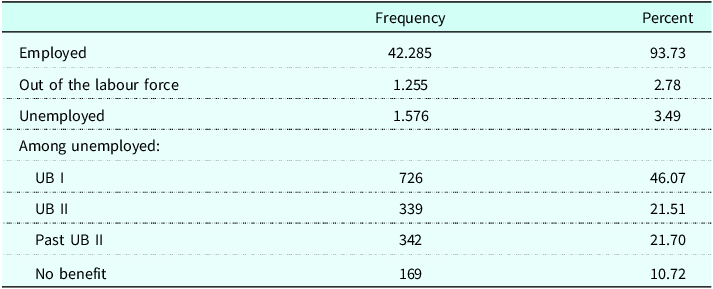
Table 1 summarises transitions out of employment. On average, 6.3 per cent exited employment in a given year, of these, 3.5 per cent transitioned into unemployment and 2.8 per cent became economically inactive. Among the unemployed, 46.1 per cent received UB I, 21.5 per cent entered freshly into UB II, 21.7 per cent were already on UB II before job loss, and 10.7 per cent did not claim any unemployment benefit.
Labour market transitions and unemployment benefit receipt

Source: PASS, waves 2007–2021, UB I = unemployment benefit I, UB II = unemployment benefit II, past UB II = unemployment entry from households receiving UB II but without having been registered as unemployed prior to entry.
Average life satisfaction across the sample was 7.3. It was highest among those who remained employed (7.4), followed by the inactive (7.1) and the unemployed (6.1), illustrating the negative association between unemployment and subjective well-being.
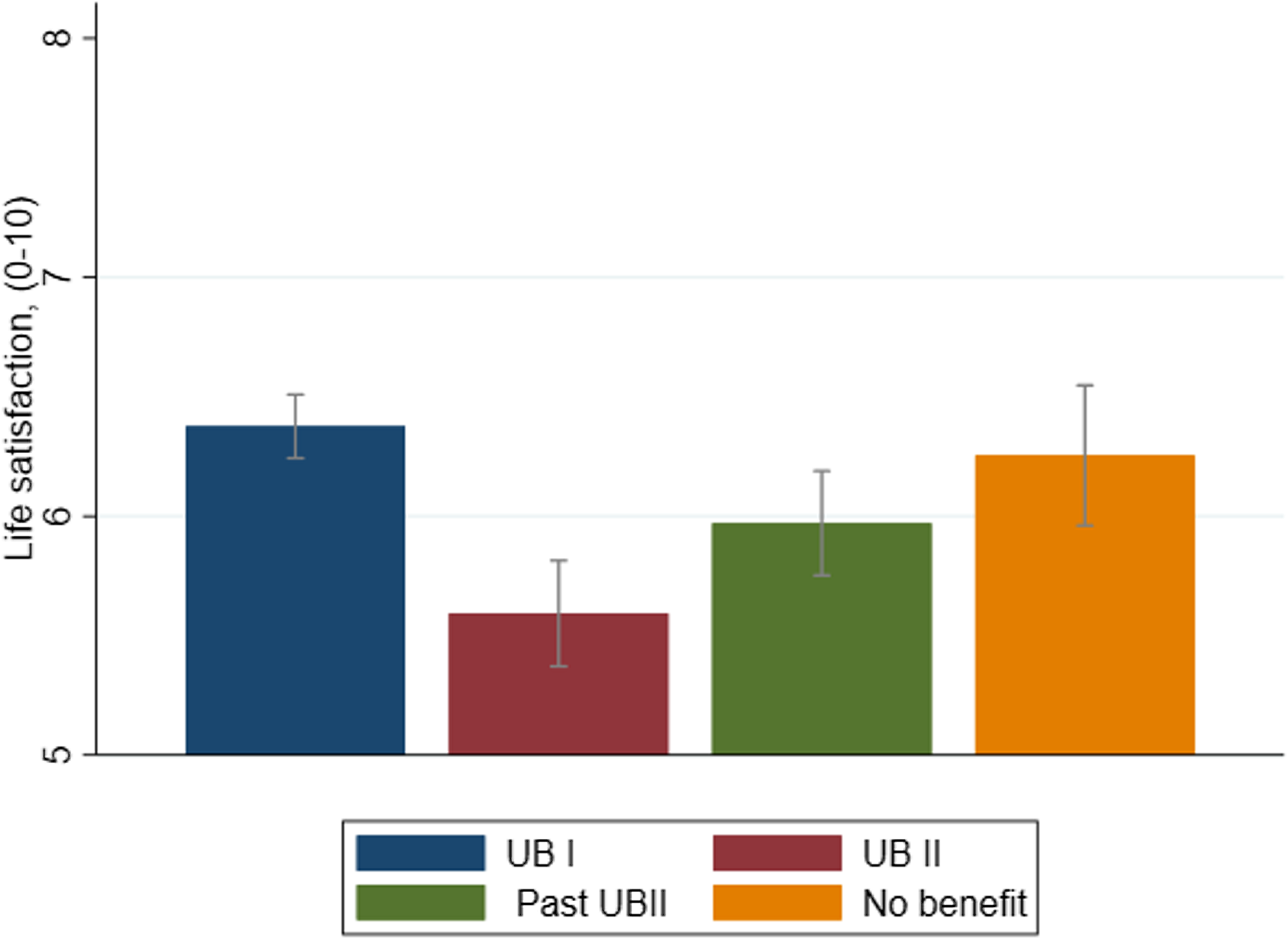
Figure 1 shows that the average life satisfaction at unemployment entry was 6.4 for UB I recipients and 5.6 for UB II recipients. Those already in UB II households at job loss average 6.0; unemployed individuals without benefits have an average life satisfaction of 6.3.
Life satisfaction of individuals entering unemployment, by unemployment benefit type.
Source: PASS, waves 2007–2021. Note: Figure 1 shows the distribution of life satisfaction scores for persons that entered unemployment by benefit type. Cap bars show 95 per cent significance interval. Number of unemployment entries 1.576.

Results
Unemployment and the effects of benefit types on life satisfaction
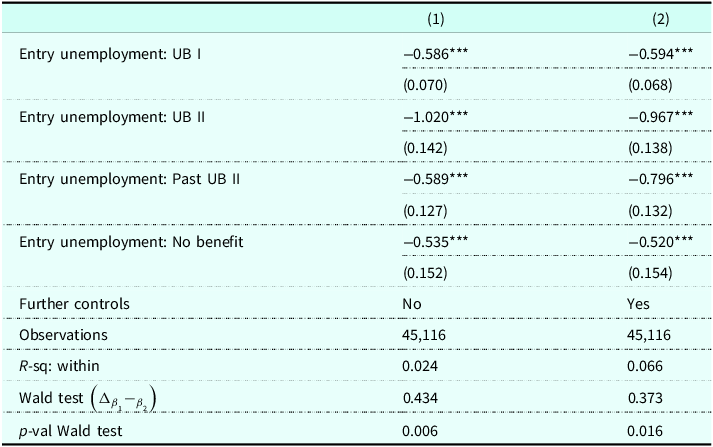
We test the first hypothesis that entering unemployment with UB II leads to a stronger decline in life satisfaction compared to entering unemployment with UB I. Table 2 presents the results. Coefficients reflect changes in life satisfaction (0 to 10 scale), relative to those who remained employed.
Effects of unemployment entry by benefit type on life satisfaction (linear fixed effect estimation)

Source: PASS, waves 2007–2021.
Note: Full results are in Table 4A. Clustered-robust standard errors in parentheses. *p < 0.10, **p < 0.05, ***p < 0.01. Reference: individuals in employment, UB I = unemployment benefit I, UB II = unemployment benefit II, past UB II = unemployment entry from households receiving UB II but without having been registered as unemployed prior to entry.
Transitions into unemployment are associated with substantial reductions in life satisfaction, and the decline differs by benefit type. Entry with UB I is associated with a 0.60-point decrease, whereas entry with UB II corresponds to a sharper 0.97 points decline. These effects reflect material losses and broader social and psychological consequences of unemployment discussed earlier. A Wald test (reported in Table 2) confirms that the difference in the coefficients is statistically significant (p < 0.05), supporting hypothesis 1.
The mediating effects of income loss and increased material deprivation
We now turn to the mediating role of household income and material deprivation. We assess whether the key mediation conditions are met. The results presented in the previous section confirms the first condition that benefit type at unemployment entry significantly predicts changes in life satisfaction (IV → DV). Table 5A examines the two remaining conditions. First, entry into unemployment reduces household income (model 1) and increases material deprivation (model 2), with stronger effects for UB II than UB I supporting IV → MV. Second, income is positively associated with life satisfaction (model 3), while material deprivation is negative associated (model 4), fulfilling MV → DV.
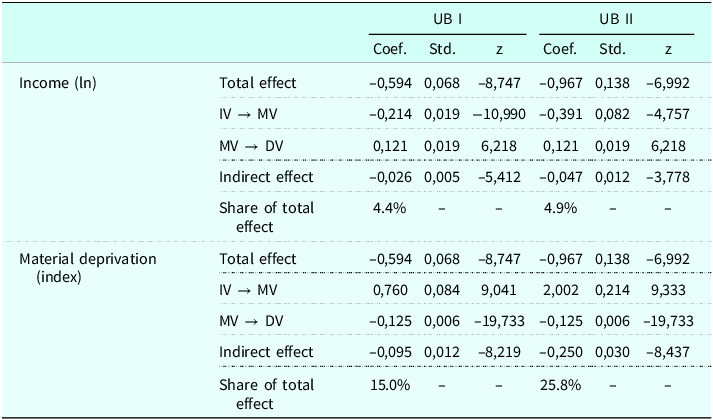
Table 3 presents the mediation results, addressing hypotheses 2a and 2b. The indirect effects, product of IV → MV and MV → DV, are statistically significant, confirming that income loss and increased material deprivation partially mediate the effects of UB I and UB II entry on life satisfaction. Income change explains about 5 per cent of the total effect for both benefit types. By contrast, material deprivation accounts for around 15 per cent for UB I and 26 per cent for UB II. These results support hypothesis 2c: material consequences of unemployment, particularly deprivation, are more influential for subjective well-being than income loss alone.
Mediation analysis for the effects of unemployment entry by benefit type on life satisfaction using income and material deprivation index as mediators

Source: PASS, waves 2007–2021
Note: UB I = unemployment benefit I, UB II = unemployment benefit II, income is the natural logarithm of the equivalent household net income (OECD equivalent scale).
Total effect shows the effect of unemployment benefit type (UB I or UB II) of life satisfaction without controlling for mediator effect (see Table 5A). (IV → MV) shows the effect of unemployment benefit regime on mediator variable and (MV → DV) shows effect of mediator variables on life satisfaction. Indirect effect (IV → MV)*(MV → DV) shows how much of the effect of benefit type is due to changes in mediation variable. Standard errors of the indirect effect are defined using Sobel (Reference Sobel1982) approach. *p < 0.10, **p < 0.05, ***p < 0.01.
Moreover, once both mediators, income and material deprivation, are included in the model (model 5, Table A5), the gap in life satisfaction between UB I and UB II recipients becomes statistically insignificant (see Table A5, Wald test). This suggests that the sharper decline among UB II recipients is primarily attributable to more severe material hardship, and not to differences in the psychological consequences of unemployment.
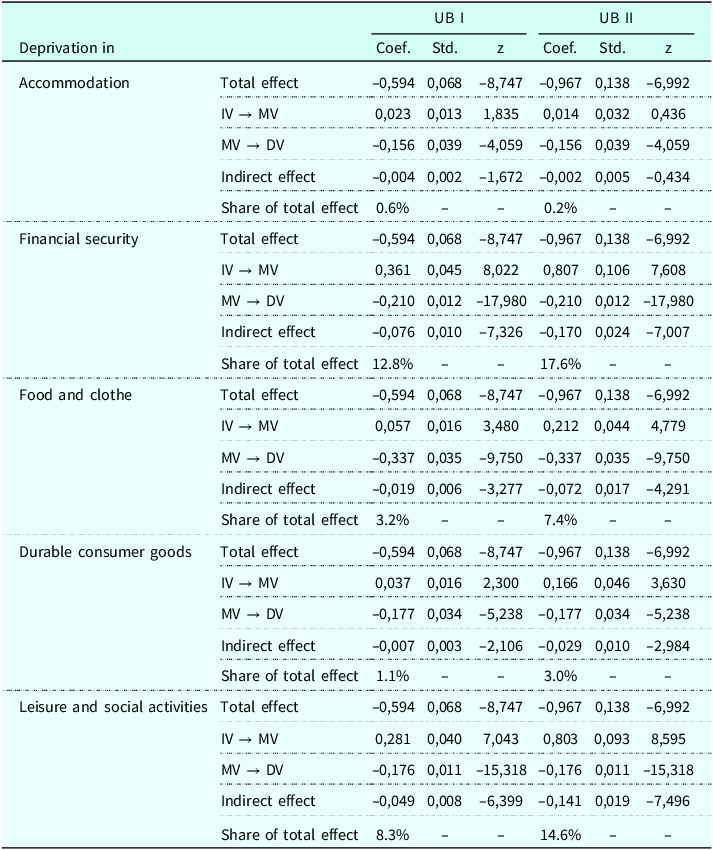
Finally, we investigate hypothesis 3, the differential role of material deprivation domains in explaining the effect of unemployment entry on well-being. Table 4 disaggregates the deprivation index into its five components. Deprivation in accommodation and durable goods has little explanatory power in our model. Deprivation in food and clothing contributes modestly, accounting for up to 7.4 per cent of the effect for UB II but very little for UB I.
Mediation analysis for the effects of unemployment entry by benefit type on life satisfaction using separate dimensions of material deprivation as mediators

Source: PASS, waves 2007–2021.
Note: UB I = unemployment benefit I, UB II = unemployment benefit II. Total effect shows the effect of unemployment benefit type (UB I or UB II) of life satisfaction without controlling for mediator effect. (IV → MV) shows the effect of unemployment benefit regime on mediator variable and (MV → DV) shows effect of mediator variables on life satisfaction. Indirect effect (IV → MV)*(MV → DV) shows how much of the effect of benefit regime is due to changes in mediation variable. Standard errors of the indirect effect are defined using Sobel (Reference Sobel1982) approach. *p < 0.10, **p < 0.05, ***p < 0.01.
By contrast, deprivation in financial security mediates 13 per cent of the total effect for UB I and 18 per cent for UB II. Deprivation in leisure and social activities explains 8 per cent of the UB I effect and 15 per cent of the UB II effect. These results affirm hypothesis 4: deprivation in leisure and social activities and financial security has greater explanatory value than more basic forms of material deprivation.
Robustness check
We conducted several robustness checks to examine sensitivity to potential violations of the econometric model’s assumptions and to alternative sample definitions.
Choice of estimation method
First, we tested the robustness to different econometric methods. While our main analysis uses linear fixed-effects models to account for unobserved time-invariant factors, we also estimated random-effects and fixed-effects ordered logit models to address linearity and the ordinal nature of life satisfaction. All approaches yield similar results, confirming a substantial negative effect of unemployment entry on life satisfaction. The magnitude and statistical significance remain robust, particulary when mediators are excluded from the analysis (see Table 6A, Appendix).
Sensitivity to unobserved selection
To test sensitivity to potential unobserved time-varying confounders (e.g. health shocks, local labour market changes, or shifts in household composition), we use the bounding approach of Oster (Reference Oster2019). This approach evaluates how much unobserved confounding would be necessary to nullify our estimated effects (see Table 7A). Even under strong assumed confounding, core estimates remain robustly different from zero, supporting a causal interpretation of unemployment entry‘s on life satisfaction.
Changes in sample definitions
Moreover, we tested the robustness across several subsamples (see Table 8A).
First, we restricted the sample to individuals with a single unemployment spell during the observation period to address concerns about cumulative or adaptive effects of repeated unemployment. Results remained consistent with the main findings, suggesting limited adaptation over time.
Second, we split spells by duration since job loss: less than three months vs. longer. In the shorter-duration group, both benefit types show more modest negative impacts on life satisfaction. Although the UB I – UB II gap persists numerically, it is no longer statistically significant.
Third, we distinguished between unemployed individuals who left their last job voluntary or involuntary. For involuntary job loss, results closely mirror the main analysis. Among voluntary quitters, UB I recipients experience a larger drop than their involuntarily unemployed counterparts, while UB II recipients report a smaller decline. As a result, the gap between benefit types diminished and lost statistical significance. These patterns suggest that the impacts hinge on both the path into unemployment and UB I eligibility rules, particularly the three-month suspension after own job termination.
Finally, we considered an alternative classification for individuals receiving both UB I and UB II. While classified as UB II in the main analysis, we reclassified them as UB I recipients. This change had no substantive impact on the results.
Discussion
This study starts from the widely supported premise that unemployment entry negatively impacts life satisfaction. It confirms that these negative consequences are stronger for individuals entering Germany’s basic income support (UB II) than for those receiving insurance-based unemployment benefits (UB I). This aligns with research showing that stricter conditionalities and lower generosity under UB II increases vulnerability and psychological distress.
Central to our contribution is a detailed exploration of losses of living standards as a mechanism, particularly income loss and increased material deprivation. We show that the unemployment effect on life satisfaction is more strongly mediated by material deprivation than by income loss. This is consistent with the view that material deprivation directly reflects the tangible consequences of becoming unemployed. Material deprivation is more impactful for UB II recipients, indicating that benefit type (level, criteria, duration) shapes the lived experience of job loss.
Further, we differentiated distinct dimensions of material deprivation, showing that the loss of financial security and restrictions in social activities significantly mediate unemployment‘s adverse impact on life satisfaction. By contrast, domains such as poor accommodation and durable goods deprivation were less relevant. Deprivation in basic needs such as food and clothing had a moderate impact, but remained meaningful for UB II recipients. Findings aligns with expectations from deprivation hierarchies (Hagenaars, Reference Hagenaars2017; Maslow, Reference Maslow1970), suggesting individuals prioritise needs. Loss of financial insecurity emerged as the strongest mediator. This finding highlights the vulnerability individuals feel when losing the ability to manage financial risks – such as handling unexpected bills or maintaining minimal savings – a dimension that has received limited explicit attention in classical unemployment research to date (Whelan & Maître, Reference Whelan and Maître2005). When becoming unemployed in a welfare state like Germany, the first and strongest losses in well-being are related to the loss of financial security and losing the ability to pursue leisure and social activities. Becoming unemployed does not necessarily cut people from the basic means of living, which are protected by unemployment benefit system, but disconnects people from keeping up their patterns of consumerism and social activities – core fields of social participation in work-based welfare states, with the effects stronger for UB II recipients.
From a policy perspective, this study underscores the need to consider specific domains of material deprivation, particularly financial security and social activities, when designing unemployment benefits. Findings suggest that current benefit levels and UB II asset thresholds may inadequately protect against profound and socially isolating forms of deprivation. This is all the more important as unemployment entrants receiving UB II are also the more vulnerable group compared to those who initially receive UB I due to their privileged employment integration before job loss. Welfare states might adopt policies explicitly addressing the crucial material deprivation domains, including greater flexibility regarding permissible savings, targeted financial support (e.g. emergency assistance loans), and additional resources (e.g. subsidisation of leisure activities, sports) to maintain social activities during unemployment. Recognising that lower subjective well-being can also reduce employability and employment quality (Wanberg et al., Reference Wanberg, van Hooft, Dossinger, van Vianen and Klehe2020), such measures could foster more stable and higher-quality reemployment.
However, the study has several limitations. First, our findings relate to the immediate material consequences of becoming unemployed. Prolonged unemployment and related transitions between UB I and UB II may lead to a greater impact of losses in housing conditions or durable consumer goods. Future research should investigate long-term unemployment trajectories as well as the cumulative effects of these transitions on different domains of deprivation. Moreover, conventional material deprivation measures may overlook emerging or subgroup-specific indicators reflecting contemporary needs and standards (Hick, Reference Hick2016; Nussbaum & Sen, Reference Nussbaum and Sen1993). Conceptual limitations arise from treating deprivation dimensions hierarchically. Universal hierarchies may not reflect varying individual and cultural contexts, and the hierarchy found here may be typical only for the context studied (Sen Reference Sen1985, Reference Sen1999). It is thus also likely that accommodation deprivation comes into account much stronger in countries where unemployed persons and households are less protected due to the absence of effective housing costs support systems. Furthermore, certain deprivation categories, notably financial insecurity, intersect multiple basic and social needs, such as maintaining housing, nutrition, and social contacts, thereby complicating straightforward hierarchical classifications (Eisfeld & Seebauer, Reference Eisfeld and Seebauer2022; Pfeiffer et al., Reference Pfeiffer, Ritter and Hirseland2011). Our analysis focuses on the Germany’s two institutional pillars and does not test whether regional differences moderate the unemployed people well-being. Further research should consider regional employment opportunities (e.g. Hajdu & Hajdu, Reference Hajdu and Hajdu2024) as well as variations in living standards. Another point is that our observation period ends during the Covid-19 pandemic and the cost-of-living crisis. However, our observation period is too short to examine whether the importance of income losses and material deprivation has thus changed recently. We might expect that the painful experience of financial insecurity upon unemployment has increased, but this requires further investigation. Finally, despite fixed-effects controls, our analysis may still face unmeasured time-varying confounders (e.g. motivation). Robustness checks support our empirical strategy, yet future research could more explicitly account for time-varying component of unobserved heterogeneity.
In conclusion, this study advances the understanding of how different unemployment benefits affect life satisfaction through the mediating roles of income and material deprivation. Findings from Germany provide insights relevant for welfare states with similar dual-tier benefit structures. Future research should incorporate multi-level contextual factors, examine longer-term unemployment impacts, and explore capability-oriented measures of material deprivation.
Supplementary material
The supplementary material for this article can be found at https://doi.org/10.1017/S0047279426101329.
Competing interests
The authors declare none.


 Open access

