

Préambule
As a powerful contrast to the prismatic movements toward belonging with that I elucidated in Chapter 1, I begin this préambule with a scene from Corinne ou l’Italie (1807), where the destructive disconnection between human and nonhuman offers a foil to the novel’s own resuscitating thing theory. A preacher (prédicateur), attacking “the period’s irreligion,”
threw his cap into the centre of the pulpit and gave it the task of representing Jean-Jacques. In that role he harangued it, saying: Well, Genevan philosopher, what have you to say against my arguments? Then he would be silent for a few moments, as if waiting for an answer, and as the cap would say nothing in reply, he would put it back on his head and would finish the conversation with the words: Now that you are convinced, let us say no more about it.
Though he does not hear the apostate-cap speak, does that mean it did not reply? This secular transubstantiation demands that the congregants, contemplating Monsieur Rousseau, rehearse in their minds whatever might be known about him, for on the devotional table, the cap speaks, albeit silently, of Julie, inequality, passionate love, social contracts and states of nature, and a not dissimilar sort of Confessions from those the Church demands. After briefly waiting for Rousseau’s response, the preacher, putting Jean-Jacques back on his head, de-auraticizes “le bonnet,” letting us see it afresh as we recognize its new power – we must feel collaterally the vellication it generates, the philosopher’s vitality circulating under it, as “Rousseau” presses against the preacher’s forehead, breathing on him. To recall Yeats’s “Leda and the Swan,” did le prédicateur “put on” Rousseau’s “knowledge with his power”?Footnote 1 If so, he cannot acknowledge it.
Evidently, repelling the nonhuman is a widespread malady: Not just this ecclesiastic, but “the run of preachers” (C, p. 170) throughout the country resuscitate things and invoke them to speak, only to suppress their breath by insisting that these objects remain inertly obedient. Yet, contradictions abound, for the preacher renders his hat contiguous with the sacred by placing it on the pulpit while simultaneously profaning it by using it to beckon Rousseau. Further, while denying the human–nonhuman connection between his hat and the philosopher, he forgets that he likewise summons Christ as he “kisses” his crucifix and “presses it to his heart” (C, p. 170). He resists and embraces human–nonhuman belonging when he denies the idea that this “square cap” can “speak,” but then, simply by invoking his cap as Rousseau, he creates the possibility that his flock could appreciate that the “voice” of this thing has the capacity to embody abstractions, to undermine an authoritarian position, to bridge and trouble relations between the human and nonhuman, and to do what the preacher will not do, but which Corinne and other texts I analyze will. He liberates his cap, only to try to reimprison it. The novel reveals that if austere paternalistic figures – like the preacher, like both the junior and senior Lord Nelvils, and like other characters I study throughout – could, in good faith, listen to the nonhuman’s heartbeat, they could resuscitate the connection between the body and mind. This breathing together could, potentially, unleash the senses and the imagination and link the material to female virtue and to physical and noetic potential.Footnote 2
2.1 Virtue, Love, and Survival
Chapter 1 interpreted the radiance of marble flesh, showing how it illuminated intersections among gender, materiality, and vitality. While there I focused on a single being – the Venus de’ Medici – and here I turn to the plurality of things Corinne and Oswald discover in Italy, this chapter pursues similar interweavings as statues and characters interact. For example, as the Venus initiated a conversation concerning how humans and things can belong with each other, so does this chapter address whether a woman or statue’s sumptuous materiality – her thinginess – can belong with virtue, defined according to the classical prototype rather than the antifeminist one so current in the eighteenth and nineteenth centuries.Footnote 3 Here Spinoza aptly argues that “the foundation of virtue is [the] very striving to preserve one’s own being” (Ethics, IVp18si). With his philosophy in mind, I ask, must Corinne die? Does her own materiality have to be broken like the arms on the Venus Belvedere for her to achieve “virtue”? Or rather, can female imperfection coexist with love and creative striving, as we saw with the Venus and in Belinda? Can nationalities exuberantly cohabitate like objects do in the Tribuna, flourishing as both individuals and neighbors, or must they be rigorously sequestered? As the Venus embodies the storyline of political and female oppression and freedom, so do things in Corinne come to incarnate the chronicle of women’s right to ethical and material liberty.
Through roughly sixteen out of Corinne’s twenty books, the heroine’s every action – from her calling as an improvisatrice to her exchanges with her environment, art, and friends – provides a theory of and model for how to practice human–nonhuman connection. As I illuminate in Section 2.3, the novel conceives of belonging with as both energizing and healing, as well as providing an antidote to the urge to possess. For example, Corinne, exercising her right to connect with things, also sustains her élan vital, for to her, things radiate intelligibility. In line with tourists’ sense that they have a relationship with the Venus, the heroine interprets Rome as a broad-ranging consciousness, describing it as a “living being,” its buildings and ruins as “friends,” and as a city wherein “the intimate union of the soul with external objects” revives “enthusiasm” (C, p. 277). This quotation introduces her thing theory’s central core, one which starkly diverges from the preacher’s described in this chapter’s préambule: She believes that thought and love are contiguous with, not opposed to, sensuous attention to nonhuman dynamism. Thus, “Rome’s marvelous charm lies not only in the actual beauty of its monuments but also in the interest they arouse by stimulating thought, and this kind of interest increases daily with each new piece of research” (C, pp. 83–84). The more one belongs with these monuments – via the “soul” and in “new” studies – the more one is liberated to love the human and nonhuman and the healthier is the political environment. As Lori Marso explains, “in arguing that love is political and [that] the first important quality of a good citizen is to have knowledge of how to love,” Staël advocates for “interdependence, rather than autonomy” and “for moral engagement as opposed to detachment as the model for political interaction.”Footnote 4 As the Venus helps tourists explore the contours of gender and materiality, so too does Corinne guide her lover, Oswald, to interrogate these intimate and political relationships, awakening him to the way things move and have the capacity to move the human.
2.2 Oswald’s Antimaterialism
The heroine believes that Nelvil’s physical-emotional-intellectual engagement with Italy’s pulsating materials will cure his antimaterialism by drawing him magnetically toward the life force of things and impel him to disown the self-loathing that possesses him, one that insists he embrace his father’s – and the British patriarchy’s – declamatory proscriptions: fidelity to an obstinate nationalism which smothers women. According to this reasoning, if Corinne and Oswald were to marry, she would have to be his possession, rather than sharing a relationship of belonging with, since this “run of” men, like the préambule’s “run of preachers” (C, p. 170) invokes things (and women) only to squelch them. As his father writes, “[a] man born in our fortunate native land must, above all, be English. He must fulfil his duties as a citizen … and in a country where political institutions give men honourable opportunities for action and public appearances, women must stay in the shade” (C, p. 318). Such an insistence on dematerializing women and disenfranchising them from the right to agency, is both a French and English problem. As Vallois states, “[t]he Civil Code and Napoleonic Code (1805), with all their institutional force, mark the end of the revolution for women and finalize the splitting of public space along sexual lines, thus formalizing the dichotomy between masculine public and feminine private space.”Footnote 5 The elder Nelvil’s call to arms maintains that if Oswald were to marry Corinne, “he would certainly love her greatly, for no one could be more attractive [“séduisante”],Footnote 6 and then, to please her, he would try to introduce foreign ways into his house. Soon he would lose the national spirit, the prejudices, if you like, which unite us and our nation” (C, p. 318).Footnote 7 Such dogmas beget what Katherine Binhammer identifies as “The Sex Panic of the 1790s,” in which the need develops
to police and control the sexual practices of women. British national honor is at stake in the battle against licentiousness, profligacy, immorality, and debauchery, and the nation’s women need to be mobilized for the cause. … The hysterical discourses around the French Revolution produced the consensus that female sexuality – since it influenced the political state of a nation – was a matter of national security. In linking sexuality to the health of the nation …, social commentators claim that the state of the nation can be judged … through the manners of its women.Footnote 8
Lord Nelvil Senior’s fears push each of these buttons, especially the notion that his son would become the “unhealthy” vassal of the “licentious” Corinne, and that, under her command, they would invert gender roles, with him becoming a passive husband. Nelvil’s father agonizes that Corinne’s “excessive” independence, beauty, and seductive charms will put England’s “national security” at risk. Nationalism was on the rise when Corinne appeared, and John Isbell notes that the first use of the French word nationalité appears in the novel (C, “Introduction,” p. xii). When Oswald reveals that loving Corinne would lead to “the disapproval of England” (C, p. 107), he abdicates his own right to choose. In doing so, he succumbs to abstractions and anticipates Nancy’s understanding that as soon as love is represented as “foreign” or “hostile” to another entity – “the city and to religion” – it becomes subject to the “procedures of control.”Footnote 9
2.3 Corinne’s Thing Theory
Like all the writers I explore, Staël develops a theory and practicum for relational models between the human and nonhuman, though Corinne’s is the most explicitly developed. This novel contends that a state of belonging with generates healing – especially of a mind held fast to abstractions and alienated from the body. How might stimulating the somatosensory system to achieve an intimacy with things, the narrative asks, lead to more salubrious communities and repaired political systems, and how might it rebalance women’s lives by offering them the right to enfold matter positively? In short, the heroine develops a theory of things to help Oswald join the fluid and material world and to help him take on what Spinoza would call virtuous striving – the striving to exist – which would, of course, allow him to love Corinne and forgive himself.
Abstractions and generalizing ideologies, Corinne recognizes, more completely bewitch Oswald than material energies, or indeed women themselves.Footnote 10 She sees that, for him, these have become irresistible paramours: “Habits, memories, and circumstances create some kind of an embrace [“enlacement”] around us that even passionate love cannot destroy” (C, p. 137; Balayé, p. 213). The French helps us understand the paradox she strives for, since “enlacement” at once accentuates the tight hold but also the intertwining and sensuous embrace of these habits and memories. This explains why Corinne believes that practicing thing attentiveness will offer moral and ethical alternatives to Oswald’s paternalism and nationalism, why she emphasizes how things, generally debased and associated with the feminine, could in fact inspire Nelvil’s mind and spirit, and why she urges him to forego trying to possess her as if she were his property. Such epiphanies would then lead to an awareness that both characters have the right to self-expression.Footnote 11 As surely as she integrates women into public life and the life of the mind, so does she strive holistically to integrate corporeality and thought; we see this when, in resuscitating the full-bodied object for Oswald, she brings a feminist perspective to materiality. Her longing to appease his strident nationalism and the death wish that accompanies it, and her longing to help him belong with Italy’s glowing materiality and women’s mobile freedom is simultaneously a longing for him to belong with her, since Italy embodies almost all that makes Corinne, Corinne.
If he could practice connecting to the nonhuman and taking on prismatic thinking, she espouses, he could “reflect, decompose, and recombine” the universe’s “wonders” (C, p. 29). Such actions would inspire a sense of belonging with, one that advances an ethical alternative to his stubborn faith in abstractions, specifically his nationalism and its compulsory gender constrictions. April Alliston persuasively demonstrates that, by the novel’s end, “the heroine’s transformation into a ghost … completes Staël’s Gothic reinscription of female desire into the patrimonial plot.”Footnote 12 I would add that the novel addresses not just the problem of Corinne as apparition, but abstract thinking’s own ghost-like nature, given that its absence of sensuous, prismatic contact with the material bars access to a specificity that inspires belonging with others, one that helps characters think less dualistically and hierarchically, given that “the chief problem with dualistic thinking is … its enmeshment with relations of domination and exclusion.”Footnote 13 Corinne affirms, then, that because human–nonhuman belonging evades possession, abstraction, and dualism, it enables one to assert personal rights. Clearly, Corinne has her work cut out for her. In the following sections, I outline Corinne’s thing-theory methods.
2.3.1 Encouraging the Human and Nonhuman to Imprint on Each Other
Teaching her thing-theory practicum to Oswald, Corinne first adopts a non-binarizing, desubjectivizing outlook in which he would, ideally, strive to experience others, other things, and other eras “from their center,” an experience wherein art, tourism, history, and love imprint energy upon each other. This practice follows from Schlegel’s notion that one should “block out … personal predilections and blind habits in order to transpose [oneself] into the singularities of other peoples and ages, and to experience them from their center as it were.”Footnote 14 If humans resuscitate their interest in things as belongings, the things themselves give back, imprinting a rich, educational impact, a sensory infusion that surpasses merely reading history: “[A]fter seeing the Roman ruins, we believe in the ancient Romans as if we had lived in their day. Intellectual memories are acquired by study. Memories of the imagination stem from a more immediate, more profound impression, which gives life to our thoughts and makes us, as it were, witnesses of what we have learned” (C, p. 64; emphasis added). Physical objects literally “impress” – physically imprint – knowledge that incarnates our ideas, rendering us witnesses to history. Such faith in materiality’s generative work anticipates Bill Brown’s suggestion that New Materialist critics should attempt to “contribute to a materialist phenomenology that does not bracket history, but asks … how … human subjects and nonhuman objects constitute one another.”Footnote 15 This concept affirms that mutual imprinting between the human and nonhuman is possible and necessary and that, as Staël later articulates in l’Allegmagne, “[u]nderstanding is a combination of the knowledge of men and things [“choses”]; and society, in which men act without object [“but”], and yet with interest, is precisely that which best develops the most opposite faculties” (G, p. 34). Thus, attempting to develop and sustain antinomies in fact nourishes human–nonhuman connection.
The novel puts into action this theory that things and humans can reciprocally impress each other when characters’ interactions radiate from the “center,” as Schlegel describes, rather than from only one pole, as dualistic or possessive models proffer. For example, Corinne’s friend, Castel-Forte, says that she has imprinted her vitality onto her things and that they have received and retained that liveliness. In the books, the places, and the pictures she has shared with him “there is a spark of her life. If I had to exist far away from her, I should at least want to surround myself with them in the certainty that nowhere else would I find again that trace of fire, … that trace of herself, which she has left on them” (C, p. 26). Castel-Forte exemplifies belonging with, for he experiences things and humans as permeable enough to absorb and refract each other’s energy. Corinne herself offers another example: She intuits that things, themselves, sensing and thinking, can register ranges between human nobility and corruption. As the hero and heroine follow “the sacred way or the triumphal way,” she says to Oswald that “[t]he ancient dust must have been amazed to bear such a chariot. But since the Roman Republic, the footprints of so much wickedness have been left on this road that the respectful feeling it used to inspire is greatly reduced” (C, p. 62).Footnote 16 Here the dust – the earth – feels and registers contact with what is ethical. Some contemporary thing-theory critics would suggest that this is a merely anthropomorphic and thus necessarily exploitative move on the novel’s part, one wherein humans project their own ideas onto the supposedly inanimate so as to dominate it. Conversely, Corinne recognizes that the dust and the chariot impress and imprint their thoughts and sensations on each other; and throughout, she strives to liberate Oswald from his own narrow projections by working to resuscitate his relationship with the material world, such that he will not need to possess her in order to breathe; as he says, “if, near you, I can breathe, [but] what will become of me when I must go back to my fate?” (C, p. 52) – that is, when he renounces belonging with for separation from. The text’s theoretical logic relies on the premise that encouraging the nonhuman to imprint the human and vice versa can spark a reciprocal giving of the gift of life.
2.3.2 Defamiliarizing and Loving the Nonhuman
In a second way, the novel emphasizes an interconnected thing-theory practice that promotes alliances between nonhuman and human communities. Part of this process – whether it comes first or second is indeterminable – defamiliarizes our ways of looking, so we can gaze with a “keener eye” (C, p. 82) at things we generally disregard. As Corinne and Oswald gaze on Vesuvius, a mountain exploding a bright red “river of fire,” the narrator emphasizes that ideas or symbols, if wedded to material grounding, can stimulate transformation, but first we must seek them out and then actually notice them: “The phenomenon of Vesuvius makes the heart really beat. Usually we are so familiar with external objects that we barely notice their existence, and we hardly ever have a new emotion about them in our prosaic countries” (C, pp. 193–194; emphasis added). A viewer who connects to Vesuvius, who sees and listens to it, who feels the volcano make her heart beat, comes to belong with it. As the narrator says, this is rare, since we generally do not notice much of anything, but when we do, “the amazement which the universe ought to arouse is renewed … and our whole being is moved by nature’s power, from which society’s arrangements have so long distracted us” (C, pp. 193–194). This moment of transcendence from subjectivity and from custom is inextricably connected to love, since affection and respect for the nonhuman – neighborly respect and companionability – is predicated on listening vigilantly to material objects.Footnote 17 Corinne’s thing theory works, momentarily, since Oswald, moving up the mountain on horseback, halfway to Vesuvius’s summit, feels that “the more his heart was filled with the generous thoughts aroused by nature and history, the more he adored Corinne” (C, p. 200). In effect, kinesthesia and a keener eye exhort him to love.
Staël champions the idea that love rouses us to a “beloved object” as well as to works of genius (G, p. 172). Winckelmann, she says, offered a standard for this:
No one before him had united such exact and profound observation with admiration so animated; it is thus only that we can comprehend the fine arts. The attention they excite must be awakened by love; and we must discover in the chefs d’oeuvre of genius, as we do in the features of a beloved object, a thousand charms, which are revealed to us by the sentiments they inspire.
Corinne consistently highlights how material attentiveness reinforces a loving companionship with the nonhuman:
The most beautiful artistic monuments, the most wonderful statues, have been thrown into the Tiber and are hidden beneath its waters. Who knows if someone will not divert it from its bed one day to look for them? But when you think that the masterpieces of human genius are perhaps there in front of us, and that a keener eye would see them through the waters, you experience an indescribable emotion which, in many guises, is continually revived in Rome and makes your thoughts find companionship in physical objects which everywhere else are dumb.Footnote 18
That “physical objects” can make thoughts “find companionship” (société) with them when “a keener eye” – one that can see even “through the waters” – sees and listens, that connection links personal intimacy and social organization. When love rouses attentiveness toward physical objects, it ripens that excessive radiance inherent in belonging with.
This practice of finding “companionship with things” – of loving the thing – is a topic I will explore throughout Embodied Experience and that I asked in Chapter 1: How can viewers belong with the Venus de’ Medici, rather than attempting to possess or feel conquered by her? And, as I discuss in Chapter 3, how can one choose a diamond or wife without exploiting it or her on the market for the highest price? How can one, in searching for a companion, avoid treating her, as Hervey treats Rachel-Virginia, as an objet d’art, as living property he seeks to sculpt into something that suits him? These questions apply to Corinne, as well, given that the third practice the heroine urges him to resist is trying to take custody of anyone or anything. This is to say that Corinne’s viewpoint on belonging, longing, and property shares the same positive aspects as the other texts I examine, though hers differs from Oswald’s, since he prefers possessing. Accordingly, the heroine advocates for the kind of belonging with that Edgeworth, and, as we shall see, Wordsworth and Burney also support.
2.3.3 Belonging With, Rather Than Possessing
Spurning property-mongering in her philosophies about materiality and artistic creation, Corinne says that improvisations are “for me … like a lively conversation. I don’t let myself be bound by any particular subject” (C, p. 45–46);Footnote 19 because of this, they provide a template for interconnections between human–nonhuman relationships. Here Melissa Ianetta’s point is apt: In not writing out Corinne’s improvisations, Staël “submerg[es] the notions of originality in an intuitive, audience-oriented invention process”; further, the heroine’s improvisations “sprin[g] not from her own desires” but from the audience’s “collective will.”Footnote 20 At this stage, Corinne expands her being by connecting to the human and nonhuman, a process which defuses self-involved emotions such as shame, possessiveness, and hopeless sorrow, partly because it reminds her that each thing has a separate life while remaining linked to others. Extending this idea to ecology and preservation, the text reads that “[i]n our day could there be places sacred enough not to be laid waste by greed? (C, p. 86). I will discuss this topic further in relation to Wordsworth’s The Ruined Cottage, where such belonging with also has ecological implications. Corinne’s philosophy anticipates Nancy’s assertion that “meaning is itself the sharing of Being” (BSP, p. 2; emphasis original) when she more lyrically says “that people become dearer to each other when, together, they admire monuments whose true greatness speaks to the soul”; responding, Oswald can only repeat that he “need[s] no other marvels” except her (C, p. 56). Corinne, trying to open his mind to belonging with, asserts that “I must know if there is anything other than you in the world … and if the feeling you arouse in me is to absorb every other interest and every other thought,” but Oswald counters: “Do you want to stop loving me then?” (C, p. 89) – a suffocating turn toward possession and, in fact, an amorous version of colonialism.
2.3.4 Embracing Art That Heals
In a fourth exercise, Corinne suggests that if Oswald could connect to certain kinds of art, he could shift from a state of fragmentation to one of belonging with.Footnote 21 Given that the novel never separates the individual from the community or art from politics, I investigate the links binding nationalism, tyranny, and what the novel calls “modern” art (post early modern), which licenses the singular over the singular plural and lionizes grief as its noblest emotion. She posits instead, as I will show, that the healing power of classical sculpture and the political regime that gave birth to it could provide a tonic for Oswald. To dramatize these two aesthetic sensibilities (the ancient and the modern), Corinne makes ekphrastic use of sculpture, for the statues behave as characters themselves and in this process the novel summons the double conceit of stone changing into human flesh and human flesh petrifying into stone so as to connect nationalism to “modern” art’s inability to appease suffering. The novel further embodies this conceit in Corinne’s creative paralysis, figured as a calcifying into marble; but unlike the Venus de’ Medici, she cannot move, an inertness ending with the character’s virtual suicide.
2.3.5 Embodied Cosmopolitanism
As a fifth exercise for belonging with, the novel advises performing what I call “embodied cosmopolitanism.” This helps one to achieve the right to personal and political expression, a fitting substitute for Oswald’s nationalism, since by connecting to Roman things, he could practice becoming less politically unbending, less severe in his proscriptions for women’s roles, and less proprietary in love. Embodied cosmopolitanism spotlights each country’s domestic particularities while simultaneously encouraging a sympathetic interaction with the beings of other nations. Inspiring a belonging with between Oswald and Italian monuments, she hopes he will embrace both the universal and the local and express allegiance to particularity, rather than employing only abstract ideologies as his guide.Footnote 22 Such practice could help cleanse toxic national affiliation and implement an “internationalist ethics of the everyday,” as Bruce Robbins writes.Footnote 23 This personal and political cosmopolitanism requires an affective commitment to objects rather than to abstractions and entails pledging oneself to belonging with. Even Oswald, having heard Corinne’s improvisation at the Capitol, intuits this when he wonders “how would it be, then, if he could simultaneously find memories of his native land, and through the imagination, receive a new life, [with Corinne] if he could be reborn for the future without breaking with the past!” (C, p. 35). A daily focus on the material thus helps viewers practice cosmopolitanism that could be transferred to the wider political domain. As Robbins reminds us, noticing the everyday stimulates “the habit of transnational connection” a practice which can be “rooted in routine duties and pleasures as well as in once-in-a-lifetime renunciations, made part of ordinary culture.”Footnote 24 Corinne’s goals foresee Robbins’s advice, for eschewing nationalist prejudices becomes an exercise that requires recognizing – as far as humans can – the power and integrity of particular things themselves. The cosmopolitan point of view sees with a “keener eye” (C, p. 82), one helping render the intellect and emotions more agile.
A workshop in embodied cosmopolitanism could thereby prompt Nelvil to exchange a nationalism unmoored from things for a cosmopolitanism rich in material textures. Corinne thus deploys her own thing theory to provide a foundation for achieving two revolutionary hopes: greater agency for women and political liberty.Footnote 25 The cosmopolitan options the novel intimates – though never set forth systematically – find their foundation in learning how to focus on the concrete. Additionally, cosmopolitan embodiment helps open any perspective that concentrates solely on one theory. Corinne, recalling her study of English literature, observes that it “was my destiny to have particular advantages because of the unusual circumstances of my dual education, and if I may put it that way, two different nationalities” (C, p. 256). Her “advantages” open her mind to a pluralistic outlook, which, among other traits, “priz[es] association over division.”Footnote 26 For this reason, the novel never endorses embodied cosmopolitanism as symbiosis; in fact, Staël realizes that if countries merged, “the vanquished would in time modify the victors, and in the end both would be losers” (G, p. 18). A country, then, should draw inspiration from, but not imitate or appropriate, another nation’s “things.” Neither does she posit this political practice as a fantasy of total openness but advocates for ways it could liberate a contracted patriotism. She draws a parallel between Oswald’s “love affair” with English nationalism and the French tendency, as Staël sees it, to withdraw rigidly into their own rules and expel artistic influences from without – “[w]e need not … encircle the frontiers of literary France with the great wall of China, to prevent all exterior ideas from penetrating within” (G, p. 24). In doing so, she unexpectedly associates Oswald, the ultimate British ambassador, with France, since, like that country, he resists learning from anyone or anything outside of his respective border. In Delphine’s preface (1802), Staël reasons that, for the French, a true national literature is only possible “when we read the writing of a nation whose outlook and feelings are very different from [ours]”; then “our mind is excited by new comparisons, our imagination is enlivened as much by the audacities it condemns as by those it approves.”Footnote 27 As Benjamin Barber proposes – and this seems very close to Corinne – to “bypass our particular neighborhood … is to risk ending up nowhere” except in mere “abstraction and disembodiment.”Footnote 28 Likewise, the novel’s tourists can only practice embodied cosmopolitanism by engaging with a country’s people and their distinctive artistic works.
Envisioning regional particularity and worldwide influence breathing together, Staël imagines a community which can hold in equipoise a simultaneous comingling of an “ethnocentric nationalism and particularistic multiculturalism.”Footnote 29 Accordingly, I interpret the correlations between the individual words in the novel’s title, Corinne ou l’Italie, along these lines, wherein the relationship’s dynamism can comprise the individual and the larger community. Thus, Corinne’s cosmopolitanism does not become “a paranoid fantasy of ubiquity and omniscience,” but one that indicates a “more general sense of ‘belonging’ to parts of the world other than one’s nation. … Instead of renouncing cosmopolitanism as a false universal, one can embrace it as an impulse to knowledge that is shared with others.”Footnote 30 In turn, this “impulse” toward sharing knowledge mirrors the need for men to share independence with women.
In Section 2.4, I explore how the heroine takes on this loving labor as she puts her thing theories into practice. Rather than suggesting a union or a melding among humans and nations, Corinne embraces a holistic, nonbinary outlook.Footnote 31 This is a kind of individuation that requires connecting, resisting possession, honoring the nonhuman, and turning toward healing art and embodied cosmopolitanism. This is, in fact, the lesson Rome itself teaches: “In Rome, that vast caravanserai, everything is foreign, even the Romans, who seem to live there not like owners, but like pilgrims resting beside the ruins” (C, p. 20). “Resting beside,” Corinne’s thing theory advocates, could help create the conditions that would allow the heroine and her lover – and collaterally Italy, France, and England – to belong with.
2.4 Practicing Thing Theory with Oswald: Visiting the Pantheon, St. Peters, and Classical Sculpture
Mary Jacobus suggests that we should try to “think through things”; to this I would add that we should move toward things.Footnote 32 Corinne offers this dual challenge to Oswald as they visit Roman sites, not so that he can employ art appreciation or aesthetic judgment, but so that she can teach him to exercise sensual responses to matter, ones correcting his abstract ideas and melancholy affect. That is, although Corinne includes elements of aesthetic theory, the last thing the heroine wants is Oswald philosophizing about what constitutes aesthetic judgment or taste. Thus, while the preacher only throws his cap “into the centre of the pulpit and [gives] it the task of representing Jean-Jacques” (C, p. 170), the heroine activates a kinesthetic interaction with objects, of which there are many – so many, in fact, that until the close of the nineteenth century the Bibliothèque Nationale classified Corinne under the category “travel guide.”Footnote 33 Though some readers criticize the surfeit of sites and things to see, most agree that these advance both plot and characterization.Footnote 34 Serge Serodes explains that Staël’s own travel notebooks, the source from which Corinne partially springs, become a “laboratory where … lived experience is converted, almost on the spot, into romantic virtuality.”Footnote 35 Likewise, I suggest that when characters breathe with these art objects, they enter a “laboratory” where they transport themselves toward affective energies.Footnote 36
The Venus de’ Medici electrified viewers and writers because she mobilized their textual and physical bodies; Corinne understands the wisdom of such kinesis, for its protagonists move toward and among things which vivify, teach, and unhinge them. Their travels through Rome and its outskirts, which require physical effort – walking, looking, craning the neck, and twisting the body, actions that in sculpture contrapposto instantiates – recall how tourism, because it intensifies one’s participation with an environment, increases intellectual and somatic suppleness. Relocating among things which vivify, baffle, and teach him, Oswald will breathe deeply, rather than sit suffocating in constrained rooms. And this exercise and breath, resetting his engrained fixations, will remind him that he has the right to love Corinne.Footnote 37 Further, the specific things he sees are crucial, and it is crucial that readers know them; thus, while Mariella Bonifacio’s, “Venezia e il tempo sospeso in Corinne ou l’Italie,” argues that Staël’s “geographical theme – her insertion of learned exposés about Rome, Naples, and Venice – is there to create a diversion from the love story,”Footnote 38 I claim that Corinne so tightly interweaves the geographical and the architectural with the hero and heroine’s growing affection that these accounts cannot be disjointed from the plot’s many turns, or from the emphasis on loving things.
2.4.1 The Pantheon
To counterbalance Oswald’s faith in nationalism and patriarchal antagonism, Corinne first escorts him to the Pantheon (Figure 2.1), an apt place for beginning recovery from rigidly obeying his father and fatherland since architecturally it provides an eidolon in its spaciousness for new, less constraining thoughts, for living vitally with death, and for experiencing redemption via movement. “Thinking ecologically” because she is “taking the whole network in view,”Footnote 39 Corinne places Oswald in an ecosystem which she hopes will mirror his internal experience. For example, the heroine highlights how the monument, in existing simultaneously as a tomb and as a radiant, open sphere, could offer a healing place for him. Its varying historical deposits – Catholic, Classical Roman, and Classical Greek – establish it as free from nationalism or one dominating religion, for though called Santa Maria Rotonda, Agrippa “dedicate[d] it to all the gods of Olympus to replace the earthly god, power” (C, p. 54). Its historical and religious syncretism speak in it as a model of cosmopolitanism.
Giovanni Paolo Panini, The Interior of the Pantheon, Rome (c. 1734).
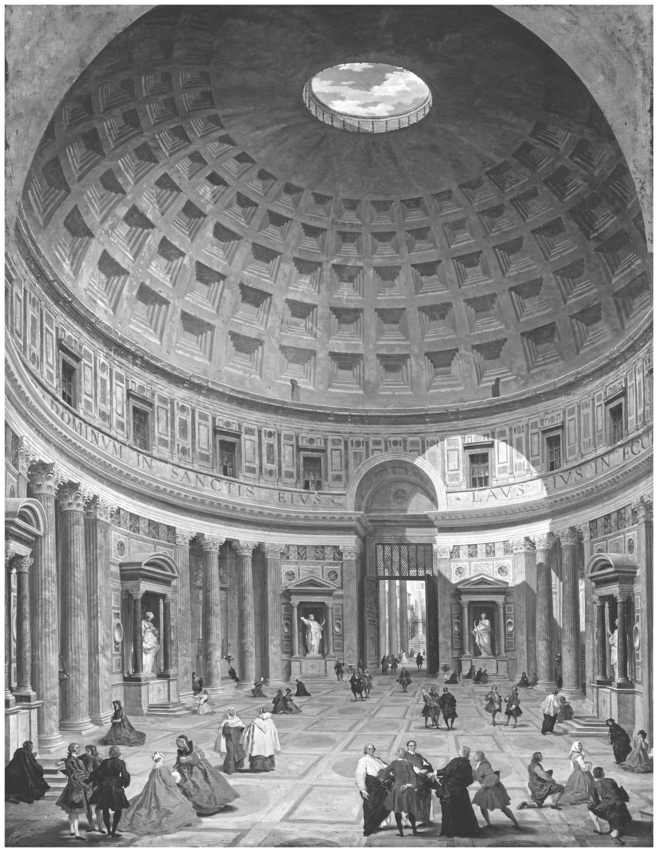
The Pantheon, embodying plurality, becomes an illuminating model for healthy individuals, relationships, and political systems. As Charlotte Hogsett writes, the novel shows that when a dictating love smothers individuality, it mimics political tyranny.Footnote 40 In contrast, Corinne, wanting to resuscitate Oswald’s ability to love the material world – wanting him to breathe – moves him toward and around a place where air circulates freely: “At first you will think it is less vast than it is. The illusion which is so favourable … comes, I am told, from the greater space between the columns and the free passage of air around them” (C, p. 53). By visually and palpably recreating the potential for spontaneous movement in a stable milieu, this architectural organism instantiates an alternative to Nelvil Senior’s nationalistic archetype and gender controls – an alternative the characters physically perform as they amble through this cosmos. The temple’s liberating energies also arise from light – “open to the sky” it materializes as a constantly flowing space, since sunshine, blazing through the oculus dances through the building during the day’s course, as we see in Panini’s painting, where the sphere of sunlight radiates from the dome’s eye, and the air flow lifts the women’s dresses, inspires some to move, and others to kneel to divinity (Figure 2.1). Shining light, moving across the dome, animates human buoyancy, for “the sun’s rays … cast light upon prayer. What serenity! What a festive air pervades this building!” (C, pp. 53, 54). And though a tomb housing the dead, it forges a homeostasis with light and cheer, breaking the binary between life and death.
Because such “magnificence” reduces the “contrast between the nothingness of death and the splendours of life” (C, p. 55), Corinne hopes it will unhinge Nelvil’s commitment to a living fatality and redirect him to “festive” life, festive because it neither represses nor dwells on death. But Oswald, resisting such a paradox, as well as love and joy in art, wants “sadness to surround death”; for him, Italian light and celebration badger one “to forget and enjoy life. I am not sure if I would like your beautiful sky to do me that kind of good” (C, p. 61). William Tronzo, contrasting the Pantheon to Hagia Sophia’s Byzantine “agitation,” points out that the former “visualizes belief as a calming truth that informs the structure of the universe”;Footnote 41 and when Corinne claims the building projects “serenity,” she tries imprinting on Oswald that another’s death can ultimately be restorative to the one grieving, that it could be “festive,” and that death and life can belong with each other (C, p. 55). Simply put, the Pantheon could teach Oswald that he could love both his dead father and the living Corinne simultaneously.
The heroine trusts that both the Pantheon and her admiration for “the man who … is not afraid to think a long time ahead about his death” (C, p. 56) interlace death into life, fostering more intense vitality. A similar idea emerges in Michel Serres’s work, which, like Corinne, turns toward solid structures, in his case statues – defined capaciously as tombs, monuments, etc. – to explicate the ways such things can reconnect a disconnected subject–object relation: those unnecessary binaries created between life and death and between the statue and the human. Serres imagines two foundations. The first, the statue, which “puts the subject in relation with death,” embodies “stable authority,” a static “inert block set there, silent, tumulary, funerary, crudely or exquisitely worked.”Footnote 42 Serres then invites the spectator to journey into the statue, into the second foundation, which “ensues from [the first] or deepens it”; this second, however, “puts death in relation” to both the subject and object, an act which “unites what lies below, what ‘here lies’ and what lies in front.”Footnote 43 In doing so, one plunges into what Serres calls a “new” nonlinear time, a pre-linguistic mode in which we can move randomly and dynamically between and among the ancient and the modern. New time, Serres contends, could help displace historical temporality, which in its trajectory forward, disremembers the past, only to repeat it. Corinne evidently pictures Oswald as remaining at the level of only this first foundation, one static and inert. Accordingly, hoping he will feel these things’ sumptuous imprint, she invokes something like Serres’s “pre-linguistic” mode where Oswald can journey into the tomb – the Pantheon – to experience what she calls the “festive”: the life force in death and the death in the life force. Thus, in these apparently rock-solid objects, Serres and Corinne discover generative and exuberant force.
2.4.2 St. Peters
Having found a touchstone for Oswald in the Pantheon, Corinne now turns to shock therapy when they visit St. Peter’s, saying: “You do not reach the sublime by degrees; the distance between it and the merely beautiful is infinite”; this is the way, she says, to “inspire a deep, keen admiration” that “reveals, as it were, a new realm of ideas, and so makes you better able to love and judge everything” (C, p. 57). And although he has so far defied the Pantheon to imprint on him any new sensations – as Balayé briskly summarizes, Oswald “lends his attention to no external object”Footnote 44 – the basilica stimulates a turn, for “when they reached the front of Saint Peter’s,” this “was the first time a work of man had affected him like a work of nature” (C, p. 57). Pleased by his amazement, she invites him to listen to his body as it resuscitates: “Does not your heart beat as you approach the sanctuary?” (C, p. 58). Hearing the heart is feeling it and the breath that makes it pulse.
In a further series of rhythmic beats, Oswald takes after the préambule’s preacher, curving toward things, only to withdraw again from material vitality (a topic I will discuss in Section 2.6 in relation to sculpture). As they enter the doors of St. Peters – then covered by a leather drape which one pushed to move through its portal – his thing-intransigence returns. “Corinne herself raised the curtain and held it to let Lord Nevil pass,” and so “graceful” was her “attitude” that his “first glance was to look at her” and “for some moments he took pleasure in looking only at her” (C, p. 58; emphasis added). Even in this sublime space, his possessive eyes seek only Corinne. Once past the threshold, the heroine’s sublime “therapy” momentarily works. As he sees the Basilica’s vastness, Oswald feels for an instant as if “the feeling of love [for Corinne] no longer sufficed to fill his heart” (C, p. 58); that is, he longs for belonging with the world at large rather than just for possession of his lover. Reinforcing his response, the heroine reminds him that Italian Catholicism “appeals to the imagination through external objects” (C, p. 59). To dislodge him from abstraction and reconnect him to the physical thing itself – St. Peters – she reminds him that the church “has its own seasons, its perpetual springtime, which the external atmosphere never alters” (C, p. 60). And in telling him that the basilica’s stones have their own memory banks – they “know more than we do about past ages” (C, p. 60) – she reminds him that his own is foreshortened and that these things have their own existences, which, according to her thing theory, enlighten the mind.
Oswald’s national prejudices prevail, however, as he again automatically reverts to political abstractions.Footnote 45 He retreats from expansion to contraction as he exclaims, “here the arts have the greatness, the imagination, of genius. But the dignity of man himself, how is it defended here? What institutions, what weakness, in most Italian governments! And although they are so weak, how they enslave minds!” (C, p. 59). As Corinne later remarks to Nelvil, not only do his national partialities blind him to Italy, to art, and to “an indescribable divine intention for man” (C, p. 139), those chauvinisms also prevent him from hearing the banalities his politics declaim: “What you say about the Italians is what all foreigners say, what must strike them at first sight. But you must probe more deeply to judge this country” (C, p. 99). He can repeat threadbare prejudices because he has not grasped the often-catastrophic consequences that emerge when one lives with those assumptions – when they are made flesh. For example, on an abstract level he thinks that a wife who “stays in the shade” is a pretty thought, until he is married to one. Corinne interfuses love, cosmopolitanism, and an intimacy with matter to try to resuscitate a man who seems bent on dying rather than loving.
2.4.3 Ancient Greek Sculpture
Corinne links practicing a brighter material attentiveness to the amelioration of Nelvil’s embrace of a nationalism rife with misogyny and possessiveness.Footnote 46 Intimacy with materiality, thus, can vitalize the community’s political and cultural life force while also exposing the ways that nationalism dismembers a woman’s ability to function as a whole being. Corinne’s thinking–feeling response to things also has repercussions for melancholy’s relationship to what Staël calls “modern art.” The Romantic-era fascination with melancholy and its potential for artistic stimulus has been well documented, even by Staël herself.Footnote 47 However, through Nelvil, the novel judges a melancholy that asphyxiates change and inhibits creativity. Corinne explains that “[i]n works of genius, what is deeply moving is not misfortune itself but the power of the soul over this misfortune” (C, p. 355). Her faith that belonging with matter can be educationally and politically ameliorative finds echoes in De l’Allemagne, where she claims that the best kind of education emphasizes action and links itself to a cosmopolitan sensibility – she urges “spontaneous activity” and thinking that “in a lively manner excite[s]” and “awakens” the mind, rendering memory “flexible”; this, she says, will prevent a child from being “all his life confined to the [narrow] circle of his own nation” (G, p. 122). Believing that he could, through this therapeutic practice, awaken his dormant sensibility and intellect, she endeavors to swerve Oswald’s attention from mourning and national biases toward the breathing, sensuous world.
After they tour the Pantheon and St. Peters, she introduces Oswald to classical sculpture,Footnote 48 which for her provides the primary embodiment of a medicinal art form and a standard for happiness that arises from good government. They visit the Vatican museums to contemplate the “likenesses of the gods and heroes … assembled, where the most perfect beauty, in eternal repose, seems to admire itself” (C, p. 139).Footnote 49 Amelia Rauser demonstrates that neoclassicism itself was embodied: her indispensable research shows how that movement was “[m]arked by a sensual, even ecstatic communion with a deeply strange and primitive classical past” and that it “aimed to use art as a portal through which the harmonious union of art and freedom – both bodily and political – could be brought back to life in a new golden age.”Footnote 50 Rauser’s insights offer one reason why Corinne gravitates toward classicism itself, why she urges Oswald to experience “a sensual, even ecstatic communion” with these ancient statues, whose own embodiment could inspire the living man to embrace material existence; for her, however, this “primitive classical past” will be the “portal” through which Oswald will emancipate himself and Corinne will remain liberated.Footnote 51 In this move, the novel links feminism and classicism, a link not historically accurate, but one extremely fruitful for the heroine.
How do these statues offer curative support? First, by virtue of their genre, they heal more efficaciously than paintings can: Sculpture, Corinne states, “could show the spectator only a vigorous, simple existence, while painting indicates the mysteries of reflection and resignation,” and though the heroine necessarily shows him “les chefs-d’œuvre de la peinture” (C, p. 143; Balayé, p. 221), ancient sculpture, given its repose and “vigorous existence,” will counteract his self-absorption and “resignation” to shame. While Cohen maintains that Corinne’s claim of “superiority of painting over sculpture” arises from the fact that the latter “is too closely bound to the brute materiality of external fact,”Footnote 52 I find instead that it is sculpture’s very materiality that leads it to be most worthwhile in its ability at this precise moment to offer Oswald solid, three-dimensional views of nourishing consolation.
These classical statues can also retune Oswald’s melancholy since they offer a paradigm for true heroism insofar as they remain composed, though suffering anguish:
in ancient times, there was something more noble than grief; it was heroic composure, it was the feeling of one’s own strength, which could develop freely in free institutions. The most beautiful Greek statues have rarely conveyed anything but the idea of rest …. The moral being of the ancients had such a healthy constitution, air circulated so freely in their broad chests, and the political system was so well in tune with their mental powers, that there were hardly ever any maladjusted souls as there are today. That maladjusted state leads to the discovery of many subtle ideas but does not provide the arts, and particularly sculpture, with the simple affections, the basic feelings, that alone can be expressed in everlasting marble. Scarcely any traces of melancholy can be found in their statues.
Here she posits ancient statuary as a paragon for a healthy, well-adjusted human. These Greeks, with their “broad chests,” could breathe, and partly because they did not insist on a binary between their intellect and their government. A “something more noble than grief” is repose, in contrast to unproductive grief, an idea I return to when I discuss Wordsworth’s The Ruined Cottage. Here, these statues embody deep feeling conjoined with autonomy.Footnote 53 In showing them to Oswald, Corinne hopes that a therapeutic abrasion will emerge between his position and the ideals Greek art embodies, for Nelvil must strain to encounter the nonhuman, and to feel some resonance with these statues, he must transcend his own dominating subjectivity in order to reach “heroic composure”; further, if Oswald could connect in that way, he would feel the differential snap between his own nonheroic reactions and those these figures embody – institutional vigor, well-being, and tranquility – since, in contrast, his nationalism, disaffected from physical vitality, produces a “maladjusted soul,” and in his chest, blood vessels “burst” (C, pp. 140, 136).
Additionally, the statues’ “perfect beauty” (C, p. 139) resuscitate Oswald because they remedy his fixation on abstraction. Here, Corinne may be thinking about Johann Gottfried Herder’s matter-driven conception of beauty in statues, which “is always only the shining through of form, the sensible expression of perfection in relation to an end, the surge of life, human health.”Footnote 54 Such beauty shining through sculpture “does not form abstractions but persons; it gives us this person, with this character, and this character is made present in every part of the body, in its placing and position, as if an enchanting wand had turned the living person into stone’”; thus, “it is never abstract love that stands before us, but the god or the goddess of love, not the female divinity or the virgin virtue, but Minerva, Juno, Venus, Apollo, and other highly specific names, forms, and persons.”Footnote 55 Herder here invites one to belong with the statue; Oswald, embracing the withdrawal and separation that abstraction triggers,Footnote 56 requires connection to Herder’s solid specificity “shining through,” a tangible anchor to connect to, and a heroic exemplar that eschews melancholic separation and instead embodies “the surge of life, human health.”
The visual paradox of serene faces and broken bodiesFootnote 57 further benefits Oswald by helping him physicalize his own dismemberment and by providing a model of composure in the midst of disintegration, letting him silently witness what is missing without feeling that he must replace or complete what has been shattered – whether that is a statue’s body part, or correlatively a father’s faith in his son.Footnote 58 Sophie Thomas argues that “[r]uins provide evidence of counter forces, of ‘counter lives’ that speak for otherwise silenced differences.”Footnote 59 And Alexander Regier has pointed out how the fragment is a “concept,” both “critically self-replenishing and productive,” partly because it “resists totalization”; it “encourages us to look for details, and to perceive the importance of minuteness anew. It requires of us a certain attentiveness that reminds us how each fracture, textual or phenomenological, demands scrutiny in its relation to a larger structure.”Footnote 60 In Corinne, such a kinesthetic “attentiveness” – one stimulating movement from details to larger structures – functions at the level of marble form and at the strata of psychological exemplar for accepting loss with equanimity. One sees in
those admirable features and physiques … an indescribable divine intention for man, expressed by the noble face that God has deigned to bestow upon him. In this contemplation, the soul is uplifted to hopes filled with enthusiasm and virtue, for beauty is one in the universe, and whatever form it assumes, it always arouses a religious feeling in the hearts of mankind.
Rather than positing binaries between body and spirit or body and thought, here the narrator conceives a ternary structure wherein all imprint upon each other; and though a spiritual design is “indescribable,” this sculpture, to some degree, manifests this design in “those admirable features and physiques.” When these elements intertwine, faces and bodies can serenely express joy or sorrow – or both simultaneously – and those expressions thereby prompt the viewer towards a “contemplation” that recalls the “divine intention.” Evidently, it is precisely the interactions among these elements that inspire an enthusiastic and virtuous hope, one which manifests public and private greatness. Paradoxically, the classical form, once fragmented, fuels insight. Its “wounds” – broken hands and arms – constitute a “sign of life,” one that “lends animation to a statue.”Footnote 61 In “How Keats Falls,” Jonathan Mulrooney insightfully observes that trauma can “make new kinds of imagining possible.”Footnote 62 Like the Venus de’ Medici, these ruins propel new forms – mobilizing cosmopolitanism and viable gender ethics, for example – while, as I show in Section 2.6, countering modern art’s inadequacy and grief’s debilitating impact.
Finally, Corinne recovers classical ideas from these statues, ones that historically excluded women, and renders them agents that challenge a nation advising women to “stay in the shade” (C, p. 318).Footnote 63 Bringing a feminist perspective to this classical equipoise, the novel finds in this statuary “a happy mixture” of the sublime and the beautiful, a mixture that corrects an imbalance between gender and power: The Greeks, “to give beauty its more sublime nature, combined, turn and turn about, in the statues of men and women, in the warlike Minerva and in the Apollo Musagetes, the charms of the two sexes, strength with gentleness, gentleness with strength, a happy mixture of two opposing qualities, without which neither would be perfect” (C, p. 141). Such a mingling characterizes Corinne herself. Her rooms are “an agreeable mixture of everything that is most pleasing” from France, England, and Italy; and she says “I feel I am a poet, not only when a happy choice of rhymes or harmonious words, when a happy combination of images … dazzles the audience, but when my soul is uplifted”; Oswald, however, cannot understand how she can fuse “so many different charms which would appear to be mutually exclusive” (C, pp. 37, 46, 52). Further, when she is “crowned” at the Capitol, “her tall, slightly plump figure, in the style of a Greek statue, gave a keen impression of youth and happiness” (C, p. 23). The laurel and myrtle adorning her collapse gender binaries between strength and gentleness. As Ianetta points out, the first is “sacred to Apollo, god of poetry” and the second is “sacred to Aphrodite.”Footnote 64 These amalgamations – especially those of gender “traits” in ancient sculpture – then, could potentially liberate women, as well as men, from emotional and political stagnation. These mixtures – as well as the persistent interchange between human and marble flesh – defamiliarize familiar ideas that dualism is inevitable.
If particular kinds of sculpture can heal, then statues and observers must belong with each other, and indeed Staël illuminates how art, myth, and even science have focused on the tense reciprocity existing between human and statue. As the human body has been the archetype for sculpture, so has sculpture been considered as “a kind of model … for man as a species.”Footnote 65 Condillac offers a precedent for such a method when he recommends a plastic identification – really almost a symbiotic relationship – between subject and object, wherein one “must enter into” the statue’s life, “begin where it begins, have but one single sense when it has only one, acquire only the ideas which it acquires, contract only the habits which it contracts: in a word he must fancy himself to become just what the statue is.”Footnote 66 The sensation of sculpture coming alive is widely examined in French eighteenth-century studies, given Diderot’s writings on the “problematics of viewing.”Footnote 67 Certainly Diderot, when delighting in Étienne-Maurice Falconet’s Pygmalion aux pieds de sa statue, à l’instant où elle s’anime, exhibited at the 1763 Salon, performs the same moves as those who gaze on the Venus de’ Medici. He doubts that the piece could be marble and not flesh, exclaiming: “What hands! What supple skin! No it is not marble; feel it under your finger and how eas[ily] it gives way to pressure”; in conversation with the nonhuman, he endorses a connection to things by speaking to the sculpted cherub, and intensifies the players’ animation and connection in this moment, imagining them in different poses, ones he believes would be “more energetic than Falconet’s. My figures would be better grouped than his. They would touch each other.”Footnote 68 Diderot wants more energy and interaction in and between the nonhuman entities, and the intimacy he experiences with these statues resembles the “companionship with” rather than the possession of things, which Corinne hopes to spark between Oswald and the material world.
2.5 The Severing
Interlacing the human and nonhuman in the Pygmalion-like way it brings marble alive, Corinne (specifically, but also the other texts I address throughout this book) demonstrate how crucial the circulation is among politics, art, and human health, for when humans reject belonging with the nonhuman, the “Severing” – “a foundational, traumatic fissure” – a “catastrophe … that does not take place ‘at’ a certain ‘point’ in linear time, but a wave that ripples out in many dimensions, in whose wake we are caught.”Footnote 69 Despite Corinne’s thing-theory work, Oswald chooses severing; resembling the preacher, he refuses to feel the “cap” – or any other material object – tingling against his skin, breathing its breath into his system. Thus, contrasting to the heroine’s lively give and take in her improvisations, Nelvil does not want to share her with anything: Seductively he pleads, “Corinne, you do not need these external activities to make me stay with you. On the contrary, when I look away from you for anything at all, I am making a sacrifice to please you” (C, p. 139). Resisting Corinne’s “de-nationalized internationalism” and her “internationalist political education,”Footnote 70 Oswald’s obstinate possessiveness resonates through his social and personal relationships: “You reveal to me the thoughts and emotions which external objects can arouse. … But this magic of the universe you are teaching me to know will never offer me anything more beautiful than your look, more touching than your voice” (C, p. 86). In collapsing all attention on her, he isolates them both from the material world. As he cannot see things, neither can he see Corinne. He longs to possess her as property, not to belong with her.Footnote 71
Once back in his native country he defies belonging with, returning to “a certain rigidity in his ideas that the intoxicating wave of the arts and Italy had washed away”; now Corinne’s lessons about things seem mere evanescence: “[E]ntrancing pictures [“les tableaux séduisants”], the poetic impressions, gave way in his heart to the deep feeling of liberty and morality” (C, p. 304; Balayé, p. 447). His allusion to these “seductive” arts mirrors his father’s sense that if Oswald had married Corinne, “il l’aimerait sûrement beaucoup, car il est impossible d’être plus séduisante” (Balayé, pp. 466, 467). Here, in collapsing the heroine with Italian art Oswald finds both incompatible with liberty. This conclusion reveals that since his “morality” cannot coexist with matter, he must let human abstractions coerce his ethics, a move which, ironically, ensures his own imprisonment. In an observation that forms an apt analogy to Nelvil, Corinne perceives that true autonomy is unavailable in a monastery since the inhabitants “pay no attention to external objects. Their discipline is too harsh to allow their minds any kind of liberty” (C, p. 168). Indeed, the heroine diagnoses his malady: “Thought without external nourishment turns in on itself, analyses, works on, digs into, inner feelings, but it no longer has the creative strength which depends on happiness and the ample strength which only happiness can give” (C, p. 140). In On Cosmopolitanism and Forgiveness, Derrida states that the Nation-State’s “foundational violence is not only forgotten. The foundation is made in order to hide it; by its essence it tends to organize amnesia, sometimes under the celebration and sublimation of the grand beginnings.”Footnote 72 Thus, while with Corinne, Oswald may have practiced connecting to matter, neither the matter itself nor that training’s larger purpose has made a permanent imprint since he commits himself to a “foundation” meant to “hide” the fact that his nation-state does not embody liberty and morality for him or Corinne.
These monuments and classical sculptures, then, influence Corinne and her confidence in the impact they could imprint on Oswald, limning the hope for happiness, creativity, and political freedom; the chapter’s next parts consider how Staël places the ancient in friction with a modern – that is, post-Renaissance – art, sensibility, and governance that churns out grief, tyranny, and imaginative paralysis.Footnote 73 I spotlight statues and the ways they both metamorphose into life (Galatea) and immobilize into death (Medusa) but also how they disrupt that binary, since sometimes contiguity exists between them.Footnote 74 Corinne draws on this transformation between marble and human to manifest the differences between classical and modern art, particularly insofar as the disparities question what artistic and political configurations might appease suffering and inspire creative work.
2.6 Abandoning Thing-Theory Practice: Oswald and Corinne’s Turn to Modern Melancholia in the Statues of Canova and Michelangelo
Beginning as a vision of belonging with the nonhuman via an embodied cosmopolitanism, a companionship with things, a nondualistic outlook, and an impatience with possession, Corinne ends disastrously, imprinting how a narrowly defined nationalism and faith in abstract ideas devastates both the individual and the community, engendering a profound melancholy that dominates modern life.Footnote 75 Rendered traumatic under Napoleon’s rule, this world – one lacking the “healthy constitution” of the Greeks, the “air [that] circulated so freely in their broad chests, and [a] political system … so well in tune with their mental powers” (C, p. 140) – fuels such modern abjection. De la littérature restates this idea: “The representations of later times do not simply offer a picture of majestic distress [as the ancients do], but distress, solitary, and without support.”Footnote 76 And yet, as I noted in Section 2.4.3, this novel’s refusal to glorify melancholy or the art springing from that emotion, as well as the text’s conviction that ancient art instead will “support” the overheated, trauma-laden Oswald, sets it apart from some of Staël’s later writings. Thomas Pfau reveals that the years 1798–1815 can be identified as a “traumatic period,” a “world whose economic, legal, and spiritual bearings had been decisively altered, indeed rendered almost unrecognizably alien and disconcerting.”Footnote 77 Oswald, having absorbed those years’ impacts, acquires a very “modern” attitude toward life and aesthetics, insofar as he feels that, in contrast to classicism’s representations of heroic composure, the arts “ought to reveal to us the charm of grief and the melancholy of prosperity” (C, p. 146). I am not claiming that the novel invokes either ancient or modern culture as a monolithic apparatus but rather that it intermixes them. Thus, while Corinne claims that ancient sculpture potentially has greater healing power than post-Renaissance art, the novel’s Romanticism relies on fragmentation as a theme and as a structural motif. However, since Oswald’s melancholy enchains him, it is significant that Corinne argues that when such despondence is found in classical art, it was created during a time of enslavement.Footnote 78 Castel-Forte reinforces this link by reminding Corinne of “how much the English in general are slaves to the customs and habits of their country” (C, p. 50). It is important to remember the physical ways that the characters embody this modern oppression, giving up their right to respiration and movement: Corinne’s “soul,” alienated from the human and nonhuman, “can no longer breathe enough air, enough emotion, enough hope in this world,” and social custom has nearly crippled Lucile, since at sixteen, “her body [is] almost too slender, for a little weakness could be seen in her walk” (C, pp. 237, 306). Oswald “breath[es] with difficulty” (C, p. 269), constricting oxygen and blood flow such that his heart fails him, and Corinne becomes one of the maladjusted souls,” who “trie[s] a thousand ways of calming the consuming power of thought, which no longer, as in the past, gave her a great variety of ideas, but only one idea, only one picture, armed with sharp points which rent her heart” (C, pp. 140, 351).
The novel specifically embodies Oswald as “modern.” Touring Antonio Canova’s studio by torchlight, the protagonists encounter a statue, the “spirit of grief, leaning against a lion” (C, p. 143), that both Corinne and Canova agree resembles Nelvil. Enrico Bruschini and Alba Amoia suggest that Staël could be referring either to Canova’s sculpted figure, the “Genius of Death” from the Cenotaph of Archduchess Maria Christina of Austria (Figure 2.2) or the figure of the same name from the memorial to Clement XIIIFootnote 79 (both “geniuses” are positioned on the tombs’ lower-right-hand corners). Given that Staël describes the spirit leaning on the lion and given the creation’s date, 1805, they most likely see the statue from Maria Christina’s ossuary, for this “genius,” having collapsed onto the lion, his head resting on the animal’s fur, seems especially grief-stricken; suggestively, however, the “Génie de la douleur” on Clement XIII’s memorial lies recumbent at the foot of a powerful man, which would manifest Oswald’s subordination to his father’s politics and anticipate the hero’s physical and emotional breakdown after Corinne’s last improvisation. Both “spirits” lack muscular definition, and both embody sorrow.
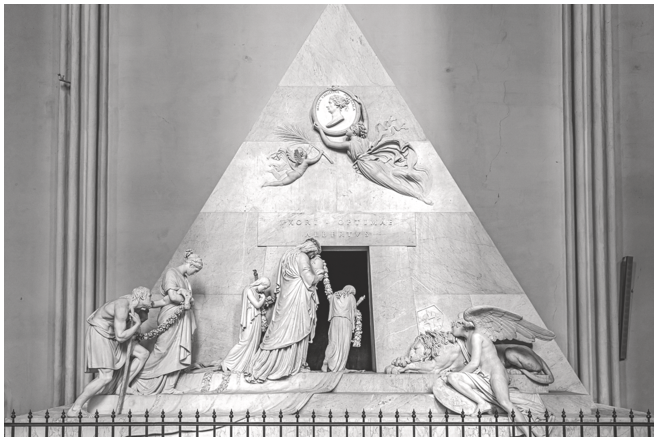
And yet, because the “spirits” are so similar, both resemble Oswald, their sameness, in turn, recalling modern art’s repetitive drone: “the cry of pain, which in the end becomes monotonous” (C, p. 356).Footnote 80 Practically identical twins, the statues convey “only one idea, only one picture” (C, p. 351). Hippolyte Taine’s 1866 analysis of the “insipid or attitudinizing” figure on the tomb of Clement XIII highlights its modernism when he writes, “[t]he more a monument approaches our time the more do its statues assume a spiritualistic and pensive expression; the head usurps all the attention; the body is reduced, veiled, and becomes accessory and insignificant.”Footnote 81 Taine’s observation echoes Oswald’s reliance on abstraction – to the degree that he renders the material “insignificant.”Footnote 82 As I will show, Canova’s statue forecasts Corinne’s own debilitating sorrow, suggesting that modern grief has a contagious quality, one infecting the heroine herself, for once Oswald has married Lucile and Corinne has returned to Italy, her pain petrifies her into sculpture, a solidity that ironically dematerializes her by reducing her to one emotion, and a modern one at that – anguish that cannot be tranquil.Footnote 83
While Oswald ossifies into the “Spirit of Grief,” Corinne, now fully “modernized,” is rendered as Michelangelo’s female statues, Night and Dawn (Figures 2.3, 2.4), which the heroine sees in Florence’s San Lorenzo. As with Canova’s figures, each is posed on a tomb, and each is drawn from two different groupings; whereas the former focuses on the male “spirits,” Corinne fixes on the female statues and, in doing so, accentuates the heroine’s isolation and fragmentation as a woman while also splintering the tomb compositions themselves. The novel quotes dueling verses about Night which echo Corinne’s own fluctuations between dying and reviving since Giovanni Strozzi’s lines beckon her to live, while Michelangelo’s urge her to anesthetize her senses and sacrifice her material vitality:
A poet [Strozzi] wrote lines about the statue of Night; it ends with these words: Although she sleeps, she is alive; waken her if you do not believe it; she will speak to you. Michelangelo … replied [to this poem] on behalf of Night:
In seeing these statues, she is momentarily “reawakened,” only then to identify with an inscription which reads: “Alone at my dawn, alone at my dusk, I am still alone here” (C, pp. 353, 354; emphasis original). Indeed, during her short visit to San Lorenzo, she zigzags between connection with and alienation from embodiment.
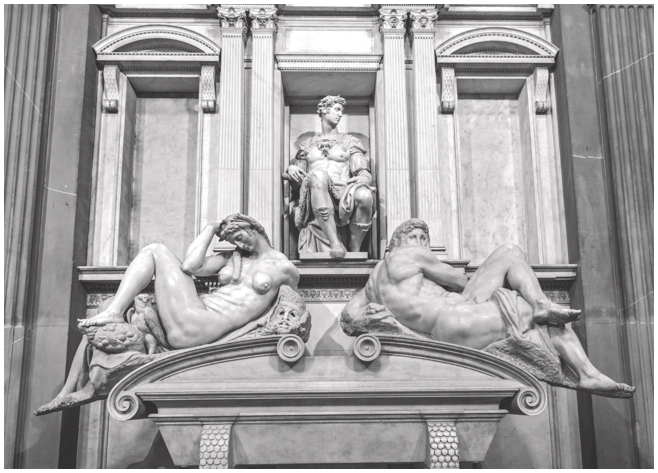
Michelangelo, Tomb of Lorenzo, Duke of Urbino, with figures of Dusk (l.) and Dawn (r.) (1519–1534). Cappelle Medicee, Church of San Lorenzo, Florence, Italy.Footnote 84
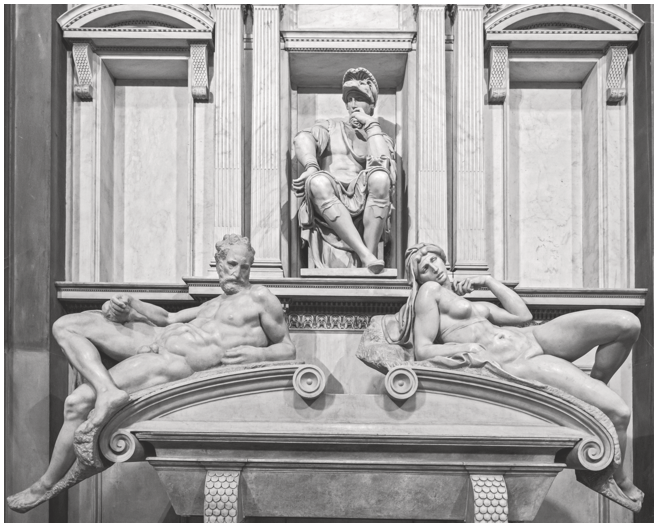
The narrator exemplifies Michelangelo as a “sculptor of modern times,” and Dawn and Night as bearing the medieval “spirit” of “an energetic, gloomy soul” (C, pp. 352–353). The statues manifest the heroine’s agony, but so too do Michelangelo’s words, which in their desire for sensory deprivation recall Corinne’s withdrawal from sensuous materiality. Slip-sliding between human and nonhuman, the heroine doubles as Night, a female figure (Figure 2.3), as she becomes a marble sleeper. While the Pantheon is a “festive” death house that honors vital existence, here the female Dawn’s (Figure 2.4) melancholy face, in ironic counterpoint to her name, and Night, in a depressive sleep with her head down and eyes closed, embody Corinne’s awareness that “[t]he sense of existence pursued her like a relentless pain” (C, p. 351). In contrast to the transformation classical statuary promised and the “sensual pleasure” the ancients felt “in the idea of death,” this encounter accentuates Corinne’s entombment in stone (C, p. 81). And, like both female statues, she herself lies prostrate at the foot of a man who feels herculean to her, a double itself of Oswald’s relation to the “spirit” collapsed below Clement XIII. These statues physicalize Corinne’s state, but ironically the less she connects to the breathing, material ebullience that roused her creativity, the more dematerialized she herself becomes.
Throttled by “modernism,” barely able to breathe and unable to write or perform, Corinne visits the Uffizi’s Tribuna to resuscitate herself by seeking inspiration from Greek sculpture’s “happy mixture” of sublime and beautiful energies (C, p. 141). Hoping to locate something embodied that would check her despair, she turns to the Niobe, a statue expressing “calm and dignity despite extreme grief” (C, p. 355). Earlier in the novel, when the hero and heroine were touring the Vatican galleries, the narrator had claimed that two of the most disturbing statues of Greek origin, the Laocoön and Niobe, “are the only ones that portray violent grief, but they both recall the vengeance of heaven and not passions born in the human heart”: Thus, because their heartache is generated from without (the Gods) rather than from within, they can express anguish without absolute, dysfunctional despair, while still conveying “the idea of rest” (C, p. 140).Footnote 85 Niobe, however, fails to help the heroine compose. Corinne, whose choking passion armors her – as if she were marble – discovers that it “cost her an effort to find each word, and often she wrote words with no meaning, words which frightened even herself” (C, p. 355). The words do not belong together. Anatomized modern life is literalized in how each word is separated from the other, each hardened into an isolated state, rendering her unable to “expre[ss] the general ideas, the universal feelings, which appeal to the hearts of all humanity” (C, p. 356). Instead of taking motivation from the thing, the artwork, she has merged symbiotically with her angst. Like Canova’s “Spirit of Grief,” she merely records “the cry of pain, which in the end becomes monotonous” (C, p. 356). The abstractions she tries to counter, the illusions she had earlier rejected, become her reality and, partitioned from the sensible, she abandons herself to one pole: that which harbors the death constructs of female powerlessness, national prejudice, and oppressive politics. Now grief possesses her, and she no longer belongs with her own being. This standpoint is reiterated not only by Corinne’s inability to find inspiration in the lamenting Niobe but is also reinforced by the fact that that statue, housed in the Tribuna, calls attention obliquely to the Venus de’ Medici’s absence. Corinne’s silence on this missing statue sounds out rebelliously against Napoleon’s role in producing modern grief since her contemporary readers would well remember that that emperor had purloined the Venus, an act broadly linking the statue to his exile of Staël, and, thus, by default, Corinne. This scene thereby illuminates the cause-and-effect relations among nationalism and misogyny as well as tyranny and melancholy in this modern world.
Corinne’s desire to defy the gap between life and death and sculpture and human lead her away from joy and “festive” death toward a “lesser perfection,” one dominated by “sadness, pain or melancholy” (Ethics, IIIp11s), since she uses her power only “to invest the painful trace and to repel or destroy the object which is its cause.”Footnote 86 She manifests this by diminishing and harming Lucile by secretly instructing her daughter, Juliet, and by tutoring Lucile herself to “be both you and me at the same time.” In these acts, we see damaging instances of how “[s]tories of both animation and petrification … are at a deep level equivalent”; that is, both metamorphoses “fulfill a … basic wish: that of collapsing the distance, the space of both desire and frustration, between the sculptural signifier and the living signified to which it is semiotically bound.”Footnote 87 She refuses to strive for her own joy and preserve her own life, choosing instead to be, after death, “reembodied” in Lucile and Juliet. And avowing that “my only personal wish is that Oswald … may never enjoy a feeling without recalling Corinne” (C, p. 398), she forces him to feel only her, as she could feel “only one idea, one picture” (C, p. 351). By wrecking vengeance on Oswald and Lucile, Corinne transforms them both into stone, renounces belonging with, and strives instead to possess her sister and her former lover in death and life. In doing so, she enwraps herself and Nelvil in what Hannah Arendt calls “relentless automatism,” a condition arising when one chooses vengeance over forgiveness, since “[f]orgiving … is the only reaction which does not merely re-act but acts anew and unexpectedly.”Footnote 88 The spontaneous improviser has left the room.
Staël renders asphyxia and “marbelization” a political emanation as well as a novelistic motif. In Considerations on the Principal Events of the French Revolution as well as in Corinne, Staël underscores the alienation arising from Napoleon’s tyranny and self-absorption, while identifying and yearning for governmental and cultural practices that would instead animate companionship between the human and nonhuman and between men and women. For example, once Staël learned that “Bonaparte had triumphed,” she “wept, not over liberty, for it never existed in France, but over the hope of that liberty, without which this country can only have disgrace and misery”; and, like Corinne’s characters, she “felt within [herself] at this instant a difficulty of breathing which, I believe, has since become the malady of all those who lived under the authority of Bonaparte.”Footnote 89 In Napoleon’s presence, Staël could never “dissipate the difficulty of breathing,” and she describes how, whenever Bonaparte “discovered that my looks were fixed upon him, he had the art of taking away all expression from his eyes, as if they had been turned into marble. His countenance was then immovable.”Footnote 90 Staël’s own choked breath in Napoleon’s presence, and his choice to become rigid and impenetrable recalls Corinne’s suffocation and, after her eventual transformation into marble, her refusal to connect either to human or nonhuman.
Throughout the novel, the resuscitation and suffocation of the cosmopolitan promise of singular-plural governance, the improvisation’s guarantee of conversation, and thing theory’s potential of connection play out in this double conceit of stone metamorphosing into human flesh and human flesh rigidifying into stone. Corinne begins with the heroine’s utopian hope for animating Oswald; he enacts this conceit by welcoming and then resisting her life force. She too tries to remain alive and transformative, only to abandon her energy-infused material existence. By the novel’s final scene, these switchbacks accelerate. Entering a room where her improvisation will be performed, Corinne is half-petrified: “veiled,” her walk is “unsteady” and her weakness resembles the feeble Lucile’s (C, p. 400). Prepared to listen to her improvisation by proxy, the powerful artist abandons her right to a lively material incarnation. Further, when she sees Oswald in the audience, “Corinne, with a quite involuntary movement, … got up and stretched out her arms to him. A moment later, however, she fell back, turning away her face”; and in listening to Corinne’s last song, Oswald loses “consciousness entirely,” prompting his former lover to “wan[t] to go to him, but her strength failed her” (C, pp. 400, 402, 403). Signaling the inability to integrate the human and the nonhuman – life and death, person and statue – the scene itself vacillates stiffly between those two narrative paradigms, Pygmalion and Medusa. Rather than embracing animation’s transformative potential, the characters fall into that very modern condition, howling “the cry of pain, which in the end becomes monotonous” (C, p. 356). By this point in the novel, to quote Henry Peacham’s observations of Greece (1622), there are “more statues standing than men living.”Footnote 91
Conclusion
The novel’s tragic end has been read variously, though generally within frameworks of victimization or blame: Corinne portrays how society abandons the woman of genius, forcing her to “remain in the shade”; or the unworthy man forsakes a worthier woman; or the woman abandons herself to social constructs of romantic love; or Corinne becomes a martyr.Footnote 92 In Lokke’s words, “feminist criticism” reads “Corinne’s self-destruction both as a protest against the restrictions of patriarchal society and an embodiment of a brilliant woman’s self-destructive internalization of the values of that society.”Footnote 93 Alternatively, to rework Joseph Luzzi’s point that “Staël’s ill-fated heroine remains the consummate symbol of European Romanticism,”Footnote 94 one could argue that Corinne is a Romantic; therefore, she dies. While the novel’s tragedy seems overdetermined, as this brief survey suggests, and while these interpretations are compelling and many irrefutable, I have moved away from this broad theme of victimization per se, and instead folded the loss of love or courage into the much larger subject of how Corinne explores human interactions with the material under different political systems.Footnote 95 To be sure, materialist political structures influence the characters’ lives; further, to open possibilities for superior vision and political change, the heroine’s thing theory envisions larger assemblies, such as governance, that respect interactions between human and nonhuman. A position that rejects belonging with thereby renders unattainable any recovery from trauma or avoidance of it.
This chapter’s préambule staged my interpretation of Corinne. I return to that moment when the narrator describes the chef religieux who “threw” down and “harangued” his Jean-Jacques cap, asking what he/it had to “say against my arguments? Then he would be silent for a few moments, as if waiting for an answer, and as the cap would say nothing in reply, he would put it back on his head and would finish the conversation with the words: Now that you are convinced, let us say no more about it” (C, p. 170; emphasis original). This passage reverberates obliquely through the entire novel, reminding readers that restricting the right to belong with the nonhuman leads to subjects who can only “harangu[e]” an object, dictate to it what it “represent[s],” only pretend to listen to it, and then assume that that thing has been so “convinced” that “no more” should be said “about it.” Corinne muses on how resuscitating our connection with things might heal what the novel refers to as the grief-stricken “modern” mind. This process, when applied to different national cultures and intimate relationships, promises to advocate for liberty since, as soon as the heroine abdicates thing-theory praxis – an ability to breathe in the transcendent, the intellectual, and the emotional in materiality and in the human – she violates herself and others. And though it ends tragically, this novel, dedicated to exposing historical and political ailments, also initially galvanizes us to contemplate and belong with things in ways that quicken happiness, a happiness crucial to producing a vital and transformative outlook in the political and domestic spheres.
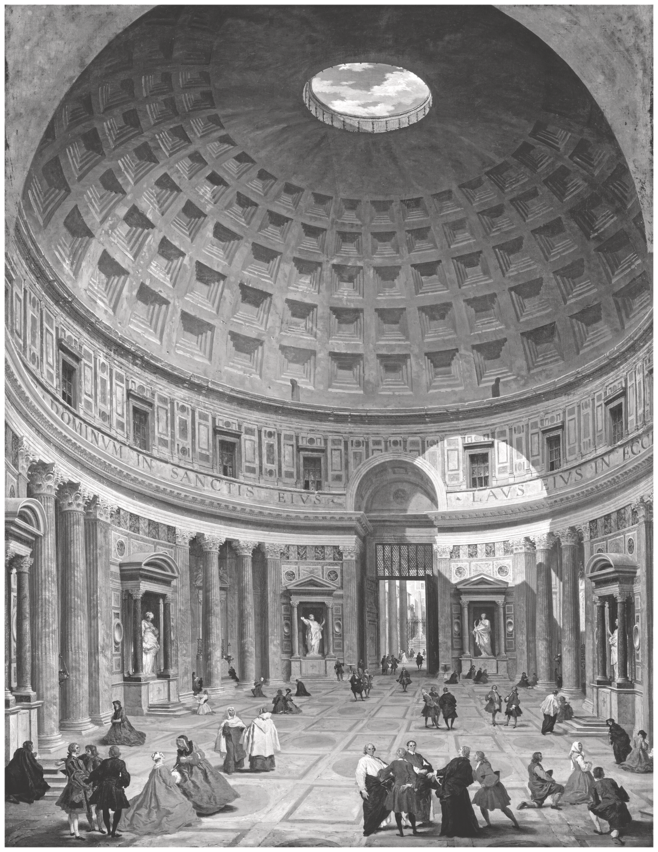
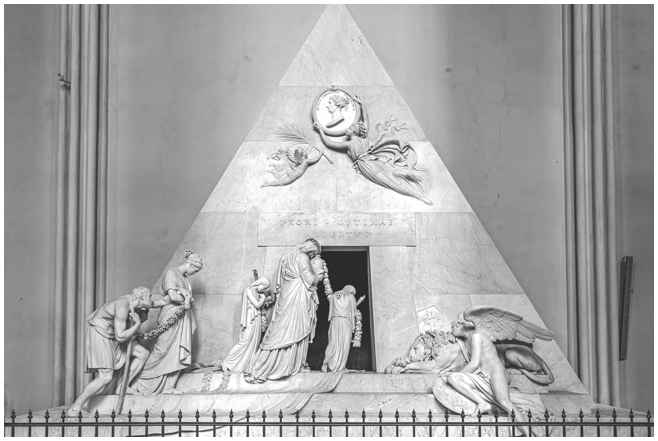
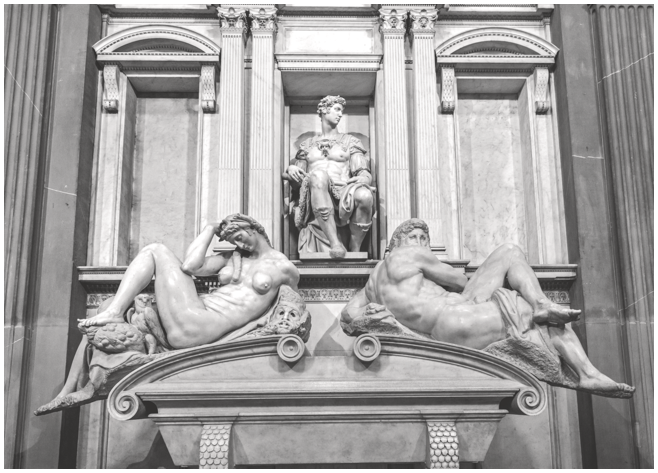
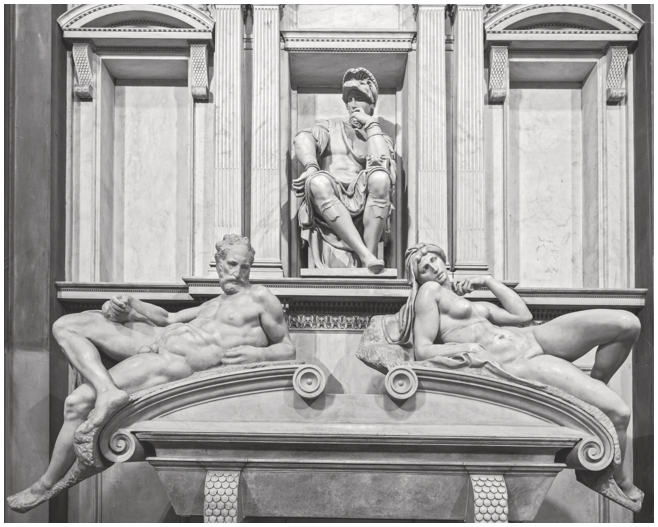

 Open access