


1. Introduction
Designers are often asked to state their assumptions. However, what assumptions are and how they are made remain poorly understood, conceptually and empirically. This study addresses the question “How do individuals make assumptions?” by analysing responses to ill-structured problems using reflexive thematic analysis (Reference Braun and ClarkeBraun & Clarke, 2006). This study is informed by gaps in the literature in critical thinking (Reference EnnisEnnis, 1982), philosophy (Reference MeinongMeinong, 1983), psychology (Reference Delin, Chittleborough and DelinDelin et al., 1994), and design (Reference SimonSimon, 1990; Reference Singh and ChakrabartiSingh, 2019). All point to the lack of an empirical understanding of how assumptions are made and the corresponding need for a theory of assumption-making.
1.1. What is an assumption?
Everything in a discipline either follows from or is based on its basic terms and fundamental concepts (Reference Mitroff and SagastiMitroff & Sagasti, 1973). Therefore, we first clarify the meaning of the term “assumption.” Assumptions are commonly understood as “things” we accept as true without question or proof (Cambridge University Press, n.d.). However, Reference Delin, Chittleborough and DelinDelin et al. (1994) propose that an assumption is an invisible boundary or limit that circumscribes a thinking episode. These limits are not relatively enduring like traits or beliefs, and often the thinker is not conscious of them. The verbalised version of these limits is termed a “postulate” (Reference Delin, Chittleborough and DelinDelin et al., 1994). We adopt this understanding of an assumption as an invisible limit, as a conceptual definition to proceed with our study. However, if these limits or constraints are invisible, how can we operationalise them for empirical investigation, and how can designers ever challenge them? Studies in cognition can test hypotheses about unobservable mental concepts by objectively measuring their corresponding behavioural consequences (Reference Bröder, Sternberg and FunkeBröder, 2019). This “indirect” measurement of theoretical concepts is not unique to research on cognition but is also commonly used in the natural sciences, for example, physics, where the force of gravity is inferred from its effects on objects. Studies in design cognition can follow suit.
1.2. Ill-structured problems as a fertile ground for assumption-making
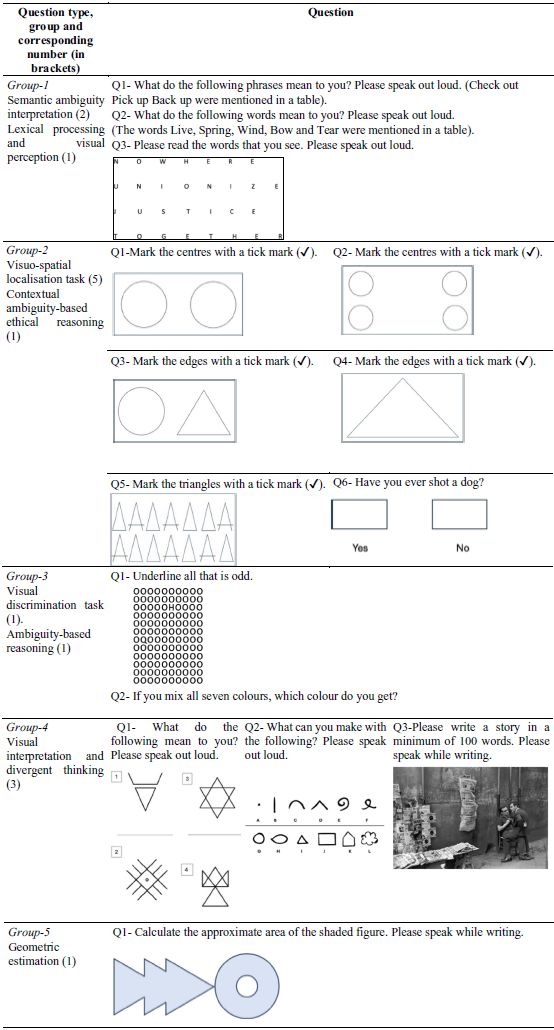
According to Reference KitchenerKitchener (1983), ill-structured problems are those for which no single solution is unequivocally correct and for which competing evidence exists (Reference KitchenerKitchener, 1983). Design problems have long been regarded as wicked (Reference Rittel and WebberRittel & Webber, 1972) and exploratory (Reference GeroGero, 1990), often due to a lack of complete information. We therefore treat ill-structured problems as a fertile ground for studying assumption-making. We have presented participants with questions containing polysemous and homonymous words, culturally unfamiliar symbols and visual glyphs from which “anything can be made in the world” (Reference GrayGray, 2010) (see Table 1).
1.3. Potential contribution to design cognition
This study recognises that when designers are asked to state their assumptions, what they report are postulates in Reference Delin, Chittleborough and DelinDelin et al.’s (1994) sense: verbalised statements that result from a thinking process. The origins of these postulates stem from limits on thinking i.e., assumptions. We aim to trace these limits with empirical data and, eventually, contribute to the understanding of assumption-making in design cognition.
2. Methodology
2.1. Research design
The study adopted a qualitatively driven research design. We employed the within-subjects design for the study. Participants were subjected to two time conditions. A within-subjects design was selected to control for individual differences and ensure that the observed effects stem from temporal variations rather than between-subject variability. We developed experimental questions with multiple plausible solutions. We developed the questions to mimic how a designer might think while solving a design problem, which is inherently ill-structured. It was done either through the words in the question or through the structure of the task that followed. The questions were administered through a test booklet, first in the short form (with question durations ranging from 5 seconds to 3 minutes) and then in the long form (15 seconds to 6 minutes). As the study is in its pilot stage, we did not investigate the distinction between short and long-form responses in this paper. We have chosen only four questions for the current analysis.
2.2. Materials
We administered fifteen experimental questions via an A4-sized booklet, printed in landscape orientation. The questions were initially presented to the participants in the order shown in Table 1, and then, to the last six participants, in a jumbled order.
The questions we have used for the current analysis are questions 1 and 2 from groups 1 and 4. Data from these questions have been analysed from two stages: once from the think-aloud data while responding to the question, and then from the responses to the probing questions. We chose these questions as they yielded rich initial insights.
Experimental questions

Table 1 Long description
The table is divided into five groups, each containing different types of questions. Group-1 includes questions on semantic ambiguity, lexical processing, and visual perception. Group-2 focuses on visuo-spatial localization tasks and contextual ambiguity-based ethical reasoning. Group-3 involves visual discrimination tasks and ambiguity-based reasoning. Group-4 includes questions on visual interpretation and divergent thinking. Group-5 contains a geometric estimation task. Each group has specific questions designed to elicit different types of cognitive responses. The table lists the question types, group numbers, and the corresponding questions.
2.3. Participants
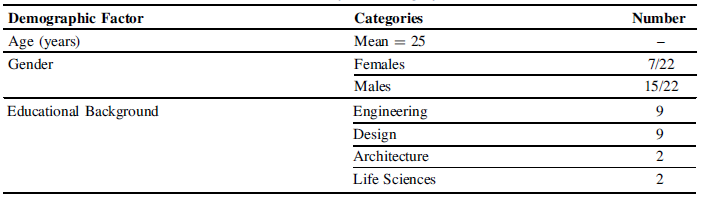
We recruited 22 students for this study through convenience sampling. The sample is drawn from a relatively homogeneous and highly educated population. Table 2 showcases the participant demographics.
Participant demographics

2.4. Data collection
We collected the data in two steps in this study. Once, as responses to the questions in the test booklet, and then as responses to probing questions asked at the end of both the short and the long forms. The probing began with a single question, “Can you tell me what your thoughts were while answering this question?” The interviews were audio-recorded and then transcribed orthographically using the Noted app on a MacBook, capturing all spoken words and sounds, including the participants’ and interviewers’ filler words (‘mm-hm’s), and laughter. All participants provided informed consent for the study and audio recording. The study has received ethical approval from the Institutional Human Ethics Committee.
2.5. Analytic strategy
We followed the steps outlined in the authoritative article by Reference Braun and ClarkeBraun and Clarke (2006) augmented by the guidelines they articulated in recent works (Reference Braun and ClarkeBraun & Clarke, 2022). The analysis starts with (1) familiarisation with the data, then (2) coding, (3) searching for themes, (4) reviewing themes, (5) defining and naming themes, and, finally, (6) writing the analysis.
The analysis is based on data gathered through questions employing the think-aloud protocol (Reference Ericsson and SimonEricsson & Simon, 1993) and probing questions at the end of the short and long forms. We have followed the inductive orientation to thematic analysis, grounded in the contextualist paradigm.
A deductive orientation also came into play as we drew on theoretical constructs from cognitive psychology, such as mental images (Reference JamesJames, 1890) and schemas as organised knowledge structures that guide perception and interpretation (Reference BartlettBartlett, 1932), to account for cognitive phenomena that participants did not explicitly articulate. We coded the data in NVivo and visualised the themes in MAXQDA. Coding of the data usually oscillated between the latent and the semantic level of analysis.
2.6. Reflexivity
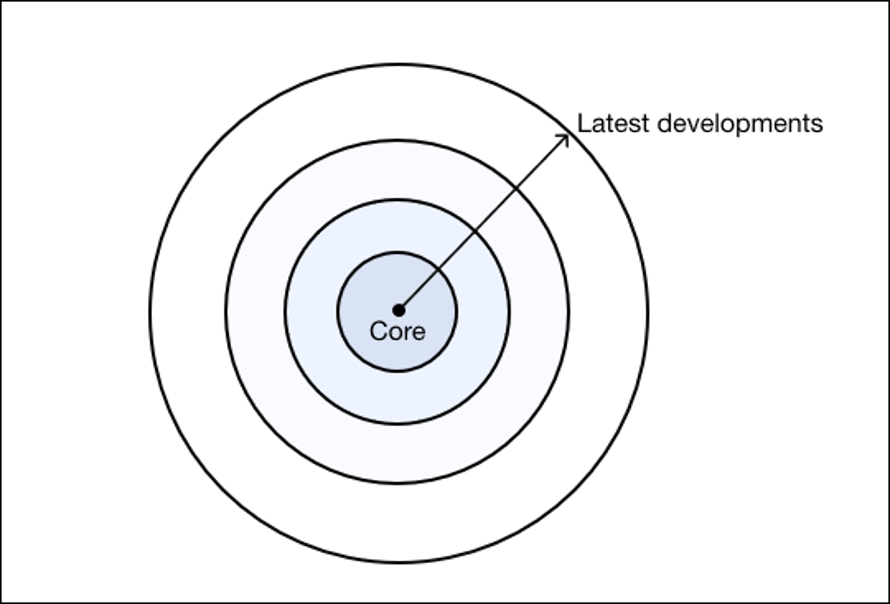
Qualitative research, owing to its situated nature, must specify the perspective from which data is gathered and interpreted. The first author is a doctoral candidate in a design department with prior training in psychology and design. This paper is part of her ongoing PhD work. She conducted the experiments and analysed the data. This is her first large-scale thematic analysis. The second author and supervisor is a professor of design who specialises in Computational Thinking, Design Thinking and Systems Thinking, and leads a group that studies a range of topics, including design cognition. A recurring topic of discussion in the lab is the degrees of separation in a discipline. At the core of the concentric diagram presented in Figure 1 are the foundational concepts of a field; shall we proceed with research at that level, ripple effects are produced, extending to the outermost level, where the latest developments lie. The aim to produce a theory of something as implicit as assumption-making is further reinforced by this discussion.
Degrees of separation in a discipline

Coding quality does not depend on multiple coders (Reference Braun and ClarkeBraun & Clarke, 2021). Therefore, only the first author conducted the coding of data in this initial analysis. Nonetheless, there were regular discussions with the supervisor and colleagues at the institute. We acknowledge that the bounds of our interests and specialisation influence the analysis from the very outset.
3. Analysis and discussion
We constructed three themes: “Inside the invisible limit”, “From my memory to meaning” and “My knowledge is valid: Epistemic justification”. This section discusses each theme in turn. Selected quotations are presented in-text with the corresponding participant number.
3.1. Theme 1: inside the invisible limit
Reference Delin, Chittleborough and DelinDelin et al. (1994) define an assumption as an invisible limit on a thinking episode. It is temporally short-lived and does not exist in the mind as an entity (as a memory or a belief). We constructed this theme to capture many ideas around this “invisible limit” on a thinking episode. The first subtheme is “Unable to understand what to do.” It seems to reflect the ill-structuredness of the questions. Some participants could not proceed confidently, especially with the glyphs question (question 2, group 4; see Table 1). The meaning of the word “make” in the question “What can you make with the following?” was the source of the confusion, as verbalised by participants 5 and 15:
“Let’s assume … Um … I don’t understand this question“(P-5)
“… and then I am reading it, it’s maybe I have to make something with it, I don’t know. But I can’t think of anything” (P-15)
The second sub-theme under this theme is “Opaque Origins of Thoughts.” For some questions, participants were unable to put into words how or even why a thought came to their minds. An excerpt from post-hoc probing illustrates this sub-theme, wherein participant 21 is asked why only specific images came to their mind:
“I don’t know. Sorry. It’s like whatever you get first is whatever you write first. I don’t know how it came. Maybe it came from somewhere.” (P-21)
The participants seem unaware of a boundary that restricts their thoughts. They can only respond within it. This understanding is reinforced by some of the verbalisations of the participants, such as:
“I don’t really know how I thought of this” (P-5)
“That’s why, yeah, I didn’t have any solid reason behind the assumption” (P-5)
“It just came to my mind” (P-3)
This difficulty in verbalising how a thought arises is consistent with the claim proposed by Reference Nisbett and WilsonNisbett and Wilson (1977) that individuals lack introspective access to their higher-level cognitive processes and instead fall back on simple narratives. This leads to two critical observations: we cannot articulate the process through which a thought comes to our mind, and we cannot articulate the limits that circumscribe the thinking process. Nonetheless, we can justify the validity of the product of the thinking process, i.e., the response to the question, and explain why we “feel it is right”, which will be explored in Theme 3 on epistemic justification.
The third sub-theme highlights a phenomenon we have termed assumptive inertia (Reference Kashyap and SinghKashyap & Singh, 2025). It can be understood as the tendency to uphold initial assumptions despite new opportunities or extended time for revision. Participant 15 articulates this while solving a question as follows:
“I don’t have anything different from last time” (P-15)
Participant 17 talked about a strong association that they cannot break in their mind:
“I didn’t want to give a different answer because these are very vivid images to me. When I think of this, I immediately have something in my head. It’s a little difficult for me to break that association and think of something else. Anything else would feel a bit more contrived to me. Like it doesn’t feel as genuine as an answer.” (P-17)
Vivid imagery is explored in a sub-theme that we will mention under Theme 2 by the same name. Images usually “pop up” in participants’ minds, indicating a strong, immediate association that seems resistant to revision, despite more time. This suggests that, among the many factors at play, time sometimes fails to override strong associations and does not affect responses to some types of stimuli. The factors that lead to the same answer may be present both within the problem-solver (as psychological variables) and in the task environment (such as time and available information). This also seems to suggest that some of the limits that circumscribe a thinking episode are stronger or more impervious to revision than others. This could be because of what informs the limit or boundary. Vivid images from an autobiographical memory probably form stronger associations that are resistant to revision over time.
The fourth sub-theme is “Failing to consider another possibility”, in which participants explicitly state that they assumed they could answer only one way. Participant 20 explicitly stated the following when asked why they used only one of each of the glyphs in their response:
“Oh, right, because I thought that I would not use it twice, although you have not mentioned that. I just made an assumption, I don’t know why.” (P-20)
This response also revisits the sub-theme “Opaque Origins of Thoughts,” as the participant is unaware of why a decision was made during the thinking process.
In our study, we do not ask participants to “state their assumptions” directly. Instead, we infer assumptions in Reference Delin, Chittleborough and DelinDelin et al.’s (1994) sense from their responses to ill-structured problems. When a participant consistently treats a symbol as if it must represent a familiar object or maintains the same interpretation even in the long form, we interpret this as evidence that their thinking is limited during that episode and may even be primed by the answer given in the short form.
3.2. Theme 2: from my memory to meaning
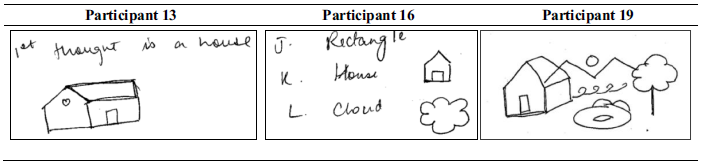
Theme 2 highlights a fundamental notion about problem-solving: any problem is solved using knowledge available in one’s memory. However, different questions activate different types of memory, implicit memory (Reference SchacterSchacter, 1987), episodic memory (Reference Tulving, Tulving and DonaldsonTulving, 1972) and procedural memory (Reference Johnson, Healy and ProctorJohnson, 2003). To illustrate this insight, we explore the first sub-theme, “Childhood Memories Triggered”. Across the experimental questions, two questions seem to illuminate participants’ childhood memories: the question with four symbols (group 4, question 1, see Table 1) and the question with glyphs (group- 4, question 2), in particular, glyph K. Participant 19, when probed about their response to the question with glyphs, said:
“I think this is the image that I usually used to draw when I was young. A house and a scenery. So maybe that’s why I immediately went there. And then there was one time … my teacher complained to my mom, and she was like, “Don’t draw this ever again.”… But then I stopped drawing. But whenever I go to my old drawing books, this is what I see.” (P-19)
Their response indicates that a vivid episodic memory (Reference Tulving, Tulving and DonaldsonTulving, 1972) was triggered upon seeing glyph K (group 4, question 2). Participants 13, 16 and 21 were also reminded of a house drawn in their childhood, as seen in their responses:
“So, the first thought that comes to my mind is a house.” (P-13)
“This looks like a house, a drawing of a house that we used to make in our childhood.” (P-16)
“… drawing. That was my hobby. … everyone has their initial stages of drawing from these houses, mountains.” (P-21)
Table 3 showcases responses to the question with glyphs (group-4, question-2) by participants 13, 16 and 19.
Responses by 3 participants (13,16, and 19) to the question with glyphs

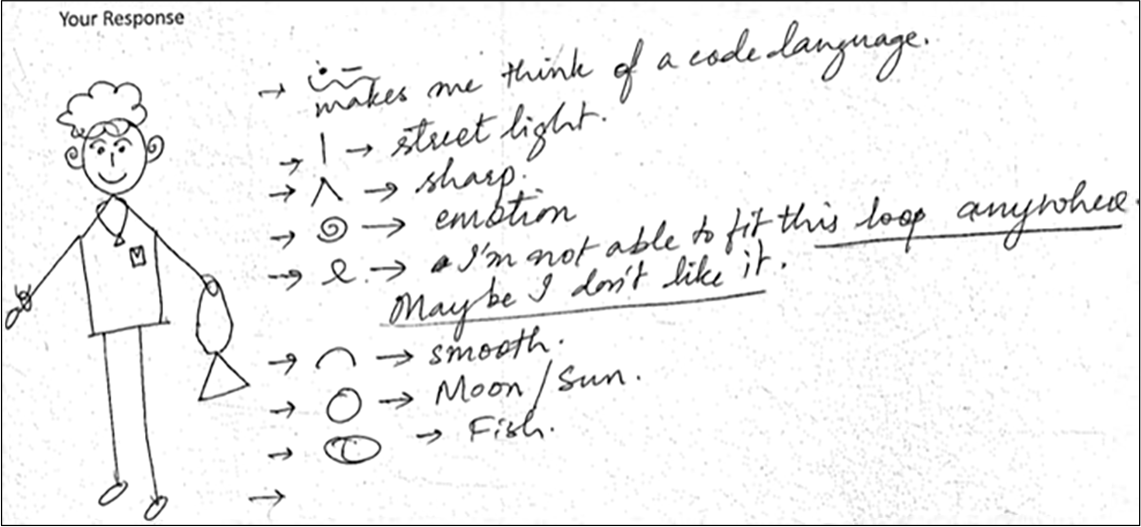
Participant 3 recalled a memory in which their teacher crossed out their work, resembling the glyph F, and explained why that emotion kept them from including it in their drawing, as shown in Figure 2 below. Their response follows Figure 2.
Response by participant 3 to the question with glyphs (group 4, question 2)

“I don’t know … it gives me some weird kind of emotion, I don’t know why, but yeah … the loop, I actually couldn’t fit it anywhere. … but now when I think of this loop … when I was a kid, when my teacher used to correct the books, when my answers were wrong, she used to put wrong just like this, but it was horizontal.” (P-3)
Another childhood memory that was mentioned more than once was the one triggered by the third symbol in the symbols question (group 4, question 1, see Table 1). Participants mentioned that this was how they learnt how to draw a star in their childhood:
“This was how I learnt to draw a star … Blue star in childhood.” (P-16)
“I used to make stars with two triangles. This is how I used to make stars in my
childhood.” (P-13)
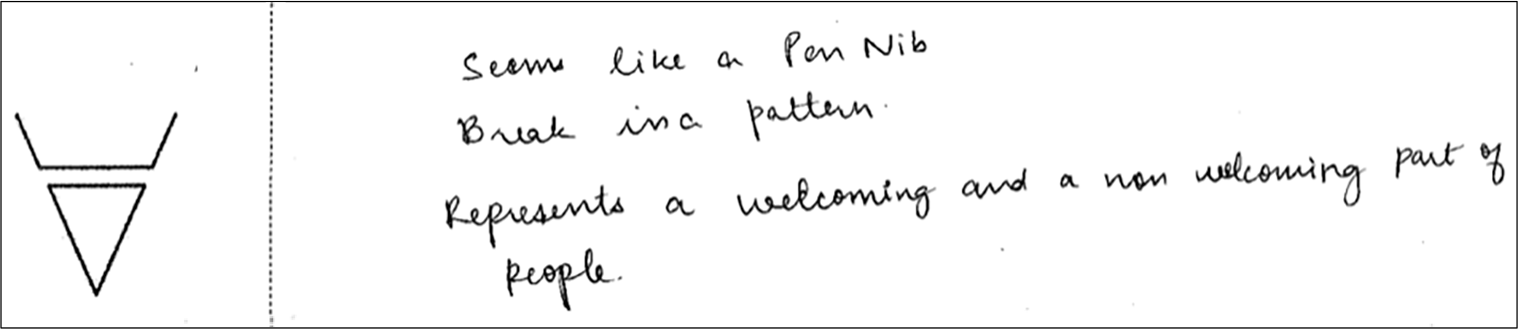
The next two sub-themes are “Schema-Based” and “Vivid Imagery”. We interpret these as closely linked, as schema-based retrievals are frequently described with vivid mental imagery. Participants make schema-based retrievals from their memory. These include immediate responses to words, phrases, glyphs and symbols. These responses are based on participants’ conceptual understanding of the meaning of a particular stimulus. Responses centre on schemas, such as an object schema, in which participants immediately think of an object that resembles a symbol. For example, the first symbol (group 4, question 1) was interpreted by multiple participants as a pen nib. When asked if they saw any images in their mind, participant 15 responded as follows:
“Yeah, the first thing was a pen nib, which is … pen nib just directly.” (P-15)
Figure 3 showcases participant 13’s interpretation of symbol 1 (group 4, question 1). The responses seem to show a progression of thought from semantic to abstract.
Response by participant 13 in the short form to question 1, group 4

Many participants also see the symbol as either an inverted A or an inverted triangle. Responses from some participants are as follows:
“But then this is also sort of an inverted triangle.” (P-20)
This suggests a schema that is so deeply entrenched that incoming perceptual information is subtly distorted to preserve coherence with prior knowledge and expectations (Reference BartlettBartlett, 1932). Another schema that features in the analysis is the “Schema of Verbs”, in which participants respond with the verb meaning in mind. Some of the responses to illustrate this are as follows:
“Live in the moment, be present …” (P-14)
“Pick up is to pick something up, to pick a thing up.” (P-16)
“By bow, I thought of bending down, greeting someone.” (P-13)
Interestingly, the response to the word bow was quite often along the lines of “bow and arrow”, which reflects linguistic entrenchment: a frequently co-occurring word pair that is stored and accessed as a familiar collocation, reflecting an underlying schematic association between the two concepts. (Reference Schmid and SchmidSchmid, 2017).
It is important to mention here that we are not studying recall. Our questions are ill-structured problems, not memory tasks. Participants are constructing an interpretation from scratch for unfamiliar symbols, polysemous words and phrases, and glyphs. The key focus is not on whether the schema distorted memory, but how a specific schema became the basis of the first response when nothing is clearly specified.
The fourth sub-theme is “Domain Activation”. Participants draw parallels to an activity they have done as part of their profession or to an object they frequently encounter in their work. One such example is from a probing excerpt of participant 15:
“This also, I think … is very similar to what I wrote last time, just that this time I started to make the surface developments. … So, if you consider them … this as a piece of paper… These are cut. … So, I started to develop them this time.” (P-15)
Participant 15 appears to recall a procedural memory of creating surface developments upon seeing the second symbol in the symbols question.
3.3. Theme 3: my knowledge is valid: epistemic justification
Reference KitchenerKitchener (1983) argues for a three-level model of cognitive processing when solving ill-structured problems. At the first level, cognition, individuals read, perceive and solve the problem. At the second metacognitive level, individuals monitor their own progress when engaged in these first-order tasks. At the third level, epistemic cognition, individuals reflect on the limits, certainty and the criteria of knowing. We interpret the third theme in our analysis as resonating with the third level in this model. The sub-themes in this theme are: “Justification based on weight of memory”, “Justification based on known facts”, “It’s basic, we all know it”, and “Justification based on experience.” The core idea of this theme is how participants justify their responses when asked why a particular response came to mind. We see this theme as a window to the invisible limit proposed by Reference Delin, Chittleborough and DelinDelin et al. (1994). We are not claiming to “see” the assumption itself, only the restricted pattern of thinking that points to it. The following excerpt is presented to illustrate the first sub-theme, “Justification based on weight of memory.” Participant 15 was asked if they could tell the experimenter why they chose one out of two images that came to their mind while answering question 2 in group 1:
“This was more visual in my brain, so I almost think of everything visually, so whatever has more visual power in my brain, I go with that. The bow down was more visual. … And spring, the second spring, was the second thing that came to my mind. These were almost parallel, but that had more weight, like the visual.” (P-15)
When asked about what images they had in their mind, participant 20 verbalised their justification for not giving the verb meaning of the word “live” in question 2 in group 1 as follows:
“Uh, live means live like real time, so it’s the match being broadcast … So yeah, some stadium scene comes in mind, and that’s live. But then the first thing which came to my mind was to live, to be alive. But then you can’t write it. There is no synonym to it. Live is just live. … so, two things came to my mind … yeah, so but the first thing that came to my mind was just live that which is we are here for right…“(P-20)
This might suggest that participant 20 and other participants too, try to defend their knowledge or vocabulary, as they rely on it to solve a problem within a limited time. Maybe the participant was trying not to use the word itself to define it as verbalised by participant 17 when asked about the thoughts that came to their mind while solving the question with words (question 2, group 1):
“Thoughts in the head … was like, how do I explain the word without using the word itself? … Because some of these are very fundamental words.” (P-17)
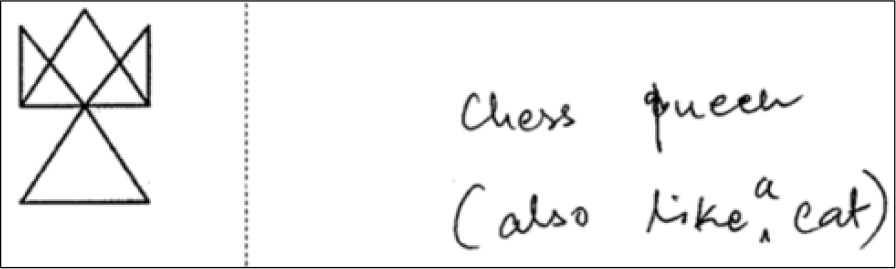
This explains the sub-theme “It’s basic, we all know it.” Participants tend to exhibit epistemic cognition (Reference KitchenerKitchener, 1983) when answering the probing question, “What were the thoughts in your head while solving this question?” They think that because they have a particular answer or constructed meaning to a stimulus, others would share the same meaning as well. This can be seen in Participant 17’s response to the symbols question (group 4, question 1), wherein they say the following:
“Origami cats look a lot like this. So that’s the first thing I thought of when I saw this. … so, this came to my head. … I would think so, but I don’t think it’s that unique of an experience. I feel like someone who’s not done origami might also think it’s a cat. Maybe it’s just what a cartoon cat looks like to a lot of people.”
Participant 17’s response to the question with symbols (Group 4, Question 1)

The themes in our analysis also seem to suggest the order in which thoughts flow in a participant’s mind, thereby taking us closer to understanding how an assumption is made.
4. Conclusion
Our analysis suggests that, when participants are presented with an ill-structured problem, a schema gets activated to organise their knowledge (Reference BartlettBartlett, 1932). However, participants are unaware of this activation and thus, unaware of the invisible limit (Reference Delin, Chittleborough and DelinDelin et al., 1994). So far, the findings agree with Reference Nisbett and WilsonNisbett and Wilson’s (1977) claim that people have limited direct access to higher-order processes and instead rely on implicit causal theories. When participants are probed to examine their thought process, they are at best able to describe a fuzzy sequence that led to their response. Even the first thing that comes to mind, which mostly presents itself as an image, cannot be verbalised clearly and is often not singular. A choice between the multiple ‘firsts’ seems to be induced by a mix of various variables. These can be external variables, such as time in our study, or internal variables, as mentioned in the third theme on epistemic justification. The findings are provisional as they are based on a pilot study.
The current thematic analysis is a step towards an eventual grounded theory analysis (Reference Charmaz, Smith, Harré and Van LangenhoveCharmaz, 1996) of the experimental data. The themes of this analysis serve as sensitising concepts for grounded theory. We have developed initial insights from the current analysis of 4 out of 15 experimental questions. Analysis of the remaining questions will allow us to test these insights and lead to a more comprehensive understanding of how we make assumptions. Eventually, this work aims to propose a theory of assumption-making with the primary aim of enabling designers to identify and challenge their assumptions.

 Open access

