





Introduction
The expansion of international law represents one of the defining features of modern global politics (e.g., Abbott, Keohane, Moravcsik et al. Reference Abbott, Keohane, Moravcsik, Slaughter and Snidal2000; Alter, Hafner-Burton, and Helfer Reference Alter, Hafner-Burton and Helfer2019). From regional and global economic agreements to the establishment of fundamental human rights regimes, individuals around the world are increasingly affected by the scope and breadth of international law. With this expanding reach, however, has come growing public scrutiny of international law’s effects (e.g., Walter Reference Walter2021; Voeten Reference Voeten2022). As a result, whereas the politics of international law were once primarily the purview of political elites, they have become ever more subject to the constraining – and at times empowering – influence of public opinion (e.g., Brutger and Kertzer Reference Brutger and Kertzer2018; Carrubba Reference Carrubba2009; Dai Reference Dai2007). Critically, the nature of citizens’ attitudes in this respect is becoming increasingly shaped by the seemingly all-powerful political force of partisanship (e.g., Strezhnev, Simmons, and Kim Reference Strezhnev, Simmons and Kim2019; Wallace Reference Wallace2019).
At the same time that attitudes toward international law have come to reflect partisanship, so too has the politicization of domestic institutions – that is, the process by which citizens come to view an institution’s output as ‘politics carried on by other means’ (Ferejohn Reference Ferejohn2002, 64) – increasingly led citizens to view national political institutions in partisan terms (e.g., Svolik Reference Svolik2020). As erstwhile institutions meant to exercise checks and balances become subject to partisan capture and subsequently devolve into ‘unaccountable instruments of partisan or incumbent advantage’ (Lieberman, Mettler, Pepinsky et al. Reference Lieberman, Mettler, Pepinsky, Roberts and Valelly2019, 471), citizens cannot help but come to see those institutions’ decisions through the lens of partisanship. Whether witnessing partisan bureaucratic capture (e.g., Dahlström and Holmgren Reference Dahlström and Holmgren2019) or more extreme forms of institutional manipulation to insulate partisan majorities (e.g., Bermeo Reference Bermeo2016; Helmke, Kroeger, and Paine Reference Helmke, Kroeger and Paine2022), citizens form beliefs over institutions’ favorability towards their own political party (e.g., Ahlquist, Ichino, Wittenberg et al. Reference Ahlquist, Ichino, Wittenberg and Ziblatt2018; Graham and Svolik Reference Graham and Svolik2020). Consequently, when citizens observe institutions they view as biased against their political party making decisions, they view such actions with skepticism and are less likely to support them.
In this article, we argue that these two trends – partisan influences on attitudes toward international law and the politicization of domestic institutions – are crucially linked in affecting public support for international law. Since international institutions often lack meaningful coercive capacity, domestic institutions are frequently involved in the implementation of international law. This connection is critical to scholarly narratives about the widespread proliferation and enforcement of international law (e.g., Hillebrecht Reference Hillebrecht2014; Simmons Reference Simmons2009). When citizens view such domestic institutions as (un)favorable towards their political party, we argue that they similarly will view their decision-making vis-a-vis international law (un)favorably. Simply put, the domestic institutions involved in questions of international law can affect citizens’ support of international law itself.
One set of institutions that are instrumental in the expansion of international law and are increasingly subject to politicization are domestic courts. Whether serving as venues where citizens can assert their fundamental protections under international law or conduits for bringing cases and implementing the decisions of international courts, domestic courts play a substantial role in translating abstract principles of international law into concrete protections for citizens (e.g., Alter and Helfer Reference Alter and Helfer2010). More specifically, these courts may serve to increase public support for international law (e.g., Cheruvu and Krehbiel Reference Cheruvu and Krehbiel2024) and may be the vehicle through which international law is enforced against recalcitrant governments (e.g., Weiler Reference Weiler1991). Precisely because of their ability to make policy and adjudicate legislative acts, however, co-opting, capturing, or otherwise neutralizing courts is a profitable strategy for a political party (e.g., Bonica and Sen Reference Bonica and Sen2017; Ginsburg and Huq Reference Ginsburg and Huq2018). These actions in turn have consequences for citizens’ beliefs about the partisan lean of the courts, making some less likely to support decision-making of courts they perceive as biased against their political party (e.g., Bartels and Johnston Reference Bartels and Johnston2013; Jessee, Malhotra, and Sen Reference Jessee, Malhotra and Sen2022). We argue that these effects extend to citizens’ perceptions of international law when they view their courts making decisions on it. That is, when citizens have an (un)favorable partisan view of their courts, they similarly view their decisions on international law (un)favorably.
We test this argument through a survey experiment fielded to 1027 respondents embedded in an original nationally representative survey of 2000 respondents in Hungary. To evaluate the impact of domestic court involvement in international law, our experiment presents a vignette that mimics the European Union’s (EU) preliminary reference system. With opponents of Hungary’s Fidesz-led government largely perceiving Hungary’s courts as captured by the government, we find that informing opposition supporters that their domestic courts were involved in an EU law decision reduces support for the decision, particularly among opposition supporters that have higher support for the Court of Justice (CJEU) than their domestic courts. Among Fidesz supporters, we do not find any legitimacy-enhancing effects of domestic court involvement, as Fidesz partisans’ support of international law does not increase when told that their domestic courts were involved in a decision on EU law.
This article, thus, extends recent research on public support for international law (Cheruvu, Krehbiel, and Mussell Reference Cheruvu, Krehbiel and Mussell2025; Cheruvu and Krehbiel Reference Cheruvu and Krehbiel2025; Madsen, Mayoral, Strezhnev et al. Reference Madsen, Mayoral, Strezhnev and Voeten2022). Building on insights from legitimation theory (Ura Reference Ura2014; Dahl Reference Dahl1957), existing research has found that domestic courts have the potential to increase public support for international law (Cheruvu and Krehbiel Reference Cheruvu and Krehbiel2024). Indeed, we preregistered this study with hypotheses based on such insights, including an expectation that domestic courts increase support for international law, even in backsliding contexts such as Hungary, and a lack of consideration for the role of partisanship in shaping the effect of individuals’ relative trust in the CJEU vis-a-vis the Hungarian courts. That we find the opposite of this – that domestic courts might delegitimize international law – thus represents a departure from our preregistration (and, in the case of our analyses of partisanship, post-hoc exploratory analyses) but also a novel theoretical and empirical contribution highlighting the influence broader political conditions have on the effects of judicial decisions on individuals’ attitudes. Even though our results are based on a single issue – we also preregistered a second experiment for the other half of our respondents regarding a hypothetical Covid pandemic-related policy on vaccination requirements for entering the country but were unable to use it because the government removed all Covid entry requirements, including vaccinations, just days before our survey went into the field – that this issue is something as relatively technical as the taxation of foreign pension funds further lends credibility to our finding of such a delegitimizing dynamic.Footnote 1
The remainder of the paper is organized as follows. First, we describe the extant literature on determinants of support for international law and theorize about how the involvement of politicized domestic courts can affect that support. Second, we present the empirical case of Hungary and explain how the politicized nature of its domestic courts and participation in the EU’s preliminary reference system make it an ideal case to test our theory. Third, we describe our empirical methodology and survey experiment testing our theory and present our results, with special attention to the lack of effects among Fidesz supporters. Lastly, we conclude by discussing our findings’ implications for the international law and comparative judicial politics literature, backlash against international courts, and the ongoing rule of law crisis in the EU.
Determinants of public support for international law
Scholars are increasingly recognizing the value of public support for the efficacy of international law (e.g., Chilton and Linos Reference Chilton and Linos2021). Simply put, when voters value international norms and their country’s international treaty commitments, leaders have electoral incentives to ensure that their behavior comports with international legal obligations (e.g., Dai Reference Dai2005; Mansfield, Milner, and Rosendorff Reference Mansfield, Milner and Rosendorff2002). The determinants of such support may vary based on a number of factors such as citizens’ proximity to a violation of international law (e.g., Chapman and Chaudoin Reference Chapman and Chaudoin2020), the policy area of the law (e.g., Madsen, Mayoral, Strezhnev et al. Reference Madsen, Mayoral, Strezhnev and Voeten2022), their confidence in domestic legal institutions (e.g., Cheruvu and Krehbiel Reference Cheruvu and Krehbiel2024), or the ideology of the voter (e.g., Wallace Reference Wallace2013).
Among these predictors of support for international law is a voter’s partisan affiliation. In particular, we may expect partisans to leverage the protections of international law when it is to their party’s benefit and to eschew such constraints when it prevents them from achieving their policy objectives. For example, Lupu and Wallace (Reference Lupu and Wallace2019) find that informing government supporters in Israel and Argentina that the government’s violent repression of the opposition violated international law did not decrease support for the government’s actions. Similarly, in the United States, Strezhnev, Simmons, and Kim (Reference Strezhnev, Simmons and Kim2019) find that elite endorsement of policies that violate international law makes co-partisans more likely to say that the policy is not illegal under international law. In other words, co-partisan endorsement affects perceptions of legality in and of itself.
The effects of partisanship, however, do not exist in a vacuum but rather within an institutional context. The creation and enforcement of international law, crucially, frequently requires partisan actors to work through domestic institutions. As such, bodies must often ratify and enforce agreements – and with international organizations often lacking the monitoring and enforcement capacity to detect and correct violations – international law’s efficacy is frequently dependent on their cooperation (e.g., Simmons Reference Simmons2009). Indeed, explicit in theories of international agreements as credible commitments is the ability of domestic institutions to hold leaders accountable for violations (e.g., Fearon Reference Fearon1998; Leeds Reference Leeds1999). Absent such domestic accountability mechanisms, leaders may face little to no political consequences for breaking international law.
This integral connection between domestic institutions and international law can become tenuous when domestic institutions are subject to partisan politicization. If ambitious politicians view sources of political accountability, such as the media or courts, as targets for criticism and manipulation rather than deference and respect, they may fundamentally affect the public’s perceptions of these institutions as politically biased (e.g., Krishnarajan Reference Krishnarajan2023). Moreover, the use of tactics such as packing erstwhile democratic guardrails with party loyalists can further citizens’ senses that institutional mechanisms of accountability are captured or otherwise under the influence of one political force to the detriment of others. One potential end result of this politicization process is that support for these institutions, which citizens may have once viewed as neutral and once had a broad base of public trust, increasingly becomes a function of whether one sees them as favoring or disfavoring their political party.
Critically, such partisan-based trust of domestic institutions may have implications for international law’s efficacy. On the face of it, having an international institution implicate one’s political opponents for violating international law may be welcome news. For those with a strong attachment to international law and norms, their opponent’s violation of international law may further play a role in galvanizing momentum to hold those officials accountable at the ballot box, as theories of democracies’ credible commitments to international agreements presuppose (e.g., Simmons and Danner Reference Simmons and Danner2010). Introducing a politicized domestic institution into the process, however, raises the possibility that citizens’ reactions will be colored by their perceptions of that institution’s partisan bias. On the one hand, for those who perceive the institution as favorable toward their party, this might well enhance acceptance for international law. On the other hand, those who perceive the institution as unfavorable toward their party may be hesitant to lend support because of their suspicion of the institution.
This dynamic creates a distinct problem for international institutions looking to leverage domestic institutions to enforce international law. Alleging that a government violated international law in and of itself may not generate any buyer’s remorse for its supporters. In fact, some experimental evidence suggests it generates more support and backlash against international law given the context (e.g., Cope and Crabtree Reference Cope and Crabtree2020; Lupu and Wallace Reference Lupu and Wallace2019). As a result, international institutions are reliant on opposition supporters to hold a government to its international commitments. If the opposition perceives domestic institutions as biased towards the government, however, and such institutions implement international law, international institutions may not be able to count on opposition partisans as allies in the enforcement process. As we lay out next, we thus expect that partisanship, in combination with citizens’ perceptions of domestic and supranational courts, informs the impact of such judicial interactions on citizens’ reactions to international legal rulings.
When the (politicized) courts come marching in
Among the institutions most frequently adjudicating and applying international law domestically are courts. Depending on the context, courts may have the jurisdiction to directly adjudicate disputes that concern international law among domestic litigants and provide an attractive venue for domestic interests looking to hold their government accountable to their international commitments (e.g., Simmons Reference Simmons2009). They, furthermore, often have the ability to directly engage in procedural dialogue with international courts and help facilitate implementation of international law (e.g., Hillebrecht Reference Hillebrecht2014). For example, preliminary reference procedures in the European Union, the Andean Community, and the East African Community – among other international organizations – allow domestic courts to refer cases to their respective international courts and charge these domestic courts with implementing the judgments of their international counterparts (e.g., Alter and Helfer Reference Alter and Helfer2010; Cheruvu and Krehbiel Reference Cheruvu and Krehbiel2024; Krehbiel and Cheruvu Reference Krehbiel and Cheruvu2022). While the details may vary across international legal regimes, broadly speaking, these procedures involve domestic courts requesting an opinion on a question of international law from the relevant international court, thereby linking the two courts together in the same case (Bricker, Carrubba, and Gabel Reference Bricker, Carrubba and Gabel2024). The European Union’s widely used preliminary reference system, for instance, has linked the bloc’s high court, the Court of Justice, and national courts by facilitating an extensive dialogue over a range of issues (Pavone Reference Pavone2022; Weiler Reference Weiler1994). More generally, these types of interactions help increase the political capital of international agreements and help raise future legal questions that necessitate the use of international law (e.g., Keohane, Moravcsik, and Slaughter Reference Keohane, Moravcsik and Slaughter2000).
Domestic courts, nonetheless, are also regularly subject to politicization. With the judicialization of politics on a global scale (e.g., Tate and Vallinder Reference Tate and Vallinder1995), courts are increasingly involved in the creation of policy. For partisan policymakers eager to achieve their goals, therefore, courts are an attractive venue to appoint allies (e.g., Bonica and Sen Reference Bonica and Sen2017), as it increases the probability that their policies will withstand constitutional muster. As such, scholars provide evidence that constitutional reform and political turnover often result in substantial alterations to the judiciary’s composition (e.g., Araya, Hughes, and Pérez-Liñán Reference Arana Araya, Hughes and Pérez-Liñán2021; Arrington, Bass, Glynn et al. Reference Arrington, Bass, Glynn, Staton, Delgado and Lindberg2021), presumably to the benefit of those wielding power.
This politicization, consequently, affects citizens’ perceptions of their courts. Existing research suggests that citizens view partisan appointment procedures as unfair (e.g., Arrington Reference Arrington2018), as they affect the composition of their courts. Citizens, likewise, update their beliefs over time about the partisan leanings of their courts (e.g., Jessee, Malhotra, and Sen Reference Jessee, Malhotra and Sen2022). When citizens perceive that their courts are politically distant from them – also known as subjective ideological disagreement (e.g., Bartels and Johnston Reference Bartels and Johnston2013) – they are less likely to accept their decision-making, with such incongruence deleterious to perceptions of courts as legitimate decision-makers (e.g., Christenson and Glick Reference Christenson and Glick2019) and, subsequently, their ability to obtain compliance (e.g., Vanberg Reference Vanberg2015).
Taken together, these dynamics threaten the efficacy of international law. A key role of courts is the legitimation of policy (e.g., Cheruvu and Krehbiel Reference Cheruvu and Krehbiel2024; Hoekstra Reference Hoekstra2000; Sternberg, Brouard, and Hönnige Reference Sternberg, Brouard and Hönnige2022; Ura Reference Ura2014), whereby courts make public opinion more favorable towards particular policy. Scholars have long argued that national high courts, in particular, may critically inform citizens on policy issues (e.g., Dahl Reference Dahl1957; Gibson, Caldeira, and Baird Reference Gibson, Caldeira and Baird1998). That is, citizens view domestic courts as credible information providers (e.g., Driscoll, Krehbiel, and Nelson Reference Driscoll, Krehbiel and Nelson2025; Staton, Reenock, and Holsinger Reference Staton, Reenock and Holsinger2022) that bring issues into the public discourse (e.g., Franklin and Kosaki Reference Franklin and Kosaki1989) and heighten their salience (e.g., Bailey, Collins, Rhodes et al. Reference Bailey, Collins, Rhodes and Rice2025). Through this process, courts may help citizens better elaborate their views and attitudes clearly (e.g., Johnson and Martin Reference Johnson and Martin1998).
For international law, which is often seen as distant and requires buy-in from domestic actors, this function is essential to gain acceptance from citizens. When citizens perceive domestic courts as politicized, instead of increasing support for a policy, domestic courts may delegitimize international law among those who believe the courts are biased against their preferred political party.Footnote 2 Conversely, we may expect domestic courts to retain their legitimation capacity among those who perceive the courts as favorable to their political party, resulting in more support for international law among these citizens when a domestic court is involved in the decision-making process. This logic leads to the following two hypotheses:
Hypothesis 1. Citizens who perceive domestic courts as unfavorable toward their political party will have lower support for international law when a domestic court is involved in a ruling.
Hypothesis 2. Citizens who perceive domestic courts as favorable toward their political party will have higher support for international law when a domestic court is involved in a ruling.
These expectations, however, may be conditional on citizens’ perceptions of the international institution involved in the dispute over international law (e.g., Anjum, Chilton, and Usman Reference Anjum, Chilton and Usman2021). Citizens may distrust their domestic courts because they perceive them as unfavorable towards their political party but may also have an unfavorable view towards the international institution making the international law claim. These citizens, thus, are already predisposed to view the international institution’s decisions negatively. As a result, their domestic courts’ involvement should not have much of a negative effect. Alternatively, citizens that hold the international institution in high regard should be less supportive of international law when their politicized domestic court is involved. These individuals are predisposed to support the policies of the international institution but become skeptical when an institution they view as biased – their domestic courts – become involved.
In contrast, for those that view the domestic courts as favorable towards their political party, we should observe precisely the opposite dynamic. If citizens trust the international institution and trust their domestic courts, the involvement of their domestic court should not contribute much to their support of international law. Conversely, among those that do not have trust in the international institution but do have trust in their domestic courts, we would expect the involvement of a domestic court to serve the legitimation function as mentioned previously (e.g., Ura Reference Ura2014). This theorizing leads to the following two hypotheses:
Hypothesis 3. The relationship in hypothesis 1 is stronger when citizens trust the international institution applying international law more than their domestic courts.
Hypothesis 4. The relationship in hypothesis 2 is stronger when citizens trust their domestic courts more than the international institution applying international law.
Empirical application: experimental evidence from Hungary
To empirically evaluate our theoretical claims, we use data from a nationally representative survey of 2000 Hungarian respondents fielded from March 17–31, 2022. The political and institutional context of the Hungarian case make it an appropriate setting for our analyses. First, the actions of Hungary’s government, led by Viktor Orban and his Fidesz party, have substantially politicized the Hungarian judiciary (e.g., Bá nkuti, Halmai, and Scheppele Reference Bánkuti, Halmai and Scheppele2012; Epperly Reference Epperly2019). Through a series of so-called reforms, Orban’s government has in effect transformed the once-vibrantly independent Hungarian courts into institutions that are largely subservient to the government (e.g., Kelemen Reference Kelemen2017). One of the many consequences of this undermining of judicial independence and the rule of law is the acute politicization of the courts. Starkly different views of the courts have emerged depending on one’s partisanship, as opposition supporters have become particularly distrustful of what they perceive as a Fidesz-controlled judiciary (e.g., Bayer Reference Bayer2022). This partisan difference is on full display in our survey data, with nearly two-thirds of opposition supporters indicating they have the least possible confidence in the Hungarian judiciary compared to only one-fifth of Fidesz respondents.Footnote 3 Similarly, 90% of opposition supporters indicate that they believe the Hungarian government has too much influence over the Hungarian courts, a view that is only held by a quarter of Fidesz supporters. While such polarized views of courts are not unique to Hungary (e.g., Aydin-Cakir Reference Aydin-Cakir2024; Bartels and Kramon Reference Bartels and Kramon2020), the highly salient nature of Fidesz’s takeover of the courts, coupled with the pronounced manner in which citizens’ views of the government’s actions have come to fall along partisan lines, makes Hungary a logical context for our analyses.
This politicization of Hungary’s courts has taken place within the context of the country’s membership in the EU and, consequently, the EU’s legal system. A key feature of the EU’s legal structure is the preliminary reference, which allows the domestic courts of member states to refer questions of EU law to the EU’s high court, the CJEU. Upon receiving the CJEU’s ruling on the question, the case is then returned to the national court for final disposition. This procedure, which scholars have characterized as critical to the successful development of EU law and the ‘transformation of Europe’ (e.g., Alter Reference Alter2000; Weiler Reference Weiler1991), thus incorporates national judiciaries into the EU legal process by allowing EU law to be spoken through domestic judiciaries rather than solely by the CJEU. As a result, preliminary references quickly became the CJEU’s most common proceeding type, as domestic courts have expanded their use of the procedure to include a wide range of issues (e.g., Stone Sweet and Brunell Reference Sweet and Brunell1998). Moreover, the reference procedure has created a widely used institutional pathway for domestic court involvement in the EU’s legal process that ensures the regular contribution of domestic courts, including Hungary’s, to the development of EU law.
Importantly, these two aspects of Hungary’s political environment are deeply intertwined. On one end, EU authorities have long sought, mostly to limited effect, to reverse the Fidesz government’s efforts to tame and ultimately capture the judiciary (e.g., European Parliament 2018). This tactic includes the use of EU law and the rulings of the CJEU to punish Hungary for violations of the rule of law and other democratic values (e.g., Bayer Reference Bayer2022). On the other end, Orban’s government has consistently sought to stymie the EU’s efforts to bring Hungary to heel, often exercising its veto power and building a coalition with like-minded member-state governments such as that of Poland led by the Law and Justice Party. The government has even gone so far as to attempt to discipline Hungarian judges for referring cases to the CJEU, a policy the CJEU declared unlawful (Reuters 2021). In these respects, the setting of our study is well positioned to assess the intersection of domestic judicial politics with support for international law.
That said, it is also important to consider the extent to which the Hungarian case presents a generalizable context. Perhaps most significant in this respect is that the development of a politicized judiciary in Hungary mirrors that of many other backsliding democracies, in that the actions taken by the Orban government reflect a newer form of backsliding that is couched in terms of reform and formally conforms with legal and constitutional requirements (Bermeo Reference Bermeo2016; Kovács and Scheppele Reference Kovács and Scheppele2018). That is, the process by which Hungary’s courts have become politicized, particularly as it relates to the use of constitutional revision to facilitate the effective capture of judicial institutions by the ruling party, is representative of the tactics regarding courts increasingly employed in polarized political contexts (Aydin-Cakir Reference Aydin-Cakir2024). Additionally, the Hungarian case has become something of a reference point for the study of democratic backsliding more generally (Haggard and Kaufman Reference Haggard and Kaufman2021; Little and Meng Reference Little and Meng2024), making it a particularly useful context given the limited empirical research on the link between public opinion toward domestic courts and support for international law. In short, while Hungary’s experience with the politicization of courts and expansion of international law is not unique in isolation, its particularly salient nature, coupled with the intrinsic importance of the Hungarian case for understanding the dynamics of democratic backsliding, makes the country an ideal setting for an empirical evaluation of our theoretical claims.
Data, experimental design, and measures
Within the survey, 1027 Hungarian respondents were randomly selected to receive our experiment’s vignette.Footnote 4 The vignette presented to respondents informs them about a hypothetical court decision – either by the CJEU directly or a Hungarian court through the preliminary reference procedure – that used European law to respond to a hypothetical government policy. To maximize the generalizability of our vignette, we sought to replicate two key characteristics common to the preliminary reference procedure in the EU. First, in identifying the domestic court that is referring the hypothetical case to the CJEU, we use a lower court rather than an apex or supreme court. While recent scholarship points to an increased willingness on the part of high courts to refer cases (e.g., Pavone Reference Pavone2022), the reference procedure has traditionally been seen as most frequently employed by the lower courts (e.g., Alter Reference Alter1996; Weiler Reference Weiler1991). By using a lower court’s involvement as our treatment, we are thus able to more directly speak to the long-standing claim that it was these courts that influenced the development of EU law. Moreover, this approach allows for greater generalizability of our results, as it limits the extent to which respondents’ reactions to the vignette are altered by idiosyncratic views of a specific court.
Second, we sought to make the experiment as reflective as possible of the types of issues most commonly seen in cases involving EU law. While EU law often does engage with highly contentious and politically salient issues like the freedom of movement, it is often the case that European law is concerned with relatively dense matters regarding economic regulation (e.g., Stone Sweet and Brunell Reference Sweet and Brunell1998). As such, one might be concerned if our vignette is not reflective of the ‘average’ preliminary reference and would, thus, be limited in its generalizability to many, if not most, cases. Therefore, we based the hypothetical case presented in the vignette on an actual preliminary reference case from Germany involving the taxation of pension plans.Footnote 5
With these considerations in mind, respondents received one of the following two vignettes, with the control text presented first followed by the treatment.
In a recent decision, the CJEU ruled that a Hungarian tax law allowing the government to tax foreign pension funds at a higher rate than Hungarian pension funds violated European law. It concluded that the Hungarian government must make the law consistent with EU requirements by taxing Hungarian and foreign pensions at the same rate.
In a recent decision, a district court ruled that a Hungarian tax law allowing the government to tax foreign pension funds at a higher rate than Hungarian pension funds violated European law. The ruling was based on an opinion written by the CJEU. It concluded that the Hungarian government must make the law consistent with EU requirements by taxing Hungarian and foreign pensions at the same rate.
We note two key features of our treatments. First, the legal decision is the same regardless of which court issues the ruling. As a result, respondents face the same policy outcome regardless of treatment; the only aspect that differs is the involvement of the national court in the preliminary references treatment. Second, the preliminary references treatment is designed to reflect the nature of that procedure, as we explicitly inform respondents that the national court requested the CJEU’s opinion and based its decision on that opinion. In doing so, the vignette makes clear the role of both the national court and the CJEU. We label the treatment variable Domestic Court Ruling, with a value of 1 for those respondents who read the vignette of the domestic court’s decision in concert with the CJEU’s ruling and a value of 0 for respondents who received the vignette of the CJEU’s decision directly.
As our theory emphasizes citizens’ support for international law, we operationalized this concept with a recognition of the multifaceted nature of such support. To this end, immediately following the vignette respondents were asked to answer three questions about their reaction to the court decision, each of which captures a different form of support for a decision. First, we asked respondents whether they agree or disagree with the decision (on a 4-point scale).Footnote 6 Second, we asked respondents to use a four-point scale to indicate whether they accepted the decision as the final word on the matter or believed the decision should be challenged, with the exact wording borrowed from Gibson and Caldeira (Reference Gibson and Caldeira2003) to read, ‘Do you accept the court’s decision? That is, do you think the decision should be accepted and taken as the final say on the matter?’ Third, we asked respondents whether they would support (on a 4-point scale) an effort by the government to defy the court decision: ‘Imagine the government refused to comply with the [CJEU’s/Hungarian court’s] decision and continue taxing foreign pensions at a higher rate than Hungarian pensions. Would you support this effort?’Footnote 7 For our dependent variable, Support for EU Law Decision, we calculate the mean of respondents’ answers to these three questions and scale the resulting score from 0 to 1, with higher values indicating higher support for the decision.Footnote 8
Turning to our empirical strategy for the first and second hypotheses, we rely on respondents’ partisanship as an indicator of their perception of Hungary’s courts. As discussed above, there are clear differences between government and opposition supporters when it comes to the judiciary, a cleavage that we leverage here. Moreover, traditional measures, which focus on ideological distance, might not be as effective in the Hungarian context due to the opposition’s significant ideological diversity that includes both left-wing and right-wing parties. Rather, the singular characteristic that largely defines the political landscape in the country is the government-opposition divide. As such, we require a measure for identifying respondents’ partisanship, particularly regarding whether a respondent is a supporter of the government or the opposition. While doing so can be complicated in multiparty systems where opposition parties might be on both ends of the ideological spectrum, in this instance we are aided by our use of the Hungarian context, where practically all significant opposition parties formed a single coalition – the United Opposition – in advance of the country’s 2022 parliamentary election. This allows us to effectively treat Hungary as a two-party system, with Fidesz in government and opposed by this coalition of parties. We, thus, asked respondents, ‘As you may know, there is a national parliamentary election scheduled for April 3rd. Competing in this election will be Fidesz and the United Opposition, which is a coalition of several opposition political parties including Jobbik, MSZP, Momentum Mozgalom and Demokratikus Koalciò. If this election were held next week, which party would you be most likely to vote for?’ Respondents could either select Fidesz (40% of respondents), United Opposition (41%), or ‘I would not vote’ (19%). Our expectation is that a domestic court’s involvement will have a negative effect on support from supporters of the United Opposition and a positive effect for Fidesz supporters.Footnote 9
For our third and fourth hypotheses, we compare respondents’ confidence in the CJEU with their confidence in their domestic courts. For both the CJEU and the domestic judiciary, respondents were asked whether they have ‘a great deal of confidence’, ‘only some confidence’, or ‘hardly any confidence’. In all, 43% stated they had hardly any confidence in the Hungarian judiciary, with 47% stating they only had some confidence and the remaining 10% a great deal of confidence. As for the CJEU, 22% indicated hardly any confidence, 54% only some confidence, and 24% a great deal of confidence. Our measure, Relative Confidence in CJEU, is calculated as the difference between confidence in the CJEU and the domestic courts such that higher values indicate greater confidence in the CJEU. The resulting variable ranges from −2 to 2, with a mean of −0.21 for Fidesz supporters (meaning, on average, slightly more confidence in domestic courts than the CJEU) and 0.94 for United Opposition supporters (meaning a considerably higher level of confidence, on average, in the CJEU than domestic courts).Footnote 10 We expect that among opposition supporters, the negative treatment effect will be greater for those with higher relative confidence in the CJEU, while for Fidesz supporters, we expect a stronger positive treatment effect as their confidence in the domestic courts exceeds that of the CJEU.Footnote 11
We include a series of political and demographic controls, which are particularly crucial for our analyses of the conditional relationships predicted by Hypotheses 3 and 4. First, we account for respondents’ ideology since views regarding both the courts and EU law may be related to one’s political ideology. This control is particularly important when considering respondents’ partisanship, as the coalition nature of the United Opposition means its supporters come from both ends of the political spectrum. To measure ideology, we use respondents’ self-placement on a 10-point scale. Second, as past research has emphasized the importance of democratic values for citizens’ trust in courts (e.g., Cheruvu Reference Cheruvu2023; Nelson and Gibson Reference Nelson and Gibson2020), we measured respondents’ support for democracy based on this question: ‘Which of the following two statements more closely resembled their view: (1) Democracy is preferable, even if it is sometimes unstable (63%; (2) Ordered society is preferable, even if that means limiting democracy (38%)’. Third, we include a measure of respondents’ support for the rule of law – a critical democratic norm – with the following question: ‘Which of the following statements is closest to your view: (1) In some cases the government should be able to ignore the law in order to solve important social or economic problems (41%); (2) The government should always follow the law, even if it causes some harm to society (59%)’.
A second set of controls regards respondents’ views toward the EU and EU law. We account for support for the EU because one’s view of the EU in general likely informs views of specific EU institutions like the CJEU and EU-related policies, such as the one in our vignette. We measure this support using the Eurobarometer’s standard question wording on views toward European membership: ‘In general terms, Hungary’s membership of the European Union is…’ with a 5-point scale from ‘Very Good’ to ‘Very Bad’. As past research has identified familiarity with courts as a key condition for supporting them (e.g., Gibson and Caldeira Reference Gibson and Caldeira1992), we control for respondents’ level of awareness of the CJEU using the question, ‘What is your level of awareness of the European Court of Justice?’ with responses in a four-point range from ‘very aware’ to ‘somewhat aware’ to ‘not very aware’ to ‘have never head of’. To control for respondents’ views on the proper allocation of judicial authority over EU law between domestic courts and the CJEU, we include responses to the following question: ‘Who should have the final say on how European Union law is applied in Hungary?’ Respondents could either answer (1) The Court of Justice of the EU (47% of respondents) or (2) Hungarian courts (53%).
Lastly, we control for several demographic characteristics, including gender, whether a respondent had a college degree, and age.Footnote 12 With our dependent variable ranging continuously from 0 to 1, we estimate linear regressions for each of our hypotheses both with and without controls. To simplify interpretation of our results, particularly discerning how treatment effects differ between opposition and government supporters, we subset the data based on partisanship and run separate models for each subset. As our hypotheses include predictions of conditional relationships, we estimate models with interaction terms between Domestic Court Ruling and Relative Confidence in the CJEU, again for both parties separately.Footnote 13
Results
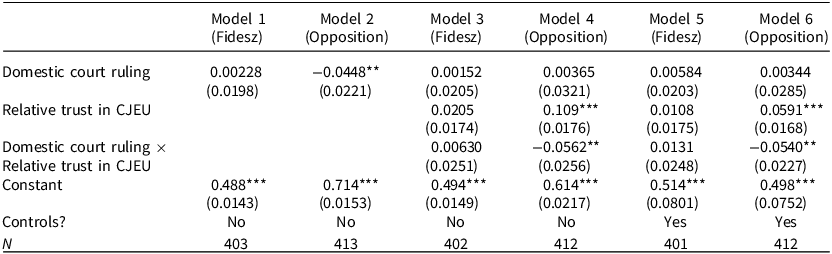
Table 1 presents the results of our analyses. We first consider the findings related to Hypotheses 1 and 2, which, as applied to the Hungarian context, predict differing direct treatment effects depending on whether a respondent is a government or opposition supporter. The results of these analyses are provided in Models 1 and 2, with the former examining Fidesz supporters and the latter United Opposition supporters. Considering Fidesz supporters, the results for whom are provided by Model 1, we do not find evidence supporting our expectation that the involvement of a domestic Hungarian court would increase support for an international law decision among government supporters. While the coefficient is correctly signed, it is statistically indistinguishable from zero.Footnote 14
Regression analyses (DV: support for EU law decision)

Table 1. Long description
The table presents regression analyses examining the support for EU law decisions among Hungarian government and opposition supporters. It includes six models, with Models 1, 3, and 5 focusing on Fidesz supporters and Models 2, 4, and 6 on United Opposition supporters. The table has six columns labeled Model 1, Model 2, Model 3, Model 4, Model 5, and Model 6, each with subheadings for different variables: Domestic court ruling, Relative trust in CJEU, Domestic court ruling x Relative trust in CJEU, Constant, and Controls. The table has multiple rows with corresponding data values for each model. The first row shows the impact of domestic court rulings, the second row shows relative trust in the Court of Justice of the European Union (CJEU), the third row shows the interaction between domestic court rulings and relative trust in the CJEU, the fourth row shows the constant, and the fifth row indicates whether controls are included. The table also includes the number of observations (N) for each model. Notable trends include the negative and statistically significant coefficient for Domestic Court Ruling in Model 2, indicating that United Opposition supporters were less supportive of rulings on EU law issued by the Hungarian court in conjunction with the CJEU than those made by the CJEU alone. This effect is both statistically and substantively significant, with an effect size of roughly 20% of a standard deviation in the dependent variable.
Standard errors in parentheses. *p < 0.10, **p < 0.05, ***p < 0.01. Full results available in the online Appendix.
We next consider the responses of United Opposition supporters. As reflected by the negative and statistically significant coefficient for Domestic Court Ruling in Model 2, we find a direct treatment effect that indicates United Opposition supporters were less supportive of rulings on EU law issued by the Hungarian court in conjunction with the CJEU than those made by the CJEU alone. This effect is both statistically and substantively significant, with an effect size of roughly 20% of a standard deviation in the DV.
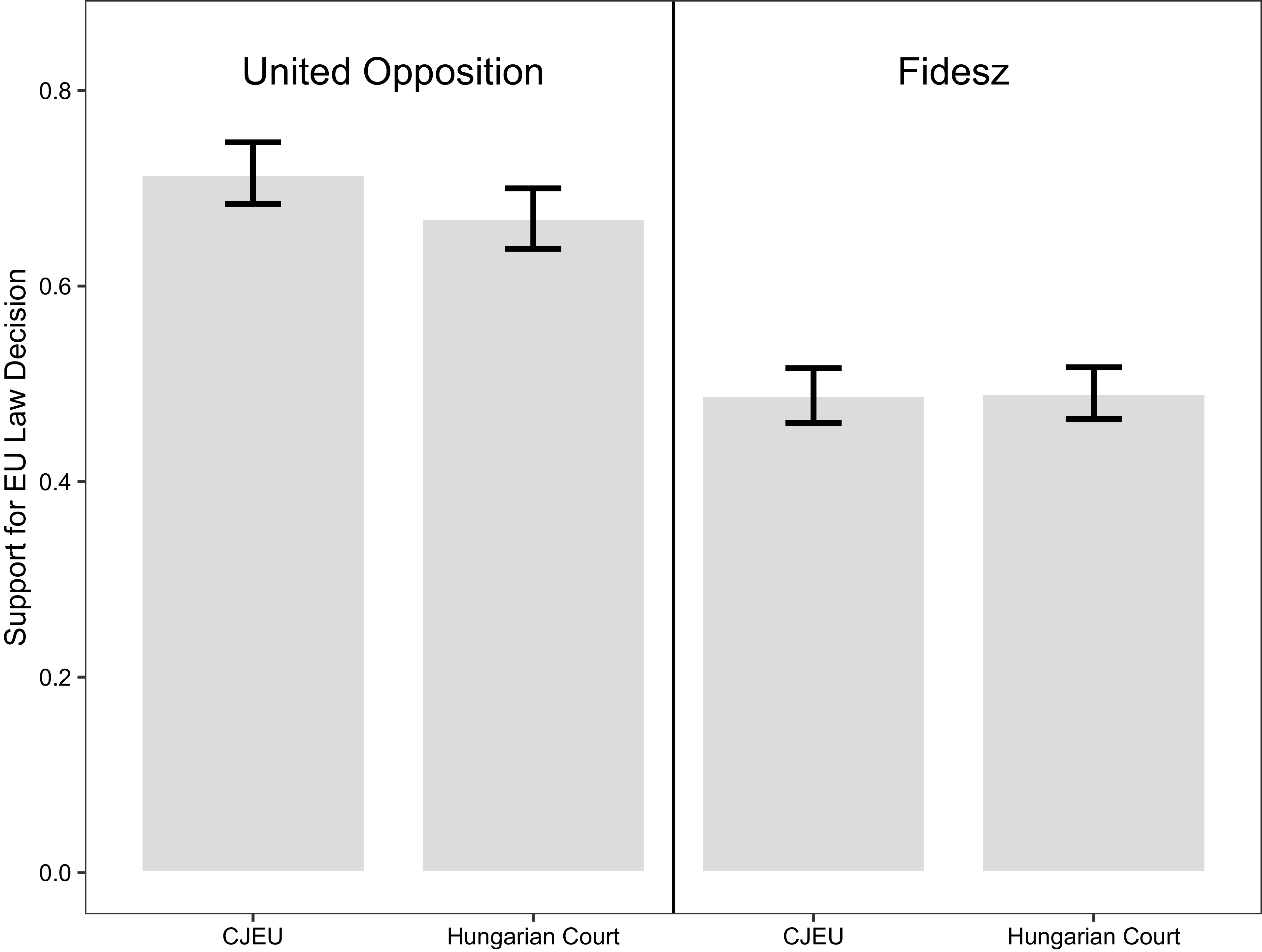
Figure 1 plots the average levels of support for the EU law decision by both treatment and party. We note four observations from the figure. First, as is evident from the figure, United Opposition supporters generally are supportive of the decision irrespective of the court issuing it, with a mean level of support of 0.715 for those receiving the CJEU treatment and 0.67 for those receiving the Hungarian court treatment. Second, this contrasts to the much lower level of support among Fidesz supporters, which hovers around 0.5 irrespective of treatment. Third, we see a marked treatment effect – roughly 0.045 – for United Opposition supporters but no such treatment effect for Fidesz supporters. Lastly, we note that this decrease in support from opposition voters, while not trivial in magnitude, does not bring their support to the same low levels of Fidesz voters. This result suggests that while opposition supporters are less supportive of an EU decision that is issued through the domestic courts, this decrease is not so large as to drastically change their overall continued support for the decision given its outcome.Footnote 15
Mean levels of support for EU law decisions by party and experimental treatment, e.g., whether the decision was issued by the CJEU or a Hungarian court. Based on Models 1 (Fidesz supporters) and 2 (Opposition supporters). The left pane of the figure presents predicted levels of support for United Opposition supporters; the right pane does so for Fidesz supporters. Error bars represent 95% confidence intervals.

Figure 1. Long description
The bar graph compares support for EU law decisions by party and experimental treatment, showing levels of support for United Opposition and Fidesz supporters. The x-axis represents the experimental treatment, with categories for CJEU and Hungarian Court. The y-axis represents the support for EU law decisions, ranging from 0.0 to 0.8. The left pane of the graph presents predicted levels of support for United Opposition supporters, while the right pane does so for Fidesz supporters. The bars are vertical and grouped by party and treatment. The United Opposition supporters show higher levels of support for EU law decisions when issued by the CJEU compared to the Hungarian Court. Fidesz supporters show lower levels of support overall, with minimal difference between the CJEU and Hungarian Court. Error bars represent 95% confidence intervals. All values are approximated.
Lastly, we consider how respondents’ trust in the CJEU and domestic courts conditions the partisan differences in support for the EU law decision. For this analysis, we estimated regressions with interaction terms between Domestic Court Ruling and Relative Confidence in the CJEU. Models 3 and 4 do so without controls for Fidesz and United Opposition supporters, respectively, while Models 5 and 6 do so again but with our set of control variables. Again considering first the responses of Fidesz supporters, we find no evidence that having greater confidence in the Hungarian courts than the CJEU increases their support for the final court ruling. That is, even when Fidesz voters hold their domestic courts in higher regard than the European court, having that domestic court involved in the process does not make them more supportive of EU law.
We do, however, find a clear conditional effect of Relative Confidence in the CJEU for United Opposition supporters. As anticipated by Hypothesis 3, the negative effect of involving a domestic court increases as one becomes more trusting of the CJEU vis-a-vis the national judiciary. This is evidenced by the statistically significant and negatively signed interaction term found in both Model 4 and Model 6. Importantly, the effect size here is substantively significant. When a Hungarian court issues the decision, a one-unit shift on the Relative Confidence in the CJEU’s −2 to 2 scale corresponds to a nearly 0.06 change in Support for the EU Law Decision. In contrast, the source of an EU law decision had no statistical effect on United Opposition supporters who hold the two courts on equal footing, much less on the few who ascribe higher confidence in the Hungarian judiciary than in the CJEU. In short, these results suggest that loss of support for the EU law decision came from those most trusting of the EU’s high court, as their skepticism of the domestic judiciary’s autonomy and trustworthiness tainted their view of the ruling.
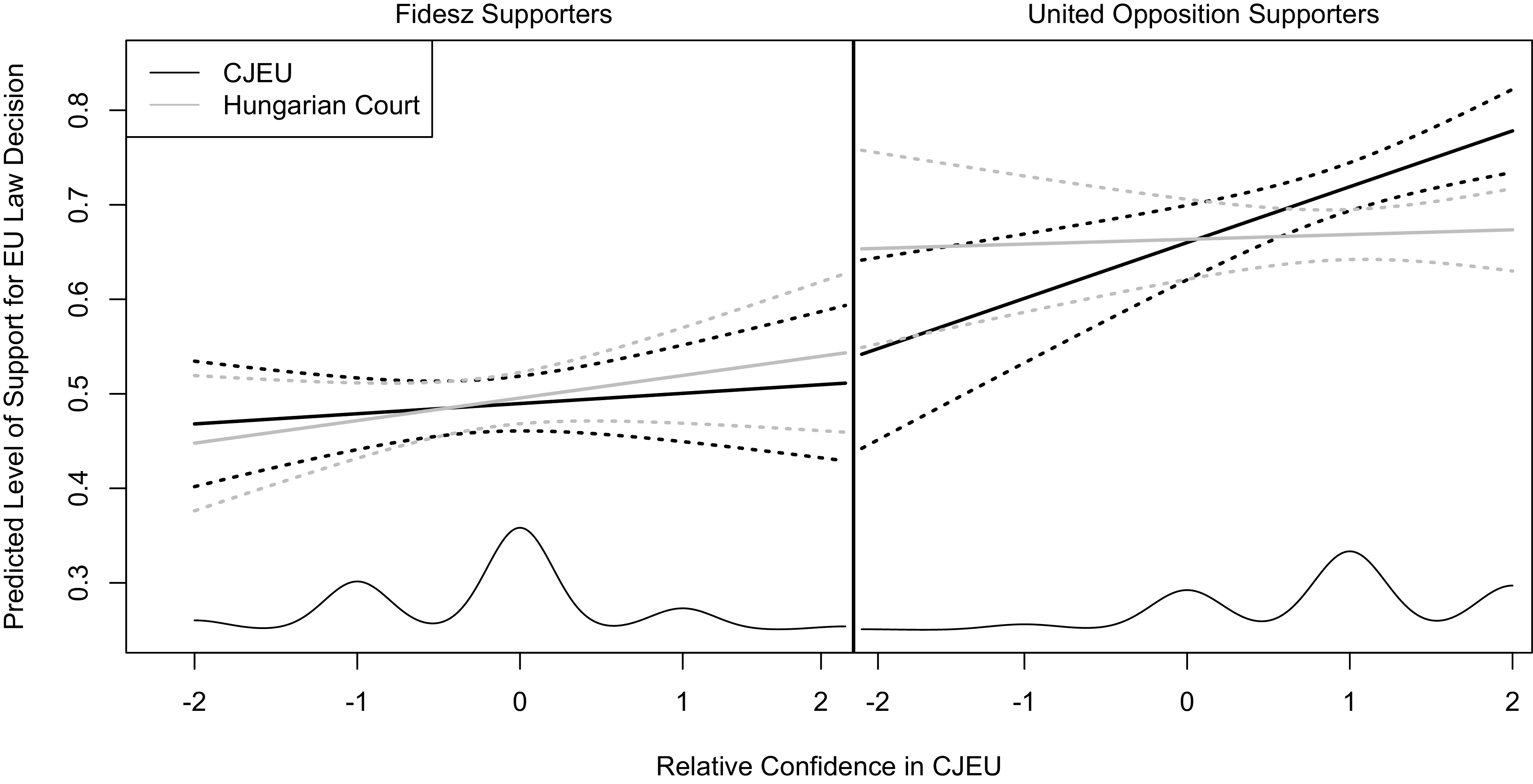
Figure 2 plots these interactive relationships for both Fidesz (left pane) and United Opposition (right pane) supporters. Here, we note several observations. To start, we see clear differences in the reactions of respondents based on their partisanship; Fidesz supporters are unmoved irrespective of their view of the two courts, while confidence in these judicial institutions influences the responses of United Opposition supporters. When we examine the results for opposition supporters more closely, we see a few notable trends. For one, United Opposition supporters who are much more confident in the domestic Hungarian courts than the CJEU appear to support the final court decision at rates very similar to Fidesz supporters. We do not read too much into this, though, as there are few such respondents, as seen in the density plot at the bottom of Figure 2’s left pane. Of more interest, however, are the dynamics of our treatment’s effect on opposition supporters at the other end of Relative Confidence CJEU. In particular, the figure reveals that the effect of the Domestic Court Ruling is limited to those who espouse greater confidence in the CJEU than the Hungarian judiciary (Relative Confidence in the CJEU < 0). For example, we observe an effect size of 0.105 for those who exhibit the highest confidence in the CJEU and lowest confidence in the domestic courts (e.g., Relative Confidence in CJEU = 2). Importantly, the density plot at the bottom of the figure reveals that a majority of United Opposition supporters have greater confidence in the CJEU than domestic courts, meaning this effect is relevant for a substantial portion of opposition partisans. Lastly, nearly all of the interactive effect in opposition respondents’ support occurs within the CJEU treatment, as the predicted level of support does not shift in a meaningful way across the values of Relative Confidence in CJEU for those receiving the Hungarian court treatment. This suggests that much of the effect may be due more to variation in opposition supporters’ confidence in the CJEU than confidence in the domestic courts, which is quite low for nearly all United Opposition supporters.Footnote 16
Predicted levels of support for EU law decisions by party, experimental treatment, and relative confidence in the CJEU vs the Hungarian judiciary. Based on Model 5 (Fidesz supporters) and Model 6 (Opposition supporters). The left pane of the figure presents predicted levels of support for United Opposition supporters; the right pane does so for Fidesz supporters. Density plots reflect the distribution of the respective level of relative trust in the CJEU for each party’s supporters. Black lines correspond to the CJEU treatment; gray lines to the Hungarian court treatment. Error bars represent 95% confidence intervals.

Figure 2. Long description
A two line graph showing predicted levels of support for EU law decisions by party, experimental treatment, and relative confidence in the CJEU vs the Hungarian judiciary. The left pane of the graph presents predicted levels of support for United Opposition supporters, while the right pane does so for Fidesz supporters. The x axis represents relative confidence in the CJEU, ranging from -2 to 2. The y axis represents the predicted level of support for EU law decisions, ranging from 0.3 to 0.8. Black lines correspond to the CJEU treatment, and gray lines to the Hungarian court treatment. Error bars represent 95% confidence intervals. Density plots reflect the distribution of the respective level of relative trust in the CJEU for each party’s supporters. All values are approximated.
Reconsidering Fidesz supporters
While the results with respect to Opposition supporters conformed with our theoretical expectations, we found no supporting evidence regarding our expectations for Fidesz supporters. In this section, we briefly explore potential theoretical explanations for this null result and conduct exploratory analyses to try and better understand the dynamics of support for EU law among this bloc of respondents. In particular, we consider the possibility of asymmetric perceived politicization of the Hungarian courts, persistent broad distrust in political institutions wrought by Fidesz’s long-running campaign against the country’s courts and other democratic institutions, and offsetting influence of support for the policy outcome of the vignette’s case.
While our theory emphasizes the consequences of the politicization of the judiciary, one possibility is that perceptions of courts, such as those in Hungary, may differ based on one’s partisanship. In particular, it may be that opposition supporters particularly view the judiciary as politicized, but government supporters do not. If this is the case, and Fidesz supporters view the courts not as an ally but simply as ‘just a court’ that is unaligned with their partisan interests, then having the domestic courts involved in international legal decision-making may simply be of little perceived advantage or benefit to them. Or, to put it another way, Fidesz supporters might see their domestic courts as neither friend nor foe and thus not alter their reactions to decisions based on these courts’ involvement. It is worth noting that the distribution of Relative Confidence in CJEU for Fidesz supporters has a clear mode at 0, with a majority indicating they have the same level of confidence in the domestic courts as they do in the CJEU.
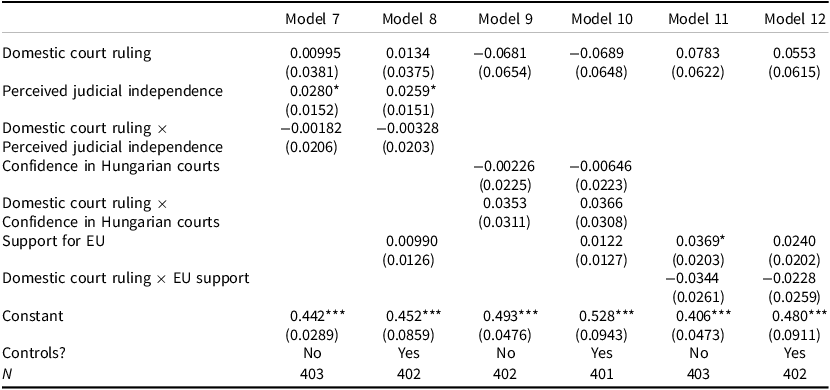
To explore this possibility, we examine whether Fidesz respondents’ beliefs about the extent of government influence over the courts condition our treatment’s effect. We do so by replicating Models 3 and 5 from Table 1 with the exception of replacing Relative Confidence in the CJEU with a new measure, Perceived Judicial Independence. This measure is based on the following question: ‘To what extent do you think the government does influence the rulings that the Hungarian courts make?’ Respondents could then select one of four choices: a great extent (17%); a moderate extent (39%); a small extent (27%); not at all (17%).Footnote 17 The results of this analysis, provided in Table 2 as Models 7 and 8, do not reveal any interactive relationship between the treatment effect and Fidesz supporters’ belief in whether the courts are influenced by the government. While the limitations of our measure make us hesitant to draw strong conclusions from this analysis, it is at least suggestive that differences in the perceived politicization of the courts do not appear to explain our null finding for Fidesz supporters.
Analyses of Fidesz supporters (DV: support for EU law decision)

Table 2. Long description
The table presents analyses of Fidesz supporters’ support for EU law decision across six different models. It includes columns for Model 7, Model 8, Model 9, Model 10, Model 11, and Model 12. Each model lists coefficients and standard errors for variables such as Domestic court ruling, Perceived judicial independence, Domestic court ruling x Perceived judicial independence, Confidence in Hungarian courts, Domestic court ruling x Confidence in Hungarian courts, Support for EU, and Domestic court ruling x EU support. The table also includes a constant term and indicates whether controls are included. The number of observations (N) for each model ranges from 401 to 403. Notable trends include the significance of Perceived judicial independence in Models 7 and 8, and the significance of Domestic court ruling in Model 11. The table aims to explore the dynamics of support for EU law among Fidesz supporters and potential theoretical explanations for null results.
Standard errors in parentheses. * p < 0.10, ** p < 0.05, *** p < 0.01. Full results available in the online Appendix.
A second possibility is that, instead of Fidesz supporters viewing the Hungarian courts in a neutral light, they hold them in low regard as a consequence of Fidesz’s long-running campaign to undermine public confidence in democratic guardrails, particularly the judiciary. Regular criticism and attacks were key parts of the Fidesz government’s efforts to neutralize and subsequently capture the Hungarian courts (e.g., Epperly Reference Epperly2019). Public confidence in the judiciary may not necessarily be quickly regained after implementing government ‘reforms’ to the system, meaning that those attacks could have a long-lasting impact such that even Fidesz supporters remain skeptical of the judiciary’s integrity. Interestingly, our data are in some respects consistent with this account, with as many Fidesz respondents indicating they have hardly any confidence in the Hungarian courts as indicating they have a great deal of confidence (20%). If it is the case that even the government’s own supporters lack confidence in the domestic courts, despite the government’s efforts to bring the judiciary into alignment with its (and presumably its voters’) preferences, then we might not expect to see the involvement of those courts having an effect on support for a case’s outcome. We investigate the potential conditioning effect of confidence in domestic courts among Fidesz voters by interacting with Domestic Court Ruling with confidence in the Hungarian courts. Table 2’s Models 9 and 10 present the results of this analysis. We find no evidence of a conditional effect, with the interaction term failing to reach statistical significance in either model. That is, having high confidence in the Hungarian courts does not make Fidesz supporters more supportive of EU law decisions issued by those courts.
Lastly, we consider the possibility that for Fidesz supporters the driving factor is not their confidence in judicial institutions but rather their satisfaction with the case’s outcome. With recent research indicating that policy congruence has a larger impact on public reactions to international law than process or procedures (e.g., Madsen, Mayoral, Strezhnev et al. Reference Madsen, Mayoral, Strezhnev and Voeten2022), it could be that involving a domestic court only increases support among those inclined to be satisfied with the court decision. Conversely, for those who are opposed to the outcome, even involving a domestic court may be insufficient to sway their views. Importantly, variation exists among Fidesz supporters when it comes to their support for the EU, with only 10% viewing Hungary’s EU membership as a bad or very bad thing.Footnote 18 We might, then, expect that incorporating a Hungarian court will have a greater effect on support for the final court decision among those who are supportive of the EU and thus presumably supportive of the case’s pro-EU outcome. Models 11 and 12 of Table 2 present results of interaction models using our variable, Support for EU. We find no evidence that support for the EU conditions the treatment’s effect. We further note that Support for EU does not have an effect, suggesting that Fidesz supporters’ views of the decision are independent of their support for the EU.Footnote 19 With none of these alternative accounts borne out in our data, the perhaps most plausible – and simplest – explanation is that Fidesz supporters hold views on EU law that are not easily swayed by institutional traits or considerations. However, we only speculate here as to the source of this consistent null result found across our models.
Conclusion and discussion
In this article, we considered the ramifications of two prominent global legal trends: the growing scope and breadth of international law and the rising politicization of domestic political institutions. As international legal processes increasingly incorporate these domestic institutions, how citizens react to the development of international law – especially when it supplants national law – may become influenced for better or worse by perceptions of domestic institutions’ political biases. Focusing on the role of domestic courts in interpreting and implementing international law to then build on work that emphasizes the implications of judicial politicization, particularly the divide between government and opposition supporters (e.g., Bartels and Kramon Reference Bartels and Kramon2020; Bartels, Horowitz, and Kramon Reference Bartels, Horowitz and Kramon2023), we argue that, in countries with substantial levels of polarization around judicial institutions, involving politicized domestic courts in the international legal decision-making process may increase support for judicial rulings among a government’s supporters but weaken it for opposition partisans. The results of a survey experiment fielded in Hungary provide partial support for our argument. While we find that opposition partisans withdraw support for an EU law decision when it is issued by a Hungarian court rather than directly by the CJEU, we find no support-enhancing effect for this treatment among the Fidesz government’s supporters.
These findings have a number of implications. For one, our study engages directly with ongoing important debates in the judicial politics literature. The influence of partisanship on public attitudes toward judicial institutions has come increasingly to the fore, with scholars identifying differential partisan effects from a diverse set of contexts (e.g., Bartels, Horowitz, and Kramon Reference Bartels, Horowitz and Kramon2023; Crandall and Lawlor Reference Crandall and Lawlor2022; Mazepus and Toshkov Reference Mazepus and Toshkov2022). While such studies have largely focused on domestic judiciaries, our contribution here is to integrate international courts into our understanding of partisanship’s impact on attitudes toward judicial institutions and decisions. We further contribute to the scholarship on backlash against international courts (e.g., Alter, Gathii, and Helfer Reference Alter, Gathii and Helfer2016; Madsen, Cebulak, and Wiebusch Reference Madsen, Cebulak and Wiebusch2018; Voeten Reference Voeten2020). Regarding the latter, our study points to the importance of considering the risk of backlash from an international court’s erstwhile supporters. That is, our observation that support for international law among its most likely allies can be weakened by domestic institutions highlights the risks international courts and legal systems face not only from its ideological foes but also, in certain conditions and decisions, from its most important supporters. This might mean, for instance, that an international court could seek to be so accommodating to domestic political forces that it weakens its credibility with the court’s defenders.
We also note our study’s contribution to research on the relative impact of procedures on public reactions to international court decisions. While scholars have long recognized the impact of procedural fairness and legitimacy for public acceptance of judicial rulings (e.g., Benesh Reference Benesh2006; Trinkner and Tyler Reference Trinkner and Tyler2016), recent research demonstrates that one’s agreement with the outcome is the most important predictor of agreement with an international court decision (e.g., Madsen, Mayoral, Strezhnev et al. Reference Madsen, Mayoral, Strezhnev and Voeten2022). Our findings return the discussion in this literature to the potential impact of procedures, particularly those embedded in legal systems that integrate multiple judicial institutions into the international legal process. For instance, our findings mirror those of Cheruvu and Krehbiel (Reference Cheruvu and Krehbiel2024), who find that informing survey respondents that the German Federal Constitutional Court (GFCC) was involved in the preliminary reference procedure increases public support for a pro-EU law decision, specifically among those that have higher support for the GFCC relative to the CJEU. While the German context is not as politicized as the Hungarian one with regards to the domestic judiciary, finding empirical support for the impact of such features only among opposition supporters reflects the impact politicization has on the effects of judicial procedures and, more generally, the limits of procedures’ impact on public opinion when it comes to international law.
Our study further has potential generalizable lessons for judicial politics. While we focused empirically here on a preliminary reference procedure as a form of domestic court involvement, it is not the only form such engagement may take, as national courts might, for instance, simply interpret international law on their own without input from an international judicial body. Additionally, many international courts have a preliminary reference-like system through which domestic courts can become involved in the international legal process (e.g., Krehbiel and Cheruvu Reference Krehbiel and Cheruvu2022). While our theory is suggestive as to the relative impact of these alternative forms of involvement, we must leave a more systematic consideration of this to future research. We note, however, that many of these systems are in effect in contexts where judicial independence is far from guaranteed as politicians seek to use the courts to their own advantage (e.g., Helmke Reference Helmke2005; Shen-Bayh Reference Shen-Bayh2022; Xu Reference Xu2020). As such, our theoretical account may be relevant for many of those countries where the development and application of international law is still in its relatively early stages of development. To the extent that public support is a key condition for the success of this development, our findings suggest that incorporating domestic institutions into the international legal process may not be an unalloyed benefit for ensuring the efficacy of international law. Moreover, our results suggest that with no legitimizing effect among government partisans, international organizations may be best served by relying directly on their own judicial institutions rather than seeking to integrate politicized domestic institutions into the decision-making process.
Furthermore, our findings are particularly relevant for the ongoing rule of law crisis in the EU (e.g., Kelemen Reference Kelemen2017). The European Commission is relying, at least in part, on the EU’s legal framework and the CJEU to confront democratic backsliding and weakening rule of law in Hungary (European Commission 2019). The success of such a strategy, however, likely depends in part on domestic political and electoral dynamics. If citizens are willing to accept CJEU rulings, whether they be related to relatively anodyne economic regulations or more contentious questions of democratic governance, then Fidesz – and other EU member-state governments engaging in democratic backsliding – may be more effectively constrained by EU actions. Our findings indicate, at least in the Hungarian case, that domestic judicial institutions may do more harm than good when it comes to efforts to enforce EU law. Moreover, that we find weakened support among opposition supporters when a domestic court is involved suggests that such procedures could harm acceptance of EU law among its otherwise strongest supporters. Of perhaps even greater concern for the efficacy of the EU’s efforts, however, is the null finding that domestic institutions are incapable of increasing Fidesz partisans’ support for the relatively uncontroversial policy in our vignette. If it is the case the Fidesz supporters’ views toward the EU are more firmly entrenched, then efforts to bring these citizens on board with EU initiatives and positions may be a losing proposition. While we are unable here to properly evaluate such a mechanism or potential alternatives driving the null result, we suggest that the stubborn nature of Fidesz supporters’ attitudes is interesting in its own right and a subject for further research.
We also acknowledge important limitations to our study. For one, our results are from a single country within a specific international legal system. While we see Hungary and the EU as presenting an appropriate context for testing our theory’s expectations, we can only theorize as to the extent to which similar findings would result from replicating our study in a country like Poland or a non-Western context (e.g., Latin America or Africa). Second, we did not vary the outcome of our case, meaning we lack leverage to assess the effect of agreement with a decision vis-a-vis the institutional factor – the presence of a domestic court – that is the focus here. Third, we recognize that international law is often a low-salience issue that relatively few citizens are likely to follow closely. As our experiment necessarily informs respondents about a decision, our findings might be characterized as identifying something of a maximal effect as compared to how such decisions might play out beyond the controlled informational environment of our survey. Similarly, the information provided to respondents was intended to be neutral, which thus leaves unexplored the impact of framing effects (e.g., Baird and Gangl Reference Baird and Gangl2006; Magalhães, Skiple, Pereira et al. Reference Magalhães, Skiple, Pereira, Arnesen and Bentsen2023) or partisan news sources (e.g., Gehlbach and Sonin Reference Gehlbach and Sonin2014; Martin and Yurukoglu Reference Martin and Yurukoglu2017). We likewise note that the study’s focus on a single policy issue – pension taxation – means we cannot evaluate how respondents’ reactions may differ either in scale or manner based on the specific policy at issue. For example, a more salient and contentious policy, such as one related to democratic backsliding, might elicit stronger reactions by both government and opposition supporters. Moreover, extending to a salient policy area may permit more valid assessments of citizens’ pre-existing support for a challenged policy, something we do not measure here and instead focus on partisanship. Such an approach would provide an opportunity to further disentangle the effects of such attitudes on reactions to court decisions from broader partisan attachments. With these limitations in mind, we acknowledge that our analyses are somewhat ‘exploratory’ in nature, with the limits of our data highlighting the need for additional future confirmatory analyses that address the above concerns.
Nonetheless, we see this study as providing a valuable initial step in better understanding the intersection of international law and the growing politicization of judiciaries in much of the world. In particular, this research demonstrates the potential gains to be made from linking once disparate literatures on public support for international law, comparative judicial politics, and key institutional features of many of the world’s international legal regimes (e.g., Staton and Moore Reference Staton and Moore2011). We are hopeful that future research will continue leveraging such theoretical and empirical synergies as a means to better understand public support for international law.
Supplementary material
The supplementary material for this article can be found at https://doi.org/10.1017/S1475676526101364.
Data availability statement
Data and replication materials are available on Harvard Dataverse.
Acknowledgements
The authors would like to thank our anonymous reviewers as well as seminar participants at American University, the London School of Economics, the Litigants, Agendas, and Decisions at the European Court of Justice conference at the University of Oslo, Michigan State University, the University of Texas at Austin, the Texas Triangle International Relations Conference, and the Texas Comparative Circle conference for their helpful comments and feedback on this article.
Funding statement
The authors recognize the generous support from the Jim and Gail Woolwine Political Science Faculty Travel Fund at WVU for the survey fielded in Hungary.
Competing interests
The authors have no competing interests to report.
Ethical standards
The survey was reviewed and cleared by the University of Texas at Dallas Institutional Review Board.


 Open access

