


Introduction
There is a growing interest among political scientists in the unequal participation and representation of poor voters. By now, there is solid evidence for two patterns that probably reinforce each other (Piven & Cloward Reference Piven and Cloward1988): relatively low turnout among poor voters and stronger responsiveness of political elites to the preferences of better‐off citizens (Erikson Reference Erikson2015; Gilens & Page Reference Gilens and Page2014; Rosset et al. Reference Rosset, Giger and Bernauer2013). These patterns have arguably been facilitated by, and contributed to, growing income inequality. If the (poorly represented) poor withdraw from politics, they diminish incentives to represent their interests in redistribution and anti‐poverty policies (Avery Reference Avery2015; Mahler Reference Mahler2008; Pontusson & Rueda Reference Pontusson and Rueda2010). The resulting social inequality could, in turn, alienate the poor even further (Iversen & Soskice Reference Iversen and Soskice2015; Jensen & Jespersen Reference Jensen and Jespersen2017; Solt Reference Solt2008). Although the causal relationship is complex, there should be little doubt by now that many Western democracies have experienced such a twin process of growing social inequality and political disaffection of (lower class) citizens with political elites (Armingeon & Schädel Reference Armingeon and Schädel2015; Kuhn et al. Reference Kuhn, Elsas, Hakhverdian and der Brug2016; Schäfer Reference Schäfer, Schäfer and Streeck2013).
Against this background, our goal is to contribute to the rather limited knowledge about factors that are conducive to a better integration of poor citizens into politics. We do so by addressing what we see as two important gaps in the existing comparative literature on the political integration of the poor. First, this literature has paid limited attention to the factors that explain poor citizens’ lower involvementFootnote 1 in the first place (Iversen & Soskice Reference Iversen and Soskice2015). In particular, it has ignored contributions from psychology and behavioural economics on how cognitively and emotionally absorbing poverty is (Haushofer & Fehr Reference Haushofer and Fehr2014; Mani et al. Reference Mani, Mullainathan, Shafir and Zhao2013). Based on this literature, we argue that one (albeit certainly not the only) mechanism underlying the poor's withdrawal from politics is that social problems impede the development of subjective political competence (or internal political efficacy).
Second, while there is ample evidence that income gaps in political participation are magnified by social inequality, the literature has paid limited attention to how party system characteristics moderate the political inclusion of the poor (a recent exception is Anderson & Beramendi (Reference Anderson and Beramendi2012)). Based on research about the effects of polarisation on political behaviour (Dalton Reference Dalton2008; Evans & Tilley Reference Evans and Tilley2012; Smidt Reference Smidt2017), our broad intuition is, as we elaborate below, that a diverse party landscape might be beneficial for poor voters’ political involvement. Given the recent growth of populist anti‐elite parties that draw support disproportionately from lower classes (Arzheimer Reference Arzheimer2009; Golder Reference Golder2016; March & Rommerskirchen Reference March and Rommerskirchen2015), we are particularly interested in whether those parties’ radical opposition to the political establishment might help to strengthen poor voters’ sense of internal political efficacy. The bulk of previous research in this literature focuses on the characteristics of populist parties and their supporters (Akkermann et al. Reference Akkerman, Mudde and Zaslove2014; Golder Reference Golder2016), while ‘not much is known about the way in which populist messages affect citizens’ attitudes’ (Rooduijn et al. Reference Rooduijn, der Brug and Lange2016: 34; see also Mudde Reference Mudde2013). Probably even less is known about how these messages affect (gaps in) citizens’ political involvement (Immerzeel & Pickup Reference Immerzeel and Pickup2015). Hence, although we primarily address the literature on poor voters, our findings are relevant for populism research as well.
Our theoretical argument therefore combines literatures on the psychology of poverty, polarisation and anti‐elite populism, and can be summarised as follows: the experience of poverty reduces citizens’ cognitive, emotional and social resources, which in turn undermines their ability and motivation to acquire political information and to develop internal political efficacy (i.e., a subjectively experienced competence to understand and influence politics). This mechanism is weaker in political systems characterised by intense anti‐elite discourses because such discourses clarify and simplify party differences, provide additional motivation to engage in politics and facilitate mobilising emotions. Although we are agnostic as to whether populists generally represent the poor in a ‘better’ way, we find it plausible that their anti‐elite rhetoric contributes to a stimulating political environment that helps them to make sense of politics.
We analyse the link between poverty, political efficacy and anti‐elite rhetoric in two related studies that combine correlational and causal inference. First, we show with data from the European Social Survey (ESS) that the poor, on average, have lower political efficacy. This efficacy gap across income groups varies with a novel measure of the salience of anti‐elite politics derived from the Chapel Hill Expert Survey (CHES) (Polk et al. Reference Polk2017).Footnote 2 Second, we establish causality in a survey experiment in Germany (a country that only recently experienced intense anti‐elite mobilisation). In line with our theory, it shows that priming anti‐elite rhetoric leads to a significant increase in internal efficacy, but only among low‐income respondents. Finally, we return to the observational data from the ESS for an exploratory analysis of whether our findings for efficacy extend to political participation. The analysis reveals that this is the case for non‐electoral forms of participation, but not for voting.
Poverty and political efficacy
For two non‐exclusive reasons, poor citizens on average show lower political involvement than other income groups. First, they are disenchanted because of insufficient substantive and descriptive representation. As described above, there might be a vicious cycle of disengagement and neglect by elites. This would explain why income gaps in participation are positively correlated to income inequality (Solt Reference Solt2008). In this explanation, the mechanism linking poverty and political (non‐)participation is depressed external political efficacy.
Second, and less frequently reflected in comparative research, economic disadvantage also compromises internal efficacy because it undermines the resources needed to engage with politics (Iversen & Soskice Reference Iversen and Soskice2015). ‘Internal efficacy’ is defined as confidence in one's ability to understand and participate in politics. It is a strong predictor of different forms of participation and therefore an important aspect of political involvement (see Verba et al. (Reference Verba, Schlozman and Brady1995) and work cited in Beaumont (Reference Beaumont2011)). Mechanisms through which economic problems impair internal efficacy and its precedents have been discussed for the special case of the unemployed (Jahoda et al. Reference Jahoda, Elsaesser, Lazarsfeld, Reginall and Zeisel1972; Marx & Nguyen Reference Marx and Nguyen2016; Rosenstone Reference Rosenstone1982). Here we would like to elaborate on how poverty more generally relates to internal efficacy.
One scarce resource for the poor is time, because they often need to develop sophisticated strategies to cope with material hardship. Hence, the opportunity costs of acquiring political information should grow with exposure to social problems. As Hassell and Settle (Reference Hassell and Settle2017: 536) put it, ‘every minute spent engaging in politics is time not spent addressing other financial or personal problems’. Besides a shortage of time to acquire political information, social problems also trigger cognitive and emotional processes that are likely to impede the processing and retrieval of information. Recent research shows how poverty and efforts to cope with it contribute to depleting mental resources (Haushofer & Fehr Reference Haushofer and Fehr2014; Mani et al. Reference Mani, Mullainathan, Shafir and Zhao2013; Vohs Reference Vohs2013). The underlying mechanisms are stress, a mentally exhausting exercise of self‐regulation and distraction through ruminating thoughts about material problems. These cognitive processes make it plausible that the poor have difficulties to translate (the already lower) exposure to political information into political knowledge, competence and efficacy.
Besides cognitive impairment, the poor typically also have to deal with intense negative emotions. Their material situation deprives them, in a fundamental way, of control over their lives. The resulting emotions of anxiety and helplessness translate into a depressed sense of agency (Fryer Reference Fryer and Nicholson1997; Gallo & Mathews Reference Gallo and Matthews2003). In addition, the stigmatisation of poverty can undermine feelings of self‐worth (Hall et al. Reference Hall, Zhao and Shafir2013). In a nutshell, poverty can be highly stressful, distracting, frustrating, shameful and disheartening. These psychological states are likely to spill over into a depressed sense of general efficacy as well as internal political efficacy (Beaumont Reference Beaumont2011; Caprara et al. Reference Caprara, Vecchione, Capanna and Mebane2009; Marx & Nguyen Reference Marx and Nguyen2016). Without denying the relevance of insufficient representation, we focus on this understudied aspect and hence use internal political efficacy as our dependent variable.
H1: Holding everything else constant, the poor have lower internal efficacy than middle‐ and high‐income groups.
Although poverty should depress political involvement everywhere, its precise effect should depend on the political context (Piven & Cloward Reference Piven and Cloward1988). Recent comparative studies on income gaps in political involvement tend to focus on socioeconomic country variation, such as income inequality or welfare state generosity (Cicatiello et al. Reference Cicatiello, Ercolano and Gaeta2015; Jensen & Jespersen Reference Jensen and Jespersen2017; Schäfer Reference Schäfer, Schäfer and Streeck2013; Solt Reference Solt2008). We argue that party system characteristics should also moderate the link between poverty and political involvement (see also Anderson & Beramendi (Reference Anderson and Beramendi2012)). In particular, we are interested in the role of (frequently populist) anti‐elite partiesFootnote 3 at the left or right fringes of the political spectrum (Judis Reference Judis2016; Polk et al. Reference Polk2017; Rooduijn & Akkerman Reference Rooduijn and Akkerman2017).
Can anti‐elite rhetoric decrease income gaps in efficacy?
How could anti‐elite discourses contribute to restoring the depressed sense of internal political efficacy among the poor? We depart from the general notion that some elite dissent is important for democracies (Schattschneider Reference Schattschneider1960). In the words of Chantal Mouffe (Reference Mouffe and Martin2013: 204), a ‘vibrant clash of democratic political positions’ provides a ‘terrain in which passions can be mobilized around democratic objectives’. By contrast, ‘[t]oo much emphasis on consensus and the refusal of confrontation lead to apathy and disaffection with political participation’. Many observers agree that such a ‘vibrant clash’ has largely disappeared from European party systems. This is reflected most famously by the cartelisation argument of Katz and Mair (Reference Katz and Mair1995, Reference Katz and Mair2009), but also by findings that many former working‐class parties have converged to neoliberal policies (Mudge Reference Mudge2011; Schumacher Reference Schumacher2012). And indeed, many contributions on the effects of polarisation (to which we return below) have shown that ideological differences between parties generally facilitate citizens’ participation (e.g., Dalton Reference Dalton2008, Reference Dalton, Dalton and Anderson2010). In this article, we argue that a diverse and contested party landscape is particularly important for poor voters.
However, we are primarily interested here in a particular type of political contestation that goes beyond ideological distance: The fundamental rejection of the political mainstream as an unresponsive elite, as it is often formulated by populist parties (Mudde Reference Mudde2004, Reference Mudde2013). Such discourses, which pit ‘ordinary people’ against the selfish and morally corrupted elite in a stylised friend‐foe dichotomy, have recently gained salience in most Western democracies (Judis Reference Judis2016; Müller Reference Müller2016). A well‐known contemporary example is Donald Trump's victorious ‘drain the swamp’ campaign. European examples include parties such as Front National, Jobbik, the Sweden Democrats or the Freedom Parties in Austria and the Netherlands. While social problems are sometimes discussed as motivations to support such parties (Arzheimer Reference Arzheimer2009; Golder Reference Golder2016), we are interested in how their discourses influence political involvement among the poor (even if they do not vote for them).
We argue that the emergence or growth of anti‐elite mobilisation could increase the relative internal efficacy of the poor. Concretely, we would expect that anti‐elite parties: (1) make decisions (as well as expressing opinions) easier because they radically simplify political questions; (2) emphasise stark differences between parties and thereby illustrate the relevance of party choice; (3) translate diffuse frustrations about the political system into concrete arguments and demands and thereby restore a sense of political agency; (4) stimulate emotions of anger and indignation which typically have a mobilising effect; and (5) dramatise politics with their confrontational style, which could make it more exciting and entertaining for relatively disinterested citizens.Footnote 4
The first two mechanisms link back to the polarisation literature. Although they usually do not differentiate by income, many studies suggest that polarisation makes it is easier for citizens to connect their preferences to parties (Dalton Reference Dalton, Dalton and Anderson2010; Jansen et al. Reference Jansen, Evans and Graaf2013; Lachat Reference Lachat2008; Lupu Reference Lupu2015) and to participate in politics (Dalton Reference Dalton2008; Moral Reference Moral2017; Steiner & Martin Reference Steiner and Martin2012; Wilford Reference Wilford2017; for a critical view, see Rogowski Reference Rogowski2014). Moreover, it is often argued that groups with on average lower political sophistication and attention (such as the poor) benefit disproportionately from a diverse and stimulating party system (Dalton Reference Dalton, Dalton and Anderson2010; Smidt Reference Smidt2017).Footnote 5 Evans and Tilley (Reference Evans and Tilley2012) show, for instance, that the convergence of British parties has coincided with a decline of support for any party that is considerably stronger among low‐income voters. Because anti‐elite parties tend to emphasise (or even exaggerate) ideological distance to other parties, they might simply facilitate the poor's political efficacy through particularly intense polarisation so that the poor would have to invest less time and cognitive resources to learn about where parties stand (Smidt Reference Smidt2017). Cognitive effort should be further reduced because anti‐elite parties often radically simplify political questions, ‘dichotomizing them into black and white and calling for yes or no answers’ (Golder Reference Golder2016: 479). Additionally, the easy solutions typically advocated (Moffitt Reference Moffitt2015) convey the message that politics is not all that complicated. Finally, the portrayal of stark ideological differences might foster an impression that party choice actually matters (Immerzeel & Pickup Reference Immerzeel and Pickup2015). This could provide a motivation to engage with politics despite distraction through material worries. A party system with strong anti‐elite discourses therefore might facilitate subjective competence to understand politics among the poor.
Our third mechanism rests on the assumption that many poor people experience at least a diffuse frustration about politics. This follows from the literature on lacking representation and responsiveness cited above. Although this should primarily lead to low external efficacy, it could also depress internal efficacy. If the disappointed poor feel they cannot influence politics anyway, they probably stop bothering and withdraw from it. This is a plausible reaction, because – for the reasons described above – they tend to lack the resources to voice criticism and protest against unresponsive elites. In such a situation, anti‐elite parties can help to restore a sense of individual agency. Their general attack on elites provides a rhetoric to translate more or less diffuse grievances into concrete criticism (Spruyt et al. Reference Spruyt, Keppens and Droogenbroeck2016). This should make it easier for the poor to express what they dislike about politics. That this dislike is shared by a visible organisation with many supporters should facilitate the feeling that it rests on competent and legitimate political attitudes.
This argument is related to our fourth mechanism on the emotional level. Anti‐elite rhetoric typically is highly emotional. It often combines anxiety‐inducing threats (e.g., the socioeconomic consequences of immigration) with frames that blame irresponsible elites and thereby incite anger (Hameleers et al. Reference Hameleers, Bos and Vreese2017; Moffitt Reference Moffitt2015; Mudde Reference Mudde2004). Anger is not only a useful coping mechanism for anxious voters, it is also a distinctly mobilising emotion that is associated with increased certainty, optimism and risk‐taking (Lerner & Keltner Reference Lerner and Keltner2001). Importantly, it is linked with greater political news consumption and participation (Valentino et al. Reference Valentino, Gregorowicz and Groenendyk2009; Reference Valentino, Brader, Groenendyk, Gregorowicz and Hutchings2011). In other words, voters that are responsive to anti‐elite parties’ emotionalised blame attribution are likely to feel more competent and internally efficacious as a consequence. Populists’ externalisation of blame could be particularly effective for lower classes that suffer from (internalised) stigmatisation and a tendency towards self‐deprecation (Anduiza et al. Reference Anduiza, Guinjoan and Rico2016; Spruyt et al. Reference Spruyt, Keppens and Droogenbroeck2016).
Our fifth and final mechanism refers to the performative dimension of anti‐elite politics – or its ‘entertainment value’. As illustrated best by Donald Trump's provocative tweeting, the style of anti‐elite parties is unconventional, confrontational and often quite spectacular (Moffitt & Tormey Reference Moffitt and Tormey2014). The use of simple, colloquial language by charismatic leaders is often combined with a calculated violation of conventions and political correctness (Mudde Reference Mudde2004). Although, or even because, many voters may dislike this coarse style, it should attract attention – much more than quibble about policy details and technocratic language that characterise ‘normal’ politics. This entertainment effect of anti‐elite rhetoric could be magnified by media reporting, which is biased in favour of the spectacular (Hameleers et al. Reference Hameleers, Bos and Vreese2017; Mudde Reference Mudde2004; Rooduijn Reference Rooduijn2014). Again, this additional motivation through excitement should disproportionately benefit previously disengaged groups such as the poor.
Based on these mechanisms, we expect that anti‐elite rhetoric boosts the internal efficacy of the poor. Two clarifications are in order. First, while mechanisms three and four apply to supporters of anti‐elite parties, the other three are also relevant for non‐supporters. Polarisation, simplification and excitement should even benefit voters who emphatically dislike anti‐elite parties. We therefore think it is appropriate to study the salience of anti‐elite rhetoric on the level of party systems.
H2: The gap in internal efficacy between the poor and other income groups is smaller in party systems characterised by pronounced anti‐elite rhetoric.
The second clarification concerns citizens with higher incomes. Our main argument underlying H2 is about poor citizens because we expect mobilisation through anti‐elite rhetoric in this relatively distracted and inattentive income group. To theorise the effects on the efficacy gap in a more encompassing way, we would also have to engage with middle and high incomes. Generally, we would expect that the effects of anti‐elite rhetoric are weaker or absent, simply because of the higher baseline efficacy in the absence of social problems. But one might speculate that anti‐elite rhetoric could even produce effects that diminish efficacy among better‐off citizens. Middle and high incomes probably feel more comfortable with a centrist political consensus as well as with the policy output and socioeconomic outcomes it produces. Anti‐elite mobilisation then might appear as a challenge to their privileges and as a disruptive attack on their taken‐for‐granted understanding of politics. This should be the case in particular for voters who identify with the attacked elite, which often also includes cultural, financial or academic elites. Overall, we can expect that many better‐off citizens feel insecure about what is the best political approach in a party landscape fundamentally changed by anti‐elite parties (this insecurity is often visible in mainstream parties’ response to anti‐elite mobilisation). Without being able to theorise or test this aspect in detail here, we point to the possibility that anti‐elite rhetoric might reduce the efficacy gap partly by making higher income groups less assertive in their political views.
Income, efficacy and anti‐elite salience in comparative perspective
Data and methodology
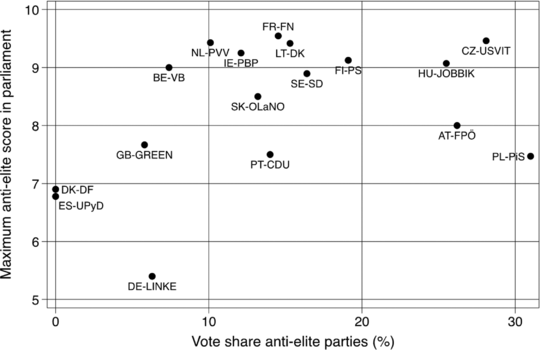
We have argued that poor voters suffer from reduced internal efficacy and that anti‐elite rhetoric may offset this effect. Our first study explores this relationship cross‐nationally. This requires individual‐level data for income and internal efficacy as well as a measure for anti‐elite discourses in the respective party systems. For the individual level, we use the ESS. The second aspect is more difficult to operationalise because there is no agreed‐upon indicator for anti‐elite discourses in party systems that would allow large cross‐national comparisons (Rooduijn & Akkerman Reference Rooduijn and Akkerman2017). Fortunately, the CHES has recently made an effort to fill this gap by including a variable on the salience of anti‐elite rhetoric at the party level (see Polk et al. (Reference Polk2017) for details and validation of the measure). This indicator is only available for 2014, which restricts us to ESS wave 7, which was collected in the same year. Both surveys jointly cover 17 countries (depicted in Figure 1) and 25,782 individuals. A full discussion of data sources and summary statistics can be found in the Online Appendix.
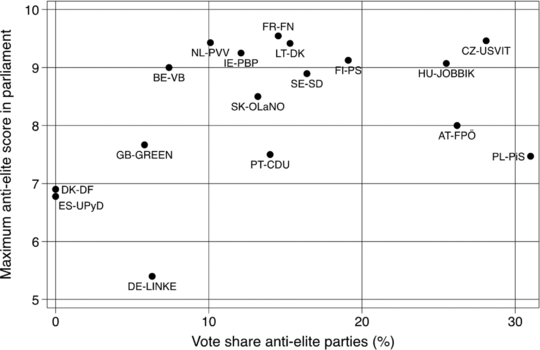
Maximum anti‐elite score in parliament and vote share of anti‐elite parties, 2014.
Notes: Labeled with country codes and party with maximum anti‐elite score in parliament. Party abbreviations: CDU = Unitary Democratic Coalition; DF = Danish People's Party; DK = Way of Courage; FN = National Front; FPÖ = Austrian Freedom Party; GREEN = Green Party; JOBBIK = Movement for a Better Hungary; LINKE = The Left; OLaNO = Ordinary People; PBP = People Before Profit; PS = True Finns; PVV = Freedom Party; PiS = Law and Justice; SD = Sweden Democrats; UPyD = Union, Progress and Democracy; USVIT = Dawn; VB = Flemish Interest.
Source: Based on CHES (Polk et al. Reference Polk2017).
Our dependent variable is respondents’ internal efficacy. It is constructed as an additive index based on three items capturing respondents’ confidence in their ability to understand and participate in politics (Crombach α = 0.84; see the Online Appendix for question wording and construction). The index ranges between 0 and 10, where higher values indicate a greater sense of internal efficacy. The main explanatory variable is respondents’ household after‐tax income. The ESS places all respondents into country‐specific income deciles, which we recoded into low (1–3), middle (4–7) and high income (8–10). This is a rather broad definition of poverty, but our results are robust to alternative specifications, such as focusing on the difference between lowest decile and median income or treating income as a linear variable (see Online Appendix Tables 8 and 9).
To capture the intensity of anti‐elite discourses in the political system, we rely on the CHES, which asks national experts to rate the ‘salience of anti‐establishment and anti‐elite rhetoric’ for each party. Salience scores range from 0 (low) to 10 (high). This measure is extremely useful for us because it allows us to go beyond a dichotomous party family approach (which would produce little variation in contemporary Europe) and to operationalise anti‐elite rhetoric as a continuous phenomenon. However, the translation of the party scores into a party‐system indicator requires an important analytical choice. On the one hand, we could use the maximum value among parties that gained a seat in the national parliament. This indicator captures the intensity of anti‐elite rhetoric. However, by ignoring electoral performance, it does not consider the relative success of anti‐elite parties. On the other hand, we could use the vote share of anti‐elite parties (which we define as being above 75th percentileFootnote 6 in anti‐elite salience). This indicator does take into account relative success, but cannot account for variations in intensity and is sensitive to the selection of the cut‐off point. Which indicator is more appropriate cannot be decided a priori as this would require a theory about whether electoral relevance or intensity of anti‐elite discourses matter more – an aspect about which we are agnostic. Fortunately, both indicators are correlated and produce virtually the same results (see Figures 1 and 2 as well as Online Appendix Table 11). For the main analysis, we rely on vote share of anti‐elite parties.
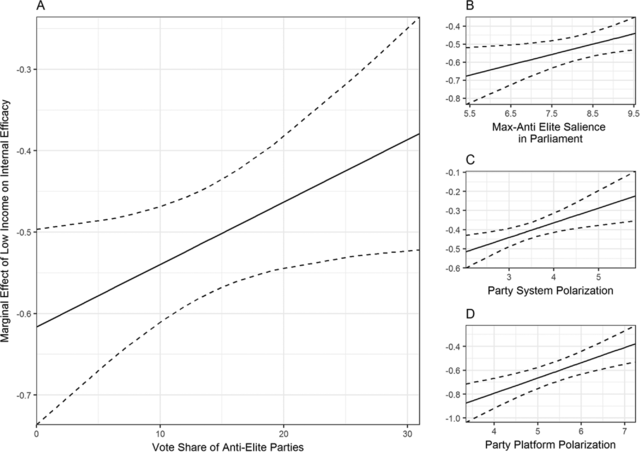
Marginal effect of low income given anti‐elite salience/polarisation.

Ideally, we would complement our party‐system indicators with information on how salient anti‐elite sentiments are in broader public discourses (e.g., in the media (Rooduijn Reference Rooduijn2014)), but to our knowledge there is no readily available comparative indicator for this aspect.
All individual‐level control variables are taken directly from the ESS. We prefer a parsimonious model and therefore include only the main socioeconomic controls that have been found to matter for internal efficacy: respondents’ main activity in the last seven days, gender and years of education. Other political orientations and membership in political organisations obviously do influence efficacy as well (Marx & Nguyen Reference Marx and Nguyen2016), but, based on our theory, these factors should mediate rather than confound the effect of low income. That said, our results remain unchanged if we also control for ideology, party affiliation, religiosity and trade union membership (see Online Appendix Table 7).
Given our nested data structure, we use a multilevel random intercept model. Isolating causal factors on the country level is, of course, difficult in this setup. One reason for concern might be that anti‐elite salience is confounded with the salience of socioeconomic problems and frustrations about them. The literature linking success of radical right‐wing parties to macroeconomic problems has produced rather mixed results (Golder Reference Golder2016), but this might differ for the radical left (March & Rommerskirchen Reference March and Rommerskirchen2015). Economic grievances could also influence efficacy through other mechanisms, such as anti‐austerity protests (Grasso & Giugni Reference Grasso and Giugni2016).
Against this background, it is important to note that our indicator of anti‐elite salience is moderately correlated with unemployment (r = 0.33) and gross domestic product (GDP) per capita (r = –0.48), and only weakly correlated with income inequality (r = –0.25) and GDP growth (r = 0.08). Another set of potential confounders could be found in political institutions. Anti‐elite salience could, for instance, be a response to exclusive electoral rules or limited choice in the party system. Finally, the theorised causal arrow might be reversed if anti‐elite salience becomes high where the poor already have a high propensity to participate and to voice their grievances. This could be the case in countries with a tradition of high participation, for instance, out of ‘civic duty’. While we address causality more explicitly in the experimental part of the paper, here the best strategy at our disposal is to control for as many of the potential confounders as possible.
With only 17 countries we are, however, restricted regarding the number of macro control variables. In our baseline model, we control for postcommunist countries with their less mature democracies and different party‐system dynamics (which are already illustrated in Figure 1). We also control for the effective number of political parties because the availability of alternatives might be a separate mechanism facilitating or complicating party choice (Wilford Reference Wilford2017). The number of parties should also pick up broad differences in electoral systems. Finally, we include income inequality within the country post taxes and transfers (i.e., Gini coefficient). Previous research suggests that social equality, which partly reflects pre‐ and re‐distributive efforts of the state to support the poor, should be beneficial for their political involvement (Iversen & Soskice Reference Iversen and Soskice2015; Marx & Nguyen Reference Marx and Nguyen2016). Inequality should also affect the political salience of income differences.
Because these variables certainly are not exhaustive, we use alternative specifications that also control for GDP/capita, GDP growth, national unemployment, the percentage of the population at risk of poverty or social exclusion, social spending, legislative fragmentation or macro turnout. Our results are robust in these alternative specifications (see Online Appendix Tables 16–20).
Results
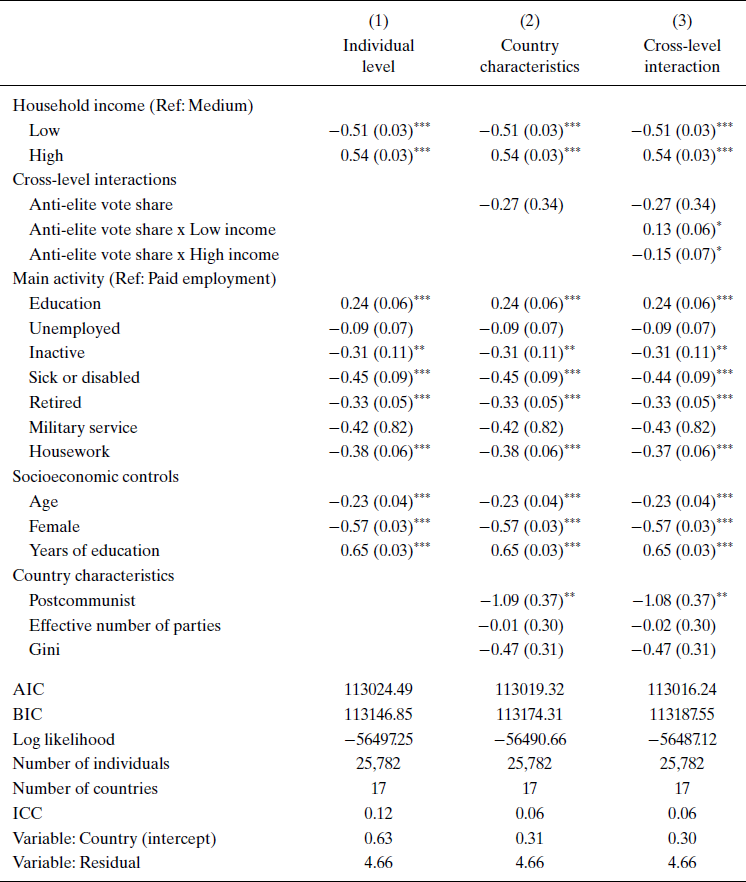
Table 1 reports the results of three hierarchical random‐intercept models. To facilitate comparisons between coefficients, we mean‐centre all continuous explanatory variables and divided them by two standard deviations (unstandardised results can be found in Online Appendix Table 6). The coefficient estimates for continuous variables now represent a movement of one standard deviation, and can be compared directly to the coefficients of binary and factor variables (Gelman Reference Gelman2008).
Multilevel regression: Internal efficacy by income, anti‐elite salience and control variables

Notes: ***p < 0.001; **p < 0.01; *p < 0.05. Standard errors in parentheses. Continuous variables are standardised.
The first model only controls for individual characteristics. The second model adds country‐level controls and the third cross‐level interactions. The findings reported in Table 1 support our hypotheses. Income has a consistent and statistically significant effect on internal efficacy. Compared to medium‐income respondents, low‐income respondents exhibit lower internal efficacy. High‐income respondents have, on average, a higher level of internal efficacy. Moving from the middle to the lower end of the income distribution is associated with reductions in internal efficacy similar to the difference between men and women or moving from full‐time employment to being sick and disabled. Adding country variables improves the model fit considerably.Footnote 7 A legacy of communism is associated with a sizable reduction in internal efficacy. However, neither inequality, anti‐elite salience nor the number of parties appear to have a significant direct effect on efficacy.
More importantly, both Table 1 and Figure 2 support H2: anti‐elite salience does reduce the effect of low income on efficacy. All other things being equal, the effect of moving from medium to poor income in Austria (where the anti‐elite FPO and Team Stronach had a combined vote share of 26.2 per cent) is approximately 35 per cent less severe than in Germany (where the AfD and the NPD combined captured less than 5 per cent of the vote share). As a consequence, anti‐elite salience is associated with a considerable reduction of the income gap in efficacy (without being able to close it entirely, see Figure 2).
As we demonstrate in more detail in Online Appendix Tables 10–13, the results do not seem to depend on our operationalisation of anti‐elite salience. Panel B of Figure 2 shows that results do not change if we use, instead, the maximum anti‐elite score in parliament. Because our argument partly rests on a more polarised party landscape, we also replicate the analysis with an interaction of income and two polarisation indicators: an updated version of Dalton's (Reference Dalton2008) measure of the perceived left‐right party system polarisation, and a measure of party platform polarisation (Finseraas & Vernby Reference Finseraas and Vernby2011). Both show a similar moderation pattern and confirm our expectation that income gaps in efficacy become smaller in more polarised party systems (Panel C and D in Figure 2). Finally, also a more permissive cut‐off point for our definition of anti‐elite parties does not change the results.
In short, there is evidence that party‐system differences moderate the effect of income on internal efficacy. While these patterns are suggestive, it is difficult to base firm conclusions on them at this stage. As discussed above, income and anti‐elite salience are likely correlated with potentially relevant factors we cannot account for in our model. Moreover, a purely cross‐sectional approach cannot establish temporality and is therefore unable to rule out reversed causality. Iversen and Soskice (Reference Iversen and Soskice2015) argue, for instance, in contrast to our theory, that polarisation is the consequence of a more politically knowledgeable lower‐class electorate. We will therefore provide additional evidence that helps us to isolate the causal effect of exposure to anti‐elite rhetoric on internal efficacy.
Priming anti‐elite rhetoric in a survey experiment
We have argued that anti‐elite rhetoric can increase the internal efficacy of lower income voters. While the results of the previous study support this hypothesis, the observational nature of the data does not allow for a causal interpretation. To address this shortcoming, we designed an experiment embedded in a representative survey of the German population. The goal is to answer the question whether exposure to anti‐elite discourses has a positive and causal effect on the internal efficacy of poor respondents.
Germany is a suitable case because it recently experienced an intense growth of anti‐elite mobilisation. As shown in Figure 1, it had one of the lowest anti‐elite scores in our 2014 sample. Die Linke was the most radical party in parliament with a very moderate anti‐elite salience score of 5.4. More pronounced anti‐elite parties only gained 5.4 per cent of the votes. This picture changed dramatically in recent years because of the growth of Alternative für Deutschland (AfD), a new radical right‐wing party, which was founded in 2013 as a protest party against bail‐outs of Eurozone countries and barely missed the 5 per cent threshold to enter parliament in the 2013 national election. Although the turn to a radical anti‐immigration platform occurred later (after a party split), the 2014 CHES already assigns an anti‐elite score of 7.8 to the AfD. Since 2015, it polled comfortably above the electoral threshold and, seven months after we conducted the experiment, it entered parliament in the 2017 elections as the third biggest party.
The recentness of intense anti‐elite mobilisation and the fact that the AfD at the time was not yet represented in parliament is advantageous for our analysis. Because voters have not yet grown accustomed to (or weary of) anti‐elite frames, we have a chance to experimentally prime a real‐world discourse that has not yet unfolded its full effect on the baseline efficacy of poor voters (as would probably be the case in party systems with more established anti‐elite parties). Hence, what we attempt to achieve is to activate anti‐elite rhetoric as the lens through which respondents look at politics when they make a self‐evaluation regarding their internal efficacy. To be clear, our assumption is that the treatment is not respondents’ first encounter with anti‐elite rhetoric. Given the context described above, we assume that the treatment will in many cases evoke prior experiences with anti‐elite rhetoric (personally or through the media). If our theory is correct, the treatment will provide a situational frame that makes politics appear simpler, but also more emotionalised, dramatic and exciting. The effect on efficacy of the poor would be positive. Again, we believe the chance of influencing respondents in this way is higher under conditions of flux in the party system when allegiances are not yet crystalised.
Data and methodology
Around 1,200 computer‐assisted web interviews of the target group between 18 and 65 years were conducted by YouGov in Feburary 2017. Based on the goal described above, we conducted a priming experiment that randomly exposed respondents to anti‐elite statements. All participants received a standard question measuring internal efficacy: ‘How confident are you in your own ability to participate in politics?’ Answer options ranged from 0 ‘Not at all confident’ to 10 ‘Completely confident’. The manipulation took the form of a randomised question order. In the treatment group, respondents first received three items that were designed to resemble typical anti‐elite rhetoric and then answered the internal efficacy question. The control group, on the other hand, received the internal efficacy question first and was only later exposed to the three anti‐elite items. Specifically, the three items were: (1) ‘Political parties often spread lies to get elected’; (2) ‘Politicians are more interested in their careers than in the good of the country’; and (3) ‘Politicians in Berlin have abandoned ordinary people’.
While the statements certainly formulate blunt criticisms, they are no more extreme than the typical accusations of anti‐elite parties (including the AfD). We deliberately refrain from pointing to criminal offenses, such as corruption, and believe that the statements could be easily encountered in a German pub or other places where politics are discussed. This is supported by response patterns. On a scale from 1 (low) to 7 (strong agreement), the average score for all three items lies above 5. ‘Strong agreement’ is the most frequently chosen answer.Footnote 8 This pattern is especially developed for lower income respondents, who have significantly elevated cynicism levels (p = 0.008). (For a more detailed breakdown of anti‐elite scores, see Online Appendix Figures 2–4.)
To avoid conflation of anti‐elite sentiments with priming ideology, we excluded messages from our treatment that explicitly focus on concrete issues such as immigration. Again, the treatment is not designed to provide any new information, but merely to prime anti‐elite criticism and thereby activate it as a salient interpretative frame for thinking about politics. According to our theory, low‐income participants should feel more internally efficacious if they apply this interpretative frame to politics.
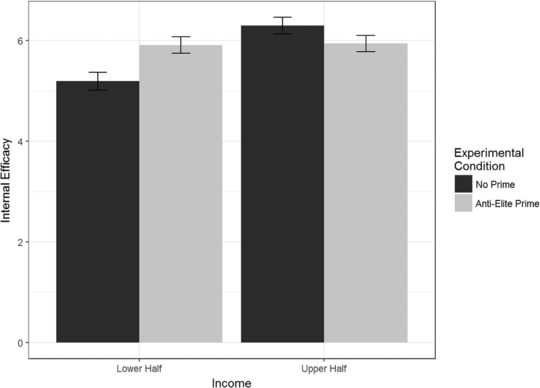
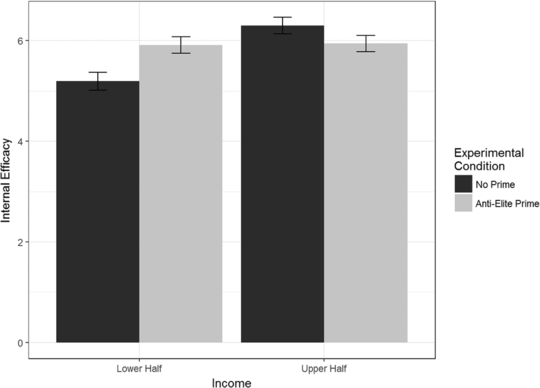
The case numbers do not allow a fine‐grained analysis of income differences. We use a rough income measure and divide respondents into two groups below and above a threshold of €2,500 as net monthly household income. After a list‐wise deletion of missing values, we have 487 respondents below the threshold (245 treated) and 411 above (208 treated). Our analysis consists of comparing means and confidence intervals of the four groups that result from our design (Figure 3).
Internal efficacy by anti‐elite prime and income.
Results
The patterns in the control group confirm what we observed in the previous study based on ESS data. Respondents in the bottom half of the income distribution express on average considerably lower internal efficacy (the mean is 5.2 compared to 6.3 in the upper half, p = 0.0009). This difference virtually disappears, however, once respondents are exposed to an anti‐elite frame. This happens because the treatment is, as expected, associated with significantly higher internal efficacy in the bottom half (in which the difference between control and treated group is 0.72, p = 0.003). Given that internal efficacy is often thought of as being rooted in rather stable characteristics, this is not a small effect. Online Appendix Figure 5 displays the entire distribution of efficacy by income and experimental group.
The results do not depend on our definition of low income. In a more narrowly defined low‐income group below €1,500 (not shown) the treatment effect is 0.78 with p = 0.015. At the same time, the anti‐elite prime causes the opposite effect among respondents with higher income (–0.35). However, this effect is not statistically significant (p = 0.128). Another robustness check is to replace income with a subjective measure of financial worries. As shown in Online Appendix Figure 6, we obtain similar results if we differentiate respondents by reported frequency of worrying about making ends meet. Again, the treatment effect is strongest among respondents who report being always worried. Hence, regardless of how income is measured, the results are exactly what we would expect based on our theory.
In the Online Appendix, we explore how the results are influenced by agreement to the anti‐elite statements that make up our treatment. The fact that our treatment takes the form of a reversed question order enables us to compare the correlation between anti‐elite cynicism and efficacy in both experimental groups. As Online Appendix Figure 4 shows, this correlation is negative in the control group; cynics have lower internal efficacy. This is unsurprising as they also disproportionately have low income and education. Against this background, it is remarkable that anti‐elite cynicism is positively related to efficacy in the treatment group (left panel of Online Appendix Figure 4). This suggests (a) that anti‐elite cynicism matters for internal efficacy particularly in situations in which it is ‘activated’ through discourses, and (b) that the positive effect is particularly strong among citizens who are receptive to such frames.
Does anti‐elite salience reduce inequality in political participation?
Our observational and experimental data suggest that anti‐elite parties can strengthen the internal political efficacy of poorer voters. An obvious and important question in democratic politics is whether this increase translates into more equal participation. Attitudes might be more responsive than actual behaviours. And even if beneficial for internal efficacy, anti‐elite parties could weaken other prerequisites for political participation (Immerzeel & Pickup Reference Immerzeel and Pickup2015; Rooduijn et al. Reference Rooduijn, der Brug and Lange2016). We therefore extend our analysis to briefly address the issue of political participation of the poor, without claiming to give full justice to this important point. The goal is merely to problematise the link between anti‐elite discourses, efficacy and participation as an empirical question that will have to be taken up by future research.
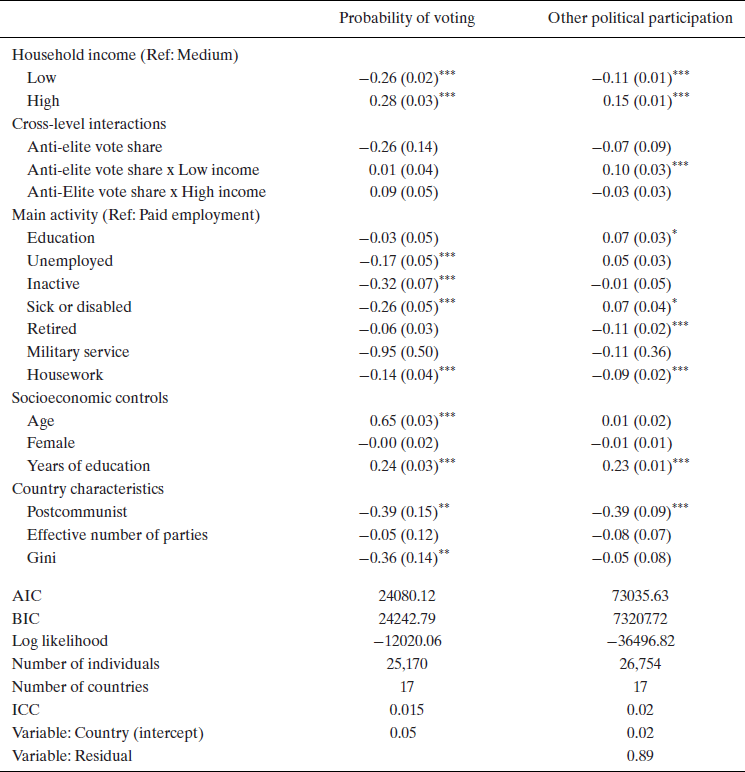
To this end, we reproduce the ESS analysis presented above with two new dependent variables: self‐reported participation in the last national election; and an index of alternative, non‐electoral forms of participation. The latter captures additively whether or not respondents engaged in the following activities in the last 12 months: worn a campaign badge, signed a petition, contacted a political official, worked in a political party or action group, or participated in a public demonstration. The indicator increases by one for each activity, such that it ranges from 0 to 5.
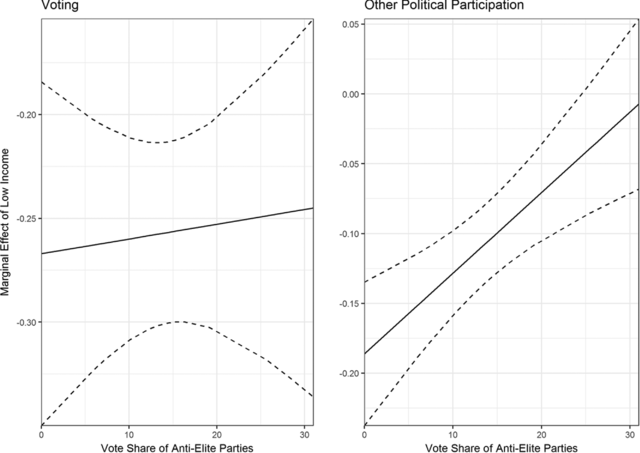
Table 2 and Figure 4 summarise the relationship between poverty, anti‐elite salience and political participation. Again, all continuous independent variables have been standardised (full models can be found in the Online Appendix). As expected, poor voters are less likely to participate in elections or in other ways. However, the moderating role of anti‐elite salience is ambiguous. With regard to voting, we do not find a statistically significant moderation effect. As panel A in Figure 4 shows, poor citizens’ lower probability of voting remains constant across party systems. Poorer citizens do, however, benefit from the presence of anti‐elite parties when it comes to other forms of political participation. As panel B shows, poor respondents no longer show significantly reduced participation if anti‐elite parties reach about 25 per cent of the vote in a country.
Multilevel regression: Voting and other forms of political participation by income, anti‐elite salience and control variables

Notes: ***p < 0.001; **p < 0.01; *p < 0.05. Standard errors in parentheses. Continuous variables are standardised.
Marginal effect of low income given vote share of anti‐elite parties.

How can we make sense of these inconsistent findings? First, we cannot rule out that the non‐finding for voting results from systematic measurement error. Self‐reported voting is usually inflated by social‐desirability bias (Selb & Munzert Reference Selb and Munzert2013), a problem that might be exacerbated by the retrospective ESS question and the varying time gap between the survey and the last election. Indeed, a comparison with actual turnout (see Online Appendix Table 16) reveals strong over‐reporting of voting in the ESS, which could artificially dampen the income gradient (Erikson Reference Erikson2015). Because unconventional forms of participation are less of a ‘civic duty’ and because the question refers to the past 12 months, social desirability and recall bias might be less severe. Biases aside, voting arguably also is a less demanding form of participation than some of the non‐electoral forms. It could be that we observe our effects on efficacy among many poor people who vote despite their relatively low subjective confidence.
But there also is a possible substantive interpretation of the non‐results for voting. It is rather plausible that anti‐elite salience might undermine other aspects of political involvement than internal efficacy – namely external political efficacy and political trust (Rooduijn et al. Reference Rooduijn, der Brug and Lange2016). Anti‐elite parties might draw support from previous non‐voters and thereby increase participation in elections. However, if they at the same time contribute to eroding external efficacy among voters who, for one reason or another, are not inclined to support a radical party, this could cancel out any positive effect on electoral participation.
Our argument implies that some voters gain relative internal efficacy because of simplified and dramatised competition between elites and populist challengers. It is not difficult to imagine, however, that some of these voters are disgusted and alienated from this competition (Rogowski Reference Rogowski2014). Particularly if the anti‐elite party is not an option (because of fundamental disagreements about values, political socialisation, social desirability, conflict aversion or disappointment with the party's performance), intense anti‐elite discourses might leave no trustworthy political actor in the electoral arena to turn to. From this perspective, there is no theoretical reason why internal and external efficacy, as well as electoral and unconventional participation, would have to react in the same way to anti‐elite rhetoric. While the evidence we bring to bear on this matter is far from conclusive, it points to an important task for future research.
Conclusions
In this article, we have developed and tested a novel argument according to which internal efficacy is an important component of the lower political involvement of poor citizens. Moreover, we have argued that anti‐elite rhetoric counters the negative effect of poverty on internal efficacy. We have shown that the salience of anti‐elite rhetoric on the party‐system level robustly correlates with the size of the efficacy gap between poor and non‐poor voters. This relationship is not simply correlational. Using a representative survey experiment, we demonstrate that random exposure to anti‐elite statements significantly increases the internal efficacy of lower income respondents. While both approaches have limitations, their joint evidence lends strong support to two conclusions: poverty tends to reduce internal political efficacy; and anti‐elite rhetoric tends to reduce the gap between the poor and the rich.
What are the broader implications of this observation? Despite our findings for internal efficacy, we are hesitant to endorse the proliferation of anti‐elite parties as a means of reducing political inequality. As we have shown, it is not clear whether higher efficacy does actually lower the income gradient in voting, even if this seems to be the case for other forms of participation. We could only deal with this important aspect in passing and hope that future research will return to it with more suitable data.
If we assume for a moment that the lower efficacy gap we observed does translate into more equal participation in elections, what would be the political implications? Could anti‐elite parties possibly contribute to breaking the vicious cycle of unequal participation and unequal representation? Can anti‐elite parties contribute to policy change that reflects the interests of the poor (or, more accurately, what we interpret as their interests)? This would be possible through two mechanisms that could be studied empirically: directly, through mobilising poor voters who increase the coalition in favour of redistribution and welfare state generosity; and indirectly, by forcing centre‐left parties to compete for lower income voters and thereby incentivising a better representation of this group.
But there are also reasons to be sceptical. Policy advances for the poor are particularly questionable in the case of radical right‐wing parties, whose ideology dictates excluding some of the most vulnerable groups in society. While many right‐wing parties project a pro‐welfare image, they often advocate cuts in programmes with a reputation of benefiting immigrants (e.g., social assistance, child benefits). Such ‘welfare chauvinism’ can actually harm poor natives as well. Hence, anti‐elite salience is but one feature of a party and we cannot assess its broader impact without looking at the entire profile. Future research should therefore contextualise our findings by including the specific ideology of anti‐elite parties as well as the programmatic response of the mainstream.
Acknowledgements
We gratefully acknowledge comments by Achim Goerres, Marc Guinjoan, Thomas Leeper, Jonathan Polk and Joshua Robinson, as well as the helpful feedback received at the workshop ‘Voters adrift: Consequences of electoral dealignment in representative democracies’.
Online Appendix
Additional supporting information may be found in the Online Appendix section at the end of the article:
Table 1: Individual Summary Statistics ‐ Nominal Variables
Table 2: Individual Summary Statistics ‐ Categorical Variables
Table 3: Country Level Summary Statistics
Table 4: Correlations between macro‐variables
Table 5: Empty Model
Table 6: Non‐Standardized Results
Table 7: Additional Covariates
Table 8: Income as Continuous Variable
Table 9: Full Income Deciles
Table 10: Lower Bound Anti‐Elite Salience Cut‐Off (Anti‐Elite Salience = 6)
Table 11: Max Anti‐Elite Salience in Parliament
Table 12: Party System Polarization
Table 13: Manifesto Polarization
Table 14: GDP/Capita
Table 15:GDP Growth
Table 16: National Unemployment
Table 17: Legislative Fragmentation
Table 18: Macroturnout
Table 19: Population at Risk of Exclusion
Table 20: Social Spending per Inhabitant
Table 21: Exclude Country Outliers
Table 22 : Randomization Check
Table 23: Income, Anti‐Elite Salience and Political Involvement
Table 24: Comparison of self‐reported and officially recorded electoral turnout
Figure 1: Cook's Distance Plot
Figure 2: Distribution of Agreement with Anti‐Elite Statements
Figure 3: Distribution of Agreement with Anti‐Elite Statement in ESS 7 (2014, Germany only)
Figure 3: Distribution of Agreement with Anti‐Elite Statements by Income
Figure 4: Relationship between Agreement with Anti‐Elite Statements and Internal Efficacy by Experimental Group
Figure 5: Distribution of Internal Efficacy by Income and Experimental Prime
Figure 6: Distribution of Internal Efficacy by Income Worries and Experimental Prime


 Open access

