

Introduction
The brain is the locus of memory, compassion, logic, identity, and art.Reference Wheater1, Reference Gasenzer, Kanat and Neugebauer2 Some studies have reported that Wolfgang Amadeus Mozart’s music has positive effects on brain functions, a theory known as the Mozart effect.Reference Wheater1, Reference Gasenzer, Kanat and Neugebauer3 Mozart (born Johannes Chrysostomus Wolfgangus Theophilus Mozart) is one of the most famous composers of classical music, born in Salzburg on January 27, 1756.Reference Gasenzer, Kanat and Neugebauer4 He died at the age of 35 after suffering for 14 days from an acute and mysterious illness. In the medical community, there is still an interest in the exact cause of his early and unexpected death; multiple hypotheses have been formulated to explain the exact nature of Mozart’s last illness, and investigators have attributed nearly 150 different medical diagnoses to him.Reference Stadlbauer, Reiter and Patzak5–Reference Karhausen7 All suggestions remain unproven. Since 1902 the “Internationale Stiftung Mozarteum” has owned a cranium assumed to be that of Mozart.Reference Stadlbauer, Reiter and Patzak5 The temporoparietal fracture on Mozart’s skull has led to speculations about the possibility of a neurological disease as a cause of his early death, but the neurosurgical aspect of his death has not been well–analyzed. In this study, we searched the cause of neurosurgical aspects of the early death of Mozart.
The Last Disease of Mozart
Between 1780 and 1790 Mozart completed almost 300 compositions, and he had no serious illnesses until he was 28 years old.Reference Wheater1 In July 1789, however, when he was 33, he began to complain of an intermittent headache and toothache.Reference Puech, Puech and Dhellemmes8 In 1791, the last year of Mozart’s life, he was especially prolific, up to his final months: the special and ingenious opera composition, “Titus,” which he completed on September 5 and conducted himself; the magnificent “Magic Flute,” the premiere of which he performed on September 30; the clarinet concerto “Freemason’s Cantata,” which he performed on November 18; and his famous Requiem, which he worked on up to his last moments and could not complete. In a letter to his friend Da Ponte, in September 1791, he wrote “My head is lost (ho il cape frastomato), I am completely exhausted and cannot take my eyes off the image of this stranger. I no longer have to tremble; I can feel something that proves the hour of my death is striking; I am close to death.”Reference Puech, Puech and Dhellemmes8
Mozart’s Untimely Death and the Review of his Skull
There are speculations on neurosurgical pathology as a cause of Mozart’s early death.Reference Ivkic and Erdeljic6, Reference Puech, Puech and Dhellemmes8, Reference Vlcek, Druga and Smahel9 Eyewitness accounts, such as his wife’s, Constanze, recorded his symptoms and final hours. Just 15 days after the onset of his illness, Mozart went into convulsions, lapsed into a coma, and died. Upon his death, Constanze crawled into bed with the corpse and clutched it.
On November 20, two days after the world premiere of the “Freemason’s Cantata,” Mozart became ill and developed fears of death, suffering from bad headaches and vomiting. After a week, half of his body was paralyzed. Mozart became bedridden on November 22, 1791Reference Wheater1 and never rose from it again. His physicians were unable to correctly diagnose him. G. M. NissenReference von Nissen10 wrote in his biography on Mozart, “Accordingly, the family doctor Dr. Closset, who arrived on the last evening of his life, Mozart fell unconscious, from which he did not come to himself again.” On December 5, at midnight, he suddenly stretched on his bed and bent his head toward the wall, then fell into a comatose state. Fifty-five minutes later, he was dead.Reference Puech, Puech and Dhellemmes8, Reference Breitinger and Kritsher11 Mozart was acutely ill only 14 days: he wrote his Requiem up until a few hours before his death, he was awake and cooperative until December 4, and unconsciousness suddenly occurred only two hours before his death.
Mozart was entombed in a common grave at the Vienna cemetery of St. Marx.Reference Stadlbauer, Reiter and Patzak5 The “Mozart cranium” was a dubious relic – in 1842 grave-diggers from the St. Marx cemetery found a skull on a place where Mozart could be buried.Reference Gasenzer, Kanat and Neugebauer12, Reference Kritscher, Kritscher and Szilvássy13 The skull was transferred to the bone collection of Joseph Hyrtl,Reference Stadlbauer, Reiter and Patzak5 a famous anatomist from the University of Vienna, who believed it to be the skull of Mozart.Reference Puech, Puech and Dhellemmes8 The cranium was finally given to the Stiftung Mozarteum in 1902.Reference Stadlbauer, Reiter and Patzak5 However, it has not been unequivocally confirmed that the described skull was of Mozart.Reference Gasenzer, Kanat and Neugebauer12
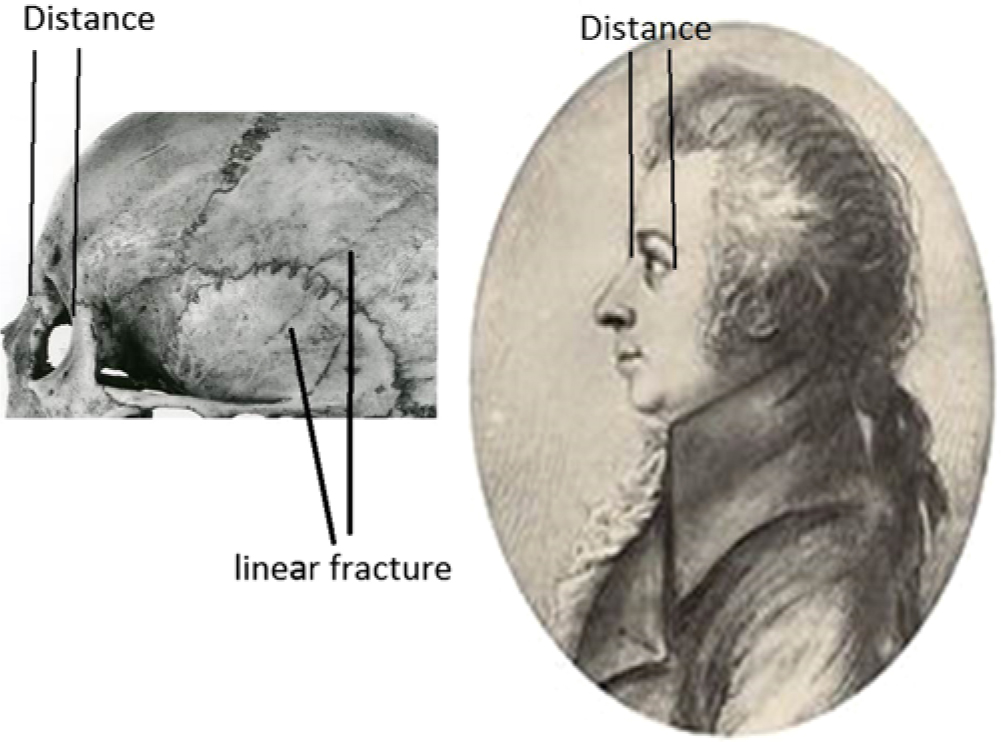
The examined skull, though, could be that of Mozart. The age of the person whose skull was discovered was expected to be over 25 but not older than 40. In relation to the portrait of Mozart by Dorothea Stock from 1789, there are similarities between the skull and the portrait, especially in relation to the lateral view of the skull (see Figure 1).Reference Gasenzer, Kanat and Neugebauer12 The skull shows a fracture (a break, or crack of the bones) on the left temporoparietal region with some healing. We believe his right side was paralyzed because the fracture of the cranium was on the left side (as seen in Figure 1).
In relation to the portrait by Dorothea Stock from 1789, there are similarities between the skull and the portrait. The left side fracture is seen.
Neurosurgical Aspects of Differential Diagnosis
Head injury and skull fracture
Mozart may have suffered head trauma at the age of 35 prior to his death, as his skull showed a big fracture on the left temporoparietal region with clear signs of healing.Reference Puech, Puech and Tichy14 This healed fracture line was very thin, with a little irregular run. The whole fracture line on the outer left side of the skull was nearly 10 cm long and reached from the left parietal eminence to the base at the parietotemporal junction. No osseous displacement was seen.Reference Puech, Puech and Tichy14 The inner side of the left temporal and parietal bones, on the calvarial surface, showed an explicit imprint of a calcified epidural hematoma, with a size of about 45 cm2.Reference Puech, Puech and Tichy14 However, the fracture line was in accordance to the outer side a little bit displaced, and the surface of lamina interna was considerably altered about an area of 8 × 5 cm2.Reference Puech, Puech and Tichy14 This type of fracture may have been the consequence of a fall. Kritscher and Szilvássy concluded in 1990 that the fracture may have occurred before the person was an adult.Reference Kritscher, Kritscher and Szilvássy13 A mapping of the CT performed at the Natural History Museum was requested, but could not be obtained. We could not agree, however, with Kritscher about the date of fracture of Mozart and believe that the trauma and fracture of Mozart’s skull occurred nearer to his death. After a traumatic brain injury (TBI), impairments in physical, cognitive, psychological, and behavioral functioning are common.Reference Rydon-Grange and Coetzer15 Mozart was 34 years when he suffered a likely TBI. Diagnosing a TBI is primarily performed by radiological examination, which was not possible during the times of Mozart.
Chronic subdural hematoma
Chronic subdural hematoma (CSH) is one of the most frequent types of post-traumatic diseaseReference Kayaci, Kanat and Koksal16 in neurosurgery among the elderly.Reference Kanat, Kayaci and Yazar17 It often manifests with headaches and insidious loss of neurological and cognitive functions. All these symptoms were noted during Mozart’s last illness. Calcification of CSH is found in 0.3–2.7% of CSH cases and generally found in children and young adults,Reference Claiborne, Hoge and Wood18 as was likely seen in Mozart at the age of 35.
Epidural hematoma
Epidural hematoma may occasionally develop slowly, which likely occurred in Mozart’s cranium. This type of epidural hematoma is a distinct and rare entity. This situation may also explain his severe headache during his last year. The last disease of Mozart may have had an effect on the composition of his K.626 Requiem and perhaps other last works.Reference Drake19 However, it should be kept in mind that musical function in professional musicians makes use of both temporal lobes indifferently.Reference Kanat, Kayaci and Yazar20 Mozart appears to have survived for a few years, since the fracture was consolidated and epidural hematoma had the time to leave its prints.Reference Puech, Puech and Dhellemmes8 Kritscher and Szilvássy described the typical characteristics of an epidural hemorrhageReference Kritscher, Kritscher and Szilvássy13 that occurs by traumatic injury of the middle meningeal artery on the underside of the fracture. In relation to Mozart’s neurological state in question, it can be assumed that he might have suffered a chronic calcified epidural hematoma, as argued by Puech et al.Reference Puech, Puech and Dhellemmes8 and Drake.Reference Drake19
Conclusion
We thoroughly describe here the neurosurgical aspects of an undoubtedly traumatized skull and open a “way to speculations,” but we were unable to definitively clarify the cause of Mozart’s death. Historically, we know that Mozart suffered from bad headaches in the spring of 1790, for more than a year before his death.Reference Vlcek, Druga and Smahel9 We unfortunately don’t know about possible major head injuries during his life. A temporoparietal linear fracture on the left side of Mozart’s skull is an important neurosurgical aspect in investigating the early death of Mozart. Our assumption is that he fractured his skull several months before his death. Previously, epiduralReference Puech, Puech and Dhellemmes8 and chronic subdural hematomaReference Drake19 are reported as occuring during the last illness of Mozart. We think that Mozart suffered a chronic calcified epidural hematoma. Today, neurosurgery has made much progress;Reference Gasenzer, Kanat and Ozdemir21 however, during the times of Mozart, it was impossible to make a radiological diagnosis. The early and unexpected death of Mozart was a mystery from the first day,Reference Gasenzer, Kanat and Neugebauer12 and in this situation, a final diagnosis of Mozart’s brain pathology remains unclear. Some confusion still exists about the exact neurosurgical pathology of Mozart, which cannot be determined without an autopsy report. The speculations, it seems, will continue.
Disclosures
The authors declare that they have nothing to disclose.



