

Introduction
Communicating research is very important to societal development and journal publication is the most common and effective channel of executing the communication. From its inception in the middle of the seventeenth century in the major cities of Western Europe, journal publishing spread to other parts of the world. By the second half of the twentieth century, the global journal publishing industry boasted several thousand titles. However, the market was dominated by commercial journal publishers who perfected business models that became a barrier in the process of research communication (Saarti and Tuominen Reference Saarti and Tuominen2017). To further control the market, commercial players introduced listing and indexing services which in many cases served as means of quality control and determining the size of the market (Asan Reference Asan2024).
Many scholars have considered the size and quality of the market, for example Bristow (Reference Bristow2021); Cook (Reference Cook and Fredriksson2001); Ezema (Reference Ezema2010a); Fyfe et al. (Reference Fyfe2022); Jinha (Reference Jinha2010); Lougee (Reference Lougee2000); Mabe (Reference Mabe2007); Morris et al. (Reference Morris2013); Stein (Reference Stein and Kümin2014); Tenopir and King (Reference Tenopir, King, Cope and Phillips2014). However, most of these studies used the popular journal indexes as their sources for data. Hodge and Lacasse (Reference Hodge and Lacasse2011), Onyancha (Reference Onyancha2009), and Roh et al. (Reference Roh, Inefuku, Drabinski, Eve and Gray2020) criticized the indexes as being biased against non-English language journals or journals from developing countries, especially Africa. To address the challenges of limited availability and accessibility of African journals, the International Network for the Availability of Scientific Publications (INASP) launched the African Journals Online (AJOL) project. This project, among other services, hosted a website designed to serve as an index and access gateway to African journals. The index went online in 1999 with fourteen journal titles (Smart Reference Smart2005) and has since grown steadily; currently, the site lists 905 journal titles. However, despite this growth, the platform still includes only a fraction of the total African journals available (Abdu Reference Abdu2023; Asubiaro Reference Asubiaro2025; Asubiaro and Onaolapo Reference Asubiaro and Onaolapo2023).
Moreover, studies such as Smart and Murray (Reference Smart and Murray2021), Ouya and Smart (Reference Ouya and Smart2006), Hussein and Smart (Reference Hussein, Smart and Mlambo2007) and Smart (Reference Smart2007) used anecdotal evidence rather than empirical data to estimate the size and quality of African journal publishing. Murray and Clobridge (Reference Murray and Clobridge2016) hinted at the difficulty of determining the number of journals published in Africa. Elsewhere, Em and Pen (Reference Em and Pen2024) hinted also at the difficulty of compiling national journal lists. The present study adopted a field survey to determine the number of journals published in ten federal universities in North-Western Nigeria. This will fill a gap and provide insight into the size of the Nigerian journal publishing sector.
Statement of the problem
Recently, there has been a proliferation of journal titles within the Nigerian university system. For instance, Mohammed (Reference Mohammed2008) reported that between 1965 and 2008, Bayero University, Kano hosted twenty-three journal titles; later Zubair (Reference Zubair2022) noted that the number had risen to fifty by 2022. Kanu et al. (Reference Kanu, Kayode and Iyama2021), in a study that relied on the International Standard Serial Number (ISSN) databank, put university-based journals in Nigeria at 989 titles. Despite this growth, university-based journals in Nigeria are largely absent from major indexing services. For example, only twenty Nigerian journals appeared in Elsevier’s Scopus citation database of about 36,000 journal titles. Only thirteen journals appeared in the Clarivate Web of Science Core Collection of about 21,000 journal titles (Mills and Brailford Reference Mills and Branford2021). On the other hand, some countries are creating national journal lists to control quality and fraudulent publishing practice (Pölönen et al. Reference Pölönen2021); for example, the journal accreditation system of the South African Department of Education (Mati Reference Mati2006). In contrast, there is no national or local index that provides comprehensive and up-to-date coverage of Nigerian journals. This limits their discoverability – both physical and digital – as they remain difficult to locate, identify, or select. Ezema (Reference Ezema2010a: 2) observed that African journals in most cases are only visible within their parent institution. An attempt by Zell (Reference Zell2022) to assess journal publishing from the websites of Nigerian university presses revealed a disturbing situation. Most of the sites had scanty or no information with regards to their journal publishing activities. In some cases links to journals’ details were broken. Since many libraries rely on listing and indexing services for journal acquisition, Nigerian journals are often excluded from library collections simply because they are not indexed (Ezema Reference Ezema2011). Although journal publishers in Nigeria comply with legal deposit to the National Library (Abenu Reference Abenu2023), the National Bibliography of Nigeria is not regularly published (Bakrin and Bakrin Reference Bakrin and Bakrin2022; Mahan et al. Reference Mahan2022). The AJOL database, which is the most comprehensive list of African journals, seems to have left out many Nigerian journals (Abdu Reference Abdu2023). Consequently, determining the size and distribution of the Nigerian journal publishing market is difficult. The present study seeks to compile a comprehensive list of journals published in ten federal universities in the North-Western region of Nigeria.
Research objectives
The research questions for this study were
-
1. To determine the number of journals that are published in the universities of the North-Western region of Nigeria.
-
2. To determine the distribution of the journals published in the universities under study.
Literature review
The origins of journal publishing trace back to learned societies in seventeenth-century Europe, particularly in London and Paris where journals quickly gained acceptance among scientists, governments, and the public as a means of reporting verified knowledge. From the mid-twentieth century onward, the journal publishing business saw the dominance of commercial publishers (Fyfe Reference Fyfe2021), a system which emerged later in the global South including Africa (Bekoe et al. Reference Bekoe2025; Beverungen et al. Reference Beverungen, Bohm and Land2012). This resulted in different market structures: in global North countries, commercial publishers control the majority of the market through oligopolistic practices (Johnson et al. Reference Johnson, Watkinson and Mabe2018; Mabe Reference Mabe2007; Moghaddam Reference Moghaddam2007, 2009; Sanz-Casado et al. Reference Sanz-Casado2021; Smart Reference Smart2007; Tenopir and King Reference Tenopir, King, Cope and Phillips2014). In contrast, university-based and not-for-profit journal publishers dominate in the global South, although they often lag behind in visibility and impact (Ezema Reference Ezema2011; Esseh Reference Esseh2011; Gbaje Reference Gbaje2009; Zakaria Reference Zakaria2019).
Several attempts have been made to estimate the global number of journals, but the figures vary widely depending on the methodology of a study. Bristow (Reference Bristow2021) reported growth of journals from thirty titles in 1700 to 750 in 1800 and several thousand by 1850. Suiter and Sarli (Reference Suiter and Sarli2019) estimated English-language journal titles at 80,000 in 2019. These estimates are criticized for relying on Northern-oriented databases such as Scopus and Web of Science, which under-represent non-English and developing-country journals (Hodge and Lacasse Reference Hodge and Lacasse2011; Onyancha Reference Onyancha2009; Roh et al. Reference Roh, Inefuku, Drabinski, Eve and Gray2020).
In Africa, journal estimates are inconsistent. Twenty years ago, Ouya and Smart (Reference Ouya and Smart2006) placed the number between 400 and 500 titles, Hussein and Smart (Reference Hussein, Smart and Mlambo2007) gave fewer than 500 titles, and Smart (Reference Smart2007) suggested about 1,200 titles, putting those published in Nigeria at about 400 titles. Murray and Clobridge (Reference Murray and Clobridge2016) sampled 1,012 African journals using multiple sources, while Smart and Murray (Reference Smart and Murray2021) reported around 2,000, with Nigeria and South Africa contributing about 450 titles each. However, these figures may still underestimate the reality, given the prevalence of unindexed, print-based journals in Africa (Uthman and Uthman Reference Uthman and Uthman2007). Indeed, Alemna et al. (Reference Alemna, Chifwepa and Rosenberg2001), Ezema (Reference Ezema2010b), Kanu and Ibiwoye (Reference Kanu and Ibiwoye2020), Ndumbaro and Wema (Reference Ndumbaro and Wema2016), and Nwagwu (Reference Nwagwu2005) highlighted that most African journals lack global visibility because they are print-only and excluded from major indexes. Although the sampling of Ezema (Reference Ezema2011) was not enough for generalization, it reported that about 76 per cent of Nigerian social science journals were not indexed by any of the major indexing databases.
Many studies portray African research output as marginal in the global system. Cloete and Maassen (Reference Cloete, Maassen, Cloete, Maassen and Brailey2015) noted that Africa contributed only 1.6 per cent of global research output in 2002, rising slightly to 2.5 per cent by 2008, while its share of researchers declined from 2.2 to 2.1 per cent. By 2021, no African country featured among the top twenty journal publishers listed in Scopus (STM 2021). Even the relatively effective journal publishing system of South Africa had limited reach to the outside world. Very few journals were distributed outside the country (Mati Reference Mati2006). Roh et al. (Reference Roh, Inefuku, Drabinski, Eve and Gray2020) argued that this imbalance reflects epistemic injustice, as global publishing standards, technologies, and languages disproportionately favour developed countries. Onyancha (Reference Onyancha2009) similarly notes that conventional impact measures disadvantage African journals, which explains their exclusion from international indexes.
African scholarly publishing continues to face challenges of visibility, coverage, and international recognition. AJOL was launched to address these limitations by providing a centralized platform for journals published on the continent. Although it is now the largest database of African journals – with Nigeria leading in contributing content, followed by South Africa (Alonso-Álvarez Reference Alonso-Álvarez2025) – the database still lists only a fraction of existing African journals (Asubiaro Reference Asubiaro2025). Furthermore, the wide disparity between AJOL and major global indexing services such as Scopus, Web of Science, and OpenAlex underscores the limited visibility and performance of African journals (Asubiaro and Onaolapo Reference Asubiaro and Onaolapo2023; Ogunfolaji et al. Reference Ogunfolaji2022). For instance, Abu-Bonsrah et al. (Reference Abu-Bonsrah2022) found that only about 23 per cent of the journals indexed on AJOL were also listed on Web of Science, while Ogunfolaji et al. (Reference Ogunfolaji2022) discovered that only twenty of 173 African health journals on AJOL were equally covered in PubMed.
A consistent theme across the literature is the dominance of university-based journals in Africa, where commercial publishing has not taken root due to economic and infrastructural constraints (Esseh Reference Esseh2011; Mills and Branford Reference Mills and Branford2021; Rosenberg Reference Rosenberg2000). Yet many studies have estimated the number of African journals from anecdotal evidence (Hussein and Smart Reference Hussein, Smart and Mlambo2007; Smart et al. Reference Smart, Pearce and Tonukari2004) or bibliographic indexes that favour Northern journals (Tijssen Reference Tijssen, Cloete, Maassen and Brailey2015; Uthman and Uthman Reference Uthman and Uthman2007; Wamisho et al. Reference Wamisho, Shibere and Teshome2012; Nwagwu Reference Nwagwu2005; Siegfried et al. Reference Siegfried, Busgeeth and Certain2006). The few exceptions include Murray and Clobridge (Reference Murray and Clobridge2016), who combined multiple data sources, but even their study did not rely on direct fieldwork. Recently, Abdu (Reference Abdu2023) using a semi-structured questionnaire estimated the university-based journals in Nigeria at about 2,000 titles.
There therefore remains a significant gap in empirical data on the size and distribution of African and Nigerian journals. Most surveys overlook the realities of university-based, print-only journals in Nigeria, which are rarely indexed. To address this gap, the present study used primary field data to provide insights about university-based journals in ten federal universities of North-Western Nigeria.
Methodology
This study employed an exploratory descriptive survey design to identify the number and distribution of journals published in federal universities in North-Western Nigeria. Data were collected from multiple sources to provide an empirical account of the journal-publishing landscape in the selected institutions. The data collection followed a three-step approach. First, where available, an official list of university journals was used from each of the universities. Second, the official websites of all the universities were examined for information on journals hosted or managed by the institutions. Third, the physical serial holdings of the universities were surveyed at their respective central libraries.
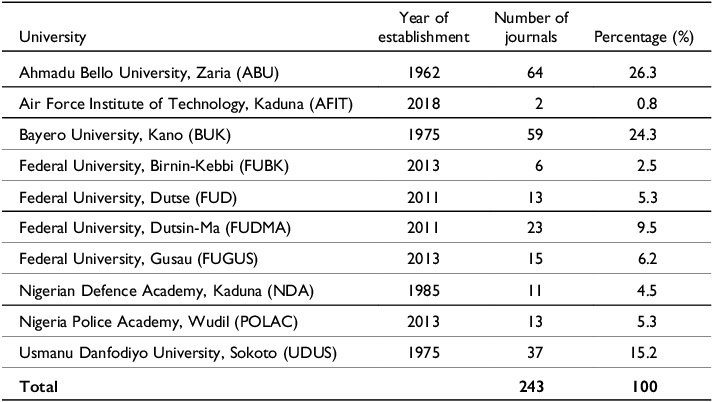
The procedure followed a hierarchy: where an official list of journals was available, it served as the primary source, and the other instruments were used for verification. Where lists were not available, reliance was placed on physical holdings and institutional websites to compile the journal data. It should be noted, however, that the study did not attempt to verify whether each journal was still active or had ceased publication; the primary objective was to compile a comprehensive list of titles associated with the selected universities, irrespective of their publication status. The study covered ten of the federal universities in North-Western Nigeria (see Table 1). Descriptive statistics, including frequency counts and percentages, were used to present the results.
Distribution of journals across the ten federal universities surveyed

During data collection, it was observed that most university libraries did not maintain a complete holding of the journals published by their parent institutions. On several instances journals were located in another university library but missing in the library of the university where the journal was published.
Results and findings
Table 1 shows that 243 journals were identified from the ten universities studied. Three universities (ABU, BUK and UDUS) account for more than half (66 per cent) of all titles. A mid-tier contributor is FUDMA with twenty-three (9.5 per cent) of the titles. The smallest contributors are FUGUS with fifteen (6.2 per cent) as well as POLAC and FUD with thirteen each (5.3 per cent), NDA with eleven (4.5 per cent), FUBK with six (2.5 per cent), and AFIT with two (0.8 per cent). In short, the journal landscape is skewed towards a few large, older universities (ABU, founded 1962; BUK and UDUS, founded 1975), while newer and specialized institutions contribute relatively few titles. This concentration is substantial: the top three universities produce 160 (66 per cent) of 243 titles, whereas the bottom three produce just nineteen (7.8 per cent).
The pattern likely reflects institutional age and disciplinary breadth: older, research-intensive universities maintain more publishing units (faculties, departments, centres), which historically float journal titles. Yet, given the lack of activity-status verification (see Methodology) we should be cautious about over-generalization.
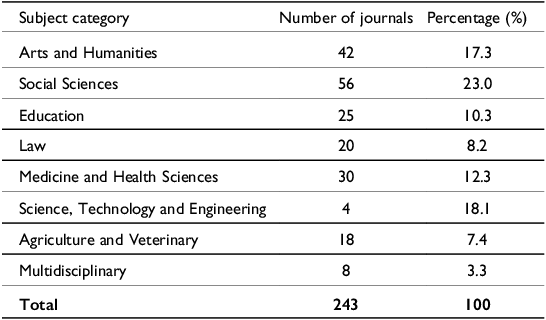
Table 2 presents the distribution of the journals identified by broad field. Social Sciences lead with 23 per cent, followed by Science, Technology and Engineering (STE) at 18.1 per cent, Arts and Humanities at 17.3 per cent, Medicine and Health Sciences at 12.3 per cent, Education at 10.3 per cent, Law at 8.2 per cent, after which numbers taper off to Agriculture and Veterinary at 7.4 per cent, and Multidisciplinary at 3.3 per cent. Taken together, social science and adjacent fields (Social Sciences + Arts and Humanities + Education + Law) constitute 58.8 per cent of all identified journals, whereas STEM and health fields (STE + Medicine) account for 30.5 per cent; Agriculture contributes 7.4 per cent, with relatively few multidisciplinary outlets (3.3 per cent). This profile is consistent with a humanities/social science heavy university publishing ecology, with sizeable but smaller footprints in STE and health. Hussein and Smart (Reference Hussein, Smart and Mlambo2007) observed a similar distribution among African journals in general.
Subject distribution of identified journals

The distribution also mirrors typical cost dynamics of journal production: social-science and humanities titles (often text-centric) proliferate more readily across faculties and departments, while STE/health titles – though present – may face higher editorial and workflow demands. Again, these are interpretive inferences; the study did not evaluate editorial capacity or funding structures.
The analysis further revealed that journals in the universities are largely organized around broad disciplines rather than specialized topics or issues. Most journals are hosted by departments, faculties or centres covering their disciplinary fields. Consequently, niche or highly focused journals are rare, and the number of multidisciplinary titles is comparatively slim. In addition, disciplinary journals are often duplicated across institutions, resulting in parallel titles in similar fields.
It is noteworthy that most university libraries do not maintain complete holdings of journals published by their parent institutions; in several instances, a title could be found in another university library but not in the publishing institution’s own library. This suggests weak preservation and bibliographic control practices on the part of the libraries; or weak promotion and distribution strategies on the part of the journal publishers. Ndumbaro and Wema (Reference Ndumbaro and Wema2016) observed that libraries in Africa are often missing issues of local journals and publishers also skip issues. In addition, Hussein and Smart (Reference Hussein, Smart and Mlambo2007) observed that publishers of African journals pay more attention to intellectual content development and less to logistical operations that ensure effective distribution and circulation. But Alemna et al. (Reference Alemna, Chifwepa and Rosenberg2001) argued that libraries are supposed to serve as repositories for local journals, especially when the journal has ceased publishing. If journals are not properly archived, long term accessibility of the journals’ content is in jeopardy.
Discussion
This study provides new insights into the size and distribution of university-based journals in federal universities of North-Western Nigeria. A total of 243 titles were identified across ten institutions, though the distribution was highly uneven. Three of the region’s oldest and largest universities – ABU, BUK, and UDUS – together accounted for more than half of the total journal titles. This confirms the observation in the literature that the age, size, and research culture of universities are strongly associated with their capacity to sustain journal publishing (Fyfe Reference Fyfe2021; Johnson et al. Reference Johnson, Watkinson and Mabe2018). By contrast, newly established universities such as the Federal University Birnin-Kebbi (FBUK, established 2013) and the Air Force Institute of Technology (AFIT, established 2018) contributed very few titles, reflecting their relatively recent development and narrower institutional scope.
In terms of subject affiliation, the study found that the majority of journals are concentrated in the social sciences, arts, humanities and education, which together accounted for about half of all identified titles. This dominance is consistent with earlier observations that social science and humanities journals proliferate more easily in developing countries, as they often rely on text-based scholarship that requires fewer financial and technological inputs compared with science, technology, and medicine (Ezema Reference Ezema2011; Gbaje Reference Gbaje2009). By contrast, while science, technology, engineering, and medicine journals were also significant, their share was smaller than expected relative to their global dominance (Mabe Reference Mabe2007; Tenopir and King Reference Tenopir, King, Cope and Phillips2014). This imbalance supports the argument that resource-intensive publishing in STEM fields remains constrained in Nigerian universities and further explains why many local researchers in these disciplines continue to face barriers to publishing in globally recognized journals (Bamgbose and Ibrahim Reference Bamgbose and Ibrahim2023).
The disciplinary orientation of the journals also suggests that publishing initiatives are driven by institutional structures (faculties and departments) rather than by editorial strategies to address topical niches. While this model promotes coverage of all academic disciplines, it also leads to duplication across universities and limited outlets for multidisciplinary or cross-cutting research. Mills and Branford (Reference Mills and Branford2021) reported a scene where a department hastily floated a journal to rival other departments as they assumed journal publishing would lift their reputation. This may further constrain visibility and competitiveness in global publishing, where niche and interdisciplinary titles are increasingly valued. It may be argued that critical development challenges of the region such as official embezzlement and corruption, politics of godfathers, the almajiri (traditional Qur’anic) system of education, the Fulani nomadic system, and the recently ravaging banditry and kidnapping syndrome may be left uncovered or unreported.
An important field observation was that most university libraries lack effective acquisition methods that ensure local journals are acquired and archived. This points to weaknesses in bibliographic control, preservation, and institutional archiving – gaps that align with earlier studies noting the fragility and low visibility of African journals (Onyancha Reference Onyancha2009; Esseh Reference Esseh2011; Roh et al. Reference Roh, Inefuku, Drabinski, Eve and Gray2020). Specifically, (Smart Reference Smart2007) observed that African published journals were not visible even at home. Without effective distribution and indexing strategies, locally published journals risk being invisible within their home universities, let alone within global scholarly communication systems. The problem is bigger than Ezema (Reference Ezema2010a) observed, as the journals were not very visible even within their parent institutions. This reinforces the argument that African publishing suffers from a specific dual challenge: limited indexing by global services and weak local systems of documentation (Hodge and Lacasse Reference Hodge and Lacasse2011; Smart Reference Smart2007).
This points to the need to substantively strengthen the rationale for institutional journal registries and/or repository infrastructures, as well as coordinated serials control across faculties, libraries, and editorial units. Methodologically, it reinforces the use of multiple sources (lists, websites, physical holdings) to reduce undercounting as adopted in the present study, while also suggesting that the 243 total may still be conservative given the presence of incomplete holdings and non-indexed, print-only titles. Moreover, the number of journal titles identified in this study suggests that previous studies underestimated the size of the Nigerian journal publishing sub-sector. Today, there are 307 universities in the country, comprising seventy-two federal universities, sixty-seven state universities and 168 private universities. In addition, there are several other journal publishers comprising learned and professional societies, non-university tertiary educational institutions, research institutes, government departments and agencies as well as a few commercial journal publishers.
The concentration of titles in a few older universities and the documented gaps in library holdings underscore the need for a national (or zonal) journal registry/index and stronger institutional bibliographic control, to improve discoverability, preservation, and policy planning.
Taken together, these findings highlight that the journal publishing landscape in North-Western Nigerian universities is expanding along traditional disciplinary lines. The proliferation of journal titles without corresponding bibliographic infrastructure and control undermines their visibility and impact. The absence of a comprehensive national journal index means Nigerian journals are often excluded from acquisition, selection, and citation systems. The present study demonstrates that this problem exists at the institutional level, where central libraries do not consistently archive their home journals. This suggests that solutions must go beyond increasing the number of journals: they must also address bibliographic control if Nigerian journals are to be more widely accessed and recognized.
Conclusion
This study provides an empirical account of journal publishing in federal universities of North-Western Nigeria, documenting 243 journal titles across ten institutions. The findings revealed a landscape dominated by a few older and larger universities. particularly ABU, BUK and UDUS, while newer institutions contribute comparatively few journals. Disciplinary distribution showed that the journals were floated along disciplinary lines with a heavy concentration in the social sciences, arts, and humanities, while STEM, health sciences, and agriculture have fewer titles. Importantly, the study also observed that most institutional libraries lacked complete holdings of journals published in the parent institution, underscoring persistent weaknesses in bibliographic control and archiving.
These findings reinforce the broader concerns raised in the literature regarding the visibility, indexing, and long-term sustainability of African scholarly publishing. Without adequate systems of indexing and archiving, many Nigerian journals will remain invisible both locally, and globally, despite their proliferation. This study has not attempted to determine whether the identified journals are still active or have ceased, which highlights the need for further work on the dynamics of sustainability and continuity in university-based publishing.
Recommendations
Based on the findings of this study, the following recommendations are proffered:
-
1. University libraries should establish systematic archiving policies to ensure comprehensive holdings of all journals published within parent institutions.
-
2. The National Library of Nigeria needs to coordinate a Nigerian journal index or register to improve discoverability, selection, and acquisition of the journals.
-
3. Universities in Nigeria should encourage the migration of print-only titles to online platforms and integrate them into institutional repositories to enhance global accessibility.
-
4. Universities in Nigeria should consider diversifying their publishing strategies by encouraging the creation of niche and interdisciplinary journals that address emerging issues and global research trends, rather than replicating traditional disciplinary structures.
-
5. Universities in Nigeria should provide special funding and editorial support toward STEM, health sciences, and agriculture journals to balance disciplinary representation.
Future studies should track the activity status of journals and investigate the factors that enable long-term survival, especially in resource-constrained context.
Appendix
Journal titles from ten federal universities covered in the study

Journals published at Air Force Institute of Technology Kaduna (AFIT)

Journals published at Bayero University Kano

Journals published at Federal University Birnin-Kebbi

Journals published at Federal University Dutse

Journals published at Federal University Dutsin-Ma

Journals published at Federal University Gusau

Journals published at Nigerian Defence Academy Kaduna

Journals published at Nigeria Police Academy Wudil

Journals published at Usmanu Danfodio Sokoto


 Open access

