


The Schizophrenia Commission has stated that: ‘shared decision-making on medication choices is essential to improving outcomes […]. This means practitioners discussing medication options fully with service users [and] providing them with quality information so that informed decisions can be made.’1
Shared decision-making in healthcare has been described as a process of supportive collaboration between patientsFootnote * and clinicians, drawing on evidence and the patient's preferences and values to reach a consensus about treatment or care.2,Reference Charles, Gafni and Whelan3 It is seen as falling midway on a continuum between paternalistic decision-making practices by clinicians and autonomous, informed decision-making by patients.Reference Duncan, Best and Hagen4–Reference Patel, Bakken and Ruland7 Although benefits have been reported for shared decision-making in physical healthcare,Reference Adams and Drake8 research and practice on this topic in relation to people with mental health problems are still at a formative stage.Reference Schauer, Everett, del Vecchio and Anderson9 Shared decision-making may be particularly relevant in psychosis, where increasing treatment-related empowerment and reducing use of coercion have been identified by patients as outcomes of intrinsic value.Reference Byrne, Davies and Morrison10–Reference Law and Morrison13 If clinical trials of this approach show it to be effective at improving these outcomes, then this would support existing recommendations that shared decision-making be widely implemented with this group.1,14
We conducted a systematic review and meta-analysis of randomised controlled trials (RCTs) of shared decision-making in psychosis, with the overall aim of finding out whether enhancing shared decision-making can improve treatment-related empowerment in this group, as judged by participants and indicated by objective measures. The effects on secondary outcomes – quality of patient–provider relationship (patient- or observer-rated) and decision-making abilities and knowledge (clinician-rated) – were also evaluated.
Method
The electronic databases Medline (from 1946), PsycINFO (from 1806), EMBASE (from 1980), CINAHL (from 1937) and the Cochrane Central Register of Controlled Trials (CENTRAL) were searched by two authors (D.S. and M.P.) in August 2013 and January 2015 respectively, along with the references of two previous reviews of shared decision-making interventions in mental healthcare.Reference Duncan, Best and Hagen4,Reference Hamann, Leucht and Kissling5 Titles, abstracts and keywords were searched using the terms ‘shared decision making’, ‘psychosis’ and ‘randomised controlled trial’, with related terms in each case. The full search strategy is given in online supplement DS1. The search was not limited by date or publication status, but only English-language studies were included. Initial screening and data extraction were carried out by D.S. and studies published between 2013 and 2015 were screened and extracted by M.P. Supervision of screening and extraction, and arbitration in the event of uncertainty, were provided by P.H.
Inclusion and exclusion criteria
Trials were included if they compared a psychosocial intervention designed to enhance shared decision-making in the planning of treatment for psychosis with usual care or a non-specific control treatment. Shared decision-making was defined as a process of supportive collaboration between patients and clinicians, drawing on evidence and the patient's preferences and values to reach a consensus about treatment or care.2,Reference Charles, Gafni and Whelan3 Interventions to enhance it could be delivered either individually or in a group format, and could involve either current or future treatment decisions (e.g. joint crisis planning), but they had to share a focus on promoting shared decision-making as defined above and they had to involve direct contact with patients or clinicians. Thus, studies of advance statements or care planning not involving promotion of shared decision-making were excluded, as were studies providing interventions to family members or carers. We included trials where assessing the effects of promoting shared decision-making was either a primary or a secondary aim of the study.
Participants
We included studies in which at least half of the participants had a diagnosis of a schizophrenia spectrum disorder. Studies where more than half of participants had a diagnosis of bipolar disorder or learning disability, or where psychosis was predominantly substance-induced or organic in origin, were excluded. We did not include participants at risk of developing psychosis, and we did not exclude participants on the basis of age or stage of established illness.
Outcomes
Two primary outcomes were chosen: first, subjective empowerment, and second, reduced objective coercion. For the first outcome a scoping review of the literature suggested that few studies measured subjective empowerment directly; however, several measured aspects of empowerment or closely related concepts. In order to include as many studies as possible a conceptual hierarchy was developed to specify in advance the order of preference for the data that would be extracted and analysed, based on its closeness to the concept of empowerment. The hierarchy was structured as follows: self-reported subjective empowerment>treatment decision-making self-efficacy>health-related locus of control>patient-perceived involvement in treatment decision-making>patient-centredness of patient–provider interaction>reduced perceived coercion. The second primary outcome was reduced objective coercion as indicated by fewer admissions under mental health legislation: the Mental Health Act 1983 for studies in England & Wales or corresponding legislation within the country concerned for studies that had taken place elsewhere. We originally planned to analyse days spent in hospital under compulsory care for this outcome, but skewed or unavailable data meant we decided to analyse admission rates instead. Secondary outcomes were quality of patient–provider relationship (patient- or observer-rated) and decision-making abilities and knowledge (clinician-rated). For all outcomes we included data derived from both validated and non-validated scales, although use of the latter was considered when assessing the quality of the individual outcome.
Data extraction
Summary data (means and standard deviations) were extracted where possible from relevant studies using a spreadsheet. Information on study characteristics was also collated. Authors were contacted where information was missing. When means and standard deviations were not reported and the authors were unable to supply this information, other parameters such as F values, regression coefficients, P values and sample size were used to estimate the standardised mean difference (SMD) using equations specified in the Cochrane Handbook.Reference Higgins and Green15 In the absence of available continuous data, proportions were converted to SMDs using the Campbell Collaboration's Practical Meta-Analysis Effect Size Calculator (campbellcollaboration.org/resources/effect_size_input.php). Numbers randomised were used where appropriate methods for imputing missing data were reported, but limitation to use of n reported for the analysis was expected where this was not the case. Missing data were assessed as part of the risk of bias assessment, but no test of robustness of estimates to changing assumptions around missing data was planned or performed. For the binary outcome of compulsory admission, we assumed those randomised but unaccounted for had an unchanged outcome from randomisation.
Meta-analytic calculations
Continuous data were extracted and combined using MetaXL version 2.0 (epigear.com) to derive the SMD and 95% confidence intervals, with Hedges' g employed to adjust for small sample sizes. Statistical significance was inferred with P values of <0.05, using two-tailed hypotheses. Analyses employed a random effects model although a fixed effect analysis was also performed where the I 2 statistic indicated less than moderate heterogeneity (defined a priori as 40%).Reference Higgins and Green15 Cohen's proposed criteria for interpretation of effect sizes (small 0.2, moderate 0.5, large 0.8) were used in the absence of more specific criteria for judging clinical significance of SMDs.Reference Cohen16 For the binary outcome of objective coercion (compulsory admission) we computed the pooled relative risk of the unfavourable outcome, the risk difference and number needed to treat, each with 95% confidence intervals.
Sensitivity analyses
Sensitivity analyses were used to assess the effect of excluding studies with more than 25% attrition.
Registration of review protocol
The review protocol was registered in advance with the International Prospective Register of Systematic Reviews (PROSPERO) number CRD42013006161.Reference Stovell, Morrison and Hutton17
Risk of bias and study quality
Risk of bias was assessed for each study using the Cochrane Collaboration risk of bias tool.Reference Higgins, Altman, Gotzsche, Juni, Moher and Oxman18 Assessment of outcome quality was performed using the GRADE approach.Reference Guyatt, Oxman, Vist, Kunz, Falck-Ytter and Alonso-Coello19 Risk of performance bias was not used as a criterion for downgrading the quality of the evidence, since it is essentially unavoidable in trials of psychosocial interventions, and to downgrade on this basis was judged to be overly conservative. Assessment of risk of publication bias using funnel plots was planned if there were at least ten studies.Reference Ioannidis and Trikalinos20 GRADE ratings were used to determine overall confidence in the reliability of individual outcomes. Full details of the assessment methods are provided in online supplements DS2 and DS3.
Results
The titles and abstracts of 4676 papers were screened for eligibility (Fig. 1). Of these, full-text reports were sought for 38. Three studies were not included because they were ongoing or could not be traced. A further 25 studies were excluded because they did not report outcomes we could use (k = 5), did not evaluate a treatment-related shared decision-making intervention (k = 11), were not RCTs (k = 6), had an attrition rate of >50% (k = 1), had less than 50% participants with non-affective psychosis (k = 1) or were not published in English (k = 1). A total of 11 RCTs were therefore included. Of these, four evaluated interventions designed to support shared decision-making in relation to future treatment (joint crisis planning or facilitated advance directives).Reference Elbogen, Swanson, Appelbaum, Swartz, Ferron and Van Dorn21–Reference Ruchlewska, Wierdsma, Kamperman, van der Gaag, Smulders and Roosenschoon25 The remaining seven RCTs examined interventions designed to support shared decision-making in relation to current treatment. Of these, four examined the effects of paper-based or web-based decision or communication aids;Reference Hamann, Langer, Winkler, Busch, Cohen and Leucht26–Reference Woltmann, Wilkniss, Teachout, McHugo and Drake29 one evaluated a group intervention;Reference Hamann, Mendel, Meier, Asani, Pausch and Leucht30 another evaluated the effects of training clinicians in a shared decision-making approach to medicines management;Reference Harris, Lovell, Day and Roberts31 and another evaluated the effects of patient-focused case management where treatment-related shared decision-making was emphasised.Reference O'Donnell, Parker, Propberts, Matthews, Fisher and Johnson32 Details of interventions delivered and baseline demography of the participants are given in online Table DS1; reasons for exclusions are summarised in online Tables DS2 and DS3.
Study selection process.
RCT, randomised controlled trial; SDM, shared decision-making.

Bias and quality assessment
Table 1 provides a summary of the results for each outcome and the GRADE ratings of outcome quality. The full risk of bias and quality ratings are provided in online Tables DS4 and DS5. Funding of the included studies is summarised in online Table DS6. Most (k = 8) studies had at least one judgement of unclear risk of selection bias.Reference Elbogen, Swanson, Appelbaum, Swartz, Ferron and Van Dorn21,Reference Swanson, Swartz, Elbogen, van Dorn, Ferron and Wagner22,Reference Ruchlewska, Wierdsma, Kamperman, van der Gaag, Smulders and Roosenschoon25,Reference Hamann, Langer, Winkler, Busch, Cohen and Leucht26,Reference Steinwachs, Roter, Skinner, Lehman, Fahey and Cullen28–Reference O'Donnell, Parker, Propberts, Matthews, Fisher and Johnson32 Risk of performance bias was high across all studies owing to the nature of the interventions, which precluded masking (blinding). Insufficient information in reporting also led to unclear detection bias in seven studies,Reference Elbogen, Swanson, Appelbaum, Swartz, Ferron and Van Dorn21,Reference Swanson, Swartz, Elbogen, van Dorn, Ferron and Wagner22,Reference Ruchlewska, Wierdsma, Kamperman, van der Gaag, Smulders and Roosenschoon25–Reference Van Os, Altamura, Bobes, Gerlach, Hellewell and Kasper27,Reference Woltmann, Wilkniss, Teachout, McHugo and Drake29,Reference Hamann, Mendel, Meier, Asani, Pausch and Leucht30,Reference O'Donnell, Parker, Propberts, Matthews, Fisher and Johnson32 and one RCT stated no attempt to mask assessors was made.Reference Harris, Lovell, Day and Roberts31 Risk of attrition bias was high or unclear on some post-intervention measures in just over half of the studies (k = 6).Reference Thornicroft, Farrelly, Szmukler, Birchwood, Waheed and Flach24–Reference Van Os, Altamura, Bobes, Gerlach, Hellewell and Kasper27,Reference Harris, Lovell, Day and Roberts31,Reference O'Donnell, Parker, Propberts, Matthews, Fisher and Johnson32 Risk of selective reporting bias was largely unclear, although there was an indication that three RCTs did not report all their outcomes.Reference Elbogen, Swanson, Appelbaum, Swartz, Ferron and Van Dorn21,Reference Ruchlewska, Wierdsma, Kamperman, van der Gaag, Smulders and Roosenschoon25,Reference O'Donnell, Parker, Propberts, Matthews, Fisher and Johnson32 There was unclear risk of other sources of bias in four trials, namely risk of recruitment bias due to cluster randomised design,Reference Hamann, Langer, Winkler, Busch, Cohen and Leucht26,Reference Woltmann, Wilkniss, Teachout, McHugo and Drake29,Reference Harris, Lovell, Day and Roberts31 and risk of cross-contamination due to in-patient research setting.Reference Hamann, Mendel, Meier, Asani, Pausch and Leucht30
Summary of results

| Outcome (number of trials) | Participants n | Effect size (95% CI) | Heterogeneity and P value | Quality rating |
|---|---|---|---|---|
| Indices of subjective empowerment (k=6) | 843 (I 423, C 420) | g = 0.30 (0.09, 0.51) | I 2 = 35%, P = 0.17 | Low |
| Risk of compulsory treatment (k = 3) | 872 (I 435, C 437) | RR = 0.59 (0.35, 1.02) RD = −0.10 (−0.19, 0) NNT = 10 (5, ∞) | I 2 = 61%, P = 0.08 | Low |
| Relationship with clinician (k=8) | 1261 (I 577, C 684) | g = 0.14 (−0.05, 0.34) | I 2 = 60%, P = 0.02 | Low |
| Relationship with clinician, excluding Hamann et al (2011)Reference Harris, Lovell, Day and Roberts31 (k = 7) | 1200 (I 545, C 655) | g = 0.21 (0.07, 0.35) | I 2 = 20%, P = 0.27 | Moderate |
| Clinician-rated decision-making abilities and knowledge (k=3) | 520 (I 258, C 262) | g = 0.27 (−0.24, 0.79) | I 2 = 83%, P = 0.003 | Very low |
C, control; I, intervention; NNT, number needed to treat; RD, risk difference; RR, relative risk.
Primary outcomes
Treatment-related empowerment
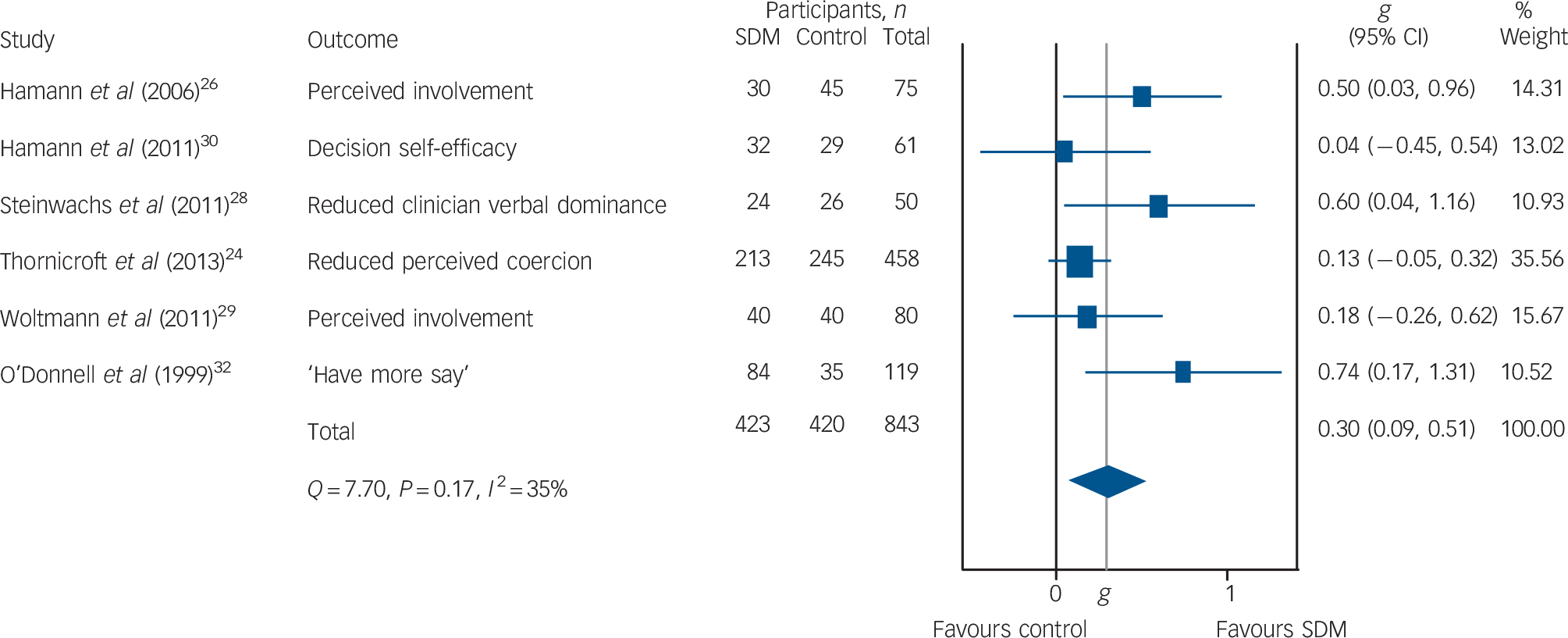
A small effect of shared decision-making interventions on indices of subjective empowerment (Fig. 2) was observed (k = 6, g = 0.30, 95% CI 0.09 to 0.51; low-quality evidence). Six trials (n = 843) provided data on this outcome.Reference Thornicroft, Farrelly, Szmukler, Birchwood, Waheed and Flach24,Reference Hamann, Langer, Winkler, Busch, Cohen and Leucht26,Reference Steinwachs, Roter, Skinner, Lehman, Fahey and Cullen28–Reference Hamann, Mendel, Meier, Asani, Pausch and Leucht30 The quality of the evidence was downgraded owing to its indirectness, with no study measuring subjective empowerment specifically, and its imprecision, given that the 95% confidence interval included both trivial and moderate effects. There was, however, no evidence of undue heterogeneity (I 2 = 35%). Two small studies provided follow-up data. One did not find a significant effect at hospital discharge (g = 0.16, 95% CI −0.27 to 0.60), but data were missing for more than a quarter of participants.Reference Hamann, Langer, Winkler, Busch, Cohen and Leucht26 For the other, ratings on an idiosyncratic measure of patient-perceived involvement were reported at 6-month follow-up, and suggested a large effect was maintained (g = 1.09, 95% CI 0.49 to 1.69).Reference Hamann, Mendel, Meier, Asani, Pausch and Leucht30
Effect of shared decision-making (SDM) on indices of subjective empowerment.

Compulsory treatment
Data from three studies (n = 872) suggested a trend towards shared decision-making for future treatment (crisis planning) reducing the likelihood of future compulsory in-patient treatment over the subsequent 15–18 months (Fig. 3), but the estimate was imprecise and inconsistent and did not exclude the possibility of no effect (RR = 0.59, 95% CI 0.35 to 1.02; risk difference −0.10, 95% CI −0.19 to 0; NNT = 10, 95% CI 5 to ∞).Reference Henderson, Flood, Leese, Thornicroft, Sutherby and Szmukler23–Reference Ruchlewska, Wierdsma, Kamperman, van der Gaag, Smulders and Roosenschoon25
Effect of shared decision-making (SDM) on risk of compulsory treatment.
MHA, Mental Health Act; RR, relative risk.

Sensitivity analysis
Excluding the two studies with more than 25% missing data from the empowerment analysis resulted in a smaller effect size (k = 4, g = 0.17, 95% CI 0.01 to 0.32),Reference Hamann, Langer, Winkler, Busch, Cohen and Leucht26,Reference O'Donnell, Parker, Propberts, Matthews, Fisher and Johnson32 as did using a fixed effect analysis instead of random effects (k = 8, g = 0.23, 95% CI 0.09 to 0.38).
Secondary outcomes
Relationship with clinician
Overall, no significant effect of shared decision-making interventions on patient or observer-rated relationship with clinician was found (k = 8, g = 0.14, 95% CI −0.05 to 0.34); see online Fig. DS1. Eight studies (n = 1200) contributed to this outcome.Reference Swanson, Swartz, Elbogen, van Dorn, Ferron and Wagner22,Reference Thornicroft, Farrelly, Szmukler, Birchwood, Waheed and Flach24,Reference Ruchlewska, Wierdsma, Kamperman, van der Gaag, Smulders and Roosenschoon25,Reference Van Os, Altamura, Bobes, Gerlach, Hellewell and Kasper27,Reference Steinwachs, Roter, Skinner, Lehman, Fahey and Cullen28,Reference Hamann, Mendel, Meier, Asani, Pausch and Leucht30–Reference O'Donnell, Parker, Propberts, Matthews, Fisher and Johnson32 High heterogeneity (I 2 = 60%) together with wide 95% confidence intervals (including both marginal negative effects and small positive effects) meant we rated the evidence as low quality. A moderate negative effect in the study by Hamann et al (g = −0.62, 95% CI −1.13 to −0.11) contributed particularly to the high heterogeneity.Reference Harris, Lovell, Day and Roberts31 This study of a group in-patient intervention differed from the others in measuring ‘trust in physician’ rather than ‘alliance’ or ‘quality of communication’. Omitting these data suggested a small, statistically significant effect (g = 0.21, 95% CI 0.07 to 0.35; moderate-quality evidence) favouring shared decision-making, with a reduction in heterogeneity to 20%.
Clinician-rated decision-making abilities
Pooled data from three studies (n = 520) did not support the hypothesis that shared decision-making interventions can enhance participant decision-making ability as rated by clinicians (k = 3, g = 0.27, 95% CI −0.24 to 0.79, very low-quality evidence); see online Fig. DS2.Reference Elbogen, Swanson, Appelbaum, Swartz, Ferron and Van Dorn21,Reference Hamann, Langer, Winkler, Busch, Cohen and Leucht26,Reference Hamann, Mendel, Meier, Asani, Pausch and Leucht30 However, heterogeneity was high (I 2 = 83%), as was imprecision, with a 95% confidence interval including both small negative and large positive estimates, and only one of the studies used a validated measure of decisional capacity.Reference Elbogen, Swanson, Appelbaum, Swartz, Ferron and Van Dorn21
Sensitivity analyses
Excluding four studies with more than 25% missing data from the analysis of patient–provider relationship reduced the overall effect size to 0.07 (95% CI −0.29 to 0.42; k = 4) but increased heterogeneity (I 2 = 73%).Reference Thornicroft, Farrelly, Szmukler, Birchwood, Waheed and Flach24,Reference Ruchlewska, Wierdsma, Kamperman, van der Gaag, Smulders and Roosenschoon25,Reference Harris, Lovell, Day and Roberts31,Reference O'Donnell, Parker, Propberts, Matthews, Fisher and Johnson32 Also removing the Hamann study from this analysis increased the pooled effect size to 0.25 (95% CI 0.08 to 0.41; k = 3) and reduced heterogeneity to 0%.Reference Hamann, Mendel, Meier, Asani, Pausch and Leucht30 Excluding one study with more than 25% missing data from the analysis of decision-making ability reduced the effect size to 0.02 (95% CI −0.60 to 0.65) but did not reduce heterogeneity (I 2 = 83%).Reference Hamann, Langer, Winkler, Busch, Cohen and Leucht26
Discussion
Collaborative decision-making around psychiatric treatment, with greater consideration of patient preferences and values, may help people receiving treatment for psychosis experience greater empowerment and reduced coercion in relation to their care. We examined whether and to what extent this hypothesis is supported by findings from clinical trials. Although we did not find any study that measured treatment-related empowerment directly, our analysis of data from six RCTs (n = 843) found that interventions that shared a focus on increasing shared decision-making were associated with a small overall increase in indices of empowerment, including patients' subjective sense of involvement in treatment, self-efficacy and autonomy. There was also trend-level evidence from three RCTs (n = 872) that applying a shared decision-making approach to decisions about future treatment may reduce by approximately 40% the risk of patients experiencing compulsory care over a 15–18 month period, with an NNTof approximately 10. Both primary outcomes were heavily influenced by the null results of a large multicentre study;Reference Thornicroft, Farrelly, Szmukler, Birchwood, Waheed and Flach24 however, the ability of this trial to detect benefits attributable to shared decision-making may have been compromised by what appeared to be poor implementation of shared decision-making by participating clinicians.Reference Thornicroft, Farrelly, Szmukler, Birchwood, Waheed and Flach24,Reference Farrelly, Lester, Rose, Birchwood, Marshall and Waheed33
What is the clinical significance of a standardised mean difference of 0.3? If we accept the results of the 2014 National Audit of Schizophrenia that 59% of people with a diagnosis of schizophrenia using mental health services in the UK do not feel involved in treatment decision-making,34 then the observed effect size of 0.3 would translate to an NNT of 9 (95% CI 6–26).Reference Furukawa and Leucht35 That is, shared decision-making would need to be implemented with approximately nine people for one to experience greater empowerment. Given that up to half of clinicians do not regularly practice shared decision-making when treating people with psychosis,34,Reference Hamann, Mendel, Cohen, Heres, Ziegler and Buhner36 this is an important finding.
We did not find clear evidence that shared decision-making can improve treatment-related decision-making ability of patients, but the data were heterogeneous and imprecise. This is unfortunate, because impaired treatment decisional ability has been identified by clinicians as a barrier to implementation of shared decision-making in psychosis, and it may also increase the risk of involuntary treatment. We tried to examine the hypothesis that shared decision-making might actually help increase decisional ability, but the very low quality of our findings prevented us from doing so. More rigorous studies investigating this question as a primary outcome would be welcome.
Eight trials provided usable data on the effect of shared decision-making on the patient–provider relationship, but the pooled results were also heterogeneous. A significant negative finding from Hamann et al seemed to account for this,Reference Hamann, Mendel, Meier, Asani, Pausch and Leucht30 and excluding it resulted in an overall small positive finding for the remaining trials. Hamann et al used the Trust in Physician scale,Reference Thom, Ribisl, Stewart and Luke37 which conceptualises trust as agreement with statements such as, ‘If my doctor tells me something is so, then it must be true’. It may be that shared decision-making can cause small improvements in working alliance and communication, while also stimulating greater questioning of clinician authority.
Study limitations
Our findings are limited by the absence of studies using direct measures of empowerment, and we were forced to consider more indirect indices of empowerment instead. We think the conceptual overlap of the different data we extracted is sufficient to ensure the pooled estimate is meaningful and interpretable. Nonetheless, our findings should be interpreted with caution and, if we wish to understand how to reduce disempowerment in schizophrenia, future RCTs need to use valid and reliable measures of this construct. Shared decision-making is often assessed by its ability to improve treatment satisfaction, but clearly this is not the same thing as empowerment, since empowerment might involve feeling able to express dissatisfaction.
In interpreting our findings it should also be noted that not everyone diagnosed with schizophrenia wishes to be involved in treatment decisions.Reference Beitinger, Kissling and Hamann6,Reference Hamann, Cohen, Leucht, Busch and Kissling38 People who believe their decision-making ability is not good enough, or lack clear goals, may prefer to adopt a more passive role in their meetings with prescribers. We would argue that shared decision-making should be implemented in a thoughtful way, and that clinical judgement and case formulation will always be required when deciding what approach to take with particular individuals. Coercing unwilling patients to engage with treatment decision-making may be as much a threat to their autonomy as excluding them without consultation.
The interventions we included in our meta-analysis were varied. However, they all shared a focus on increasing the use of shared decision-making, and we assumed they were successful in this regard. Our interest lay not in finding out which interventions were best placed to increase shared decision-making, but rather in finding out whether doing so led to improvements in empowerment. Our assumption that interventions were successful in increasing shared decision-making is challenged by the study reported by Thornicroft et al,Reference Thornicroft, Farrelly, Szmukler, Birchwood, Waheed and Flach24 where the particular context may have moderated uptake of shared decision-making by clinicians.Reference Farrelly, Lester, Rose, Birchwood, Marshall and Waheed33 It could also be argued that our definition of shared decision-making was overly broad, and that pooling results from trials of shared decision-making and trials of joint crisis planning is misleading, since these interventions might have different aims. However, we argue the only real distinction between these interventions is the time frame of the decision to be made. Supporting this, in the most recent report of the largest trial of joint crisis planning to date, that by Thornicroft et al,Reference Thornicroft, Farrelly, Szmukler, Birchwood, Waheed and Flach24 the authors have also described their approach as shared decision-making about future treatment.Reference Farrelly, Lester, Rose, Birchwood, Marshall and Waheed33
There was some evidence that excluding trials missing more than a quarter of outcome data led to smaller estimates of benefit. We did not test whether the overall results were robust to making different assumptions about the outcomes of those who left early, but the overall rates of missing data were generally low and better than for other interventions in psychosis.Reference Hutton, Morrison, Yung, Taylor, French and Dunn39,Reference Hutton, Taylor, Mulligan, Tully and Moncrieff40 The limited number of studies for the primary outcome (six) also contributed to increased imprecision in our estimate. Although this is not uncommon for healthcare interventions – for example, the median number of trials in Cochrane reviews across medicine is six – more trials are required to reduce uncertainty regarding the true effect.Reference Mallett and Clarke41
Implications of the study
Finally, it may be argued that empowerment has value only in so far as it facilitates other established outcomes, such as symptom reduction, lower cost or improved social outcomes. However, there is considerable evidence that people using mental health services regard greater treatment-related empowerment not just as a means to some further end, but also as having value in its own right.Reference Law and Morrison13,Reference Farrelly, Brown, Rose, Doherty, Henderson and Birchwood42,Reference Byrne and Morrison43 Indeed, some 80% of people with experience of psychosis believe that knowing a great deal about treatment options is an essential part of what it means to experience recovery.Reference Law and Morrison13
Acknowledgements
We would like to thank all the original authors who helped answer our various queries, and we are also grateful to anonymous reviewers for their useful comments and suggestions.






eLetters
No eLetters have been published for this article.