




No CrossRef data available.
Article contents
A Force for Law and Order
Published online by Cambridge University Press: 07 October 2016
Extract
Much of police psychology over the past 50 years or so has been clinically focused. The role and function of the industrial–organizational (I-O) psychologist within the context of law enforcement was highlighted by Lefkowitz (1977), and in the years since, the contributions of I-O psychology applied to law enforcement issues have become increasingly valued. It is, therefore, appreciated that Ruggs et al. (2016) offer suggestions for how I-O psychologists might get involved in addressing some of the current hot spots in police work.
Information
- Type
- Commentaries
- Information
- Copyright
- Copyright © Society for Industrial and Organizational Psychology 2016
References
Burrows, S., & Stewart, M. (2015). Shooting a fleeing man does not constitute the use of lethal force! [Blog post]. Retrieved from https://darkmoonseries.wordpress.com/2015/04/08/shooting-a-fleeing-man-does-not-constitute-the-use-of-lethal-force/
Google Scholar
Lefkowitz, J. (1977). Industrial–organizational psychology and the police. American Psychologist, 32
(5), 346–364.CrossRefGoogle Scholar
Ruggs, E. N., Hebl, M. R., Rabelo, V. C., Weaver, K. B., Kovacs, J., & Kemp, A. S. (2016). Baltimore is burning: Can I-O psychologists help extinguish the flames? Industrial and Organizational Psychology: Perspectives on Science and Practice, 9
(3), 525–547.CrossRefGoogle Scholar
Scrivner, E. M. (1994). Controlling police use of excessive force: The role of the police psychologist. Washington, DC: National Institute of Justice.Google Scholar
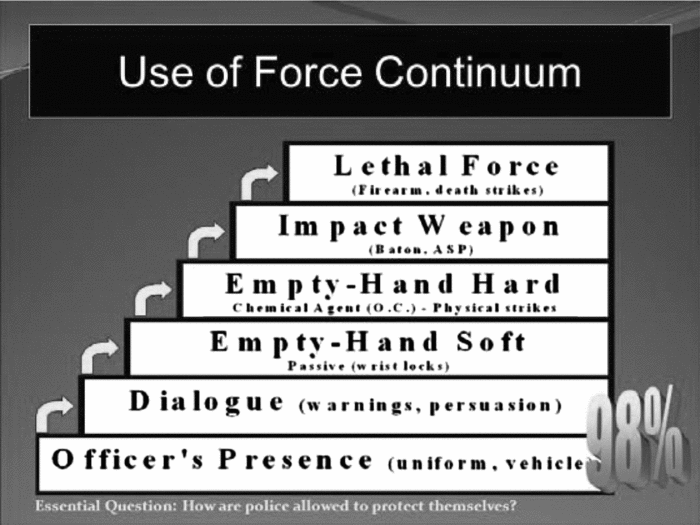
Figure 1. O.C. = oleoresin capsicum. From “Shooting a Fleeing Man Does Not Constitute the Use of Lethal Force!” [Blog post], by S. Burrows and M. Stewart, 2015, Dark Moon Series, https://darkmoonseries.wordpress.com/2015/04/08/shooting-a-fleeing-man-does-not-constitute-the-use-of-lethal-force/
 You have
Access
You have
Access
Much of police psychology over the past 50 years or so has been clinically focused. The role and function of the industrial–organizational (I-O) psychologist within the context of law enforcement was highlighted by Lefkowitz (Reference Lefkowitz1977), and in the years since, the contributions of I-O psychology applied to law enforcement issues have become increasingly valued. It is, therefore, appreciated that Ruggs et al. (Reference Ruggs, Hebl, Rabelo, Weaver, Kovacs and Kemp2016) offer suggestions for how I-O psychologists might get involved in addressing some of the current hot spots in police work.
Two observations are made about their article. The first has to do with the use of the term “force.” Force in some form or another (excessive use of force, excessive force, even law enforcement) was used 66 times in the article. By the nature of the occupation, force is the operating concept. If people obeyed laws, enforcement wouldn't be at issue. But, more important is the concern that those who do not work in law enforcement misconstrue the use of force as being excessive, even when justified. Officers generally adhere to a use of force matrix or continuum (see Figure 1), which guides them in the appropriate and lawful use of force.
O.C. = oleoresin capsicum. From “Shooting a Fleeing Man Does Not Constitute the Use of Lethal Force!” [Blog post], by S. Burrows and M. Stewart, Reference Burrows and Stewart2015, Dark Moon Series, https://darkmoonseries.wordpress.com/2015/04/08/shooting-a-fleeing-man-does-not-constitute-the-use-of-lethal-force/
In the majority of cases, it is suspect resistance or noncompliance with officer commands that escalates the type and amount of force used to gain compliance. Why is this an important point to make? Use of force (in varying degrees) is the nature of law enforcement. To condemn such use of force and label it as excessive, even when lethal, is to miss the point that context factors must be fully considered. Officers are justified (legally authorized) to use deadly force when their lives are in danger or they fear for the safety and lives of others. That is a personal judgment call that cannot be made by bystanders, the media, or Monday morning quarterbacks. Decisions must be made in a split second. As much as we might want to curtail the unauthorized use of force (which is what excessive force really implies), it is unfair to place all of the burden on one side of the equation.
Here is my second point. All the things that I-O psychologists can and might do for police officers and agencies to address racial bias may do little to reduce violence on the streets unless and until citizens become more understanding and accepting of the job of the police officer. Race and bias are not the only operating variables. Police respond to calls for service and use the necessary force to gain compliance and effect an arrest, if required to do so. All the screening, training, coaching, and counseling in the world will not necessarily alter the ways in which police are met with resistance on the streets. This is not in any way to diminish the examples cited by Ruggs et al. It is just to call attention to the fact that something needs to be done to educate the public about the proper use of force and what determines such. Scrivner (Reference Scrivner1994) addressed some of the actions police psychologists can take to control use of force. Her ideas should be taken into account by I-O psychologists working for police and interacting with the community. I applaud Ruggs et al. for calling for the involvement of I-O psychologists in law enforcement. They offer many good suggestions for I-O psychology applications and research.